


Abstract
Improvements in the emergency response efficiency and management level of power construction sites are conducive to reducing the construction safety risk of power infrastructure projects and then achieving the sustainability of construction site safety. Therefore, this paper proposes an emergency decision-making method for electric power personal accidents, which applies ontology and case-based reasoning to electric power emergency decision making. Firstly, ontology technology is used to structurally represent power accident case knowledge and clarify concepts and their relationships. Then, a power accident knowledge ontology hierarchy is designed, and a powerful personal accident case library is established. Secondly, by calculating cases’ conceptual similarity, attribute similarity, and structural similarity, a global power accident case similarity calculation method is proposed, and case matching is performed based on the calculation results to achieve case knowledge retrieval and reuse. Finally, the results of the example-based study show that the method effectively achieves the accurate retrieval of electric power accident cases, improves the efficiency of the emergency decision response to electric power construction site accidents, and then provides support for emergency decision making for electric power construction site accidents.
1. Introduction
As the most important basic energy industry in the development of the national economy, the electric power industry is a key and leading industry in the national economic development strategy. The stability of the power industry has a profound impact on the effectiveness and sustainability of economic and social development. For example, Shin et al. [1] believed that the operation mode of the power grid combined with distributed power generation could effectively improve energy efficiency and deal with environmental problems through research on the power demand of steel plants. Alabbasi et al. [2] combined the sustainable indicators of renewable energy power production in Bahrain with reality when considering the selection of sustainable indicators and provided effective advice for relevant government decisions. Hou et al. [3] developed a multi-objective congestion management method based on probability to improve the reliability and economic sustainability of power grid system operation.
Along with the rapid development of China’s social economy and infrastructure construction, the electricity demand is rising day by day, and the scale of electricity production and construction is expanding. However, the heavy operational tasks in the process of power production and construction, the complexity of the construction site, and the variety of safety management scenarios have led to difficulties in safety management and the frequent occurrence of various types of power safety accidents. According to the statistical data of the National Energy Administration, there were 389 electric power accidents and electric power safety incidents in the country from 2012 to 2020, of which electric power personal accidents accounted for about 78%. The high proportion of electric power personal accidents indicates the urgent need to further improve the level of electric power safety management and take timely, effective control measures to reduce the impact and harm of electric power safety accidents on people’s lives, health, and economic development. Furthermore, the sustainable construction safety of the power industry can be promoted, and the sustainable stability of the economy and society can be realized.
However, the accident itself is sudden in nature and is characterized by the randomness of its evolution process, which brings greater difficulties to on-site emergency decision making. For the power industry, accident emergency responses mainly rely on manual experience and emergency plans [4], which have strong subjectivity and poor operability. In addition, in the process of establishing an emergency system for electric power accidents, there are still problems, such as imperfect emergency mechanisms and imperfect emergency systems [5]. Thus, there is an urgent need for a more scientific and efficient method to provide support for the emergency management of power safety. Unlike research on safety risks and sustainability related to the technical parameters of power grids [6,7,8], this paper focuses on a large number of historical cases and empirical knowledge accumulated on emergency disposal in the field of power safety, analyzes and summarizes various accidents that occurred in the past, and draws and summarizes lessons from them to develop a more efficient early-warning mechanism. In turn, the safety management level of electric power construction sites and the response efficiency of on-site emergency decision making can be improved.
To enhance the emergency risk management of safety incidents, scholars have conducted a lot of research work around case-based reasoning (CBR), ontology techniques, and other methods. CBR, as one of the approaches to knowledge reuse, borrows the experience and solutions from similar cases to solve new problems; it includes four stages: retrieve, reuse, revise, and retain [9]. In recent years, domestic and foreign scholars have widely applied CBR methods to the field of emergency decision making for emergencies and have achieved some promising results. For example, Wang et al. [10] constructed a structured representation model for subway engineering safety accident cases and proposed case retrieval strategies and similarity calculation methods to provide support for accident emergency decision making. Aiming at the problem of incomplete emergency information and missing attribute data on case features, structural similarity was introduced to address the problem of missing attributes. Zhang [11] implemented CBR for urban fire emergencies, and Li et al. [12] constructed a risk emergency management model for the recycling and construction of old industrial buildings. In addition, some scholars have also divided the emergency occurrence process into several scenarios and implemented CBR by retrieving similar scenarios. Xia et al. [13] analyzed sudden disaster accident scenarios from the temporal and spatial dimensions, proposed the concept of scenario elements, and calculated the similarity based on scenario elements. The effectiveness and feasibility of this method were verified by accident examples. Ma and Wang [14] first analyzed the emergency case structure of environmental emergencies, constructed an emergency scenario ontology model, optimized scenario-matching algorithms, and implemented scenario-based emergency decision making. Then, Men and Liu [4] applied this method in the field of electric power and proposed a method for emergency decision making in electric power accidents. Moreover, Yu et al. [15] took grid operation accidents as the research object, sorted out the case characteristics and attributes, and designed the structure of an operation accident case database.
However, CBR reuses knowledge only at the case level, ignoring the macro-structural representation of the domain consensus. Therefore, its output often does not conform to the domain consensus. Ontologies are explicit formal specification descriptions of shared conceptual models, and the use of ontologies can effectively compensate for the deficiencies of CBR techniques. Ontology originates from the field of philosophy and is a specification for modeling concepts [16]. It provides a clear, formal definition of the relationships between concepts, ensuring that these concepts and their relationships have a clear and unique meaning within the shared scope. With the gradual informatization of the field of construction engineering, ontology is also increasingly widely used in the safety risk management of construction sites. For instance, Wang and Boukamp [17] constructed a risk ontology for construction activities and steps and designed a set of ontology rules for the safety inspection of construction activities. Ding et al. [18] combined BIM, ontology, and semantic web technologies to develop a prototype system for construction risk knowledge management. He et al. [19] built an ontology knowledge base for subway foundation pit construction based on BIM and ontology technology, which is used for hazard source management in subway construction projects. Consequently, combined with the aforementioned research, the introduction of ontology concepts promotes the integration of semantic content into traditional information retrieval mechanisms, improving the efficiency and accuracy of knowledge retrieval.
Furthermore, to improve the efficiency of risk assessment, researchers have combined ontology techniques with CBR to establish a deep foundation pit construction safety risk assessment model, an emergency ontology knowledge base for urban rail transportation networks, and so on [20,21,22]. However, previous studies did not effectively address the need to improve the efficiency of emergency decision-making responses to power construction site accidents.
To this end, based on the above-mentioned research basis, this paper proposes an emergency decision-making method using a large number of existing historical cases and empirical knowledge to solve the existing problem of inefficient emergency decision-making responses to accidents at power construction sites. Firstly, this paper details the analysis of the accident case structure of electric power personal accident report records and the construction of an ontology knowledge base of electric power personal accidents by using ontology technology to structurally represent the knowledge of electric power accident cases. Secondly, a similarity calculation method for power accident cases is proposed, which integrates attribute similarity, conceptual similarity, and structural similarity. Finally, through an example analysis, it is illustrated that the method proposed in this paper can effectively solve the problem of matching the accuracy of electric power accident cases, provide decision-making intelligence support for decision makers, solve the difficult problem of accident emergency decision making caused by the complex field environment, and improve the electric power production and construction safety management level of electric power enterprises.
In general, the core contributions of this paper can be summarized into two aspects. On the one hand, an emergency decision-making method for electric power personal accidents is proposed, which provides support for emergency decision making on power construction sites. On the other hand, ontology and CBR are applied to electric power emergency decision making. The following chapters of this paper are arranged as follows: Section 2 introduces the emergency decision-making method flow of power personal accidents proposed in this paper. Section 3 introduces the representation method of electric personal accident cases in detail, which lays the foundation for the realization of the subsequent CBR. Section 4 shows the related concepts needed for the CBR of power personal accidents. Section 5 presents an empirical analysis of the existing data based on the above methods. Finally, the research in this paper is summarized. The flow chart of this paper’s framework is shown in Figure 1.
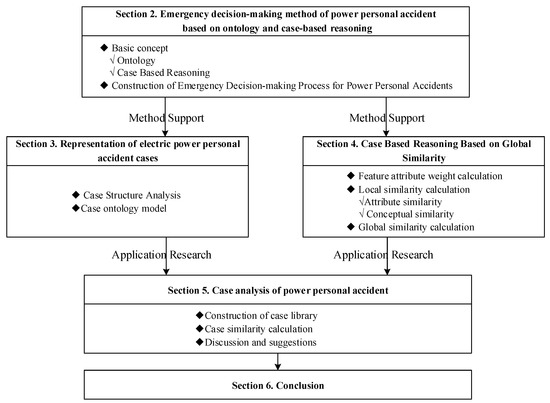
Figure 1.
The flow chart of this research.
2. Emergency Decision-Making Method for Power Personal Accidents Based on Ontology and CBR
2.1. Basic Concept
2.1.1. Ontology
Ontology was originally a philosophical concept [23]. With the continuous development of understanding and research on ontology, the definition of ontology is constantly changing [24]. In the field of informatics, ontology was first defined as the basic terms and relations of related vocabulary [25] and the rules for defining lexical extension by using these terms and relations [26]. In addition, ontology is widely regarded as a clear specification of a conceptual model [27,28].
At present, ontology is widely used in the Semantic Web, intelligent information retrieval, information integration, digital library, and other fields [29]. It represents concepts and their relationships in an explicit and formal way and becomes a medium for people, machines, and applications to reach a common understanding of the semantics of concepts, enabling knowledge sharing and reuse among various applications [30].
The purpose of an ontology is to obtain knowledge about a field, provide a consensus on the knowledge in this field, and provide a clear definition for recognized vocabulary in this field [31]. In general, the ontology structure can realize knowledge sharing and reuse to a certain extent and improve the communication ability, interoperability, and reliability of the system [32,33]. With the reform of the power system and the continuous expansion of the power network, it is crucial to build a fully flexible information exchange system and a fully covered knowledge system to adapt to the rapidly changing business environment [34,35]. The use of ontology technology can improve the efficiency of the information extraction process and present the reasoning results of knowledge [36]. For the ubiquitous information silo problem in the same field, we can use ontology to create a domain knowledge model so that information in the same field can be shared and integrated [37]. Through automatic case identification, case information can be obtained so as to solve the case input problem [38]. Since an ontology provides a clear conceptual model, semantic conflicts caused by different expressions in the case library are resolved [39,40].
2.1.2. CBR
CBR is used to solve new problems by looking for similar historical cases and using specific knowledge from existing experience or results, that is, specific cases [41,42]. Also, it is a method of relying on past successful experiences to reason about the solution to the case. CBR can imitate the way that people think about problems to solve them, and it can continue to accumulate past successful experience from self-learning, so its coverage gradually increases with the use of the system [43,44,45,46]. Case retrieval is one of the key steps of CBR, and its purpose is to select a suitable retrieval strategy and matching algorithm to retrieve historical cases similar to the current case from the historical cases [47].
In recent years, unexpected events have occurred from time to time; we have faced a variety of unexpected events, and the methods used to handle them are also different [48]. However, for a specific emergency that is currently occurring, there have generally been situations in the past that are more or less similar to the current emergency [49]. Thus, we can use the experience of solving past cases to handle the current event. The problem-solving approach based on CBR is to quickly retrieve similar cases from history and provide the most similar case solution to emergency managers based on the similarity between the cases to assist emergency decision makers in making correct and reasonable decisions about current emergencies [50].
CBR originates from human psychological and cognitive activities. When faced with a new problem that needs to be solved, people tend to compare previously used cases that are similar to the problem and learn from past experiences and methods of solving cases in order to achieve the purpose of solving the current problem [51,52].
With the increasing attention paid to power grid emergencies, the advantages of ontology technology and CBR in solving this problem have been demonstrated [53,54]. The combination of ontology technology and CBR will be able to better and effectively solve emergency decision-making problems for grid incidents.
2.2. Construction of Emergency Decision-Making Process for Power Personal Accidents
The emergency decision-making method for electric power personal accidents proposed in this paper uses ontology technology to sort out the relevant concepts and relationships among cases, achieve the standardization of accident sample cases, and develop a structural representation of case knowledge. Then, the case data are stored to build a case library for electric power personal accidents. On this basis, the CBR method is used to achieve the rapid retrieval and matching of similar cases and generate auxiliary decision-making schemes. The specific process is shown in Figure 2.
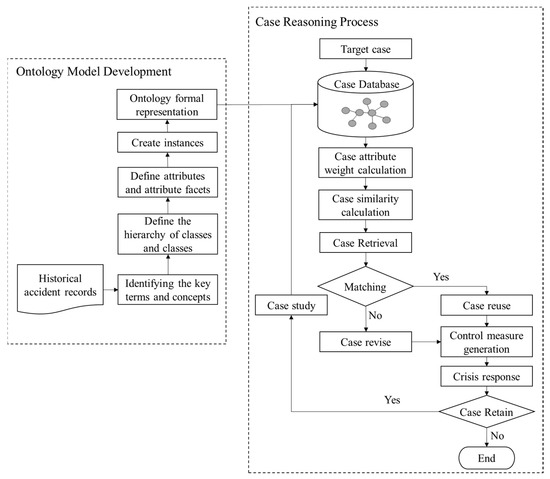
Figure 2.
Emergency decision-making process for electric power personal accidents based on ontology and CBR.
The above-mentioned emergency decision-making framework constructed in this paper includes two modules, namely, the ontology model of the accident case knowledge base and CBR, to realize the standardized representation and knowledge sharing of risk management and control knowledge. By using ontology modeling technology, the risk management knowledge contained in the traditional accident report text file is mined, the risk management knowledge is standardized by using digital technology, and the ontology model of risk management knowledge is constructed. Among them, the ontology model construction module mainly includes three steps: knowledge acquisition, ontology design, and formal ontology representation. And the CBR module mainly includes two steps: similarity calculation and retrieval matching.
3. Representation of Electric Power Personal Accident Cases
Case representation is the description of accident cases, which is the foundation and premise of CBR. A good case representation method can reflect the essential characteristics of events, facilitate the implementation of subsequent reasoning, and improve the utilization of case knowledge [55].
3.1. Case Structure Analysis
A case usually includes three aspects, namely, problem description, problem solving, and effect evaluation [56], which, respectively, correspond to the basic situation of the accident, the accident-handling process, and the evaluation of the handling effect of a specific accident case.
According to the electric power personal accident investigation report, the specific accident description includes basic accident information, accident process information, and accident analysis information. Among them, the basic accident information is the description of the accident profile, including the name of the accident, the time of occurrence, the incident unit, the type of accident, and the consequences of the accident. The accident process information is the detailed description of the accident. The accident analysis information is the cause of the accident and the lessons learned after an analysis by industry experts. In this paper, accident attributes are further summarized with reference to the existing industry standards and norms to form a multi-level structure of the characteristics of power personal accident cases, as shown in Figure 3.
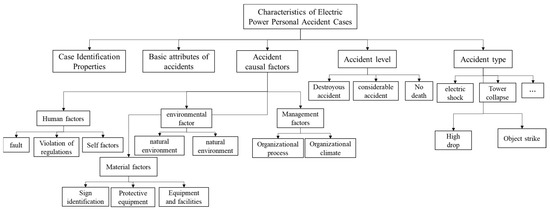
Figure 3.
Multilayer structure of personal case characteristics in electric power.
3.2. Case Ontology Model
The basic elements of an ontology include concepts (or classes), relationships, functions, axioms, and instances [57]. In this paper, ontology technology is used to structurally represent case knowledge, and it is represented as a four-tuple form based on the characteristics of accident cases, which is formally defined as:
C_ Case represents a collection of concepts in a case ontology model. The concepts involved in the case ontology model include “accident”, “accident causal factors”, “accident level”, and “accident type”. The basic attributes of the “accident” concept are shown in Table 1.

Table 1.
Definition of the concept of an accident.
R_ Case represents a collection of relationships between concepts. The basic relationship types include part of, kind of, instance of, and attribute of, respectively representing the relationship between parts and the whole, the inheritance relationship between concepts, the relationship between instances and concepts, and the relationship between attributes and concepts. On this basis, in the process of building the domain ontology, this paper defines other binary relations among concepts, as shown in Table 2.
Table 2.
Definition of basic conceptual relationships.
I_ Case represents a collection of instances of concepts, and the instantiation objects for different concepts are different.
A_ Case represents an axiom set, which is mainly used to define the relationships between attributes, including function relationships, inverse function relationships, transitive relations, etc.
4. CBR Based on Global Similarity
4.1. Feature Attribute Weight Calculation
The reflection of each characteristic attribute of an accident case is different, and it is necessary to evaluate the importance of each characteristic attribute to determine its weight. The entropy weight method is an objective weighting method that is performed by calculating the information entropy of indicators. The calculation steps are as follows.
- (1)
- Assume that the case database contains a total of n cases and m feature attribute values, which constitute the affiliation evaluation matrix R.
Firstly, it is necessary to standardize the value of each indicator. The data in the case database cover case information from 2014 to 2020, spanning different time periods. The value of each indicator during different periods is represented by (the value of the j-th indicator at time i). And represents the indicator value obtained after the standardization of .
When the indicator value is as large as possible, it is a positive indicator, and its standardization formula is
when the index value is as small as possible, it is an inverse index, and its standardization formula is
The data in this paper are all inverse indicators, which are the degree of membership of evaluation indicators.
- (2)
- Calculate the proportion of the j-th feature attribute value of case i to the total feature attribute value of this indicator in the case library .
- (3)
- Calculate the entropy value of the characteristic attribute value of the j-th indicator.
- (4)
- Calculate the information entropy of the characteristic attribute value of index j.
- (5)
- Calculate the weight of the feature attribute value of the j-th indicator.
4.2. Local Similarity Calculation
Assuming that the case library contains m cases and n indicator characteristic attributes, case is the target case, is the i-th case in the case library, and is the j-th indicator characteristic attribute value of the i-th case .
4.2.1. Attribute Similarity
Attributes are characteristic representations of concepts and an important component of case knowledge, including numerical and symbolic types. The similarity calculation methods for different types of attributes are different. The similarity between the target case and case with respect to the conceptual attribute j is recorded as .
- (1)
- Numerical attributes
In the formula, represents the maximum value of the j-th feature attribute. represents the minimum value of the j-th feature attribute.
- (2)
- Symbolic attributes
Symbolic attributes are enumeration-type variables and can be further divided into ordered and unordered types. Among the characteristic attributes of electric power personal accident cases, the accident type is an unordered enumeration-type variable, and the accident level is an ordered enumeration-type variable. The similarity calculation method for the above two types of attributes is as follows.
- I.
- When the characteristic attribute is an unordered enumeration-type variable,
- II.
- When the characteristic attribute is an ordered enumeration variable,
4.2.2. Conceptual Similarity
In addition to containing case attributes, the case ontology model also includes several concepts. The conceptual similarity cannot be measured by the traditional attribute similarity calculation method. For this reason, some scholars have proposed a “concept tree” similarity calculation method based on semantic information, which uses the level of concepts and the distance between concepts as the calculation basis [58].
- (1)
- Tree similarity
In the concept tree, the tree similarity of concepts c1 and c2 is calculated as follows:
In Equation (10), and represent the conceptual levels of c1 and c2, respectively. is the conceptual distance between c1 and c2. a is an adjustment parameter, and indicates that there is an equivalence relation between c1 and c2.
- (2)
- Lineage similarity
Lineage similarity is the degree of similarity between upper-level concepts, reflecting the indirect similarity between concepts, denoted by , which denotes the similarity between c1 and c2 based on the upper attributes. It reveals the indirect similarity between c1 and c2. In addition, the calculation formula is the same as in Equation (10).
- (3)
- Conceptual similarity
In the concept tree, the similarity between two non-equivalent concepts c1 and c2 is denoted by , and the calculation is as follows:
The target case is set to contain l object-type attributes , and is set to contain categories; contains h object-type attributes , and contains categories. The conceptual similarity between cases and is denoted by . The calculation method is as follows:
In the formula, represents the similarity of the j-th concept in cases and , and represents the concept weight.
4.3. Global Similarity Calculation
Based on the different weights of attribute indicators, the local similarity is weighted and summed [59], and the global similarity between the target case and the i-th case is recorded as . The characteristics and attributes of accident cases reflect different situations, and this paper uses the entropy weight method [60] to calculate and obtain indicator weights.
Due to missing information or improper recording in accident reports, directly weighting and summing case feature attributes can result in low global similarity. Before calculating global similarity, first, the case structural similarity is calculated to solve the problem of inaccurate global similarity caused by partially missing attributes. The structural similarity between the target case and case is recorded as and is calculated as follows.
Based on the structural similarity calculation results, the global similarity calculation between the accident sample case and the target case is as follows.
represents the weight of the j-th attribute, represents the local similarity between the sample case and the target case in the j-th attribute, represents the structural similarity of the case, and represents the conceptual similarity between the sample case and the target case .
5. Case Analysis of Power Personal Accidents
Two different types of electrical infrastructure construction accident cases were selected for relevant experiments to verify that the combined ontology and CBR approach can effectively analyze and summarize various types of accidents that occurred in the past and achieve the effective retrieval of similar cases of unexpected accidents. Section 5.1 shows some of the constructed cases of electrical personal accidents. Section 5.2 and Section 5.3 validate the effectiveness of the methodological model in this paper based on electrocution and fall-from-height accidents as target cases, respectively. Section 5.4 discusses the related modeling results and gives related suggestions. The related research framework is shown in Figure 4.
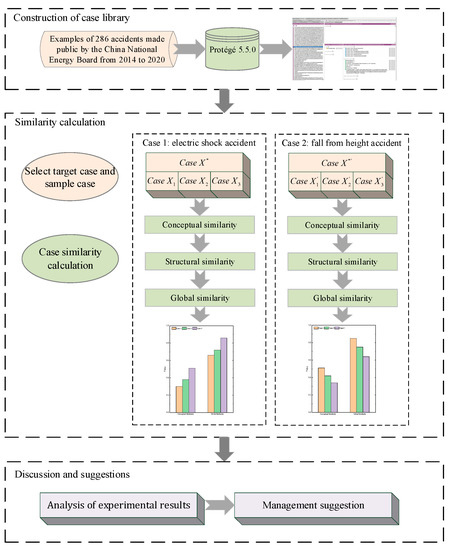
Figure 4.
Framework diagram of emergency decision making for electric power personal accident research.
5.1. Construction of Case Library
According to the statistical data released by the National Energy Administration, during the period from 2014 to 2020, a total of 305 electric power personal injury and death accidents occurred nationwide, with a total of 286 accident examples, excluding some accident cases that lack records and cause analyses. Ontology technology was used to structure the representation of accident case knowledge and build a powerful personal accident case database. The individuals of the “Electric power personal accident” were developed using protégé 5.5.0, and the partially constructed case database is shown in Figure 5.
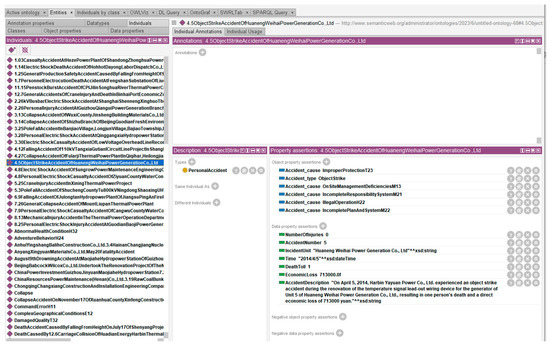
Figure 5.
The screenshot of individuals of the “Electric power personal accident” and their properties.
5.2. Similarity Calculation of Case 1
In this section, an electric shock accident that occurred on 28 March 2015 is selected as the target case, with case number 49. In addition, three other electric shock accidents have been randomly selected as alternative cases. The corresponding accident descriptions of the above cases are shown in Table 3.
Table 3.
Brief introduction of Target Case 1 and alternative case accidents.
Then, the entropy weight method is used to calculate the weights of each indicator in the case based on their varying degrees of variation. The specific calculation steps are detailed in Section 4.1. And the final calculation results are shown in Table 4.
Table 4.
Case feature attributes and their weights.
The conceptual attribute types in the case ontology model include numerical attributes, symbolic attributes, and object attributes. The calculation of numerical and symbolic attributes is relatively simple and will not be explained here. For the accident causal factors in the accident case ontology model, the conceptual similarity calculation method mentioned above is used, and the calculation results are as follows.
The structural similarity between the target case and the alternative case is calculated based on the completeness of the case attributes, and the calculation results are as follows:
Taking into account local similarity, feature attribute weights, and structural similarity, the global similarity of the case can be calculated by referring to Equation (12). The final calculation result is as follows:
In order to show the calculation results more visually, the relevant results are plotted in Figure 6.
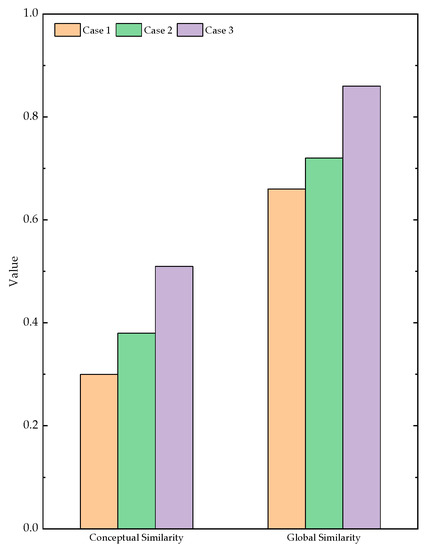
Figure 6.
Similarity of Case 1.
5.3. Similarity Calculation of Case 2
In this section, an additional fall-from-height accident that occurred on 7 June 2017 is selected as the target case, and three other high-fall accidents are selected as sample cases in the case base with the accident numbers and brief descriptions shown in Table 5.
Table 5.
Brief introduction of Target Case 2 and alternative case accidents.
For the accident causal factors in the accident case ontology model, the conceptual similarity calculation method is mentioned in Section 4.2, and the weights of each indicator in the case based on their varying degrees of variation are the same as in Table 4 for Case 1. Then, the calculation results are as follows:
Then, structural similarity calculation results between the target case and cases , , are as follows:
The global similarity of the case can be calculated by referring to Equation (12). The final calculation results are as follows:
In order to show the calculation results more visually, the relevant results are plotted in Figure 7.
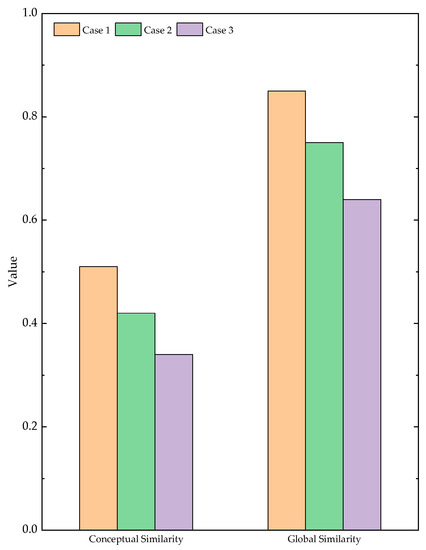
Figure 7.
Similarity of Case 2.
5.4. Discussion and Suggestions
It can be seen in Case 1 that the similarity between the target case and cases , , and , the three alternative cases, is 0.66, 0.72, and 0.86, respectively. In addition, the similarity calculation results of the three alternative cases are all greater than 0.5, and the above accident cases have all caused the serious consequence of one person’s death, which is a major casualty accident. However, the target case lacks records for the economic loss caused by the accident, and there are missing attributes. Among the alternative cases, only case records the economic loss of the accident, which is CNY 1.55 million. And the economic loss indexes of the remaining two accident cases are missing. Therefore, the structural similarity between the target case and case is the lowest. From the global similarity calculation results, case has the highest similarity and the highest matching degree with the target case and can be used as a reference case.
From the experimental results of Case 2, the similarity between the target case and cases , , and are 0.85, 0.75, and 0.64, respectively. At the same time, the target case also lacks a record of the economic loss caused by the accident, and there are missing attributes. Among the alternative cases, only case is the same as the target case , and none of them recorded the economic loss of the accident. Therefore, the target case and case have the highest structural similarity. According to the global similarity calculation result, case has the highest similarity to the target case and can be used as the reference case.
In general, this study used CBR and ontology technology methods to focus on engineering to complete this manuscript. The case validation results in Section 5.2 show that the proposed approach can make full use of a large number of historical cases and empirical knowledge accumulated in emergency responses in the field of electric power safety, analyze and summarize various accidents that occurred in the past, and, when a new accident occurs, quickly draw on the methods used to handle similar cases in the past to improve the efficiency of the emergency response.
From the discussion of the above results, it is clear that the situation causing the low similarity between the target case and the alternative case structure stems from the partial absence of accident records. This mainly stems from the fact that there are many different requirements for the internal evaluation system and data construction standards when information power infrastructure is being built, resulting in non-uniform data standards and unsound systems, which in turn affect the sustainable storage and utilization of existing basic information. At the same time, it reduces the quality and data utilization effectiveness of electric power personal injury and death accident records in accident emergency decision making. Therefore, to further enhance the effectiveness of the emergency decision-making method in this paper, based on the deficiencies in the above-mentioned research process information, the following relevant information management suggestions are put forward to promote the effectiveness of electric power safety emergency decision making by improving the quality of data records and thus enhance the sustainability of electric power safety production.
- (1)
- Accident information standardization construction and system sustainability improvement. The standardization of accident information records should be improved to reduce the waste of resources by enabling the convenient extraction of important concepts and terms when using ontology technology, thus enhancing the effectiveness of existing information records in accident emergency decision making.
- (2)
- Sustainability of accident information association. Effective accident information linkage can improve the response efficiency in similar accidents, thus avoiding the expansion of the scope of accidents and reducing the spread of their impact. Then, continuous accident information linkage can promote the continuous improvement of the emergency decision-making management system.
- (3)
- Sustainability of effective communication between accident information recording and emergency management personnel. As the source and user of accident information, emergency management personnel and accident recorders should form a long-term communication and consultation mechanism to continuously improve the effectiveness of accident information utilization and emergency decision making.
6. Conclusions
From the aspect of case representation, this study first analyzed the case structure of electric power personal accidents, used ontology technology to structure case knowledge, and constructed a case library of electric power personal accidents. Secondly, in the CBR process, the global similarity calculation model was used to comprehensively consider the indicator attribute weight, case structural similarity, attribute similarity, and conceptual similarity, improving the accuracy of case matching. Finally, the case similarity calculation method proposed in this paper was validated through specific accident cases. The experimental results show that this method can effectively improve the accuracy of case matching and is suitable for emergency decision making for electric power construction site accidents, providing a reference for other types of accident emergency decision making. In general, this study used CBR and ontology technology methods to focus on engineering to complete this manuscript. Follow-up studies can focus on in-depth mathematical model research.
Author Contributions
Methodology, C.C.; Software, S.Y.; Validation, X.S.; Formal analysis, X.H.; Investigation, M.F.; Resources, W.L.; Data curation, Z.X. and H.X.; Writing—original draft, X.H. and C.C.; Writing—review & editing, W.L. All authors have read and agreed to the published version of the manuscript.
Funding
This work was funded by the State Grid Corporation Science and Technology Project “Research and Application of Key Technologies for Integrated Management and Early Warning of Infrastructure Based on Knowledge Reasoning” (Grant No. 5700-202256191A-1-1-ZN).
Data Availability Statement
Data available in a publicly accessible repository. The data presented in this study are openly available in Chinese National Energy Administration (http://www.nea.gov.cn/).
Conflicts of Interest
The authors declare no conflict of interest.
References
- Shin, H.K.; Cho, J.M.; Lee, E.B. Electrical Power Characteristics and Economic Analysis of Distributed Generation System Using Renewable Energy: Applied to Iron and Steel Plants. Sustainability 2019, 11, 6199. [Google Scholar] [CrossRef]
- Alabbasi, A.; Sadhukhan, J.; Leach, M.; Sanduk, M. Sustainable Indicators for Integrating Renewable Energy in Bahrain’s Power Generation. Sustainability 2022, 14, 6535. [Google Scholar] [CrossRef]
- Hou, W.; Li, M.Y.R.; Sittihai, T. Management Optimization of Electricity System with Sustainability Enhancement. Sustainability 2022, 14, 6650. [Google Scholar] [CrossRef]
- Men, Y.S.; Liu, S.B. CBR based emergency decision-making method for power accidents. Telecommun. Sci. 2015, 31, 95–98. [Google Scholar]
- Li, B.G. Strengthen emergency management of power safety and ensure safe production of electricity. Mod. SOE Res. 2017, 24, 23. [Google Scholar]
- Yang, L.X.; Sun, Q.Y.; Zhang, N.; Li, Y.S. Indirect Multi-Energy Transactions of Energy Internet With Deep Reinforcement Learning Approach. IEEE Trans. Power Syst. 2022, 37, 4067–4077. [Google Scholar] [CrossRef]
- Moazzam, N.; Klaehn, B.; Johan, H.E. Electrical Safety Considerations of Neutral Blocker Placements for Mitigating DC. IEEE Trans. Ind. Appl. 2021, 57, 1113–1121. [Google Scholar]
- Lai, Q.P.; Liu, C.X.; Sun, K. Formulation and Visualization of Bus Voltage-Var Safety Regions for a Power System. IEEE Trans. Power Syst. 2022, 37, 3153–3156. [Google Scholar] [CrossRef]
- Schank, R.C. Dynamic Memory: A Theory of Reminding and Learning in Computers and People; Cambridge University Press: Cambridge, UK, 1983. [Google Scholar]
- Wang, X.P.; Lei, S.H.; Liu, W.M. Research on Emergency Decision Method for Metro Engineering Accidents Based on CBR. J. Railw. Eng. Soc. 2018, 35, 104–109. [Google Scholar]
- Zhang, Y.L.; Xu, Y.Y.; Li, J.Y. Research on Case-based Reasoning for Urban Fire Emergency Decision under Incomplete Information. J. Saf. Sci. Technol. 2018, 14, 13–18. [Google Scholar]
- Li, R.P.; Wang, H.W.; Chen, X. Research on Emergency Management of Construction Risks in the Recycling and Utilization of Old Industrial Buildings. J. Saf. Sci. Technol. 2019, 15, 151–156. [Google Scholar]
- Xia, D.Y.; Li, C.Y.; Zhu, Y.; Xue, T. Case Based Reasoning Based on Scenario Elements and Its Application in Emergency Decision Making. J. Saf. Environ. 2020, 20, 1028–1033. [Google Scholar]
- Ma, W.X.; Wang, D.L. A Case Based Reasoning Emergency Decision Model for Sudden Environmental Events. J. Saf. Sci. Technol. 2017, 13, 85–90. [Google Scholar]
- Yu, X.P.; Xu, C.Q.; Lu, D.; Zhu, Z.; Zhou, Z.; Ye, N.; Mi, C. Design and application of power grid accident case library based on CBR. Information 2020, 11, 91. [Google Scholar] [CrossRef]
- Studer, R.; Benjamins, V.R.; Fensel, D. Knowledge engineering: Principles and methods. Data Knowl. Eng. 1998, 25, 161–197. [Google Scholar] [CrossRef]
- Wang, H.H.; Boukamp, F. Ontology-Based Representation and Reasoning Framework for Supporting Job Hazard Analysis. J. Comput. Civ. Eng. 2011, 25, 442–456. [Google Scholar] [CrossRef]
- Ding, L.Y.; Zhong, B.T.; Wu, S.; Luo, H.B. Construction risk knowledge management in BIM using ontology and semantic web technology—ScienceDirect. Saf. Sci. 2016, 87, 202–213. [Google Scholar] [CrossRef]
- He, H.G.; Wang, W.; Zhao, L.; Luo, C. Automatic identification of hazard in subway foundation pit construction based on BIM and ontology. Ind. Saf. Environ. Prot. 2019, 45, 31–34+70. [Google Scholar]
- Tan, W.B.; Guo, H.X.; Gong, P.S.; Guo, S.Y. Safety Risk Assessment of Deep Foundation Pit Construction Based on Ontology and Case Reasoning. J. Eng. Manag. 2020, 34, 147–152. [Google Scholar]
- He, G.Q.; Zhang, Y.F.; Han, Y.Q. Formal description and matching of emergency plans for urban rail transit network based on ontology. Urban Mass Transit 2015, 18, 62–66. [Google Scholar]
- Wu, H.; Zhong, B.; Medjdoub, B.; Xing, X.; Jiao, L. An Ontological Metro Accident Case Retrieval Using CBR and NLP. Appl. Sci. 2020, 10, 5298. [Google Scholar] [CrossRef]
- Kolli, M. A New Approach for Formal and Coherent Ontology Alignment. Int. J. Organ. Collect. Intell. (IJOCI) 2022, 12, 16. [Google Scholar] [CrossRef]
- Liu, L.; Guo, C. Retrieval and Evaluation of Target Component Based on Ontology Knowledge. In Proceedings of the International Association of Applied Science and Engineering, Conference Proceedings of 2021 4th International Conference on Algorithms, Computing and Artificial Intelligence (ACAi 2021), ACM, Sanya, China, 22–24 December 2021; pp. 635–640. [Google Scholar]
- Abeer, H.; Bakly, E.; Nagy, R.D.; Hesham, A.H. Using Ontology for Revealing Authorship Attribution of Arabic Text. Int. J. Eng. Adv. Technol. (IJEAT) 2020, 9, 143–151. [Google Scholar]
- Ondřej, Z. A Survey of Ontology Benchmarks for Semantic Web Ontology Tools. Int. J. Semant. Web Inf. Syst. (IJSWIS) 2020, 16, 47–68. [Google Scholar]
- Antoniazzi, F.; Viola, F. Building the Semantic Web of Things Through a Dynamic Ontology. IEEE Internet Things J. 2019, 6, 10560–10579. [Google Scholar] [CrossRef]
- Garanina, N.O.; Anureev, I.S.; Borovikova, O.I. Verification-Oriented Process Ontology. Autom. Control. Comput. Sci. 2019, 53, 584–594. [Google Scholar] [CrossRef]
- Zhang, L.; Zhang, Y.F. The application of ontology model in knowledge retrieval and recommendation. In Proceedings of the 3rd International Conference on Multimedia Technology (ICMT-13), Guangzhou, China, 29 November–1 December 2013. [Google Scholar]
- Yan, H.C.; Zhang, F.; Liu, B.X. Granular Computing Based Ontology Learning Model and Its Applications. Cybern. Inf. Technol. 2015, 15, 103–112. [Google Scholar] [CrossRef]
- Yu, Y.X.; Wang, L.Y.; Zhu, Q.Y. Intelligent fuzzy information retrieval based on ontology knowledge-base. Int. J. Internet Protoc. Technol. 2018, 11, 180–191. [Google Scholar] [CrossRef]
- Karpenko, A.P. Method for Estimating Document Relevance in Ontology Knowledge Base. Inf. Technol. 2011, 4, 13–23. [Google Scholar]
- Karpenko, A.P. Hybrid population algorithms for parametrical optimisation of design decisions. Inf. Technol. 2013, 12, 6–15. [Google Scholar]
- Zhang, H.Q.; Hua, G. A methodology to identify and assess high-risk causes for electrical personal accidents based on directed weighted CN. Reliab. Eng. Syst. Saf. 2023, 231, 109027. [Google Scholar] [CrossRef]
- Batra, P.E.; Ioannides, M.G. Assessment of electric accidents in power industry. Hum. Factors Ergon. Manuf. Serv. Ind. 2002, 12, 151–169. [Google Scholar] [CrossRef]
- Wang, Y.; Huang, Y.H.; Li, Y.S.; Wang, Y.Y. Overview of Ontology-Based Power System Applications. Appl. Mech. Mater. 2013, 291, 2346–2351. [Google Scholar] [CrossRef]
- Rihab, I.; Karim, S.E.; Basel, S.; Kamel, H. Ontology Knowledge Mining for Ontology Alignment. Int. J. Comput. Intell. Syst. 2016, 9, 876–887. [Google Scholar]
- Hu, Z.Q. Knowledge Acquisition of Domain Ontology Based on the Documents. Appl. Mech. Mater. 2013, 333, 2243–2247. [Google Scholar] [CrossRef]
- Marthinus, C.G.; Aurona, J.G.; Alta, V.D.M. An analysis of fundamental concepts in the conceptual framework using ontology technologies. South Afr. J. Econ. Manag. Sci. 2014, 17, 396–411. [Google Scholar]
- Keedong, Y.; Hyunseok, H. Ontology-based Implementation of the Process-oriented Knowledge Map. J. Korea Ind. Inf. Syst. Res. 2012, 17, 396–411. [Google Scholar]
- Doğan, N.B.; Ayhan, B.U.; Kazar, G.S.M.; Ayözen, Y.E.; Tokdemir, O.B. Predicting the Cost Outcome of Construction Quality Problems Using Case-Based Reasoning (CBR). Buildings 2022, 12, 1946. [Google Scholar] [CrossRef]
- Zhang, L.; Wang, S.D.; Jia, G.Y.; Chen, L. Smart Grid Risk Warning Based on Multi-Level Fuzzy Analytic Hierarchy Process. J. Phys. Conf. Ser. 2019, 1325, 012215. [Google Scholar] [CrossRef]
- Dent, C.J.; Bialek, J.W. Non-Iterative Method for Modeling Systematic Data Errors in Power System Risk Assessment. IEEE Trans. Power Syst. A Publ. Power Eng. Soc. 2011, 26, 120–127. [Google Scholar] [CrossRef]
- Li, W.Y.; Zhou, J.Q.; Xie, K.G.; Xiong, X.F. Power System Risk Assessment Using a Hybrid Method of Fuzzy Set and Monte Carlo Simulation. IEEE Trans. Power Syst. A Publ. Power Eng. Soc. 2008, 23, 336–343. [Google Scholar]
- Bannour, W.; Maalel, A.; Ben, G.; Henda, H. Emergency Management Case-Based Reasoning Systems: A Survey of Recent Developments. J. Exp. Theor. Artif. Intell. 2023, 35, 35–38. [Google Scholar] [CrossRef]
- Okudan, O.; Budayan, C.; Dikmen, I. A knowledge-based risk management tool for construction projects using case-based reasoning. Expert Syst. Appl. 2021, 173, 114776. [Google Scholar] [CrossRef]
- Sahand, S.; Nima, G.S.; Aminah, R.F. Framework for Risk Identification of Renewable Energy Projects Using Fuzzy Case-Based Reasoning. Sustainability 2020, 12, 5231. [Google Scholar]
- Li, F.; Zhang, P.C.; Huang, X.; Sun, J.B.; Li, Q. Emergency Decision-Making for Middle Route of South-to-North Water Diversion Project Using Case-Based Reasoning and Prospect Theory. Sustainability 2022, 14, 13707. [Google Scholar] [CrossRef]
- Wang, D.L.; Wan, K.D.; Ma, W.X. Emergency decision-making model of environmental emergencies based on case-based reasoning method. J. Environ. Manag. 2020, 262, 110382. [Google Scholar] [CrossRef]
- Homem, T.P.D.; Santos, P.E.; Costa, A.H.R.D.; Costa, B.R.A.; Lopez, D.M.R. Qualitative Case-Based Reasoning and Learning. Artif. Intell. 2020, 283, 103258. [Google Scholar] [CrossRef]
- Tsai, Y.T. Applying a case-based reasoning method for fault diagnosis during maintenance. Proc. Inst. Mech. Eng. Part C J. Mech. Eng. Sci. 2009, 223, 2431–2441. [Google Scholar] [CrossRef]
- Zhu, C.L. Research on the Semantic Web Reasoning Technology. AASRI Procedia 2012, 1, 87–91. [Google Scholar]
- Zhong, H.; Zhang, H.Z.; Zhang, J.Q.; Yuan, Z.Y. A Novel Ontology Construction and Reasoning Approach Based on the Case Investigation. Int. J. Data Sci. Anal. 2019, 5, 148–158. [Google Scholar] [CrossRef]
- Yu, S.W.; Hou, H.; Wang, C.Z.; Geng, H.; Fan, H. Review on Risk Assessment of Power System. Procedia Comput. Sci. 2017, 109, 1200–1205. [Google Scholar]
- Zhu, Q.N.; Zhou, X.F.; Tan, J.L.; Guo, L. Knowledge Base Reasoning with Convolutional-based Recurrent Neural Networks. IEEE Trans. Knowl. Data Eng. 2019, 33, 2015–2028. [Google Scholar] [CrossRef]
- Wang, W.J.; Yang, P.; Dong, C.X. Research and Application of Emergency Case Ontology Model. J. Comput. Appl. 2009, 29, 1437–1440+1445. [Google Scholar]
- Perez, A.G.; Benjamins, V.R. Overview of Knowledge Sharing and Reuse Components: Ontologies and Problem-Solving Methods. In Proceedings of the 16th International Joint Conference on Artificial Intelligence (IJCAI’99) Workshop KRR5: Ontologies and Problem-Solving Methods: Lesson Learned and Future Trends, Stockholm, Sweden, 2 August 1999. [Google Scholar]
- Xiang, D.; Zhao, Y.; Chen, Y. Research on Semantic information Oriented Case Knowledge Representation and Similarity Calculation Method. Comput. Eng. Sci. 2011, 33, 159–166. [Google Scholar]
- Makwana, A.; Ganatra, A. A Better Approach to Ontology Integration using Clustering Through Global Similarity Measure. J. Comput. Sci. 2018, 14, 854–867. [Google Scholar] [CrossRef]
- Mon, D.L.; Cheng, C.H.; Lin, J.C. Evaluating weapon system using fuzzy analytic hierarchy process based on entropy weight. Fuzzy Sets Syst. 1994, 62, 127–134. [Google Scholar] [CrossRef]
Disclaimer/Publisher’s Note: The statements, opinions and data contained in all publications are solely those of the individual author(s) and contributor(s) and not of MDPI and/or the editor(s). MDPI and/or the editor(s) disclaim responsibility for any injury to people or property resulting from any ideas, methods, instructions or products referred to in the content. |
© 2023 by the authors. Licensee MDPI, Basel, Switzerland. This article is an open access article distributed under the terms and conditions of the Creative Commons Attribution (CC BY) license (https://creativecommons.org/licenses/by/4.0/).