Abstract
Load frequency control (LFC) has recently gained importance due to the increasing integration of wind energy in contemporary power systems. Hence, several power system models, control techniques, and controllers have been developed to improve the efficiency, resilience, flexibility, and economic feasibility of LFC. Critical factors, such as energy systems, resources, optimization approaches, resilience, and transient stability have been studied to demonstrate the uniqueness of the proposed design. This paper examines the most recent advances in LFC techniques for wind-based power systems. Moreover, the use of classical, artificial intelligence, model predictive control, sliding mode control, cascade controllers, and other newly designed and adopted controllers in the LFC area is thoroughly examined. Statistical analysis and a comparison table are used to evaluate the advantages, disadvantages, and applications of various controllers. Finally, this paper presents a comprehensive overview of contemporary and other widely used soft computing tools for the LFC issue. This detailed literature review will assist researchers in overcoming the gap between current progress, application, limitations, and future developments of wind energy in LFC.
1. Introduction
1.1. Background
Renewable energy generation has emerged as a global trend and a primary priority for governments globally in response to rising energy constraints and environmental degradation. Wind energy has fully recognized itself as humanity’s dominating alternative, more than any other green technology, owing to its minimal carbon footprint, low operating costs, and broad operational range [1,2]. The worldwide wind energy industry set a new milestone in 2020, reaching 743 GW, an increase of 14.3 percent over the previous year [3]. Additionally, wind energy is expected to provide 36% of the world’s electricity by 2050 [4]. Although wind energy is often abundant, it is extremely unpredictable owing to its reliance on adverse weather conditions. There may be instances where the wind energy generation does not meet the load requirement, resulting in power imbalance and high-frequency fluctuations [5,6]. These situations may degrade voltage stability and, in the worst scenario, trigger certain protective relays, resulting in a partial or total loss of power. As a result, integrating wind turbine generators (WTGs) into the load frequency control (LFC) of the power system may be a challenging task to address. LFC’s primary objective is to balance load-generation mismatches and to reduce frequency and tie-line power variations across various control regions [7,8,9]. To smooth the output power of WTGs, changes in the blade pitch angle have been proposed [10,11]. However, such strategies may compel the turbines to operate under substandard conditions, raising the WTG’s energy costs. It is also possible to adjust the output power by operating WTGs in a de-loaded state; but, this approach puts extra mechanical stress on the turbine rotor, potentially shortening the turbine’s life [12]. Additionally, storage devices (battery packs, supercapacitors) for smoothing the output power of WTGs have been a popular research topic over the last few decades [13,14,15]. While energy storage devices are effective for regulating wind power, they are expensive, mainly when used to manage large power systems [5]. The concept of vehicle-to-grid (V2G) has received considerable attention in recent years [16,17] and aggregating electric vehicles (EVs) as a storage reserve for a power system has shown to be an economical technique for minimizing wind power fluctuation. This approach enhances wind energy utilization in the power system while lowering the operating demands for separate energy storage devices [18]. When EV batteries are charged and discharged properly, they can feature bidirectional power regulation that supports LFC in the power system.
1.2. Literature Review
Numerous studies have been conducted on the LFC of WTG-integrated power systems, and innovative controllers and algorithms for effective coordination and damping in single-area [19], two-area [20], three-area [21], and multiple-area [22] configurations have been developed. For instance, traditional proportional–integral (PI) [23] and proportional–integral–derivative (PID) [24] controllers have been used to regulate system frequency using moth-flame optimization (MFO). However, due to the non-linear dynamics of the system, turbine strain, and load disturbance, such controllers cannot achieve the required efficiency. Fuzzy logic control (FLC) [25] based on differential evolution (DE) has shown excellent performance in the LFC problem of power systems. However, the authors did not consider renewable energy penetration, and membership functions (MFs) and criterion selection have certain limitations. These constraints may be overcome through the use of a multilayer recurring artificial neural network (ANN) coupled with a regressive and adjustable control mechanism [26]. The proposed recurrent ANN demonstrates the ability to restore LFC responses to their original values, even in the presence of parameter variations, peak load, and non-linearity. However, recurrent ANN is greatly reliant on training data, which requires a precise algorithm, adding significant computational complexity to the system. For enhanced dynamic performance in today’s power systems, the authors in [27] proposed FLC in conjunction with conventional PI/PID controllers using a novel teaching–learning-based optimization (TLBO) approach. However, an inappropriate selection of FLC features, including such MFs and baseline rules, might reduce the controller’s transient performance. Ref. [28] presents an approach for improving the resilience and transient stability of WTG’s integrated power systems by using sliding mode control (SMC). However, while developing the SMC controller, the authors assumed that all power system states were to be determined, which is challenging for actual power systems. In addition, SMCs continue to have limitations, such as the inability to achieve finite-time resolution, slow response to abrupt changes in disturbances, and the increased chattering of control signals [29]. Model predictive control (MPC) has been widely employed in recent years for several applications, including the integrated power system’s LFC issue. MPC has been deemed a suitable alternative to PI and PID controllers when it comes to achieving optimal performance in the LFC issue. It is also claimed that only MPCs are capable of dealing with constraints, in addition to their optimization capabilities [30]. Ref. [31] used a two-layer optimization technique to include the MPC into the LFC of a microgrid comprising wind turbines, base loads, and aggregated EVs. The results indicate that the proposed optimization can effectively manage uncertainty in microgrids and minimize forecasting errors. The LFC of a single-area power system has been optimized using an adaptive MPC based on a recursion algorithm [32]. These analyses made no attempt to account for the uncertainties and physical constraints inherent in the system operation. Ref. [33] addressed governor uncertainty, turbine parameter variations, and load changes; however, wind power fluctuations were not considered for the proposed controller. Ref. [34] proposed centralized MPC-based control techniques for managing dispersed power requirements and system constraints including the output power of WTGs. However, the optimization of MPC becomes increasingly complicated as the number of evaluative criteria, model parameters, and precise measurements increases.
1.3. Objectives and Contributions
Numerous surveys on LFC have been conducted, but they have predominantly focused on conventional power systems. In modern power systems, renewable energy, particularly wind energy, is increasingly integrated, which may have a detrimental effect on system inertia response and frequency stability. Consequently, a comprehensive review and study are required to address all recent trends of LFC within the wind-integrated power system. This paper presents a comprehensive review of the current state of knowledge and recent advancements in LFC for wind-interconnected power systems. Figure 1 depicts the survey segmentation conducted for this paper. As illustrated in the figure, three distinct aspects of LFC have been examined. First, the control area suitability of single-area, two-area, three-area, and four-area models for wind-integrated power system models have been discussed. Second, numerous control techniques for classifying LFC for wind-integrated power systems have been discussed. The use of soft computing for LFC classification has been examined further. Hence, the major contributions of this survey are briefly summarized below:
Figure 1.
Flow chart on LFC survey.
- The impact of wind power on the frequency stability of interconnected power systems has been reviewed.
- The pros and cons of various wind-integrated power system models, as well as their influence on LFC, have been examined.
- The application and shortcomings of the most commonly employed control techniques for wind-integrated power systems have been investigated.
- The use of soft computing approaches to LFC models that can manage uncertainties and parameter variations in varied load disturbances has been outlined.
- Analysis of research gaps and future recommendations for LFC in wind-integrated power systems has been undertaken.
This manuscript is divided into six sections: Section 2 discusses the review of conventional and wind-integrated power systems. In Section 3, a description of the different types of wind-integrated power system models is discussed in relation to control area suitability for single-area, two-area, three-area, and four-area models. In the following Section 4, various control techniques are discussed to classify LFC for wind-integrated power systems. A further investigation of LFC classification is provided and investigated in Section 5 using soft computing and different control algorithms. The Section 6 of this literature review presents the conclusions.
2. Review of the Load Frequency Control Scheme
LFC is an ancillary service that plays an important role in the design and operation of modern power systems. It eliminates steady-state error in frequency and reduces unscheduled power flows between adjacent control areas [35]. During disturbances, it also maintains reasonable limits on overshoot and settling time. In the past, the frequency of the system was regulated by adjusting the governor positions of the generator; however, this mechanism was later found to be insufficient. Subsequently, the governor was equipped with supplementary analog control systems that relied on feedback signals from the generators, and load to regulate the frequency and output power of the power systems [36]. The introduction of power electronic converters, as well as renewable energy sources (RESs), such as wind and solar, poses new challenges for frequency regulation. This is because the RESs have very low inertia and limited reserves of power generation for frequency support. Therefore, modern LFC schemes use advanced control technologies to enable concurrent monitoring and control capabilities, even amidst the fluctuating nature of power systems.
2.1. LFC Scheme Considering Conventional Power Systems
Conventional power systems have been in use for many decades. These power systems heavily rely on the generation of electricity from multiple sources, including hydropower, thermal power, natural gas power, and nuclear power [37]. In such systems, it is standard practice to program the active power reserve on the generating side, allowing the generator to quickly ramp up or down the active power production. However, in recent years, researchers have been focusing on providing an active power reserve through demand response programs. Demand response is an effective technique for adjusting power system frequency. The switching-based control capability to load enables a quicker response to system disruptions than is possible with conventional synchronous generators. Together with recent technological advancements in processing, monitoring, and communication, this capability may empower load-side devices to improve frequency regulation in power systems. Considered an interconnected power system, tie-line power may be expressed as [38,39]:
where are the reactance and angles of end voltages . For slight angle deviation, the tie-line power varies accordingly as:
where is the synchronizing coefficient of areas 1 and 2. Similarly, the incremental angle change caused by frequency deviation can be expressed as follows:
Putting the above value and taking Laplace transform:
Consequently, the power deviation between the tie lines in regions 1–3 and 1–4 is determined as:
The generalized equation for tie-lines power deviation can be expressed as:
Auxiliary control in a multi-area power system should ensure that, as compared to regulating a region’s frequency, the tie-line power exchange with other areas maintains within set limits. Area control error (ACE) is often applied as an indicator to reduce these two variations [40,41]:
where and represent frequency bias, damping coefficient, and governor droop, respectively. The determines the LFC system’s ability to rapidly reduce frequency deviations in the power system. A higher indicates that the LFC system can respond quickly to frequency variations and stabilize the power system. The of conventional power systems can be calculated as follows:
where and represent the inertia constant, natural frequency, and damping factor, respectively. Similarly, plays an essential role in determining the system’s capacity to respond to load demand variations and maintain frequency stability. The of a single generator can be determined as follows:
where , , and represent the moment of inertia, rotor speed, and rated power of the generator, respectively. Since conventional power systems consist of several interconnected generators, the total inertia constant may be calculated using the following equation:
where and are the total number of connected generators and rated power of the power system. When addressing the optimization problem of LFC in interconnected power systems, various objective functions may be utilized to minimize the frequency and tie-lines power deviations. The frequency distortion and tie-lines power have been included in objective functions using a variety of techniques provided in the published research. Integral square error (ISE), integral absolute error (IAE), integral time square error (ITSE), and integral time absolute error (ITAE) are the four most significant objective functions for load frequency controller design [42]:
2.2. LFC Scheme Considering Wind-Integrated Power Systems
The power system’s challenges have intensified as a consequence of the following factors: (a) increased integration of renewable sources [43]; (b) implementation of innovative technologies including microgrids [44]; and (c) reliance on insecure communications infrastructure. These factors have a direct impact on the performance, reliability, and stability of electric power systems. As wind power becomes increasingly integrated into power systems, the uncertainty associated with active power generation rises, leading to higher frequency deviations [45]. This requires that future LFC techniques for power systems must be more robust and efficient to overcome these challenges. Any variations in wind speed can impact the power output of WTs, which in turn can affect the equilibrium between power generation and consumption in the grid, resulting in deviations from the intended frequency. In the case of WTs, power output is directly proportional to the cube of the wind speed, as shown by the following equation:
where , and represent power output, air density, turbine blade’s covered area, wind speed, tip speed, pitch angle, and power coefficient, respectively. A small change in wind speed can have a substantial effect on the output power of WTs, which alters the system’s inertia constant and increases the amplitude of oscillations. Hence, when WTGs are added to a system, the effectiveness of LFC decreases due to the relative loss of inertia and the system’s lower capacity to regulate the amount of generated power. The new system’s overall inertia ( can be calculated as [46]:
where , , and are the wind penetration level, equivalent inertia of conventional generators, and inertia of WTGs, respectively. is the percentage of power produced by wind relative to the total power produced, which accounts for both conventional generators and WTGs. Similarly, represents the inertia contribution of the WTGs, while represents the reduction in the inertia of conventional generation due to the presence of wind. WTG inertia can be calculated using the following equation [46]:
where and are the delay time and load damping constant. When WTGs are integrated into power systems, the regulatory constant, frequency bias, and damping coefficient also change, which can be calculated as follows:
where is the apparent power of the wind-integrated power system. Similarly, the system’s frequency deviation is described as follows:
where , , and represent turbine-governor transfer function, non-frequency-sensitive load change, and LFC controller, respectively. The above equation may be used to calculate the relation between frequency deviation and wind penetration levels. Several approaches are employed to alleviate the frequency impact of WTs integration, including the introduction of advanced control systems to modify the output of WTs in response to changes in wind speed and power grid conditions. These control systems have the capability to adjust the power output of the WTs in real time, thereby aiding in the stabilization of power grid frequency.
3. Taxonomy of LFC Based on the Types of Power Systems
The increasing use of renewable energy sources, notably wind power, has led to an increase in the operational complexity of the power system. Numerous control techniques and optimization algorithms have been proposed to enhance power quality and system response to irregularities.
3.1. Single-Area Wind-Integrated Power System
Planning and implementing a controller for a single-area system laid the foundation of the field’s research into regulating frequency deviations [47]. A single-area power system, which uses a WTG in addition to other traditional energy sources, is a basic system with uncomplicated power production and consumption. When operating a single-area system, the LFC’s primary responsibility is to adjust the frequency to match the system’s actual value since no tie-line power regulation is required. For wind-integrated power systems, a plethora of LFC control strategies have been proposed [7,19,48,49]. Ref. [32] developed an AMPC control scheme for resilient frequency regulation in a single-area power system, which was proven against a variety of unmatched variables and load disruptions. The linear representation of the turbine’s rotational speed implied by this technique does not guarantee continuous dependability. An intriguing technique based on non-linear MPC has been described with the goal of balancing power optimization and control, hence improving system dependability, and minimizing transient loads [50]. Similarly, as an alternative to the conventional LFC technique, the authors in [51] addressed the challenge of developing optimal linear time-invariant (LTI) designs at various operating points. In [19], a control strategy for wind-integrated single-area power systems was proposed that incorporates MPC and a linear quadratic gaussian (LQG) to account for physical constraints and load disturbances. The authors of [52] also used aggregated EVs in frequency control to limit wind-related system frequency changes by using a tube-based MPC (T-MPC). In this case, the influence of multiple disturbances was not considered concurrently. With these problems under consideration, a single-area microgrid system’s MPC controller has been designed to assess system performance while concurrently experiencing source and load disturbances [53]. The authors in [19,54] developed a mathematical model for wind-integrated power systems that considers the system’s frequency response during load disturbances. These models included traditional energy sources such as thermal and natural gas, as well as wind energy as a renewable energy source.
3.2. Dual-Area Wind-Integrated Power System
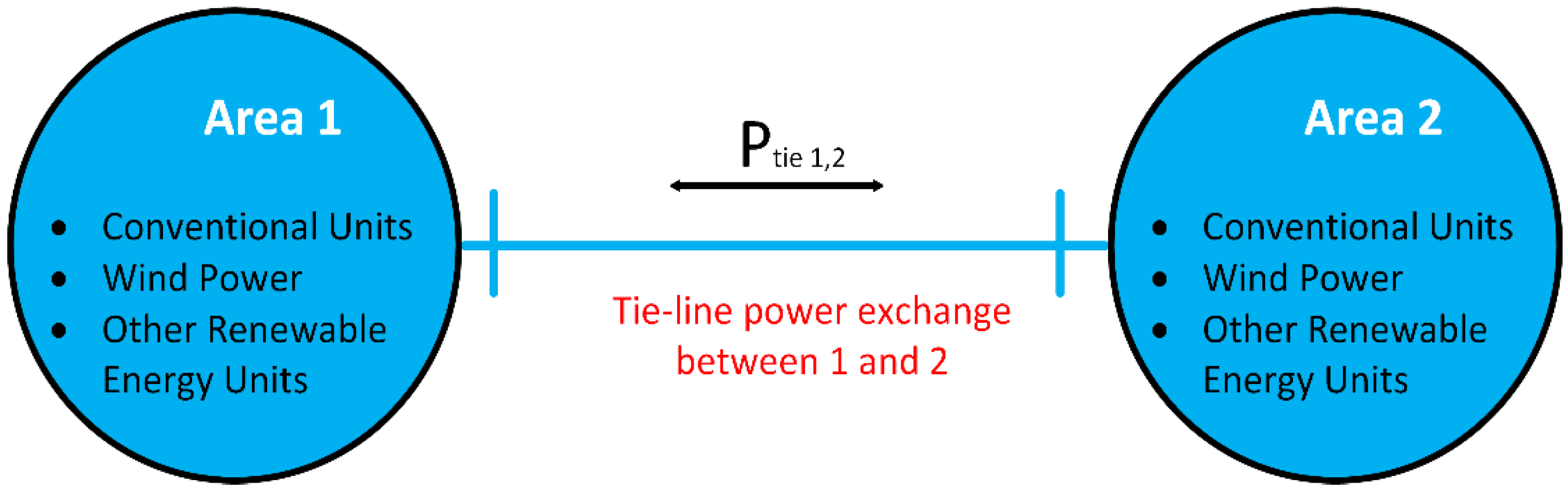
Dual-area power systems are connected by a tie line as shown in Figure 2, implying that both frequency and tie-line power regulation is required to ensure that the whole power system operates as designed and intended. Each area is equipped with many generators that are tightly connected to create a coherent group, guaranteeing that all generators in the power system respond in unison when the demand varies. During normal operation, the tie-line power for a dual-area system is calculated by the authors in [55,56]. Moreover, several studies have examined an overview of LFC systems in dual-area power systems and tie-line models, as well as their impacts on LFC systems that have been thoroughly investigated [16,20,26,54]. Multiple operating scenarios of the LFC of a dual-area power system comprised both thermal and wind turbine generators were explored using recurrent ANN and adaptive fuzzy control approaches [26]. Additionally, the authors in [16] introduced a modified fractional-order PID (FOPID) controller for wind energy and EVs based on two-area power systems. The cross-area power balance between demand and supply is more difficult to achieve, and it has an adverse effect on frequency stability and reduces auxiliary frequency control capabilities. To address the secondary frequency control issue in a deregulated dual-area power system, an enhanced SMC was developed that minimizes the optimum values of the objective functions while simultaneously requiring less computational effort [54]. Similarly, the authors in [20] compared the LFC capabilities of ANFIS, ANN, and fuzzy controllers, and their results indicate that the ANFIS controller improves dynamic response, including efficient execution, reduced fault magnitudes, and a lower transitory frequency. Additionally, several optimization strategies have been examined for the LFC problem in a dual-area power system in order to enhance the PID controller settings [57]. Reference [58] proposed using a tilt PID controller to regulate the frequency of traditional two-area deregulated power systems that also incorporate WTGs, EVs, and hybrid energy storage.
Figure 2.
Schematic dual-area power system.
3.3. Three-Area Wind-Integrated Power System
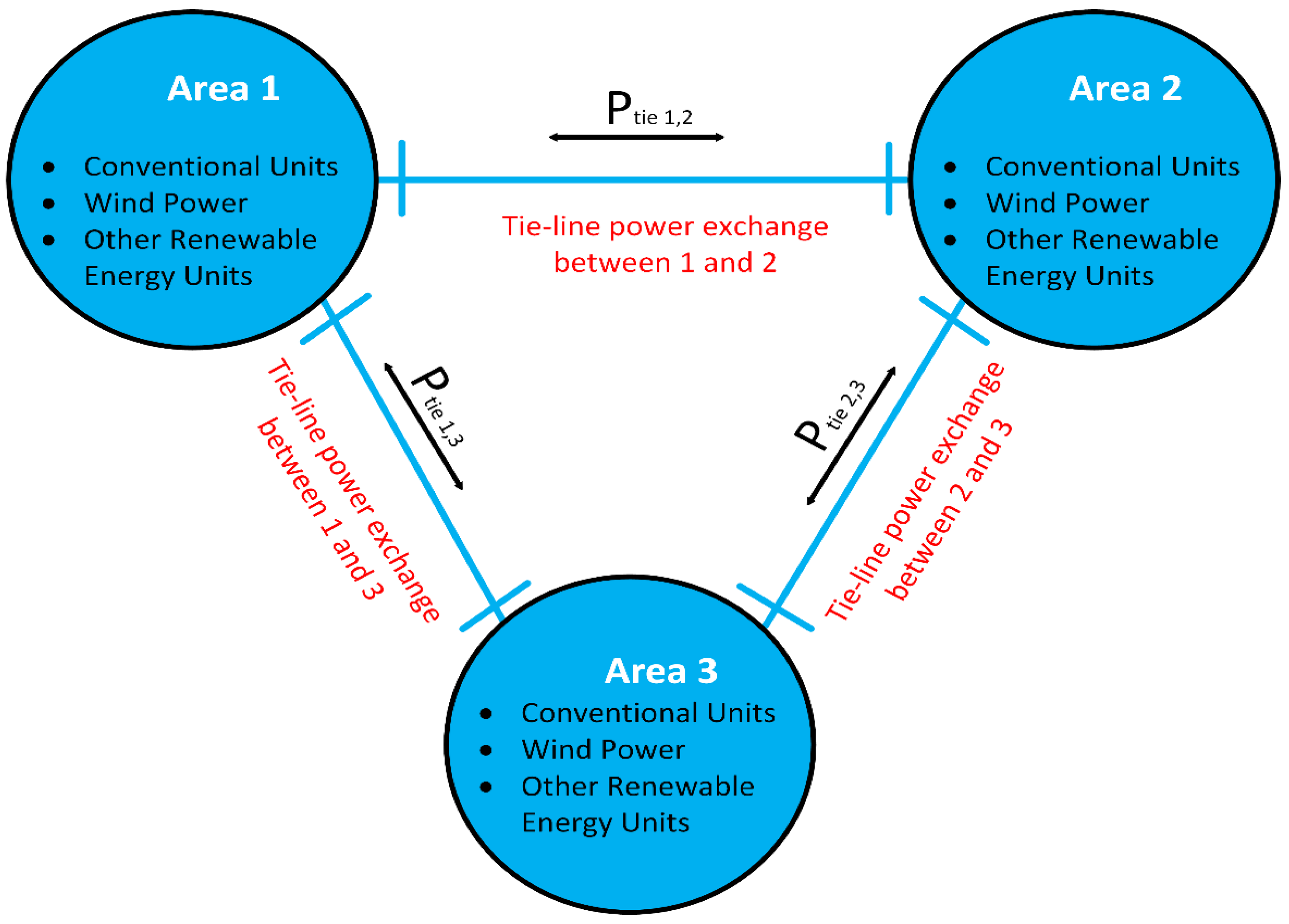
These systems employ tie lines to interconnect the three control zones as depicted in Figure 3, each of which has a different combination of power generation resources and loads to control. As the control area associated with the fault level current expands, a more robust set of control mechanisms is needed to prevent disturbances from propagating. For a three-area wind-integrated power system, the and area control error (ACE) were determined [55,56]. Moreover, several studies on LFC modelling for three-area connected power systems have been found in the literature. Ref. [59] presented an LFC technique based on RES integration and a novel algorithm for optimizing the parameters of a conventional PID controller. Assuming all of the system’s parameters have been adjusted to their nominal values, an LFC technique based on a full-order adaptive SMC has been developed [60]. The uncertainty associated with the parameters was not addressed in this system. Using a hybrid H2/H∞ controller, the parameter uncertainties and response latency of EVs to participate in multi-objective LFC with conventional sources were studied [22]. However, this technique does not provide an acceptable conclusion for voltage transients or any other constraint since the load is not scheduled during peak hours. Using the differential evolution (DE), the authors in [61] developed a resilient FOPID controller for a three-area power system that considers peak undershoots, convergence speed, and physical constraints. In a dynamic setting, the mathematical models of an unequal triple-area system with a diverse variety of energy resources, including wind energy, have been studied, and the results have been published [62,63]. The LFC of a composite power system that comprises thermal, solar, and EVs were studied, and an integral-double-derivative (IDD) controller was applied to assess the system performance [64].
Figure 3.
Schematic triple-area power system.
3.4. Four-Area Wind-Integrated Power System
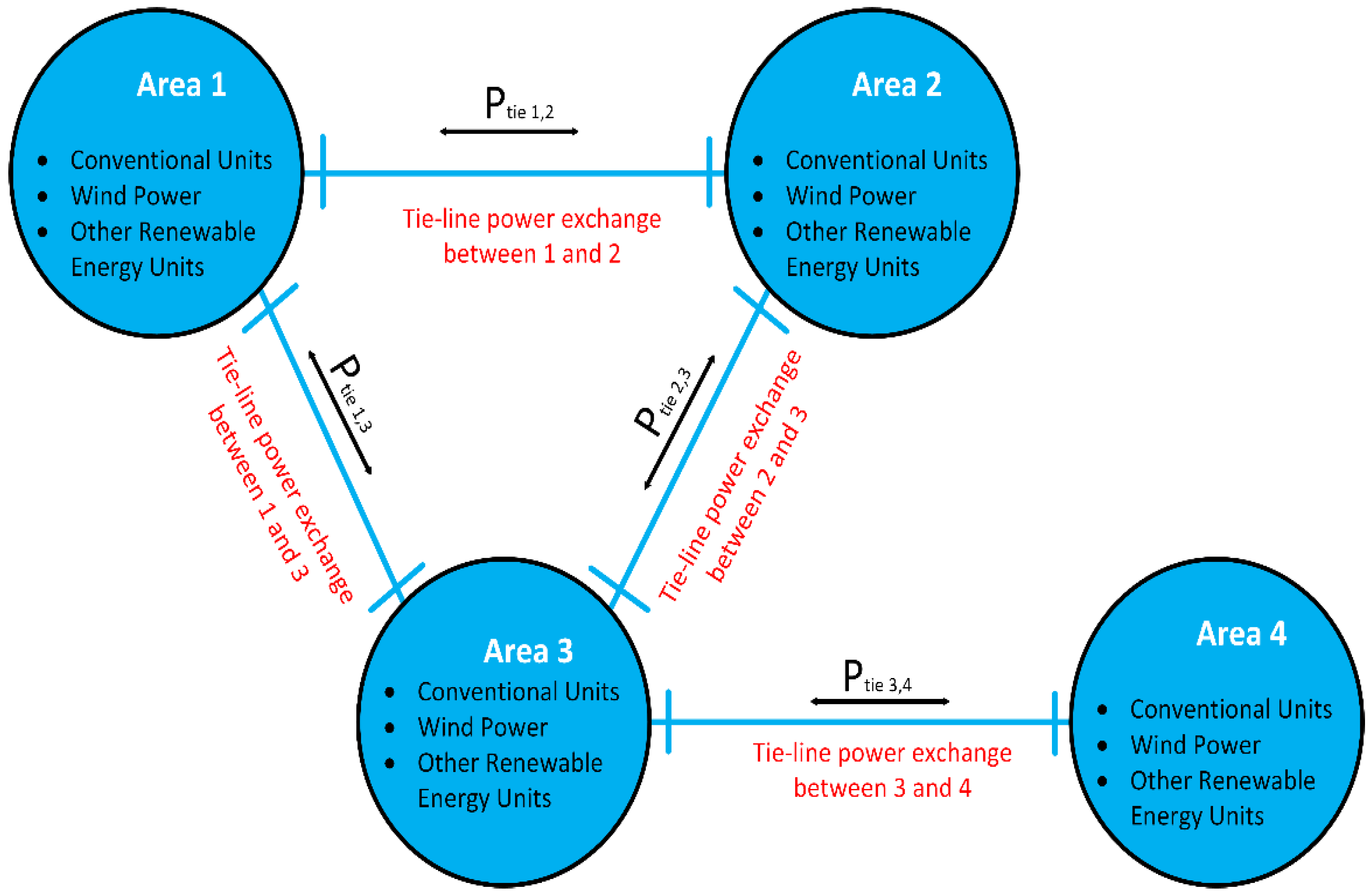
In general, four-area power systems that are coupled by tie lines are separated into four regions, as illustrated in Figure 4, to maintain the frequency fluctuation within an acceptable range. The LFC model of four-area integrated power systems has been described by the authors in [51,65,66,67]. The initial design for a four-area LFC system using the generalized technique incorporated non-linear systems and dual controllers. On the other hand, as power systems become more complex and diverse, much research has been conducted on four-area integrated contemporary power systems with the goal of improving overall system performance [28]. The mathematical model for frequency regulation of wind-integrated power systems was investigated by the authors in [51]. The LFC model was investigated in a four-region design with identical reheated thermal units [68]. The formulation of the problem and the constraints associated with this model have been analyzed. Using a customized variant of the bat algorithm (BA) in conjunction with fuzzy logic, it is possible to obtain the optimum outputs of a traditional PI controller used for LFC in four-area systems [69]. However, unstable optimization outcomes and the tendency to slip into local optimums are some of BA’s shortcomings. While such algorithms provide the best coefficients, they are expensive and time intensive to apply, necessitating the use of cluster analysis and parallel computing to achieve the intended results.
Figure 4.
Schematic four-area power system.
4. Taxonomy of LFCs Based on Various Control Strategies
Since the inception of LFC, several controllers have been effectively devised and deployed. Some studies have upgraded existing control models, while others applied hybrid techniques to address power system LFC problems. This section examines the most common LFC control strategies in wind-integrated power systems. Table 1 details the advantages, disadvantages, and applications of these prevalent control strategies.
4.1. Classical Control Techniques
Most studies in the domain of LFC are devoted to the use of conventional controllers, the first in a succession of closed-loop systems designed to address the shortcomings of open-loop systems. To improve frequency regulation, the classic control paradigm uses integer order (IO) controllers that are usually coupled to the governor and are employed to reduce area control error [70]. Several conventional control approaches and optimization algorithms have been suggested in the past for LFC in power systems [63,64,69,71,72]. The innovative developed moth-flame optimization (MFO) technique has been used to obtain the required results while calibrating the PI parameters and the WTG’s speed regulator [23]. An MFO-optimized PID controller for wind-integrated power systems is being developed, which considers both local and large-scale uncertainty [24]. For a dual-area deregulated power network that incorporates EVs and WTGs along with conventional power sources, a tilt PID controller has been applied to investigate non-linear effects such as GRC, GDB, and boiler behavior [64]. An improved and optimized frequency response and tie-line power during a transient scenario have been achieved by using a PID controller and a PID acceleration controller [63]. The authors implemented three optimization strategies to obtain model parameters for an LFC in a multi-area wind interconnected system. Also, a 3DOF-PID controller has been offered to address the dynamic controller design issue of an integrated power system’s LFC [72]. For complex operations, a comparative study of three distinct PID controller design methods has been carried out [73]. Similarly, several studies [16,19,57,63,68] examined cascade controllers for LFC in an attempt to optimize the dynamic response of the power system. In a multi-area system, PID and PIDA controllers with three optimization algorithms have been presented to optimize frequency response and tie-line power under a transient condition [63]. For LFC of an integrated power system integrating EVs with various resources, including wind energy, a cascaded controller including TIDN and 1+PI has been proposed [68]. In addition, the authors developed an improved FO controller that integrates the features of two commonly used FOPID and TID controllers for LFC of two-area power networks [16]. Also, for concurrent variation in wind power and load fluctuation, a cascade PI-PD control strategy for LFC of an integrated power system with traditional and wind power sources was devised and tested [74]. Although, operational and physical constraints were not considered by the authors. Using a T-MPC and disturbance observer controllers, the authors of [57] applied aggregated EVs in frequency control to minimize wind-related system frequency variations. The following equations represent the transfer functions of the controllers described previously:
where denote the controllers’ proportional, integral, and derivative gain values. and are the proportional and derivative controller’s setpoint weights, respectively; and represent the filter coefficient and tilt-parameter. For cascade control, two controllers operate in such a manner that the output of the first controller serves as a setpoint for the succeeding controller. The transfer function of the system for a cascade controller is as follows:
4.2. Sliding Mode Control Techniques
SMC is one of the various resilient controller techniques that may be used to modify a system’s behavior by applying pressure to allow it to slide over the system’s usual operating trajectory. It exhibits a resilient response to system disturbances and parameter variations, precluding the need for accurate modelling [75,76]. Consider a 2nd order system:
where are possible unknown coefficients, and is a’s maximum limit of . In state space, the sliding surface appears as,
where is the positive constant. Now after using the controller:
The indicates the sign function, which is defined as:
Multiple studies have shown that including SMC in a power system’s LFC may significantly assist in achieving the targeted control objectives due to its efficacy and simplicity of implementation [28,29,48,54,66,71]. SMC has been used to investigate the frequency fluctuations caused by power mismatch and transmission delays in wind-integrated power networks [28]. However, conventional SMCs continue to have limitations, including the increased chattering of control signals, a slow response to sudden changes in disturbances, and an inability to achieve finite-time resolution. To address these concerns, an adaptive fuzzy SMC with fast resolution and no singularity problem has been developed [29]. This approach, however, is still limited in its capacity to identify maximum boundary limits, the possibility of chattering, and high computation costs. An upgraded SMC has been developed to address the high computing costs and LFC problems in a deregulated dual-area power system by reducing the optimal values of the objective functions [54]. Reference [66] proposed an adaptive SMC-based LFC technique to recover the nominal values of all system parameters during external disturbances and parametric uncertainties. Also, a PSO-optimized SMC controller has been developed and evaluated for two and four areas with parameter uncertainties and load fluctuations using a third-order transfer function [71]. While such controls provide the best coefficients, they are expensive and time intensive to apply, necessitating the use of cluster analysis and parallel computing to obtain the intended results. Moreover, these control approaches are suitable for traditional generating units with a high system inertia and do not consider the probability of variable wind energy in the near future.
4.3. Model Predictive Control Techniques
MPC has been widely used in recent years for various applications, including solving the LFC problem of integrated power systems. For achieving optimal performance in the LFC issue, MPC has been considered an alternative to PI and PID controllers [41]. Consider MPC’s discrete linear state-space model, which is as follows [40]:
The MPC predicts the states and outputs of all control regions n-steps ahead of time as follows:
where indicate the state vector, input signal vector, disturbance vector, and output vector, respectively, and are the constants. It is also claimed that only MPCs, in addition to their optimization capabilities, can cope with constraints [30]. A two-layer optimization technique was used by the authors in [31] to include the MPC in the LFC of a microgrid that includes wind turbines, base loads, and aggregated EVs. An adaptive MPC based on a recursion algorithm was used to improve the LFC of a single-area power system [74]. Also, the authors in [53] examined a coordinated MPC-based design strategy for solving localized design problems and the effects of load disturbance changes on LFC on a four-area connected system with WTGs. The uncertainties and physical constraints that come with system operation were not considered in these analyses. The LFC’s MPC development process addressed the uncertainty in [33], but the fluctuation in wind power was ignored. Similarly, in [19], a control strategy for a wind-integrated single-area power system was proposed that incorporated MPC and an LQG to account for physical constraints and load disturbances. An intriguing technique based on non-linear MPC has been described with the goal of balancing power optimization and control, hence improving system dependability, and minimizing transient loads [60]. Ref. [34] proposed MPC-based control techniques for managing dispersed power requirements and system constraints including the output power of WTGs. However, optimization for MPC becomes increasingly complicated as the number of evaluative criteria, model parameters, and precise measurements increases. Reference [57] also employed aggregated EVs in frequency control to minimize wind-related system frequency fluctuations using a T-MPC; although, the impact of multiple disturbances was not examined concurrently in this situation. With these issues taken into account, the MPC controller of a single-area microgrid system has been designed to assess system performance while experiencing source and load disturbances [62].
4.4. Similar Designed and Deployed Controllers

During the early stages of LFC, basic conventional tuned controllers with mismatched parameter sets were extensively employed, resulting in poor performance under a broad variety of working circumstances and varied load perturbations. Therefore, a unique design is crucial to preserve the relationship between generation and load fluctuations to maintain the resilience of the LFC. Some newly designed controllers have been demonstrated to be reliable for LFC schemes in multi-area and microgrid systems [77,78]. As an alternative to the conventional LFC approach, the authors in [61] used a self-tuning regulator to address the challenge of developing optimal LTI designs at various operating points. The performance of LFC was improved by a resilient H∞ controller based on linear matrix inequality (LMI), which is suitable for conventional systems with HESS [79]. Using a hybrid H2/H∞ controller, the parameters uncertainties and response latency of EVs to participate in multi-objective LFC with conventional sources were studied [22]. A DRL-based LFC technique for controlling renewable power uncertainties and minimizing frequency deviation with a faster reaction time and better flexibility has been proposed [7]. However, these techniques do not provide an acceptable conclusion for voltage transients or any other constraints since the load is not scheduled during peak hours. The LFC of a composite power system composed of thermal, solar, and EVs under GRC and the time delay was investigated, and an IDD controller was used to evaluate system performance [80]. Recently, the authors in [68,81] proposed the preliminary implementation of the TI-TID controller for LFC of a conventional power system, taking physical constraints and load uncertainties into consideration. Similarly, a TIDN and 1+PI have been suggested for the LFC of an integrated power system integrating EVs with other resources, including wind energy [68]. Also, the author in [16] developed an enhanced FO controller that combines the capabilities of two commonly used FOPID and TID controllers for a two-area power network LFC. Nevertheless, due to the limitations of such control techniques, they cannot dampen out large fluctuations. Using linear matrix inequality, a mathematical model of a single-area system was developed to optimize the LFC’s resilience and reliability [79].
Table 1.
Merits, demerits, and applications of various controllers.
Table 1.
Merits, demerits, and applications of various controllers.
| Controllers | Advantages | Disadvantages | Applications | References |
|---|---|---|---|---|
| Model predictive control |
|
|
| [82,83,84,85] |
| Sliding mode control |
|
|
| [85,86,87,88] |
| Classical |
|
|
| [85,89,90] |
| Cascaded Control |
|
|
| [91,92,93] |
5. Using Soft Computing to Implement Control Techniques
The challenges of balancing customers’ demands with the availability of renewable and conventional power sources are becoming increasingly complicated. Thus, the growing recognition of the importance of frequency regulation in renewable and conventional power networks has resulted in a particular focus on soft computing techniques. The concept of soft computing, in contrast to hard computing, allows for implicit assumptions, imprecisions, ambiguities, and partial truths [94]. In recent years, soft computing, which is inspired by human brains, has become a popular research and study topic within the LFC scheme of power systems [95,96]. The reason for this predicament is the growing penetration of renewable energies into conventional power systems, which has resulted in an increase in scale and a change in system structure, making it impossible to implement classic LFC schemes. Hence, numerous control theories based on soft computing approaches have been proposed for resilient control and system reconfiguration. Some of these approaches for tuning and optimizing controller settings are as follows:
5.1. Differential Evolution Technique
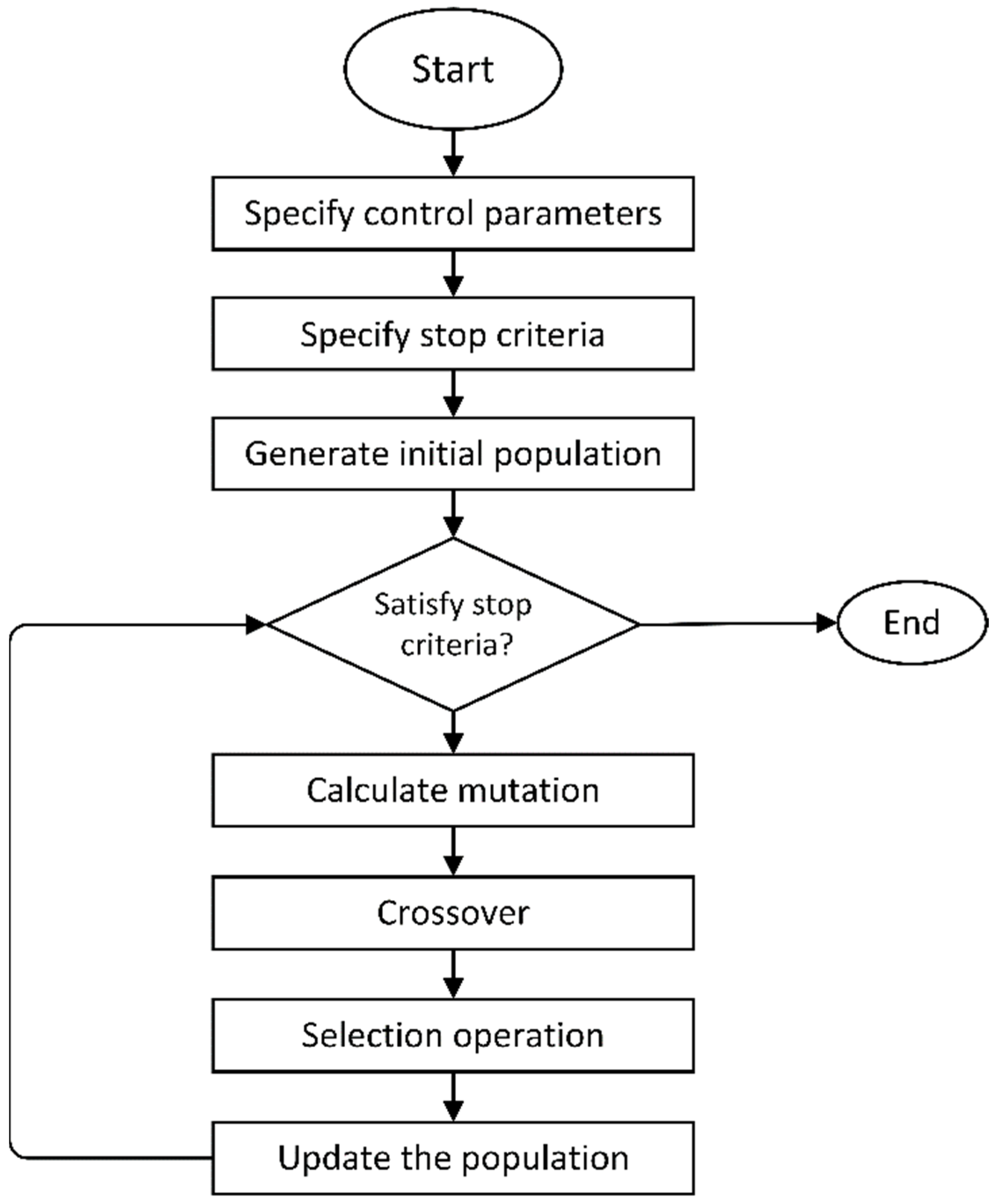
DE is a heuristic technique for problem optimization that improves a candidate solution in accordance with a predefined competency measure. Such an algorithm requires no assumptions about the underlying optimization problem and may successfully investigate a wide design space while displaying robustness in multi-modal situations. DE differs from other algorithms in the evolution process [97,98]. Figure 5 depicts a flow chart of traditional differential evolution. Using a set of randomly generated initial populations, DE picks two distinct individual vectors from according to a predetermined procedure and subtracts them together to produce a unique vector. In the first stage, preliminary parameter vectors are developed, and then the DE algorithm creates new individuals as shown below [98]:
where , and are the initial value, lower bound, and upper bound of search space, respectively. The next phase is the mutation, and the corresponding equation is given below:
where and are all separate random individuals, represents the mutant vector, and is the scaling factor. Crossover is used to improve the diversity of the disturbed parameter vectors, and the following equation describes the trail vector
where
represent the kth iteration of the regular random number, the crossover constant, and the arbitrarily chosen index 1, 2, ……,D. Several studies have examined DE for LFC to determine the optimal parameter settings for network stability. A PID controller with an optimum controller configuration was used in conjunction with a DE algorithm to ensure that LFC can be carried out efficiently in a regionally integrated power network that includes wind energy [99]. Similarly, a DE-based fuzzy-PID was presented for the LFC of conventional power networks with system fluctuations and modest load disturbances [25]. Using the DE, the authors in [67] developed a resilient FO-PIλD controller for a three-area power system that considers peak undershoots, convergence speed, and physical constraints. In reference [100], fuzzy and DE were combined to determine the optimum parameters of adaptive FOPID, which were evaluated for LFC problems during load disturbances.
Figure 5.
Flow chart of traditional DE [101].
5.2. Genetic Algorithm Technique
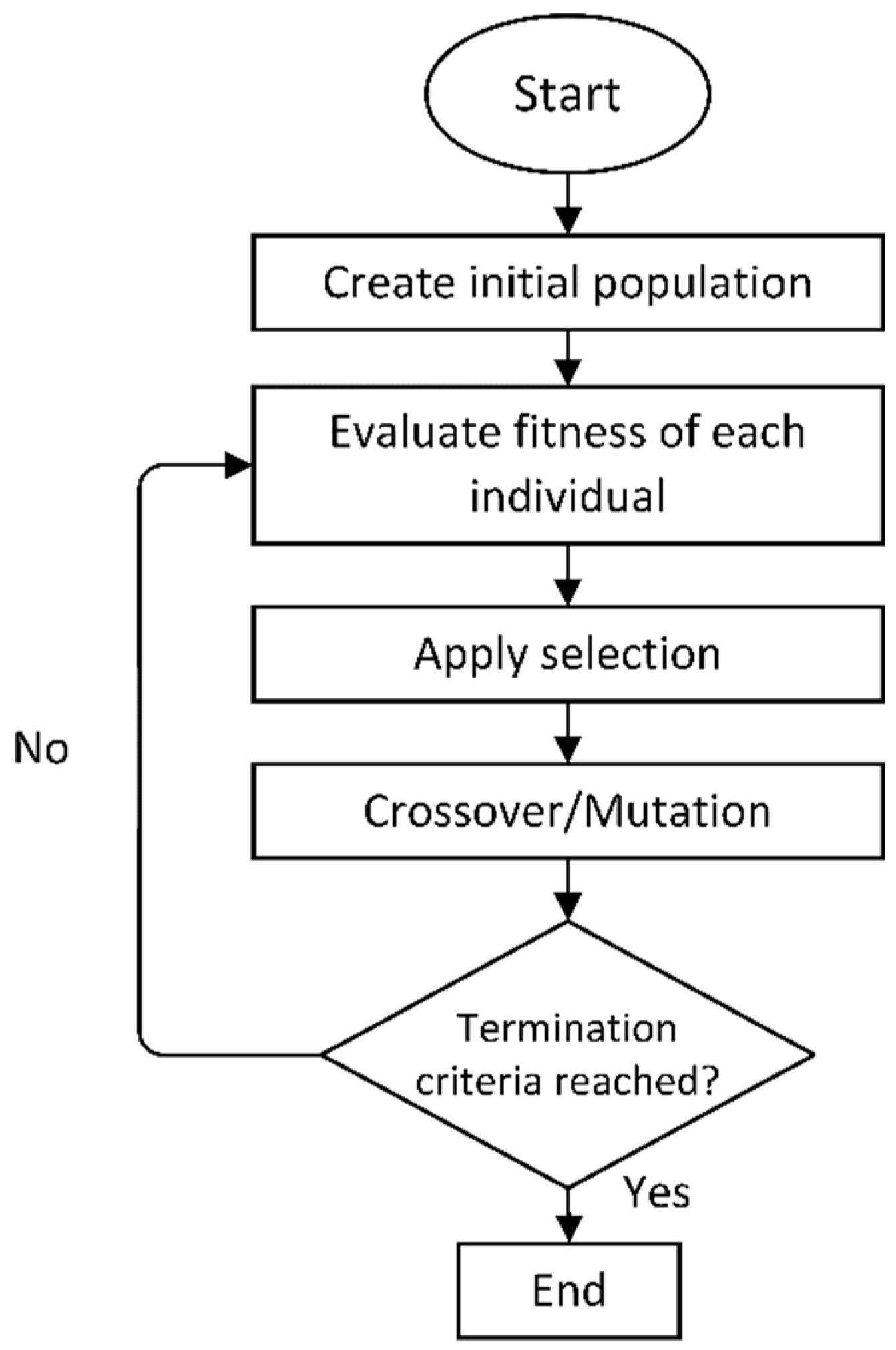
The GA is a stochastic selection-based approach for addressing non-linear, non-differentiable, irregular, and uncontrolled multi-objective optimization problems. The GA is continuously changing the population of candidate solutions, and at every phase, the GA picks out the best individuals in the existing population to be parents and employs them to produce offspring for the subsequent generation. Figure 6 depicts a flow diagram of a conventional GA. There have been several studies that investigated the effectiveness of GA for LFC to determine optimal parameter settings that help ensure network stability. A GA-based LFC for an EV microgrid was presented, and an assessment of a PID controller under uncertain conditions was performed to demonstrate system robustness [102]. Ref. [103] presented a GA-optimized FLC for frequency control in a dual-area thermal and solar power plant. In terms of dynamic performance, the suggested controller outperformed the PID, fuzzy logic, and GA-tuned PID controllers. For both conventional and unconventional microgrid systems with concurrent source and load fluctuations, a GA-optimized PI/PID controller was compared to the MPC design [62]. In [67], the DE and GA performances for three-area conventional power systems were examined, and a number of non-linear constraints such as GDB, GRC, and fuel dynamics were included. Similarly, the performance of a double-chain quantum GA on multi-area power systems was evaluated through application to real-world systems and its ability to handle non-linear constraints [104].
Figure 6.
Flow chart of a traditional GA [105].
5.3. Particle Swarm Algorithmic Technique
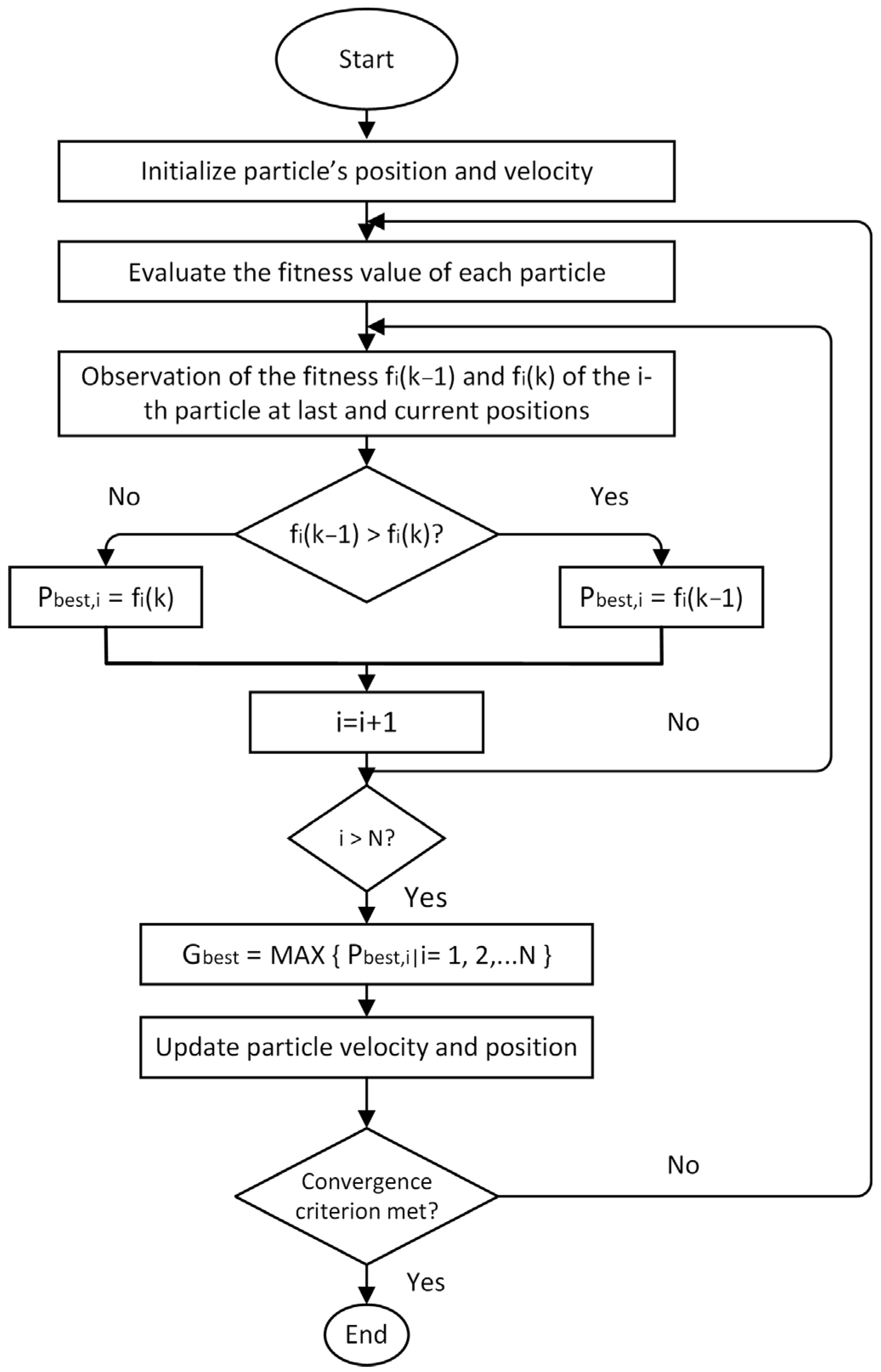
PSO is one of the strategies inspired by the movements of flocks of birds and schooling fish, and it is used to determine the best candidate solution using bio-inspired techniques. The advantage of this optimization approach is that it just requires the objective function and is unaffected by the gradient, implying that the problems do not need to be differentiable. PSO is quite comparable to evolutionary computation approaches [106,107]. The system is seeded with a population of stochastic solutions, and the optimal response is discovered through iterative upgrades. To find the optimum response, the particles in the swarm move according to their previous optimal and global optimal positions. Figure 7 depicts the flowchart of a traditional PSO technique.
where denote the particle index, particle counts, current iteration’ number, fitness value, and position. Similarly, the below equation governs the velocity ( and position of each particle in the PSO:
where and represent two constants; is the inertia weight; is the best prior position of the ith individual, respectively. Similarly, and both represent a random number generated independently from the other. Several studies examined the performance of PSO for LFC to optimize controller settings for network stability. The authors in [5] provided a method for regulating the pitch angle of WTGs and EVs for LFC in a microgrid system while simultaneously tuning the parameters of MPC using PSO. A T-MPC was designed to regulate the frequency of renewable-penetrated power systems that contain a significant number of EVs [57]. During this process, the PSO algorithm was applied to tune the parameters to find the optimum solution. Similarly, [52] demonstrated the performance of a composite bacterial foraging-PSO tuned PI/PID controller in an LFC non-linear integrated power system with conventional and non-conventional energy sources. The authors compared a PSO-optimized PID controller with a layered recurrent ANN in a dual-area wind-integrated power system [26]. Also, an SMC design approach was proposed for frequency control in an integrated power system, and controller parameters were derived using GWO and PSO methods to achieve an optimal outcome [71].
Figure 7.
Flow chart of a traditional PSO [108].
5.4. Artificial Intelligence (AI) Control Techniques
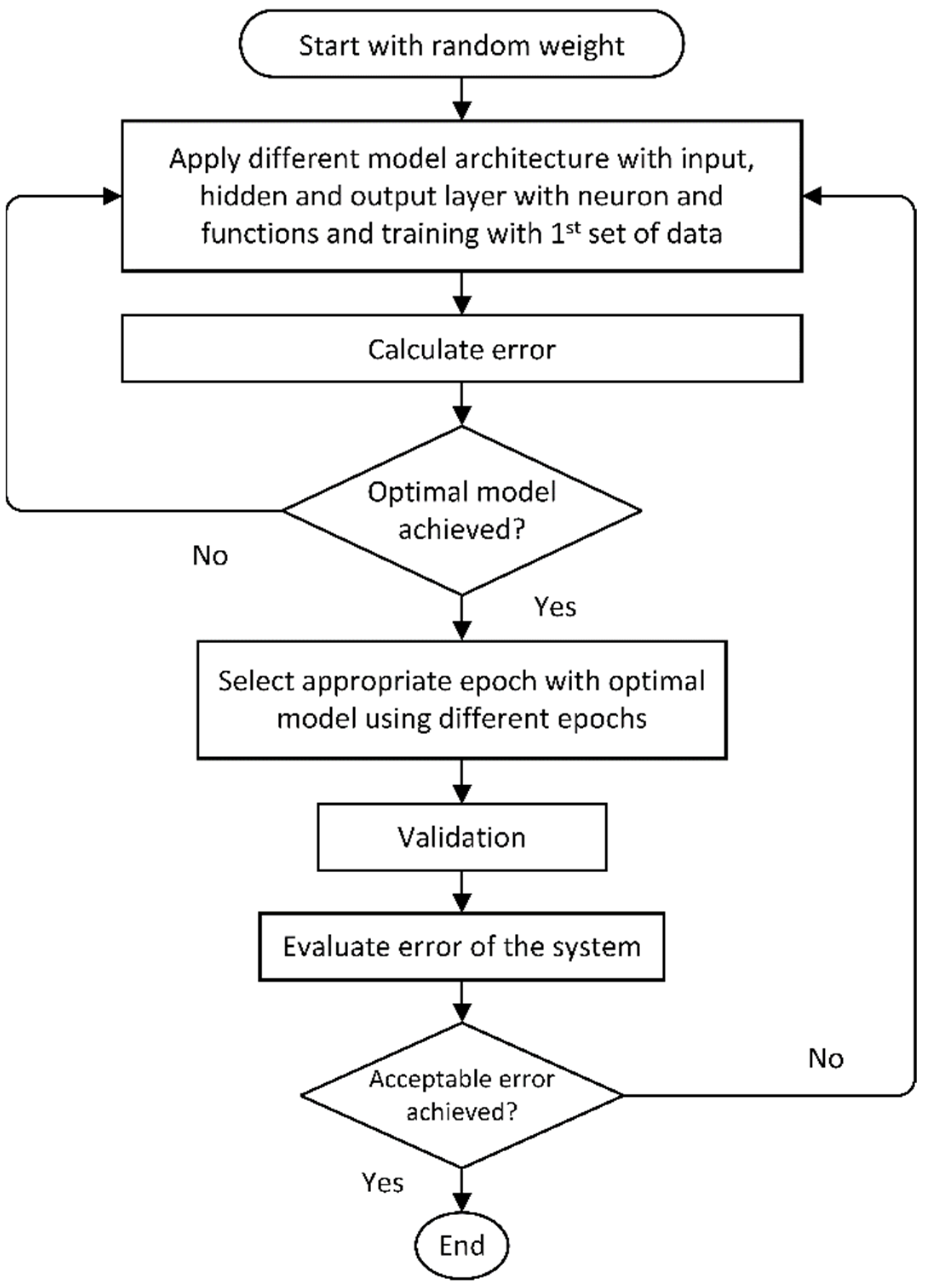
As more renewable energy sources, such as wind and solar, are added to power networks, conventional control may not be able to provide the level of precision required. When it comes to addressing this challenge, AI control methods including ANN and fuzzy logic control have been shown to be particularly effective. An ANN is a learning mechanism that uses a network of connected nodes or neurons to replicate the structure of the human mind [109,110]. An ANN may be programmed to identify trends, categorize data, and anticipate future occurrences based on the data it has been provided. Figure 8 is a flowchart illustrating the ANN algorithm applied in the model’s development. The multilayer perceptron ANN systems were designed have a generic shape:
where , and indicate the system outputs, system inputs, multilayer perceptron inputs, weight of input to hidden layer neuron, activation function constant, and the number of hidden neurons, respectively. Numerous studies have employed fuzzy logic and ANN to develop autonomous controllers for the LFC in the power system [20,25,26,27,111]. In a triple-connected system, an ANN controller was utilized to adjust the PI controller’s gain, which enhances the LFC’s transient response [111]. Owing to the resilience and durability of fuzzy logic, it has been utilized to solve complex variable structure problems that conventional control systems cannot effectively resolve. An FLC [25] based on DE has shown excellent performance in the LFC problem of power systems; however, there are certain limitations in terms of MFs and criterion selection. These constraints may be overcome through the use of a multilayer recurring ANN coupled with a regressive and adjustable control mechanism [26], but this adds considerable computing complexity to the system. For enhanced dynamic performance in today’s power systems, the authors in [27] proposed FLC in conjunction with conventional PI/PID controllers using a novel TLBO approach. Also, the authors in [20] compared the LFC capabilities of ANFIS, ANN, and fuzzy controllers, and the results indicate that the ANFIS controller improves dynamic response, including efficient execution, reduced fault magnitudes, and lower transitory frequency.
Figure 8.
Flow chart of a traditional ANN [112].
5.5. Fuzzy Logic Approach
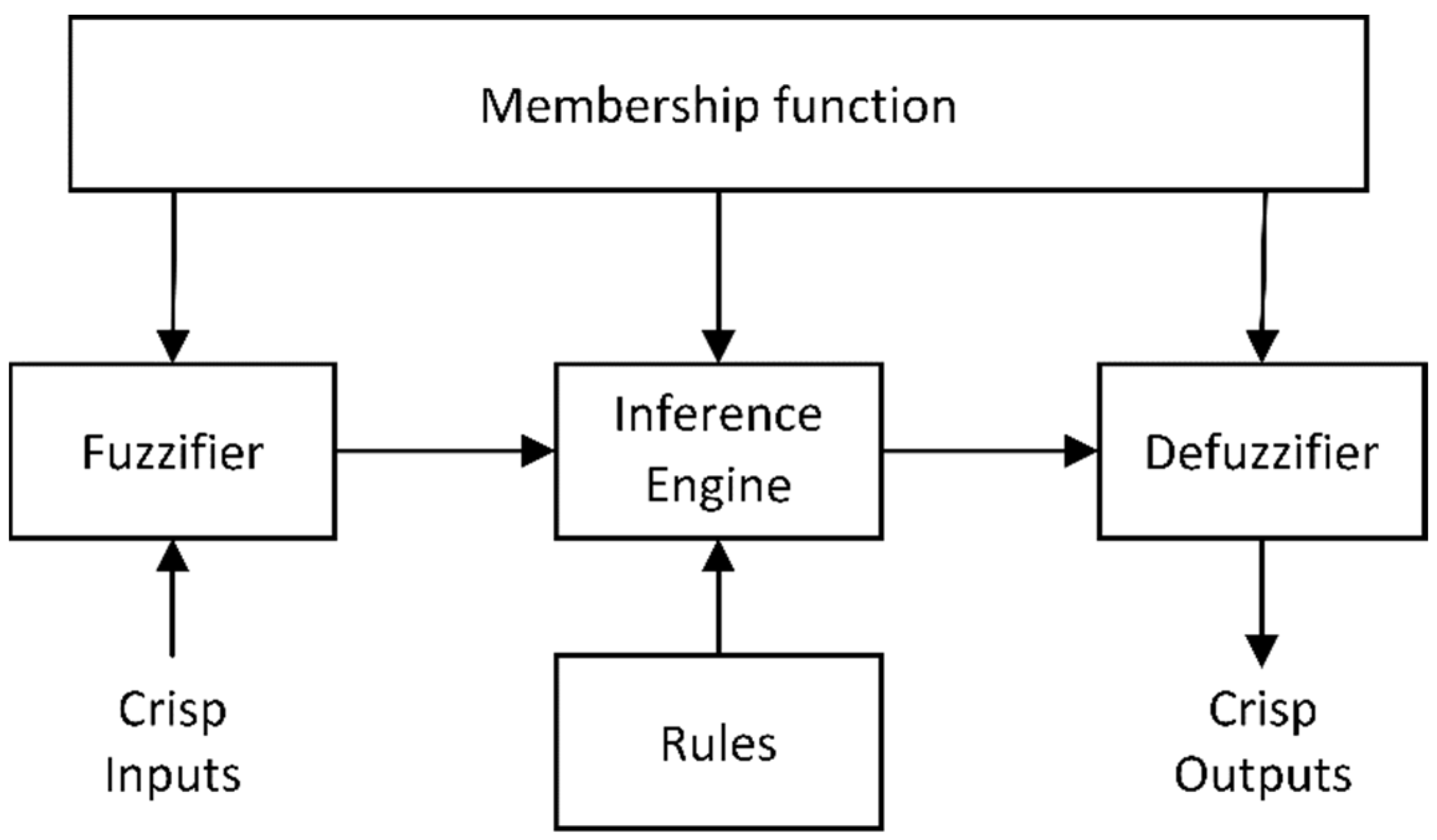
In recent years, an FL strategy for regulating system behavior has revived research interest due to its wide operating range and reasonable response times. More control scheme implementations are expected for complex power systems due to FL’s robustness, reliability, and capability to address difficulties without comprehending the mathematical functions of the system [12]. The FL control is made up of four major elements: the fuzzifier, the inference system, the rule base, and the de-fuzzifier, as shown in Figure 9. The fuzzifier converts numerical input into fuzzy sets, while the inference engine carries out all logic operations in FLC. The rule base is made up of MF and control rules, and the de-fuzzifier converts again the fuzzy set to numerical values. Various studies examined the dynamics of FL for LFC to optimize controller settings for network stability. A fuzzy-based SMC has been developed to deal with the maximum boundary limit of disturbances and instabilities in second-order systems [29]. The FL control system simulates the switching control law, which reduces disturbances and instabilities while eliminating input signal chattering. Reference [34] designed a fuzzy-based two-layer MPC to integrate ESSs in the LFC scheme of three-area power systems while considering a number of operational and physical constraints. Similarly, for the LFC of a hybrid system comprising conventional and non-conventional power sources, an IDD tuned by FL was used to examine the system’s performance and response to disturbances [80].
Figure 9.
Flow chart of a traditional FL [113].
5.6. Moth-Flame Optimization Technique
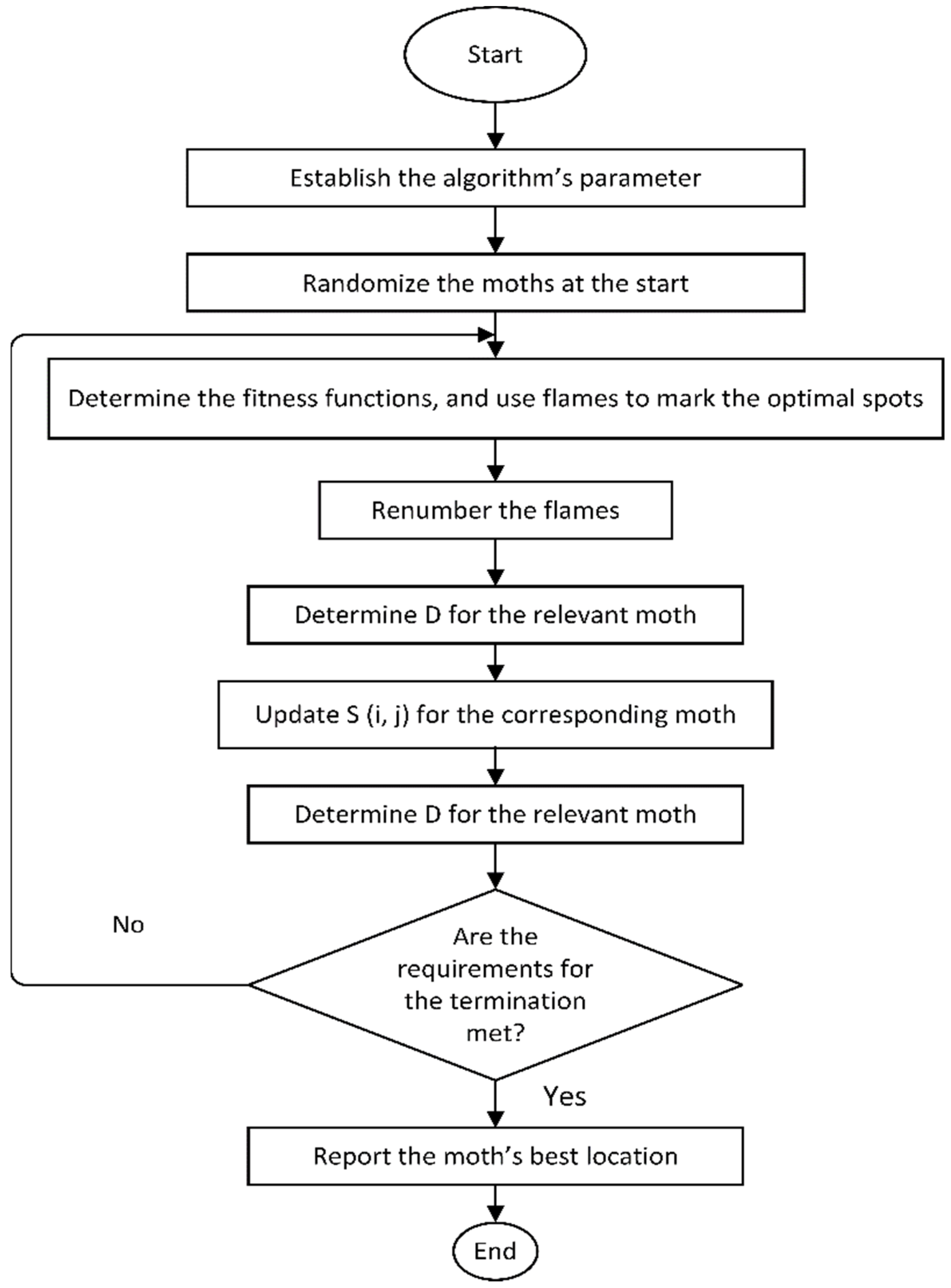
The MFO technique was created in 2016 as one of the key attempts to simulate moth movement in computers and give an optimization strategy. Figure 10 depicts a traditional MFO algorithm’s flowchart. MFO determines the candidate solutions as moths, with their locations in space as the solution variable. Consequently, moths may fly in 1D, 2D, 3D, or multidimensional environments by altering their position vectors. Both moths and flames are viable solutions, but the difference lies in how we manage and adjust them during each cycle. The array of moths (M) and flames (F), as well as their fitness value vectors (OM, OF), may be expressed as follows [114]:
Figure 10.
Flow chart of a traditional MFO [115].
In this case, indicate the number of moths and control variables required, respectively. In the same way, the position of each moth relative to a flame can be determined by considering the following equation when studying a moth’s flying behavior:
indicate the jth moth, kth flame, and helical function, respectively. The helical function is represented as:
, , , , and are the linear distance, logarithmical helix shape constant, path coefficient, the maximum number of iterations, and constant, respectively. The performance of MFO for LFC has been analyzed in several studies to determine the appropriate settings for controllers. In [23], LFC was structured for multi-area power systems.
The MFO technique was employed to tune the PI controller and the WTG frequency regulator for optimum performance. Reference [24] employed MFO and PID techniques to design blade pitch controllers (BPC) to regulate voltage and power output oscillations, demonstrating the MFO technology’s efficacy. An algorithm that tunes the BPC’s settings was only applied to one wind turbine. An MFO-optimized 2-DOF PID controller was designed for frequency regulation of dual-areas interconnected power systems [116]. In addition, a comparison was performed between the MFO-optimized controller and the GA and cuckoo search algorithms (CSA). Similarly, an MFO was developed to optimize the controller parameters for the LFC of a two-area power system, and the algorithm’s performance was evaluated using sensitivity analysis in the presence of loaded scenarios and network instabilities [117].
5.7. Other Soft Computing Approaches
LFC solutions based on various recently developed soft computing approaches have been proposed for both conventional and unconventional power systems. For instance, a customized variant of the BA along with FL was used to obtain optimal results from a traditional PI controller for LFC in four-area systems [69]. For a concurrent variation in wind output and load fluctuation, a moth swarm algorithm (MSA)-tuned PI-PD controller for LFC of an integrated power system was designed and tested [74]. Using an MVO-optimized 3DOF-PID controller, the authors in [72] addressed the dynamic controller design challenge of a four-region integrated power system. The authors in [71] proposed an SMC controller for frequency regulation in an integrated power system, and the grey wolf optimization (GWO) technique was employed to build sliding surface parameters. The authors in [118] addressed the usage of an artificial bee colony (ABC) to give synchronized frequency management to a decentralized sustainable energy microgrid system. A novel LFC approach for interconnected power systems using biogeography-based optimization (BBO) was presented in [119] to improve controller settings. Three optimization techniques for adjusting controller settings in a dual-area power system were proposed, and the findings demonstrate that teaching-learning-based optimization (TLBO) had the highest performance during the dynamic test period [63]. To optimize the gains of an IDD controller, a sophisticated magnetotactic bacteria optimization (MBO) algorithm was being developed [80]. Various system changes, such as load disturbances, overloading, and solar irradiation, have been shown to demonstrate the robustness of the MBO-optimized IDD controller. Furthermore, a chimp optimization algorithm (COA) was used to fine-tune the constraints on the robust MPC controller design, and the controller design’s performance was demonstrated for a multi-area power system [19]. A newly developed water cycle algorithm (WCA) was also evaluated for its performance when used for configuring the TI-TID for LFC in a deregulated power system [81].
Table 2 provides an overview of recent controllers and soft computing tools developed for LFC conventional and renewable integrated power networks. Different controllers and soft computing techniques have been used for both conventional and renewable energy integrated power systems. Some authors have provided a detailed description of a wind-integrated power system, while others have focused on conventional power. The table also shows that further research on the LFC of wind-integrated power systems is required to develop more robust systems capable of supporting the anticipated growth in wind power production.
Table 2.
A comparison of numerous studies on the LFC scheme.
6. Conclusions
Over the last few decades, there has been an increase in the significance of renewable energy, particularly wind energy, which has placed an additional strain on the LFC capacity of the power system. As a consequence of the fluctuating wind speeds, WTGs are unable to offer continuous load monitoring and control, which may have a substantial effect on the system’s operating frequency. Thus, maintaining frequency stability is critical in minimizing power system failures and turbine blade damage caused by extreme vibrations. This survey examined the frequency stability issues in wind-integrated power systems. The pros and cons of various wind-integrated power system models, as well as the impact of these models on LFC, were examined. Critical factors, such as energy systems, resources, optimization approaches, resilience, and transient stability have been studied to demonstrate the uniqueness of the proposed design. In addition, this paper has outlined current research on LFC control strategies for wind-integrated power systems, including PI/PID/PIDF; SMC; MPC; cascade; and dual phase controllers. Finally, in terms of the LFC issue, many contemporary soft computing approaches including DE, GA, PSO, ANN, FL, MFO, and other widely used soft computing tools have been explored. The analysis concluded that although there have been significant advancements in control and optimization techniques, these techniques still have deficiencies that impact the operation of real power systems. Furthermore, these approaches did not account for the high level of wind energy integration in the future power system. Therefore, additional research on the LFC of wind-integrated power systems is necessary to develop more resilient systems capable of sustaining the anticipated increase in wind power production.
Future power systems may face frequent stability issues due to rising load demands and greater integration of renewable energy sources, notably wind and solar. Therefore, a modern control mechanism with appropriate optimization approaches that account for varying load demands and renewable energy penetrations are required to mitigate LFC concerns. Given the potential future of LFC research and the fact that wind and solar energies together account for more than 10% of global electricity production, it is imperative that a comparative study be conducted to analyze advanced controllers and optimization strategies for both wind- and solar-integrated power systems.
Funding
This research received no external funding.
Institutional Review Board Statement
Not applicable.
Informed Consent Statement
Not applicable.
Data Availability Statement
Not applicable.
Conflicts of Interest
The authors declare no conflict of interest.
References
- Asghar, R.; Ullah, Z.; Azeem, B.; Aslam, S.; Hashmi, M.H.; Rasool, E.; Shaker, B.; Anwar, M.J.; Mustafa, K. Wind Energy Potential in Pakistan: A Feasibility Study in Sindh Province. Energies 2022, 15, 8333. [Google Scholar] [CrossRef]
- Li, J.; Wang, G.; Li, Z.; Yang, S.; Chong, W.T.; Xiang, X. A Review on Development of Offshore Wind Energy Conversion System. Int. J. Energy Res. 2020, 44, 9283–9297. [Google Scholar] [CrossRef]
- REN21. Renewables 2021 Global Status Report. Available online: https://www.ren21.net/wp-content/uploads/2019/05/GSR2021_Full_Report.pdf (accessed on 21 October 2022).
- International Energy. AGENCY Net Zero by 2050 A Roadmap for the Global Energy Sector. Available online: https://iea.blob.core.windows.net/assets/deebef5d-0c34-4539-9d0c-10b13d840027/NetZeroby2050-ARoadmapfortheGlobalEnergySector_CORR.pdf (accessed on 21 October 2022).
- Pahasa, J.; Ngamroo, I. Coordinated Control of Wind Turbine Blade Pitch Angle and PHEVs Using MPCs for Load Frequency Control of Microgrid. IEEE Syst. J. 2016, 10, 97–105. [Google Scholar] [CrossRef]
- Ratnam, K.S.; Palanisamy, K.; Yang, G. Future Low-Inertia Power Systems: Requirements, Issues, and Solutions—A Review. Renew. Sustain. Energy Rev. 2020, 124, 109773. [Google Scholar] [CrossRef]
- Yan, Z.; Xu, Y. Data-Driven Load Frequency Control for Stochastic Power Systems: A Deep Reinforcement Learning Method with Continuous Action Search. IEEE Trans. Power Syst. 2019, 34, 1653–1656. [Google Scholar] [CrossRef]
- Singh, B.; Slowik, A.; Bishnoi, S.K. A Dual-Stage Controller for Frequency Regulation in a Two-Area Realistic Diverse Hybrid Power System Using Bull–Lion Optimization. Energies 2022, 15, 8063. [Google Scholar] [CrossRef]
- Jood, P.; Aggarwal, S.K.; Chopra, V. Performance Assessment of a Neuro-Fuzzy Load Frequency Controller in the Presence of System Non-Linearities and Renewable Penetration. Comput. Electr. Eng. 2019, 74, 362–378. [Google Scholar] [CrossRef]
- Dreidy, M.; Mokhlis, H.; Mekhilef, S. Inertia Response and Frequency Control Techniques for Renewable Energy Sources: A Review. Renew. Sustain. Energy Rev. 2017, 69, 144–155. [Google Scholar] [CrossRef]
- Ochoa, D.; Martinez, S. Frequency Dependent Strategy for Mitigating Wind Power Fluctuations of a Doubly-Fed Induction Generator Wind Turbine Based on Virtual Inertia Control and Blade Pitch Angle Regulation. Renew. Energy 2018, 128, 108–124. [Google Scholar] [CrossRef]
- Guo, S.F.; Zhang, J.T.; Asaah, P.; Hao, L.L.; Ji, J. A Review of Wind Turbine Deloaded Operationtechniques for Primary Frequency Control in Power System. In Proceedings of the 2018 China International Conference on Electricity Distribution (CICED), Tianjin, China, 17–19 September 2018; pp. 63–71. [Google Scholar] [CrossRef]
- Abouzeid, S.I.; Guo, Y.; Zhang, H.C. Coordinated Control of the Conventional Units, Wind Power, and Battery Energy Storage System for Effective Support in the Frequency Regulation Service. Int. Trans. Electr. Energy Syst. 2019, 29, e2845. [Google Scholar] [CrossRef]
- Hazari, M.R.; Jahan, E.; Mannan, M.A.; Tamura, J. Coordinated Control Scheme of Battery Storage System to Augment LVRT Capability of SCIG-Based Wind Turbines and Frequency Regulation of Hybrid Power System. Electronics 2020, 9, 239. [Google Scholar] [CrossRef]
- Barra, P.H.A.; de Carvalho, W.C.; Menezes, T.S.; Fernandes, R.A.S.; Coury, D.V. A Review on Wind Power Smoothing Using High-Power Energy Storage Systems. Renew. Sustain. Energy Rev. 2021, 137, 110455. [Google Scholar] [CrossRef]
- Ahmed, E.M.; Mohamed, E.A.; Elmelegi, A.; Aly, M.; Elbaksawi, O. Optimum Modified Fractional Order Controller for Future Electric Vehicles and Renewable Energy-Based Interconnected Power Systems. IEEE Access 2021, 9, 29993–30010. [Google Scholar] [CrossRef]
- Bibak, B.; Tekiner-Moğulkoç, H. A Comprehensive Analysis of Vehicle to Grid (V2G) Systems and Scholarly Literature on the Application of Such Systems. Renew. Energy Focus 2021, 36, 1–20. [Google Scholar] [CrossRef]
- Gonzalez Venegas, F.; Petit, M.; Perez, Y. Active Integration of Electric Vehicles into Distribution Grids: Barriers and Frameworks for Flexibility Services. Renew. Sustain. Energy Rev. 2021, 145, 111060. [Google Scholar] [CrossRef]
- Khamies, M.; Magdy, G.; Kamel, S.; Khan, B. Optimal Model Predictive and Linear Quadratic Gaussian Control for Frequency Stability of Power Systems Considering Wind Energy. IEEE Access 2021, 9, 116453–116474. [Google Scholar] [CrossRef]
- Yadav, P.K.; Bhasker, R.; Upadhyay, S.K. Comparative Study of ANFIS Fuzzy Logic and Neural Network Scheduling Based Load Frequency Control for Two-Area Hydro Thermal System. Mater. Today Proc. 2021, 56, 3042–3050. [Google Scholar] [CrossRef]
- Zhang, C.; Wang, S.; Zhao, Q. Distributed Economic MPC for LFC of Multi-Area Power System with Wind Power Plants in Power Market Environment. Int. J. Electr. Power Energy Syst. 2021, 126, 106548. [Google Scholar] [CrossRef]
- Khan, M.; Sun, H.; Xiang, Y.; Shi, D. Electric Vehicles Participation in Load Frequency Control Based on Mixed H2/H∞. Int. J. Electr. Power Energy Syst. 2021, 125, 106420. [Google Scholar] [CrossRef]
- Dhundhara, S.; Verma, Y.P. Grid Frequency Enhancement Using Coordinated Action of Wind Unit with Redox Flow Battery in a Deregulated Electricity Market. Int. Trans. Electr. Energy Syst. 2020, 30, e12189. [Google Scholar] [CrossRef]
- Ebrahim, M.A.; Becherif, M.; Abdelaziz, A.Y. Dynamic Performance Enhancement for Wind Energy Conversion System Using Moth-Flame Optimization Based Blade Pitch Controller. Sustain. Energy Technol. Assess. 2018, 27, 206–212. [Google Scholar] [CrossRef]
- Jalali, N.; Razmi, H.; Doagou-Mojarrad, H. Optimized Fuzzy Self-Tuning PID Controller Design Based on Tribe-DE Optimization Algorithm and Rule Weight Adjustment Method for Load Frequency Control of Interconnected Multi-Area Power Systems. Appl. Soft Comput. 2020, 93, 106424. [Google Scholar] [CrossRef]
- Sharma, G.; Panwar, A.; Arya, Y.; Kumawat, M. Integrating Layered Recurrent ANN with Robust Control Strategy for Diverse Operating Conditions of AGC of the Power System. IET Gener. Transm. Distrib. 2020, 14, 3886–3895. [Google Scholar] [CrossRef]
- Annamraju, A.; Nandiraju, S. Robust Frequency Control in a Renewable Penetrated Power System: An Adaptive Fractional Order-Fuzzy Approach. Prot. Control Mod. Power Syst. 2019, 4, 16. [Google Scholar] [CrossRef]
- Lv, X.; Sun, Y.; Wang, Y.; Dinavahi, V. Adaptive Event-Triggered Load Frequency Control of Multi-Area Power Systems under Networked Environment via Sliding Mode Control. IEEE Access 2020, 8, 86585–86594. [Google Scholar] [CrossRef]
- Vo, A.T.; Kang, H.J.; Le, T.D. An Adaptive Fuzzy Terminal Sliding Mode Control Methodology for Uncertain Nonlinear Second-Order Systems. In Proceedings of the 14th International Conference, ICIC 2018, Wuhan, China, 15–18 August 2018; pp. 123–135. [Google Scholar] [CrossRef]
- Borrelli, F.; Bemporad, A.; Morari, M. Predictive Control for Linear and Hybrid Systems; Cambridge University Press: Cambridge, UK, 2017. [Google Scholar] [CrossRef]
- Wu, C.; Gao, S.; Liu, Y.; Song, T.E.; Han, H. A Model Predictive Control Approach in Microgrid Considering Multi-Uncertainty of Electric Vehicles. Renew. Energy 2021, 163, 1385–1396. [Google Scholar] [CrossRef]
- Mohamed, M.A.; Diab, A.A.Z.; Rezk, H.; Jin, T. A Novel Adaptive Model Predictive Controller for Load Frequency Control of Power Systems Integrated with DFIG Wind Turbines. Neural Comput. Appl. 2020, 32, 7171–7181. [Google Scholar] [CrossRef]
- Liu, X.; Zhang, Y.; Lee, K.Y. Robust Distributed MPC for Load Frequency Control of Uncertain Power Systems. Control Eng. Pract. 2016, 56, 136–147. [Google Scholar] [CrossRef]
- Oshnoei, A.; Kheradmandi, M.; Muyeen, S.M. Robust Control Scheme for Distributed Battery Energy Storage Systems in Load Frequency Control. IEEE Trans. Power Syst. 2020, 35, 4781–4791. [Google Scholar] [CrossRef]
- Jain, S.K.; Chakrabarti, S.; Singh, S.N. Review of Load Frequency Control Methods, Part-I: Introduction and Pre-Deregulation Scenario. In Proceedings of the 2013 International Conference on Control, Automation, Robotics and Embedded Systems (CARE), Jabalpur, India, 16–18 December 2013. [Google Scholar] [CrossRef]
- Pappachen, A.; Peer Fathima, A. Critical Research Areas on Load Frequency Control Issues in a Deregulated Power System: A State-of-the-Art-of-Review. Renew. Sustain. Energy Rev. 2017, 72, 163–177. [Google Scholar] [CrossRef]
- Pandey, S.K.; Mohanty, S.R.; Kishor, N. A Literature Survey on Load–Frequency Control for Conventional and Distribution Generation Power Systems. Renew. Sustain. Energy Rev. 2013, 25, 318–334. [Google Scholar] [CrossRef]
- Prakash, A.; Kumar, K.; Parida, S.K. PIDF(1+FOD) Controller for Load Frequency Control with Sssc and Ac-Dc Tie-Line in Deregulated Environment. IET Gener. Transm. Distrib. 2020, 14, 2751–2762. [Google Scholar] [CrossRef]
- Prakash, A.; Kumar, K.; Parida, S.K. A Novel I-PDF Controller for LFC with AC/DC Tie-Line. In Proceedings of the 2019 20th International Conference on Intelligent System Application to Power Systems (ISAP), New Delhi, India, 10–14 December 2019. [Google Scholar] [CrossRef]
- Imam, A.M.; Chaudhary, K.; Kunya, A.B.; Rizvi, Z.; Ali, J. Impact of Communication Delay on Distributed Load Frequency Control (Dis-LFC) in Multi-Area Power System (MAPS). Malays. J. Fundam. Appl. Sci. 2019, 15, 626–632. [Google Scholar] [CrossRef]
- Asghar, R.; Ali, A.; Rehman, F.; Ullah, R.; Ullah, K.; Ullah, Z.; Sarwar, M.A.; Khan, B. Load Frequency Control for EVs Based Smart Grid System Using PID and MPC. In Proceedings of the 2020 3rd International Conference on Computing, Mathematics and Engineering Technologies (iCoMET), Sukkur, Pakistan, 29–30 January 2020. [Google Scholar] [CrossRef]
- Haes Alhelou, H.; Hamedani-Golshan, M.E.; Zamani, R.; Heydarian-Forushani, E.; Siano, P. Challenges and Opportunities of Load Frequency Control in Conventional, Modern and Future Smart Power Systems: A Comprehensive Review. Energies 2018, 11, 2497. [Google Scholar] [CrossRef]
- Mikulčić, H.; Baleta, J.; Klemeš, J.J.; Wang, X. Energy Transition and the Role of System Integration of the Energy, Water and Environmental Systems. J. Clean. Prod. 2021, 292, 126027. [Google Scholar] [CrossRef]
- Fouladi, E.; Baghaee, H.R.; Bagheri, M.; Gharehpetian, G.B. Power Management of Microgrids Including PHEVs Based on Maximum Employment of Renewable Energy Resources. IEEE Trans. Ind. Appl. 2020, 56, 5299–5307. [Google Scholar] [CrossRef]
- Al Kez, D.; Foley, A.M.; McIlwaine, N.; Morrow, D.J.; Hayes, B.P.; Zehir, M.A.; Mehigan, L.; Papari, B.; Edrington, C.S.; Baran, M. A Critical Evaluation of Grid Stability and Codes, Energy Storage and Smart Loads in Power Systems with Wind Generation. Energy 2020, 205, 117671. [Google Scholar] [CrossRef]
- Aziz, A.; Oo, A.T.; Stojcevski, A. Analysis of Frequency Sensitive Wind Plant Penetration Effect on Load Frequency Control of Hybrid Power System. Int. J. Electr. Power Energy Syst. 2018, 99, 603–617. [Google Scholar] [CrossRef]
- Gulzar, M.M.; Iqbal, M.; Shahzad, S.; Muqeet, H.A.; Shahzad, M.; Hussain, M.M. Load Frequency Control (LFC) Strategies in Renewable Energy-Based Hybrid Power Systems: A Review. Energies 2022, 15, 3488. [Google Scholar] [CrossRef]
- Guo, J. Application of Full Order Sliding Mode Control Based on Different Areas Power System with Load Frequency Control. ISA Trans. 2019, 92, 23–34. [Google Scholar] [CrossRef]
- Uyioghosa, I.E.; Saha, A.K. DMPC Scheme for Load Frequency Control with Application to Interconnected Power System. In Proceedings of the 2020 International SAUPEC/RobMech/PRASA Conference, Cape Town, South Africa, 29–31 January 2020. [Google Scholar] [CrossRef]
- Naga Sai Kalyan, C.H.; Srikanth Goud, B.; Rami Reddy, C.; Bajaj, M.; Sharma, N.K.; Alhelou, H.H.; Siano, P.; Kamel, S. Comparative Performance Assessment of Different Energy Storage Devices in Combined LFC and AVR Analysis of Multi-Area Power System. Energies 2022, 15, 629. [Google Scholar] [CrossRef]
- Liu, X.; Zhang, Y.; Lee, K.Y. Coordinated Distributed MPC for Load Frequency Control of Power System with Wind Farms. IEEE Trans. Ind. Electron. 2017, 64, 5140–5150. [Google Scholar] [CrossRef]
- Dhillon, S.S.; Lather, J.S.; Marwaha, S. Multi Objective Load Frequency Control Using Hybrid Bacterial Foraging and Particle Swarm Optimized PI Controller. Int. J. Electr. Power Energy Syst. 2016, 79, 196–209. [Google Scholar] [CrossRef]
- Zhang, Y.; Liu, X.; Qu, B. Distributed Model Predictive Load Frequency Control of Multi-Area Power System with DFIGs. IEEE/CAA J. Autom. Sin. 2017, 4, 125–135. [Google Scholar] [CrossRef]
- Dahiya, P.; Sharma, V.; Naresh, R. Optimal Sliding Mode Control for Frequency Regulation in Deregulated Power Systems with DFIG-Based Wind Turbine and TCSC–SMES. Neural Comput. Appl. 2019, 31, 3039–3056. [Google Scholar] [CrossRef]
- Osman, S.O.; Rahim, A.; Mustafa, S.P.; Nawari, O. Load Frequency Control for a Two Area Power System; University of Khartoum: Al Khurtum, Sudan, 2017. [Google Scholar]
- Aung, S.S.; Htike, Z.M. Modeling and Simulation of Load Frequency Control for Three Area Power System Using Proportional Integral Derivative (PID) Controller. Am. Acad. Sci. Res. J. Eng. Technol. Sci. 2016, 26, 301–315. [Google Scholar]
- Oshnoei, A.; Kheradmandi, M.; Muyeen, S.M.; Hatziargyriou, N.D. Disturbance Observer and Tube-Based Model Predictive Controlled Electric Vehicles for Frequency Regulation of an Isolated Power Grid. IEEE Trans. Smart Grid 2021, 12, 4351–4362. [Google Scholar] [CrossRef]
- Tumino, P. Frequency Control in a Power System-Technical Articles. Available online: https://eepower.com/technical-articles/frequency-control-in-a-power-system/# (accessed on 15 October 2020).
- Alhelou, H.H.; Siano, P.; Tipaldi, M.; Iervolino, R.; Mahfoud, F. Primary Frequency Response Improvement in Interconnected Power Systems Using Electric Vehicle Virtual Power Plants. World Electr. Veh. J. 2020, 11, 40. [Google Scholar] [CrossRef]
- Bektache, A.; Boukhezzar, B. Nonlinear Predictive Control of a DFIG-Based Wind Turbine for Power Capture Optimization. Int. J. Electr. Power Energy Syst. 2018, 101, 92–102. [Google Scholar] [CrossRef]
- Lei, W.; Li, C.; Chen, M.Z.Q. Robust Adaptive Tracking Control for Quadrotors by Combining PI and Self-Tuning Regulator. IEEE Trans. Control Syst. Technol. 2019, 27, 2663–2671. [Google Scholar] [CrossRef]
- Mishra, S.; Nayak, P.C.; Prusty, U.C.; Prusty, R.C. Model Predictive Controller Based Load Frequency Control of Isolated Microgrid System Integrated to Plugged-in Electric Vehicle. In Proceedings of the 2021 1st Odisha International Conference on Electrical Power Engineering, Communication and Computing Technology (ODICON), Bhubaneswar, India, 8–9 January 2021. [Google Scholar] [CrossRef]
- Elsaied, M.M.; Attia, M.A.; Abdelhamed, M.; Said, M.; Mekhamer, F.; Mostafa, M.A.; Mekhamer, S.F. Application of Different Optimization Techniques to Load Frequency Control with WECS in a Multi-Area System. Electr. Power Compon. Syst. 2018, 46, 739–756. [Google Scholar] [CrossRef]
- Kumar, A.; Shankar, R. A Quasi Opposition Lion Optimization Algorithm for Deregulated AGC Considering Hybrid Energy Storage System. J. Electr. Eng. Technol. 2021, 16, 2995–3015. [Google Scholar] [CrossRef]
- Vedik, B.; Kumar, R.; Deshmukh, R.; Verma, S.; Shiva, C.K. Renewable Energy-Based Load Frequency Stabilization of Interconnected Power Systems Using Quasi-Oppositional Dragonfly Algorithm. J. Control Autom. Electr. Syst. 2020, 32, 227–243. [Google Scholar] [CrossRef]
- Guo, J. Application of a Novel Adaptive Sliding Mode Control Method to the Load Frequency Control. Eur. J. Control 2021, 57, 172–178. [Google Scholar] [CrossRef]
- Delassi, A.; Arif, S.; Mokrani, L. Load Frequency Control Problem in Interconnected Power Systems Using Robust Fractional PIλD Controller. Ain Shams Eng. J. 2018, 9, 77–88. [Google Scholar] [CrossRef]
- Das, S.; Saikia, L.C.; Datta, S. Maiden Application of TIDN-(1+PI) Cascade Controller in LFC of a Multi-Area Hydro-Thermal System Incorporating EV–Archimedes Wave Energy-Geothermal-Wind Generations under Deregulated Scenario. Int. Trans. Electr. Energy Syst. 2021, 31, e12907. [Google Scholar] [CrossRef]
- Khooban, M.H.; Niknam, T. A New Intelligent Online Fuzzy Tuning Approach for Multi-Area Load Frequency Control: Self Adaptive Modified Bat Algorithm. Int. J. Electr. Power Energy Syst. 2015, 71, 254–261. [Google Scholar] [CrossRef]
- Shayeghi, H.; Rahnama, A.; Mohajery, R.; Bizon, N.; Mazare, A.G.; Ionescu, L.M. Multi-Area Microgrid Load-Frequency Control Using Combined Fractional and Integer Order Master–Slave Controller Considering Electric Vehicle Aggregator Effects. Electronics 2022, 11, 3440. [Google Scholar] [CrossRef]
- Kumar, A.; Anwar, M.N.; Kumar, S. Sliding Mode Controller Design for Frequency Regulation in an Interconnected Power System. Prot. Control Mod. Power Syst. 2021, 6, 6. [Google Scholar] [CrossRef]
- Mudi, J.; Shiva, C.K.; Mukherjee, V. Multi-Verse Optimization Algorithm for LFC of Power System with Imposed Nonlinearities Using Three-Degree-of-Freedom PID Controller. Iran. J. Sci. Technol. Trans. Electr. Eng. 2019, 43, 837–856. [Google Scholar] [CrossRef]
- Memon, S.; Kalhoro, A.N. Design of Multivariable PID Controllers: A Comparative Study. Int. J. Comput. Sci. Netw. Secur. 2021, 21, 11–18. [Google Scholar] [CrossRef]
- Khamari, D.; Sahu, R.K.; Panda, S. Moth Swarm Algorithm Based Cascade PI-PD Controller for Frequency Regulation of Distributed Power Generation System with Electric Vehicle. In Proceedings of the 2020 First International Conference on Power, Control and Computing Technologies (ICPC2T), Raipur, India, 3–5 January 2020; pp. 16–20. [Google Scholar] [CrossRef]
- Asghar, R.; Rehman, F.; Ullah, Z.; Aman, A.; Iqbal, K.; Nawaz, A.A. Modified Switch Type Fault Current Limiter for Low-Voltage Ride-through Enhancement and Reactive Power Support of DFIG-WT under Grid Faults. IET Renew. Power Gener. 2020, 14, 1481–1490. [Google Scholar] [CrossRef]
- Sami, I.; Khan, B.; Asghar, R.; Mehmood, C.A.; Ali, S.M.; Ullah, Z.; Basit, A. Sliding Mode-Based Model Predictive Torque Control of Induction Machine. In Proceedings of the 2019 International Conference on Engineering and Emerging Technologies (ICEET), Lahore, Pakistan, 21–22 February 2019. [Google Scholar] [CrossRef]
- Abubakr, H.; Guerrero, J.M.; Vasquez, J.C.; Mohamed, T.H.; Mahmoud, K.; Darwish, M.M.F.; Dahab, Y.A. Adaptive LFC Incorporating Modified Virtual Rotor to Regulate Frequency and Tie-Line Power Flow in Multi-Area Microgrids. IEEE Access 2022, 10, 33248–33268. [Google Scholar] [CrossRef]
- Vafamand, N.; Arefi, M.M.; Asemani, M.H.; Dragicevic, T. Decentralized Robust Disturbance-Observer Based LFC of Interconnected Systems. IEEE Trans. Ind. Electron. 2022, 69, 4814–4823. [Google Scholar] [CrossRef]
- Yan, W.; Sheng, L.; Xu, D.; Yang, W.; Liu, Q. H∞ Robust Load Frequency Control for Multi-Area Interconnected Power System with Hybrid Energy Storage System. Appl. Sci. 2018, 8, 1748. [Google Scholar] [CrossRef]
- Farooq, Z.; Rahman, A.; Lone, S.A. Load Frequency Control of Multi-Source Electrical Power System Integrated with Solar-Thermal and Electric Vehicle. Int. Trans. Electr. Energy Syst. 2021, 31, e12918. [Google Scholar] [CrossRef]
- Kumari, S.; Shankar, G. Maiden Application of Cascade Tilt-Integral-Derivative Controller in Load Frequency Control of Deregulated Power System. Int. Trans. Electr. Energy Syst. 2020, 30, e12257. [Google Scholar] [CrossRef]
- Anderson, B.; Bennick, A.; Salciccioli, M. 12.3: MIMO Using Model Predictive Control-Engineering LibreTexts. Available online: https://eng.libretexts.org/Bookshelves/Industrial_and_Systems_Engineering/Chemical_Process_Dynamics_and_Controls_(Woolf)/12%3A_Multiple_Input_Multiple_Output_(MIMO)_Control/12.03%3A_MIMO_using_model_predictive_control (accessed on 23 November 2022).
- Ding, Y.; Wang, L.; Li, Y.; Li, D. Model Predictive Control and Its Application in Agriculture: A Review. Comput. Electron. Agric. 2018, 151, 104–117. [Google Scholar] [CrossRef]
- Ekaputri, C.; Syaichu-Rohman, A. Model Predictive Control (MPC) Design and Implementation Using Algorithm-3 on Board SPARTAN 6 FPGA SP605 Evaluation Kit. In Proceedings of the 2013 3rd International Conference on Instrumentation Control and Automation (ICA), Ungasan, Indonesia, 28–30 August 2013; pp. 115–120. [Google Scholar] [CrossRef]
- Behrooz, F.; Mariun, N.; Marhaban, M.H.; Radzi, M.A.M.; Ramli, A.R. Review of Control Techniques for HVAC Systems—Nonlinearity Approaches Based on Fuzzy Cognitive Maps. Energies 2018, 11, 495. [Google Scholar] [CrossRef]
- Báez, X.; Defaz, F.; Leica, P.; Camacho, O. Application of a Sliding Mode Controller to a Cooling Tower. Rev. Técnica la Fac. Ing. Univ. del Zulia 2018, 41, 15–24. [Google Scholar]
- Komurcugil, H.; Biricik, S.; Bayhan, S.; Zhang, Z. Sliding Mode Control: Overview of Its Applications in Power Converters. IEEE Ind. Electron. Mag. 2021, 15, 40–49. [Google Scholar] [CrossRef]
- Xu, Z.; Huang, W.; Li, Z.; Hu, L.; Lu, P. Nonlinear Nonsingular Fast Terminal Sliding Mode Control Using Deep Deterministic Policy Gradient. Appl. Sci. 2021, 11, 4685. [Google Scholar] [CrossRef]
- Pfeiffer, C.F.; Skeie, N.-O.; Perera, D.W.U. Control of Temperature and Energy Consumption in Buildings—A Review. Int. J. Energy Environ. 2014, 5, 2076–2909. [Google Scholar]
- Song, Y.; Wu, S.; Yan, Y.Y. Control Strategies for Indoor Environment Quality and Energy Efficiency—A Review. Int. J. Low-Carbon Technol. 2015, 10, 305–312. [Google Scholar] [CrossRef]
- Sivaranjith Cascade Control Loop Working, Application, Avantages|Instrumentation and Control Engineering. Available online: https://automationforum.co/cascade-control-loop-working-application-avantages/ (accessed on 23 November 2022).
- ahshamseldin Cascade Pid Controllers. Available online: https://www.slideshare.net/ahshamseldin/cascade-pid-controllers (accessed on 23 November 2022).
- Raja, G.L.; Ali, A. Series Cascade Control: An Outline Survey. In Proceedings of the 2017 Indian Control Conference (ICC), Guwahati, India, 4–6 January 2017; pp. 409–414. [Google Scholar] [CrossRef]
- Yenduri, G.; Gadekallu, T.R. A Systematic Literature Review of Soft Computing Techniques for Software Maintainability Prediction: State-of-the-Art, Challenges and Future Directions. arXiv 2022, arXiv:2209.10131. [Google Scholar] [CrossRef]
- Latif, A.; Hussain, S.M.S.; Das, D.C.; Ustun, T.S. State-of-the-Art of Controllers and Soft Computing Techniques for Regulated Load Frequency Management of Single/Multi-Area Traditional and Renewable Energy Based Power Systems. Appl. Energy 2020, 266, 114858. [Google Scholar] [CrossRef]
- Pandey, S.K.; Pandey, V.; Tiwari, S.; Mohanty, S.R.; Singh, V.P. Load Frequency Control of Hybrid Power System Using Soft Computing Approach. In Computing Algorithms with Applications in Engineering, Proceedings of the ICCAEEE 2019, Sonbhadra, India, 30–31 August 2019; Springer: Berlin/Heidelberg, Germany, 2020; pp. 429–438. [Google Scholar] [CrossRef]
- Kalyan, C.N.S.; Suresh, C.V. Differential Evolution Based Intelligent Control Approach for LFC of Multiarea Power System with Communication Time Delays. In Proceedings of the 2021 International Conference on Computing, Communication, and Intelligent Systems (ICCCIS), Greater Noida, India, 19–20 February 2021; pp. 868–873. [Google Scholar] [CrossRef]
- Zamee, M.A.; Islam, K.K.; Ahmed, A.; Zafreen, K.R. Differential Evolution Algorithm Based Load Frequency Control in a Two-Area Conventional and Renewable Energy Based Nonlinear Power System. In Proceedings of the 2016 4th International Conference on the Development in the in Renewable Energy Technology (ICDRET), Dhaka, Bangladesh, 7–9 January 2016. [Google Scholar] [CrossRef]
- Chen, M.; Xiao, J.; Wang, X. Load Frequency Control of Two-Region Power System Based on Differential Evolution Algorithm. Int. Core J. Eng. 2021, 7, 403–409. [Google Scholar] [CrossRef]
- Osinski, C.; Leandro, G.V.; da Costa Oliveira, G.H. A New Hybrid Load Frequency Control Strategy Combining Fuzzy Sets and Differential Evolution. J. Control Autom. Electr. Syst. 2021, 32, 1627–1638. [Google Scholar] [CrossRef]
- Eltaeib, T.; Mahmood, A. Differential Evolution: A Survey and Analysis. Appl. Sci. 2018, 8, 1945. [Google Scholar] [CrossRef]
- Anuradhika, K.; Dash, P. Genetic Algorithm-Based Load Frequency Control of a Grid-Connected Microgrid in Presence of Electric Vehicles. In Sustainable Energy and Technological Advancements, Proceedings of the ISSETA 2021, Shillong, India, 24–25 September 2021; Springer: Singapore, 2022; pp. 435–447. [Google Scholar] [CrossRef]
- Cam, E.; Gorel, G.; Mamur, H.; Bernal-Agustín, J.L.; Dufo-López, R. Use of the Genetic Algorithm-Based Fuzzy Logic Controller for Load-Frequency Control in a Two Area Interconnected Power System. Appl. Sci. 2017, 7, 308. [Google Scholar] [CrossRef]
- Huang, Z.; Chen, Z.; Zheng, Y.; Sun, M.; Sun, Q. Optimal Design of Load Frequency Active Disturbance Rejection Control via Double-Chains Quantum Genetic Algorithm. Neural Comput. Appl. 2021, 33, 3325–3345. [Google Scholar] [CrossRef]
- Hassanat, A.; Almohammadi, K.; Alkafaween, E.; Abunawas, E.; Hammouri, A.; Prasath, V.B.S. Choosing Mutation and Crossover Ratios for Genetic Algorithms—A Review with a New Dynamic Approach. Information 2019, 10, 390. [Google Scholar] [CrossRef]
- Lu, H.; Chen, J.; Guo, L. 5.7 Energy Quality Management. Compr. Energy Syst. 2018, 5, 258–314. [Google Scholar] [CrossRef]
- Sami, I.; Ali, S.M.; Asghar, R.; Khan, I.; Abid, M.A.; Ullah, Z.; Khan, B.; Mehmood, C.A. Linear and Nonlinear Control Schemes for Smart Grid. In Proceedings of the 2019 International Conference on Electrical, Communication, and Computer Engineering (ICECCE), Swat, Pakistan, 24–25 July 2019. [Google Scholar] [CrossRef]
- Cheng, P.C.; Peng, B.R.; Liu, Y.H.; Cheng, Y.S.; Huang, J.W. Optimization of a Fuzzy-Logic-Control-Based MPPT Algorithm Using the Particle Swarm Optimization Technique. Energies 2015, 8, 5338–5360. [Google Scholar] [CrossRef]
- Han, S.-H.; Kim, K.W.; Kim, S.; Youn, Y.C. Artificial Neural Network: Understanding the Basic Concepts without Mathematics. Dement. Neurocognitive Disord. 2018, 17, 83–89. [Google Scholar] [CrossRef]
- Abiodun, O.I.; Jantan, A.; Omolara, A.E.; Dada, K.V.; Mohamed, N.A.E.; Arshad, H. State-of-the-Art in Artificial Neural Network Applications: A Survey. Heliyon 2018, 4, e00938. [Google Scholar] [CrossRef]
- Kumar, P.K.A.; Uthirasamy, R.; Saravanan, G.; Ibrahim, A.M. AGC Performance Enhancement Using ANN. In Proceedings of the 2016 2nd International Conference on Contemporary Computing and Informatics (IC3I), Greater Noida, India, 14–17 December 2016; pp. 452–456. [Google Scholar] [CrossRef]
- Chang, Y.K.; Mahmud, M.S.; Shin, J.; Nguyen-Quang, T.; Price, G.W.; Prithiviraj, B. Comparison of Image Texture Based Supervised Learning Classifiers for Strawberry Powdery Mildew Detection. AgriEngineering 2019, 1, 32. [Google Scholar] [CrossRef]
- Zhang, Y.; Wang, J.; Han, D.; Wu, H.; Zhou, R. Fuzzy-Logic Based Distributed Energy-Efficient Clustering Algorithm for Wireless Sensor Networks. Sensors 2017, 17, 1554. [Google Scholar] [CrossRef]
- Li, Y.; Zhu, X.; Liu, J. An Improved Moth-Flame Optimization Algorithm for Engineering Problems. Symmetry 2020, 12, 1234. [Google Scholar] [CrossRef]
- Mohamed, A.A.; Kamel, S.; Hassan, M.H.; Mosaad, M.I.; Aljohani, M. Optimal Power Flow Analysis Based on Hybrid Gradient-Based Optimizer with Moth–Flame Optimization Algorithm Considering Optimal Placement and Sizing of FACTS/Wind Power. Mathematics 2022, 10, 361. [Google Scholar] [CrossRef]
- Sahu, A.; Hota, S.K. Performance Comparison of 2-DOF PID Controller Based on Moth-Flame Optimization Technique for Load Frequency Control of Diverse Energy Source Interconnected Power System. In Proceedings of the 2018 Technologies for Smart-City Energy Security and Power (ICSESP), Bhubaneswar, India, 28–30 March 2018; pp. 1–6. [Google Scholar] [CrossRef]
- Nandi, M.; Shiva, C.K.; Mukherjee, V. Moth-Flame Algorithm for TCSC- and SMES-Based Controller Design in Automatic Generation Control of a Two-Area Multi-Unit Hydro-Power System. Iran. J. Sci. Technol. Trans. Electr. Eng. 2019, 44, 1173–1196. [Google Scholar] [CrossRef]
- Abazari, A.; Monsef, H.; Wu, B. Coordination Strategies of Distributed Energy Resources Including FESS, DEG, FC and WTG in Load Frequency Control (LFC) Scheme of Hybrid Isolated Micro-Grid. Int. J. Electr. Power Energy Syst. 2019, 109, 535–547. [Google Scholar] [CrossRef]
- Mohammadikia, R.; Aliasghary, M. A Fractional Order Fuzzy PID for Load Frequency Control of Four-Area Interconnected Power System Using Biogeography-Based Optimization. Int. Trans. Electr. Energy Syst. 2019, 29, e2735. [Google Scholar] [CrossRef]
- Sahoo, D.K.; Sahu, R.K.; Sekhar, G.T.C.; Panda, S. A Novel Modified Differential Evolution Algorithm Optimized Fuzzy Proportional Integral Derivative Controller for Load Frequency Control with Thyristor Controlled Series Compensator. J. Electr. Syst. Inf. Technol. 2018, 5, 944–963. [Google Scholar] [CrossRef]
- Rezk, H.; Mohamed, M.A.; Diab, A.Z.; Kanagaraj, N. Load Frequency Control of Multi-Interconnected Renewable Energy Plants Using Multi-Verse Optimizer. Comput. Syst. Sci. Eng. 2021, 37, 219–231. [Google Scholar] [CrossRef]
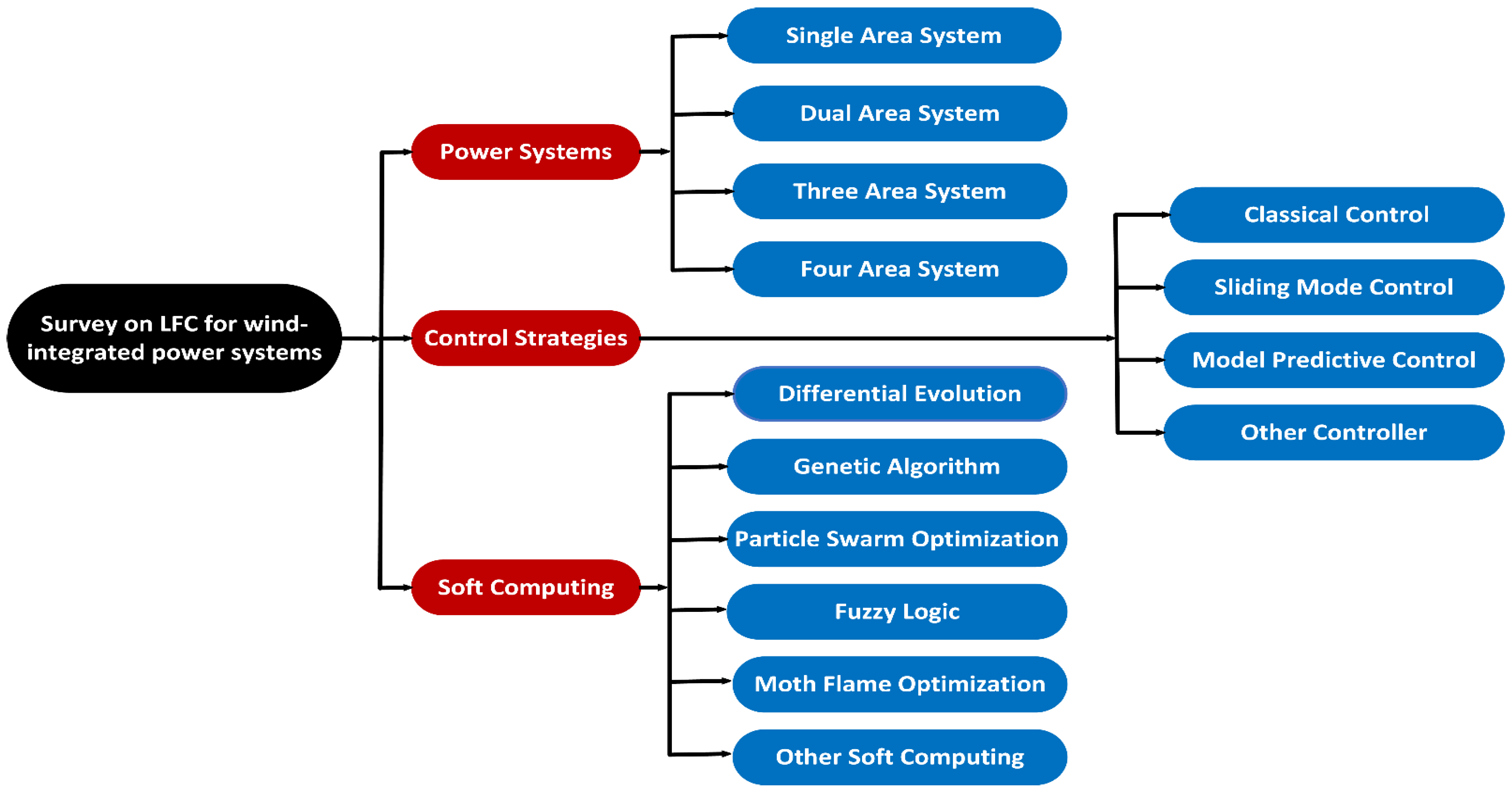
Disclaimer/Publisher’s Note: The statements, opinions and data contained in all publications are solely those of the individual author(s) and contributor(s) and not of MDPI and/or the editor(s). MDPI and/or the editor(s) disclaim responsibility for any injury to people or property resulting from any ideas, methods, instructions or products referred to in the content. |
© 2023 by the authors. Licensee MDPI, Basel, Switzerland. This article is an open access article distributed under the terms and conditions of the Creative Commons Attribution (CC BY) license (https://creativecommons.org/licenses/by/4.0/).