


Abstract
Underwater photosynthesis is the most important metabolic activity for submerged plants since it could utilize carbon fixation to replenish lost carbohydrates and improve internal aeration by producing O2. The present study used bibliometric methods to quantify the annual number of publications related to underwater photosynthesis. CiteSpace, as a visual analytic software for the literature, was employed to analyze the distribution of the subject categories, author collaborations, institution collaborations, international (regional) collaborations, and cocitation and keyword burst. The results show the basic characteristics of the literature, the main intellectual base, and the main research powers of underwater photosynthesis. Meanwhile, this paper revealed the research hotspots and trends of this field. This study provides an objective and comprehensive analysis of underwater photosynthesis from a bibliometric perspective. It is expected to provide reference information for scholars in related fields to refine the research direction, solve specific scientific problems, and assist scholars in seeking/establishing relevant collaborations in their areas of interest.
1. Introduction
The study of the photosynthesis of marine phytoplankton opened up the field of underwater photosynthesis [1], which is the most critical metabolic activity for submerged plants [2,3]. Continuous carbohydrate consumption during respiration or fermentation causes underwater plants to run out of sugar and eventually die [4,5]. Many underwater plants can produce carbohydrates by underwater photosynthesis [6,7,8]. For example, submerged rice (Oryza sativa L.) uses carbohydrates produced by underwater photosynthesis to maintain its normal growth [9,10]. Moreover, the O2 permeability of the roots could be improved by underwater photosynthesis because most of the O2 produced in the leaves diffuses to the roots through the aeration tissues [11,12]. It is precisely because underwater photosynthesis can provide carbohydrates for underwater plants and help them improve internal aeration that it is important for the survival and growth of underwater plants [13,14].
Underwater photosynthesis is easily affected by the water environment [15]. Light attenuation is the most vulnerable condition due to the influences of water body dissolved matter, suspended particles, and water depth [16]. To adapt to this adverse situation, aquatic plants developed some strategies. From the morphological point of view, they obtained limited light resources by reducing the number of cell layers or increasing the specific leaf area [17,18]. Moreover, thin submerged leaves with chloroplasts in epidermal layers increase the cost-effectiveness of light use [19]. In addition to light, CO2 is limited by the diffusion rate of underwater gas and the extracellular diffusion layer, making underwater photosynthesis under the stress of insufficient CO2 supply [7,20]. Interestingly, a carbon-concentrated mechanism was observed in Hydrilla verticillata [21,22], Elodea canadensis [23], Egeria densa [24], and Hygrophila polysperma [25], namely the reaction from HCO3− to CO2 catalyzed by carbonic anhydrase. It could effectively increase the utilization rate of CO2 and enhance the carbon gain of underwater plants [26,27]. Some leaves with hydrophobic surfaces could form a leaf air film [10,28], and some have higher plasticity [13,29]. These phenomena could facilitate the exchange of underwater gas [30,31], leading to a higher assimilation rate and lower CO2 compensation point, and then increase the underwater photosynthetic rate [13,32]. In freshwater systems, it is reported that the inorganic carbon sources used by underwater plants for photosynthesis depend on pH values [19]. Moreover, underwater photosynthesis could be influenced by water temperature. Previous studies found that the optimal temperature is 25–30 °C, but the photosynthesis capacity showed significant differences when the temperatures were much lower (10~15 °C) [33]. In seawater systems, in addition to the above factors, salinity also affects the intensity of underwater photosynthesis [19].
Since 1979, many references to underwater photosynthesis have been found, including some higher-impact review articles that played essential roles in in-depth research in specific directions [7,19]. Analyzing this literature by literature metrology [34,35], we can have a more comprehensive understanding of the research status, popular research topics, and development trends of underwater photosynthesis. CiteSpace is a visual analytic tool [36], and it has been employed to analyze research hotspots, frontiers, cooperative relationships between author institutions and countries, and theme evolution in a specific research field [37,38], such as medicine [39,40], mathematics [41,42], and ecology [43,44]. In this study, literature metrology was combined with CiteSpace to conduct data mining and visual analysis of the literature and analyze the current research status and hotspots of underwater photosynthesis. We aimed to promote more comprehensive research on underwater photosynthesis and provide reference information for scholars in related fields to determine research directions and refine issues.
2. Materials and Methods
2.1. Data Collection
Literature data were retrieved from the Web of Science Core Collection (WOSCC) [45], and the SCI-E is the most frequently used database in bibliometrics research. It is considered the most reputable academic journal system, and its published papers are guaranteed through a rigorous peer review [46]. The data was retrieved on 1 June 2020. The topic was set to “TS = (underwater photosynthesis*)”, and the document type was set to “All”. The selected language was English, and the default period was all years (1900–2021) involved in the database. The basic information of screened articles is saved in plain text file format. Then, data that had nothing to do with underwater photosynthesis by checking the title and abstract were eliminated. Finally, valuable data for visual analysis were obtained.
It should be noted that if the search term is set to “TS = (underwater photosynthesis* OR macroalgae* OR phytoplankton*)”, there will be a large number of articles unrelated to underwater photosynthesis, which will seriously affect the accuracy of subsequent analysis. Finally, the search term was set to “TS = (underwater photosynthesis*)”, and the obtained articles are closely related to underwater photosynthesis. However, because macroalgae and phytoplankton originally grow in water, articles on photosynthesis sometimes do not emphasize underwater, so there may be omissions.
2.2. Methodology
The data obtained through WOSCC included title, author, year, source publication, keywords, abstract, and references. CiteSpace.5.7.R5 (64. bit) (Chaomei Chen, Drexel University, Philadelphia, PA, USA) is a visual analysis software based on the Java language developed by the Chinese-American scholar Professor Chaomei Chen. In this study, CiteSpace.5.7.R5 (64. bit) was used to conduct a network diagram of the cooperation of authors, institutions, countries, and teams based on WOSCC data and visual analysis of major journals, subject distribution, and funding units [47]. In addition, CiteSpace was employed to perform cluster analysis on keywords to find out research hotspots and research prefaces in this field. CiteSpace parameters: time slice (1979–2021), each slice year (1) was used in this study. We have selected different node types according to the type of analysis performed. CiteSpace’s selection criteria were as follows: g-index = 25, Top N = 50, and Top N% = 10%/100. Threshold parameters included citation threshold (c), cocitation threshold (cc), and cosine coefficient threshold (CCV), which were set to 2/2/20, 4/3/20, and 4/3/20, respectively. Usage 180 = 50, Usage 2013 = 50, not quoted, pruning (pruning slice network and merge network), and visualization were selected.
OriginPro 9.1 (64. bit) (OriginLab, Northampton, MA, USA) software was used to visualize the data subjects. Tableau 10.5 (Tableau, Seattle, Washington, DC, USA) software was used to analyze the global distribution of data by country or region. Pie charts and line graphs were drawn by Microsoft Excel 2010 to analyze types and annual volumes of documents.
2.3. Special Terms
Centrality refers to the ability to act as a mediator in the entire relationship network. In the network structure, a node with a centrality greater than 0.1 represents that its position is more important. Frequency refers to the number of occurrences of the retrieved target word. Keywords with high frequency and centrality are generally the hot frontiers of research in this field. Aggregation network refers to the clustering map drawn after classifying similar keywords using CiteSpace software. Through the analysis of larger clusters, the research hotspots can be found. Silhouette value is a reflection of the cluster quality and an indicator of its homogeneity or consistency. Silhouette values of homogenous clusters tend to be close to 1. When silhouette >0.3, it means that the divided map structure is significant and reasonable. Keyword burst refers to the sudden increase of technical terms in the literature published in certain years. CiteSpace software has the function of burst keyword detection. Detecting keywords with high frequency change rate from the literature can identify the research frontier in a certain field.
3. Results and Discussion
3.1. Descriptive Analysis
As of 2021, a total of 389 publications were retrieved related to underwater photosynthesis. There were 336 articles, 31 reviews, and 16 proceedings papers, accounting for 87%, 8%, and 4% of all WOSCC publications. Only five editorial materials and one note were found. Consequently, 367 articles and reviews accounting for 95% of all papers were used for the following analysis (Figure 1).
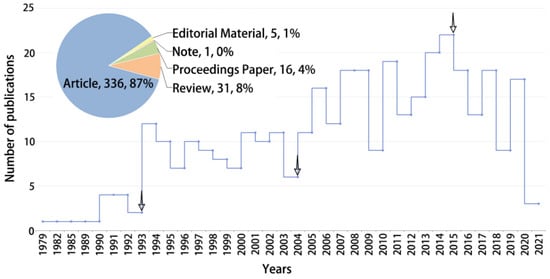
Figure 1.
Types and annual variations of underwater photosynthesis documentation.
3.1.1. Annual Variations in Publications
The changes in the number of published articles per year could reflect the development status and trends of a specific research field [34]. Here, we can find that there were 15 publications in the 1979–1993 period, 101 publications in the 1994–2004 period, 173 publications in the 2005–2015 period, and 78 publications in the 2016–2021 period. The average annual publication volume was 1, 9.18, 15.7, and 13, respectively. Consequently, we separated the entire research stage into four stages: initial development, stable development, rapid development, and deep development according to the annual publication volume (Figure 1). Prior to 1993, this research received limited attention and was in the initial stage. From 1994 to 2004, with the continuous publications of related documents and the formation of theoretical foundations, the field entered a stable development stage. After 2005, underwater photosynthesis received more and more attention and entered a stage of rapid development, reaching its peak in 2015. Since 2016, the research has entered a stage of deepening development. As the relevant studies develop, research on underwater photosynthesis is expected to be more in-depth and improved.
3.1.2. Subject Category Distribution
We used the category visualization function of CiteSpace to analyze the distribution of subject categories and master the relationship between the main subject categories and subjects involved in underwater photosynthesis. Nodes is an indicator of the proportion of a certain discipline, which can help scholars intuitively see the distribution of disciplines. Nodes with centrality >0.1 were regarded as crucial nodes in the network, and the subject category of key nodes has significant contributions to the research. Here, we can find that “Marine and freshwater biology” was the subject with the greatest frequency (154), indicating that it received the greatest attention, followed by “Plant sciences” (119), “Environmental sciences and ecology” (94), “Oceanography” (87), and “Ecology” (64) (Figure 2). Among the top 10 high-frequency discipline categories, the centralities of “Plant Sciences” and “Environmental Sciences” were relatively higher, which were 0.58 and 0.51, respectively. This result reveal that these two disciplines played essential roles in connecting different disciplines. The following were “Geosciences, Multidisciplinar” and “Environmental sciences and ecology”, with the centralities of 0.39 and 0.38, respectively (Figure 3). In summary, “Marine and freshwater biology” and “Plant sciences” obtained the greatest attention, and “Plant Sciences” and “Environmental Sciences” were the most influential disciplines in this field.
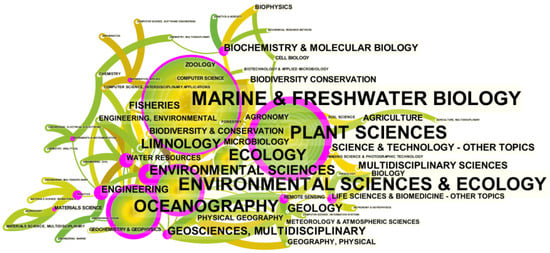
Figure 2.
Co-occurring subject categories during the 1979–2021 period.
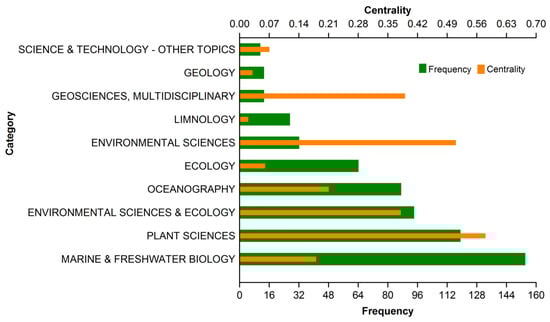
Figure 3.
Top 10 most frequently appearing subjects with frequency and centrality.
3.1.3. Journal Distribution
The prominent journals determined through statistics on the distribution of related literature can help scholars quickly learn from crucial journals [48,49] and publish articles demonstrating their academic achievements [38]. The top 13 journals with the highest number of publications are shown in Table 1. All of these journals have published more than 100 papers. “Limnology and Oceanography”, “Marine Ecology Progress Series”, “New Phytologist”, “Aquatic Botany”, “Plant Physiology”, “Nature”, and “Plant Cell and Environment” were influential journals. Each of them has published more than 140 articles and has been cited more than 6000 times. Among them, “Limnology and Oceanography” ranked first, with 273 citations and 227 documents. The first citation year can be traced back to 1979 and continues today. It can be inferred that this journal is the essential traditional journal in underwater photosynthesis. Since 1990, journals such as “Marine Ecology Progress Series”, “New Phytologist”, and “Aquatic Botany” have become new forces with a relatively high volume of publications. It is worth noting that “Nature” and “Science” have published 142 and 100 papers, respectively. It is shown that significant results have been achieved at this stage.

Table 1.
Top 13 journals based on the number of documents.
3.2. Research Power Analysis
3.2.1. Author Distribution and Collaboration
Analyzing the distribution of core authors can provide a better overview and promote academic exchange cooperation and research development [50]. In Table 2, 11 authors were listed who published more than five papers. They published 118 papers accounting for 32.15% of the total papers. The number of authors indicated that the core author group has not yet been formed. Notably, the top four scholars, Ole Pedersen, Timothy David Colmer, Eric J. W. Visser, and Anders Winkel, published numerous articles between 2004 and 2020, indicating that they were the core authors of the explosive and deepening period. In addition, from the average citation frequency and citation time of each article, C. W. P. M Blom made outstanding contributions in the initial and development stages. R. M. Forster was the backbone of the stable development stages.
Table 2.
Top 11 authors based on the number of documents.
Through the analysis of the coauthor map, the group of scholars who work closely can be revealed. As shown in Figure 4, there were two closely cooperating groups. The team with Ole Pedersen as the core comprising Anders Winkel, Max Herzog, Dennis Konnerup, etc., mainly studied the physiology and molecular of waterlogging plants [19,51]. The other team with Timothy David Colmer as the core comprising K. A. G. Sand-Jensen, Gustavo G. Striker, etc., focused on plants’ physiological and biochemical characteristics and regulation mechanisms [7,11]. There are no large and many nodes in the coauthorship network, and the connection is single. This showed that the authors of underwater photosynthesis research were not closely linked, and the team effect was not apparent.
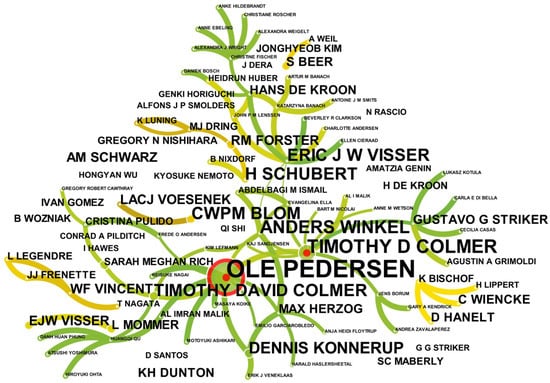
Figure 4.
Coauthorship network.
3.2.2. Institutional Distribution and Collaboration
Analyzing institutions’ distribution is conducive to illustrating interinstitutional exchanges and cooperation among scholars [34,52]. The top 3 institutions were The University of Western Australia, University of Copenhagen, and Radboud University Nijmegen, indicating that these institutions played essential roles in contacting and exchanging institutions (Table 3). It is noted that 8 of 11 institutions were universities, which showed that the primary research forces were distributed in universities. In addition, The University of Western Australia, University of Copenhagen, and Radboud University Nijmegen surpassed other institutions in terms of publication volumes and influences. Obviously, they played essential roles in cooperation and exchanges in this field (Figure 5).
Table 3.
Top 11 institutions based on the number of documents.
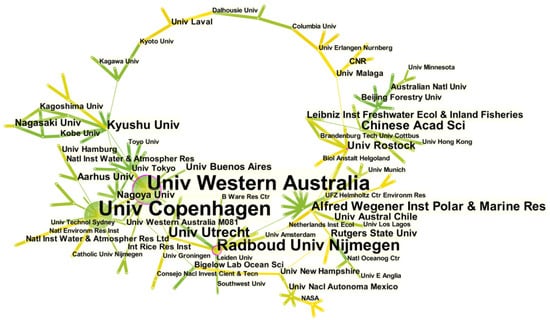
Figure 5.
The network of coauthors’ institutions.
3.2.3. International (Regional) Distribution and Collaboration
By analyzing the distribution of countries or regions and the number of publications and other indicators, we can understand these countries’ geographic locations and the field’s degree of attention and influences [35,36]. The United States ranked first with 64 publications, followed by Australia and Denmark with 56 and 48 papers, respectively (Figure 6). Although there were only 41 papers published in The Netherlands and Germany, the average citation frequency of each paper was high (76.22 and 60.61), which showed that their research was relatively in-depth (Table 4). China accounted for 2 of the top 8 funding units, which showed that China attached great importance to the development of underwater photosynthesis (Table 5). The centralities of the United States, Denmark, Germany, and England were greater than 0.3, indicating that these countries had greater contributions to the international exchange and were more active in international collaboration than other countries (Figure 6).
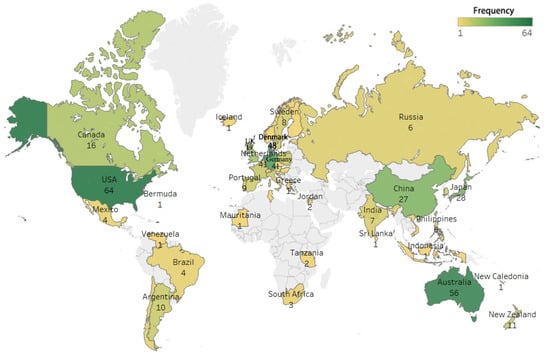
Figure 6.
Country/region distribution map based on frequency.
Table 4.
Top 10 countries or regions based on the number of documents.
Table 5.
Top 8 funding agencies based on the number of documents.
3.3. Intellectual Base Analysis
3.3.1. Reference Cocitation Network
The basic literature and essential knowledge base in the research of underwater photosynthesis could be discovered by the cocitation analysis of the literature [53,54]. In this study, an aggregation network composed of 954 references for the above 367 papers was constructed, and 10 key cocitation clusters were observed (Figure 7 and Table 6). The clusters in the initial development stage included #7 (ecophysiological determinant). The clusters in the stable development stage included #1 (variable environment), #3 (solar UV-induced DNA damage), #4 (aquatic ecosystem), #6 (changing irradiance environment), and #9 (water level fluctuation). In the case of the rapid development stage, it included #0 (underwater photosynthesis), #8 (CO2 enrichment), #2 (adaptive trait), and #5 (growth responses).
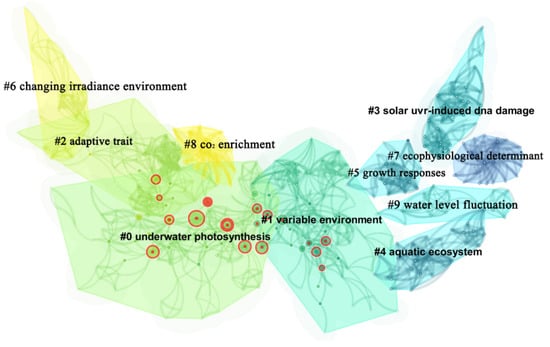
Figure 7.
Cluster visualization based on the document cocitation network.
Table 6.
Top 10 cocitation clusters based on frequency.
Cluster #7 had 21 members and a silhouette value of 1. Cluster analysis showed that various physiological processes might be affected by these flooding-induced physical changes, including aerobic respiration, photosynthesis, and processes in which light is a source of information. Underwater photosynthesis [19], shoot elongation [55], adventitious roots [56], and aerenchyma formation were typical adaptive responses that were believed to improve the O2 status of submerged plants [6]. Ethylene and other plant hormones were central in initiating and regulating most of these adaptive responses [57,58]. It is shown that the initial stage explored the eco-physiological determinant of underwater photosynthesis.
There were 74 members in cluster #1 with a silhouette value of 0.902. The study of this cluster focused on the influences of variable environments on underwater photosynthesis. When the external CO2 concentration was low, the increased gas exchange might lead to a higher assimilation rate and a lower underwater CO2 compensation point [13,59]. #3 had 46 members with a silhouette value of 0.985, which analyzed the impacts of sunlight on the survival of underwater plants (mainly algae) [60]. In the case of cluster #4, it had 39 members and a silhouette value of 0.989. The cluster mainly studied the aquatic ecosystem. For example, surface and underwater ultraviolet radiation in autumn, winter, and spring and its effects on phytoplankton photosynthesis were measured on the central coast of Chile [61]. Cluster #6 had 26 members with a silhouette value of 0.973, which studied the changes in underwater irradiance. It was found that the quantum yield of photosystem II (PSII) decreased rapidly with the increase in irradiance in the morning and increased with the decrease in irradiance in the afternoon [62,63]. Cluster #9 had 74 members and a silhouette value of 0.902. The articles focused on the water level fluctuation, which showed that the depth of waterlogging significantly influenced the formation of adventitious roots and plant growth [64]. Here, we can find that the studies gradually deepened from ecological and physiological determinants to the underwater environmental variables and water level fluctuations.
Clusters #0 and #8 were the two largest clusters with 83 members and a silhouette value of 0.906. They focused on the influences of the leaf gas film on the underwater gas exchange and photosynthesis [65]. The literature in cluster #8 showed that the enrichment of CO2 in floods could improve underwater photosynthesis [5] since the CO2 enrichment significantly improved the relative maximum electron transfer rate and minimum saturation irradiance [66,67]. Cluster #2 had 49 members with a silhouette value of 0.956. The cluster’s research focused on the adaptation strategies of plants to flooding [68,69], the influence of aquatic adventitious roots on underwater photosynthesis [70,71], and whether this phenomenon was conducive to the survival of completely submerged plants [56,64]. Cluster #5 had 37 members with a silhouette value of 0.951, which demonstrated the growth responses of underwater plants. The growth recovery of each variety after complete flooding was different, and it was positively correlated with the number of green leaves retained after flooding [72].
In summary, the underwater photosynthesis intellectual base included its importance to the survival of waterlogged plants, the affecting factors [73,74], and adaptation strategies [65,75].
3.3.2. Landmark References
The burst value could be used to show a sharp increase in the publication’s total citation frequency in a certain period. Here, the burst value of the 10 most frequently cited papers was 6.56–10.25, indicating that these documents were suddenly cited in large numbers (Table 7).
Table 7.
Top 10 cited references based on frequency.
Among these 10 articles, the most frequently cited article was published by Colmer et al. on New Phytologist in 2008 [76]. The importance of leaf gas film is proved in this paper. The leaf gas film enhanced the absorption of CO2 by net photosynthesis during the light period and increased the absorption of O2 by respiration in the dark period. Colmer et al.’s review published in AoB Plant in 2011 pointed out that flooding had an inhibitory effect on the photosynthesis of terrestrial wetland plants, but no significant effects were found on species that produced new leaves underwater or species with leaf gas film [7]. In addition, an article by Pedersen et al. published in Plant Journal in 2009 proved that leaf gas film could improve O2 and CO2 exchange, root aeration, and the growth of completely submerged rice [10]. Articles by Winkel et al. published in The Journal of Experimental Botany in 2014 [28] and Plant, Cell and Environment in 2011 [77] also proved the importance of leaf gas film membranes in underwater gas exchange. Meanwhile, the relationship between air film persistence and underwater net photosynthesis was studied. In short, these five articles have conducted detailed studies on leaf gas film and proved that it could enhance underwater photosynthesis by stimulating the exchange of O2 and CO2 underwater. This is of great significance to the research field.
Mommer et al. published an article in Annals of Botany in 2005 [13] which found that some terrestrial plants exhibited high plasticity in leaf development under flooding conditions. It is also speculated that the regulatory mechanism that induces the transition from terrestrial leaves to submerged adaptive leaves may be the same as that of hetero leaf aquatic plants. Bailey-Serres et al. published an article in The Annual Review of Plant Biology in 2008 [4]. They found that at the developmental level, plants could promote the acquisition and diffusion of O2 through various changes in the structure of cells and organs, thereby evading the hypoxia stress caused by flooding. These processes drive plant hormones, including ethylene, gibberellin, and abscisic acid. Colmer et al.’s article published in Functional Plant Biology in 2009 demonstrated that rice leaves could enhance the ability to absorb O2 and CO2 from floodwater and improve underwater photosynthesis [5]. These three articles explored the natural variation of strategies to improve O2 and carbohydrate status during floods and provided valuable resources for improving the tolerance of crops to environmental adversity.
The article published by Winkel et al. in New Phytologist in 2013 [78] studied the in situ aeration of rice roots under completely flooded conditions. It clarified the effects of underwater photosynthesis and O2 content in floods on the aeration of roots in hypoxic soils. An article published by Pedersen et al. in Frontiers in Plant Science in 2013 [19] gave a detailed review of the approaches and methods for studying underwater photosynthesis, such as the rotating wheel incubator, the closed chamber with injection ports, community photosynthesis in a large room, and the open natural system. This research was considered to have milestone significance to the development of underwater photosynthesis.
3.4. Research Hotspots and Trend Analysis
3.4.1. Research Hotspot Analysis
Keywords often represent an article’s core and main contents [37,79], and their cluster map effectively reflects research hotspots. Here, 10 keyword clusters in the constructed map were observed (Figure 8). The silhouette values of all clusters (#0 to #9) were at least 0.8, which showed the clusters were reasonable (Table 8). Among them, cluster #0 (underwater photosynthesis) was the largest cluster and focused on the morphological responses of plants to flooding [58] and the characteristics of underwater photosynthesis [76]. Cluster #1 (light absorption) focused on the effects of changes in seawater temperature and light conditions on the photosynthetic efficiency of aquatic plants [80]. Cluster #2 (phytoplankton productivity) studied the effects of underwater light intensity and inorganic carbon on phytoplankton productivity [81]. Cluster #3 (chlorophyll-a distribution) focused on ocean acidification and global warming effects on phytoplankton communities and seagrass growth [60]. Cluster #4 (in situ photosynthesis) and cluster #5 (HCO3− use photosynthesis) studied the in situ measurement of photosynthesis of aquatic plants [82] and how they use HCO3− to maintain photosynthesis when the diffusion of CO2 underwater was inhibited [25]. Cluster #6 (microphytobenthos community production) focused on the microphytobenthos community production and photosynthetic characteristics [63]. Cluster #7 (carbohydrate utilization) focused on the flood tolerance of terrestrial plants and leaf gas films to improve underwater gas exchange and enhance underwater photosynthesis [83]. Cluster #8 (coastal area) and #9 (photosynthetic efficiency) studied the photosynthesis of aquatic plants in the coastal area [67] and the influence of bathymetric changes and water flow on photosynthetic efficiency [84].
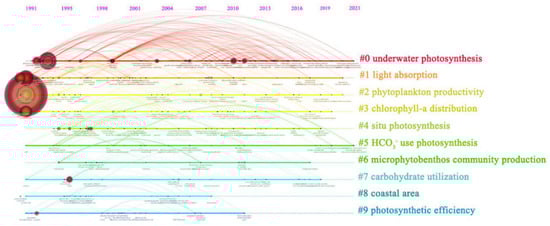
Figure 8.
Timeline map of keyword clustering.
Table 8.
Top 10 keyword clusters based on frequency.
3.4.2. Development Trend Analysis
Keyword burst analysis could show the sudden decrease or increase in the frequency of keyword citations, which in turn reflects a major shift in research hotspots [85]. Table 9 shows when each sudden keyword first appeared and its duration in this field.
Table 9.
Keywords with the strongest frequency bursts in different periods.
Stable Development Stage (1994–2004)
At this stage, three burst keywords appeared, namely light, ultraviolet radiation, and phytoplankton. Obviously, the study of underwater photosynthesis has just entered the development stage. The research object was mainly floating plants [86,87], and the studies focused on the effects of light and ultraviolet radiation changes on phytoplankton’s underwater photosynthesis [80]. At this stage, scholars are mainly concerned about aquatic plants’ underwater photosynthesis characteristics [15,88].
Rapid Development Stage (2005–2015)
A total of four burst keywords were involved at this stage, namely plant, submergence tolerance, flooding tolerance, and underwater photosynthesis. The research objects have expanded from aquatic plants to wetland and terrestrial plants [76]. Then, the flooding tolerances of these plants were studied a lot [89]. At the same time, the importance of underwater photosynthesis for the growth and survival of wetland and terrestrial plants was emphasized. Furthermore, the bursts of flooding tolerance and underwater photosynthesis are continued today [11].
Deep Development Stage (2016–2021)
This stage involved three bursts of keywords: flooding tolerance, underwater photosynthesis, and response, and the topics were relatively concentrated. Scholars in this period began to explore the relationship between underwater photosynthesis and waterlogging tolerance [90,91]. The most frequently cited keywords during this period were underwater photosynthesis (10.39), response (6.31), and flood resistance (5.85). Related research has continued to this day and is currently the most cutting-edge research topic.
4. Conclusions and Outlook
On the whole, underwater photosynthesis research could be divided into four stages: initial development (1979–1993), stable development (1994–2004), rapid development (2005–2015), and deep development (2016–2021). So far, it has received significant attention in marine and freshwater biology, plant sciences, environmental sciences and ecology, oceanography, and ecology. Limnology and Oceanography, Marine Ecology Progress Series, New Phytologist, and Plant Physiology were considered the top journals. Ole Pedersen, Timothy D. Colmer, Anders Winkel, and Eric J. W. Visser were the core authors and have played vital roles in developing and expanding this field. The United States was the most influential country, followed by Australia, Denmark, Germany, and The Netherlands.
The knowledge base included the following aspects: (a) underwater photosynthesis; (b) variable environment; (c) adaptive trait; (d) solar UV-induced DNA damage; (e) aquatic ecosystem; (f) growth responses; (g) changing irradiance environment; (h) ecophysiological determinant; (i) CO2 enrichment; (j) water level fluctuation. Colmer et al. (2008, 2009 and 2011), Bailey-Serres et al. (2008), Pedersen et al. (2009 and 2013), Winkel et al. (2011, 2013 and 2014), and Mommer et al. (2005) played vital roles in the evolution of the basic knowledge. In the initial stage, the photosynthetic productivity of marine algae and the effect of ultraviolet rays on algal photosynthesis were research hotspots. In the development stage, the characteristics of underwater photosynthesis of phytoplankton and large aquatic plants and the effect of light were hotspots. In the outbreak stage, the adaptation of wetland and terrestrial plants to flooding and the importance of underwater photosynthesis for the growth and survival of flooded plants were the most studied topics. In the deepening stage, leaf gas film, internal aeration of submerged plants, and the differences in underwater photosynthesis of C3 plants, C4 plants, and CAM plants have become hotspots and frontiers. Leaf gas films, hetero leaf, HCO3− utilization, and CO2 enrichment are the research hotspots at this stage. It is predicted that the research and improvement of underwater photosynthesis from the molecular level will become the development trend in this field.
In conclusion, our analysis could help scholars accurately grasp the research hotspots and frontiers and provide a reliable theoretical basis for the in-depth study of underwater photosynthesis. In the past, scholars have conducted a lot of research on the basic characteristics and main influencing factors of underwater photosynthesis, which has deepened people’s understanding of the importance of underwater photosynthesis. In the future, more research should focus on the molecular mechanisms of underwater photosynthesis rather than physiological levels, which play vital roles in cultivating plants with great underwater photosynthesis.
Author Contributions
Conceptualization, J.G. and J.X.; data curation, J.G.; formal analysis, J.G.; funding acquisition, J.G.; investigation, J.G. and J.H.; methodology, J.X.; project administration, J.H., L.X., and Y.Y.; resources, J.H.; software, J.G.; supervision, J.H.; validation, J.X.; writing—original draft, J.G.; Writing—review and editing, J.X. All authors have read and agreed to the published version of the manuscript.
Funding
This research was funded by China’s National Natural Science Foundation (31870592, 32101488) and Jiangsu’s Long-term Scientific Research Base for Taxodium Rich. Breeding and Cultivation [LYKJ(2021)05].
Data Availability Statement
Not applicable.
Conflicts of Interest
The authors declare no conflict of interest.
References
- Morris, G.I. Photosynthetic Carboxylating Enzymes in Marine Phytoplankton. Limnol. Oceanogr. 1979, 24, 510–519. [Google Scholar] [CrossRef]
- Clevering, O.; Van Vierssen, W.; Blom, C. Growth, photosynthesis and carbohydrate utilization in submerged Scirpus maritimus L. during spring growth. New Phytol. 1995, 130, 105–116. [Google Scholar] [CrossRef]
- Armstrong, J.; Afreen-Zobayed, F.; Blyth, S.; Armstrong, W. Phragmites australis: Effects of shoot submergence on seedling growth and survival and radial oxygen loss from roots. Aquat. Bot. 1999, 64, 275–289. [Google Scholar] [CrossRef]
- Bailey-Serres, J.; Voesenek, L. Flooding stress: Acclimations and genetic diversity. Annu. Rev. Plant Biol. 2008, 59, 313–339. [Google Scholar] [CrossRef] [PubMed]
- Colmer, T.; Voesenek, L. Flooding tolerance: Suites of plant traits in variable environments. Funct. Plant Biol. 2009, 36, 665–681. [Google Scholar] [CrossRef] [PubMed]
- Voesenek, L.; Colmer, T.; Pierik, R.; Millenaar, F.; Peeters, A. How plants cope with complete submergence. New Phytol. 2006, 170, 213–226. [Google Scholar] [CrossRef]
- Colmer, T.D.; Winkel, A.; Pedersen, O. A perspective on underwater photosynthesis in submerged terrestrial wetland plants. AoB Plants 2011, 2011, plr030. [Google Scholar] [CrossRef]
- Mommer, L.; Pedersen, O.; Visser, E. Acclimation of a terrestrial plant to submergence facilitates gas exchange under water. Plant Cell Environ. 2004, 27, 1281–1287. [Google Scholar] [CrossRef]
- Setter, T.; Waters, I.; Wallace, I.; Bhekasut, P.; Greenway, H. Submergence of rice. I. Growth and photosynthetic response to CO2 enrichment of floodwater. Funct. Plant Biol. 1989, 16, 251–263. [Google Scholar] [CrossRef]
- Pedersen, O.; Rich, S.M.; Colmer, T.D. Surviving floods: Leaf gas films improve O2 and CO2 exchange, root aeration, and growth of completely submerged rice. Plant J. 2009, 58, 147–156. [Google Scholar] [CrossRef]
- Colmer, T.D.; Pedersen, O.; Wetson, A.M.; Flowers, T.J. Oxygen dynamics in a salt-marsh soil and in Suaeda maritima during tidal submergence. Environ. Exp. Bot. 2013, 92, 73–82. [Google Scholar] [CrossRef]
- Colmer, T.D.; Pedersen, O. Oxygen dynamics in submerged rice (Oryza sativa). New Phytol. 2008, 178, 326–334. [Google Scholar] [CrossRef] [PubMed]
- Mommer, L.; Visser, E.J. Underwater photosynthesis in flooded terrestrial plants: A matter of leaf plasticity. Ann. Bot. 2005, 96, 581–589. [Google Scholar] [CrossRef] [PubMed]
- Pedersen, O.; Colmer, T.D. Underwater photosynthesis and internal aeration of submerged terrestrial wetland plants. In Low-Oxygen Stress in Plants; Springer: Berlin/Heidelberg, Germany, 2014; pp. 315–327. ISBN 978-3-7091-1253-3. [Google Scholar]
- Vervuren, P.; Beurskens, S.; Blom, C. Light acclimation, CO2 response and long-term capacity of underwater photosynthesis in three terrestrial plant species. Plant Cell Environ. 1999, 22, 959–968. [Google Scholar] [CrossRef]
- Fernandez, M. Changes in photosynthesis and fluorescence in response to flooding in emerged and submerged leaves of Pouteria orinocoensis. Photosynthetica 2006, 44, 32–38. [Google Scholar] [CrossRef]
- Nielsen, S.R.L. A comparison of aerial and submerged photosynthesis in some Danish amphibious plants. Aquat. Bot. 1993, 45, 27–40. [Google Scholar] [CrossRef]
- Frost-Christensen, H.; Sand-Jensen, K. Comparative kinetics of photosynthesis in floating and submerged Potamogeton leaves. Aquat. Bot. 1995, 51, 121–134. [Google Scholar] [CrossRef]
- Pedersen, O.; Colmer, T.D.; Sand-Jensen, K. Underwater photosynthesis of submerged plants–recent advances and methods. Front. Plant Sci. 2013, 4, 140. [Google Scholar] [CrossRef]
- Yang, T.; Liu, X. Comparing photosynthetic characteristics of Isoetes sinensis Palmer under submerged and terrestrial conditions. Sci. Rep. 2015, 5, 17783. [Google Scholar] [CrossRef]
- Magnin, N.C.; Cooley, B.A.; Reiskind, J.B.; Bowes, G. Regulation and Localization of Key Enzymes during the Induction of Kranz-Less, C4-Type Photosynthesis in Hydrilla verticillata. Plant Physiol. 1998, 115, 1681–1689. [Google Scholar] [CrossRef]
- Spencer, W.E.; Wetzel, R.G.; Teeri, J. Photosynthetic phenotype plasticity and the role of phosphoenolpyruvate carboxylase in Hydrilla verticillata. Plant Sci. 1996, 118, 1–9. [Google Scholar] [CrossRef]
- Elzenga, J.T.M.; Prins, H.B.A. Light-Induced Polar pH Changes in Leaves of Elodea canadensis: I. Effects of Carbon Concentration and Light Intensity. Plant Physiol. 1989, 91, 62–67. [Google Scholar] [CrossRef] [PubMed]
- Casati, P. Induction of a C4-like mechanism of CO2 fixation in Egeria densa, a submersed aquatic species. Plant Physiol. 2000, 123, 1611–1621. [Google Scholar] [CrossRef] [PubMed]
- Horiguchi, G.; Matsumoto, K.; Nemoto, K.; Inokuchi, M.; Hirotsu, N. Transition from Proto-Kranz-Type Photosynthesis to HCO3− Use Photosynthesis in the Amphibious Plant Hygrophila polysperma. Front. Plant Sci. 2021, 12, 675507. [Google Scholar] [CrossRef]
- Maberly, S.C.; Madsen, T.V. Freshwater angiosperm carbon concentrating mechanisms: Processes and patterns. Funct. Plant Biol. 2002, 29, 393–405. [Google Scholar] [CrossRef]
- Prins, H.; Elzenga, J. Bicarbonate utilization: Function and mechanism. Aquat. Bot. 1989, 34, 59–83. [Google Scholar] [CrossRef]
- Winkel, A.; Pedersen, O.; Ella, E.; Ismail, A.M.; Colmer, T.D. Gas film retention and underwater photosynthesis during field submergence of four contrasting rice genotypes. J. Exp. Bot. 2014, 65, 3225–3233. [Google Scholar] [CrossRef]
- Molnár, A.; Toth, J.P.; Sramko, G.; Horvath, O.; Popiela, A.; Mesterházy, A.; Lukács, B.A. Flood induced phenotypic plasticity in amphibious genus Elatine (Elatinaceae). PeerJ 2015, 3, e1473. [Google Scholar] [CrossRef]
- Markovskaya, E.; Gulyaeva, E. Role of stomata in adaptation of Plantago maritima L. Plants to tidal dynamics on the White Sea coast. Russ. J. Plant Physiol. 2020, 67, 68–75. [Google Scholar] [CrossRef]
- Mommer, L.; Pons, T.L.; Wolters-Arts, M.; Venema, J.H.; Visser, E.J. Submergence-induced morphological, anatomical, and biochemical responses in a terrestrial species affect gas diffusion resistance and photosynthetic performance. Plant Physiol. 2005, 139, 497–508. [Google Scholar] [CrossRef]
- Horiguchi, G.; Nemoto, K.; Yokoyama, T.; Hirotsu, N. Photosynthetic acclimation of terrestrial and submerged leaves in the amphibious plant Hygrophila difformis. AoB Plants 2019, 11, plz009. [Google Scholar] [CrossRef] [PubMed]
- Yang, R.; Chen, B.; Liu, H.; Liu, Z.; Yan, H. Carbon sequestration and decreased CO2 emission caused by terrestrial aquatic photosynthesis: Insights from diel hydrochemical variations in an epikarst spring and two spring-fed ponds in different seasons. Appl. Geochem. J. Int. Assoc. Geochem. Cosmochem. 2015, 63, 248–260. [Google Scholar] [CrossRef]
- Yan, T.; Xue, J.; Zhou, Z.; Wu, Y. The Trends in Research on the Effects of Biochar on Soil. Sustainability 2020, 12, 7810. [Google Scholar] [CrossRef]
- Qin, F.; Zhu, Y.; Ao, T.; Chen, T. The Development Trend and Research Frontiers of Distributed Hydrological Models—Visual Bibliometric Analysis Based on Citespace. Water 2021, 13, 174. [Google Scholar] [CrossRef]
- Zhang, Y.; Li, C.; Ji, X.; Yun, C.; Wang, M.; Luo, X. The knowledge domain and emerging trends in phytoremediation: A scientometric analysis with CiteSpace. Environ. Sci. Pollut. Res. 2020, 27, 15515–15536. [Google Scholar] [CrossRef] [PubMed]
- Wu, J.; Wu, X.; Zhang, J. Development trend and frontier of stormwater management (1980–2019): A bibliometric overview based on CiteSpace. Water 2019, 11, 1908. [Google Scholar] [CrossRef]
- Ding, X.; Yang, Z. Knowledge mapping of platform research: A visual analysis using VOSviewer and CiteSpace. Electron. Commer. Res. 2020, 4, 1–23. [Google Scholar] [CrossRef]
- Fang, J.; Pan, L.; Gu, Q.X.; Juengpanich, S.; Wang, Y.F. Scientometric analysis of mTOR signaling pathway in liver disease. Ann. Transl. Med. 2020, 8, 93. [Google Scholar] [CrossRef]
- Wang, Q.; Wang, C.; Wu, L.; Zhang, H.; Chen, F. Visual analysis of influenza treated by traditional Chinese medicine based on CiteSpace. Zhonghua Wei Zhong Bing Ji Jiu Yi Xue 2020, 32, 779–784. [Google Scholar] [CrossRef]
- Chen, Y.; Chen, C.; Liu, Z.; Hu, Z.; Wang, X. The methodology function of CiteSpace mapping knowledge domains. Stud. Sci. Sci. 2015, 33, 242–253. [Google Scholar] [CrossRef]
- Xuyan, L.I. Analysis on International Scientific Cooperation of Mathematics by CiteSpace (2005–2015). Sci. Technol. Manag. Res. 2016, 36, 6. [Google Scholar] [CrossRef]
- Xu, Y. Digital Innovation Ecosystem: Research Context, Research Hotspot and Research Trends--Knowledge Mapping Analysis Using Citespace. J. Electron. Inf. Sci. 2020, 5, 72–80. [Google Scholar] [CrossRef]
- Xue, Y. The Research Status and Prospect of Global change Ecology in the Past 30 Years Based on CiteSpace. Adv. Environ. Prot. 2021, 11, 281–287. [Google Scholar] [CrossRef]
- Shao, H.; Kim, G.; Li, Q.; Newman, G. Web of Science-Based Green Infrastructure: A Bibliometric Analysis in CiteSpace. Land 2021, 10, 711. [Google Scholar] [CrossRef] [PubMed]
- Yu, L. The Scientific Development of Ecosystem Service Values. In Proceedings of the 2021 7th International Engineering Conference “Research & Innovation amid Global Pandemic” (IEC), Erbil, Iraq, 24–25 February 2021; pp. 128–133. [Google Scholar] [CrossRef]
- Wang, W.; Lu, C. Visualization analysis of big data research based on Citespace. Soft Comput. 2020, 24, 8173–8186. [Google Scholar] [CrossRef]
- SStringer, M.J.; Sales-Pardo, M.; Amaral, L.A.N. Effectiveness of journal ranking schemes as a tool for locating information. PLoS ONE 2008, 3, e1683. [Google Scholar] [CrossRef]
- Smith, D.R. A 30-year citation analysis of bibliometric trends at the Archives of Environmental Health, 1975–2004. Arch. Environ. Occup. Health 2009, 64 (Suppl. S1), 43–54. [Google Scholar] [CrossRef]
- Kim, J.; Perez, C. Co-Authorship Network Analysis in Industrial Ecology Research Community. J. Ind. Ecol. 2015, 19, 222–235. [Google Scholar] [CrossRef]
- Pedersen, O.; Colmer, T.D.; Garcia-Robledo, E.; Revsbech, N.P. CO2 and O2 dynamics in leaves of aquatic plants with C3 or CAM photosynthesis–application of a novel CO2 microsensor. Ann. Bot. 2018, 122, 605–615. [Google Scholar] [CrossRef]
- Aleixandre-Benavent, R.; Aleixandre-Tudó, J.L.; Castelló-Cogollos, L.; Aleixandre, J.L. Trends in scientific research on climate change in agriculture and forestry subject areas (2005–2014). J. Clean. Prod. 2017, 147, 406–418. [Google Scholar] [CrossRef]
- Li, X.; Du, J.; Long, H. A comparative study of Chinese and foreign green development from the perspective of mapping knowledge domains. Sustainability 2018, 10, 4357. [Google Scholar] [CrossRef]
- Hu, W.; Li, C.; Ye, C.; Wang, J.; Wei, W.; Deng, Y. Research progress on ecological models in the field of water eutrophication: CiteSpace analysis based on data from the ISI web of science database. Ecol. Model. 2019, 410, 108779. [Google Scholar] [CrossRef]
- Sakagami, J.-I.; Joho, Y.; Sone, C. Complete submergence escape with shoot elongation ability by underwater photosynthesis in African rice, Oryza glaberrima Steud. Field Crops Res. 2013, 152, 17–26. [Google Scholar] [CrossRef]
- Ayi, Q.; Zeng, B.; Liu, J.; Li, S.; van Bodegom, P.M.; Cornelissen, J.H. Oxygen absorption by adventitious roots promotes the survival of completely submerged terrestrial plants. Ann. Bot. 2016, 118, 675–683. [Google Scholar] [CrossRef] [PubMed]
- Voesenek, L.; Van der Sman, A.; Harren, F.; Blom, C. An amalgamation between hormone physiology and plant ecology: A review on flooding resistance and ethylene. J. Plant Growth Regul. 1992, 11, 171–188. [Google Scholar] [CrossRef]
- Yan, L. Growth and morphological responses to water level variations in two Carex species from Sanjiang Plain, China. Afr. J. Agric. Res. 2011, 6, 28–34. [Google Scholar] [CrossRef]
- Pedersen, O.; Vos, H.; Colmer, T. Oxygen dynamics during submergence in the halophytic stem succulent Halosarcia pergranulata. Plant Cell Environ. 2006, 29, 1388–1399. [Google Scholar] [CrossRef]
- Gao, K.; Zhang, Y.; Häder, D.-P. Individual and interactive effects of ocean acidification, global warming, and UV radiation on phytoplankton. J. Appl. Phycol. 2018, 30, 743–759. [Google Scholar] [CrossRef]
- Montecino, V.; Pizarro, G. Phytoplankton acclimation and spectral penetration of UV irradiance off the central Chilean coast. Mar. Ecol. Prog. Ser. 1995, 121, 261–269. [Google Scholar] [CrossRef][Green Version]
- Küster, A.; Schaible, R.; Schubert, H. Light acclimation of the charophyte Lamprothamnium papulosum. Aquat. Bot. 2000, 68, 205–216. [Google Scholar] [CrossRef]
- Wolfstein, K.; Colijn, F.; Doerffer, R. Seasonal dynamics of microphytobenthos biomass and photosynthetic characteristics in the northern German Wadden Sea, obtained by the photosynthetic light dispensation system. Estuar. Coast. Shelf Sci. 2000, 51, 651–662. [Google Scholar] [CrossRef]
- Zhang, Q.; Visser, E.J.; de Kroon, H.; Huber, H. Life cycle stage and water depth affect flooding-induced adventitious root formation in the terrestrial species Solanum dulcamara. Ann. Bot. 2015, 116, 279–290. [Google Scholar] [CrossRef] [PubMed]
- Winkel, A.; Visser, E.J.; Colmer, T.D.; Brodersen, K.P.; Voesenek, L.A.; Sand-Jensen, K.; Pedersen, O. Leaf gas films, underwater photosynthesis and plant species distributions in a flood gradient. Plant Cell Environ. 2016, 39, 1537–1548. [Google Scholar] [CrossRef] [PubMed]
- Jiang, Z.J.; Huang, X.P.; Zhang, J.P. Effects of CO2 enrichment on photosynthesis, growth, and biochemical composition of seagrass Thalassia hemprichii (Ehrenb.) Aschers. J. Integr. Plant Biol. 2010, 52, 904–913. [Google Scholar] [CrossRef] [PubMed]
- Huang, W.; Jin, Q.; Yin, L.; Li, W. Responses of CO2—concentrating mechanisms and photosynthetic characteristics in aquatic plant Ottelia alismoides following cadmium stress under low CO2. Ecotoxicol. Environ. Saf. 2020, 202, 110955. [Google Scholar] [CrossRef] [PubMed]
- Striker, G.G.; Izaguirre, R.; Manzur, M.E.; Grimoldi, A.A. Different strategies of Lotus japonicus, L. corniculatus and L. tenuis to deal with complete submergence at seedling stage. Plant Biol. 2012, 14, 50–55. [Google Scholar] [CrossRef]
- Manzur, M.; Grimoldi, A.; Insausti, P.; Striker, G. Escape from water or remain quiescent? Lotus tenuis changes its strategy depending on depth of submergence. Ann. Bot. 2009, 104, 1163–1169. [Google Scholar] [CrossRef]
- Rich, S.M.; Ludwig, M.; Pedersen, O.; Colmer, T.D. Aquatic adventitious roots of the wetland plant Meionectes brownii can photosynthesize: Implications for root function during flooding. New Phytol. 2011, 190, 311–319. [Google Scholar] [CrossRef]
- Rich, S.M.; Ludwig, M.; Colmer, T.D. Photosynthesis in aquatic adventitious roots of the halophytic stem-succulent Tecticornia pergranulata (formerly Halosarcia pergranulata). Plant Cell Environ. 2008, 31, 1007–1016. [Google Scholar] [CrossRef]
- Striker, G.G.; Kotula, L.; Colmer, T.D. Tolerance to partial and complete submergence in the forage legume Melilotus siculus: An evaluation of 15 accessions for petiole hyponastic response and gas-filled spaces, leaf hydrophobicity and gas films, and root phellem. Ann. Bot. 2019, 123, 169–180. [Google Scholar] [CrossRef]
- Sou, H.-D.; Masumori, M.; Ezaki, G.; Tange, T. Source of Oxygen Fed to Adventitious Roots of Syzygium kunstleri (King) Bahadur and RC Gaur Grown in Hypoxic Conditions. Plants 2020, 9, 1433. [Google Scholar] [CrossRef] [PubMed]
- Mommer, L.; Pons, T.L.; Visser, E.J.W. Photosynthetic consequences of phenotypic plasticity in response to submergence: Rumex palustris as a case study. J. Exp. Bot. 2006, 57, 283–290. [Google Scholar] [CrossRef] [PubMed]
- Teakle, N.L.; Colmer, T.D.; Pedersen, O. Leaf gas films delay salt entry and enhance underwater photosynthesis and internal aeration of M elilotus siculus submerged in saline water. Plant Cell Environ. 2014, 37, 2339–2349. [Google Scholar] [CrossRef] [PubMed]
- Colmer, T.D.; Pedersen, O. Underwater photosynthesis and respiration in leaves of submerged wetland plants: Gas films improve C and O2 exchange. New Phytol. 2008, 177, 918–926. [Google Scholar] [CrossRef]
- Winkel, A.; Colmer, T.D.; Pedersen, O. Leaf gas films of Spartina anglica enhance rhizome and root oxygen during tidal submergence. Plant Cell Environ. 2011, 34, 2083–2092. [Google Scholar] [CrossRef]
- Winkel, A.; Colmer, T.D.; Ismail, A.M.; Pedersen, O. Internal aeration of paddy field rice (O ryza sativa) during complete submergence–importance of light and floodwater O2. New Phytol. 2013, 197, 1193–1203. [Google Scholar] [CrossRef]
- Yang, H.; Shao, X.; Wu, M. A review on ecosystem health research: A visualization based on CiteSpace. Sustainability 2019, 11, 4908. [Google Scholar] [CrossRef]
- Best, E.P.; Buzzelli, C.P.; Bartell, S.M.; Wetzel, R.L.; Boyd, W.A.; Doyle, R.D.; Campbell, K.R. Modeling submersed macrophyte growth in relation to underwater light climate: Modeling approaches and application potential. Hydrobiologia 2001, 444, 43–70. [Google Scholar] [CrossRef]
- Clark, D.R.; Flynn, K.J. The relationship between the dissolved inorganic carbon concentration and growth rate in marine phytoplankton. Proc. R. Soc. London Ser. B Biol. Sci. 2000, 267, 953–959. [Google Scholar] [CrossRef]
- Pedersen, O.; Pulido, C.; Rich, S.M.; Colmer, T.D. In situ O2 dynamics in submerged Isoetes australis: Varied leaf gas permeability influences underwater photosynthesis and internal O2. J. Exp. Bot. 2011, 62, 4691–4700. [Google Scholar] [CrossRef]
- Konnerup, D.; Pedersen, O. Flood tolerance of Glyceria fluitans: The importance of cuticle hydrophobicity, permeability and leaf gas films for underwater gas exchange. Ann. Bot. 2017, 120, 521–528. [Google Scholar] [CrossRef] [PubMed]
- Sant, N.; Ballesteros, E. Photosynthetic activity of macroalgae along a bathymetric gradient: Interspecific and seasonal variability. Sci. Mar. 2020, 84, 7–16. [Google Scholar] [CrossRef]
- Huang, L.; Zhou, M.; Lv, J.; Chen, K. Trends in global research in forest carbon sequestration: A bibliometric analysis. J. Clean. Prod. 2020, 252, 119908. [Google Scholar] [CrossRef]
- Post, A.; Larkum, A. UV-absorbing pigments, photosynthesis and UV exposure in Antarctica: Comparison of terrestrial and marine algae. Aquat. Bot. 1993, 45, 231–243. [Google Scholar] [CrossRef]
- Krause-Jensen, D.; Sand-Jensen, K. Light attenuation and photosynthesis of aquatic plant communities. Limnol. Oceanogr. 1998, 43, 396–407. [Google Scholar] [CrossRef]
- Schwarz, A.M.; Howard-Williams, C.; Clayton, J. Analysis of relationships between maximum depth limits of aquatic plants and underwater light in 63 New Zealand lakes. N. Z. J. Mar. Freshw. Res. 2000, 34, 157–174. [Google Scholar] [CrossRef]
- Tamang, B.G.; Fukao, T. Plant adaptation to multiple stresses during submergence and following desubmergence. Int. J. Mol. Sci. 2015, 16, 30164–30180. [Google Scholar] [CrossRef]
- Pan, Y.; Cieraad, E.; Clarkson, B.R.; Colmer, T.D.; Pedersen, O.; Visser, E.J.; Voesenek, L.A.; van Bodegom, P.M. Drivers of plant traits that allow survival in wetlands. Funct. Ecol. 2020, 34, 956–967. [Google Scholar] [CrossRef]
- Chakraborty, K.; Guru, A.; Jena, P.; Ray, S.; Guhey, A.; Chattopadhyay, K.; Sarkar, R.K. Rice with SUB1 QTL possesses greater initial leaf gas film thickness leading to delayed perception of submergence stress. Ann. Bot. 2021, 127, 251–265. [Google Scholar] [CrossRef]








Publisher’s Note: MDPI stays neutral with regard to jurisdictional claims in published maps and institutional affiliations. |
© 2022 by the authors. Licensee MDPI, Basel, Switzerland. This article is an open access article distributed under the terms and conditions of the Creative Commons Attribution (CC BY) license (https://creativecommons.org/licenses/by/4.0/).