Abstract
The importance of supporting agricultural mechanization in agri-food supply chains to achieve agricultural and rural development has been comprehensively recognized. There has been a surge in the attention given to Sustainable Agricultural Mechanization (SAM) in the context of developing countries. However, it is important to address the major challenge of studying the important factors and the influencing path of SAM. As a representative province of China’s agricultural development, Hubei has developed significantly in terms of agricultural mechanization in the past 20 years. Therefore, using a literature review, representative field survey data, and statistical analytical approaches, 28 relevant factors related to SAM were extracted, and the main influencing factors of SAM were determined by building an integrative conceptual framework and using the corresponding structural equation model based on partial least squares (PLS-SEM). The relationships and influencing paths between the factors were analyzed, and a confirmatory measurement model and a structural model of the effects on sustainable agricultural mechanization were constructed. The results show that (1) the PLS-SEM model fits the experimental data well and can effectively reflect the relationships among factors in this complex system; (2) within the factors influencing the development level of SAM in Hubei, China, the economic factors have the greatest weight, whereas government policy factors are the core elements promoting development, and environmental factors are the most noteworthy outcome factors; and (3) economic and policy factors play a very obvious role in promoting SAM through the influencing paths of agricultural production and agricultural machinery production and sales. Ultimately, corresponding suggestions have been put forward for decisions regarding the implementation of SAM for similar countries and regions.
1. Introduction
Mechanization is a crucial input for agricultural crop production and one that historically has been neglected in the context of developing countries [1], especially in sub-Saharan Africa, Southeast Asia, South Asia, and Latin America. Mechanization contributes significantly to the development of food supply chains through improved agricultural practices for increased production and enhanced food security. It eases and reduces hard labor, relieves labor shortage, and improves the productivity and timeliness of agricultural operations [2,3].
The issue of Sustainable Agricultural Mechanization (SAM) has received considerable critical attention in recent years. The research of SAM continues the typical paradigm of sustainable agriculture [4], wherein SAM can be described as mechanization that is economically viable, environmentally sensitive, and socially acceptable [3]. The United Nations (UN) Food and Agriculture Organization (FAO) SAM website noted that sustainable mechanization is important, as farmers who have access to improved agricultural tools and powered technologies can shift from subsistence farming to more market-oriented farming, making the agricultural sector more attractive to rural youth [2]. SAM can improve the efficient use of resources, enhance market access, and contribute to mitigating climate-related hazards, as it has the potential to render producing, processing, and marketing activities and functions more efficient, economically feasible, socially acceptable, and environmentally friendly [5]. As the effects of climate change and natural resource depletion become more visible, sustainable mechanization has adopted Conservation Agriculture principles, and the “Save and Grow” paradigm-which aims to protect the soil, use less energy, and encourage more efficient and precise use of inputs-will be essential to maintain and sustainably improve food production and distribution. Analyses of SAM have to account for not just the technical, economical, and engineering aspects, but also the linkages and inter-dependencies with other sectors, such as social, environmental, cultural, and policy aspects, and consider their role when contributing to the sustainable development of the food and agriculture sector. Overcoming the environmental and social challenges of today is not an isolated action but is part of a comprehensive view of agriculture that considers efficiency and ecology [2].
As a representative of developing countries, the agricultural mechanization of China has made remarkable achievements in the past 20 years. The comprehensive mechanization rate of crop cultivation and harvesting in China has risen from 45.8% in 2008 to 71.3% in 2020, an average annual increase of about 2%. However, with the slowing of economic growth and the “The New Normal” of agriculture, the development of agricultural mechanization has recently faced many unsustainable problems [6]. The challenges to agricultural machinery and equipment, production technology, and professional and technical personnel are structural shortages; issues with public service funding and an insufficient effective supply of social service systems and policy support increase pressure on agricultural resources, the ecological environment, and the cost of agricultural machinery [7]. Therefore, this present research focuses on the role of the influencing factors, the development paths, and the development mode of SAM.
The purpose of this study was to take Hubei, a typical region of China, as an example for empirical analysis to estimate the effect of various factors and the development paths of SAM in an integrated analytic framework. The results will enable us to understand the mutual influence of SAM on agriculture, society, the economy, and the environment and can be used to help policymakers and project implementers of agricultural machinery purchase subsidy policies and further formulate and implement their policies’ strategy and development path, thus promoting steady and efficient improvements in SAM.
2. Literature Review and Conceptual Framework
2.1. Literature Review
In line with new efforts and opportunities to promote mechanization, there is a growing body of empirical research on the topic of SAM. Research on adaptation to SAM is diverse but mainly focuses on two aspects: (1) the relationship between SAM and economic, environmental, and social sustainability and policy factors; (2) the influencing factors of mechanization development and effective implementation. These two aspects complement each other.
As a sub-element of sustainable development of agriculture, SAM is bound to interact with multiple systems. Some scholars have tried to explore the agronomic, environmental, and socioeconomic effects of mechanization, thereby revealing linkages and trade-offs. For example, the economy has a driving effect on mechanization, which is a direct requirement for improving agricultural output; mechanization is bound to have an impact on the environment, and the machinery industry can promote mechanization [8,9,10,11,12]. Some research has given a voice to the rural population in Africa regarding mechanization and allowed researchers to identify causal impact chains [13]. Other scholars have researched and analyzed the effects of policy formulation. Governments must create an enabling environment to allow the multiple dimensions of SAM to develop. This policy environment includes mechanization policy instruments, including appropriate short-term subsidies for purchasing and leasing equipment [14,15], and law [16]. Sustainability requires the mechanization pathways promoted through policies to be thought through carefully. Formulating adaptation strategies or frameworks are the most common means used by governments to carry out SAM actions, which can guide countries or regions [17]. According to different national conditions, some countries have issued national promotion policies or laws to guide practice, while others have issued action plans that match the strategies. Some studies have also empirically analyzed the relationships of agricultural mechanization with agricultural carbon emissions [18,19,20], green agricultural transformation [21,22,23], a low-carbon economy, and food safety [24]. Table 1 lists various agricultural sustainability- and SAM-related policies introduced by developing countries in the past two decades.
Table 1.
Agricultural sustainability/SAM related policies.
With the continuous deepening of SAM research, scholars have begun to pay attention to the influencing factors of SAM. Few previous studies have looked at the potential effects of mechanization empirically but rather have mostly focused on yields and labor alone [13]. However, the factors involved in SAM are likely to be more complex. However, because of the differences in the research objects, research perspectives, or sample selection, the conclusions of the different studies are different. In China, the research related to SAM can be roughly divided into three categories: (1) qualitative policy analysis [7]; (2) mechanization as a sub-element of agricultural sustainability [10,25]; and (3) a discussion of factors related to SAM, including the environment [11,21,22], agricultural carbon emissions [19,20,23], mechanization level [14,26,27], agricultural machinery industry [18], etc. However, there is a lack of quantitative and systematic research on SAM in China.
This study focused on the interactions among SAM factors and undertook an overall and systematic quantitative empirical study to make up for the shortcomings in the existing literature. At the same time, an analysis system covering education and training, science and technology, and other influencing factors was constructed, which expanded the scope of influencing factors and the path of research by including the ecological environment in the influencing factors of agricultural mechanization. This part of the research is an important complement to the existing literature on SAM. These two aspects are the important innovation points of this study, which are different from those in previous studies.
2.2. Analysis of the Influencing Factors of SAM
There is a wide range of factors affecting SAM. Each country has different land conditions, planting bases, and climate backgrounds, and there are great differences in the mechanization process. Therefore, research on the development mode mechanization and appropriate strategies should ensure the application of mechanization theory at the decomposition level. The types of strategies needed to promote the development of SAM must account for the conditions of specific sites, each of the factors and the mechanisms, and the extent to which these influence SAM will vary from country to country, potentially even within countries. According to investigation and research, literature reviews, and policy analyses, combined with the actual situation in different regions, it can be concluded that the factors affecting the SAM include those summarized in Table 2. Of course, one should not ignore that there are potentially several adverse propositions that have emerged from using agricultural mechanization, such as “mechanization leads to unemployment” or “smallholders cannot benefit from mechanization” (particularly in developing countries) [3,28]. Such topics also can affect policies and programs regarding mechanization.
Table 2.
Influencing factors of SAM.
From the analysis above, it can be seen that the factors affecting the sustainable development of agricultural mechanization mainly include economics, society, the population and labor force, agricultural production, land resources, industrial technology development, education, the energy environment, ecology, and policies and regulations. There are many corresponding component indicators with each aspect. The relationships are also more complicated, and the mutually influencing relationship paths are often not clear, so traditional methods of research are more difficult. Therefore, this article focused on the use of structured statistical research methods to comprehensively and quantitatively analyze the relationships among the influencing factors of agricultural mechanization and the path and intensity, as well as to quantitatively verify the conclusions of the qualitative analysis. According to the analysis above and index-selection principles, 28 representative indicators were finally selected from the different categories (socioeconomic, environmental, production and land resource, agricultural machinery industry and technology, agricultural mechanization status and policy support, etc.).
3. Materials and Methods
3.1. Research Area and Data Sources
The regional area of Hubei Province (185,900 km2) is equivalent to that of a medium-sized developing country, such as Uganda, Ghana, or Cambodia. The terrain includes plains, hills, mountains, and lakes. There are various agricultural planting operations, and they have been dominated by small farmers and small business owners for a long time. The development strategy of SAM is highly typical of quite a few developing countries. The original data of Hubei Province collected in this article came from China Statistical Yearbook, China Agricultural Machinery Industry Yearbook, Hubei Statistical Yearbook, Hubei Rural Statistical Yearbook, and some field investigations. For some of the missing data and unreasonable data, we estimated the missing values through mean replacement and regression interpolation, then completed data preprocessing and finally obtained 392 valid data for the 28 measurement indicators used in this article. The descriptive statistical results of indicators data are shown in Table A1 (see in Appendix A).
To eliminate the effects of the different orders of magnitude and dimensions of different variables, the data of all variables were standardized. The method used for standardization of the variables was the Min-Max standardization method [14]. That is, all variables were transformed linearly. If MinX and MaxX are the minimum and maximum values of variable X, after standardization, X’ = (X − MinX)/(MaxX − MinX). It is also difficult to deal with the complexity of SAM via traditional methods. Furthermore, in this study, there were several latent influencing variables (latent variables) of practical significance for agricultural mechanization, and there were also several different observation variables or manifest variables for each latent variable, which may have also affected other latent variables. These can be influenced by the internal and external relationships of SAM within the model, and it was necessary to evaluate the influencing relationships and size from different aspects. The six aspects of the influencing factors can be regarded as latent variables, and the influencing factors themselves can be regarded as manifest variables. This article established the latent variables as economic and population factors (EP), agricultural production (AP), the agricultural mechanization development level (AMDL), the agricultural machinery industry and agricultural technology (AMIAT), policies (P), and the environment (E). The final results are shown in Table 3.
Table 3.
Impact factors of SAM.
3.2. Basic Hypotheses
Our research set the first-level indicators, divided their corresponding explicit variables, and established the causal relationships among latent variables. Since the assignment of indicators and the setting process of causality are subjective and referential, the set construction and adjustment process relied on the overall assumptions of the model described in the following hypotheses:
Hypothesis 1.
The correlation between the latent variable and its corresponding explicit variable can be expressed by linear equations; the latent variables do not cross each other in the theoretical sense.
Hypothesis 2.
According to the actual meaning of the selected indicators, the selected latent variables are directly related to each other, and they may have indirect secondary path effects through other latent variables.
According to the influencing factors and the related relationships analyzed in the literature review, the following assumptions were put forward: The impact of agricultural mechanization and agricultural economic development has a strong two-way positive effect. Conversely, to promote the development of agricultural mechanization, capital investment is indispensable. At the same time, the development of the agricultural machinery industry is an important basic guarantee for the sustainable development of agricultural mechanization. The development of agricultural mechanization and the agricultural machinery industry complement each other. In addition, making the input of agricultural machinery produce real profits and increasing wealth by using production machinery is the only way to encourage agricultural machinery users to further invest and expand production [38]. Thus, based on the above view, we hypothesize:
Hypothesis 2a.
The agricultural mechanization development level (AMDL) is affected by economic factors, agricultural production, policy, and the agricultural machinery industry and agricultural technology (AMIAT) factor.
The healthy development of agricultural mechanization can directly increase the output and efficiency of agricultural workers, directly increase labor income, and stimulate the overall development of the agricultural economy [9]. Many studies have also discussed the impact of policies and the agricultural machinery industry on the growth of agricultural products [6,7,8,12]. Thus, based on the above view, we hypothesize:
Hypothesis 2b.
Economic factors, policy factors, the AMDL, and AMIAT can promote agricultural production.
With their rapid development, modern science and technology have become widely used in agricultural production, including high-tech informatization and intelligent agricultural machinery used in innovative crop production methods. Improved machinery operation capabilities are used to implement precision production operations, saving labor while improving efficiency. It is no doubt that science and technology play a key role in the development of modern agricultural mechanization. At the same time, the agricultural machinery industry must strive to improve its innovation and investment, which is an important new growth point to realize the development of SAM for developing countries [39]. Moreover, the implementation of China’s Agricultural Mechanization Promotion Law in 2004 and the subsidy policy for the purchase of agricultural machinery in 1998 played significant roles in improving the agricultural machinery industry and agricultural mechanization [14]. Thus, based on the above view, we hypothesize:
Hypothesis 2c.
AMIAT is positively correlated with economy and policy.
Physical limits to land and water availability within ecosystems are often worsened by climate change. By including SAM in its projects, FAO promotes conservation agriculture practices that contribute to soil conservation and water use efficiency [2]. The development of SAM must be organically combined with energy-conservation technology, emission control, and ecological protection, and must strive to achieve harmonious coexistence between human activities and nature. To advocate for a green economy [11,19,20], there needs to be active promotion by the government. We are sure that the change in the environment must be the product of a comprehensive effect [16]. Thus, based on the above view, we hypothesize:
Hypothesis 2d.
Environmental factors are affected by economic factors, agricultural production, AMIAT, AMDL, and policy factors at the same time.
Relevant national policies and regulations can ensure that capital investment and subsidy policies can effectively reduce purchasing costs so that they can effectively promote the sound and rapid development of agricultural mechanization and the agricultural machinery industry, which is one of the main ways to effectively promote the popularization and extension of agricultural machinery [7]. Meanwhile, policies and regulations can also manage and coordinate various development goals and promote the balanced development of society. Therefore, national policies provide strong support and guarantee the sustainable development of agricultural mechanization. Thus, based on the above view, we hypothesize:
Hypothesis 2e.
Economic factors are affected by policy factors.
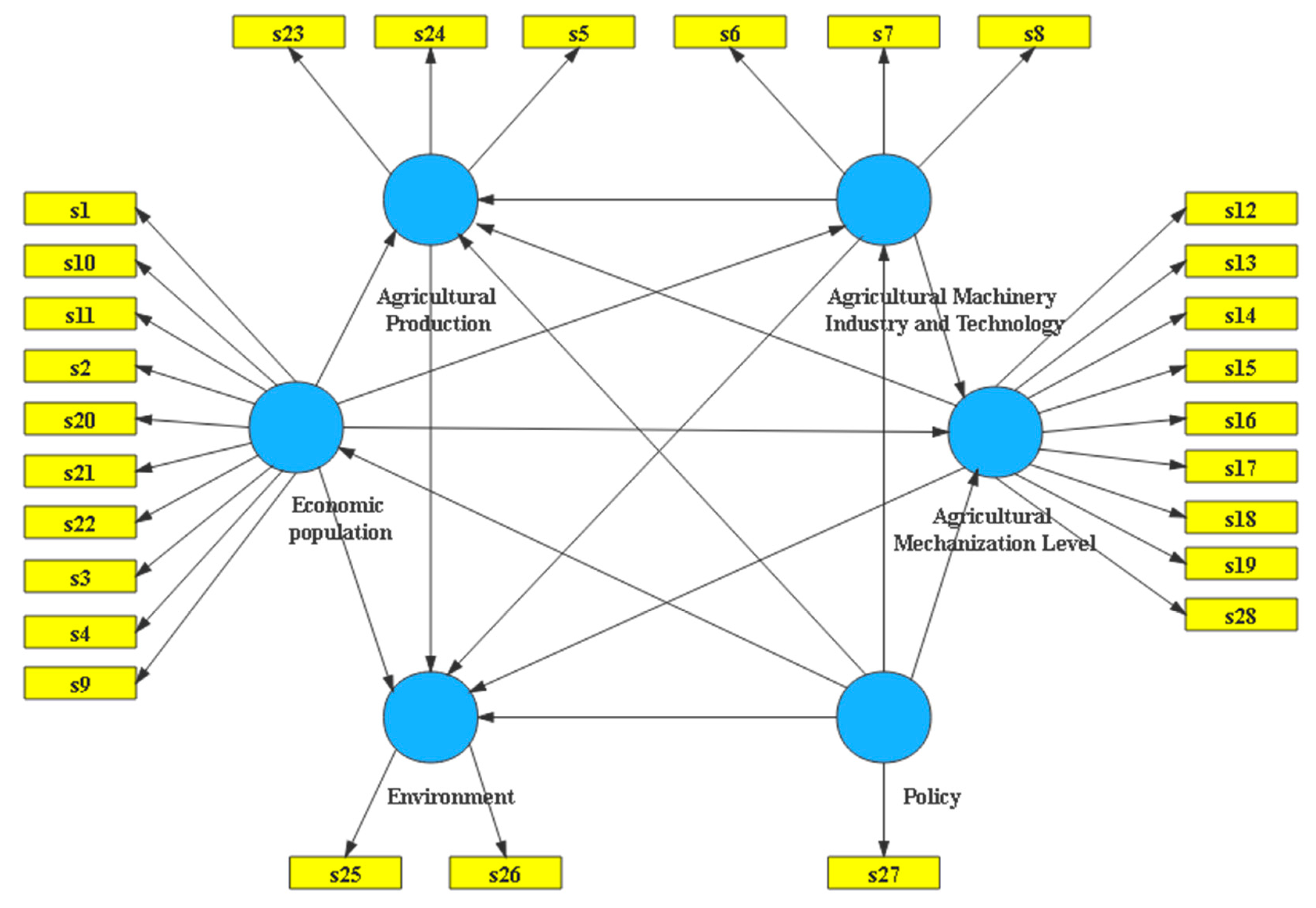
Based on these assumptions, this research first established an initial path graph structure in a fully connected form and then continuously made corrections based on the analysis results to create the final improved model. In the establishment of the measurement model, the corresponding relationships and influencing paths between the observed variables and latent variables were set according to the actual meaning of the indicators. All the indicators were then matched to the latent variables to achieve a causal equilibrium. The initial hypothesis structure is shown in Figure 1.
Figure 1.
Hypothetical structural equation framework of SAM.
3.3. Statistical Modeling Methods
Traditional statistical analysis methods, such as linear regression and principal component analysis, cannot effectively deal with these latent variables, but they can be studied with the help of structural equations. Structural equation modeling (SEM) is a systematic analysis method that integrates factor analysis and path analysis. SEM has the advantages of simultaneously processing multiple dependent variables, allowing independent variables and dependent variables to contain measurement errors; estimating factor structures and factor relationships; and estimating the fitting degree of the whole model [14]. It uses a structure of linear equations to deal with the relationships between manifest variables and latent variables and the relationships between latent variables.
SEM can be divided into two types according to the nature and relationship characteristics of the variables. One is the measurement model, and the other is the structural model, which uses a similar path-analysis method to establish the structural relationships between latent variables. The following equations show the specific forms of the measurement model and the structural model. The measurement model is [40]:
In Formula (1), is a dimensional vector formed by exogenous manifest variables, is an dimensional vector formed by exogenous latent variables, is a dimensional load matrix, and is a dimensional vector composed of measurement errors. In Formula (2), is a dimensional vector formed by exogenous manifest variables, is an dimensional vector formed by exogenous latent variables, is a dimensional load matrix, and is a dimensional vector composed of measurement errors.
The structural model is:
where is an dimensional correlation coefficient matrix, which is used to reflect the relationships among the various endogenous latent variables; is an dimensional correlation coefficient matrix, which is used to reflect the relationship between the exogenous latent variable and the endogenous latent variable ; is an dimensional vector composed of interpretation errors. The correlation coefficient is a standardized path coefficient. This path coefficient is used to measure the degree of correlation between two variables and is generally used to indicate reliability, under the premise that when the significance of the path coefficient is larger, the indicator has a greater impact [41].
In a realistic structural model, the variables may be both dependent variables and independent variables, and there may be not only direct but also indirect relationships among the variables. Some causal variables will affect the result variable through one or more intermediate variables, which are called indirect effects. The path coefficient of the indirect path is the product of the direct path coefficient involved in each path. The meaning of the total effect is the sum of the result variables affected by the causal variables, which is expressed as the sum of the direct effects and indirect effects, which can be used to verify the rationality of the hypothetical effect through path analysis.
Due to the number of samples collected, the maximum likelihood estimation method was not used, but the partial least squares (PLSs) method based on nonparametric estimation was used, as it has no strict assumptions about the sample size and sample distribution. Using the PLSs method to solve the SEM can avoid the situation where the model cannot be recognized because of a non-positive definite covariance matrix, and the method is more extensive. In summary, the study finally conducted an empirical analysis of the factors affecting the SAM by using the PLS-SEM method.
4. Results of the Case Study
In this study, Smart-PLS3 [42] was used to estimate Equations (1)–(3) based on the standardized data. Model evaluation and testing used multiple test statistical indicators to carry out correlation reliability and validity tests, such as Cronbach’s alpha coefficient (Cronbach’s α) and composite reliability. Hair et al. stated that it is acceptable for Cronbach’s α to be greater than 0.7 for verification purposes [43].
4.1. Model Specification Tests
The test results of the reliability and the goodness of fit of the model are shown in Table 4. It can be seen from Table 4 that the model passed the reliability and validity test. The outer loading of the measurement model and the path coefficient of the structural model were calculated by the PLSs method. Then, the bootstrapping method was used to test and evaluate the estimated results of the two coefficients, as shown in Table A2 and Table A3.
Table 4.
Test result of reliability and goodness of model.
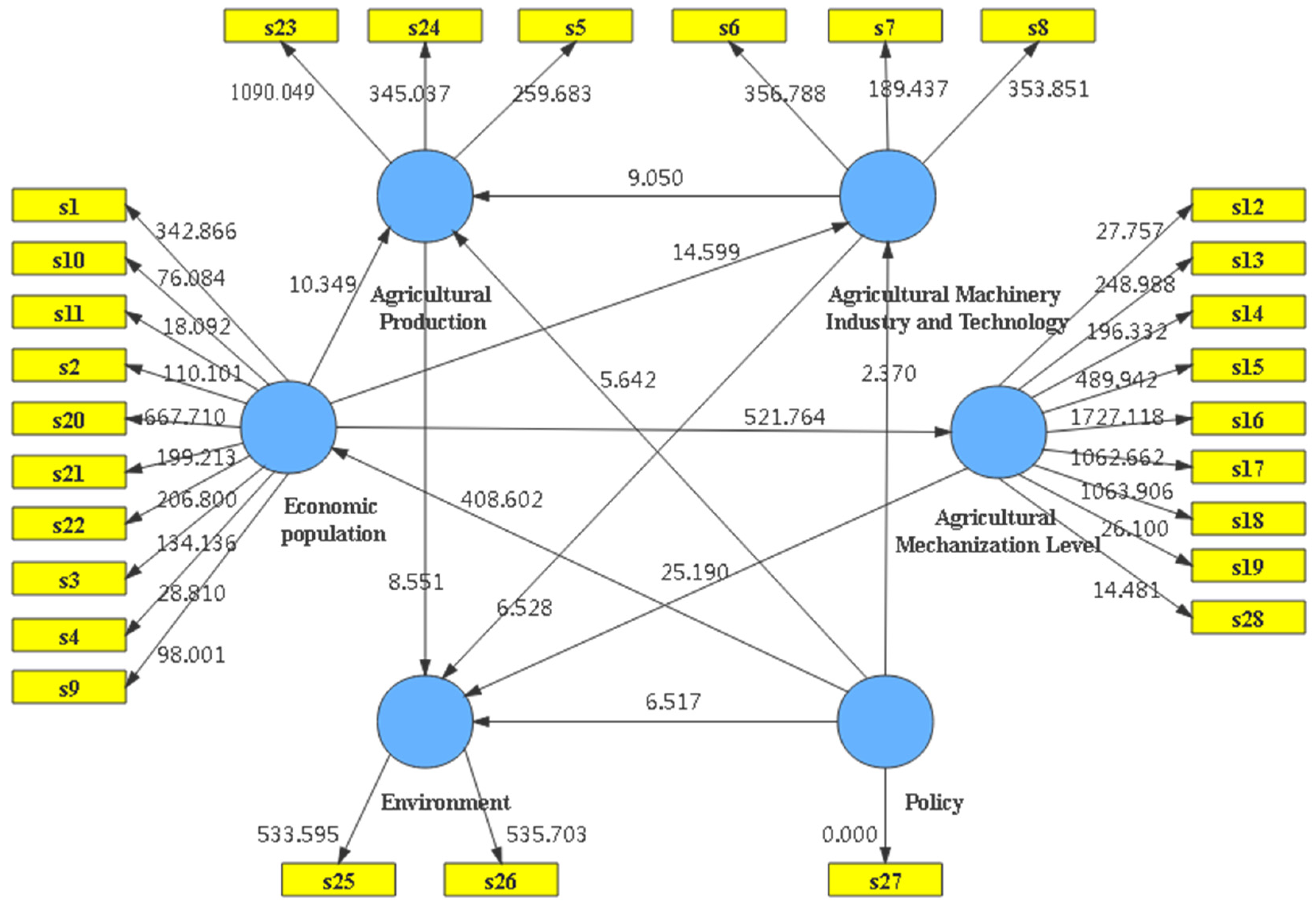
It can be seen from Table A2 that the loading of each path in the measurement model passed the significance test. The general test passing standard is that the significance level is 0.05, and the t-statistic is greater than 1.96. The parameter estimation results of the structural model are shown in Table A3. In Table A3, the estimated values of the direct path coefficients of four paths did not pass the significance test. As these direct relationships were not supported by the test results, these four paths were excluded from the model. Generally speaking, the path coefficient relates to the number, type, and nature of the observed variables corresponding to the latent variables. An insignificant path coefficient in the internal model does not prove that there is no causal relationship between these latent variables. The current variables and model settings were not enough to prove their relationship, and other latent variables can be used as intermediaries to supplement the path. Since the model passed the best test, the significant initial variables used when setting the measurement model did not change, but the causal relationships between the latent variables in the structural model were adjusted, and several insignificant paths were removed. The model was then tested again. The result was that in the revised structural model, all of the path coefficients also passed the significance test, and therefore, the model is desirable. The structural equation model obtained after the final adjustment is referred to as Model B, as shown in Figure 2.
Figure 2.
Model B of the influencing factors of SAM in Hubei.
4.2. Results of the First-Order PLS-SEM Model
The calculation results of measurement Model B are shown in Table A4. The factor loadings in Table A4 indicate that most of the indicators have a higher explanatory degree, reflecting that the selection of indicators is more representative and indicating that the measurement model’s interpretation ability is good. The negative numbers reflect negative correlations between the indicator and Sustainable Agricultural Mechanization (SAM).
According to measurement Model B, the latent variables of the original value of agricultural machinery, GDP, and agricultural machinery profit were the three most important economic factors, indicating that the overall economic environment and the economic conditions of the agricultural machinery industry are important economic factors of SAM. The agricultural machinery price index is negatively related to the economic factors, indicating that the higher the price of agricultural machinery, the lower the market for agricultural machinery, in line with the actual situation. The relationship between the SAM and the number of people in the labor force is also negatively related, consistent with theoretical analysis. It is also worth noting that the degree of education (the proportion of the population educated in junior high school) is about 0.78. Mechanization is related to the quality of workers, but with the popularization of education, the degree of relevance of the impact of this indicator is not particularly sensitive. The correlations of the three indicators of agricultural production are high, which indicates that the benefits of agricultural mechanization are obvious from the statistical point of view. It is noted that the correlations between several indicators of the agricultural machinery industry and scientific and technological factors are also strong, indicating that the contribution of scientific and technological input to SAM is increasing, and the previous qualitative analysis is verified.
In the indicator corresponding to the latent variable “agricultural level”, most of the indicators’ factor loadings are relatively large. The correlation coefficient of the number of households with agricultural machinery is about 0.76, which does not show a high correlation, indicating that SAM has slowly reflected the trend of increasing through quality and intensive development, rather than a simple absolute increase in quantity, which may also be reflected by the two negatively related indicators of the number of agricultural machinery service organizations and the number of agricultural technology extension agencies. The results for social services and the use of agricultural machinery technology to promote education suggest that the increase in agricultural mechanization in itself is not through popularization in terms of head counts but has been a gradual process of information dissemination regarding the precision and characteristics of SAM. The results of the structural model are shown in Table 5. The influencing factors are presented in Table 6, including the total effect of the change after considering the indirect effects.
Table 5.
Causality and path coefficients of latent variables in SEM.
Table 6.
Total effect of SAM in Model B.
The path coefficients in Table 5 and Table 6 describe whether there is a causal relationship between a pair of latent variables. If the path coefficient is small, the causal relationship reflected by that path may not exist. Of course, the paths in Table 5 only show the direct effects between the latent variable, that is, the direct impact of the cause variable on the result variable. Table 6 reflects the combination of direct and indirect effects of some of the latent variables.
4.3. Results of Hypothesis Testing
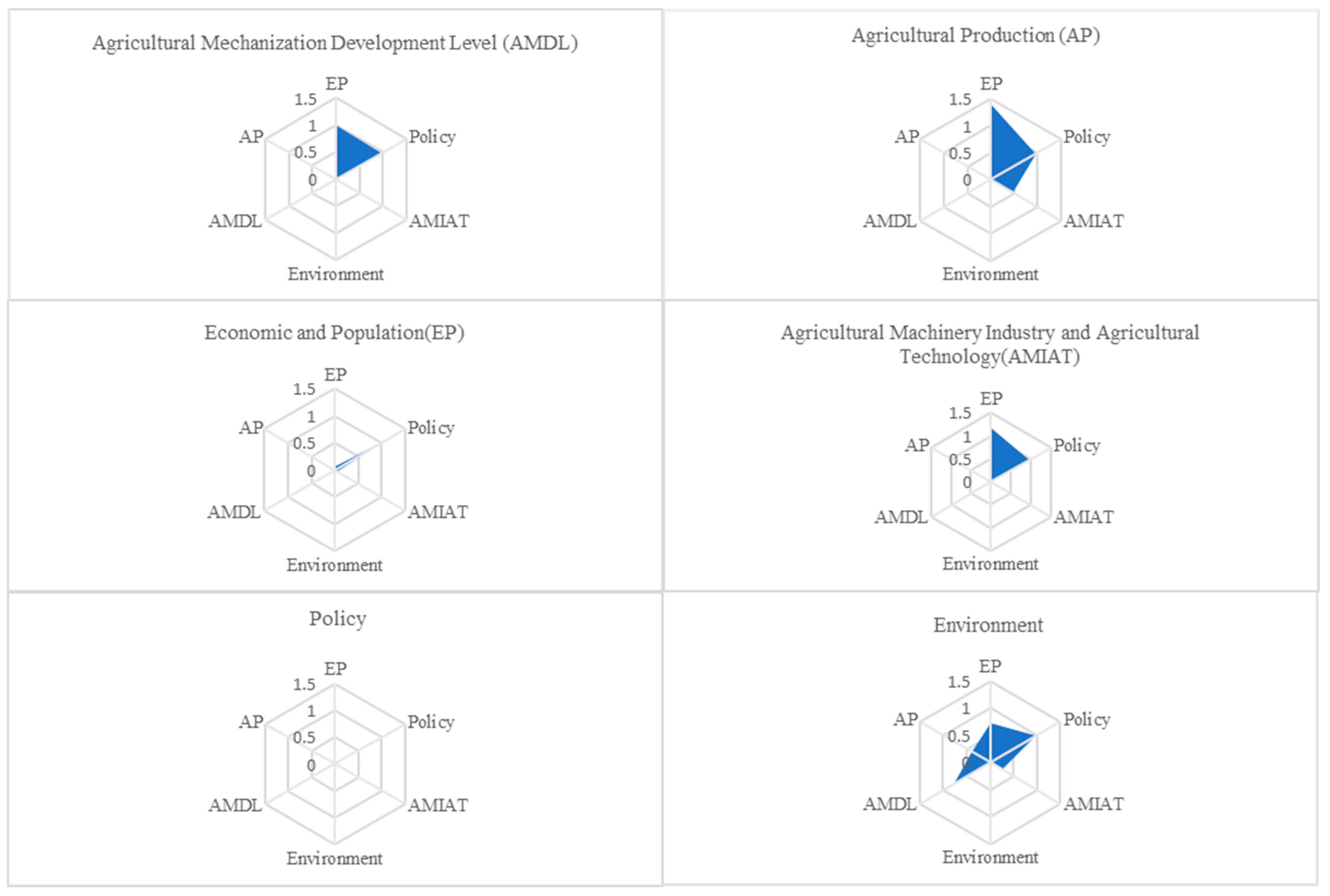
The results of the PLS-SEM analysis showed that agricultural mechanization is directly related to the six dimensions of economy, population, agricultural production, the agricultural machinery industry and agricultural technology, the environment, and policies. It can be seen from Figure 3 that the level of Agricultural Mechanization Development Level (AMDL) is obviously promoted by the economic, population, and policy factors. The economic and population factors are the most critical factors affecting SAM. The effect of the agricultural machinery industry and agricultural technology (AMIAT) on SAM is not statistically obvious.
Figure 3.
Radar chart of the total effect of the latent variables.
Secondly, the effects of policy on agricultural machinery (mainly referring to the agricultural machinery purchase subsidy policy) are not significant, but the path regression coefficient of the overall impact of the effect is 0.9725, and that is a strong positive correlation. In terms of agricultural production, the positive effect of economic factors on agricultural production input and output is obvious. The direct effect of policy factors on agricultural production is negatively correlated, but the total effect is still a relatively large positive correlation. The effects of the agricultural machinery industry and agricultural science and technology on agricultural production were also quantified in this article, showing a certain degree of persuasive power. The impact of agricultural mechanization on agricultural production is not significant. In terms of economic and population factors, apart from the strong influence of policy factors, no other path of influence is significant. The factors of the agricultural machinery industry and agricultural science and technology are similar to agricultural production factors: economic factors and policy factors are significantly affected by these factors. Finally, among the directly related factors, the two factors with the greatest effect on the environment are the AMDL and AMIAT. The path regression coefficient of the impact of agricultural mechanization on the environment is 0.7745, and it shows a strong positive correlation. Although this is not very high, a certain significant correlation has been shown, reflecting the increasing degree of the environmental impact of SAM. The coefficient of the direct impact of the agricultural machinery industry and agricultural science and technology on the environment is not particularly high, but the overall effect is reduced because the impact of agricultural production itself has a relatively strong negative correlation, indicating that when agricultural output is higher, the environmental impact will improve. There is a certain harmony between the two factors. Statistically speaking, this improvement (more than 40%) should be given sufficient attention.
4.4. Discussion
- (1)
- Sustainable Agricultural Mechanization (SAM) is directly affected by economic effects to a high degree. The development of SAM needs the necessary economic input and asset investment for its support. The cost of agricultural machinery and the efficiency of output have a direct impact on farmers’ use, making these important factors. The income level of farmers directly affects the farmers’ willingness and ability to purchase agricultural machinery, so agricultural mechanization and economics form feedback loops of mutual restriction and mutual promotion. This conclusion has also been confirmed in sub-Saharan Africa, South Asia, and Latin America [12,15,17].
- (2)
- Our results show that SAM requires policy investment support, and the indirect incentives of policy-guided market regulation can still bring great vitality to SAM, but the direct effect of the agricultural machinery policy subsidy on SAM has not been very significant. However, through policy guidance, market regulation of indirect incentives can still bring great vitality to SAM. Policy factors are still the leading factors promoting SAM, and our results corroborate several findings of prior studies [12,38,44]. However, as the degree of marketization deepens and government functions are gradually weakened, whether farmers’ willingness to purchase agricultural machinery can be maintained for future development are unclear.
- (3)
- However, our findings are also in contrast with other research results [45]. Our study confirms that the impact of agricultural mechanization on agricultural production is not significant, indicating that, on the one hand, many factors affecting agricultural output, such as climate, natural disasters, markets, and other factors, can strongly affect production results, and that therefore more complex agricultural mechanization is only one of the factors affecting production. On the other hand, one can also see that the current development of mechanization in Hubei is not particularly balanced. Because of the many lakes in large areas, mechanization is only found in a few areas, and only a few popular crops are grown. There is still a significant gap between Hubei and the provinces and regions with a high degree of SAM, such as Heilongjiang, Henan, and Jiangsu Provinces.
- (4)
- Environmental factors are influenced by several other factors comprehensively. The past period of high economic growth has been accompanied by high pollution and high consumption issues, which can be seen very clearly here. Adjusting the relative balance of agricultural development and the ecological environment, which must be a non-negotiable part of SAM, requires attention. At the same time, our results also show that through the improvement of agricultural machinery technology and agricultural science and technology input, accompanied by the effective improvement of agricultural output mode and processes, the environment can also play a significant role in achieving the sustainable green development of agriculture [11].
So far, we have clarified the relationships, influence paths, and intensity of the interactions among several factors affecting SAM, analyzed the factors influencing SAM within the overall and structural relationships, and clearly showed the mechanisms and quantity of the internal influencing relationships. Among these key elements of SAM, the total effect of the two aspects of policy and economic factors is consistent with the actual situation [7], the relationship between the level of agricultural mechanization and agricultural production is worth exploring, and the environment is the result of comprehensive action. In addition, we also suggest that we should focus on improving the system of laws and regulations regarding agricultural mechanization and that we should standardize the production, sales, use, and service of agricultural machinery. New studies should be pursued to actively explore policies and measures to promote the development of agricultural mechanization, strengthen administrative laws regarding agricultural machinery, and perfect the operation mechanism of regulatory supervision of agricultural machinery. Multiple measures should be used to strengthen public legislation and education and to enhance the legislative awareness and ideas of the public to meet the objective requirements of building a modern agricultural system and sustainable development.
5. Conclusions
Although some studies have investigated the factors affecting agricultural mechanization in China, relatively few have involved systematic and structured econometric research. Based on historical data and the status quo of the development of agricultural mechanization in Hubei, this study used a partial least squares–structural equation model (PLS-SEM) framework to conduct a reasonable modeling analysis based on 28 measurement indicators and determined the relationships and paths of the factors affecting Sustainable Agricultural Mechanization (SAM) in Hubei. The measurement results provided solid support for most of our hypotheses and effectively verified and supplemented the corresponding qualitative research: SAM is directly affected by economic effects to a high degree, and environmental factors are comprehensively influenced by several other factors. In addition, some influencing relationships are presented in the form of quantitative results for the first time, such as the total effect of policy on the agricultural mechanization level and the path coefficient of the impact of agricultural mechanization on the environment.
Our finding relies on data we collected. Different data-collection methods, data facticity, and limitations of data may result in greater deviation from our results and the interpretation of our results to formulate our conclusions. Therefore, future research that could enrich our understanding of China’s SAM could potentially proceed with longer-term empirical research. Meanwhile, the internet and big data technology can be used to monitor SAM in real time to reflect instantaneous developments and changes in SAM in response to different factors. These represent improvements that future studies can be undertaken to develop a more in-depth understanding of other economic, policy, and environmental factors impacting the adoption of Sustainable Agricultural Mechanization by producers in China and beyond.
Author Contributions
Conceptualization, Z.L. and M.Z.; methodology, Z.L., M.Z. and H.H.; software, Z.L. and J.F.; validation Z.L.; formal analysis, Z.L.; investigation, Z.L. and H.H.; resources, Z.L.; data curation, Z.L. and J.F.; writing—original draft preparation, Z.L.; writing—review and editing, Z.L. and Y.Y.; visualization, Z.L.; supervision, Z.L. and Y.Y.; project administration, Y.Y.; funding acquisition, Z.L. All authors have read and agreed to the published version of the manuscript.
Funding
This research was supported by the National Natural Science Foundation of China (71503095), a guiding project of humanities and social sciences of the Hubei Provincial Department of Education (15G028).
Institutional Review Board Statement
Not applicable.
Informed Consent Statement
Not applicable.
Data Availability Statement
The data used in this study are available from the authors on reasonable request.
Acknowledgments
We appreciate the advice of the reviewers very much.
Conflicts of Interest
The authors declare no conflict of interest.
Appendix A
Table A1.
Descriptive statistics of the variables.
Table A1.
Descriptive statistics of the variables.
| Variable Codes | Variable | N | Minimum | Maximum | Mean | Std. Deviation |
|---|---|---|---|---|---|---|
| s1 | Gross Domestic Product of the region | 17 | 5633.24 | 45,828 | 23,168.34 | 13,167.26 |
| s2 | Agricultural investment in fixed assets | 17 | 46.24 | 650.49 | 293.2665 | 201.8406 |
| s3 | Number of employees in agriculture, forestry, animal husbandry, and fishery | 17 | 863 | 1105 | 939.2941 | 88.02457 |
| s4 | The proportion of rural labor force with junior high school education or above | 17 | 0.67 | 0.76 | 0.722941 | 0.024438 |
| s5 | The sown area of food crops | 17 | 3817 | 4852 | 4346.647 | 353.1728 |
| s6 | The sales output value of agricultural machinery industry | 17 | 887 | 4735 | 2745.824 | 1202.251 |
| s7 | The contribution rate of agricultural science and technology progress | 17 | 39.64 | 61 | 52.5288 | 6.2936 |
| s8 | Informationization level | 17 | 1.09 | 34.32 | 16.8453 | 12.3385 |
| s9 | Total investment in agricultural mechanization | 17 | 9.1 | 54.9 | 35.1059 | 14.5315 |
| s10 | Farm machinery purchase cost | 17 | 7.9 | 50.9 | 30.6 | 12.6586 |
| s11 | Fixed base price index of mechanized farm tools | 17 | 99.1 | 107.7 | 102.1765 | 2.3720 |
| s12 | Number of service organizations of agricultural mechanization | 17 | 3.4 | 219 | 45.3471 | 67.6336 |
| s13 | Number of trainees in agricultural mechanization | 17 | 98,832 | 560,816 | 381,649.5 | 181,420.3 |
| s14 | Machine sowing area | 17 | 233.66 | 3362.6 | 1565.45 | 1085.071 |
| s15 | Machine farming area | 17 | 2015.93 | 6127.6 | 4602.291 | 1526.089 |
| s16 | Machine collecting area | 17 | 1263.46 | 4633.2 | 3227.768 | 1161.949 |
| s17 | Total power of agricultural machinery | 17 | 1768.6 | 4626.1 | 3541.795 | 924.7491 |
| s18 | Comprehensive operation rate of main crops cultivation and harvesting | 17 | 42 | 71.3 | 58.2059 | 9.4999 |
| s19 | Number of farm machinery households | 17 | 94.6 | 237.3 | 211.5353 | 37.8286 |
| s20 | The original value of agricultural machinery | 17 | 98.57 | 550 | 319.9506 | 144.1551 |
| s21 | Total profit of agricultural machinery | 17 | 28.22 | 103.44 | 70.3544 | 23.7995 |
| s22 | Per capita net income of farmers | 17 | 2890.01 | 16,390.86 | 8791.248 | 4666.718 |
| s23 | Per capita food production | 17 | 349 | 500 | 426.7059 | 47.7417 |
| s24 | Agricultural output value | 17 | 921.59 | 3492.54 | 2198.772 | 853.4645 |
| s25 | Agricultural diesel consumption | 17 | 41.09 | 67.33 | 58.1059 | 9.3321 |
| s26 | Agricultural carbon emissions | 17 | 1833 | 4598 | 3226.294 | 836.1836 |
| s27 | Government Agricultural Machinery Policy Subsidies—National | 17 | 0.7 | 237.54 | 140.2788 | 86.7749 |
| s28 | Number of agricultural mechanization technology promotion agencies | 17 | 670 | 1016 | 832.1765 | 103.1482 |
Table A2.
Factor load estimation results of the measurement model.
Table A2.
Factor load estimation results of the measurement model.
| Path | Original Sample Value (O) | T Statistic (|O/STERR|) | Significance | Path | Original Sample Value (O) | T Statistic (|O/STERR|) | Significance |
|---|---|---|---|---|---|---|---|
| s1 ← EP | 0.9810 | 345.5423 | *** | s2 ← EP | 0.9258 | 106.6113 | *** |
| s10 ← EP | 0.9215 | 880.8130 | *** | s20 ← EP | 0.9929 | 678.2270 | *** |
| s11 ← EP | −0.7261 | 17.9869 | ** | s21 ← EP | 0.9740 | 202.7099 | *** |
| s12 ← AMDL | −0.7505 | 26.1794 | ** | s22 ← EP | 0.9599 | 217.1062 | *** |
| s13 ← AMDL | 0.9712 | 255.6121 | *** | s23 ← AP | 0.9943 | 1125.4639 | *** |
| s14 ← AMDL | 0.9537 | 196.9908 | *** | s24 ← AP | 0.9733 | 329.7788 | *** |
| s15 ← AMDL | 0.9855 | 407.7759 | *** | s28 ← AMDL | −0.6921 | 14.8183 | ** |
| s16 ← AMDL | 0.9960 | 1594.6752 | *** | s3 ← EP | −0.9494 | 132.5960 | *** |
| s17 ← AMDL | 0.9891 | 1055.2473 | *** | s4 ← EP | 0.7831 | 35.1248 | ** |
| s18 ← AMDL | 0.9924 | 1028.9101 | *** | s5 ← AP | 0.9734 | 262.2697 | *** |
| s19 ← AMDL | 0.7595 | 24.3129 | ** | s6 ← AMIAT | 0.9834 | 372.2486 | *** |
| s25 ← E | 0.9885 | 511.9002 | *** | s7 ← AMIAT | 0.9625 | 181.3262 | *** |
| s26 ← E | 0.9885 | 512.6484 | *** | s8 ← AMIAT | 0.9821 | 359.1926 | *** |
| s27 ← P | 1.0000 | s9 ← EP | 0.9357 | 101.2481 | *** |
Note: (1) Economic and population factors (EP), agricultural production (AP), the agricultural mechanization development level (AMDL), the agricultural machinery industry and agricultural technology (AMIAT), environment (E), and policy (P). (2) *** indicates a significance level of 1%, ** indicates a significance level of 5%. (3) STERR indicates standard error.
Table A3.
Estimation of path coefficients for structural model.
Table A3.
Estimation of path coefficients for structural model.
| Path | Original Sample Value (O) | T Statistic (|O/STERR|) | Significance |
|---|---|---|---|
| AP → Environment | −0.3624 | 5.3331 | * |
| AMDL → AP | −0.1030 | 0.9804 | -- |
| AMDL→ Environment | 0.8246 | 12.7605 | ** |
| AMIAT → AP | 0.4739 | 8.8222 | ** |
| AMIAT → AMDL | 0.0514 | 0.7795 | -- |
| AMIAT → Environment | 0.4446 | 7.7764 | ** |
| Policy → AP | −0.3525 | 6.0133 | ** |
| Policy → AMDL | −0.0507 | 0.6018 | -- |
| Policy → AMIAT | −0.2062 | 2.2246 | * |
| Policy → Environment | 0.2363 | 5.0714 | * |
| Policy → EP | 0.9819 | 450.3113 | *** |
| EP → AP | 0.9639 | 7.5819 | ** |
| EP → AMDL | 0.9900 | 7.9282 | ** |
| EP → AMIAT | 1.1889 | 13.3998 | ** |
| EP → Environment | −0.1449 | 1.1388 | -- |
Note: (1) Economic and population factors (EP), agricultural production (AP), the agricultural mechanization development level (AMDL), and the agricultural machinery industry and agricultural technology (AMIAT). (2) *** indicates a significance level of 1%, ** indicates a significance level of 5%, and * indicates a significance level of 10%, -- indicates failed t-test. (3) STERR indicates standard error.
Table A4.
Factor load of observed variables in measurement Model B.
Table A4.
Factor load of observed variables in measurement Model B.
| Latent Variable | Observation Variables | Factor Load |
|---|---|---|
| EP | s1 | 0.9811 |
| s2 | 0.9261 | |
| s9 | 0.9353 | |
| s10 | 0.9212 | |
| s11 | −0.7265 | |
| s20 | 0.9929 | |
| s21 | 0.9738 | |
| s22 | 0.9601 | |
| s3 | −0.9490 | |
| s4 | 0.7834 | |
| AP | s5 | 0.9734 |
| s23 | 0.9943 | |
| s24 | 0.9733 | |
| AMIAT | s7 | 0.9625 |
| s8 | 0.9821 | |
| s6 | 0.9834 | |
| s12 | −0.7543 | |
| s13 | 0.9705 | |
| s14 | 0.9516 | |
| AMDL | s15 | 0.9864 |
| s16 | 0.9957 | |
| s17 | 0.9895 | |
| s18 | 0.9923 | |
| s19 | 0.7627 | |
| s28 | −0.6874 | |
| Environment | s25 | 0.9884 |
| s26 | 0.9885 | |
| Policy | s27 | 1 |
Note: Economic and population factors (EP), agricultural production (AP), the agricultural mechanization development level (AMDL), and the agricultural machinery industry and agricultural technology (AMIAT).
References
- Sims, B.; Kienzle, J.; Hilmi, M. Agricultural Mechanization a Key Input for Sub-Saharan African Smallholders; FAO: Rome, Italy, 2016. [Google Scholar]
- FAO. Sustainable Agricultural Mechanization. Available online: http://www.fao.org/sustainableagricultural-mechanization (accessed on 13 February 2022).
- Sims, B.; Kienzle, J. Sustainable Agricultural Mechanization for Smallholders: What Is It and How Can We Implement It? Agriculture 2017, 7, 50. [Google Scholar] [CrossRef] [Green Version]
- Kobrich, C.; Rehman, T. Sustainable agriculture and the MCDM paradigm: The development of compromise programming models with special reference to small-scale farmers in Chile′s VIth region. In Proceedings of the First International Conference on Multiple Objective Decision Support Systems (MODSS) for Land, Water and Environmental Management: Concepts, Approaches and Applications, Honolulu, HI, USA, September 1996; pp. 557–569. [Google Scholar]
- FAO. Agri-Hire in Sub-Saharan Africa Business Models for Investing in Sustainable Mechanization; FAO: Rome, Italy, 2021. [Google Scholar]
- Ministry of Agriculture and Rural Affairs, P.R.C. National Agricultural Mechanization Development Plan in the 14th Five-Year Plan. Available online: http://www.moa.gov.cn/govpublic/NYJXHGLS/202201/t20220105_6386316.htm (accessed on 13 February 2022).
- Yang, M. Discussion on the development of Agricultural Mechanization in China under the new normal. Agric. Mach. Qual. Superv. 2015, 3, 4–9. [Google Scholar]
- Gowdy, J.; Baveye, P. Chapter 27-An Evolutionary Perspective on Industrial and Sustainable Agriculture. In Agroecosystem Diversity; Lemaire, G., Carvalho, P.C.D.F., Kronberg, S., Recous, S., Eds.; Elsevier: Amsterdam, The Netherlands, 2019; pp. 425–433. [Google Scholar]
- Mrema, G.; Kienzle, J.; Mpagalile, J. Current status and future prospects of agricultural mechanization in sub-saharan Africa (SSA). Agric. Mech. Asia Afr. Lat. Am. 2018, 49, 13–30. [Google Scholar]
- Yu, J.; Wu, J. The sustainability of agricultural development in China: The agriculture–environment nexus. Sustainability 2018, 10, 1776. [Google Scholar] [CrossRef] [Green Version]
- Jiang, M.; Hu, X.; Chunga, J.; Lin, Z.; Fei, R. Does the popularization of agricultural mechanization improve energy-environment performance in China’s agricultural sector? J. Clean. Prod. 2020, 276, 124210. [Google Scholar] [CrossRef]
- Kormawa, P.; Mrema, G.; Mhlanga, N.; Fynn, M.; Kienzle, J.; Mpagalile, J. Sustainable Agricultural Mechanization: A Framework for Africa; FAO: Addis Ababa, Ethiopia; AUC: Addis Ababa, Ethiopia, 2018. [Google Scholar]
- Daum, T.; Adegbola, Y.P.; Kamau, G.; Daudu, C.; Zossou, R.C.; Crinot, G.F.; Houssou, P.; MOSES, L.; Ndirpaya, Y.; Wahab, A. Impacts of agricultural mechanization: Evidence from four African countries. Hohenh. Work. Pap. Soc. Inst. Chang. Agric. Dev. 2020. [Google Scholar] [CrossRef]
- Li, W.; Wei, X.; Zhu, R.; Guo, K. Study on Factors Affecting the Agricultural Mechanization Level in China Based on Structural Equation Modeling. Sustainability 2019, 11, 51. [Google Scholar] [CrossRef] [Green Version]
- Van Loon, J.; Woltering, L.; Krupnik, T.J.; Baudron, F.; Boa, M.; Govaerts, B. Scaling agricultural mechanization services in smallholder farming systems: Case studies from sub-Saharan Africa, South Asia, and Latin America. Agric. Syst. 2020, 180, 102792. [Google Scholar] [CrossRef]
- Baudron, F.; Misiko, M.; Getnet, B.; Nazare, R.; Sariah, J.; Kaumbutho, P. A farm-level assessment of labor and mechanization in Eastern and Southern Africa. Agron. Sustain. Dev. 2019, 39, 17. [Google Scholar] [CrossRef] [Green Version]
- Devkota, R.; Pant, L.P.; Gartaula, H.N.; Patel, K.; Gauchan, D.; Hambly-Odame, H.; Thapa, B.; Raizada, M.N. Responsible Agricultural Mechanization Innovation for the Sustainable Development of Nepal’s Hillside Farming System. Sustainability 2020, 12, 374. [Google Scholar] [CrossRef] [Green Version]
- Chen, Y.E.; Chen, W. A Study on the Relationship among Agricultural Mechanization, Industrial Upgrading and Agricultural Carbon Emission—The Empirical Research Based on Dynamic Panel Data Model. J. Agrotech. Econ. 2018, 5, 122–133. [Google Scholar]
- Cui, H.; Zhao, T.; Shi, H. STIRPAT-Based Driving Factor Decomposition Analysis of Agricultural Carbon Emissions in Hebei, China. Pol. J. Environ. Stud. 2018, 27, 1449–1461. [Google Scholar] [CrossRef]
- Cui, Y.; Khan, S.U.; Deng, Y.; Zhao, M.; Hou, M. Environmental improvement value of agricultural carbon reduction and its spatiotemporal dynamic evolution: Evidence from China. Sci. Total Environ. 2021, 754, 142170. [Google Scholar] [CrossRef]
- Chi, Y.; Zhou, W.; Wang, Z.; Hu, Y.; Han, X. The Influence Paths of Agricultural Mechanization on Green Agricultural Development. Sustainability 2021, 13, 12984. [Google Scholar] [CrossRef]
- Guo, X.; Huang, S.; Wang, Y. Influence of Agricultural Mechanization Development on Agricultural Green Transformation in Western China, Based on the ML Index and Spatial Panel Model. Math. Probl. Eng. 2020, 2020, 6351802. [Google Scholar] [CrossRef]
- Liu, D.; Zhu, X.; Wang, Y. China’s agricultural green total factor productivity based on carbon emission: An analysis of evolution trend and influencing factors. J. Clean. Prod. 2021, 278, 123692. [Google Scholar] [CrossRef]
- Li, W.; Zhang, P. Relationship and integrated development of low-carbon economy, food safety, and agricultural mechanization. Environ. Sci. Pollut. Res. 2021, 28, 68679–68689. [Google Scholar] [CrossRef]
- Bai, R. Thinking on the development of agricultural mechanization during the ‘13th Five-year′ in China. J. Chin. Agric. Mech. 2014, 35, 1–5. [Google Scholar]
- Lu, B.; Zhang, Z.; Zhu, M.; Chen, Z.; Lv, X. Discrimination and analysis of key influencing factors for agricultural mechanization development. Trans. Chin. Soc. Agric. Eng. (Trans. CSAE) 2008, 24, 114–117. [Google Scholar]
- Yan, Z.; Qi, Y.; Liao, J. Comparative analysis of evaluation methods of agricultural mechanization level in China. J. Agric. Mech. Res. 2018, 10, 1–5. [Google Scholar]
- Daum, T.; Birner, R. Agricultural mechanization in Africa: Myths, realities and an emerging research agenda. Glob. Food Secur. 2020, 26, 100393. [Google Scholar] [CrossRef]
- Kirui, O.K. The Agricultural mechanization in Africa: Micro-level analysis of state drivers and effects. ZEF-Discuss. Pap. Dev. Policy 2019, 60. [Google Scholar] [CrossRef]
- Cossar, F. Boserupian Pressure and Agricultural Mechanization in Modern Ghana; Intl Food Policy Res Inst: Washington, DC, USA, 2016; Volume 1528, Available online: https://ssrn.com/abstract=2778742 (accessed on 20 January 2022).
- Berhane, G.; Dereje, M.; Minten, B.; Tamru, S. The Rapid–But from a Low Base–Uptake of Agricultural Mechanization in Ethiopia: Patterns, Implications and Challenges; Intl Food Policy Res Inst: Washington, DC, USA, 2017; Volume 105. [Google Scholar] [CrossRef]
- Saliou, I.O.; Zannou, A.; Aoudji, A.K.; Honlonkou, A.N. Drivers of Mechanization in Cotton Production in Benin, West Africa. Agriculture 2020, 10, 549. [Google Scholar] [CrossRef]
- Mottaleb, K.A.; Krupnik, T.J.; Erenstein, O. Factors associated with small-scale agricultural machinery adoption in Bangladesh: Census findings. J. Rural. Stud. 2016, 46, 155–168. [Google Scholar] [CrossRef] [PubMed] [Green Version]
- Ghosh, B.K. Determinants of Farm Mechanisation in Modern Agriculture: A Case Study of Burdwan Districts of West Bengal. Int. J. Agric. Res. 2010, 5, 1107–1115. [Google Scholar] [CrossRef]
- Aryal, J.P.; Sofina, M.; Olaf, E. Understanding factors associated with agricultural mechanization: A Bangladesh case. World Dev. Perspect. 2019, 13, 1–9. [Google Scholar] [CrossRef]
- Aryal, J.P.; Thapa, G.; Simtowe, F. Mechanisation of small-scale farms in South Asia: Empirical evidence derived from farm households survey. Technol. Soc. 2021, 65, 101591. [Google Scholar] [CrossRef]
- Belton, B.; Win, M.T.; Zhang, X.; Filipski, M. The rapid rise of agricultural mechanization in Myanmar. Food Policy 2021, 101, 102095. [Google Scholar] [CrossRef]
- Li, Z.; Zhu, M.; Huang, H. Evaluating the sustainable development of agricultural mechanization in Hubei Province based on fuzzy DEMATEL and ISM combined method. Trans. Chin. Soc. Agric. Eng. 2022, 38, 51–58. [Google Scholar]
- Mamat, T.; Ding, W.; Kasim, E.; Hassan, M. The sustainable development of agricultural mechanization based on combination weighting and ahp. Chin. J. Agric. Resour. Reg. Plan. 2018, 39, 67–73. [Google Scholar]
- WOLD, S. Modeling data tables by principal components and PLS: Class pattern and quantitative predictive relations. Cemomet. Intell. Lab. Syst. 1989, 7, 53–65. [Google Scholar] [CrossRef]
- Fornell, C.; Larcker, D.F. Evaluating structural equation models with unobservable variables and measurement error. J. Mark. Res. 1981, 18, 39–50. [Google Scholar] [CrossRef]
- Ringle, C.M.; Christian, M.; Wende, S.; Becker, J.M. SmartPLS 3; SmartPLS GmbH: Boenningstedt, Germany, 2015; Available online: http://www.smartpls.com (accessed on 13 February 2022).
- Hair, J.F. Multivariate Data Analysis; Prentice Hall: Englewood Cliffs, NJ, USA, 2011. [Google Scholar]
- Tian, X.; Li, W.; Li, R. The Environmental Effects of Agricultural Mechanization: Evidence from Agricultural Machinery Purchase Subsidy Policy. Chin. Rural. Econ. 2021, 9, 95–109. [Google Scholar]
- Zhou, Z.; Kong, X. Agricultural Machines Subsidy Policy and the Grain Output of China: DID Empirical Analysis Based on National County-Level Data. China Soft Sci. 2019, 4, 20–32. [Google Scholar]
Publisher’s Note: MDPI stays neutral with regard to jurisdictional claims in published maps and institutional affiliations. |
© 2022 by the authors. Licensee MDPI, Basel, Switzerland. This article is an open access article distributed under the terms and conditions of the Creative Commons Attribution (CC BY) license (https://creativecommons.org/licenses/by/4.0/).