Abstract
Continuous increases in electrical energy demand and the deregulation of power systems have forced utility companies to provide high-quality and reliable services to maintain a sustainable operation and reduce electricity price. One way to continue providing the required services while simultaneously reducing operational costs is through minimizing power losses and voltage deviation in the distribution network. For this purpose, Network Reconfiguration (NR) is commonly adopted by employing the switching operation to enhance overall system performance. In the past, work proposed by researchers to attain switching sequence operation was based on hamming distance approach. This approach caused the search space to grow with the increase in total Hamming distance between the initial and the final configuration. Therefore, a method is proposed in this paper utilizing a Mixed Integer Second Order Cone Programming (MISOCP) to attain optimal NR to address this issue. The Hamming dataset approach is opted to reduce search space by considering only radial configuration solutions to achieve an optimal switching sequence. In addition, a detailed economic analysis has been performed to determine the saving after the implementation of the proposed switching sequence. The effectiveness of the proposed technique is validated through simulations on IEEE 33-bus distribution network and a practical 71-bus network in Malaysia. The result shows that the proposed method determined the optimal network configuration by minimizing the power losses for the 33 bus and 71-bus system by 34.14% and 25.5% from their initial configuration, respectively to maintain sustainable operation.
1. Introduction
Nowadays, human lives are highly dependent on technologies and has thus made electricity instrumental for their livelihood. It also plays a pivotal role in increasing sustainability and economic development in a wide variety of sectors. For example, demand for electricity in Malaysia has increased by an average factor of 5.48% per year for the last 20 years, and it is expected to increase further in the future [1]. Electricity is supplied through a power system which typically consists of three subsystems; the first is the generation, followed by the transmission and distribution system. During power distribution, current flows through a conductor and produces power losses which are in the form of heat. Studies conducted in [2,3] stated that the power loss in the transmission and distribution system is 30% and 70% of the total losses in the power system, respectively. The distribution system provides electricity to residential, commercial, and industrial consumers. Total power losses in a distribution network are reasonably high because it has a low voltage and a high current amplitude than the high voltage network (transmission system). Hence, the performance of the electrical distribution network degrades further due to the reduction in voltage magnitude at heavily loaded feeders, which in turn increases the power loss of the system. Therefore, power losses in the distribution network reduce system efficiency and increase operational costs.
In a modern distribution network, the efficiency of a distribution network is improved by mitigating the power loss using Network Reconfiguration (NR). Network Reconfiguration is a process that alters the distribution network’s switching state. The distribution network consists of two types of switches which are sectionalizing switches (normally closed) and tie switches (normally open) [4]. The main concept of NR is to open the sectionalizing switches and close the tie switches while maintaining the radiality of the distribution network. Network Reconfiguration was one of the methods utilized in order to reduce the power loss of the distribution network and balance the load by transferring from heavily loaded feeders to lightly loaded feeders; additionally, it is used to isolate the faulted area and restore the power outage of an un-faulted area in the distribution network. Hence, NR can reduce the power loss and voltage deviation while simultaneously improving the distribution network’s reliability, stability, and loadability [5,6,7,8]. However, attaining the optimal switches to achieve the previous objectives is a complicated task, especially due to the considerable search space. Hence, a robust method should be adopted to obtain the optimal switching to reduce the power losses and improve the voltage profile. Previously, several techniques had been presented to attain optimal solutions for the power losses problem in [9], another comprehensive comparison studies among meta-heuristic techniques were addressed in [10], where the Equilibrium Optimizer (EO) showed its superiority compared with other meta-heuristic techniques in attaining optimal solutions. Furthermore, the Cuckoo Search Algorithm (CSA) was used in [11] to reduce the active power losses and improve the voltage profile, whereas an improved CSA was utilized in [12] for power loss minimizing. The Firefly Algorithm (FA) [13] and Coyote Optimization Algorithm (COA) in [14] were used for reducing the power loss and improving the voltage profile. Similarly, Cloud Theory was utilized in [15] to reduce the power losses, voltage deviation and improve system reliability. A Mixed Integer Second Order Cone Programming (MISOCP) was proposed in [16], considering NR and optimal capacitor placement to minimize the power losses in addition to operating costs. For more pragmatic solutions, the Distributed Generation (DG) was included in many works alongside NR [17]. For example, the salp swarm algorithm was presented in [18] to reduce the active power loss, and NR was used to enhance the distribution system resilience in [6] to reduce the accumulative cost during the load restoration and DGs operation. Furthermore, heuristic algorithms such as artificial bee colony, differential evaluation, particle swarm optimization (PSO), and genetic algorithm (GA) were addressed in [19] to minimize the real power losses and enhance system performance. Finally, an improved sine–cosine algorithm was used to decrease the power losses and enhance the voltage stability [20].
On the other hand, a switching sequence identifies the switching path from an initial configuration to achieve an optimal NR configuration. It is necessary to maintain the network operational condition during intermittent switching. In the past, most investigations were conducted on obtaining the minimum power loss by using NR, but few have considered the network switching sequence technique [21]. Moreover, the real-time optimal switching sequence was discussed in [22]. The main aim was to minimize the power loss and enhance the voltage profile using different meta-heuristic techniques like the firefly algorithm, GA, and PSO. The pathfinder algorithm (PFA) was utilized in [8] to minimize the total cost of power losses and the changing of the switches. Finally, the switch opening and exchange method was proposed in [23], where the authors in this work attain to find a solution for the multi-hour stochastic distribution NR.
However, most researchers consider the two-level strategy in which NR is used to identify the optimal configuration in the first stage, whereas in the second stage, an algorithm determines the path of the switching sequence based on minimum power loss. The proposed switching technique considers Hamming distance equal to one for switching search space. Thus, it requires a large switching search space, i.e., where is the total Hamming distance between initial and final configuration. Therefore, the large space of the switching sequence requires an optimization method to search and find the optimum results for the problem. The previous works showed a robust method to find the optimal configuration for the network to reduce the power losses. However, the search space was large, and the relation between the number of buses and the search space is direct. Hence, it will take considerable computational time to find the optimal switching. Furthermore, the accuracy in finding the optimal network configuration that gives minimum power loss is difficult with such a large search space.
This study focuses on NR to improve system efficiency by reducing the distribution network’s power loss and voltage deviation to ensure sustainable operation. In addition, to cope with the previous work drawbacks, the proposed MISOCP technique attains a switching sequence from the initial configuration based on minimum power loss during intermittent switching. Due to the implementation of the proposed technique, the search space has been reduced significantly, which resulted in obtaining the optimal switching that gives the minimum power loss and voltage deviation. In each switching operation, the radiality of the network is maintained, and the bus voltage is kept within the voltage limit. The performance of the proposed technique is vetted on a 33-bus distribution network, and the practical impact of the proposed technique is evaluated on the practical 71-bus system in Malaysia. The main contributions of this work are outlined as follows:
- NR for a practical 71-bus system in Malaysia has been conducted based on the MISOCP method to minimize the power loss and voltage deviation to acquire sustainable operation.
- Hamming dataset approach with reduced search space based on exhaustive search has been proposed to attain the optimal switching sequence during intermittent switching.
- Economic analysis has been conducted on a practical 71-bus system to minimize operational costs.
The paper is structured as follows; the problem formulation is presented in Section 2, followed by the methodology of the switching sequence in Section 3, then the results and discussion are elaborated in Section 4. Finally, a conclusion to sum up the whole paper is demonstrated at the end of the manuscript.
2. Problem Formulation
This work aims to reduce the total power losses in addition to the voltage deviation in the system and consequently minimize the operational cost while fulfilling the technical and operational constraints. The whole problem formulation is elaborated in this section, beginning with the objective function and then the problem constraints.
2.1. Objective Function
The proposed technique solves NR problems to reduce the total power losses in addition to voltage deviation utilizing the MISOCP. An objective function is defined in Equation (1), where Equation (2) utilized to minimize the voltage deviation. Finally, the cost of power losses is calculated in Equation (3). Because the objective function (Obj) has two parts with different units, the net power loss is calculated as the ratio of the system’s total active power loss after reconfiguration to its power loss prior to reconfiguration . Equation (5) denotes to the active power loss after the network reconfiguration.
where is the ratio of the system’s total active power loss; is the voltage deviation index; is the total power loss cost.
is the electricity tariff (0.224 MYR/kWh); is the year in hour (8760 h); is the voltage at the receiving bus.
is the nominal voltage at bus j; is the active power loss after the reconfiguration; is the active power loss before the network reconfiguration; is the branch in which is a sending bus and is a receiving bus, is the active power passing through the branch ; is the reactive power passing through the branch ; is the branch resistance; is the binary variable, which determines the state of that branch; and is the whole number of branches in the network.
2.2. Constraints
In order to attain the optimum network configuration, the following constraints have to be maintained and fulfilled:
2.2.1. Active and Reactive Power Flows
Inward and outward power flow of ith bus defined in Equations (6) and (7) must be balanced with the generated power and load demand at the particular bus.
where is the active power generations at bus ; is the reactive power generations at bus ; is the active power demand at bus ; is the reactive power demand at bus ; is the active power loss; is the reactive power loss; is the set of buses; and is the set of branches.
2.2.2. Voltage Limit
The voltage drop in branch can be calculated considering the binary variable , as shown in Equation (8). Moreover, the voltage should be kept within nominal limits, as defined by Equation (10).
where and are the sending and receiving bus voltages; is the branch current; is the branch reactance; and is the branch impedance.
2.2.3. Maximum Power Flow of a Branch
The power flow and the current through a branch depends on its current carrying capacity () and its state variable, as defined by Equations (11)–(13).
2.2.4. Radiality of Network
The distribution network should operate in a radial topology. Constraints Equations (14) and (15) define the radiality condition.
where is the total number of buses, and is the number of a substation in the distribution network.
2.2.5. Apparent Power Limit
The non-linear equation of the apparent power is defined in Equation(16) and converted into MISOCP using Equation (17).
where and represent the active and reactive power flows through the branch .
3. Methodology of the Switching Sequence Technique
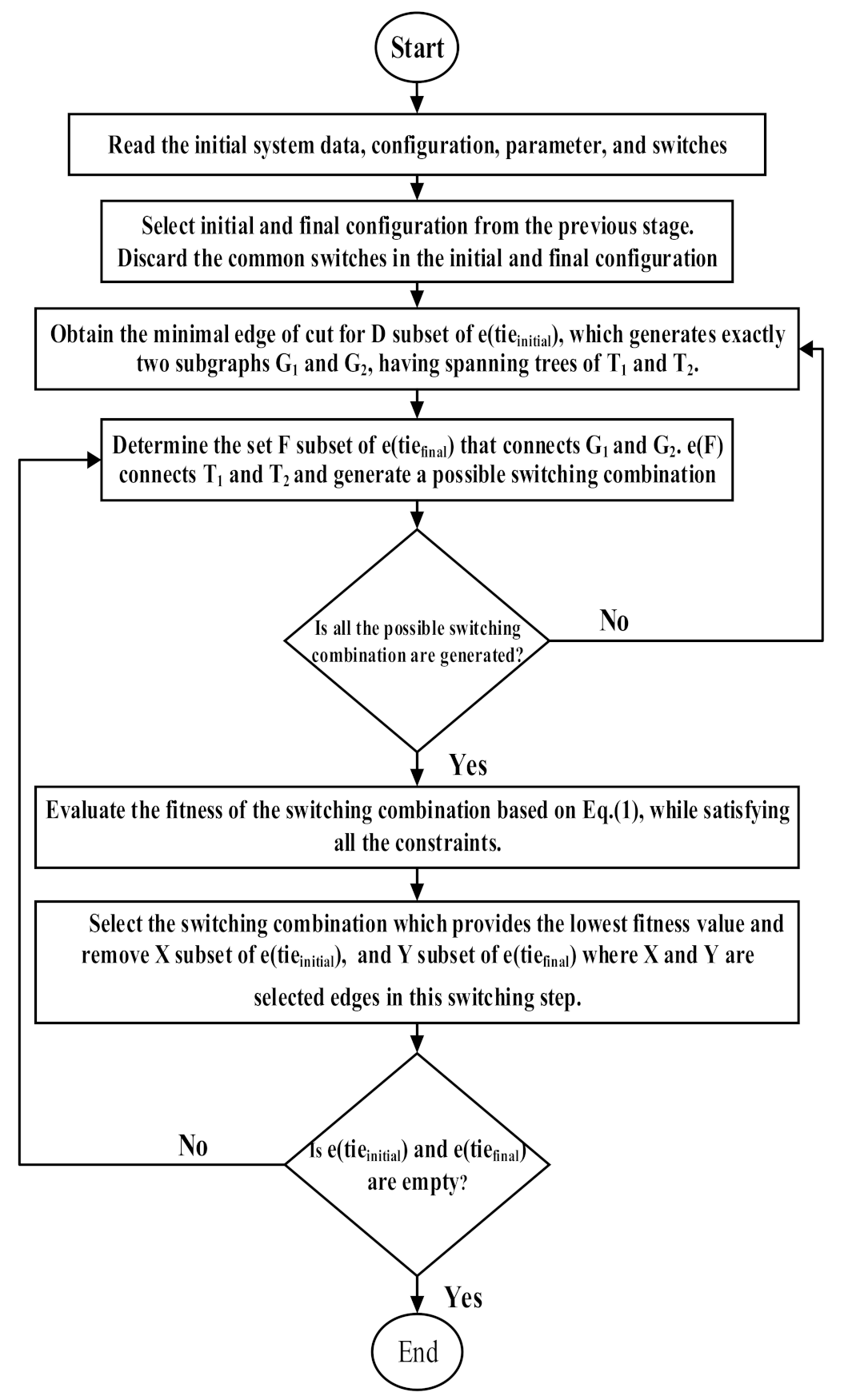
This paper adopts a two-stage methodology to determine the optimum switching sequences to get to the optimum network configuration. In the first stage, the optimum configuration is selected using the MISOCP, while in the second stage, the optimal switching sequence is decided for the optimal configuration found in the first stage, utilizing hamming distance dataset approach with reduced search space. Optimal switching sequence is a technique that identifies the sequence to change the network from its initial configuration to the final one that optimizes the objective function. Hence, only switches that modify their state from the initial configuration will be considered during the searching process in this scenario. Two systems are used to validate the work proposed in this paper, the IEEE 33-bus [24] and the actual small-scale network of a public practical 71-bus system in Malaysia. Two platforms were used in this work, MATLAB and AMPL to perform the proposed methodology.
The maximum number of switches that can modify their state will be twice the number of tie lines in the network since the algorithm searches for pair switching to be open/close. Previous researchers consider Hamming distance equal to one for switching search space. Therefore, it requires a large search space, i.e., where is the total Hamming distance between initial and final configuration. This paper presents a hamming dataset technique that only examines the radial combination; as a result, the search space is significantly reduced. The steps to attain the optimal switching sequence is as follows:
- Step 1: Select initial and final configuration from the previous stage. Discard the common switches in the initial and final configuration.
- Step 2: Attain the minimum edge of cut for , which generates precisely two subgraphs and , having spanning tree of and .
- Step 3: Select the set F() that connects and . e(F) connects and and generate a possible switching combination. Repeat steps 2 and 3 to generate all the possible switching combinations have Hamming distance equal to two.
- Step 4: Evaluate the fitness of the switching combination based on Equation (1). Select the switching combination which provides the lowest fitness value.
- Step 5: Remove and , where and are the selected edges in this switching step.
- Step 6: When and becomes empty; the process will stop. Otherwise, it will repeat from step 3.
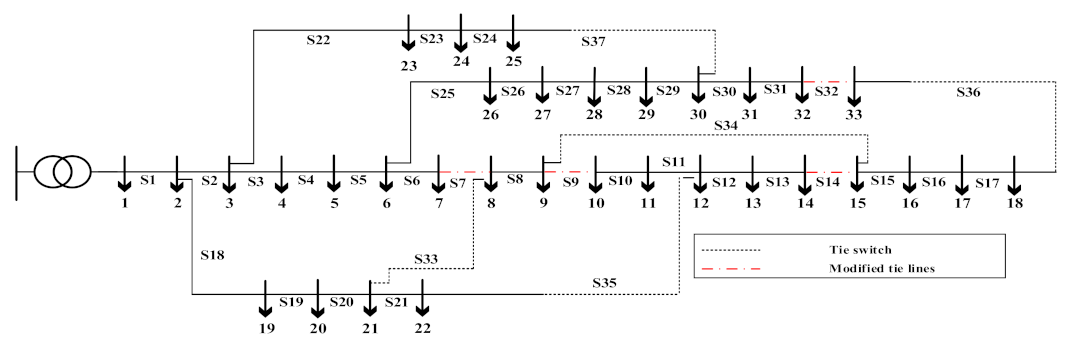
The flowchart of the switching sequence technique is demonstrated in Figure 1. To analyze the complexity of the search space, let us consider the example of the switching step in the small distribution network (33-bus network). The switches changed from the initial configuration (S33, S34, S35, and S36) to the final configuration (S7, S9, S14, and S32) in the distribution network, as shown in Figure 2. It can be observed from Figure 2 that one of the switches from (S33, S34, S35, and S36) is closed first, and in the consecutive stage, one of the switches is open from (S7, S9, S14, and S32) or vice versa. Therefore, the total possible switching sequence for a 33-bus distribution network is 1152. However, the complexity of the search space increases immensely with the increase in tie lines in the extensive distribution system. Moreover, there is a considerable number of possible combinations which is non-radial (non-feasible). Therefore, it is imperative to apply optimization techniques to attain the optimal switching sequence of the network.
Figure 1.
The flowchart of the switching sequence technique.
Figure 2.
Initial configuration for 33 bus system.
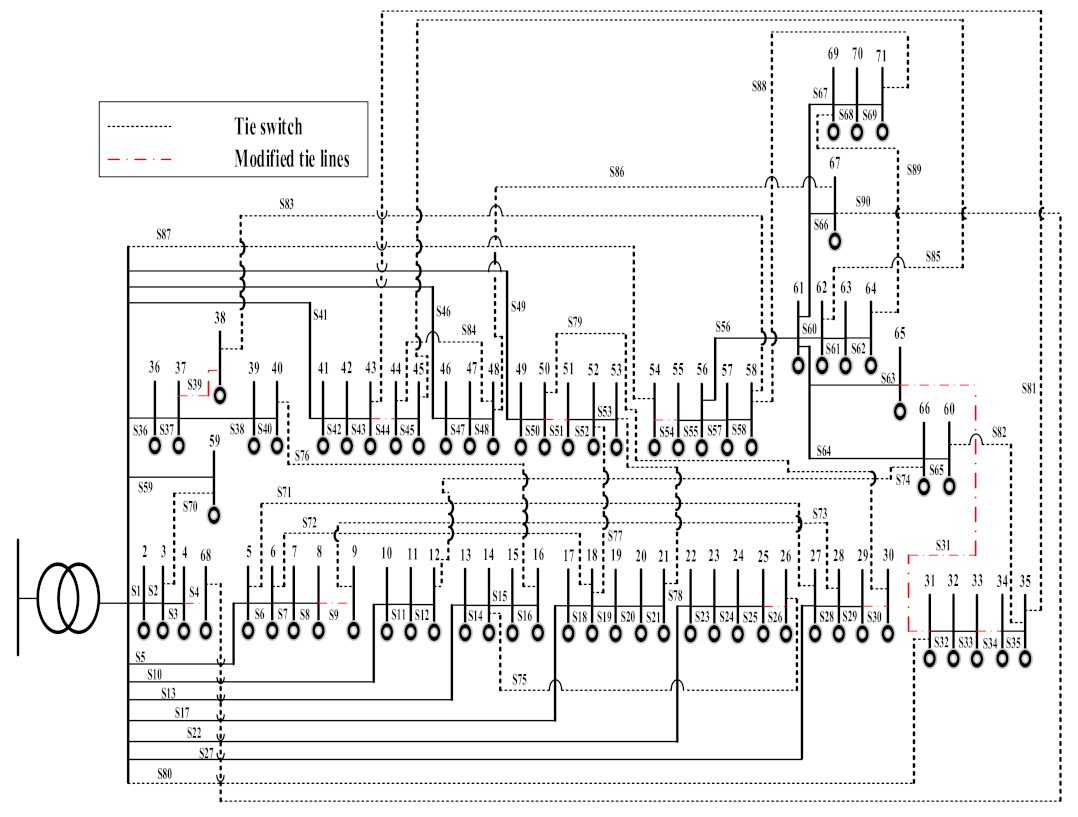
In the same manner, as the 33-bus system, Figure 3 demonstrates the topological structure for a practical 71-bus system, and the line and bus data are given in Appendix A, Table A1 and Table A2. One of the switches from these tie switches (S70 till S90) is closed first. Then, in the consecutive stage, one of the switches is open from the set of these modified switches (S4, S9, S26, S30, S31, S34, S39, S44, S51, S54) or vice versa. Consequently, the total possible switching sequence for a practical 71-bus system is 3.24 × 1024.
Figure 3.
Initial configuration for a practical 71-bus system in Malaysia.
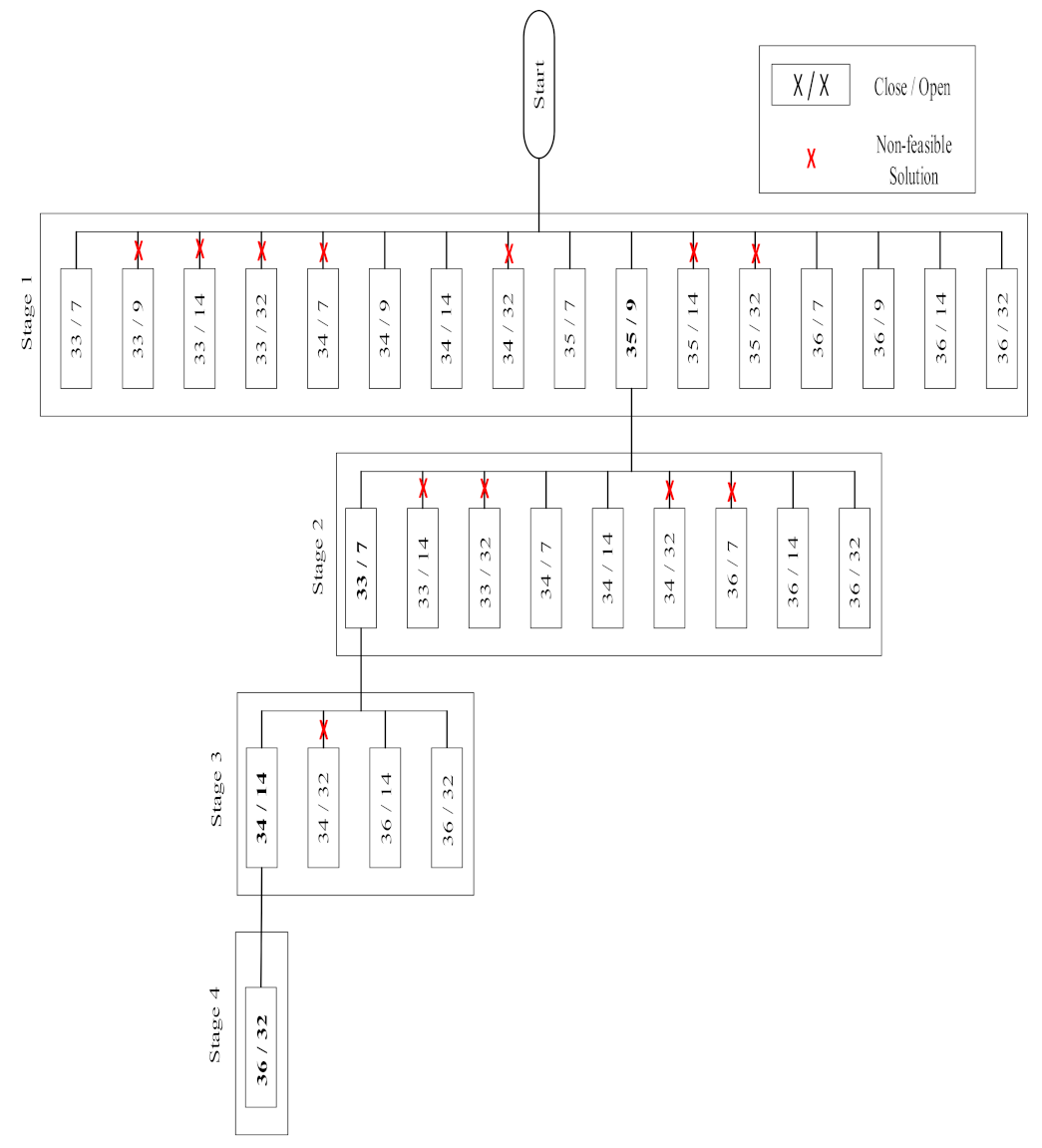
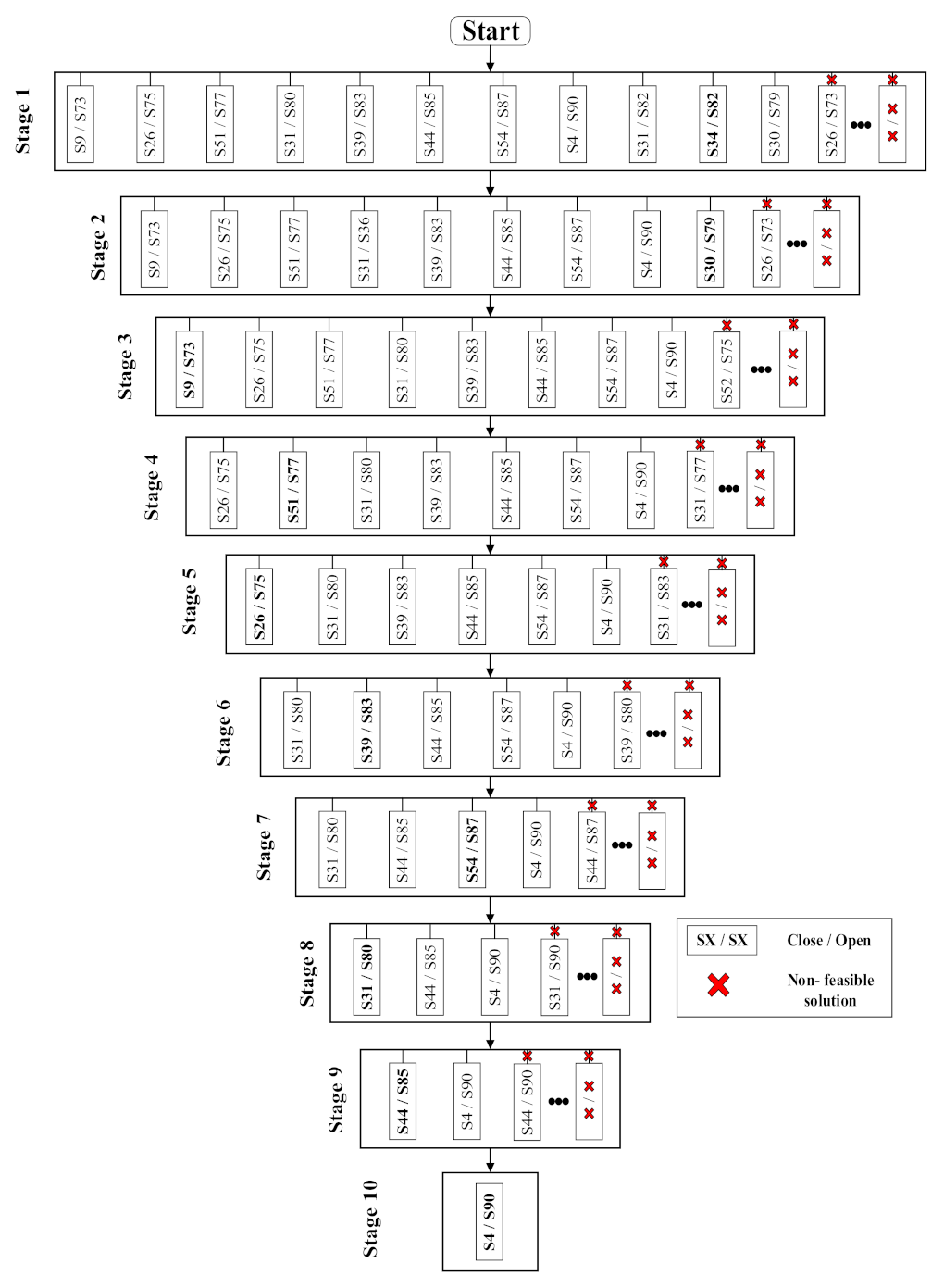
Nevertheless, this study proposes a hamming dataset approach that only considers the radial combination; thus, search space reduces immensely. For example, from Figure 4 and Figure 5, it can be observed that the search space has been confined to only 18 and 56 possible combinations for the IEEE 33 and a practical 71-bus system, respectively.
Figure 4.
Possible switching sequence for small (33-bus) distribution network considering dataset approach.
Figure 5.
Possible switching sequence for the practical 71-bus distribution system considering dataset approach.
4. Results and Discussion
This section discusses the results obtained by employing the proposed method onto the two distribution networks described early on. The IEEE 33-bus distribution system consists of one 12.66 kV substation, while the practical 71-bus system consists of two 11 kV substations. Sectionalizing and tie switches and modified tie lines are present in these networks to be used as tie switches.
4.1. Network Reconfiguration
4.1.1. IEEE 33-Bus System
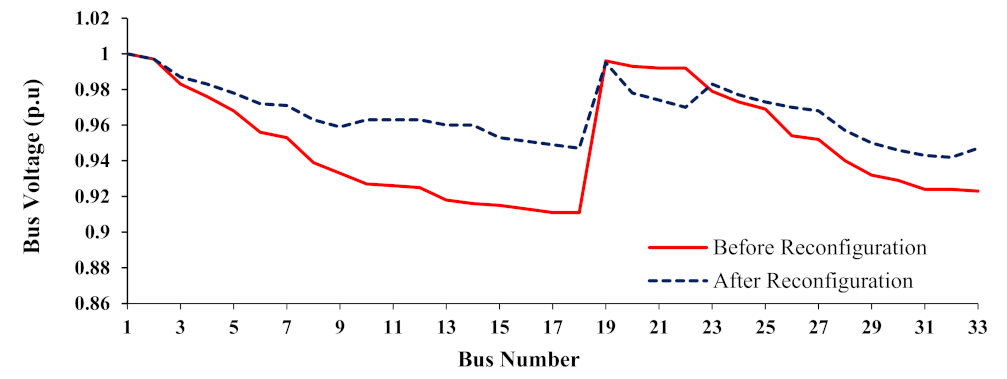
Network reconfiguration has been applied to the distribution network to improve efficiency, reduce power loss, and maximize the minimum voltage of the distribution network. The fitness function of the algorithm is calculated according to Equation (1). The active power losses attained from the proposed technique before and after the configuration are 208.459 kW and 138.928 kW, respectively. Figure 6 demonstrates the voltage profile of the 33-bus system before and after the reconfiguration. The lowest voltage of the 33-bus system has been enhanced by 3.46%, where the voltage of buses 19, 20, 21, and 22 reduces after the optimal reconfiguration is achieved. The reason behind that is the load transferred from the middle of the main feeder to the sub-branches. Table 1 summarizes comparative studies of NR techniques conducted on the IEEE 33-bus distribution system and shows the proposed method’s superiority.
Figure 6.
Voltage profile of IEEE 33-bus distribution network.
Table 1.
Comparative studies of NR techniques conducted on the 33-bus test network.
4.1.2. A Practical 71-Bus System in Malaysia
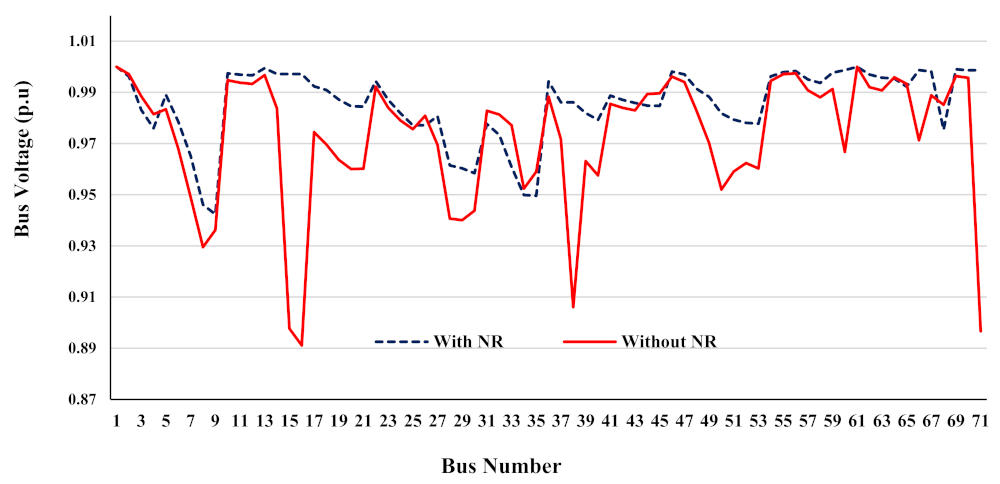
Similarly to the previous test system, NR has been implemented on a practical 71-bus system in Malaysia to enhance system performance, minimize power loss and improve the voltage profile of the distribution network. The objective function of the proposed algorithm is calculated based on Equation (1). The active power loss obtained from the proposed technique using the initial and final configurations is 228.78 kW and 169.91 kW, respectively. Figure 7 illustrates the voltage profile of the practical 71-bus system before and after the reconfiguration. The minimal voltage of the practical 71-bus system at bus 16 has been enhanced by 10.63% after changing the network’s topology. On the other hand, it can be noticed that the voltage of buses 7, 16, 28, 38, 50, and 71 increased and improved after the reconfiguration. Therefore, the new configuration of the system reduces the power loss and enhances the overall voltage profile. Table 2 demonstrates the performance of the proposed technique on the practical 71-bus system in Malaysia and highlights the NR before and after the implementation of the proposed method. The comparison with other methods is not considered for this case study because the network belongs to individual authority.
Figure 7.
Voltage profile of the practical 71-bus system in Malaysia.
Table 2.
A comparison of the power loss before and after implementing the NR on the practical 71-bus system in Malaysia.
4.2. Switching Sequence
This section presents the optimal switching sequence, which attains the minimum power loss during the intermittent switching from the initial to the final configuration.
4.2.1. IEEE 33-Bus System
The maximum switching step required by the proposed technique equals the number of tie lines in the distribution network. However, previous researchers [21,29] require Hamming distance equal to one for switching search space compared to the proposed technique. Therefore, the proposed technique generates a dataset of Hamming distance equal to two for each stage to attain the optimal switching sequence, as shown in Table 3 for the IEEE 33-bus distribution network.
Table 3.
Switching sequence for the IEEE 33-bus distribution network.
In the 33-bus distribution network, four tie switches (S7, S9, S14, S32) are modified from the initial configuration (S33, S34, S35, S36). However, the tie switch S37 remains unchanged; thus, it is not included during the switching sequence. The optimum switching sequence is attained for the IEEE 33-bus system. In the first stage, branch S7 is open, generating two spanning trees and combining these two spanning trees, and switches are closed from initial tie switches, i.e., S33, S34, S35, and S36. Tie switch S34 does not have an interconnection with both spanning trees; therefore, it is not selected. A similar procedure is adopted for switches S9, S14, and S32. The total possible combination at stage one is nine combinations. Exhaustive search is utilized to attain the minimum power losses of stage one. The minimum power loss occurs when switch S9 is open and switch S35 is closed, i.e., [S9, S35], and the power loss is 153.58 kW. The optimal switching sequence for 33-bus distribution network is [S9, S35], [S7, S33], [S14, S34] and [S32, S36]. The total power loss during the intermittent switching is 579.35 kW.
In reference to [21], consider the switching sequence search space that is equal to , where is the total Hamming distance between the initial and final configuration. Hence, the search space for IEEE 33-bus and a practical 71-bus system is 1152 and 3.24 * 1024 and the proposed technique reduces the search space to 18 and 56, respectively. Due to the large search space, [21,29] requires optimization to search for the best switching sequence, but the proposed search space is very small. Therefore, an exhaustive search will attain the optimal solution.
Furthermore, when switching, the sequence for the 33-bus is selected randomly, i.e., [S36, S7], [S34, S14], [S35, S9] and [S33, S32], and the total intermittent power loss is 992.59 kW. The minimum voltage at each stage is 0.832 p.u, 0.828 p.u, 0.885 p.u, and 0.942 p.u, whereas the minimum voltage of the initial configuration is 0.91 p.u. On the contrary, the minimum bus voltage with the proposed technique is 0.934, 0.938, 0.938, and 0.942. Hence, improper switching sequence increases the power loss and reduces the bus voltages.
4.2.2. The Practical 71-Bus System in Malaysia
In the practical 71-bus system, ten tie switches (S4, S9, S26, S30, S31, S34, S39, S44, S51, and S55) are modified from the initial configuration (S73, S75, S77, S79, S80, S82, S83, S85, S87, and S90). However, these tie switches (S70, S71, S72, S74, S76, S78, S81, S84, S86, S88, and S89) are kept unaltered; hence, they are not inserted during the switching sequence. To get the optimum switching sequence for the practical 71-bus system, there are 100 possible combinations of two hamming distance in the first stage, out of which only 11 combinations are feasible (i.e., producing radial network). Exhaustive search determines the combination that offers minimum power loss at stage one. The minimum power loss occurs when switch S82 is open and switch S34 is closed, i.e., [S82, S34], and the power loss is 205.15 kW.
The optimal switching sequence for the practical 71-bus system in Malaysia is [S82, S84], [S79, S39], [S73, S9], [S77, S51], [S75, S26], [S83, SS39], [S87, S54], [S80, S31], [S85, S44], and [S90, S4]. Table 4 elaborates the rest of the ten stages where the total power loss during the intermittent switching is 1862.18 kW. Moreover, the voltage profile for the network improved after selecting the optimal switching compared with the initial configuration.
Table 4.
Switching sequence for the practical 71-bus system in Malaysia.
4.3. Economic Analysis
The economic analysis for any project is a crucial factor. The planners usually perform their plans based on financial analysis studies and try to find a compromise between the operational costs and system loadability to achieve the expected level of system performance. It is worth mentioning that power losses are responsible for degrading system performance and depleting the budget. Therefore, the main aim for any decision maker is to find the best network configuration that gives better system performance with minimum power losses cost [30].
The proposed NR was conducted on the a practical 71-bus system in Malaysia to solve the power losses problem, where the electricity tariff for the University of Malaya is 0.224 MYR/kWh [31]. Table 5 shows the economic analysis between the power losses and the cost using the proposed NR. For instance, the power loss for the initial configuration when the loading is at the maximum were 228.78 kW and 277.94 kW for the 100% and 110%, respectively. However, after the first pair of switching, the power losses are reduced for the 100% loading by 9.9% compared with the initial configuration. Furthermore, in the second pair of switching, the power losses decreased by 12.8% for the maximum loading, costing around 387,117.56 MYR when the load was 100%. Lastly, the highest reduction in power losses was 169.91 kW for the maximum 100% loading, which reduced by 25.5% compared to the initial configuration, saving around 113,065.17 MYR.
Table 5.
The economic analysis between the power losses and the cost using network reconfiguration for a practical 71-bus system in Malaysia.
It can be concluded from the results that the optimal switching for the distribution network reduces the total power losses, which positively impacts the system performance and minimize the financial loss.
5. Conclusions
This paper applies a MISOCP method to determine the optimal network reconfiguration while adopting hamming dataset approach to obtain the best switching sequence to reach the optimal network configuration found earlier. The proposed technique was tested using the standard IEEE 33 bus system as well as a practical 71-bus system in Malaysia. Results show that the network total power losses for the 33 bus and a practical 71-bus system reduced by 34.14% and 25.5% from their initial configuration, respectively. The proposed technique additionally managed to determine the optimal switching sequence for the network reconfiguration process and hence reduced the search space from 1152 and 3.24 ∗ 1024 to only 18 and 56 configurations, respectively, for IEEE 33 bus and practical 71-bus system. Moreover, a comparative study has been conducted with other methods to highlight the effectiveness of the proposed method in attaining optimal solutions. Finally, economic analysis of the practical 71-bus system using different numbers and pairs of switches intended to be modified provide a heads-up on the savings resulting from the network reconfiguration. Therefore, it can be concluded that through the adoption of the proposed technique, it is possible to reduce the power losses, which will result in a reduction in electricity price and ensure the sustainable operation of the distribution network.
The NR and the switching sequence have been done in this work without considering any DGs. Hence, the extension of this work will be focused on implementing DGs into the practical 71-bus system and investigating the impact of the DGs on the NR and switching sequence.
Author Contributions
Conceptualization, H.M. (Hamza Mubarak) and N.N.M.; methodology, H.M. (Hamza Mubarak) and M.A.M.; software, H.M. (Hamza Mubarak) and M.A.M.; validation, H.M. (Hazlie Mokhlis), S.A. and N.N.M.; formal analysis, H.M. (Hamza Mubarak) and N.N.M.; investigation, H.M. (Hamza Mubarak) and H.M. (Hazlie Mokhlis); resources, H.M. (Hamza Mubarak), N.N.M. and M.S.; writing—original draft preparation, H.M. (Hamza Mubarak); writing—review and editing, H.M. (Hamza Mubarak), N.N.M. and M.A.M.; visualization, H.M. (Hamza Mubarak); supervision, H.M. (Hazlie Mokhlis) and N.N.M.; funding acquisition, T.A. and S.A. All authors have read and agreed to the published version of the manuscript.
Funding
This research has been supported by the University of Malaya (Grant No.: GPF045A-2019) and (Grant No.: IIRG001A-2020IISS).
Institutional Review Board Statement
Not applicable.
Informed Consent Statement
Not applicable.
Data Availability Statement
The data used in this research is enclosed within the manuscript. No external data sources are used in this research.
Conflicts of Interest
The authors declare no conflict of interest.
Abbreviations
Abbreviations for the whole manuscript.
| Acronyms | |
| NR | Network Reconfiguration |
| MISOCP | Mixed Integer Second Order Cone Programming |
| EO | Equilibrium Optimizer |
| CSA | Cuckoo Search Algorithm |
| COA | Coyote Optimization Algorithm |
| DG | Distributed Generation |
| PSO | Particle Swarm Optimization |
| GA | Genetic Algorithm |
| PFA | Pathfinder algorithm |
| Nomenclature | |
| Obj | Objective Function |
| The ratio of the system’s total active power loss | |
| The voltage deviation index | |
| The total power loss cost | |
| The electricity tariff (0.224 MYR/kWh) | |
| The year in hour (8760 h) | |
| The voltage at the receiving bus | |
| The nominal voltage at bus j | |
| The active power loss after the reconfiguration | |
| The active power loss before the network reconfiguration | |
| The branch in which is a sending bus and is a receiving bus | |
| The active power passing through the branch | |
| The reactive power passing through the branch | |
| The branch resistance | |
| The binary variable, which determines the state of that branch | |
| The whole number of branches in the network | |
| The active power generations at bus | |
| The reactive power generations at bus | |
| The active power demand at bus | |
| The reactive power demand at bus | |
| The active power loss | |
| The reactive power loss | |
| The set of buses | |
| The set of branches | |
| & | The sending and receiving bus voltages |
| The branch current | |
| The branch reactance | |
| The branch impedance | |
| Maximum current capacity | |
| total number of buses | |
| the number of a substation in the distribution network | |
| active power flows through the branch | |
| reactive power flows through the branch | |
Appendix A

Table A1.
The load data of the practical 71-bus system in Malaysia.
Table A1.
The load data of the practical 71-bus system in Malaysia.
| Bus | Active Power (kW) | Reactive Power (kVAR) |
|---|---|---|
| 2 | 165.6476 | 102.6518 |
| 3 | 436.286 | 270.3664 |
| 4 | 290.5331 | 180.0433 |
| 40 | 540.4815 | 334.9364 |
| 41 | 263.8048 | 163.4799 |
| 42 | 67.27742 | 41.69182 |
| 43 | 233.4809 | 144.6881 |
| 44 | 166.3602 | 103.0934 |
| 45 | 110.6121 | 68.54632 |
| 46 | 313.3315 | 194.1715 |
| 48 | 745.2973 | 461.8607 |
| 49 | 232.2124 | 143.902 |
| 51 | 294.5516 | 182.5336 |
| 52 | 181.5532 | 112.5085 |
| 53 | 74.91237 | 46.42319 |
| 54 | 180.8376 | 112.0651 |
| 55 | 126.8992 | 78.63943 |
| 56 | 116.9312 | 72.46225 |
| 59 | 563.5933 | 349.2588 |
| 7 | 594 | 368.1018 |
| 8 | 736.4677 | 456.3891 |
| 9 | 253.414 | 157.0406 |
| 10 | 68.60215 | 42.51275 |
| 11 | 102.7288 | 63.66101 |
| 12 | 58.61048 | 36.32092 |
| 18 | 182.7567 | 113.2543 |
| 19 | 248.7212 | 154.1326 |
| 20 | 339.7847 | 210.5646 |
| 21 | 167.3005 | 103.6761 |
| 22 | 469.3422 | 290.8514 |
| 23 | 129.0312 | 79.96062 |
| 25 | 578.4285 | 358.4521 |
| 28 | 499.2374 | 309.3774 |
| 29 | 770.6032 | 477.5428 |
| 30 | 459.8325 | 284.9582 |
| 31 | 345.3468 | 214.0114 |
| 32 | 21.42634 | 13.27791 |
| 33 | 244.8801 | 151.7522 |
| 34 | 880.5441 | 545.6732 |
| 35 | 123.9954 | 76.83997 |
| 67 | 221.0763 | 137.001 |
| 68 | 407.4347 | 252.4873 |
| 62 | 145.4336 | 90.1252 |
| 65 | 199.0734 | 123.3658 |
| 66 | 123.9126 | 76.78866 |
| 5 | 107.3387 | 66.5178 |
| 6 | 99.20699 | 61.47857 |
| 63 | 103.8495 | 64.35551 |
| 64 | 93.85484 | 58.16184 |
| 24 | 107.9301 | 66.88429 |
| 50 | 138.3871 | 85.75848 |
| 70 | 117.9839 | 73.1146 |
| 58 | 155.0645 | 96.09348 |
| 57 | 125.4059 | 77.71404 |
| 14 | 183.629 | 113.7949 |
| 36 | 478.4409 | 296.4898 |
| 27 | 340.5269 | 211.0245 |
| 1 | 0 | 0 |
| 13 | 172.4613 | 106.8743 |
| 15 | 172.4613 | 106.8743 |
| 16 | 172.4613 | 106.8743 |
| 17 | 172.4613 | 106.8743 |
| 26 | 172.4613 | 106.8743 |
| 37 | 172.4613 | 106.8743 |
| 38 | 172.4613 | 106.8743 |
| 39 | 172.4613 | 106.8743 |
| 47 | 172.4613 | 106.8743 |
| 60 | 0 | 0 |
| 61 | 0 | 0 |
| 69 | 172.4613 | 106.8743 |
| 71 | 172.4613 | 106.8743 |
Table A2.
The line data of the practical 71-bus system in Malaysia.
Table A2.
The line data of the practical 71-bus system in Malaysia.
| From | To | R (Ω) | X (Ω) |
|---|---|---|---|
| 1 | 2 | 8.88 × 10⁻⁵ | 0.000101 |
| 2 | 3 | 0.000446 | 0.000257 |
| 3 | 4 | 0.000368 | 0.000213 |
| 3 | 59 | 0.000147 | 8.47 × 10⁻⁵ |
| 4 | 68 | 6.22 × 10⁻⁵ | 3.59 × 10⁻⁵ |
| 1 | 5 | 0.000222 | 0.000252 |
| 5 | 6 | 0.000309 | 0.000179 |
| 5 | 27 | 0.000413 | 0.000238 |
| 6 | 18 | 0.000171 | 9.88 × 10⁻⁵ |
| 6 | 7 | 0.000436 | 0.000252 |
| 7 | 8 | 0.001025 | 0.000592 |
| 8 | 9 | 0.000751 | 0.000434 |
| 9 | 28 | 0.000239 | 0.000138 |
| 1 | 10 | 0.000481 | 0.000546 |
| 10 | 11 | 0.000174 | 0.0001 |
| 11 | 12 | 0.000233 | 0.000135 |
| 12 | 66 | 0.000177 | 0.000167 |
| 1 | 13 | 8.65 × 10⁻⁵ | 9.8 × 10⁻⁵ |
| 13 | 14 | 0.000465 | 0.000269 |
| 14 | 26 | 0.000153 | 8.84 × 10⁻⁵ |
| 14 | 15 | 0.000208 | 0.00012 |
| 15 | 16 | 0.000395 | 0.000228 |
| 16 | 40 | 0.000417 | 0.000241 |
| 1 | 17 | 0.000289 | 0.000327 |
| 17 | 18 | 7.28 × 10⁻⁵ | 4.20 × 10⁻⁵ |
| 18 | 52 | 0.000218 | 0.000126 |
| 18 | 19 | 0.000223 | 0.000129 |
| 19 | 20 | 0.000227 | 0.000131 |
| 20 | 21 | 2.66 × 10⁻⁵ | 1.53 × 10⁻⁵ |
| 21 | 53 | 1.33 × 10⁻⁵ | 7.67 × 10⁻⁶ |
| 1 | 22 | 0.00014 | 0.000159 |
| 22 | 23 | 0.000355 | 0.000205 |
| 23 | 24 | 0.000305 | 0.000176 |
| 24 | 25 | 0.000329 | 0.00019 |
| 25 | 26 | 0.000287 | 0.000166 |
| 1 | 27 | 0.000352 | 0.000399 |
| 27 | 28 | 0.00055 | 0.000318 |
| 28 | 29 | 4.41 × 10⁻⁵ | 2.55 × 10⁻⁵ |
| 29 | 30 | 0.000201 | 0.000116 |
| 30 | 50 | 0.000218 | 0.000126 |
| 1 | 31 | 0.000869 | 0.000502 |
| 31 | 65 | 0.000367 | 0.000348 |
| 31 | 32 | 0.000169 | 9.76 × 10⁻⁵ |
| 32 | 33 | 0.000504 | 0.000291 |
| 33 | 34 | 0.00053 | 0.000306 |
| 34 | 35 | 0.000173 | 9.97 × 10⁻⁵ |
| 35 | 43 | 0.000306 | 0.000177 |
| 35 | 60 | 0.000154 | 0.000146 |
| 1 | 36 | 0.000166 | 0.000189 |
| 36 | 37 | 0.000655 | 0.000378 |
| 37 | 39 | 0.000336 | 0.000194 |
| 37 | 38 | 0.000307 | 0.000177 |
| 38 | 58 | 0.000462 | 0.000267 |
| 39 | 40 | 0.000218 | 0.000126 |
| 1 | 41 | 0.000571 | 0.000647 |
| 41 | 42 | 0.000175 | 0.000101 |
| 42 | 43 | 0.000132 | 7.61 × 10⁻⁵ |
| 43 | 44 | 0.0002 | 0.000116 |
| 44 | 45 | 4.68 × 10⁻⁵ | 2.70 × 10⁻⁵ |
| 44 | 48 | 0.00015 | 8.65 × 10⁻⁵ |
| 45 | 62 | 0.000186 | 0.000176 |
| 1 | 46 | 7.81 × 10⁻⁵ | 8.85 × 10⁻⁵ |
| 46 | 47 | 8.29 × 10⁻⁵ | 4.79 × 10⁻⁵ |
| 47 | 48 | 0.000434 | 0.000251 |
| 48 | 67 | 1.62 × 10⁻⁵ | 1.53 × 10⁻⁵ |
| 1 | 49 | 0.000359 | 0.000407 |
| 49 | 50 | 0.000402 | 0.000232 |
| 50 | 51 | 0.000192 | 0.000111 |
| 51 | 52 | 0.000228 | 0.000132 |
| 52 | 53 | 0.000186 | 0.000108 |
| 1 | 54 | 0.000536 | 0.000608 |
| 54 | 55 | 0.00042 | 0.000242 |
| 55 | 56 | 7.49 × 10⁻⁵ | 4.33 × 10⁻⁵ |
| 56 | 61 | 7.49 × 10⁻⁵ | 8.49 × 10⁻⁵ |
| 56 | 57 | 0.000422 | 0.000244 |
| 57 | 58 | 0.000328 | 0.000189 |
| 58 | 71 | 0.000264 | 0.00025 |
| 1 | 59 | 0.000157 | 0.000178 |
| 61 | 62 | 0.000279 | 0.000317 |
| 62 | 63 | 0.00019 | 0.00018 |
| 63 | 64 | 0.000101 | 9.61 × 10⁻⁵ |
| 64 | 69 | 7.42 × 10⁻⁵ | 7.03 × 10⁻⁵ |
| 61 | 65 | 0.00016 | 0.000181 |
| 61 | 66 | 0.000471 | 0.000534 |
| 66 | 60 | 9.01 × 10⁻⁵ | 8.53 × 10⁻⁵ |
| 61 | 67 | 0.000284 | 0.000322 |
| 67 | 68 | 0.000154 | 0.000146 |
| 61 | 69 | 0.000231 | 0.000261 |
| 69 | 70 | 8.78 × 10⁻⁵ | 8.32 × 10⁻⁵ |
| 70 | 71 | 0.000223 | 0.000211 |
References
- Tang, K.H.D. Hydroelectric dams and power demand in Malaysia: A planning perspective. J. Clean. Prod. 2020, 252, 119795. [Google Scholar] [CrossRef]
- Riaño, F.E.; Cruz, J.F.; Montoya, O.D.; Chamorro, H.R.; Alvarado-Barrios, L. Reduction of losses and operating costs in distribution networks using a genetic algorithm and mathematical optimization. Electronics 2021, 10, 419. [Google Scholar] [CrossRef]
- Montoya, O.D.; Molina-Cabrera, A.; Chamorro, H.R.; Alvarado-Barrios, L.; Rivas-Trujillo, E. A Hybrid approach based on SOCP and the discrete version of the SCA for optimal placement and sizing DGs in AC distribution networks. Electronics 2021, 10, 26. [Google Scholar] [CrossRef]
- Helmi, A.M.; Carli, R.; Dotoli, M.; Ramadan, H.S. Efficient and Sustainable Reconfiguration of Distribution Networks via Metaheuristic Optimization. IEEE Trans. Autom. Sci. Eng. 2021, 19, 82–98. [Google Scholar] [CrossRef]
- Uniyal, A.; Sarangi, S. Optimal network reconfiguration and DG allocation using adaptive modified whale optimization algorithm considering probabilistic load flow. Electr. Power Syst. Res. 2021, 192, 106909. [Google Scholar] [CrossRef]
- Shi, Q.; Li, F.; Olama, M.; Dong, J.; Xue, Y.; Starke, M.; Winstead, C.; Kuruganti, T. Network reconfiguration and distributed energy resource scheduling for improved distribution system resilience. Int. J. Electr. Power Energy Syst. 2021, 124, 106355. [Google Scholar] [CrossRef]
- Shaheen, A.M.; Elsayed, A.M.; El-Sehiemy, R.A.; Abdelaziz, A.Y. Equilibrium optimization algorithm for network reconfiguration and distributed generation allocation in power systems. Appl. Soft Comput. 2021, 98, 106867. [Google Scholar] [CrossRef]
- Nguyen, T.T.; Nguyen, T.T.; Duong, L.T.; Truong, V.A. An effective method to solve the problem of electric distribution network reconfiguration considering distributed generations for energy loss reduction. Neural Comput. Appl. 2021, 33, 1625–1641. [Google Scholar] [CrossRef]
- Sambaiah, K.S.; Jayabarathi, T. Loss minimization techniques for optimal operation and planning of distribution systems: A review of different methodologies. Int. Trans. Electr. Energy Syst. 2020, 30, e12230. [Google Scholar] [CrossRef] [Green Version]
- Cikan, M.; Kekezoglu, B. Comparison of metaheuristic optimization techniques including Equilibrium optimizer algorithm in power distribution network reconfiguration. Alex. Eng. J. 2022, 61, 991–1031. [Google Scholar] [CrossRef]
- Bhattacharjee, I.; Bohre, A.K. Optimal Sizing and Placement of Multiple DGs in Distribution Network to Reduce Total Loss Using Cuckoo Search Optimization. In Proceedings of the ICIPCN 2021: Second International Conference on Image Processing and Capsule Networks, Changhua, Taiwan, 27–28 May 2021; pp. 167–179. [Google Scholar]
- Nguyen, T.T.; Nguyen, T.T. An improved cuckoo search algorithm for the problem of electric distribution network reconfiguration. Appl. Soft Comput. 2019, 84, 105720. [Google Scholar] [CrossRef]
- Al Samman, M.; Mokhlis, H.; Mansor, N.N.; Mohamad, H.; Suyono, H.; Sapari, N.M. Fast optimal network reconfiguration with guided initialization based on a simplified network approach. IEEE Access 2020, 8, 11948–11963. [Google Scholar] [CrossRef]
- Nguyen, T.T.; Nguyen, T.T.; Nguyen, N.A.; Duong, T.L. A novel method based on coyote algorithm for simultaneous network reconfiguration and distribution generation placement. Ain Shams Eng. J. 2021, 12, 665–676. [Google Scholar] [CrossRef]
- Kavousi-Fard, A.; Niknam, T.; Fotuhi-Firuzabad, M. A Novel Stochastic Framework Based on Cloud Theory and θ-Modified Bat Algorithm to Solve the Distribution Feeder Reconfiguration. IEEE Trans. Smart Grid 2015, 7, 740–750. [Google Scholar] [CrossRef]
- Home-Ortiz, J.M.; Vargas, R.; Macedo, L.H.; Romero, R. Joint reconfiguration of feeders and allocation of capacitor banks in radial distribution systems considering voltage-dependent models. Int. J. Electr. Power Energy Syst. 2019, 107, 298–310. [Google Scholar] [CrossRef]
- Badran, O.; Mekhilef, S.; Mokhlis, H.; Dahalan, W. Optimal reconfiguration of distribution system connected with distributed generations: A review of different methodologies. Renew. Sustain. Energy Rev. 2017, 73, 854–867. [Google Scholar] [CrossRef]
- Sambaiah, K.S.; Jayabarathi, T. Optimal reconfiguration and renewable distributed generation allocation in electric distribution systems. Int. J. Ambient Energy 2021, 42, 1018–1031. [Google Scholar] [CrossRef]
- Dogan, A.; Alci, M. Simultaneous optimization of network reconfiguration and DG installation using heuristic algorithms. Elektron.Elektrotech. 2019, 25, 8–13. [Google Scholar] [CrossRef] [Green Version]
- Raut, U.; Mishra, S. An improved sine–cosine algorithm for simultaneous network reconfiguration and DG allocation in power distribution systems. Appl. Soft Comput. 2020, 92, 106293. [Google Scholar] [CrossRef]
- Badran, O.; Mekhilef, S.; Mokhlis, H.; Dahalan, W. Optimal switching sequence path for distribution network reconfiguration considering different types of distributed generation. IEEJ Trans. Electr. Electron. Eng. 2017, 12, 874–882. [Google Scholar] [CrossRef]
- Badran, O.; Jallad, J.; Mokhlis, H.; Mekhilef, S. Network reconfiguration and DG output including real time optimal switching sequence for system improvement. Aust. J. Electr. Electron. Eng. 2020, 17, 157–172. [Google Scholar] [CrossRef]
- Zhan, J.; Liu, W.; Chung, C.; Yang, J. Switch opening and exchange method for stochastic distribution network reconfiguration. IEEE Trans. Smart Grid 2020, 11, 2995–3007. [Google Scholar] [CrossRef]
- Baran, M.E.; Wu, F.F. Network reconfiguration in distribution systems for loss reduction and load balancing. IEEE Power Eng. Rev. 1989, 9, 101–102. [Google Scholar] [CrossRef]
- Zhang, D.; Fu, Z.; Zhang, L. An improved TS algorithm for loss-minimum reconfiguration in large-scale distribution systems. Electr. Power Syst. Res. 2007, 77, 685–694. [Google Scholar] [CrossRef]
- Rao, R.S.; Narasimham, S.V.L.; Raju, M.R.; Rao, A.S. Optimal network reconfiguration of large-scale distribution system using harmony search algorithm. IEEE Trans. Power Syst. 2010, 26, 1080–1088. [Google Scholar]
- Imran, A.M.; Kowsalya, M. A new power system reconfiguration scheme for power loss minimization and voltage profile enhancement using fireworks algorithm. Int. J. Electr. Power Energy Syst. 2014, 62, 312–322. [Google Scholar] [CrossRef]
- Tyagi, A.; Verma, A.; Bijwe, P. Reconfiguration for loadability limit enhancement of distribution systems. IET Gener. Transm. Distrib. 2018, 12, 88–93. [Google Scholar] [CrossRef]
- Badran, O.; Mokhlis, H.; Mekhilef, S.; Dahalan, W.; Jallad, J. Minimum switching losses for solving distribution NR problem with distributed generation. IET Gener. Transm. Distrib. 2017, 12, 1790–1801. [Google Scholar] [CrossRef] [Green Version]
- Mubarak, H.; Mansor, N.N.; Mokhlis, H.; Mohamad, M.; Mohamad, H.; Muhammad, M.A.; Samman, M.A.; Afzal, S. Optimum Distribution System Expansion Planning Incorporating DG Based on N-1 Criterion for Sustainable System. Sustainability 2021, 13, 6708. [Google Scholar] [CrossRef]
- Subramani, G.; Ramachandaramurthy, V.K.; Padmanaban, S.; Mihet-Popa, L.; Blaabjerg, F.; Guerrero, J.M. Grid-tied photovoltaic and battery storage systems with Malaysian electricity tariff—A review on maximum demand shaving. Energies 2017, 10, 1884. [Google Scholar] [CrossRef] [Green Version]
Publisher’s Note: MDPI stays neutral with regard to jurisdictional claims in published maps and institutional affiliations. |
© 2022 by the authors. Licensee MDPI, Basel, Switzerland. This article is an open access article distributed under the terms and conditions of the Creative Commons Attribution (CC BY) license (https://creativecommons.org/licenses/by/4.0/).