


Abstract
Life cycle sustainability assessment (LCSA) is an approach utilized for products to analyze their sustainability indicators. However, no definite study has determined the sustainability of an organization using the LCA approach. This review focuses on a systematic review and bibliometric analysis of the OLCSA in University. The literature was searched in the Scopus online database considering PRISMA guidelines, and VOSviewer software was used for three types of bibliometric analysis, i.e., co-authorship, co-occurrence, and co-citation were analyzed with their units of analysis. The results show that there is no specific study that has found or assessed the LCSA of an organization. However, 17 articles on O-LCA and 2 on SO-LCA were found, and there were numerous articles available about ELCC in the literature. Researchers mostly used UNEP guidelines for O-LCA, in line with ISO standards. However, they used NPV for E-LCC. Based on VOSviewer software, Matthias Finkbeiner, Forin, Martínez-Blanco Julia, Berger Markus, Lehman, Loss, Manzardo, Scipion, Hall, and Weldu are co-authors. The keyword of “life cycle” was broadly used, and the most cited source was the “International Journal of Life Cycle Assessment”. Adoption of the LCSA framework is recommended for O-LCSA studies to estimate organizations’ sustainability, and to ensure quality education contributing the fourth SDGs.
1. Introduction
With the adoption of 17 Sustainable Development Goals in September 2015, the United Nations has reiterated the importance of taking immediate measures to protect natural resources and the environment. The key reason for this focus is that global challenges, such as climate change, water shortages, and resource depletion, are hurting people’s lives and upsetting national economies, restricting the possibility of global sustainable development. In this setting, an increasing number of businesses have realized the importance of using tools and processes to help them make decisions about how to reduce the environmental impacts of their products and activities [1].
Commonly, life cycle sustainability assessment is conducted to analyze the sustainability indicators of a particular product or process [2]. However, there are no studies found specifically about the sustainability of organizations. However, the life cycle assessment used for organizations considers the UNEP/SETAC 2015 [3] guidelines. This problem and lack of information motivated the authors to conduct a systematic literature review about organizational life cycle sustainability assessment (OLCSA), especially about universities as organizations. The organizational life cycle assessment (O-LCA) guidance, which is aligned with ISO/TS 14072 [4], demonstrates the applicability of the technique and assists professionals in overcoming the methodological obstacles posed by transferring their focus from products to organizations [5]. Even though the O-LCA study was used in a higher education institution by [6] with EMS combined, there are no studies found about University O-LCA separately.
According to the 1987 Bruntland Commission, sustainable development is “the development that meets the needs of the present without compromising the ability of future generations to meet their own needs” [7]. Nowadays, considering the environmental, social, and economic problems, policymakers are considerate of the sustainability of products or processes to achieve sustainable development goals. Consequently, the policymakers are cautious in their decisions about a product or process to avoid the negative impacts and improve their positive impacts that will trigger sustainability. According to [8], education plays a dynamic role in attaining sustainable development goals. Sustainable development demarcates three dimensions: environment, economics, and society. Education is also a process and service, which is provided by educational institutes and universities; therefore, it needs to be analyzed based on life cycle sustainability assessment (LCSA). Actually, universities and educational institutions are organizations; thus, it is required that they adopt organizational life cycle sustainability assessment (O-LCSA) the same way that LCSA is adopted for products or processes. Therefore, a discreet LCSA study is needed, including the consolidation of LCA, S-LCA, and LCC [2,9,10].
The 2002 World Summit on Sustainable Development in Johannesburg emphasized the importance of establishing a comprehensive set of programs centered on sustainable consumption and production. Organizations may analyze, compare, and demonstrate the environmental performance of their products, including commodities and services, using a variety of approaches, tools, and strategies [3]. ISO 14001 [9], or its European equivalent, Eco Management and Auditing The Environmental Management System (EMS), certified as a scheme, is a reference method for many businesses at the organizational level (EMAS). They are mostly procedural tools, and when adding an organization Eco-balance, they typically only assess gate-to-gate operations. The European Commission recently published a draft of its OEF Guide. The International Organization for Standardization created ISO/TS 14072 [4]. The great majority of ISO 14044 [10] standards (27 out of 31) are fundamentally transferrable from products to organizations. In addition, along with the creation of the standard document, the UNEP/SETAC Life Cycle Initiative launched the flagship project, “LCA of Organizations”, which evaluates the capabilities and application of LCA in organizations [3].
According to ISO/TS 14072 [4], organizational LCA, or O-LCA, gathers and evaluates the inputs, outputs, and potential environmental consequences of activities related to an organization adopting a life cycle assessment approach [3,4]. Moreover, O-LCA is a life cycle method for tackling an organization’s environmental footprint. The O-LCA technique identifies areas and measures environmental factors beyond its organization’s boundaries, while taking into account stakeholders’ interests. It is an environmental impact strategy, since it examines the environmental concerns significant for an organization, while also offering a prospective environmental impact profile of its operations [6]. Specifically, ISO/TS 14072 [4] emphasizes identifying, assessing, and interpreting the potential of environmental factors affecting organizations [9]. Even though O-LCA is still a relatively new concept, researchers and managers use an LCA perspective to measure businesses’ environmental performance for some time now [6,11].
Another notable advantage is that O-LCA can be used to analyze an organization’s environmental performance and benefits related to decision-making processes, as the technology can be utilized to generate necessary data. The provision of advice reporting and open policies are other essential advantages of O-LCA implementation [6]. Environmental impact profiles provide the necessary data to reveal environmental insights into an organization’s decision-making process. UNEP/SETAC [3] and Martnez-Blanco [12] have shown that O-LCA may be used to foresee scenarios and drive data-collecting initiatives.
The first and precise definition [13] of SO-LCA is “a compilation and evaluation of the social and socio–economic aspects and the positive and negative impacts of the activities associated with the organization as a whole or a portion thereof adopting a life cycle perspective”. Social organizational LCA (SO-LCA) and its first outline could be implemented in practice, considering different levels of organizations’ experience in social and environmental assessments [12,14]. The S-LCA outline is generally used in SO-LCA impact assessment and interpretation [12,15]. It is necessary to describe how SO-LCA helps in the resolution of S-LCA’s main concerns. SO-LCA is not thought to be a replacement for existing methods [6]. Moreover, the impact assessment and interpretation of SO-LCA are primarily based on the S-LCA outline [12]. However, in the transition toward socially, environmentally, and economically safe communities, higher education institutions and universities play a significant role. The social aspect and the activity of higher education transformation play a significant role in addressing the complicated process of transition towards sustainable higher education systems and societies in general [16].
A lack of funding is one of the biggest issues and red-line concerns for university or higher education institutions’ sustainability. The academic community has difficulty perceiving the relevance of adopting of a sustainability model for the management of higher education institutions/universities. As university campus infrastructure lasts relatively long, non-academic employees have indicated an additional obstacle in older campus buildings. As far as conservatism or a lack of readiness to change are concerned, self-awareness and the way people think play a significant role [17].
Environmental life cycle costing (E-LCC) estimates the economic cost of a product or service considering environmental protection [18]. Life cycle costing is used in parallel with life cycle assessment (LCA) to focus on external environmental costs to support sustainability [19]. However, sustainability is seen as a priority in today’s world. Environmental life cycle costs are estimated as the direct and indirect costs of environmental damage over an entire product’s life cycle [20]. Life cycle cost involves five steps: (1) defining the goal, (2) selecting the parameters, (3) collecting data, (4) performing the assessment, and (5) reviewing the result [21]. Finally, E-LCC estimates the economic cost of products or services in terms of protecting the environment. Both life cycle costing (LCC) and E-LCC assessment techniques are for decision-making; the LCC calculates the whole life cycle economic cost of product or process. However, the newly established OLCC were introduced recently for the estimation of organization life cycle costs [22].
This study deliberately analyzes the environmental input and output of resources and impact assessment of the education process needed to perform the organizational life cycle assessment. For the satisfaction of stakeholders, the organizational social life cycle assessment should be conducted accordingly. For calculating the whole cost of an organization and its services considering environmental externalities in the whole life span, the E-LCC will be considered. Consequently, it is obligatory to analyze the O-LCA, SO-LCA, and E-LCC for education and consolidate them all to organizational sustainability for developing the new module. In addition, three studies mentioned O-LCA, SO-LCA, and E-LCC will be combined to estimate the OLCSA and develop a new sustainability framework to estimate the sustainability of the education institution or university.
Nowadays, the bibliometric analysis uses literature mapping in scientific communities to analyze the current literature value and trend. With the vast amount of data available, bibliometric analysis has become one of the most valuable methods for conducting literature reviews in any research field. The contemporary bibliometric analysis employs various cartographic ways to portray bibliographic data and mathematical and statistical methodologies to identify current research. A bibliometric analysis is the most appropriate methodology for responding to the specified target. Garfield established this system in the mid-nineteenth century with the goal of identifying, organizing, and evaluating the essential aspects of a particular subject of study [23].
This article is aimed to systematically review the OLCSA approach’s state of art for university or higher education institutes all over the world. However, the literature was reviewed systematically for analyzing the OLCSA in its dimension’s relevant researches, articles, and papers. This review aims to answer to the following questions. What is the current state of the art on OLCSA up to date? What is the current research trend of OLCSA based on bibliometric analysis? What are the suitable methods available in related research? The review includes an introduction and a methodology. Moreover, the authors illustrated the results and discussions, and the last part delivers the review’s conclusion.
2. Materials and Methods
This review was carried out systematically, with a “Preferred Reporting Items for Systematic Reviews and Meta-Analyses” (PRISMA) statement [24]. PRISMA is a comprehensive guideline, in which three steps for undertaking this study were followed: (1) planning and preparing a review, (2) performing the review, and (3) disseminating and reporting the results of the review. There are no systematic review databases in the environmental sector to decrease bias in systematic reviews [24]. Reviewed articles from 2008 to 2021 were selected.
2.1. Planning and Preparing a REVIEW
This stage clarifies or develops the study topics. The review questions were selected, and the authors created the review procedure [24]. The reviewers identified the following research questions to be addressed:
- What is the current state of the art on OLCSA?
- What is the current research trend of SO-LCA based on bibliometric analysis?
- What are the suitable methods available in the related research?
2.2. Performing the Review
2.2.1. Systematic Literature Search
In this stage, we created a systematic literature search protocol to identify linked publications. A Scopus online database was targeted as it includes high-quality journals. The review protocol changed the search terms in the title, abstract, and keywords during the review, which were as follows. “OLCSA” OR “OLCA” OR “SOLCA” OR “ELCC of higher education” OR “organizational life cycle sustainability assessment” OR “organizational life cycle assessment” OR “Social organizational life cycle assessment” OR “environmental life cycle costing” OR “OLCSA of Higher Education” OR “OLCA of Higher Education” OR “SOLCA of Higher Education” OR “ELCC of higher education” OR “organizational life cycle sustainability assessment of Higher Education” OR “organizational life cycle assessment of Higher Education” OR “Social organizational life cycle assessment of Higher Education” OR “environmental life cycle costing of Higher Education” OR “OLCSA of University” OR “OLCA of University” OR “SOLCA of University” OR “ELCC of University” OR “organizational life cycle sustainability assessment of University” OR “organizational life cycle assessment of University” OR “Social organizational life cycle assessment of University” OR “environmental life cycle costing of university”.
The sources were chosen based on the inclusion and exclusion criteria. The search primarily focused on mapping the existing literature for OLCSA at universities or higher education institutions in the fields of environmental science, social science, engineering, economics, and so on. The inclusion criteria included “Organizational life cycle Assessment, “social organizational life cycle Assessment”, and “environmental life cycle costing”.
Moreover, 145 articles were searched from Scopus and were imported to Mendeley software, and were developed by Elsevier for further process. Two duplicates were found and merged in Mendeley. The total number of the articles was 144. Furthermore, after reading the titles of articles by the research team, 86 articles were excluded from 144, and 58 articles were included for further reading to read the abstracts. The team read the abstract carefully and excluded nine more articles which were not related to OLCSA or its dimensions. The total number of papers that should be reviewed completely was 49. The article focusses on OLCSA, O-LCA, SO-LCA, and E-LCC, which are closely related to the OLCSA study. Finally, the study will review and analyze the articles related to OLCSA, O-LCA, SO-LCA, and E-LCC intensely.
Based on Figure 1, the literature review framework explains the review conducted based on four steps of the search strategy. In the first step, the keywords were defined, and 145 articles were searched, based on including and excluding the documents. Then, 86 articles were excluded after reading the title, and 9 more articles were excluded after reading the abstract of the articles, and 49 articles were chosen to be reviewed as full text. Finally, in the third step, 49 articles were reviewed, and 18 out of 49 articles were found to integrate the framework for OLCSA from O-LCA, SO-LCA, and E-LCC for university or higher education institutions as an organization.
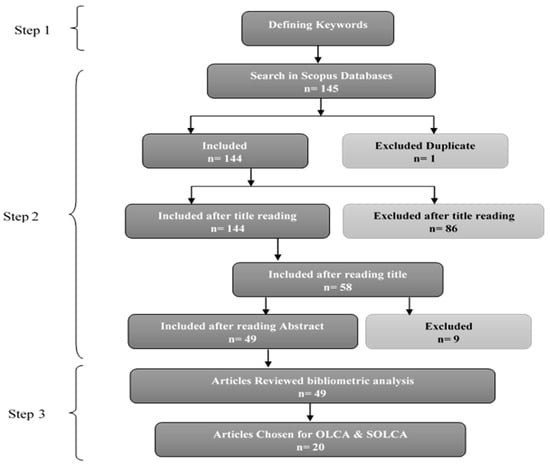
Figure 1.
Systematic literature review flow chart.
2.2.2. Bibliometric Analysis of OLCSA
There is now a general desire among decision-makers to qualify and quantify the research conducted. In this setting, bibliometric analysis readily presents itself as a tool, and the quantitative evaluation of written publications is possible through the use of bibliometric approaches [25]. Using the VOSviewer software, the RIS and CSV file types were used from Scopus database to analyze the software, which was then used to construct the graphic figures network and overlay visualization maps [26]. The map was created for three types of analysis: co-authorship; full counting; and analysis of (1) authors, (2) organization, and (3) country. Furthermore, for co-occurrence, three units were analyzed by a full counting method, using (1) all keywords, (2) author’s keywords, and (3) index keywords. However, for co-citation analysis, three units were analyzed by a full counting method using (1) the cited reference, (2) cited sources, and (3) cited. Figure 2 is visual map setting in the VOSviewer program for co-authorship, co-occurrence, and co-citation. Additionally, due to the vast amount of available information, bibliometric analysis is now one of the primary tools used to conduct literature reviews in any area of science. Contemporary bibliometric assessment makes use of a variety of cartographic techniques to represent bibliographic data, as well as statistical and mathematical methods to ascertain patterns in a field of study [23].
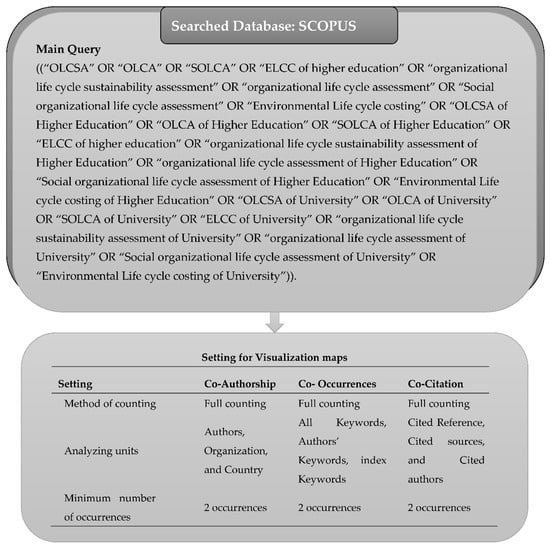
Figure 2.
Flowchart Bibliometric Analysis for visualization maps.
The maps employ an overlay visualization to illustrate trends, with purple, blue, green, and yellow colors varying by year, with purple representing earlier years and yellow representing later years.
2.3. Disseminating and Reporting the Results of the Review
The outcomes and results of the review and the inclusion and exclusion were presented qualitatively, and the selected articles were descriptively analyzed. From these 49 papers included for review, 18 papers were related to O-LCA, 2 articles were related to SO-LCA, and 29 article were related to E-LCC. Thus, those 49 articles were targeted and analyzed. The chosen articles mostly used the O-LCA, SO-LCA, and E-LCC for different purposes. The authors tried to integrate these three-dimensional methods for OLCSA.
3. Results
The systematic literature search in Scopus databases considered the current PRISMA guidelines [24]. Therefore, the answer to the first question will be answered, as there is no study on OLCSA. There are some articles about O-LCA, SO-LCA, and E-LCC to integrate for OLCSA, and the method used in these studies will be adopted for OLCSA studies.
3.1. Subject Areas in OLCSA (O-LCA, E-LCC, and SO-LCA) Research
3.1.1. Organizational Life Cycle Sustainability Assessment Literature Review
OLCSA is a new approach adopted from [27] the LCSA framework, which consists of LCA + LCC + S-LCA. Similarly, O-LCSA comprises O-LCA + E-LCC + SO-LCA. However, there is no article found about OLCSA. Moreover, articles on O-LCA, SO-LCA, and E-LCC were found. The most relative study is the O-LCA. The ISO/TS 14072 [4] “Requirements and Guidelines for Organizational Life Cycle Assessment” were the first guidelines used to conduct O-LCA, adapted from LCA. Meanwhile, the most useful guideline is the “UNEP/SETAC Guidance on Organizational Life Cycle Assessment” [3], which focuses only on O-LCA and uses some case studies O-LCA in their publication.
Based on the literature, Figure 3 quantifies the chronological contribution of the published articles on OLCSA comprised from O-LCA, E-LCC, and SO-LCA, specifically for higher education institutions and universities. The year 2020 had the highest contribution with 11 related papers; 2018 with eight papers; 2016 and 2017 with seven papers; 2019 with six articles; 2015 with five papers each year; 2011 and 2008 with two papers; 2012 with three papers; 2010 and 2011 with one paper per each year; and 2009, 2013, and 2014 did not contribute to O-LCA, SO-LCA, and E-LCC.
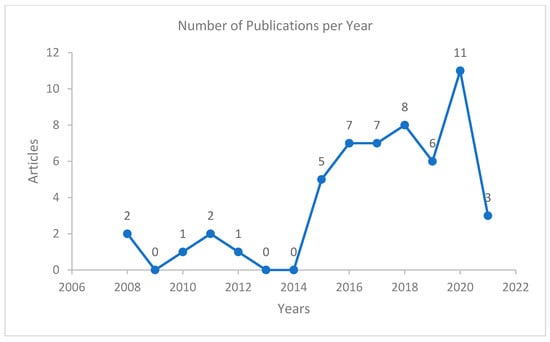
Figure 3.
The chronological contribution of publications by years.
3.1.2. Literature Found about Organizational Life Cycle Assessment (O-LCA) of University or Higher Education Institute
Based on the Table 1, 18 articles were published specifically about the organizational life cycle assessment, and the most of the authors used the [3] guideline for assessing the organization activities. However, there is no consensus to use the named guideline, as some of the authors used the ISO/TS 14072 [4] guideline, as the basis for the UNEP/SETAC O-LCA guideline [3].

Table 1.
Literature review table for O-LCA of university or higher education Institute.
3.1.3. Literature Found about Social Organizational Life Cycle Assessment (SO-LCA) of University or Higher Education Institute
The social organizational life cycle assessment is a newly established approach to evaluate the social satisfaction in an organization; therefore, there are less research articles found in the literature on this. Only D’Eusanio et al. (2020) [14] (“Social Organizational Life Cycle Assessment is an Approach for Identification of Relevant Subcategories for Wine Production in Italy”) and Julia Martínez-Blanco et al. (2015) [12] (“Social Organizational LCA (S-LCA)—a New Approach for Implementing Social LCA”) researched the social organizational life cycle assessment. The detailed literature review table of SO-LCA relevant article is explained in Table 2.
Table 2.
The reviewed articles found in the literature about SO-LCA specifically.
According to Table 2, the social organizational life cycle assessment (SO-LCA) is a new method which is introduced to assess the organization social impacts instead using those in line with the UNEP/SETAC 2013 [43] guidelines used for products. Therefore, the SO-LCA uses the UNEP/SETAC 2013 S-LCA guidelines in line with O-LCA guidelines. Additionally, there are limited studies about SO-LCA in the literature; therefore, UNEP [13] recently developed updated guideline for “Guidelines for social life cycle assessment of products and organizations”.
3.1.4. Literature Found about Environmental Life Cycle Costing (E-LCC) of University or Higher Education Institute
Environmental life cycle costing is a quite an old approach used to estimate of all costs in a product or process in whole life considering environmental externalities. This pillar of OLCSA has been heavily researched in the literature. The detailed literature review table of SO-LCA relevant article is explained in Table 3.
Table 3.
Articles contributing to E-LCC approaches.
The LCC is most useful method for estimating the whole cost of product in its life span; however, the E-LCC is used for product life cycle assessment, including for environmental externalities. Furthermore, the abovementioned studies on environmental life cycle costing (E-LCC) were used, which estimated the whole cost of product including environmental externalities. Therefore, 29 E-LCC related studies were found in the literature review, which were mainly articles published in the last three years.
LCSA is a complex study which we will adopt to estimate the organizational life cycle sustainability assessment (OLCSA), using the three pillars of sustainable development. First, the environmental impact will be analyzed in the O-LCA of organization with UNEP/SETAC [3] and the social impacts in the UNEP/SETAC (2013) [43] guideline will be assessed in line with the UNEP/SETAC guideline [3] of O-LCA. Furthermore, to assess the economic pillar, the E-LCC was used to estimate the whole cost of organization with externalities. However, there is no consensus about the method used for costing. However, there is no study found on OLCSA as an organization, especially in relation to university or higher education institutes.
3.2. Visual Maps Based on Bibliometric Analysis
3.2.1. Co-Authorship
Author
A visualization map was created based on bibliographic data, and the co-authorship read data was based bibliographic CSV database files. The author’s unit was analyzed by a full counting method, with maximum of 25 authors per document. Furthermore, the minimum documents per author was two, and minimum citation of an author was two. However, 148 authors met in 16 thresholds. Consequently, for each of the 16 authors, the total strength of the co-authorship links with other authors was calculated. The author with the greatest total link strength was selected. The number of authors to be selected was 16. The number of articles was represented by the size of each frame in the visual maps; for example, the tiny frames correspond to two articles per author at least. As the circle or frame gets larger, a high quantity of articles was shown by the author. The frame color depicts the typical year of publications; yellow denotes a relatively new theme, while the purple color denotes the oldest. Figure 3 lists the 19 authors who wrote at least three publications about OLCA, SOLCA, and ELCC. Matthias Finkbeiner published the highest number of articles with seven; Forin. S with six; Martínez-Blanco Julia with five; Berger Markus with four, Lehman. A, Loss. A., Manzardo. A., scipion. A., Hall. M.R., and Weldu. Y.W. with three; and Cremer. A., Muller. K., Chang. Y.J., Ciroth. A., and Lutenberger. A. all published at least three.
The visual map of the authors in Figure 4 shows a bigger circle, which represents the highest number of co-authorship of publications by authors, and a smaller circle, which corresponds to the low number of publications during the period. Furthermore, there is a strong network among the authors that published the article with co-authors. For example, Matthias Finkbeiner has a strong publication network with 17 authors and is the owner of 85 citations. Secondly, Forin. S. contributes to a publication network with 11 authors and 15 citations. Martínez-Blanco Julia is part of a network which includes 10 authors and 83 citations. Berger Markus’s network operates among 10 authors with 7 citations. Lehman. A, Loss. A., Manzardo. A., Scipion. A., Cremer. A., and Muller. K. contribute to a network of 6 authors, with 46, 20, 20, 20, 2, and 2 citations, respectively. Chang. Y.J. has a network with five authors across 46 citations. Additionally, Hall. M.R. and Weldu. Y.W. have networks among three authors, while Ciroth. A. and Lutenberger. A. have no network of publications with authors. Additionally, Finkbiener. M., Artinez-Blanoc, Forin. S., and Berger. M. have the highest citations, respectively.
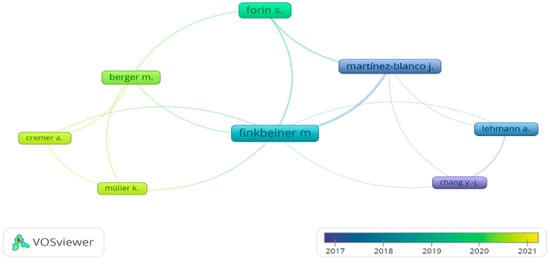
Figure 4.
Co-authorship authors co-occurrence visual map.
Organization
To illustrate the visualization map created based on bibliographic data chosen from SOVviewer software, the type of co-authorship and the organization unit were both analyzed, where data were read from bibliographic CSV database files and were analyzed by the full counting method. The maximum number of organizations per document was 25, the minimum number of documents per organization was selected as 1, and the minimum number of citation per organization was 2. Among the 106 organizations, 82 thresholds were met. Consequently, each of the 230 organization’s total strength of the co-authorship links with other organizations were calculated. In total, 230 organizations with the greatest total link strength were selected.
Figure 5 indicates that AquaTECH Specialties, Geneva, Switzerland; Geography, Planning, and Environmental Management, University of Queensland, Australia; Green Delta, Berlin, Germany; LCA Consult and Review, Frankfurt, Germany; School of Public Leadership, Sustainability Institute, Stellenbosch University, South Africa; Sustainability By Design, United States; University of Jyvaskyla, School of Business and Economics, Finland are strongly associated with six other organizations and hold 193 citations. Advanced Resource Efficiency Center (AREC), the University of Sheffield, United Kingdom; Center for Energy, Environment, and Sustainability (cees), the University of Sheffield, United Kingdom; Department of Electronic and Electrical Engineering, the University of Sheffield, United Kingdom; and Sheffield University Management School (SUMS), United Kingdom have the second strongest links with three and hold 48 citations. Agribusiness Postgraduate Program, Face, Federal University of Grande Dourados, cep rodovia dourados-itahum km 12, caixa postal 533, dorados, ms 79825-070; Center for Studies and Research in AgriBusiness, Cepan, Federal University of Rio Grande do Sul, Faculty of Agronomy, Brazil; Department of Economics and International Relations (DERI), Faculty of Economics, Federal University of Rio Grande do Sul, Brazil; Department of Electronic and Electrical Engineering, the University of Sheffield, United Kingdom also have the second strongest links with three with 31 citations. Deloitte Sustainability, Paris, France; Department of Agricultural and Food Sciences, University of Bologna, Italy; Research Institutes of Sweden, Agrifood and Bioscience, Sweden; University of Natural Resources and Life Sciences (Boku), Austria also have second strong link with three with eight citations. The rest of the organizations have no citation; here, there is zero or no link with other organizations and co-authorship.
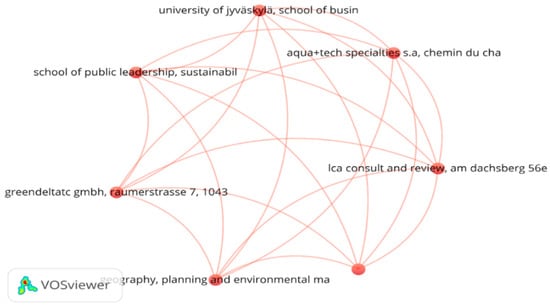
Figure 5.
Organization co-authorship visualization.
Country Co-Authorship
To illustrate the visualization map created based on bibliographic data chose in SOVviewer software, the type of analysis of co-authorship and the country unit were analyzed, with data from bibliographic CSV database files analyzed by the full counting method. There was a maximum of 25 countries per document, and the minimum number of documents per country was two. The minimum number of citations per organization was two. However, 40 countries met 13 thresholds. Additionally, for each of the 13 countries, the total strength of the co-authorship links with other countries was calculated. The organization with the greatest total link strength was selected across 13 countries.
Country co-authorship is the also a useful unit of analysis for co-authorship and can be explained by the total link strength. Germany publishes the most SOLCSA articles, i.e., about 13 documents with 356 citations, and has a total link strength of 9. United States publishes the second highest amount of documents, i.e., 8, with 282 citations and a total link strength of 8. Italy contributes the third most OLCSA articles, with 6 documents and 60 citations, and a total link strength of 3. Switzerland contributes 4 documents and 237 citations, with a total link strength of 3. Furthermore, Denmark contributes 4 documents and 99 citations, with a total link strength of 2. However, Switzerland and Denmark have a higher of citations compared to Italy. Furthermore, Sweden contributes in 2 documents and 18 citations, with a total link strength of 2. Chile has the smallest total link strength with one, publishing two documents with seven citations. Australia, Croatia, Poland, and Spain contribute 2 documents and have a total link strength of 0, with 21, 7, and 6 citations, respectively. Figure 6 illustrate the abovementioned information in a map.
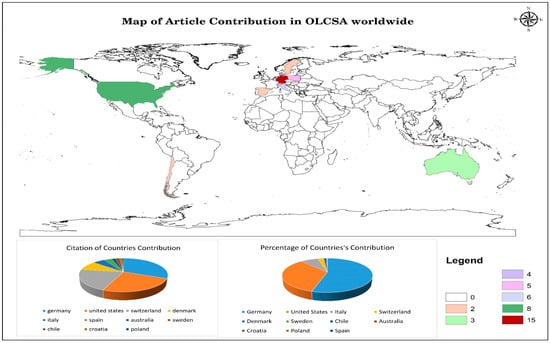
Figure 6.
Country co-authorship map.
3.2.2. Co-Occurrence of Keywords
All Keywords
SOVviewer software was used to illustrate a visualization map based on bibliographic data which were selected by a analysis of co-occurrence. Here, all keywords were analyzed, and data were read from CSV bibliographic database files and analyzed by the full counting method. The minimum number of occurrence in relation to keyword selection was five., and full counting methods were used. However, for each of the 23 keywords, the total strength of the co-occurrence links with other keywords was calculated. The 23 keywords with the greatest total link strength were selected and analyzed. Based on VOSviewer software analyzed in Figure 7, there were 23 keywords across 5 occurrences. Moreover, the most used keyword is “Life Cycle” with 25 searches, and the total link strength was 123, followed by “Environmental Life Cycle” with 16 searches and a total link strength of 82. “Costs” occurred 14 times with a total link strength of 71; “sustainable development” occurred 15 times with a total link strength of 68; and “Life Cycle Assessment” occurred 22 times with a total link strength of 62; “environmental impact” occurred 13 times with a total link strength of 60; “Life Cycle Analysis” occurred 9 times with a total link strength of 45; “Cost-Benefit Analysis” occurred 6 times with a total link strength of 42; “Economics” occurred 8 times with a total link strength of 40; “Life Cycle Assessment (Lca)” occurred 7 times with a total link strength of 39; “Decision Making” occurred 8 times with a total link strength of 37; “cost analysis” and “Environmental Management” occurred 6 and 9 occurred times, respectively, with a total link strength of 36; “Greenhouse Gases” and “Life Cycle Costing” occurred 5 and 6 times, respectively, with a total link strength of 31; “Environmental And Economic Impacts” and “global warming” both occurred 5 times, with a total link strength of 29 and 28, respectively, “Organizational Life Cycle Assessment” occurred 10 times with a total link strength of 28; and “lca”, “Organizational Life Cycle”, “Environmental Life Cycle Costing”, and “environmental impact assessment” occurred 5 times, and with a total link strength of 26, 18, 15, and 13, respectively.
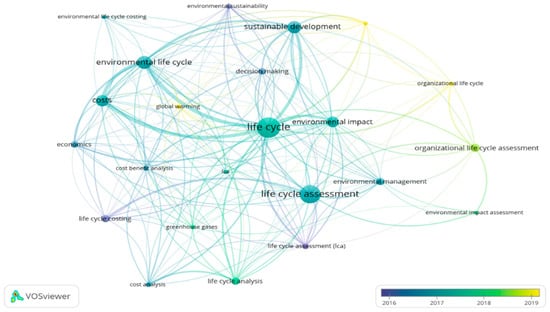
Figure 7.
Visual map of co-occurrence of all keywords.
This visual map illustrates that the largest frame represents the highest number of keyword co-occurrences, while the smallest frame represents the lowest number of keyword co-occurrences.
Author Keywords
The visualization map was created based on bibliographic data based on the type of co-occurrence analysis. The author keywords unit were analyzed, and the data were analyzed by the full counting method. The minimum number of occurrences of a keyword was two. However, for each of the 24 keywords, the total strength of the co-occurrence links with other key words was calculated. The keywords with the greatest total link strength was selected for analysis of 24 keywords. Based on VOSviewer software, as shown in Figure 8, 24 keywords were selected. “Life Cycle Assessment” occurred 10 times with a total link strength of 13, “Life Cycle Costing” occurred 7 times with a total link strength of 10, “life cycle costing” occurred 7 times with a total link strength of 10, and “Sustainability” occurred 3 times with a total link strength of 8 8. “Environmental Management”, “Footprinting”, and “water scarcity” each occurred three times, with a total link strength of seven for each. Furthermore, “organizational life cycle assessment” occurred eight times; “LCA” occurred five times; “life cycle sustainability assessment” occurred three times; and “corporate footprints”, “Social LCA”, “sustainable supply chain management”, “water footprint”, and “corporate footprints” occurred twice, with a total link strength of six for each. Moreover, “environmental life cycle costing” occurred five times with a total link strength of five. “O-LCA”, “organizational LCA”, “organizational level”, and “social assessment” occurred twice, with a total link strength of four for each. LCC occurred three times, with a total link strength of three. Additionally, “environmental sustainability” and “sustainable development” occurred twice, with a total link strength of three for each. However, “ELCC”, “life cycle costing (LCC)”, and “life-cycle costing” all occurred twice, with no total link strength found.
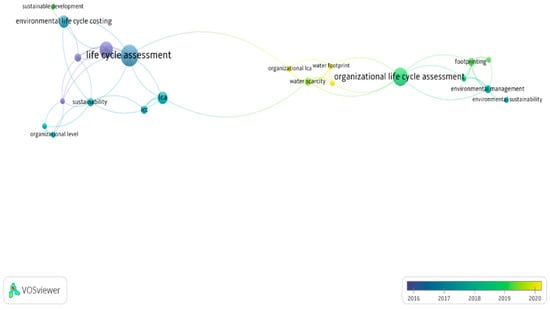
Figure 8.
Authors keywords visualization map.
Index Keywords
SOVviewer software is used to explain the visual map created from bibliographic data based on the type of analysis of co-occurrence. The index keywords were analyzed by full counting. The minimum number of occurrences of five was selected, and full counting methods were used on 515 keywords across 16 thresholds. However, for each of the 16 keywords, the total strength of the co-occurrence links with other keywords was calculated. The keywords with the greatest total link strength were selected for analysis of 16 selected keywords. As shown in Figure 9, VOSviewer software was used. “Life Cycle” occurred 25 times with a total link strength of 84, “Environmental Life Cycle” occurred 16 times with a total link strength of 52, “sustainable development” occurred 14 times with a total link strength of 52, and “environmental impact” occurred 13 times with a total link strength of 25. Furthermore, “decision making” occurred 8 times with a total link strength of 44, while “Life Cycle Analysis” occurred 9 times and “life cycle costing (lcc)” occurred 7 times, both with a total link strength of 30. Furthermore, “Environmental Management” occurred 9 times with a total link strength of 28, and “Cost-Benefit Analysis” occurred 6 times with a total link strength of 27. Additionally, “environmental sustainability” occurred 6 times and “life cycle assessment” occurred 15 times, both with a total link strength of 26. Additionally, “cost analysis” occurred 6 times with a total link strength of 24, while “environmental and economic impacts”, “global warming”, “organizational life cycle”, and “environmental impact assessment” occurred 5 times each, with a total link strength of 22, 17, 13, and 9, respectively.
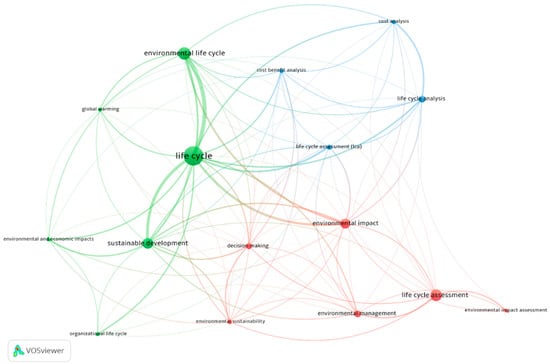
Figure 9.
Index keywords.
3.2.3. Co-Citation
Cited Reference
In light of the SOVviewer software analysis used to illustrate the visual map generated from bibliographic based on a co-citation type of analysis, the cited reference unit was analyzed by the full counting method. Out of the 1996 cited references, the minimum number of citations of cited references was 2 across 33 thresholds. For each of the 33 cited references, the total strength of the co-citation links with other cited references was calculated. The cited references with the greatest total link strength were selected, and the 1996 cited references were used across 33 thresholds. For each of the 33 cited references, the total strength of the co-authorship links with other cited references was calculated. Based on Figure 10, “martinez-blanco, j., inaba, a., finkbeiner, m., life cycle assessment of organizations (2016) special types of life cycle assessment, pp. 333–394, finkbeiner m, (ed), springer, Netherlands” had three citations and “lo-iacono-ferreira, v.g., torregrosa-lopez, j.i., capuz-rizo, s.f., use of life cycle assessment methodology in the analysis of ecological footprint assessment results to evaluate the environmental performance of universities (2016) j clean prod, 133, pp. 43–53” had four citations in the network, both with a total link strength of 15, i.e., the most commonly referenced. The second most common references include “resta, b., gaiardelli, p., pinto, r., dotti, s., enhancing environmental management in the textile sector: an organizational-life cycle assessment approach (2016) j clean prod, 135, pp. 620–632” and “neppach, s., nunes, k.r.a., schebek, l., organizational environmental footprint in german construction companies (2017) j clean prod, 142, pp. 78–86” which had three citations each, both with a total link strength of 13 and 12, respectively. The third most referenced centred around the social organizational life cycle assessment “martinez-blanco, j., lehmann, a., chang, y.-j., finkbeiner, m., social organizational lca (solca)—a new approach for implementing social lca (2015) int j life cycle assess, 20, pp. 1586–1599”, “martinez-blanco, j., forin, s., finkbeiner, m., launch of a new report: “road testing organizational life cycle assessment around the world: applications, experiences and lessons learned (2018) int j life cycle assess, 23, pp. 159–163”, “jungbluth, n., keller, r., konig, a., one-two we—life cycle management in canteens together with suppliers, customers and guests (2016) int j life cycle assess, 21, pp. 646–653”, and “(2013) organization environmental footprint (oef) guide”, with two citations each in this network and a total link strength of 10. Furthermore “manzardo, a., loss, a., niero, m., vianello, c., scipioni, a., organizational life cycle assessment: the introduction of the production allocation burden (2018) procedia cirp, 69, pp. 429–434” had two citations and a total link strength with other references. Additionally, the others all had a total link strength less than 10.
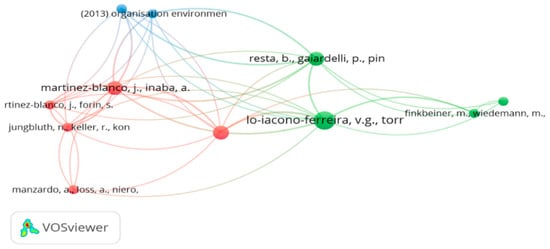
Figure 10.
Co-citation cited reference.
Cited Source
Based on the SOVviewer software analysis used to illustrate the visual map generated from bibliographic data based on a co-citation type of analysis, the cited resource unit was analyzed by the full counting method. The minimum number of citations of cited references was five. Of the 975 cited references, 20 met the thresholds. For each of the 20 cited references, the total strength of the co-authorship links with other cited references was calculated. Figure 11 shows that the cited references with the greatest total link strength were selected. The “int. j. life cycle assesses” source had 123 citations, with a total link strength of 989, in which was the highest among publications of OLCSA, OLCA, ELCC, and SOLCA. The second source refers to “j. clean. Prod.”, with 44 citations and a total link strength of 647. The third source on publication is “sustainability”, with 28 citations and a total link strength of 315. The source of “renew. sustain. energy rev” had 16 citations and total link strength of 212. The sources of “cycle assessment” and “waste manage” both 15 citations, and total link strengths of 53 and 213, respectively. Furthermore, “ecol econ”, “energy build.”, “environ. sci. technol.”, and “environmental life cycle costing” each had 12 citations each, and had total link strengths of 388, 264, 122, and 56, respectively. The source of “j. ind. ecol.” had ten citations and a total link strength of 250. “resour. conserv. Recycl.” and “Science” both had 10 citations each and total link strengths of 274 and 183, respectively. Additionally, the sources of “environ. sci. technol”, “guidance on organizational life cycle assessment”, “appl. Energy”, “biomass bioenergy”, “renew. Energy”, “build. Environ.”, “energy policy”, “j. ind. Ecol.”, “procedia cirp”, “sci. total environ.”, “Ambio”, “environmental science & technology”, “j. bus ethics”, and “j. environ. Manage” contributed to OLCSA, O-LCA, SO-LCA, and E-LCC with less than ten citations each. Finally, the International Journal of Life Cycle Assessment had a more significant contribution with a higher score of citations.
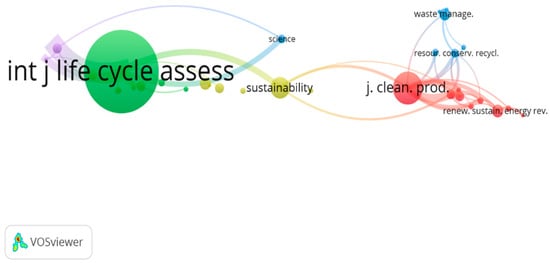
Figure 11.
Co-citation cited sources.
Cited Author
Based on a co-citation type of analysis which used SOVviewer software to illustrate the visual map produced from bibliographic data, the cited author unit was analyzed by the full counting method. The minimum number of citations of the cited author is 20; from 2837, only 9 authors met the threshold. For each of the nine authors, the total strength of the co-citation links with other authors was calculated. Therefore, Figure 12 demonstrates that the cited author with the greatest total link strength. Therefore, Finkbeiner, M. was the most cited author with 102 citations and with a total link strength of 1050. Martinez-Blanco, J. had 50 citations and a total link strength of 682. Inaba, A. had 27 citations and Berger, M. had 23 citations, both with a total link strength of 372. Manzardo, A. and Lehmann, A. had 21 citations, with a total link strength of 348 and 252, respectively. Ciroth, A. had 23 citations with a of 132, Rebitzer, G. had 28 citations with a total link strength of 125, and Hunkeler, D. had 35 citations with a total link strength of 124, making them the most identified and cited authors in the field of OLCA, SOLCA, and ELCC in the literature.
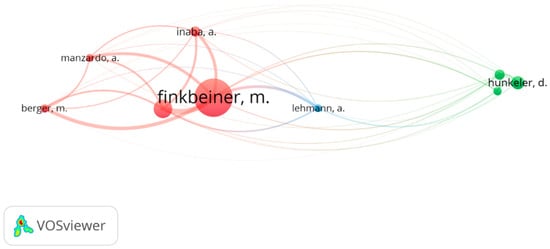
Figure 12.
Visual map of cited authors.
4. Discussion
4.1. Method Used for O-LCA
Organizational life cycle assessment (O-LCA) is a relatively new concept, gaining traction as a scientifically competent and practical approach [5]. With the increased need for organizations to measure and analyze the environmental effects of their activities, organizational lifecycle assessment has recently been implemented from a life cycle viewpoint [5,37]. The growing use of the O-LCA methods is relevant in life cycle assessment approaches [39]. Furthermore, life cycle thinking is the underlying foundation for both LCA and O-LCA methods. In essence, the most significant distinction is the kind of object of analysis: product, the entire company, or activities connected with it [1]. The organizational life cycle assessment (O-LCA) was developed to transition the life cycle approach from the product level to the entire organization level within the scope of the UNEP/SETAC Life Cycle Initiative [31].
However, Julia Martínez-Blanco et al. (2018) [5] argued that three main tasks should be taken in future during testing: (1) the road testing problems should be solved in the future by the LCA field; (2) methodological obstacles unique to particular types of organizations, such as the service industry, should be tackled; and (3) the organizational perspective’s potential should be used in adjacent LCA areas. However, there was one limitation of O-LCA in their study: O-LCA may be unable to account for all activities occurring inside a city [28].
Additionally, existing scientific and technological progressions showed that the advantages of life cycle assessment might be applied to the environmental impact assessment of organizations, taking their operations and value chain into account [70]. Furthermore, environmental and organizational life cycle assessment can be used alongside the life cycle assessment, based on ISO/TS 14072. Furthermore, ISO/TS 14072 serves as the foundation for O-LCA, and the guidance is compliant with these standards [71]. Consequently, there is no consensus found to use a specific method for OLCSA. Numerous articles used the “Guidance on Organizational Life Cycle Assessment” UNEP/SETAC 2015 guideline, which is developed considering the ISO/TS 14072. Finally, Lo-Iacono-Ferreira et al. (2017) [6] make several recommendations in their study’s conclusion. Thus, the O-LCA methodology is relevant to higher education institutions.
4.2. The Method Used for SO-LCA
The social dimension is vital in sustainability assessment, especially for university and higher education institutions, as social organizations provide social services. SO-LCA is defined as “a compilation and evaluation of the social and socio-economic aspects and the positive and negative impacts of the activities associated with the organization as a whole or a portion thereof adopting a life cycle perspective” [12]. Moreover, in the above-mentioned definition, the organization also has a huge amount of negative and positive social impacts on society and stakeholders. Therefore, the social organization life cycle assessment, including one of the important pillars of sustainability, must be conducted.
SO-LCA is comprised of O-LCA using the UNEP/SETAC [43] guideline and [13]. The main methodological and practical challenges and limitations of SLCA, resulting from the complexity of the social dimension and the novelty of the method and the need for further development, are highlighted in the SLCA guidelines [12]. There are just 8 indicators at the product level, 127 at the organizational level, and 69 at the national level in the current S-LCA method for the product [12,16]. The bulk of presently implemented SLCA indicators are organizational-level in nature. Connecting social elements to a “reporting organization”, i.e., the O-LCA and SO-LCA reference unit, appears more logical, relevant, and feasible [12].
The organizational viewpoint of O-LCA and the O-LCA framework may be used to create the new SO-LCA method, regardless of an organization’s level of experience with social and environmental assessment. SO-LCA is not intended to replace current methods, but to enhance them by broadening their scope (addressing the whole life cycle and including new social dimensions) and increasing their applicability (using an organizational instead of product perspective). However, the S-LCA guidelines emphasize the major methodological and practical difficulties and constraints of S-LCA, which arise from the complexity of the social component and the uniqueness of the technique, as well as the need for future development. Finally, more reliable and suitable methods for assessing the social demission of sustainability in an organization are required [12].
4.3. Methods Used for Organization Life Cycle Costing E-LCC or O-LCC
Economically, the life cycle costing (LCC) methodology can be used to assess a system’s economic performance. There is no unanimity on the procedure for calculating life cycle costs. However, Hunkeler, Lichtenvort, and Rebitzer (2008) [72] initially developed a methodological framework for LCC. Moreover, Swarr et al. (2011) [69] developed the code of practice for LCC. When applied alone or in combination with the LCA methodology, there is a substantial body of background material on the LCC’s applicability. No organizational life cycle costing (O-LCC) methodology has been developed to date. O-LCC could be developed on the basis of the LCC framework, with changes that are comparable to those that were needed when O-LCA was developed on the basis of the LCA framework [22].
Additionally, based on the literature, LCC and E-LCC are the most used methods for products; however, Alejandrino, Mercante, and Bovea [22] firstly used the O-LCC method for organization. Therefore, the O-LCC method is required alongside organization life cycle assessment to estimate all costs of organization in its life cycle.
5. Conclusions
Higher education institutions and universities are some of the most important service-enhancing organizations, as they produce graduates who will contribute to the communities as human capital. A limited number of articles are written about organizational life cycle assessment, with a total of only 17. OLCSA, including O-LCA, O-LCA, and SO-LCA, is a vital decision-making tool for analyzing organizational sustainability in its entire life span. Therefore, UNEP can also help to develop 2015’s “Guidance on Organizational Life Cycle Assessment”, considering the ISO/TS 14072 standards. Nowadays, the organization can use O-LCA and SO-LCA, and E-LCC can be used to estimate the sustainability of their organizations as a new framework as OLCSA.
Bibliometric analysis is the most useful approach to analyze the existing literature values and its visualization; nine visual maps were shaped to illustrate co-authorship, co-occurrence, and co-citation analysis. In this regard, 19 authors wrote and published at least three publications on O-LCA, SO-LCA, and E-LCC. Matthias Finkbeiner published the highest number of articles. Furthermore, considering the co-authorship type of analysis, the organization has analyzed the unit of analysis, the highest number of publications, the total link strength, and citations referring to AquaTECH Specialties, Geneva, Switzerland. Additionally, Germany publishes the most OLSCA articles, i.e., about 13 documents with 356 citations, showing a total link strength of 9. Based on VOSviewer software analyzed, the type of analysis co-occurrence was analyzed with three analyzing units—the whole keyword, the author’s keywords, and the index keywords. According to the analysis of the whole keywords, 23 keywords, each with an occurrence of five, were analyzed. The most used key is “Life Cycle”, which occurred 25 times, with a total link strength of 123. Additionally, the index keywords were analyzed under the co-occurrence type of method, based on VOSviewer software. “Life Cycle” occurred 25 times, with a total link strength of 84, “Environmental Life Cycle” occurred 16 times with a total link strength of 52, and “sustainable development” occurred 14 times. Based on the SOVviewer software, a visual map was generated from bibliographic data. Furthermore, the co-citation type of analysis, the cited reference, the cited source, and the cited author units were analyzed by the full counting method. The cited references with the greatest total link strength were selected, and 1996 cited references were met across 33 thresholds. For each of the 33 cited references, the total strength of the co-authorship links with other cited references was calculated. Furthermore, the cited references with the greatest total link strength was selected. Moreover, the “int j life cycle assesses” source, with 123 citations with a total link strength of 989, was at the top of publications on OLCSA, O-LCA, E-LCC, and SO-LCA.
Consequently, in order to analyze the organization sustainability, it is crucial to adopt the available guidelines, namely 2015’s UNEP/SETAC for the organizational life cycle assessment, the UNEP/SETAC, “the methodological sheets for subcategories in social life cycle assessment”, and UNEP 2020 guidelines for social life cycle assessment of products and organizations, in order to analyze the social impacts and considerations related to the organization. However, there is no consensus around which method of life cycle costing should be used in the literature review. Most of the articles use life cycle costing and numerous other articles use environmental life cycle costing as well as net present value calculations. The sustainability of an organization should be assessed, especially the university or higher education institute which adopt the abovementioned methods, such as organizational life cycle sustainability assessment, to fulfill the fourth goal of sustainable development on the quality of education.
Author Contributions
Conceptualization of this work by A.H.S., the research was performed and analyzed by W.W. and N.K.M. The paper was written by W.W. and checked and revised by A.H.S., N.K.M., S.A.J.H. and N.A.A. All authors have read and agreed to the published version of the manuscript.
Funding
This research received no external funding.
Institutional Review Board Statement
Not applicable.
Informed Consent Statement
Not applicable.
Data Availability Statement
Not applicable.
Acknowledgments
We thank Universiti Putra Malaysia (UPM) for providing their resources to conduct this review. We also thank the Higher Education Development Program (HEDP) in the Ministry of Higher Education in Afghanistan for this opportunity.
Conflicts of Interest
The authors declare no conflict of interest.
References
- Manzardo, A.; Loss, A.; Niero, M.; Vianello, C.; Scipioni, A. Organizational life cycle assessment: The introduction of the production allocation burden. In Procedia CIRP, Proceedings of the 25th CIRP Conference on Life Cycle Engineering (CIRP LCE), Copenhagen, Denmark, 30 April–2 May 2018; Laurant, A., Leclerc, A., Niero, M., Dong, Y., Olsen, S.I., Owsianiak, M., Bey, N., Ryberg, M., Hauschild, M.Z., Eds.; Elsevier: Amsterdam, The Netherlands, 2018; Volume 69, pp. 429–434. [Google Scholar]
- Omran, N.; Sharaai, A.; Hashim, A. Visualization of the sustainability level of crude palm oil production: A life cycle approach. Sustainability 2021, 13, 1607. [Google Scholar] [CrossRef]
- UNEP/SETAC. Guidance on Organizational Life Cycle Assessment; UNEP: Paris, France, 2015; ISBN 978-92-807-3453-9. [Google Scholar]
- I.S.O. TS 14072; Environmental Management—Life Cycle Assessment—Requirements and Guidelines for Organizational Life Cycle Assessment. International Organization for Standardization: Geneva, Switzerland, 2014.
- Martínez-Blanco, J.; Forin, S.; Finkbeiner, M. Launch of a new report: “Road testing organizational life cycle assessment around the world: Applications, experiences and lessons learned”. Int. J. Life Cycle Assess. 2018, 23, 159–163. [Google Scholar] [CrossRef]
- Lo-Iacono-Ferreira, V.G.; Torregrosa-López, J.I.; Capuz-Rizo, S.F. Organizational life cycle assessment: Suitability for higher education institutions with environmental management systems. Int. J. Life Cycle Assess. 2017, 22, 1928–1943. [Google Scholar] [CrossRef]
- Keeble, B.R. The Brundtland report: ‘Our common future’. Med. War 1988, 4, 17–25. [Google Scholar] [CrossRef]
- Soni, V.; Singh, S.P.; Banwet, D.K. Sustainable coal consumption and energy production in India using life cycle costing and real options analysis. Sustain. Prod. Consum. 2016, 6, 26–37. [Google Scholar] [CrossRef]
- ISO 14001; Environmental Management Systems—Requirements with Guidance for Use. ISO: Geneva, Switzerland, 2004.
- ISO 14044:2006; Environmental Management—Life Cycle Assessment—Requirements and Guidelines. ISO: Geneva, Switzerland, 2006.
- Finkbeiner, M.; Wiedemann, M.; Saur, K. A comprehensive approach towards product and organisation related environmental management tools. Int. J. Life Cycle Assess. 1998, 3, 169–178. [Google Scholar] [CrossRef]
- Martínez-Blanco, J.; Lehmann, A.; Chang, Y.-J.; Finkbeiner, M. Social organizational LCA (SOLCA)—A new approach for implementing social LCA. Int. J. Life Cycle Assess. 2015, 20, 1586–1599. [Google Scholar] [CrossRef]
- UNEP; Achten, W.; Barbeau-Baril, J.; Barros Telles Do Carmo, B.; Bolt, P.; Chandola, V.; Corona Bellostas, B.; Dadhish, Y.; Di Eusanio, M.; Di Cesare, S.; et al. Guidelines for Social Life Cycle Assessment of Products and Organizations; Achten, W., Barbeau-Baril, J., Do Carmo, B.B.T., Bolt, P., Chandola, V., Corona Bellostas, B., Dadhish, Y., D’Eusanio, M., Di Cesare, S., Di Noi, C., et al., Eds.; United Nations Environment Program: Nairobi, Kenya, 2020; p. 138. [Google Scholar]
- D’Eusanio, M.; Lehmann, A.; Finkbeiner, M.; Petti, L. Social organizational life cycle assessment: An approach for identification of relevant subcategories for wine production in Italy. Int. J. Life Cycle Assess. 2020, 25, 1119–1132. [Google Scholar] [CrossRef]
- Kalvani, S.R.; Sharaai, A.H.; Abdullahi, I.K. Social consideration in product life cycle for product social sustainability. Sustainability 2021, 13, 11292. [Google Scholar] [CrossRef]
- Kapitulčinová, D.; Atkisson, A.; Perdue, J.; Will, M. Towards integrated sustainability in higher education—Mapping the use of the Accelerator toolset in all dimensions of university practice. J. Clean. Prod. 2018, 172, 4367–4382. [Google Scholar] [CrossRef]
- Filho, W.L.; Salvia, A.L.; Frankenberger, F.; Akib, N.A.M.; Sen, S.K.; Sivapalan, S.; Novo-Corti, I.; Venkatesan, M.; Emblen-Perry, K. Governance and sustainable development at higher education institutions. Environ. Dev. Sustain. 2021, 23, 6002–6020. [Google Scholar] [CrossRef]
- Roh, S.; Tae, S.; Kim, R. Development of a streamlined environmental life cycle costing model for buildings in South Korea. Sustainability 2018, 10, 1733. [Google Scholar] [CrossRef] [Green Version]
- Śnierzyński, M.; Hernes, M.; Bytniewski, A.; Krzywonos, M.; Sobieska-Karpińska, J. Data sources for environmental life cycle costing in network organizations. In International Conference on Computational Collective Intelligence; Springer: Cham, Switzerland, 2019; pp. 394–405. [Google Scholar]
- Stevanovic, M.; Allacker, K.; Vermeulen, S. Development of an approach to assess the life cycle environmental impacts and costs of general hospitals through the analysis of a Belgian case. Sustainability 2019, 11, 856. [Google Scholar] [CrossRef] [Green Version]
- Kaewunruen, S.; Sresakoolchai, J.; Peng, J. Life cycle cost, energy and carbon assessments of Beijing-Shanghai high-speed railway. Sustainability 2020, 12, 206. [Google Scholar] [CrossRef] [Green Version]
- Alejandrino, C.; Mercante, I.T.; Bovea, M.D. Combining O-LCA and O-LCC to support circular economy strategies in organizations: Methodology and case study. J. Clean. Prod. 2022, 336, 130365. [Google Scholar] [CrossRef]
- López-Serrano, M.J.; Velasco-Muñoz, J.F.; Aznar-Sánchez, J.A.; Román-Sánchez, I.M. Sustainable use of wastewater in agriculture: A bibliometric analysis of worldwide research. Sustainability 2020, 12, 8948. [Google Scholar] [CrossRef]
- Moher, D.; Liberati, A.; Tetzlaff, J.; Altman, D.G.; The PRISMA Group. Preferred reporting items for systematic reviews and meta-analyses: The PRISMA statement. J. Clin. Epidemiol. 2009, 62, 1006–1012. [Google Scholar] [CrossRef]
- Ellegaard, O.; Wallin, J.A. The bibliometric analysis of scholarly production: How great is the impact? Scientometrics 2015, 105, 1809–1831. [Google Scholar] [CrossRef] [Green Version]
- Van Eck, N.J.; Waltman, L. Software survey: VOSviewer, a computer program for bibliometric mapping. Scientometrics 2010, 84, 523–538. [Google Scholar] [CrossRef] [Green Version]
- Klöpffer, W. Outlook: Role of environmental life cycle costing in sustainability assessment. In Environmental Life Cycle Costing; CRC Press: Geneva, Switzerland, 2008; pp. 157–162. ISBN 9781420054736/9781420054705. [Google Scholar]
- Cremer, A.; Berger, M.; Müller, K.; Finkbeiner, M. The first city organizational LCA case study: Feasibility and lessons learned from Vienna. Sustainability 2021, 13, 5062. [Google Scholar] [CrossRef]
- Büdel, V.; Fritsch, A.; Oberweis, A. Integrating sustainability into day-to-day business: A tactical management dashboard for O-LCA. In ICT4S 2020, Proceedings of the 7th International Conference on ICT for Sustainability, Bristol, UK, 21–26 June 2020; Association for Computing Machinery: New York, NY, USA; Institute Aifb, Karlsruhe Institute of Technology: Karlsruhe, Germany, 2020; pp. 56–65. [Google Scholar]
- Cremer, A.; Müller, K.; Berger, M.; Finkbeiner, M. A framework for environmental decision support in cities incorporating organizational LCA. Int. J. Life Cycle Assess. 2020, 25, 2204–2216. [Google Scholar] [CrossRef]
- Marx, H.; Forin, S.; Finkbeiner, M. Organizational life cycle assessment of a service providing SME for renewable energy projects (PV and wind) in the United Kingdom. Sustainability 2020, 12, 4475. [Google Scholar] [CrossRef]
- Forin, S.; Gossmann, J.; Weis, C.; Thylmann, D.; Bunsen, J.; Berger, M.; Finkbeiner, M. Organizational water footprint to support decision making: A case study for a German technological solutions provider for the plumbing industry. Water 2020, 12, 847. [Google Scholar] [CrossRef] [Green Version]
- Forin, S.; Mikosch, N.; Berger, M.; Finkbeiner, M. Organizational water footprint: A methodological guidance. Int. J. Life Cycle Assess. 2020, 25, 403–422. [Google Scholar] [CrossRef] [Green Version]
- Fritsch, A. Towards a modeling method for business process oriented organizational life cycle assessment. In Proceedings of the 7th International Conference on ICT for Sustainability, Bristol, UK, 21–26 June 2020. [Google Scholar] [CrossRef]
- Martínez-Blanco, J.; Forin, S.; Finkbeiner, M. Challenges of organizational LCA: Lessons learned from road testing the guidance on organizational life cycle assessment. Int. J. Life Cycle Assess. 2019, 25, 311–331. [Google Scholar] [CrossRef]
- Forin, S.; Martínez-Blanco, J.; Finkbeiner, M. Facts and figures from road testing the guidance on organizational life cycle assessment. Int. J. Life Cycle Assess. 2019, 24, 866–880. [Google Scholar] [CrossRef]
- Manzardo, A.; Loss, A.; Jingzheng, R.; Zuliani, F.; Scipioni, A. Definition and application of activity portfolio and control/influence approaches in organizational life cycle assessment. J. Clean. Prod. 2018, 184, 264–273. [Google Scholar] [CrossRef]
- Florindo, T.J.; de Medeiros Florindo, G.I.B.; Talamini, E.; da Costa, J.S.; Ruviaro, C.F. Carbon footprint and life cycle costing of beef cattle in the Brazilian midwest. J. Clean. Prod. 2017, 147, 119–129. [Google Scholar] [CrossRef]
- Manzardo, A.; Loss, A.; Mazzi, A.; Scipioni, A. Organization Life-Cycle Assessment (OLCA): Methodological issues and case studies in the beverage-packaging sector. In Environmental Footprints of Packaging; Springer: Singapore, 2015; pp. 47–73. [Google Scholar] [CrossRef]
- Resta, B.; Gaiardelli, P.; Pinto, R.; Dotti, S. Enhancing environmental management in the textile sector: An organisational-life cycle assessment approach. J. Clean. Prod. 2016, 135, 620–632. [Google Scholar] [CrossRef]
- Martínez-Blanco, J.; Inaba, A.; Finkbeiner, M. Scoping organizational LCA—Challenges and solutions. Int. J. Life Cycle Assess. 2015, 20, 829–841. [Google Scholar] [CrossRef]
- Reyes, N.; Vidal, A.; Ramirez, E.; Arnason, K.; Richter, B.; Steingrimsson, B.; Acosta, O.; Camacho, J. Geothermal exploration at Irruputuncu and Olca volcanoes: Pursuing a sustainable mining development in Chile. In Geothermal 2011, Proceedings of the Geothermal Resources Council Annual Meeting 2011, San Diego, CA, USA, 23–26 October 2011; Compañía Minera Doña Inés de Collahuasi: Santiago, Chile, 2011; Volume 35, pp. 983–986. [Google Scholar]
- Benoît Norris, C.; Traverso, M.; Valdivia, S.; Vickery-Niederman, G.; Franze, J.; Azuero, L.; Ciroth, A.; Mazjin, B.; Aulisio, D. The Methodological Sheets for Subcategories in Social Life Cycle Assessment (S-LCA); United Nations Environment Program: Nairobi, Kenya, 2013. [Google Scholar]
- Zhang, C.; Hu, M.; Laclau, B.; Garnesson, T.; Yang, X.; Li, C.; Tukker, A. Environmental life cycle costing at the early stage for supporting cost optimization of precast concrete panel for energy renovation of existing buildings. J. Build. Eng. 2021, 35, 102002. [Google Scholar] [CrossRef]
- Ardolino, F.; Cardamone, G.F.; Parrillo, F.; Arena, U. Biogas-to-biomethane upgrading: A comparative review and assessment in a life cycle perspective. Renew. Sustain. Energy Rev. 2021, 139, 110588. [Google Scholar] [CrossRef]
- De Menna, F.; Davis, J.; Östergren, K.; Unger, N.; Loubiere, M.; Vittuari, M. A combined framework for the life cycle assessment and costing of food waste prevention and valorization: An application to school canteens. Agric. Food Econ. 2020, 8, 2. [Google Scholar] [CrossRef]
- Walaszczyk, E.; Fojcik, M.; Hernes, M.; Dolińska, A.; Dudek, A.; Nowosielski, K.; Kes, Z.; Kuziak, K.; Łysik, Ł. A conceptual framework of intelligent system for environmental life cycle costing. Stud. Comput. Intell. 2020, 887, 75–91. [Google Scholar]
- Luttenberger, A.; Luttenberger Runko, L. Environmental life-cycle costing in maritime transport. In Proceedings of the 16th Annual General Assembly and Conference of the International Association of Maritime Universities, IAMU AGA 2015, Rijeka, Croatia, 7–10 October 2015; pp. 217–223. [Google Scholar]
- Al-Nuaimi, S.R.; Weldu, Y.W.; Al-Ghamdi, S. Analyzing the environmental and economic sustainability of building materials flow under geopolitical uncertainty. In Proceedings of the International Conference on Sustainable Infrastructure, Los Angeles, CA, USA, 6–9 November 2019. [Google Scholar] [CrossRef]
- Rigamonti, L.; Borghi, G.; Martignon, G.; Grosso, M. Life cycle costing of energy recovery from solid recovered fuel produced in MBT plants in Italy. Waste Manag. 2019, 99, 154–162. [Google Scholar] [CrossRef]
- Hall, M.R. The sustainability price: Expanding environmental life cycle costing to include the costs of poverty and climate change. Int. J. Life Cycle Assess. 2019, 24, 223–236. [Google Scholar] [CrossRef]
- Weldu, Y.W.; Al-Ghamdi, S.G. Evaluating the environmental and economic sustainability of energy efficiency measures in buildings. In Proceedings of the 2019 9th International Conference on Future Environment and Energy, ICFEE 2019, Osaka, Japan, 9–11 January 2019; Institute of Physics Publishing: Bristol, UK, 2019; Volume 257. [Google Scholar] [CrossRef]
- Biernacki, M.; Dobroszek, J.; Macuda, M. Modelo barriers to implementing ELCC in production enterprises. In Proceedings of the 32nd International Business Information Management Association Conference (IBIMA 2018), Seville, Spain, 15–16 November 2018; Soliman, K.S., Ed.; International Business Information Management Association, IBIMA: Wroclaw, Poland, 2018; pp. 1283–1286. [Google Scholar]
- Hall, M.R.; Priestley, A.; Muster, T.H. Environmental life cycle costing and sustainability: Insights from pollution abatement and resource recovery in wastewater treatment. J. Ind. Ecol. 2018, 22, 1127–1138. [Google Scholar] [CrossRef]
- Biernacki, M. Identification of life cycle stages as part of environmental life cycle costing in business practice. In Proceedings of the 31st International Business Information Management Association Conference: Innovation Management and Education Excellence through Vision 2020, IBIMA 2018, Milan, Italy, 25–26 April 2018; pp. 147–150. [Google Scholar]
- Weldu, Y.W.; Assefa, G. The search for most cost-effective way of achieving environmental sustainability status in electricity generation: Environmental life cycle cost analysis of energy scenarios. J. Clean. Prod. 2017, 142, 2296–2304. [Google Scholar] [CrossRef]
- Luttenberger, A.; Luttenberger, L.R. Sustainable procurement and environmental life-cycle costing in maritime transport. WMU J. Marit. Aff. 2017, 16, 219–231. [Google Scholar] [CrossRef]
- Sonnemann, G.; Gemechu, E.D.; Sala, S.; Schau, E.M.; Allacker, K.; Pant, R.; Adibi, N.; Valdivia, S. Life cycle costing: An introduction. In Life Cycle Assessment: Theory and Practice; Hauschild, M.Z., Rosenbaum, R.K., Olsen, S.I., Eds.; Springer International Publishing: Cham, Switzerland, 2017; pp. 373–399. ISBN 9783319564753. [Google Scholar]
- Miah, J.; Koh, S.; Stone, D. A hybridised framework combining integrated methods for environmental Life Cycle Assessment and Life Cycle Costing. J. Clean. Prod. 2017, 168, 846–866. [Google Scholar] [CrossRef]
- Janik, A. The role of environmental life cycle costing in sustainability assessment of the technologies. In Proceedings of the 16th International Multidisciplinary Scientific GeoConference: SGEM 2016, Albena, Bulgaria, 28 June–7 July 2016; Volume 3, pp. 677–684. [Google Scholar]
- Daylan, B.; Ciliz, N. Life cycle assessment and environmental life cycle costing analysis of lignocellulosic bioethanol as an alternative transportation fuel. Renew. Energy 2016, 89, 578–587. [Google Scholar] [CrossRef]
- Chiesa, M.; Monteleone, B.; Venuta, M.; Maffeis, G.; Greco, S.; Cherubini, A.; Schmidl, C.; Finco, A.; Gerosa, G.; Denti, A.B. Integrated study through LCA, ELCC analysis and air quality modelling related to the adoption of high efficiency small scale pellet boilers. Biomass-Bioenergy 2016, 90, 262–272. [Google Scholar] [CrossRef]
- Martinez-Sanchez, V.; Tonini, D.; Møller, F.; Astrup, T.F. Life-cycle costing of food waste management in Denmark: Importance of indirect effects. Environ. Sci. Technol. 2016, 50, 4513–4523. [Google Scholar] [CrossRef] [PubMed] [Green Version]
- Corona, B.; Cerrajero, E.; López, D.; Miguel, G.S. Full environmental life cycle cost analysis of concentrating solar power technology: Contribution of externalities to overall energy costs. Sol. Energy 2016, 135, 758–768. [Google Scholar] [CrossRef]
- Ciroth, A.; Hildenbrand, J.; Steen, B. Life cycle costing. In Sustainability Assessment of Renewables-Based Products: Methods and Case Studies; John Wiley & Sons: Hoboken, NJ, USA, 2015; pp. 215–228. ISBN 9781118933916/9781118933947. [Google Scholar]
- Moreau, V.; Weidema, B. The computational structure of environmental life cycle costing. Int. J. Life Cycle Assess. 2015, 20, 1359–1363. [Google Scholar] [CrossRef]
- Hall, M.R. A transdisciplinary review of the role of economics in life cycle sustainability assessment. Int. J. Life Cycle Assess. 2015, 20, 1625–1639. [Google Scholar] [CrossRef]
- Schau, E.M.; Traverso, M.; Finkbeiner, M. Life cycle approach to sustainability assessment: A case study of remanufactured alternators. J. Remanuf. 2012, 2, 5. [Google Scholar] [CrossRef] [Green Version]
- Swarr, T.E.; Hunkeler, D.; Klöpffer, W.; Pesonen, H.-L.; Ciroth, A.; Brent, A.C.; Pagan, R. Environmental life-cycle costing: A code of practice. Int. J. Life Cycle Assess. 2011, 16, 389–391. [Google Scholar] [CrossRef]
- Martínez-Blanco, J.; Finkbeiner, M. Organisational LCA BT—Life Cycle Assessment: Theory and Practice; Hauschild, M.Z., Rosenbaum, R.K., Olsen, S.I., Eds.; Springer International Publishing: Cham, Switzerland, 2018; pp. 481–498. ISBN 978-3-319-56475-3. [Google Scholar]
- Martínez-Blanco, J.; Inaba, A.; Quiros, A.; Valdivia, S.; Milà-I-Canals, L.; Finkbeiner, M. Organizational LCA: The new member of the LCA family—Introducing the UNEP/SETAC life cycle initiative guidance document. Int. J. Life Cycle Assess. 2015, 20, 1045–1047. [Google Scholar] [CrossRef] [Green Version]
- Hunkeler, D.; Lichtenvort, K.; Rebitzer, G. Environmental Life Cycle Costing; CRC Press: Boca Raton, FL, USA, 2008. [Google Scholar] [CrossRef]
Publisher’s Note: MDPI stays neutral with regard to jurisdictional claims in published maps and institutional affiliations. |
© 2022 by the authors. Licensee MDPI, Basel, Switzerland. This article is an open access article distributed under the terms and conditions of the Creative Commons Attribution (CC BY) license (https://creativecommons.org/licenses/by/4.0/).