


Abstract
The lean manufacturing strategy is used to eliminate waste, improve quality, reduce time and costs, and enhance operational efficiency. This paper explores the method of systematic cycle time reduction for sustainability (environmental, social, and economic) through the lens of the theory of constraints. This paper uses a case study method in support of a developed method of systematic cycle time reduction. The findings suggest that reduction in cycle time results in improved sustainability performance. Results also demonstrate that sustainability performance can be improved with low investment and without compromising working conditions of any manufacturing operation.
1. Introduction
The manufacturing sector is the backbone of many economies, including emerging ones [1]. However, ignorance towards depletion of natural resources and enormous waste creation from manufacturing, as well as overconsumption of energy are matters of concern [2].
Moreover, the ongoing initiatives for the enhancement of the manufacturing sectors in their respective national economies across the world, intensive demand of energy, and other natural resources pose new challenges for environmental sustainability [3]. Hence, achieving sustainability in the manufacturing process is one of the most discussed issues, considering the depletion of natural resources by industrial activities [4]. Sustainable manufacturing minimizes negative environmental impacts; it conserves energy and natural resources [5]. It is also stated that it should be a safe process for the employees and the community. It will also help consumers with economic viability. Sustainable manufacturing not only focuses on making more sustainable products but also emphasizes the adoption of more sustainable manufacturing processes for sustainable products [6]. Therefore, the focus of sustainable manufacturing is not limited to products only; rather, it is an umbrella term to include entire manufacturing processes and the system as a whole.
In recent years, it has become a primary concern of the manufacturing industries to reduce their ecological footprint using green manufacturing (GM) technologies. The emerging technologies in industries are making operations more resource-efficient and divert the organization towards sustainability [7]. While there are a large number of techniques for minimizing the adverse impact of manufacturing on environment, there is no unique technique which alone can yield environment-friendly manufacturing [8]. In the absence of a holistic approach, earlier studies have attempted to identify specific ways to reduce the environmental impact of different manufacturing processes and practices [9]. These practices have been broadly based on the principles of reduce, reuse, recycle, recover, redesign, and remanufacture.
A researcher [10] developed an integrated lean and green model that adopted the Kaizen approach to improve mass and energy flow in manufacturing for reducing the production of waste and environmental impact. Another researcher [11] developed and implemented a green integrated value stream mapping (GIVSM) to reduce both lean and green waste from a product value stream to increase operational efficiencies and environmental performance, respectively. It has been observed that the use of lean production tools, such as value stream mapping, 5S, cellular manufacturing, single minute exchange of die (SMED), and total productive maintenance (TPM) reduced the environmental impact for sustainable manufacturing [12]. A study [13] found that companies which are practicing lean practices could easily implement sustainable practices in manufacturing. This is because lean improves the resource productivity and reduces the consumption of energy, water, raw material, and waste generation in manufacturing processes, which further minimises the ecological impact of the manufacturing activities.
Energy is considered to be a crucial element that affects sustainability of any operation [14]. In addition, consuming less energy is the main pillar of efforts in reduction of greenhouse gases [15]. Currently, most of the energy used in industries is generated using fossil fuels. In the manufacturing process, the energy usage is directly proportional to the length of machine running time or the process time, thus, process cycle time plays a vital role in the way to minimise the use of energy and to make the process more efficient. It provides direction that a method of cycle time reduction can be developed to improve sustainability. The existing literature mentioned that lack of investment is one of the potential barriers in implementation of environmental sustainability [16,17,18]. Moreover, recent research suggests that enhancement of sustainability in existing manufacturing processes is still possible at low investment along with financial gain [19]. Financial gain encourages management for support as an essential enabler of sustainable manufacturing [20]. With these insights, the authors initiated this research with the objective of unlocking the potential of cycle time reduction methods for sustainable manufacturing.
2. Methodology
Methodology adopted in present research work is shown in Figure 1.
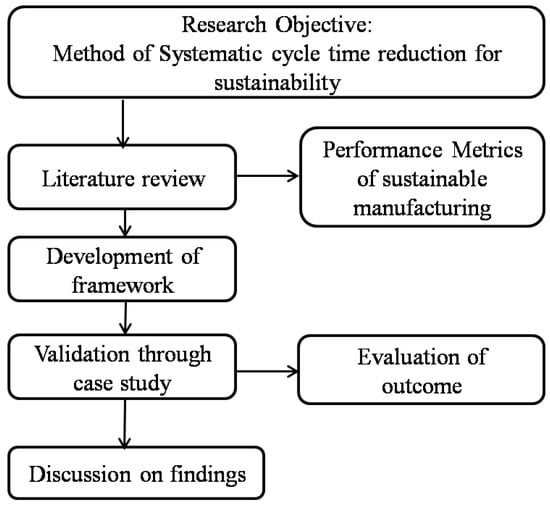
Figure 1.
Methodology.
The authors searched articles, reports, and research papers published during the years 2000 to 2022 with keywords: cycle time reduction, productivity, green manufacturing, sustainable manufacturing, sustainability, supply chain design, reverse logistics, etc. Reputed publishers such as Springer, MDPI, Emerald, Taylor & Francis, Elsevier, Wiley and Interscience were used for the literature search. However, the literature review was not limited to the above areas and was expanded. Through a reading of the research papers, we referred relevant citations irrespective of the publication year. A total of 153 papers were referred in the literature review. The filtering of articles is presented in Figure 2, and Figure 3 presents the year-wise literature review.
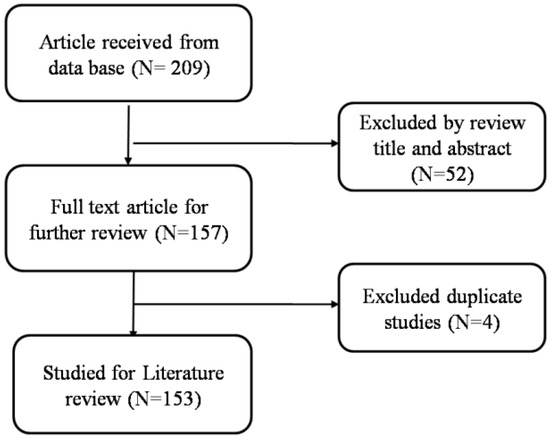
Figure 2.
Filtering of articles.
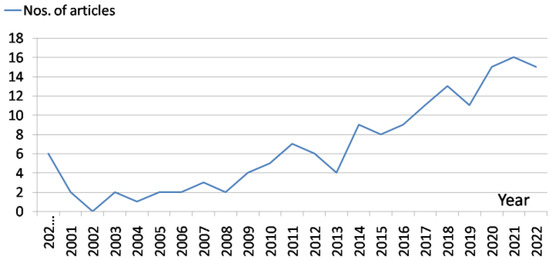
Figure 3.
Year-wise number of articles in the literature review.
Year-wise, the number of articles in the literature review is increasing; this is because of growing research for sustainability, as confirmed in recent research [21]. During this research work, we interacted with practitioners and owners of industries during industry visits and found that investment is a major barrier in adopting sustainable practices, while there is also a lack of case studies showing achievable sustainability through available resources at low investment.
With the findings from the literature and in line with insights from industry, the authors developed a theoretical systematic procedure of cycle time reduction for sustainable manufacturing. In this paper, case study methodology was also adopted. This is because theoretical knowledge is more valuable in the presence of evidence [22], and case studies can be used as evidence [23]. In support of the findings, the authors developed a case study in an Indian manufacturing company. Moreover, this case study demonstrates the potential of the most common activities performed across the industries, i.e., cycle time reduction and constraint improvement for enhancement of sustainability in manufacturing process. This enhances the manufacturing sustainability, even in the presence of major barriers: requirement of investment and other resources [17,24]. This particular company was established in the decade of the 1960s to accommodate the need of the power sector in India. With a 70% domestic market share, 17 manufacturing units across India, 5 research institutes, 14 centers of excellence, more than 30,000 employees, and with a state-of-the-art manufacturing process, this company is the pioneer company in the Indian manufacturing sector for implementing TPM, TQM, and quality circle. It has achieved the ranking of 5th among Indian applicants for patents. These achievements prove that numerous improvements and innovations have been achieved in existing manufacturing processes. Hence, improvement for environmental sustainability was not a low hanging fruit. In the presence of the above factors, a project was initiated to enhance the environmental sustainability in a manufacturing process of the manufacturing unit located in northern India.
3. Literature Review
The basic purpose of a literature review is to prevent repetition of existing research. Moreover, a literature review provides research gaps and provides direction for the development of theory [25]. In this research work, the literature review is arranged in the following sections:
3.1. Sustainable Manufacturing
Sustainable manufacturing practices are one of the momentous initiatives undertaken by manufacturing industries to reduce the environment impact and improve the socio-economic aspect of human life as well as businesses while performing manufacturing activities. Natural resources are under pressure due to acute consumption in the development process [26]. After the initial concept of sustainability given by the World Commission on Environment and Development [27], the meaning of sustainability was elaborated and presented in three dimensions, i.e., environmental, social, and economic responsibilities commonly known as the triple bottom line concept [28]. Ref. [29] provides the most-cited definition; “Sustainable manufacturing is the optimal use of natural resources which minimises negative environmental impact in manufacturing practices in order to achieve balance among economic, environment and social aspects”.
The early research on sustainability was aimed at economic sustainability, but in further research, researchers shifted their focus towards environmental sustainability [30]. Recent research on sustainable manufacturing is focused on all three pillars of sustainability, i.e., economic, environment, and social aspects [29]. The concept of sustainable manufacturing has gained momentum recently, owing to global climate issues, increased pressure on natural resources, and the increased consumerism. The intensive global competition, sophisticated customer requirements, rise in material cost, and rise in cost of energy have forced many companies to optimise their operations at the strategic and tactical levels [31]. Adoption of sustainable manufacturing improves operational efficiency and the long-term profitability of companies.
Sustainable manufacturing not only deals with products but also with the manufacturing process [6]. Since management remains focused on the economic aspect of sustainability—because of profit as the main objective of business—the environmental aspect needs focus in the context of barriers. With the focus on environmental sustainability, it is necessary to know the metrics of environmentally sustainable manufacturing because well-structured and focused measurement of performance of a process improves the performance of organizations [32]. The Global Reporting Initiative (GRI) guidelines suggest a set of 34 indicators for disclosure in annual sustainability reporting. Many researchers [33,34,35,36,37] proposed either new metrics or considered a set of environmental indicators in measuring sustainability of manufacturing companies. For the purpose of assessment of the outcome of the case study in the present work, the authors are using a comprehensive list of metrics proposed in the literature [38], as given in Table 1.

Table 1.
Metrics of environmentally sustainable manufacturing [38].
Conventional productivity and quality improvement methods, such as SMED, Kaizen, and quality circles are being used in the age of Industry 4.0 for improvement in production processes [19,39,40]. To contribute to solutions for climate change, productivity, cost reduction, and operational excellence are required [41]. Moreover, systematic elimination of waste in manufacturing processes is necessary to achieve sustainable manufacturing [42]. Whilst numerous studies have focused on several aspects of sustainable manufacturing practices, and researchers have begun to focus on extended use of proven productivity improvement techniques for enhancement of sustainability [43], this paper focuses on cycle time reduction to achieve the goals of sustainable manufacturing. Cycle time reduction has widespread recognition for efficient manufacturing operations [44].
3.2. Cycle Time Reduction for Sustainable Manufacturing
Cycle time in manufacturing is described as the time required to complete a specific task from start to finish on a machine. Cycle time is an important parameter in deciding productivity of a manufacturing process [45] and flexibility of production line [46]. In order to determine bottleneck on a production line, the study of cycle time provides important insights [47]. Longer cycle time has always been seen as a problem, even in the age of Industry 4.0 [48,49]. Cycle time reduction is also an integral part of the Toyota Production System [50], which has motivated the Lean Manufacturing literature [51]. In addition, cycle time reduction is considered as the indicator of lean processes [52]. Cycle time can be reduced using several techniques, which are well-adopted in industries and covered by numerous works in the literature through the past decades. One of the techniques is adding additional machines or tools in parallel with increasing manufacturing capacity and speed or adding any auxiliary equipment to reduce the process time. Some of the important efforts reflected in previous studies to reduce the cycle time are mentioned below (Table 2).
Table 2.
Previous studies outlining cycle time reduction in relation to sustainability.
The reduction in operating time minimises the ecological impact of production activities [12], as well as provides economic benefits [59] to manufacturing organisations. It is quite evident from various studies that cycle time reduction improves environmental and economic dimensions of sustainability. While some of the researchers [60,61] have argued about the negative impact of cycle time reduction on social sustainability, several other studies [62,63,64] did not find a strong relation between job stress and implementation of lean production system. The literature also suggests that process improvement for sustainability leads to cycle time reduction [65], whereas the authors did not find literature that suggests cycle time reduction for sustainability. In the absence of literature covering a method of cycle time reduction for sustainability, this study proposes a systematic method for cycle time reduction and sustainable manufacturing with following research question,
Research Question:
How sustainability can be enhanced through reduction in cycle time.
4. Findings
4.1. Systematic Cycle Time Reduction for Sustainability
As discussed earlier, this study proposes a novel method for increasing sustainability performance within the manufacturing process through a systematic reduction of cycle time using the theory of constraints (TOC). This paper considers the potential viability of TOC within the proposed method, owing to its complete methodological approach in operations [66]. According to TOC, the bottleneck is a critical resource which determines the throughput rate, thereby influencing an operation’s ability to earn profit. In order to maximise the throughput rate, the bottleneck should be scheduled at 100% utilisation [67]. The implementation of the concepts TOC consists of five steps: (1) identify the system’s constraint, (2) decide how to exploit the system’s constraint, (3) subordinate everything else to the above decision, (4) elevate the system’s constraint, and (5) if in any of the previous steps a constraint is broken, go back to Step 1.
Conventionally, TOC is used to enhance the throughput of the production line by identifying and breaking the constraints, which are in reference to the production capacity or throughput of the production line. If these references are shifted to environment sustainability, the least sustainable location would be the location of the constraint. If the consumption of critical resources remains almost independent of throughput, the increase in throughput would not require additional resources. This makes the application of TOC relevant to increasing the throughput with respect to the volume of throughput, while there is a reduction in the consumption of resources.
As emphasised by a researcher [68], the efficient use of waste generated in a process improves sustainability of the whole factory. This also characterises the systematic effect in which an action taken at one place may show an effect at another place. Some processes have a high impact on the environment and this impact remains fixed irrespective of their capacity utilisation. Considering the case as shown below in Figure 4, a process may consume a fixed amount of resources (energy or indirect material) irrespective of its capacity utilisation, resulting in high environmental impacts. In this paper, the authors have considered this stage in the complete process as location ‘X’. Some of the common examples of location ‘X’ can be cited as furnace in a heat treatment process, where the necessary heat losses remain the same irrespective of the load usage. Another example can be found in the amount of energy consumed in CNC machines irrespective of their productive usage [69].
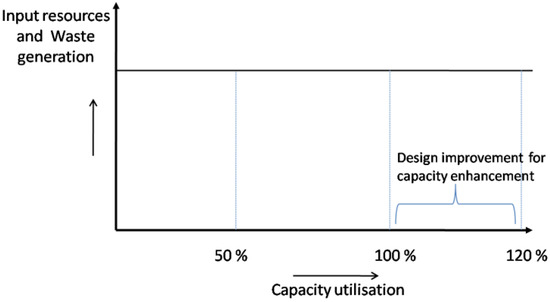
Figure 4.
Pattern of raw material utilisation and waste generation at location X.
In a balanced manufacturing line, the utilisation of capacity at different stages depends on the stage having the maximum capacity utilisation. This maximum capacity utilisation stage acts as a constraint to achieve sustainability if resources at other locations (location ‘X’) in the process are consumed, irrespective of capacity utilisation. All the resources need to be subordinated to the constraint to increase the resource utilisation at the location ‘X’. Interestingly, design improvements can help in increasing the manufacturing capacity of machines and process beyond 100%. For example, Unilever redesigned the bottle of a product and enhanced its capacity to fit 30% more product on a pallet, yielding reduction in GHG emission during transportation. The increase in output increases the speed of a process, leading to the reduction in cycle time of the process. Regarding a production line, to reduce the cycle time at one location for improving sustainability at another location, the authors of this paper propose that cycle time reduction should be achieved in a systematic manner as follows:
- Identify location ‘X’ (A process that consume a fixed amount of resources, i.e., energy or material, irrespective of its capacity utilisation, as shown in Figure 4).
- Identify and optimise constraints in the production line to utilise location X at a higher or full capacity.
- In case the location X reaches maximum utilisation in the entire manufacturing process, the location ‘X’ can become a new constraint itself.
- Subordinate all the resources of the manufacturing process to the location ‘X’ for further improving the overall sustainability of the manufacturing process.
This systematic method answers the research question. Figure 5 presents the novel conceptual method for increasing sustainability performance through cycle time reduction, which is achieved using TOC.
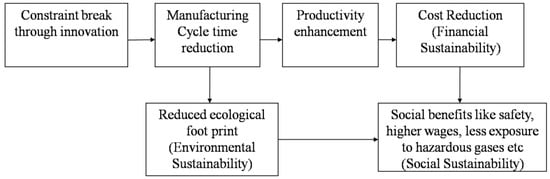
Figure 5.
Method of sustainable manufacturing through cycle time reduction.
Each manufacturing process differs from others in terms of capacity, type of product, and raw materials, to name a few. Moreover, there is no common method for breaking a constraint. The method of breaking or eliminating a constraint depends on various factors, such as nature of the process, investment capacity, technological capabilities, and location. Since the breaking of constraint aims at increasing sustainability performance while avoiding negative influence on other important metrics, process innovation is required to maximise the impact from initiatives undertaken.
4.2. Case Study for Step towards Validation of the New Method
A case study was undertaken to demonstrate the efforts put into reducing the cycle time for sustainable manufacturing. Protocol (Table 3) was ensured for reliability of study.
Table 3.
Contents of protocol for case study.
On a typical production line for a component, six units of a component in each cycle are produced and the bottleneck located at the curing stage of the process (Figure 6). The operation of impregnation plant (location X) leaves ecological footprints, which are almost fixed irrespective of capacity utilisation, as described in Table 4.
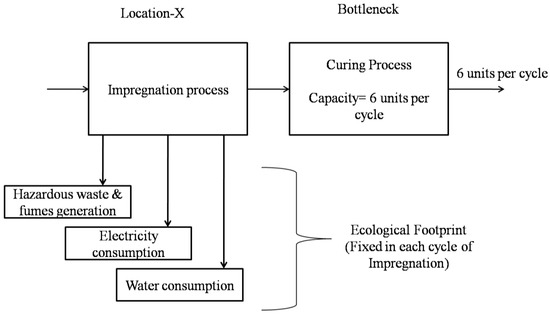
Figure 6.
Production line before cycle time reduction.
Table 4.
Environmental impact of each cycle of process.
The operation of the impregnation plant is taken as location ‘X’; Figure 7 shows that the required resources (energy, water, and pressurised nitrogen gas) and waste generation are equal for two different levels of output.
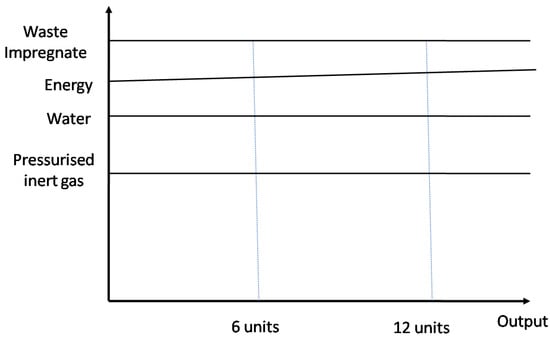
Figure 7.
Raw material utilisation and waste generation.
Applying proposed systematic cycle time reduction,
Step 1: Location ‘X’ is identified in the manufacturing process.
Step 2: This is the capacity of the curing process, which limits the throughput by 6 units. In order to reduce the ecological footprints at location ‘X’, a new curing system is added in parallel with the existing curing system (Figure 8). The case study proposed small changes that were carried out in the process to accommodate 12 units of component. Within the same amount of time, a total 12 units of component could be impregnated. This increased production output had the same ecological footprint from the impregnation process in the plant as it did when producing 6 units (as depicted in Figure 7).
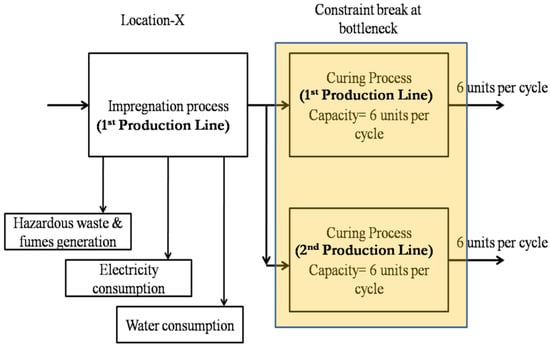
Figure 8.
Production line after cycle time reduction.
It can be observed here that the output is doubled, i.e., that cycle time is reduced by 50%, but with same amount of raw material consumption. It yields an ecological footprint for each unit reduced by 50%, compared with the amount ecological footprint left before achieving the reduction in cycle time. The outcome of this case study can be viewed in Table 5 with regard to the metrics of sustainable manufacturing (Table 1). Moreover, the specific outcomes of the case study are mentioned in Table 6.
Table 5.
Achieved outcome in case study.
Table 6.
Economic, environmental, and social benefits after cycle time reduction.
At every step of improvement activity, brainstorming was carried out, as suggested by [70], considering it to be most efficient and commonly used method to maintain the delivery speed, cost, and product quality. Integration of sustainability in manufacturing processes should not deteriorate quality of the product, delivery speed, or cost [71]. On the improvement aspect of the case study, this company filed a patent. This outcome is well supported by the existing literature which suggests that linking sustainability with well-established manufacturing systems yields innovation [72]. Adoption of innovative practices is one of the indicators of sustainability [73].
5. Discussion
Cycle time reduction is a widely used practice in industries but has not been seen as an enabler of sustainable manufacturing by practitioners and academicians. Sustainable manufacturing is an emerging area from the last two decades for researchers in the development of decision-making tools [74]. The practice of sustainable manufacturing has been elaborated in all three dimensions, i.e., economic, environmental, and social, by using cycle time reduction. The paper began with the question of cycle time reduction and sustainable manufacturing. With the help of a case study, it has been demonstrated that cycle time reduction has positively impacted all three dimensions of sustainability.
In reference to the reduction in cycle time, it is necessary to discuss the ergonomic issue because health and safety of operators cannot be compromised. There is deep discussion about ergonomics in the existing literature. A work by [60] reviewed the literature of a 20-year span (1990–2013) and found that increased stress may not necessarily have a negative effect on employees at work. Because of the multiple dimensions of lean production system, there is no strong relation between job stress and cycle time reduction type lean practices [62]. Moreover, it is found in a study of 21 sites [63] that lean production is not inherently stressful. Lean production aims at eliminating non-value-adding activities, and the higher practice of ergonomic provides better economic and social performance [64]. In the early stage of lean production initiatives, a negative impact of work stress may emerge. Organisations adopting sustainable practice have maturity in lean production practices and are well aware of the impact on health of workers.
This paper extends the lean practice of cycle time reduction for sustainability. Organisations practicing cycle time reduction for sustainability can achieve environmental sustainability without stressing the existing work force. The negative impact on health at work can be reduced by specific training, reinforcement of skills, planned job rotation, and maintaining buffer stocks [61]. Communication with employees, incentives, rewards, relevant training, and job design can manage human resources in the course of implementation of lean manufacturing. A study [63] suggested parallel work cells to reduce job stress in the case of cycle time reduction. Proposed systematic cycle time reduction aims to reduce cycle time at locations prone to sustainability by integrating the theory of constraints. Reduction in cycle time or increased speed at location X increases the speed of the whole production line through eliminating idle time. It is evident from the case study that reduced cycle time may not increase the stress on operators working on the production line. Furthermore, to reap the benefits of environmental sustainability, additional facility accommodation was developed in parallel with the existing structure, ensuring no additional stress on operators working in existing work centres. The work of cycle time reduction in the case study addresses all three dimensions of sustainability and fulfills the need of business objectives [75]. This is sustainable manufacturing because of enhancement of productivity, profitability, satisfaction, and competitiveness [29]. The existing literature regarding TOC suggests it is useful in the service sector (such as tourism [76]) and in cost effectiveness through integration with Six Sigma [77]. The authors of this paper, with the evidence through the case study, established the usefulness of ‘theory of constraints’ for sustainability and further provide a use to practitioners along with accumulation of theoretical knowledge [78,79]. In the manufacturing process, the constraint break should accommodate quality because the process improvement may result in unexpected outcome on quality [80] and have adverse impacts on competitiveness [81,82].
Organisations with sustainable manufacturing practices are very responsive so that these organizations are leaders in the adoption of emerging disruptive changes, such as Industry 4.0 [83]. Hence, this research is highly insightful to policy makers. In emerging economies, considering the constraints of technology and other resources, some of the drivers are gaining very high importance such as investment, economic benefits, management support, lack of resources, uncertain benefits, and training. It would be ideal for management to support sustainability efforts while incurring high investment despite uncertain benefits and without understanding its need. To ensure commitment from management, sustainability efforts should serve another driver ‘Investment’. Risk of uncertainty and over expectation is reduced with low investment, which makes sustainability efforts more adoptable in small- and medium-sized organizations. This successful case study is evidence that at low investment, sustainability can be enhanced along with financial gain.
The low investment and lucrative financial gain can attract management support as an essential driver in successful implementation of sustainable manufacturing [84]. Thus, this case study develops an insight that environmental sustainability is not an elusive state in emerging economies. Accordingly, economic and industrial policy can be formed.
6. Conclusions
Considering the importance of manufacturing in development of an economy, manufacturing activities are bound to increase. New manufacturing systems are more advanced and being supported by information technology, but at the same time, increased manufacturing activities put much stress on the natural resources and the surroundings. Therefore, sustainable manufacturing practices that can help in reducing the carbon footprint are highly desirable.
6.1. Implications for Theory
The theoretical method developed in this research enables management of energy and waste, a focused area for sustainability [85]. Further, this paper integrates TOC with sustainability. This integration activity is a new direction for sustainability [86].
6.2. Implications for Practice
This work is useful to practitioners because of its systematic manner which minimizes the importance of experience [87] and improves performance through just-in-time techniques [88,89,90]. This paper integrates sustainability in existing manufacturing processes through TOC at a very low investment. It supports the concept that sustainability can be infused in existing manufacturing processes [91]. The case study demonstrates an interesting aspect that sustainability can be integrated in an existing manufacturing process through very low investment. It further provides a competitive advantage. It is useful to the practitioners in the manufacturing sector of emerging economies where sustainability remains a secondary aspect over profitability.
6.3. Limitations and Direction for Future Research
The limitation of this study is that a simple production line was considered in developing and validating the new method, but it can be applicable in fixed-demand and continuous-process industries. While the proposed method is suitable for a machine operating in conventional manufacturing setting, it needs to be tested in more cases and other industries for further validation of our argument’s acceptance in other industry sectors. Since lean practices are also being widely used in the service sector [92], and the service sector has the problem of capacity expansion [93], future research can incorporate constraint improvement for service sectors such as hospitals.
Author Contributions
Conceptualization, A.G. and R.A.; Formal analysis, D.C.V.; Funding acquisition, D.C.V.; Investigation, A.G. and R.A.; Methodology, A.G., D.C.V. and R.A.; Resources, S.C. and R.N.; Writing—original draft, A.G. and R.N.; Writing—review & editing, D.C.V., R.A. and S.C. All authors have read and agreed to the published version of the manuscript.
Funding
This research received no external funding.
Conflicts of Interest
The authors declare no conflict of interest.
References
- Abdul-Rashid, S.H.; Sakundarini, N.; Raja Ghazilla, R.A.; Thurasamy, R. The Impact of Sustainable Manufacturing Practices on Sustainability Performance. Int. J. Oper. Prod. Manag. 2017, 37, 182–204. [Google Scholar] [CrossRef]
- Abdul Rashid, S.H.; Evans, S.; Longhurst, P. A Comparison of Four Sustainable Manufacturing Strategies. Int. J. Sustain. Eng. 2008, 1, 214–229. [Google Scholar] [CrossRef]
- Bui, T.-D.; Tseng, J.-W.; Tseng, M.-L.; Lim, M.K. Opportunities and Challenges for Solid Waste Reuse and Recycling in Emerging Economies: A Hybrid Analysis. Resour. Conserv. Recycl. 2022, 177, 105968. [Google Scholar] [CrossRef]
- Chen, C.; Habert, G.; Bouzidi, Y.; Jullien, A. Environmental Impact of Cement Production: Detail of the Different Processes and Cement Plant Variability Evaluation. J. Clean. Prod. 2010, 18, 478–485. [Google Scholar] [CrossRef]
- Jayal, A.D.; Badurdeen, F.; Dillon, O.W.; Jawahir, I.S. Sustainable Manufacturing: Modeling and Optimization Challenges at the Product, Process and System Levels. CIRP J. Manuf. Sci. Technol. 2010, 2, 144–152. [Google Scholar] [CrossRef]
- Pusavec, F.; Krajnik, P.; Kopac, J. Transitioning to Sustainable Production—Part I: Application on Machining Technologies. J. Clean. Prod. 2010, 18, 174–184. [Google Scholar] [CrossRef]
- Bag, S.; Yadav, G.; Wood, L.C.; Dhamija, P.; Joshi, S. Industry 4.0 and the Circular Economy: Resource Melioration in Logistics. Resour. Policy 2020, 68, 101776. [Google Scholar] [CrossRef]
- Johansson, G.; Sundin, E. Lean and Green Product Development: Two Sides of the Same Coin? J. Clean. Prod. 2014, 85, 104–121. [Google Scholar] [CrossRef]
- Despeisse, M. Sustainable Manufacturing Tactics and Improvement Methodology: A Structured and Systematic Approach to Identify Improvement Opportunities. Ph.D. Thesis, Cranfield University, Bedford, UK, 2013. [Google Scholar]
- Pampanelli, A.B.; Found, P.; Bernardes, A.M. A Lean & Green Model for a Production Cell. J. Clean. Prod. 2014, 85, 19–30. [Google Scholar] [CrossRef]
- Choudhary, S.; Nayak, R.; Dora, M.; Mishra, N.; Ghadge, A. An Integrated Lean and Green Approach for Improving Sustainability Performance: A Case Study of a Packaging Manufacturing SME in the U.K. Prod. Plan. Control 2019, 30, 353–368. [Google Scholar] [CrossRef]
- Chiarini, A. Sustainable Manufacturing-Greening Processes Using Specific Lean Production Tools: An Empirical Observation from European Motorcycle Component Manufacturers. J. Clean. Prod. 2014, 85, 226–233. [Google Scholar] [CrossRef]
- Piercy, N.; Rich, N. The Relationship between Lean Operations and Sustainable Operations. Int. J. Oper. Prod. Manag. 2015, 35, 282–315. [Google Scholar] [CrossRef]
- Garetti, M.; Taisch, M. Sustainable Manufacturing: Trends and Research Challenges. Prod. Plan. Control 2011, 23, 83–104. [Google Scholar] [CrossRef]
- Niñerola, A.; Ferrer-Rullan, R.; Vidal-Suñé, A. Climate Change Mitigation: Application of Management Production Philosophies for Energy Saving in Industrial Processes. Sustainability 2020, 12, 717. [Google Scholar] [CrossRef]
- Panda, B.; Paul, S.C.; Hui, L.J.; Tay, Y.W.D.; Tan, M.J. Additive Manufacturing of Geopolymer for Sustainable Built Environment. J. Clean. Prod. 2017, 167, 281–288. [Google Scholar] [CrossRef]
- Oliveira Neto, G.C.; Leite, R.R.; Shibao, F.Y.; Lucato, W.C. Framework to Overcome Barriers in the Implementation of Cleaner Production in Small and Medium-Sized Enterprises: Multiple Case Studies in Brazil. J. Clean. Prod. 2017, 142, 50–62. [Google Scholar] [CrossRef]
- Govindan, K.; Diabat, A.; Madan Shankar, K. Analyzing the Drivers of Green Manufacturing with Fuzzy Approach. J. Clean. Prod. 2015, 96, 182–193. [Google Scholar] [CrossRef]
- Goyal, A.; Agrawal, R.; Kumar Sharma, A. Green Quality Circle: Achieving Sustainable Manufacturing with Low Investment. Resour. Conserv. Recycl. Adv. 2022, 15, 200103. [Google Scholar] [CrossRef]
- Yadav, G.; Mangla, S.K.; Bhattacharya, A.; Luthra, S. Exploring Indicators of Circular Economy Adoption Framework through a Hybrid Decision Support Approach. J. Clean. Prod. 2020, 277, 124186. [Google Scholar] [CrossRef]
- Pansare, R.; Yadav, G.; Nagare, M.R. Reconfigurable Manufacturing System: A Systematic Bibliometric Analysis and Future Research Agenda. J. Manuf. Technol. Manag. 2021, 33, 543–574. [Google Scholar] [CrossRef]
- Rousseau, D.M. Is There Such a Thing as “Evidence-Based Management”? Acad. Manag. Rev. 2006, 31, 256–269. [Google Scholar] [CrossRef]
- Yin, R.K. Case Study Research: Design and Methods, 3rd ed.; Sage: Thousand Oaks, CA, USA, 2003. [Google Scholar]
- Mathiyazhagan, K.; Govindan, K.; NoorulHaq, A.; Geng, Y. An ISM Approach for the Barrier Analysis in Implementing Green Supply Chain Management. J. Clean. Prod. 2013, 47, 283–297. [Google Scholar] [CrossRef]
- Seuring, S.; Müller, M. From a Literature Review to a Conceptual Framework for Sustainable Supply Chain Management. J. Clean. Prod. 2008, 16, 1699–1710. [Google Scholar] [CrossRef]
- Gunasekaran, A.; Dubey, R.; Singh, S.P. Flexible Sustainable Supply Chain Network Design: Current Trends, Opportunities and Future. Glob. J. Flex. Syst. Manag. 2016, 17, 109–112. [Google Scholar] [CrossRef]
- World Commission on Environment and Development. Our Common Future; Oxford University Press: New York, NY, USA, 1987. [Google Scholar]
- Elkington, J. Cannibals with Forks: The Triple Bottom Line of the 21st Century; New Society Publishers: Stoney Creek, ON, Canada, 1998. [Google Scholar]
- Moldavska, A.; Welo, T. The Concept of Sustainable Manufacturing and Its Definitions: A Content-Analysis Based Literature Review. J. Clean. Prod. 2017, 166, 744–755. [Google Scholar] [CrossRef]
- Rajeev, A.; Pati, R.K.; Padhi, S.S.; Govindan, K. Evolution of Sustainability in Supply Chain Management: A Literature Review. J. Clean. Prod. 2017, 162, 299–314. [Google Scholar] [CrossRef]
- Zhou, B. Lean Principles, Practices, and Impacts: A Study on Small and Medium-Sized Enterprises (SMEs). Ann. Oper. Res. 2012, 241, 457–474. [Google Scholar] [CrossRef]
- Turner, T.J.; Bititci, U.S.; Nudurupati, S.S. Implementation and Impact of Performance Measures in Two SMEs in Central Scotland. Prod. Plan. Control 2005, 16, 135–151. [Google Scholar] [CrossRef]
- Harik, R.; EL Hachem, W.; Medini, K.; Bernard, A. Towards a Holistic Sustainability Index for Measuring Sustainability of Manufacturing Companies. Int. J. Prod. Res. 2015, 53, 4117–4139. [Google Scholar] [CrossRef]
- Amrina, E.; Vilsi, A.L. Key Performance Indicators for Sustainable Manufacturing Evaluation in Cement Industry. Procedia CIRP 2015, 26, 19–23. [Google Scholar] [CrossRef]
- Joung, C.B.; Carrell, J.; Sarkar, P.; Feng, S.C. Categorization of Indicators for Sustainable Manufacturing. Ecol. Indic. 2013, 24, 148–157. [Google Scholar] [CrossRef]
- Trumpp, C.; Endrikat, J.; Zopf, C.; Guenther, E. Definition, Conceptualization, and Measurement of Corporate Environmental Performance: A Critical Examination of a Multidimensional Construct. J. Bus. Ethics 2013, 126, 185–204. [Google Scholar] [CrossRef]
- Wu, H.; Lv, K.; Liang, L.; Hu, H. Measuring Performance of Sustainable Manufacturing with Recyclable Wastes: A Case from China’s Iron and Steel Industry. Omega 2017, 66, 38–47. [Google Scholar] [CrossRef]
- Goyal, A.; Agrawal, R. Advanced Manufacturing Management System for Environmental Sustainability: A Review of Select Literature. Int. J. Glob. Bus. Compet. 2017, 12, 1–11. [Google Scholar] [CrossRef]
- Fonda, E.; Meneghetti, A. The Human-Centric SMED. Sustainability 2022, 14, 514. [Google Scholar] [CrossRef]
- Kaswan, M.S.; Rathi, R.; Garza-Reyes, J.A.; Antony, J. Green Lean Six Sigma Sustainability—Oriented Project Selection and Implementation Framework for Manufacturing Industry. Int. J. Lean Six Sigma, 2022; in press. [Google Scholar] [CrossRef]
- Momaya, K.S. Towards cooperation-based approaches to competitiveness: Exploring the role of EMNEs for sustainability. Int. J. Glob. Bus. Compet. 2015, 10, 3–8. [Google Scholar]
- Garza-Reyes, J.A. Lean and Green—A Systematic Review of the State of the Art Literature. J. Clean. Prod. 2015, 102, 18–29. [Google Scholar] [CrossRef]
- Rodriguez Delgadillo, R.; Medini, K.; Wuest, T. A DMAIC Framework to Improve Quality and Sustainability in Additive Manufacturing—A Case Study. Sustainability 2022, 14, 581. [Google Scholar] [CrossRef]
- Filho, M.G.; Uzsoy, R. The Impact of Simultaneous Continuous Improvement in Setup Time and Repair Time on Manufacturing Cycle Times under Uncertain Conditions. Int. J. Prod. Res. 2013, 51, 447–464. [Google Scholar] [CrossRef]
- Cigolini, R.; Grando, A. Modelling Capacity and Productivity of Multi-Machine Systems. Prod. Plan. Control 2009, 20, 30–39. [Google Scholar] [CrossRef]
- Asadi, N.; Jackson, M.; Fundin, A. Implications of Realizing Mix Flexibility in Assembly Systems for Product Modularity—A Case Study. J. Manuf. Syst. 2019, 52, 13–22. [Google Scholar] [CrossRef]
- Li, L. A Systematic-Theoretic Analysis of Data-Driven Throughput Bottleneck Detection of Production Systems. J. Manuf. Syst. 2018, 47, 43–52. [Google Scholar] [CrossRef]
- Babu, M.; Franciosa, P.; Ceglarek, D. Spatio-Temporal Adaptive Sampling for Effective Coverage Measurement Planning during Quality Inspection of Free Form Surfaces Using Robotic 3D Optical Scanner. J. Manuf. Syst. 2019, 53, 93–108. [Google Scholar] [CrossRef]
- Huang, Z.; Kim, J.; Sadri, A.; Dowey, S.; Dargusch, M.S. Industry 4.0: Development of a Multi-Agent System for Dynamic Value Stream Mapping in SMEs. J. Manuf. Syst. 2019, 52, 1–12. [Google Scholar] [CrossRef]
- Liker, J. The Toyota Way: 14 Management Principles from the World’s Greatest Manufacturer; McGraw-Hill: New York, NY, USA, 2004. [Google Scholar]
- Womack, J.; Jones, D.; Roos, D. The Machine that Changed the World; Rawson Associates: New York, NY, USA, 1990. [Google Scholar]
- Bellisario, A.; Pavlov, A. Performance Management Practices in Lean Manufacturing Organizations: A Systematic Review of Research Evidence. Prod. Plan. Control 2018, 29, 367–385. [Google Scholar] [CrossRef]
- Johnson, M.S. The Application of Microwave Preheating in Resin Transfer Moulding. Ph.D. Thesis, University of Nottingham, Nottingham, UK, 1995. [Google Scholar]
- Rother, M.; Shook, J. Learning to See: Value Steam Mapping to add and Eliminate Muda; The Lean Enterprise Institute: Boston, MA, USA, 1999. [Google Scholar]
- Yildirim, M.B.; Mouzon, G. Single-Machine Sustainable Production Planning to Minimize Total Energy Consumption and Total Completion Time Using a Multiple Objective Genetic Algorithm. IEEE Trans. Eng. Manag. 2012, 59, 585–597. [Google Scholar] [CrossRef]
- Yuan, C.; Zhai, Q.; Dornfeld, D. A Three Dimensional System Approach for Environmentally Sustainable Manufacturing. CIRP Ann. 2012, 61, 39–42. [Google Scholar] [CrossRef]
- Li, K.; Zhang, X.; Leung, J.Y.-T.; Yang, S.-L. Parallel Machine Scheduling Problems in Green Manufacturing Industry. J. Manuf. Syst. 2016, 38, 98–106. [Google Scholar] [CrossRef]
- Allwood, J.M.; Childs, T.H.C.; Clare, A.T.; De Silva, A.K.M.; Dhokia, V.; Hutchings, I.M.; Leach, R.K.; Leal-Ayala, D.R.; Lowth, S.; Majewski, C.E.; et al. Manufacturing at Double the Speed. J. Mater. Processing Technol. 2016, 229, 729–757. [Google Scholar] [CrossRef]
- Deif, A.M. A System Model for Green Manufacturing. J. Clean. Prod. 2011, 19, 1553–1559. [Google Scholar] [CrossRef]
- Koukoulaki, T. The Impact of Lean Production on Musculoskeletal and Psychosocial Risks: An Examination of Sociotechnical Trends over 20 Years. Appl. Ergon. 2014, 45, 198–212. [Google Scholar] [CrossRef] [PubMed]
- Bouville, G.; Alis, D. The Effects of Lean Organizational Practices on Employees’ Attitudes and Workers’ Health: Evidence from France. Int. J. Hum. Resour. Manag. 2014, 25, 3016–3037. [Google Scholar] [CrossRef]
- Parker, S.K. Longitudinal Effects of Lean Production on Employee Outcomes and the Mediating Role of Work Characteristics. J. Appl. Psychol. 2003, 88, 620–634. [Google Scholar] [CrossRef] [PubMed]
- Conti, R.; Angelis, J.; Cooper, C.; Faragher, B.; Gill, C. The Effects of Lean Production on Worker Job Stress. Int. J. Oper. Prod. Manag. 2006, 26, 1013–1038. [Google Scholar] [CrossRef]
- Thun, J.-H.; Lehr, C.B.; Bierwirth, M. Feel Free to Feel Comfortable—an Empirical Analysis of Ergonomics in the German Automotive Industry. Int. J. Prod. Econ. 2011, 133, 551–561. [Google Scholar] [CrossRef]
- Rathi, R.; Kaswan, M.S.; Garza-Reyes, J.A.; Antony, J.; Cross, J. Green Lean Six Sigma for Improving Manufacturing Sustainability: Framework Development and Validation. J. Clean. Prod. 2022, 345, 131130. [Google Scholar] [CrossRef]
- Davies, J.; Mabin, V.J.; Balderstone, S.J. The Theory of Constraints: A Methodology Apart?—A Comparison with Selected OR/MS Methodologies. Omega 2005, 33, 506–524. [Google Scholar] [CrossRef]
- Goldratt, E.M. Theory of Constraints; North River Press Inc.: Croton-on-Hudson, NY, USA, 1990. [Google Scholar]
- Despeisse, M.; Ball, P.D.; Evans, S.; Levers, A. Industrial Ecology at Factory Level—A Conceptual Model. J. Clean. Prod. 2012, 31, 30–39. [Google Scholar] [CrossRef]
- ElMaraghy, H.A.; Youssef, A.M.A.; Marzouk, A.M.; ElMaraghy, W.H. Energy Use Analysis and Local Benchmarking of Manufacturing Lines. J. Clean. Prod. 2017, 163, 36–48. [Google Scholar] [CrossRef]
- Rybski, C.; Jochem, R.; Homma, L. Empirical Study on Status of Preparation for ISO 9001:2015. Total Qual. Manag. Bus. Excell. 2017, 28, 1076–1089. [Google Scholar] [CrossRef]
- Goyal, A.; Agrawal, R.; Chokhani, R.K.; Saha, C. Waste Reduction through Kaizen Approach: A Case Study of a Company in India. Waste Manag. Res. 2018, 37, 102–107. [Google Scholar] [CrossRef] [PubMed]
- Hamdoun, M.; Chiappetta Jabbour, C.J.; Ben Othman, H. Knowledge Transfer and Organizational Innovation: Impacts of Quality and Environmental Management. J. Clean. Prod. 2018, 193, 759–770. [Google Scholar] [CrossRef]
- Yadav, G.; Kumar, A.; Luthra, S.; Garza-Reyes, J.A.; Kumar, V.; Batista, L. A Framework to Achieve Sustainability in Manufacturing Organisations of Developing Economies Using Industry 4.0 Technologies’ Enablers. Comput. Ind. 2020, 122, 103280. [Google Scholar] [CrossRef]
- Esmaeilian, B.; Behdad, S.; Wang, B. The Evolution and Future of Manufacturing: A Review. J. Manuf. Syst. 2016, 39, 79–100. [Google Scholar] [CrossRef]
- Madan Shankar, K.; Kannan, D.; Udhaya Kumar, P. Analyzing Sustainable Manufacturing Practices—A Case Study in Indian Context. J. Clean. Prod. 2017, 164, 1332–1343. [Google Scholar] [CrossRef]
- Zhao, X.; Hou, J. Applying the Theory of Constraints Principles to Tourism Supply Chain Management. J. Hosp. Tour. Res. 2021, 46, 400–411. [Google Scholar] [CrossRef]
- Ekleş, E.; Ay Türkmen, M. Integrating the Theory of Constraints and Six Sigma: Process Improvement Implementation. Istanb. Bus. Res. 2022, 51, 123–147. [Google Scholar] [CrossRef]
- Suddaby, R. Editor’s Comments: Why Theory? Acad. Manag. Rev. 2014, 39, 407–411. [Google Scholar] [CrossRef]
- Rynes, S.L.; Bartunek, J.M.; Daft, R.L. Across the Great Divide: Knowledge Creation and Transfer between Practitioners and Academics. Acad. Manag. J. 2001, 44, 340–355. [Google Scholar] [CrossRef]
- Mackelprang, A.W.; Habermann, M.; Swink, M. How Firm Innovativeness and Unexpected Product Reliability Failures Affect Profitability. J. Oper. Manag. 2015, 38, 71–86. [Google Scholar] [CrossRef]
- Goyal, A.; Agrawal, R.; Saha, C.R. Quality Management for Sustainable Manufacturing: Moving from Number to Impact of Defects. J. Clean. Prod. 2019, 241, 118348. [Google Scholar] [CrossRef]
- Su, H.-C.; Linderman, K.; Schroeder, R.G.; Van de Ven, A.H. A Comparative Case Study of Sustaining Quality as a Competitive Advantage. J. Oper. Manag. 2014, 32, 429–445. [Google Scholar] [CrossRef]
- Bag, S.; Yadav, G.; Dhamija, P.; Kataria, K.K. Key Resources for Industry 4.0 Adoption and Its Effect on Sustainable Production and Circular Economy: An Empirical Study. J. Clean. Prod. 2021, 281, 125233. [Google Scholar] [CrossRef]
- Kaswan, M.S.; Rathi, R.; Reyes, J.A.G.; Antony, J. Exploration and Investigation of Green Lean Six Sigma Adoption Barriers for Manufacturing Sustainability. IEEE Trans. Eng. Manag. 2021, 1–15. [Google Scholar] [CrossRef]
- Alayón, C.; Säfsten, K.; Johansson, G. Conceptual Sustainable Production Principles in Practice: Do They Reflect What Companies Do? J. Clean. Prod. 2017, 141, 693–701. [Google Scholar] [CrossRef]
- Walmsley, T.G.; Ong, B.H.Y.; Klemeš, J.J.; Tan, R.R.; Varbanov, P.S. Circular Integration of Processes, Industries, and Economies. Renew. Sustain. Energy Rev. 2019, 107, 507–515. [Google Scholar] [CrossRef]
- Easton, G.S.; Rosenzweig, E.D. The Role of Experience in Six Sigma Project Success: An Empirical Analysis of Improvement Projects. J. Oper. Manag. 2012, 30, 481–493. [Google Scholar] [CrossRef]
- Mackelprang, A.W.; Nair, A. Relationship between Just-In-Time Manufacturing Practices and Performance: A Meta-Analytic Investigation. J. Oper. Manag. 2009, 28, 283–302. [Google Scholar] [CrossRef]
- Fullerton, R.R.; Kennedy, F.A.; Widener, S.K. Lean Manufacturing and Firm Performance: The Incremental Contribution of Lean Management Accounting Practices. J. Oper. Manag. 2014, 32, 414–428. [Google Scholar] [CrossRef]
- Fullerton, R.R.; McWatters, C.S. The Production Performance Benefits from JIT Implementation. J. Oper. Manag. 2000, 19, 81–96. [Google Scholar] [CrossRef]
- Alemam, A.; Li, S. Eco-Design Improvement for the Diaphragm Forming Process. Int. J. Sustain. Eng. 2016, 9, 401–410. [Google Scholar] [CrossRef]
- Dobrzykowski, D.D.; McFadden, K.L.; Vonderembse, M.A. Examining Pathways to Safety and Financial Performance in Hospitals: A Study of Lean in Professional Service Operations. J. Oper. Manag. 2016, 42–43, 39–51. [Google Scholar] [CrossRef]
- LaGanga, L.R. Lean Service Operations: Reflections and New Directions for Capacity Expansion in Outpatient Clinics. J. Oper. Manag. 2010, 29, 422–433. [Google Scholar] [CrossRef]
Publisher’s Note: MDPI stays neutral with regard to jurisdictional claims in published maps and institutional affiliations. |
© 2022 by the authors. Licensee MDPI, Basel, Switzerland. This article is an open access article distributed under the terms and conditions of the Creative Commons Attribution (CC BY) license (https://creativecommons.org/licenses/by/4.0/).