


Abstract
To gain an in-depth understanding of the resource status of terrestrial wild vertebrates in the Qinghai Area of Qilian Mountain National Park, a total of 10 field surveys were conducted in the reserve from May 2019 to May 2022, and the diversity and geographical fauna of terrestrial wild vertebrates in the study area were studied combined with literature. The results show that in the Qinghai Area of the Qilian Mountain National Park, there are 265 species of terrestrial vertebrates in 4 classes, 30 orders, 71 families and 167 genera. Among them, Amphibia has 1 order, 2 families, 2 genera and 3 species; Reptilia has 2 orders, 4 families, 5 genera and 5 species; Aves has 21 orders, 51 families, 131 genera and 214 species; Mammalia has 6 orders, 15 families, 29 genera and 43 species. The composition of terrestrial wild vertebrate species in the study area shows that Aves account for 80.75%, Mammalia account for 16.23%; Reptilia account for 1.89% and Amphibia account for only 1.13%. The geographical fauna is dominated by Cosmopolitan species (218), followed by Palaearctic species (48) and a few Oriental species (3). Data from the G-F analysis shows that birds are more diverse at both family and genus levels, followed by mammals, with amphibians lower and reptiles lowest.
1. Introduction
Biodiversity is inseparable from human life and is one of the conditions for the sustainable development of human society. Biodiversity is the material basis for human survival and plays a vital role in maintaining the stability and functionality of ecosystems. The terrestrial vertebrates are an important component of biodiversity.
China is one of the richest countries in the world in terms of biodiversity, with 3232 species of terrestrial vertebrates, including 687 species of mammals, 1445 species of birds, 548 species of amphibians and 552 species of reptiles [1,2]. In recent years, vertebrates are under great threat of extinction around the world, due mainly to exotic species, conversion, degradation and fragmentation of habitats, climate change, over-exploitation and pollution caused by anthropogenic activities [3,4,5,6,7]. Studies on “terrestrial vertebrate diversity” have focused on the biodiversity and geographical fauna of terrestrial wild vertebrates in different areas [8,9,10,11,12,13,14,15,16,17,18,19,20,21,22,23,24,25,26,27,28,29,30,31,32,33,34,35] (see Appendix A Table A1) and the impact of human activities on terrestrial wild vertebrates [36,37]. In addition, based on the research on terrestrial wild vertebrate biodiversity and fauna, scholars have also studied the conservation measures, conservation policies to terrestrial wild vertebrates and utilization of wildlife-related resources [38,39,40], and constructed an index system for evaluating the effectiveness of conservation in national nature reserves [41]. Therefore, it is an important task for China’s wildlife diversity conservation research to identify the number, distribution, population dynamics, habitat and its conservation and utilization status of each species, and to recognize the objective factors that affect and endanger the survival and development of wildlife.
Qilian Mountain National Park is located at the southeast edge of the Qinghai–Tibet Plateau, known as the “Third Pole”. As one of the first ten national parks in China, Qilian Mountain National Park aims to protect the integrity and authenticity of regional biodiversity and natural ecosystems and is China’s major ecological function area, as well as an important ecological security barrier and a water-conserving area in western China. The Park is rich in animal resources and unique in species, where the unique geographical location and the complex and diverse ecosystem environment have nurtured relatively rich biological resources. At present, the only related studies on terrestrial wild vertebrates in Qilian Mountain National Park are those on terrestrial wild vertebrate diversity and geographical fauna in Tianzhu County, the Gansu Area of this Park. As an important part of Qilian Mountains National Park, The Qinghai Area accounts for 31.5% of the total area of the Park. Studying the terrestrial wild vertebrate diversity and geographical fauna in this area will not only acquire the basic data of wildlife resources in the Park and improve the animal data of the reserve, but also provide some reference point for biodiversity conservation in the area.
2. Materials and Methods
2.1. The Study Area
Qilian Mountain National Park is located on the northeastern edge of the Qinghai-Tibet Plateau (see Figure 1), it is located in the northern foot of the Qilian Mountain, which is the intersection of the three major plateaus of Qinghai-Tibet, Mengxin and Loess. It is situated in an alpine zone with a continental plateau climate, strong solar radiation, large temperature differences between day and night, and significant vertical changes in temperature and precipitation. The Park covers a total area of 50,200 square kilometers and is divided into 2 areas, Gansu and Qinghai, of which the Qinghai Area has a total area of 15,800 square kilometers, accounting for 31.5% of the total area, including Menyuan County and Qilian County in Haibei Tibetan Autonomous Prefecture, Qinghai Province, and Tianjun County and Delingha City in Haixi Prefecture. Qilian Mountain National Park Qinghai Area has a unique ecosystem and diverse natural landscape, with an average altitude of 4000~5000 m, extensive glacial cover, making it an important “solid reservoir” in the northeastern part of the Qinghai-Tibet Plateau [42], and is the Source of Heihe River, Shule River, Shiyang River and Datong River.
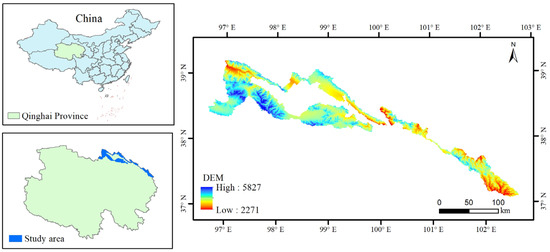
Figure 1.
Location of the Qinghai Area of Qilian Mountain National Park.
2.2. Data Sources and Processing
Field survey was used as well as a combination of long-term monitoring data from the study area and historical documentation such as scientific expedition collections. Field surveys of the species and numbers of inland wild vertebrates in the reserve were conducted based on vegetation types, topography and landform and distribution of each animal taxon, and geographical information such as topography, landform, elevation and habitat of the survey area were recorded.
Ten surveys were conducted in May, July and October each year from 2019 to 2021 and in May 2022 in the Qinghai Area of Qilian Mountain National Park. The sample line method and infrared camera monitoring method were mainly used to survey the terrestrial wild vertebrates distributed in the area. Due to the influence of climate and topography, the sample line method was mainly used to survey the eastern part of the park, while the infrared camera monitoring method was mainly used in the western part of the park. In addition to field surveys, visits to farmers, foresters and herders to understand the changes in local animal resources and their current status were conducted as a supplement.
2.2.1. Sample Line Method
In the sample line survey, the sample line length was set at least 3 km, the survey time was 8:00–20:00 every day, and the walking speed of the investigators was 1–1.5 km/h. 40 sample lines were laid out, taking into account these issues of functional area, vegetation type, elevation gradient, and frequency of animal occurrence. (see Figure 2).

Figure 2.
Location of Sample Lines and Infrared camera points in the Qinghai Area of Qilian Mountain National Park.
2.2.2. Infrared Camera Monitoring Method
A total of 70 infrared cameras (LTL-6210 PLUS) were deployed in the park (see Figure 2). In order to improve the efficiency of the infrared cameras, three principles were followed in the selection and deployment of the sites: (1) As far as possible, the sites with more animal tracks, scat, food traces, markers and other activity traces were selected or the animal trails with abundant food and close to water sources. (2) Infrared camera fixed at 50–100 cm from the ground on the trunk of the camera lens to maintain a horizontal or slightly downward, as far as possible to avoid direct sunlight. (3) The distance between adjacent sites should be greater than 500 m. At the same time, the number, date of placement, latitude, longitude, elevation and vegetation type of each camera should be recorded. Infrared cameras are replaced with batteries and memory cards every 2–3 months, and lost cameras are maintained and replenished in a timely manner. The working time of the infrared camera is set to 24 h, and each time the trigger takes three consecutive photos with 1 video of 10–15 s to form 1 group of photos, and the trigger interval is 30 s.
2.3. Species Identification Methods
Species were identified and systematically classified according to the Vertebrate Species and Distribution in Qinghai [43], Qinghai Economic Zoology [44], A Guide to the Mammals of China [45], Catalogue of mammals in China (2021) [46], The Updated Checklists of Amphibians and Reptiles of China [47], A Field Guide to the Birds of China [48], A Checklist on the Classification and Distribution of Birds in China (Third Edition) [49]. Rare species were identified with reference to the List of National Key Protected Wildlife [50] and the Red List of Chinese Vertebrates [51], and species were classified by geographical fauna and distribution type according to the Zoogeography of China [52].
2.4. Research Methods
The G-F index formula [53] was used to calculate the diversity of terrestrial wild vertebrates in the reserve for the aggregated terrestrial wild vertebrate list.
- (1)
- F-index (diversity of families).
is the species diversity in family k, calculated as
In the formula, is the ratio of the number of species in genus i of family k to the total number of species in family k in mammals, n is the number of genera in family k, and m is the number of families in mammals.
- (2)
- G index (diversity of genera):
is the ratio of the number of species in genus j to the total number of species in an order, and p is the number of genera in an order.
- (3)
- G-F index:
3. Results
3.1. Species Composition
The survey results showed that there were 265 species of terrestrial wild vertebrates in 4 classes, 30 orders, 71 families and 167 genera in the study area, accounting for 64.4% of the number of terrestrial wild vertebrate species (418 species) in Qinghai Province (see Appendix A Table A2).
There were 214 species of birds in 21 orders, 51 families and 131 genera in the study area, accounting for 80.75% of the total number of species. The birds of the order Passeriformes (95 species) were absolutely dominant with 44.39% of the total species number. This was followed by Charadriiformes (23 species), with the proportion of 10.75%, Falconiformes (20 species) and Anseriformes (20 species), each accounting for 9.35%.
There were 43 species of mammals in 6 orders, 15 families and 29 genera in the study area, accounting for 16.23% of the total number of species. The largest number of species of carnivores (16 species) accounted for 37.21% of the total number of species, followed by Artiodactyla (9 species) at 20.93%, Lagomorpha (8 species) at 18.6%, and Rodentia (7 species) at 16.28%. The least common species was Perissodactyla, only the Equus kiang.
There were 5 species of Reptilia in 2 orders, 4 families, 5 genera in the study area, accounting for 1.89% of the total number of species. They were Eremias multiocellata, Phrynocephalus vlangalii, Rhabdophis tigrinus, Elaphe dione, Gloydius cognatus, etc.
There were 3 species of Amphibia in only 1 order, 2 families, 2 genera in the study area, accounting for 1.13% of the total number of species, and all of them were Anura, namely, Rana kukunoris, Bufo gargarizans minshanicus and Bufo gargarizans.
There were 98 species of terrestrial vertebrates found by the sample line method, including four species of mammals, three species of reptiles, and 91 species of birds. 35 species of terrestrial vertebrates were found by the infrared camera monitoring method, including 20 species of mammals and 15 species of birds. 132 species of terrestrial vertebrates were found by searching published books [43,44] and press reports. (see Table A2)
Figure 3 records the distribution of species found by the sample line method and the infrared camera monitoring method within the park. The amphibians were discovered by reviewing the literature and we presume that they are mainly distributed near rivers and lakes, so we provide maps of the distribution of rivers and lakes in the Park (see Figure 3).

Figure 3.
Distribution of Mammalia, Aves, Reptilia, River and Lake in the Qinghai Area of Qilian Mountain National Park.
3.2. Rare and Endangered Species Composition of the Reserve
According to the newly released National List of Key Protection Wildlife, there are 77 species of national key protection wildlife in the reserve, accounting for 29% of the number of wildlife species in the reserve. Among them, there are 20 species of China‘s national first-class key protected wild animals, with 13 species of birds and 7 species of mammals; 57 species of China‘s national second-class key protected wild animals, with 43 species of birds and 14 species of mammals (see Table A2); China‘s national first-class and second-class protected animals account for 7.6% and 16% of the vertebrate species in the reserve.
In addition, there are 55 threatened species listed in the Red List of Chinese Vertebrates, accounting for 20.75% of the number of wildlife species in the reserve. One species, Felis bieti, is classified as Critically Endangered (CR). Ten species are classified as Endangered (EN), including 4 species of birds and 6 species of mammals, including Falco cherrug, Haliaeetus leucoryphus, Aquila heliaca, Pelecanus onocrotalus, Cervus elaphus, Cervus albirostris, Lynx lynx, Felis manul, Panthera uncia and Martes foina. Thirteen species are classified as Vulnerable (VU), including 9 species of birds and 4 species of mammals. Meanwhile, there are also 16 species of wildlife listed as Near Threatened (LC), including 15 species of birds and 1 species of mammals (see Table A2).
3.3. Geographical Fauna Features
The number of Cosmopolitan species (214 species) was absolutely dominant, accounting for 80.75% of the total number of species, followed by the Palaearctic (48 species), accounting for 18.11%, and the Oriental species (3 species), accounting for 1.13% of the least number of species. Among them, the number of species in Cosmopolitan species: Aves > Mammalia > Amphibian = Reptilia; the number of species in Palaearctic species: Aves > Mammalia > Reptilia > Amphibian; the number of species in Oriental species: Aves > Mammalia, with no distribution in Amphibian and Reptilia (see Table 1).

Table 1.
Fauna composition of terrestrial wild vertebrates.
3.4. Distribution Type
In terms of species distribution type, Palaearctic type (U) accounted for 22.64%, followed by Highland type (P) accounting for 20%, Palaearctic & Nearctic type (C) and south China type (O) accounting for 15.09% and 14.34%, Central Asian type (D), Himalayan-Transverse mountain type (H) and Oriental type (W) accounting for 8.68%, 7.17% and 5.28%, and the remaining Northeastern type (M), Monsoon type (E), North China type (B), Northeast-North China type (X), Not-easily-categorized type (S) and Local type (L) all accounted for less than 5%. Mammalia occupied 11 distribution types, among which Palaearctic and Highland types were dominant, with no Northeast type; Aves occupied 11 distribution types, among which Palaearctic and Himalayan-Transverse type were dominant, with no North China type; Reptilia had Palaearctic & Nearctic type (1 species), Monsoon type (1 species) and Himalayan-Transverse type (1 species); Amphibia occupied 4 distribution types and were more evenly distributed (see Table 2).
Table 2.
Fauna composition of terrestrial wild vertebrates.
3.5. G-F Index Features
The data show that in terms of the number of orders, families, genera, species, G-index and F-index: Aves > Mammalia > Reptilia > Amphibian, which shows that birds in the reserve have the highest species diversity and are richer in both families and genera; in terms of G-F index: Aves >Mammalia >Amphibian > Reptilia, which shows that birds and mammals have higher species diversity than the other two groups, while reptiles have the lowest species diversity level with negative values (see Table 3).
Table 3.
Analysis of G-F indexes of terrestrial wild vertebrates.
4. Discussion
In this study, a total of 265 species of terrestrial wild vertebrates in Qinghai Area of Qilian Mountain National Park were recorded and collated, including 4 classes, 30 orders, 71 families, 167 genera. Among them, there are 21 orders, 51 families, 131 genera, 214 species of birds, 6 orders, 15 families, 29 genera, 43 species of mammals, 2 orders, 4 families, 5 genera, 5 species of reptiles, and only 1 order, 2 families, 2 genera, 3 species of amphibians. Rare and endemic species and their distribution forms are important indicators of the biodiversity of an area [54,55]. Protected species in the study area accounted for 29.06% of the total species, and the discovery of numerous protected animals proves that the conservation measures of the reserve have achieved a certain degree of success.
There are 214 species of Aves in the study area. The area is rich in rivers and water resources, and the fish, invertebrates and aquatic plants in rivers and wetlands provide abundant food for birds. Among them, the Passeriformes (95 species) occupy an absolute advantage with 44.39% proportion, indicating that medium and small finches are highly adaptable and can radiate into various ecological environments, becoming the dominant bird species in the reserve. There are 43 species of Mammalia, whose species composition, geographical fauna composition and distribution characteristics are related to the geographical location of the reserve. The Park has high vegetation cover, diverse habitat types and vast grasslands, resulting in a high number of species of Artiodactyla, Lagomorpha and Rodentia, while species of Carnivora, which feed on the above-mentioned orders, are predominant. The small number of amphibian and reptilian species is probably due to the geographical location of the park. Amphibia and Reptilia cannot migrate long distances due to their morphological and functional characteristics, and their habitats are relatively fixed, especially for Amphibians, which cannot breed without a water environment, while the Park has a series of high mountains running northwest to southeast, with an average altitude of about 4000 m, which, to large extent, limits the penetration of Amphibia and Reptilia species from other areas, and the Park is located in the alpine zone with an alpine climate unsuitable for the breeding and survival of Amphibia and Reptilia. Consequently, the level of species diversity of Amphibia and Reptilia is not high.
Wildlife, through long-term evolution, will interact with the regional habitats they live in and adapt to each other, so that wild animals with the same distribution range and same distribution environment have the same geographical fauna characteristics [17]. The size of the range of a wildlife is closely related to the extent to which it is adapted to its environment. The migratory nature of wildlife can lead to a complex regional geographical fauna, mostly characterized by a cross-fertilization of different distribution types and zones. In terms of geographical fauna distribution types, the Park is dominated by Palaearctic type, Highland type, Palaearctic & Nearctic type and South China type, with Central Asian type, Himalayan-Transverse Mountain type and Oriental types occupying a certain proportion, and a smaller number of Northeast type, Monsoon type, North China type, Northeast-North China type, Not-easily-categorized type and local type. The multi-distribution pattern is probably related to the typical plateau geographical features of the Park. The Park is the source of inland rivers such as the Shule River, with good habitat quality, and has the highest peak in the Qilian Mountain, Tuanjie Feng, with relatively undulating areas on the north and south sides and east part of the mountain, and a part of this area is close to no man’s land, and benefits from religious influence, which is a “paradise” for wildlife.
5. Conclusions
In the Qinghai Area of Qilian Mountain National Park, there are 265 species of terrestrial wild vertebrates in 4 classes, 30 orders, 71 families and 167 genera. 98 species were identified by the sample line method,35 species were identified by the infrared camera monitoring method. The species geographical fauna is dominated by the following types: Palaearctic and Highland types, with more species of Palaearctic & Nearctic type and south China type, and a certain pro-portion of Central Asian type, Himalayan-Transverse Mountains type, Oriental type and Northeast China type. But the number of species of these types are smaller: monsoon type, North China type, Northeast-North China type, Not-easily-categorized type and local type. The G-F index indicates high levels of species diversity in birds and mammals and low levels in amphibians and reptiles.
Author Contributions
Conceptualization, methodology, formal analysis, writing—original draft preparation: S.X.; investigation, data curation, validation, visualization: H.M.; writing—review and editing: J.X.; investigation, data curation, software: F.W.; resources, supervision, project administration, funding acquisition, Z.R. All authors have read and agreed to the published version of the manuscript.
Funding
This research was funded by the Second Tibetan Plateau Scientific Expedition and Research Program (2019QZKK0501), Qinghai Key R&D and Transformation Program (2020-SF-146).
Institutional Review Board Statement
Not applicable.
Informed Consent Statement
Not applicable.
Data Availability Statement
Data is available from the corresponding author upon reasonable request.
Acknowledgments
The authors thank the Second Tibetan Plateau Scientific Expedition and Research Program (2019QZKK0501), the Qinghai Key R&D and Transformation Program (2020-SF-146), and the Technological Innovation Project of Qinghai Normal University (qhnuxskj2022003, qhnuxskj2022032, qhnuxskj2022036).
Conflicts of Interest
The authors declare no conflict of interest.
Appendix A
Table A1.
Diversity of terrestrial vertebrates in different parts of the China.
Table A1.
Diversity of terrestrial vertebrates in different parts of the China.
| Province | Aves | Mammalia | Reptilia | Amphibia | Total | Year | |
|---|---|---|---|---|---|---|---|
| Hubei | Northwestern Hubei Province | 405 | 108 | 55 | 51 | 619 | 2017 |
| Hubei | Shennongjia World Natural Heritage Site | 400 | 87 | 53 | 37 | 577 | 2018 |
| Hubei | Dongting Lake Wetlands | 180 | 19 | 18 | 12 | 229 | 2017 |
| Hubei | Zhonghua Mountain Nature Reserve | 165 | 39 | 31 | 15 | 250 | 2018 |
| Gansu | Taizishan National Nature Reserve | 138 | 60 | 3 | 7 | 208 | 2022 |
| Gansu | Guazhou Tangdun Hu Nature Reserve | 120 | 29 | 9 | 2 | 160 | 2020 |
| Gansu | Mazongshan | 48 | 25 | 7 | 0 | 80 | 2017 |
| Tibet | Ngari | 71 | 26 | 2 | 0 | 99 | 2018 |
| Tibet | Niyang River Basin | 52 | 15 | 2 | 1 | 70 | 2013 |
| Tibet | National Reserve of Lhalu Wetland, Lhasa | 62 | 6 | 2 | 1 | 71 | 2010 |
| Hebei | Chagannur wetlands | 141 | 19 | 8 | 4 | 172 | 2022 |
| Hebei | Hebei Province | 440 | 83 | 25 | 8 | 556 | 2012 |
| Shanxi | Gucheng National Wetland Park | 159 | 11 | 7 | 4 | 181 | 2018 |
| Shanxi | Xi County Seat | 77 | 30 | 5 | 0 | 122 | 2015 |
| Guangdong | Zhongshan Xiangshan Nature Reserve | 106 | 10 | 36 | 16 | 168 | 2021 |
| Guangdong | Nanling National Nature Reserve | 259 | 89 | 94 | 44 | 486 | 2012 |
| Guangdong | Meijiang Basin | 201 | 42 | 42 | 17 | 302 | 2012 |
| Guangxi | Wanggangshan Nature Reserve | 122 | 18 | 39 | 14 | 193 | 2018 |
| Guangxi | Mulun Nature Reserve | 203 | 60 | 64 | 33 | 360 | 2014 |
| Sichuang | Ruoerge Wetland National Nature Reserve | 187 | 38 | 4 | 3 | 232 | 2021 |
| Yunnan | Pu’er City | 499 | 182 | 87 | 69 | 837 | 2020 |
| Inner Mongolia | Tumuji Nature Reserve | 276 | 23 | 8 | 6 | 313 | 2020 |
| Qinghai | Tianzhu County Seat | 166 | 64 | 7 | 3 | 240 | 2020 |
| Tengger Desert | 201 | 33 | 12 | 3 | 249 | 2020 | |
| Heilongjiang | Shuanghe Nature Reserve | 180 | 28 | 7 | 6 | 281 | 2017 |
| Guizhou | Chishui Suoluo National Nature Reserve | 182 | 60 | 35 | 23 | 300 | 2013 |
| Jiangxi | Mountain National Forest Park | 149 | 34 | 38 | 16 | 237 | 2013 |
| Ningxia | Liupan Mountain National Nature Reserve | 160 | 47 | 8 | 5 | 220 | 2013 |
Table A2.
Checklist of terrestrial wild vertebrates in Qinghai Area of Qilian Mountain National Park.
Table A2.
Checklist of terrestrial wild vertebrates in Qinghai Area of Qilian Mountain National Park.
| Name | Order | Fauna | Fauna Types | Animal Protection Class | Conservation Status | Survey Methodology |
|---|---|---|---|---|---|---|
| Rana kukunoris | Anura | Cosmopolitan species | P | |||
| Bufo gargarizans minshanicus | Anura | Cosmopolitan species | L | |||
| Bufo gargarizans | Anura | Cosmopolitan species | E | |||
| Rhabdophis tigrinus | Squamata | Cosmopolitan species | E | |||
| Elaphe dione | Squamata | Cosmopolitan species | U | Simple line method | ||
| Gloydius cognatus | Squamata | Cosmopolitan species | D | |||
| Phrynocephalus vlangalii | Squamata | Palaearctic realm | P | Simple line method | ||
| Eremias multiocellata | Squamata | Palaearctic realm | D | Simple line method | ||
| Jynx torquilla | Piciformes | Cosmopolitan species | U | |||
| Picus canus | Piciformes | Cosmopolitan species | U | Simple line method | ||
| Dendrocopos major | Piciformes | Cosmopolitan species | U | Simple line method | ||
| Picoides tridactylus | Piciformes | Cosmopolitan species | C | II | LC | |
| Dryocopus martius | Piciformes | Cosmopolitan species | U | II | LC | Simple line method |
| Apus pacificus | Caprimulgiformes | Cosmopolitan species | M | Simple line method | ||
| Anser anser | Anseriformes | Palaearctic realm | U | |||
| Anser indicus | Anseriformes | Cosmopolitan species | P | Simple line method | ||
| Mareca strepera | Anseriformes | Palaearctic realm | U | Simple line method | ||
| Anas platyrhynchos | Anseriformes | Palaearctic realm | C | Simple line method | ||
| Anas crecca | Anseriformes | Palaearctic realm | C | Simple line method | ||
| Anas zonorhyncha | Anseriformes | Palaearctic realm | W | Simple line method | ||
| Spatula clypeata | Anseriformes | Cosmopolitan species | C | |||
| Anas penelope | Anseriformes | Cosmopolitan species | C | Simple line method | ||
| Anas acuta | Anseriformes | Cosmopolitan species | C | |||
| Netta rufina | Anseriformes | Palaearctic realm | O | Simple line method | ||
| Bucephala clangula | Anseriformes | Cosmopolitan species | C | |||
| Mergus merganser | Anseriformes | Cosmopolitan species | C | Simple line method | ||
| Aythya ferina | Anseriformes | Palaearctic realm | C | |||
| Aythya fuligula | Anseriformes | Palaearctic realm | U | Simple line method | ||
| Aythya nyroca | Anseriformes | Cosmopolitan species | O | Simple line method | ||
| Tadorna ferruginea | Anseriformes | Cosmopolitan species | U | Simple line method | ||
| Anser cygnoides | Anseriformes | Cosmopolitan species | M | II | VU | |
| Cygnus cygnus | Anseriformes | Palaearctic realm | C | II | NT | Simple line method |
| Cygnus olor | Anseriformes | Cosmopolitan species | U | II | NT | |
| Mergellus albellus | Anseriformes | Cosmopolitan species | U | II | LC | |
| Ithaginis cruentus | Galliformes | Cosmopolitan species | H | II | NT | Simple line method |
| Tetraogallus tibetanus | Galliformes | Cosmopolitan species | P | II | NT | Infrared camera monitoring method |
| Tetraogallus himalayensis | Galliformes | Palaearctic realm | P | II | NT | Infrared camera monitoring method |
| Crossoptilon auritum | Galliformes | Cosmopolitan species | P | II | NT | Simple line method |
| Alectoris magna | Galliformes | Palaearctic realm | P | II | NT | Infrared camera monitoring method |
| Tetraophasis obscurus | Galliformes | Cosmopolitan species | H | I | VU | Simple line method |
| Tetrastes sewerzowi | Galliformes | Cosmopolitan species | H | I | Simple line method | |
| Phasianus colchicus | Galliformes | Cosmopolitan species | O | Simple line method | ||
| Alectoris chukar | Galliformes | Palaearctic realm | D | Simple line method | ||
| Perdix dauurica | Galliformes | Palaearctic realm | D | Simple line method | ||
| Perdix hodgsoniae | Galliformes | Cosmopolitan species | H | Simple line method | ||
| Upupa epops | Bucerotiformes | Cosmopolitan species | O | Simple line method | ||
| Nycticorax nycticorax | Ciconiiformes | Cosmopolitan species | O | |||
| Egretta garzetta | Ciconiiformes | Cosmopolitan species | W | Simple line method | ||
| Ciconia nigra | Ciconiiformes | Cosmopolitan species | U | I | VU | Simple line method |
| Podiceps nigricollis | Podicipediformes | Cosmopolitan species | C | II | LC | Simple line method |
| Tachybaptus ruficollis | Podicipediformes | Cosmopolitan species | W | |||
| Podiceps cristatus | Podicipediformes | Cosmopolitan species | U | |||
| Urocynchramus pylzowi | Passeriformes | Cosmopolitan species | P | II | NT | |
| Alauda arvensis | Passeriformes | Cosmopolitan species | U | II | LC | Simple line method |
| Melanocorypha mongolica | Passeriformes | Palaearctic realm | D | II | VU | Simple line method |
| Alauda gulgula | Passeriformes | Cosmopolitan species | C | Simple line method | ||
| Eremophila alpestris | Passeriformes | Cosmopolitan species | C | Simple line method | ||
| Galerida cristata | Passeriformes | Cosmopolitan species | O | Simple line method | ||
| Calandrella acutirostris | Passeriformes | Cosmopolitan species | P | Simple line method | ||
| Calandrella brachydactyla | Passeriformes | Cosmopolitan species | O | Simple line method | ||
| Melanocorypha maxima | Passeriformes | Cosmopolitan species | P | Simple line method | ||
| Loxia curvirostra | Passeriformes | Cosmopolitan species | C | II | LC | Simple line method |
| Carpodacus erythrinus | Passeriformes | Cosmopolitan species | U | Simple line method | ||
| Carpodacus rubicilloides | Passeriformes | Cosmopolitan species | P | |||
| Carpodacus rubicilla | Passeriformes | Palaearctic realm | P | |||
| Carpodacus pulcherrimus | Passeriformes | Cosmopolitan species | H | |||
| Carpodacus puniceus | Passeriformes | Cosmopolitan species | P | |||
| Carpodacus dubius | Passeriformes | Cosmopolitan species | W | |||
| Linaria flavirostris | Passeriformes | Cosmopolitan species | U | |||
| Mycerobas carnipes | Passeriformes | Cosmopolitan species | P | |||
| Leucosticte brandti | Passeriformes | Cosmopolitan species | P | Infrared camera monitoring method | ||
| Leucosticte nemoricola | Passeriformes | Cosmopolitan species | P | Infrared camera monitoring method | ||
| Phoenicurus alaschanicus | Passeriformes | Palaearctic realm | D | II | Simple line method | |
| Luscinia calliope | Passeriformes | Cosmopolitan species | U | II | Simple line method | |
| Chaimarrornis leucocephalus | Passeriformes | Cosmopolitan species | H | Infrared camera monitoring method | ||
| Saxicola maurus | Passeriformes | Cosmopolitan species | O | |||
| Tarsiger cyanurus | Passeriformes | Cosmopolitan species | M | Simple line method | ||
| Oenanthe isabellina | Passeriformes | Palaearctic realm | D | |||
| Oenanthe pleschanka | Passeriformes | Palaearctic realm | D | |||
| Oenanthe deserti | Passeriformes | Palaearctic realm | D | Infrared camera monitoring method | ||
| Phoenicuropsis schisticeps | Passeriformes | Cosmopolitan species | H | Simple line method | ||
| Phoenicuropsis frontalis | Passeriformes | Cosmopolitan species | H | |||
| Phoenicurus ochruros | Passeriformes | Cosmopolitan species | O | Infrared camera monitoring method | ||
| Phoenicurus hodgsoni | Passeriformes | Cosmopolitan species | H | Simple line method | ||
| Phoenicurus auroreus | Passeriformes | Cosmopolitan species | M | Simple line method | ||
| Phoenicurus erythrogastrus | Passeriformes | Palaearctic realm | P | Infrared camera monitoring method | ||
| Calliope pectoralis | Passeriformes | Cosmopolitan species | H | |||
| Grandala coelicolor | Passeriformes | Cosmopolitan species | H | |||
| Luscinia svecica | Passeriformes | Cosmopolitan species | U | II | ||
| Turdus kessleri | Passeriformes | Cosmopolitan species | H | Simple line method | ||
| Turdus ruficollis | Passeriformes | Cosmopolitan species | O | |||
| Poecile superciliosus | Passeriformes | Cosmopolitan species | P | II | NT | Simple line method |
| Aegithalos glaucogularis | Passeriformes | Cosmopolitan species | U | |||
| Periparus rubidiventris | Passeriformes | Cosmopolitan species | H | Simple line method | ||
| Poecile montanus | Passeriformes | Cosmopolitan species | C | |||
| Pseudopodoces humilis | Passeriformes | Cosmopolitan species | P | |||
| Trochalopteron elliotii | Passeriformes | Cosmopolitan species | H | II | LC | Simple line method |
| Garrulax davidi | Passeriformes | Palaearctic realm | B | Simple line method | ||
| Syrrhaptes paradoxus | Pterocliformes | Cosmopolitan species | D | Simple line method | ||
| Syrrhaptes tibetanus | Pterocliformes | Palaearctic realm | P | Simple line method | ||
| Hirundo rustica | Passeriformes | Cosmopolitan species | C | Simple line method | ||
| Delichon urbicum | Passeriformes | Cosmopolitan species | U | |||
| Cecropis daurica | Passeriformes | Cosmopolitan species | U | Simple line method | ||
| Prunella fulvescens | Passeriformes | Cosmopolitan species | P | Infrared camera monitoring method | ||
| Prunella collaris | Passeriformes | Cosmopolitan species | U | Infrared camera monitoring method | ||
| Prunella rubeculoides | Passeriformes | Cosmopolitan species | P | |||
| Corvus corax | Passeriformes | Cosmopolitan species | C | |||
| Corvus monedula | Passeriformes | Cosmopolitan species | U | |||
| Corvus dauuricus | Passeriformes | Palaearctic realm | U | |||
| Corvus macrorhynchos | Passeriformes | Cosmopolitan species | E | Simple line method | ||
| Pyrrhocorax graculus | Passeriformes | Cosmopolitan species | O | |||
| Pyrrhocorax pyrrhocorax | Passeriformes | Cosmopolitan species | O | Infrared camera monitoring method | ||
| Pica pica | Passeriformes | Cosmopolitan species | C | Simple line method | ||
| Pseudopodoces humilis | Passeriformes | Cosmopolitan species | P | Simple line method | ||
| Cyanopica cyanus | Passeriformes | Cosmopolitan species | U | Simple line method | ||
| Podoces hendersoni | Passeriformes | Palaearctic realm | D | |||
| Montifringilla henrici | Passeriformes | Cosmopolitan species | P | Infrared camera monitoring method | ||
| Montifringilla nivalis | Passeriformes | Palaearctic realm | P | Simple line method | ||
| Montifringilla adamsi | Passeriformes | Cosmopolitan species | P | Simple line method | ||
| Petronia petronia | Passeriformes | Cosmopolitan species | O | |||
| Passer montanus | Passeriformes | Cosmopolitan species | U | Simple line method | ||
| Pyrgilauda davidiana | Passeriformes | Cosmopolitan species | P | Simple line method | ||
| Pyrgilauda ruficollis | Passeriformes | Cosmopolitan species | P | Infrared camera monitoring method | ||
| Onychostruthus taczanowskii | Passeriformes | Cosmopolitan species | P | Simple line method | ||
| Pyrgilauda blanfordi | Passeriformes | Cosmopolitan species | P | |||
| Certhia familiaris | Passeriformes | Cosmopolitan species | C | Simple line method | ||
| Tichodroma muraria | Passeriformes | Cosmopolitan species | O | Simple line method | ||
| Emberiza leucocephalos | Passeriformes | Palaearctic realm | U | Simple line method | ||
| Emberiza godlewskii | Passeriformes | Cosmopolitan species | O | |||
| Leptopoecile sophiae | Passeriformes | Cosmopolitan species | P | |||
| Leptopoecile elegans | Passeriformes | Cosmopolitan species | H | |||
| Anthus richardi | Passeriformes | Cosmopolitan species | M | |||
| Anthus roseatus | Passeriformes | Cosmopolitan species | P | |||
| Anthus spinoletta | Passeriformes | Cosmopolitan species | C | |||
| Motacilla alba | Passeriformes | Cosmopolitan species | U | Simple line method | ||
| Motacilla tschutschensis | Passeriformes | Cosmopolitan species | U | |||
| Motacilla citreola | Passeriformes | Cosmopolitan species | U | |||
| Phylloscopus inornatus | Passeriformes | Palaearctic realm | U | |||
| Phylloscopus fuscatus | Passeriformes | Cosmopolitan species | M | |||
| Phylloscopus affinis | Passeriformes | Cosmopolitan species | H | |||
| Phylloscopus subaffinis | Passeriformes | Oriental realm | S | |||
| Phylloscopus proregulus | Passeriformes | Cosmopolitan species | U | |||
| Sturnus vulgaris | Passeriformes | Cosmopolitan species | O | |||
| Dicrurus hottentottus | Passeriformes | Cosmopolitan species | W | |||
| Troglodytes troglodytes | Passeriformes | Cosmopolitan species | C | |||
| Cinclus cinclus | Passeriformes | Cosmopolitan species | O | Simple line method | ||
| Regulus regulus | Passeriformes | Cosmopolitan species | C | |||
| Lanius tephronotus | Passeriformes | Cosmopolitan species | H | |||
| Lanius sphenocercus | Passeriformes | Cosmopolitan species | M | |||
| Lanius isabellinus | Passeriformes | Cosmopolitan species | X | |||
| Aegypius monachus | Accipitriformes | Cosmopolitan species | O | I | NT | |
| Milvus migrans | Accipitriformes | Cosmopolitan species | U | II | LC | |
| Accipiter nisus | Accipitriformes | Cosmopolitan species | U | II | LC | |
| Circus cyaneus | Accipitriformes | Cosmopolitan species | C | II | NT | |
| Gyps fulvus | Accipitriformes | Oriental realm | W | II | NT | |
| Gyps himalayensis | Accipitriformes | Cosmopolitan species | O | II | NT | Simple line method |
| Buteo hemilasius | Accipitriformes | Cosmopolitan species | D | II | NT | Simple line method |
| Buteo japonicus | Accipitriformes | Cosmopolitan species | U | II | LC | Simple line method |
| Gypaetus barbatus | Accipitriformes | Cosmopolitan species | O | I | NT | |
| Pandion haliaetus | Accipitriformes | Cosmopolitan species | C | II | NT | |
| Haliaeetus leucoryphus | Accipitriformes | Cosmopolitan species | D | I | EN | |
| Haliaeetus albicilla | Accipitriformes | Cosmopolitan species | U | I | VU | |
| Aquila nipalensis | Accipitriformes | Cosmopolitan species | D | I | VU | |
| Aquila chrysaetos | Accipitriformes | Cosmopolitan species | C | I | VU | Simple line method |
| Red-legged Falcon | Accipitriformes | Cosmopolitan species | U | |||
| Falco tinnunculus | Falconiformes | Cosmopolitan species | O | II | LC | |
| Falco columbarius | Falconiformes | Cosmopolitan species | C | II | NT | |
| Falco cherrug | Falconiformes | Cosmopolitan species | C | I | EN | Simple line method |
| Falco peregrinus | Falconiformes | Cosmopolitan species | C | II | NT | |
| Aquila heliaca | Falconiformes | Cosmopolitan species | O | I | EN | |
| Athene noctua | Strigiformes | Cosmopolitan species | U | II | LC | Infrared camera monitoring method |
| Aegolius funereus | Strigiformes | Cosmopolitan species | C | II | VU | |
| Asio otus | Strigiformes | Cosmopolitan species | C | II | LC | Simple line method |
| Asio flammeus | Strigiformes | Cosmopolitan species | C | II | NT | Simple line method |
| Bubo bubo | Strigiformes | Cosmopolitan species | U | II | NT | |
| Sterna hirundo | Lariformes | Cosmopolitan species | C | |||
| Larus brunnicephalus Jerdon | Lariformes | Cosmopolitan species | P | Simple line method | ||
| Chlidonias leucopterus | Lariformes | Cosmopolitan species | U | |||
| Cuculus canorus | Cuculiformes | Cosmopolitan species | O | Simple line method | ||
| Phalacrocorax carbo | Suliformes | Cosmopolitan species | O | Simple line method | ||
| Phoenicopterus roseus | Phoenicopteriformes | Palaearctic realm | O | |||
| Ibidorhyncha struthersii | Charadriiformes | Cosmopolitan species | P | II | NT | |
| Arenaria interpres | Charadriiformes | Cosmopolitan species | C | II | LC | |
| Numenius minutus | Charadriiformes | Cosmopolitan species | M | II | NT | |
| Tringa totanus | Charadriiformes | Cosmopolitan species | U | Simple line method | ||
| Tringa nebularia | Charadriiformes | Cosmopolitan species | U | |||
| Xenus cinereus | Charadriiformes | Cosmopolitan species | U | |||
| Actitis hypoleucos | Charadriiformes | Cosmopolitan species | C | Simple line method | ||
| Limosa lapponica | Charadriiformes | Cosmopolitan species | U | |||
| Calidris alpina | Charadriiformes | Cosmopolitan species | C | |||
| Calidris ruficollis | Charadriiformes | Cosmopolitan species | M | |||
| Calidris temminckii | Charadriiformes | Cosmopolitan species | U | |||
| Calidris ferruginea | Charadriiformes | Cosmopolitan species | U | |||
| Ichthyaetus ichthyaetus | Charadriiformes | Cosmopolitan species | D | Simple line method | ||
| Himantopus himantopus | Charadriiformes | Cosmopolitan species | O | |||
| Recurvirostra avosetta | Charadriiformes | Cosmopolitan species | O | |||
| Tringa ochropus | Charadriiformes | Cosmopolitan species | U | Simple line method | ||
| Tringa glareola | Charadriiformes | Cosmopolitan species | U | |||
| Tringa erythropus | Charadriiformes | Cosmopolitan species | U | |||
| Vanellus vanellus | Charadriiformes | Cosmopolitan species | U | Simple line method | ||
| Charadrius dubius | Charadriiformes | Cosmopolitan species | O | Simple line method | ||
| Charadrius alexandrinus | Charadriiformes | Cosmopolitan species | O | |||
| Charadrius mongolus | Charadriiformes | Cosmopolitan species | D | |||
| Pluvialis fulva | Charadriiformes | Cosmopolitan species | C | Simple line method | ||
| Grus virgo | Gruiformes | Cosmopolitan species | W | II | LC | |
| Grus grus | Gruiformes | Cosmopolitan species | U | II | NT | |
| Grus nigricollis | Gruiformes | Cosmopolitan species | P | I | VU | Simple line method |
| Rallus aquaticus | Gruiformes | Cosmopolitan species | U | Simple line method | ||
| Fulica atra | Gruiformes | Cosmopolitan species | O | Simple line method | ||
| Gallinula chloropus | Gruiformes | Cosmopolitan species | O | |||
| Ixobrychus sinensis | Pelecaniformes | Cosmopolitan species | W | |||
| Bubulcus ibis | Pelecaniformes | Cosmopolitan species | W | |||
| Ardea cinerea | Pelecaniformes | Cosmopolitan species | U | |||
| Ardea alba | Pelecaniformes | Cosmopolitan species | O | |||
| Ardeola bacchus | Pelecaniformes | Cosmopolitan species | W | |||
| Platalea leucorodia | Pelecaniformes | Cosmopolitan species | O | II | NT | |
| Pelecanus onocrotalus | Pelecaniformes | Cosmopolitan species | O | I | EN | |
| Columba livia | Columbiformes | Palaearctic realm | O | Simple line method | ||
| Columba rupestris | Columbiformes | Palaearctic realm | O | Simple line method | ||
| Columba leuconota | Columbiformes | Palaearctic realm | H | Simple line method | ||
| Streptopelia decaocto | Columbiformes | Cosmopolitan species | W | Simple line method | ||
| Alcedo atthis | Coracheiiformes | Cosmopolitan species | O | |||
| Naemorhedus griseus | Artiodactyla | Palaearctic realm | E | II | VU | |
| Procapra picticaudata | Artiodactyla | Palaearctic realm | P | II | NT | Infrared camera monitoring method |
| Pseudois nayaur | Artiodactyla | Cosmopolitan species | P | II | LC | Infrared camera monitoring method |
| Ovis ammon | Artiodactyla | Cosmopolitan species | P | II | Infrared camera monitoring method | |
| Bos grunniens | Artiodactyla | Oriental realm | P | I | VU | Infrared camera monitoring method |
| Lepus oiostalus | Lagomorpha | Cosmopolitan species | P | Infrared camera monitoring method | ||
| Lepus oiostolus | Lagomorpha | Cosmopolitan species | P | Infrared camera monitoring method | ||
| Ochotona macrotis | Lagomorpha | Palaearctic realm | P | |||
| Ochotona erythrotis | Lagomorpha | Palaearctic realm | P | |||
| Ochotona curzoniae | Lagomorpha | Cosmopolitan species | P | Infrared camera monitoring method | ||
| Ochotona thomasi | Lagomorpha | Palaearctic realm | P | |||
| Ochotona cansus | Lagomorpha | Cosmopolitan species | P | |||
| Ochotona dauurica | Lagomorpha | Palaearctic realm | D | |||
| Cervus elaphus | Artiodactyla | Cosmopolitan species | C | II | EN | Simple line method |
| Moschus chrysogaster | Artiodactyla | Cosmopolitan species | P | I | Infrared camera monitoring method | |
| Capreolus capreolus | Artiodactyla | Cosmopolitan species | U | Simple line method | ||
| Cervus albirostris | Artiodactyla | Palaearctic realm | P | I | EN | Infrared camera monitoring method |
| Equus kiang | Perissodactyla | Palaearctic realm | P | I | NT | Infrared camera monitoring method |
| Felis bieti | Carnivora | Cosmopolitan species | D | I | CR | Infrared camera monitoring method |
| Lynx lynx | Carnivora | Cosmopolitan species | C | II | EN | Infrared camera monitoring method |
| Felis manul | Carnivora | Cosmopolitan species | D | II | EN | Infrared camera monitoring method |
| Felis bengalensis | Carnivora | Cosmopolitan species | W | II | VU | |
| Panthera uncia | Carnivora | Palaearctic realm | P | I | EN | Infrared camera monitoring method |
| Vulpes ferrilata | Carnivora | Cosmopolitan species | P | II | NT | Infrared camera monitoring method |
| Cuon alpinus | Carnivora | Cosmopolitan species | W | I | NT | Simple line method |
| Canis lupus | Carnivora | Cosmopolitan species | C | II | NT | Infrared camera monitoring method |
| Vulpes vulpes | Carnivora | Cosmopolitan species | C | II | NT | Infrared camera monitoring method |
| Vulpes corsac | Carnivora | Palaearctic realm | D | II | NT | |
| Mustela altaica | Carnivora | Cosmopolitan species | O | |||
| Mustela sibirica | Carnivora | Cosmopolitan species | U | |||
| Ursus arctos | Carnivora | Palaearctic realm | C | II | VU | Infrared camera monitoring method |
| Meles meles | Carnivora | Cosmopolitan species | U | Simple line method | ||
| Mustela eversmanii | Carnivora | Cosmopolitan species | U | |||
| Martes foina | Carnivora | Cosmopolitan species | U | II | EN | Infrared camera monitoring method |
| Allactaga sibirica | Rodentia | Palaearctic realm | D | |||
| Petaurista xanthotis | Rodentia | Cosmopolitan species | H | |||
| Marmota himalayana | Rodentia | Cosmopolitan species | P | |||
| Myospalax bailyi | Rodentia | Palaearctic realm | B | Infrared camera monitoring method | ||
| Cricetulus kamensis | Rodentia | Cosmopolitan species | P | |||
| Cricetulus longicandatus | Rodentia | Palaearctic realm | D | |||
| Alticola stracheyinus | Rodentia | Palaearctic realm | P | |||
| Sorex caecutiens | Insectivora | Cosmopolitan species | U | |||
| Sorex thibetanus | Insectivora | Cosmopolitan species | U |
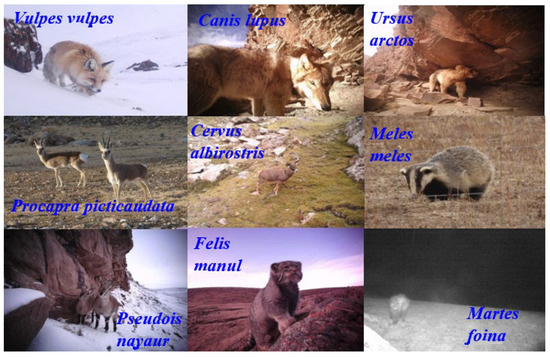
Figure A1.
Photos of wildlife in the study area (All photos were taken by Z.R).

Figure A2.
Photos of wildlife in the study area (All photos were taken by Z.R).

Figure A3.
Photos of Panthera uncia in the study area (All photos were taken by Z.R).
References
- Ji, L. China Checklist of Animals. In Catalogue of Life China: 2022 Annual Checklist; The Biodiversity Committee of Chinese Academy of Sciences: Beijing, China, 2022. [Google Scholar]
- Catalogue of Life China: 2022 Annual Checklist; The Biodiversity Committee of Chinese Academy of Sciences: Beijing, China, 2022.
- Bellard, C.; Genovesi, P.; Jeschke, J. Global patterns in threats to vertebrates by biological invasions. Proc. R. Soc. B 2016, 283, 20152454. [Google Scholar] [CrossRef]
- Bellard, C.; Cassey, P.; Blackburn, T. Alien species as a driver of recent extinctions. Biol. Lett. 2016, 12, 2015062. [Google Scholar] [CrossRef]
- Tittensor, D.P.; Walpole, M.; Hill, S.L.; Boyce, D.G.; Britten, G.L.; Burgess, N.D.; Butchart, S.H.; Leadley, P.W.; Regan, E.C.; Alkemade, R.; et al. A mid-term analysis of progress toward international biodiversity targets. Science 2014, 346, 241–244. [Google Scholar] [CrossRef] [PubMed]
- Newbold, T.; Hudson, L.N.; Hill, S.L.; Contu, S.; Lysenko, I.; Senior, R.A.; Börger, L.; Bennett, D.J.; Choimes, A.; Collen, B.; et al. Global effects of land use on local terrestrial biodiversity. Nature 2015, 520, 45–50. [Google Scholar] [CrossRef] [PubMed]
- Zhang, L.; Ameca, E.; Cowlishaw, G.; Pettorelli, N.; Foden, W.; Mace, G. Global assessment of primate vulnerability to extreme climatic events. Nat. Clim. Chang. 2019, 7, 554–561. [Google Scholar] [CrossRef]
- Tian, K. Research on Species Diversity and Geographical Distribution Type of Wild Vertebrate in Northwestern Hubei Province, China. Master’s Thesis, Hubei University, Wuhan, China, 2017. [Google Scholar]
- Zhou, Y.; Han, W.; Chen, W.; Cui, J.; Shen, G.; Xiong, G.; Xu, W.; Fan, D.; Zhao, C.; Xie, Z. Terrestrial vertebrate diversity in Shennongjia World Natural Heritage Site, China. Ecol. Sci. 2018, 37, 47–52. [Google Scholar] [CrossRef]
- Liu, Y. Study of Terrestrial Animal Resource and Diversity in Dongting Lake Wetland. Master’s Thesis, Hunan Normal University, Changsha, Hunan, 2017. [Google Scholar] [CrossRef]
- Chen, Y. Study on the Geography and Protection of Vertebrate in Zhonghua Mountain Nature Reserve. Master’s Thesis, Hubei University, Wuhan, China, 2018. [Google Scholar]
- Xu, X.; Gong, D.; Min, Z.; Qiao, S.; Cai, P. Diversity and geographical fauna of terrestrial wild vertebrates in Taizishan National Nature Reserve. J. Arid. Land Resour. Environ. 2022, 36, 167–171. [Google Scholar] [CrossRef]
- He, J.; Gong, D.; Huang, Q.; Huang, S.; Zhang, Y. Diversity and geographical fauna of terrestrial wild vertebrates in Guazhou Tangdun Hu Nature Reserve. J. Arid. Land Resour. Environ. 2020, 34, 175–181. [Google Scholar] [CrossRef]
- Liu, K.; Gong, D.; Zhao, H.; Li, X.; Li, W.; Chen, Z. Fauna and species diversity of wild vertebrates in Mazongshan, Gansu. J. Arid. Land Resour. Environ. 2017, 31, 187–191. [Google Scholar] [CrossRef]
- Yang, K.; Liu, W.; Liu, Y.-H.; Genga, Y. Biodiversity in Ngari of Tibet. J. Southwest Minzu Univ. (Nat. Sci. Ed.) 2018, 44, 221–228. [Google Scholar]
- Tsering, B.; Sgolma, S.; Zhong, Y. A summer survey of terrestrial vertebrates in the Niyang River Basin, Tibet. Tibet. Sci. Technol. 2013, 8, 71–75. [Google Scholar]
- Lhagdor, P.; Tsering, B. Study on Species Diversity of Vertebrates in the National Reserve of Lhalu Wetland, Lhasa. J. Tibet. Univ. 2010, 25, 1–7. [Google Scholar] [CrossRef]
- Jiang, D.; Fu, X.; Gao, N.; Wang, J.; Li, W.; Wu, N.; Jia, X.; Li, N. Research on the faunal resources of the Chagannur wetlands in Hebei. Mod. Rural. Sci. Technol. 2022, 2, 102. [Google Scholar]
- Gao, S.-P.; Li, D.-M.; Wang, R.-J.; Gao, Y.-J.; Li, J.-Y.; Wu, Y.-F. Species abundance and distribution patterns of vertebrates in Hebei province. J. Hebei Acad. Sci. 2012, 29, 62–64. [Google Scholar] [CrossRef]
- Xue, A. Study on the Biodiversity and Conservation of Gucheng National Wetland Park in Shanxi. J. Shanxi Agric. Sci. 2018, 46, 998–1000. [Google Scholar]
- Hao, J.; Wang, Q.; Zou, B. Terrestrial Vertebrate Species and Dominant Groups Distribution. Agric. Technol. Equip. 2015, 4, 60–63. [Google Scholar]
- Hua, G.; Ye, D.; Wang, J.; Huang, Z.; Yuan, Q.; Ke, P.; Hu, H.; Zhou, Z. Terrestrial Vertebrate Survey Based on Monitoring Grid System in Zhongshan Xiangshan Nature Reserve, Guangdong Province. Trop. For. 2021, 49, 46–53. [Google Scholar]
- Li, C.-R.; Gong, Y.-N.; Lu, X.-L.; Li, S.-Z. Species diversity of terrestrial vertebrates in the Guangdong Nanling National Nature Reserve. J. Shaoguan Univ. 2012, 33, 55–57. [Google Scholar]
- Huang, X.-H.; Zhong, F.-S.; Yu, J.; Li, W.-N. Species Diversity and Protection Measures of Terrestrial Vertebrates in Meijiang Basin of Guangdong. J. Jiaying Univ. (Nat. Sci.) 2012, 30, 73–76. [Google Scholar]
- Mao, C. The Terrestrial Vertebrates Resources Survey and Diversity Analysis in Guangxi Wanggangshan Nature Reserve. Master’s Thesis, Guangxi University, Nanning, China, 2018. [Google Scholar]
- Wang, Q. The Terrestrial Vertebrates Diversity in Mulun Nature Reserve of Guangxi. Master’s Thesis, Guizhou Normal University, Guiyang, China, 2014. [Google Scholar]
- Wu, Y.; Han, J.; Solange; Qi, Y. Diversity and Geographical Fauna of Terrestrial Vertebrates in the Ruoerge Wetland National Nature Reserve on the Eastern Edge of Qinghai-Tibet Plateau. Tibet. Sci. Technol. 2021, 6, 3–9. [Google Scholar] [CrossRef]
- Zhang, R.; Zhang, Y.; Gong, C.; Liu, Y. Resources of Terrestrial Wild Vertebrate in Pu’er City. For. Inventory Plan. 2020, 45, 92–95; 107. [Google Scholar] [CrossRef]
- Yu, M. Study on the Conservation value of Species Diversity in Tumuji Nature Reserve, Inner Mongolia. Master’s Thesis, Shenyang Agricultural University, Shenyang, China, 2020. [Google Scholar] [CrossRef]
- He, J.; Gong, D.; Huang, Q.; Zhang, Y.; Huang, S. Study on the Diversity and Geographical Fauna of Terrestrial Wild Vertebrates in Tianzhu County of Qilian Mountains. J. Arid. Land Resour. Environ. 2020, 34, 148–155. [Google Scholar] [CrossRef]
- Chen, Y.; Chen, Q.; Yang, H. Diversity and Fauna of Terrestrial Wild Vertebrate in Tengger Desert. J. Desert Res. 2020, 40, 171–182. [Google Scholar] [CrossRef]
- Li, H.; Zhu, S.; Zhang, S.; Zhang, S.; Wei, D.; Liu, Y.; Zhao, X.; Chen, P. Analysis on Vertebrate Diversity of Shuanghe Nature Reserve in Heilongjiang Province. Territ. Nat. Resour. Study 2017, 4, 90–92. [Google Scholar] [CrossRef]
- Yin, X. Vertebrate Diversity in Chishui Suoluo National Nature Reserve. Master’s Thesis, Southwest University, Chongqing, China, 2013. [Google Scholar]
- Xie, Z.; Li, X. Wild Terrestrial Vertebrate Species Diversity and Conservation Status in Mountain National Forest Park. Jiangxi Sci. 2013, 31, 635–637; 641. [Google Scholar] [CrossRef]
- Chang, B. The Suvey and Analysis on Vertebrate Resources in National Nature Reserve in Liupan Mountain, NingXia. Master’s Thesis, Northwest University, Xi’an, China, 2013. [Google Scholar]
- Allan, J.R.; Watson, J.E.; Di Marco, M.; O’Bryan, C.J.; Possingham, H.P.; Atkinson, S.C.; Venter, O. Hotspots of human impact on threatened terrestrial vertebrates. PLoS Biol. 2019, 17, e3000158. [Google Scholar] [CrossRef]
- Zhang, S.-Y.; Gheyret, G.; Chi, X.; Bai, Y.-H.; Zheng, C.; Tang, Z. Representativeness of threatened terrestrial vertebrates in nature reserves in China. Biol. Conserv. 2020, 246, 108599. [Google Scholar] [CrossRef]
- Liang, D.-N.; Miao, T.; Chang, J.; Guo, S.-K.; Jiang, Z.-G.; Ji, N.; Ping, X.-G.; Li, C.-W. Vertebrate Richness and Conservation Effectiveness in Shaanxi Qingmuchuan National Nature Reserve. Chin. J. Zool. 2021, 56, 808–818. [Google Scholar] [CrossRef]
- Yang, S.; Liu, J. The Vertebrate Wildlife Resources and Habitat Protection Countermeasures. For. Investig. Des. 2014, 3, 79–81. [Google Scholar]
- Fan, H.; Geng, Y.; Hu, G.; Su, H.; Zhang, M.; Hu, C. Analysis of Wildlife Species Diversity and Related Resources Utilization Characteristics in Traditional Villages: The Case of Dazhai, Zhenshan Village, Huaxi District, Guiyang City, in Guizhou Province. J. Mt. Agric. Biol. 2021, 40, 48–55. [Google Scholar] [CrossRef]
- Yan, Y.; Yang, D.; Deng, J.; Zhang, Z.; Zhou, X.; Wang, W.; Li, J. Construction of an Indicator System for Evaluating the Protection Efficacy of National Nature Reserves in China: A Case Study on Terrestrial Vertebrates (excluding migratory birds). Chin. J. Appl. Ecol. 2015, 26, 1571–1578. [Google Scholar]
- Rong, Z.; Gao, Y.; Chen, S.; Zhang, T. Habitat Suitability Evaluation of Snow Leopard (Panthera uncia) in the Qilian Mountain National Park (Qinghai area), China. Acta Theriol. Sin. 2022, 42, 553–562. [Google Scholar] [CrossRef]
- Liu, W.; Wang, X. Vertebrate Species and Distribution in Qinghai; Qinghai People’s Publishing House: Qinghai, China, 2018. [Google Scholar]
- Northwest Institute of Plateau Biology, CAS. Qinghai Economic Zoology; Qinghai People’s Publishing House: Qinghai, China, 1987. [Google Scholar]
- Xie, Y.; Wang, S.; Smith, A.T. A Guide to the Mammals of China; Hunan Education Publishing House: Changsha, China, 2009; pp. 75–483. [Google Scholar]
- Wei, F.; Yang, Q.; Wu, Y.; Jiang, X.; Liu, S.; Li, B.; Yang, G.; Li, M.; Zhou, J.; Li, S.; et al. Catalogue of mammals in China (2021). Acta Theriol. Sin. 2021, 41, 487–501. [Google Scholar] [CrossRef]
- Wang, K.; Ren, J.; Chen, H.; Lyu, Z.; Guo, X.; Jiang, K.; Chen, J.; Li, J.; Guo, P.; Wang, Y.; et al. The updated checklists of amphibians and reptiles of China. Biodivers. Sci. 2020, 28, 189–218. [Google Scholar] [CrossRef]
- MacKinnon, J.; Phillipps, K.; He, F. A Field Guide to the Birds of China; Hunan Education Publishing House: Changsha, China, 2000; pp. 19–497. [Google Scholar]
- Zheng, G. A Checklist on the Classification and Distribution of Birds in China, 3rd ed.; Science Press: Beijing, China, 2017; pp. 20–432. [Google Scholar]
- China Forestry and Grassland Administration, Ministry of Agriculture and Rural Affairs, China. List of key protected wild animals in China. Chin. J. Wildl. 2021, 42, 605–640. [Google Scholar] [CrossRef]
- Jiang, Z.; Jiang, J.; Wang, Y.; Zhang, E.; Zhang, Y.; Li, L.; Xie, F.; Cai, B.; Cao, L.; Zheng, G.; et al. Red List of China’s Vertebrates. Biodivers. Sci. 2016, 24, 501–551; 615. [Google Scholar]
- Zhang, R. Zoogeography of China; Science Press: Beijing, China, 2011; pp. 1–330. [Google Scholar]
- Jiang, Z.; Ji, L. Avian-mammalian species diversity in nine representative sites in China. Biodivers. Sci. 1999, 7, 61–66, CNKI:SUN:SWDY.0.1999-03-009. [Google Scholar]
- David, J. Background and Mass Extinctions: The Alternation of Macroevolutionary Regimes. Science 1986, 231, 129–133. [Google Scholar] [CrossRef]
- Myers, N.; Mittermeier, R.A.; Mittermeier, C.G.; Da Fonseca, G.A.; Kent, J. Biodiversity hotspots for conservation priorities. Nature 2000, 403, 853–858. [Google Scholar] [CrossRef]
Publisher’s Note: MDPI stays neutral with regard to jurisdictional claims in published maps and institutional affiliations. |
© 2022 by the authors. Licensee MDPI, Basel, Switzerland. This article is an open access article distributed under the terms and conditions of the Creative Commons Attribution (CC BY) license (https://creativecommons.org/licenses/by/4.0/).