


Citizens’ Social Participation to Implement Sustainable Development Goals (SDGs): A Literature Review



Abstract
1. Introduction
2. Methods
2.1. Review Scope Definition
- (a)
- Focus: The purpose of this study is to understand the status and challenges of citizen participation in recent initiatives to achieve the SDGs.
- (b)
- Goal: The goal is to identify the central issues of citizen participation that are common to the diverse themes of the SDGs.
- (c)
- Perspective: This study was conducted to understand how the literature with some reliability on the SDGs handles “citizen participation” and “information for citizens”. For this reason, the study does not focus on the objectives of individual articles.
- (d)
- Coverage: A variety of themes related to the SDGs were addressed. The objective was to understand the issues that are common to them.
2.2. Conceptualization of the Topic
2.3. The Literature Search
- (a)
- Database source: Online search using Web of Science [3].
- (b)
- Open access papers searchable on Web of Science.
- (c)
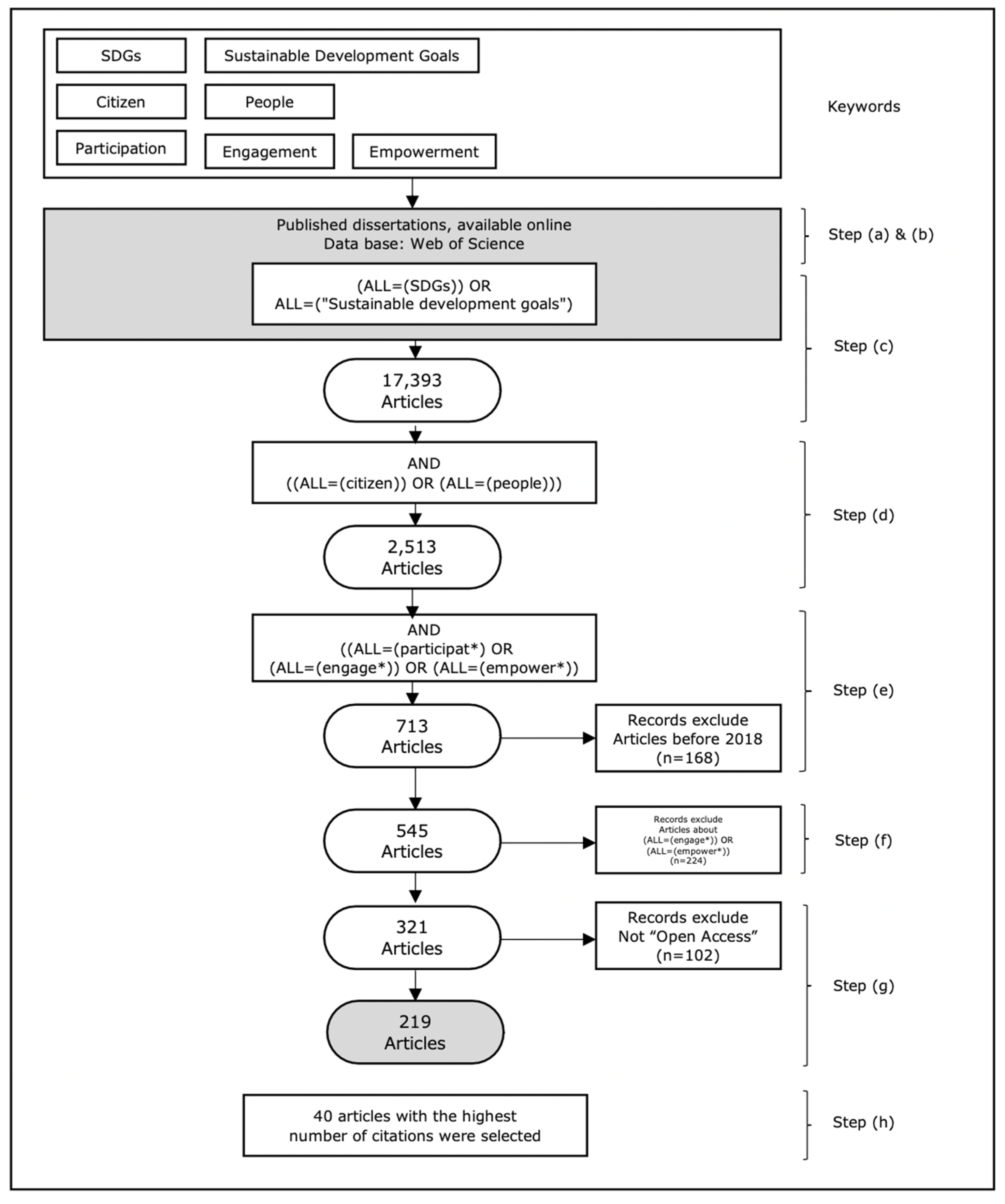
- The following steps were used to set search criteria and extract articles.
- (i)
- First, a search was conducted using “(ALL = (SDGs)) OR ALL = (“Sustainable development goals”)” to identify articles in the Web of Science that focus on the SDGs. The search resulted in 17,393 papers.
- (ii)
- Next, a search was conducted using “(AND ((ALL = (citizen)) OR (ALL = (people)))” to identify papers related to citizens. In addition to “Citizen”, “people” was added to the search criteria to cover a wider area. The search resulted in 2513 papers.
- (iii)
- In this context, we decided to identify papers that include participation as an element. In addition to “participation”, by adding “engagement” and “empowerment” to the word, papers with different approaches to citizens were also included. The search was conducted using “(AND ((ALL = (participate *) OR (ALL = (engage *)) OR (ALL = (empower *))))”, and the * search was conducted to include verbs. The search returned 713 results.
- (iv)
- Since the objective of this research was to identify recent trends in the subject matter of this research, the search was limited to papers from 2019 onward. The search resulted in 545 results.
- (v)
- Since there were still a large number of papers at this point, the papers related to “engagement” and “empowerment” were excluded from the scope of this research. As a result, there were 321 papers covered. These papers that were excluded in this research will be reviewed separately in future research for comparison with the findings of this current one.
- (vi)
- Finally, since we included papers for which the main body of the paper was available, papers that were not open access were excluded. As a result, 219 articles were included.
- (d)
- Among the 219 papers listed above, we decided to select papers that were objectively reliable and highly rated. Forty papers were selected in order of the number of citations and were the subject of this review.
2.4. Validation of the Literature Review Process
- Is this review needed and what is the contribution of conducting this review?
- This research is necessary to identify issues to be considered in the following action research processes.
- What is the potential audience of this review?
- Those studying and practicing citizen participation in the implementation of the SDGs.
- What is the specific purpose and research question(s) this review will be addressing?
- To identify issues of citizen participation in recent research on the SDGs.
- What is an appropriate method to use regarding this review’s specific purpose?
- Select papers that deal with citizen participation from recent studies on the SDGs. Then, examine the common issues among these studies.
- What is the search strategy for this specific review? (Including search terms, databases, inclusion and exclusion criteria, etc.)
- Does the search plan developed in phase one work to produce an appropriate sample, or does it need adjustment?
- It is appropriate to summarize how recent papers on the SDGs address citizen participation. Since the selection was based on the number of citations, it is possible that important papers in each field were overlooked, and additional study is needed to understand the common issues.
- What is the practical plan for selecting articles?
- Understand how papers on the SDGs address citizen participation. In order to target papers that have achieved a certain level of credibility, the number of citations were used as the criteria.
- How will the search process and selection be documented?
- The search query is shown in Figure 1.
- How will the quality of the search process and selection be assessed?
- Based on previous studies on literature review, validation is conducted by means of methodological models, taxonomies and guidelines that have already been evaluated.
- What type of information needs to be abstracted to fulfill the purpose of the specific review?
- Extract the issues common to the selected papers. Since the importance of “information” is raised in SDGs and Agenda 21, we examine information as one perspective.
- What type of information is needed to conduct the specific analysis?
- How citizen participation is valued and what challenges exist in promoting it.
- How will this process be documented and reported?
- Are the motivation and the need for this review clearly communicated?
- It is described as a basic study for the following action research process.
- What standards of reporting are appropriate for this specific review?
- It is structured with reference to the methodology of the previous literature review papers.
- What information needs to be included in the review?
- Information on how the literature was identified, analyzed, synthesized, and reported by the authors is included in this paper.
- Is the level of information provided enough and appropriate to allow for transparency so readers can judge the quality of the review?
- Are the results clearly presented and explained?
- Is the contribution of the review clearly communicated?
2.5. Literature Analysis
3. Review Results
3.1. Analysis by Category
3.1.1. Citizen Science
3.1.2. Health
3.1.3. Environment and Climate Change
3.1.4. Education
3.1.5. Gender
3.1.6. Governance
3.1.7. Poverty
3.1.8. Other
3.2. Cross-Sectional Analysis
3.2.1. Participation
3.2.2. Information
- Information Hub and Information Infrastructure [44].
4. Discussion and Conclusions
- (A)
- Necessity of participation: The achievement of the SDGs and efforts toward each goal require the proactive participation of citizens.
- (B)
- Challenges in participation: One of the factors hindering participation is the existence of biased information access and information gaps, which deprive people of opportunities to participate in decision-making and reduce their sense of ownership.
- (C)
- Promoting participation: Appropriate provision of information can promote participation. In this process, the participating actors themselves can be the generators of information, which will enhance their sense of ownership. Key words: enhancement of information and scientific literacy; diversity of participants/multi-stakeholder; transparency of information; and motivation.
- (D)
- Contribution to the SDGs: Increased participation as information generators could contribute to the acquisition of more detailed data on the SDGs, which is currently lacking.
- (E)
- Basis for participation: The use of technology and the development of information infrastructure and the formation of smart cities may encourage the acquisition and generation of such information.
Author Contributions
Funding
Institutional Review Board Statement
Informed Consent Statement
Data Availability Statement
Conflicts of Interest
References
- Vom Brocke, J.; Simons, A.; Niehaves, B.; Niehaves, B.; Reimer, K.; Plattfaut, R.; Cleven, A. Reconstructing the giant: On the importance of rigour in documenting the literature search process. In Proceedings of the 17th European Conference on Information Systems (ECIS), Verona, Italy, 8 June 2009. [Google Scholar]
- Cooper, H.M. Organizing knowledge syntheses: A taxonomy of literature reviews. Knowl. Soc. 1988, 1, 104. [Google Scholar] [CrossRef]
- Web of Science. Available online: https://access-clarivate-com.kras.lib.keio.ac.jp (accessed on 18 August 2022).
- Snyder, H. Literature review as a research methodology: An overview and guidelines. J. Bus. Res. 2019, 104, 333–339. [Google Scholar] [CrossRef]
- Ajates, R.; Hager, G.; Georgiadis, P.; Coulson, S.; Woods, M.; Hemment, D. Local Action with Global Impact: The Case of the GROW Observatory and the Sustainable Development Goals. Sustainability 2020, 12, 10518. [Google Scholar] [CrossRef]
- Fraisl, D.; Campbell, J.; See, L.; Wehn, U.; Wardlaw, J.; Gold, M.; Moorthy, I.; Arias, R.; Piera, J.; Oliver, J.L.; et al. Mapping citizen science contributions to the UN sustainable development goals. Sustain. Sci. 2020, 15, 1735–1751. [Google Scholar] [CrossRef]
- Koffler, S.; Barbieri, C.; Ghilardi-Lopes, N.P.; Leocadio, J.N.; Albertini, B.; Francoy, T.M.; Saraiva, A.M. A Buzz for Sustainability and Conservation: The Growing Potential of Citizen Science Studies on Bees. Sustainability 2021, 13, 959. [Google Scholar] [CrossRef]
- Moczek, N.; Voigt-Heucke, S.L.; Mortega, K.G.; Cartas, C.F.; Knobloch, J. A Self-Assessment of European Citizen Science Projects on Their Contribution to the UN Sustainable Development Goals (SDGs). Sustainability 2021, 13, 1774. [Google Scholar] [CrossRef]
- Pocock, M.J.O.; Roy, H.E.; August, T.; Kuria, A.; Barasa, F.; Bett, J.; Githiru, M.; Kairo, J.; Kimani, J.; Kinuthia, W.; et al. Developing the global potential of citizen science: Assessing opportunities that benefit people, society and the environment in East Africa. J. Appl. Ecol. 2019, 56, 274–281. [Google Scholar] [CrossRef]
- Queiruga-Dios, M.A.; Lopez-Inesta, E.; Diez-Ojeda, M.; Saiz-Manzanares, M.C.; Dorrio, J.B.V. Citizen Science for Scientific Literacy and the Attainment of Sustainable Development Goals in Formal Education. Sustainability 2020, 12, 4283. [Google Scholar] [CrossRef]
- Shulla, K.; Leal, W.; Sommer, J.H.; Salvia, A.L.; Borgemeister, C. Channels of collaboration for citizen science and the sustainable development goals. J. Clean. Prod. 2020, 264, 121735. [Google Scholar] [CrossRef]
- Wuebben, D.; Romero-Luis, J.; Gertrudix, M. Citizen Science and Citizen Energy Communities: A Systematic Review and Potential Alliances for SDGs. Sustainability 2020, 12, 10096. [Google Scholar] [CrossRef]
- Anton-Peset, A.; Fernandez-Zamudio, M.A.; Pina, T. Promoting Food Waste Reduction at Primary Schools. A Case Study. Sustainability 2021, 13, 600. [Google Scholar] [CrossRef]
- Lozano-Diaz, A.; Fernandez-Prados, J.S. Educating Digital Citizens: An Opportunity to Critical and Activist Perspective of Sustainable Development Goals. Sustainability 2020, 12, 7260. [Google Scholar] [CrossRef]
- Merritt, E.; Hale, A.; Archambault, L. Changes in Pre-Service Teachers’ Values, Sense of Agency, Motivation and Consumption Practices: A Case Study of an Education for Sustainability Course. Sustainability 2019, 11, 155. [Google Scholar] [CrossRef]
- Nguyen, T.P.L.; Nguyen, T.H.; Tran, T.K. STEM Education in Secondary Schools: Teachers’ Perspective towards Sustainable Development. Sustainability 2020, 12, 8865. [Google Scholar] [CrossRef]
- Loizia, P.; Voukkali, I.; Zorpas, A.A.; Pedreno, J.N.; Chatziparaskeva, G.; Inglezakis, V.J.; Vardopoulos, I.; Doula, M. Measuring the level of environmental performance in insular areas, through key performed indicators, in the framework of waste strategy development. Sci. Total Environ. 2021, 753, 141974. [Google Scholar] [CrossRef]
- Nash, K.L.; Alexander, K.; Melbourne-Thomas, J.; Novioaglio, C.; Sbrocchi, C.; Villanueva, C.; Pecl, G.T. Developing achievable alternate futures for key challenges during the UN Decade of Ocean Science for Sustainable Development. Rev. Fish Biol. Fish. 2022, 32, 19–36. [Google Scholar] [CrossRef]
- Pinto, L.; Ferreira, C.S.S.; Pereira, P. Environmental and socioeconomic factors influencing the use of urban green spaces in Coimbra (Portugal). Sci. Total Environ. 2021, 792, 148293. [Google Scholar] [CrossRef]
- Pittman, S.J.; Rodwell, L.D.; Shellock, R.J.; Williams, M.; Attrill, M.J.; Bedford, J.; Curry, K.; Fletcher, S.; Gall, S.C.; Lowther, J.; et al. Marine parks for coastal cities: A concept for enhanced community well-being, prosperity and sustainable city living. Mar. Policy 2019, 103, 160–171. [Google Scholar] [CrossRef]
- Romano, O.; Akhmouch, A. Water Governance in Cities: Current Trends and Future Challenges. Water 2019, 11, 500. [Google Scholar] [CrossRef]
- Vaz, A.S.; Moreno-Llorca, R.A.; Goncalves, J.F.; Vicente, J.R.; Mendez, P.F.; Revilla, E.; Santamaria, L.; Bonet-Garcia, F.J.; Honrado, J.P.; Alcaraz-Segura, D. Digital conservation in biosphere reserves: Earth observations, social media, and nature’s cultural contributions to people. Conserv. Lett. 2020, 13, e12704. [Google Scholar] [CrossRef]
- Capitani, C.; Garedew, W.; Mitiku, A.; Berecha, G.; Hailu, B.T.; Heiskanen, J.; Hurskainen, P.; Platts, P.J.; Siljander, M.; Pinard, F.; et al. Views from two mountains: Exploring climate change impacts on traditional farming communities of Eastern Africa highlands through participatory scenarios. Sustain. Sci. 2019, 14, 191–203. [Google Scholar] [CrossRef]
- Clay, N.; Zimmerer, K.S. Who is resilient in Africa’s Green Revolution? Sustainable intensification and Climate Smart Agriculture in Rwanda. Land Use Policy 2020, 97, 104558. [Google Scholar] [CrossRef] [PubMed]
- Higgins-Desbiolles, F.; Wijesinghe, G. The critical capacities of restaurants as facilitators for transformations to sustainability. J. Sustain. Tour. 2019, 27, 1080–1105. [Google Scholar] [CrossRef]
- Hepp, P.; Somerville, C.; Borisch, B. Accelerating the United Nation’s 2030 Global Agenda: Why prioritization of the gender goal is essential. Glob. Policy 2019, 10, 677–685. [Google Scholar] [CrossRef]
- Levy, J.K.; Darmstadt, G.L.; Ashby, C.; Quandt, M.; Halsey, E.; Nagar, A.; Greene, M.E. Characteristics of successful programmes targeting gender inequality and restrictive gender norms for the health and wellbeing of children, adolescents, and young adults: A systematic review. Lancet Glob. Health 2020, 8, E225–E236. [Google Scholar] [CrossRef]
- Nunez, R.B.C.; Bandeira, P.; Santero-Sanchez, R. Social Economy, Gender Equality at Work and the 2030 Agenda: Theory and Evidence from Spain. Sustainability 2020, 12, 5192. [Google Scholar] [CrossRef]
- Almeida, A.C.L. Multi actor multi criteria analysis (MAMCA) as a tool to build indicators and localize sustainable development goal 11 in Brazilian municipalities. Heliyon 2019, 5, e02128. [Google Scholar] [CrossRef]
- Anderson, C.R.; Bruil, J.; Chappell, M.J.; Kiss, C.; Pimbert, M.P. From Transition to Domains of Transformation: Getting to Sustainable and Just Food Systems through Agroecology. Sustainability 2019, 11, 5272. [Google Scholar] [CrossRef]
- Fisher, A.; Fukuda-Parr, S. Introduction? Data, Knowledge, Politics and Localizing the SDGs. J. Hum. Dev. Capab. 2019, 20, 375–385. [Google Scholar] [CrossRef]
- Bellemo, V.; Lim, Z.W.; Lim, G.; Nguyen, Q.D.; Xie, Y.C.; Yip, M.Y.T.; Hamzah, H.; Ho, J.Y.; Lee, X.Q.; Hsu, W.N.; et al. Artificial intelligence using deep learning to screen for referable and vision-threatening diabetic retinopathy in Africa: A clinical validation study. Lancet Digit. Health 2019, 1, E35–E44. [Google Scholar] [CrossRef]
- Dai, J.H.; Menhas, R. Sustainable Development Goals, Sports and Physical Activity: The Localization of Health-Related Sustainable Development Goals Through Sports in China: A Narrative Review. Risk Manag. Healthc. Policy 2020, 13, 1419–1430. [Google Scholar] [CrossRef] [PubMed]
- Engel, D.M.C.; Paul, M.; Chalasani, S.; Gonsalves, L.; Ross, D.A.; Chandra-Mouli, V.; Cole, C.B.; Eriksson, C.D.; Hayes, B.; Philipose, A.; et al. A Package of Sexual and Reproductive Health and Rights Interventions-What Does It Mean for Adolescents? J. Adolesc. Health 2019, 65, S41–S50. [Google Scholar] [CrossRef] [PubMed]
- Guthold, R.; Stevens, G.A.; Riley, L.M.; Bull, F.C. Global trends in insufficient physical activity among adolescents: A pooled analysis of 298 population-based surveys with 1.6 million participants. Lancet Child Adolesc. Health 2020, 4, 23–35. [Google Scholar] [CrossRef]
- Leuenberger, A.; Farnham, A.; Azevedo, S.; Cossa, H.; Dietler, D.; Nimako, B.; Adongo, P.B.; Merten, S.; Utzinger, J.; Winkler, M.S. Health impact assessment and health equity in sub-Saharan Africa: A scoping review. Environ. Impact Assess. Rev. 2019, 79, 106288. [Google Scholar] [CrossRef]
- Lozano, R.; Fullman, N.; Mumford, J.E.; Gbd Universal Hlth, C. Measuring universal health coverage based on an index of effective coverage of health services in 204 countries and territories, 1990–2019: A systematic analysis for the Global Burden of Disease Study 2019. Lancet 2020, 396, 1250–1284. [Google Scholar] [CrossRef]
- Ramirez-Rubio, O.; Daher, C.; Fanjul, G.; Gascon, M.; Mueller, N.; Pajin, L.; Plasencia, A.; Rojas-Rueda, D.; Thondoo, M.; Nieuwenhuijsen, M.J. Urban health: An example of a “health in all policies” approach in the context of SDGs implementation. Glob. Health 2019, 15, 87. [Google Scholar] [CrossRef]
- Salvo, D.; Garcia, L.; Reis, R.S.; Stankov, I.; Goel, R.; Schipperijn, J.; Hallal, P.C.; Ding, D.; Pratt, M. Physical Activity Promotion and the United Nations Sustainable Development Goals: Building Synergies to Maximize Impact. J. Phys. Act. Health 2021, 18, 1163–1180. [Google Scholar] [CrossRef]
- Cappa, F.; Rosso, F.; Capaldo, A. Visitor-Sensing: Involving the Crowd in Cultural Heritage Organizations. Sustainability 2020, 12, 1445. [Google Scholar] [CrossRef]
- Owusu-Manu, D.; Adjei, T.K.; Sackey, D.M.; Edwards, D.J.; Hosseini, R.M. Mainstreaming sustainable development goals in Ghana’s energy sector within the framework of public-private partnerships: Challenges, opportunities and strategies. J. Eng. Des. Technol. 2021, 19, 605–624. [Google Scholar] [CrossRef]
- Dong, Y.; Jin, G.; Deng, X.Z.; Wu, F. Multidimensional measurement of poverty and its spatio-temporal dynamics in China from the perspective of development geography. J. Geogr. Sci. 2021, 31, 130–148. [Google Scholar] [CrossRef]
- Ogutu, S.O.; Qaim, M. Commercialization of the small farm sector and multidimensional poverty. World Dev. 2019, 114, 281–293. [Google Scholar] [CrossRef]
- Israilidis, J.; Odusanya, K.; Mazhar, M.U. Exploring knowledge management perspectives in smart city research: A review and future research agenda. Int. J. Inf. Manag. 2021, 56, 101989. [Google Scholar] [CrossRef]

| Category | Theme | SDG | Ref. No. | Citations | Author | Journal | Year |
|---|---|---|---|---|---|---|---|
| Citizen Science | Citizen Observatories | Monitoring Data | [5] | 15 | R. Ajates et al. | Sustainability | 2020 |
| Data | Monitoring | [6] | 80 | D. Fraisl et al. | Sustainability Science | 2020 | |
| Citizen Science Studies | Monitoring | [7] | 11 | S. Koffler et al. | Sustainability | 2021 | |
| Contribution | Monitoring | [8] | 13 | N. Moczek et al. | Sustainability | 2021 | |
| Data | Monitoring | [9] | 51 | M.J.O. Pocock et al. | Journal of Applied Ecology | 2019 | |
| ESD | 5 | [10] | 26 | M.A. Queiruga-Dios et al. | Sustainability | 2020 | |
| collaboration | 17 | [11] | 20 | K. Shulla et al. | Journal of Cleaner Production | 2020 | |
| Energy Communitie | 7, 11, 13 | [12] | 12 | D. Wuebben et al. | Sustainability | 2020 | |
| Education | Food Wastte | 12 | [13] | 13 | A. Anton-Peset et al. | Sustainability | 2021 |
| Digital Citizens | 5 | [14] | 17 | A. Lozano-Diaz et al. | Sustainability | 2020 | |
| ESD | 5 | [15] | 16 | E. Merritt et al. | Sustainability | 2019 | |
| STEM | 5 | [16] | 15 | T.P.L. Nguyen et al. | Sustainability | 2020 | |
| Environment | Waste Strategy | 12 | [17] | 33 | P. Loizia et al. | Science of the Total Environment | 2021 |
| Future Seas | 14 | [18] | 16 | K.L. Nash et al. | Reviews in Fish Biology and Fisheries | 2022 | |
| UGS | 11, 3 | [19] | 15 | L. Pinto et al. | Science of the Total Environment | 2021 | |
| Marine Park | 14 | [20] | 28 | S.J. Pittman et al. | Marine Policy | 2019 | |
| Water Governance | 6 | [21] | 33 | O. Romano et al. | Water | 2019 | |
| Digital conservation | Monitoring | [22] | 13 | A.S. Vaz et al. | Conservation Letters | 2020 | |
| Biodiversity | 13 | [23] | 22 | C. Capitani et al. | Sustainability Science | 2019 | |
| climate-resilient food systems | 2 | [24] | 11 | N. Clay et al. | Land Use Policy | 2020 | |
| Food | Tourism | 2 | [25] | 15 | F. Higgins-Desbiolles et al. | Journal of Sustainable Tourism | 2019 |
| Gender | prioritization of the gender goal | 5 | [26] | 13 | P. Hepp et al. | Global Policy | 2019 |
| gender inequality | 5 | [27] | 61 | J.K. Levy et al. | Lancet Global Health | 2020 | |
| Social Economy | 5, 8, 10 | [28] | 17 | R.B.C. Nunez et al. | Sustainability | 2020 | |
| Governance | MAMCA | 11 | [29] | 11 | A.C.L. Almeida | Heliyon | 2019 |
| Agroecology | All | [30] | 76 | C.R. Anderson et al. | Sustainability | 2019 | |
| Data | All | [31] | 20 | A. Fisher et al. | Journal of Human Development and Capabilities | 2019 | |
| Health | AI | 3 | [32] | 88 | V. Bellemo et al. | Lancet Digital Health | 2019 |
| Sports | 3 | [33] | 16 | J.H. Dai et al. | Risk Management and Healthcare Policy | 2020 | |
| SPHR | 3 | [34] | 15 | D.M.C. Engel et al. | Journal of Adolescent Health | 2019 | |
| physical activity adolescents | 3 | [35] | 1428 | R. Guthold et al. | Lancet Child & Adolescent Health | 2020 | |
| HIA | 3 | [36] | 19 | A. Leuenberger et al. | Environmental Impact Assessment Review | 2019 | |
| UHC | 3 | [37] | 155 | R. Lozano et al. | Lancet | 2020 | |
| HiAP | 3 | [38] | 42 | O. Ramirez-Rubio et al. | Globalization and Health | 2019 | |
| Physical Activity | 3, 9, 11, 13, 16 | [39] | 29 | D. Salvo et al. | Journal of Physical Activity & Health | 2021 | |
| Open Innnovation | Heritage Organizations | 11 | [40] | 23 | F. Cappa et al. | Sustainability | 2020 |
| Partnership | PPP | 17 | [41] | 12 | D. Owusu-Manu et al. | Journal of Engineering Design and Technology | 2021 |
| Poverty | Poverty reduction | 1 | [42] | 14 | Y. Dong et al. | Journal of Geographical Sciences | 2021 |
| Smalll Farm | 1,2 | [43] | 50 | S.O. Ogutu et al. | World Development | 2019 | |
| Smart City | Knowledge Management | 9, 11, 17 | [44] | 34 | J. Israilidis et al. | International Journal of Information Management | 2021 |
| Ref. No. | Methodology | Conclusion |
|---|---|---|
| [5] | An analysis of Citizen Observatories’ project activities and outcomes mapped against the SDG framework. | Global datasets are growing exponentially, 68 percent of the 93 environmental SDG indicators cannot yet be monitored due to a lack of suitable data. COs emerge as promising mechanisms for closing data gaps and helping to validate monitoring data from other sources. |
| [6] | Systematic review of the metadata and work plans of the 244 SDG indicators, and the identification of past and ongoing citizen science initiatives that could directly or indirectly provide data for these indicators. | Citizen science provides the public with the means to inform policy, which could raise trust, credibility and ultimately accountability in the SDG monitoring process. Moreover, engaging with citizens in the data collection process, and in research more generally, could create opportunities to stimulate citizen action. |
| [7] | By performing a systematic review of citizen science studies on bees, assessed how these studies could contribute towards SDG reporting and monitoring, and also verified compliance with citizen science principles. | Since sustainability can only be achieved through an intergenerational approach, establishing firm partnerships is an essential step, whereby citizen science can act as a powerful strategy for providing data and implementing SDGs. |
| [8] | designed a survey to obtain direct assessments of the contribution of citizen science to the SDGs by European project participants | Indicate that European citizen science projects lack infrastructures and institutional support to facilitate data sharing. Recommend a focus on the promotion or creation of interfaces, for example, between projects and UN databases. |
| [9] | Undertake a collaborative prioritization process with experts in conservation and the environment to assess the potential of environmental citizen science in East Africa, including its opportunities, benefits and barriers | Citizen science can provide data to support decision-making and reporting against international targets. Participation can also provide societal benefits, informing and empowering people, thus supporting the United Nations’ Sustainable Development Goals. In developing countries, innovation is needed to further develop culturally relevant citizen science that benefits participants and end users. |
| [10] | A questionnaire based on validated studies was created and used to analyze the changes in attitudes of pupils towards science and technology and their improvement in scientific literacy in terms of scientific processes and scientific situations | Scientific literacy will presumably make it possible to develop critical thinking among pupils, and promote citizens who are freer, and have greater ownership of their destiny, which is what scientific education aims for. Pupils must learn about science in the same way that science itself works. |
| [11] | Challenges and critical aspects are discussed based on the opinions of practitioners collected through a comprehensive online survey | The results point out to the involvement of Citizen Science activities mainly with SDG 4, 11, 13, 15; to the need for institutionalization of CS representation in the national and international SDGS processes; to the importance of CS data infrastructure for the SDGs monitoring framework; to the mutual benefits of CS and SDGs from strengthening education and competencies; to the increase in the presence of Citizen Science in companies through fair partnerships; and to the importance of Citizen Science in the policy cycles which helps the governments in fulfilling their commitments to the SDGs. |
| [12] | Performed a systematic literature review and analysis of “public participation” and “energy communities” using the Preferred Reporting Items for Systematic Review and Meta-Analyses (PRIMSA) guidelines | The results show four pathways through which current public participation in energy communities might be more explicitly aligned with citizen science projects: benefits and values, energy practices, intermediaries, and energy citizenship. |
| [13] | Analyzed whether a didactic intervention, consisting of informing teachers and pupils and involving pupils in reducing FW, could bring about changes in the level of knowledge and attitude towards FW and in the amount of FW generated during the mid-morning break and lunch at schools. | The educational intervention of this study showed that, by working on FW, it contributes to achieve not only SDG 4 and SDG 12, which it is directly related to but, from education, it also allows other Agenda 2030 goals to be worked on. |
| [14] | A quasi-experimental method was used to learn about the behaviors of digital citizens, and intervention was carried out by means of an SDG-focused workshop and observation of the final level of commitment. ß | The results are revealing as they show an important improvement in the digital citizenship skills of students. Above all, Critical Perspective and Political Activism on the Internet are proven to play a key role. |
| [15] | the case study that explore pre-service teachers’ changes in their values, sense of agency, consumption practices and motivation after participation in a required EfS course. | Students reported significant changes in their beliefs about the relevance of sustainability education, attitudes toward sustainable development, self-efficacy, locus of control and sustainable consumption practices. |
| [16] | A review on how pedagogical approaches in science, technology, engineering, and mathematics (STEM) education can be deployed to teach concepts of sustainability. Seventy-seven STEM teaching projects of teachers across the country were analyzed, and interviews were conducted with 635 teachers who participated in the STEM program. | Inclusive STEM education could contribute to the achievement of SDG4—equitable and quality education for sustainable development and sustainable lifestyles and social equity. It should have received more attention. The implementation of inclusive STEM education requires innovation and change in pedagogical approach, curriculum development, methods of student assessment, school management structure and teacher-support initiatives. |
| [17] | Included several key performed indicators (KPIs), in order to evaluate the E.P of an area, through hybrid approach which cover among others, the waste compositional analysis, SWOT and PESTEL analysis, waste recycling and waste accumulation index, prevention activities, awareness activities etc. | Transitioning towards a sustainable waste strategy to be in a position to adopt CES, EGD and SDGs, involves validation methods that can be functional at all levels and moreover strong political decisions and commitment must be agree, even though success implementation of any waste strategy (i.e., prevention, recycling, reuse etc.), their results does not have direct to the citizens. |
| [18] | Brought together researchers across career stages, Indigenous Peoples and environmental managers to develop scenarios for 12 challenges facing the oceans, leveraging interdisciplinary knowledge to improve society’s capacity to purposefully shape the direction of marine social-ecological systems over the UN Decade of Ocean Science for Sustainable Development (2021–2030). | The complex and uncertain nature of many key challenges facing the oceans and our society can lead to inertia and paralysis among private and public actors alike. We need to develop and disseminate tangible depictions of where we are headed but also where we could head if we actively chose to steer the transformation to a more sustainable future. |
| [19] | Assesses the CES perceived by different users in five distinct urban parks l. A questionnaire survey was performed in each park to investigate the activities performed and their relevance for the users, users’ motivations to develop the activities on that specific UGS, the perceived benefits regarding physical and emotional well-being and social interactions, and users’ perception about disservices. | Characteristics such as UGS size, the distance between UGS and users’ residence, water elements in the landscape, and available sports equipment affect the UGS multifunctional use. Although presenting additional management challenges, multifunctional UGS can provide a diversified set of CES-related activities to be both offered and enjoyed by urban dwellers, even in limited-size areas |
| [20] | Proposed a collaborative community-led marine park concept that celebrates a city’s connection to the marine environment, enhances sustainable economic prosperity and enables communities to participate in activities that deepen understanding, value, care and enjoyment of the city seascape. | A CMP will serve as a vehicle for building a deeper connection between people and the marine environment through a holistic approach where social, economic and cultural values and benefits are considered alongside the ecological health of the ecosystem. Through nurturing growth in local knowledge of marine and coastal ecosystem and heritage, the CMP promote an organic growth in value, pride, enjoyment and care for the marine and coastal environment without the need for top-down exclusionary regulations. |
| [21] | Building mainly on recent studies on water governance carried out by The Organization for Economic Co-operation and Development (OECD) and specifically on urban water governance, this paper will discuss current trends and provide a set of tools for policy solutions based on OECD’s 3Ps framework: people, policies and places. | Cities can greatly benefit from the multi-stakeholder process to acquire information for each indicator. In fact, the self-assessment should be carried out in a participative manner in order to ensure that the process is transparent, neutral and open, as indicated by the 10-step methodology for self-assessment. |
| [22] | Combined information from those two digital sources in a multimodal inference framework to identify, map, and predict the potential for nature’s cultural contributions to people in two contrasting UNESCO biosphere reserves | Combined Earth observations and social media data to identify the major nature’s cultural contributions in the two reserves, to understand how they relate with distinct Earth observation predictors, and to evaluate the potential for nature’s cultural contributions in a spatially explicit way. The content analysis of social media photographs showed a dominance of different categories of nature’s cultural contributions, in agreement with the natural and cultural capital of these biosphere reserves. |
| [23] | Applied a participatory scenario development framework in two parts of the Eastern Afromontane Biodiversity Hotspot | Future trajectories of socio-ecological systems in tropical mountain ecosystems will largely depend on societal willingness and capacity, at different levels, to undertake the changes needed to reduce the impacts of climate and land management change. Through a participatory scenario development process, we engaged mountain communities in the Taita Hills, Kenya and Jimma, Ethiopia in envisioning the potential impacts of global climate change and local land changes and identifying and negotiating trade-offs between desirable and undesirable goals. |
| [24] | Report on a multi-season study of smallholder food producers’ experiences with Rwanda’s Crop Intensification Program (CIP) and related policies that aim to commercialize subsistence agriculture while implementing CSA. | For Rwanda, this means that rather than mandating agricultural intensification uniformly across space and time, it is essential to consider options for a nuanced approach that recognizes that there are various groups and areas of land use for whom the risks associated with full compliance are simply too high. |
| [25] | Case study research of twenty Australian restaurants featuring sustainability in their business concept and in their practices. | Restaurateurs who show a commitment to sustainability and underpin their business with a balanced “profit, people and planet” concept and approach achieve a committed following and make important contributions to efforts to secure the goals of the SDGs. |
| [26] | Assembled evidence to make the case that decisively (and politically) placing the gender equality goal (SDG5 and its 9 targets) together with 54 gender indicators across all goals as the priority focus of the 2030 agenda is the most impactful way to ensure measurable achievements are made across the agenda to deliver on all 5 pillars of the global commitment: namely People, Planet, Peace, Prosperity and Partnerships. | Propose that goal prioritization is necessary and argue that only one goal can deliver across and through the entire agenda: Goal 5—achieving gender equality. Without the full participation of all women and men and all people free of the historical and persistent pervasiveness at the intersections of sex and gender discrimination, none of the SDGs will deliver as planned. |
| [27] | Systematically reviewed rigorous evaluations published between 1 January 2000, and 1 November 2018 of programs that sought to decrease gender inequalities and transform restrictive gender norms to improve the health and wellbeing of 0–24-year-olds. | Thematic analysis of the evaluated programs revealed a potential model for accelerating achievement of the Sustainable Development Goals through programmatic approaches that improve health-related outcomes and seek to achieve gender equality and broader transformation of restrictive gender norms. Four such programmatic approaches were identified: (1) using multisectoral action; (2) incorporating multilevel, multistakeholder involvement; (3) implementing diversified programming; and (4) fostering social participation and empowerment. |
| [28] | An impact analysis with quasi-experimental counterfactual techniques, in which we compare one experimental group (the SE) with a control group (profit-seeking firms) using labor data from Spain for the period 2008–2017 | The impact analysis conducted in this paper contributes to the visibility of the SE as a key agent in the attainment of the SDGs related to decent employment and equal opportunities. It also provides rigor to the comparison of SE entities with traditional profit-seeking firms, highlighting the contribution of the distinctive principles of SE to sustainable and gender inclusive growth. |
| [29] | A conceptual framework was developed, and distinct indicators were analyzed to facilitate the implementation of SDG 11 in Brazilian municipalities. Two case studies were deployed based on the Multi-Actor Multi-Criteria Analysis (MAMCA) to guarantee stakeholder participation during the whole process. | This research concludes that the adopted methodology can support local decision-makers to build a more effective implementation of SDG 11 in Brazilian municipalities by mainly providing an overview of major urban issues based on a multi-stakeholder view. |
| [30] | Analyzed the enabling and disabling conditions that shape agroecology transformations and the ability of communities to self-organize. | Our analysis presents governance—particularly power imbalances and deficits in democracy—as the key determining factor for transformation across these domains. |
| [31] | Introduction of the “Journal of Human Development and Capabilities”. this introduction highlights the insights that emerge by using the framework of data infrastructure—means of collection and analysis, social structures amongst actors, knowledge systems. | The infrastructures of measurement are a result of an interdependent and correlative relationship between technical forms, processes and expertise, standards, laws and regulatory structures and political agendas. They show that the effects of data are biased in favor of those with power. Given the unequal distribution of and access to data, both globally and between public and private actors, questions about which data is used, who participates in its analysis, and through which process the analytic outputs are interpreted deserve enhanced attention. |
| [32] | Evaluated the accuracy of an artificial intelligence (AI) model using deep learning in a population-based diabetic retinopathy screening program in Zambia, a lower-middle-income country. | Showed that the AI model is clinically effective in detecting referable diabetic retinopathy, vision-threatening diabetic retinopathy, and diabetic macular oedema within a real-life diabetic retinopathy screening program in Zambia |
| [33] | A Narrative Review about Healthy China 2030 plan to achieve health-related SDGs through sport and physical activity | A program “Healthy Living for all” has been implemented with the theme of “three reductions and threefold health” under the health-related SDGs to achieve the target of Healthy China 2030. China is making tremendous progress towards the goal of Healthy China in multidimensional. To meet challenges and achieve health-related SDGs, China must take more coordinated steps. |
| [34] | Analyzed the relevance of the comprehensive definition of sexual and reproductive health and rights (SRHR) to adolescents and identifies adolescent-specific implications for the implementation of an essential package of SRHR interventions. | All SRHR interventions are relevant to adolescents, and to deliver on the ICPD Program of Action, the package of essential SRHR interventions must be made responsive to adolescents. As the health sector moves toward UHC, it must include SRHR, and it must cater to all adolescents including marginalized subgroups, such as unmarried adolescents, adolescents living with disabilities, and lesbian, gay, bisexual, transgender, intersex and other sex, and gender-diverse adolescents. |
| [35] | A pooled analysis of cross-sectional survey data that were collected through random sampling with a sample size of at least 100 individuals, were representative of a national or defined subnational population, and reported prevalence of insufficient physical activity by sex in adolescents. | The majority of adolescents do not meet current physical activity guidelines. Urgent scaling up of implementation of known effective policies and programs is needed to increase activity in adolescents. Investment and leadership at all levels to intervene on the multiple causes and inequities that might perpetuate the low participation in physical activity and sex differences, as well as engagement of youth themselves, will be vital to strengthen the opportunities for physical activity in all communities. |
| [36] | A scoping review to determine whether and to what extent HIA in sub-Saharan Africa addresses health equity included peer-reviewed publications and guidelines pertaining to HIA, environmental impact assessment (EIA) and social impact assessment (SIA). | In view of the strengths of rigorously conducted HIA, which might improve health equity, we recommend inclusion of a qualitative data collection step during profiling, in order to stratify the community into subgroups, address health differentials adequately and most importantly “to leave no one behind”, as suggested by the 2030 Agenda for Sustainable Development. |
| [37] | Assessed UHC effective coverage for 204 countries and territories from 1990 to 2019. Drawing from a measurement framework developed through WHO’s GPW13 consultation, we mapped 23 effective coverage indicators to a matrix representing health service types (e.g., promotion, prevention, and treatment) and five population-age groups spanning from reproductive and newborn to older adults (≥65 years) | This study provides a new measurement framework and metric on UHC effective coverage, supporting country and global stakeholders in their efforts to track improved performance over time. By striving to capture potential health gains delivered by health systems, we hope to better diagnose and address challenges that otherwise impede the ultimate objective of UHC: improving health for all people and leaving no one behind. |
| [38] | Create a comprehensive, urban health related SDGs conceptual framework, by linking already described urban health dimensions to existing SDGs, targets and indicators. Discuss, taking into account the necessary conditions and steps to conduct HiAP, the main barriers and opportunities within the SDGs framework. | HiAP, and applying tools such as HIA, can be used in cities worldwide, including those of less developed regions or countries, to achieve urban health related SDGs in the 2030 Agenda. Data availability, taking into account equity issues, strengthening the communication between experts and citizens, interdisciplinary and inter-agency collaboration and the involvement of all major stakeholders are crucial elements in a HiAP approach for SDG implementation. |
| [39] | Examined the contribution of physical activity promotion strategies toward achieving the SDGs through a conceptual linkage exercise, a scoping review, and an agent-based model. | call for a synergistic approach to physical activity promotion and SDG achievement, involving multiple sectors beyond health around their goals and values, using physical activity promotion as a lever for a healthier planet. |
| [40] | Contend that visitor-sensing has the potential to yield higher numbers of visitors, with positive impacts in terms of increased revenues and increased literacy of the general public, thus benefiting the economic and social sustainability of cultural organizations towards the achievement of the Sustainable Development Goals outlined in Agenda 2030. | The concept of OIS implies the adoption of OI practices for the generation of new scientific knowledge, whose employment may have major societal impacts. While the contributions of the crowd have been considered so far mainly in for-profit contexts (e.g., crowdsourcing) and in not-for-profit environmentally concerned projects (e.g., citizen science), we argue that they can also be extremely helpful for the purposes of hybrid organizations such as cultural heritage organizations. |
| [41] | Literature review to explore concepts, theories and frameworks for initiating PPP. Best local and international practices in the implementation of PPP projects; challenges and opportunities in the implementation of PPP projects, strategies for mainstreaming the SDGs in Ghana’s energy sector and assess business action in the implementation of the SDGs in Ghana’s energy sector. | The research concluded that governments have to put in place a PPP policy and regulation to guide the practice of PPPs in Ghana. The policy should spell out the various governance structures, processes, institutions, roles and responsibilities, incentives, qualifications and target areas with sustainability goals embedded, which can be known as the sustainable PPP model. National targets should feature in relevant policy documents to ensure a holistic implementation of the SDGs across all levels of government sectors from MDAs to MMDAs. |
| [42] | Use the exploratory spatio-temporal data analysis (ESTDA) method to reveal the characteristics of the spatio-temporal dynamics of multidimensional poverty. | According to GMM and IRF analyses, we determined the direction, extent, and path of the influential factors on poverty in China and identified the poverty-reducing and poverty-causing indicators. Except the proportion of non-agricultural industries, health insurance coverage rate of urban residents, and student-teacher ratio, other indicators are significantly related to poverty. |
| [43] | Evaluate the effect of commercialization on income poverty, as well as on the multidimensional poverty index that looks at deprivations in terms of education, nutrition, health, and other dimensions of living standard. Using data from 805 farm households in Kenya, estimate average treatment effects and also analyze impact heterogeneity with quantile regressions. | Commercialization reduces both income poverty and multidimensional poverty. The magnitude of the income gains is positively correlated with income level, meaning that market-linkage support for marginalized farms may be needed to avoid rising inequality. However, the effect in terms of reducing basic needs deprivations is stronger for the poorest households, suggesting that agricultural commercialization contributes effectively to achieving the sustainable development goals. |
| [44] | Eighty-two peer-reviewed publications were analyzed covering smart city studies in various research domains. The systematic review identifies five different themes: strategy and vision, frameworks, enablers and inhibitors, citizen participation, and benefits. | It identifies three key research thrusts: (1) sociotechnical approaches to smart cities, (2) integrating knowledge sharing perspectives and (3) developing organizational learning capabilities. These are emerging and interlinked elements of smart city development and present a conceptual approach for improving smart city knowledge management mechanisms. Smart cities have multidimensional components such as ICT applications, citizen engagement and governance. |
Publisher’s Note: MDPI stays neutral with regard to jurisdictional claims in published maps and institutional affiliations. |
© 2022 by the authors. Licensee MDPI, Basel, Switzerland. This article is an open access article distributed under the terms and conditions of the Creative Commons Attribution (CC BY) license (https://creativecommons.org/licenses/by/4.0/).
Share and Cite
Ozaki, Y.; Shaw, R. Citizens’ Social Participation to Implement Sustainable Development Goals (SDGs): A Literature Review. Sustainability 2022, 14, 14471. https://doi.org/10.3390/su142114471
Ozaki Y, Shaw R. Citizens’ Social Participation to Implement Sustainable Development Goals (SDGs): A Literature Review. Sustainability. 2022; 14(21):14471. https://doi.org/10.3390/su142114471
Chicago/Turabian StyleOzaki, Yasutaka, and Rajib Shaw. 2022. "Citizens’ Social Participation to Implement Sustainable Development Goals (SDGs): A Literature Review" Sustainability 14, no. 21: 14471. https://doi.org/10.3390/su142114471
APA StyleOzaki, Y., & Shaw, R. (2022). Citizens’ Social Participation to Implement Sustainable Development Goals (SDGs): A Literature Review. Sustainability, 14(21), 14471. https://doi.org/10.3390/su142114471

