


Abstract
The increasing consumption of energy and the numerous obstacles in the way of its extraction, including diminishing fossil fuels and the turn towards renewable energies, environmental changes, a tendency towards systems of information networks, rising costs of energy and advancement of technology have made the need for new technologies aimed at efficient management of energy more imminent. The Internet of Energy (IoE) technology has been recognized as a novel and efficient strategy that provides the necessary tools for optimal energy management. The present study was carried out with the purpose of identifying key components in implementation of IoE in Iran. This study is practical in its goal and descriptive-explorative in its methodology. First, the data were categorized using the qualitative method of meta-synthesis and using the Sandelowski and Barroso method. The statistical population of the study was the scholarly finding of 2010–2021 and 55 papers were sampled from the published works. The kappa coefficient was used to determine reliability and quality control. The kappa coefficient calculated with SPSS equals 0.87, which falls in the “excellent” category. Second, the frequency and importance of each component was determined using the Shannon entropy technique. The purpose of this method is to measure the weight or importance of each component based on frequency and to identify the key components. Third, the MICMAC structural analysis method was used to evaluate the influence/dependence of components by eight experts in the field of energy and determine strategic components. The purpose of this step is to compare the results with the results of the second step of the research. The results show that 82 indicators play a role in implementation of the concept of IoE; these indicators can be divided into ten axial categories of rules and regulations, individual and human factors, funding, technological infrastructure, cultural and social factors, security factors, technological factors, knowledge factors, learning style, and management factors. In the Shannon entropy method, technological infrastructure, management factors, and rules and regulations are the most significant, respectively. In MICMAC structural analysis, the components of managerial factors, technological infrastructure, and financing have the largest share in influence and dependence, respectively. Conclusion: The two components of management factors and technological infrastructure can be considered as key and strategic components in implementation of IoE in Iran.
1. Introduction
In the 21st century, the growing demand for energy and the widespread use of fossil fuels and traditional energy sources have been challenged by factors like the energy crisis, environmental pollution, and global warming [1]. In 2011, 82% of energy was generated from fossil fuels [2]. On the one hand, global energy demand in 2018 increased by 2.3 percent compared to 2017, which is the largest increase since 2010. As a result, CO2 emissions from the energy sector set a new record in 2018. According to figures released by the International Energy Agency (IEA), global energy demand will increase by more than two-thirds by 2035 [3]. Compared to the pre-industrial temperature levels, global warming has reached 1.5 degrees Celsius, and, if this trend continues, will exceed 2 degrees Celsius and have a negative impact on the planet and human life [2]. Undoubtedly, such an increase in energy demand will put an additional burden on the old energy infrastructure, which will lead to serious problems of grid congestion and reduced energy quality. The usual grid structure faces reliability problems due to the lack of real-time monitoring, automation techniques, error detection, transparency, and flexibility [3,4]. The demand for renewable energy sources, such as solar and wind energy, is increasing significantly as a solution for the problem of traditional energy sources. In addition to protecting the environment, such an approach will also meet future energy demands [5].
Although renewable energy sources have advantages, such as sustainable development and environmental conservation, they have disadvantages too. It is difficult to accurately predict the amount of energy generation from renewable energy sources and it mainly depends on environmental conditions [6,7]. Moreover, with the existing electricity infrastructure, energy from renewable sources cannot be fully efficient. China, for example, generates most of its energy in a green way but still faces an energy crisis because it cannot deliver the energy it needs to its large population. The gradual shift to decentralized renewable sources also shows that electricity generation depends on the seasons, and this unpredictable nature of electricity generation requires new demand-supply management techniques [8,9]. In addition, a key question for peer-to-peer energy trading is making it possible to share and connect the existing energy infrastructure with decentralized renewable energy sources. This matter requires systematic management and intelligent control, in addition to renewable energy sources, Distributed Generation (DG), flexibility, and transparency to achieve a smart, sustainable, and coordinated energy market. Distributed Generation (DG) of electricity provides several advantages, such as high efficiency and environmental protection, reduction of transmission and distribution losses, supporting the local power grid, and improving system stability. A better way to understand the potential benefits of DG is to take a system approach that considers generation and associated loads as a subsystem or “micro-grid” [10]. Micro-Grid (MG) ecosystems are increasingly being utilized to integrate smart grids with renewable energy sources such as wind power, photovoltaics, hydro turbines, biogas, etc. A micro-grid is a set of micro-resources such as micro-turbines, fuel cells, photovoltaic systems, storage systems, and wind turbines that provides distributed energy generation [2,11,12]. It can be connected to the utility grid (grid mode) or used independently and separated from the utility grid (island mode) [10]. The micro-grid also allows local energy exchange in the smart grid and reduces the waste due to energy transmission. In short, micro-grids are considered a solution to meet the challenges facing traditional power systems [2,11,12].
Smart grid technology is created in the context of micro-grids. The smart grid provides a platform for the production, distribution, storage, and transmission of energy and creates a reliable, transparent, flexible, and automated power system. A smart grid system with balanced generation and consumption of energy ensures energy sustainability [2,11,13]. Since decentralized renewable energy sources are widely used in micro-grids, achieving a stable power balance is difficult [4]. Therefore, there is a more imminent need to find a solution for the demand–supply balance, optimal management of energy, sustainable development, and all the problems mentioned before. IoE is of great importance as a future solution for the optimal management of energy production and consumption. IoE provides access to large amounts of decentralized energy sources by considering micro-grids as infrastructure in future energy systems. The purpose of this study is to identify the infrastructure components to implement the new concept of IoE in Iran.
The existing studies have presented concepts related to the IoE in a scattered manner. Therefore, a comprehensive classification of the factors affecting this concept helps to understand it correctly. On the other hand, rapid global and technological developments in all areas such as IoE are inevitable. That is why future study approaches, including scenario analysis, become more important. In order to use this approach, it is necessary to identify the key drivers of that area so that future scenarios can be designed based on them, as well as appropriate policies for each scenario. In addition to identifying and classifying the components affecting IoE, the present study ranks them and determines the strategic components that can be used as an input for future research.
The present study answers two basic questions: What are the fundamental components in implementation of the concept of IoE? What are the key drivers of the implementation of IoE concept? In response to these questions, in response to these questions, two approaches of meta-synthesis and MICMAC analysis were used. In the first approach, after going through the screening process of papers based on the Critical Appraisal Skills Program (CASP), the number of relevant papers for review was determined. Then, based on the review of research literature and library studies, a set of key parameters for the implementation of IoE were extracted in the form of main and sub-categories. At this stage, using the MAXQDA software, the research parameters were coded and the frequency of each of them was determined. In the next step, the validity of extracted parameters was measured based on the opinions of ten experts. Having expertise and related education in the area of IoE have been the two main factors in the selection of research experts. Finally, strategic components were determined based on the Shannon entropy method and MICMAC structural analysis.
2. Theoretical Foundations of Research
The term IoE was first coined in 2011 by renowned American researcher Jeremy Rifkin. In his book, The Third Industrial Revolution, he points to the role of IoE in reducing fossil fuel consumption, increasing the use of decentralized energy sources, and decreasing environmental pollutions [14].
IoE combines the two concepts of the smart grid and Internet of Things (IoT). IoT is a concept in which every object can be identified, accessed, and even remotely controlled through the Internet and via the Internet Protocol (IP). This concept, based on smart grids, has been developed and introduced to the scientific community as IoE [3,15]. IoE refers to a robust understanding of IoT, big data, artificial intelligence technologies, and computing capabilities in centralized and decentralized energy management systems with the aim of optimizing the efficiency of existing energy infrastructure. It also facilitates coordination between renewable energy sources, smart grids, micro-grids, electric vehicles, and control centers, with the primary goal of improving efficiency, flexibility, and energy support [4,16]. In other words, IoE provides a real-time interface between the smart grid and a large set of equipment, and by processing data and information, creates the capacity for optimal energy production and storage while balancing energy production and consumption in the smart grid [17]. IoE is a paradigm that transforms current grid systems from centralized and one-way energy production to sustainable, flexible, efficient, reliable, and highly secure energy girds [1]. Using IoE paradigm provides a complete set of benefits. First, with the balanced effect of IP-based networking, it is possible to coordinate interactions with a large number of ICT technologies. In addition, Machine-to-Machine (M2M) interactions decentralize the control process, which in turn destroys the central communication network. Finally, interactive communication is the key to success in the global free energy market [18].
The development of renewable energies, along with the growth of information and communication technology, are the two driving and key elements in the field of IoE. Therefore, IoE can be seen as an energy efficiency system that enables the distribution of clean energy through systems of information and communication technology and can be studied as a smart grid [7,19]. Smart energy control, energy security, demand-side management of energy, increasing the use of renewable energies and their integration, reducing energy loss, reducing blackouts due to reduced energy production, the possibility of real-time monitoring, reducing operating and maintenance costs, increasing energy efficiency, system flattening, resource management, and self-organization are the main benefits of IoE [2,4,5].
3. Empirical Foundations of Research
The concept of IoE has gained the attention of various sectors, including universities, industries, and government departments [4]. For example, in the ARTEMIS IoE project in Europe, 38 companies from 10 European countries are developing IoE technology by focusing on Electric Mobility Infrastructure and smart grids [20]. In the United States, the Center for Future Renewable Electric Energy Delivery and Management (FREEDM), established by the National Science Foundation (NSF), has created new energy distribution infrastructure with the ability to plug and play decentralized renewable energy sources. In their view, IoE is considered a tool for flexible and automatic distribution of electricity [21]. In 2015, the President of China introduced IoE as a green solution to the global electricity demands [22]. In the same year, China launched a project called the Global Energy Internet (GEI), which works by developing smart grids to connect decentralized renewable energy sources by exchanging their information over the Internet [8]. In 2016, as well, the Global Energy Interconnection Development and Cooperation Organization (GEIDCO) in China introduced IoE as a sustainable new source of energy [23].
Numerous studies have been conducted on the new concept of IoE and its application in optimal energy management. Miglani et al. (2020) [4] introduced IoE as an essential technology required in the energy sector to not only manage demand response and peer-to-peer energy trading, but also provide smart grid security. In this study, the use of blockchain technology in the context of IoE is considered an important tool in creating a decentralized structure, countering cyber-attacks, and maintaining smart grid security.
Hossein Motlagh et al. (2020) [2] examined the widespread uses of IoT technology in the energy sector (production, transmission, distribution, and consumption of energy). They also offer blockchain technology as a solution to the challenges of IoE, such as privacy and security.
Taghavi et al. (2021) [17], expressing the need for optimal energy management in the country due to the increased likelihood of facing an energy crisis in the near future, considered the new paradigm of IoE as a suitable solution and presented an IoE model for optimal energy management.
Sani et al. (2019) [23] considered the structure of the existing smart grids in the field of energy to be insufficient, and therefore proposed a cybersecurity structure for IoE. This structure introduces an identity-security mechanism called “I-ICAAAN” (Integrity, Confidentiality, Availability, Authorization, Authenticity, and Nonrepudiation), a secure communication protocol and a smart security system for energy management. Such a structure provides sufficient privacy and security for data and components of the network. It defines IoE as a software platform for controlling, monitoring, and managing the entire smart network through two-way interaction between all sources of energy production and consumption.
Nguyen et al. (2018) [24] propose a building energy management system (BEMS) based on IoE to manage issues such as large volumes of building energy data and energy overload problems in the future. Based on the studies, the most important key components for the implementation of IoE were identified as follows (Table 1).

Table 1.
Key components in implementation of IoE.
4. Research Method
The present study is practical in its purpose and descriptive-explorative in its methodology. In the first step of the research, the Sandelowski and Barroso method (2007) [62] was used to identify the components of the implementation of the concept of IoE. Meta-synthesis is a qualitative method based on a systematic review of literature to gain in-depth knowledge of the phenomenon under study. With the expansion of research in various fields of science and the confrontation of the scientific community with an explosion of information, researchers have, in practice, come to the conclusion that it is mostly not possible to be aware, up-to-date, and a master in all aspects of a field. Therefore, synthesis methods that offer the essence of research on a particular subject in a systematic and scientific way to researchers have become increasingly popular (Tables S1 and S2). Meta-synthesis evaluates other research; hence, it is called an evaluation of evaluations. Meta-synthesis is not merely an integrated review of the literature, but an analysis of the findings of these studies [63].
In the second step of the research, a futuristic approach called structural analysis was used. The potential of this method in using qualitative data along with quantitative data has made it one of the most widely used methods in research about the future. In this step, the matrix of analysis of the interaction of variables is completed by forming a panel consisting of eight experts in the field of energy. Then, in the framework of MIKMAK forecasting software, the influence and dependence (direct and indirect) of each variable on others are measured and strategic or key driving variables are obtained. MIKMAK software is one of the best software designed to implement structural analysis. The output of the software, in the form of tables and graphs, can help in understanding the system relationships and how they will work in future [64].
5. Research Findings
5.1. Meta-Synthesis
In this step, papers and studies conducted from 2010 to 2021 in the field of IoE were studied and analyzed. The Web of Science, Science Direct, Google Scholar, Springer, Emerald, ResearchGate, and Scopus databases were used to collect and categorize papers based on content, using two keywords of “Internet of Energy” and “Energy Internet” in the title; a total of 417 studies were found. Then, the process of reviewing papers, including the title, abstract, content, and research methodology began, the purpose of which was to exclude studies that were not relevant to the research questions. The review process is summarized in Figure 1.
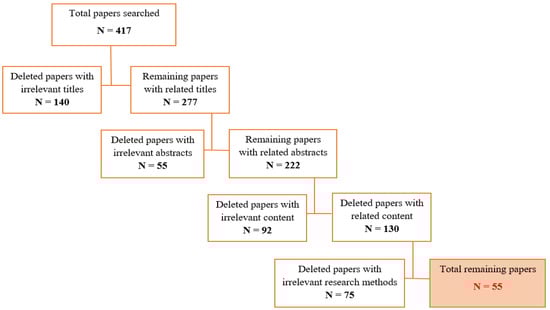
Figure 1.
Screening process of papers.
The next step was to evaluate the methodological quality of the research, which aimed to eliminate studies in which the researcher did not trust the findings. The most commonly used tool for assessing the quality of primary studies in qualitative research is the Critical Appraisal Skills Program (CASP), which helps identify the accuracy, validity, and importance of qualitative studies by asking ten questions. These questions focus on the following: 1. Research objectives, 2. Methodological logic, 3. Research design, 4. Sampling method, 5. Data collection, 6. Reflectivity, 7. Ethical considerations, 8. Accuracy of data analysis, 9. Clarity of results and findings, and 10. Value of research [63].
In using this tool, studies were assigned a score of 1 to 5 on the above criteria after being studied. Based on the 50-point scale of CASP, the researcher proposed a scoring system according to Table 2 and categorized the studies based on their methodological quality. Studies that scored below the “good” category (score 31) were excluded from the project [65].
Table 2.
Scoring system of the Critical Appraisal Skills Program (CASP).
In this study, the 55 studies that had survived the first round of filtering based on title, abstract, content, and research methodology were then evaluated using the CASP system (Table 3). After assigning scores to each study based on the given criteria and eliminating studies with a score of less than 31, 55 studies were finally accepted to enter the evaluation process, of which 11 studies were assigned to the “very good” category and 44 studies to the “good” category. Therefore, after a few rounds of filtering, 362 papers were eliminated from the initial 417 and 55 found their way to analysis (Figure S1, Table 4). After evaluating the papers, the data were categorized as primary codes (open code) with reference to the source and frequency. Each of the codes was then classified according to their meaning in terms of similar concepts, which helped identify the main components of the research Table 1.
Table 3.
The result of the Critical Appraisal Skills Program (CASP).
Table 4.
List of papers evaluated using the Critical Assessment Skills Program (CASP).
5.1.1. Analytical Quality Control
In qualitative research, the concept of trustworthiness is used instead of the concepts of reliability and validity. In this regard, to control the extracted concepts, the coding of the two researchers was compared. To evaluate the degree of agreement between two coders (by two people or using two tools or at two different times) and, therefore, to evaluate internal reliability, the Kappa interclass correlation was used in SPSS. The kappa index value is calculated to be 0.87, which is in the range of excellent agreement (0.81–1) [66].
5.1.2. Shannon Entropy
The steps for data analysis based on the Shannon entropy method are as follows:
- First, the frequency of each of the identified indicators should be determined based on content analysis:
- The desired frequency matrix should be normalized. For this purpose, the linear normalization method is used (Equation (1)):
- The entropy value of each indicator ( is calculated based on Equation (3):
- The significance coefficient of each indicator must be calculated. Whatever has a higher value is more significant (Equation (4)):
To calculate the weight of each of the components, the total weight of its codes was calculated, and the ranking took place based on the weights obtained in Table 5.
Table 5.
Determining significance and emphasis of the studied research on the effective factors.
5.2. Structural Analysis Using MICMAK Software
In this step, the ten components extracted in the previous step are placed in a 10 by 10 matrix and evaluated, based on the opinion of experts, by being assigned numbers between 0–3 in accordance with Table 6. The final availability matrix after expert scores is shown in Figure 2. Based on the findings obtained from Table 7, it can be said that the matrix filling index is 88%, which indicates the high degree of connectivity and influence of the identified variables with and on each other.
Table 6.
Evaluation table of relationships between variables.
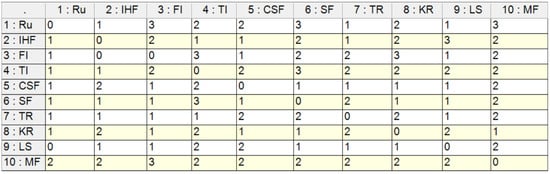
Figure 2.
Final availability matrix of research variables.
Table 7.
Preliminary analysis of interaction matrix.
5.2.1. Determining the Degree of Direct Influence and Dependence of Components
Based on the matrix of direct effects, the sum of rows and columns of the matrix indicates the degree of influence and dependence of the components, respectively. As can be seen in Table 8, the component of management factors has the greatest influence on other factors, and the components of laws and regulations and technological infrastructure come in second and third places. Based on the software results on the level of dependence, the component of technological infrastructure has been dependent on other components the most; management factors and security factors come in second and third in terms of dependence.
Table 8.
The degree of direct influence and dependence of components.
5.2.2. Location of Components in the Zones of the Influence and Dependence Map
Variables are divided into four types based on their location in one of the four areas of the influence-dependence map Figure 3:
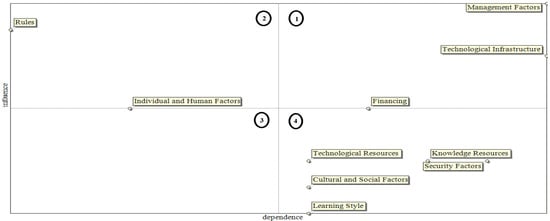
Figure 3.
Diagram of system stability/instability.
- (1)
- Zone (1) components (linkage or strategic variables): These components have two common characteristics of high degrees of influence and dependence, and any small change in these components will cause fundamental changes in the system. Based on the output of MICMAK software, components of technological infrastructure and management factors are located in this area.
- (2)
- Zone (2) components (influential variables): Zone 2 components influence the system more than they are dependent on it. The rules and regulations component is located in this area.
- (3)
- Zone (3) components (Independent variables): The components of this zone have, on average, lower degrees of influence and dependence. A change in these variables does not cause a serious change in the system. Individual and human factors fall within this zone.
- (4)
- Zone (4) components (dependent variables): The components of this zone have little influence on the system and are themselves subject to changes in other variables. The components in this zone include financing, technological resources, knowledge resources, security factors, cultural and social factors, and learning style.
5.2.3. Analyzing the Graph of Influence
The graph of influence shows the relationships between the components and how they influence each other. This graph is shown in the form of red and blue lines, the end of which is shown by an arrow and indicates the direction of the component’s influence. Red lines indicate strong influence of factors on each other and blue lines, with differences in thickness, showing moderate to weak relationships (Figure 4).
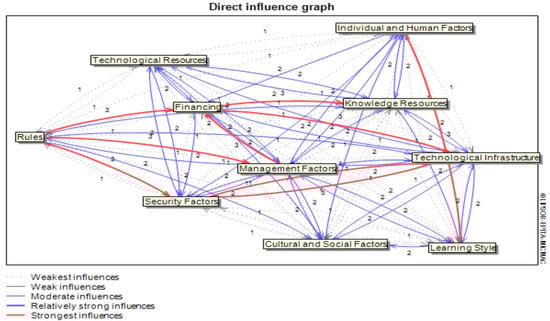
Figure 4.
The influence cycle graph.
The status of relationships in the graph of influence indicates that the variables of management factors, laws and regulations, and technological infrastructure have been the source of the most severe influences and increased their role in the system. Management factors, technological infrastructure, and security factors are also strongly influenced by other components of the system. Table 9 shows the share of each component in influence and dependence and Figure 5 shows the movement of each component.
Table 9.
Arrangement of components with the largest contribution to direct influence and dependence.
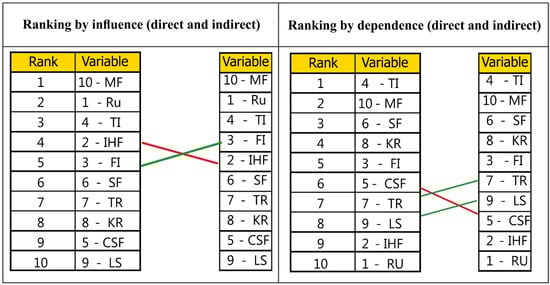
Figure 5.
Movement of components in direct and indirect influence and dependence.
6. Discussion and Conclusions
The Internet of Energy (IoE) technology as a novel solution has changed the methods of production, transmission, and consumption of energy and has affected human life. IoE plays an essential role as an efficient tool to increase energy efficiency, recover the economy of energy and sustainable development. In order to answer the research questions, two approaches of meta-synthesis and MICMAC analysis were used. First, after the screening process of papers based on Critical Appraisal Skills Program (CASP), relevant papers were identified and carefully reviewed. Then, the research parameters were coded using MAXQDA software to determine their frequency and classification. The kappa coefficient is a statistic in qualitative research that shows the robustness of the methodology by measuring the agreement of experts on the extracted codes. In this research, the Kappa coefficient value is 0.87, which is in the excellent range and indicates the reliability of the method. There is also a consensus among experts in the field of IoE about the research parameters. In the next step, the importance of each component was determined using the Shannon entropy and MICMAC structural analysis methods. In the Shannon entropy method, based on the frequency of components and calculating the significance coefficient for each of them, the components can be ranked. In the MICMAK structural analysis method, the influence and dependence levels of the components were obtained, which resulted in determining the strategic components that have the largest share in influence and dependence. In other words, the accuracy of the results can be ensured by comparing the results obtained from the Shannon entropy and MICMAK structural analysis methods. The results show that 82 indicators under the umbrella of ten axial components are involved in the implementation of IoE: rules and regulations, individual and human factors, financing, technological infrastructure, cultural and social factors, security factors, technological resources, knowledge resources, learning style, and managerial factors. In the Shannon entropy method, technological infrastructure (1), management factors (2), rules and regulations (3), technological resources (4), security factors (5), financing (6), cultural and social factors and individual and human factors (7), knowledge resources (8), and learning style (9) are the most significant, respectively. In MICMAK structural analysis, the components of management factors (1), technological infrastructure (2), security factors and financing (3), knowledge resources (4), rules and regulations and technological resources (5), cultural and social factors and individual and human factors (6), and learning style (7) have the largest share in influence and dependence, respectively. Conclusion: The two components of management factors and technological infrastructure are the most important in both methods and can be considered as key and strategic components, which is consistent with the findings of researchers, such as Taghavi et al., 2021 [17]; Miglani et al., 2020 [4]; Hua et al., 2019 [5]; Qiu et al., 2019 [19]; Sun, 2019 [45]; Lombardi et al., 2018 [47]; and Town et al., 2018 [38]. On the other hand, individual and human factors and cultural and social factors together are of equal importance, which is in accordance with the findings of Umer et al., 2019 [46]; Pirmagomedov and Koucheryavy, 2019 [36]; and Mahapatra, 2018 [41]. In both methods, the learning style has less priority.
One of the important points in qualitative research is that the basis of such research is the opinions of experts. Undoubtedly, the emergence of new studies in the area of IoE introduce new parameters that keep the way open for future research.
Today, Scenario-Based Strategic Planning (SBSP) is one of the most important and key tools in the field of future studies that has attracted the attention of many researchers. SBSP outlines a more realistic future for individuals and helps them make future decisions. The use of this tool requires the identification of key drivers in the subject under study. The output of this research can be a good criterion for future works of researchers. Therefore, it is suggested that researchers use the results of this study on the subject of future studies regarding the IoE. Blockchain technology is another emerging technology that is influential in various fields such as energy. In their study, Azizi et al. (2021) [67] mentioned the use of Internet of Things (IoT) and blockchain in the smart supply chain. In addition, as another suggestion to researchers, studying the application of blockchain technology in the field of IoE is another interesting topic that can pave the way for future research.
Supplementary Materials
The following supporting information can be downloaded at: https://www.mdpi.com/article/10.3390/su142013180/s1, Figure S1: PRISMA 2020 flow diagram for systematic reviews which included searches of databases and registers; Table S1: PRISMA 2020 Main Checklist; Table S2: PRISMA 2020 Abstract Checklist [68].
Author Contributions
Conceptualization, P.A., R.A. and M.H.T.; methodology, A.B.N. and M.H.T.; software, M.H.T.; validation, P.A., R.A. and A.B.N.; formal analysis, P.A. and M.H.T.; investigation, R.A. and A.B.N.; resources, P.A., R.A., A.B.N. and M.H.T.; data curation, M.H.T.; writing—original draft preparation, M.H.T.; writing—review and editing, P.A., R.A. and A.B.N.; visualization, A.B.N.; supervision, P.A. and R.A.; project administration, P.A., R.A. and A.B.N. All authors have read and agreed to the published version of the manuscript.
Funding
This research received no external funding.
Institutional Review Board Statement
Not applicable.
Informed Consent Statement
Not applicable.
Data Availability Statement
Not applicable.
Conflicts of Interest
The authors declare no conflict of interest.
References
- Hong, Z.; Feng, Y.; Li, Z.; Wang, Y.; Zheng, H.; Li, Z.; Tan, J. An integrated approach for multi-objective optimisation and MCDM of energy internet under uncertainty. Future Gener. Comput. Syst. 2019, 97, 90–104. [Google Scholar] [CrossRef]
- Hossein Motlagh, N.; Mohammadrezaei, M.; Hunt, J.; Zakeri, B. Internet of Things (IoT) and the energy sector. Energies 2020, 13, 494. [Google Scholar] [CrossRef]
- Hannan, M.A.; Faisal, M.; Ker, P.J.; Mun, L.H.; Parvin, K.; Mahlia, T.M.I.; Blaabjerg, F. A review of internet of energy based building energy management systems: Issues and recommendations. IEEE Access 2018, 6, 38997–39014. [Google Scholar] [CrossRef]
- Miglani, A.; Kumar, N.; Chamola, V.; Zeadally, S. Blockchain for Internet of Energy management: Review, solutions, and challenges. Comput. Commun. 2020, 151, 395–418. [Google Scholar] [CrossRef]
- Hua, H.; Qin, Y.; Hao, C.; Cao, J. Optimal energy management strategies for energy Internet via deep reinforcement learning approach. Appl. Energy 2019, 239, 598–609. [Google Scholar] [CrossRef]
- Pourbabak, H.; Chen, T.; Su, W. Centralized, decentralized, and distributed control for energy internet. In The Energy Internet; Woodhead Publishing: Cambridge, UK, 2018; pp. 3–19. [Google Scholar]
- Qi, J.; Wu, D. Green energy management of the energy Internet based on service composition quality. IEEE Access 2018, 6, 15723–15732. [Google Scholar] [CrossRef]
- Ren, S.; Hao, Y.; Xu, L.; Wu, H.; Ba, N. Digitalization and energy: How does internet development affect China's energy consumption? Energy Econ. 2021, 98, 105220. [Google Scholar] [CrossRef]
- Wu, H.; Hao, Y.; Ren, S.; Yang, X.; Xie, G. Does internet development improve green total factor energy efficiency? Evidence from China. Energy Policy 2021, 153, 112247. [Google Scholar] [CrossRef]
- Yoldaş, Y.; Önen, A.; Muyeen, S.M.; Vasilakos, A.V.; Alan, I. Enhancing smart grid with micro-grids: Challenges and opportunities. Renew. Sustain. Energy Rev. 2017, 72, 205–214. [Google Scholar] [CrossRef]
- Ahmad, T.; Zhang, D. Using the internet of things in smart energy systems and networks. Sustain. Cities Soc. 2021, 68, 102783. [Google Scholar] [CrossRef]
- Khatua, P.K.; Ramachandaramurthy, V.K.; Kasinathan, P.; Yong, J.Y.; Pasupuleti, J.; Rajagopalan, A. Application and assessment of internet of things toward the sustainability of energy systems: Challenges and issues. Sustain. Cities Soc. 2020, 53, 101957. [Google Scholar] [CrossRef]
- Wang, D.; Zhong, D.; Souri, A. Energy management solutions in the Internet of Things applications: Technical analysis and new research directions. Cogn. Syst. Res. 2021, 67, 33–49. [Google Scholar] [CrossRef]
- Rifkin, J. The Third Industrial Revolution: How Lateral Power Is Transforming Energy, the Economy, and the World; Palgrave MacMillan: New York, NY, USA, 2011. [Google Scholar]
- Bui, N.; Castellani, A.P.; Casari, P.; Zorzi, M. The internet of energy: A web-enabled smart grid system. IEEE Netw. 2012, 26, 39–45. [Google Scholar] [CrossRef]
- Huang, A.Q.; Crow, M.L.; Heydt, G.T.; Zheng, J.P.; Dale, S.J. The future renewable electric energy delivery and management (FREEDM) system: The energy internet. Proc. IEEE 2010, 99, 133–148. [Google Scholar] [CrossRef]
- Taghavi, M.H.; Akhavan, P.; Ahmadi, R.; Bonyadi Naeini, A. Modeling of the Internet of Energy (IoE) for Optimal Energy Management with an Interpretive Structural Modeling (ISM) Approach, Iranian Journal of Information. Process. Manag. 2021, 36, 1049–1080. [Google Scholar]
- Poyner, I.K.; Sherratt, R.S. Privacy and security of consumer IoT devices for the pervasive monitoring of vulnerable people. In Proceedings of the Living in the Internet of Things: Cybersecurity of the IoT, London, UK, 28–29 March 2018; pp. 1–5. [Google Scholar]
- Qiu, C.; Cui, S.; Yao, H.; Xu, F.; Yu, F.R.; Zhao, C. A novel QoS-enabled load scheduling algorithm based on reinforcement learning in software-defined energy internet. Future Gener. Comput. Syst. 2019, 92, 43–51. [Google Scholar] [CrossRef]
- Kafle, Y.R.; Mahmud, K.; Morsalin, S.; Town, G.E. Towards an internet of energy. In Proceedings of the 2016 IEEE International Conference on Power System Technology (POWERCON), Wollongong, NSW, Australia, 28 September–1 October 2016; pp. 1–6. [Google Scholar]
- Feng, C.; Liao, X. An overview of “Energy + Internet” in China. J. Clean. Prod. 2020, 258, 120630. [Google Scholar] [CrossRef]
- Yang, S.X.; Zhu, C.X.; Qiao, L.; Chi, Y.Y. Dynamic assessment of Energy Internet’s emission reduction effect—a case study of Yanqing, Beijing. J. Clean. Prod. 2020, 272, 122663. [Google Scholar] [CrossRef]
- Sani, A.S.; Yuan, D.; Jin, J.; Gao, L.; Yu, S.; Dong, Z.Y. Cyber security framework for Internet of Things-based Energy Internet. Future Gener. Comput. Syst. 2019, 93, 849–859. [Google Scholar] [CrossRef]
- Nguyen, V.T.; Vu, T.L.; Le, N.T.; Jang, Y.M. An Overview of Internet of Energy (IoE) Based Building Energy Management System. In Proceedings of the 2018 International Conference on Information and Communication Technology Convergence (ICTC), Jeju, Korea, 17–19 October 2018; pp. 852–855. [Google Scholar]
- Strbac, G.; Konstantelos, I.; Pollitt, M.; Green, R. Delivering future-proof energy infrastructure. In Report for National Infrastructure Commission; University of Cambridge & Imperial College London: London, UK, 2016. [Google Scholar]
- Strielkowski, W.; Streimikiene, D.; Fomina, A.; Semenova, E. Internet of energy (IoE) and high-renewables electricity system market design. Energies 2019, 12, 4790. [Google Scholar] [CrossRef]
- Zhihong, J.; Jian, H.; Wenzhou, L.; Zhe, C.; Ning, L.; Siyuan, W.; Chang, L. Energy internet—A new driving force for sustainable urban development. Energy Procedia 2018, 152, 1206–1211. [Google Scholar] [CrossRef]
- Xiao, Z.; Wang, J.; Yang, X.; Xiao, Y.; Liu, H.; Wu, Y.; Chen, J. Research on the medium and long-term development framework of smart grid under the background of energy Internet. Procedia Comput. Sci. 2020, 175, 769–773. [Google Scholar] [CrossRef]
- Chen, X.; Li, C.; Tang, Y.; Xiao, Q. An Internet of Things based energy efficiency monitoring and management system for machining workshop. J. Clean. Prod. 2018, 199, 957–968. [Google Scholar] [CrossRef]
- Liu, G.; Qu, L.; Zeng, R.; Gao, F. Energy internet in china. In The Energy Internet; Woodhead Publishing: Cambridge, UK, 2019; pp. 265–282. [Google Scholar]
- Shrouf, F.; Miragliotta, G. Energy management based on Internet of Things: Practices and framework for adoption in production management. J. Clean. Prod. 2015, 100, 235–246. [Google Scholar] [CrossRef]
- Wang, Z.L. Entropy theory of distributed energy for internet of things. Nano Energy 2019, 58, 669–672. [Google Scholar] [CrossRef]
- Zhang, J. Distributed network security framework of energy internet based on internet of things. Sustain. Energy Technol. Assess. 2021, 44, 101051. [Google Scholar] [CrossRef]
- Al-Ali, A.R. Internet of things role in the renewable energy resources. Energy Procedia 2016, 100, 34–38. [Google Scholar] [CrossRef]
- Cao, Y. Energy Internet blockchain technology. In The Energy Internet; Woodhead Publishing: Cambridge, UK, 2019; pp. 45–64. [Google Scholar]
- Pirmagomedov, R.; Koucheryavy, Y. IoT technologies for Augmented Human: A survey. Internet Things 2019, 14, 100120. [Google Scholar] [CrossRef]
- Mahmud, K.; Khan, B.; Ravishankar, J.; Ahmadi, A.; Siano, P. An internet of energy framework with distributed energy resources, prosumers and small-scale virtual power plants: An overview. Renew. Sustain. Energy Rev. 2020, 127, 109840. [Google Scholar] [CrossRef]
- Mahmud, K.; Town, G.E.; Morsalin, S.; Hossain, M.J. Integration of electric vehicles and management in the internet of energy. Renew. Sustain. Energy Rev. 2018, 82, 4179–4203. [Google Scholar] [CrossRef]
- Muhanji, S.O.; Flint, A.E.; Farid, A.M. eIoT: The Development of the Energy Internet of Things in Energy Infrastructure; Springer Nature: Berlin/Heidelberg, Germany, 2019; p. 160. [Google Scholar] [CrossRef]
- Lin, C.C.; Deng, D.J.; Kuo, C.C.; Liang, Y.L. Optimal charging control of energy storage and electric vehicle of an individual in the internet of energy with energy trading. IEEE Trans. Ind. Inform. 2017, 14, 2570–2578. [Google Scholar] [CrossRef]
- Mahapatra, C. Energy-Efficient Device Architecture and Technologies for the Internet of Everything. Ph.D. Thesis, University of British Columbia, University Endowment Lands, Vancouver, BC, Canada, 2018. [Google Scholar]
- Rana, M. Architecture of the internet of energy network: An application to smart grid communications. IEEE Access 2017, 5, 4704–4710. [Google Scholar] [CrossRef]
- Chen, Z.; Liu, Q.; Li, Y.; Liu, S. Discussion on energy internet and its key technology. J. Power Energy Eng. 2017, 5, 1–9. [Google Scholar] [CrossRef]
- Lin, B.; Zhou, Y. Does the Internet development affect energy and carbon emission performance? Sustain. Prod. Consum. 2021, 28, 1–10. [Google Scholar] [CrossRef]
- Sun, Q. Energy Internet and We-Energy; Springer: Berlin/Heidelberg, Germany, 2019. [Google Scholar]
- Umer, T.; Rehmani, M.H.; Kamal, A.E.; Mihaylova, L. Information and resource management systems for Internet of Things: Energy management, communication protocols and future applications. Future Gener. Comput. Syst. 2018, 92, 1021–1027. [Google Scholar] [CrossRef]
- Lombardi, F.; Aniello, L.; De Angelis, S.; Margheri, A.; Sassone, V. A blockchain-based infrastructure for reliable and cost-effective IoT-aided smart grids. In Proceedings of the Living in the Internet of Things: Cybersecurity of the IoT, London, UK, 28–29 March 2018. [Google Scholar] [CrossRef]
- Cao, Y.; Li, Q.; Tan, Y.; Li, Y.; Chen, Y.; Shao, X.; Zou, Y. A comprehensive review of Energy Internet: Basic concept, operation and planning methods, and research prospects. J. Mod. Power Syst. Clean Energy 2018, 6, 399–411. [Google Scholar] [CrossRef]
- Zhou, K.; Yang, S.; Shao, Z. Energy internet: The business perspective. Appl. Energy 2016, 178, 212–222. [Google Scholar] [CrossRef]
- Babar, M.; Khattak, A.S.; Jan, M.A.; Tariq, M.U. Energy aware smart city management system using data analytics and Internet of Things. Sustain. Energy Technol. Assess. 2021, 44, 100992. [Google Scholar] [CrossRef]
- Lin, C.C.; Wu, Y.F.; Liu, W.Y. Optimal sharing energy of a complex of houses through energy trading in the Internet of energy. Energy 2021, 220, 119613. [Google Scholar] [CrossRef]
- Mahapatra, C.; Moharana, A.K.; Leung, V. Energy management in smart cities based on internet of things: Peak demand reduction and energy savings. Sensors 2017, 17, 2812. [Google Scholar] [CrossRef]
- Raghavan, B.; Ma, J. The energy and emergy of the internet. In Proceedings of the 10th ACM Workshop on Hot Topics in Networks, Cambridge, MA, USA, 14–15 November 2011; pp. 1–6. [Google Scholar]
- Hyysalo, S.; Juntunen, J.K.; Martiskainen, M. Energy Internet forums as acceleration phase transition intermediaries. Res. Policy 2018, 47, 872–885. [Google Scholar] [CrossRef]
- Cao, J.; Yang, M. Energy internet-towards smart grid 2.0. In Proceedings of the 2013 Fourth International Conference on Networking and Distributed Computing, Los Angeles, CA, USA, 21–24 December 2013; pp. 105–110. [Google Scholar]
- Jaradat, M.; Jarrah, M.; Bousselham, A.; Jararweh, Y.; Al-Ayyoub, M. The internet of energy: Smart sensor networks and big data management for smart grid. Procedia Comput. Sci. 2015, 56, 592–597. [Google Scholar] [CrossRef]
- Ren, G.; Yu, M.; Yin, D.; Huang, S.; Xu, H.; Yuan, M. Design and optimization of integrated energy management network system based on internet of things technology. Sustain. Comput. Inform. Syst. 2021, 30, 100502. [Google Scholar] [CrossRef]
- Ziogou, C.; Voutetakis, S.; Papadopoulou, S. Energy Management Strategies for RES-enabled Smart-grids empowered by an Internet of Things (IoT) Architecture. In Computer Aided Chemical Engineering; Elsevier: Amsterdam, The Netherlands, 2017; Volume 40, pp. 2473–2478. [Google Scholar]
- Smart, G.; Atkinson, J.; Mitchell, J.; Rodrigues, M.; Andreopoulos, Y. Energy harvesting for the Internet-of-Things: Measurements and probability models. In Proceedings of the 23rd International Conference on Telecommunications (ICT), Thessaloniki, Greece, 16–18 May 2016; pp. 1–6. [Google Scholar]
- Shakerighadi, B.; Anvari-Moghaddam, A.; Vasquez, J.C.; Guerrero, J.M. Internet of things for modern energy systems: State-of-the-art, challenges, and open issues. Energies 2018, 11, 1252. [Google Scholar] [CrossRef]
- Yao, C.; Zhang, Z.; Yu, J.; Feng, W.; Zhou, C.; Han, Y. Research on operation and management multi-node model of mega city energy Internet. Glob. Energy Interconnect. 2018, 1, 130–136. [Google Scholar]
- Sandelowski, M.; Barroso, J. Handbook for Synthesizing Qualitative Research; Springer Publishing Company: Berlin/Heidelberg, Germany, 2006. [Google Scholar]
- De Ridder, D.T.; Lensvelt-Mulders, G. Taking stock of self-control: A meta-analysis of how trait self-control relates to a wide range of behaviors. In Self-Regulation and Self-Control; Routledge: England, UK, 2018; pp. 221–274. [Google Scholar]
- Omran, A.; Khorish, M.; Saleh, M. Structural analysis with knowledge-based MICMAC approach. Int. J. Comput. Appl. 2014, 86, 39–43. [Google Scholar] [CrossRef]
- Chenail, R.J. Learning to appraise the quality of qualitative research articles: A contextualized learning object for constructing knowledge. Qual. Rep. 2011, 16, 236–248. [Google Scholar] [CrossRef]
- Honorton, C.; Ferrari, D.B.; Hansen, G. Meta-analysis of Forced-Choice Precognition Experiments (1935–1987). In The Star Gate Archives: Reports of the United States Government Sponsored Psi Program, 1972–1995. Volume 2: Remote Viewing; McFarland: McFarland, CA, USA, 2018; Volume 291, pp. 1985–1995. [Google Scholar]
- Azizi, N.; Malekzadeh, H.; Akhavan, P.; Haass, O.; Saremi, S.; Mirjalili, S. IoT-Blockchain: Harnessing the Power of Internet of Thing and Blockchain for Smart Supply Chain. Sensors 2021, 21, 6048. [Google Scholar] [CrossRef]
- Page, M.J.; McKenzie, J.E.; Bossuyt, P.M.; Boutron, I.; Hoffmann, T.C.; Mulrow, C.D.; Shamseer, L.; Tetzlaff, J.M.; Akl, E.A.; Brennan, S.E. The PRISMA 2020 Statement: An Updated Guideline for Reporting Systematic Reviews. MetaArXiv. 14 September 2020. Available online: www.prisma-statement.org (accessed on 3 May 2022).
Publisher’s Note: MDPI stays neutral with regard to jurisdictional claims in published maps and institutional affiliations. |
© 2022 by the authors. Licensee MDPI, Basel, Switzerland. This article is an open access article distributed under the terms and conditions of the Creative Commons Attribution (CC BY) license (https://creativecommons.org/licenses/by/4.0/).