1. Introduction and Goals
Total cost management (TCM) is an integrated set of approaches, methods, and techniques to manage the relations among the techno-organizational and economic dimensions of projects and programs. The AACE International (Association for the Advancement of Cost Engineering) defines TCM as a process for applying the skills and knowledge of cost engineering [
1]. Initially conceived in 1990, the discipline has attracted a consolidated interest in the practitioner community, and it has developed as a systematic approach to managing resources, costs, profitability, and risks throughout the lifecycle of any enterprise, program, facility, project, product or service.
Several change factors are today creating a socio-technical scenario characterized by increasing volatility, uncertainty, complexity, and ambiguity (VUCA). In particular, the COVID-19 pandemic, the Ukrainian conflict, and the growing climate-change issues represent disruptive challenges, which are influencing in an unprecedented manner the context in which organizations are managed, and are significantly affecting the applications of TCM methods, and the management of organizations and complex projects and programs [
2,
3,
4,
5].
Whereas cost engineering is still crucial in organizational decision-making and business [
6] as it supports performance improvement and it helps accomplish business strategy [
7,
8], cost management should become more holistic and purposeful, while taking a supply chain and sustainability perspective [
9,
10]. Moreover, although the fundamental concept of TCM is similar across geographic contexts, there are differences due to the adaptation of the contextual constraints [
11,
12], which also calls for a renewed quest for global standards in project cost management [
13].
Moreover, the volatile context has generated the need to introduce more sophisticated approaches to managing unforeseen events and operational uncertainties. Faster rates of change in complex environments antagonize traditional risk assessment and demand a more dynamic approach. In order to mitigate the impact of a VUCA environment on complex projects, organizations and project leaders need in fact to know the type and severity of challenges they are dealing with in order to enhance the risk assessment procedure [
14].
All the described factors have implications on the assumptions of cost engineering and the TCM discipline. On top of that, the increasing sustainability requirements derived from the agenda of 17 goals (SDGs) of the United Nations, call for a logic of multi-stakeholder value able to address the competing and multi-dimensional needs of customers, employees, strategic partners, and large stakeholder ecosystems.
The idea of incorporating more value-oriented approaches to managing complex organizational and business ecosystems is not new. In the last two decades, the concept of value management was discussed in the shipbuilding industry [
15], with a focus on lean total quality management (TQM) and the shift from TQM to total value management [
16], and the integration of TQM into concurrent product and process development [
17]. Whereas the idea of value was predominantly associated with an “extension” of quality, there are still no attempts to bring and operationalize the idea of systemic value creation and value management into the traditional specialist fields of cost engineering and total cost management (TCM).
In such a scenario, the goal of this research was to analyze the main transformation drivers affecting the contemporary business and socio-technical scenario and to identify areas of development of TCM as an evolving discipline and profession. The study shows a review of cross-disciplinary literature and the use of direct authors’ engagement and long dated expertise to design a conceptual framework and a research manifesto for a next-generation TCM. The research has the ambition to advance the current knowledge on value-based and sustainable approaches to management and to offer to experts and business leaders a basis to implement innovative development projects in the area of TCM. In particular, a research agenda is presented, including nine trajectories which provide food-for-thought to support the evolution of TCM towards systemic value management (SVM).
The paper is a conceptual effort and the outcomes of the research can support future empirical studies aiming to fine-tune or test the outlined assumptions. The framework building process is driven by a literature-based conceptual exploration and systematization activity, which is supported by Delphi-style rounds of discussions and intelligence gathering performed by the authors acting as an expert panel and conducting participant observation.
The remainder of the paper is structured as follows.
Section 2 presents the background concepts and the current challenges arising in the field of TCM.
Section 3 presents the research process undertaken to derive findings.
Section 4 illustrates the first “part” of findings, i.e., the transformational business and socio-technical trends influencing TCM whereas
Section 5 presents research trajectories aimed to develop new approaches and artefacts for a systemic value management (SVM) discipline.
Section 6 concludes the paper with limitations and avenues for further research.
2. Total Cost Management: Background and Current Challenges
The great economic crisis of 1929, and the subsequent Second World War, contributed to the refinement of the scientific methods adopted by large companies in their activities. In the wake of the great scientific discoveries of the twentieth century, mathematics and science were in fact increasingly being used in many fields of human activity, including the management of large organizations and complex project endeavors.
The Moon landing, and the related enabling projects and activities, drove the development of methods such as PERT (Project Evaluation Review Technique) and CPM (Critical Path Method), and probabilistic applications (e.g., GERT) requiring sophisticated mathematical procedures. In addition, based on the use of sophisticated information systems, those methods provided the elements for a more “scientific” approach to the analysis and evaluation of industrial investments (business planning) and complex project efforts.
Starting from the 1950s, also in order of responding to the request of major postwar development programs, many professional associations were established in the field of project management as well as in areas at the boundaries between engineering and economics, which brought the development of a new concept or discipline, i.e., cost engineering. The Dutch association DACE (1953), the US association AACE (1958), and the British association ACostE (1960) represent pioneering efforts in such a perspective. The growing interest in cost engineering brought about the establishment, in 1976, of ICEC (International Cost Engineering Council) as a global network. The International Cost Engineering Council (ICEC) is a non-political and non-profit organization founded to promote cooperation between national and multinational cost engineering, quantity surveying, and project management organizations worldwide. Through its chapters and sections, ICEC has today access to more than 120,000 cost engineers and project managers in over 120 different nations.
In Italy, the AICE (Associazione Italiana di Ingegneria Economica—Italian Association for Total Cost Management) was founded in 1979. Since its beginning, it has cooperated with the Institute of Quantitative Methods of the Bocconi University and since 1980 it has been a member of ICEC with an accredited certification program. AICE has also gradually extended its scope and focus and has developed an integrated conceptual and professional framework, with the purpose of promoting a more systematic approach to the management of costs.
Over the years, also driven by the growth of international associations, many handbooks, body of knowledge reports, and other contributions have been published on total cost management and project control, program feasibility analysis, and mathematical approaches to managing project activities [
18,
19,
20,
21]. The proliferation of technical documentation and autonomous professional associations created, in turn, some “identity issues” and doubts on the knowledge and expertise boundaries between disciplines such as total cost management and project management. In this regard, ICEC has recently proposed a more effective characterization and specialization of knowledge areas related to cost engineering, which is also a basis for defining stronger alliances and synergies among different associations.
In the IX ICEC World Congress (held in Milan in October 2014), total cost management was discussed as a key approach to control projects, products, and strategic assets. The congress gave the opportunity to outline how “cost” can effectively evolve into “value”, a concept which is today central in many business and socio-technical discussions. Following such new direction, in January 2015 the Board of AICE constituted a working group to discuss and design new development trajectories for the association. The project titled “AICE 2.0” was launched to develop different innovation paths for the association and to define the foundation of a new approach in creating multi-stakeholder value through a systematic use of methods and techniques, and with potential impact on different units of analysis, such as activities, products, assets, projects, and entire organizations.
The trend towards a new understanding of TCM, and the inclusion of more value-oriented considerations, has especially developed over the last five years, in which the socio-technical scenario has revealed the fragility and vulnerability of human, economic, political, and social aggregates. As discussed in the introduction, the COVID-19 pandemic and the Russian–Ukrainian conflict have had serious repercussions on business and social eco-systems. Vulnerabilities and fragility have affected global value chains [
22,
23], and are today contributing to the risk of violating workers’ human rights, raising new and more pressing concerns on the future sustainability of a global economy. Hence there is the opportunity to envision a more regional world economy able to offer a better balance between national and international interests, and to build more resilient global supply chains able to generate positive externalities on growth, social inclusiveness, and equity.
In the context just described, TCM can no longer be understood as a discipline solely aimed at the company and the project—their management, programming, monitoring, or reporting. Especially for large institutional, national, and international projects, which are increasingly numerous in the context of vast crises, the idea emerges that it is not the technical capacity of process governance that is lacking, but rather the holistic capability of the same to generate sustainable value for a large plethora of stakeholders.
Sustainability is a broad goal with three interrelated dimensions, i.e., environmental, economic, and social. Whereas there are numerous indicators which could be used as a basis for sustainability measurement, few of them are commonly used in practice, and some of them may turn to be just theoretical or inappropriate for developing sustainability in practice. A general shared agreement on sustainability measurement seems not to be still in place. The arising environmental complexity poses a number of new design and governance issues in today’s project end enterprise endeavors, which include both strategic and operational problems to be faced by managers. The successful management of projects and complex organizations thus requires the development of purposeful technical and contextual knowledge among all the stakeholders, while the increasing complexity shows all the limitations deriving from the use of non-systemic management approaches.
Considering the underlying themes around which the debate in the scientific literature and civil society (economic, industrial, institutional, and political) is developing today, TCM cannot avoid contributing and evolving accordingly. Whichever models are adopted for a transition towards sustainability and value creation, their application in practice will certainly not be automatic, easy, and without continuous work of optimal adjustment.
3. Research Process
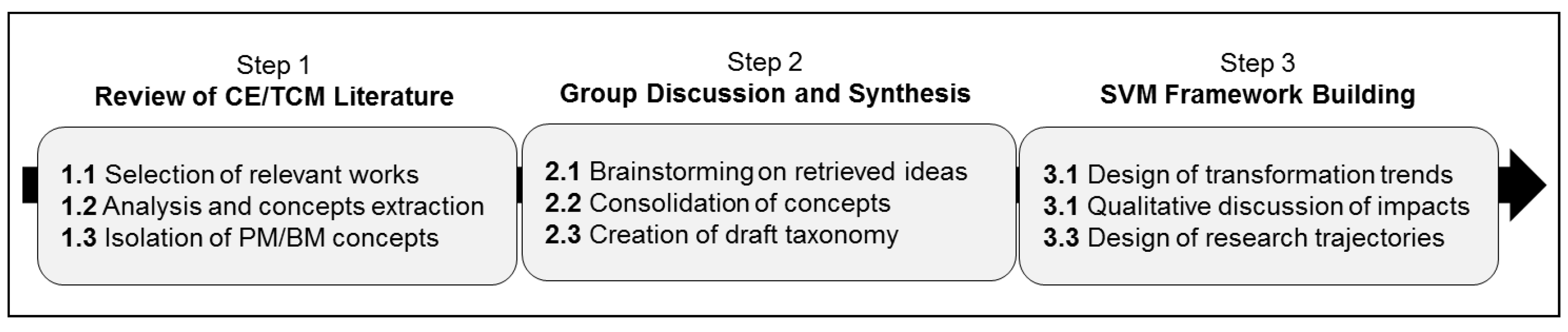
The study adopts a mixed methodological approach, which was based on the execution of three research steps, as shown in
Figure 1, i.e.,
Review of CE/TCM Literature,
Group Discussion and Synthesis, and
SVM Framework Building.
First (
Review of CE/TCM Literature), a review of cross-disciplinary literature streams was conducted in the cost engineering and total cost management fields with the purpose of deriving the following: (a) socio-technical and business/project management challenges that are reshaping contemporary industries, markets, and societies; and (b) the transformational trends of specific relevance for the TCM endeavor. To gather definitions and conceptualizations useful for the study, a review of specialized research works was undertaken [
24].
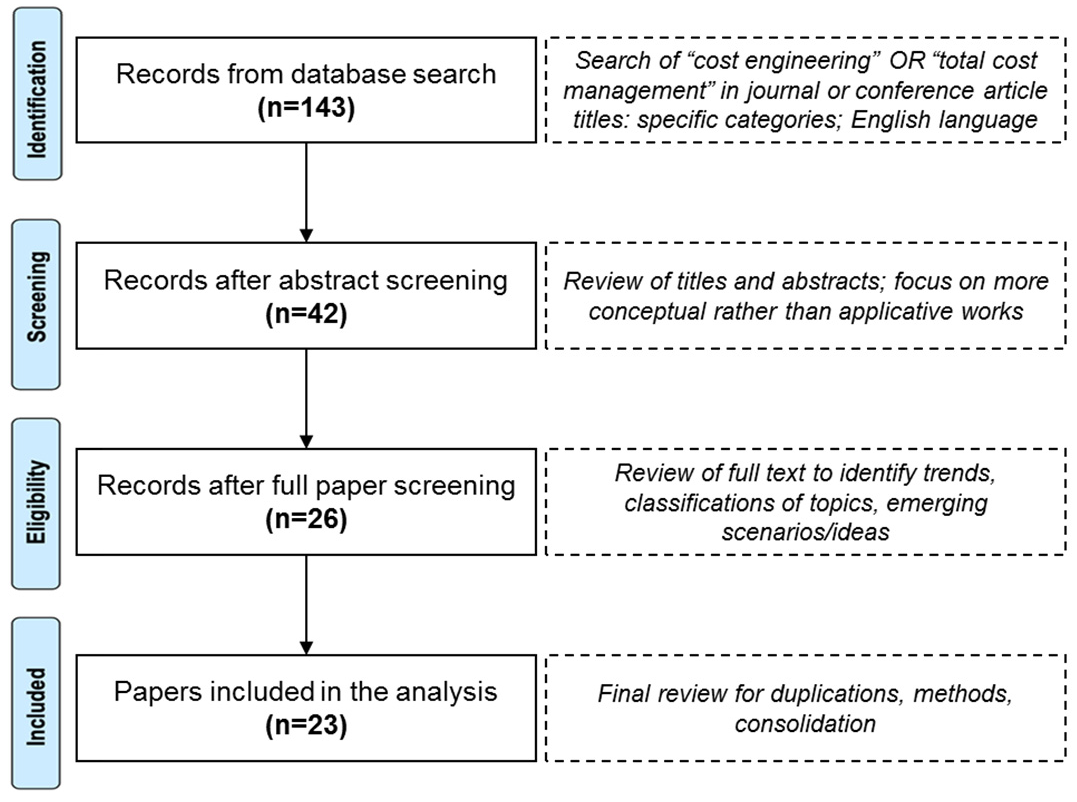
Figure 2 shows a chart of the literature identification and selection process. In line with the PRISMA (
Preferred Reporting Items for Systematic Reviews and Meta-Analyses) guidelines, we attempted to improve transparency in the review activity and to avoid biases in the article identification and selection process. To achieve this, the key element was to predefine and share objective inclusion and exclusion criteria, and to proceed gradually with every step using a collaborative approach among all the authors. PRISMA offers an evidence-based minimum set of items aimed at reporting systematic reviews and meta-analyses. The method focuses on ways in which authors can ensure a transparent and complete reporting of research activities, and it includes four main steps [
25] as reported in
Figure 2 for our study.
Using the Scopus® database, a search was performed (end of August 2022) to retrieve the research strings “total cost management” OR “cost engineering” into article titles, with a limitation to works published in scientific journals and conference articles written in English. Scopus® offers a comprehensive and cross-disciplinary view of the extant state-of-the art knowledge. We only considered journal papers and relevant conference articles, which ensures a reasonable overlapping with papers retrieved using different research databases. We limited our selection to articles related to the categories “engineering”, “business management and accounting”, “decision sciences”, and “economics, econometrics and finance”. Using such research criteria, 143 research articles were identified (Identification step) for further analysis. We then looked more in-depth at titles and abstracts of selected papers to identify, more than specific applications of TCM or industry/company-related studies, articles providing a broader investigation of the meaning of cost engineering and TCM, and the main evolution trends in the discipline. We selected (Screening step) 42 articles for full-text analysis. The in-depth analysis of those articles allowed the isolation of (Eligibility step) 26 works of highest relevance for the specific purposes of the research. A final review for duplications, methods, and consolidation (Inclusion step) allowed the selection of 23 works based on which a number of key trends and conceptual elements were extracted to represent the starting point for the collective authors’ discussion (Step 2).
In the second step (
Group Discussion and Synthesis), direct authors’ engagement and consolidated expertise in the TCM field was leveraged to drive a group model building exercise. Each author holds 20 to 30 years of experience by a twofold academic perspective on project management theories and methodologies, and practitioner expertise on industrial and company-based applications in areas such as technology entrepreneurship, digital innovation, and new product development. The group discussion included a preliminary meeting (to establish the goals, define the approach, and share material), and actual group modelling sessions [
26] which were aimed to identify and share key concepts related to transformational trends and new research and development needs in the field of TCM. Based on the outcomes of the preliminary literature review, one author acting as facilitator produced an extraction table containing a long-list of key ideas, trends, challenges, and other aspects of relevance for outlining the evolution of TCM. The table represented the basis for collective brainstorming and the gathering of new ideas.
The final step (SVM Framework Building) was aimed to use the outcomes of the literature review and group discussion to define an integrative framework of SVM. The work of synthesis and integration enabled three results to be obtained. First, a definition of transformative business and socio-technical trends of relevance for the TCM field. Second, a preliminary discussion on the qualitative impact of those trends on key TCM areas or units of analysis. Third, a definition of research trajectories providing a research and development agenda for the evolution of TCM towards a new idea of SVM. The three outcomes were preliminarily validated with senior managers of leading international organizations, who provided useful insights and feedback aimed to improve the developed artefacts. This paper outlines a concept of systemic value management (SVM) based on literature review and authors’ expertise. The outcomes of the research can support future empirical studies aiming to fine-tune or test the outlined assumptions.
4. Findings A: Transformational Trends
This section presents a classification of nine socio-technical and business trends which have today a major influence on the discipline and profession of TCM. The impact of those trends on six key TCM dimensions is also qualitatively evaluated.
4.1. Organizational Agility, Business Continuity and Resilience
The pandemic emergency and the Ukrainian conflict have highlighted the importance of organizational agility and business continuity as key capabilities to effectively react to emergencies and different types of disruption [
27]. Agility includes a combination of technology, data, people, and process components [
28], which support the organizational capacity to rapidly “sense” the environment and adapt accordingly or anticipate the transformation forces. The complex socio-technical and geo-political scenario will increasingly put organizations and projects in front of disruptions and wicked challenges to address by leveraging individual and group resilience. To foster agility and flexibility, the organizational equilibrium in enterprises and institutions has to evolve towards horizontal and more collaborative configurations [
29]. This has a potential impact on dimensions such as project management mindset and configurations, and the strategic approach to using core organizational assets. The impact of the evolving inter- and intra-organizational models and the transforming idea of “agility” should be also explored in terms of the nature and re-configuration of transaction costs, especially from a supply network and ecosystem perspective. The described trend is of interest for organizations (and projects) of different size and potentially operating in any industry. The idea of agility and resilience is especially relevant for organizational and project stakeholders mostly concerned with logistics and operations management, as well as with human resource and change management (agility awareness and preparedness).
4.2. Digital Transformation and Platform Revolution
The business world is living a networked and platform-centric revolution [
30], where digital technologies are creating ecosystems of organizations and individuals able to create new forms of socio-economic value [
31]. Double-side and multi-sided platforms allow creation of new business models and new ways of addressing specific market needs by gathering purposeful product and service portfolios. Platform strategy emerges thus as an approach to entering and dominating a market, which revolves around the task of allowing platform participants to benefit from the presence of others. The pervasive digitalization and growth of platforms has a differentiated impact on the role and application of TCM in networks of inter-organizational ecosystems dealing with cooperative and coopetitive projects.
The boundary between the concepts platforms and ecosystems should be clarified. A platform is a value mechanism within an ecosystem of participants and contributors. With such a view, it is a socio-technical configuration and a tool to enhance the synergies and coordination management arising within the ecosystem. The described trend is of interest for organizations (and projects) of different size and potentially operating in any industry. The idea of digital transformation is particularly relevant for organizational and project stakeholders mostly involved with innovation and change management processes and dealing with the strategic foundations of operational transformation aimed to enhance efficiency and effectiveness based on technology adoption.
4.3. Sustainability and Sustainable Development Goals
Sustainability is today much more than a buzzword, as a number of pressing environmental and societal challenges are increasingly requiring individuals, organizations, and institutions to define and apply more effective approaches to ensure socio-economic progress while properly addressing the ability of future generations to achieve sustainable development goals [
32]. The UN agenda 2030 has set a systemic and compelling program of 17 critical sustainable development priorities to be achieved by world governments, here including end poverty and hunger, protect the planet from degradation, foster peaceful, just, and inclusive societies, and ensure sustainable consumption and production patterns. This has a relevant impact on different TCM areas of application, considering the obligated changes in the way how enterprises and institutions have to define and manage the aspects of their global and local operations [
33], as well as the impact of project activities and outcomes in terms of sustainability and sustainable development goals.
The described challenge is of potential importance for organizations (and projects) of different size and operating in any industry. The idea of sustainability today generates an integrative business requirement which is especially relevant for organizational and project stakeholders mostly involved with strategic design, portfolio management, and corporate relations management (including corporate responsibility).
4.4. Green and Circular Economy, Green Production
Environmental concerns have direct and indirect implications on TCM, in many possible directions. In terms of new production and consumption models, “circular” approaches are increasingly developing as an industrial trend aimed to extend the lifecycle of products and services and to enhance reuse and recycling for new productions in line with a green or bio-oriented economy [
34]. Green manufacturing is the renewal of production processes and the establishment of environmentally friendly operations, thus organizations are compelled to use fewer natural resources, reduce pollution and waste, recycle and reuse materials, and moderate emissions in their processes. The reduction target of CO
2 emissions is increasingly radical and will affect how industry will be organized in the future. This “green awareness” has a potential impact on different areas of TCM, including the management of key assets, the execution of operational processes, and the identification and validation of strategic projects. The described trend is of interest for organizations and projects of different size and operating in any industry. The idea of a green and circular economy is especially relevant for organizational and project stakeholders involved with product design and engineering, and process engineering aimed to optimize resource allocation and utilization in a product/service lifecycle perspective.
4.5. Exponential and Fast-Growth Organizational Models
Exponential technologies such as artificial intelligence, 3D printing, advanced materials, Internet of Things, and virtual reality are driving the creation of a new breed of business and non-business organizations able to scale rapidly their industries and markets thanks to a number of internal and external drivers. These entities are called “exponential organizations” [
35], and the trend is of great interest in terms of how such entities are able to conceive, design and undertake hi-impact initiatives in very short time-frames. In this perspective, a new area of investigation could derive from the academic and practitioner discussion on how organizations are able or expected to reinvent themselves [
36]. This has a potential impact on different areas of TCM, including product portfolios, strategic technology assets, and the entrepreneurial processes of the organization.
The challenge is of interest for organizations and projects of different dimensions and scope and potentially operating in any industry. The idea of exponential innovation is especially relevant for organizational and project stakeholders mostly involved with disruptive technologies and product/process redesign or business model reinvention based on the use of exponential technologies.
4.6. Open and Stakeholder-Driven Innovation Networks
The high number and variety of elements affecting the business and socio-economic equilibrium brings about the adoption of discontinuity as an approach for innovation [
37]. Closed and single-loop models of innovation do not seem to properly grasp the complexity of modern socio-technical ecosystems, the multifaceted nature and expectations of key stakeholders, and the great potential existing in distributed models of collective intelligence. Organizations and project endeavors should thus properly connect strategic orientation, innovation strategy, and corporate sustainability in order to support innovation through sustained stakeholder engagement [
38]. Open innovation and the distributed organization of innovation becomes increasingly the most effective response to the quest for time-critical and stakeholder-oriented innovation actions. This has a differentiated impact of different areas of TCM, including innovation processes and collaborative projects in the extended enterprise configuration.
This challenge is of interest for organizations of different size and potentially operating in any industry. The idea of open and stakeholder innovation is especially relevant for organizational and project stakeholders mostly involved with customer-driven product/service innovation, as well as with complex problem resolution endeavors which require a collective intelligence and open (ecosystem-based) approach.
4.7. Human-Centered Organization and HR Analytics
As business intelligence becomes more and more a strategic capability of organizations, the adoption of advanced analytics and artificial intelligence are today crucial for the governance of human resources in organizations and complex projects. On the one hand, to free people’s energy as a way to recover humanistic logic in people management [
39], on the other hand to allocate the right people to the right goals to achieve. The adoption of descriptive, predictive, and prescriptive HR analytics [
40] is decisive to support evidence-based and people-oriented value creation. The building of “individualized” or “people-centered” organizations requires a more analytical and fact-based understanding of how human resources can be more effectively and purposefully allocated to specific decisions and actions. This trend has an impact on different aspects of relevance for TCM, including workforce economics, evaluation of human resource assets, key resource management, and project allocation processes.
As with all of the above, the described trend is of major interest for organizations of different sizes and potentially operating in any industry. The idea of people analytics is especially relevant for organizational and project stakeholders mostly involved with strategic management and human resource management embracing innovative ideas of how an organization’s success is driven by people-centered and HR-oriented approaches.
4.8. Technology Entrepreneurship and Business Venturing
The emergence of disruptive technologies (technological “singularity”) has fed the creation of new entrepreneurial initiatives aimed to transform the potential of innovative scientific discoveries and engineering solutions into value-creating products and services. In general, technology-driven entrepreneurship grows alongside the ability to develop a technology perspective of entrepreneurship [
41], and new forms of technology entrepreneurship systems [
42]. Whereas individual-centered entrepreneurship is a “traditional” agent-driven entrepreneurship process, large organizations and project endeavors gradually develop a more mature approach to “corporate entrepreneurship” and business venturing as a pre-condition of business growth and sustainable development. This trend has a potential impact on different areas of interest for TCM, including asset and portfolio management, entrepreneurial processes, and the evaluation activity supporting the launch of new ventures.
The topic is of potential interest for organizations of different sizes and operating in any industry. The idea of technology entrepreneurship is especially relevant for organizational and project stakeholders mostly involved with innovation and business development driven by the ability to transform technology opportunities into value added products and services able to generate new market segments or purposeful new ventures.
4.9. Emergence of Exponential Technologies and Industry 5.0
The last macro-trend concerns the emergence of new industrial configurations enabled by “Industry 5.0” technologies and applications [
43]. Such new technologies are general purpose, enabling, and pervasive tools and solutions holding a myriad of potential applications in many industries, markets, and areas of human life. In the EU understanding, Industry 5.0 complements and extends Industry 4.0 as it emphasizes crucial aspects, beyond purely economic and technological dimensions, which include environmental, social, and fundamental human rights aspects. This has a potential impact on different areas of relevance for TCM, including corporate assets and operational processes, as well as the impact of technological innovation in production and social systems.
The described trend is of interest for organizations (and projects) of different sizes and potentially operating in any industry. The idea of Industry 5.0 is especially relevant for organizational and project stakeholders mostly involved with asset management, production configuration, and logistics issues.
4.10. A Primer on Impact of Trends on TCM Areas
This section introduces a qualitative evaluation of the impact of the presented nine trends or global socio-technical challenges on a number of TCM dimensions. In particular, in line with extant definitions of total cost management knowledge areas, the management “units” and control dimensions typically associated with TCM include the following:
Asset and Technology Management;
Process and Activity Management;
Product and Service Management;
Project and Program Management;
Business and Enterprise Management;
People and Human Capital Management.
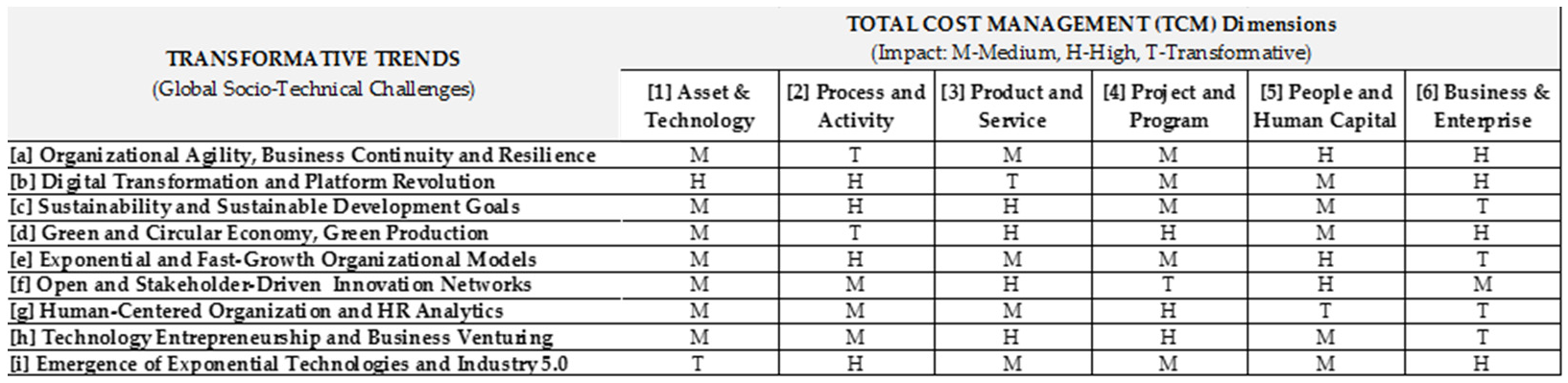
The impact of transformative trends or global socio-technical challenges, although transversal to the different management levels/units, can be graduated to define “M” (medium), “H” (high), or “T” (transformative) degree of impact.
Figure 3 shows a synopsis of the identified trends and the impact on the six dimensions. It is likely to imagine that at least one of the nine trends is expected to generate transformative impacts on at least one TCM dimension. Whereas this qualitative discussion is proposed with the only purpose of providing food-for-thought for future research and discussion, the analysis of impact(s) should of course be undertaken based on the definition of more specific assumptions and metrics-based evaluations.
This article is a conceptual paper and it does not have an ambition to present any empirical outcomes or considerations. Nevertheless, the contributory nature and value added from the research is objective and it can be incorporated into the presentation of a systematization or “platform” study to be the basis for several more specific (also empirical) contributions. Concerning the assessment of impacts brought about by the defined trends, the content presented is only qualitative and purely illustrative. Whereas it represents a quite marginal aspect of the overall research undertaken, it is useful to reflect on the specific relevance of how/how much the trends can influence the peculiar dimensions of TCM. The impact concept is thus not associated with the “included studies” but rather with the defined transformation trends. The evaluation “exercise” was based on expert feedback and authors’ discussion.
5. Findings B: Research Trajectories and Innovative Artefact Development
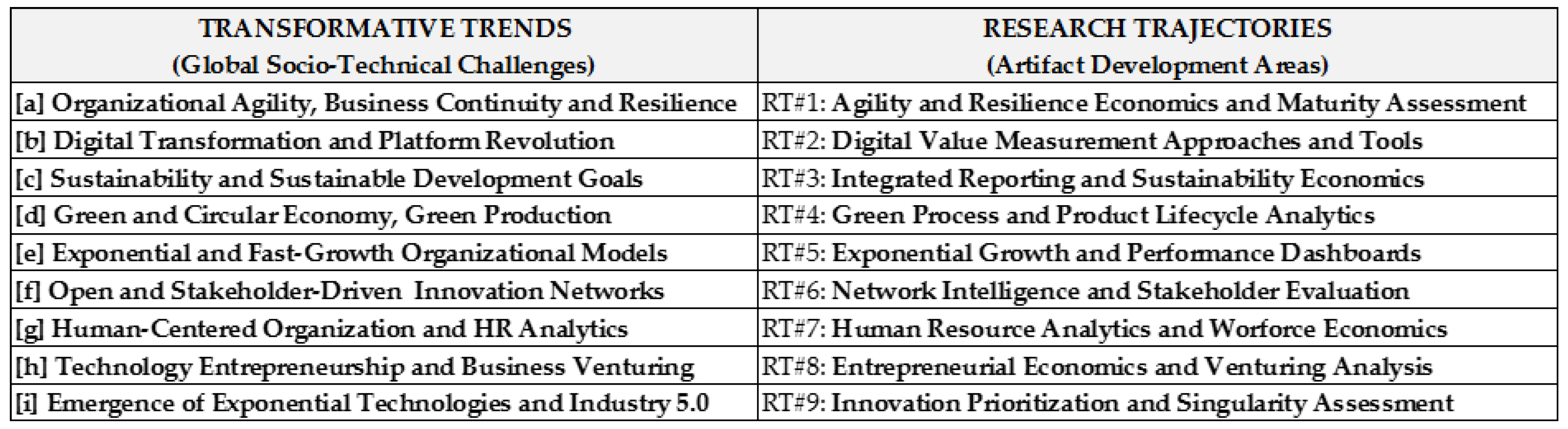
Based on the nine transformational trends introduced in
Section 4, a research agenda is presented below including knowledge and artifact development trajectories for scholars and practitioners engaged in supporting the evolution of the TCM discipline along a perspective of systems value and sustainable management (SVM).
Figure 4 shows a synopsis of the association of identified trends or global socio-technical challenges and the proposed research trajectories (which help to define related artifact development areas). Trends were obtained, starting from the outcomes of the SLR (structured literature review), based on authors’ discussion and gathering of expertise and points of view. Trends were then associated with trajectories.
5.1. RT#1: Agility and Resilience Economics and Maturity Assessment
The first area in which to advance specialized knowledge and develop new approaches, methods, and tools is the qualitative evaluation and quantitative measurement of organizational and project agility and resilience, here including the assessment of individual resilience capabilities. In line with the evolution of TCM towards SVM, there is thus a call to develop a new definition of agility and resilience economics (cost foundations and cost implications, but also extension to a larger consideration of “value” of agility and resilience) which has not yet been incorporated into the management of complex systems. Whereas efficiency and cost reduction have been traditionally targeted as key goals, these are today insufficient to address the emerging organizational requirements. In fact, resilience development may imply an additional production capacity, also “converted” when external factors bring about modification of the production input, output or both, and an increase or reconfiguration of direct and indirect costs. In such a view, new analytical models are needed. The traditional break-even analysis would not be appropriate anymore, and new approaches and tools will be required to measure and monitor agility and resilience in the perspective of SVM. A call for follow-up and artifact development can be envisioned for strategy, finance and operations management scholars and practitioners aiming to contribute to enhance the agility and resilience “intelligence” of organizations and institutions.
5.2. RT#2: Digital Value Measurement Approaches and Tools
The second domain in which to advance specialized knowledge and develop new approaches, methods, and tools is the measurement of the digital value of an organization, project or production system. In line with the evolution of TCM towards SVM, there is thus a call to develop quantitative models and relevant information systems able to cope with the requirements of the scientific research (first) and the practitioner applications (after) in the scenario of digital transformation. The value of a digital organization cannot be measured using traditional approaches and techniques. The call for new practitioner-led research and artifact development effort is thus aimed to generate SVM methods able to identify the cost and value determinants of the “digital” into new organizational configurations. A follow-up and development goal exists for digital innovation scholars and business engineering practitioners aiming to contribute to the evaluation of the value creation potential of organizations based on the adoption of digital technologies.
5.3. RT#3: Integrated Reporting and Sustainability Economics
The third area in which to advance specialized knowledge and develop new approaches, methods, and tools is the elaboration of comprehensive (systems view) reports of sustainability aspects and management dimensions. In line with the evolution of TCM towards SVM, there is a call to develop new conceptual links between organizational cost and value determinants, and the application of the same into more sophisticated analytics and reporting frameworks. The principles and the framework of integrated reporting defined by the IIRC—International Integrated Reporting Council [
44]—state that the resources used (and affected) by an organization, which are collectively referred to as “the capitals”, represent stocks of value that are increased, decreased, or transformed through the activities and outputs of the organization. They are categorized in the <IR> Framework as “financial”, “manufactured”, “intellectual”, “human”, “social and relationship”, and “natural” capital. The ability of an organization to create financial value is interrelated with the value the organization creates for the stakeholders and the society at large through a wide range of activities and relationships. With such a view, there is a need to build and share new approaches and tools for classifying, auditing, and describing the different “capitals” of an organization or a complex project/program. An interesting evolution in such a perspective is represented by the publication the ICMS standard related to the presentation of construction life cycle costs and carbon emissions [
45], with a view on the natural capital and natural resource impact of complex project endeavors. While integrated reporting is an important topic for modern organizations, it may also be limited in its applications, including the geographic scope of adoption, and has competing methodologies as well. A call for follow-up and development can be envisioned for business analytics scholars reporting and business intelligence practitioners aiming to advance the capacity to measure the role of intellectual capital management for value creation and sustainability.
5.4. RT#4: Green Process and Product Lifecycle Analytics
The fourth domain in which to advance specialized knowledge and develop new approaches, methods, and tools in the field of TCM is related to the lifecycle analytics of new product/service development when green strategies and approaches are adopted. In line with the evolution of TCM towards SVM, there is thus a call to develop new evaluation methods in green production design and monitoring. The impact of environmental sustainability concerns is increasingly strong in the conceptualization, design, and execution of large-scale projects. This requires definition of new quantitative methods able to measure and correlate a number of green-related KPIs which should be monitored over the project lifecycle in order to meet the requirements provided by customers or government norms or protocols. A call for follow-up and development can be identified for product development scholars and practitioners aiming to support the development of an evidence-based “green awareness” and a lifecycle management approach within organizations and institutions.
5.5. RT#5: Exponential Growth and Performance Dashboards
The fifth area in which to advance specialized knowledge and develop new approaches, methods, and tools in the field of TCM is the definition and evaluation of innovative performance measures and management dashboards able to properly address the value creation capacity of hi-growth organizations. Exponential organizations are able to grow at an above-average rate—up to ten times faster than comparable companies in the industry—but they can do this with considerably fewer resources thanks to new forms of organization and the use of new digital technologies. In most cases, such exponential organizations adopt project or matrix organizations able to provide the required agility and operational dynamicity. It is thus of relevance also to control and measure the performance of projects and programs realized by exponential organizations, in which trade-off among cost/efficiency and effectiveness/agility respond to a new logic and should be assessed using purposeful approaches. A call for follow-up and development can be thus identified for strategy and business analytics scholars and practitioners aiming to rethink the methods used to measure organizational performance in the evolving business and technological scenario.
5.6. RT#6: Network Intelligence and Stakeholder Evaluation
The sixth domain in which to advance specialized knowledge and develop new approaches, methods, and tools in the field of TCM is related to the economic and analytics dimensions of organizational networks and open innovation projects. The increasing scale and scope of large international programs (especially in technology-driven sectors), which require multiple capabilities and cross-disciplinary contributions, brings about today the development of new forms of “network intelligence”. The need is to build new evaluation approaches and methods keener to measure the cost and value creation dimensions of large stakeholder consortia. New forms of analytics should be conceptualized in theory and applied in practice to ensure a systematic approach (SVM) to managing resources, costs, profitability, risk, and value throughout the life-cycle of network-based organizations. A call for follow-up and development can be suggested for business ecosystem scholars and practitioners aiming to contribute to enhance the network centrality of organizations and to support the ability to leverage synergies arising within large ecosystems.
5.7. RT#7: Human Resource Analytics and Workforce Economics
The seventh area in which to advance specialized knowledge and develop new approaches, methods, and tools in the field of TCM is related to workforce economics and the cost and value creation determinants of human resource management. The management of human resources during the twentieth century evolved from the mere control of personnel to the application of more sophisticated criteria and approaches able to lever individual contributions and skills. There is thus a need to define quantitative instruments aiming at connecting hard and soft dimensions of human capital, and to address the complexity of decisions and evaluations, also in contexts of significant employee autonomy and time span of discretion [
46]. Human resource analytics or people analytics are today applied (especially) by large organizations to support evidence-based management of human resources and to foster their productivity and innovation capacity. The application of HR analytics in project and program settings would be aimed at creating new forms of workforce economics, which is a core evaluation dimension in the perspective of SVM, and enhancing project predictability and overall performance based on the assessment of crucial management competencies [
47]. A call for follow-up and further applications development can be thus envisioned for human resource management scholars and practitioners aiming to enhance the people-centrality of organizations based on evidence-based and advanced analytics approaches.
5.8. RT#8: Entrepreneurial Economics and Venturing Analysis
The eighth area in which to advance specialized knowledge and develop new approaches, methods, and tools in the field of TCM is related to the economics of business venturing and corporate entrepreneurship initiatives. There are two opposed aspects to discuss in this regard. From one side, the entrepreneurial process is being limited by a changing structure of ownership in complex capital projects, also due to a shift from line to matrix organizations. Whereas it was previously possible to distinguish the “owner” and the “contractors”, the structure of many projects is today more articulated since the owner is replaced by actors such as “promoters”, “developers”, and “investment funds”, that supply the majority of finance. This may generate a “lack” of entrepreneurship since the investors have a completely different approach to risk management and value creation. From the other side, the intensifying innovation and technology development attitude of large organizations and projects, which are able to lever the activity of smaller start-ups operating under their influence, stimulates new forms of technology-entrepreneurship and venturing dynamics. This brings about the building of new approaches and tools of entrepreneurial economics and evaluation methods and techniques which might fall into the scope of SVM. A call for follow-up can be envisioned for strategy and techno-entrepreneurship scholars and practitioners aiming to enhance the entrepreneurial attitude and scope of organizations, and the ability to use SVM as an inspiring management and entrepreneurial framework.
5.9. RT#9: Innovation Prioritization and Singularity Assessment
The last area in which to advance specialized knowledge and develop new approaches, methods, and tools in the field of TCM is related to technology road-mapping and the analysis of innovation priorities in technology-related decisions and actions. A technology roadmap is aimed to support strategic and long-range planning, by matching goals with specific technology solutions. It may include using technology forecasting or scouting to identify emerging technologies which can generate industry or market disruptions (singularity). In the perspective of SVM, the comprehensive analysis of the technological scenarios of relevance for the company projects is crucial since it helps managers to reach a consensus, it provides a mechanism to help forecast technology developments, and it provides a framework to coordinate technology and innovation developments.
A call for follow-up and development can be thus envisioned for strategy and innovation management scholars and engineering practitioners aiming to enhance the innovation road mapping capacity and technology (singularity) preparedness of organizations.
6. Conclusions
Total cost management (TCM) is a systematic approach (with related methods and tools) to manage resources, costs, profitability, and risks throughout the life cycle of any enterprise, program, facility, project or product/service. However, a number of factors (VUCA) affect the strategic scope and applicative dimensions of TCM, and a logic of sustainability and multi-stakeholder value is increasingly required to account for the multi-dimensional needs of large stakeholder ecosystems.
The adoption of traditional cost engineering models and tools, although they provide crucial elements of judgment regarding the optimization of costs, break-even points, pay-back periods, etc., seems to be of more limited value to address the emerging requirements generated by the disruptive transformations in the business and socio-technical scenario. The goals of sustainability and value creation imply an effort of optimization which is not (only) on the cost/efficiency side, but rather on multiple aspects requiring a collaborative (academic and practitioner) effort of systemic definition. The contribution of von Bertalanffy and the work
General System Theory [
48] represented a seminal contribution in the study and application of systems view to complex domains. In the management field, there have been different attempts to adopt a systems approach in the analysis of organizational systems. Today, a systems view is required also in the TCM domain and the management and control of projects, activities, assets, and resources.
In such endeavor, this article describes an attempt to outline the factors and the artifacts being driven for a new understanding and definition of cost engineering and TCM. The work presents a conceptual framework and a research manifesto for an emerging systemic value management (SVM) discipline and profession. A classification is provided of nine major transformational trends associated with nine development trajectories for scholars and practitioners.
The research advances the current academic knowledge on value-based and sustainable approaches to management and project management in complex and rapidly transforming scenarios. The main value of the research is to bring a cross-disciplinary review of topics and transformative scenarios which are not necessarily or directly associated with TCM but which have the potential to drive the evolution of the field along the envisioned trajectories. The choice not to deepen specific aspects is justified by the goal to provide a “big picture” of the evolving scenario, and the value added lies then in the systematic gathering of change factors and the formation of a research framework which is not present in the literature (also because of the predominantly practitioner orientation of the TCM field). The “new piece” of research is represented by the systematization of topics, based on SLR and expert insights, and the presentation of lines of evolution that provide food-for-thought for developing more actionable and in-depth investigations.
By a practitioner perspective, the paper offers management experts and business leaders a basis to implement innovative development projects in the area of TCM, and with the goal of supporting the development of a new systemic value management approach. This requires the replacement of the specialist and “disciplinary” views on total cost management with approaches capable of capturing and addressing the complex interrelations among multiple variables and parameters, which characterize the modern organizational and project systems.
The work is not without limitations. Whereas the study can provide food-for-thought for future contributions and be a pivotal framework for articulating the idea of SVM, an extended discussion among scholars and professionals will be necessary in the coming years to understand and describe the evolution of TCM in the transforming global environment. Any ambition of innovation requires a methodology and a specific action plan. In such a perspective, whereas the paper is a useful knowledge asset to drive the discussion, an extended effort of collective intelligence and practitioner-led brainstorming and expert interviews (at least in OECD countries) are required to understand the points of view of professional associations, authorities, companies, professionals, and managers. Further research should also be addressed to provide more in-depth (quantitative) analysis of the impact of transformational trends on crucial TCM areas, and to describe in more operational terms the research trajectories, especially the specific artefacts, methods, and tools, which would be able to support the affirmation of a new SVM discipline and profession.




 ,
,