


Abstract
The general opinion and current scientific evidence highlight the link between red meat consumption and the development of non-communicable diseases (NCDs). We explored the determinants of the intention to consume red meat in relation to the risks of developing NCDs in Senegal with a special focus on popular “dibiterie” meat (braised meat) consumed in Dakar, Senegal. Building on the theory of planned behaviour as a theoretical framework, we used a structured questionnaire to collect data on the knowledge of consumers regarding the risk of NCDs from consuming meat. The survey involved 478 people randomly selected from households in the Dakar region. Data collected was analysed by performing the calculation of the dibiterie meat quantities consumed and frequencies of consumption, analyses of the principal components, binary logistic regression, and multiple hierarchical regression. Results show that dibiterie meat is mainly a dietary supplement for the population. The convenience, the social pressure, and quality indicators such as producer expertise and health perceived a link between meat consumption and NCDs; gender and age predicted the intention to consume dibiterie meat in the households of the Dakar region. This study provides a theoretical basis for the development of incentive-based interventions aiming to promote a balanced diet and healthy eating habits. Nutrition education and the use of social media have been raised as important in risky meat consumption behaviour change.
1. Introduction
Since the 1990s there has been an accelerated change in the diets and lifestyles of populations around the world. This evolution, designated as a “nutritional transition”, is mainly linked to the industrialisation pressure, urbanisation, and growing globalisation of traditional food systems, sometimes with harmful consequences for the health and nutritional status of populations. Developing countries and countries with economies in transition are particularly affected [1,2,3].
Modern food systems and diets are characterised by the consumption of foods with high energy density, generally rich in saturated fat, salt, and sugar, and hardly containing unrefined carbohydrates [2]. At the same time, the urban lifestyle leads to a decrease in metabolic energy expenditure associated with a sedentary lifestyle. Indeed, city dwellers using motorised transport do not devote themselves to physical activities and have leisure activities that involve low energy expenditure. As a result of this concomitant change in diet and lifestyle, non-communicable diseases (NCDs) are increasingly becoming important causes of death, both in developing countries and in countries with economies in transition [1]. Fifty years ago, the majority of worldwide deaths were caused by infectious diseases. In 2013, two out of three worldwide deaths were caused by NCDs and the number of deaths from these diseases increased by 15% between 2010 and 2020. However, most of this increase was localized in Southeast Asia, the Middle East, and Africa [4].
Meat is a valuable source of macro- and micronutrients, including protein, vitamins, iron, and zinc. Its consumption is very beneficial for health. However, the increased and imbalanced consumption of animal source products has harmful effects on the health of populations. Indeed, the high availability of meat and the decrease in its cost sometimes lead to the excessive consumption of this product, leading to a high fat intake which is harmful to the health [1]. In addition, meat is known for its high concentration of uric acid and may be a contributing factor to obesity, cardiovascular disease (CVD), type 2 diabetes, etc. Thus, in recent years, several epidemiological studies have demonstrated an association between the high consumption of meat (red/processed) and the increased risk of obesity and NCDs [5]. The study by Wolk [6] showed an increased risk of the main NCDs (diabetes, coronary heart disease, stroke, etc.) due to the high consumption of red meat (100 g/day) and processed meat (50 g/day). Moreover, just one additional meal taken away from home per week is associated with a 6% increased risk of pre-hypertension [7].
In Senegal, the demographic pressure and increasing urbanisation have strongly contributed to out-of-home consumption, especially in popular neighbourhoods, and significantly to the change in the eating habits of populations [8]. Indeed, for households living in difficult and precarious conditions, it is cheaper to buy a meal for the group than prepare it at home [9]. In the out-of-home catering sector, the development of dairy bars, canteens, fast-food restaurants, and dibiteries perfectly illustrate the nutritional transition of Senegalese populations [10]. Dibiteries are informal catering outlets. They are mostly owned by citizens from Senegal, Mauritania, and Niger and mainly specialise in braised meat from small ruminants (especially sheep) and occasionally chicken over a wood or charcoal fire [11,12,13]. The sheep meat prepared in these dibiteries is particularly appreciated and its consumption is very anchored in the eating habits of the Senegalese populations. However, knowledge and perceptions as well as the extent of NCD risks are poorly known from these populations. In fact, in addition to inequalities in access to care, three-quarters of Dakar residents with hypertension are unaware of being sick and the risk of mortality linked to the non-treatment and ignorance of NCDs in Dakar is today very high [14,15].
Previous studies on food environments and health status have highlighted the importance of identifying the factors that influence eating behaviours and food safety, especially in disadvantaged areas, as an important step in ensuring that interventions and policy changes will be informed by local evidence [16,17]. An analysis of the association between the motivation to consume dibiterie meat and the risks of developing NCDs in this population is essential for the design and implementation of behavioural interventions aimed at preventing and controlling NCDs in the context of high meat consumption. To the best of our knowledge, no study in Senegal has yet addressed this issue. This study, therefore, aims to (i) examine the socio-demographic characteristics and population’s preferences of dibiterie meat consumption; (ii) determine socioeconomic and demographic factors related to dibiterie meat consumption; (iii) analyse determinants of the intention to consume dibiterie meat in relation to the risks of NCD development.
2. Material and Methods
2.1. Study Zone
The present study was a descriptive cross-sectional study conducted from November 2018 to February 2019 in the department of Dakar and its suburbs (Pikine, Guédiawaye, and Rufisque). Some 17 representative districts of Dakar and its suburbs were selected and visited. The choice focused on the neighbourhoods of Medina, Gueule Tapée, Grand Dakar, Grand Yoff, Ouakam, Fann, Point E, Sacré Coeur, Mamelle, and Mermoz in the department of Dakar, and Keur Massar, Niakoulrab, Bambilor, Sam Notaire, Médina Gounass, Guinaw Rail, and Rufisque city in the Dakar suburbs. The Dakar region which includes Dakar, the capital city of Senegal, is home to a quarter (3,529,300 inhabitants) of the Senegalese population. Dakar is also the main pole of demand for food products with a higher purchasing power compared to other regions [18]. In addition, the suburb of Dakar brings together around 63% of the region’s population.
2.2. Sampling and Selection of Participants
Through random sampling, 478 people from households in the Dakar region were selected. The sampling method was based on the structure of the Senegalese population according to gender and age. To avoid gender bias and the fact that the intention to consume dibiterie meat may differ from consumers, and knowing that a household has an average of 8.3 people in the Dakar region [18], we investigated at least 2 people within each household. The inclusion of people was based on the following criteria: (i) individuals of both sexes who had agreed to participate in the survey by signing the informed consent form; (ii) individuals aged at least 16 and having obtained the consent of one of the parents or a member of the family. At the end of the survey, 478 informants provided complete answers to the questionnaire and the percentage of women and men interviewed did not change significantly. Table 1 shows the distribution of the sample by gender.

Table 1.
Number of study participants in Dakar and its suburbs according to gender (n = 478).
2.3. Theoretical Framework
In the literature, several models have been developed to explain the behaviour of populations towards food consumption [19,20,21,22,23]. Among these models, the theory of planned behaviour (TPB) developed by Ajzen [24] has demonstrated its effectiveness in predicting the intention to adopt various health-related eating behaviours [25,26,27,28,29]. The TPB starts from the observation that individuals make informed decisions and that behaviour is the result of committing to them. The stronger the intention, the more effort a person will put into that behaviour and the more likely they are to engage in that behaviour [30]. In this theory, the intention to adopt a behaviour is explained by three conceptually independent and direct variables: attitude (A), perceived social pressure (PSP) (subjective norms), and perceived behavioural control (PBC). Attitude is a favourable assessment of the adoption of the behaviour. Perceived social pressure is the respondent’s perception that people significant to them would approve or disapprove of them adopting the behaviour. Perceived behaviour control is the perceived ease or difficulty in adopting the behaviour. This third variable allows taking into account the fact that even if individuals have a rather favourable attitude towards the behaviour, even if they think that its adoption would be approved by those around them, they may not feel capable or free to adopt this behaviour [29,31].
In summary, the TPB allows the identification of the variables to be targeted in order to define the content of an intervention aimed at maintaining or increasing the intention and promoting the adoption of behaviours [29]. Several studies have shown and explained the relationship between the daily consumption of red meat and the development of NCDs [5,6,7]. In addition, beliefs about the nutritional quality and health effects of food may be more important than the actual nutritional quality and health consequences in determining a person’s choice [32]. In this study, it will be a question of identifying all the determinants of the intention to consume the dibiterie meat which could cause a daily consumption of this product and their analysis in relation to the possible development of NCDs by using the TPB. We will analyse the perception and knowledge of the community of consumers in understanding the dynamics of consumption and its relation to the development of NCDs.
2.4. Data Collection
Data were collected through a structured questionnaire developed in French and used in a household’s survey according to the level of formal education of the participant. However, the questionnaire was pre-validated after a pre-survey involving 30 consumers. The people surveyed during the pre-survey were not included in the analyses. A direct translation from French to Wolof (Senegal’s local language) was often necessary when the informant was not fluent in French. The questionnaire was composed of three distinct sections: (i) the socioeconomic and demographic characteristics of the participants (age, gender, level of formal education, marital status, profession, individual income, religion, etc.); (ii) the quantities and frequencies of dibiterie meat consumption; (iii) behaviour regarding the consumption of meat and the risk of NCDs.
2.5. Questionnaire Design and Empirical Model
The intention to consume dibiterie meat towards the risk of non-communicable diseases was measured through a questionnaire developed following the guide produced by Gagné and Godin [33] for the measurement of variables and the development of the questionnaire. Studies by Alam and Sayuti [34], Bonne et al. [35], and Boucher et al. [29] also contributed to contextualising the questionnaire on the issue of meat consumption and its health implications. Indeed, these studies meet the formulation criteria recommended by Ajzen [36] for the construction of questionnaires based on the TPB.
Factors that may influence the intention to consume dibiterie meat were measured through two groups of variables called subjective and objective. The subjective variables concerned the intention to consume dibiterie meat, all three TPB variables (attitude, perceived social pressure, and perceived behavioural control), perceptions of the dibiterie meat quality, and perceptions of the risks of developing NCDs and foodborne infections. Furthermore, the measurement of the direct variables of the TPB was defined in terms of (i) action: consume; (ii) target: dibiterie braised meat; (iii) context: towards the risks of NCDs, and (iv) time: on a regular basis; as suggested by Ajzen and Fishbein [37]. Regarding NCDs, it is not only the quantities consumed but also the high frequencies of consumption that determine the risk.
The attitude was measured across six items, for example, “Consuming dibiterie meat regularly has a beneficial impact on my personal health”, on a 5-point scale ranging from (1) “Strongly disagree” to (5) “Strongly agree”. For the perceived social pressure, it was measured through three items, for example, “People who are important to me (family, friends, doctor, religious guide) want me to consume dibiterie meat on a regular basis”, on a 5-point scale ranging from (1) “Strongly disagree” to (5) “Strongly agree”. Perceived behavioural control was measured through six items; for example, “I can manage all the difficulties (financial, temporal, information) linked to my decision to consume dibiterie meat regularly”, on a 5-point scale ranging from (1) “Strongly disagree” to (5) “Strongly agree”. Finally, the intention was measured across four items; for example, “I am willing to eat dibiterie meat on a regular basis”, on a 5-point scale ranging from (1) “Strongly disagree” to (5) “Strongly agree”.
The objective variables were made up of socioeconomic and demographic variables such as geographical location, gender, age, marital status, level of education, monthly income, and the purchase price of dibiterie meat (in Franc CFA).
Knowing that the daily consumption of red meat such as dibiterie meat can have long-term health implications, including the development of non-communicable diseases, the influence of each of the direct variables of the TPB on the intention to consume the dibiterie meat towards NCD risks was measured according to the empirical model shown in Figure 1.
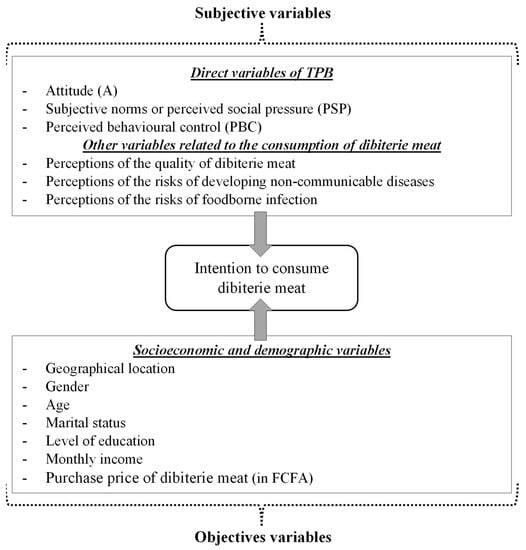
Figure 1.
Illustration of the theoretical model of the study.
2.6. Management and Statistical Data Analysis
Data collected were analysed with IBM SPSS Statistics version 24 software (IBM Corp., Armonk, NY, USA). Means followed by standard deviations were estimated for quantitative variables, whereas percentages were determined for qualitative data.
The socio-demographic and economic determinants of dibiterie meat consumption were estimated using binary logistic regression because the dependent variable (consumption) is dichotomous (yes or no). The socio-demographic and economic variables and their modalities used in the model are presented in Table 2. One variable was declared significant at the p threshold of 5%.
Table 2.
Socio-demographic and economic variables used in the binary regression model.
In order to summarise the information obtained by the Likert scales, a principal component analysis (PCA) with Varimax rotation was performed accordingly. Depending on the correlations between items, PCA can easily condense consumer responses into a smaller set of principal dimensions called principal components (PCs). In addition, based on Cronbach’s α coefficient, which measures the internal consistency of items in order to estimate their reliability, all the subjective variables in the study were examined. Moreover, the higher the coefficient α, the more consistent the elements of the questionnaire are for measuring the variables studied. Thus, in this study, the acceptable threshold of reliability (value of the coefficient α) must be ≥0.6 [38]. However, a component was retained if, on the one hand, its initial eigenvalue is greater than or equal to 1, and on the other hand, it is statistically significant at the threshold of 5%. Subsequently, a multiple hierarchical regression was performed to identify the determinants of intention to consume dibiterie meat. A model was significant at the significance level p of 5%.
2.7. Ethical Approval and Participant Consent
The present study was carried out with the approval of the research ethics committee of the University Cheikh Anta Diop (n° 0318/2018/CER/UCAD) and the signed written consent of the participants for the use and publication of information they provided. Furthermore, prior to obtaining the consent of participants, they had been informed of the objectives, the confidentiality clause, and the anonymity, and that the results will only be used for research and strategic decisions.
3. Results
3.1. Profile and Preferences of Dibiterie Meat Consumers
More than half of the people surveyed were consumers of dibiterie meat (61%). They were predominantly Muslim (90%), women (52%), and two ethnic groups (Wolof: 28%, and Peulh: 20%). Their average age was 36.07 ± 14.35 years with 59% of young adults belonging to the 20 to 40 years age group. Consumers of dibiterie meat were mainly married (52%), educated (89%), and carried out various professional activities such as employee (27%), housewife activities (20%), studies (students and schoolboy, 20%), and traders (13%). The majority of these consumers had monthly incomes above 300 Euros (41%) and allocated more than 150 Euros (56%) per month to the purchase of food. The same trends are observed at the level of the category of non-consumers of dibiterie meat (Table 3).
Table 3.
Socioeconomic and demographic profile of study participants (n = 478).
Two modes or places of consumption of dibiterie meat were observed in households. Whereas 59% of participants preferred to buy and take away the dibiterie meat to home for consumption, 41% preferred to eat it in the dibiterie. The frequency of purchase for home consumption ranged from once every 15 days (20%) to once a month (33%) (Table 4) with a variation in the quantities consumed ranging from 1500 at 6000 g. For individual consumption at the point of purchase or outside the home, consumption quantities varied between 150 and 1000 g. The consumers preferred that the mode of dibiterie meat cooking was “Well-cooked” (80%) followed by “Bloody” (9%) and “Perfectly cooked” (9%).
Table 4.
Preferences for dibiterie meat consumption in Dakar (n = 291).
3.2. Socio-Demographic and Economic Determinants of Dibiterie Meat Consumption
Through a binary econometric regression model, it was possible to identify variables determining the consumption of dibiterie meat. Table 5 shows that the model is globally significant (p < 0.01). Independent variables introduced into the model explain 25% of the variations observed in the consumption of dibiterie meat. However, the model presents a good performance in terms of the classification of populations in the right categories of the dependent variable (consumption vs. non-consumption) with a probability of correct prediction of 71%. In addition, the Hosmer–Lemeshow test is not significant, meaning that the model is generally good because the predicted values and the observed values are not significantly different.
Table 5.
Identification of socio-demographic and economic factors determining the consumption of dibiterie meat in Dakar (n = 478).
The results of the binary logistic regression showed that geographic location, gender, age, monthly income, and family size positively or negatively influence the consumption of dibiterie meat. The geographical location (Dakar), gender (female), and monthly income (<75 Euros) had a positive influence on the consumption of dibiterie meat, whereas the opposite was observed for age (≥60 years) and family size (2–5 people). The elderly, high-income, male, from small families (2–5), and residing in the Dakar suburbs demographics consumed less dibiterie meat.
3.3. Intention to Consume Dibiterie Meat
In total, 291 people questioned corresponded to consumers of dibiterie meat. They provided complete answers to behavioural questions. The different items of the subjective variables were recombined into principal components (PCs) using PCA.
3.3.1. Reconstitution of the TPB Variables
Regarding consumer attitude towards the consumption of dibiterie meat, the six original items were recombined into two main components which are the initial eigenvalues greater than 1. This is “convenience” (C; α = 0.854; 48.3% of the total variance; p < 0.01) and “desirable” (D; α = 0.889; 31.14% of the total variance; p > 0.05); and together explain 79.53% of the total variance of attitudes. The variable “convenience (C)” is made up of four items that express consumer attitudes towards price and the perceived importance of the impact of meat consumption on health. Furthermore, the variable “desirable (D)” is represented by two items expressing the desirable attitudes of individuals towards the consumption of dibiterie meat. However, this dimension is not statistically significant and was therefore discarded for the rest of the analyses (Table 6).
Table 6.
Principal components of the subjective variables of the theory of planned behaviour (attitudes, perceived social pressure, perceived behavioural control, intention).
The subjective norms or perceived social pressure (PSP) represented by three original items were recombined into a single main component keeping the same nomenclature with an initial eigenvalue greater than 1 and explaining 71.1% of the total variance (PSP; α = 0.784; 71.1% of the total variance; p < 0.01).
Regarding the variable relating to perceived behavioural control (PBC), the six original items were reconstituted into two principal components whose initial eigenvalues are greater than 1. The first principal component “perceived control (Pc)” is composed of four items related to the perceived control (finance, time, personnel, etc.) on the consumption of dibiterie meat and explains about 35% of the total variance (Pc; α = 0.676; 35.14% of the total variance; p < 0.01). The second main component “availability and reduction (AR)” is not significant and can therefore be omitted.
The four original items of intention were recombined into a single principal component (I; α = 0.854; 73.35% of the total variance; p < 0.01) and explains about 73% of the total variance.
3.3.2. Consumer Perceptions on the Quality of Dibiterie Meat and the Link between Meat Consumption and the Risk of NCDs
Three different subjective variables were added to the three direct variables of the TPB to determine factors that may affect the intention to consume dibiterie meat.
The principal component analysis allowed us to identify five principal components from the 14 original items expressing consumers’ perceptions of the quality of dibiterie meat. Of this, three principal components are significant and explain about 45% of the variance. These are the dimensions “meat safety (MS)” (MS; α = 0.906; 18.88% of the total variance; p < 0.01), “expertise of the dibiterie” (ED; α = 0.891; 18.17% of total variance; p < 0.01) and “health (H)” (H; α = 0.633; 7.84% of total variance; p < 0.01). Principal components 3 and 4 (PC3 and PC4) are not significant and were therefore omitted from the rest of the analyses (Table 7).
Table 7.
Principal components of the perceptions of the quality of dibiterie meat in households in the Dakar region, Senegal.
Concerning the variable related to the perception of the link between meat consumption and the risk of NCDs, two main components were identified and expressing about 71% of the total variance (Table 8). However, only one dimension is significant, called “link between meat consumption and risk of non-communicable diseases” (α = 0.868; 36.65% of the total variance; p < 0.01). However, the analysis of the perception on the risks of foodborne infections linked to the consumption of dibiterie meat reveals a single main component explaining 67% of the total variance (α = 0.726; 66.69% of total variance; p < 0.01).
Table 8.
Principal components of perceptions on the risks of developing non-communicable diseases and foodborne infections.
3.3.3. Main Determinants of the Intention to Consume Dibiterie Meat
The multiple hierarchical regression allowed us to identify three statistically significant models reflecting the different subjective variables of the TCP and the objective socio-demographic and economic variables that influence behavioural intention (Table 9).
Table 9.
Identification of determinants of the intention to consume dibiteries meat in the Dakar region, Senegal (n = 291).
Model 1, which includes the three direct variables of the TPB, explains 97.15% of the variance of intention (F = 2972.588; p < 0.01). However, attitude (convenience; β = 0.982; p < 0.01) positively influences intention, whereas perceived social pressure (PSP; β = −0.052; p < 0.01) affects it negatively. The perceived behavioural control (β = 0.012; p > 0.05) does not determine the intention of consumers to eat dibiterie meat.
In Model 2, the three classic TPB variables were associated with other significant subjective variables identified by a PCA and explain 97.70% of the variance of intention (F = 1238.971; p < 0.01). Thus, besides the attitude (convenience) and perceived social pressure, the variables “expertise of the dibiterie” (ED; β = 0.004; p < 0.01), “health” (H; β = 0.041; p < 0,01), and “perception on the link between meat consumption and NCDs” (β = 0.028; p < 0.05) positively influence behavioural intention.
Finally, in the third step of the multiple hierarchical regression, model 3 which includes all the subjective and objective variables allowed us to explain 97.80% of the variance of intention (F = 701.254; p < 0.01). The same trends of previous models were observed. However, among the objective variables, gender (female) positively influences (β = 0.085; p < 0.01) behavioural intention, whereas the age of consumers affects it negatively (β = −0.002; p < 0.05).
In summary, model 3 is the most explanatory, and the intention to consume dibiterie meat in households in Dakar is determined by the factors attitude (convenience), perceived social pressure (PSP), the expertise of the dibiterie (ED), health (H), perception on the link between meat consumption and NCDs, gender, and age of consumers.
4. Discussion
The present study showed that half of the people consume dibiteries meat. Their frequency of consumption was mostly once a month and the quantities varied from 1.5 to 6 Kg according to whether the meat was purchased and consumed at home. “Well-cooked” meat was the preferred mode of cooking by consumers. The identification of the determinants of the dibiterie meat consumption showed among the socio-demographic and economic factors that geographical location, gender, age, monthly income, and family size significantly determined the dibiteries meat consumption. In addition, attitude (convenience), perceived social pressure, the expertise of the dibiterie, health, perception of the link between meat consumption and NCDs, gender, and age of consumers were the determinants of the intention to consume the dibiterie meat in households in the Dakar region.
Socio-demographic and economic determinants of the consumption of dibiterie meat have shown the significant influence of geographic location, gender, age, family size, and monthly income on the consumption of dibiterie meat. However, among these variables, income appeared to be the most discriminating factor, due to its high coefficient in the model.
The positive influence of geographic location on the consumption of dibiterie meat means that households living in Dakar tend to consume more dibiterie meat than those in the suburbs. The purchasing power of the populations of Dakar, which is higher than that of the rest of the country, explains this difference. According to Orou Seko et al. [13], it constitutes a factor of attractiveness, installation, and concentration of the production and marketing workshops such as dibiteries in popular neighbourhoods of this department. In the practice of dibiterie meat consumption, women significantly eat more than men. The organisation of meals in households in Dakar may explain this result. Indeed, evening meals are rarely taken with the family. Thus, to ensure the evening’s needs in the household, women tend to turn to collective catering such as dibiteries and fast-food restaurants. These dibiteries have operating hours that coincide perfectly with the evening meals of the population living especially in popular neighbourhoods [8,13]. The study by Orou Seko et al. [39] on the out-of-home consumption of dibiterie meat had instead shown that women (21%) were poorly represented compared to men (79%). This confirms the idea that few women consume dibiterie meat in the outlets. The act of purchase they make is in most cases for family consumption rather than for individuals.
In this study, the factor of age above 60 years negatively influences the consumption of dibiterie meat in households in Dakar. In other words, the older people get, the less they eat dibiterie meat. Indeed, the elderly must pay more attention to their lifestyle by adopting healthier eating behaviours towards the risks of NCDs. For example, the elderly must pay attention to their health by reducing their consumption of animal fats by eating more fish [40].
In Dakar, Mankor [41] revealed that the level of income has a positive influence on the amount spent monthly by households on the purchase of meat in the sense that the higher the level of income, the more money is spent monthly on the purchase of fresh meat. This result is in line with the economic theory linking increased income and the consumption of luxury animal products, which is not verified for processed products (braised meat). Our results have shown that the income “less than 75 Euros” positively influences the consumption of dibiterie meat; these are individuals with an income lower than the minimum wage in Senegal, i.e., 89 Euros according to Jeune Afrique [42], and are more likely to consume dibiterie meat than people with higher income. This result could be explained by the fact that individuals with high incomes pay more attention to the “health” factor linked to meat consumption. The quality is generally requested by the better-off. This result is all the more supported by the study on the purchasing decision factors for dibiterie meat carried out by Orou Seko et al. [39] among consumers within dibiteries in Dakar. According to these authors, the majority of consumers surveyed (61%) were “less concerned” by the health dimension (quality and safety) when buying braised meat in dibiteries. In addition, in the dibiteries hygiene and good production practices are often not mastered by the staff. Consequently, the products from these restaurants are often of doubtful microbiological quality or do not meet the international standards required for human consumption [43,44]. The installation of dibiteries in popular neighbourhoods with low or diversified income allows them to be closer to the target customers who do not care about the quality of the products consumed [13].
The results also showed that the size of the family between “2 and 5 persons” negatively affects the consumption of dibiterie meat. This means that the smaller the household is, the less it consumes dibiterie meat. In Senegal, the majority of households are large (on average 8.3 people) and most often live in difficult and precarious conditions [45]. For the latter, it is cheaper to buy a meal for the group to vary the monotonous eating habits. It is thus difficult for these types of families to diversify meals within households. They are therefore faced with a certain dietary monotony which forces some family members to go for out-of-home catering in order to diversify their evening [8]. This situation therefore suggests that the dibiterie meat constitutes a food supplement to support the monotonous diets of low-income and large households. The result contradicts the tendency of high meat consumption described in urban areas.
The results of the study showed that attitude (convenience), perceived social pressure, the expertise of the dibiterie, health, perception of the link between meat consumption and NCDs, gender, and age of consumers influence the intention to consume dibiterie meat in households in the Dakar region.
In the first model, attitude (convenience), perceived social pressure, and perceived behavioural control explain 97.15% of the variance of intention to consume dibiterie meat. The studies by Boucher et al. [29] on the intention to consume at least five servings of vegetables and fruit each day and Giampietri and Del Giudice [46] on the purchase of food in short food supply chains had obtained certainly high proportions of variance, but lower than our study (75% and 73%, respectively). Therefore, the theory of planned behaviour [24] is an effective predictor of intention to consume dibiterie meat.
Among these factors, convenience (attitude) is the main determinant regardless of the model, and it turns out to be very important for consumers. This result differs from that of the studies by Gao et al. [47] and Giampietri and Del Giudice [46] who indicated that among the attitude variables, loyalty was the main determinant of intention. However, in our study, convenience had a positive influence on intention, indicating that consumers of dibiterie meat find its price favourable and its sanitary impact beneficial on their health, and thus, are more willing to consume this product. Consumers are therefore motivated or feel capable to consume dibiterie meat despite its price, and above all highlight its perceived beneficial impact on their health. These factors tend to induce an increased consumption of red meat and therefore an increased risk of developing an NCD. In the context of high consumption, the design and implementation of nutrition education interventions, and promoting good practices in the prevention of NCDs may be necessary. The positive influence of attitude on intention has also been reported by certain studies carried out on the determinants of food choice [29,34,35,48]. However, Blanchard et al. [48] and Boucher et al. [29] found that attitude is a significant predictor of intention to consume fruits and vegetables, but not the best. On the other hand, other studies have shown that attitude, especially convenience, has a negative influence on intention; thus, indicating that consumers with a high propensity to save money are less willing to buy food in short food supply chains [46,49].
However, perceived social pressure negatively affected the intention to consume dibiterie meat. This result indicates that the consumer is under pressure from his social network which contributes to reducing his intention to consume dibiteries meat. In the context of low revenue and the large size of the family, people may hide when consuming meat to avoid being qualified as selfish. We can conclude that the relatives and important people for the consumer, such as his family, friend, doctor, or religious guide would disapprove of his consuming dibiterie meat, especially being aware of the link associated with this act to the development of NCDs. In addition, the consumption of dibiterie meat is seen as an act that promotes individualism in Senegal, hence their greater disapproval in face of the risks of developing an NCD. The social network, therefore, seems to be very important in developing the intention of the populations of Dakar to consume dibiterie meat. The negative effect of the perceived social pressure on the intention would favour the reduction in the consumption of meat and by extension a reduction in the risks of developing an NCD. Consequently, in the context of high meat consumption, interventions promoting a healthy lifestyle and eating habits could be implemented through communication and awareness campaigns on the media (radio, television, and social networks). In addition, traditional dance fairs could also be places for disseminating messages on healthy eating behaviours. Finally, the strategy that appears to be the most cost-effective could involve teachers in schools broadcasting messages in order to change the behaviour of a large number of children’s families. Unlike our study, some authors found that perceived social pressure did not help predict participants’ intention to consume vegetables and fruit [29,48,50].
In addition to the direct variables of the TCP, model 3 of the present study allowed us to show that the expertise of dibiterie, health, perception of the link between meat consumption and NCDs, gender, and age also have a significant influence on the intention to consume dibiterie meat. Indeed, this model is the most explanatory and allows us to state that all the variables included explain about 98% of the variance of intention.
However, the perception of the quality of dibiterie meat, the “expertise of the dibiterie” and “health” components related to dibiterie meat, as well as consumer perception of the link between meat consumption and NCDs, positively influence behavioural intention. This means that a consumer will tend to consume dibiterie meat if: (i) the dibiterie has proven expertise in processing meat, (ii) he is aware of the impact of animal fat and the bad hygiene of the meat on his health, and (iii) he is also aware of the risks of NCDs associated with the consumption of red meat.
Regarding gender and age, they positively and negatively influence intention, respectively. In the Dakar region, females largely tend to consume dibiteries meat in the household. However, within the dibiteries, it is mostly men who buy and consume dibiterie meat [39]. Moreover, the negative influence of age on intention means that the older the participants are, the less they intend to consume meat from dibiteries. It is the age groups of 20–30 years and 30–40 years that are most present when buying and consuming braised meat in dibiteries [39].
In summary, a consumer would be motivated to consume dibiterie meat in households if he or she feels able to do so, perceives less social pressure, if the dibiterie has proven expertise in the grilling of meat, if the person is aware of the impact of animal fat and the poor hygiene of the dibiterie on his health, if the consumer is aware of the risks of NCDs associated with the consumption of red meat, and more if the person is female and in the 20–40 age group (Figure 2). Interventions aimed at preventing or controlling NCDs by promoting the adoption of healthy eating behaviours should take into account all of these factors which significantly determine the intention to consume dibiterie meat.
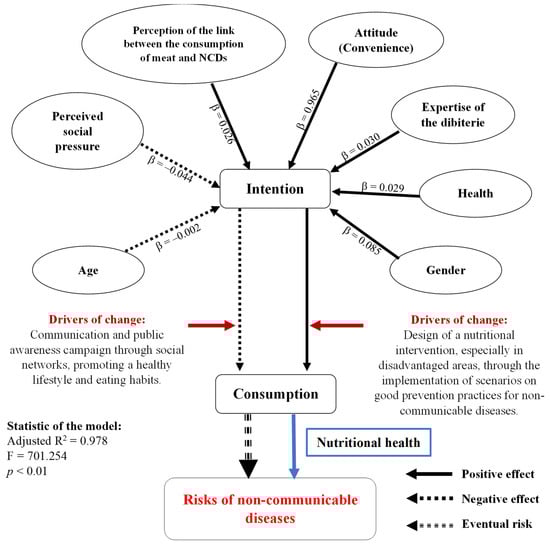
Figure 2.
Conceptual model on the intention of consumers to eat dibiterie meat and avenues for intervention towards the risk of NCD development.
Apart from the widely documented link between the daily consumption of red meat and the development of non-communicable diseases, a diet low in fruits and vegetables may also contribute to an increased risk of heart disease, stroke, and certain types of cancer [51,52,53]. Indeed, according to Hernandez-Rodas et al. [54], diet directly influences the development of obesity and specific pathologies such as non-alcoholic fatty liver disease (NAFLD). High energy intake in the form of fat, a diet low in fruit and vegetables, and lack of physical activity are the major problems. Worldwide, 1.7 million deaths (2.8% of all deaths) can be attributed to insufficient fruit and vegetable consumption. Low intake of fruits and vegetables is estimated to account for approximately 14% of deaths associated with gastrointestinal cancer, 11% of deaths associated with heart disease, and 9% of stroke-related deaths each year worldwide [55]. Factors affecting access to fresh fruits and vegetables are complex and include income, gender, education, age, geographic location (rural vs. urban), accessibility, availability, quality, adequate transportation, and lack of food-related skills, including preparation, handling, and storage [56].
5. Conclusions
The nutritional transition in Senegal is reflected in out-of-home consumption, particularly in working-class neighbourhoods, and in the development of collective catering workshops called “dibiterie”. Dibiteries offer braised sheep meat that is particularly popular and anchored in the eating habits of populations more and more exposed to the risk of NCDs. In the context of unequal access to care, the risk of mortality linked to non-treatment and ignorance of NCDs in Dakar appears high.
It emerges from this study that 61% of people in households consume dibiterie meat as a food supplement, mostly at a low frequency of once a month (33%). This consumption is positively determined by the geographic location, gender, and monthly income of the populations, and negatively by age and the size of the family.
The intention to consume dibiterie meat is influenced by convenience, social pressure, quality indicators (expertise of the dibiterie and health), perceived link between meat consumption and NCDs, gender, and age. These factors will provide a theoretical co-produced knowledge basis for the development of incentive-based interventions aiming to promote a balanced diet and healthy eating habits towards the mitigation of NCD risks. Among consumers of dibiterie meat, nutrition education and the use of the media would be important in behaviour change in favour of the adoption of healthy eating behaviours.
Author Contributions
Conceptualization, M.O.S., N.L., W.O. and B.B.; data curation, M.O.S. and N.L.; formal analysis, M.O.S. and N.L.; investigation, N.L.; methodology, M.O.S., N.L. and W.O.; project administration, B.B.; resources, G.F. and B.B.; supervision, W.O.; validation, W.O. and B.B.; visualization, G.F. and D.D.; writing—original draft, M.O.S.; writing—review and editing, M.O.S., N.L., W.O., G.F., D.D., and B.B. All authors have read and agreed to the published version of the manuscript.
Funding
This research was funded by the DELTAS Africa Initiative [Afrique One-ASPIRE/DEL-15-008].
Institutional Review Board Statement
Not applicable.
Informed Consent Statement
Not applicable.
Data Availability Statement
The data presented in this study are available on request from the corresponding author (orousekom@gmail.com).
Acknowledgments
The authors are grateful to DELTAS Africa, a consortium of donors including the African Academy of Sciences (AAS), the Alliance for Accelerating Excellence in Science in Africa (AESA), the New Partnership for Africa’s Development Planning and Coordinating (NEPAD) Agency, the Wellcome Trust [107753/A/15/Z], and the UK government. We also acknowledge consumers who have agreed to participate in this study.
Conflicts of Interest
The authors declare no conflict of interest.
References
- WHO/FAO. Diet, Nutrition, and the Prevention of Chronic Diseases: Report of a Joint WHO/FAO Expert Consultation; WHO Technical Report Series; World Health Organization: Geneva, Switzerland, 2003; Volume 916. [Google Scholar]
- Baker, P.; Friel, S. Food Systems Transformations, Ultra-Processed Food Markets and the Nutrition Transition in Asia. Glob. Health 2016, 12, 80. [Google Scholar] [CrossRef] [PubMed]
- WHO Cardiovascular Diseases (CVDs). Available online: https://www.who.int/fr/news-room/fact-sheets/detail/cardiovascular-diseases-(cvds) (accessed on 6 July 2020).
- Cicolella, A. Toxique Planète. Le Scandale Invisible Des Maladies Chroniques: Le Scandale Invisible Des Maladies Chroniques; Média Diffusion: Paris, France, 2013. [Google Scholar]
- Richi, E.B.; Baumer, B.; Conrad, B.; Darioli, R.; Schmid, A.; Keller, U. Aspects Sanitaires de La Consommation de Viande. Forum Méd Suisse 2015, 15, 566–572. [Google Scholar]
- Wolk, A. Potential Health Hazards of Eating Red Meat. J. Internal Med. 2017, 281, 106–122. [Google Scholar] [CrossRef]
- Seow, D.Y.; Haaland, B.; Jafar, T.H. The Association of Prehypertension with Meals Eaten Away from Home in Young Adults in Singapore. Am. J. Hypertens. 2015, 28, 1197–1200. [Google Scholar] [CrossRef]
- Ndoye, F.; Diop, A.; Sokhona, K.; Broutin, E.; Cheyns, E.; Bricas, N.; Ndiaye, J. Evolution Des Styles Alimentaires à Dakar; Enda-Graf; CIRAD: Dakar, Senegal, 2001. [Google Scholar]
- Leyinda, L.U.E.; des Effets Socio-Économiques, U.A. Analyse Des Effets Socio- Économiques Du Commerce Des Aliments de Rue Dans La Zone de Dakar: Cas de La Commune d’arrondissement de Ouakam. Master’s Thesis, Ecole Nationale D’économie Appliquée, Dakar, Senegal, 2012. [Google Scholar]
- Duteurtre, G. Evolution Du Secteur de l’élevage Ouest Africain. Grain Sel. 2009, 46, 12–15. [Google Scholar]
- Duho, K.S.D. Le Nettoyage et La Désinfection En Restauration Collective à l’hôpital Principal de Dakar. Master’s Thesis, Ecole Inter-Etats des Sciences et Médecine Vétérinaires (EISMV), Dakar, Senegal, 2012. [Google Scholar]
- Orou Seko, M. Evaluation Des Options de Performance Managériale Des Dibiteries de Dakar et Sa Banlieue (Sénégal). Master’s Thesis, Ecole Inter Etats des Sciences et Medecine Veterinaires de Dakar, Dakar, Senegal, 2015. [Google Scholar]
- Orou Seko, M.; Ossebi, W.; Traoré, G.S.; Ndour, A.P.N.; Saric, J.; Fokou, G.; Dao, D.; Bonfoh, B. Typology, Technical Efficiency and Scale Economy of Dibiteries in Dakar, Senegal. AAS Open Res. 2019, 2, 10. [Google Scholar] [CrossRef]
- Duboz, P.; Chapuis-Lucciani, N.; Boëtsch, G.; Gueye, L. Prevalence of Diabetes and Associated Risk Factors in a Senegalese Urban (Dakar) Population. Diabetes Metab. 2012, 38, 332–336. [Google Scholar] [CrossRef]
- Duboz, P.; Boëtsch, G.; Gueye, L.; Macia, E. Hypertension Prevalence, Awareness, Treatment and Control in Dakar (Senegal). J. Hum. Hypertens. 2014, 28, 489–493. [Google Scholar] [CrossRef]
- D’Angelo, H.; Suratkar, S.; Song, H.-J.; Stauffer, E.; Gittelsohn, J. Access to Food Source and Food Source Use Are Associated with Healthy and Unhealthy Food-Purchasing Behaviours among Low-Income African-American Adults in Baltimore City. Public Health Nutr. 2011, 14, 1632–1639. [Google Scholar] [CrossRef]
- Thornton, L.E.; Pearce, J.R.; Ball, K. Sociodemographic Factors Associated with Healthy Eating and Food Security in Socio-Economically Disadvantaged Groups in the UK and Victoria, Australia. Public Health Nutr. 2014, 17, 20–30. [Google Scholar] [CrossRef]
- ANSD. Situation Économique et Sociale du Sénégal Edition 2014; ANSD: Dakar, Senegal, 2017. [Google Scholar]
- Sparks, P.; Shepherd, R. Self-Identity and the Theory of Planned Behavior: Assesing the Role of Identification with Green Consumerism. Soc. Psychol. Q. 1992, 388–399. [Google Scholar] [CrossRef]
- Grunert, K.G.; Larsen, H.H.; Madsen, T.K.; Baadsgaard, A. Market Orientation in Food and Agriculture; Springer: Berlin/Heidelberg, Germany, 1995. [Google Scholar]
- Thompson, K.E.; Haziris, N.; Alekos, P.J. Attitudes and Food Choice Behaviour. Br. Food J. 1994, 96, 9–13. [Google Scholar] [CrossRef]
- Conner, M.; Sparks, P. Theory of Planned Behaviour and Health Behaviour. Predict. Health Behav. 2005, 2, 121–162. [Google Scholar]
- Cook, A.J.; Kerr, G.N.; Moore, K. Attitudes and Intentions towards Purchasing GM Food. J. Econ. Psychol. 2002, 23, 557–572. [Google Scholar] [CrossRef]
- Ajzen, I. The Theory of Planned Behavior. Organ. Behav. Hum. Decis. Process. 1991, 50, 179–211. [Google Scholar] [CrossRef]
- Ajzen, I.; Timko, C. Correspondence between Health Attitudes and Behavior. Basic Appl. Soc. Psychol. 1986, 7, 259–276. [Google Scholar] [CrossRef]
- Godin, G.; Kok, G. The Theory of Planned Behavior: A Review of Its Applications to Health-Related Behaviors. Am. J. Health Promot. 1996, 11, 87–98. [Google Scholar] [CrossRef]
- Armitage, C.J.; Conner, M. Efficacy of the Theory of Planned Behaviour: A Meta-Analytic Review. Br. J. Soc. Psychol. 2001, 40, 471–499. [Google Scholar] [CrossRef]
- Smith, J.R.; Terry, D.J.; Manstead, A.S.; Louis, W.R.; Kotterman, D.; Wolfs, J. The Attitude-Behavior Relationship in Consumer Conduct: The Role of Norms, Past Behavior, and Self-Identity. J. Soc. Psychol. 2008, 148, 311–334. [Google Scholar] [PubMed]
- Boucher, D.; Gagné, C.; Côté, F. Determinants of the Intention of Post-Secondary Students to Eat at Least Five Servings of Vegetables and Fruit Daily. Rev. D’epidemiol. Sante Publique 2012, 60, 109–119. [Google Scholar]
- Steg, L.; Nordlund, A. Models to Explain Environmental Behaviour. In Environmental Psychology: An Introduction; Wiley-Blackwell: Hoboken, NJ, USA, 2012; pp. 185–195. [Google Scholar]
- Bertrandias, L.; Pernin, J.-L. Comprendre l’intention d’adhérer à Une AMAP: Une Approche Par La Théorie Du Comportement Planifié. J. Rech. Mark. Bourgogne 2010, 15, 18–19. [Google Scholar]
- Shepherd, R. Social Determinants of Food Choice. Proc. Nutr. Soc. 1999, 58, 807–812. [Google Scholar] [CrossRef] [PubMed]
- Gagné, C.; Godin, G. Les Théories Sociales Cognitives: Guide Pour La Mesure Des Variables et Le Développement de Questionnaire; Groupe de Recherche sur les Aspects Psychosociaux de la Santé, Université Laval: Québec, QC, Canada, 1999. [Google Scholar]
- Alam, S.S.; Sayuti, N.M. Applying the Theory of Planned Behavior (TPB) in Halal Food Purchasing. Int. J. Commer. Manag. 2011, 21, 8–20. [Google Scholar] [CrossRef]
- Bonne, K.; Vermeir, I.; Bergeaud-Blackler, F.; Verbeke, W. Determinants of Halal Meat Consumption in France. Br. Food J. 2007, 109, 367–386. [Google Scholar] [CrossRef]
- Ajzen, I. Constructing a TPB Questionnaire: Conceptual and Methodological Considerations; University of Massachusetts Amherst: Amherst, MA, USA, 2006. [Google Scholar]
- Azjen, I.; Fishbein, M. Understanding Attitudes and Predicting Social Behavior; Prentice-Hall: Englewood Cliffs, NJ, USA, 1980. [Google Scholar]
- Bartee, R.T.; Grandjean, B.D.; Bieber, S.L. Confirming the Reliability of a Theory-Based Questionnaire. Am. J. Health Stud. 2004, 19, 175–180. [Google Scholar]
- Orou Seko, M.; Ndour, A.P.N.; Ossebi, W.; Saric, J.; Kreppel, K.; Dao, D.; Bonfoh, B. Consumer Perception on Purchase Decision Factors and Health Indicators Related to the Quality and Safety of Meat Sold in Dibiteries in Dakar, Senegal. Sustainability 2020, 12, 7428. [Google Scholar] [CrossRef]
- Dhraief, M.Z.; Ameur, M.; Khaldi, R. Typologie Des Consommateurs Selon Leur Perception de La Qualité Des Poissons Frais En Tunisie. Mediterr. J. Econ. Agric. Environ. 2011, 10, 49–55. [Google Scholar]
- Mankor, A. Etude Des Déterminants de La Consommation Urbaine En Viandes En Afrique de l’Ouest: L’exemple de Dakar. Ph.D. Thesis, Ecole Nationale Supérieure Agronomique de Montpellier, Montpellier, France, 2001. [Google Scholar]
- Jeune Afrique Sénégal: Le Salaire Minimum Revalorisé Pour La Première Fois Depuis 1996. Available online: https://www.jeuneafrique.com/556925/economie/senegal-le-salaire-minimum-revalorise-pour-la-premiere-fois-depuis-1996/ (accessed on 6 August 2020).
- Yougbaré, B. Appréciation Des Risques de Contamination Microbienne de La Viande de Petits Ruminants Dans Les Abattoirs et Dibiteries de Dakar, Sénégal. Master’s Thesis, Ecole Inter Etats des Sciences et Medecine Veterinaires de Dakar, Dakar, Senegal, 2014. [Google Scholar]
- Traoré, S.G.; Ndour, A.P.N.; Ossebi, W.; Seko, M.O.; Fokou, G.; Alonso, S.; Koné, P.S.; Roesel, K.; Grace, D.; Bonfoh, B. Impact of Good Hygiene Management Practices on the Reduction in Microbial Contamination of Roasted Sheep Meat Sold at Urban Dibiteries in Senegal. Food Prot. Trends 2021, 41, 70–79. [Google Scholar] [CrossRef]
- ANSD. Situation Économique et Sociale du Sénégal Edition 2013; ANSD: Dakar, Senegal, 2016. [Google Scholar]
- Giampietri, E.; Finco, A.; Del Giudice, T. Exploring Consumers’ Behaviour towards Short Food Supply Chains. Br. Food J. 2016, 118, 618–631. [Google Scholar] [CrossRef]
- Gao, Z.; Swisher, M.; Zhao, X. A New Look at Farmers’ Markets: Consumer Knowledge and Loyalty. HortScience 2012, 47, 1102–1107. [Google Scholar] [CrossRef]
- Blanchard, C.M.; Fisher, J.; Sparling, P.B.; Shanks, T.H.; Nehl, E.; Rhodes, R.E.; Courneya, K.S.; Baker, F. Understanding Adherence to 5 Servings of Fruits and Vegetables per Day: A Theory of Planned Behavior Perspective. J. Nutr. Educ. Behav. 2009, 41, 3–10. [Google Scholar] [CrossRef] [PubMed]
- Wolf, M.M.; Spittler, A.; Ahern, J. A Profile of Farmers’ Market Consumers and the Perceived Advantages of Produce Sold at Farmers’ Markets. J. Food Distrib. Res. 2005, 36, 192–201. [Google Scholar]
- Brug, J.; Lechner, L.; De Vries, H. Psychosocial Determinants of Fruit and Vegetable Consumption. Appetite 1995, 25, 285–296. [Google Scholar] [CrossRef] [PubMed]
- Hung, H.-C.; Joshipura, K.J.; Jiang, R.; Hu, F.B.; Hunter, D.; Smith-Warner, S.A.; Colditz, G.A.; Rosner, B.; Spiegelman, D.; Willett, W.C. Fruit and Vegetable Intake and Risk of Major Chronic Disease. J. Natl. Cancer Inst. 2004, 96, 1577–1584. [Google Scholar] [CrossRef]
- He, F.J.; Nowson, C.A.; MacGregor, G.A. Fruit and Vegetable Consumption and Stroke: Meta-Analysis of Cohort Studies. Lancet 2006, 367, 320–326. [Google Scholar] [CrossRef]
- Crowe, F.L.; Roddam, A.W.; Key, T.J.; Appleby, P.N.; Overvad, K.; Jakobsen, M.U.; Tjønneland, A.; Hansen, L.; Boeing, H.; Weikert, C. Fruit and Vegetable Intake and Mortality from Ischaemic Heart Disease: Results from the European Prospective Investigation into Cancer and Nutrition (EPIC)-Heart Study. Eur. Heart J. 2011, 32, 1235–1243. [Google Scholar] [CrossRef]
- Hernandez-Rodas, M.C.; Valenzuela, R.; Videla, L.A. Relevant Aspects of Nutritional and Dietary Interventions in Non-Alcoholic Fatty Liver Disease. Int. J. Mol. Sci. 2015, 16, 25168–25198. [Google Scholar] [CrossRef]
- OMS. Initiative Visant à Stimuler La Consommation Des Fruits et Légumes, Rapport de La Rencontre; OMS: Genève, Switzerland, 2003. [Google Scholar]
- Hendrickson, D.; Smith, C.; Eikenberry, N. Fruit and Vegetable Access in Four Low-Income Food Deserts Communities in Minnesota. Agric. Hum. Values 2006, 23, 371–383. [Google Scholar] [CrossRef]
Publisher’s Note: MDPI stays neutral with regard to jurisdictional claims in published maps and institutional affiliations. |
© 2022 by the authors. Licensee MDPI, Basel, Switzerland. This article is an open access article distributed under the terms and conditions of the Creative Commons Attribution (CC BY) license (https://creativecommons.org/licenses/by/4.0/).