What Is the Link between Strategic Innovation and Organizational Sustainability? Historical Review and Bibliometric Analytics

Abstract
:1. Introduction
- (1)
- To investigate the core journals, document characteristics, and research trends over thirty years (1991–2021) both in the SI and OS research domains.
- (2)
- To examine how many journal papers are frequently cited. These journals can be an exceptional reference for rising researchers to swiftly detect relevant information.
- (3)
- To explore the relationship between the number of authors and the number of publications
1.1. Strategic Innovation
1.2. Organizational Sustainability
1.3. The Connection between Strategic Innovation and Organizational Sustainability
2. Research Datasets and Methodology
2.1. Datasets
2.2. Methodology
2.2.1. Bradford’s Law
2.2.2. Lotka’s Law
2.3. Research Framework
2.3.1. Bradford’s Law
- (1)
- Data collection from the SSCI electronic database.
- (2)
- Organize a list of publications and citations.
- (3)
- Rank according to the number of references of journal articles from most occurring to least.
- (4)
- Divide numbers into several areas: (a) the area of the core journal is closely related to the subject; (b) the other areas with the same number of articles as the section of the core journal. The number of journals in the area of the core journal and the following areas will be in a ratio of .
- (5)
- According to the analysis of the actual data, separately rank the journals of SI and OS in order of the number of referenced articles in descending order which can be divided into several portions, each accounting for of the total number of referenced articles. The area 1 is the core journals, recording a few journals with the highest frequency cited, assuming that the number of journals is ; the area 2 comprises related journals with the second-highest frequency of reference, assuming that the number of journals is ; the last part contains the lowest frequency of citation and is assumed to be . This distribution law is:
- (6)
- Since the ratios of area 2 to area 1, and area 3 to area 2, is a range from 2 to 7, Bradford suggested that the ratio of the constant 5 could represent its data. Bradford described his law graphically; therefore, according to the above, the logarithm . of the number of ranked journals was used to plot the relative cumulative number of citations of the journals . The diagram is initially an upward curve, and after a certain point, converts to a straight line.
2.3.2. Lotka’s Law
- (7)
- Data collection from the SSCI electronic database.
- (8)
- Organize a list of publications and citations.
- (9)
- Perform the calculation of the slope, namely, the value of .
- (10)
- According to Lotka’s law, the generalized formula is , where the value of is . The parameter . of the applied field is calculated by the least square method using the following formula:where . is the number of pairs of data, is the logarithm of the publications and is the logarithm of the authors .
- (11)
- The least square method is utilized to estimate the best value for the slope of a regression line which is the exponent for Lotka’s law. The slope is usually calculated without data points representing the authors of high productivity. Since the values of the slope change with a different number of points for the same set of data, we have made several computations of . The median or the mean values of can also be identified as the best slope for the observed distribution and different values of produce different values of the constant .
- (12)
- Perform the calculation of the constant, namely, the value of .
- (13)
- According to Lotka’s law, the generalized formula is , where the value of is 0.6079. The parameter of the applied field is calculated using the following formula:where is 20, is the value obtained in (9) performing the calculation of the value of , and is the number of publications.
- (14)
- Adopt the K–S test to evaluate whether the analysis matches Lotka’s law. Pao suggests the K–S test, is a goodness-of-fit statistical test to assert that the observed author productivity distribution is not significantly different from a theoretical distribution. The hypothesis concerns a comparison between the observed and expected frequencies. The experiment allows for the determination of the associated probability that the observed maximum deviation occurs within the limits of chance. The maximum deviation between the cumulative proportions of the observed and theoretical frequency is determined by the following formula [68]:
- (15)
- The examination is exercised at the 0.01 level of significance. When the sample size is greater than 35, the critical value of significance is calculated by the following formula:
- (16)
- If the maximum deviation falls within the critical value, the null hypothesis that the data set conforms to Lotka’s law can be accepted at a certain level of significance, but if it exceeds the critical value, the null hypothesis must be rejected at a certain level of significance, and it must be concluded that the observed distribution is significantly different from the theoretical distribution [68,69].
3. Results
3.1. Panorama by Publication Year
3.2. Panorama by Citation Report
3.3. Panorama by Country/Territory
3.4. Panorama by Affiliation Name
3.5. Panorama by Document Types
3.6. Panorama by Web of Science (WoS) Categories
3.7. Panorama by Publication Title
4. Discussion
4.1. The Test of Distribution of Publications by Bradford’s Law for Both SI and OS
4.1.1. Strategic Innovation (SI)
4.1.2. Organizational Sustainability (OS)
4.2. The Test of the Distributions of Authors’ Productivity by Lotka’s Law for Both SI and OS
4.2.1. Strategic Innovation (SI)
4.2.2. Organizational Sustainability (OS)
4.3. Argumentation
- (1)
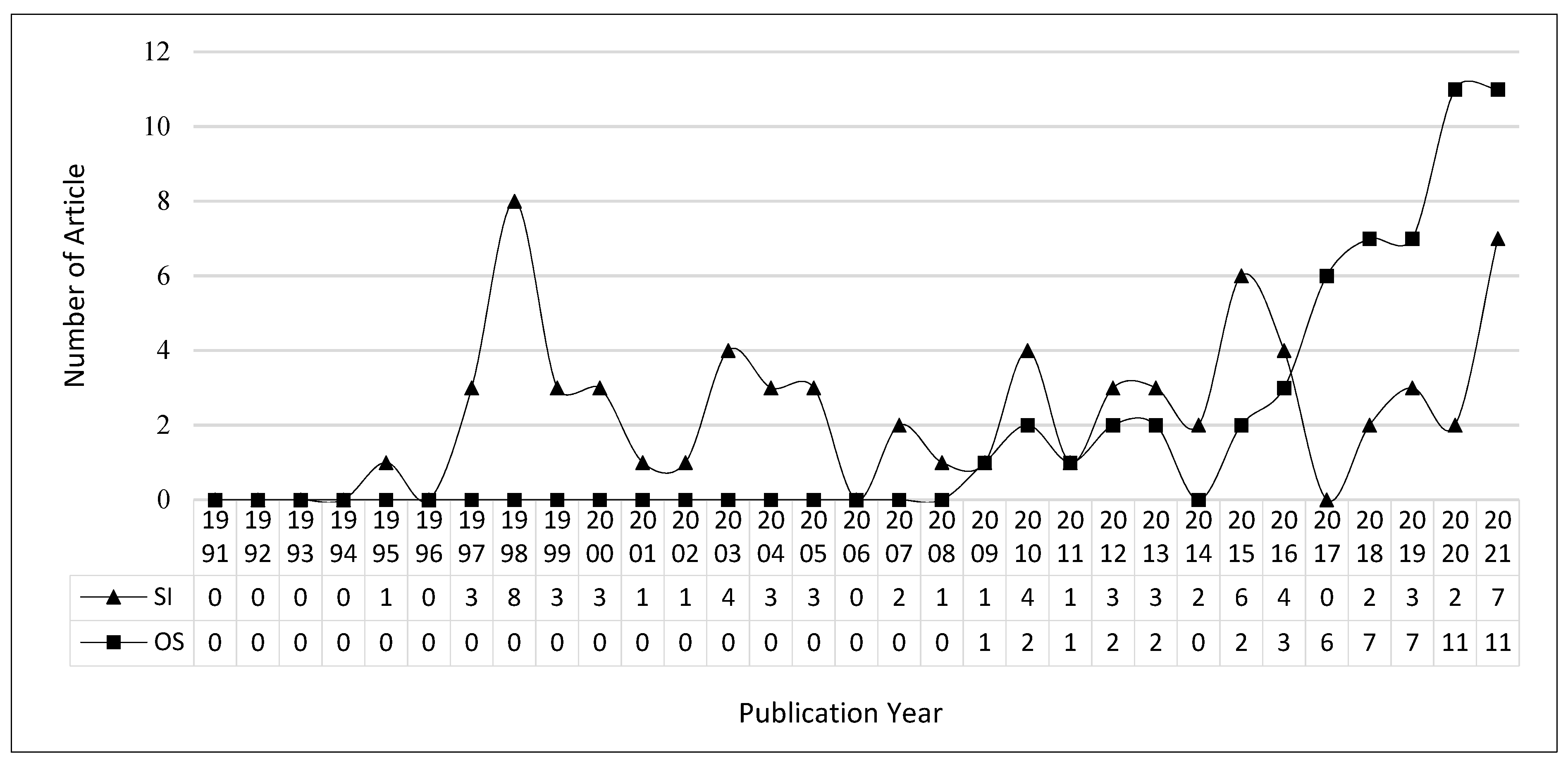
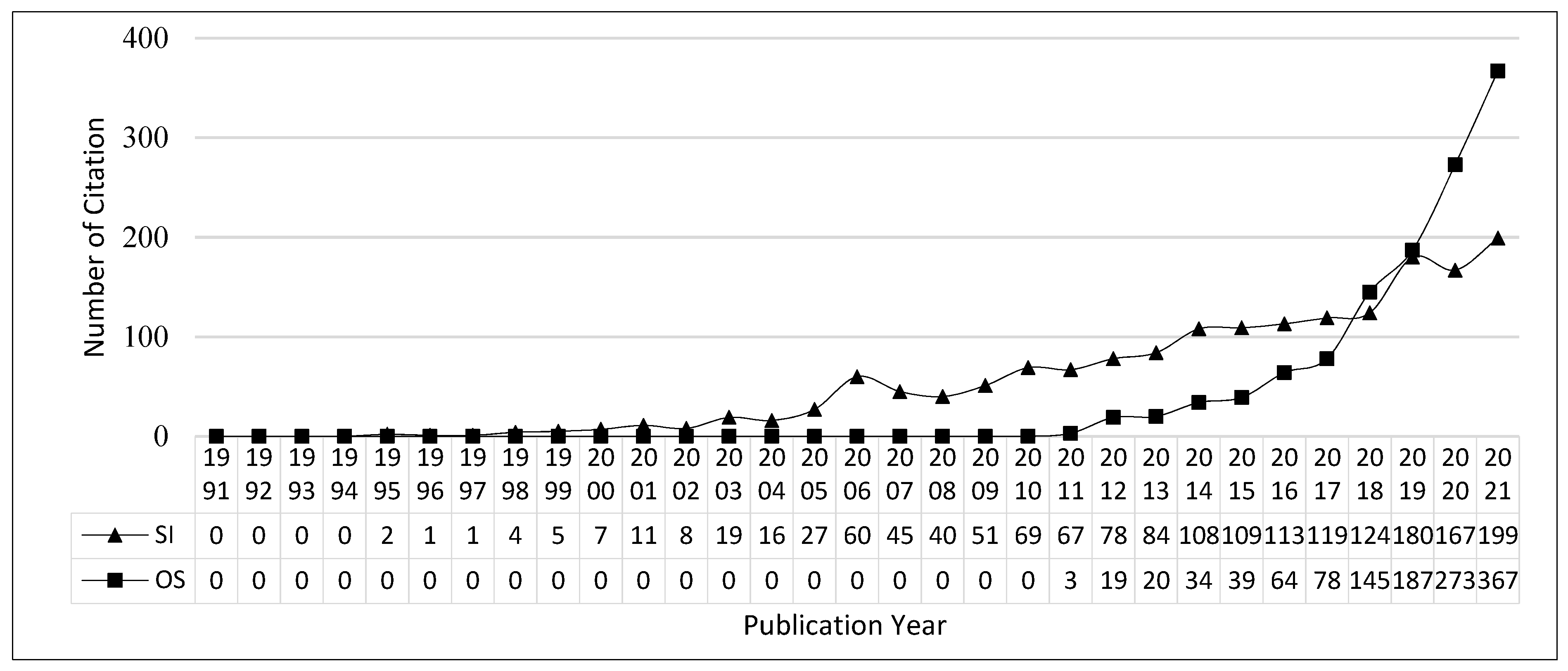
- The publication productivity per annum steadily increased in the SI research field, but the OS did not draw many researchers’ attention before the year 2010, which was followed by a rapid growth in the last five years. Since the year 2017, as well as what can be inferred from the literature analysis, OS is becoming an essential subject. New research topics are being emphasized to stimulate research momentum that implies the study of OS has the great potential to grow in the near future. Meanwhile, the citation distributions for SI have been steadily ascending since the year 2001, followed by dramatic growth, and which rapidly peaked in the year 2017 on OS. The result indicates that OS is becoming an important topic of concern in the upcoming years. Reviewing the distributions of country/territory, the top 5 countries published a total of 50 papers that reached 71.43% of the overall publications in the SI field. China (5), Japan (3), and Korea (2) were three countries that contributed 10 articles (14.29%) from 1991 to 2021, which highlights that most countries still need to invest more effort in academic research related to strategic innovation. Unlike strategic innovation, the discussions of organizational sustainability are being actively participated in by many nations worldwide. The USA (21) is a leading country contributing to the OS research domain, followed by China (6) and Turkey (5). These top three ranked countries issued 32 articles (58.18%) in a total of 55 publications in the last decade.
- (2)
- In the most relevant disciplines in the SI subject category provided by Management and Business, the total citations reached 3563 occurrences. On the OS aspect, Green Sustainable Science Technology, Environmental Sciences, Environmental Studies, and Management were ranked as the top four categories, with 2887 citations representing continuous growth. The research findings can be extended to investigate the author productivity by analyzing variables such as chronological and academic age, the number and frequency of previous publications, access to research grants, job status, etc. In such a way, the characteristics of the high, medium, and low publishing activity of authors can be identified. Moreover, these findings will also help to judge the social science research trends and understand the scale of development of the research in SI and OS, by comparing increases in the article authors. From the above information, governments and enterprises may infer the collective tendencies and demands for scientific researchers in SI and OS to formulate the appropriate training strategies and policies in the future.
- (3)
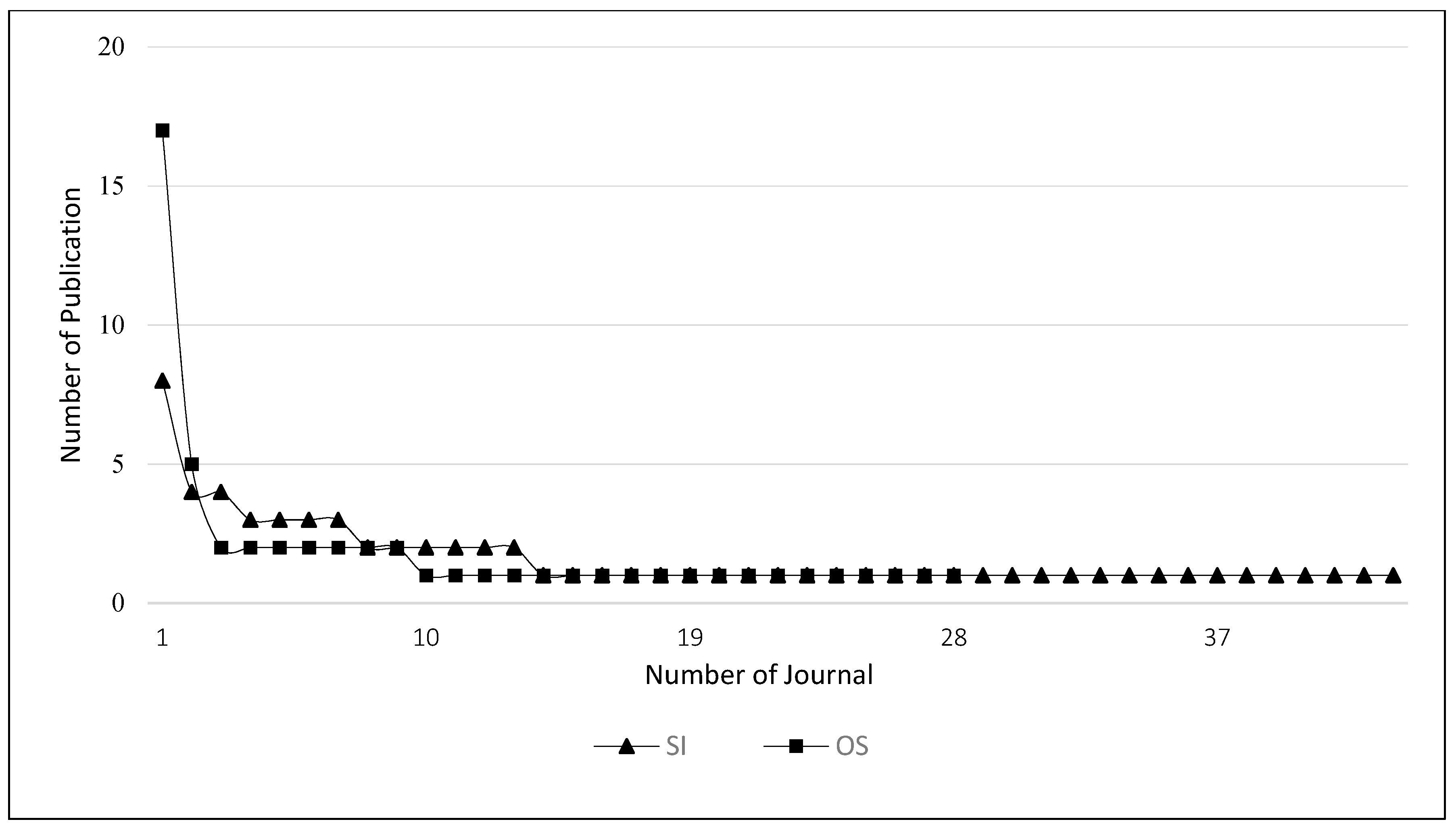
- Exploring the distribution of SI by Bradford’s law, the ratio of the number of journals in each area was in the SI research aspect, which is consistent with the Equation (1) relationship between the number of journals in each area stated by Bradford’s law, thus, the distributions of publication characteristics in the SI research domain did conform to the relationship of Bradford’s law. Additionally, utilizing Bradford’s law to examine the distribution of OS, the ratio of the number of journals in each area was , which is inconsistent with the Equation (1) relationship between the number of journals in each area stated by Bradford’s law. This reveals that the distributions of publication characteristics in the OS research domain did not correspond to Bradford’s law. According to Lotka’s law, the value of the exponent for SI was estimated at , and the constant was computed at . Applying the K–S test revealed that the maximum deviation found was which did not exceed the critical value of at the 0.01 level of significance. Therefore, a null hypothesis must be accepted, and it must be concluded that the dataset of SI did conform to Lotka’s law. Furthermore, based on Lotka’s law, the value of the exponent for OS was estimated at and the constant c was computed at . Applying the K–S test, the maximum deviation found was which did exceed the critical value of at the 0.01 level of significance. Thus, a null hypothesis must be rejected, and it must be concluded that the dataset of OS did not fit Lotka’s law. The reason why OS did not follow either Bradford’s law or Lotka’s law is that the number of authors who published only one article was too large; as a result, the difference between the observed value and the expected value was greater than the K–S test critical value. This effect reveals that the distributions of OS diverged from the slope of Lotka’s law.
5. Conclusions
Author Contributions
Funding
Data Availability Statement
Conflicts of Interest
References
- Nanes, M.; Bachus, T. Walls and strategic innovation in violent conflict. J. Confl. Resolut. 2021, 65, 1131–1158. [Google Scholar] [CrossRef]
- Nawaz, W.; Koc, M. Exploring organizational sustainability: Themes, functional areas, and best practices. Sustainability 2019, 11, 4307. [Google Scholar] [CrossRef] [Green Version]
- Pritchard, A. Statistical bibliography or bibliometrics. J. Doc. 1969, 25, 348–349. [Google Scholar]
- Anderson, J.; Markides, C. Strategic innovation at the base of the pyramid. Sloan Manag. Rev. 2007, 49, 83–84. [Google Scholar]
- Markides, C. Strategic innovation. Sloan Manag. Rev. 1997, 38, 9–23. [Google Scholar]
- Markides, C. Strategic innovation in established companies. Sloan Manag. Rev. 1998, 39, 31–32. [Google Scholar]
- Talke, K.; Salomo, S.; Kock, A. Top management team diversity and strategic innovation orientation: The relationship and consequences for innovativeness and performance. J. Prod. Innov. Manag. 2011, 28, 819–832. [Google Scholar] [CrossRef]
- Diaz-Carrion, R.; Franco-Leal, N. Social and strategic innovation: Extending the varieties of capitalism to Asian countries. Int. Entrep. Manag. J. 2021. [Google Scholar] [CrossRef]
- Gebauer, H.; Worch, H.; Truffer, B. Absorptive capacity, learning processes and combinative capabilities as determinants of strategic innovation. Eur. Manag. J. 2012, 30, 57–73. [Google Scholar] [CrossRef]
- Li, J.Q.; Ren, H.; Zhang, C.C.; Li, Q.X.; Duan, K.F. Substantive innovation or strategic innovation? Research on multiplayer stochastic evolutionary game model and simulation. Complexity 2020, 2020, 9640412. [Google Scholar] [CrossRef]
- Yin, C.Y. Measuring organization impacts by integrating competitive intelligence into executive information system. J. Intell. Manuf. 2018, 29, 533–547. [Google Scholar] [CrossRef]
- Schlegelmilch, B.B.; Diamantopoulos, A.; Kreuz, P. Strategic innovation: The construct, its drivers and its strategic outcomes. J. Strateg. Mark. 2010, 11, 117–132. [Google Scholar] [CrossRef]
- Cassia, L.; de Massis, A.; Pizzurno, E. Strategic innovation and new product development in family firms: An empirically grounded theoretical framework. Int. J. Entrep. Behav. Res. 2015, 18, 198–199. [Google Scholar] [CrossRef] [Green Version]
- Grillitsch, M.; Hansen, T.; Coenen, L.; Miorner, J.; Moodysson, J. Innovation policy for system-wide transformation: The case of strategic innovation programmes (SIPs) in Sweden. Res. Policy 2019, 48, 1048–1061. [Google Scholar] [CrossRef]
- Simonse, L.W.L.; Hultink, E.J.; Buijs, J.A. Innovation roadmapping: Building concepts from practitioners’ insights. J. Prod. Innov. Manag. 2015, 32, 904–924. [Google Scholar] [CrossRef]
- Sundbo, J. Management of innovation in services. Serv. Ind. J. 1997, 17, 432–455. [Google Scholar] [CrossRef]
- Thakur, R.; Hale, D. Service innovation: A comparative study of U.S. and Indian service firms. J. Bus. Res. 2013, 66, 1108–1123. [Google Scholar] [CrossRef]
- Zeng, D.L.; Hu, J.B.; Ouyang, T.H. Managing innovation paradox in the sustainable innovation ecosystem: A case study of ambidextrous capability in a focal firm. Sustainability 2017, 9, 2091. [Google Scholar] [CrossRef] [Green Version]
- Galambos, L.; Sturchio, J.L. Pharmaceutical firms and the transition to biotechnology: A study in strategic innovation. Bus. Hist. Rev. 1998, 72, 250–278. [Google Scholar] [CrossRef]
- Pitt, M.; Clarke, K. Competing on competence: A knowledge perspective on the management of strategic innovation. Technol. Anal. Strateg. Manag. 1999, 11, 301–316. [Google Scholar] [CrossRef]
- Kodama, M. Strategic innovation in traditional big business: Case studies of two Japanese companies. Organ. Stud. 2003, 24, 235–268. [Google Scholar] [CrossRef]
- Charitou, C.D.; Markides, C.C. Responses to disruptive strategic innovation. MIT Sloan Manag. Rev. 2003, 44, 55–63. [Google Scholar]
- Kranz, J. Strategic innovation in IT outsourcing: Exploring the differential and interaction effects of contractual and relational governance mechanisms. J. Strateg. Inf. Syst. 2021, 30, 1–21. [Google Scholar] [CrossRef]
- Paulraj, A. Understanding the relationships between internal resources and capabilities, sustainable supply management and organizational sustainability. J. Supply Chain. Manag. 2011, 47, 19–37. [Google Scholar] [CrossRef]
- Carayannis, E.G.; Sindakis, S.; Walter, C. Business model innovation as lever of organizational sustainability. J. Technol. Transf. 2015, 40, 36. [Google Scholar] [CrossRef]
- Lopes, C.M.; Scavarda, A.; Hofmeister, L.F.; Thome, A.M.T.; Vaccaro, G.L.R. An analysis of the interplay between organizational sustainability, knowledge management, and open innovation. J. Clean. Prod. 2015, 142, 476–488. [Google Scholar] [CrossRef]
- Florea, L.; Cheung, Y.H.; Herndon, N.C. For all good reasons: Role of values in organizational sustainability. J. Bus. Ethics 2013, 114, 393–408. [Google Scholar] [CrossRef]
- Moizer, J.; Tracey, P. Strategy making in social enterprise: The role of resource allocation and its effects on organizational sustainability. Syst. Res. Behav. Sci. 2010, 27, 252–266. [Google Scholar] [CrossRef]
- Horak, S.; Arya, B.; Ismail, K.M. Organizational sustainability determinants in different cultural settings: A conceptual framework. Bus. Strat. Env. 2017, 27, 528–546. [Google Scholar] [CrossRef]
- Muff, K. Learning from positive impact organizations: A framework for strategic innovation. Sustainability 2021, 13, 8891. [Google Scholar] [CrossRef]
- De Freitas, J.G.; Costa, H.G.; Ferraz, F.T. Impacts of lean six sigma over organizational sustainability: A survey study. J. Clean. Prod. 2017, 156, 262–275. [Google Scholar] [CrossRef]
- Van de Wetering, R.; Mikalef, P.; Helms, R. Driving organizational sustainability-oriented innovation capabilities: A complex adaptive systems perspective. Curr. Opin. Environ. Sustain. 2017, 28, 71–79. [Google Scholar] [CrossRef]
- Batista, A.A.D.; de Francisco, A.C. Organizational sustainability practices: A study of the firms listed by the corporate sustainability index. Sustainability 2018, 10, 226. [Google Scholar] [CrossRef] [Green Version]
- Braccini, A.M.; Margherita, E.G. Exploring organizational sustainability of Industry 4.0 under the triple bottom line: The case of a manufacturing company. Sustainability 2019, 11, 36. [Google Scholar] [CrossRef] [Green Version]
- Lueg, K.; Krastev, B.; Lueg, R. Bidirectional effects between organizational sustainability disclosure and risk. J. Clean. Prod. 2019, 229, 268–277. [Google Scholar] [CrossRef]
- Yu, M.C.; Mai, Q.; Tsai, S.B.; Dai, Y. An empirical study on the organizational trust, employee-organization relationship and innovative behavior from the integrated perspective of social exchange and organizational sustainability. Sustainability 2018, 10, 864. [Google Scholar] [CrossRef] [Green Version]
- Bastas, A.; Liyanage, K. Integrated quality and supply chain management business diagnostics for organizational sustainability improvement. Sustain. Prod. Consum. 2019, 17, 11–30. [Google Scholar] [CrossRef]
- Partidario, P.J.; Vergragt, P.J. Planning of strategic innovation aimed at environmental sustainability: Actor-networks, scenario acceptance and backcasting analysis within a polymeric coating chain. Futures 2002, 34, 841–861. [Google Scholar] [CrossRef]
- Govindarajan, V.; Trimble, C. Organizational DNA for strategic innovation. Calif. Manag. Rev. 2005, 47, 47–48. [Google Scholar] [CrossRef]
- Yang, J.W. Thriving organizational sustainability through innovation: Incivility climate and teamwork. Sustainability 2016, 8, 860. [Google Scholar] [CrossRef] [Green Version]
- Shelomentsev, A.G.; Goncharova, K.S.; Stepnov, I.M.; Kovalchuk, J.A.; Lan, D.H.; Golov, R.S. Strategic innovation as a factor of adaptation of national economies to the development of global value chains. Sustainability 2021, 13, 9765. [Google Scholar] [CrossRef]
- Thomas, T.E.; Lamm, E. Legitimacy and organizational sustainability. J. Bus. Ethics 2012, 110, 191–203. [Google Scholar] [CrossRef]
- Yang, L.; Hou, G.S. Study on the strategic innovation and industrial development effect of marine industry. J. Coast. Res. 2019, 94, 581–584. [Google Scholar] [CrossRef]
- Kilintzis, P.; Samara, E.; Carayannis, E.G.; Bakouros, Y. Business model innovation in Greece: Its effect on organizational sustainability. J. Knowl. Econ. 2020, 11, 949–967. [Google Scholar] [CrossRef]
- Wilczek, B.; Stanoevska-Slabeva, K.; Kernbach, K.; Meckel, M. Un-locking strategic lock-ins of local media: An investigation of local media’s preferences towards public support for strategic innovation. Digit. J. 2021, 9, 276–299. [Google Scholar] [CrossRef]
- Zhao, D.Q.; Zhong, H.Q.; Wu, Y.L.; Zhou, Q.F. A study of the impact of internet-based instruction integrated innovation education on university student entrepreneurial team collaboration and strategic innovation. Front. Psychol. 2020, 11, 1–9. [Google Scholar] [CrossRef]
- Zhou, Y.Y.; Shu, C.L.; Jiang, W.; Gao, S.X. Green management, firm innovations, and environmental turbulence. Bus. Strategy Environ. 2019, 28, 567–581. [Google Scholar] [CrossRef]
- Broadus, R.N. Toward a definition of bibliometrics. Scientometrics 1987, 12, 373–379. [Google Scholar] [CrossRef]
- Tsai, M.Y. Literature growth, journal characteristics, and author productivity in subject indexing, 1977–2000. J. Am. Soc. Inf. Sci. Technol. 2004, 55, 64–73. [Google Scholar] [CrossRef]
- Tsai, M.Y. Bibliometric analysis of literature on randomized controlled trials. J. Med. Libr. Assoc. 2005, 93, 450–458. [Google Scholar]
- Tsai, M.Y. A bibliometric analysis of hydrogen energy literature, 1965–2006. Scientometrics 2008, 75, 421–438. [Google Scholar] [CrossRef]
- Moed, H.F.; Burger, W.J.M.; Frankfort, J.G.; van Raan, A.F.J. The use of bibliometric data for the measurement of university-research performance. Res. Policy 1985, 14, 131–149. [Google Scholar] [CrossRef]
- Moed, H.F.; Debruin, R.E.; van Leeuwen, T.N. New bibliometric tools for the assessment of national research performance—Database description, overview of indicators and first applications. Scientometrics 1995, 33, 381–422. [Google Scholar] [CrossRef]
- Nederhof, A.J. Bibliometric monitoring of research performance in the social sciences and the humanities: A review. Scientometrics 2006, 66, 81–100. [Google Scholar] [CrossRef]
- Costas, R.; van Leeuwen, T.N.; Bordons, M. A bibliometric classificatory approach for the study and assessment of research performance at the individual level: The effects of age on productivity and impact. J. Am. Soc. Inf. Sci. Technol. 2010, 61, 1564–1581. [Google Scholar] [CrossRef] [Green Version]
- Diem, A.; Wolter, S.C. The use of bibliometrics to measure research performance in education sciences. Res. High. Educ. 2013, 54, 86–114. [Google Scholar] [CrossRef] [Green Version]
- Cardoso, L.; Silva, R.; de Almeida, G.G.F.; Santos, L.L. A bibliometric model to analyze country research performance: SciVal Topic prominence approach in tourism, leisure and hospitality. Sustainability 2021, 12, 9897. [Google Scholar] [CrossRef]
- Koenig, M.E.D. Bibliometric indicators versus expert opinion in assessing research performance. J. Am. Soc. Inf. Sci. 1983, 34, 136–145. [Google Scholar] [CrossRef]
- Luukkonen, T. Bibliometrics and evaluation of research performance. Ann. Med. 1990, 22, 145–150. [Google Scholar] [CrossRef]
- Salisu, S.A.; Salami, M.O. A bibliometric analysis of Nigeria’s research performance, 1901–2016. Afr. J. Libr. Arch. Inf. Sci. 2020, 30, 23–36. [Google Scholar]
- Zou, Y.W. A bibliometric study on the R&D funding and academic research performance in Shenzhen. Sci. Public Policy 2022, scab092. [Google Scholar] [CrossRef]
- Bradford, S.C. Sources of information on specific subjects. J. Inf. Sci. 1985, 10, 176–180, reprinted in Engineering 1934, 137, 85–86. [Google Scholar]
- Nicolaisen, J.; Hjorland, B. Practical potentials of Bradford’s law: A critical examination of the received view. J. Doc. 2007, 63, 359–377. [Google Scholar] [CrossRef] [Green Version]
- Venable, G.T.; Shepherd, B.A.; Loftis, C.M.; McClatchy, S.G.; Roberts, M.L.; Fillinger, M.E.; Tansey, J.B.; Klimo, P. Bradford’s law: Identification of the core journals for neurosurgery and its subspecialties. J. Neurosurg. 2016, 124, 569–579. [Google Scholar] [CrossRef] [PubMed] [Green Version]
- Gupta, B.M.; Karisiddippa, C.R. Collaboration and author productivity: A study with a new variable in Lotka’s law. Scientometrics 1999, 44, 129–134. [Google Scholar] [CrossRef]
- Kawamura, M.; Thomas, C.D.L.; Kawaguchi, Y.; Sasahara, H. Lotka’s law and the pattern of scientific productivity in the dental science literature. Med. Inform. Internet Med. 1999, 24, 309–315. [Google Scholar] [CrossRef]
- Rowlands, I. Emerald authorship data, Lotka’s law and research productivity. Aslib Proc. 2005, 57, 5–10. [Google Scholar] [CrossRef]
- Lotka, A.J. The frequency distribution of scientific productivity. J. Wash. Acad. Sci. 1926, 16, 317–324. [Google Scholar]
- Pao, M.L. Lotka’s law: A testing procedure. Inf. Processing Manag. 1985, 21, 305–320. [Google Scholar] [CrossRef]
- Peng, C.; Jiang, H.; Zhang, T.Y. Does the national risk of overseas investment affect the strategic innovation behavior of enterprises? Evidence from China. Manag. Decis. Econ. 2021, 43, 1548–1565. [Google Scholar] [CrossRef]


| Ranked | Strategic Innovation (SI) | Ranked | Organizational Sustainability (OS) | ||||
|---|---|---|---|---|---|---|---|
| Country/ Territory | NP | % of 70 (%) | Country/ Territory | NP | % of 55 (%) | ||
| 1 | USA | 18 | 25.71% | 1 | USA | 21 | 38.18% |
| 2 | England | 16 | 22.86% | 2 | Peoples R. China | 6 | 10.91% |
| 3 | Switzerland | 6 | 8.57% | 3 | Turkey | 5 | 9.09% |
| 4 | Netherlands | 5 | 7.14% | 4 | Brazil | 4 | 7.27% |
| 4 | Peoples R. China | 5 | 7.14% | 4 | India | 4 | 7.27% |
| 6 | Germany | 4 | 5.71% | 4 | Pakistan | 4 | 7.27% |
| 7 | Italy | 3 | 4.29% | 7 | England | 3 | 5.45% |
| 7 | Japan | 3 | 4.29% | 7 | South Africa | 3 | 5.45% |
| 7 | Spain | 3 | 4.29% | 9 | Finland | 2 | 3.64% |
| 10 | Australia | 2 | 2.86% | 10 | Greece | 2 | 3.64% |
| 10 | Belgium | 2 | 2.86% | 10 | Italy | 2 | 3.64% |
| 10 | Denmark | 2 | 2.86% | 10 | Saudi Arabia | 2 | 3.64% |
| 10 | France | 2 | 2.86% | 10 | South Korea | 2 | 3.64% |
| 10 | South Korea | 2 | 2.86% | 10 | Sweden | 2 | 3.64% |
| Ranked | Strategic Innovation (SI) | Ranked | Organizational Sustainability (OS) | ||||||
|---|---|---|---|---|---|---|---|---|---|
| Institution Name | NP | % of 70 (%) | Country | Institution Name | NP | % of 55 (%) | Country | ||
| 1 | University of London | 5 | 7.14% | UK | 1 | University of Wisconsin Madison | 3 | 5.45% | USA |
| 2 | League of European Research Universities (LERU) | 4 | 5.71% | Belgium | 1 | University Of Wisconsin System | 3 | 5.45% | USA |
| 2 | London Business School | 4 | 5.71% | UK | 3 | Altinbas University | 2 | 3.64% | Turkey |
| 4 | Dartmouth College | 3 | 4.29% | USA | 3 | Comsats University Islamabad (CUI) | 2 | 3.64% | Pakistan |
| 5 | Aston University | 2 | 2.86% | UK | 3 | George Washington University | 2 | 3.64% | USA |
| 5 | McKinsey & Company | 2 | 2.86% | USA | 3 | Malaviya National Institute of Technology Jaipur (MNIT) | 2 | 3.64% | India |
| 5 | University of North Carolina | 2 | 2.86% | USA | 3 | National Institute of Technology NIT System | 2 | 3.64% | India |
| 5 | University of Texas Austin | 2 | 2.86% | USA | 3 | Universidade Federal Fluminense | 2 | 3.64% | Brazil |
| 5 | University of Texas System | 2 | 2.86% | USA | 3 | University of Johannesburg | 2 | 3.64% | South Africa |
| Others | 44 | 62.85% | 3 | University of Michigan | 2 | 3.64% | USA | ||
| 3 | University of Michigan System | 2 | 3.64% | USA | |||||
| 3 | University of Missouri System | 2 | 3.64% | USA | |||||
| 3 | Victoria University Wellington | 2 | 3.64% | New Zealand | |||||
| 3 | Yasar University | 2 | 3.64% | Turkey | |||||
| Others | 25 | 45.45% | |||||||
| Items | Strategic Innovation (SI) | Items | Organizational Sustainability (OS) | ||||
|---|---|---|---|---|---|---|---|
| Document Type | NP | % of 70 (%) | Document Type | NP | % of 55 (%) | ||
| 1 | Articles | 46 | 65.71% | 1 | Articles | 48 | 87.27% |
| 2 | Editorial Materials | 8 | 11.43% | 2 | Review Articles | 4 | 7.27% |
| 3 | Book Reviews | 7 | 10.00% | 3 | Early Access | 2 | 3.64% |
| 4 | Letters | 6 | 8.57% | 4 | Meeting Abstract | 2 | 3.64% |
| 5 | Proceedings Papers | 5 | 7.14% | 5 | Corrections | 1 | 1.82% |
| 6 | Review Articles | 3 | 4.29% | 6 | Proceedings Papers | 1 | 1.82% |
| 7 | Early Access | 2 | 2.86% | ||||
| Ranked | Strategic Innovation (SI) | Ranked | Organizational Sustainability (OS) | ||||||
|---|---|---|---|---|---|---|---|---|---|
| Web of Science Categories | NP | % of 70 (%) | TC | Web of Science Categories | NP | % of 55 (%) | TC | ||
| 1 | Management | 47 | 67.14% | 1503 | 1 | Green Sustainable Science Technology | 27 | 49.09% | 534 |
| 2 | Business | 31 | 44.29% | 1304 | 2 | Environmental Sciences | 24 | 43.64% | 484 |
| 3 | Economics | 7 | 10.00% | 78 | 3 | Environmental Studies | 19 | 34.55% | 312 |
| 4 | Engineering Industrial | 6 | 8.57% | 163 | 4 | Management | 16 | 29.09% | 612 |
| 5 | Information Science Library Science | 5 | 7.14% | 75 | 5 | Business | 8 | 14.55% | 239 |
| 6 | Business Finance | 4 | 5.71% | 21 | 6 | Engineering Environmental | 5 | 9.09% | 186 |
| 6 | Computer Science Information Systems | 4 | 5.71% | 48 | 7 | Engineering Industrial | 4 | 7.27% | 147 |
| 6 | Multidisciplinary Sciences | 4 | 5.71% | 110 | 8 | Economics | 3 | 5.45% | 27 |
| 9 | Engineering Multidisciplinary | 3 | 4.29% | 6 | 8 | Social Sciences Interdisciplinary | 3 | 5.45% | 76 |
| 9 | Environmental Sciences | 3 | 4.29% | 2 | 10 | Development Studies | 2 | 3.64% | 6 |
| 9 | Operations Research Management Science | 3 | 4.29% | 6 | 10 | Ethics | 2 | 3.64% | 143 |
| 12 | Environmental Studies | 2 | 2.86% | 0 | 10 | Health Care Sciences Services | 2 | 3.64% | 1 |
| 12 | Green Sustainable Science Technology | 2 | 2.86% | 0 | 10 | Psychology Applied | 2 | 3.64% | 49 |
| 12 | International Relations | 2 | 2.86% | 9 | 10 | Public Administration | 2 | 3.64% | 25 |
| 12 | Political Science | 2 | 2.86% | 7 | 10 | Regional Urban Planning | 2 | 3.64% | 6 |
| 12 | Regional Urban Planning | 2 | 2.86% | 31 | Others | 8 | 14.55% | 40 | |
| Others | 15 | 21.43% | 200 | ||||||
| Ranked | Strategic Innovation (SI) | Ranked | Organizational Sustainability (OS) | ||||||
|---|---|---|---|---|---|---|---|---|---|
| Publication Title | NP | % of 70 (%) | TC | Publication Title | NP | % of 55 (%) | TC | ||
| 1 | Sloan Management Review | 8 | 11.43% | 312 | 1 | Sustainability | 17 | 30.91% | 264 |
| 2 | Journal of Production Innovation Management | 4 | 5.71% | 161 | 2 | Journal of Cleaner Production | 5 | 9.09% | 186 |
| 2 | Journal of Strategic Information Systems | 4 | 5.71% | 48 | 3 | International Journal of Lean Six Sigma | 2 | 3.64% | 30 |
| 4 | Academy of Management Executive | 3 | 4.29% | 3 | 3 | Journal of Business Ethics | 2 | 3.64% | 1 |
| 4 | International Journal of Technology Management | 3 | 4.29% | 6 | 3 | Operations Management Research | 2 | 3.64% | 1 |
| 4 | MIT Sloan Management Review | 3 | 4.29% | 341 | 3 | Organizational Dynamics | 2 | 3.64% | 49 |
| 4 | Technology Analysis Strategic Management | 3 | 4.29% | 98 | 3 | Public Management Review | 2 | 3.64% | 25 |
| 8 | European Management Journal | 2 | 2.86% | 156 | 3 | Sustainable Development | 2 | 3.64% | 6 |
| 8 | Journal of Monetary Economics | 2 | 2.86% | 19 | 3 | Systems Research and Behavioral Science | 2 | 3.64% | 75 |
| 8 | Journal of Organizational Change Management | 2 | 2.86% | 48 | Others | 19 | 34.55% | 554 | |
| 8 | R D Management | 2 | 2.86% | 37 | |||||
| 8 | Research Technology Management | 2 | 2.86% | 2 | |||||
| 8 | Sustainability | 2 | 2.86% | 0 | |||||
| Others | 30 | 42.86% | 512 | ||||||
| Strategic Innovation (SI) | Organizational Sustainability (OS) | ||||||||||
|---|---|---|---|---|---|---|---|---|---|---|---|
| NP1 | NJ1 | Accumulated NJ1 | Accumulated NJ1 (%) | Accumulated NP1 | Accumulated NP1 (%) | NP2 | NJ2 | Accumulated NJ2 | Accumulated NJ2 (%) | Accumulated NP2 | Accumulated NP2 (%) |
| 8 | 1 | 1 | 2.33% | 8 | 11.43% | 17 | 1 | 1 | 3.57% | 17 | 30.91% |
| 4 | 2 | 3 | 6.98% | 16 | 22.86% | 5 | 1 | 2 | 7.14% | 22 | 40.00% |
| 3 | 4 | 7 | 16.28% | 28 | 40.00% | 2 | 7 | 9 | 32.14% | 36 | 65.45% |
| 2 | 6 | 13 | 30.23% | 40 | 57.14% | 1 | 19 | 28 | 100% | 55 | 100% |
| 1 | 30 | 43 | 100% | 70 | 100% | ||||||
| The Authors’ Productivity for SI | |||||||
|---|---|---|---|---|---|---|---|
| Items | NP | Author(s) | NP x Author(s) | Accumulated Record(s) | Accumulated Record (%) | Accumulated Author(s) | Accumulated Author(s) (%) |
| 1 | 5 | 1 | 5 | 5 | 3.25% | 1 | 0.70% |
| 2 | 3 | 1 | 3 | 8 | 5.19% | 2 | 1.41% |
| 3 | 2 | 6 | 12 | 20 | 12.99% | 8 | 5.63% |
| 4 | 1 | 134 | 134 | 154 | 100% | 142 | 100% |
| The Estimation of the Exponent n of SI | |||||
|---|---|---|---|---|---|
| (NP) | y (Author) | ||||
| 5 | 1 | 0.70 | 0.00 | 0.00 | 0.49 |
| 3 | 1 | 0.48 | 0.00 | 0.00 | 0.23 |
| 2 | 6 | 0.30 | 0.78 | 0.23 | 0.09 |
| 1 | 134 | 0.00 | 2.13 | 0.00 | 0.00 |
| Total | 142 | 1.48 | 2.91 | 0.23 | 0.81 |
| Strategic Innovation (SI) | ||||||
|---|---|---|---|---|---|---|
| (NP) | Author(s) | Observation by Author(s) | Accumulated Value | Expectation by Author(s) | Accumulated Value | |
| 1 | 134 | 0.943662 | 0.943662 | 0.872266 | 0.872266 | 0.071396 |
| 2 | 6 | 0.042254 | 0.985915 | 0.094346 | 0.966612 | 0.019304 |
| 3 | 1 | 0.007042 | 0.992958 | 0.025686 | 0.992298 | 0.000660 |
| 5 | 1 | 0.007042 | 1.000000 | 0.004987 | 0.997285 | 0.002715 |
| The Authors’ Productivity for OS | |||||||
|---|---|---|---|---|---|---|---|
| Items | NP | Author(s) | NP x Author(s) | Accumulated Record(s) | Accumulated Record (%) | Accumulated Author(s) | Accumulated Author(s)(%) |
| 1 | 2 | 12 | 24 | 24 | 14.12% | 12 | 7.59% |
| 2 | 1 | 146 | 146 | 170 | 100% | 158 | 100% |
| The Estimation of the Exponent n of OS | |||||
|---|---|---|---|---|---|
| (NP) | (Author) | ||||
| 2 | 12 | 0.30 | 1.08 | 0.32 | 0.09 |
| 1 | 146 | 0.00 | 2.16 | 0.00 | 0.00 |
| Total | 158 | 0.30 | 3.24 | 0.32 | 0.09 |
| Organizational Sustainability (OS) | ||||||
|---|---|---|---|---|---|---|
| (NP) | Author(s) | Observation by Author(s) | Accumulated Value | Expectation by Author(s) | Accumulated Value | |
| 1 | 146 | 0.924051 | 0.924051 | 0.670660 | 0.670660 | 0.253391 |
| 2 | 12 | 0.075949 | 1.000000 | 0.192272 | 0.862932 | 0.137068 |
Publisher’s Note: MDPI stays neutral with regard to jurisdictional claims in published maps and institutional affiliations. |
© 2022 by the authors. Licensee MDPI, Basel, Switzerland. This article is an open access article distributed under the terms and conditions of the Creative Commons Attribution (CC BY) license (https://creativecommons.org/licenses/by/4.0/).
Share and Cite
Yin, C.-Y.; Chang, H.-H. What Is the Link between Strategic Innovation and Organizational Sustainability? Historical Review and Bibliometric Analytics. Sustainability 2022, 14, 6937. https://doi.org/10.3390/su14116937
Yin C-Y, Chang H-H. What Is the Link between Strategic Innovation and Organizational Sustainability? Historical Review and Bibliometric Analytics. Sustainability. 2022; 14(11):6937. https://doi.org/10.3390/su14116937
Chicago/Turabian StyleYin, Chi-Yen, and Hsiao-Hsin Chang. 2022. "What Is the Link between Strategic Innovation and Organizational Sustainability? Historical Review and Bibliometric Analytics" Sustainability 14, no. 11: 6937. https://doi.org/10.3390/su14116937
APA StyleYin, C.-Y., & Chang, H.-H. (2022). What Is the Link between Strategic Innovation and Organizational Sustainability? Historical Review and Bibliometric Analytics. Sustainability, 14(11), 6937. https://doi.org/10.3390/su14116937