


Abstract
Sustainable economic development is an important force to enhance the comprehensive national strength. It mainly depends on the breakthrough and innovation of science and technology. The new generation of information technology (NGIT) is the most active field in scientific and technological innovation. It is of great significance to deeply consider the relationship between the new generation of information technology and the sustainable development of a regional economy. In this study, 29 provinces and cities in China from 2009 to 2018 were selected and use the feasible generalized least squares (FGLS) method to empirically analyze the impact of the new generation of information technology on the sustainable development of regional economy. Simultaneously, it analyzes the differences between NGIT and economy sustainable development of the regional economy under different institutional environments. According to the research results, there is a positive correlation between new-generation information technology and the sustainable development of a regional economy. There is a positive U-shaped relationship between the penetration depth of NGIT and the sustainable development of a regional economy. Simultaneously, the higher the institutional environment’s level, the stronger the positive relationship between the penetration of NGIT and the sustainable development of a regional economy.
1. Introduction
The new generation of information technology (NGIT) is the core of China’s current development, which is an important measure to achieve the international competitiveness of China, such as China made 2025, Internet accelerated speed, and Artificial Intelligence (AI) action [1]. Actively promoting the Internet accelerated speed and AI actions is a significant strategic move to deepen the structural reform of supply-side and achieve the high-quality development of China’s economy. The Central Committee of the Communist Party of China and the State Council attach great importance to the development of NGIT, and make a series of strategic plans in the fields of cloud computing, big data, and artificial intelligence to promote the sustainable development of NGIT industry. As the most intensive and innovative industrial field in the scientific and technological revolution, NGIT has become the leading force to lead innovation and promote sustainable economic development [2]. By infiltrating into other industries other than Information Communication Technology (ICT), NGIT improves efficiency, enables knowledge exchange in other industries, promotes the deep integration of NGIT and the real economy, and realizes high-quality and sustainable development region.
The sustainable development of a regional economy gives full play to regional advantages under the constraints of existing resources. To achieve sustained and effective growth of regional economy. Economic growth is a professional intensive economic growth based on technological progress and continuous upgrading of industrial structure [3,4]. For developing countries, the premise of sustainable development of a regional economy is the imbalance of economic growth. A regional economy’s sustainable development is a process from quantitative change to qualitative change [5]. With the continuous development of the social economy, after reflecting on the adverse ecological and social effects caused by simple economic growth, human beings turn their pursuit to sustainable development of regional economy [6,7], and more and more scholars have reached a consensus on pursuing sustainable economic development. As an inexhaustible driving force to promote sustainable development, scientific and technological innovation is an important factor to promote the sustainable development of regional economy [8]. In fact, the fundamental solution to many unsustainable problems depends on the breakthrough and innovation of science and technology. In recent years, the application of information technology in various industries is primarily due to the combination of digital technology and non-digital products or services in the industry [9]. Promote the deep integration of information technology and the real economy. It can reduce the cost of information exchange, processing, and coordination. By saving social resources, promote sustainable development of regional economy. Unlike traditional information technology, the NGIT is not only a technological innovation, but a transition of development paradigm. Relying on NGIT, the integration of information collection, information exchange, information processing, and information application can be realized. It can provide technical support and reform opportunities for enterprises in various industries and form a new complex network space system [1]. In this system, the way of resource allocation has changed; NGIT has penetrated a series of links in the value chain, such as R & D design, production control, marketing, and so on, which breaks the boundaries between R & D, manufacturing and service, to optimize resource allocation, promote the upgrading of traditional industries, and promote sustainable development of regional economy. At present, China’s manufacturing sector is large but not strong. The development of NGIT has injected new energy into the manufacturing industry. The whole manufacturing and production process makes the production process achieve information integration, and the level of technological production has been improved [10]. China’s manufacturing industry has been promoted to move towards the middle and high end of the global value chain, realizing the transformation from “made in China” to “ intelligent manufacturing in China”, which has extensively promoted the sustainable development of a regional economy. China’s regional development is facing the problem of imbalance. The integration and development of information technology and the real economy are unbalanced. The eastern region has a better development situation, while the western region is relatively backward, so there is a lot of room for improvement [11]. Sustainable development of the regional economy can seek long-term and efficient regional development based on maintaining system coordination and lay the foundation for sustainable development [7].
China is currently in a period of economic transformation. In addition to the influence of industrial characteristics and its resources, industrial development is primarily affected by the regional institutional environment. The level of the institutional environment has different impacts on the industrial development of various regions [12]. Regions with a better institutional level can help enterprises obtain more external resources [13]. Therefore, it is necessary to optimize the institutional environment. Conducive to sustainable development of regional economy [14]. There are still many problems to be solved in researching the NGIT penetration, sustainable development of regional economy, and institutional environment.
NGIT is a vital development object in China. This article studies the impact of NGIT penetration on the sustainable development of a regional economy. Starting from the characteristics of NGIT penetration, this article studies the depth and breadth of NGIT penetration, respectively. Considering the institutional environment’s modulatory role on NGIT penetration and sustainable development of regional economy, this article analyzes how the penetration of NGIT affects the sustainable development of the regional economy by collecting data. It then reveals the relationship between the depth and breadth of NGIT penetration and the sustainable development of the regional economy. It provides theoretical references and suggestions for the sustainable development of the regional economy. This article mainly studies the following issues: (1) the influence of the penetration breadth of NGIT on the sustainable development of the regional economy; (2) the influence of the penetration depth of NGIT on the sustainable development of the regional economy; and (3) the modulatory role of the institutional environment.
2. Theoretical Analysis and Research Hypothesis
2.1. The Penetration of NGIT and Sustainable Development of the Regional Economy
Penetration refers to the potential ability of particular technology to change the lifestyle of all walks of life in society [15]. The penetration of NGIT is mainly reflected in the application of NGIT in design, R & D, manufacturing, sales, and service, improving the efficiency of each link and enterprise performance [2]. NGIT penetrates various industries. As an important force for guiding and social and economic development, a NGIT represented by the Internet of Things, big data, and cloud computing has injected new momentum into the regional economy’s sustainable development. It has become essential support for other industries [16]; it unifies information collection, information transmission, and information application, and constructs a brand-new information mode, which is embodied in the structure of “cloud, network, terminal, and platform”, and realizes the optimization of infrastructure. Enterprises carry out enterprise informatization construction with the help of optimized infrastructure, which has a great impact on production, transportation, trading and other links, and greatly reduces the cost of information exchange, processing, and coordination between enterprise partners, reducing a lot of their own investment and saving the resources of the whole society [1,17]. With the rapid spread of artificial intelligence, big data, and cloud computing technology, driving the transformation of enterprise product R & D paradigm has become the general trend in the era of digital economy [18].
The essence of sustainable development of the regional economy is to change the mode of economic development and adjust the economic structure to promote the development mode of sustainable economic growth. The growth of a regional economy is the primary condition and material basis for the sustainable development of a regional economy. Sustainable economic development improves people’s life through economic growth. Without regional economic growth, there will be no sustainable development of the regional economy [19]. Especially for developing countries, economic development has become the theme of the times, but sustainable development is still the precondition of regional economic development. Since the concept of sustainable development was put forward, it has aroused widespread attention of the academic community on the driving force of sustainable development. It is expected that the complex evaluation process of sustainable development of regional economy can be determined through the study of the nature of development. Forecast future development potential and trend [20]. Sustainable development is a complex system composed of economy, society, and environment.
Complex systems generally have the characteristics of multi-input and multi-output [21]. From the overall perspective, scholars regard the economic subsystem, social subsystem, and ecological subsystem as the same status and construct a sustainable development evaluation system [22]. At the same time, sustainable development of regional economy needs to consider the quality and speed of the process of sustainable development of regional economy and measure the level of sustainable development of regional economy [20] in combination with society and the economic level. In the era of the digital economy, the arrival of digital technology is significant to the development of industry. Considering the important role of digital technology in economic development, the Chinese government has formulated a series of policies to support the sustainable development of digital economy [9]. As the technical carrier of digital economy development, information technology can improve the quality of regional economic development by changing the characteristics of products and services [23]. Promote the sustainable development of the regional economy.
2.1.1. The Breadth of the NGIT Penetration and Sustainable Development of the Regional Economy
The breadth of NGIT penetration lies in the scope of NGIT penetration. NGIT is an “essential driving force for the sustainable development of the regional economy”. With the development of the NGIT industry, the penetration of NGIT enables the industry to have the same technological foundation to promote the in-depth integration of a NGIT and the real economy and promote sustainable regional development. For example, the penetration of NGIT into enterprises involves R & D platforms, manufacturing platforms, service platforms, and resource platforms. Internet companies have emerged on a large scale and penetrated various industries such as transportation, travel, catering, and finance [24]; this enables to maximize the net benefits of economic development while maintaining the quality of natural resources and the services they provide. NGIT promotes various production factors and service resources on a larger scale, dramatically reduces the cost of cooperation and information exchange between enterprises, and realizes information sharing [17]. NGIT service companies can use their resources to vertically integrate upstream and downstream business resources, weigh the specialization level, and reduce learning costs [24]. It is mainly manifested in the penetration of NGIT into all industries, including industry, service industry, and agriculture, realizing intelligent production, organizational collaboration, and new service transformation models. Presenting a new trend of integration of R & D, production, and service. The application of NGIT enables the originally independent industrial value chain to achieve value chain integration [25]. Promote the sustainable development of the regional economy.
Hypothesis 1 (H1).
The breadth of the NGIT penetration positively impacts the sustainable development of regional economy.
2.1.2. The Depth of the NGIT Penetration and Sustainable Development of the Regional Economy
The depth of NGIT penetration lies in accepting NGIT by enterprises and industries, which can effectively improve information acquisition quality and quantity. The process of industrial integration is accompanied by knowledge interoperability. The emergence of NGIT makes information search and information transmission faster. The degree of integration and knowledge integration is higher [26]. On the one hand, with the continuous development of NGIT, NGIT serves as an intermediate input in the production and operation process. Continuously infiltrate products and services in various social and economic fields, and unify information collection, information transmission, and information application methods. A new information-sharing platform has been formed [15]. The enterprise’s resource acquisition capabilities are enhanced, thereby increasing the effective input of high-end elements such as knowledge, technology, management, and capital in enterprise operations, realizing the optimization of infrastructure, and enhancing the deep integration of NGIT real economy [1]. The greater the penetration depth, the more companies, and industries can fully absorb and utilize NGIT integrate knowledge. Further, promote industrial integration. When the penetration depth of NGIT reaches a certain value, industry standards and consumption power in China’s related fields are due to the lack of professionals. The current necessary conditions and knowledge level cannot meet the in-depth application of NGIT such as artificial intelligence technology, cloud computing technology, and the Internet of Things (IoT) technology. For companies, the proportion of big data and cloud computing applications in R&D, manufacturing, and service is not high, and its ability to accept NGIT is insufficient. As a result, the ability to extract the value of enterprise data is limited, and enterprises cannot better apply NGIT, thereby hindering the role of NGIT in sustainable development of regional economy. During the development of NGIT, it will have a negative impact on the sustainable development of the region. For example, the large but not strong situation of China’s manufacturing industry hinders the process of artificial intelligence integration and development. It is precisely because China’s manufacturing industry’s basic conditions and knowledge cannot satisfy the in-depth application of artificial intelligence technology (The data comes from the Data Map of China’s Industrialization and Informatization Integration Development (2018)).
Hypothesis 2 (H2).
The depth of the NGIT penetration has an inverted U-shaped impact on the sustainable development of the regional economy.
2.2. Institutional Environment
As a critical factor in economic development, the institutional environment is composed of rules and regulations outside the system. Any economic phenomenon can be regarded as a manifestation of the system [27]. The government has mastered the key resources, and through efforts to promote personnel training, to a certain extent, replace the market mechanism for resource allocation. Enterprises promoted by the government can create new employment opportunities and contribute to the sustainable development of the regional economy [28]. Makes the institutional environment an important external environmental factor. The system environment mainly includes several aspects, such as the legal system environment, the development degree of the product market, and the relationship between the government and the market [29]. There are fewer opportunities for opportunistic behaviorism among enterprises in regions with a better institutional environment, and communication between enterprises is closer [30]. The improvement of the marketization level means a large investment and the influx of high-tech talents, accelerating the knowledge exchange between enterprises [31]. Therefore, optimizing the institutional environment is conducive to improving talent quality and optimizing regional resource allocation. China is currently in a period of economic transformation, where government intervention and market mechanisms play a role simultaneously in the capital market. NGIT penetrates the intra-industry or inter-industry network of various regions. The flow of labor, knowledge, and other factors among various industries realizes the penetration or transfer of information technology [30]. The institutional environment level determines the allocation of market resources and is an important external condition that affects industrial development. It is of great significance to implement integrated development strategies for regional industries [13].
Based on various publications [12,24,28], the NGIT is the foundation of multiple industries. Through empowerment and penetration into other sectors, it can increase the industry’s total production and promote sustainable regional economy development. More literature focuses on the mechanism of NGIT penetration in other industries and its internal mechanism analysis [18,30]. Few scholars have used empirical research to examine the impact of NGIT penetration and the sustainable development of the regional economy [1,2]. This article examines the impact of NGIT penetration on the sustainable development of the regional economy. It introduces the role of differences in the institutional environment of each region to understand the effectiveness of NGIT industrial policies.
2.2.1. The Moderating Role of Institutional Environment on the Breadth of the New Generation Information Technology Penetration and Sustainable Development of the Regional Economy
As an external condition affecting economic development [32], the institutional environment can provide an equal environment for regional economic development. The more significant the institutional environment’s difference, the more uneven the marketization level [33]. The level of marketization affects the development process by deciding how to allocate resources. First, marketization can weaken government intervention. To a certain extent, the level of marketization determines the flow of technical knowledge. There are shortcomings such as lack of resources and imperfect interaction mechanisms in the process of industrial development. Regions with relatively complete systems can efficiently obtain information resources and improve the function of regional development. Simultaneously, the higher the institutional environment level, which means a lot of investment and the influx of high-tech talents. This area can forecast the development prospect more professionally and strengthen inter-industry communication. Finally, this will accelerate the process of the sustainable development of the regional economy. Second, marketization can enhance the transformation of regional scientific and technological achievements. The level of marketization in each region has a positive impact on corporate R&D performance. With the continuous increase of the stock of technical knowledge, enterprises’ innovation performance has been dramatically improved, and the NGIT industry’s development has been accelerated [32]. That is, the level of marketization reflects the ability of various regions to allocate resources. Influencing inter-industry interaction through processes such as controlling information flow and knowledge dissemination. Existing studies have shown that areas with high institutional environment levels tend to have a closer intra-industry and inter-industry connection network, which is more conducive to the sustainable development of regional economy [34].
Hypothesis 3a (H3a).
The institutional environment positively regulates the positive impact between the breadth of the NGIT penetration and the sustainable development of the regional economy.
2.2.2. The Moderating Role of Institutional Environment on the Depth of the New Generation Information Technology Penetration and Sustainable Development of the Regional Economy
The extent of the institutional environment’s penetration of the NGIT and sustainable development of regional economy follows the development of NGIT. NGIT continues to import high-end knowledge elements into enterprises, and the level of the institutional environment will affect the depth of NGIT penetration. First, the better the region’s institutional environment, the stronger the regional independent research and development capabilities. Accompanied by the increase in R&D expenditures, R&D personnel training costs, and the enterprise’s internal knowledge stock. Promote the ability of enterprises to accept new knowledge and new technology [32]. Second, the institutional environment’s improvement has promoted the flow of knowledge and information, and the speed of information iteration has accelerated. The high-tech talents brought about by the progress of the institutional environment can effectively make up for the current lack of professional talents and lack of industry standards. It enhances the acceptance of the NGIT. For sustainable development of the regional economy. The higher the institutional environment level, the deeper the penetration of NGIT can promote sustainable development of the regional economy.
Hypothesis 3b (H3b).
The weakening of the institutional environment has an inverted U-shaped impact on the sustainable development of the regional economy by the depth of NGIT penetration.
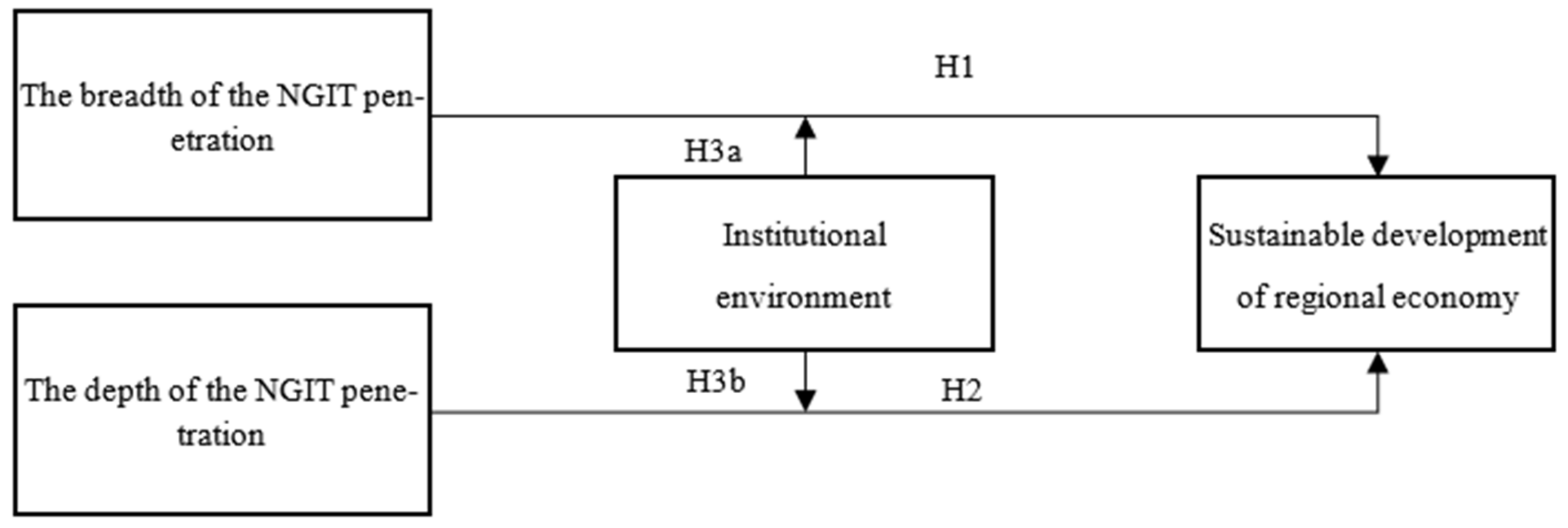
The theoretical model we propose in this article is given in Figure 1 as follows.

Figure 1.
Conceptual model of the relationship between the breadth of the new generation of information technology (NGIT) penetration, the depth of the NGIT penetration, sustainable development of regional economy and institutional environment.
3. Empirical Study Design
3.1. Sample and Data
This article takes 29 provinces and cities in Mainland China (Tibet and Xinjiang are not included in the statistics due to lack of data) as the research objects to analyze the impact of NGIT penetration on the sustainable development of the regional economy. The data are from China Statistical Yearbook, China Information Industry Yearbook, China population and Employment Statistical Yearbook, China Science and Technology statistical yearbook, and other relevant yearbooks in the official national statistical database. The regional institutional environment uses the marketization index compiled by Gang Fan and Xiaolu Wang [35]. Due to the new statistical caliber adopted by the marketization index after 2008, the data after 2008 is more comparable. Other yearbooks have different statistical calibers and industry classifications, so this article has transformed additional data. For different statistical units, they have been converted before data processing. Finally, 290 observations in 29 provinces and cities from 2009 to 2018 were selected for this article. Use STATA15.1 statistical software to analyze the empirical results.
3.2. Index Selection and Variable Definition
3.2.1. Dependent Variable
Sustainable development of the regional economy. Sustainable development of the regional economy is an issue of industrial development. In the development process, there is a continuous evolution of technology integration, market, and environment, which ultimately promotes sustainable development of the regional economy. This article draws on some scholars’ research [26,36,37] and combines the development status of China in recent years. Based on the principles of science, comparability, and maneuverability, construct a sustainable development of regional economy indicator system from three aspects: resource subsystem, economic subsystem, and environmental subsystem. See Table 1.

Table 1.
Evaluation indicators of sustainable development of regional economy level.
The entropy method is an objective copy method based on information entropy theory [38]. That is, the more discrete the data, the greater the amount of information it contains, and the more comprehensive evaluation results can be displayed. In this case, the improved entropy method is used to calculate the index weight [20]. The specific process is as follows.
- 1.
- Establish the original matrix
- 2.
- Standardization of indicators
- 3.
- Index normalization processing
- 4.
- Calculate the index entropy
- 5.
- Calculate the redundancy of various indicators
- 6.
- Calculate the weight of each indicator
- 7.
- Calculate the sustainable development level of each region
Among them, X is the original matrix composed of a total of α indicators in I province and j year, (Zi,j)α refers to the standardized matrix obtained by the standardized post-processing of the matrix composed of a total of α indicators in I province and j year. (Pi,j)α means to normalize the standardized matrix (Zi,j)α. Dα represents the entropy of the calculated α index. According to entropy theory [38], the smaller the information entropy is, the greater the redundancy Dα is Wα is the final α index weight. Finally, RESDij represents the sustainable development of regional economy level of i province and city in j years. The index weight is shown in Table 2. The sustainable development level of regional economy is shown in Table 3.
Table 2.
Evaluation Index Weight of sustainable development of regional economy Level.
Table 3.
The level of sustainable economic development in each region from 2009 to 2018.
3.2.2. Independent Variable
Degree of NGIT penetration. To be able to reflect the degree of penetration of NGIT more thoroughly, this article measures both the penetration width and penetration depth of NGIT. Based on related scholars’ research on NGIT [16], this article uses technical service revenue and embedded system software revenue to measure the breadth of NGIT penetration. The proportion of technical service revenue and embedded system software revenue measures the depth of NGIT penetration. First, the entropy method is used to determine the technology application level’s entropy value and the embedded system usage level’s entropy value. The specific steps are shown above. The final entropy values are 0.47 and 0.53. Secondly, the entropy value is multiplied by technical service income and embedded system software income and added together. Finally, take the logarithm of this value to measure the NGIT breadth to get a more accurate estimate. In addition, the entropy value is multiplied by the percentage of revenue from technical services and the percentage of revenue from embedded system software and then added together to measure the depth of NGIT penetration. Because NGIT penetration breadth is proportional, it is not necessary to take logarithm processing. See Table 4.
Table 4.
NGIT penetration indicators.
3.2.3. Moderator Variable
Institutional Environment. An excellent institutional environment means that the government will reduce its intervention in the market and give full play to the market’s moderation effect. Means a relatively sound legal system environment. An excellent institutional environment represents a more developed product market, factor market, and intermediary market. This article uses the relative marketization index of various provinces and cities in China compiled by Fan Gang and others [35]. The marketization index is obtained by analyzing the relationship between the government and the market, developing the non-state economy, the development of the product market, the legal system environment, and the factor market development. The market-oriented process of each region is continuously measured. It reflects the progress of market-oriented reform in various regions. It is currently the most extensive index to measure various regions’ institutional environment in China [33]. This article uses the logarithm of the marketization index to measure the regional institutional environment.
3.2.4. Control Variable
This article also controls other factors that affect the region’s sustainable development, and the selection of control variables refers to previous studies [36]. Market demand: Measured by the logarithm of the final consumption expenditure of urban residents in each region. Technical Support: Technical support for each region is measured by the logarithm of each regional technology market’s transaction volume. Talent support: The number of talents in each region is measured by the logarithm of the number of talents with a bachelor’s degree or above in each region. Government demand: select high-tech industry fixed asset investment as a proportion of policy support. See Table 5.
Table 5.
Control variable indicators.
3.3. Empirical Model
According to Yulin Zhao [39], control for the fixed effect of the year. We set the models as shown in the following Equations (9)–(12).
The theoretical model of this article is designed as follows:
To verify Hypothesis 1, set the following model
To verify Hypothesis 2, set the following model
To verify Hypothesis 3, set the following model
To verify Hypothesis 4, set the following model
Among them, the variable RESDij represents the sustainable development of regional economy level of province i in year t. The variables PBi,t and PDi,t represent the NGIT penetration breadth and NGIT penetration depth of province i in year t, respectively. The variable IEi,t represents the institutional environment of province i in year t. Variables PBi,t * IEi,t and PDi,t * IEi,t respectively represent the interactive items of variable PBi,t, variable PDi,t and variable IEi,t. Control means controlling the variable market demand, technical support, talent support, and government policy. The subscripts i and t represent province and year, respectively, and j represents the j control variable. λt represents the time-fixed effect that changes with time, and εit represents the random disturbance term that has nothing to do with the explanatory variable.
4. Empirical Results
4.1. Descriptive Statistics
The average value, standard deviation, and maximum value of each variable are shown in Table 6. The maximum value of the sustainable development of regional economy level is 0.706, the minimum value is 0.203, and the average value is 0.345. The standard deviation of 0.088 indicates that the sustainable development of the regional economy level of different provinces and cities is relatively large. The maximum penetration extent of NGIT is 17.45, the minimum is 5.507, the mean is 12.61, and the standard deviation is 2.655. The maximum penetration depth of NGIT is 45.71, the minimum is 0.152, the mean is 20.11, and the standard deviation is 13.78. It shows that there are big differences in the development level of NGIT between different provinces and cities. The maximum value of environmental systems in various provinces and cities is 2.408, the minimum value is 0.846, the average value is 1.814, and the standard deviation is 0.305. This indicates that there are specific differences in the institutional environment between different provinces and cities. It preliminarily shows that it is meaningful to discuss regional differences in sustainable development levels from NGIT development levels.
Table 6.
Descriptive statistics.
4.2. Multicollinearity Test
The independent variable NGIT penetration breadth and NGIT penetration depth. The regulatory variables, institutional environment, and control variables market demand, government demand, technical support, talent support, and other indicators are tested for multicollinearity. The results are shown in Table 7. The variance expansion factor of all variables is less than 10; that is, there is no multicollinearity between the variables, and regression analysis can be performed.
Table 7.
Multicollinearity analysis.
4.3. Regression Analysis
First, after the Hausman test, a fixed-effect model is selected to control the influence of time differences on the regression results. Afterward, the heteroscedasticity and serial correlation problems in panel data were tested. It is found that the data has issues related to heteroscedasticity and sequence. Since the data period of this paper is ten (10) years, the unit root test is not performed. To solve the above problems in the data, referring to the research of existing scholars [40,41], this paper uses the feasible generalized least square method (FGLS) to estimate the model. In order to reduce the influence of multicollinearity, the variables are standardized when constructing the interaction term. Model 1 only includes control variables. Models 2 and 3 introduce NGIT depth and breadth and NGIT penetration depth, respectively. Then introduce the interactive items into Models 4, 5, and 6 in turn.
4.3.1. The Impact of the Penetration of New Generation Information Technology on Sustainable Development of the Regional Economy
First, when analyzing the impact of NGIT penetration and sustainable development of the regional economy. First, consider the influence of the control variable on the dependent variable. The market demand (MD), technical support (TS), talent support (TS1), and government demand (GD) in Model 1 in the table are all positively correlated with the sustainable development of the regional economy at the 1% significance level. Model 2 and Model 3 respectively report the regression results of NGIT penetration breadth and NGIT penetration depth on sustainable development of the regional economy.
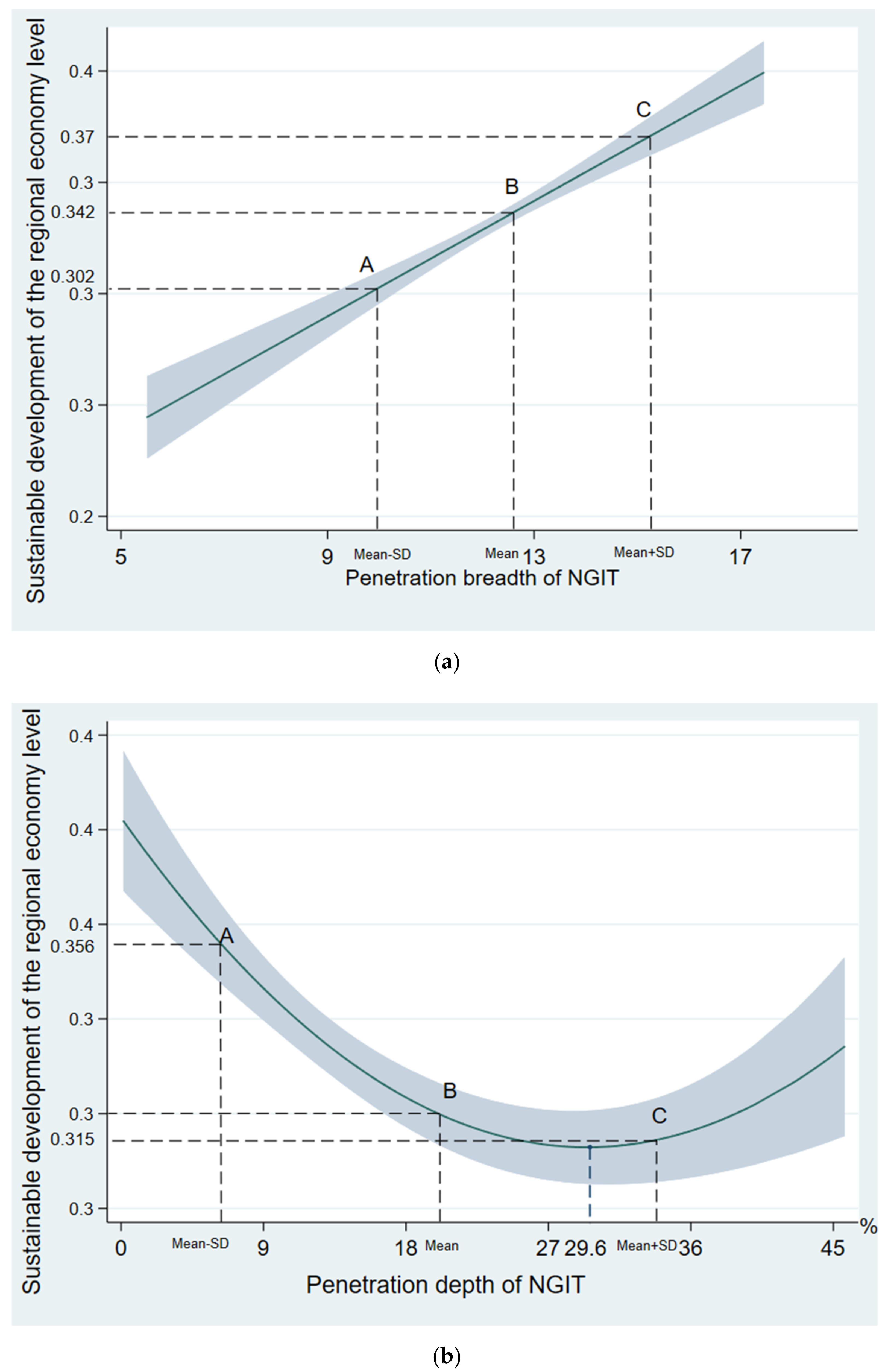
The penetration breadth of NGIT is positively correlated with the sustainable development of the regional economy at the 1% significance level, with a correlation coefficient of 0.013. Hypothesis 1 is valid. We examine the economic significance of the model results by calculating marginal effects. Figure 2a shows the marginal effect of NGIT penetration span under the 95% confidence interval. When the NGIT penetration breadth increases by one standard deviation (from point A to point B or point B to point C), the sustainable development of the regional economy level will increase by a corresponding value (from 0.302 to 0.342 or from 0.342 to 0.37). The empirical results confirm hypothesis 1 of this article. There is a positive correlation between the breadth of NGIT penetration and the sustainable development of the regional economy.
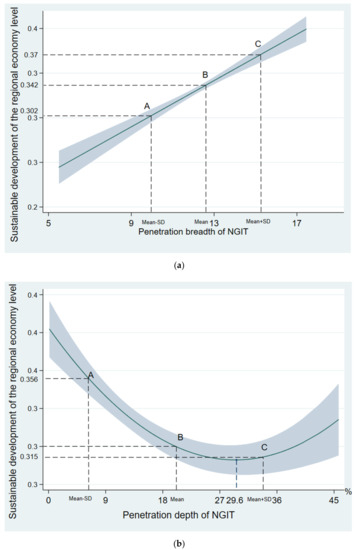
Figure 2.
The main effect of the penetration of NGIT on sustainable development of the regional economy. (a) The main impact of the penetration breadth of the NGIT on sustainable development of the regional economy; (b) The main impact of the penetration depth of the NGIT on sustainable development of regional economy.
The primary term of NGIT penetration depth is negatively correlated with sustainable development of the regional economy at the 1% significance level. The secondary term of NGIT penetration depth is positively correlated with sustainable development of the regional economy at the 1% significance level. Hypothesis 2 has not been confirmed. The reasons may be as follows. First, when the penetration depth of NGIT is at a low level. With the increase in penetration depth, the imperfection of corporate talent knowledge and infrastructure construction makes the NGIT unable to better serve the sustainable development of the regional economy. The increase in the penetration depth of NGIT has a negative impact on the sustainable development of the region.
When the penetration depth of NGIT reaches a particular value. The expansion of market demand, sufficient professional talents, and complete infrastructure at this time, as the penetration depth of NGIT increases, will positively impact the region’s sustainable development. Second. Every time a disruptive technology enters society, it will bring social unrest. When the penetration depth of NGIT is low, the enterprise will experience a destructive “pain period” in the process of absorbing NGIT. At this time, the increase in the penetration depth of NGIT has a negative impact on the sustainable development of the regional economy. After an enterprise has passed the “throttle period”, disruptive technologies will bring new society progress. The increase in the depth of NGIT penetration has a positive impact on the region’s sustainable development of. To examine the economic significance. Figure 2b shows the marginal effect of NGIT penetration depth under the 95% confidence interval. When NGIT penetration depth increases by one standard deviation (from point A to point B or point B to point C), the sustainable development of the regional economy level will change the corresponding value (from 0.356 to 0.32 or 0.32 to 0.315). From the main effect map of NGIT penetration depth on sustainable development of regional economy, it can be concluded that NGIT penetration depth has a positive U-shaped impact on sustainable development of regional economy. When the penetration depth of NGIT is low, the penetration depth of NGIT has a negative impact on the sustainable development of the region. When the penetration depth of NGIT reaches a certain value, the penetration depth of NGIT will positively affect the sustainable development level of the region. The empirical results reflect that reality is contrary to the hypothesis of this article, and we have analyzed this reason. As shown in Figure 2b, combined with the fact of developing my country’s NGIT industry, the penetration depth of the NGIT is generally not high. The average penetration depth in the samples obtained in this paper is 20.11. That is, the adjustment effect diagram drawn according to the sample only reflects the current reality. It cannot reflect the effect of NGIT penetration depth on the sustainable development of the regional economy when the penetration depth of NGIT is greater than the maximum value in the sample (45.71). However, it can be obtained from the main effect diagram that when the penetration depth is greater than 29.6, as the penetration depth of NGIT increases, the sustainable development of the regional economy level will continue to rise and will eventually be higher than the left endpoint.
4.3.2. Moderation Effect of Institutional Environment
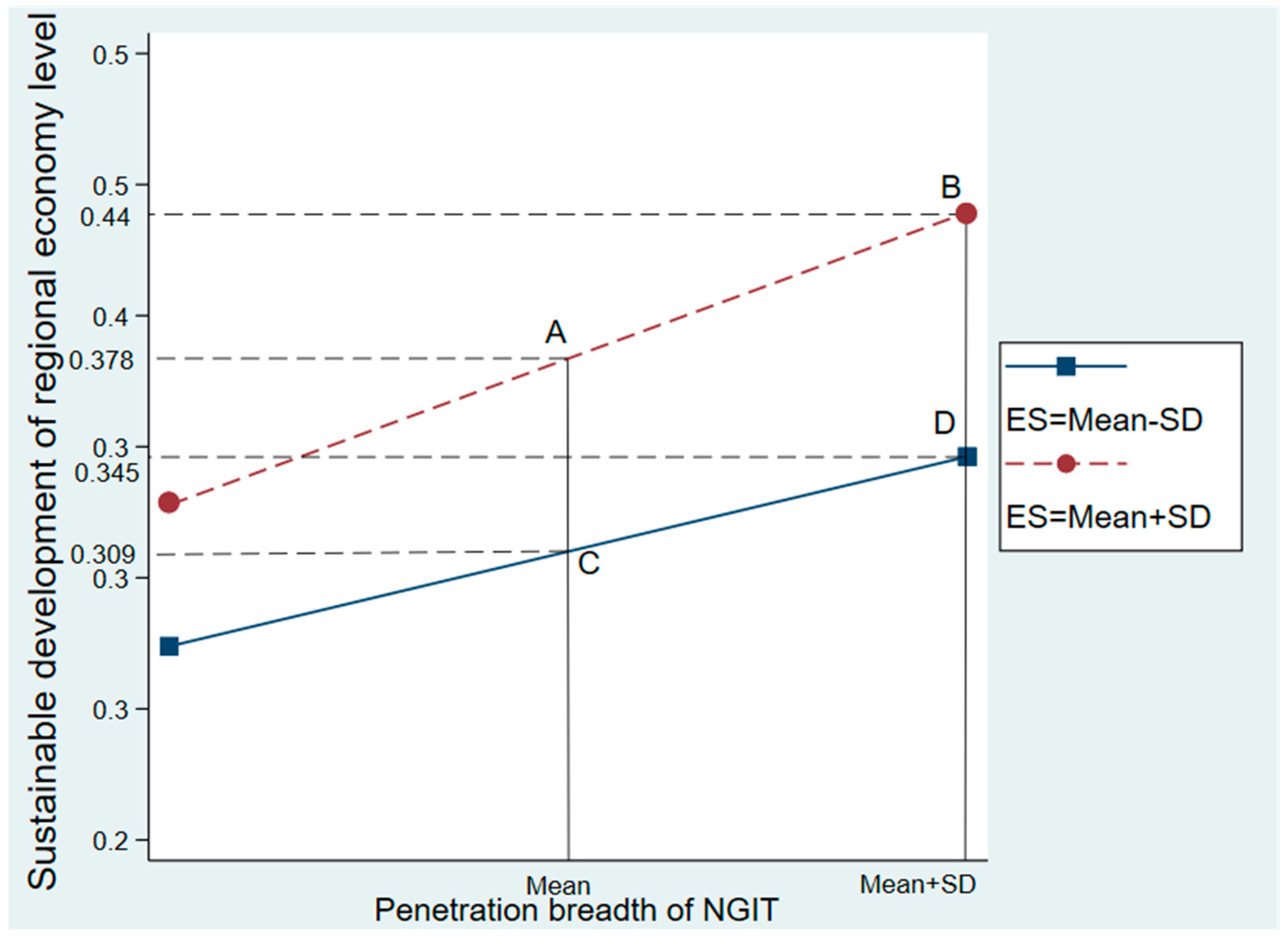
Model 4 in Table 8 reports that the regression coefficient of the institutional environment is significantly positive. It shows a significant positive correlation between the institutional environment and the sustainable development of the regional economy. Model 5 adds an interaction term between the institutional environment and the penetration breadth of NGIT to verify the institutional environment’s moderation role. The regression coefficient of the interaction term between the institutional environment and the penetration of NGIT is significant, which shows that the institutional environment positively regulates the correlation between the penetration of NGIT and the sustainable development of the regional economy. Figure 3 shows the institutional environment at a lower level (mean minus one standard deviation, indicated by the solid line) and at a higher level (mean minus one standard deviation, indicated by the dashed line). The marginal effect of NGIT penetration breadth (horizontal axis) on the level of sustainable development of the regional economy (vertical axis). Under the higher level of the institutional environment, the relationship between the penetration breadth of NGIT and the level of industrial integration is steeper, and the positive relationship is more significant. Model 4 in Table 8 reports that the regression coefficient of the institutional environment is significantly positive. It shows that there is a significant positive correlation between the institutional environment and the sustainable development of regional economy. Model 5 adds an interaction term between the institutional environment and the penetration breadth of NGIT to verify the institutional environment’s moderation role. The regression coefficient of the interaction term between the institutional environment and the penetration of NGIT is significant, which shows that the institutional environment positively regulates the correlation between the penetration of NGIT and the sustainable development of the regional economy. Hypothesis 3a is valid. Examining its economic significance: In the case of a low institutional environment, when the penetration breadth of NGIT increases by one standard deviation (from point C to point D), the sustainable development of the regional economy level increases by 0.036 (from 0.309 to 0.345). In the case of a relatively high institutional environment level, when the penetration breadth of NGIT increases by one standard deviation (from point A to point B), the sustainable development of the regional economy level increases by 0.062 (from 0.378 to 0.44).
Table 8.
Regression results.
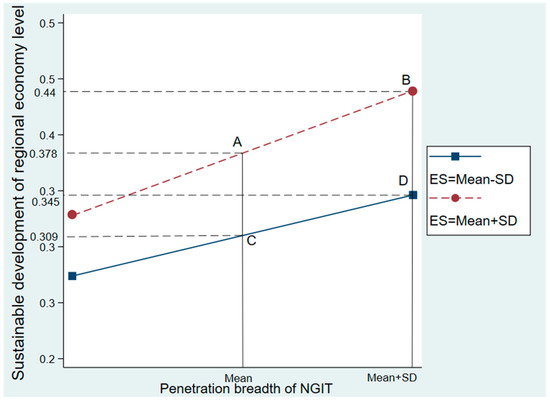
Figure 3.
The moderation role of the institutional environment on the penetration of the NGIT and sustainable development of the regional economy.
Model 6 in Table 8 adds an interaction term between the institutional environment and the penetration depth of NGIT, which fails the significance test, and Hypothesis 3b does not hold. The regulatory effect of the institutional environment on the penetration depth of NGIT and sustainable development of the regional economy is not significant. This shows that the environment institutional environment’s impact on the penetration depth of NGIT and sustainable development of regional economy may be related to the reserve of professional talents and knowledge background in each region. This article’s marketization index is the most commonly used index to measure the differences in the institutional environment of different regions in China. It does not involve factors such as talent knowledge background.
4.4. Robustness Test
To test the robustness of the previous research conclusions, refer to the research method of the robustness test of the scholars [21]. There are considering that the two dimensions of NGIT penetration may be endogenous to the sustainable development of the regional economy. The depth and breadth of NGIT penetration will determine the application of NGIT and the interaction between the NGIT industry and traditional industries, which may affect the region’s sustainable development. The resulting endogenous problems may cause deviations in the estimation results. Therefore, this article lags the two dimensions of NGIT by one period to test its impact on the level of sustainable development of the regional economy one year later. The regression results are shown in the figure. Table 9 shows the regression results of the dependent variable at T+1. The regression results of all models are not significantly different from the previous ones. This indicates that the results of this paper are robust.
Table 9.
Robustness Test.
5. Conclusions
5.1. Discussion
With the development of NGIT, this article will focus on the relationship between NGIT and the sustainable development of the regional economy and analyze the impact of NGIT penetration on the sustainable development of the regional economy. The research results explain the relationship between NGIT penetration and sustainable development of regional economy and provide corresponding suggestions for regional economic development. Simultaneously, the government proposes to vigorously develop new-generation information technologies such as the Internet of Things, big data, and cloud computing and optimize the regional institutional environment to promote technological and market development. The subject of this article is to promote the sustainable development of the regional economy. Some scholars have researched the relationship between the Internet, the institutional environment, and industrial development [24,27,30,42]. This article constructs the sustainable development of regional economy level’s evaluation index system from the three dimensions of economy, environment, and resources. Study the impact of a NGIT on the level of sustainable development of the regional economy. Feasible generalized least squares regression based on time fixed-effects model. The empirical results show that:
- The penetration breadth of NGIT has a significant positive effect on the sustainable development of the regional economy. The NGIT realizes the deployment of various production factors in a broader range. It reduces the cost of enterprise cooperation, which is mainly reflected in the enterprise’s internal R&D, manufacturing and marketing links. For example, The NGIT is profoundly integrating with the manufacturing industry, completely changing the manufacturing products, processes, equipment, models, and promoting the manufacturing industry’s development into an intelligent stage [43]. The broader the scope of NGIT application, the faster the sustainable development of the regional economy process.
- The penetration depth of NGIT has a positive U-shaped effect on the sustainable development of the regional economy. The acceptance of NGIT by enterprises and industries determines their ability to apply NGIT. Due to the necessary conditions and talent pool at this stage, it cannot meet artificial intelligence technology and Internet of Things technology requirements. Simultaneously, considering that disruptive technologies such as artificial intelligence and the Internet of Things have first entered the society, enterprises will experience a destructive “pain period” in absorbing NGIT, which will slow down the process of sustainable development of the regional economy. With the improvement of education level and infrastructure construction, the training of professional talents by universities and colleges has strengthened the acceptance of NGIT by consumers. Allows the enterprise to pass the “throttle period”. At this time, the penetration depth of NGIT has increased to promote the integration of NGIT and the real economy and accelerate the sustainable development of the regional economy.
- The institutional environment has a moderating role between NGIT and the sustainable development of the regional economy. The better the institutional environment is for the flow of regional knowledge and information, the faster the information iteration and the closer the exchanges between industries. As Jinyun Sun mentioned [44], the institutional environment’s level positively impacts technological innovation efficiency. Enhancing the regional institutional environment’s level is conducive to strengthening the role of NGIT and the sustainable development of the regional economy.
5.2. Management Implications
Analyze the empirical results and propose targeted countermeasures to enhance the sustainable development of the regional economy.
- With the development of a NGIT, Internet information services have entered various industrial chains, reducing corporate transaction costs, enhancing industrial integration, and promoting sustainable development of the regional economy. The integration of NGIT and the real economy is inseparable from infrastructure construction. Improve infrastructure construction and use NGIT’s advantages in information service efficiency to optimize industrial enterprises’ design, production, sales, and management. Replace manual production with intelligent production, reduce production management costs, realize the deep integration of NGIT and the real economy, and promote the regional economy’s sustainable development.
- Enhance the popularization of NGIT knowledge and cultivate professional talents. The NGIT industry’s development is inseparable from scientific and technical personnel. Universities are encouraged to set up artificial intelligence majors, big data, and cloud computing, and vigorously cultivate high-tech talents. At the same time, undergraduate courses such as NGIT foundation and basic application are offered. Strengthen cooperation between universities and enterprises. Encourage students to do internships in companies on the premise of completing their studies, apply theoretical knowledge to industrial production and operations, and formulate reward policies for outstanding students or scientific researchers.
- Encourage the government to introduce relevant policies to improve the internal institutional environment of each region because the institutional environment has a positive impact on NGIT and industrial integration. In areas with a higher institutional environment level, NGIT’s role in promoting industrial integration is more prominent. First, improve the regional NGIT development level, support NGIT enterprises in research and development, and improve relevant legal systems by local governments, focusing on improving the legal environment in various regions. Strengthen property rights protection, reduce administrative intervention, and give full play to the market’s regulatory role so enterprises with strong innovation capabilities and high production efficiency can attract more funds and increase regional R&D investment.
5.3. Research Gaps and Direction of Further Studies
Due to the limited space of this article, there are still the following limitations: First, this article discusses the adjustment mechanism of the institutional environment level on the relationship between NGIT and sustainable development of regional economy, but ignores the role of product market development and financial level in the institutional environment. Secondly, for the measurement of the level of sustainable development of regional economy, this article uses data conversion and other methods to measure selected indicators, which may have a particular impact on the research results, and in considering whether the level of regional economy will affect the development of the NGIT. Finally, the study can be extended to the sustainable development of international regional economy. The above issues are issues that need to be addressed in subsequent research.
Author Contributions
Conceptualization, L.C. and X.L.; methodology, Y.Y.; software, S.Z.; formal analysis, S.Z.; resources, X.L. and W.J.; writing—original draft preparation, S.Z.; writing—review and editing, Y.Y., X.L., W.J., and L.C. All authors have read and agreed to the published version of the manuscript.
Funding
This work was supported by Grant-in-aid for scientific research from the National Natural Science Foundation for the Youth of China (No. 72002170), (Ministry of Education in China) Project of Humanities and Social Sciences (No. 20YJC630010), Shaanxi Province Philosophy and Social Science Key Research Base Project of China (No. 20JZ090). Shaanxi Provincial Department of Education Think Tank Connotation Construction Project of China (No. 20JT062) General Program of Humanities and Social Sciences of Shaanxi Provincial Ministry of Education of China (No. 20YJA790033), Shaanxi Province Soft Science Research Program General Project of China (No. 2020KRM027), General Projects of Shaanxi Soft Science Research Program of China (No. 2018KRM040), Xi’an University of Posts and Telecommunications Innovation Fund of China (No. CXJJWZ2019002).
Institutional Review Board Statement
Not applicable.
Informed Consent Statement
Not applicable.
Data Availability Statement
Restrictions apply to the availability of these data. Data was obtained from China official national statistical database, and are available at these publishers’ websites, with prior permission.
Conflicts of Interest
The authors declare that they have no conflict of interest.
Abbreviations
| RESD | Sustainable Development of Regional Economy |
| PB | The Breadth of the NGIT Penetration |
| PD | The Depth of the NGIT Penetration |
| IE | Institutional Environment |
| MD | Market Demand |
| TS | Technical Support |
| TS1 | Talent Support |
| GD | Government Demand |
References
- Wang, R.; Liang, Q.; Li, G. A New form of the Spatial Agglomeration Under the Deep Integration of a New Generation of Information Technology and the Real Economy. Manag. World 2018, 34, 13–21. [Google Scholar]
- Han, B.; Li, S. Software and Information Technology Service Industry and China’s Economic Growth. J. Quant. Tech. Econ. 2018, 35, 128–141. [Google Scholar]
- Wang, W. Introduction to Local Sustainable Development; The Commercial Press: Beijing, China, 1999; p. 449. [Google Scholar]
- Hong, Y. Economics of Sustainable Development; The Commercial Press: Beijing, China, 2000; p. 449. [Google Scholar]
- Fan, C.; Chen, C. On the unbalanced sustainable development strategy of regional economy. China Econ. Stud. 2000, 43–48. [Google Scholar] [CrossRef]
- Zhang, F.; Wang, Z.; Xie, X. Combined Evaluation Method of Regional Sustainable Development Based on CW Operator and Its Application. Ecol. Econ. 2020, 36, 70–77. [Google Scholar]
- Liu, Y.; Liu, Y. On the Index System and Situation of China’s Regional Sustainable Development. China Soft Sci. 2003, 7, 113–118. [Google Scholar]
- Bröring, S.; Martin Cloutier, L.; Leker, J. The front end of innovation in an era of industry convergence: Evidence from nutraceuticals and functional foods. RD Manag. 2006, 36, 487–498. [Google Scholar] [CrossRef]
- Lyu, F.; Zhu, Y. The Effect of External Environment on the Adoption of Digital Technology for Chinese SMEs. Stud. Sci. Sci. 2000, 1–17. [Google Scholar] [CrossRef]
- Xiong, W.; Liu, Q. Mechanism of IT’s Penetration into Machinery Industry and Analysis of Its Applied Result. J. China Soc. Sci. Tech. Inf. 2000, 492–498. [Google Scholar] [CrossRef]
- Zhang, H.; Qian, Y.; Yu, L.; Wang, Z. Integrated Development of Information Technology and the Real Economy in China Based on Provincial Panel Data. Sustainability 2020, 12, 6773. [Google Scholar] [CrossRef]
- Guo, T.; Ding, X.; Ren, X. The Relationship among Institutional Environment, Business Model and Innovation Performance—Based on the Simulation Analysis of System Dynamics. Manag. Rev. 2019, 31, 193–206. [Google Scholar]
- Liu, W.; Gong, Z.-Y.; Zhang, S. The Influence of Previous Experience and Political Connection on New Venture M&A Decision: The Moderation Function of Institutional Environment. Forecasting 2019, 38, 32–38. [Google Scholar]
- Xu, H.; Zhou, X.-H. Research on the influence of institutional environment, financial-industrial on enterprise innovation performance. Stud. Sci. Sci. 2020, 38, 158–168. [Google Scholar]
- Cai, Y.; Chen, N. Artificial Intelligence and High-quality Growth & Employment in the Era of New Technological Revolution. J. Quant. Tech. Econ. 2019, 36, 3–22. [Google Scholar]
- Yu, C.; Wang, C.; Zhuang, W.; Fu, W. Evaluation of New Generation Information Technology Industry Based on Dynamic Evolvement. Inf. Sci. 2018, 36, 110–113. [Google Scholar]
- Feng, H.; Nie, L.; Shi, Y.-L. The Interaction between Supply Chain Governance Mechanisms and Supply Chain Performance: Based on the Mediating Effects of Information Sharing and the Moderating Effects of Information Technology Level. Chin. J. Manag. Sci. 2020, 28, 104–114. [Google Scholar]
- Liu, Y.; Xie, K.; Deng, H. Data-Driven R&D Transformation of New Product: A Case Study from the Perspective of Adaptive Change in Organizational Practices. Manag. World 2020, 36, 164–183. [Google Scholar]
- Lu, M.; Sun, W. Research on Routes of Regional Economic Sustainable Development in the Vision of Progress of Economic Development Stages. Sci. Technol. Manag. Res. 2012, 32, 13–17. [Google Scholar]
- Zhong, L.; Li, X.; Law, R.; Sun, S. Developing Sustainable Urbanization Index: Case of China. Sustainability 2020, 12, 4585. [Google Scholar] [CrossRef]
- Moutinho, V.; Madaleno, M.; Robaina, M. The economic and environmental efficiency assessment in EU cross-country: Evidence from DEA and quantile regression approach. Ecol. Indic. 2017, 78, 85–97. [Google Scholar] [CrossRef]
- Ren, T.; Li, S.-X.; Zhou, Z.-B. Study on Efficiency Evaluation of Regional Sustainable Development System Based on BLP-DEA and Satisfaction Degree. Chin. J. Manag. Sci. 2000, 1–13. [Google Scholar] [CrossRef]
- Lei, D.T. Industry evolution and competence development: The imperatives of technological convergence. Int. J. Technol. Manag. 2000, 19, 699–738. [Google Scholar] [CrossRef]
- Huang, H. Industrial Convergence Drove by Internet—An Interpretation Base on Division Theory and Vertical Integration. China Soft Sci. 2000, 3, 19–31. [Google Scholar]
- Tang, D. Industrial convergence under industry transformation and internet penetration. Sci. Res. Manag. 2015, 36, 453–458. [Google Scholar]
- Jiang, B.; Ma, S.; Tang, X. The Impact of Industrial Integration on the Innovation Efficiency of China’s Equipment Manufacturing Industry: Adjustment Perspective based on Structural Embedding. Sci. Technol. Prog. Policy 2019, 36, 77–86. [Google Scholar]
- Zhao, Y.; Zhang, Z.; Feng, T.; Tao, K. Big data development, institutional environment and government governance efficiency. Manag. World 2019, 35, 119–132. [Google Scholar]
- Doh, S. Social Entrepreneurship and Regional Economic Development: The Case of Social Enterprise in South Korea. Sustainability 2020, 12, 8843. [Google Scholar] [CrossRef]
- Liu, Y. Institutional environment, knowledge-based capital and export sophistication of China’s manufacturing industries. Sci. Res. Manag. 2019, 40, 144–152. [Google Scholar]
- Mao, Q.; Wang, F. Institutional Environment, Technical Sophistication and Asymmetric Spatial Spillovers across Industries. China Ind. Econ. 2000, 118–136. [Google Scholar] [CrossRef]
- Gao, N.; Chao, W.; Han, P. Markets, legal environment and regional innovation activities. Sci. Res. Manag. 2017, 38, 26–34. [Google Scholar]
- Hong, J.; Shi, L. Independent R&D, region-specific institutions and innovation performance: Evidence from 371 innovative enterprises in China. Stud. Sci. Sci. 2017, 35, 310–320. [Google Scholar]
- Zhang, X.; Zhang, L.; Lu, J. Organizational knowledge, institutional environments, and the syndication of venture capital firms. J. Ind. Eng. Eng. Manag. 2020, 34, 1–10. [Google Scholar]
- Yang, C.; Liao, H. Industrial agglomeration of Hong Kong and Taiwanese manufacturing investment in China: A town-level analysis in Dongguan. Ann. Reg. Sci. 2010, 45, 487–517. [Google Scholar] [CrossRef]
- Wang, X.; Fan, G. Marketization Index of China’s Provinces: Neri Report 2018; Social Sciences Academic Press: Beijing, China, 2019. [Google Scholar]
- Cheng, G.; Yang, C. Study on Evaluation and Affecting Factors of Regional Industrial Integration Level: Take the Yangtze River Economic Belt as an Example. East China Econ. Manag. 2020, 34, 100–107. [Google Scholar]
- Tang, X.; Jiang, B.; Ma, S. A Development Study on China’s Regional Industrial Convergence based on ISCNFI Analysis Framework. Commer. Res. 2015, 1–10. [Google Scholar] [CrossRef]
- Zhao, J.; Ji, G.; Tian, Y.; Chen, Y.; Wang, Z. Environmental vulnerability assessment for mainland China based on entropy method. Ecol. Indic. 2018, 91, 410–422. [Google Scholar] [CrossRef]
- Zhao, Y.; Wang, M. Industry Convergence, Industry Cluster and Regional Industry Competitive Advantage Promotion: Based on an Empirical Analysis of the Advanced Manufacturing Industry’s Data in Hubei Province. Sci. Technol. Prog. Policy 2016, 33, 26–32. [Google Scholar]
- Li, X.; Chen, H.; Zhang, X. Research on the Industrial Performance of the Convergence of Information Industry with Manufacturing Industry Based on the Data of Zhejiang Province. China Soft Sci. 2017, 22–30. [Google Scholar] [CrossRef]
- Wang, Y.; Wang, J.; Yan, J. The Double Effect of Global Value Chain Embeddedness on Energy Conservation and Emission Reduction—An Empirical Study on Panel Data of China’s Industries. China Soft Sci. 2015, 148–162. [Google Scholar] [CrossRef]
- Fang, M.; Yang, S.; Zhou, J.; Lei, Y. The Innovative Development Path of Industry Agglomeration in Yangtze River Economic Belt under the Background of High-Quality Development. China Soft Sci. 2019, 137–150. [Google Scholar] [CrossRef]
- Zhao, J. The Integration of the New Generation of Information Technology with the Real Economy: Based on the Paradigm of Smart Manufacturing. Sci. Sci. Manag. S. T. 2020, 41, 3–16. [Google Scholar]
- Sun, J.; Yu, M. Institutional Environment and Technical Efficiency of Chinese High-tech Industries. Forum Sci. Technol. China 2020, 80–87. [Google Scholar] [CrossRef]
Publisher’s Note: MDPI stays neutral with regard to jurisdictional claims in published maps and institutional affiliations. |
© 2021 by the authors. Licensee MDPI, Basel, Switzerland. This article is an open access article distributed under the terms and conditions of the Creative Commons Attribution (CC BY) license (http://creativecommons.org/licenses/by/4.0/).