Abstract
This study examines the impact of energy management and productivity-enhancing measures, implemented as part of LEED Existing Buildings Operations and Management (EBOM) certification, on source energy use intensity and rental premiums of office spaces using data on four major US markets. Energy management practices, comprised of commissioning and advanced metering, may reduce energy usage. Conversely, improving air quality and occupant comfort in an effort to increase worker productivity may in turn lead to higher overall energy consumption. The willingness to pay for these features in rental office buildings is hypothesised to depend not only on the extent to which productivity gains enhance the profits of a commercial tenant but also on the lease arrangements for passing any energy savings to the tenant. We apply a difference-in-differences method at a LEED EBOM certification group level and a multi-level modelling approach with a panel data structure. The results indicate that energy management and indoor environment practices have the expected effect on energy consumption as described above. However, the magnitude of the achieved rental premiums appears to be independent of the lease type.
1. Introduction
The commercial real estate sector contributes significantly to climate change as it is responsible for approximately 18% of greenhouse gas emissions in the UK and 29% in the US [1,2]. Despite extensive government-led efforts to decarbonise the industry by providing financial support for retrofitting the existing building stock, numerous studies conclude that these one-off structural solutions will not deliver energy savings to their fullest potential. According to the OECD/IEA report [3], many buildings have been designed and built using very efficient technologies and systems, recognised with awards such as LEED Platinum [4]. However, some often fail to meet their intended energy saving objectives and use up to three times their projected energy usage levels [5]. Bridging the energy performance gap between projected and measured performance is critical to ensuring the building sector delivers on its greenhouse gas emissions reduction targets [6]. Many researchers and industry players emphasise the need to start looking beyond “hard” building interventions towards “soft” measures that target facilities management and building occupants [7].
The primary reasons for the existence of the energy performance gap are (1) occupants using more energy than implied by the design features, (2) more occupants than originally foreseen, and (3) energy-efficient technologies failing or degrading [8]. This paper focuses on measures that address the third factor, which is more likely to occur in properties that are operated in a “fix and forget” manner. Mechanically ventilated buildings, which have become the new norm in response to meeting tenants’ demand for optimum comfort conditions, possess a range of features that require routine adjustment and fine-tuning, such as temperature set points and control schedules. Many systems installed in green/high performance buildings are becoming increasingly reliant on software, which requires regular upgrades in order to keep up with changes in the internal environment [9]. Without maintenance and monitoring of these complex systems, excessive energy losses can arise and unnecessarily drain cash flows. It has been reported that while poor operational practices can increase energy consumption in the range of 49–79%, good practices can reduce it by 15–29% [10,11].
A proactive approach to a building’s facilities management can minimise the adverse effects of technological failures. Additionally, it can help to address some of the unpredictable aspects of human behaviour in buildings where occupants have greater control over operating systems such as temperature, ventilation, lighting, and hot water [12]. Effectively, facilities management can act as a bridge between occupiers’ need for optimum comfort conditions and landlords’ energy consumption objectives [13]. Operational flaws may not only result in higher than necessary energy levels but also create an environment of an “unhealthy” building, issues which a proactive facilities management would address simultaneously. In certain situations, there may be a conflict between these areas, such as when a building has an insufficient external air supply; fixing this problem would enhance interior environmental quality but may raise energy usage. With workforce being the most substantial expense for commercial occupants, prioritisation of these measures in an effort to boost employee productivity may therefore compromise energy reduction efforts.
The aim of this paper is to juxtapose these operational elements, which are embedded in the LEED EBOM scorecard, and investigate their impact on energy consumption and rental premiums. Specifically, we evaluate whether the emphasis on indoor environment (air quality and comfort) influences energy consumption adversely, while energy management processes (commissioning and advanced metering) result in energy savings. We then analyse whether a rental premium in a LEED EBOM building is the product of the achieved energy savings (if any), productivity-enhancing features, or both. In the following paragraphs, we introduce the LEED EBOM programme and its underlying scorecard features that are of interest to this study; consequently, we analyse previous studies related to this field and present our hypotheses.
1.1. LEED Existing Buildings Operations and Management (EBOM)
There are many green classification systems adopted by owners to signal buildings’ environmentally friendly design, construction, and operation process that result in enhanced indoor environmental conditions for their occupants and reduction in the utilisation of natural resources [10,14]. LEED, which stands for Leadership in Energy and Environmental Design, remains the most widely used green building rating system in the world. LEED acts as a third party that verifies performance of buildings across a range of environmental themes [15]. While most LEED assessment schemes relate to energy consumption levels predicted during the design stage, as a response to failing to address in-use building operations, LEED Existing Building Operations and Management (LEED EBOM) system was officially launched in 2004 [16]. This rating system puts great emphasis on activities under the control of the facilities management and presents an opportunity for earning credits in water efficiency, energy performance, commissioning, and green cleaning [17]. Tracking of environmental performance is at the core of this system, since a building will lose its certification after five years should it fail to demonstrate empirically that its key performance indicators are congruent with LEED EBOM certification.
This study undertakes a quantitative analysis of building inventory credits to assess the impact of energy and atmosphere (EA) and indoor environmental quality (IEQ) practices. Among practices deemed to reduce the risks associated with operating heating, ventilation, and air conditioning (HVAC) and automation applications are commissioning and metering. Improved commissioning is known for delivering operational savings, identification of installation flaws, addressing occupant discomfort, enhancing indoor air quality and thermal comfort, prolonging equipment lifespan, and many other benefits [18]. In order to gain points in this category, engagement with a professional consultancy is required that helps to verify if there are discrepancies between the design intents and owner’s needs [19]. LEED EBOM scorecard encompasses commissioning during various stages such as investigation and analyses, implementation, and ongoing commissioning. Meanwhile, accurate quantification of energy use can be enabled by installing metering equipment. Such equipment provides ongoing accountability for building energy use over time and enables verification of energy savings [20].
Improved indoor environmental quality (IEQ) is another critical component of green building design since it has been positively associated with self-assessed employee productivity [21]. A summary of 15 case studies related to this theme reports that, on average, higher indoor air quality is associated with a 0.5–11% rise in employee productivity, while access to daylight increased productivity in the range of 5–15% [22]. Air quality problems such as inadequate ventilation and chemical pollutants from indoor and outdoor sources are seen as major contributors to what has been identified as Sick Building Syndrome (SBS). LEED EBOM certification stresses the importance of comfort conditions facilitated by granting individuals greater control of indoor temperature settings as well as access to natural daylight and views. Thermal comfort is often considered the most important component in achieving overall indoor air quality [23]. Complaints about being excessively hot or cold are frequently accompanied by headaches, tiredness, and mucosal irritation—all of which can have severe adverse impacts on productivity [24]. Continuous monitoring of air temperature and humidity accompanied by periodic measurements of air speed and radiant temperature are required by LEED to address the conditions experienced by occupants.
1.2. Energy Consumption of Green Buildings
The nimbus of green buildings regarding their energy-saving credentials is not unequivocally supported by empirical evidence. Early work, such as a study conducted by Turner and Frankel [25], did show some promising findings regarding energy use. Examining a sample of 552 properties (of which 121 are LEED certified), the median energy use intensity of LEED buildings was 32% lower than the mean EUI in the Commercial Buildings Energy Consumption Survey (CBECS). Despite being one of the most comprehensive studies in this field, the lack of rigorous statistical analysis casts doubt on the validity of the findings [26]. Newsham, Mancini, and Birt [27] use the same dataset and provided a supplemental statistical analysis to this study, showing that LEED buildings delivered an 18–39% reduction in energy use. Similarly, Baylon and Storm [28] found that the average energy used per square foot in 12 LEED buildings is 10% lower than 39 non-certified buildings.
However, later work has shown that LEED buildings do not necessarily consume less energy than their non-certified counterparts [29]. At least eight peer-reviewed studies published since 2009 have examined the energy use of LEED buildings, none of which supported the conclusion that they use less energy than non-certified buildings. This conclusion applies to studies focusing on source as well as site energy use intensity [30,31,32]. Scofield [33] revisited the earlier studies by Turner and Frankel [25] and Newsham et al. [27], and after performing further statistical analysis on the same dataset, found no energy savings in LEED buildings. A source of disagreement is the comparison of median and mean values, which allowed LEED buildings to appear more efficient when compared to CBECS-rated structures. These disparities in the results can however be attributed to a variety of factors, including the research design used to determine energy efficiency, the design orientation of the LEED criteria, the LEED certification design, differences in the time of construction of the buildings, and unexpected occupancy numbers and energy uses [26]. Overall, the existing literature does not provide conclusive evidence that green-certified buildings have smaller carbon footprints in operation than similar non-certified buildings.
1.3. Rent Premium in LEED Buildings
Green office buildings are known to provide financial and non-financial advantages to owners through a number of channels, resulting in property and rental premiums, higher occupancy rates, and a favourable corporate social responsibility image [34]. A tenant’s willingness to pay higher rents in certified buildings may be due to perceived improvement in productivity since employee costs represent about 90% of the total business costs for a typical tenant in an office building [35]. Out of the 39 peer-reviewed and published papers in this field commissioned by the Department of Energy, 27 papers consistently report a positive association between green building certifications and rents: rental premiums for LEED and Energy Star are estimated to be about 5% and in some cases fluctuated up to 20% [36,37,38,39,40,41,42]. These premiums are dynamic over time, space, and market segment [43,44]. Among the few studies specifically looking into the effect of LEED EBOM, this paper’s primary focus, a 7.1% rental premium is uncovered [45].
There is still a lack of consensus relating to the impact of sustainability certification on operating expenses [46]. Additionally, less apparent is whether the reported premiums are the result of some underlying building characteristics leading to such certifications (i.e., green attributes such as energy and water efficiency) or the designations and labels themselves [42]. Using a revealed preferences approach, the effects of some specific factors such as air quality, efficient systems, and recycling have been investigated alongside the presence of LEED certification by Robinson, Simons, and Lee [34]. The labelling effect itself is found to be the most valued characteristic, followed by water conservation, access to natural light, and efficient heating, ventilation, and air conditioning (HVAC). These findings largely support these authors’ earlier work that used a stated preferences method: the highest ranking green features are all oriented towards space users such as natural light, proximate public transportation, indoor air quality, and localised temperature controls [34].
The majority of previous studies measure the effect of certification using a hedonic pricing model, laid out by Rosen [47]. Such studies tend to be cross-sectional, with only a few employing a pooling approach using longitudinal data [37,48]. Cross-sectional methods are not able to address omitted variable bias: since the measured certification effect is likely to be correlated with other premium features of a building, it is vital to use methods that isolate the effect of certification from other confounding variables [42]. Similarly, failure to account for energy-expending features bundled with LEED EBOM certification, such as higher quality finishes and amenities, would result in the estimated effect suffering from a positive bias in energy consumption. Therefore, there is still substantial scope for studies that utilise panel and quasi-experimental methods to verify the existence of a green premium as well as demonstrate the benefits of green certification, if any [42].
1.4. Mechanism and Hypotheses
Before examining the effect of energy efficiency and productivity-enhancing operating features, the impact of the LEED EBOM certificate is analysed both in terms of energy consumption and rent. As a baseline case, we compare the average energy performance of LEED EBOM buildings to a non-certified building group, expecting that LEED EBOM buildings consume less energy in the post-certification period. To echo the findings of previous studies reporting that green certificates correlate with increased economic value, a LEED EBOM certification premium is anticipated. The premium is expected to depend at least partially on the lease provisions for utility payments. If tenants pay directly for their energy, they will also benefit directly from any savings, whereas benefits tend to accrue to landlords when a bulk rate is charged, or utility costs are not separated from the overall payable rent.
We then proceed with analysing the impact of scorecard features on energy consumption:
Hypothesis 1 (H1).
Energy management practices reduce the energy consumption of an office building.
Hypothesis 2 (H2).
Indoor environment management practices increase the energy consumption of an office building.
The effect of the same variables on rental premia is explored in the second part of the analysis. Since the primary beneficiary of increased operating efficiency is the tenant in net leases where this party pays for utilities, a rental premium is expected in the presence of active energy management practices, should we find empirical support for Hypothesis 1.
Hypothesis 3 (H3).
Rental premiums in leases where tenants pay for utilities increase proportionally to their energy management scores.
Since indoor environment features should positively influence employee productivity, we hypothesise that:
Hypothesis 4a (H4a).
Higher indoor environment scores translate into a larger rental premium in all lease types.
However, this effect would be dampened in net lease structures to reflect increased utilities expenses should we find evidence in support of Hypothesis 2.
Hypothesis 4b (H4b).
The premium effect associated with higher indoor environment scores is reduced in lease structures where the tenant pays for utilities.
2. Data
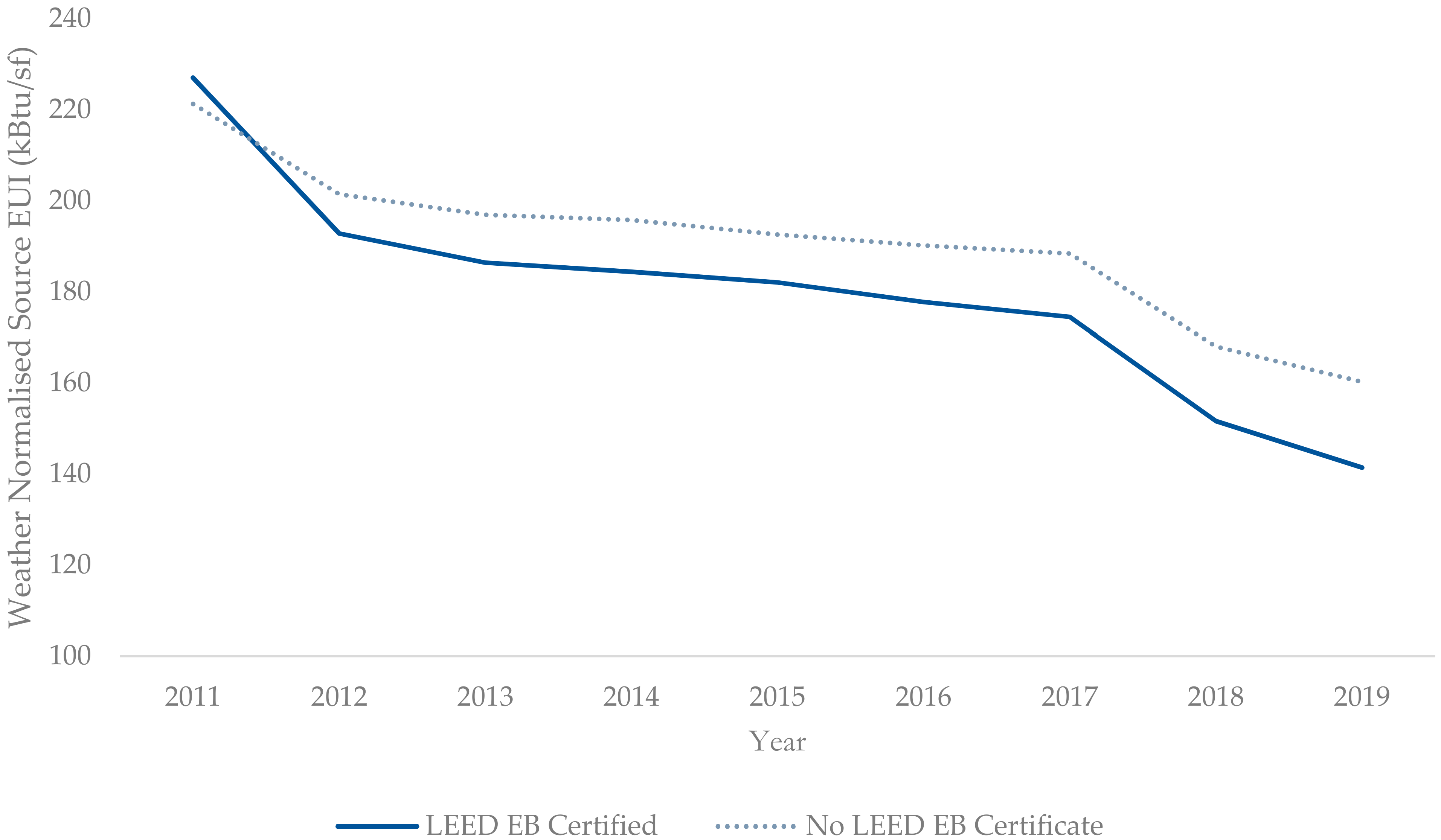
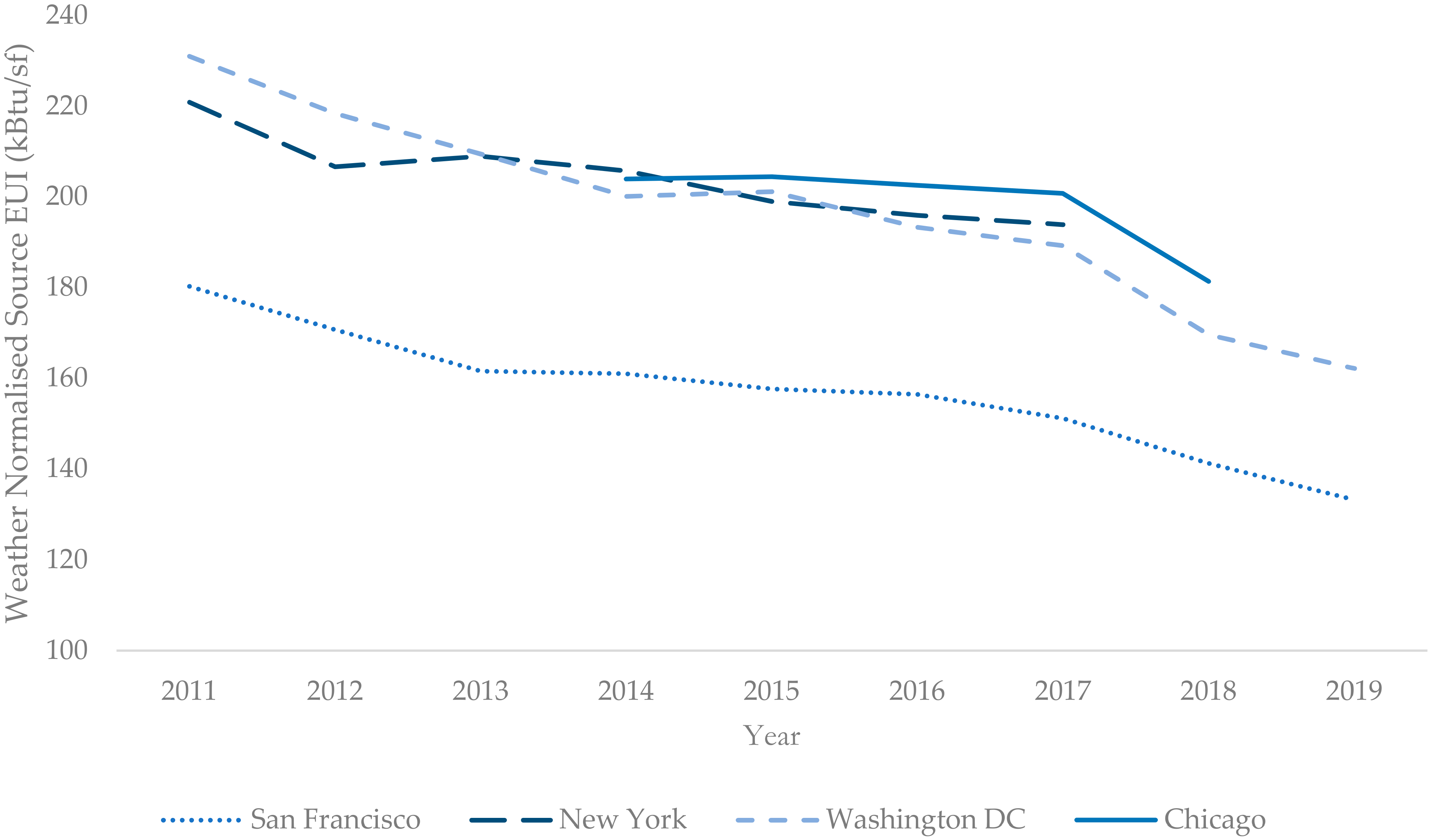
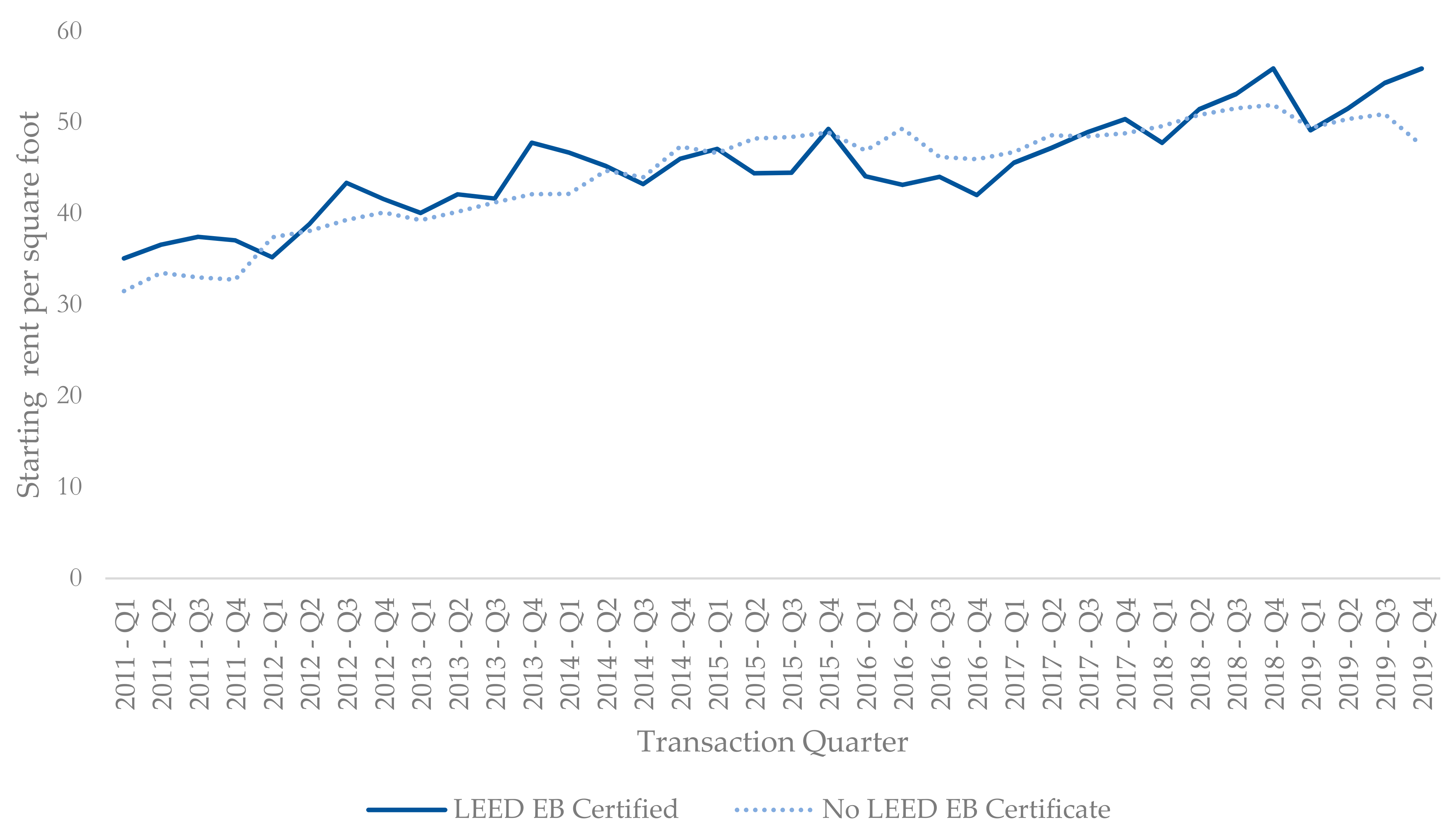
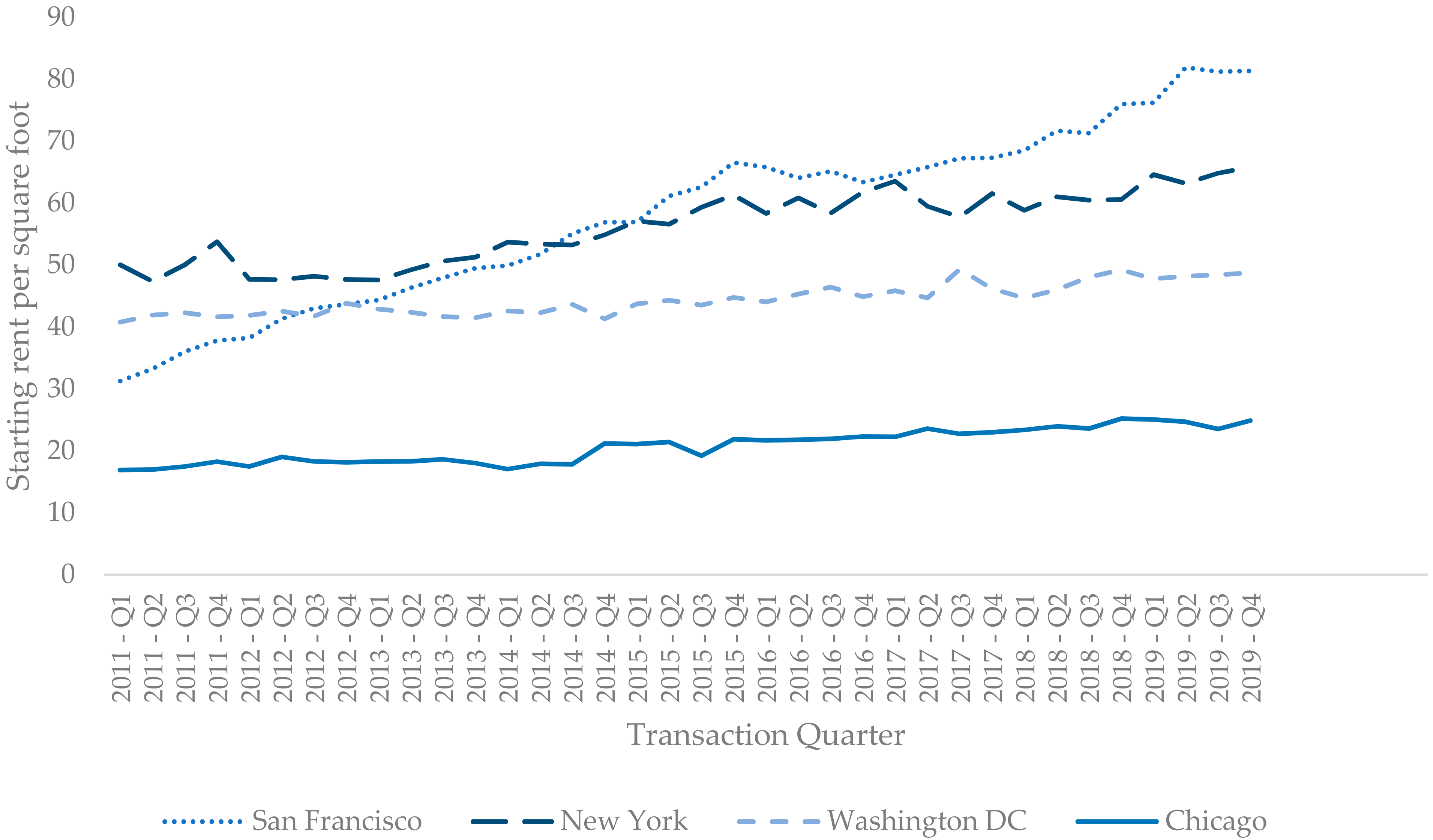
The empirical analysis draws on an integrated database that combines LEED scorecard information obtained from the US Green Building Council with municipal benchmarking reports and the Green Building Information Gateway (GBIG) [49,50,51,52,53,54]. Lease and building characteristics are obtained from CompStak and CoStar, respectively [55,56]. Table 1 provides a list of all datasets and the main variables constructed for the analysis. Further insight into the variables and their descriptive statistics can be found in Table A1 and in Figure A1, Figure A2, Figure A3 and Figure A4 in the Appendix A.
Table 1.
Summary of data sources.
Address data such as building name, street name, and zip code are used to identify matching building pairs between these datasets. String comparison of addresses is undertaken in Excel using fuzzy matching, which generates a matching score specifying the closeness of the identified match. Matches below the 90% threshold are discarded. The time dimension is incorporated using lease execution and certification dates, which help to establish whether a given lease applies to a building with LEED EBOM certification. We assume the lease execution date must either coincide with or occur in a period later than the date of certification for a given building. Unlike other types of LEED certifications, LEED EBOM is only valid for five consecutive years after the date of certification, while LEED’s design-stage labels do not expire. In the absence of any reported information on building recertification within five years, LEED EBOM certification is assumed to revert to a non-certified status.
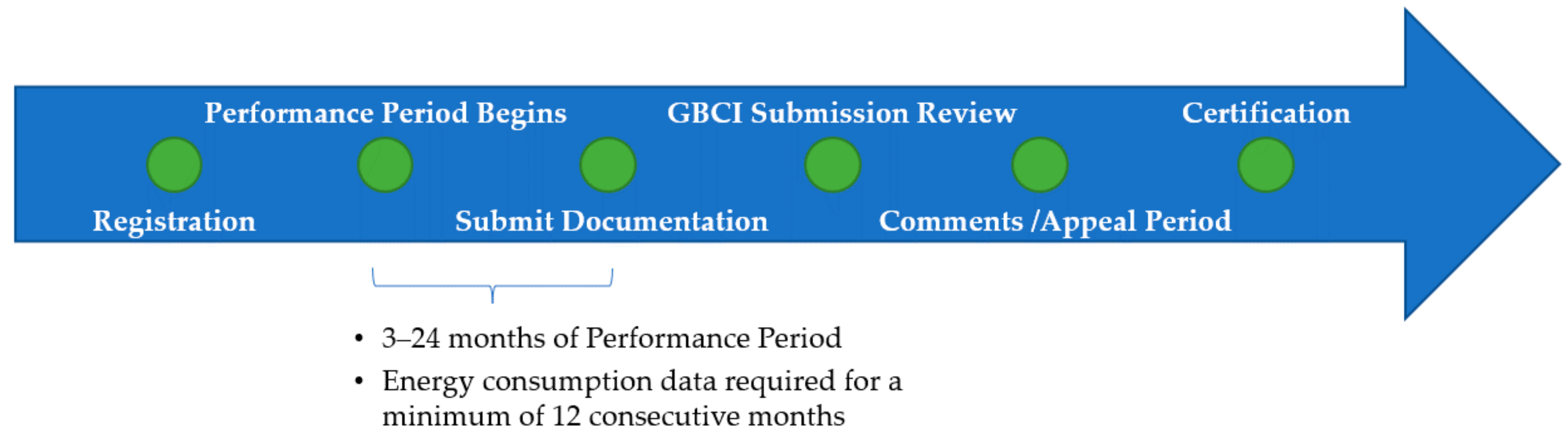
The LEED EBOM program is based on the concept of a “performance period” or a snapshot of time during which teams collect performance data for GBCI evaluation. Following the completion of a performance period, the USGBC decides at what level to certify the building based on the information gathered by the project team [15]. The performance period must be at least 3 months long but cannot exceed 24 months. LEED EBOM certification timeline is represented in Figure 1. We do not have information on the duration of a performance period for each building in the sample, or when the measures prescribed in the scorecard are implemented. Since certification is achieved for implementing a given set of energy and indoor measures in the past (during the performance period), we assume that a scorecard recorded in the current year corresponds to an energy consumption observation in the previous period. Further checks to this assumption will be undertaken by investigating the energy consumption time trend of pre- and post-certification years.
Figure 1.
LEED EBOM certification timeline. Source: USGBC; LEED User.
2.1. Municipal Benchmarking Reports
Energy performance data from municipal benchmarking databases are obtained for a period of 2011–2019 for the following cities: New York, San Francisco, Washington DC, and Chicago. These cities document annual energy and water use, as well as the carbon emissions data of large commercial buildings. The decision to use these cities is driven by the fact that they are the first to mandate energy consumption disclosure of commercial buildings in the US, obliging building owners to manually enter their building energy data into Energy Star’s Portfolio Manager [57]. Additionally, these markets have the largest number of LEED EBOM certified office buildings. Building size determines whether a building is required to disclose its energy data. The requirements mandating disclosure vary between these cities and are continuously updated to capture an ever-increasing number of buildings. Due to the different timings of these cities’ legislative mandates, the availability of data throughout 2011–2019 is non-uniform, resulting in an unbalanced panel dataset. A reference sample of non-LEED EBOM buildings is obtained from this data source to include buildings with the following characteristics: (a) where at least 3 years of energy data are observed; (b) the minimum size of 10,000 square feet.
The key dependent variable obtained from this database is source energy use intensity (source EUI) per square foot. Other variables, such as site Energy Use Intensity (site EUI) per square foot and Energy Star score, are also obtained for comparative purposes. Both source and site EUI measures are weather normalised, accounting for different weather patterns (cooling and heating degree days) and correcting for year-to-year and state-to-state weather differences. While much debate has ensued over which of these metrics should be used, EPA considers source EUI a superior metric. This is because source EUI incorporates efficiency factors of the entire fuel mix required to operate a building (including off-site energy losses associated with the production and delivery of energy to a building), while site EUI only considers heat and electricity consumed on the premises. Scofield [57], among others, asserts that energy efficiency is a function of primary (source) energy, therefore source EUI is a more relevant metric. Since we are interested in understanding the aggregate environmental impact of certified buildings, source EUI is more compatible with the objectives of this study.
To minimise the incidence of outliers in our final sample, information from Building Performance Database (BPD) [58] is used for cross-referencing. The Building Performance Database (BPD) is the largest collection of data in the United States on the energy-related features of commercial and residential buildings. Data collected by federal, state, and municipal governments, utilities, energy efficiency initiatives, building owners, and commercial organisations are aggregated, cleaned, and anonymised by BPD [58]. According to BPD, the average consumption and standard deviation of an office building in the US are 198 kBtu/sf and 160 kBtu/sf, respectively. Based on these figures, we exclude any observations above 700 kBtu/sf (99.9th percentile). A high cut-off percentile is used as our sample contains office buildings with data centres on site, which are known to increase energy consumption significantly.
2.2. LEED Certification and Scorecards
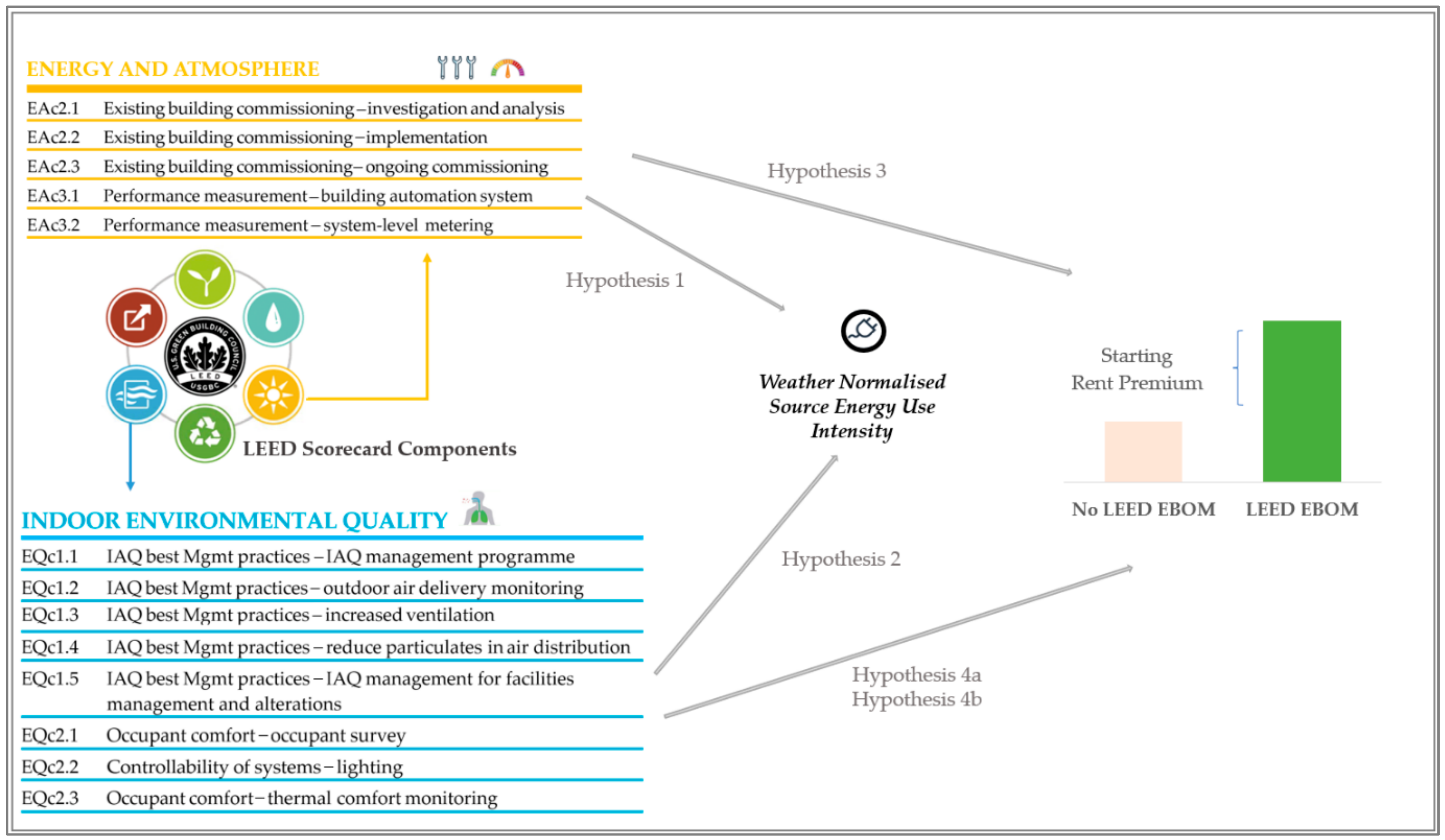
From the USGBC [49] website, scorecards for all the projects listed in California, Illinois, New York, and the District of Columbia are obtained. The LEED scorecard is a one-page document that provides a detailed break-down of the credits where points can be achieved across 7 sections: sustainable sites, water efficiency, energy and atmosphere, materials and resources, indoor environmental quality, innovation, and regional priority. The sum of the earned points determines which certification level is achieved (Certified, Silver, Gold, and Platinum). For the purposes of this research, we focus on extracting credits from 2 sections in the scorecard: energy and atmosphere (EA) and indoor environmental quality (IEQ). The specific credits and their relationship to the main hypotheses are demonstrated in Figure 2. Explanations and justifications for the inclusion of the specific credits in constructing energy management and indoor environment variables have been provided in the introductory section. Further details of specific criteria that must be fulfilled to earn points for each of these credits is documented Table A2 in the Appendix A.
Figure 2.
Credits, variables, and hypotheses. Source: USGBC.
In addition to the scorecard data available for LEED EBOM projects, high level information for all certification types and versions is separately obtained from the USGBC website. Among the variables of interest are LEED certification type (LEED EBOM, LEEN NC, LEED BD+C, etc.), certification version (v2.0, v2008, v2009, and v4), project size, and certification and registration dates. Any project that has not been certified after registering is omitted. We exclude projects that apply to a proportion of a building (such as LEED Commercial Interiors), since energy in the municipal reports is measured at the whole-building level.
Energy management and indoor environment scores are calculated based on the percentage of points gained for the credits that make up these variables and the weights applied by LEED EBOM. These values are converted to a 1–10-point scale and rounded to the nearest whole number. Since LEED EBOM has undergone a series of updates, there have been a few modifications in the type of credits earned and the weightings applied. Overall, our sample consists of ~90% of projects that are certified under version 3 of LEED EBOM (v2008 and v2009). To ensure a like-for-like comparison, the second part of the analysis, only version 3 (v2009) projects are included since this version has the greatest number of certified projects. Meanwhile, the first part of the analysis that is concerned with the impact of LEED EBOM certification as a whole encompasses all LEED EBOM versions.
2.3. Leases and Building Characteristics
Having collected energy and LEED scorecard data, rental information for the matched property sample is obtained from CompStak [55], a crowd-sourced real estate data platform. CompStak offers a detailed and accurate insight into lease-level transactions of achieved rental data and agreed concessions. Among the variables obtained from CompStak are starting rent, lease term, lease execution date, lease commencement date, lease expiry date, lease type (gross, net, double net, triple net, modified gross, industrial gross), transaction size, and concessions. Although various property types are included in our sample, lease observations other than for office space are excluded. Alongside lease information, building-level data such as building size, number of storeys, renovation year, and construction year are obtained from CompStak. Missing building-level information is supplemented with CoStar to report on variables such as building construction material, amenities, and quarterly vacancy rates.
2.4. Geographic Controls
According to Kok, McGraw, and Quigley, the proliferation of green certifications is driven by new construction activities and would therefore depend on market fundamentals [59,60,61,62]. We therefore obtain submarket-level information that would influence the probability of a given certification (level). Among the variables that we include are the average annual rents and vacancy rates, both of which are retrieved from CoStar.
3. Methodology
The following section outlines this study’s methodological approach in investigating the impact of the variables of interest on energy consumption and starting rent. Ideally, buildings would be randomly assigned to green certification and the outcomes regarding energy consumption and financial characteristics subsequently compared in a randomised control trial (RCT) [63,64]. However, this is not practical in our context given the corporate strategic decision-making and financial implications of a purely random assignment. Therefore, this study relies on quasi-experimental methods.
We begin our analysis by exploring the features of our sample, specifically if there are noteworthy differences between our treatment and control groups. For comparative purposes, we first apply a difference-in-differences (DiD) specification on the whole sample of certified and non-certified buildings, to control for unobservable group-level fixed effects attributable to LEED EBOM buildings. In this instance, the effect of LEED EBOM certification is measured using a whole sample of buildings, including those that never receive this certification. Consequently, we utilise our dataset’s repeat building-level observations via a multi-level approach. In the final stage of our analysis, we examine the effect of specific scorecard characteristics on the outcomes of interest using a sample of LEED EBOM certified buildings in the certified stage. The rationale for restricting our sample posits in that scorecard information is not observed in the period prior to LEED EBOM certification.
3.1. Study Design Considerations
To determine a pertinent econometric approach, we begin by investigating whether our data are consistent with an independent random draw. Furthermore, aggregation of observations across different geographies must be justified based on the similarity of green building strategies across the cities in our sample. If, for example, buildings self-select into a given certification level according to some unobserved locational factors, and if those are correlated with energy and rents, the internal validity of our study would be compromised. For example, it is well-known that the costs and economic benefits of implementing LEED building standards vary depending on the project’s location, type, and scale, as well as the intended certification level [65]. Projects may agglomerate if they value to be at the same level as others found in the same market, or because of some unobserved market characteristics [65]. Previous research suggests energy savings may also vary by the level of certification, the incidence of which may be subject to geographic idiosyncrasies. Among such studies is one by Scofield [66] who finds that the greatest source energy savings are achieved by Certified projects (10%), followed by Platinum and Gold (9%), and finally Silver (2%). However, in this study only Gold projects show a statistically significant difference in source energy use intensity compared to the non-certified building group. Using a 2-sample t-test (Appendix B Table A3) we also confirm that there is a significant difference between source energy consumption of varying certification levels and the base level (non-certified buildings). Significant energy savings are achieved in Gold and Platinum projects relative to the non-LEED EBOM group in each respective city with the exception of the city of New York and Platinum level in Chicago. Meanwhile, the effect sizes are the greatest for Platinum level projects achieved by San Francisco and Washington DC (Appendix B Table A4).
Table 2 and Table 3 demonstrate that (a) there are indeed differences in the hedonic features of our control and treatment groups, and (b) the distribution of LEED EBOM certification levels is non-homogenous across the cities in our sample. To eliminate any potential selection bias that could result from pooling buildings with different hedonic characteristics and across different geographies, we pre-process our data in a manner described below.
Table 2.
Descriptive statistics of leases matched to the non-certified (control) and LEED EBOM certified (treatment) groups using data from the original sample.
Table 3.
Distribution of unique projects by certification level for each city in our sample.
To address the fact that LEED buildings tend to be newer, larger, and better in quality, some studies use a propensity score matching (PSM) method to balance the differences in attributes between these groups. In the first instance, we therefore utilise a logit model to compute probabilities of LEED EBOM certification (at any level) based on a range of hedonic characterisitcs separately for each cluster (city) in our sample:
where is a dummy variable equal to one for buildings holding any level and version of LEED EBOM certification and zero otherwise. represents a vector of characteristics that differ between the treated and untreated buildings: building size, building class, the number of storeys, and years since built or last renovated. The estimated propensity scores are used for one-to-one nearest neighbour matching within a caliper of one quarter of their standard deviations. This method matches 3843 LEED EBOM lease observations adhering to the treatment group to 3843 control ones with replacement to create a subset of buildings comparable in the specified hedonic features. The same exercise yields 2714 energy observations corresponding to the control and the same number of observations to the treatment group. We investigate distributions of propensity scores of the control and treatment groups finding that after matching the propensity scores sufficiently overlap. On this reduced sample of observations, we estimate the propensity scores and associated weights for multinomial treatment (varying certification levels) using a Generalised Boosted Model (GBM) [67,68]. Equation is effectively modified to incorporate different LEED EBOM levels, with representing a range of city controls. GBM applies iterations that minimise the differences between the incidence of different certification levels occurring in different cities. This procedure allows us to re-weight our sample according to the differences in certification levels and correct for the imbalance in the proportion of observations for each certification level in the four cities. As such, we ensure that the probability of a given certification level is constant for each city thus bypassing any potential bias stemming from geographic variation in green building strategies. For example, prior to weighting the probabilities of Certified and Platinum observations for the city of San Francisco are 9% and 66%, respectively. After weighting, the probability of San Francisco observations at any level is 29%. Table 4 demonstrates that reweighting results in 26% of observations in our sample (at any level) occuring in New York, 23% from Chicago, 22% from Washington DC, and the remaining from San Francisco. The generated sampling weights are applied to the regressions where aggregate LEED EBOM effects are investigated. To ensure that the assumption of common support is satisifed, we combine observations corresponding to Certified and Silver certifications as well as Gold and Platinum. The former group is formed due to a relatively scarce number of Certified level observations in San Francisco. Meanwhile, creation of the latter one is justified in light of the lack of Platinum level observations for the city of New York, as demonstrated in Table 3. The details of a GBM and the assumptions made are found in Appendix C.
Table 4.
The proportion of observations for certification sub-groups from each city before and after sample reweighting.
3.2. Difference in Differences (DiD)
To prevent erroneous attribution of energy use and rental differences between LEED EBOM and non-certified buildings to the differences in energy efficiency features, quasi-experimental methods are the next best alternative to random assignment. The dataset available for this study allows to control for the time-invariant unobservable characteristics attributable to either of the groups by applying difference-in-differences (DiD). Among those fixed features that are controlled for through this specification are the intrinsic differences between structural characteristics, building technologies, appliances, and operational hours between the certified and non-certified building groups [63]. The following model summarises the DiD set-up:
where the dependent variable, , stands for source energy consumption of a building and achieved starting rent of a lease observed at building during a time period . A logarithm transformation of the dependent variable is used to account for the observed positive skewness in the distributions of both source energy and starting rent, capturing the percentage change in these variables. Vectors of time-invariant hedonic building and time-variant lease features are represented by and , respectively. The DiD estimator, , captures a change in the dependent variable achieved because of LEED EBOM certification. To control for macroeconomic factors such as inflation and interest rates that influence all buildings systematically, is applied on a quarterly (annual) basis for the rental (energy) regressions. Finally, locational controls, , are comprised of submarket dummy variables (alongside other submarket-level controls such as average rents and vacancy rates) in the regressions where rental outcomes are investigated; meanwhile, city controls are used in regressions examining the effects of the variables of interest on source energy use intensity.
3.3. Multi-Level Modelling (MLM)
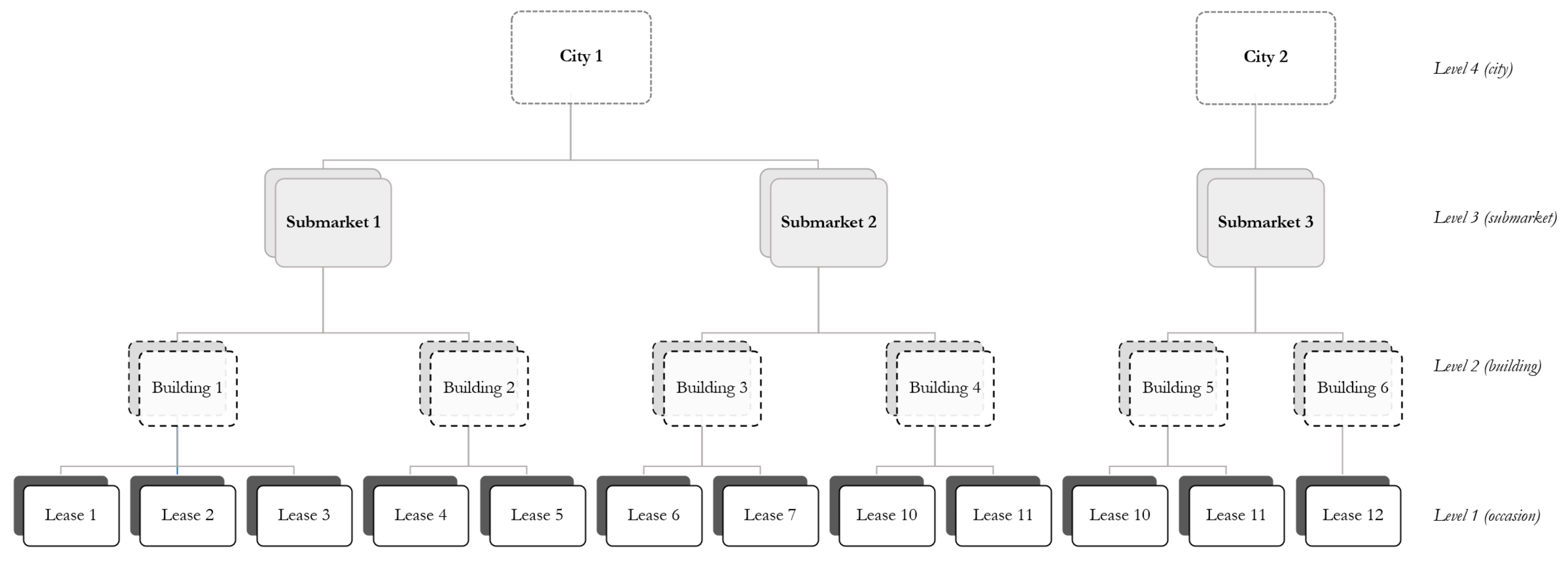
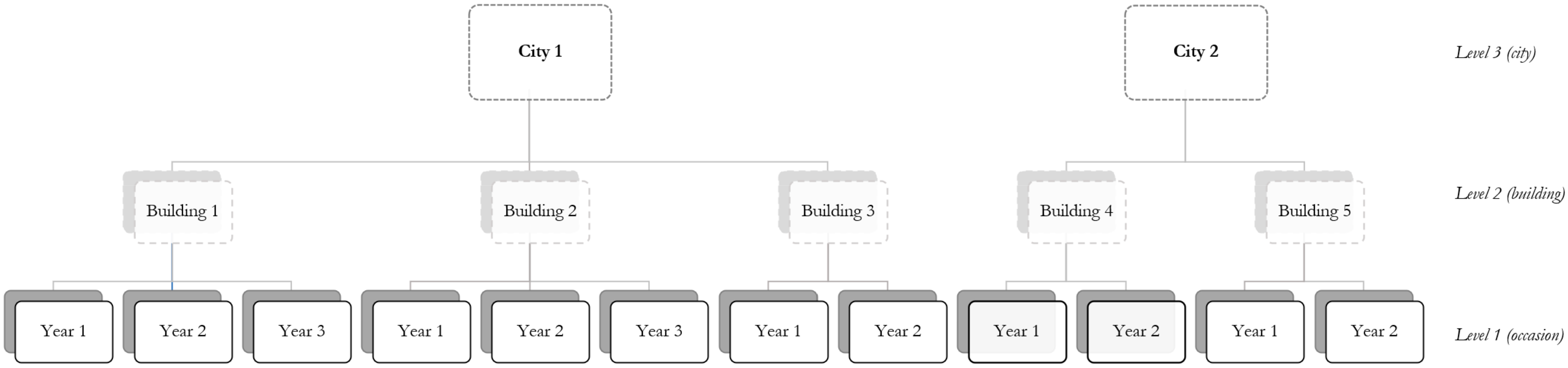
The presence of a hierarchical/nested data structure in this study requires an approach where heterogeneity can be incorporated at the building and higher level locational levels [69]. Figure 3 provides a visual snapshot of our lease dataset’s structure: lease observations are nested within buildings, while buildings are nested within submarkets, and submarkets within cities. Multiple leases can be executed per unit time (quarter) in any given building. Aggregation of lease variables to higher order ones would result in a diminished within variation, potentially causing ecological fallacy [70]. Similarly, Figure 4 shows the data structure for energy observations, which are recorded annually: energy observations (occasions) are nested within buildings, which are nested within cities.
Figure 3.
Nested data structure snapshot—lease observations.
Figure 4.
Nested data structure snapshot—energy observations.
A multi-level model (MLM) is a widely used approach to deal with nested datasets, where variation across different clusters is assumed to be random and uncorrelated with the independent variables in the model [71]. This specification is a modified form of a hedonic pricing model since it has the same overall structure, which consists of fixed and random effects [72]. This model allows intercepts and slopes to have their own distributions across clusters, which can be summarised by a set of parameters, such as mean and variance. In addition, this approach accounts for within variation to control for the time-invariant building characteristics, which influence the probability of obtaining green certification [63].
MLM specification is represented by the following model:
where is the logarithm of starting rent (source energy use intensity) for a lease (energy observation) recorded in period in building located in (submarket); , , and represent the effects of fixed covariates associated with lease, building, and time, respectively. Additionally, since multi-level models do not automatically guarantee a balance within each cluster, this specification is reliant on inclusion of cluster-level covariates as regressors, , comprised of the average annual and vacancy rates for each submarket. Meanwhile, and represent level 2 (building) and level 3 (submarket) random intercept controls. The vectors of lease (), hedonic (), and time () controls are characterised by the same variables as in Equation . Finally, the effect of interest, aggregate LEED EBOM certificate (followed by individual scorecard features) is captured by .
For energy and rental regressions, the proportion of variation in the outcome variables attributable to the differences at the group levels is measured using intraclass coefficient. ICC coefficient is a descriptive statistic that depicts how strongly observations belonging to the same group resemble each other [73], represented by the following:
where represents the variance of interest and is the unwanted variance [74]. Although there are no standard rules for acceptable values of ICC [75], an ICC coefficient of less than 0.5 is considered to indicate low degree reliability, while values between 0.75 and 0.95 are considered to be high.
4. Results
First of all, we present the results of regressing the logarithm of weather normalised source energy use intensity on LEED EBOM certificate and a range of scorecard characteristics. Secondly, using lease-level data for the same group of buildings, the logarithm of starting rent is regressed on the same set of variables pertinent to this research. For comparative purposes, we present a summary of statistics (Table A5 in the Appendix B) documenting the differences between the treatment and control groups prior to conducting analysis.
4.1. Operating Features and Energy Consumption
Table 5 presents the selected results for regression models relating LEED EBOM to source energy consumption levels. The complete set of results can be found in Table A6 in the Appendix B. Specifically, this part investigates energy performance of LEED EBOM certified buildings compared to a non-certified building group using a whole sample of energy observations while employing sample weights generated by a GBM (n = 5428). The reference category is comprised of Class A masonry buildings operating under gross/full service gross leasing structures in San Francisco. Model 1 demonstrates the results of using a DiD approach: LEED EBOM certification results in a 2.7% decrease in source energy use intensity. Additionally, the level of source energy consumption of LEED EBOM certified buildings is lower in the pre-certification period compared to the reference group (−3.1%). As expected, the most tangible impact on energy usage occurs due to an increase in vacancy rates (−52.9%) and in the presence of a data centre (63.5%). Single tenant buildings consume on average 9.9% more energy than their multi-tenant counterparts. As expected, a split incentive problem is evident from these findings, which occurs when the tenant’s marginal cost of energy consumption is zero, thus causing more energy wasted in gross than net leases. As such, buildings adopting net leases consume on average 4.0% less source energy than their gross lease counterparts under a DiD specification. Finally, buildings made from steel use 7.5% more energy than masonry buildings. This is also expected, since masonry buildings’ thermal envelope and insulation properties (R-values) mean their glazing ratio is lower than in curtainwall buildings. Meanwhile, structural steel properties have uncovered slab edges that provide little insulation [29]. An adjusted-R2 is used to determine if the inclusion of additional lease- and building-level variables results in a better predictive power of the OLS model. In addition, the variables are checked for multicollinearity using their variance inflation factors (VIFs). A Breusch–Pagan [76] test detects heteroscedasticity issues, as the null hypothesis of constant variance is rejected at 90% significance level. Furthermore, Wooldridge test for first order autocorrelation firmly rejects the null hypothesis of no first order autocorrelation. Cluster-robust standard errors are therefore used, allowing for building-level intragroup correlation [77]. Finally, no substantial deviation from normality is observed in the distribution of the residuals.
Table 5.
Energy regressions—Part 1. Selected results.
In the next stage, we utilise this dataset’s panel characteristics. A Hausman [78] test rejects the null hypothesis of the difference in random and fixed effects not being systematic. Researchers frequently interpret this result as an indication that a fixed effect model should be used [69]. Yet Fielding [79] notes that this is a test for the presence of a contextual effect, or whether there is a difference between a within and between-unit variation [69]. Since a mixed effects specification would give the same results for the within effect (in both coefficient and standard error) as the fixed effects model, while retaining the between effect, we proceed with this approach [80,81]. Because the intraclass correlation coefficient (ICC) at city-level (20%) is closer to the lower bound recommended for running a multi-level model [82], where a minimum of 5 levels is usually required [83], city fixed effects are employed instead. Meanwhile, building-level ICC coefficient is high (85%), justifying building-level random effects. The results show that using a mixed effects approach, LEED EBOM certification yields a reduction in energy consumption by 3.2%. In the following regression (Model 3), we investigate if there is evidence of heterogenous certification effects over time using a sample of LEED EBOM certified buildings 5 years prior and during the certification period. Although coefficients vary from year to year in the periods before and after certification, only the first certification year yields a significant result.
For comparative purposes and as a robustness check, we conduct a fixed effects analysis that removes any bias arising from contextual effects. Specifically, we focus on comparing energy consumption of LEED EBOM buildings on an individual basis compared to their own energy consumption levels before certification occurs. This specification allows to eliminate any confounding factors arising from the between variation, which may be causing selection bias into the treatment (certification) group. A fixed effects regression with a reduced sample for buildings (where information available before and after certification) shows that LEED EBOM results in a 3.0% reduction in source energy. This finding is nearly identical to our main set of reported results in Table 5.
Next, we analyse the effect of energy management features on energy consumption using a sample of LEED EBOM certified buildings in the post certification period and present the results in Table 6 (n = 1377). The complete set of results can be found in Table A7 in the Appendix B. Model 4 demonstrates that a 1-point (equivalent to 10%) increase in the energy management variable results in an increase in source energy consumption by 0.4%. The effect of this variable is broken down into its components in Model 5, measurement and commissioning, demonstrating that commissioning is a significant driver of this effect: a 1-point increase in these credits (equivalent to an increase by 1/3rd) results in a 1.1% rise in source energy. Since the relationship between energy management (including commissioning) and energy consumption is contrary to the expectations laid out in our hypotheses, we postulate that there may be reverse causality issues at play. Having only utilised information in the certification period, it is possible that buildings with higher-than-average energy performance pursue energy management principles either to increase their total LEED score (to make up for a low number of points achieved in the energy optimisation category which is directly proportional to energy consumption), while possibly expecting to reap energy savings in the future. To account for this possibility, the whole panel of observations before and after LEED EBOM certification is employed in the next stage. Although information on the exact duration of the performance period, or when the measures of interest are implemented, is unavailable, we compare periods before and after the performance period. Given that the effect of LEED EBOM certification should start taking place at the onset of the performance period (in order to attain LEED EBOM certification and for reasons other than energy management), we exclude observations 1 year prior to the date of certification. Observations corresponding to the year of certification are also excluded in order to remove any ambiguity with respect to the end of the performance period, which results in a sample of 1580 observations. Assuming that all energy management principles are implemented during the performance period and lagged by one year, we find that a 10% increase in this category results in a 0.5% fall in source energy (Model 6). This decrease is again underpinned by energy commissioning: a 1/3rd increase in the number of points scored reduces energy consumption by 1.0% (Model 7). As a robustness check, a further exclusion of observations 2 years prior to the date of certification to allow for a longer performance period does not produce results notably deviating from the coefficients reported in Model 6 and Model 7.
Table 6.
Energy regressions—Part 2. Selected results.
In Table 6, we also present our findings involving the effect of the Indoor Environment: a 1-point (equivalent to 10%) increase in this variable results in a 0.8% rise in source energy consumption (Model 8). This variable is an aggregation of credits representing air quality and occupant comfort, which we proceed to investigate separately. Among the variables driving the increase in energy is IAQ Outdoor Monitoring (9.9%), which is one of the five components of indoor air quality. Finally, the presence of comfort surveys is associated with a 1.8% increase in source energy, as demonstrated in Model 9.
In the final stage, we conduct some general robustness checks to examine the impact of some missing variables. Since one of the main operating characteristics, worker density per unit area, is reported by the city of New York, a separate set of regressions is conducted for New York to include this variable. Despite this variable being highly significant under this setting, the coefficients of interest do not deviate substantially from those reported in the above tables.
4.2. Operating Features and Rental Premium
Table 7 shows the second set of regression results with the logarithm of starting rent as a dependent variable. As before, the starting point of the analysis is a DiD regression, aggregated at a LEED EBOM certification group level, using the whole sample of leases signed in both LEED EBOM and non-certified buildings with GBM weights applied (n = 7686). Overall, the regression is highly significant with an R2 of 80.4%. LEED EBOM certification incurs a 3.0% premium; however, no significant LEED EBOM premium is observed for a net lease, as demonstrated in Model 2. An equivalent set of checks as described in the previous section is conducted to test the validity of the OLS approach and determine the inclusion of variables. A graphical inspection of the residuals against the time variable (transaction quarter) does not reveal any autocorrelation issues. However, a Breush–Pagan [76] test rejects the null hypothesis of constant varaince in the error terms. Huber–White error estimation is therefore used, which ensures that standard errors are robust to heteroscedasticity [84,85]. Additionally, the residuals are mostly normally distributed. A scatterplot of residuals versus fitted values, however, indicates that the independence of errors assumption is violated. These findings are expected in light of this dataset’s hierarchical data structure, thus supporting a multi-level approach. The Hausman test once again indicates the lack of equivalence between the within and between estimators [78]. The use of the mixed effects approach with the specified levels is further reinforced by high intraclass coefficients for building and submarket levels of 58% and 23%, respectively. In a multi-level setting, as Model 3 demonstrates, the effect of LEED EBOM certification does not deviate substantially from the DiD specification (2.7%). However, the interaction term between net lease type and LEED EBOM certificate is significant at 10% level in a MLM (Model 4): net leases in LEED EBOM certified properties incur a 5.0% premium (in addition to a 2.1% premium in all lease types). The signs and magnitudes of building-level coefficients are as expected and reported in Table A8 in the Appendix B. The lack of significance in variables such as class and the number of storeys in some models is not unexpected after employing propensity score balancing procedures.
Table 7.
Rent regressions—Part 1. Selected results.
Next, we use a restricted sample of leases signed under version 3 (v2009) of LEED EBOM by applying this label’s scorecard data. Such information is available for 3287 leases in 303 buildings. The results of these regressions are presented in Table 8 and the complete set of results can be found in Table A9 in the Appendix B. Overall, a 1-point (equivalent to 10%) increase in energy management results in a 0.4% increase in the rental premium for all lease types (Model 5). However, no significant interaction effect is observed between this variable and the type of lease signed (Model 6). A separate regression examining this variable’s individual components uncovered a positive relationship between the number of commissioning points earned and rental premium: a 1-point (equivalent to 1/3rd) increase incurs a 1.2% rise in the premium (Model 7). The presence of measurement technologies, such as building automation systems (BAS) and system measurements, does not yield a significant result.
Table 8.
Rent results—Part 2. Selected results.
Using the same restricted sample, a separate set of regressions is conducted for the Indoor Environment variable. As per Model 8, a 1-point (equivalent to 10%) increase in this variable results in a 1.3% premium in all types of leases. No significant difference in the premium of net and gross leases occurs for the incidence of indoor environment features (Model 9). To understand the effect of the specific attributes driving this premium, the effect of a set of dummy variables which constitute this category is analysed. Once again, the significance stems from the presence of IAQ Outdoor Monitoring features (13.3%) and Thermal Monitoring (7.8%) credits are found to underpin the positive effect.
We finalise our analysis with further robustness checks. Since LEED EBOM certification may not be priced in immediately upon certifying, we explore whether the above results hold using lagged terms of LEED EBOM status as well as energy management and indoor environment practices. The results of the lagged status of LEED EBOM are not significant. Using the restricted sample to study scorecard effects, only the lagged indoor environment variable bears significance, with a 1-point increase resulting in a rental premium of 1.6%.
4.3. Discussion
This section draws on the results from all the above regressions and evaluates them in the context of the original hypotheses. Throughout this section, we focus on the results using the MLM specification which can account for autocorrelation and heteroscedasticity of residuals, as opposed to OLS with clustering of standard errors [86]. Modelling the clustering of data using multilevel methods is considered to be a better approach than adjusting the standard errors of the OLS estimates [87] because one-level OLS is likely to underestimate the standard errors and overestimate the statistical significance of the parameters. The results of the multi-level approach show that energy savings in the magnitude of 3.2% are achieved in the LEED EBOM post-certification period over non-certified buildings. Some past studies highlight that the effect of green certification on energy consumption is likely to vary over time in the certification phase due to technical and behavioural factors, such as the rebound effect [63]. In the following regression (Model 3 in Table 5), we investigate the presence of heterogenous certification effects over time using a sample of LEED EBOM certified buildings 5 years prior and during the certification period of up to 5 years. However, only the first year of certification yields significant results, showing a decrease in source energy use intensity by 8.0%. The lack of significance could be attributed to a relatively low number of observations corresponding to LEED EBOM certified buildings in each year.
The fact that LEED EBOM certification reduces energy consumption and consequently energy costs is expected to be priced in via a premium in leases where tenants pay directly for operating expenses. By exploring the interaction effect between lease type and LEED EBOM certificate, we find it to be the case: in addition to a 2.1% premium, tenants pay a further premium of 5.0% under such lease structures using a mixed effects specification. This finding is in support of a study conducted by Szumilo and Fuerst [88] who discovered increased rents in both gross and net-leased properties. In our case, however, this effect is significant despite controlling for energy consumption, which is expected to act as a mediating channel. One possible explanation is that since energy costs represent ~30% of total operating expenses [37,48], LEED EBOM may also affect other operating expenses such as maintenance costs. Understanding the effect of this certification on various operating expenses components presents a potential area for future research.
Next, we focus on studying the effects of individual scorecard features that form the basis of LEED EBOM label. The lack of information on these variables in the period prior to the certification drives the initial decision to exclude those observations from the set. In investigating the combined effect of energy management credits, comprised of commissioning and measurement, we find that these practices have an adverse effect on energy consumption. The unexpected sign could arise due to reverse causality if buildings with higher-than-average energy consumption are incentivised to pursue energy management credits to reap energy saving benefits in the future and/or attain a higher LEED score. To overcome this bias, we utilise observations before and after LEED EBOM certification. By assuming that a decrease in energy consumption occurs at least 1 year prior to the year of certification (for reasons other than energy management), that energy management principles are implemented during the performance period and their effect is delayed by 1 year, we find a significant negative association between energy management and source energy consumption. The presence of commissioning credits is driving this effect. Although these findings support Hypothesis 1, the observed reduction in energy consumption is trivial (1.0% decrease in energy for a 1/3 increase in the number of commissioning points). To put this in the absolute terms, with the average source energy consumption of an office building being ~200 kBtu/sqft/year [58], implementing one of the commissioning principles (investigation, implementation or ongoing commissioning) would result in a decrease in source energy usage of ~2 kBtu/sqft/year. Further research could elucidate the effectiveness of these practices from a cost-benefit perspective.
A negative association between energy consumption and energy management principles (increase in energy savings) does not translate into a premium for net leases, as postulated by Hypothesis 3. This could be due to the relatively small decrease in energy usage as described above. However, an observed premium for these features in all types of leases could be indicative of the perceived productivity benefits of these credits. For example, the presence of commissioning may not only address energy performance issues in buildings with energy management systems and equipment failures, but also identify and correct flaws regarding indoor air quality conditions. However, it is also possible that building owners bundle energy management practices with other productivity-related features, which have been omitted from our regression. Yet given the average number of energy management points in our sample (3.73), the average premium achieved for the presence of these features is not very large (~1.5%).
In the final part of the analysis, the effect of indoor environment features is explored. Implementation of these practices results in a significant increase in source energy consumption, a finding in support of Hypothesis 2. It occurs due to the incidence of comfort features (Comfort Survey) and indoor air quality (IAQ Outdoor Monitoring). Specifically, energy increase in the presence of outdoor air monitoring is substantial (~10%), especially compared to the energy rise for a Comfort Survey credit (1.8%). Productivity advantages of superior air quality are also shown to translate into a fairly substantial premium for the IAQ Outdoor Monitoring credit (~13%). This credit mandates the installation of permanent, continuous monitoring systems that inform building operators when external airflow falls below the minimum set point by more than 15%. The likely invisible nature of this credit in the eyes of the tenants, however, casts doubt on whether the size of the coefficient is attributable to this feature alone. Similarly, IAQ Outdoor Monitoring (and Comfort Survey) should not per se have an adverse effect on energy. Rather, this credit could trigger an increase in a ventilation rate throughout the building or a range of actions that would address occupants’ comfort concerns, resulting in an increase in HVAC energy consumption and associated costs [89]. Therefore, it is possible that these coefficients are inflated by omitted factors that are positively correlated with these features. Finally, Thermal Monitoring is the only comfort feature that is found to yield a significant in addition to a substantial premium (7.8%). This credit requires continuous monitoring of air temperature and humidity in addition to periodic measurements of air speed and humidity to assess the conditions experienced by building occupants [89]. The relatively large size of the premium is hardly surprising since getting the temperature right is vital for occupants’ comfort. Besides, acquisition of this credit often relies on installation of automatic sensors in the building automation system (BAS) infrastructure, which may be costly to building owners. Overall, these results reveal some interesting insights into the prominence of monitoring technologies to ensure that both air and thermal conditions are optimal and therefore conducive to employee productivity.
Contrary to the expectations laid out in Hypothesis 4b, the adverse energy consumption effect associated with indoor environment attributes does not translate into rent reduction for leases where tenants pay for utilities. We do not find it to be the case upon exclusion of the logarithm of source energy consumption, the proposed mediating channel. Meanwhile, a substantial premium emerges under gross lease structures (as per Hypothesis 4a) where such attributes are present: a 10% increase in this category yields a 1.3% premium. These results further reinforce the notion that productivity aspects may be more prominent in LEED EBOM buildings and may overshadow any adverse energy ramifications.
The findings of this paper are important for policy makers seeking to lower greenhouse gas emissions as well as property investors interested in reducing operating expenses to improve their bottom line. These stakeholders would unequivocally benefit from considering productivity-boosting features that do not come at the expense of higher energy consumption. One uncovered strategy is associated with the implementation of Thermal Monitoring since it resulted in a significant rent premium without a significant (adverse) effect on energy consumption. Another strategy, although not supported empirically in this study, is the provision of task lighting controls for occupants. This strategy can theoretically reduce energy usage by allowing occupants to adjust lighting levels to their specific needs without depending on over-lit space of the whole building. Future research, involving more granular datasets with high-frequency energy data collected in a RCT setting, is needed to draw more decisive conclusions to determine which productivity-boosting features can have such an effect. Based on the results of such findings, USGBC could consider re-weighting the scorecard to incentivise the adoption of thise productivity-related credits that do not harm the environment.
There are several limitations of this study which may question the results obtained in this study. The low coefficient magnitudes obtained for some variables of interest may be trivial considering the imperfections of the real estate market and the high degree of uncertainty associated with energy predictions. Different implementation windows of energy benchmarking policies in the cities studied and the minimum affected floor area result in varying data availability for each city. Specifically, availability of energy data skews our sample towards San Francisco and New York, which were some of the first to initiate energy benchmarking policies for non-residential buildings. Additionally, verification of energy data is not required by every city [90], exposing our sample to some degree of error. However, as long as such errors are randomly distributed, the validity of the generated results should not be compromised. Additionally, with a relatively scarce availability of buildings under certain certification levels in the studied cities, we cannot examine the extent of heterogeneity in the outcomes for equivalent certification levels between these cities. Furthermore, key occupational variables (such as worker density and number of computers per person and operating hours), which are known to influence energy consumption considerably [91], are absent from this study. Although a set of separate regressions with worker density included for the city of New York does not produce a significant deviation in the coefficients, the model’s overall predicting power would be improved upon the inclusion of such variables. Another noteworthy limitation is the lack of information on the features represented by the scorecards prior to LEED EBOM certification. Thus, we cannot precisely isolate the effect of mandatory prerequisites and individual features constituting the LEED EBOM label from the aggregate effect using the period before and after certification. Furthermore, aside from the traditional hedonic variables (class, building size, etc.), key information on the type of equipment installed in a building (such as HVAC systems) is missing. Information on the tenant firm type, credit rating, size, and behaviour is not included, reducing the explanatory power of our models. If environmentally conscious tenants systematically choose to locate in a building with LEED EBOM certification, any reduction in energy consumption (increase in savings) achieved due to certification would suffer from a negative (positive) bias. There may be a selection bias in the types of businesses that choose net leases over gross leases, a decision that could be based on the tenant’s projected intensity of space usage [38].
5. Conclusions
Environmental certification has become the primary signalling channel for superior green credentials in the commercial real estate market. In recent years, attention has shifted from energy efficient design features to in-use energy performance. In response to the rising evidence base documenting a disparity between predicted and actual levels of energy consumption, LEED’s Existing Buildings Operations and Management has been launched. We examine the impact of this label’s scorecard features, on both energy consumption and rents. Features can be grouped into either improving operational energy performance or enhancing productivity, such as occupant comfort and air quality. Our dataset comprises of LEED EBOM certified and non-certified properties located in San Francisco, New York, Washington DC, and Chicago. The analysis conducted in this study (a) combines novel datasets that report on a building’s actual, rather than estimated, energy consumption and rental figures; (b) applies panel data methods thereby controlling for unobservable building-level characteristics; (c) differentiates between operating and design types of LEED certification; and (d) analyses the effect of individual LEED components.
We find that LEED EBOM certification results in lower energy consumption. This effect is positively priced into leases obliging the tenant to cover energy expenses. In addition, the fact that a rental premium is associated with all lease types (irrespective of who bears responsibility for the utilities), is indicative of this certification’s productivity-related benefits. It is less clear, however, what drives these effects. Although we find proof in support of Hypothesis 1 that energy management results in a reduction in energy usage, the relatively small magnitude of the coefficient casts doubt on the effectiveness of these energy measures. Although contrary to our original expectations, the small effect size may be the reason that net leases do not show a rental premium for these features (Hypothesis 3). Productivity-enhancing features captured by indoor environment credits command higher premiums (Hypothesis 4a), a notion that is reinforced by the lack of a differentiation between net and gross lease types (Hypothesis 4b) despite their adverse energy outcomes as postulated by Hypothesis 2. Overall, these findings imply that users of certified buildings value productivity and well-being enhancing features more highly than measures aimed at curbing energy consumption. While there may be measures such occupant lighting controls that can theoretically enhance both user productivity and energy conservation, there appears to be a trade-off between these two objectives which should be taken into account in the design of certification schemes.
Author Contributions
Conceptualization, Y.A.; Data curation, Y.A.; Formal analysis, Y.A.; Funding acquisition, F.F.; Methodology, Y.A.; Project administration, F.F.; Research design and conceptualisation, F.F.; Writing—original draft, Y.A.; Writing—review & editing, F.F. All authors have read and agreed to the published version of the manuscript.
Funding
This research was funded by Cambridge Humanities Research Grants Scheme (2019/20 Round 2).
Institutional Review Board Statement
Not applicable.
Informed Consent Statement
Not applicable.
Data Availability Statement
Proprietary data on leases and building characteristics were obtained via an individual license from CompStak, Inc. and CoStar Group and cannot be disclosed or made available to third parties. Energy benchmarking, USGBC and GBIG datasets for New York, San Francisco, Chicago and Washington DC are publicly available. These datasets are referenced in the paper and can be accessed via the links provided.
Acknowledgments
This paper is based on a presentation given at the Joint Workshop Series on Sustainable Property Market jointly organized by CSIS-The University of Tokyo and CRERC-University of Cambridge. The publication fee is financially subsidised by the University of Tokyo. Franz Fuerst acknowledges the support of the Cambridge University Land Society. We would like to thank our conference discussant and the anonymous reviewers for their invaluable feedback.
Conflicts of Interest
The authors declare no conflict of interest.
Appendix A
Table A1.
Description of variables and summary statistics using data from the original sample (prior to one-to-one caliper based matching on propensity scores).
Table A1.
Description of variables and summary statistics using data from the original sample (prior to one-to-one caliper based matching on propensity scores).
| Variable Name | Variable Description | N | Min | Max | ||
|---|---|---|---|---|---|---|
| Starting Rent | Actual rent the landlord receives (per square foot) | 12,500 | 50.14 | 19.36 | 5.00 | 214.80 |
| Source EUI | Weather normalised source energy use intensity (per square foot) | 6048 | 185.65 | 62.66 | 90.10 | 686.50 |
| Dummy variable is 1 for buildings that achieve LEED EBOM certification in any period. | 12,500 | 0.49 | 0.50 | 0 | 1 | |
| Dummy variable is 1 for LEED EBOM certified buildings. The dummy is “switched off” after five years unless the building recertifies. | 12,500 | 0.25 | 0.43 | 0 | 1 | |
| Energy Management | Number of points scored for energy commissioning and performance measurement, converted to a 1–10-point scale. | 3287 | 3.73 | 2.6 | 0 | 9 |
| Measurement | Dummy variable is 1 indicating the presence of building automation systems (BAS) or systems measurment technologies. | 3287 | 0.22 | 0.41 | 0 | 1 |
| Commissioning | Number of commissioning points earned for investigation and analysis, implementation, and ongoing commissioning credits; converted to a 1–3-point scale. | 3287 | 1.58 | 1.06 | 0 | 3 |
| Indoor Environment | Number of points scored for air quality and comfort, converted to a 1–10-point scale. | 3287 | 3.93 | 1.46 | 0 | 9 |
| IAQ Plan | Dummy variable is 1 for LEED EBOM v2009 projects with an IAQ Planning credit. | 3287 | 0.83 | 0.38 | 0 | 1 |
| IAQ Outdoor Monitoring | Dummy variable is 1 for LEED EBOM v2009 projects with an IAQ outdoor air monitoring credit. | 3287 | 0.03 | 0.18 | 0 | 1 |
| Particulates | Dummy variable is 1 for LEED EBOM v2009 projects with an IAQ particulates credit. | 3287 | 0.77 | 0.42 | 0 | 1 |
| Renovation | Dummy variable is 1 for LEED EBOM v2009 projects with an IAQ renovation credit. | 3287 | 0.15 | 0.36 | 0 | 1 |
| Ventilation | Dummy variable is 1 for LEED EBOM v2009 projects with an IAQ ventilation credit. | 3287 | 0.15 | 0.36 | 0 | 1 |
| Comfort Survey | Dummy variable is 1 for LEED EBOM v2009 projects with a survey of comfort credit. | 3287 | 0.50 | 0.50 | 0 | 1 |
| Lighting Controls | Dummy variable is 1 for LEED EBOM v2009 projects with a lighting system controls credit. | 3287 | 0.56 | 0.50 | 0 | 1 |
| Thermal Monitoring | Dummy variable is 1 for LEED EBOM v2009 projects with a thermal occupant comfort credit. | 3287 | 0.02 | 0.13 | 0 | 1 |
| LEED Design | Dummy variable is 1 for any design-stage LEED certifications such as LEED Core and Shell (CS), LEED NC (New Construction), or LEED BD+C (Building Design and Construction). | 12,500 | 0.06 | 0.23 | 0 | 1 |
| Mixed/Multifamily | Dummy variable is 1 for mixed /multifamily buildings. | 12,500 | 0.01 | 0.10 | 0 | 1 |
| Industrial | Dummy variable is 1 for industrial buildings. | 12,500 | 0.00 | 0.05 | 0 | 1 |
| Retail | Dummy variable is 1 for retail buildings. | 12,500 | 0.00 | 0.05 | 0 | 1 |
| Metal | Dummy variable is 1 for metal buildings. | 12,500 | 0.00 | 0.07 | 0 | 1 |
| Concrete | Dummy variable is 1 for concrete buildings. | 12,500 | 0.15 | 0.35 | 0 | 1 |
| Steel | Dummy variable is 1 for steel buildings. | 12,500 | 0.54 | 0.50 | 0 | 1 |
| Class B | Dummy variable is 1 for Class B properties. | 12,500 | 0.33 | 0.47 | 0 | 1 |
| Building size | Building size in square feet. | 12,500 | 580.48 k | 577.18 k | 11.99 k | 4.56 m |
| Storeys | Total number of floors in the building. | 12,500 | 27.50 | 17.13 | 1 | 110 |
| Built/Last Renovated | Number of years since the building was built/last renovated at the time of the transaction/energy observation. | 12,500 | 26.37 | 27.63 | 0 | 150 |
| Vacancy | Percentage of space vacant in a building at the time of transaction. | 12,500 | 0.13 | 0.13 | 0 | 1 |
| Single Tenant | Dummy variable is 1 if the property is occupied by a single tenant. | 12,500 | 0.00 | 0.07 | 0 | 1 |
| Renewal | Dummy variable is 1 if lease type is renewal. | 12,500 | 0.25 | 0.43 | 0 | 1 |
| Expansion/Extension | Dummy variable is 1 if lease type is expansion/extension. | 12,500 | 0.11 | 0.31 | 0 | 1 |
| Other Transaction | Dummy variable is 1 for all other lease types (excl. new transactions) | 12,500 | 0.02 | 0.15 | 0 | 1 |
| Lease Term | Lease length in years. | 12,500 | 6.44 | 3.70 | 0.08 | 41 |
| Transaction Size | The total amount of space leased by the tenant in the transaction (in square feet). | 12,500 | 16.47 k | 36.58 k | 95 | 1.60 m |
| Net | Dummy variable is 1 in lease structures where tenant pays for utilities. | 12,500 | 0.06 | 0.24 | 0 | 1 |
| Location Controls: | ||||||
| New York | Dummy variable is 1 if lease/building is in New York. | 12,500 | 0.38 | 0.49 | 0 | 1 |
| Washington DC | Dummy variable is 1 if lease/building is in Washington DC. | 12,500 | 0.17 | 0.37 | 0 | 1 |
| Chicago | Dummy variable is 1 if lease/building is in Chicago. | 12,500 | 0.17 | 0.38 | 0 | 1 |
| Submarket Rent | Average annual market rent observed at the submarket level (per square foot). | 12,500 | 58.31 | 15.17 | 8.41 | 91 |
| Submarket Vacancy | Average annual vacancy rate observed at the submarket level. | 12,500 | 0.027 | 0.09 | 0.00 | 0.23 |
Note: Thousands (k) and millions (m) are abbreviated. Dummy variables indicating the presence of atrium, balcony, all-day access to the building, air conditioning, conference room, dry cleaner, food facilities/restaurant, concierge, and data centre are excluded from this table. Submarket and time control variables are also excluded. The reference category is comprised of new transactions obliging the landlord to cover utilities (gross leases) signed in Class A, masonry, and primarily office type buildings in San Francisco in (Q’1) 2011.
Table A2.
Independent variables—Scorecard components. Source: LEED User, USGBC website.
Table A2.
Independent variables—Scorecard components. Source: LEED User, USGBC website.
| Category | Credits | Main RMainequirements | |
|---|---|---|---|
| Energy Management | Commissioning |
|
|
|
| ||
|
| ||
| Performance measurement |
|
| |
|
| ||
| Indoor Environ-mental Quality | Air |
|
|
|
| ||
|
| ||
|
| ||
| Comfort |
|
| |
|
| ||
|
|
Figure A1.
Average source energy use intensity by LEED EBOM certification status. Source: Municipal Benchmarking Reports, USGBC.
Figure A2.
Average source energy use intensity by city (2011–2019). Source: Municipal Benchmarking Reports.
Figure A3.
Average starting rent by LEED EBOM certification status (2011–2019). Source: CompStak, USGBC.
Figure A4.
Average Starting Rent by City (2011–2019); Source: CompStak.
Appendix B
Table A3.
Source energy difference by certification level relative to non-LEED EBOM in each city.
Table A3.
Source energy difference by certification level relative to non-LEED EBOM in each city.
| City | Certified | Silver | Gold | Platinum | Aggregate |
|---|---|---|---|---|---|
| San Francisco | 0.14 (0.04) | 0.04 (0.19) | −0.05 (0.01) | −0.09 (0.00) | −0.06 (0.00) |
| Washington DC | 0.14 (0.06) | −0.08 (0.01) | −0.09 (0.00) | −0.09 (0.00) | −0.08 (0.00) |
| Chicago | 0.13 (0.00) | −0.04 (0.19) | −0.11 (0.00) | 0.06 (0.00) | −0.06 (0.00) |
| New York | 0.01 (0.72) | 0.07 (0.07) | 0.03 (0.06) | n/a | 0.06 (0.00) |
| Aggregate | 0.06 (0.03) | 0.04 (0.01) | −0.07 (0.00) | −0.14 (0.00) | −0.07 (0.00) |
Note: Energy savings have a negative coefficient sign. p-values are shown in brackets.
Table A4.
Effect sizes (Cohen’s d) of different certification levels on the logarithm of source energy use intensity relative to the non-LEED EBOM certified building group in each respective city.
Table A4.
Effect sizes (Cohen’s d) of different certification levels on the logarithm of source energy use intensity relative to the non-LEED EBOM certified building group in each respective city.
| City | Certified | Silver | Gold | Platinum | City Aggregate |
|---|---|---|---|---|---|
| San Francisco | 0.49 | 0.15 | −0.17 ** | −0.40 ** | −0.22 ** |
| Washington DC | 0.50 | −0.31 ** | −0.35 ** | −0.48 ** | −0.33 ** |
| Chicago | 0.42 | −0.12 | −0.36 ** | 0.35 | −0.20 ** |
| New York | −0.04 | 0.27 | 0.17 | n/a | −0.23 |
| Aggregate | 0.19 | 0.13 | −0.23 ** | −0.60 ** | −0.18 ** |
Note: The sample consists of LEED EBOM certified buildings under versions v2, v3, and v4. There are no Platinum level projects for the city of New York in our sample. Aggregate effects represent pooled LEED EBOM effect sizes for each respective city and certification levels. ** Significance at 95% confidence interval.
Table A5.
Comparison of the control and treatment groups.
Table A5.
Comparison of the control and treatment groups.
| Treatment | Control | Cohen’s d | p-Value | |
|---|---|---|---|---|
| Source EUI | ||||
| N | 2714 | 2714 | ||
| 173.211 | 192.081 | |||
| 42.830 | 66.080 | |||
| Cohen’s d | −0.339 (small) | |||
| p-value | 0.000 | |||
| Starting Rent | ||||
| N | 3843 | 3843 | ||
| 50.905 | 49.359 | |||
| 21.231 | 17.717 | |||
| Cohen’s d | 0.079 (small) | |||
| p-value | 0.001 |
Note: Cohen’s d (effect size) is calculated by subtracting the control group mean from the mean of the treatment group and divided by a pooled standard deviation.
Table A6.
Energy regressions—Part 1. Complete results.
Table A6.
Energy regressions—Part 1. Complete results.
| Model | (1) | (2) | (3) |
|---|---|---|---|
| Fixed Part | |||
| −0.031 *** | |||
| −0.027 ** | −0.032 *** | ||
| LEED Design | −0.003 | −0.018 | 0.027 |
| Vacancy | −0.529 *** | −0.544 *** | −0.594 *** |
| Net | −0.040 ** | −0.083 * | −0.099 |
| Class B | 0.016 | −0.048 ** | 0.025 |
| Single Tenant | 0.099 *** | 0.096 | 0.096 |
| Data centre | 0.635 *** | 0.732 *** | − |
| Metal | −0.065 ** | −0.065 | −0.055 |
| Concrete | 0.033 * | 0.038 * | 0.012 |
| Steel | 0.075 *** | 0.058 *** | 0.022 |
| Wood | −0.414 *** | −0.472 *** | |
| LEED EBOM Certification—Time Controls: | |||
| 4 Years Before | −0.006 | ||
| 3 Years Before | −0.003 | ||
| 2 Years Before | −0.012 | ||
| 1 Year Before | −0.029 | ||
| Year of Certification | −0.042 | ||
| 1 Year After | −0.080 ** | ||
| 2 Years After | −0.054 | ||
| 3 Years After | −0.052 | ||
| 4 Years After | −0.031 | ||
| 5 Years After | −0.043 | ||
| Mixed/Multifamily | 0.193 | 0.166 | |
| Industrial | −0.040 | −0.087 | −0.000 |
| Retail | −0.022 | 0.169 | 0.218 |
| Built/Last Renovated | −0.000 | 0.000 | −0.000 |
| Building Size (log) | 0.022 *** | 0.027 *** | 0.043 *** |
| Storeys | −0.001 * | −0.000 | −0.001 |
| Washington DC | 0.270 *** | 0.222 *** | 0.300 *** |
| Chicago | 0.292 *** | 0.205 *** | 0.380 *** |
| New York | 0.192 *** | 0.215 *** | 0.407 *** |
| Year: 2012 | −0.224 *** | −0.112 *** | −0.079 *** |
| Year: 2013 | −0.299 *** | −0.176 *** | −0.154 *** |
| Year: 2014 | −0.350 *** | −0.201 *** | −0.177 *** |
| Year: 2015 | −0.364 *** | −0.224 *** | −0.195 *** |
| Year: 2016 | −0.362 *** | −0.223 *** | −0.180 *** |
| Year: 2017 | −0.470 *** | −0.307 *** | −0.263 *** |
| Year: 2018 | −0.486 *** | −0.335 *** | −0.269 *** |
| Year: 2019 | −0.513 *** | −0.344 *** | −0.266 *** |
| Air Conditioning | −0.019 | −0.007 | −0.057 * |
| All-day access | 0.014 | 0.010 | 0.007 |
| Atrium | 0.040 *** | 0.034 * | −0.006 |
| Balcony | 0.052 *** | 0.033 | 0.048 |
| Conference | −0.033 *** | −0.027 | −0.034 |
| Concierge | 0.040 ** | 0.051 | 0.030 |
| Dry Cleaner | −0.031 | −0.007 | −0.044 |
| Fitness | 0.056 *** | 0.042 * | 0.050 * |
| Food/Restaurant Facilities | 0.025 ** | 0.003 | −0.017 |
| Manager | −0.017 | −0.016 | −0.035 |
| Roof Terrace | 0.024 | −0.023 | −0.007 |
| Intercept | 4.808 *** | 5.011 *** | 4.477 *** |
| Random Parameters | |||
| Building Intercept | 0.057 | 0.033 | |
| Residual | 0.009 | 0.006 | |
| # of groups (building) | 667 | 303 | |
| AIC | −1990 | −20,709 | −20,869 |
| BIC | −1707 | −20,418 | −20,575 |
| Overall R2 | 0.382 | ||
| # of observations | 5428 | 5428 | 1706 |
Note: the dependent variable is the logarithm of source energy use intensity per square foot. Model (1) and Models (2)–(3) employ a difference-in-difference (DiD) and multi-level (MLM) approaches, respectively. All of the above models employ sampling weights generated from a GBM. Models (1)–(2) utilise the whole sample of LEED EBOM certified and non-certified buildings including all rating versions. Model (3) applies a sample of LEED EBOM (v3) certified buildings only, covering a period of 5 years before certification until the end of the 5-year certification period, with the reference period comprised of observations 5 years before certification. Huber–White standard errors are employed in the presented models. Standard errors and t-statistics can be made available upon request. *** p < 0.01, ** p < 0.05, * p < 0.1
Table A7.
Energy regression—Part 2. Complete results.
Table A7.
Energy regression—Part 2. Complete results.
| Model | (4) | (5) | (6) | (7) | (8) | (9) |
|---|---|---|---|---|---|---|
| Fixed Part | ||||||
| Energy Management | 0.004 * | −0.005 *** | ||||
| Measurement | 0.005 | −0.014 | ||||
| Commissioning | 0.011 ** | −0.010 ** | ||||
| Indoor Environment | 0.008 ** | |||||
| IAQ Plan | 0.009 | |||||
| IAQ Outdoor Monitoring | 0.099 ** | |||||
| Particulates | 0.022 | |||||
| Renovation | −0.005 | |||||
| Ventilation | −0.009 | |||||
| Comfort Survey | 0.018 * | |||||
| Thermal Monitoring | 0.028 | |||||
| Lighting Controls | −0.005 | |||||
| LEED Design | 0.036 | 0.036 | 0.045 * | 0.046 * | 0.031 | 0.042 * |
| Mixed/Multifamily | −0.193 *** | −0.186 | −0.170 | 0.129 | −0.165 | −0.169 |
| Industrial | 0.186 *** | 0.203 | 0.171 | 0.163 | ||
| Retail | 0.224 *** | 0.169 | 0.218 | 0.223 | 0.168 | 0.174 |
| Net | −0.024 * | −0.025 | −0.028 ** | −0.028 ** | −0.026 | −0.031 * |
| Vacancy | −0.546 *** | −0.543 *** | −0.568 *** | −0.572 *** | −0.547 *** | −0.586 *** |
| Built/Last Renovated | −0.000 | −0.000 * | −0.000 | −0.000 | −0.000 | −0.000 |
| Data Centre | − | − | − | − | − | − |
| Single Tenant | 0.110 ** | 0.122 * | 0.135 * | 0.135 * | 0.105 | 0.099 |
| Class B | 0.005 | 0.009 | 0.005 | 0.001 | 0.010 | 0.026 |
| Building Size (log) | 0.042 ** | 0.040 ** | 0.047 ** | 0.047 ** | 0.044 ** | 0.034 |
| Storeys | −0.005 * | −0.005 * | −0.005 ** | −0.004 * | −0.005 * | −0.004 |
| Metal | −0.082 | −0.077 | −0.059 | −0.038 | −0.073 | −0.073 |
| Concrete | 0.004 | 0.004 | 0.003 | 0.009 | 0.001 | 0.026 |
| Steel | 0.028 | 0.027 | 0.020 | 0.017 | 0.029 | 0.045 * |
| Air conditioning | −0.005 | −0.006 | −0.023 | −0.016 | −0.002 | −0.001 |
| All-day access | −0.047 ** | −0.045 ** | −0.029 | −0.031 | −0.045 ** | −0.030 |
| Atrium | −0.001 | −0.004 | 0.011 | 0.006 | −0.003 | −0.002 |
| Balcony | 0.044 | 0.044 | 0.035 | 0.023 | 0.041 | 0.036 |
| Conference | 0.000 | −0.004 | −0.026 | −0.019 | −0.005 | −0.004 |
| Concierge | −0.014 | −0.013 | −0.005 | −0.014 | −0.014 | 0.001 |
| Dry cleaner | −0.013 | −0.016 | −0.017 | 0.014 | −0.015 | −0.013 |
| Fitness | 0.041 | 0.047 * | 0.052 ** | 0.052 ** | 0.046 ** | 0.042* |
| Food/Restaurant Facilities | 0.006 | 0.008 | 0.004 | −0.002 | 0.005 | 0.013 |
| Manager | 0.011 | 0.016 | 0.009 | 0.016 | 0.019 | 0.016 |
| Roof terrace | 0.023 | 0.035 | 0.020 | 0.011 | 0.035 | 0.014 |
| City Controls: | ||||||
| Washington DC | 0.265 *** | 0.265 *** | 0.296 *** | 0.296 *** | 0.268 *** | 0.280 *** |
| Chicago | 0.340 *** | 0.341 *** | 0.348 *** | 0.350 *** | 0.348 *** | 0.353 *** |
| New York | 0.375 *** | 0.370 *** | 0.355 *** | 0.345 *** | 0.384 *** | 0.410 *** |
| Post Performance Period | −0.022 ** | −0.022 ** | ||||
| Year: 2012 | 0.012 | 0.012 | −0.048 *** | −0.043 *** | 0.011 | 0.049 * |
| Year: 2013 | −0.066 *** | −0.066 *** | −0.108 *** | −0.104 *** | −0.066 *** | −0.041 * |
| Year: 2014 | −0.077 *** | −0.076 *** | −0.134 *** | −0.129 *** | −0.076 *** | −0.050 ** |
| Year: 2015 | −0.094 *** | −0.094 *** | −0.147 *** | −0.147 *** | −0.093 *** | −0.070 *** |
| Year: 2016 | −0.116 *** | −0.116 *** | −0.169 *** | −0.169 *** | −0.115 *** | −0.093 *** |
| Year: 2017 | −0.142 *** | −0.142 *** | −0.195 *** | −0.198 *** | −0.140 *** | −0.123 *** |
| Year: 2018 | −0.264 *** | −0.264 *** | −0.320 *** | −0.316 *** | −0.260 *** | −0.240 *** |
| Year: 2019 | −0.270 *** | −0.271 *** | −0.337 *** | −0.337 *** | −0.267 *** | −0.246 *** |
| Intercept | 4.500 *** | 4.500 *** | 4.553 *** | 4.554 *** | 4.467 *** | 4.633 *** |
| Random Parameters | ||||||
| building intercept | 0.022 | 0.022 | 0.020 | 0.022 | 0.021 | 0.021 |
| residual | 0.007 | 0.007 | 0.008 | 0.008 | 0.007 | 0.006 |
| # of buildings | 303 | 303 | 303 | 303 | 303 | 303 |
| AIC | −2007 | −2006 | −2319 | −2318 | −1788 | −1781 |
| BIC | −1768 | −1762 | −2099 | −2098 | −1555 | −1512 |
| # of observations | 1377 | 1377 | 1580 | 1580 | 1377 | 1377 |
Note: the dependent variable is the logarithm of source energy use per square foot. A multi-level (MLM) approach is applied in the presented models with Huber-White standard errors. Models (4)–(5) and (8)–(9) employ a restricted sample of LEED EBOM v2009 buildings in the certification period only. Models (6)–(7) utilise LEED EBOM v2009 before and after certification, while excluding observations in the performance period (one year prior to certification) and the year of certification. Standard errors and t-statistics can be made available upon request. *** p < 0.01, ** p < 0.05, * p < 0.1
Table A8.
Rent regression—Part 1. Complete results.
Table A8.
Rent regression—Part 1. Complete results.
| Model | (1) | (2) | (3) | (4) |
|---|---|---|---|---|
| Fixed Part | ||||
| −0.005 | −0.004 | |||
| 0.030 *** | 0.028 *** | 0.027 *** | 0.021 ** | |
| Net | −0.087 *** | −0.097 *** | −0.063 *** | −0.086 *** |
| * Net | 0.020 | 0.050 ** | ||
| LEED Design | 0.009 | 0.010 | 0.065 *** | 0.065 *** |
| Source EUI (log) | 0.012 | 0.012 | −0.033 | −0.033 |
| Vacancy (quarterly) | −0.015 | −0.015 | −0.030 | −0.030 |
| Transaction Size (log) | −0.007 ** | −0.007 ** | −0.004 | −0.004 |
| Lease Term | 0.008 *** | 0.008 *** | 0.006 *** | 0.006 *** |
| Class B | 0.003 | 0.003 | −0.031 | −0.031 |
| Renewal | 0.065 *** | 0.065 *** | 0.066 *** | 0.066 *** |
| Expansion | 0.045 *** | 0.045 *** | 0.035 *** | 0.035 *** |
| Other Transaction | 0.053 *** | 0.053 *** | 0.052 *** | 0.052 *** |
| Mixed/Multifamily | −0.118 *** | −0.117 *** | −0.041 | −0.041 |
| Industrial | −0.569 *** | −0.569 *** | −0.368 *** | −0.368 *** |
| Retail | 0.179 *** | 0.180 *** | 0.291 *** | 0.291 *** |
| Building Size (log) | 0.048 *** | 0.048 *** | 0.027 ** | 0.027 ** |
| Built/Last Renovated | −0.001 *** | −0.001 *** | −0.001 * | −0.001 * |
| Storeys | 0.001 *** | 0.001 *** | 0.001 | 0.001 |
| Air conditioning | −0.046 *** | −0.046 *** | −0.011 | −0.011 |
| All-day access | 0.015 ** | 0.015 ** | 0.008 | 0.008 |
| Atrium | 0.003 | 0.002 | 0.010 | 0.010 |
| Balcony | 0.017 * | 0.017 * | −0.009 | −0.009 |
| Conference | 0.017 | 0.017 * | −0.003 | −0.003 |
| Dry Cleaner | −0.051 *** | −0.051 *** | −0.023 | −0.023 |
| Food/Restaurant Facilities | 0.022 *** | 0.022 *** | 0.014 | 0.014 |
| Management | −0.019 *** | −0.020 *** | −0.015 | −0.015 |
| Roof Terrace | 0.052 *** | 0.052 *** | 0.046 *** | 0.046 *** |
| Submarket Controls: | ||||
| Average Submarket Rent | 0.831 *** | 0.831 *** | 0.988 *** | 0.988 *** |
| Average Submarket Vacancy Rate | −0.465 ** | −0.465 ** | −0.536 ** | −0.535 ** |
| Intercept | −0.421 * | −0.421 * | −0.206 | −0.198 |
| Submarket Dummies | Yes | Yes | No | No |
| Random Parameters | ||||
| Submarket Intercept | 0.013 | 0.013 | ||
| Building Intercept | 0.020 | 0.020 | ||
| Residual | 0.024 | 0.024 | ||
| # of groups (submarket) | 50 | 50 | ||
| # of groups (building) | 667 | 667 | ||
| AIC | −3266 | −4520 | −18,096 | −18,127 |
| BIC | −2488 | −1746 | −17,609 | −17,634 |
| R2 | 0.804 | 0.804 | ||
| # of observations | 7686 | 7686 | 7686 | 7686 |
Note: The dependent variable is the logarithm of starting rent per square foot. Models (1)–(2) and (3)–(4) employ difference-in-differences (DiD) and multi-level (MLM) specifications, respectively. Huber–White standard errors are employed in the presented models. All of the above models employ sampling weights generated from a GBM. Standard errors and t-statistics can be made available upon request. *** p < 0.01, ** p < 0.05, * p < 0.1.
Table A9.
Rent regression—Part 2. Complete results.
Table A9.
Rent regression—Part 2. Complete results.
| Model | (5) | (6) | (7) | (8) | (9) | (10) |
|---|---|---|---|---|---|---|
| Fixed Part | ||||||
| Energy Management | 0.004 * | 0.005 ** | ||||
| Energy Management * Net | −0.010 | |||||
| Commissioning | 0.012 ** | |||||
| Measurement | −0.016 | |||||
| Indoor Environment | 0.013 ** | 0.013 ** | ||||
| Indoor Environment * Net | −0.000 | |||||
| IAQ Plan | 0.031 | |||||
| IAQ Outdoor Monitoring | 0.133 *** | |||||
| Particulates | −0.004 | |||||
| Renovation | 0.009 | |||||
| Ventilation | 0.028 | |||||
| Comfort Survey | 0.012 | |||||
| Lighting Controls | 0.031 | |||||
| Thermal Monitoring | 0.078 ** | |||||
| Source EUI (log) | 0.064 ** | 0.063 ** | 0.063 ** | 0.064 ** | 0.064 ** | 0.059 ** |
| LEED Design | 0.071 * | 0.073 * | 0.074 ** | 0.070 * | 0.070 * | 0.060 |
| Net | −0.047 *** | −0.040 *** | −0.047 *** | −0.047 *** | −0.050 *** | −0.047 *** |
| Vacancy (quarterly) | −0.032 | −0.036 | −0.035 | −0.035 | −0.037 | −0.029 |
| Transaction Size (log) | −0.001 | −0.001 | −0.001 | −0.001 | −0.001 | −0.001 |
| Renewal | 0.030 *** | 0.029 *** | 0.030 *** | 0.030 *** | 0.030 *** | 0.030 *** |
| Expansion | 0.012 | 0.013 | 0.012 | 0.012 | 0.012 | 0.012 |
| Other Transaction | 0.029 | 0.029 | 0.029 | 0.029 | 0.029 | 0.029 |
| Mixed/Multifamily | 0.001 | 0.023 | 0.002 | 0.009 | 0.009 | 0.026 |
| Lease Term | 0.009 *** | 0.009 *** | 0.009 *** | 0.009 *** | 0.009 *** | 0.009 *** |
| Class B | 0.009 | 0.010 | 0.009 | 0.007 | 0.006 | −0.000 |
| Building Size (log) | 0.043 ** | 0.042 ** | 0.042 ** | 0.046 ** | 0.046 ** | 0.039 * |
| Built/Last Renovated | −0.001 * | −0.001 * | −0.001 * | −0.001 * | −0.001 * | −0.001 * |
| Storeys | 0.002 * | 0.002 * | 0.002 | 0.002 | 0.002 * | |
| Air Conditioning | −0.053 ** | −0.054 ** | −0.052 ** | −0.051 ** | −0.051 ** | −0.053 ** |
| All-day access | −0.012 | −0.013 | −0.013 | −0.018 | −0.018 | −0.025 |
| Atrium | −0.019 | −0.018 | −0.015 | −0.019 | −0.019 | −0.028 |
| Balcony | −0.019 | −0.019 | −0.021 | −0.019 | −0.019 | −0.014 |
| Conference | −0.009 | −0.017 | −0.010 | −0.013 | −0.013 | −0.014 |
| Dry Cleaner | −0.000 | −0.004 | 0.002 | −0.001 | −0.001 | −0.002 |
| Food/Restaurant Facilities | 0.000 | −0.002 | 0.002 | −0.004 | −0.004 | −0.002 |
| Management | −0.004 | −0.009 | −0.005 | 0.001 | 0.001 | 0.006 |
| Roof Terrace | 0.080 *** | 0.079 *** | 0.081 *** | 0.078 *** | 0.077 ** | 0.069 ** |
| Submarket Controls: | ||||||
| Average Submarket Rent | 0.878 *** | 0.875 *** | 0.878 *** | 0.883 *** | 0.883 *** | 0.899 *** |
| Average Submarket Vacancy Rate | −1.083 *** | −1.108 *** | −1.095 *** | −1.055 *** | −1.058 *** | −1.013 *** |
| Intercept | −0.817 ** | −0.796 ** | −0.792 ** | −0.884 *** | −0.888 ** | −0.850 ** |
| Submarket Dummies | No | No | No | No | No | No |
| Random Effects | ||||||
| Submarket Intercept | 0.018 | 0.018 | 0.018 | 0.017 | 0.017 | 0.016 |
| Building Intercept | 0.013 | 0.013 | 0.013 | 0.013 | 0.013 | 0.013 |
| Residual | 0.023 | 0.023 | 0.023 | 0.023 | 0.023 | 0.023 |
| # of groups (submarket) | 35 | 35 | 35 | 35 | 35 | 35 |
| # of groups (building) | 303 | 303 | 303 | 303 | 303 | 303 |
| AIC | −2376 | −2382 | −2375 | −2373 | −2372 | −2377 |
| BIC | −1961 | −1960 | −1954 | −1959 | −1960 | −1919 |
| # of observations | 3287 | 3287 | 3287 | 3287 | 3287 | 3287 |
Note: The dependent variable is the logarithm of starting rent per square foot. Models (5)–(10) employ a multi-level (MLM) specification with Huber–White standard errors. Standard errors and t-statistics can be made available upon request. *** p < 0.01, ** p < 0.05, * p < 0.1
Appendix C
Generalised Boosted Model (GBM)
The GBM is implemented using twang Stata package, which is executed in R. We select the option of running 10,000 iterations with a maximum of 3 interactions between covariates and a shrinkage option of 0.01 to increase the smoothness of the resulting model. As a stopping rule, we apply the weights generated from GBM iterations used to minimise mean standardized bias (effect size). Estimation of the weights is followed by a range of diagnostic checks to ensure that the specified number of iterations is sufficient. Among those are investigation of the convergence and optimisation plots as well as propensity score box plots to check that there is sufficient overlap between the explored certification levels. Finally, the balance between the covariate distributions is assessed for the treatment and control groups prior to the investigation of the causal effects.
References
- Carbon Trust. Building the Future, Today: Trsansforming the Economic and Carbon Performance of the Buildings We Work in; Carbon Trust: London, UK, 2009. [Google Scholar]
- Leung, J. Decarbonizing U.S. Buildings|Center for Climate and Energy Solutions. Available online: https://www.c2es.org/document/decarbonizing-u-s-buildings/ (accessed on 25 August 2019).
- OECD. World Energy Outlook 2013; Organisation for Economic Co-Operation and Development: Paris, France, 2013; ISBN 978-92-64-20131-6. [Google Scholar]
- Min, Z.; Morgenstern, P.; Marjanovic-Halburd, L. Facilities Management Added Value in Closing the Energy Performance Gap. Int. J. Sustain. Built Environ. 2016, 5, 197–209. [Google Scholar] [CrossRef]
- Zou, P.X.W.; Alam, M. Closing the Building Energy Performance Gap through Component Level Analysis and Stakeholder Collaborations. Energy Build. 2020, 224, 110276. [Google Scholar] [CrossRef]
- De Wilde, P. The Gap between Predicted and Measured Energy Performance of Buildings: A Framework for Investigation. Autom. Constr. 2014, 41, 40–49. [Google Scholar] [CrossRef]
- Clayton, J.; Devine, A.; Holtermans, R. Beyond Building Certification: The Impact of Environmental Interventions on Commercial Real Estate Operations. Energy Econ. 2021, 93, 105039. [Google Scholar] [CrossRef]
- Liang, J.; Qiu, Y.; Hu, M. Mind the Energy Performance Gap: Evidence from Green Commercial Buildings. Resour. Conserv. Recycl. 2019, 141, 364–377. [Google Scholar] [CrossRef]
- America, P.; van de Laar, P.; Muller, G. Experiences in Evolvability Research. Adv. Eng. Inform. 2012, 26, 478–486. [Google Scholar] [CrossRef]
- Mathew, P.; Pang, X.; Wang, L. Determining Energy Use Volatility for Commercial Mortgage Valuation; Lawrence Berkeley National Lab. (LBNL): Berkeley, CA, USA, 2012. [Google Scholar] [CrossRef]
- Van Dronkelaar, C.; Dowson, M.; Spataru, C.; Mumovic, D. A Review of the Regulatory Energy Performance Gap and Its Underlying Causes in Non-Domestic Buildings. Front. Mech. Eng. 2016, 1, 17. [Google Scholar] [CrossRef]
- Dobiáš, J.; Macek, D. Leadership in Energy and Environmental Design (LEED) and Its Impact on Building Operational Expenditures. Procedia Eng. 2014, 85, 132–139. [Google Scholar] [CrossRef]
- Axon, C.J.; Bright, S.J.; Dixon, T.J.; Janda, K.B.; Kolokotroni, M. Building Communities: Reducing Energy Use in Tenanted Commercial Property. Build. Res. Inf. 2012, 40, 461–472. [Google Scholar] [CrossRef]
- Gui, X.; Gou, Z. Understanding Green Building Energy Performance in the Context of Commercial Estates: A Multi-Year and Cross-Region Analysis Using the Australian Commercial Building Disclosure Database. Energy 2021, 222, 119988. [Google Scholar] [CrossRef]
- U.S. Green Building Council LEED Rating System. Available online: https://www.usgbc.org/leed (accessed on 20 April 2021).
- Saunders, T. Comparsion of International Environmental Assessment Methods; BRE: Watford, UK, 2008. [Google Scholar]
- Jones, B.; Dahl, P.; Stokes, J. Greening Existing Buildings with the LEED Rating System. J. Green Build. 2009, 4, 41–57. [Google Scholar] [CrossRef]
- Elzarka, H.M. Best Practices for Procuring Commissioning Services. J. Manag. Eng. 2009, 25, 155–164. [Google Scholar] [CrossRef]
- Kuo, R.; Low, B. Comprehensive Commissioning Benefits for Building Owners during Design, Construction, and Beyond. In Ports; American Society of Civil Engineers: Reston, VA, USA, 2016; pp. 459–467. [Google Scholar] [CrossRef]
- Gurgun, A.P.; Arditi, D. Assessment of Energy Credits in LEED-Certified Buildings Based on Certification Levels and Project Ownership. Buildings 2018, 8, 29. [Google Scholar] [CrossRef]
- Altomonte, S.; Schiavon, S. Occupant Satisfaction in LEED and Non-LEED Certified Buildings. Build. Environ. 2013, 68, 66–76. [Google Scholar] [CrossRef]
- Loftness, V.; Hartkopf, V.; Lam, K.; Snyder, M.; Hua, Y.; Gu, Y.; Choi, J.-H.; Yang, X. Sustainability and Health Are Integral Goals for the Built Environment. In Proceedings of the 8th International Conference and Exhibition on Healthy Buildings 2006, Lisbon, Portugal, 4–8 June 2006; Volume 1, pp. 1–17. [Google Scholar]
- Frontczak, M.J.; Wargocki, P. Literature Survey on How Different Factors Influence Human Comfort in Indoor Environments. Build. Environ. 2011, 46, 922–937. [Google Scholar] [CrossRef]
- Hodgson, M. Indoor Environmental Exposures and Symptoms. Environ. Health Perspect. 2002, 110 (Suppl. 4), 663–667. [Google Scholar] [CrossRef] [PubMed]
- Turner, C.; Frankel, M. Energy Performance of LEED for New Construction Buildings. New Build. Inst. 2008, 4, 1–42. [Google Scholar]
- Al-Zubaidy, M.S.K. A Literature Evaluation of the Energy Efficiency of Leadership in Energy and Environmental Design (LEED) -Certified Buildings. Am. J. Civ. Eng. Archit. 2015, 3, 1–7. [Google Scholar] [CrossRef]
- Newsham, G.R.; Mancini, S.; Birt, B.J. Do LEED-Certified Buildings Save Energy? Yes, But…. Energy Build. 2009, 41, 897–905. [Google Scholar] [CrossRef]
- Baylon, D. Comparison of Commercial LEED Buildings and Non-LEED Buildings within the 2002–2004 Pacific Northwest Commercial Building Stock. In ACEEE Summer Study on Energy Efficiency of Buildings; American Council for an Energy-Efficient Economy: Washington DC, USA, 2008. [Google Scholar]
- Kontokosta, C.E. A Market-Specific Methodology for a Commercial Building Energy Performance Index. J. Real Estate Financ. Econ. 2015, 51, 288–316. [Google Scholar] [CrossRef]
- Menassa, C.; Mangasarian, S.; El Asmar, M.; Kirar, C. Energy Consumption Evaluation of U.S. Navy LEED-Certified Buildings. J. Perform. Constr. Facil. 2012, 26, 46–53. [Google Scholar] [CrossRef]
- Oates, D.; Sullivan, K.T. Postoccupancy Energy Consumption Survey of Arizona’s LEED New Construction Population. J. Constr. Eng. Manag. 2012, 138, 742–750. [Google Scholar] [CrossRef]
- Agdas, D.; Srinivasan, R.; Frost, K.; Masters, F. Energy Use Assessment of Educational Buildings: Toward a Campus-Wide Sustainable Energy Policy. Sustain. Cities Soc. 2015, 17, 15–21. [Google Scholar] [CrossRef]
- Scofield, J.H. Do LEED-Certified Buildings Save Energy? Not Really…. Energy Build. 2009, 41, 1386–1390. [Google Scholar] [CrossRef]
- Robinson, S.J.; Simons, R.A.; Lee, E. Which Green Office Building Features Do Tenants Pay For? A Study of Observed Rental Effects. J. Real Estate Res. 2017, 39, 467–492. [Google Scholar] [CrossRef]
- Clark, D. What Colour Is Your Building?: Measuring and Reducing the Energy and Carbon Footprint of Buildings, 1st ed.; RIBA Publishing: London, UK, 2019. [Google Scholar]
- Fuerst, F.; McAllister, P. New Evidence on the Green Building Rent and Price Premium; University of Reading: Reading, UK, 2009. [Google Scholar]
- Eichholtz, P.; Kok, N.; Quigley, J. The Economics of Green Building. Rev. Econ. Stat.—REV ECON Stat. 2013, 95, 50–63. [Google Scholar] [CrossRef]
- Wiley, J.A.; Benefield, J.D.; Johnson, K.H. Green Design and the Market for Commercial Office Space. J. Real Estate Financ. Econ. 2010, 41, 228–243. [Google Scholar] [CrossRef]
- McEwen, B.; Wang, Y.; Johnson, E.; Anderson, P. Bellevue Energy Efficiency Market Transformation Strategy. Strategies to Realize Energy Savings and Economic Development; Massachusetts Institute of Technology: Cambridge, MA, USA, 2013. [Google Scholar]
- Wu, J.; Deng, Y.; Huang, J.; Morck, R.; Yeung, B.Y. Incentives and Outcomes: China’s Environmental Policy; Social Science Research Network: Rochester, NY, USA, 2013. [Google Scholar]
- Kahn, M.; Kok, N. The Capitalization of Green Labels in the California Housing Market. Reg. Sci. Urban Econ. 2014, 47, 25–34. [Google Scholar] [CrossRef]
- Zhu, C.; White, A.; Mathew, P.; Deason, J.; Coleman, P. Raising the Rent Premium: Moving Green Building Research Beyond Certifications and Rent. Lawrence Berkeley Natl. Lab. 2021. [Google Scholar] [CrossRef]
- Das, P.; Wiley, J.A. Determinants of Premia for Energy-Efficient Design in the Office Market. J. Prop. Res. 2014, 31, 64–86. [Google Scholar] [CrossRef]
- Robinson, S.; McAllister, P. Heterogeneous Price Premiums in Sustainable Real Estate?: An Investigation of the Relation between Value and Price Premiums. J. Sustain. Real Estate 2015, 7, 1–20. [Google Scholar]
- Kok, N.; Miller, N.G.; Morris, P. The Economics of Green Retrofits. J. Sustain. Real Estate 2012, 4, 4–22. [Google Scholar] [CrossRef]
- Leskinen, N.; Vimpari, J.; Junnila, S. A Review of the Impact of Green Building Certification on the Cash Flows and Values of Commercial Properties. Sustainability 2020, 12, 2729. [Google Scholar] [CrossRef]
- Rosen, S. Hedonic Prices and Implicit Markets: Product Differentiation in Pure Competition. J. Polit. Econ. 1974, 82, 34–55. [Google Scholar] [CrossRef]
- Szumilo, N.; Fuerst, F. The Operating Expense Puzzle of US Green Office Buildings. SSRN Electron. J. 2012, 5, 86–110. [Google Scholar] [CrossRef]
- U.S. Green Building Council LEED Project Profiles. Available online: https://www.usgbc.org/projects (accessed on 30 April 2021).
- Green Building Information Gateway (GBIG). Available online: http://www.gbig.org/ (accessed on 1 March 2021).
- Existing Buildings Energy Performance Ordinance Report | DataSF | City and County of San Francisco. Available online: https://data.sfgov.org/Energy-and-Environment/Existing-Buildings-Energy-Performance-Ordinance-Re/j2j3-acqj (accessed on 5 November 2021).
- Department of Energy & Environment D.C. Energy Benchmarking. Available online: https://energybenchmarkingdc.org/#dc/2020?layer=energy_star_score&sort=energy_star_score&order=desc&lat=38.889931&lng=-77.009003&zoom=12 (accessed on 5 September 2021).
- The City of Chicago Chicago Energy Benchmarking Results, Analysis & Building Data. Available online: https://www.chicago.gov/content/city/en/depts/mayor/supp_info/chicago-energy-benchmarking/Chicago_Energy_Benchmarking_Reports_Data.html (accessed on 6 October 2021).
- NYC Mayor’s Office of Sustainability NYC Energy & Water Performance Map. Available online: http://energy.cusp.nyu.edu/ (accessed on 25 July 2021).
- CompStak. Nationwide Commercial Real Estate Data. One Platform. Available online: https://www.compstak.com (accessed on 6 October 2021).
- CoStar Group. CoStar Property—Commercial Property Research and Information. Available online: https://www.costar.com (accessed on 6 October 2021).
- Scofield, J.H. Efficacy of LEED-Certification in Reducing Energy Consumption and Greenhouse Gas Emission for Large New York City Office Buildings. Energy Build. 2013, 67, 517–524. [Google Scholar] [CrossRef]
- U.S. DOE Building Performance Database. Available online: https://bpd.lbl.gov/explore (accessed on 20 July 2021).
- Dippold, T.; Mutl, J.; Zietz, J. Opting for a Green Certificate: The Impact of Local Attitudes and Economic Conditions. J. Real Estate Res. 2014, 36, 435–474. [Google Scholar] [CrossRef]
- Kok, N.; McGraw, M.; Quigley, J.M. The Diffusion of Energy Efficiency in Building. Am. Econ. Rev. 2011, 101, 77–82. [Google Scholar] [CrossRef]
- NOAA Center for Weather and Climate Prediction. Index of /Htdocs/Degree_days/Weighted/Daily_data. Available online: https://ftp.cpc.ncep.noaa.gov/htdocs/degree_days/weighted/daily_data/ (accessed on 26 October 2021).
- U.S. Energy Information Administration Electricity Data Browser—Average Retail Price of Electricity. Available online: https://www.eia.gov/beta/electricity/data/browser/#/topic/7?agg=0&geo=0000002&endsec=&freq=M&start=200101&end=202108&ctype=linechart<ype=pin&pin=&rse=0&maptype=0 (accessed on 1 November 2021).
- Qiu, Y.; Kahn, M.E. Impact of Voluntary Green Certification on Building Energy Performance. Energy Econ. 2019, 80, 461–475. [Google Scholar] [CrossRef]
- Allcott, H.; Rogers, T. The Short-Run and Long-Run Effects of Behavioral Interventions: Experimental Evidence from Energy Conservation. Am. Econ. Rev. 2014, 104, 3003–3037. [Google Scholar] [CrossRef]
- Rysman, M.; Simcoe, T.; Wang, Y. Differentiation Strategies in the Adoption of Environmental Standards: LEED from 2000 to 2014. Manag. Sci. 2020, 66, 4173–4192. [Google Scholar] [CrossRef]
- Scofield, J.H.; Brodnitz, S.; Cornell, J.; Liang, T.; Scofield, T. Energy and Greenhouse Gas Savings for LEED-Certified U.S. Office Buildings. Energies 2021, 14, 749. [Google Scholar] [CrossRef]
- McCaffrey, D.F.; Griffin, B.A.; Almirall, D.; Slaughter, M.E.; Ramchand, R.; Burgette, L.F. A Tutorial on Propensity Score Estimation for Multiple Treatments Using Generalized Boosted Models. Stat. Med. 2013, 32, 3388–3414. [Google Scholar] [CrossRef] [PubMed]
- Ridgeway, G.; McCaffrey, D.; Morral, A.; Griffin, B.A.; Burgette, L. Toolkit for Weighting and Analysis of Nonequivalent Groups. In R Package Version 1.3-20; RAND Corporation: Santa Monica, CA, USA, 2013. [Google Scholar]
- Bell, A.; Fairbrother, M.; Jones, K. Fixed and Random Effects Models: Making an Informed Choice. Qual. Quant. 2019, 53, 1051–1074. [Google Scholar] [CrossRef]
- Portnov, B.A.; Dubnov, J.; Barchana, M. On Ecological Fallacy, Assessment Errors Stemming from Misguided Variable Selection, and the Effect of Aggregation on the Outcome of Epidemiological Study. J. Expo. Sci. Environ. Epidemiol. 2007, 17, 106–121. [Google Scholar] [CrossRef] [PubMed]
- Greene, W.H. Fixed and Random Effects Models for Count Data; Social Science Research Network: Rochester, NY, USA, 2007. [Google Scholar]
- Keskin, B.; Dunning, R.; Watkins, C. Modelling the Impact of Earthquake Activity on Real Estate Values: A Multi-Level Approach. J. Eur. Real Estate Res. 2017, 10, 73–90. [Google Scholar] [CrossRef]
- Raudenbush, S.W.; Bryk, A.S. Hierarchical Linear Models: Applications and Data Analysis Methods, 2nd ed.; SAGE Publications, Inc.: Thousand Oaks, CA, USA, 2001; ISBN 978-0-7619-1904-9. [Google Scholar]
- Liljequist, D.; Elfving, B.; Roaldsen, K.S. Intraclass Correlation—A Discussion and Demonstration of Basic Features. PLoS ONE 2019, 14, e0219854. [Google Scholar] [CrossRef]
- Koo, T.K.; Li, M.Y. A Guideline of Selecting and Reporting Intraclass Correlation Coefficients for Reliability Research. J. Chiropr. Med. 2016, 15, 155–163. [Google Scholar] [CrossRef] [PubMed]
- Breusch, T.S.; Pagan, A.R. The Lagrange Multiplier Test and Its Applications to Model Specification in Econometrics. Rev. Econ. Stud. 1980, 47, 239–253. [Google Scholar] [CrossRef]
- Hoechle, D. Robust Standard Errors for Panel Regressions with Cross-Sectional Dependence. Stata J. Promot. Commun. Stat. Stata 2007, 7, 281–312. [Google Scholar] [CrossRef]
- Hausman, J.A. Specification Tests in Econometrics. Econometrica 1978, 46, 1251–1271. [Google Scholar] [CrossRef]
- Fielding, A. The Role of the Hausman Test and Whether Higher Level Effects Should Be Treated as Random or Fixed. Multilevel Model. Newsl. 2004, 16, 3–9. [Google Scholar]
- Goetgeluk, S.; Vansteelandt, S. Conditional Generalized Estimating Equations for the Analysis of Clustered and Longitudinal Data. Biometrics 2008, 64, 772–780. [Google Scholar] [CrossRef]
- Bell, A.; Jones, K. Explaining Fixed Effects: Random Effects Modeling of Time-Series Cross-Sectional and Panel Data. Polit. Sci. Res. Methods 2015, 3, 133–153. [Google Scholar] [CrossRef]
- Raftopoulou, A. Geographic Determinants of Individual Obesity Risk in Spain: A Multilevel Approach. Econ. Hum. Biol. 2017, 24, 185–193. [Google Scholar] [CrossRef]
- Gelman, A.; Hill, J. Data Analysis Using Regression and Multilevel/Hierarchical Models; Cambridge University Press: New York, NY, USA, 2007; ISBN 978-0-521-68689-1. [Google Scholar]
- Huber, P.J. The Behavior of Maximum Likelihood Estimates under Nonstandard Conditions. In Proceedings of the Fifth Berkeley Symposium on Mathematical Statistics and Probability: Weather modification, University of California, Berkeley, CA, USA, 21 June–18 July 1965 and 27 December 1965–7 January 1966; University of California Press: Berkeley, CA, USA, 1967; Volume 5, pp. 221–234. [Google Scholar]
- White, H. A Heteroskedasticity-Consistent Covariance Matrix Estimator and a Direct Test for Heteroskedasticity. Econometrica 1980, 48, 817–838. [Google Scholar] [CrossRef]
- Krull, J.L.; MacKinnon, D.P. Multilevel Modeling of Individual and Group Level Mediated Effects. Multivar. Behav. Res. 2001, 36, 249–277. [Google Scholar] [CrossRef] [PubMed]
- Cheah, B.C. Clustering Standard Errors or Modeling Multilevel Data? University of Columbia: New York, NY, USA, 2009. [Google Scholar]
- Szumilo, N.; Fuerst, F. Who Captures the “Green Value” in the US Office Market? J. Sustain. Financ. Invest. 2015, 5, 65–84. [Google Scholar] [CrossRef]
- BuildingGreen LEEDuser. Available online: https://www.buildinggreen.com/ (accessed on 11 May 2021).
- Institute for Market Transformation Building Performance Policy Center. Available online: https://www.imt.org/public-policy/building-performance-policy-center/ (accessed on 10 November 2021).
- Kontokosta, C. From Transparency to Transformation: A Market-Specific Methodology for a Commercial Building Energy Performance Rating System. SSRN Electron. J. 2013. [Google Scholar] [CrossRef]
Publisher’s Note: MDPI stays neutral with regard to jurisdictional claims in published maps and institutional affiliations. |
© 2021 by the authors. Licensee MDPI, Basel, Switzerland. This article is an open access article distributed under the terms and conditions of the Creative Commons Attribution (CC BY) license (https://creativecommons.org/licenses/by/4.0/).