Changes in Workers’ Physical Activity and Sedentary Behavior during the COVID-19 Pandemic

 ,
,  ,
,  , and
, and
Abstract
:1. Introduction
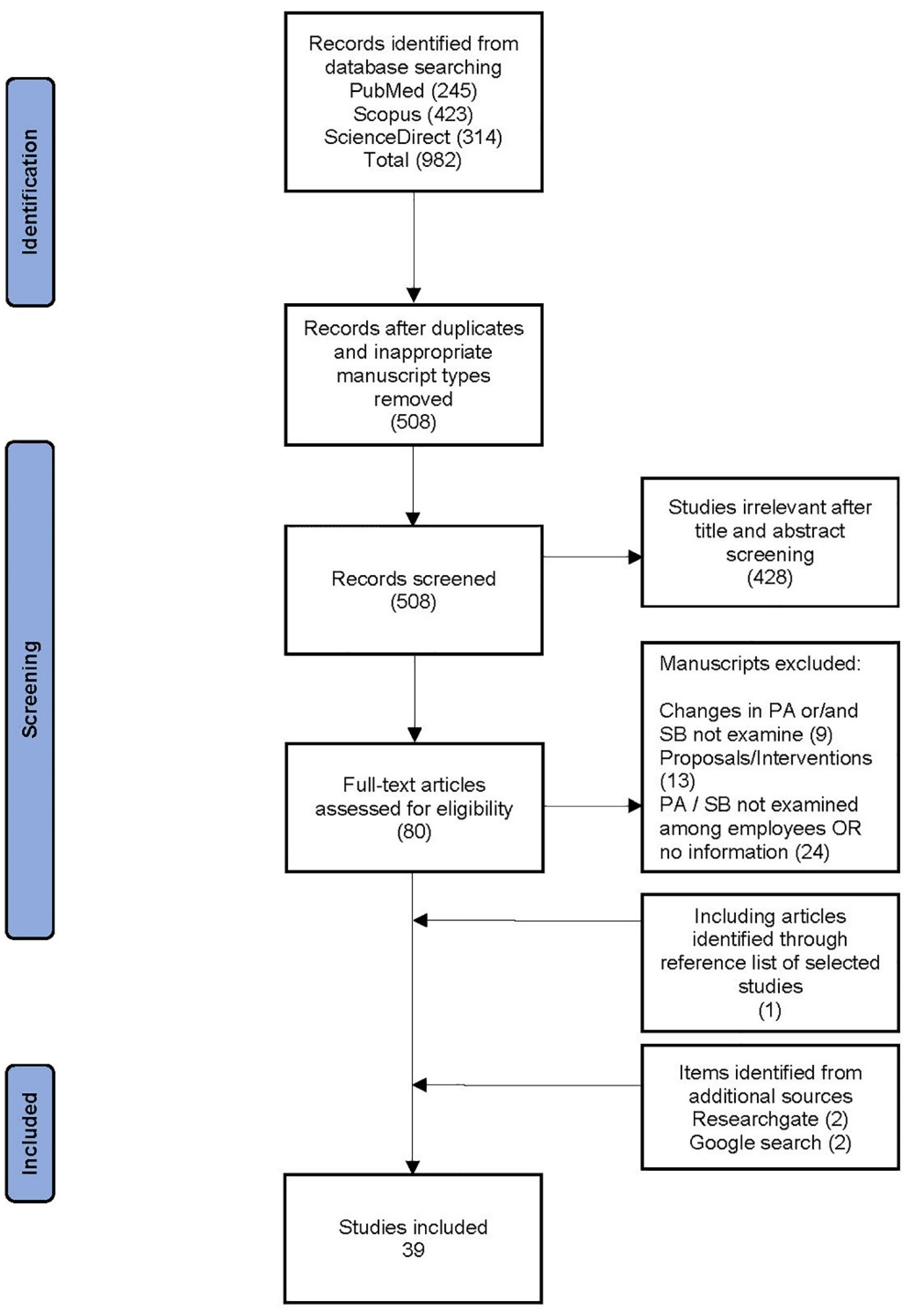
2. Materials and Methods
- Study populations involving healthy adult employees (in any country);
- Study outcomes investigating any form of PA and/or SB changes before and during the COVID-19 lockdown;
- Manuscripts written in English language;
- No restriction used in connection with study design;
- Publication type involving research papers.
- Study population involving children, adolescents, older or retired people or with a specific disease condition;
- Study outcomes not investigating the change of the PA and/or SB before and during the COVID-19 lockdown;
- Study not examining the employees’ subgroup;
- Publication type involving letters to editor, comments, editorials, reviews and recommendations.
3. Results
3.1. Main Characteristics of the Studies
3.2. Measurement Types and Outcomes of the Studies
3.3. PA in Adult Working Populations
3.4. SB in Adult Working Populations
4. Discussion
Limitations
5. Conclusions
Author Contributions
Funding
Institutional Review Board Statement
Informed Consent Statement
Conflicts of Interest
References
- Tremblay, M.S.; Aubert, S.; Barnes, J.D.; Saunders, T.J.; Carson, V.; Latimer-Cheung, A.E.; Chastin, S.F.M.; Altenburg, T.M.; Chinapaw, M.J.M.; On Behalf of Sbrn Terminology Consensus Project Participants. Sedentary Behavior Research Network (SBRN)—Terminology Consensus Project process and outcome. Int. J. Behav. Nutr. Phys. Act. 2017, 14, 75. [Google Scholar] [CrossRef] [Green Version]
- Wang, N.X.; Chen, J.; Wagner, N.L.; Rebello, S.A.; Petrunoff, N.; Owen, N.; Müller-Riemenschneider, F. Understanding and Influencing Occupational Sedentary Behavior: A Mixed-Methods Approach in a Multiethnic Asian Population. Health Educ. Behav. 2019, 47, 419–429. [Google Scholar] [CrossRef] [PubMed]
- Ryan, C.G.; Dall, P.M.; Granat, M.; Grant, P.M. Sitting patterns at work: Objective measurement of adherence to current recommendations. Ergonomics 2011, 54, 531–538. [Google Scholar] [CrossRef] [Green Version]
- Kazi, A.; Duncan, M.; Clemes, S.; Haslam, C. A survey of sitting time among UK employees. Occup. Med. 2014, 64, 497–502. [Google Scholar] [CrossRef] [Green Version]
- Van Der Ploeg, H.P.; Hillsdon, M. Is sedentary behaviour just physical inactivity by another name? Int. J. Behav. Nutr. Phys. Act. 2017, 14, 142. [Google Scholar] [CrossRef]
- Kelso, A.; Reimers, A.K.; Abu-Omar, K.; Wunsch, K.; Niessner, C.; Wäsche, H.; Demetriou, Y. Locations of Physical Activity: Where Are Children, Adolescents, and Adults Physically Active? A Systematic Review. Int. J. Environ. Res. Public Health 2021, 18, 1240. [Google Scholar] [CrossRef] [PubMed]
- Owen, N.; Healy, G.N.; Matthews, C.E.; Dunstan, D.W. Too Much Sitting: The population health science of sedentary behavior. Exerc. Sport Sci. Rev. 2010, 38, 105–113. [Google Scholar] [CrossRef]
- Chau, J.Y.; Grunseit, A.; Chey, T.; Stamatakis, E.; Brown, W.J.; Matthews, C.; Bauman, A.E.; van der Ploeg, H. Daily Sitting Time and All-Cause Mortality: A Meta-Analysis. PLoS ONE 2013, 8, e80000. [Google Scholar] [CrossRef] [Green Version]
- Thorp, A.A.; Owen, N.; Neuhaus, M.; Dunstan, D.W. Sedentary Behaviors and Subsequent Health Outcomes in Adults: A Systematic Review of Longitudinal Studies, 1996–2011. Am. J. Prev. Med. 2011, 41, 207–215. [Google Scholar] [CrossRef] [PubMed]
- De Rezende, L.F.M.; Rodrigues Lopes, M.; Rey-López, J.P.; Matsudo, V.K.R.; do Carmo Luiz, O. Sedentary Behavior and Health Outcomes: An Overview of Systematic Reviews. PLoS ONE 2014, 9, e105620. [Google Scholar] [CrossRef]
- Biswas, A.; Oh, P.I.; Faulkner, G.E.; Bajaj, R.R.; Silver, M.A.; Mitchell, M.S.; Alter, D.A. Sedentary time and its association with risk for disease incidence, mortality, and hospitalization in adults a systematic review and meta-analysis. Ann. Intern. Med. 2015, 162, 123–132. [Google Scholar] [CrossRef] [PubMed]
- Lee, I.-M.; Shiroma, E.J.; Lobelo, F.; Puska, P.; Blair, S.N.; Katzmarzyk, P.T. Lancet Physical Activity Series Working Group. Effect of physical inactivity on major non-communicable diseases worldwide: An analysis of burden of disease and life expectancy. Lancet 2012, 380, 219–229. [Google Scholar] [CrossRef] [Green Version]
- Booth, F.W.; Roberts, C.K.; Laye, M.J. Lack of Exercise Is a Major Cause of Chronic Diseases. Compr. Physiol. 2012, 2, 1143–1211. [Google Scholar] [CrossRef] [Green Version]
- Warburton, D.E.; Nicol, C.W.; Bredin, S.S. Health benefits of physical activity: The evidence. Can. Med. Assoc. J. 2006, 174, 801–809. [Google Scholar] [CrossRef] [Green Version]
- WHO. Prevalence of Insufficient Physical Activity among Adults; Global Health Observatory: Cork, Ireland, 2018. [Google Scholar]
- Bull, F.C.; Al-Ansari, S.S.; Biddle, S.; Borodulin, K.; Buman, M.P.; Cardon, G.; Carty, C.; Chaput, J.-P.; Chastin, S.; Chou, R.; et al. World Health Organization 2020 guidelines on physical activity and sedentary behaviour. Br. J. Sports Med. 2020, 54, 1451–1462. [Google Scholar] [CrossRef]
- Koohsari, M.J.; Nakaya, T.; McCormack, G.R.; Shibata, A.; Ishii, K.; Oka, K. Changes in Workers’ Sedentary and Physical Activity Behaviors in Response to the COVID-19 Pandemic and Their Relationships With Fatigue: Longitudinal Online Study. JMIR Public Health Surveill. 2021, 7, e26293. [Google Scholar] [CrossRef]
- Hadgraft, N.T.; Healy, G.N.; Owen, N.; Winkler, E.A.; Lynch, B.M.; Sethi, P.; Eakin, E.G.; Moodie, M.; LaMontagne, A.D.; Wiesner, G.; et al. Office workers’ objectively assessed total and prolonged sitting time: Individual-level correlates and worksite variations. Prev. Med. Rep. 2016, 4, 184–191. [Google Scholar] [CrossRef] [Green Version]
- Sugiyama, T.; Hadgraft, N.; Clark, B.K.; Dunstan, D.W.; Owen, N. Sitting at work & waist circumference—A cross-sectional study of Australian workers. Prev. Med. 2020, 141, 106243. [Google Scholar] [CrossRef]
- O’Dolan, C.; Grant, M.; Lawrence, M.; Dall, P. A randomised feasibility study to investigate the impact of education and the addition of prompts on the sedentary behaviour of office workers. Pilot Feasibility Study 2018, 4, 33. [Google Scholar] [CrossRef] [Green Version]
- Worldometer. COVID-19 Coronavirus Pandemic. 2021. Available online: https://www.worldometers.info/coronavirus/ (accessed on 20 July 2021).
- McDowell, C.P.; Herring, M.P.; Lansing, J.; Brower, C.; Meyer, J.D. Working From Home and Job Loss Due to the COVID-19 Pandemic Are Associated With Greater Time in Sedentary Behaviors. Front. Public Health 2020, 8, 597619. [Google Scholar] [CrossRef] [PubMed]
- Xiao, Y.; Becerik-Gerber, B.; Lucas, G.; Roll, S.C. Impacts of Working from Home during COVID-19 Pandemic on Physical and Mental Well-Being of Office Workstation Users. J. Occup. Environ. Med. 2021, 63, 181–190. [Google Scholar] [CrossRef] [PubMed]
- Hall, G.; Laddu, D.R.; Phillips, S.A.; Lavie, C.J.; Arena, R. A tale of two pandemics: How will COVID-19 and global trends in physical inactivity and sedentary behavior affect one another? Prog. Cardiovasc. Dis. 2021, 64, 108–110. [Google Scholar] [CrossRef]
- Ammar, A.; Brach, M.; Trabelsi, K.; Chtourou, H.; Boukhris, O.; Masmoudi, L.; Bouaziz, B.; Bentlage, E.; How, D.; Ahmed, M.; et al. Effects of COVID-19 Home Confinement on Eating Behaviour and Physical Activity: Results of the ECLB-COVID19 International Online Survey. Nutrients 2020, 12, 1583. [Google Scholar] [CrossRef] [PubMed]
- Stanton, R.; To, Q.G.; Khalesi, S.; Williams, S.L.; Alley, S.J.; Thwaite, T.L.; Fenning, A.S.; Vandelanotte, C. Depression, Anxiety and stress during COVID-19: Associations with changes in physical activity, sleep, tobacco and alcohol use in australian adults. Int. J. Environ. Res. Public Health 2020, 17, 4065. [Google Scholar] [CrossRef] [PubMed]
- Reyes-Olavarría, D.; Latorre-Román, P.Á.; Guzmán-Guzmán, I.P.; Jerez-Mayorga, D.; Caamaño-Navarrete, F.; Delgado-Floody, P. Positive and Negative Changes in Food Habits, Physical Activity Patterns, and Weight Status during COVID-19 Confinement: Associated Factors in the Chilean Population. Int. J. Environ. Res. Public Health 2020, 17, 5431. [Google Scholar] [CrossRef]
- Constandt, B.; Thibaut, E.; De Bosscher, V.; Scheerder, J.; Ricour, M.; Willem, A. Exercising in Times of Lockdown: An Analysis of the Impact of COVID-19 on Levels and Patterns of Exercise among Adults in Belgium. Int. J. Environ. Res. Public Health 2020, 17, 4144. [Google Scholar] [CrossRef]
- Lesser, I.A.; Nienhuis, C.P. The Impact of COVID-19 on Physical Activity Behavior and Well-Being of Canadians. Int. J. Environ. Res. Public Health 2020, 17, 3899. [Google Scholar] [CrossRef]
- Gallo, L.A.; Gallo, T.F.; Young, S.L.; Moritz, K.M.; Akison, L.K. The Impact of Isolation Measures Due to COVID-19 on Energy Intake and Physical Activity Levels in Australian University Students. Nutrients 2020, 12, 1865. [Google Scholar] [CrossRef] [PubMed]
- Górnicka, M.; Drywień, M.; Zielinska, M.; Hamułka, J. Dietary and Lifestyle Changes During COVID-19 and the Subsequent Lockdowns among Polish Adults: A Cross-Sectional Online Survey PLifeCOVID-19 Study. Nutrients 2020, 12, 2324. [Google Scholar] [CrossRef] [PubMed]
- Ugbolue, U.; Duclos, M.; Urzeala, C.; Berthon, M.; Kulik, K.; Bota, A.; Thivel, D.; Bagheri, R.; Gu, Y.; Baker, J.; et al. An Assessment of the Novel COVISTRESS Questionnaire: COVID-19 Impact on Physical Activity, Sedentary Action and Psychological Emotion. J. Clin. Med. 2020, 9, 3352. [Google Scholar] [CrossRef] [PubMed]
- Carriedo, A.; Cecchini, J.A.; Fernandez-Rio, J.; Méndez-Giménez, A. COVID-19, Psychological Well-being and Physical Activity Levels in Older Adults During the Nationwide Lockdown in Spain. Am. J. Geriatr. Psychiatry 2020, 28, 1146–1155. [Google Scholar] [CrossRef]
- Trabelsi, K.; Ammar, A.; Masmoudi, L.; Boukhris, O.; Chtourou, H.; Bouaziz, B.; Brach, M.; Bentlage, E.; How, D.; Ahmed, M.; et al. Sleep Quality and Physical Activity as Predictors of Mental Wellbeing Variance in Older Adults during COVID-19 Lockdown: ECLB COVID-19 International Online Survey. Int. J. Environ. Res. Public Health 2021, 18, 4329. [Google Scholar] [CrossRef] [PubMed]
- Goethals, L.; Barth, N.; Guyot, J.; Hupin, D.; Celarier, T.; Bongue, B. Impact of Home Quarantine on Physical Activity Among Older Adults Living at Home During the COVID-19 Pandemic: Qualitative Interview Study. JMIR Aging 2020, 3, e19007. [Google Scholar] [CrossRef]
- Di Stefano, V.; Battaglia, G.; Giustino, V.; Gagliardo, A.; D’Aleo, M.; Giannini, O.; Palma, A.; Brighina, F. Significant reduction of physical activity in patients with neuromuscular disease during COVID-19 pandemic: The long-term consequences of quarantine. J. Neurol. 2020, 268, 20–26. [Google Scholar] [CrossRef] [PubMed]
- Caruso, I.; Di Molfetta, S.; Guarini, F.; Giordano, F.; Cignarelli, A.; Natalicchio, A.; Perrini, S.; Leonardini, A.; Giorgino, F.; Laviola, L. Reduction of hypoglycemia, lifestyle modifications and psychological distress during lockdown following SARS-CoV-2 outbreak in type 1 diabetic patients using flash continuous glucose monitoring: A retrospective cohort study. Diabetes/Metab. Res. Rev. 2020, e3404. [Google Scholar] [CrossRef]
- Ruiz-Roso, M.B.; Knott-Torcal, C.; Matilla-Escalante, D.C.; Garcimartín, A.; Sampedro-Nuñez, M.A.; Dávalos, A.; Marazuela, M. COVID-19 Lockdown and Changes of the Dietary Pattern and Physical Activity Habits in a Cohort of Patients with Type 2 Diabetes Mellitus. Nutrients 2020, 12, 2327. [Google Scholar] [CrossRef]
- Mota, I.A.; Sobrinho, G.D.D.O.; Morais, I.P.S.; Dantas, T.F. Impact of COVID-19 on eating habits, physical activity and sleep in Brazilian healthcare professionals. Arq. De Neuro-Psiquiatr. 2021, 79, 429–436. [Google Scholar] [CrossRef]
- Shepherd, H.; Evans, T.; Gupta, S.; McDonough, M.; Doyle-Baker, P.; Belton, K.; Karmali, S.; Pawer, S.; Hadly, G.; Pike, I.; et al. The Impact of COVID-19 on High School Student-Athlete Experiences with Physical Activity, Mental Health, and Social Connection. Int. J. Environ. Res. Public Health 2021, 18, 3515. [Google Scholar] [CrossRef] [PubMed]
- Santos, A.M.D.S.; Rossi, F.E.; Moura, H.P.D.S.N.D.; Junior, A.V.M.d.S.; Machado, D.C.D.; Neves, L.M.; Brito, A.S.; Moura, P.; Monteiro, P.A.; Junior, I.F.F.; et al. COVID-19 pandemic impacts physical activity levels and sedentary time but not sleep quality in young badminton athletes. Sport Sci. Health 2021, 1–9. [Google Scholar] [CrossRef]
- Hernandez, Y.A.T.; Parente, F.; Faghy, M.A.; Roscoe, C.M.P.; Maratos, F. Influence of the COVID-19 lockdown on remote workers’ physical and psychosocial wellbeing and work productivity. JMIRx Med. 2021, 1–42. [Google Scholar] [CrossRef]
- Castañeda-Babarro, A.; Arbillaga-Etxarri, A.; Gutiérrez-Santamaria, B.; Coca, A. Impact of COVID-19 confinement on the time and intensity of physical activity in the Spanish population. Res. Sq. 2020, 1–14. [Google Scholar] [CrossRef]
- Mata, J.; Wenz, A.; Rettig, T.; Reifenscheid, M.; Moehring, K.; Krieger, U.; Friedel, S.; Fikel, M.; Cornesse, C.; Blom, A.G.; et al. Health Behaviors and Mental Health before and during the COVID-19 Pandemic: A Longitudinal Population Based Survey. PsyArXiv 2020. [Google Scholar] [CrossRef]
- Huntley, D. Effects of Working at Home During COVID-19 on Sedentary Behavior, Use of Strategies to Decrease Sedentary Behavior, and Perceived Work Performance. Retrieved from the University of Minnesota Digital Conservancy. 2021. Available online: https://hdl.handle.net/11299/220401 (accessed on 30 June 2021).
- Schaap, G. Occupational Sedentary Behaviour during COVID-19 Regulations-Related Working from Home; University of Twente: Enschede, The Netherlands, 2020. [Google Scholar]
- Bourdas, D.I.; Zacharakis, E.D. Impact of COVID-19 Lockdown on Physical Activity in a Sample of Greek Adults. Sports 2020, 8, 139. [Google Scholar] [CrossRef] [PubMed]
- Bourdas, D.I.; Zacharakis, E.D. Evolution of changes in physical activity over lockdown time: Physical activity datasets of four independent adult sample groups corresponding to each of the last four of the six COVID-19 lockdown weeks in Greece. Data Brief 2020, 32, 106301. [Google Scholar] [CrossRef] [PubMed]
- Wilke, J.; Mohr, L.; Tenforde, A.; Edouard, P.; Fossati, C.; González-Gross, M.; Ramírez, C.S.; Laiño, F.; Tan, B.; Pillay, J.; et al. A Pandemic within the Pandemic? Physical Activity Levels Substantially Decreased in Countries Affected by COVID-19. Int. J. Environ. Res. Public Health 2021, 18, 2235. [Google Scholar] [CrossRef]
- Adamakis, M. Physical activity, sleep and weight management in the COVID-19 era: A case report. J. Phys. Educ. Sport 2021, 21, 60–65. [Google Scholar] [CrossRef]
- Ong, J.L.; Lau, T.; A A Massar, S.; Chong, Z.T.; Ng, B.K.L.; Koek, D.; Zhao, W.; Yeo, B.T.T.; Cheong, K.; Chee, M.W.L. COVID-19-related mobility reduction: Heterogenous effects on sleep and physical activity rhythms. Sleep 2021, 44, 1–13. [Google Scholar] [CrossRef]
- Hallman, D.M.; Januario, L.B.; Mathiassen, S.E.; Heiden, M.; Svensson, S.; Bergström, G. Working from home during the COVID-19 outbreak in Sweden: Effects on 24-h time-use in office workers. BMC Public Health 2021, 21, 1–10. [Google Scholar] [CrossRef]
- Brusaca, L.; Barbieri, D.; Mathiassen, S.; Holtermann, A.; Oliveira, A. Physical Behaviours in Brazilian Office Workers Working from Home during the COVID-19 Pandemic, Compared to before the Pandemic: A Compositional Data Analysis. Int. J. Environ. Res. Public Health 2021, 18, 6278. [Google Scholar] [CrossRef]
- Franco, E.; Urosa, J.; Barakat, R.; Refoyo, I. Physical Activity and Adherence to the Mediterranean Diet among Spanish Employees in a Health-Promotion Program before and during the COVID-19 Pandemic: The Sanitas-Healthy Cities Challenge. Int. J. Environ. Res. Public Health 2021, 18, 2735. [Google Scholar] [CrossRef]
- Aegerter, A.M.; Deforth, M.; Sjøgaard, G.; Johnston, V.; Volken, T.; Luomajoki, H.; Dratva, J.; Dressel, H.; Distler, O.; Melloh, M.; et al. No Evidence for a Decrease in Physical Activity Among Swiss Office Workers During COVID-19: A Longitudinal Study. Front. Psychol. 2021, 12, 1–10. [Google Scholar] [CrossRef]
- Argus, M.; Pääsuke, M. Effects of the COVID-19 lockdown on musculoskeletal pain, physical activity, and work environment in Estonian office workers transitioning to working from home. Work 2021, 69, 741–749. [Google Scholar] [CrossRef]
- Blom, V.; Lönn, A.; Ekblom, B.; Kallings, L.V.; Väisänen, D.; Hemmingsson, E.; Andersson, G.; Wallin, P.; Stenling, A.; Ekblom, Ö.; et al. Lifestyle Habits and Mental Health in Light of the Two COVID-19 Pandemic Waves in Sweden, 2020. Int. J. Environ. Res. Public Health 2021, 18, 3313. [Google Scholar] [CrossRef]
- Gibbs, B.B.; E Kline, C.; A Huber, K.; Paley, J.L.; Perera, S. COVID-19 shelter-at-home and work, lifestyle and well-being in desk workers. Occup. Med. 2021, 71, 86–94. [Google Scholar] [CrossRef]
- Majumdar, P.; Biswas, A.; Sahu, S. COVID-19 pandemic and lockdown: Cause of sleep disruption, depression, somatic pain, and increased screen exposure of office workers and students of India. Chronobiol. Int. 2020, 37, 1191–1200. [Google Scholar] [CrossRef] [PubMed]
- da Silva, D.R.P.; Werneck, A.O.; Malta, D.C.; Júnior, P.R.B.D.S.; Azevedo, L.O.; Barros, M.B.D.A.; Szwarcwald, C.L. Changes in the prevalence of physical inactivity and sedentary behavior during COVID-19 pandemic: A survey with 39,693 Brazilian adults. Cadernos De Saúde Pública 2021, 37, e00221920. [Google Scholar] [CrossRef] [PubMed]
- Fearnbach, S.N.; Flanagan, E.W.; Höchsmann, C.; Beyl, R.A.; Altazan, A.D.; Martin, C.K.; Redman, L.M. Factors Protecting against a Decline in Physical Activity during the COVID-19 Pandemic. Med. Sci. Sports Exerc. 2021, 53, 1391–1399. [Google Scholar] [CrossRef]
- Radwan, H.; Al Kitbi, M.; Hasan, H.; Al Hilali, M.; Abbas, N.; Hamadeh, R.; Saif, E.; Naja, F. Indirect Health Effects of COVID-19: Unhealthy Lifestyle Behaviors during the Lockdown in the United Arab Emirates. Int. J. Environ. Res. Public Health 2021, 18, 1964. [Google Scholar] [CrossRef] [PubMed]
- Schmidt, T.; Pawlowski, C.S. Physical Activity in Crisis: The Impact of COVID-19 on Danes’ Physical Activity Behavior. Front. Sports Act. Living 2021, 2, 610255. [Google Scholar] [CrossRef]
- Ding, D.; Cheng, M.; Cruz, B.D.P.; Lin, T.; Sun, S.; Zhang, L.; Yang, Q.; Ma, Z.; Wang, J.; Jia, Y.; et al. How COVID-19 lockdown and reopening affected daily steps: Evidence based on 164,630 person-days of prospectively collected data from Shanghai, China. Int. J. Behav. Nutr. Phys. Act. 2021, 18, 1–10. [Google Scholar] [CrossRef]
- Buoitestella, A.; Ajčevic, M.; Furlanis, G.; Cillotto, T.; Menichelli, A.; Accardo, A.; Manganotti, P. Smart technology for physical activity and health assessment during COVID-19 lockdown. J. Sports Med. Phys. Fit. 2021, 61, 452–460. [Google Scholar]
- Karaca, A.; Aytar, S.H.; Demirci, N.; Akcan, F.; Çağlar, E.; Araç, Ş.N. Sedentary Screen Time in Working Adults Before and During COVID-19 Pandemic. Spor Bilimleri Derg. Hacet. Üniversitesi 2021, 32, 98–108. [Google Scholar] [CrossRef]
- Katewongsa, P.; Widyastari, D.A.; Saonuam, P.; Haemathulin, N.; Wongsingha, N. The effects of the COVID-19 pandemic on the physical activity of the Thai population: Evidence from Thailand’s Surveillance on Physical Activity 2020. J. Sport Health Sci. 2021, 10, 341–348. [Google Scholar] [CrossRef] [PubMed]
- Katewongsa, P.; Potharin, D.; Rasri, N.; Palakai, R.; Widyastari, D. The Effect of Containment Measures during the COVID-19 Pandemic to Sedentary Behavior of Thai Adults: Evidence from Thailand’s Surveillance on Physical Activity 2019–2020. Int. J. Environ. Res. Public Health 2021, 18, 4467. [Google Scholar] [CrossRef]
- López-Bueno, R.; Calatayud, J.; Andersen, L.; Balsalobre-Fernández, C.; Casaña, J.; Casajús, J.; Smith, L.; López-Sánchez, G. Immediate Impact of the COVID-19 Confinement on Physical Activity Levels in Spanish Adults. Sustainability 2020, 12, 5708. [Google Scholar] [CrossRef]
- Rodríguez-Nogueira, Ó.; Leirós-Rodríguez, R.; Benítez-Andrades, J.; Álvarez-Álvarez, M.; Marqués-Sánchez, P.; Pinto-Carral, A. Musculoskeletal Pain and Teleworking in Times of the COVID-19: Analysis of the Impact on the Workers at Two Spanish Universities. Int. J. Environ. Res. Public Health 2020, 18, 31. [Google Scholar] [CrossRef]
- Taeymans, J.; Luijckx, E.; Rogan, S.; Haas, K.; Baur, H. Physical Activity, Nutritional Habits, and Sleeping Behavior in Students and Employees of a Swiss University During the COVID-19 Lockdown Period: Questionnaire Survey Study. JMIR Public Health Surveill. 2021, 7, e26330. [Google Scholar] [CrossRef]
- Yang, Y.; Koenigstorfer, J. Determinants of physical activity maintenance during the COVID-19 pandemic: A focus on fitness apps. Transl. Behav. Med. 2020, 10, 835–842. [Google Scholar] [CrossRef]
- Schuch, F.B.; Bulzing, R.A.; Meyer, J.; López-Sánchez, G.F.; Grabovac, I.; Willeit, P.; Vancampfort, D.; Caperchione, C.M.; Sadarangani, K.P.; Werneck, A.O.; et al. Moderate to vigorous physical activity and sedentary behavior changes in self-isolating adults during the COVID-19 pandemic in Brazil: A cross-sectional survey exploring correlates. Sport Sci. Health 2021, 1–9. [Google Scholar] [CrossRef]
- Hall-López, J.A. Physical activity levels in physical education teachers before and during school suspension brought by the COVID-19 quarantine. Facta Univ. Series Phys. Educ. Sport 2020, 18, 475–481. [Google Scholar] [CrossRef]
- Alfawaz, H.; Amer, O.E.; Aljumah, A.A.; Aldisi, D.A.; Enani, M.A.; Aljohani, N.J.; Alotaibi, N.H.; Alshingetti, N.; Alomar, S.Y.; Khattak, M.N.K.; et al. Effects of home quarantine during COVID-19 lockdown on physical activity and dietary habits of adults in Saudi Arabia. Sci. Rep. 2021, 11, 1–7. [Google Scholar] [CrossRef]
- Barkley, J.E.; Lepp, A.; Glickman, E.; Farnell, G.; Beiting, J.; Wiet, R.; Dowdell, B. The Acute Effects of the COVID-19 Pan-demic on Physical Activity and Sedentary Behavior in University Students and Employees. Int. J. Exerc. Sci. 2020, 13, 1326–1339. [Google Scholar] [PubMed]
- Greaney, M.L.; Kunicki, Z.J.; Drohan, M.M.; Ward-Ritacco, C.L.; Riebe, D.; Cohen, S.A. Self-reported changes in physical activity, sedentary behavior, and screen time among informal caregivers during the COVID-19 pandemic. BMC Public Health 2021, 21, 1–9. [Google Scholar] [CrossRef]
- Stockwell, S.; Trott, M.; Tully, M.; Shin, J.; Barnett, Y.; Butler, L.; McDermott, D.; Schuch, F.; Smith, L. Changes in physical activity and sedentary behaviours from before to during the COVID-19 pandemic lockdown: A systematic review. BMJ Open Sport Exerc. Med. 2021, 7, e000960. [Google Scholar] [CrossRef]
- Dunton, G.F.; Do, B.; Wang, S.D. Early effects of the COVID-19 pandemic on physical activity and sedentary behavior in children living in the U.S. BMC Public Health 2020, 20, 1–13. [Google Scholar] [CrossRef]
- López-Valenciano, A.; Suárez-Iglesias, D.; Sanchez-Lastra, M.A.; Ayán, C. Impact of COVID-19 Pandemic on University Students’ Physical Activity Levels: An Early Systematic Review. Front. Psychol. 2021, 11, 624567. [Google Scholar] [CrossRef]
- de Boer, D.; Hoekstra, F.; Huetink, K.; Hoekstra, T.; Krops, L.; Hettinga, F. Physical Activity, Sedentary Behavior and Well-Being of Adults with Physical Disabilities and/or Chronic Diseases during the First Wave of the COVID-19 Pandemic: A Rapid Review. Int. J. Environ. Res. Public Health 2021, 18, 6342. [Google Scholar] [CrossRef]
- Felber, S. Data: Quarantine Isn’t Making Us Gain Weight or Slow Down. Withings. 2020. Available online: https://blog.withings.com/2020/05/01/data-quarantine-isnt-making-us-gain-weight-or-slow-down/ (accessed on 25 May 2021).
- Fitbit Staff. The Impact of Coronavirus on Global Activity. Fitbit. 2020. Available online: https://blog.fitbit.com/covid-19-global-activity/ (accessed on 25 May 2021).
- Stables, J. Garmin Data Reveals How the World Is Working out during the Lockdown. 2020. Available online: https://www.wareable.com/garmin/garmin-data-lockdown-7940 (accessed on 25 May 2021).
- Tison, G.H.; Avram, R.; Kuhar, P.; Abreau, S.; Marcus, G.M.; Pletcher, M.J.; Olgin, J.E. Worldwide Effect of COVID-19 on Physical Activity: A Descriptive Study. Ann. Intern. Med. 2020, 173, 767–770. [Google Scholar] [CrossRef] [PubMed]
- Okazaki, K.; Suzuki, K.; Sakamoto, Y.; Sasaki, K. Physical activity and sedentary behavior among children and adolescents living in an area affected by the 2011 Great East Japan earthquake and tsunami for 3 years. Prev. Med. Rep. 2015, 2, 720–724. [Google Scholar] [CrossRef] [Green Version]
- Brancaccio, M.; Mennitti, C.; Gentile, A.; Correale, L.; Buzzachera, C.; Ferraris, C.; Montomoli, C.; Frisso, G.; Borrelli, P.; Scudiero, O. Effects of the COVID-19 Pandemic on Job Activity, Dietary Behaviours and Physical Activity Habits of University Population of Naples, Federico II-Italy. Int. J. Environ. Res. Public Health 2021, 18, 1502. [Google Scholar] [CrossRef] [PubMed]
- Gartner. Gartner HR Survey Reveals 41% of Employees Likely to Work Remotely at Least Some of the Time Post Coro-Navirus Pandemic. Newsroom. 2020. Available online: https://www.gartner.com/en/newsroom/press-releases/2020-04-14-gartner-hr-survey-reveals-41--of-employees-likely-to- (accessed on 30 May 2021).
- De Haas, M.; Faber, R.; Hamersma, M. How COVID-19 and the Dutch ‘intelligent lockdown’ change activities, work and travel behaviour: Evidence from longitudinal data in the Netherlands. Transp. Res. Interdiscip. Perspect. 2020, 6, 100150. [Google Scholar] [CrossRef] [PubMed]
- Deng, Z.; Morissette, R.; Messacar, D. Running the Economy Remotely: Potential for Working from Home during and after COVID-19. Statistics Canada Catalogue. Available online: https://www150.statcan.gc.ca/n1/pub/45-28-0001/2020001/article/00026-eng.htm (accessed on 28 June 2021).
- Koohsari, M.; Nakaya, T.; Shibata, A.; Ishii, K.; Oka, K. Working from Home After the COVID-19 Pandemic: Do Company Employees Sit More and Move Less? Sustainability 2021, 13, 939. [Google Scholar] [CrossRef]
- Brynjolfsson, E.; Horton, J.; Ozimek, A.; Rock, D.; Sharma, G.; TuYe, H.-Y. COVID-19 and Remote Work: An Early Look at US Data; National Bureau of Economic Research Inc: Cambridge, MA, USA, 2020. [Google Scholar]
- A Thorp, A.; Healy, G.N.; Winkler, E.; Clark, B.K.; A Gardiner, P.; Owen, N.; Dunstan, D.W. Prolonged sedentary time and physical activity in workplace and non-work contexts: A cross-sectional study of office, customer service and call centre employees. Int. J. Behav. Nutr. Phys. Act. 2012, 9, 128. [Google Scholar] [CrossRef] [PubMed] [Green Version]
- Meyer, J.; McDowell, C.; Lansing, J.; Brower, C.; Smith, L.; Tully, M.; Herring, M. Changes in physical activity and sedentary behaviour due to the COVID-19 outbreak and associations with mental health in 3052 US adults. Int. J. Environ. Res. Public Health 2020, 17, 6469. [Google Scholar] [CrossRef] [PubMed]
- Fukushima, N.; Machida, M.; Kikuchi, H.; Amagasa, S.; Hayashi, T.; Odagiri, Y.; Takamiya, T.; Inoue, S. Associations of working from home with occupational physical activity and sedentary behavior under the COVID-19 pandemic. J. Occup. Health 2021, 63, e12212. [Google Scholar] [CrossRef]
- Clemes, S.; O’Connell, S.E.; Edwardson, C.L. Office Workers’ Objectively Measured Sedentary Behavior and Physical Activity During and Outside Working Hours. J. Occup. Environ. Med. 2014, 56, 298–303. [Google Scholar] [CrossRef] [Green Version]
- Learnpatch. Research Reveals Impact of COVID-19 on Working Practices and Remote Working. 2020. Available online: https://learnpatch.com/2020/05/covid-remote-working/ (accessed on 30 May 2021).
- Ali, S.M.; Lindström, M. Psychosocial work conditions, unemployment, and leisure-time physical activity: A population-based study. Scand. J. Public Health 2006, 34, 209–216. [Google Scholar] [CrossRef]
- Katzmarzyk, P.T.; Church, T.S.; Craig, C.L.; Bouchard, C. Sitting Time and Mortality from All Causes, Cardiovascular Disease, and Cancer. Med. Sci. Sports Exerc. 2009, 41, 998–1005. [Google Scholar] [CrossRef]
- Caprara, G. Mediterranean-Type Dietary Pattern and Physical Activity: The Winning Combination to Counteract the Rising Burden of Non-Communicable Diseases (NCDs). Nutrients 2021, 13, 429. [Google Scholar] [CrossRef] [PubMed]
- Schlichtiger, J.; Steffen, J.; Huber, B.C.; Brunner, S. Physical activity during COVID-19 lockdown in older adults. J. Sports Med. Phys. Fit. 2021, 61, 164–166. [Google Scholar]
- Smith, L.; McCourt, O.; Sawyer, A.; Ucci, M.; Marmot, A.; Wardle, J.; Fisher, A. A review of occupational physical activity and sedentary behaviour correlates. Occup. Med. 2016, 66, 185–192. [Google Scholar] [CrossRef] [PubMed] [Green Version]
- Santini, S.; Galassi, F.; Kropf, J.; Stara, V. A Digital Coach Promoting Healthy Aging among Older Adults in Transition to Retirement: Results from a Qualitative Study in Italy. Sustainability 2020, 12, 7400. [Google Scholar] [CrossRef]


| Database | Searching Terms |
|---|---|
| PubMed | (((COVID-19 [Title/Abstract] OR “Novel Coronavirus” [Title/Abstract] AND (“Physical activity” [Title/Abstract] OR “Physical inactivity” [Title/Abstract] OR “Sedentary behavior” [Title/Abstract] OR Sitting[Title/Abstract]) AND (Worker [Title/Abstract] OR “Working from home” [Title/Abstract] OR Employment [Title/Abstract] OR Employee [Title/Abstract] OR Occupation [Title/Abstract]))) |
| Scopus | (TITLE-ABS-KEY (COVID-19 OR “Novel Coronavirus” AND TITLE-ABS-KEY (“Physical activity” OR “Physical inactivity” OR “Sedentary behavior” OR Sitting) AND TITLE-ABS-KEY (Worker OR “Working from home” OR Employment OR Employee OR Occupation)) |
| ScienceDirect | COVID-19 OR Coronavirus AND physical activity OR sedentary OR physical inactivity OR sitting AND worker OR working from home OR employment OR employee OR occupation. |
| Author (Year of Publication) | Title of the Manuscript | Country | Sample Size | PA or SB Assessment | Study Design | Working Population of the Sample | Employment Status | Change Direction in SB | Key Findings Related to SB | Change Direction in PA | Key Findings Related to PA | Main Outcomes | Outcomes Category |
|---|---|---|---|---|---|---|---|---|---|---|---|---|---|
| Adamkis (2021) [50] | Physical activity, sleep and weight management in the COVID-19 era: a case report | IRE | 1 | Activity tracker (Garmin Vivofit 4) | case study—8 weeks | Workers | Office worker | NI | ▼ | During COVID-19, there was a significant decrease in daily steps taken. | step count/day | ||
| Aegerter et al. (2021) [55] | No Evidence for a Decrease in Physical Activity Among Swiss Office Workers During COVID-19: A Longitudinal Study | SUI | 76 | self-reported (IPAQ-SF) | longitudinal study | Workers | Office worker | NI | ▬ | The total PA did not decline during the COVID-19 lockdown. There was no evidence of a decline in any of the three types of PA (walking, moderate-intensity activity and vigorous-intensity activity). Across the three categories “high,” “moderate” and “low” PA, 17% of the participants became less active during the lockdown while 29% became more active. | MET minutes/week | Walking, moderate-intensity activity, vigorous-intensity activity. | |
| Argus—Pääsuke (2021) [56] | Effects of the COVID-19 lockdown on musculoskeletal pain, physical activity, and work environment in Estonian office workers transitioning to working from home | EST | 161 | self-reported (BPAQ) | cross-sectional data | Workers | Office worker | ▼ | In text: A significantly lower sedentary time was detected. No significant difference in the duration of continuous work was found. | ▼ | During COVID-19, a decline has been detected in self-reported PA levels (sport, leisure). However, an increase can be observed in work-related PA level. | Baecke Physical Activity Index | Work-related PA, sport-related PA and leisure-time PA. |
| Blom et al. (2021) [57] | Lifestyle Habits and Mental Health in Light of the Two COVID-19 Pandemic Waves in Sweden, 2020 | SWE | 5599 | self-reported | cross-sectional data | Workers | Blue-collar workers/White-collar workers | ▬ | Small perceived changes in sitting time. The majority of respondents reported no change due to the first pandemic wave (66.1%) and second wave (78.5%) in sitting time. White-collar workers had higher odds of decreasing sedentary time compared to blue-collar workers. | ▬ | Small perceived negative changes in PA. The majority of respondents reported no change due to the pandemic in daily PA (first wave: 62.5%; second wave: 72.2%) and exercise (first wave: 59.4%; second wave: 71.0%). White-collar workers had higher odds of increasing daily PA and exercise than blue-collar workers. | min/day, percentage of the respondents | Perceived change in sitting time, daily activity, exercise. |
| Bourdas—Zacharakis (2020) [47] | Impact of COVID-19 Lockdown on Physical Activityin a Sample of Greek Adults | GRE | 8495 | self reported (Active-Q) | cross-sectional data | No information | No information, just reference to occupational PA | NI | ▼ | During COVID-19, a large decline has been detected in daily occupational PA level. | MET minutes/week | Daily occupation, transportation to and from daily occupation, leisure time activities and regular sporting activities. | |
| Bourdas—Zacharakis (2020) [48] | Evolution of changes in physical activity over lockdown time: Physical activity datasets of four independent adult sample groups corresponding to each of the last four of the six COVID-19 lockdown weeks in Greece | GRE | 5206 | self reported (Active-Q) | cross-sectional data | No information | No information, just reference to occupational PA | NI | ▼ | During COVID-19, a large decline has been detected in daily occupational PA level. | MET minutes/week | Daily occupation, transportation to and from daily occupation, leisure time activities and regular sporting activities | |
| Brusaca et al. (2021) [53] | Physical Behaviours in Brazilian Office Workers Working from Home during the COVID-19 Pandemic, Compared to before the Pandemic: A Compositional Data Analysis | BRA | 11 | accelerometer (Axivity AX3) + self-reported diary | longitudinal study (5 days (weekend)) | Workers | Office worker | ▬ | Office workers spent much time in SB, but no significant change was observed during the COVID-19. | ▼ | During COVID-19, workers spent less time in different PA levels. | min/day | Sedentary behaviour: lying and sitting, standing.; light PA: moving and slow walking; moderate-to-vigorous PA: fast walking, stair climbing, running and cycling, time-in-bed. |
| Buoite Stella et al. (2020) [65] | Smart technology for physical activity and health assessment during COVID-19 lockdown | ITA | 400 (continued working as usual: 69 person can identify as a worker) | self-reported (IPAQ-SF; step data) | cross-sectional data | Workers—50.5% of the respondents—17.25% investigated directly | Employee/Manager/Freelancer/Health professional | NI | ▼ | During COVID-19, a large decline has been detected in daily step count and MET value (IPAQ-SF) among those who continued working as usual during the lockdown. | MET minutes/week; step count/day | ||
| Castañeda—Babarro et al. (2020) [43] | Impact of COVID-19 confinement on the time and intensity of physical activity in the Spanish population | ESP | 3800 | self-reported (IPAQ-SF) | cross-sectional data | Workers—78% of the respondents; Study work—10% of the respondents | Workers | ▲ | SB were negatively affected during the COVID-19 outbreak. Significant increase can be observed. | ▼ | PA were negatively affected during the COVID-19 outbreak. Significantly decreased VPA, walking can be observed, MPA did not change | MET minutes/week | Walking, moderate-intensity PA and vigorous-intensity PA, sitting. |
| Da Silva et al. (2021) [60] | Changes in the prevalence of physical inactivity and sedentary behavior during COVID-19 pandemic: a survey with 39,693 Brazilian adults | BRA | 39693 | self-reported (ConVid—Behavior Survey) | cross-sectional data | Workers—25.9% WFH and 20.7% work with normal routine of the respondents | WFH/Normal routine/No work | ▲ | Prevalence of ≥4 h/day of TV-viewing and ≥4 h/day of computer/tablet significantly increased during the COVID-19 pandemic in the working population. | ▼ | Prevalence of physical inactivity (<150 min/week) increased, therefore PA declined during the COVID-19 pandemic in the working population. | percentage of the respondents | <150 min/week of PA; ≥4 h/day of TV viewing; ≥4 h/day of computer/tablet. |
| Ding et al. (2021) [64] | How COVID-19 lockdown and reopening affected daily steps: evidence based on 164,630 person-days of prospectively collected data from Shanghai, China | CHI | 815 | Smartphone application (WeRun—step data) | longitudinal study | Workers | Workers | NI | ▼ | Sharp decline in daily steps has been detected, and it was followed by a slow but steady increase. This increasing trend continued into the reopening phase. By the end of the study (3.5 month into the reopening), total step counts were still slightly below the baseline level. | step count/day | ||
| Fearnbach et al. (2021) [61] | Factors Protecting against a Decline in Physical Activity during the COVID-19 Pandemic | USA | 4376 | self-reported (Pennington Biomedical COVID-19 Health Behaviors Survey) | cross-sectional data | Workers—72.9% of the respondents. (WFH—32.2%; Not WFH—37.4%; Already WFH—3.3%;—Not working—27.1%) | WFH/Not WFH/Already WFM/No work | NA | ▼ | During COVID-19, those who transitioned to working from home saw a minimal increase in PA, whereas all others (not working from home, already working from home before COVID-19 and not working before COVID-19) experienced a decline. | MET minutes/week, percentage of the respondents | Perceived change in PA. | |
| Franco et al. (2021) [54] | Physical activity and adherence to the mediterranean diet among Spanish employees in a health-promotion program before and during the COVID-19 pandemic: The sanitas-healthy cities challenge | ESP | 297 | self-reported (IPAQ-SF) | cross-sectional data | Workers | Office worker | ▲ | Despite of employees have been participating in a health promotion program, SB were negatively affected during the COVID-19 outbreak. The ratio of sedentary participants significantly increased during the pandemic. | ▲ | Due to participants having been participating in a health promotion program during the COVID-19 pandemic, a significant increase has been detected in the moderate and total activity and a non-significant increase in vigorous activity and non-significant decrease in walking reported. | MET minutes/week, percentage of the respondents | Walking, moderate-intensity PA, vigorous-intensity PA, sedentarism. |
| Gibbs et al. (2021) [58] | COVID-19 shelter-at-home and work, lifestyle and well-being in desk workers | USA | 112 | self-reported (SBQ; PPAQ) | longitudinal study | Workers | Desk workers (sales or services; Clerical/administrative support; Professional/managerial/technical; Other) | ▲ | SB was negatively affected during the COVID-19 outbreak. Increased sitting and screen time can be observed, especially on non-workdays. | ▬ | PA was no affected during the COVID-19 outbreak. | hours/day, minutes/week | SB, moderate-intensity activity, vigorous-intensity activity, moderate to vigorous intensity activity. |
| Hallman (2020) [52] | Working from home during the COVID-19outbreak in Sweden: effects on 24-h time-use in office workers | SWE | 27 | accelerometer (Axivity AX3), | longitudinal study (7 day (weekend)) | Workers | Office worker | ▬ | Sedentary, standing and moving behaviours did not change markedly during days WFH compared to days WAO. A total sedentary time of this size, which is consistent with other studies of office workers. | NI | Standing and moving behaviors did not change markedly during days WFH compared to days WAO. | minutes/day | Sitting/lying, standing, moving. |
| Hernandez et al. (2021) [42] | Influence of the COVID-19 lockdown on remote workers’ physical and psychosocial wellbeing and work productivity | GBR | 184 | self-reported (IPAQ) | cross-sectional data | Workers | Remote worker/not remote worker | ▲ | The majority of respondents (70%) reported spending a greater amount of time sitting during the COVID-19 lockdown. | ▲ | During COVID-19, more respondents managed to increase the investigated PA levels (VPA, MVPA, walking). | MET minutes/week | Walking, moderate-intensity activity, vigorous-intensity activity, sitting. |
| Huntley, DG (2021) [45] | Effects of Working at Home During COVID-19 on Sedentary Behavior, Use of Strategies to Decrease Sedentary Behavior, and Perceived Work Performance | USA | 194 | self-reported (OSPAQ) | cross-sectional data | Workers | WFH | ▲ | Increased time spent in SB. However, sitting time decreased but no significant difference was found between the pre-COVID-19 and during COVID-19 times. | ▼ | During COVID-19, a decline has been detected in all investigated non-sedentary levels (walking, standing, heavy labour). | Minutes/day | Sitting, Standing, Walking, Heavy Labour. |
| Karaca et al. (2020) [66] | Sedentary Screen Time in Working Adults Before and During COVID-19 Pandemic | TUR | 602 | self-reported (PAAQ) | cross-sectional data | Workers | Employed | ▲ | Sedentary screen time (SST) at work decreased during COVID-19 compared to before COVID-19, while recreational SST increased. Work related sedentary screen time (SST) at home increased. | NI | Hours/week | Work-related SST at work, Work-related SST at home. | |
| Katewongsa et al. (2020) [67] | The effects of the COVID-19 pandemic on the physical activity of the Thai population: Evidence from Thailand’s Surveillance on Physical Activity 2020 | THA | 4460 (2019) 4482 (2020) | self-reported (GPAQ) | cross-sectional data | Workers—80.2% (2019) 83.6% (2020) of the respondents | Formal sector/Informal sector/Private enterprise/Agriculture/Unemployed | NI | ▼ | Huge decline can be observed in the percentage of Thai adult workers with sufficient MVPA in all types of occupation. | MVPA minutes/week, percentage of the respondents | Work-related, transportation and recreational. | |
| Katewongsa et al. (2020) [68] | The effect of containment measures during the COVID-19 pandemic to sedentary behavior of Thai adults: Evidence from Thailand’s surveillance on physical activity 2019–2020 | THA | 5379 (2019) 6531 (2020) | self-reported (GPAQ v.2) | cross-sectional data | Workers—79.2% (2019) 84.2% (2020) of the respondents | Formal sector/Informal sector/Private enterprise/Agriculture/Unemployed | ▲ | During the COVID-19 pandemic, SB increased. Higher levels of SB were most frequent among employees in the private enterprises. Slight decrease can be observed in SB in the formal sector. | NI | SB minutes/day, percentage of the respondents | Work-related, transportation, and recreational. | |
| Kooshari et al. (2021) [17] | Changes in Workers’ Sedentary and Physical Activity Behaviors in Response to the COVID-19 Pandemic and Their Relationships With Fatigue: Longitudinal Online Study | JAP | 2466 | self-reported (GPAQ) | longitudinal study | Workers | Workers | ▲ | SB were negatively affected during the COVID-19 outbreak. The total SB level significantly increased during the pandemic (The work related and the PC use sitting time). | ▼ | PA were negatively affected during the COVID-19 outbreak. The total PA level significantly decreased during the pandemic (All domain specific PA decreased). | Hours/day | Work-related vigorous PA, Work-related moderate PA, Transport-related PA, Leisure-related vigorous PA, Leisure-related moderate PA, Sitting time in different domain. |
| Lopez—Bueno et al. (2020) [69] | Immediate Impact of the COVID-19 Confinement on Physical Activity Levels in Spanish Adults | ESP | 2042 | self-reported (PAVS-SF) | cross-sectional data | Workers—63% of the respondents | Employed/Unemployed | NI | ▼ | The total PA declined during the COVID-19 lockdown among employees. Unemployed group showed greater PA levels decline than those employed. | Minutes/week | PA, MVPA (WHO) | |
| Majumdar et al. (2020) [59] | COVID-19 pandemic and lockdown: cause of sleep disruption, depression, somatic pain, and increased screen exposure of office workers and students of India | IND | 558 | self-reported (MCTQ;CES-D;NQ) | cross-sectional data | Workers—36.4% of the respondents | Office worker/Students | ▲ | Increased time spent at the workstation. Office workers spent greater duration of time on their cell phone, desktop/laptop computers during the lockdown. | NI | Hours/day | Cellphone usage, Desktop/laptop usage, Television usage. | |
| Mata et al. (2020) [44] | Health behaviors and mental health before and during the COVID-19 pandemic: A longitudinal population-based survey. | GER | 3500 | self-reported | longitudinal study | Workers—14.4% (remote workers) of the respondents investigated directly | Working at the workplace/Remote work/Part-time work, furloughed, unemployed/Retired/Not working | ▲ | People working remotely spent more time in front of the screen during the COVID-19 lockdown. | ▼ | People working remotely less active during the COVID-19 lockdown. | Percentage of the respondents | |
| McDowell et al. (2020) [22] | Working From Home and Job Loss; Due to the COVID-19 Pandemic Are Associated With Greater Time in SB | USA | 2303 | self-reported | cross-sectional data | Workers | No change in work/WFH/Job loss | ▲ | Greater time spent sitting and viewing screens. | ▬ | PA did not differ by COVID-19 employment changes. | Minutes/day, Share of WHO recommendation | |
| Ong et al. (2021) [51] | COVID-19-related mobility reduction: heterogeneous effects on sleep and physical activity rhythms. | SIN—INT | 1824 | Activity tracker (Fitbit Ionic) | longitudinal study | Workers | In text: Most were office worker | NI | ▼ | Indices of PA (step count and MVPA), declined during COVID-19 lockdown. | Step count/day, moderate to vigorous PA (MVPA) minutes | ||
| Radwan et al. (2021) [62] | Indirect Health Effects of COVID-19: Unhealthy Lifestyle Behaviors during the Lockdown in the United Arab Emirates | UAE | 2060 | self-reported | cross-sectional data | Workers—74.58% of respondents (WFH 54.8% investigated directly) | WFH/Working/Not working | NI | ▼ | Decreased physical activity was significantly associated with WFH. | Percentage of the respondents | Decreased PA. | |
| Rodríguez—Nogueira et al. (2021) [70] | Musculoskeletal Pain and Teleworking in Times of the COVID-19: Analysis of the Impact on the Workers at Two Spanish Universities | ESP | 472 | self-reported (SNQ) | cross-sectional data | Workers | Administrative staff/Teaching and research staff | ▲ | SB were negatively affected during the COVID-19 outbreak. A significant increase was observed in the number of participants who not doing any exercise. | ▼ | During COVID-19, a decline has been detected in all investigated PA levels, but the number of women who carry out exercise frequently has increased. | Hours/day | PA (never, seldom, frequently). |
| Schaap (2020) [46] | Occupational Sedentary Behaviour During COVID-19 Regulations-Related Working From Home | NED | 119 | self-reported (BQOS) | cross-sectional data | Workers | Office worker (WFH) | ▲ | Office workers are very much sedentary while working from home during the COVID-19 regulations. | ▼ | Participants experienced less PA during WFH. | Minutes/day, percentage of the respondents | Sitting, moving, standing. |
| Schmidt—Pawlowski (2021) [63] | Physical Activity in Crisis: The Impact of COVID-19 on Danes’ Physical Activity Behavior | DEN | 1802 | self-reported | cross-sectional data | Workers—60.2% of the population are employed | Work outside of home/Work at home/Work partly outside partly at home/Not work/Sent home student/Other | NI | ▼ | The total PA declined during the COVID-19 lockdown in the WFH, partly WFH groups. An increase has been detected among the work outside of home group. | Minutes/week | PA | |
| Taeymans et al. (2021) [71] | Physical Activity, Nutritional Habits, and Sleeping Behavior in Students and Employees of a Swiss University During the COVID-19 Lockdown Period: Questionnaire Survey Study | SUI | 821 | self-reported (IPAQ-SF) | cross-sectional data | Workers—12.2% of the respondents | BSc students/MSc students/Employees | ▲ | Employees had a higher median daily sitting time. Prevalence of long sitting time is higher compared to national data. | NI | The employee group showed a lower median summed MET minutes per week. | MET minutes/week, minutes/day | Walking, moderate-intensity PA, and vigorous-intensity PA, sitting. |
| Wilke et al. (2021) [49] | A pandemic within the pandemic? Physical activity levels substantially decreased in countries affected by COVID-19 | INT | 13,503 | self-reported (NPAQ-S) | cross-sectional data | no information | No information, just reference to occupational PA | NI | ▼ | During COVID-19, a decline has been detected in all investigated PA levels. Declines in PA were higher for occupational (53%) than for leisure time (34%). | Minutes/week | Moderate-to-vigorous PA, vigorous PA during leisure time, occupational time. | |
| Xiao et al. (2021) [23] | Impacts of Working From Home During COVID-19 Pandemic on Physical and Mental Well-Being of Office Workstation Users | INT | 988 | self-reported | cross-sectional data | Workers | Office worker (WFH) | NI | In text: Increased time spent at the workstation. | ▼ | During COVID-19, a large decline has been detected in daily occupational PA level. Respondents reported decreased overall PA and exercise. | Percentage of the respondents | Overall PA (e.g., standing, step count), Physical exercise (e.g., classes, walking, running, biking). |
| Yang—Koenigstofer (2020) [72] | Determinants of physical activity maintenance during the COVID-19 pandemic: A focus on fitness apps. | USA | 431 | self-reported (IPAQ-SF) | longitudinal study | Workers—93% of the respondents | Employed/Self-employed/Unemployed | ▬ | ▼ | During COVID-19 decline has been detected in two PA levels: moderate PA and vigorous PA decreased. | MET minutes/week | Walking, moderate-intensity PA, vigorous-intensity PA, sitting. | |
| Schuch et al. (2021) [73] | Moderate to vigorous physical activity and sedentary behavior changes in self-isolating adults during the COVID-19 pandemic in Brazil: a cross-sectional survey exploring correlates. | BRA | 877 | self-reported | cross-sectional data | Workers—66.1% of the respondents (self-isolated) | Employed/Unemployed/Student/Military/Retired | ▲ | SB were negatively affected during the COVID-19 outbreak. Significant increase was observed in the number of participants who were employed. | ▼ | During COVID-19, MVPA declined in those with an occupation. | Hours/day, minutes/week | MVPA, SB—persistent inactive, decreased PA, increased PA, persistent active. |
| Hall-López (2020) [74] | Physical activity levels in physical education teachers before and during school suspension brought by the COVID-19 quarantine | MEX | 37 | self-reported (IPAQ) | cross-sectional data | Workers | Workers | NI | ▼ | The level of PA MET-minutes/week of PE teachers decreased during the COVID-19 quarantine. | MET minutes/week | Low, Moderate, High. | |
| Alfawaz et al. (2021) [75] | Effects of home quarantine during COVID-19 lockdown on physical activity and dietary habits of adults in Saudi Arabia | KSA—INT | 1946 | self-reported | cross-sectional data | Workers—58.6% of the respondents | Employed/Unemployed/Student/Own business/Farmer | NI | ▼ | During COVID-19, daily walking and home PA decreased. However, there was a significant percentage of participants who increased their frequency by 3–4 times per week in swimming. Employment status has no effect on this result. | Days/week | Daily walking, Home PA with weights, Swimming. | |
| Barcley et al. (2020) [76] | The Acute Effects of the COVID-19 Pandemic on Physical Activity and Sedentary Behavior in University Students and Employees. | USA | 398 | self-reported (IPAQ, Godin) | cross-sectional data | Workers—53.7% of the respondents | Undergraduate/Graduate/Faculty/Staff/Administration/Other | ▲ | Participants significantly increased average weekly sitting during the COVID-19 isolation. | ▬ | Although the overall PA increased among the employees, this is not supported by the statistical analysis. | MET minutes/week, Godin Score | Mild, Moderate, Vigorous, Sedentary. |
| Greany et al. (2021) [77] | Self-reported changes in physical activity, sedentary behavior, and screen time among informal caregivers during the COVID-19 pandemic. | USA | 835 | self reported | cross-sectional data | Workers | Workers | ▲ | More than half of the respondents reported an increase in SB (63%) an ST (weekday: 61%; weekend: 57%). | ▲ | More than half of respondents (55%) reported an increase in MPA and nearly half of respondents (48%) reported an increase VPA. | Percentage of the respondents | Moderate intensity PA, Vigorous intensity PA, Sedentary Behavior, Screen time. |
Publisher’s Note: MDPI stays neutral with regard to jurisdictional claims in published maps and institutional affiliations. |
© 2021 by the authors. Licensee MDPI, Basel, Switzerland. This article is an open access article distributed under the terms and conditions of the Creative Commons Attribution (CC BY) license (https://creativecommons.org/licenses/by/4.0/).
Share and Cite
Ráthonyi, G.; Kósa, K.; Bács, Z.; Ráthonyi-Ódor, K.; Füzesi, I.; Lengyel, P.; Bácsné Bába, É. Changes in Workers’ Physical Activity and Sedentary Behavior during the COVID-19 Pandemic. Sustainability 2021, 13, 9524. https://doi.org/10.3390/su13179524
Ráthonyi G, Kósa K, Bács Z, Ráthonyi-Ódor K, Füzesi I, Lengyel P, Bácsné Bába É. Changes in Workers’ Physical Activity and Sedentary Behavior during the COVID-19 Pandemic. Sustainability. 2021; 13(17):9524. https://doi.org/10.3390/su13179524
Chicago/Turabian StyleRáthonyi, Gergely, Karolina Kósa, Zoltán Bács, Kinga Ráthonyi-Ódor, István Füzesi, Péter Lengyel, and Éva Bácsné Bába. 2021. "Changes in Workers’ Physical Activity and Sedentary Behavior during the COVID-19 Pandemic" Sustainability 13, no. 17: 9524. https://doi.org/10.3390/su13179524
APA StyleRáthonyi, G., Kósa, K., Bács, Z., Ráthonyi-Ódor, K., Füzesi, I., Lengyel, P., & Bácsné Bába, É. (2021). Changes in Workers’ Physical Activity and Sedentary Behavior during the COVID-19 Pandemic. Sustainability, 13(17), 9524. https://doi.org/10.3390/su13179524