


Abstract
Air transportation systems are an important part of the critical infrastructure in our connected world. Accordingly, a better understanding and improvements in the resilience of the overall air transportation system are essential to the well-functioning of our society and overall sustainability of human beings. In the literature, network science is increasingly used to better understand the resilience dynamics of air transportation. Given the wide application of tools for network science and the importance of designing resilient air transportation systems, a rich body of studies has emerged in recent years. This review paper synthesizes the related literature that has been published throughout the last 15 years regarding the robustness of air transportation systems. The contributions of this work consist of two major elements. The first part provides a comprehensive discussion and cross-comparison of the reported results. We cover several major topics, including node importance identification, failure versus attack profiles, recovery and improvement techniques, and networks of networks approaches. The second part of this paper complements the review of aggregated findings by elaborating on a future agenda for robust air transportation research. Our survey-style overview hopefully contributes toward a better understanding of the state of the art in this research area, and, in turn, to the improvement of future air transportation resilience and sustainability.
1. Introduction
Globalization, increased wealth, and advanced accessibility have led to tremendous increases in air transport operations throughout recent decades, with regular yearly passenger increases of 5–10%. The growth, together with the extraordinary requirements of efficiency in air transportation and ongoing competition between airlines and high-speed rail [1], comes with an inevitable increase in operational complexity and risks for disturbances. Such disturbances include, but are not limited to, extreme weather, geological abnormalities, terrorist attacks, and congestion-based cascades.
Analyzing the impact of such disruptions and the resilience of air transportation is not simply an academic exercise but has huge impacts on our society and the overall environmental and economical sustainability of human beings; see [2] for a recent survey on how the concept resilience should be understood in the context of sustainability. From the sustainability perspective, disruptions to air transportation may incur huge economic losses. Examples for recent large-scale disruptions to transportation systems include the European air traffic outage caused by the Icelandic Eyjafjallajökull volcano [3], power outages of the major hub airport in Atlanta [4], and the impact of COVID-19 on global air transportation [5]. In addition to the economic losses, the impact on human mobility and social behavior are devastating [6].
To better understand resilience, it is critical to identify the complexity and hidden dynamic patterns of air transportation systems. Network science, as developed in the last two decades, provides excellent tools for understanding the structure and dynamics of the system [7,8,9]. In such network models, nodes are usually individual airports or air navigation route points, and links are connections between the elements of interest.
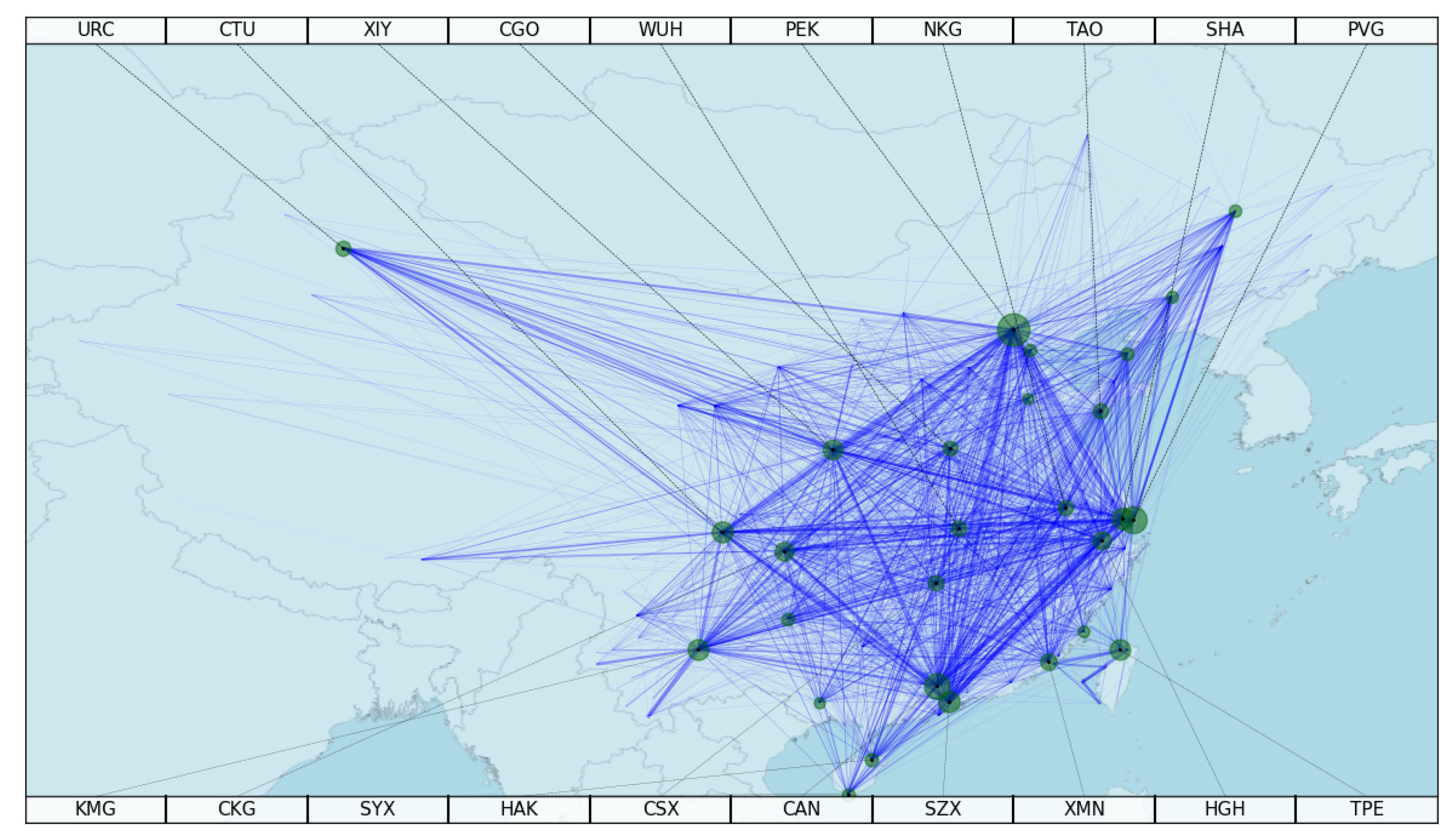
Figure 1 presents an example of the Chinese airport network from 2019, where the nodes are airports and links are direct flights. The weight of the links (visualized by their thickness) corresponds to the number of flights per day (as of 1 August 2019). The top 20 airports according to the total number of passengers are highlighted by their IATA code, with the green circle growing with the total number of passengers. It can be seen that some airports in the network are better connected than others—in other words, these airports are more central in the network regarding direct connectivity.

Figure 1.
Chinese air transportation network on 1 August 2019.
A pioneering study [10] in the area of air transportation analysis discussed the worldwide air transportation systems using complex network techniques and discovered several anomalous centrality relationships (based on the number of direct connections versus the shortest path-centrality) and also the roles of cities in the network. For the last 15 years, based on this initial study, many researchers have applied similar techniques to analyze the criticality of system components in the worldwide air transportation system and its subsystems.
The goal of this paper is to provide a review of the state-of-the-art in complex networks for assessing the robustness of air transportation systems. In total, a collection of more than 100 papers were identified in the literature, following keyword-based searches on academic search engines (Google Scholar and Microsoft Academic) together with archival webpages of large academic publishers. These papers, at their heart, aim to understand and improve the robustness of the overall air transportation system, yet, often have unique purposes.
For the sake of this literature review, we identify several recurring streams of topics, including node importance identification, failure versus attack profiles, recovery and improvement techniques, and networks of networks approaches. For each category, we report the overall problem, together with a brief summary of each paper. Finally, this study continues with the derivation of seven directions for future work. We elucidate how complex network techniques can help to better understand the operational dynamics underlying the air transportation system.
2. Literature Review
A wide range of studies have reported results on various application domains, taking different perspectives on network robustness. Based on the collected literature, we have sorted all papers into eight categories reported in individual sections as follows. Section 2.1 reports on the phenomenon that random failures in the air transportation system are usually less harmful than targeted attacks; an effect that has been shown on many subsystems. Section 2.2 focuses on the identification of important nodes in the network, which can be based on various techniques, including node centralities and active dismantling approaches. Section 2.3 discusses the complementary problems of link importance identification, which received comparatively less attention in the literature. Section 2.4 discusses the literature on the recovery process and ways to improve the robustness of air transportation networks.
Section 2.5 provides a succinct discussion of studies on the evolution of system properties throughout the process of dismantling. Section 2.6 takes the perspective of systems-of-systems, by reporting on studies that treat air transportation as a network of networks. Section 2.7 gives an overview on the robustness measures presented in the literature, including giant component, percolation theory, shock propagation, and adaptive capacity. Section 2.8 reviews other studies that do not directly contribute to the topics in one of the earlier sections. It should be noted that some studies fit multiple sections. We have usually reported studies in the section that we considered most relevant, and only reported studies multiple times in cases where it is instructive for understanding the state of the art. Since the vast majority of other studies on airport network robustness are based on the size of the giant component, the remainder of this survey refers the giant component as the robustness measure, unless mentioned otherwise.
2.1. Targeted Attacks Are More Harmful Than Random Failures
A wide range of studies in the literature analyze the different impacts of targeted attacks versus random failures. A random failure is the outage (or removal) of nodes in random-uniformly chosen order, i.e., each node has the same initial probability to fail. Random failure traces are not unique, and in order to generate a representative set of traces, one needs to run a considerable number of simulations, especially for larger networks.
A targeted attack, on the other hand, is controlled by an informed process, which selects nodes based on a given importance or centrality measure, where more important nodes are attacked first. From a sustainability point of view, failures cannot be prevented; but it is necessary to understand the degree of damage that can be caused by these unavoidable outages, especially in presence of a cascade, which will lead to huge economic and social losses. A better understanding of targeted attacks helps our society to increase the protection of critical infrastructure for selected components. Accordingly, society should carefully distinguish the roles of airports under failures and intentional attacks.
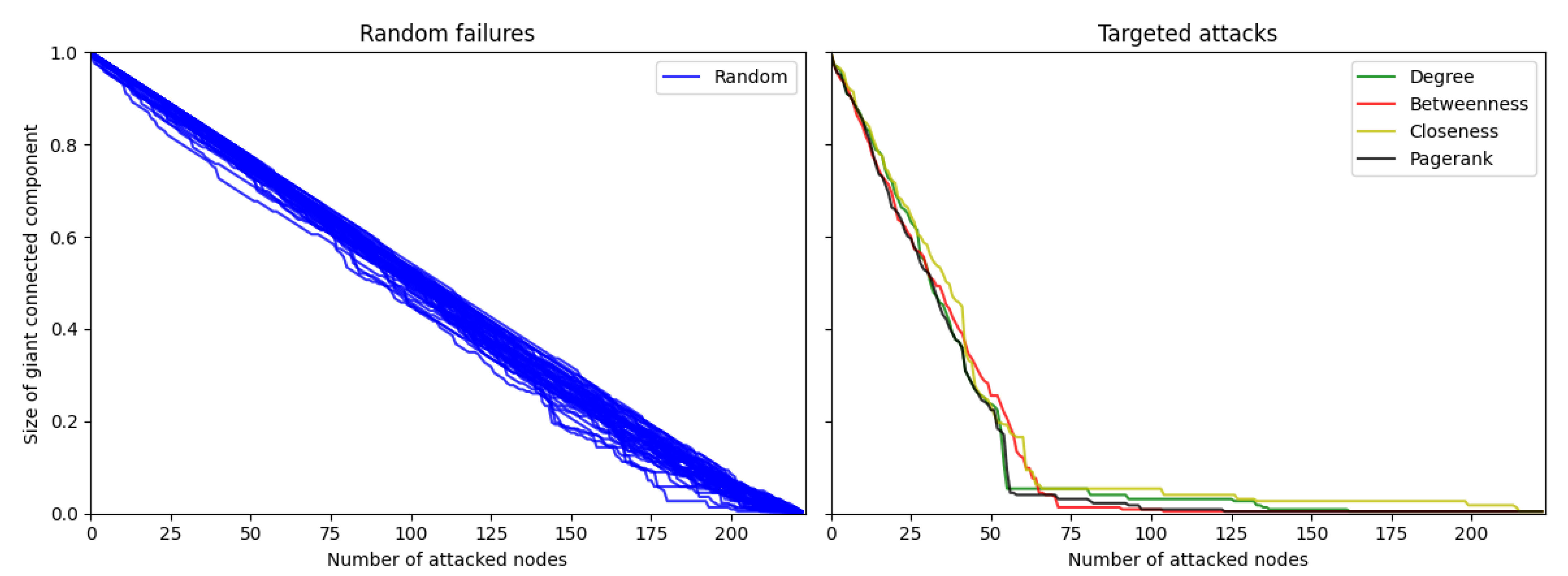
Figure 2 shows the effectual difference between random and targeted attacks. Here, four widely-used network metrics are used for comparison (see Section 2.2 for more details). It can be seen for the figure that the size of the network’s giant component is much more resilient to random failures (left) than to targeted attack (right). Many studies report this insight on air transportation (sub-)systems. The studies shown in Table 1 have a major focus on reporting this observation on different network types and subsets.

Figure 2.
Example of random versus targeted attacks in the Chinese airport network.

Table 1.
Random failures versus targeted attacks.
Overall, it is intuitively expected that targeted attacks are more harmful than random failures, since the notion of being a targeted attack implies that nodes are chosen in an informed way. In fact, it is difficult to imagine a network topology for which random failures have similar harmful effects as targeted attacks. On the other hand, one could argue that attacks following the increasing degree of nodes in the network are possibly less harmful than random failures. Yet, it is doubted whether identifying such a best-case attack (in terms of the network being resilient) is a worthwhile research undertaking. Nevertheless, the finding that targeted attacks are significantly more harmful than random ones has raised tremendous interest in the literature, even in recent years.
2.2. Critical Node Identification
Contrary to the general observation of targeted attacks being more effective than random failures, several studies investigated the actual differences between targeted attacks and how to improve the effectiveness of attacks toward the network. Identifying vital nodes is important across many domains with large potential impacts on our society. While it is clear that major airports (in terms of passenger throughput) play important roles, it is often the case that smaller airports, which have less direct connections but are placed at topologically-important locations, play a significant role for resilience [10]. Accordingly, in order to ensure sustainable mobility and avoid high economic losses, we need to better understand nodes in the network that are of outstanding importance.
In network science; there is a plethora of methods to identify the importance of a node. One of the most commonly used methods is to assign a value to the importance of each node, based on some centrality metric. Such metrics assign a centrality value (usually normalized between zero and one) to each node, with a higher value indicating a higher level of importance. In general, one can distinguish local and global node centralities, where the former consider parts of the network for each node’s importance and the latter consider information from the full network. An example for a local metric is degree, which simply counts the number of direct neighbors of each node.
Betweeness, which measures the number of shortest paths a node appears on, is a global node centrality. There are several other ways to identify node importance, e.g., by spreading processes or the explicit formulation of a network dismantling problem. In Table 2, we review studies discussing the node importance on different subsystems. Many studies use existing centralities and compare their effects on the network at hand, while a few other studies propose specific algorithms to solve the dismantling problem.
Table 2.
Critical node identification.
2.3. Link Failures in Airline Networks
The previous sections were concerned with the robustness of airport networks against node failures or node attacks. The response of air transportation networks to node attacking strategies is rather well-investigated. Another element of networks are links, connecting two nodes; considerably fewer studies have analyzed link-based disruptions. Links are similarly important to a sustainable aviation future, as are nodes. The only difference is that, for the air transportation system, it is, in general, easier to connect two airports via a link, than it is to build up a new airport. Nevertheless, highly-competitive slot auctions at major airports and the necessity to have departure slots and matching landing slots make it often difficult to freely add links to the system. Therefore, the importance of links should not be neglected.
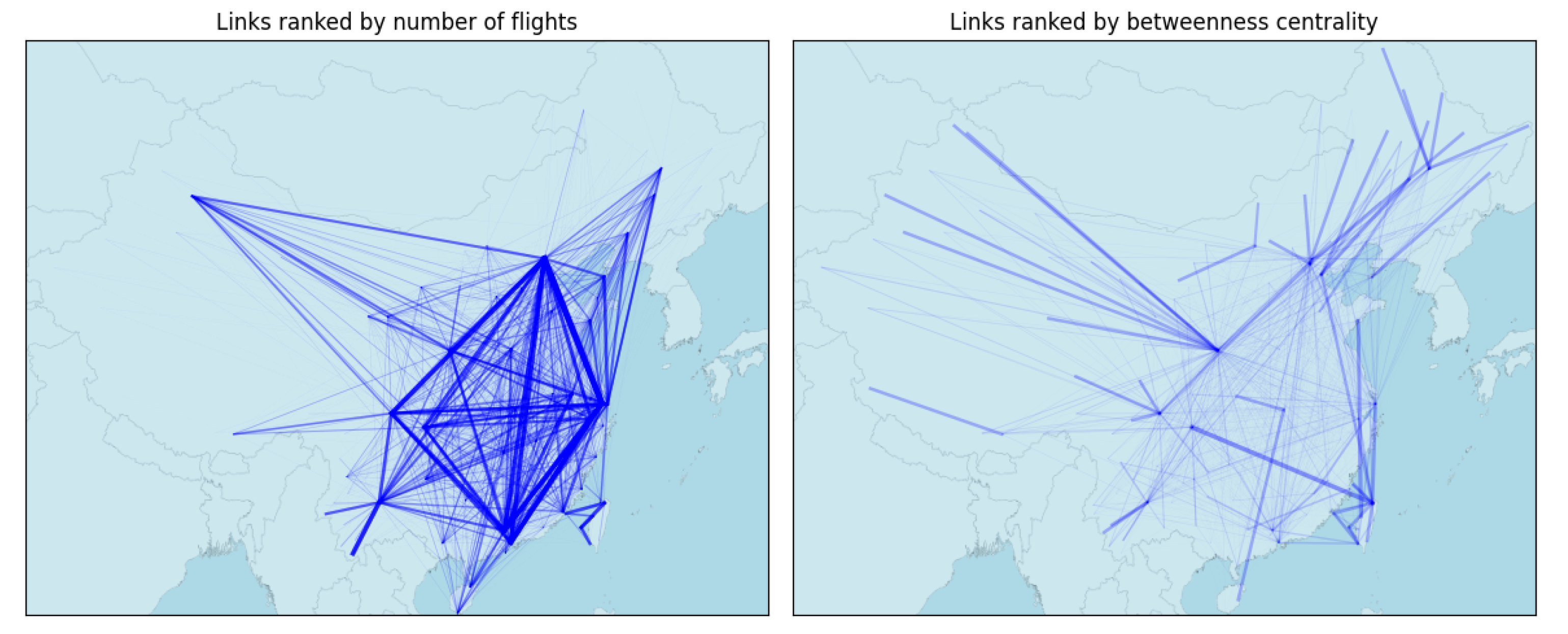
Figure 3 provides an example for link importance on the Chinese airport network, comparing the importance by the number of flights (left) to the importance by the betweenness centrality of the links (right). Choosing the right measure is of high importance for assessing the roles of links in a network. On a side note, causes for link failures could mainly be seen in weather-induced phenomena, which prevent aircraft to efficiently connect pairs of airports. Table 3 gives an overview on the studies on link failures in airport networks. These studies rely, for instance, on topological measures [43], the concept of bridges [44], algebraic connectivity [45], and percolation [46].

Figure 3.
Example of important links in the Chinese airport network.
Table 3.
Link failures in airline networks.
2.4. Improvement of Airline Network Robustness
While Section 2.3 discusses how the failure of links affects the network, several recent studies addressed the inverse question: How can the robustness of the network be improved by adding links? It should be noted that adding nodes to the network does not contribute to the increase of robustness, and therefore only link additions are studied in the literature. Essentially, the goal of most studies is to identify airport pairs that are not directly connected and simulate/predict how the addition of a link affects the overall robustness of the network.
This task has a tremendous direct importance for the sustainability of the aviation system in the long run, aiming to not only incorporate enhancements that increase passenger connectivity but also consider alternative routes under failures and attacks. A system that is more resilient to such disruption will be beneficial for the whole of society; informed approaches of how to improve the robustness are of tremendous importance.
We review these studies in Table 4. The literature should be distinguished into two types: performing recovery and rewiring strategies. The studies concerned with recovery usually address the problem of a disrupted network and how to regain functionality. The studies concerned with rewiring aim to increase the robustness before the actual event, by adding new links. Some of these studies enforce the existence of constraints during rewiring, such as the preservation of the degree distribution, which means that the topology of the underlying network does not change significantly.
Table 4.
Improvement of airline network robustness.
2.5. System Properties
Several studies have analyzed the properties of the air transportation system and how these properties influence the resilience of the network or change throughout a disruption. Contrary to the literature in Section 2.1, these studies reviewed below had a stronger focus on disruption analysis of the system using comprehensive tools developed for network science. These studies do not have a direct impact on the sustainability of aviation but can help to understand the patterns and dynamics a system undergoes throughout a disruption. Deeper knowledge on these system evolutions helps to build better simulations and tools for the early detection of significant network changes. Table 5 gives an overview on these studies.
Table 5.
System properties.
2.6. Networks of Networks
The aforementioned studies typically analyzed the air transportation system as single networks. In reality, however, the air transportation system consists of multiple, interacting networks. For instance, each airline on its own induces an airport network. In Table 6, we review studies that emphasize the multi-layer nature of the air transportation system.
Table 6.
Networks of networks.
2.7. Robustness Measurement and Simulation
The group of studies reviewed in this subsection concerns the measurement process of robustness for a given network representation, except from the size of the giant component. The size of the giant components—and its evolution throughout attack evolution, is frequently used in the literature. However, this comes with a set of limitations, which are addressed in the studies discussed in Table 7. These aim to propose specific frameworks for identifying the robustness of an airport network. The exploited techniques are rather distinct conceptually, e.g., using shock propagation [69], fuzzy soft sets [70], adaptive capacity [71], rerouting-based approaches [72]. Most of these are evaluated on the US airport network—due to freely available data—and the Chinese airport network.
Table 7.
Robustness measurement and simulation.
2.8. Others
A few other studies in the literature do not fit any of the earlier categories. These studies are reviewed in Table 8.
Table 8.
Other studies on air transportation robustness.
3. Air Transportation Robustness and Aviation Sustainability
Since the emergence of aviation, a major focus of all stakeholders has been on the safety of operations, with the ultimate goal to prevent damage and injury to humans and infrastructure. This goal has been mainly achieved through the elimination or mitigation of potential hazards. While passengers are highly concerned about safety, airlines and airports have been under tremendous pressure to be profitable. Given the extremely high capital cost of airlines and airports, these entities often rely on external funding and need to satisfy their venture capitalists’ desire to increase profits. It becomes increasingly clear that the goal of safe aviation and highly profitable aviation are working in opposite directions; as robustness often requires redundancy, which in turn requires additional costs.
In this work, we reviewed the existing literature on complex network-based robustness of air transportation systems. These studies usually describe a part of the aviation system as a network as well as the analyzed topological properties and derive estimations on the network robustness or resilience as well as strategies for improving the network into becoming more robust. Many studies report the existence of phase transitions in the percolation process, which means that there is a sudden transition from the system working toward the system breaking down.
Identifying the properties and conditions of the phase transitions is the the heart of network robustness analysis and is critical for better understanding our aviation system. For instance, several domestic air transportation networks were reported to break down upon the failure of a few selected airports. This effect is often due to the network structure being designed for efficient hub-and-spoke operations. Notably, efficiency here should be understood from an operator’s perspective, i.e., taking the view of airlines. For passengers, these hub-and-spoke connections are often rather inconvenient, since they require multiple stopovers, particularly on thin markets with fewer demands.
Recently, aviation stakeholders have acknowledged these passenger preferences, and have aimed to change their network structure toward more passenger-friendly operations, by, e.g., retiring wide body aircraft and rather focusing on smaller aircraft, which are then used to satisfy thin markets; notably, this trend has been pushed by the existence of low-cost carriers, whose business model is simply to fill this gap left by the major traditional carriers. These ongoing changes to the network structure induce changes to the robustness and resilience of the aviation system. It is of tremendous importance to better understand the inherent dynamics of future network structure to reach the goal of sustainable aviation.
In addition to the direct effect on the network’s robustness, there exist a few other sustainability-related issues of importance. In order to provide an efficient and resilient aviation system, megacities increasingly makes use of multiple airport regions, where several airports satisfy the high demand of the population; the airport choice behavior inside such large agglomerations is not well understood, as it depends on complex interactions of land-side accessibility, air-side accessibility, operating airlines, and passenger-specific preferences.
To build a sustainable system, we need to better understand the airport choice behavior in megacities as induced by how the complex network structure together with its robustness. Recently, a highly important challenge for sustainable aviation is how to reduce fuel consumption and noise pollution to reach the goal of greener aviation. Network robustness is indirectly related to this issue since the underlying route structure and aircraft parameters largely determine the possible space of aircraft trajectories and overflight regions. For instance, the availability of free-flight trajectories enables significant reductions in aircraft emissions, while giving up on an explicit network structure.
Finally, we would like to emphasize that the ongoing COVID-19 pandemic provides ample opportunity to rethink mobility and aviation in particular. When redesigning the underlying networks for sustainable aviation, one should not neglect the inherent challenges due to the network robustness. This pandemic can be considered a critical phase yielding the chance to increase the investment into research and engineering, identifying and implementing new forms of sustainable aviation [85,86]. A development into a direction that is beneficial for society should be geared and supported by governments, for instance by providing state incentives and goal-oriented funding and making collaborative recommendations and decisions at larger scales. In doing so, one must find a balance between the economic requirements, the environmental priorities concerning the issues of pollution, and a robust operation of the aviation system, leading toward sustainable aviation.
4. Discussion of Future Research Directions
The paper provides a comprehensive review on the literature for estimating and improving air transportation robustness. Within the last 15 years, due to the emergence of network science tools to discover hidden patterns in complex systems, a wide range of studies have been published, covering various topics of system robustness, including node/link importance, system evolution, and recovery from failures. Overall, more than 100 studies were hand-collected and analyzed for this review. We can conclude that some of these topics are much better explored and understood than others.
In the following, we provide a set of future research recommendations, which we hope will further contribute to the literature. The below-raised observations and challenges, which were developed through the analysis of the reviewed literature, yield a research agenda for future work on air transportation robustness. Notably, these future research directions not only technically enhance our understanding of air transportation but also ensure the long-term, sustainable planning and operation of air transportation as a system in our increasingly connected and optimized world.
4.1. The Role of Identifying Node Importance
A significant number of studies on air transportation robustness are concerned with the identification of important nodes. In terms of network dismantling, betweenness has been found to be very effective when dismantling a network [87]. The betweenness of a node depends on the number of shortest paths it lies on while taking all possible node pairs as origins and destinations. Several assumptions here are problematic. First of all, not all origin–destination pairs have an equal demand in the network; connections between larger airports usually have many more flights and passengers than rural airports.
Second, these node importance measures are based on the idea that nodes are completely removed from the system. This is a very strong assumption. Particularly, when being extended to more than a few airports. While it is true that the whole air transportation system could be fundamentally disrupted by removing the top 50 ranked nodes, it is at least questionable how realistic such a scenario is. In other words, is it possible for an attacker to obtain control over the 50 busiest airports in the world, distributed over all continents? The answer is almost certainly no. In fact, even making the top five airports inoperable takes a highly-coordinated and sophisticated attack. Moreover, the required cost for taking out individual airports is not constant [88] but depends on many factors, including the size, level of security/safety, and also the location.
Finally, all these node centralities are based on the topology of the network. This measure neglects effects that might be of critical importance for ground processes, e.g., the presence of aircraft maintenance checks at regional airports, which cannot be identified based on topological measures. A lack of aircraft maintenance checks, however, will have tremendous impacts on the system, since aircraft will simply not be allowed to fly. Accordingly, not all airports are the same; and not all airports can simply be assessed based on their topology. Finally, future work could move away from node/link importance and rather investigate subsystems, such as communities [89].
4.2. Hub-and-Spoke vs. Point-to-Point
Complex network-based analysis has a strong focus on the topology of the network. From an operational perspective, this means finding a transition between hub-and-spoke and point-to-point operations. Both come with known limitations. For instance, hub-and-spoke networks have a few highly-connected hubs that allow for efficient transportation of passengers with fewer hops. These hubs, however, make the system highly susceptible to failures. In point-to-point networks, there are not outstandingly-connected airports, leading to a much higher resilience, but larger operation costs, since more flights need to be offered.
4.3. Multi-Layer Interactions
Multi-layer interactions within the system deserve much larger attention in future research. Such interactions are not only limited to multiple airlines—as has been done in some existing studies. For instance, air transportation comes at different levels of fractality [90], where different levels of granularity (airports, multiple-airport regions, cities, counties, countries) model the same system. Investigating individual layers of the system misses opportunities to reveal hidden patterns.
Air transportation is building increasing interactions with other transportation modes, in an attempt to provide a more efficient and reliable passenger experience; one prominent example being high-speed railway systems, which have strong competition and complementary effects up to distances of 1200 km in China [1]. Without consideration of these interactions, one neglects ample optimization potential. The development of true multi-layer and multi-modal techniques, beyond a simple treatment as individual components, requires the development of novel network analysis and optimization techniques, which can be partially found in the network science community [91,92].
4.4. Operational Patterns and Dynamics
Complex networks are an abstraction; in fact, one of the simplest abstractions of the air transportation system—transforming all elements into nodes and links. Naturally, such an abstraction comes at the price of simplifications; some of which might over-simplify the problem at hand and lead to unrealistic observations and possibly wrong conclusions. Accordingly, we suggest that future research moves away from purely complex network-based representations and rather includes operational patterns on these networks. For instance, neglecting the movement of aircraft on the network likely misses a tremendous potential for disruptions at specific airports, which are used as hubs for smaller airlines.
Accordingly, there is a huge gap in the literature on the transition from oversimplified complex network models toward scalable optimization-based air transportation resilience and recovery approaches [93,94,95,96]; the latter ones usually being highly intractable in terms of computation. Examples for other air transportation domains that could be modeled as complex networks include airport self-service locations [97], network-based representations of airport duty-free shops [98], queuing/waiting times in airports [99], or the air transportation sector and its efficiency at large [100,101]. We believe that studies exploiting the strengths of both domains, e.g., the tractability of complex network analysis and formal goals of optimization, will be of strategic importance for further pushing research on air transportation resilience.
4.5. Recovery from COVID-19
It is arguable whether the current COVID-19 pandemic can be understood as a matter of resilience; the system performance was significantly reduced throughout the year 2020 [5], which raises an analogy to the resilience of networks. A natural question arising here is what the recovery of air transportation could look like. Preliminary complex network-based analysis of the system has suggested significant differences between different stakeholders and airlines, depending on the type of competitive advantage [102].
One typical question in such studies is regarding the shape of the recovery function, usually distinguishing L-shaped (longer valley of reduced function) or U-shaped (timely recovery) [103] recovery functions. From an operational analysis, it was reported that the recovery phase could take at least 2–4 years [104], a process involving many subjective factors, e.g., the perceived threat of COVID-19 and fear [105] and induced changes in passenger behavior [106]. This leads to a large potential for future studies to further model the recovery process using multi-layer complex networks at different scales.
4.6. Emergence of Travel Bubbles
As a special case for pandemic-safe transportation, the concept of travel bubbles emerged throughout the year 2020, where several regions established travel arrangements, which are also referred to as ‘travel bridges’, ‘travel corridors’, or ‘corona corridors’ in the literature [107]. The goal is to stimulate/maintain mobility, trade, and economic recovery in specific regions, where the number of confirmed cases allows for travels inside the bubble [108]. The design of such travel bubbles is tremendously challenging, since many factors influence the decision making; leading to evidence-based, real-time decisions regarding cross-border measures for mitigation [109,110]. Notably, such travel bubbles are not a permanent, ever-lasting decision; if there is a rise confirmed cases, these travel bubbles have to be adapted [107]. Accordingly, the design and verification of resilient travel bubbles in air transportation based on complex networks is a highly-interesting direction for future work.
4.7. Unified Datasets and Experimental Setup
Air transportation networks can be analyzed by at least six conceptually distinct types. First, classification concerns the dimension of scale, which is related to the concept fractality [90]. At different resolutions, e.g., airport vs. metropolitan area, the network will reveal gradually distinct structures. Second, the species of the transportation should be distinguished, e.g., business vs. leisure vs. cargo transportation. Third, air transportation has highly seasonal patterns [111]. Despite their differences, each type has a generally similar complex network architecture, with deviations in the details [112].
Accordingly, experiments on air transportation networks should be performed on comparable, unified datasets. Similarly, the setups of experiments should be performed in a unified manner. This includes the step data pre-processing, in which authors often eliminate small-scale effects (e.g., origin-destination pairs with a small number of flights or passengers) and data cleansing (e.g., joining travel data with incompatible airport data). Finally, there is a need to devise commonly-agreed upon primitives of robustness processing, which includes the usage of normalized network measures [81].
Author Contributions
Conceptualization, X.S. and S.W.; methodology, X.S. and S.W.; software, S.W.; formal analysis, X.S. and S.W.; writing—original draft preparation, X.S.; writing—review and editing, X.S. and S.W.; visualization, S.W.; funding acquisition, X.S. and S.W. All authors have read and agreed to the published version of the manuscript.
Funding
This research was funded by National Natural Science Foundation of China grant numbers 61861136005, No. 61851110763, and No. 71731001.
Institutional Review Board Statement
Not applicable.
Informed Consent Statement
Not applicable.
Data Availability Statement
Visualizations are based on data from https://www.flightradar24.com (accessed on 4 June 2021).
Conflicts of Interest
The authors declare no conflict of interest.
References
- Sun, X.; Zhang, Y.; Wandelt, S. Air Transport versus High-Speed Rail: An Overview and Research Agenda. J. Adv. Transp. 2017, 2017, 1–18. [Google Scholar] [CrossRef]
- Nüchter, V.; Abson, D.J.; von Wehrden, H.; Engler, J.O. The Concept of Resilience in Recent Sustainability Research. Sustainability 2021, 13, 2735. [Google Scholar] [CrossRef]
- Brooker, P. Fear in a handful of dust: Aviation and the Icelandic volcano. Significance 2010, 7, 112–115. [Google Scholar] [CrossRef]
- Usher, M.; Brace, A. Blackout Chaos: Travelers Could Be Stranded for Christmas Because of a Major Power Failure at the World’s Busiest Airport in Atlanta. 2017. Available online: https://search.informit.org/doi/abs/10.3316/tvnews.tsm201712180011 (accessed on 20 February 2021).
- Sun, X.; Wandelt, S.; Zhang, A. How did COVID-19 impact air transportation? A first peek through the lens of complex networks. J. Air Transp. Manag. 2020, 89, 101928. [Google Scholar] [CrossRef]
- Cardillo, A.; Zanin, M.; Gómez-Gardenes, J.; Romance, M.; del Amo, A.J.G.; Boccaletti, S. Modeling the multi-layer nature of the European Air Transport Network: Resilience and passengers re-scheduling under random failures. Eur. Phys. J. Spec. Top. 2013, 215, 23–33. [Google Scholar] [CrossRef]
- Barabasi, A.L. Network Science. Philos. Trans. R. Soc. A Math. Phys. Eng. Sci. 2013, 371, 20120375. [Google Scholar] [CrossRef]
- Newman, M.E. Networks-An Introduction; Oxford University Press: Oxford, UK, 2010. [Google Scholar]
- Zanin, M.; Lillo, F. Modelling the air transport with complex networks: A short review. Eur. Phys. J. Spec. Top. 2013, 215, 5–21. [Google Scholar] [CrossRef]
- Guimera, R.; Mossa, S.; Turtschi, A.; Amaral, L.N. The worldwide air transportation network: Anomalous centrality, community structure, and cities’ global roles. Proc. Natl. Acad. Sci. USA 2005, 102, 7794–7799. [Google Scholar] [CrossRef] [PubMed]
- Chi, L.P.; Cai, X. Structural changes caused by error and attack tolerance in US airport network. Int. J. Mod. Phys. B 2004, 18, 2394–2400. [Google Scholar] [CrossRef]
- Hossain, M.; Alam, S.; Rees, T.; Abbass, H. Australian Airport Network Robustness Analysis: A Complex Network Approach. In Proceedings of the 36th Australasian Transport Research Forum, Brisbane, Australia, 2–4 October 2013. [Google Scholar]
- Bing, D. Reliability analysis for aviation airline network based on complex network. J. Aerosp. Technol. Manag. 2014, 6, 193–201. [Google Scholar] [CrossRef]
- Li, H.; Guo, X.M.; Xu, Z.; Hu, X.B. A study on the spatial vulnerability of the civil aviation network system in China. In Proceedings of the 17th International IEEE Conference on Intelligent Transportation Systems (ITSC), Qingdao, China, 24–26 September 2014; pp. 2650–2655. [Google Scholar]
- Agrawal, S.; Agrawal, D.; Chen, C.B.; Hutchison, K.; Kumara, S. Robustness Analysis of Indian Airport Network: A Graph Analysis Approach. In IIE Annual Conference. Proceedings; Institute of Industrial and Systems Engineers (IISE): Peachtree Corners, GA, USA, 2015; p. 1524. [Google Scholar]
- Ribeiro, M.; Pinto, S.E.; Bortolini, D.; Lenz, W.; Balthazar, J.; Tusset, A. Failure in complex network of airport. Math. Eng. Sci. Aerosp. 2018, 9, 431–437. [Google Scholar]
- Baruah, D.; Bharali, A. Analysis of Three Major Airline Networks of India: A Complex Network Approach. In International Conference on Applied and Computational Mathematics; Springer: Berlin/Heidelberg, Germany, 2018; pp. 503–513. [Google Scholar]
- Bharali, A.; Baruah, D. On structure and robustness of airport network of India. Res. Rev. Discret. Math. Struct. 2018, 5, 26–33. [Google Scholar]
- Alamsyah, A.; Ramadhani, D.P. Air Transportation Network Robustness under Random and Hub-Based Disruptions. In Proceedings of the 2019 7th International Conference on Information and Communication Technology (ICoICT), Kuala Lumpur, Malaysia, 24–26 July 2019; pp. 1–6. [Google Scholar]
- Chen, Z.; Zhang, G.; Gao, X.; Dong, Y. Research on the Damage Resistance of Air Transportation Network based on Complex Network Theory. In Proceedings of the 2019 5th International Conference on Systems, Control and Communications, Wuhan, China, 21–23 December 2019; pp. 76–81. [Google Scholar]
- Wuellner, D.R.; Roy, S.; D’Souza, R.M. Resilience and rewiring of the passenger airline networks in the United States. Phys. Rev. E 2010, 82, 056101. [Google Scholar] [CrossRef] [PubMed]
- Wang, J.; Mo, H.; Wang, F.; Jin, F. Exploring the network structure and nodal centrality of China’s air transport network: A complex network approach. J. Transp. Geogr. 2011, 19, 712–721. [Google Scholar] [CrossRef]
- Mirzasoleiman, B.; Babaei, M.; Jalili, M.; Safari, M. Cascaded failures in weighted networks. Phys. Rev. E 2011, 84, 046114. [Google Scholar] [CrossRef]
- Wilkinson, S.M.; Dunn, S.; Ma, S. The vulnerability of the European air traffic network to spatial hazards. Nat. Hazards 2012, 60, 1027–1036. [Google Scholar] [CrossRef]
- Conti, E.; Cao, S.; Thomas, A. Disruptions in the US airport network. arXiv 2013, arXiv:1301.2223. [Google Scholar]
- Kim, H.; Anderson, R. An Experimental Evaluation of Robustness of Networks. IEEE Syst. J. 2013, 7, 179–188. [Google Scholar] [CrossRef][Green Version]
- Marzuoli, A.; Feron, E.; Boidot, E. Resilience of the national airspace system structure: A data-driven network approach. In Proceedings of the 2014 IEEE/AIAA 33rd Digital Avionics Systems Conference (DASC), Colorado Springs, CO, USA, 5–9 October 2014; pp. 1D21–1D213. [Google Scholar] [CrossRef]
- Wandelt, S.; Sun, X.; Cao, X. Computationally efficient attack design for robustness analysis of air transportation networks. Transp. A Transp. Sci. 2015, 11, 939–966. [Google Scholar] [CrossRef]
- Requião da Cunha, B.; González-Avella, J.C.; Gonçalves, S. Fast Fragmentation of Networks Using Module-Based Attacks. PLoS ONE 2015, 10, 1–15. [Google Scholar] [CrossRef] [PubMed]
- Clusella, P.; Grassberger, P.; Pérez-Reche, F.J.; Politi, A. Immunization and Targeted Destruction of Networks using Explosive Percolation. Phys. Rev. Lett. 2016, 117, 208301. [Google Scholar] [CrossRef]
- Cong, W.; Hu, M.; Dong, B.; Wang, Y.; Feng, C. Empirical analysis of airport network and critical airports. Chin. J. Aeronaut. 2016, 29, 512–519. [Google Scholar] [CrossRef]
- Jos, M.S.O.L.; Sallan, M. Heuristics of node selection criteria to assess robustness of world airport network. Chin. J. Aeronaut. 2017, 30, 1473–1480. [Google Scholar]
- Sun, X.; Gollnick, V.; Wandelt, S. Robustness analysis metrics for worldwide airport network: A comprehensive study. Chin. J. Aeronaut. 2017, 30, 500–512. [Google Scholar] [CrossRef]
- Clark, K.L.; Bhatia, U.; Kodra, E.A.; Ganguly, A.R. Resilience of the US national airspace system airport network. IEEE Trans. Intell. Transp. Syst. 2018, 19, 3785–3794. [Google Scholar] [CrossRef]
- Faramondi, L.; Setola, R.; Panzieri, S.; Pascucci, F.; Oliva, G. Finding critical nodes in infrastructure networks. Int. J. Crit. Infrastruct. Prot. 2018, 20, 3–15. [Google Scholar] [CrossRef]
- Wandelt, S.; Sun, X. Robustness Estimation of Infrastructure Networks: On the Usage of Degree Centrality. In Proceedings of the 13th International Conference on Availability, Reliability and Security, Hamburg, Germany, 27–30 August 2018; Association for Computing Machinery: New York, NY, USA, 2018. [Google Scholar] [CrossRef]
- Clemente, G.P.; Cornaro, A. A novel measure of edge and vertex centrality for assessing robustness in complex networks. Soft Comput. 2019, 24, 13687–13704. [Google Scholar] [CrossRef]
- Wen, X.; Tu, C.; Wu, M. Node importance evaluation in aviation network based on “No Return” node deletion method. Phys. A Stat. Mech. Appl. 2018, 503, 546–559. [Google Scholar] [CrossRef]
- Abid, H.; Malik, H.A.M.; Mahmood, N.; Usman, M.H.; Rziwan, K. Analysis of Airport Network in Pakistan Utilizing Complex Network Approach. Int. J. Adv. Comput. Sci. Appl. 2019, 10. [Google Scholar] [CrossRef]
- Wong, A.; Tan, S.; Chandramouleeswaran, K.R.; Tran, H.T. Data-driven analysis of resilience in airline networks. Transp. Res. Part E Logist. Transp. Rev. 2020, 143, 102068. [Google Scholar] [CrossRef]
- Sun, X.; Wandelt, S.; Zhang, A. Resilience of cities toward airport disruptions at global scale. Res. Transp. Bus. Manag. 2020, 34, 100452, Data analytics for international transportation management. [Google Scholar] [CrossRef]
- Chen, Y.; Wang, J.; Jin, F. Robustness of China’s air transport network from 1975 to 2017. Phys. A Stat. Mech. Appl. 2020, 539, 122876. [Google Scholar] [CrossRef]
- Kashyap, G.; Ambika, G. Link deletion in directed complex networks. Phys. A Stat. Mech. Appl. 2019, 514, 631–643. [Google Scholar] [CrossRef]
- Shiyan, L.; Zhenfu, L.; Zhong, J.; Daqing, L. Percolation transition in temporal airport network. Chin. J. Aeronaut. 2020, 33, 219–226. [Google Scholar]
- Wei, P.; Chen, L.; Sun, D. Algebraic connectivity maximization of an air transportation network: The flight routes’ addition/deletion problem. Transp. Res. Part E Logist. Transp. Rev. 2014, 61, 13–27. [Google Scholar] [CrossRef]
- Kitsak, M.; Ganin, A.A.; Eisenberg, D.A.; Krapivsky, P.L.; Krioukov, D.; Alderson, D.L.; Linkov, I. Stability of a giant connected component in a complex network. Phys. Rev. E 2018, 97, 012309. [Google Scholar] [CrossRef]
- Liu, H.; Hu, X.B.; Yang, S.; Zhang, K.; Paolo, E.D. Application of Complex Network Theory and Genetic Algorithm in Airline Route Networks. Transp. Res. Rec. 2011, 2214, 50–58. [Google Scholar] [CrossRef]
- Wei, P.; Spiers, G.; Sun, D. Algebraic connectivity maximization for air transportation networks. IEEE Trans. Intell. Transp. Syst. 2013, 15, 685–698. [Google Scholar]
- Yang, Y.; Li, Z.; Chen, Y.; Zhang, X.; Wang, S. Improving the Robustness of Complex Networks with Preserving Community Structure. PLoS ONE 2014, 10, e0116551. [Google Scholar] [CrossRef] [PubMed]
- Gallos, L.K.; Fefferman, N.H. Simple and efficient self-healing strategy for damaged complex networks. Phys. Rev. E 2015, 92, 052806. [Google Scholar] [CrossRef] [PubMed]
- Dunn, S.; Wilkinson, S.M. Increasing the resilience of air traffic networks using a network graph theory approach. Transp. Res. Part E Logist. Transp. Rev. 2016, 90, 39–50. [Google Scholar] [CrossRef]
- Hayasaka, S. Explosive percolation in thresholded networks. Phys. A Stat. Mech. Appl. 2016, 451, 1–9. [Google Scholar] [CrossRef][Green Version]
- Gunasekara, R.C.; Mohan, C.K.; Mehrotra, K. Multi-objective optimization to improve robustness in networks. In Multi-Objective Optimization; Springer: Berlin/Heidelberg, Germany, 2018; pp. 115–139. [Google Scholar]
- Bai, L.; Xiao, Y.D.; Hou, L.L.; Lao, S.Y. Smart Rewiring: Improving Network Robustness Faster. Chin. Phys. Lett. 2015, 32, 078901. [Google Scholar] [CrossRef]
- Yang, C.; Mao, J.; Qian, X.; Wei, P. Designing Robust Air Transportation Networks via Minimizing Total Effective Resistance. IEEE Trans. Intell. Transp. Syst. 2019, 20, 2353–2366. [Google Scholar] [CrossRef]
- Zhou, J.; Coit, D.W.; Felder, F.A.; Wang, D. Resiliency-based restoration optimization for dependent network systems against cascading failures. Reliab. Eng. Syst. Saf. 2020, 207, 107383. [Google Scholar] [CrossRef]
- Wang, X.; Miao, S.; Tang, J. Vulnerability and Resilience Analysis of the Air Traffic Control Sector Network in China. Sustainability 2020, 12, 3749. [Google Scholar] [CrossRef]
- Bagler, G. Complex Network view of performance and risks on Airport Networks. arXiv 2008, arXiv:0805.0924. [Google Scholar]
- Bagler, G. Analysis of the airport network of India as a complex weighted network. Phys. A Stat. Mech. Appl. 2008, 387, 2972–2980. [Google Scholar] [CrossRef]
- Verma, T.; Araujo, N.; Herrmann, H. Revealing the structure of the world airline network. Sci. Rep. 2014, 4. [Google Scholar] [CrossRef] [PubMed]
- Wang, J.; Sun, E.; Xu, B.; Li, P.; Ni, C. Abnormal cascading failure spreading on complex networks. Chaos Solitons Fractals 2016, 91, 695–701. [Google Scholar] [CrossRef]
- Voltes-Dorta, A.; Rodríguez-Déniz, H.; Suau-Sanchez, P. Vulnerability of the European air transport network to major airport closures from the perspective of passenger delays: Ranking the most critical airports. Transp. Res. Part A Policy Pract. 2017, 96, 119–145. [Google Scholar] [CrossRef]
- Kim, S.; Yoon, Y. On node criticality of the Northeast Asian air route network. J. Air Transp. Manag. 2019, 80, 101693. [Google Scholar] [CrossRef]
- Cai, Q.; Alam, S.; Duong, V. On robustness paradox in air traffic networks. IEEE Trans. Netw. Sci. Eng. 2020, 7, 3087–3099. [Google Scholar] [CrossRef]
- Ouyang, M.; Pan, Z.; Hong, L.; He, Y. Vulnerability analysis of complementary transportation systems with applications to railway and airline systems in China. Reliab. Eng. Syst. Saf. 2015, 142, 248–257. [Google Scholar] [CrossRef]
- Radicchi, F. Percolation in real interdependent networks. Nat. Phys. 2015, 11, 597–602. [Google Scholar] [CrossRef]
- Hackett, A.; Cellai, D.; Gómez, S.; Arenas, A.; Gleeson, J.P. Bond Percolation on Multiplex Networks. Phys. Rev. X 2016, 6, 021002. [Google Scholar] [CrossRef]
- Sun, X.; Wandelt, S. Complementary strengths of airlines under network disruptions. Saf. Sci. 2018, 103, 76–87. [Google Scholar] [CrossRef]
- Cerqueti, R.; Ferraro, G.; Iovanella, A. Measuring network resilience through connection patterns. Reliab. Eng. Syst. Saf. 2019, 188, 320–329. [Google Scholar] [CrossRef]
- Li, S.; Xu, X. Vulnerability analysis for airport networks based on fuzzy soft sets: From the structural and functional perspective. Chin. J. Aeronaut. 2015, 28, 780–788. [Google Scholar] [CrossRef][Green Version]
- Yoo, S.; Yeo, H. Evaluation of the resilience of air transportation network with adaptive capacity. Int. J. Urban Sci. 2016, 20, 38–49. [Google Scholar] [CrossRef]
- Yassien, Y.; Ezzeldin, M.; Mohamed, M.; El-Dakhakhni, W. Air Transportation Infrastructure Robustness Assessment for Proactive Systemic Risk Management. J. Manag. Eng. 2020, 36, 04020037. [Google Scholar] [CrossRef]
- Pien, K.C.; Han, K.; Shang, W.; Majumdar, A.; Ochieng, W. Robustness analysis of the European air traffic network. Transp. A Transp. Sci. 2015, 11, 772–792. [Google Scholar] [CrossRef]
- Bianconi, G.; Radicchi, F. Percolation in real multiplex networks. Phys. Rev. E 2016, 94, 060301. [Google Scholar] [CrossRef] [PubMed]
- Wang, Y.; Zhan, J.; Xu, X.; Li, L.; Chen, P.; Hansen, M. Measuring the resilience of an airport network. Chin. J. Aeronaut. 2019, 32, 2694–2705. [Google Scholar] [CrossRef]
- Zhou, Y.; Wang, J.; Huang, G.Q. Efficiency and robustness of weighted air transport networks. Transp. Res. Part E Logist. Transp. Rev. 2019, 122, 14–26. [Google Scholar] [CrossRef]
- Lesko, S.; Aleshkin, A.; Zhukov, D. Reliability Analysis of the Air Transportation Network when Blocking Nodes and/or Connections Based on the Methods of Percolation Theory. IOP Conf. Ser. Mater. Sci. Eng. 2020, 714, 012016. [Google Scholar] [CrossRef]
- Lacasa, L.; Cea, M.; Zanin, M. Jamming transition in air transportation networks. Phys. A Stat. Mech. Appl. 2009, 388, 3948–3954. [Google Scholar] [CrossRef]
- Wandelt, S.; Sun, X. Evolution of the international air transportation country network from 2002 to 2013. Transp. Res. Part E Logist. Transp. Rev. 2015, 82, 55–78. [Google Scholar] [CrossRef]
- Sun, X.; Wandelt, S.; Cao, X. On Node Criticality in Air Transportation Networks. Netw. Spat. Econ. 2017, 17, 737–761. [Google Scholar] [CrossRef]
- Zanin, M.; Sun, X.; Wandelt, S. Studying the topology of transportation systems through complex networks: Handle with care. J. Adv. Transp. 2018, 2018. [Google Scholar] [CrossRef]
- Wang, J.; Zhou, Y.; Huang, G.Q. Alternative pair in the airport network. Transp. Res. Part A Policy Pract. 2019, 124, 408–418. [Google Scholar] [CrossRef]
- Sano, H.H.; Berton, L. Topology and robustness analysis of temporal air transport network. In Proceedings of the 35th Annual ACM Symposium on Applied Computing, Brno, Czech Republic, 30 March–3 April 2020; pp. 1881–1884. [Google Scholar]
- Siozos-Rousoulis, L.; Robert, D.; Verbeke, W. A study of the US domestic air transportation network: Temporal evolution of network topology and robustness from 2001 to 2016. arXiv 2020, arXiv:2005.01101. [Google Scholar]
- Arena, M.; Aprea, C. Impact of Covid-19 Pandemic on Air Transport: Overview and Implications. Adv. Environ. Eng. Res. 2021, 2. [Google Scholar] [CrossRef]
- Sun, X.; Wandelt, S.; Zheng, C.; Zhang, A. COVID-19 pandemic and air transportation: Successfully navigating the paper hurricane. J. Air Transp. Manag. 2021, 94, 102062. [Google Scholar] [CrossRef]
- Wandelt, S.; Sun, X.; Feng, D.; Zanin, M.; Havlin, S. A comparative analysis of approaches to network-dismantling. Sci. Rep. 2018, 8, 1–15. [Google Scholar] [CrossRef] [PubMed]
- Ren, X.; Gleinig, N.; Helbing, D.; Antulov-Fantulin, N. Generalized Network Dismantling. Proc. Natl. Acad. Sci. USA 2018, 116, 6554–6559. [Google Scholar] [CrossRef]
- Wandelt, S.; Shi, X.; Sun, X. Estimation and improvement of transportation network robustness by exploiting communities. Reliab. Eng. Syst. Saf. 2021, 206, 107307. [Google Scholar] [CrossRef]
- Sun, X.; Wandelt, S.; Zanin, M. Worldwide air transportation networks: A matter of scale and fractality? Transp. A Transp. Sci. 2017, 13, 607–630. [Google Scholar] [CrossRef]
- Gao, J.; Buldyrev, S.V.; Havlin, S.; Stanley, H.E. Robustness of a Network of Networks. Phys. Rev. Lett. 2011, 107, 195701. [Google Scholar] [CrossRef] [PubMed]
- Gao, J.; Li, D.; Havlin, S. From a single network to a network of networks. Natl. Sci. Rev. 2014, 1, 346–356. [Google Scholar] [CrossRef]
- Froyland, G.; Maher, S.J.; Wu, C.L. The recoverable robust tail assignment problem. Transp. Sci. 2013, 48, 351–372. [Google Scholar] [CrossRef]
- Maher, S.J.; Desaulniers, G.; Soumis, F. The daily tail assignment problem under operational uncertainty using look-ahead maintenance constraints. Eur. J. Oper. Res. 2018, 264, 534–547. [Google Scholar] [CrossRef]
- Şafak, Ö.; Çavuş, Ö.; Aktürk, M.S. Multi-stage airline scheduling problem with stochastic passenger demand and non-cruise times. Transp. Res. Part B Methodol. 2018, 114, 39–67. [Google Scholar] [CrossRef]
- Antunes, D.; Vaze, V.; Antunes, A.P. A Robust Pairing Model for Airline Crew Scheduling. Transp. Sci. 2019, 53, 1751–1771. [Google Scholar] [CrossRef]
- Antwi, C.O.; Ren, J.; Owusu-Ansah, W.; Mensah, H.K.; Aboagye, M.O. Airport Self-Service Technologies, Passenger Self-Concept, and Behavior: An Attributional View. Sustainability 2021, 13, 3134. [Google Scholar] [CrossRef]
- Choi, Y.J.; Park, J.W. Investigating Factors Influencing the Behavioral Intention of Online Duty-Free Shop Users. Sustainability 2020, 12, 7108. [Google Scholar] [CrossRef]
- Kim, M.H.; Park, J.W.; Choi, Y.J. A Study on the Effects of Waiting Time for Airport Security Screening Service on Passengers’ Emotional Responses and Airport Image. Sustainability 2020, 12, 10634. [Google Scholar] [CrossRef]
- Song, M.; Jia, G.; Zhang, P. An Evaluation of Air Transport Sector Operational Efficiency in China based on a Three-Stage DEA Analysis. Sustainability 2020, 12, 4220. [Google Scholar] [CrossRef]
- Song, K.H.; Choi, S.; Han, I.H. Competitiveness Evaluation Methodology for Aviation Industry Sustainability Using Network DEA. Sustainability 2020, 12, 10323. [Google Scholar] [CrossRef]
- Ye, J.; Ji, P.; Barthelemy, M. Scenarios for a Post-COVID-19 World Airline Network. 2020. Available online: https://arxiv.org/abs/2007.02109 (accessed on 20 February 2021).
- Gallego, I.; Font, X. Changes in air passenger demand as a result of the COVID-19 crisis: Using Big Data to inform tourism policy. J. Sustain. Tour. 2020, 1–20. [Google Scholar] [CrossRef]
- Gudmundsson, S.; Cattaneo, M.; Redondi, R. Forecasting Recovery Time in Air Transport Markets in the Presence of Large Economic Shocks: COVID-19. SSRN Electron. J. 2020. [Google Scholar] [CrossRef]
- Lamb, T.L.; Winter, S.R.; Rice, S.; Ruskin, K.J.; Vaughn, A. Factors that predict passengers willingness to fly during and after the COVID-19 pandemic. J. Air Transp. Manag. 2020, 89, 101897. [Google Scholar] [CrossRef] [PubMed]
- Song, K.H.; Choi, S. A Study on the Behavioral Change of Passengers on Sustainable Air Transport after COVID-19. Sustainability 2020, 12, 9207. [Google Scholar] [CrossRef]
- Sharun, K.; Tiwari, R.; Natesan, S.; Yatoo, M.I.; Malik, Y.S.; Dhama, K. International travel during the COVID-19 pandemic: Implications and risks associated with ‘travel bubbles’. J. Travel Med. 2020, 27. [Google Scholar] [CrossRef] [PubMed]
- Dickens, B.L.; Koo, J.R.; Lim, J.T.; Sun, H.; Clapham, H.E.; Wilder-Smith, A.; Cook, A.R. Strategies at points of entry to reduce importation risk of COVID-19 cases and reopen travel. J. Travel Med. 2020, 27. [Google Scholar] [CrossRef]
- Lee, K.; Worsnop, C.; Grépin, K.; Kamradt-Scott, A. Global coordination on cross-border travel and trade measures crucial to COVID-19 response. Lancet 2020, 395. [Google Scholar] [CrossRef]
- Iacus, S.; Natale, F.; Santamaria, C.; Spyratos, S.; Vespe, M. Estimating and Projecting Air Passenger Traffic during the COVID-19 Coronavirus Outbreak and its Socio-Economic Impact. Saf. Sci. 2020, 129, 104791. [Google Scholar] [CrossRef]
- Sun, X.; Wandelt, S.; Linke, F. Temporal evolution analysis of the European air transportation system: Air navigation route network and airport network. Transp. B Transp. Dyn. 2015, 3, 153–168. [Google Scholar] [CrossRef]
- Neal, Z. The devil is in the details: Differences in air traffic networks by scale, species, and season. Soc. Netw. 2014, 38, 63–73. [Google Scholar] [CrossRef]
Publisher’s Note: MDPI stays neutral with regard to jurisdictional claims in published maps and institutional affiliations. |
© 2021 by the authors. Licensee MDPI, Basel, Switzerland. This article is an open access article distributed under the terms and conditions of the Creative Commons Attribution (CC BY) license (https://creativecommons.org/licenses/by/4.0/).