Abstract
A high-quality credit index system is essential for technological small and medium-sized enterprises (TSMEs) to obtain financing from various institutions, such as banks, venture capital. Some attempts have made to construct the credit index system for TSMEs. However, the current credit index systems for TSMEs have placed too much emphasis on their financial ability with few prominent technological and talent indicators. Therefore, this study has proposed a dynamic credit index system for TSMEs in China using the Delphi and the Analytic Hierarchy Process (AHP) methods. This credit index system covers a wide range of indicators to measure the enterprises’ controller ability, operation and management ability, financial ability, and innovation capacity. This study made some contributions in the following aspects: (1) This study proposed a credit index system for TSMEs that highlights the main characteristics of technological innovation and talents of enterprises in China. (2) The credit index system is also highly adaptable as it can dynamically adjust the index weight according to the life cycles of TSMEs. (3) A case study of evaluating the credit of three TSMEs in China was selected to verify the feasibility and the effectiveness of this system. The results show that the credit index system constructed in this study provides a comprehensive and systematic model for evaluating the credit of TSMEs in China.
Keywords:
technological small and medium-sized enterprises (TSMEs); credit evaluation; delphi method; analytic hierarchy process (AHP) JEL Classification:
C44; C69; D22
1. Introduction
In recent years, the economic growth of China has transformed from high-speed growth to high-quality development, while technological enterprises are important micro-foundations for high-quality development. Technological small and medium-sized enterprises (TSMEs) have played an irreplaceable role in stimulating economic growth, promoting industrial competition, and stimulating industrial innovation [1]. The development of TSMEs has attracted more and more attention from governments and academia [2]. However, the small scale of TSMEs in China leads to their weak ability to resist risks, and the level of their credit is hard to measure. Thus, it is difficult for the TSMEs to obtain financing from various institutions, such as banks, venture capital, and even though they have been financed, the cost is extraordinarily high [3,4,5]. At present, the exiting credit evaluation system cannot meet the development of Chinese TSMEs. Therefore, it is urgent to construct a state of the art credit index system for TSMEs in China. Such a solution will have important practical and theoretical significance for addressing the financing difficulties and promoting the high-quality development of TSMEs.
The credit evaluation of enterprise has always been an exciting and essential topic in the field of financial risk management [6,7,8]. Although the credit evaluation theory of large and medium-sized enterprises is relatively mature, the credit evaluation for small and medium-sized businesses (SMEs) has not received sufficient attention. Notably, less attention has been paid to TSMEs. In practical application, credit evaluations are most developed in the United States. Some organizations, such as Moody’s, S&P, Fitch, and Dun & Bradstreet, have accumulated rich experience in evaluating the credit of governments, enterprises, and others.
Furthermore, financial institutions, such as Silicon Valley Bank, have developed some credit index systems for TSMEs in the United States. In China, banks and other financial institutions are still the dominant players in the credit evaluation of TSMEs. Meantime, some representative cities, such as Beijing, Shanghai, Chongqing, Shenzhen, Hangzhou, and Wuhan, have proposed government-oriented credit index systems for TSMEs. However, there are some problems in the above credit index systems, such as fewer indicators and unscientific weight calculation methods, which are difficult to satisfy the practical requirements in China.
To date, although some credit index systems for TSMEs in China have been proposed in the existing studies and the practical, there are still several significant gaps are as follows: (1) These credit index systems generally have fewer indicators and lack some promising orientation indicators, such as the flow economy indicators and poor credit record indicators. (2) The existing credit index systems do not adequately reflect the technological and talent factors of TSMEs, such as controllers’ ability indicators, innovation team indicators, and core technology indicators. (3) Financial indicators dominate those credit index systems, and their weight is not adjusted dynamically according to the life cycles of TSMEs.
This study aimed at constructing a dynamic credit index system for TSMEs in China to help decision-makers (DMs) accurately evaluate the credit level of enterprises. The main novelties and contributions of this study were listed as follows:
(1) This study proposed a high-quality credit index system for TSMEs in China. This credit index system enriched the evaluation indicators representing the characteristics of TSMEs, such as the flow economy indicators, discredit indicators, innovation capacity indicators, by conducting a large number of surveys on banks, technological enterprises, and government departments.
(2) This study highlighted the main characteristics of technological innovation and the talents of TSMEs. For example, these indicators include the founder and the innovation team indicators, the technological innovation capacity indicator, etc.
(3) This study offered some crucial insights on dynamically adjusting the index weight based on the life cycle stages of TSMEs (e.g., start-up stage, growth stage, and mature stage). We adopted the Analytic Hierarchy Process (AHP) method to calculate the weight of the credit index system based on expert scoring. Moreover, A case was introduced to verify the feasibility and effectiveness of the constructed credit index system for TSMEs in China.
(4) This study used the Delphi method to select the indicators and to obtain expert scoring. To reduce the subjectivity, we distributed a total of 400 questionnaires in two rounds and collected the experts scoring from different institutions, such as governments, banks, loan companies, TSMEs, and specialized credit evaluation companies.
The rest of the paper was organized as follows: Section 2 gave the preliminaries and previous literature. Section 3 proposed the credit index system for TSMEs, including the selection of indicator, reliability and validity test, and the determination of the weight of the credit index system. Section 4 applied a case analysis. The final section summarized the main findings and conclusions.
2. Preliminaries and previous literature
This section was designated for representing the AHP method in Section 2.1, as well as noteworthy research efforts covering the development of the credit index system, the credit index system for TSMEs, and the application of the AHP method in Section 2.2.
2.1. Analytic Hierarchy Process (AHP)
Some multi-criteria decision making (MCDM) problems with intangible or conflicts usually occur in the real world. Hence, various MCDM methods have been extensively proposed to handle these problems in the economic, social, and management sciences [9,10,11,12,13,14,15,16,17,18]. Among them, AHP is one of the most popular MCDM methods, which has been identified as an essential method to solve MCDM problems, as well as one of the more practical ways of economic management and other fields [19,20,21,22].
The AHP method is a systematic analysis method proposed by [23]. It decomposes the decision problem into multiple layers, thus forming a hierarchical structure with one-way hierarchical relations among the layers. AHP has the advantage of combining qualitative and quantitative analysis, which provides a new, simple, and practical basis for us to construct a scientific credit evaluation system of TSMEs. In AHP, the weight of the attribute is calculated by pair-wise comparison of the relative importance of two factors. Moreover, only when the pairwise comparison matrix passes the consistency test, the calculated priority is appropriate [24]. The pair-wise comparison matrix consists of elements represented in a numerical scale, which is given by DMs based on their knowledge and experiences. The apparent advantage of using AHP is that it combines qualitative and quantitative criteria to obtain a single score and to form a hierarchical decision-making structure [24].
Up to now, previous studies have used the AHP method to construct the credit index system. For example, the study of [25] applied the AHP method to build a credit index system for SMEs in the internet finance industry. The study of [26] studied AHP for group decision making based on fully considering the cognitive levels of different experts, and applied two improved MCDM methods for the empirical research of credit risk analysis of urban commercial banks in China. The study of [27] proposed a credit rating method based on AHP and designed a framework to adjust the balance between evaluation criteria. They provided a more transparent established risk evaluation system to assess mortgage loans for DMs. To sum up, the above studies outline a critical role for AHP in the construction of the credit system.
The steps of AHP were showed as follows:
Step 1: Define problems and determined objectives, scope, criteria, and constraint conditions.
Step 2: Construct the hierarchical structure, which includes the target layer, criterion layer, and scheme layer. The target layer is the credit index system for TSMEs, the criterion layer is the sub-indicators that help achieve the goal, and the scheme layer is composed of alternative evaluation indicators.
Step 3: Establish the judgment matrix, which is one of the core elements of AHP. The AHP adopts the pair-wise comparison method to allocate the index weight at each level and uses the 1–9 scale to measure its relative importance [28]. Table 1 provided the scaling definitions of a judgment matrix.
Table 1.
Scaling definition of a judgment matrix.
For the DMs, the proportions assigned to the criteria at all the layers are not necessarily the same, with each criterion accounting for a certain percentage. In the sorting of each level, the single sorting of factors at each level relative to elements at the previous level can be simplified into the subjective comparison of a series of paired elements, and the comparison can be quantified. The pair-wise comparison matrix was established as follows:
Step 4: Consistency test.
(1) Consistency indicator (CI) for the consistency test. When the judgment matrix has complete consistency, its maximum eigenvalue is represented as . However, experts have different understandings of the indicators’ importance, which is caused by various factors, such as education, work experience, and knowledge. It is difficult for experts to make consistent judgments on the importance of multiple items using pairwise comparison. In this situation, the final proposed judgment matrix is often not wholly accurate and the maximum eigenvalue . Therefore, it is necessary to test the differences between the judgment matrix and complete consistency. We used CI to test the consistency of the judgment matrix, and it was defined as follows:
where is the maximum eigenvalue of the judgment matrix.
(2) Look up the random consistency indicator (RI), as shown in Table 2.
Table 2.
Average random consistency indicator.
(3) Calculate consistency ratio (CR):
when CR < 0.10, it passes the consistency test; otherwise, it should be modified.
Step 5: Calculate the hierarchical composition.
This study applied the geometric method to calculate the weight of the credit index system. The steps for calculating the index weight using AHP method were given as follows:
Calculate the geometric mean of all elements in each row of the judgment matrix A according to Equation (4):
Normalize the obtained vector U = (u1, u2, …, un) to get the weight vector. The calculation equation was defined as follows:
The vector W = (w1, w2, …, wn) obtained using the Equation (5) can be defined as the approximate value for the eigenvector corresponding to the maximum eigenvalue in the judgment matrix. Its calculation equation was shown in Equation (6):
where (AW)i is the ith element in vector AW.
2.2. Previous Research on Credit Evaluation of Enterprises
The credit evaluation of enterprises started at the beginning of the 20th century. The United States was one of the earliest countries to carry out these evaluations. However, the theoretical research on the credit evaluation for enterprises has been lagging behind the practical application. The studies of credit evaluation were mostly carried out from two dimensions of credit indicators and evaluation method [8,29]. Over the years, the research has gone through three stages. The first stage is from the early 20th century to the 1950s, when the research on the enterprises’ credit evaluation mainly focused on the subjective assessment of qualitative indicators by experts. For example, the “5C” method is one of the typical credit evaluations, which includes character, capital, capacity, collateral, and condition [30]. Most of the literature at this stage only emphasizes the qualitative analyses. Since subjective factors greatly influence these index systems, and the objectivity and impartiality of rating results are questionable.
In the second stage, around the late 1950s, small-scale research and case studies began to study the credit evaluation system using mathematical and statistical models, and mainly focused on quantitative financial indicators. For example, the study of [31] firstly constructed a credit evaluation model with 22 financial indicators by using the z-score method. After that, scholars have designed many representative statistical credit evaluation models, such as the 14 financial indicator model [32], discriminant analysis model [29], black-scholes option pricing credit evaluation model [33], and k-nearest neighbor model [34]. Although some statistical methods and quantitative indicators are adopted for the credit index system at this stage, they focus on financial indicators, which are not suitable for the SMEs with imperfect financial systems.
In the third stage, after the 1970s, some methods, such as AHP, fuzzy comprehensive evaluation, were applied in credit evaluation on enterprises [25,35]. During this period, the construction of the credit evaluation system had a breakthrough with more non-financial indicators introduced [27,28,29,30]. For example, the study of [36] indicated that the combination of financial indicators and non-financial indicators could more accurately predict the credit level of enterprises. The study of [37] proposed a multi-layer perceptron neural network credit evaluation model containing financial information and non-financial information, and considered it indispensable to carry out the targeted model according to the non-financial characteristics of small enterprises. The study of [26] designed the predictive credit model for SMEs using the questionnaire and support vector machine (SVM) method, including financial information and supply chain financial information. The study of [24] proposed a credit index system for SMEs in internet finance using the AHP and data envelopment analysis (DEA) methods, which includes financial indicators and non-financial indicators. Although the current credit index systems in the selection of indicators and methods have been greatly improved, they are dominated by a relatively small number of financial indicators.
Most studies have constructed credit index systems based on the characteristics of enterprises [25,38]. The construction of the credit index system for TSMEs has reached some consensus in the theoretical research and practical application [5,6,8]. First, it is very critical to select appropriate indicators in the credit index system, which should be target-based and can represent the dual characteristics of small and medium-sized and technology-oriented. Second, the credit index system should include multiple index categories and levels. In most literature, indicators are not only divided into different categories based on different index attributes, such as financial ability, operation and management ability, and innovation ability, but also classified by different levels, such as first-level indicator, second-level indicator, and third-level indicator. Third, more appropriate methods, such as AHP, neural network (NN), logistic regression (LR) analysis, and fuzzy comprehensive evaluation (FCE), should be adopted to construct the credit index system.
However, these studies mainly focus on the credit evaluation of large and medium-sized enterprises [8,39]. It is not suitable for assessing the credit characteristics of TSMEs. With the development of TSMEs, the credit evaluation of TSMEs has attracted more and more attention [8]. For example, the study of [40] proposed the credit index system of high-tech enterprises, including the following indicators: the enterprises’ basic quality, innovation capacity, growth ability, debt-paying ability, cash liquidity, earning capacity, and operational capability. The study of [6] concretely constructed a credit index system for TSMEs, including nine first-level indicators and 26 second-level indicators. Using a genetic algorithm, the study of [41] established the credit index system for high-tech enterprises, which focuses on debt-paying ability, operation capacity, and earning capacity, and also introduces the indicators of innovation capacity and development prospects. The study of [8] used the fuzzy set theory to construct the credit index system for TSMEs, including financial indicators, enterprise status, and development prospects. The study of [39] built a logistic back-propagation neural network combination model to assess the credit evaluation of TSMEs. Taken together, these studies have provided valuable insights into the construction of the credit evaluation system on TSMEs. However, most of these studies are problematic in having a smaller number of indicators, laying emphasis on financial indicators, and having unscientific methods for determining weights.
To date, various methods have been developed and introduced to construct the credit evaluation models, such as AHP [25,26,42,43,44,45,46,47], fuzzy AHP (FAHP) [48,49], DEA [25], [44,45], LR analysis [27,35,50,51], artificial neural network (ANN) [52,53], and SVM [54]. However, AHP can be used to evaluate the subjective and objective attributes of multi-criteria decision making, which is capable of guiding DMs to make the best and optimal judgment. Hence, the AHP method is considered to be the most effective and common MCDM method to construct the credit index system. Table 3 gave a summary of those methods used in the credit evaluation models in prior studies.
Table 3.
Studies on the method for credit evaluation.
3. The Proposal of the Credit Index System for TSMEs
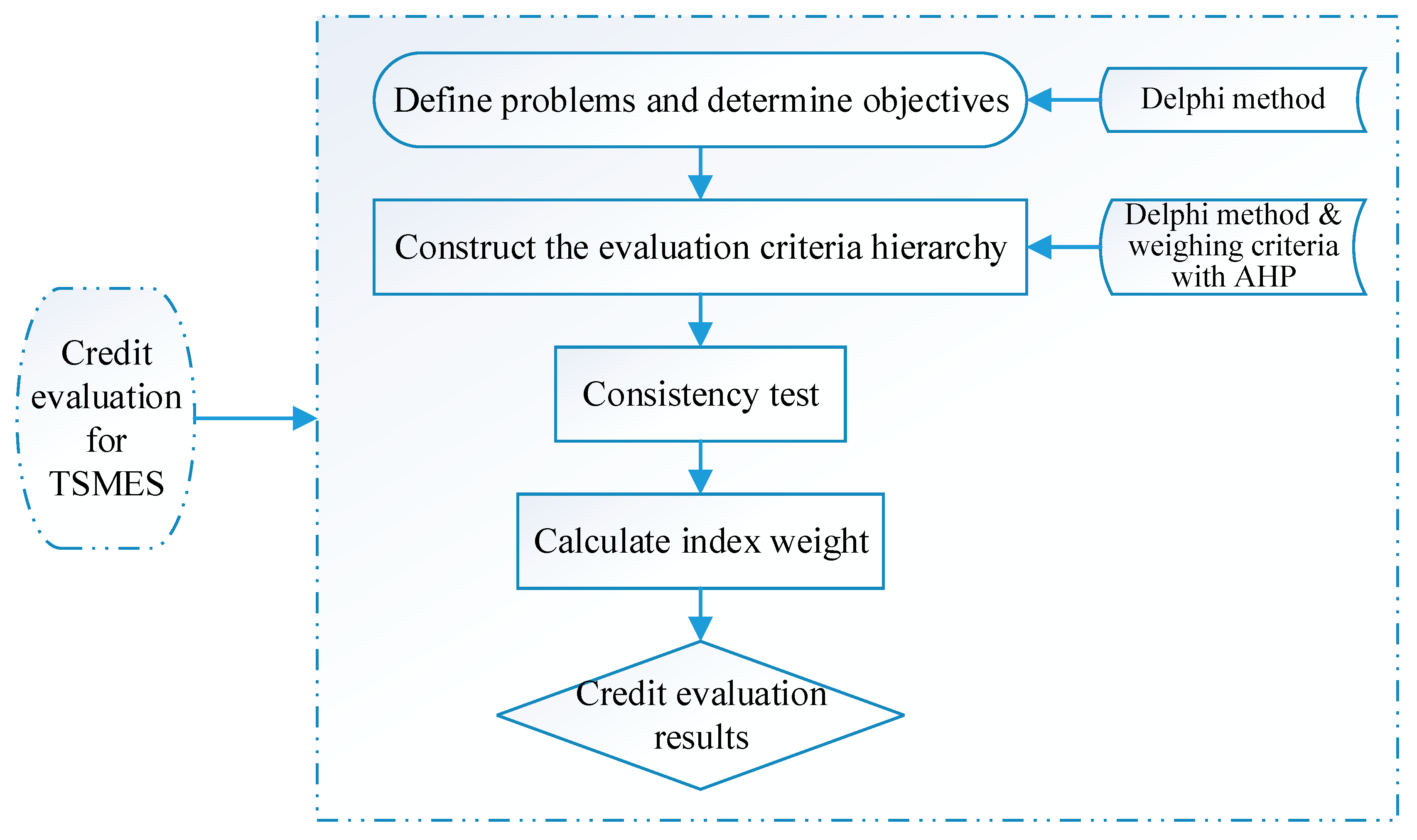
The appropriate indicators are the foundation of the credit index system for TSMEs. This study selected the indicators of the credit index system using the Delphi method. In this section, the process of indicator selection was described in Section 3.1, the data collection using the Delphi method were presented in Section 3.2, the reliability and validity test of the questionnaires were conducted in Section 3.3, and the index weight calculated using AHP method was conducted in Section 3.4. Figure 1 summarized the main framework of constructing the credit index system for TSMEs in China with Delphi and AHP method.
Figure 1.
The framework for constructing the credit system of technological small and medium-sized enterprises (TSMEs).
3.1. Indicator Selection
Following the principles of scientificity, purposiveness, pertinence, and operability, this study selected the indicators of the credit index system for TSMEs using the following steps:
Step 1: More than 100 primary indicators were obtained through four methods, including the credit index system of financial institutions, the credit index system of governments, the credit evaluation research literature, and the investigation of banks, enterprises, governments, small loan companies, TSMEs and specialized credit evaluation companies.
Step 2: Interviews were conducted with the government, financial institutions, TSMEs, etc. Some indicators were adjusted according to the preferences and opinions of the experts, and then questionnaires were formed.
Step 3: The experts from many institutions, such as the governments, banks, small loan companies, TSMEs, and specialized credit evaluation companies, were selected as respondents, and the final indicators were determined using the Delphi method.
Step 4: A credit index system of TSMEs was established, which is based on a series of processes such as indicator primary election, pre-survey, indicator correction, and questionnaire survey. This system includes four first-level indicators, 16 second-level indicators, and 66 third-level indicators. The first-level indicator involves the controllers’ ability, operation and management ability, financial capacity, and innovation capacity. The specific credit index system was shown in Appendix A Table A1.
3.2. Data Collection using the Delphi Method
The Delphi method is a structured process, which obtains the opinions among experts through an iterative procedure of multiple questionnaires [54]. The experts exchange their ideas anonymously through questionnaires of inquiry and then provide their advice. After repeated inquiries and feedback, the experts reach a strong consensus on the selection and importance of indicators. This approach not only reflects the personal knowledge and experience of each expert but also maximizes the use of their wisdom.
In this study, we randomly collected 400 experts from governments, banks, small loan companies, TSMEs, and specialized credit evaluation companies. The experts are very familiar with the current situation and business structure of TSMEs, and also understand the credit index system. Therefore, we selected a wide range of experts who can offer suggestions on the enterprises’ credit system from different perspectives. According to the requirements of the Delphi method, the selected respondents must be familiar with the credit evaluation of enterprises. The experts in this study were chosen mainly based on the following criteria: (1) Vice president or manager in charge of credit in the banks; (2) General manager or vice president in charge of credit in the small loan company; (3) Principal in charge of funding or credit evaluation for science and technology enterprises in government; (4) Vice president or manager in the TSMEs and specialized credit evaluation companies.
In this study, two rounds of questionnaires were conducted by professional volunteers who have received professional training. The first round of expert questionnaire was designed based on the preliminary indicators. The experts were asked to rate the importance of the proposed indicators, and the numbers 1–9 were used to indicate the importance of the indicators (The larger the number is, the more important it is. For example, the number 9 means that it is very important while the number 1 means that it is not important). Based on the results of the first round, we modified the preliminary credit index system of TSMEs to form a comprehensive and well-structured questionnaire for the second round of the questionnaire.
In the two rounds of questionnaires, 200 questionnaires were distributed to the respondents in each round. In the first round, 151 questionnaires were returned, of which 145 are effective, with an effective recovery rate of 72.50%. While 155 questionnaires were collected in the second round, of which 149 are valid, with an effective recovery rate of 74.50%. According to recommendations by [55] on sample capacity, there are more than 100 samples in this study, satisfying the requirements of the questionnaire survey. Table 4 presented the detailed statistic of respondents in the two rounds above.
Table 4.
Detailed statistic of respondents.
3.3. Reliability and Validity Test of the Questionnaire
The effectiveness of the questionnaire is critical for constructing a credit index system of TSMEs. Reliability and validity are usually applied to test the questionnaire’s effectiveness. Reliability is adopted to evaluate whether the survey results are consistent, whether the established evaluation items are complete and comprehensive, and whether the overall structure is reasonable. In contrast, validity is mainly used to evaluate whether the questionnaires are valid. In terms of a questionnaire survey, validity is the first requirement, while reliability is an indispensable supplement to validity.
In this study, we used the internal consistency reliability to test the reliability of questionnaires. This variable is usually measured using the coefficient of Cronbach’s a that defines the proportion of the total variation in questionnaire results caused by different respondents. It can be defined as follows [56]:
where K is the number of questions in the questionnaire, is the variance of answers to the ith question in all surveys, and is the variance of all respondents and responses to all items.
The value of Cronbach’s a is greater than 0 and less than 1. A larger Cronbach’s a indicates higher internal consistency reliability. Generally, if the Cronbach’s a is more significant than 0.8, it means the internal consistency reliability is outstanding. If the Cronbach’s a is more significant than 0.6 and less than 0.8, it means the internal consistency reliability is relatively excellent. While the Cronbach’s a is less than 0.6, it means the internal consistency reliability is relatively weak [56].
The results of the reliability test were reported in Appendix A Table A1. As can be seen from the table, the Cronbach’s a of the first-level indicators ranges from 0.940–0.944, that of the second-level indicators ranges from 0.941–0.943, and that of the third-level indicators ranges from 0.938-–0.944. All the above values are higher than 0.800, indicating that the questionnaire meets the reliability test [56] and that the surveys in this study are a high level of reliability.
Validity refers to whether the results from the questionnaires are consistent with the content being investigated. The higher the validity is, the more consistent the survey results are with the content. This study applied structural validity to test the validity of the questionnaires and adopted the factor analysis function to test the structural validity of the questionnaires [57]. The leading indicators of the structural validity include eigenvalue, variance contribution rate, accumulative contribution rate, and factor loading. The results show that the eigenvalues of common factors of all indicators exceed 1, the cumulative variance of the common factors exceeds 70%, the standard factor load of each problem is higher than 0.5, and the average variance extracted (AVE) is more significant than 0.5. These results indicate that all the indicators have strong structural validity.
3.4. Calculate the Weight of Indicators using the AHP Method
The credit evaluation of TSEMs is oriented to all kinds of institutions at all levels and is very important for all aspects of economic development. The credit evaluation has formed a complex system composed of many interrelated and mutually restricting factors. It is difficult to make a rational decision on this complex system only by subjective judgment or qualitative research. In the credit index system of TSMEs, we considered the relative importance of each indicator and determined its weight. For example, if innovation ability and talent indicators are more important than financial indicators, they will be given higher weight.
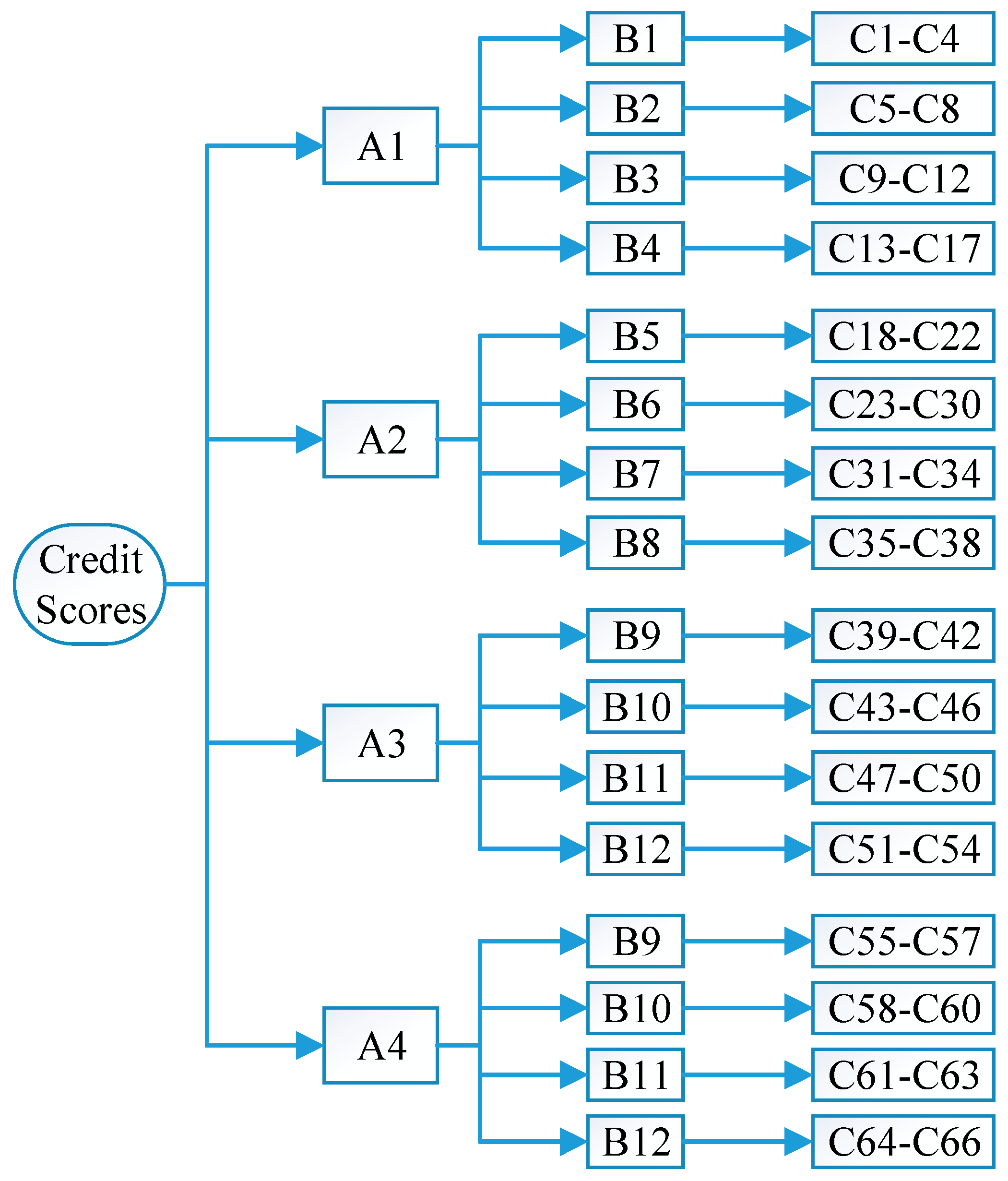
This section used the AHP method to calculate the weight of the credit index system for TSMEs. The credit index system consists of 66 different criteria, and it is decomposed into a hierarchy of decision components containing: (1) the ultimate goal, (2) the criteria, and (3) the sub-criteria. In this study, the credit level of TSMEs could be evaluated by actual controllers’ ability criteria, operation and management ability criteria, financial capacity criteria, and innovation capacity criteria. Figure 2 presented the hierarchical structure of the credit index system for TSMEs.
Figure 2.
The hierarchical structure of the credit index system for TSMEs.
According to the score of experts and the importance of indicators, this study divided the indicators into basic-score items and plus-score items. Due to the significant impact of the plus-score items on the credit evaluation of TSMEs, we did not directly give weight for these indicators but replaced it with a specific score. The plus-score was directly added to the total score of the basic-score items calculated by the weight. A pair-wise comparison procedure was applied to construct the judgment matrix for getting the weights of the basic-score items. It was constructed according to the relative scores assigned by experts with the Delphi method in Section 3.2. The pair-wise comparison matrix was constructed from the Equation (1) above. The matrix mainly includes relative elements and relative weights. The diagonal elements of the matrix always are number one because there is no difference between the same items.
In the different life cycles of TSMEs (including start-up stage, growth stage, and mature stage), various indicators have different importance to the credit evaluation of TSMEs. In this study, we adjusted the weight of main criteria (including A1-actual controllers’ ability, A2-operation and management ability, A3-financial capacity, and A4-innovation capacity) based on the life cycles of TSMEs. We used the AHP method to calculate weights by expert scoring that experts give in light of the importance of indicators in the different life cycles of TSMEs.
The summarized results of the main criteria obtained from the above steps were reported in Appendix A Table A2. As can be seen from the table, actual controllers’ ability and innovation capacity are dominant over financial capability in the start-up stage and growth stage, while in the mature stage of TSMEs, actual controllers’ ability is less important than the other three indicators. Also, Table A2 shows that the matrixes of the main criteria are consistent in the different life circles, because their consistency ratio (CR) values are 0.0000, 0.0000, and 0.0001 respectively and satisfy the requirement for consistency ratio (CR < 0.1). Thus, it is believed that the preferences shown in the evaluation are correct, and the weights can be further calculated.
We used step 5 in Section 2.1 to estimate the weight of the main criteria A1, A2, A3, and A4, and the results were given in Appendix A Table A3. We concluded that the weights of those criteria are diverse in different life circles of TSMEs, and they change dynamically according to the life circles. For example, in the start-up stage and growth stage, the controller’s ability is given a higher weight, while the weight of financial capacity is smaller. The reason is that the controlling shareholder or founder of TSME has more influence on the development of the enterprise than the financial indicators in the start-up stage. On the contrary, in the mature stage, the financial system of TSMEs is relatively sound and standardized, and the financial data can reflect the company’s operating conditions. Thus, the indicators of financial capacity are weighted higher than the actual controllers’ ability in the mature stage.
Similarly, this study adopted the steps in Section 2.1 to calculate the weight of second-level indicators and third-level indicators. Table A3 reported the weight of the second-level and third-level indicators for TSMEs.
4. Case of Study on the Credit Index System for TSMEs in China
The development of TSMEs is a power source for the rapid development of national productive forces. By the end of 2018, the number of enterprises in the national TSMEs information database in China has exceeded 130,000, and the intensity of R&D is mostly concentrated from 5% to 7% (The source of data is from the website: http://www.iprchn.com). TSMEs generally face with difficulties in financing and credit evaluation, which restrict their development.
This study has constructed a high-quality credit index system for TSMEs in China. However, whether the system can evaluate the credit of TSMEs accurately or not? In this section, we conducted a case study to illustrate the application of our proposed model for evaluating the credit of TSMEs in China. Section 4.1 gave a brief description of the cases, and Section 4.2 proposed an empirical analysis.
4.1. Case Description
This section described the information and the data source of TSMEs. We collected the data of ten enterprises from the list of TSMEs provided by the Chengdu Bureau of Science and Technology in China. To reduce the selection bias, we randomly selected three enterprises from the above ten TSMEs to conduct the case analysis, and they were replaced by Enterprise A, B, and C, respectively. The information about the three TSMEs was as follows:
(1) Enterprise A was established in January 2015 in China, and its registered capital is 2.29 million RMB. It mainly provides enterprise users with the overall solution in the cloud environment, such as data migration, backup, and recovery. Enterprise A is a start-up firm, which has 12 employees, including one doctorate, four master’s degrees, and seven bachelor’s degrees. The company has 11 intellectual property rights. In 2017, it applied for a loan of 800,000 CNY from a financial institution in China and was finally approved.
(2) Enterprise B was established in August 2015 in China, with a registered capital of 7.81 million RMB. Its business includes network technology development, biotechnology research and development, internet of things technology development, industrial automation control equipment, and the research of the computer information system. The company is a startup founded by experts and scholars from the University of Electronic Science and Technology of China. It has 13 utility model patents. In 2017, the Enterprise B applied for a loan of 1 million RMB from a financial institution in China, which was finally approved.
(3) Enterprise C was established in December 2002 in China, with a registered capital of 20.66 million RMB. The company is mainly engaged in the development and application of rare earth elements in the fields of agriculture and forestry. It is a mature TSME, and a critical enterprise of strategic emerging industries in Sichuan province. In 2017, it applied for a loan of 1 million RMB from a financial institution in China but was rejected because of its low credit score.
The relevant data used for the case study were mainly collected by investigating the target company’s controllers, managers, employees, main customers, and cooperative financial institutions. Chengdu Bureau of Science and Technology provided some information of the three TSMEs. Also, some data were obtained from the official website of governments. Finally, the data and information consistent with a credit index system were initially formed.
4.2. Empirical Analysis
In this section, an empirical analysis was conducted to verify the credit index system of TSMEs proposed in this study, and the credit value of the three TSMEs was reported in Appendix A Table A3. The table shows the scores of the three TSMEs using the credit index system established above. They were calculated via the following steps:
Step 1: Give a score for each of the three-level indicators
The credit index system consists of 66 third-level indicators, and different enterprises may score differently on the same metric. We used the relevant information collected in Section 4.1 to score each indicator of the three TSMEs.
Step 2: Calculate the score of the basic-score items
All the indicators were divided into basic-score items and plus-score items according to the importance of the indicators. For the basic-score items, we have constructed the weight of indicators using the Delphi and AHP methods. Thus, the scores of the basic-score items were calculated based on the credit index system for TSMEs.
Step 3: Calculate the score of the plus-score items
The plus-score items have a significant impact on the credit level of TSMEs. Thus, the plus-score items were not directly given weight but replaced it with a specific score.
Step 4: Calculate the full credit score and rating
The full credit score was calculated by adding up the score of the basic-score items and plus-score items. Besides, the credit level of TSMEs was divided into nine grades based on the full credit score, including AAA (more than 90), AA (85–90), A (80–85), BBB (7–80), BB (70–75), B (60–70), CCC (50–60), CC (40–50) and C (less than 40).
As can be seen from Appendix A Table A3, the three TSMEs have different full credit scores. The score for the basic-score items of Enterprise A is 84.87, while the score for the bonus-score items is 3.0, and thus the total credit score is 87.87. For Enterprise B and C, the total credit score is 96.63and 73.80, respectively.
The reasons for the different credit scores of these three TSMEs mainly include: (1) They are located at different stages of the life cycle, and their index weights are dynamically adjusted. Among them, Enterprise A and B are in the start-up stage and are given a relatively higher weight to the indicators of the controller ability, while Enterprise C is in the mature stage and has a relatively high weight on the financial indicators. (2) Enterprise A and Enterprise B have a high score in the talent indicator, especially Enterprise B, while Enterprise C has a low score of the talent indicators. Emphasizing the talent factor of TSMEs is one of the novelties in this study. (3) Enterprise A and Enterprise B have higher innovation capability scores than Enterprise C. The innovation capability is the core competitiveness of TSMEs, and paying more attention to the innovation capability is also one of the innovations in this research.
To further test the scientificity and operability of the credit index system, an investigation was conducted on the application of the above three TSMEs for loans from banks in the past year. These results are compared with the full credit scores of the three TSMEs, as shown in Table 5.
Table 5.
Comparison of the credit evaluation results of Enterprises A, B, and C.
From Table 5 we can see that Enterprise B has a higher credit score than Enterprise A, and Enterprise C has the lowest credit score. Based on the loan situations of financial institutions concerning Enterprises A, B, and C in 2017, we can find that the results are consistent with the credit evaluation results. In other words, if one enterprise obtained the bank loan, it can get a higher credit score using the credit index system constructed in this study. On the contrary, if the bank rejected the enterprise’s application for a loan, the enterprise maybe has a lower credit score based on the credit index system proposed in this study. Besides, it is easy to conclude from this case that the higher the credit score is, the greater the loan amount will be.
As this case very clearly demonstrates, the credit index system proposed in this paper can accurately evaluate the credit status of TSMEs. This system is more suitable for the credit evaluation of TSMEs in China at the present stage. We can use the credit index system constructed to evaluate the credit of TSMEs with different characteristics and life cycles.
5. Conclusions
The development of TSMEs is an essential driving force for economic growth. However, TSMEs are faced with financing difficulties, financing guarantee and “polarization” of credit activities, which restricts the development of the TSMEs. The market economy is based on credit, which is a credit economy in a certain sense. Credit evaluation is the key to solve the difficulty of financing for TSMEs in the market economy. The establishment of a high-quality credit index system can not only simplify the financing procedures, but also broaden the financing channels. Therefore, the establishment of a credit index system is the key to promote the healthy development of TSMEs.
At present, the credit evaluation of TSMEs is becoming more and more severe in China, among which the unreasonable credit index system is one of the crucial reasons. Besides, the existing credit index systems of TSMEs ignore the heterogeneous characteristics, place too much emphasis on the financial indicators, and give the fixed index weight for all the indicators. These credit index systems cannot accurately reflect the credit of TSMEs. Furthermore, constructing a high-quality credit index system for TSMEs is a difficult task because it is a complex problem with multiple criteria. Hence, in this study, we constructed a high-quality credit index system for TSMEs in China using the Delphi-AHP approach, and made several contributions to the current literature and practical application:
(1) This study avoided the shortcomings of the previous credit evaluation systems that only focused on financial indicators, and introduced some indicators with the characteristics of TSMEs and the actual situation of Chinese economy. For example, the credit index system highlighted the “talents” and “science-technology” characteristics of TSMEs in China, and gave more prominence to the importance of the controller or founder, intellectual property, and innovation capacity.
(2) This study interviewed a large number of experts from governments, banks, small loan companies, TSMEs, and specialized credit evaluation companies, and firstly took some indicators with Chinese economic characteristics, such as flow economy indicators, supply-chain indicators, and discredit indicators. Moreover, A case was introduced to verify the feasibility and effectiveness of the constructed credit index system for TSMEs in China.
(3) This study proposed a crucial insight that the credit level of TSMEs in China is closely related to the life cycles of enterprises. Enterprises in different life cycle stages have different characteristics and face different risks, so they have different levels of credit risk. The credit index system of TSMEs constructed in this study dynamically adjusted the weight of the first-level indicators according to the life cycle stages of enterprises, and gave different weights of indicators in the different life cycles.
The proposed credit index system provided a comprehensive and systematic model, which has good feasibility and the effectiveness of evaluating the credit of TSMEs in China. In future research, the proposed methodology for constructing the credit index system of TSMEs can be applied to other fields or industries such as banking industries, high-tech enterprises, or growth enterprises. Based on the same attribute framework, the other approaches such as the analytic network process (ANP), NN can be conducted, and the results of these methods can be compared with the results of this paper. Moreover, we can also use the ideas and methods of this study to predict credit risk in future research.
Author Contributions
The research was designed and performed by A.Y., Z.J. and W.Z. The data were collected and analyzed by A.Y., Z.J., W.Z., and K.D. The paper was written by A.Y. and W.Z., and finally checked and revised by W.Z. and F.H. All authors read and approved the final manuscript.
Funding
The research was funded by Sichuan University and Chengdu Administration China (Sichuan) Pilot Free Trade Zone. And the APC was funded by Sichuan University.
Conflicts of Interest
The authors declare no conflict of interest.
Appendix A
Table A1.
The credit evaluation indicators and reliability test results for TSMEs.
Table A1.
The credit evaluation indicators and reliability test results for TSMEs.
| First-Level Indicator | a value | Second-Level Indicator | a value | Third-Level Indicator | a value |
|---|---|---|---|---|---|
| Controllers’ ability A1 | 0.940 | Basic information B1 | 0.942 | Education background C1 | 0.943 |
| Work experience C2 | 0.942 | ||||
| Marital status C3 | 0.942 | ||||
| Number of children C4 | 0.942 | ||||
| Personal assets B2 | 0.942 | Real estate and vehicles C5 | 0.942 | ||
| Bank deposit C6 | 0.942 | ||||
| Financial assets C7 | 0.942 | ||||
| Investment assets C8 | 0.941 | ||||
| Credit conditions B3 | 0.942 | Liabilities C9 | 0.942 | ||
| Records of violation of laws and regulations C10 | 0.942 | ||||
| Litigation situation C11 | 0.941 | ||||
| Guarantee situation C12 | 0.941 | ||||
| Status title B4 | 0.943 | Top talents at home and abroad C13 | 0.942 | ||
| National leading talents C14 | 0.942 | ||||
| Local-level leading talents C15 | 0.942 | ||||
| NPC members or CPPCC members C16 | 0.942 | ||||
| Professional title C17 | 0.942 | ||||
| Operation & management ability A2 | 0.942 | Basic information B5 | 0.942 | Historical evolution C18 | 0.941 |
| Management structure C19 | 0.943 | ||||
| Shareholder change C20 | 0.940 | ||||
| Corporate institutions C21 | 0.942 | ||||
| Registered capital C22 | 0.942 | ||||
| Business information B6 | 0.941 | Current account detailed history list from banks C23 | 0.942 | ||
| Goodwill of cooperative enterprises C24 | 0.942 | ||||
| Quality certification C25 | 0.941 | ||||
| Obtained external capital C26 | 0.941 | ||||
| Social security payment C27 | 0.938 | ||||
| Tax situation C28 | 0.939 | ||||
| Payment for water, electricity and gas C29 | 0.942 | ||||
| Liability situation C30 | 0.942 | ||||
| Negative information B7 | 0.941 | Litigation situation C31 | 0.942 | ||
| Abnormal operation C32 | 0.942 | ||||
| Administrative penalty C33 | 0.941 | ||||
| Bad loan and repayment records C34 | 0.942 | ||||
| Competitive strength B8 | 0.941 | Industry situation C35 | 0.942 | ||
| Market share C36 | 0.941 | ||||
| Policy support C37 | 0.941 | ||||
| Technical barriers C38 | 0.941 | ||||
| Financial capacity A3 | 0.941 | Debt paying ability B9 | 0.941 | Asset-liability ratio C39 | 0.942 |
| Cash to current liabilities ratio C40 | 0.942 | ||||
| Current ratio C41 | 0.941 | ||||
| Quick ratio C42 | 0.941 | ||||
| Operating capacity B10 | 0.941 | Total asset turnover C43 | 0.941 | ||
| Inventory turnover ratio C44 | 0.944 | ||||
| Operating expense ratio C45 | 0.941 | ||||
| Receivable turnover ratio C46 | 0.941 | ||||
| Earning capacity B11 | 0.942 | Sales net profit ratio C47 | 0.942 | ||
| Gross profit margin C48 | 0.942 | ||||
| Return on assets (ROA) C49 | 0.941 | ||||
| Ratio of profits to cost C50 | 0.944 | ||||
| Growth ability B12 | 0.941 | Total asset growth rate C51 | 0.941 | ||
| Main business profit growth rate C52 | 0.942 | ||||
| Main business income growth rate C53 | 0.941 | ||||
| Net profit growth rate C54 | 0.942 | ||||
| Innovation capacity A4 | 0.944 | Innovation inputs B13 | 0.942 | Proportion of R&D expenditure in the main business C55 | 0.942 |
| Proportion of R&D personnel C56 | 0.942 | ||||
| New product development ability C57 | 0.941 | ||||
| Intellectual property B14 | 0.941 | Intellectual property creation C58 | 0.942 | ||
| Intellectual property operation C59 | 0.941 | ||||
| Intellectual property management and protection C60 | 0.941 | ||||
| Innovation team B15 | 0.942 | Education background of members C61 | 0.942 | ||
| Work experience of members C62 | 0.944 | ||||
| Members’ influence power C63 | 0.942 | ||||
| Innovation evaluation B16 | 0.941 | National-level award C64 | 0.941 | ||
| Provincial-level award C65 | 0.942 | ||||
| Municipal-level award C66 | 0.942 |
Note: 1. a value is the coefficient of Cronbach’s a; 2. NPC is the abbreviation of the National People’s Congress; CPPCC is the abbreviation of the Chinese People’s Political Consultative Conference.
Table A2.
A summary of the pair-wise comparison matrix and the consistency test.
Table A2.
A summary of the pair-wise comparison matrix and the consistency test.
| Start-up Stage | Growth Stage | Mature Stage | ||||||||||
|---|---|---|---|---|---|---|---|---|---|---|---|---|
| A1 | A2 | A3 | A4 | A1 | A2 | A3 | A4 | A1 | A2 | A3 | A4 | |
| A1 | 1.00 | 1.21 | 1.39 | 1.03 | 1.00 | 1.02 | 1.09 | 1.03 | 1.00 | 0.91 | 0.93 | 0.93 |
| A2 | 0.83 | 1.00 | 1.15 | 0.85 | 0.98 | 1.00 | 1.08 | 1.01 | 1.095 | 1.00 | 1.02 | 1.01 |
| A3 | 0.72 | 0.87 | 1.00 | 0.74 | 0.91 | 0.93 | 1.00 | 0.94 | 1.075 | 0.98 | 1.00 | 1.00 |
| A4 | 0.97 | 1.18 | 1.35 | 1.00 | 0.98 | 0.99 | 1.07 | 1.00 | 1.079 | 0.99 | 1.00 | 1.00 |
| W(%) | 28.40 | 23.49 | 20.46 | 27.65 | 25.82 | 25.40 | 23.60 | 25.18 | 23.53 | 25.76 | 25.31 | 25.40 |
| CI | 0.0000 | 0.0001 | 0.0053 | |||||||||
| CR | 0.0000 | 0.0000 | 0.006 | |||||||||
Table A3.
The scores of the three TSMEs using the credit index system established.
Table A3.
The scores of the three TSMEs using the credit index system established.
| Category | First-Level Indicator Weight (%) | Second-Level Indicator Weight (%) | Third-Level Indicator | Weight (%) Add Score | TSME A Score | TSME B Score | TSME C Score |
|---|---|---|---|---|---|---|---|
| Basic items | Controllers’ ability Start-up stage (28.40) Growth stage (25.82) Mature stage (23.53) | Basic information (33.00) | Education background | 24.67 | 100 | 100 | 60 |
| Work experience | 28.85 | 80 | 80 | 100 | |||
| Marital status | 23.64 | 100 | 100 | 100 | |||
| Number of children | 22.84 | 100 | 100 | 100 | |||
| Personal assets (32.48) | Real estate and vehicles | 24.86 | 80 | 80 | 80 | ||
| Bank deposit | 24.09 | 60 | 60 | 80 | |||
| Financial assets | 25.06 | 60 | 60 | 80 | |||
| Investment assets | 25.99 | 60 | 60 | 60 | |||
| Credit conditions (34.52) | Liabilities | 26.56 | 80 | 80 | 0 | ||
| Records of violation of laws and regulations | 22.65 | 100 | 100 | 100 | |||
| Litigation situation | 26.10 | 100 | 100 | 100 | |||
| Guarantee situation | 24.69 | 100 | 100 | 100 | |||
| Operation & management ability Start-up stage (23.49) Growth stage (25.40) Mature stage (25.76) | Basic information (25.27) | Historical evolution | 20.92 | 60 | 60 | 100 | |
| Management structure | 25.78 | 80 | 80 | 90 | |||
| Shareholder change | 19.10 | 100 | 100 | 100 | |||
| Corporate institutions | 14.52 | 60 | 100 | 100 | |||
| Registered capital | 19.69 | 100 | 100 | 100 | |||
| Business information (25.49) | Current account detailed history list from banks | 13.53 | 100 | 100 | 0 | ||
| Goodwill of cooperative enterprises | 13.21 | 100 | 100 | 80 | |||
| Quality certification | 12.43 | 60 | 100 | 80 | |||
| Obtained external capital | 12.93 | 100 | 100 | 100 | |||
| Social security payment | 11.81 | 100 | 100 | 100 | |||
| Tax situation | 11.85 | 80 | 80 | 80 | |||
| Payment for water, electricity and gas | 12.02 | 100 | 100 | 100 | |||
| Liability situation | 12.23 | 100 | 60 | 60 | |||
| Negative information (25.65) | Litigation situation | 25.71 | 100 | 100 | 100 | ||
| Abnormal operation | 24.18 | 100 | 100 | 100 | |||
| Administrative penalty | 23.58 | 100 | 100 | -100 | |||
| Bad loan and repayment records | 26.53 | 100 | 100 | 100 | |||
| Competitive strength (23.59) | Industry situation | 25.82 | 100 | 100 | 60 | ||
| Market share | 24.68 | 60 | 60 | 60 | |||
| Policy support | 24.03 | 80 | 100 | 100 | |||
| Technical barriers | 25.47 | 100 | 100 | 60 | |||
| Financial capacity Start-up stage (20.46) Growth stage (23.60) Mature stage (25.31) | Debt paying ability (26.58) | Asset-liability ratio | 25.22 | 80 | 80 | 80 | |
| Cash to current liabilities ratio | 24.35 | 60 | 80 | 80 | |||
| Current ratio | 25.54 | 60 | 80 | 80 | |||
| Quick ratio | 24.89 | 60 | 80 | 80 | |||
| Operating capacity (25.23) | Total asset turnover | 26.61 | 80 | 80 | 0 | ||
| Inventory turnover ratio | 22.27 | 80 | 80 | 0 | |||
| Operating expense ratio | 22.81 | 80 | 80 | 80 | |||
| Receivable turnover ratio | 28.31 | 80 | 80 | 60 | |||
| Earning capacity (24.15) | Sales net profit ratio | 26.19 | 60 | 60 | 80 | ||
| Gross profit margin | 24.45 | 80 | 80 | 80 | |||
| Return on assets (ROA) | 24.17 | 60 | 60 | 60 | |||
| Ratio of profits to cost | 25.19 | 60 | 60 | 60 | |||
| Growth ability (24.04) | Total asset growth rate | 26.44 | 80 | 80 | 60 | ||
| Main business profit growth rate | 24.12 | 80 | 80 | 80 | |||
| Main business income growth rate | 24.85 | 100 | 80 | 100 | |||
| Net profit growth rate | 24.58 | 80 | 80 | 60 | |||
| Innovation capacity Start-up stage (27.65) Growth stage (25.18) Mature stage (25.40) | Innovation inputs (34.36) | Proportion of R&D expenditure in main business | 33.72 | 100 | 100 | 80 | |
| Proportion of R&D personnel | 32.49 | 100 | 100 | 100 | |||
| New product development ability | 33.79 | 80 | 80 | 60 | |||
| Intellectual property (32.27) | Intellectual property creation | 34.21 | 80 | 80 | 60 | ||
| Intellectual property operation | 33.70 | 60 | 60 | 60 | |||
| Intellectual property management and protection | 32.09 | 80 | 100 | 60 | |||
| Innovation team (33.37) | Education background of members | 32.36 | 100 | 100 | 80 | ||
| Work experience of members | 35.55 | 100 | 100 | 80 | |||
| The influence power of members | 32.09 | 100 | 100 | 60 | |||
| Bonus-point items | Controllers’ ability | Status & title | Top talents at home and abroad | 30 | 0 | 0 | 0 |
| National leading talents | 20 | 0 | 0 | 0 | |||
| Local-level leading talents | 10 | 0 | 10 | 0 | |||
| NPC members or CPPCC members | 15/10/8/3 | 0 | 0 | 0 | |||
| Professional title | 5/3/1 | 3 | 0 | 0 | |||
| Innovation capacity | Innovation evaluation | National-level award | 30/20/15 | 0 | 0 | 0 | |
| Provincial-level award | 10 | 0 | 0 | 0 | |||
| Municipal-level award | 5 | 0 | 0 | 0 | |||
| The comprehensive credit score | 87.87 | 96.63 | 73.80 | ||||
Note: The value in parentheses is the weight of indicators, and its unit is %.
References
- Wang, Z.; Shou, M.; Wang, S.; Dai, R.N.; Wang, K.Q. An empirical study on the key factors of intelligent upgrade of small and medium-sized enterprises in China. Sustainability 2019, 11, 619. [Google Scholar] [CrossRef]
- Tian, X.L.; Xu, Z.S.; Wang, X.X.; Gu, J. Decision models to find a promising start-up firm with QUALIFLEX under probabilistic linguistic circumstance. Int. J. Inf. Technol. Decis. Mak. 2019, 18, 1379–1402. [Google Scholar] [CrossRef]
- Tian, X.L.; Xu, Z.S.; Gu, J. Group decision-making models for venture capitalists: The PROMETHEE with hesitant fuzzy linguistic information. Technol. Econ. Dev. Econ. 2019, 25, 743–773. [Google Scholar] [CrossRef]
- Tian, X.L.; Xu, Z.S.; Gu, J.; Herrera-Viedma, E. How to select a promising enterprise for venture capitalists with prospect theory under intuitionistic fuzzy circumstance? Appl. Soft. Comput. 2018, 67, 756–763. [Google Scholar] [CrossRef]
- Sang, B.H.; Kwon, S.; Yun, J. The effects of policy funds on the financing constraints of small and medium-sized enterprises in South Korea. Appl. Econ. Lett. 2017, 24, 1–4. [Google Scholar]
- Bao, S.X.; Yin, Y.F. Credit evaluation and empirical analysis of technological small and medium-sized enterprises. Sci. Technol. Prog. Policy 2009, 10, 143–147. [Google Scholar]
- Giudici, P. Financial data science. Stat. Probab. Lett. 2018, 136, 160–164. [Google Scholar] [CrossRef]
- Liu, C.; Wu, P.; Hao, F.J. Research on credit rating of technological small and medium-sized enterprises based on fuzzy set theory. Sci. Technol. Prog. Policy 2013, 9, 170–175. [Google Scholar]
- Kou, G.; Yang, P.; Peng, Y.; Xiao, F.; Chen, Y.; Alsaadi, F.E. Evaluation of feature selection methods for text classification with small datasets using multiple criteria decision-making methods. Appl. Soft. Comput. 2019, 86, 105836. [Google Scholar] [CrossRef]
- Zhang, H.H.; Kou, G.; Yang, P. Soft consensus cost models for group decision making and economic interpretations. Eur. J. Oper. Res. 2019, 277, 964–980. [Google Scholar] [CrossRef]
- Kou, G.; Ergu, D.; Lin, C.S.; Chen, Y. Pairwise comparison matrix in multiple criteria decision making. Technol. Econ. Dev. Econ. 2016, 22, 738–765. [Google Scholar] [CrossRef]
- Kou, G.; Lu, Y.Q.; Peng, Y.; Shi, Y. Evaluation of classification algorithms using MCDM and rank correlation. Int. J. Inf. Technol. Decis. Mak. 2012, 11, 197–225. [Google Scholar] [CrossRef]
- Kou, G.; Peng, Y.; Wang, G.X. Evaluation of clustering algorithms for financial risk analysis using MCDM methods. Inf. Sci. 2014, 27, 1–12. [Google Scholar] [CrossRef]
- Zhang, W.K.; Du, J.; Tian, X.L. Finding a promising venture capital project with TODIM under probabilistic hesitant fuzzy circumstance. Technol. Econ. Dev. Econ. 2018, 24, 2026–2044. [Google Scholar] [CrossRef]
- Gonçalves, T.S.H.; Ferreira, F.A.F.; Jalali, M.S.; Meidutė-Kavaliauskienė, I. An idiosyncratic decision support system for credit risk analysis of small and medium-sized enterprises. Technol. Econ. Dev. Econ. 2016, 22, 598–616. [Google Scholar] [CrossRef]
- Liu, X.; Xu, Y.J.; Ge, Y.; Zhang, W.K.; Herrera, F. A group decision making approach considering self-confidence behaviors and its application in environmental pollution emergency management. Int. J. Environ. Res. Public Health 2019, 16, 385. [Google Scholar] [CrossRef]
- Tian, X.L.; Xu, Z.S.; Fujita, H. Sequential funding the venture project or not? A prospect consensus process with probabilistic hesitant fuzzy preference information. Knowl. Based Syst. 2018, 161, 172–184. [Google Scholar] [CrossRef]
- Tian, X.L.; Xu, Z.S.; Gu, J. An extended TODIM based on cumulative prospect theory and its application in venture capital. Informatica 2019, 30, 413–429. [Google Scholar] [CrossRef]
- Herrera, F.; Herrera, V.E.; Martínez, L.; Mata, F.; Sánchez, P.J. A Multi-granular linguistic decision model for evaluating the quality of network services. In Intelligent Sensory Evaluation; Springer: Berlin/Heidelberg, Germany, 2004. [Google Scholar]
- Martínez, L.; Liu, J.; Yang, J.B.; Herrera, F. A multigranular hierarchical linguistic model for design evaluation based on safety and cost analysis. Int. J. Intell. Syst. 2010, 20, 1161–1194. [Google Scholar] [CrossRef]
- Kou, G.; Ergu, D. AHP/ANP theory and its application in technological and economic development: The 90th anniversary of Thomas L. Saaty. Technol. Econ. Dev. Econ. 2016, 22, 649–650. [Google Scholar] [CrossRef]
- Gunduz, M.; Alfar, M. Integration of innovation through analytical hierarchy process (AHP) in project management and planning. Technol. Econ. Dev. Econ. 2019, 25, 258–276. [Google Scholar] [CrossRef]
- Saaty, T.L. Book review. J. Optim. Theory Appl. 1970, 6, 284. [Google Scholar] [CrossRef]
- Ishizaka, A.; Lusti, M. An expert module to improve the consistency of AHP matrices. Int. Trans. Oper. Res. 2010, 11, 97–105. [Google Scholar] [CrossRef]
- Gu, W.; Basu, M.; Chao, Z.; Wei, L.R. A unified framework for credit evaluation for internet finance companies: Multi-criteria analysis through AHP and DEA. Int. J. Inf. Technol. Decis. Mak. 2017, 16, 597–624. [Google Scholar] [CrossRef]
- Lang, Z.; Hu, H.; Dan, Z. A Credit risk assessment model based on SVM for small and medium enterprises in supply chain finance. Financ. Innov. 2015, 1, 14–35. [Google Scholar]
- Calabrese, R.; Marra, G.; Osmetti, S.A. Bankruptcy prediction of small and medium enterprises using a flexible binary generalized extreme value model. J. Oper. Res. Soc. 2016, 67, 604–615. [Google Scholar] [CrossRef]
- Saaty, T.L. The Analytic Hierarchy Process; McGraw-Hill: New York, NY, USA, 1980. [Google Scholar]
- Eisenbeis, R.A. Problems in applying discriminant analysis in credit scoring models. J. Bank Financ. 1978, 2, 205–219. [Google Scholar] [CrossRef]
- William, P. The Four Big C’s Factor in Extending Credit; Central National Bank of Philadelphia: Philadelphia, PA, USA, 1910. [Google Scholar]
- Altman, E.I. Financial ratios, discriminant analysis and the prediction of corporate bankruptcy. J. Financ. 1968, 23, 589–609. [Google Scholar] [CrossRef]
- Beaver, W.H. Financial ratios as predictors of failure. J. Account. Res. 1966, 4, 71–111. [Google Scholar] [CrossRef]
- Black, F.; Scholes, M. The pricing of options and corporate liabilities. J. Polit. Econ. 1973, 81, 637–654. [Google Scholar] [CrossRef]
- Chatterjee, S.; Barcun, S. A nonparametric approach to credit screening. J. Am. Stat. Assoc. 1970, 65, 150–154. [Google Scholar]
- Kang, L.; Niskanen, J.; Kolehmainen, M.; Niskanen, M. Financial innovation: Credit default hybrid model for SME lending. Expert Syst. Appl. 2016, 61, 343–355. [Google Scholar]
- Grunert, J.; Norden, L.; Weber, M. The role of non-financial factors in internal credit ratings. J. Bank Financ. 2005, 29, 509–531. [Google Scholar] [CrossRef]
- Lugovskaya, L. Predicting default of Russian SMEs on the basis of financial and non-financial variables. J. Financ. Serv. Mark. 2010, 14, 301–313. [Google Scholar] [CrossRef]
- Blanco, O.A.; Irimia, D.A.; Oliver, A.M.; Wilson, N. Improving bankruptcy prediction in micro-entities by using nonlinear effects and non-financial variables. Financ. A Uver 2015, 65, 144–166. [Google Scholar]
- Mao, Q.; Zhao, X.C. Research on credit evaluation from the perspective of innovation value chain. East China Econ. Manag. 2018, 5, 134–139. [Google Scholar]
- Zhao, C.W.; Chen, C.F.; Tang, Y.K. Science and Technology Financial; Science Press: Beijing, China, 2009. [Google Scholar]
- Zhang, D.F.; Zhou, X.Y.; Leung, S.C.H.; Zhang, J.M. Vertical bagging decision trees model for credit scoring. Expert Syst. Appl. 2010, 37, 7838–7843. [Google Scholar] [CrossRef]
- Ferreira, F.A.F.; Santos, S.P.; Dias, V.M.C. An AHP-based approach to credit risk evaluation of mortgage loans. Int. J. Strateg. Prop. Manag. 2014, 18, 38–55. [Google Scholar] [CrossRef]
- Li, J.; Zhang, Q.; Yan, F.; Zhong, M. A cloud model-based multi-level fuzzy comprehensive evaluation approach for financing credit of scientific & technological small-medium enterprises. J. Differ. Equ. Appl. 2016, 23, 443–456. [Google Scholar]
- Thanassoulis, E.; Dey, P.K.; Petridis, K.; Goniadis, I.; Georgiou, A.C. evaluating higher education teaching performance using combined analytic hierarchy process and data envelopment analysis. J. Oper. Res. Soc. 2017, 68, 431–445. [Google Scholar] [CrossRef]
- Chao, S.L. Integrating multi-stage data envelopment analysis and a fuzzy analytical hierarchical process to evaluate the efficiency of major global liner shipping companies. Marit. Policy Manag. 2018, 44, 1–16. [Google Scholar] [CrossRef]
- Ilce, A.C.; Ozkaya, K. An integrated intelligent system for construction industry: A case study of raised floor material. Technol. Econ. Dev. Econ. 2018, 24, 1866–1884. [Google Scholar] [CrossRef]
- Pamucar, D.; Stevic, Z.; Zavadskas, E.K. Integration of interval rough AHP and interval rough MABAC methods for evaluating university web pages. Appl. Soft. Comput. 2018, 67, 141–163. [Google Scholar] [CrossRef]
- Kim, D.H.; Sohn, S.Y. Fuzzy analytic hierarchy process applied to technology credit scorecard considering entrepreneurs’ psychological and behavioral attributes. J. Intell. Fuzzy Syst. 2016, 30, 2349–2364. [Google Scholar] [CrossRef]
- Mou, W.M.; Wong, W.K.; Mcaleer, M. Financial credit risk evaluation based on core enterprise supply chains. Sustainability 2018, 10, 3699. [Google Scholar] [CrossRef]
- Karan, M.B.; Ulucan, A.; Kaya, M. Credit risk estimation using payment history data: A comparative study of Turkish retail stores. Cent. Eur. J. Oper. Res. 2013, 21, 479–494. [Google Scholar] [CrossRef]
- Ju, Y.H.; Sohn, S.Y. Updating a credit-scoring model based on new attributes without realization of actual data. Eur. J. Oper. Res. 2014, 234, 119–126. [Google Scholar] [CrossRef]
- Ciampi, F. Small enterprise default prediction modeling through artificial neural networks: An empirical analysis of Italian small enterprises. J. Small Bus. Manag. 2012, 51, 23–45. [Google Scholar] [CrossRef]
- Li, Z.J.; Yang, C.R. Establishment of the credit indicator system of micro enterprises based on support vector machine and r-type clustering. Math. Probl. Eng. 2018, 4, 1–12. [Google Scholar] [CrossRef]
- Dalkey, N.; Helmer, O. An experimental application of the Delphi method to the use of experts. Manag. Sci. 1963, 9, 458–467. [Google Scholar] [CrossRef]
- Boomsma, A. The robustness of LISREL against small sample sizes in factor analysis models. In Systems Under Indirect Observation: Causality, Structure, Prediction; Jöreskog, K.G., Wold, H., Eds.; North-Holland: Amsterdam, The Netherlands, 1982. [Google Scholar]
- Nunnally, J.C.; Bernstein, I.H. Psychometric Theory; McGraw-Hill: New York, NY, USA, 1994. [Google Scholar]
- Sethi, V.; Carraher, S. Developing measures for assessing the organizational impact of information technology: A comment on Mahmood and Soon’s paper. Decis. Sci. 2010, 24, 867–877. [Google Scholar] [CrossRef]
© 2020 by the authors. Licensee MDPI, Basel, Switzerland. This article is an open access article distributed under the terms and conditions of the Creative Commons Attribution (CC BY) license (http://creativecommons.org/licenses/by/4.0/).