Will Consumers Pay More for Efficient Delivery? An Empirical Study of What Affects E-Customers’ Satisfaction and Willingness to Pay on Online Shopping in Bangladesh


Abstract
1. Introduction
2. Conceptual Framework and Hypothesis Development
2.1. Cost-Saving Efficiency Online Shopping Satisfaction
2.2. Online Shopping Experience Online Customer Satisfaction
2.3. Delivery Efficiency Online Customer Satisfaction
2.4. Online Customer Satisfaction Willingness to Pay More (WTPM)
2.5. Online Customer Satisfaction Intention to Repurchase
2.6. The Moderating Role of Online Shopping Experience
3. Methodology
3.1. Sampling and Data Collection
3.2. Descriptive Statistics
3.3. Testing Normal Distribution and Common Method Bias (CMB)
4. Data Analysis Procedures
4.1. Questionnaire and Measure
4.1.1. Cost-Saving Efficiency
4.1.2. Online Purchase Experience
4.1.3. Delivery Efficiency
4.1.4. Online Customer Satisfaction
4.1.5. Intention to Repurchase
4.1.6. Willingness to Pay More
5. Validation of Measures
6. Hypotheses Testing
7. Testing of an Alternative Model
8. Discussion and Conclusions
8.1. Managerial Contribution
8.2. Limitations and Opportunities for Future Research Directions
Author Contributions
Funding
Conflicts of Interest
References
- EMarketer’s Worldwide Retail and Ecommerce Sales: eMarketer’s Updated Forecast and New Mcommerce Estimates for 2016—2021-eMarketer. Available online: https://www.emarketer.com/Report/Worldwide-Retail-Ecommerce-Sales-eMarketers-Updated-Forecast-New-Mcommerce-Estimates-20162021/2002182 (accessed on 2 January 2020).
- Ramkumar, B.; Ellie Jin, B. Examining pre-purchase intention and post-purchase consequences of international online outshopping (IOO): The moderating effect of E-tailer’s country image. J. Retail. Consum. Serv. 2019, 49, 186–197. [Google Scholar] [CrossRef]
- Slap, V. Online Shopping Getting Costlier for VAT slap|The Daily Star. Available online: https://www.thedailystar.net/bangladesh-national-budget-2019-20/news/online-shopping-getting-costlier-vat-slap-1756981 (accessed on 2 January 2020).
- UNCTAD Unctad B2C E-Commerce Index 2017. 2017, p. 30. Available online: http://unctad.org/en/ (accessed on 2 January 2020).
- Rahman, M.A.; Islam, M.A.; Esha, B.H.; Sultana, N.; Chakravorty, S. Consumer buying behavior towards online shopping: An empirical study on Dhaka city, Bangladesh. Cogent Bus. Manag. 2018, 5, 1–22. [Google Scholar] [CrossRef]
- Al Mamun, M.A.; Griffiths, M.D. The association between Facebook addiction and depression: A pilot survey study among Bangladeshi students. Psychiatry Res. 2019, 271, 628–633. [Google Scholar] [CrossRef] [PubMed]
- Siddiquee, N.A. E-government and transformation of service delivery in developing countries. Transform. Gov. People Process Policy 2016, 10, 368–390. [Google Scholar] [CrossRef]
- Talukder, M.S.; Shen, L.; Hossain Talukder, M.F.; Bao, Y. Determinants of user acceptance and use of open government data (OGD): An empirical investigation in Bangladesh. Technol. Soc. 2019, 56, 147–156. [Google Scholar] [CrossRef]
- Thirumalai, S.; Sinha, K.K. Customer satisfaction with order fulfillment in retail supply chains: Implications of product type in electronic B2C transactions. J. Oper. Manag. 2005, 23, 291–303. [Google Scholar] [CrossRef]
- Visser, J.; Nemoto, T.; Browne, M. Home Delivery and the Impacts on Urban Freight Transport: A Review. Procedia-Soc. Behav. Sci. 2014, 125, 15–27. [Google Scholar] [CrossRef]
- Chou, S.; Chen, C.-W.; Lin, J.-Y. Female online shoppers. Internet Res. 2015, 25, 542–561. [Google Scholar] [CrossRef]
- YU, J.; Subramanian, N.; Ning, K.; Edwards, D. Product delivery service provider selection and customer satisfaction in the era of internet of things: A Chinese e-retailers’ perspective. Int. J. Prod. Econ. 2015, 159, 104–116. [Google Scholar] [CrossRef]
- Jain, N.K.; Gajjar, H.; Shah, B.J.; Sadh, A. E-fulfillment dimensions and its influence on customers in e-tailing: A critical review. Asia Pac. J. Mark. Logist. 2017, 29, 347–369. [Google Scholar] [CrossRef]
- Cao, Y.; Ajjan, H.; Hong, P. Post-purchase shipping and customer service experiences in online shopping and their impact on customer satisfaction: An empirical study with comparison. Asia Pac. J. Mark. Logist. 2018, 30, 400–416. [Google Scholar] [CrossRef]
- Huang, W.-H.; Shen, G.C.; Liang, C.-L. The effect of threshold free shipping policies on online shoppers’ willingness to pay for shipping. J. Retail. Consum. Serv. 2019, 48, 105–112. [Google Scholar] [CrossRef]
- Vakulenko, Y.; Shams, P.; Hellström, D.; Hjort, K. Service innovation in e-commerce last mile delivery: Mapping the e-customer journey. J. Bus. Res. 2019, 101, 461–468. [Google Scholar] [CrossRef]
- Loo, W.H.; Yeow, P.H.P.; Chong, S.C. User acceptance of Malaysian government multipurpose smartcard applications. Gov. Inf. Q. 2009, 26, 358–367. [Google Scholar] [CrossRef]
- Venkatesh, V.; Morris, M.G.; Davis, G.B.; Davis, F.D. User Acceptance of Information Technology: Toward a Unified View. MIS Q. 2003, 27, 425–478. [Google Scholar] [CrossRef]
- Moore, G.C.; Benbasat, I. Development of an Instrument to Measure the Perceptions of Adopting an Information Technology Innovation. Inf. Syst. Res. 1991, 2, 192–222. [Google Scholar] [CrossRef]
- Fishbein, M.; Ajzen, I. Belief, Attitude, Intention, and Behavior: An Introduction to Theory and Research; Addison-Wesley Pub. Co.: Boston, MA, USA, 1975; ISBN 9780201020892. [Google Scholar]
- Davis, F.D. Perceived Usefulness, Perceived Ease of Use, and User Acceptance of Information Technology. MIS Q. 1989, 13, 319–340. [Google Scholar] [CrossRef]
- Ajzen, I. The theory of planned behavior. Organ. Behav. Hum. Decis. Process. 1991, 50, 179–211. [Google Scholar] [CrossRef]
- Thompson, R.L.; Higgins, C.A.; Howell, J.M. Personal Computing: Toward a Conceptual Model of Utilization. MIS Q. 2006, 15, 125–143. [Google Scholar] [CrossRef]
- Taylor, S.; Todd, P. Assessing IT Usage: The Role of Prior Experience. MIS Q. 1995, 19, 561–570. [Google Scholar] [CrossRef]
- Compeau, D.; Higgins, C. Development of a Measure and Initial Test. Manag. Inf. Syst. Res. Center Univ. Minesota 1995, 19, 189–211. [Google Scholar]
- Davis, F.D.; Bagozzi, R.P.; Warshaw, P.R. Extrinsic and Intrinsic Motivation to Use Computers in the Workplace1. J. Appl. Soc. Psychol. 1992, 22, 1111–1132. [Google Scholar] [CrossRef]
- Bigné, E.; Sanz, S.; Ruiz, C.; Aldás, J. Why Some Internet Users Don’t Buy Air Tickets Online. In Information and Communication Technologies in Tourism 2010; Springer: Vienna, Austria, 2010; pp. 209–221. [Google Scholar]
- Chiu, C.-M.; Wang, E.T.G.; Fang, Y.-H.; Huang, H.-Y. Understanding customers’ repeat purchase intentions in B2C e-commerce: The roles of utilitarian value, hedonic value and perceived risk. Inf. Syst. J. 2014, 24, 85–114. [Google Scholar] [CrossRef]
- Yeo, V.C.S.; Goh, S.-K.; Rezaei, S. Consumer experiences, attitude and behavioral intention toward online food delivery (OFD) services. J. Retail. Consum. Serv. 2017, 35, 150–162. [Google Scholar] [CrossRef]
- Tsu Wei, T.; Marthandan, G.; Yee-Loong Chong, A.; Ooi, K.; Arumugam, S. What drives Malaysian m-commerce adoption? An empirical analysis. Ind. Manag. Data Syst. 2009, 109, 370–388. [Google Scholar] [CrossRef]
- Chong, A.Y.-L. A two-staged SEM-neural network approach for understanding and predicting the determinants of m-commerce adoption. Expert Syst. Appl. 2013, 40, 1240–1247. [Google Scholar] [CrossRef]
- Escobar-Rodríguez, T.; Carvajal-Trujillo, E. Online purchasing tickets for low cost carriers: An application of the unified theory of acceptance and use of technology (UTAUT) model. Tour. Manag. 2014, 43, 70–88. [Google Scholar] [CrossRef]
- Macedo, I.M. Predicting the acceptance and use of information and communication technology by older adults: An empirical examination of the revised UTAUT2. Comput. Hum. Behav. 2017, 75, 935–948. [Google Scholar] [CrossRef]
- Lu, J.; Yu, C.; Liu, C.; Wei, J. Comparison of mobile shopping continuance intention between China and USA from an espoused cultural perspective. Comput. Hum. Behav. 2017, 75, 130–146. [Google Scholar] [CrossRef]
- Srivastava, M.; Kaul, D. Exploring the link between customer experience–loyalty–consumer spend. J. Retail. Consum. Serv. 2016, 31, 277–286. [Google Scholar] [CrossRef]
- Izogo, E.E.; Jayawardhena, C. Online shopping experience in an emerging e-retailing market: Towards a conceptual model. J. Consum. Behav. 2018, 17, 379–392. [Google Scholar] [CrossRef]
- Wan, Y.; Nakayama, M.; Sutcliffe, N. The impact of age and shopping experiences on the classification of search, experience, and credence goods in online shopping. Inf. Syst. E-Bus. Manag. 2012, 10, 135–148. [Google Scholar] [CrossRef]
- McLean, G.; Wilson, A. Evolving the online customer experience … is there a role for online customer support? Comput. Hum. Behav. 2016, 60, 602–610. [Google Scholar] [CrossRef]
- Tsao, W.-C.; Hsieh, M.-T.; Lin, T.M.Y. Intensifying online loyalty! The power of website quality and the perceived value of consumer/seller relationship. Ind. Manag. Data Syst. 2016, 116, 1987–2010. [Google Scholar] [CrossRef]
- Pappas, I.O.; Pateli, A.G.; Giannakos, M.N.; Chrissikopoulos, V. Moderating effects of online shopping experience on customer satisfaction and repurchase intentions. Int. J. Retail Distrib. Manag. 2014, 42, 187–204. [Google Scholar] [CrossRef]
- Campo, K.; Breugelmans, E. Buying Groceries in Brick and Click Stores: Category Allocation Decisions and the Moderating Effect of Online Buying Experience. J. Interact. Mark. 2015, 31, 63–78. [Google Scholar] [CrossRef]
- Rose, S.; Clark, M.; Samouel, P.; Hair, N. Online Customer Experience in e-Retailing: An empirical model of Antecedents and Outcomes. J. Retail. 2012, 88, 308–322. [Google Scholar] [CrossRef]
- Subramanian, N.; Yu, J.; Cheng, J.; Ning, K. Customer satisfaction and competitiveness in the Chinese E-retailing: Structural equation modeling (SEM) approach to identify the role of quality factors. Expert Syst. Appl. 2014, 41, 69–80. [Google Scholar] [CrossRef]
- Wu, I.-L. The antecedents of customer satisfaction and its link to complaint intentions in online shopping: An integration of justice, technology, and trust. Int. J. Inf. Manag. 2013, 33, 166–176. [Google Scholar] [CrossRef]
- Michaud Trevinal, A.; Stenger, T. Toward a conceptualization of the online shopping experience. J. Retail. Consum. Serv. 2014, 21, 314–326. [Google Scholar] [CrossRef]
- Stock, R.M. Can Customer Satisfaction Decrease Price Sensitivity in Business-to-Business Markets? J. Bus. Bus. Mark. 2005, 12, 59–87. [Google Scholar] [CrossRef]
- Jensen, J.M. Shopping orientation and online travel shopping: The role of travel experience. Int. J. Tour. Res. 2012, 14, 56–70. [Google Scholar] [CrossRef]
- Venkatesh, V.; Thong, J.Y.L.; Xu, X. Consumer Acceptance and Use of Information Technology: Extending the Unified Theory of Acceptance and Use of Technology. MIS Q. 2012, 36, 157–178. [Google Scholar] [CrossRef]
- Escobar-Rodríguez, T.; Carvajal-Trujillo, E. Online drivers of consumer purchase of website airline tickets. J. Air Transp. Manag. 2013, 32, 58–64. [Google Scholar] [CrossRef]
- Roth, S.; Bösener, K. The influence of customer satisfaction on customer price behavior: Literature review and identification of research gaps. Manag. Rev. Q. 2015, 65, 1–33. [Google Scholar] [CrossRef]
- Hult, G.T.M.; Sharma, P.N.; Morgeson, F.V.; Zhang, Y. Antecedents and Consequences of Customer Satisfaction: Do They Differ Across Online and Offline Purchases? J. Retail. 2019, 95, 10–23. [Google Scholar] [CrossRef]
- Bucklin, L.P.; Sengupta, S. Organizing Successful Co-Marketing Alliances. J. Mark. 1993, 57, 32–46. [Google Scholar] [CrossRef]
- Zhuang, H.; Popkowski Leszczyc, P.T.L.; Lin, Y. Why is Price Dispersion Higher Online than Offline? The Impact of Retailer Type and Shopping Risk on Price Dispersion. J. Retail. 2018, 94, 136–153. [Google Scholar] [CrossRef]
- Heitz-Spahn, S. Cross-channel free-riding consumer behavior in a multichannel environment: An investigation of shopping motives, sociodemographics and product categories. J. Retail. Consum. Serv. 2013, 20, 570–578. [Google Scholar] [CrossRef]
- Akroush, M.N.; Al-Debei, M.M. An integrated model of factors affecting consumer attitudes towards online shopping. Bus. Process Manag. J. 2015, 21, 1353–1376. [Google Scholar] [CrossRef]
- Rekettye, G.; Pinter, J. Customer satisfaction and price acceptance in the case of electricity supply. Int. J. Process Manag. Benchmarking 2006, 1, 220. [Google Scholar] [CrossRef]
- Soopramanien, D. Conflicting attitudes and scepticism towards online shopping: The role of experience. Int. J. Consum. Stud. 2011, 35, 338–347. [Google Scholar] [CrossRef]
- Izogo, E.E.; Jayawardhena, C. Online shopping experience in an emerging e-retailing market. J. Res. Interact. Mark. 2018, 12, 193–214. [Google Scholar] [CrossRef]
- Holloway, B.B.; Wang, S.; Parish, J.T. The role of cumulative online purchasing experience in service recovery management. J. Interact. Mark. 2005, 19, 54–66. [Google Scholar] [CrossRef]
- Frambach, R.T.; Roest, H.C.A.; Krishnan, T.V. The impact of consumer Internet experience on channel preference and usage intentions across the different stages of the buying process. J. Interact. Mark. 2007, 21, 26–41. [Google Scholar] [CrossRef]
- Khalifa, M.; Liu, V. Online consumer retention: Contingent effects of online shopping habit and online shopping experience. Eur. J. Inf. Syst. 2007, 16, 780–792. [Google Scholar] [CrossRef]
- Bagdare, S.; Jain, R. Measuring retail customer experience. Int. J. Retail. Distrib. Manag. 2013, 41, 790–804. [Google Scholar] [CrossRef]
- Bernard, E.K.; Makienko, I. The effects of information privacy and online shopping experience in E-commerce. Acad. Mark. Stud. J. 2011, 15, 97. [Google Scholar]
- de Kerviler, G.; Demoulin, N.T.M.; Zidda, P. Adoption of in-store mobile payment: Are perceived risk and convenience the only drivers? J. Retail. Consum. Serv. 2016, 31, 334–344. [Google Scholar] [CrossRef]
- Bélanger, F.; Schaupp, L.C. A Conjoint Analysis of Online Consumer Satisfaction. J. Electron. Commer. Res. 2005, 6, 95–111. [Google Scholar]
- Mentzer, J.T.; Dewitt, W.; Keebler, J.S.; Min, S.; Nix, N.W.; Smith, C.D.; Zacharia, Z.G. Defining Supply Chain Management. J. Bus. Logist. 2001, 22, 1–25. [Google Scholar] [CrossRef]
- Xing, Y.; Grant, D.B.; McKinnon, A.C.; Fernie, J. Physical distribution service quality in online retailing. Int. J. Phys. Distrib. Logist. Manag. 2010, 40, 415–432. [Google Scholar] [CrossRef]
- Collier, J.E.; Bienstock, C.C. Measuring Service Quality in E-Retailing. J. Serv. Res. 2006, 8, 260–275. [Google Scholar] [CrossRef]
- Goetzinger, L.; Kun Park, J.; Widdows, R. E-customers’ third party complaining and complimenting behavior. Int. J. Serv. Ind. Manag. 2006, 17, 193–206. [Google Scholar] [CrossRef]
- Ramanathan, R. The moderating roles of risk and efficiency on the relationship between logistics performance and customer loyalty in e-commerce. Transp. Res. Part E Logist. Transp. Rev. 2010, 46, 950–962. [Google Scholar] [CrossRef]
- Lopes, A.B.; Galletta, D.F. Consumer Perceptions and Willingness to Pay for Intrinsically Motivated Online Content. J. Manag. Inf. Syst. 2006, 23, 203–231. [Google Scholar] [CrossRef]
- Herhausen, D.; Binder, J.; Schoegel, M.; Herrmann, A. Integrating Bricks with Clicks: Retailer-Level and Channel-Level Outcomes of Online–Offline Channel Integration. J. Retail. 2015, 91, 309–325. [Google Scholar] [CrossRef]
- Pham, T.S.H.; Ahammad, M.F. Antecedents and consequences of online customer satisfaction: A holistic process perspective. Technol. Forecast. Soc. Chang. 2017, 124, 332–342. [Google Scholar] [CrossRef]
- Cameron, T.A.; James, M.D. Estimating Willingness to Pay from Survey Data: An Alternative Pre-Test-Market Evaluation Procedure. J. Mark. Res. 1987, 24, 389–395. [Google Scholar] [CrossRef]
- Krishna, A. Effect of Dealing Patterns on Consumer Perceptions of Deal Frequency and Willingness to Pay. J. Mark. Res. 1991, 28, 441–451. [Google Scholar] [CrossRef]
- Jedidi, K.; Zhang, Z.J. Augmenting Conjoint Analysis to Estimate Consumer Reservation Price. Manag. Sci. 2002, 48, 1350–1368. [Google Scholar] [CrossRef]
- Reichheld, F.F.; Sasser, W.E. Zero Defections: Quality Comes to Services. Harv. Bus. Rev. 1990, 68, 105–111. [Google Scholar]
- Srinivasan, S.S.; Anderson, R.; Ponnavolu, K. Customer loyalty in e-commerce: An exploration of its antecedents and consequences. J. Retail. 2002, 78, 41–50. [Google Scholar] [CrossRef]
- Hellier, P.K.; Geursen, G.M.; Carr, R.A.; Rickard, J.A. Customer repurchase intention. Eur. J. Mark. 2003, 37, 1762–1800. [Google Scholar] [CrossRef]
- Kim, C.; Galliers, R.D.; Shin, N.; Ryoo, J.-H.; Kim, J. Factors influencing Internet shopping value and customer repurchase intention. Electron. Commer. Res. Appl. 2012, 11, 374–387. [Google Scholar] [CrossRef]
- Wen, I. An Empirical Study of an Online Travel Purchase Intention Model. J. Travel Tour. Mark. 2012, 29, 18–39. [Google Scholar] [CrossRef]
- Ha, H.; Janda, S.; Muthaly, S.K. A new understanding of satisfaction model in e-re-purchase situation. Eur. J. Mark. 2010, 44, 997–1016. [Google Scholar] [CrossRef]
- Chen, Y.-Y. Why Do Consumers Go Internet Shopping Again? Understanding the Antecedents of Repurchase Intention. J. Organ. Comput. Electron. Commer. 2012, 22, 38–63. [Google Scholar] [CrossRef]
- Duarte, P.A.D.O.; Silva, S.C. The role of consumer-cause identification and attitude in the intention to purchase cause-related products. Int. Mark. Rev. 2018. [Google Scholar] [CrossRef]
- Cheema, A.; Papatla, P. Relative importance of online versus offline information for Internet purchases: Product category and Internet experience effects. J. Bus. Res. 2010, 63, 979–985. [Google Scholar] [CrossRef]
- Ling, K.C.; Chai, L.T.; Piew, T.H. The Effects of Shopping Orientations, Online Trust and Prior Online Purchase Experience toward Customers’ Online Purchase Intention. Int. Bus. Res. 2010, 3, 63. [Google Scholar] [CrossRef]
- Melis, K.; Campo, K.; Breugelmans, E.; Lamey, L. The Impact of the Multi-channel Retail Mix on Online Store Choice: Does Online Experience Matter? J. Retail. 2015, 91, 272–288. [Google Scholar] [CrossRef]
- Duarte, P.; Costa e Silva, S.; Ferreira, M.B. How convenient is it? Delivering online shopping convenience to enhance customer satisfaction and encourage e-WOM. J. Retail. Consum. Serv. 2018, 44, 161–169. [Google Scholar] [CrossRef]
- Loehlin, J. Guttman on Factor Analysis and Group Differences: A Comment. Multivar. Behav. Res. 1992, 27, 235–237. [Google Scholar] [CrossRef]
- Pham, Q.; Tran, X.; Misra, S.; Maskeliūnas, R.; Damaševičius, R.; Pham, Q.T.; Tran, X.P.; Misra, S.; Maskeliūnas, R.; Damaševičius, R. Relationship between Convenience, Perceived Value, and Repurchase Intention in Online Shopping in Vietnam. Sustainability 2018, 10, 156. [Google Scholar] [CrossRef]
- Curran, P.J.; West, S.G.; Finch, J.F. The Robustness of Test Statistics to Nonnormality and Specification Error in Confirmatory Factor Analysis. Psychol. Methods 1996, 1, 16–29. [Google Scholar] [CrossRef]
- Hudson, D.; Seah, L.-H.; Hite, D.; Haab, T. Telephone presurveys, self-selection, and non-response bias to mail and Internet surveys in economic research. Appl. Econ. Lett. 2004, 11, 237–240. [Google Scholar] [CrossRef]
- Armstrong, J.S.; Overton, T.S. Estimating Nonresponse Bias in Mail Surveys. J. Mark. Res. 1977, 14, 396–402. [Google Scholar] [CrossRef]
- Podsakoff, P.M.; MacKenzie, S.B.; Lee, J.Y.; Podsakoff, N.P. Common Method Biases in Behavioral Research: A Critical Review of the Literature and Recommended Remedies. J. Appl. Psychol. 2003, 88, 879–903. [Google Scholar] [CrossRef]
- Brislin, R.W. Back-translation for cross-cultural research. J. Cross. Cult. Psychol. 1970, 1, 185–216. [Google Scholar] [CrossRef]
- Sekaran, U. Methodological and Theoretical Issues and Advancements in Cross-Cultural Research. J. Int. Bus. Stud. 1983, 14, 61–73. [Google Scholar] [CrossRef]
- Chiu, C.-M.; Lin, H.-Y.; Sun, S.-Y.; Hsu, M.-H. Understanding customers’ loyalty intentions towards online shopping: An integration of technology acceptance model and fairness theory. Behav. Inf. Technol. 2009, 28, 347–360. [Google Scholar] [CrossRef]
- Colwell, S.R.; Aung, M.; Kanetkar, V.; Holden, A.L. Toward a measure of service convenience: Multiple-item scale development and empirical test. J. Serv. Mark. 2008, 22, 160–169. [Google Scholar] [CrossRef]
- Hsu, M.-H.; Yen, C.-H.; Chiu, C.-M.; Chang, C.-M. A longitudinal investigation of continued online shopping behavior: An extension of the theory of planned behavior. Int. J. Hum. Comput. Stud. 2006, 64, 889–904. [Google Scholar] [CrossRef]
- Jiang, L.; Yang, Z.; Jun, M. Measuring consumer perceptions of online shopping convenience. J. Serv. Manag. 2013, 24, 191–214. [Google Scholar] [CrossRef]
- Roy, S.K.; Balaji, M.S.; Sadeque, S.; Nguyen, B.; Melewar, T.C. Constituents and consequences of smart customer experience in retailing. Technol. Forecast. Soc. Chang. 2017, 124, 257–270. [Google Scholar] [CrossRef]
- Fathi, E.; Zailani, S.; Iranmanesh, M.; Kanapathy, K. Drivers of consumers’ willingness to pay for halal logistics. Br. Food J. 2016, 118, 464–479. [Google Scholar] [CrossRef]
- Hulland, J. Use of partial least squares (PLS) in strategic management research: A review of four recent studies. Strateg. Manag. J. 1999, 20, 195–204. [Google Scholar] [CrossRef]
- Bagozzi, R.P.; Yi, Y. On the evaluation of structural equation models. J. Acad. Mark. Sci. 1988, 16, 74–94. [Google Scholar] [CrossRef]
- Chin, W. Issues and Opinion on Structural Equation Modeling. Manag. Inf. Syst. Q. 1998, 22, vii–xvi. [Google Scholar]
- Gefen, D.; Straub, D. A Practical Guide To Factorial Validity Using PLS-Graph: Tutorial And Annotated Example. Commun. Assoc. Inf. Syst. 2005, 16, 5. [Google Scholar] [CrossRef]
- Fornell, C.; Larcker, D.F. Evaluating Structural Equation Models with Unobservable Variables and Measurement Error. J. Mark. Res. 1981, 18, 39–50. [Google Scholar] [CrossRef]
- Aiken, L.S.; West, S.G.; Reno, R.R. Multiple Regression: Testing and Interpreting Interactions; Sage Publications: Thousand Oaks, CA, USA, 1991; ISBN 9780761907121. [Google Scholar]
- Hamilton, B.H.; Nickerson, J.A. Correcting for Endogeneity in Strategic Management Research. Strateg. Organ. 2003, 1, 51–78. [Google Scholar] [CrossRef]
- Verdegem, P.; De Marez, L. Rethinking determinants of ICT acceptance: Towards an integrated and comprehensive overview. Technovation 2011, 31, 411–423. [Google Scholar] [CrossRef]
- Palau-Saumell, R.; Forgas-Coll, S.; Sánchez-García, J.; Robres, E. User Acceptance of Mobile Apps for Restaurants: An Expanded and Extended UTAUT-2. Sustainability 2019, 11, 1210. [Google Scholar] [CrossRef]
- Lee, S.W.; Sung, H.J.; Jeon, H.M. Determinants of Continuous Intention on Food Delivery Apps: Extending UTAUT2 with Information Quality. Sustainability 2019, 11, 3141. [Google Scholar] [CrossRef]
- Hult, G.T.M.; Morgeson, F.V.; Morgan, N.A.; Mithas, S.; Fornell, C. Do managers know what their customers think and why? J. Acad. Mark. Sci. 2017, 45, 37–54. [Google Scholar] [CrossRef]
- Bucy, E.P. Second Generation Net News: Interactivity and Information Accessibility in the Online Environment. Int. J. Media Manag. 2004, 6, 102–113. [Google Scholar] [CrossRef]
- Venkatesh, V.; Morris, M.G.; Davis, G.B.; Davis, F.D. Management Information Systems Research Center, University of Minnesota. MIS Q. 2012, 27, 425–478. [Google Scholar] [CrossRef]



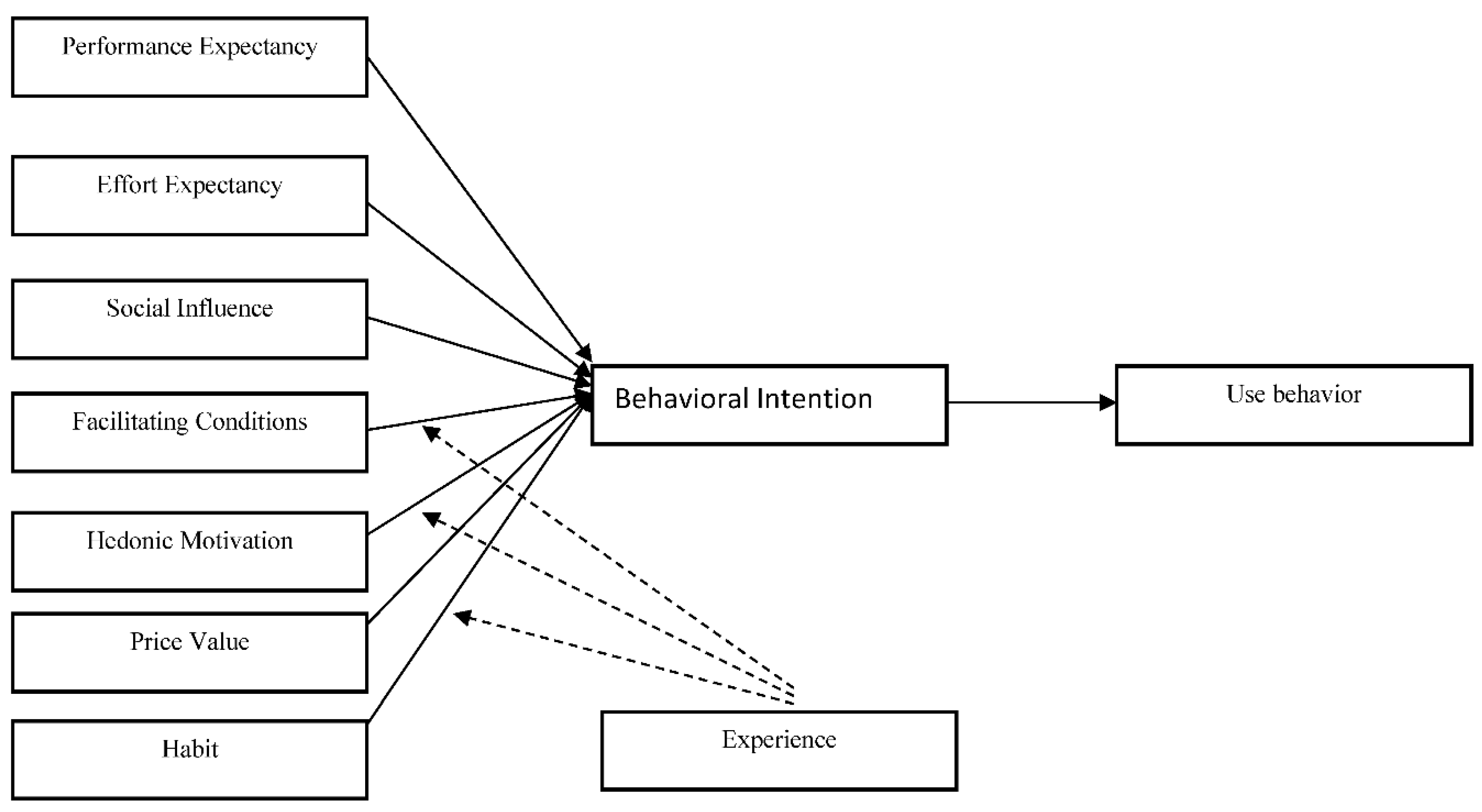
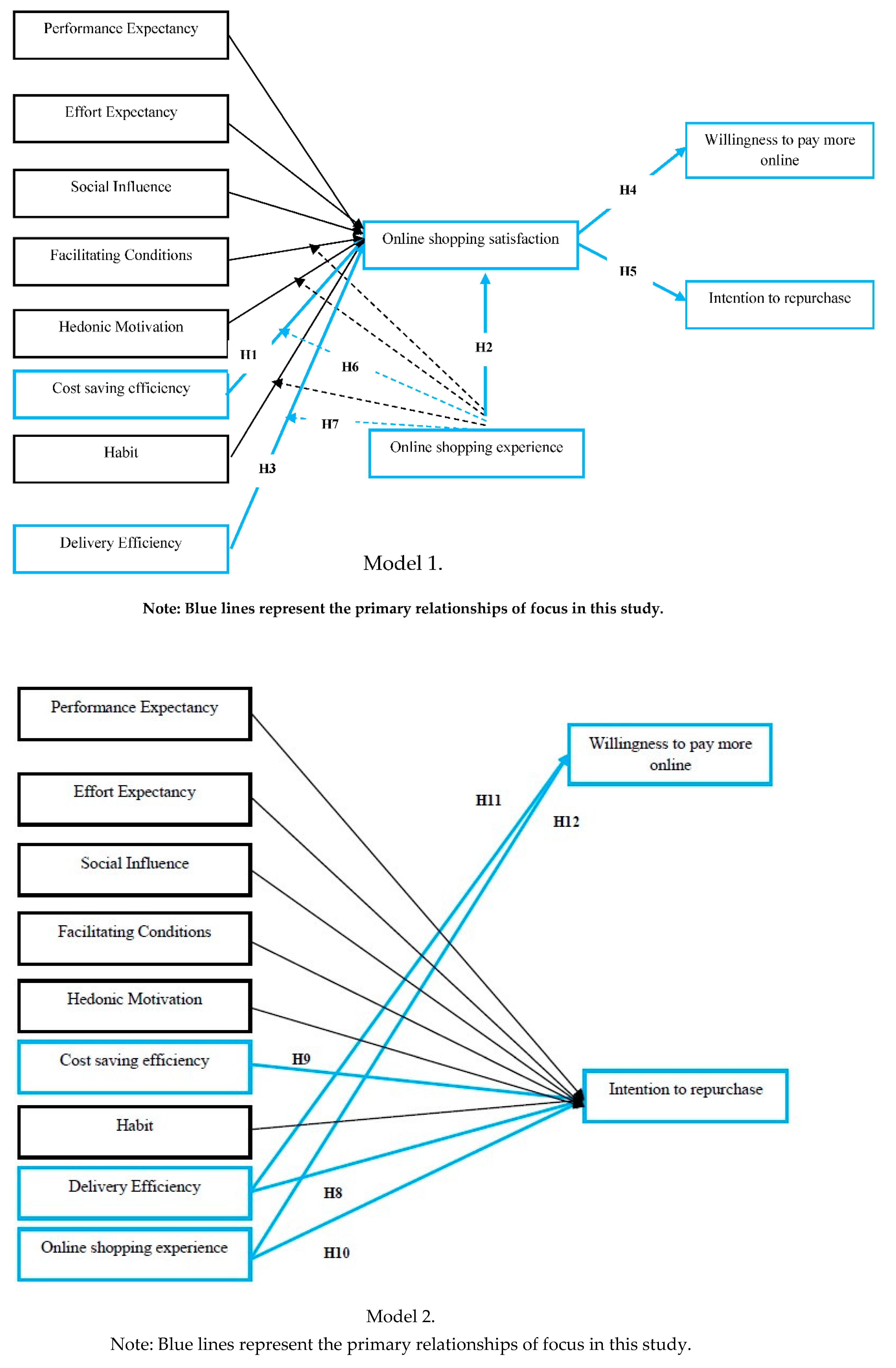
| Hypotheses | Key Supporting Literature | |
|---|---|---|
| H1 | Cost-saving efficiency or cost benefits positively increase online shopping satisfaction | [47,48,49,50,51] |
| H2 | The online shopping experience has a direct effect on online customer satisfaction | [39,40,41,42,43,45,58,59,61,62,63,64,65] |
| H3 | Delivery efficiency positively increase shopping satisfaction in the context of online shopping | [9,10,11,12,13,14,15] |
| H4 | Customer shopping satisfaction positively influences the willingness to pay in the context of online shopping | [71,72,73,78,88] |
| H5 | Online customer satisfaction positively influences the intention to repurchase | [13,57,82,83] |
| H6 & H7 | Online shopping experience positively moderates the relationship between cost saving efficiency and online shopping satisfaction Online shopping experience positively moderates the relationship between delivery efficiency and online shopping satisfaction | [39,40,61,85,86,87] |
| H8 | Delivery efficiency positively increase customer intention to repurchase in the context of online shopping | [11,12,13,14,15,41] |
| H9 | Cost-saving efficiency or cost benefits positively increase customer intention to repurchase in the context of online shopping | [29,46,50,51] |
| H10 | Online shopping experience positively increase customer intention to repurchase | [39,40,61] |
| H11 | Delivery efficiency positively increase customer willingness to pay in the context of online shopping | [71,72,73] |
| H12 | Online shopping experience positively increase customer willingness to pay more | [71,78] |
| Constructs | Items | No. | Min | Max | Mean | S.D | Skewness | Kurtosis |
|---|---|---|---|---|---|---|---|---|
| Delivery efficiency | DE 1 | 210 | 1 | 7 | 5.305 | 1.335 | −1.283 | −0.815 |
| DE 2 | 210 | 1 | 7 | 5.186 | 1.543 | −1.378 | −1.252 | |
| DE 3 | 210 | 1 | 7 | 5.419 | 1.375 | −1.414 | −0.536 | |
| DE 4 | 210 | 1 | 7 | 5.581 | 1.357 | −1.466 | −0.557 | |
| DE 5 | 210 | 1 | 7 | 5.373 | 1.144 | −1.630 | 0.304 | |
| Cost-saving efficiency | CSE 1 | 210 | 1 | 7 | 5.390 | 1.206 | −1.128 | −0.504 |
| CSE 2 | 210 | 1 | 7 | 5.600 | 1.242 | −1.521 | 0.373 | |
| CSE3 | 210 | 1 | 7 | 5.405 | 1.310 | −1.367 | −0.471 | |
| CSE 4 | 210 | 1 | 7 | 5.543 | 1.218 | −1.238 | −0.489 | |
| Online shopping satisfaction | OSS 1 | 210 | 1 | 7 | 5.243 | 1.295 | −1.120 | −0.409 |
| OSS 2 | 210 | 1 | 7 | 5.495 | 1.167 | −1.275 | −0.236 | |
| OSS 3 | 210 | 1 | 7 | 5.538 | 1.133 | −1.520 | 1.235 | |
| OSS 4 | 210 | 1 | 7 | 5.500 | 1.328 | −1.512 | 0.255 | |
| Online shopping experience | OSE1 | 210 | 1 | 7 | 5.452 | 1.174 | −1.202 | −0.404 |
| OSE 2 | 210 | 1 | 7 | 5.590 | 1.028 | −1.185 | −0.295 | |
| OSE 3 | 210 | 1 | 7 | 5.529 | 1.158 | −1.274 | −0.088 | |
| OSE4 | 210 | 1 | 7 | 5.524 | 0.909 | −1.399 | 0.467 | |
| OSE 5 | 210 | 1 | 7 | 5.484 | 0.975 | −1.465 | 0.407 | |
| Willingness to pay more | WTPM 1 | 210 | 1 | 7 | 5.524 | 1.158 | −1.077 | −0.767 |
| WTPM 2 | 210 | 1 | 7 | 5.524 | 1.137 | −1.418 | 0.579 | |
| WTPM 3 | 210 | 1 | 7 | 5.619 | 1.097 | −1.188 | −0.121 | |
| WTPM 4 | 210 | 1 | 7 | 5.662 | 1.151 | −1.408 | 0.607 | |
| WTPM 5 | 210 | 1 | 7 | 5.492 | 1.150 | −1.721 | 0.591 | |
| Intention to repurchase | IRP 1 | 210 | 1 | 7 | 5.333 | 1.280 | −1.367 | −0.257 |
| IRP 2 | 210 | 1 | 7 | 5.409 | 1.452 | −1.422 | −0.816 | |
| IRP 3 | 210 | 1 | 7 | 5.495 | 1.381 | −1.515 | −0.318 | |
| IRP 4 | 210 | 1 | 7 | 5.729 | 1.248 | −1.504 | 0.159 | |
| IRP 5 | 210 | 1 | 7 | 5.582 | 0.944 | −1.580 | 1.590 |
| Scale Items | Loadings | Cronbach’sAlpha (α) |
|---|---|---|
| DE1. I frequently receive my product in the estimated period. DE2. I expect to deliver the product supported on an allocated time. DE3. I frequently receive free/discounted delivery DE4. I would be capable of recognizing my order position at whatever time. DE5. Overall, I believe that the online store process my order quickly. | 0.75 0.76 0.83 0.78 0.84 | 0.85 |
| CSE1. I can save money by applying prices of a different online retailer CSE2 I expect to the search for inexpensive product pacts in different online retailer’s webpage. CSE3. Online retailers propose superior worth for my money. CSE4. In general, I am happy with the online retailer’s prices. | 0.77 0.74 0.81 0.80 | 0.79 |
| OSS1. I fulfilled my previous online shopping experience. OSS2. I fulfilled with the pre-purchase experience of this online retailer (e.g., product evaluation) OSS3.I am pleased with the shopping experience of this online retailer (e.g., payment process, ordering) OSS4.I am delighted with the post-purchase experience of this online retailer (e.g., handling of refunds/returns, after-sale support, delivery care) | 0.84 0.84 0.83 0.82 | 0.85 |
| OSE1. I have a great deal of experience with online shopping. OSE2. I have been exposed to online shopping very frequently in the past. OSE3. I am well-known with the different possibilities to exploit online shopping OSE4. I frequently update my knowledge about the functionalities of online purchases. OSE5. I am very confident in employing online shopping. | 0.76 0.77 0.75 0.80 0.75 | 0.82 |
| IRP 1. I will carry on online shopping in the future IRP 2. I will regularly use online shopping in the future. IRP 3. I intend to continue online shopping in the future. IRP 4. I propose to suggest the online shopping page that I frequently employ to people close by me IRP 5. I intend to obtain product details from the online shopping site that regularly use | 0.80 0.82 0.76 0.82 0.82 | 0.87 |
| WTPM1. I do not bother to pay extra to ensure the product delivered on time WTPM2. I do not worry about paying extra to ensure the goods transported to the right place. WTPM3. I do not concern to pay extra to confirm the product is not fake WTPM4 I do not worry about giving more to ensure the online retailers provide a good warranty WTPM5 I do not bother to provide extra charge confirm product includes insurance facility | 0.83 0.88 0.84 0.84 0.79 | 0.89 |
| CR | AVE | DE | CSE | OSE | OSS | IRP | WTPM | |
|---|---|---|---|---|---|---|---|---|
| DE | 0.89 | 0.63 | 0.79 * | |||||
| CSE | 0.86 | 0.61 | 0.70 * | 0.78 * | ||||
| OSE | 0.87 | 0.59 | 0.61 * | 0.67 * | 0.83 * | |||
| OSS | 0.90 | 0.70 | 0.65 * | 0.68 * | 0.68 * | 0.77 * | ||
| IRP | 0.90 | 0.65 | 0.61 * | 0.60 * | 0.66 * | 0.67 * | 0.81 * | |
| WTPM | 0.92 | 0.70 | 0.45 * | 0.34 * | 0.42 * | 0.50 * | 0.52 * | 0.84 * |
| Dependent Variables | Shopping Satisfaction | Intention to Repurchase | Willingness to Pay More | ||||||
|---|---|---|---|---|---|---|---|---|---|
| Model 1 | Model 2 | Model 3 | |||||||
| Independent Variables | β | T | P | β | T | P | β | T | P |
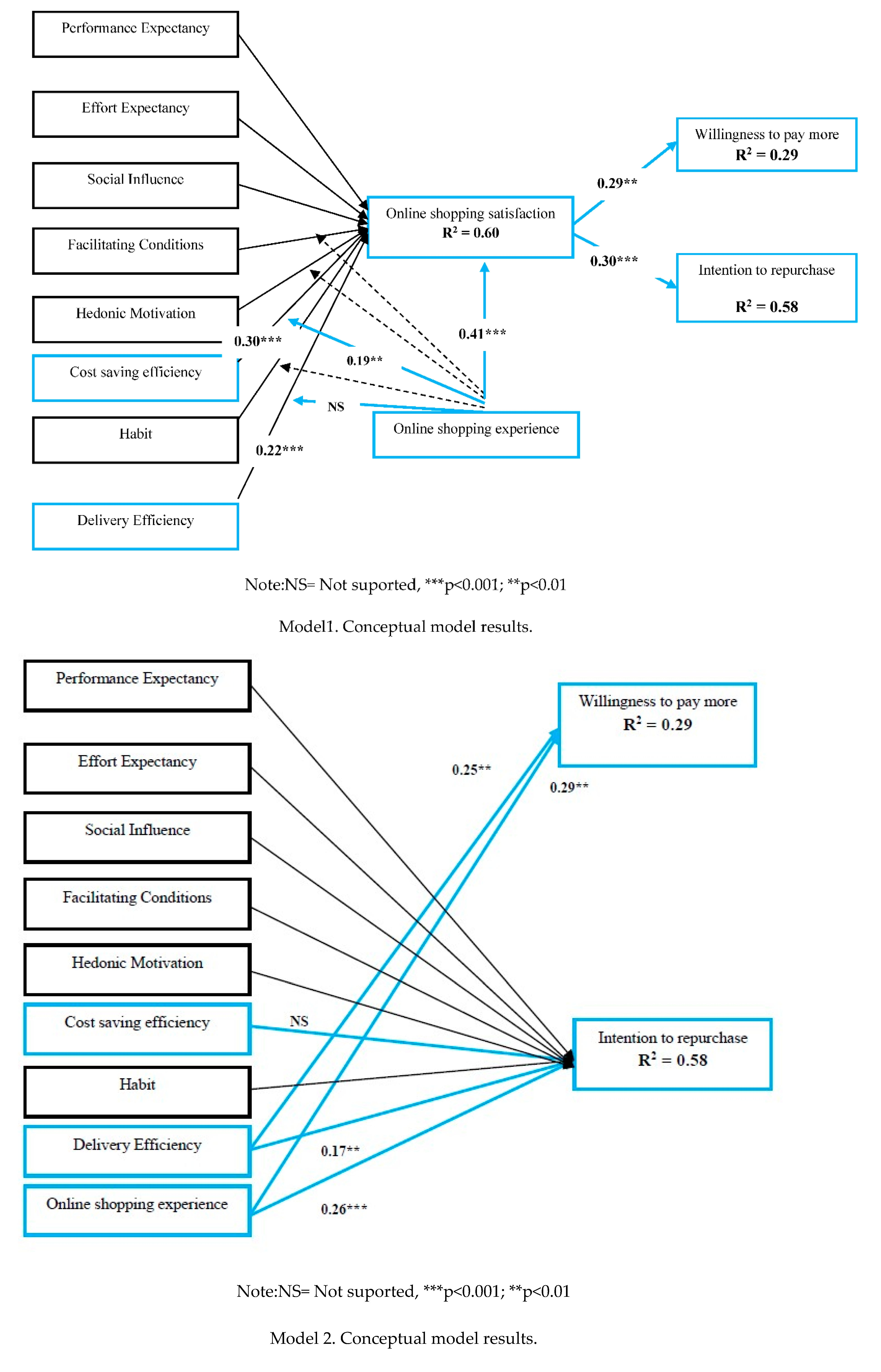
| Delivery Efficiency (DE) | 0.22 *** | 3.44 | 0.001 | 0.17 ** | 2.85 | 0.005 | 0.25 ** | 2.65 | 0.009 |
| Cost Saving Efficiency (CSE) | 0.30 *** | 4.01 | 0.000 | 0.04 | 0.68 | 0.497 | −0.18 | −1.70 | 0.092 |
| Online shopping experience (OSE) | 0.41 *** | 5.71 | 0.000 | 0.26 *** | 3.68 | 0.000 | 0.26 * | 2.30 | 0.023 |
| Online Consumer Satisfaction (OCS) | 0.30 *** | 4.63 | 0.000 | 0.29 ** | 2.81 | 0.005 | |||
| Interaction Terms | |||||||||
| DE*OE | 0.04 | ||||||||
| CSE*OE | 0.19 ** | ||||||||
| Age | −0.02 | −0.15 | −0.37 | ||||||
| Gender | −0.19 | 0.17 | −0.06 | ||||||
| Income | −0.14 | 0.04 | 0.08 | ||||||
| Frequency | −0.13 | 0.18 | −0.35 | ||||||
| Spend | −0.00 | −0.15 | 0.30 | ||||||
| _cons | 0.61 | 1.43 | 3.11 | ||||||
| R-squared | 0.60 | 0.57 | 0.32 | ||||||
| Agj-R2 | 0.59 | 0.55 | 0.29 | ||||||
| F M1(8,201),M2(9,200),M3(9,200) | 38.15 *** | 29.41 *** | 10.67 *** | ||||||
| RMSE | 0.6591 | 0.6006 | 0.9469 | ||||||
| Relationships | Estimate | t | Findings |
|---|---|---|---|
Cost-saving efficiency  Shopping satisfaction Shopping satisfaction | 0.30 | 4.01 *** | Supported |
| Online shopping experience Shopping satisfaction | 0.41 | 5.71 *** | Supported |
| Delivery efficiency Shopping satisfaction | 0.22 | 3.44 *** | Supported |
| Shopping satisfaction Willingness to pay | 0.29 | 2.81 ** | Supported |
| Sopping satisfaction Repurchase intention | 0.30 | 4.63 *** | supported |
| Relationships | Findings |
|---|---|
| Cost-saving efficiency *OE Shopping satisfaction | Supported |
| Delivery efficiency *OE Shopping satisfaction | Not supported |
| Relationship | Estimate | p | Result |
|---|---|---|---|
| Delivery-efficiency Repurchase intention | 0.17 | 0.005 | Accepted |
| Cost-saving efficiency Repurchase intention | 0.04 | 0.497 | Not accepted |
| Online shopping experience Repurchase intention | 0.26 | 0.000 | Accepted |
| Delivery efficiency Willingness to pay | 0.25 | 0.009 | Accepted |
| Online shopping experience Willingness to pay | 0.29 | 0.023 | Accepted |
© 2020 by the authors. Licensee MDPI, Basel, Switzerland. This article is an open access article distributed under the terms and conditions of the Creative Commons Attribution (CC BY) license (http://creativecommons.org/licenses/by/4.0/).
Share and Cite
Saha, S.K.; Zhuang, G.; Li, S. Will Consumers Pay More for Efficient Delivery? An Empirical Study of What Affects E-Customers’ Satisfaction and Willingness to Pay on Online Shopping in Bangladesh. Sustainability 2020, 12, 1121. https://doi.org/10.3390/su12031121
Saha SK, Zhuang G, Li S. Will Consumers Pay More for Efficient Delivery? An Empirical Study of What Affects E-Customers’ Satisfaction and Willingness to Pay on Online Shopping in Bangladesh. Sustainability. 2020; 12(3):1121. https://doi.org/10.3390/su12031121
Chicago/Turabian StyleSaha, Swapan Kumar, Guijun Zhuang, and Sihan Li. 2020. "Will Consumers Pay More for Efficient Delivery? An Empirical Study of What Affects E-Customers’ Satisfaction and Willingness to Pay on Online Shopping in Bangladesh" Sustainability 12, no. 3: 1121. https://doi.org/10.3390/su12031121
APA StyleSaha, S. K., Zhuang, G., & Li, S. (2020). Will Consumers Pay More for Efficient Delivery? An Empirical Study of What Affects E-Customers’ Satisfaction and Willingness to Pay on Online Shopping in Bangladesh. Sustainability, 12(3), 1121. https://doi.org/10.3390/su12031121