


Abstract
We pose that instead of problematizing negative attitudes of local stakeholders, such as citizens and NGOs, wind energy implementers should be more focused on scrutinizing the acceptability of their projects. The emphasis in this study is on the potential for representation of local stakeholders’ values in the project design, including amongst others business model and placement. Informed by value sensitive design literature, we analyzed two contrasting, locally-owned wind projects in the Dutch province of Groningen: the implementation of mini-turbines in a national landscape and a large-scale multi MW wind project in an industrialized area close to a World Heritage nature reserve. The study analyses how the respective farmer-developers and other local stakeholders attempted to resolve or ameliorate inter- and intra-value conflicts regarding livability, economy, landscape, and nature. The value conflicts turned out to be fruitful to identifying key issues and creating more widely shared value conceptualizations and design priorities. Hence, from this study it can be concluded that value conflict can be productive if carefully unpacked and managed. Uneven power distribution among stakeholders in the planning process, overcoming incommensurability of perspectives, and creating intersubjectivity remain challenges.
1. Introduction
In many European countries’ energy policies, wind energy is an important means for realizing a transition to a sustainable energy system. However, frequently a main bottleneck to smooth implementation of wind energy is the lack of support of local stakeholders—such as local resident communities, landscape organizations, and environmental NGOs. This resistance has been described as a lack of social acceptance of a project [1] and has been much researched for over a decade. A synthesis of this work can be found in several reviews with varying focuses (e.g., geographic [2], community-ownership [3], and planning guidelines [4]) and in reviews of social acceptance of renewable energy technologies more generally (such as [5]).
Framing a lack of social acceptance as a problem invites problematization of resistance by local stakeholders to wind energy projects. Yet, instead of problematizing lack of acceptance, the wind energy projects themselves could be scrutinized. Project developers could ask themselves the question of whether they are behaving like a good neighbor: Do I design my project mindful of the other users of this area? Is the project acceptable to them, and if not, can I alter the design of my project to improve this?
In this paper it is argued that project developers should pay more attention to whether and in what way a wind project is desirable in a certain local context. A focus on the fit of a wind project with the values and interests of the local stakeholders shifts the stress from acceptance of a project design to acceptability of the very plans that need to be accepted by the impacted stakeholders.
This difference could be described as the difference between social acceptance and acceptability. Taebi characterizes social acceptance as the acceptation or mere toleration of a new technology, while he describes acceptability as a reflection on a new technology that takes into account the issues that emerge from its introduction [6]. Hence, by focusing on acceptability, the normative dimension concerned with the acceptability of the wind project to its local environment becomes central, and so do the value perspectives of and conflicts between the stakeholders in this environment. Thus, it brings in a more local, and therefore territorial, focus [7], stresses ex ante acceptability instead of ex post acceptance of a development [8], and goes beyond recommending process participation by putting inclusion of key values of local stakeholders at center stage [9].
Key within the acceptability perspective is the desirability of the process and outcome for all local stakeholders [10,11,12]. Gross has shown how that acceptability is influenced by a combination of the perceived fairness of the process and the outcomes, as well as the favorability of the outcomes [12]. Hence, even if the process and outcomes are perceived to be legitimate, a lack of favorability of the outcomes of a project can make it unacceptable to local stakeholders.
We pose that resistance due to perceived unfavourability of outcome should no longer be dismissed as selfish not-in-my-backyard motives [10], but as an impetus to look at wind energy implementation more holistically, take the local context into consideration [11], and strive for better alignment between wind projects and their implementation environment [13].
Such alignment between the interests of turbine developers and other local stakeholders could lead to the design of more desirable, and so more acceptable, wind projects. In line with Oosterlaken, we hypothesize that designing locally desirable wind projects could speed up implementation in a morally acceptable way, and could thereby foster long-term support for wind farms [9]. Therefore, we are interested in analyzing how acceptability can be realized through a process of embedding outcome-related values of local stakeholders in the design of a wind project.
Previous research looking at responses to wind projects from a value point of view has described the values involved in wind energy development [14], theoretically explored the merit of value sensitivity [9], empirically analyzed the values represented in the physical and institutional design of offshore wind [15], and looked into the situatedness of value conflicts of onshore wind [16]. However, to our knowledge, no previous empirical research has put the focus explicitly on design attempts to make wind projects more sensitive to the values of local stakeholders and improve their acceptability, while a focus on design may have unused potential and could be a welcome addition to participative planning strategies.
Hence, we are specifically interested in which mechanisms exist to embed local values in wind energy projects, and how value sensitivity can affect the acceptability of locally-owned wind projects and reduce value conflicts. Therefore, our central question is:
How can wind projects be made sensitive to the values of local stakeholders by integrating them in project design?
To answer this question, we use concepts from Value Sensitive Design as a heuristic framework, which can be used to analyze a design for values, value conflicts, and trade-offs between values [17]. A strength of VSD is that it responds to the need for moving beyond conceptual accounts of values and towards the development of practical applications informing energy and planning practices [17].
An interesting contribution to the development of VSD itself is that we do not exclusively focus on how the values in the design of a technology affect its development [18], but we go broader and look at how values of local stakeholders are affected by design choices in the whole project development process, including, for instance, the placement and business model. Thereby, we expand the range of application to the design of wind projects.
Apart from this theoretical contribution, we also want to contribute to planning praxis by showing what a value-based approach can mean for wind energy development. The potential of a value-based approach for wind energy planning will be illustrated by a comparative case study of two farmer-owned wind projects of varying scales to contrast the opportunities of design for acceptability in different types of planning processes. The farmer-developers, to varying degrees, try and are pressured to be better neighbors to the other stakeholders within the area and make their projects more desirable.
Because of the central focus on farmer-ownership, we can contribute more insight into the relation between local ownership and acceptability. In the community energy literature, which predominantly foregrounds projects of citizens’ collectives, this relation has been described as potentially positive but not uncomplicated [19,20]. Through this research, we can explore whether the same holds true for farmer-owned projects.
The remainder of the paper has the following structure: Section 2 introduces the value-based perspective inspired by value-sensitive design literature and outlines the conceptual framework used for the analysis of the empirical findings. Subsequently, Section 3 gives an overview of the case study methodology and introduces the two farmer-owned case study projects. Then Section 4 contains the results and gives an overview of the value perspectives of the stakeholders in the case studies and the ways in which they tried to negotiate the inclusion of their values in the project design. Finally, Section 5 concludes the paper by discussing five observations regarding how wind projects can be made more value sensitive and a reflection on the influence of local ownership on acceptability.
2. A Value-Based Perspective
A strand of literature that is helpful to analyze what and whose values are involved in the design of a wind project and can provide pointers on how to create a broader representation of local stakeholders’ values is value sensitive design (VSD). VSD literature assumes that a design, whether it is about placement, business, or the design of a technology itself, is not value-neutral. It supposes that several alternatives for design decisions exist, which have to be compared and assessed on how well they resemble the values of different stakeholders [9]. VSD does not rank or compare values in a normative way, but it assumes that broad value inclusion contributes to understanding and improving decision-making by articulating and comparing the way values are taken into account.
When it comes to the methodology, VSD is in principle a proactive approach to systematically including values in design [9]; the full methodology includes a tripartite approach involving conceptual, technical, and empirical investigations [18]. We will describe the approach and explain how we adapted it to fit our purposes.
The first phase is the conceptual phase, during which it is determined which values are relevant, how they should be understood, and which trade-offs between conflicting values are acceptable. In our research, the choices about trade-offs are made via the planning process by the provincial and local government. Hence, our conceptual phase will only cover identification of relevant values and operationalization. The second phase is the technical phase that assesses how technological properties affect values and looks at how design can support relevant values. The empirical phase looks at the perception of the users and other stakeholders and assesses their perception of which values are embedded in the design and which are not. As this research does not focus on the design process of a technology but of projects using existing technologies, we introduce the technologies in the case description but apart from that, skip the second step and fully focus on the empirical dimension. We choose to do so as we are interested in the negotiation of value inclusion during local implementation of the wind technologies.
Our empirical analysis focuses on the values the wind projects represent and impact according to the stakeholders. This includes values ascribed to the technology, such as profitability or efficiency, but also and especially the situated values impacted by its implementation in the specific local context, such as landscape values. By constructing stakeholders’ value perspectives, we can identify value conflicts in the empirical phase of this project. We then analyze how value inclusion is negotiated in the cases. Finally, we use the insights from this analysis to formulate suggestions on the usefulness of value inclusive planning. Hence, we use VSD as a heuristic frame to do an ex post analysis of value conflict, negotiation, and inclusion to reach recommendations about using it proactively during project development of wind energy projects.
As part of the conceptual phase, we will now go into more detail about how values can be understood when it comes to designing wind energy implementation processes. According to Feather, values are in essence “general beliefs that people hold about desirable and undesirable modes of conduct and end states of existence” [21] (p 130). This can be concretized to what people consider as important to their lives. This understanding is broader than the conceptualization of values in philosophy as moral values governing right and wrong, and extents to concepts that can be associated with desirability, such as natural and economic value. Examples of values in the context of onshore wind energy are profitability of the project and the aesthetic quality of the landscape of which a project becomes part.
During the design process of a wind project, different stakeholders can have a different understanding of what a value means. They may find spatial quality important, but operationalize it differently. Values can, therefore, be split up into two levels, using a distinction that has been made by Rawls [22], which differentiates between the concept of a value and the conception of a value. The concept, on the one hand, is the general idea of a value, such as livability or inclusivity. The conception, on the other hand, is a specific interpretation or understanding of the meaning of that value. One stakeholder might consider the implementation process of a turbine project inclusive when other local parties have been consulted, while another may consider a project inclusive only if it enables ownership of the neighboring community. When two different values conflict at a conceptual level, this is called an inter-value conflict, and when two conceptions conflict, it is called an intra-value conflict. When looking for value conflicts, planners and developers should be sensitive to both types during the design process.
By synthesizing literature reviews of values in wind energy projects [4,7,23,24], we made an overview of values relevant to the outcome dimension of the implementation of wind energy projects. We operationalized these categories and gave examples of values that fall under these categories (see Table 1).

Table 1.
Value categories.
During the empirical phase, the value categories from Table 1 are used as sensitizing concepts to reconstruct the value perspectives of the stakeholders involved in the case studies. By comparing and contrasting stakeholder value perspectives, we analyzed if conflicts occurred at inter- or intra-value level. We then analyzed which procedural mechanisms have been used to attempt to ameliorate these value conflicts and better integrate values of local stakeholders. Hence, we chose to exclude procedural values such as inclusivity and transparency, but instead included the procedural aspect of project development by carefully analyzing how the design is negotiated.
3. Case Study Methodology
3.1. Case Study Design
To answer our research question, we made use of a case study design, which allows for in-depth analysis of a contemporary phenomenon in a real-life context [25]. It allowed us to research value conflicts that came up in specific projects and analyze the ways in which these were dealt with.
The main case selection criteria were the presence of value conflicts among local stakeholders and variation in scale of the studied wind projects. We wanted to represent the two, very contrasting, types of wind energy development that are possible in the Dutch province of Groningen: small-scale 15 m turbines for local use and large-scale concentration areas to minimize spatial impact. Both types of wind turbines have very different planning procedures: the first a notice to the municipal government followed by a spatial quality check and the second an extensive planning process including securing a location and permit application (requiring, among other things, a feasibility assessment and environmental assessment).
Secondly, we selected two locally-owned projects, which we deemed interesting as the developers of these projects are not only figurative neighbors, but also have a local connection beyond the project as residents of the area. Just like community energy initiatives [26], farmers or farmers collectives can be more receptive to the need for place-based renewable energy integration. Furthermore, much less research looks into the response to locally but not community-owned projects [3].
Based on these criteria, we selected wind park Oostpolder and the implementation of E.A.Z. mini-turbines in Middag-Humsterland.
3.1.1. Wind Park Oostpolder
As an introduction to this case, we give some further information about the proposed project and the area.
Project Oostpolder
In 2015, a group of farmers started the development of a jointly owned windfarm situated on their lands in the Oostpolder (see Figure 1). Their plan is to install approximately 60 MW of wind energy. Thirteen 4.65 MW Enercon turbines with a hub height of 155 m and a rotor diameter of 136 m will provide this capacity [27]. The project is part of an extension of the wind capacity in the Eems Harbor concentration area. The total extension would mean an addition of 170 MW to the already operational 276 MW [28]. Recently, the project has gotten a green light to start construction, and the planning is that it will be operational in 2021.
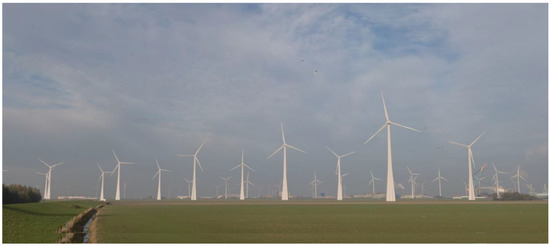
Figure 1.
Impression of the current landscape in the Oostpolder [29].
The farmers work without a professional developer, which is a special situation. Even though the farmers were limited to commercially available largescale turbines, they could decide upon the project design, instead of the conventional way where a professional developer or company dominates the process and decisions.
After the basic design of the project was made, a sounding board was established in September 2016 on the recommendation of local governments to involve the community and other local stakeholders in the development process of this wind park and a second nearby park. This sounding board consists of local governments (province of Groningen and municipality Eemsmond), an environmental NGO (Natuur en Milieufederatie Groningen, NMFG), and representatives of the residents and farmers of Oostpolder.
Concentration Area Eems Harbor
When it comes to concentration area, Eems Harbor, where the project is implemented, a first important characteristic is the proximity to the Wadden Sea, a UNESCO world heritage as well as a Natura 2000 area (part of EU nature protection regulation). This area has specific landscape qualities and houses protected species that are affected by wind turbines. Especially its birds and bats can become victims of the wind turbines due to the moving rotor blades.
A second characteristic of the area is the Eems Harbor, a storage and transshipment sea port. Energy production is an important industry in the Eems Harbor. Gas fired power plants, a coal fired power plant, and 90 wind turbines are generating approximately a third of all Dutch energy [30] (see Figure 1). Moreover, Google is building a data center for approximately 100,000 severs in the region, and new transmission towers are constructed for the transportation of the generated electricity. Furthermore, a helicopter port is planned in the Eems Harbor to facilitate the transport of employees to (future) offshore windfarms. Altogether, the inhabitants of the sparsely populated Eems Harbor area have endured many impactful spatial developments, and new developments are still contributing. Therefore, creating alignment between project Oostpolder and the values of local stakeholders was central to the farmers in avoiding being yet another negative development in the area.
3.1.2. E.A.Z. Turbines in Middag-Humsterland
As an introduction to this case, we will introduce the type of wind technology proposed and the characteristics of the case study area.
E.A.Z.-12 Turbine
The small-scale wind technology that has been implemented in the case study area is the 15 kW E.A.Z.-12 turbine, the product of the company E.A.Z., which is specifically designed to fit the values of its users and other local stakeholders in the Groningen landscape. From its start in the stables at the farm of the parents of one of the founders to an own production hall, the product has been by and large developed and produced in the province of Groningen with the specificities of that area in mind.
To make their product more aesthetically pleasing, E.A.Z. designed their turbine together with a landscape architect, a father of one of the founders. They consciously gave their turbine a friendlier and more natural appearance, so it could blend in with the rural landscape of their first market, the province of Groningen. They gave the turbine wooden rotor blades (6 m), a tail vane, and a thin tall green mast (15 m) (see Figure 2).
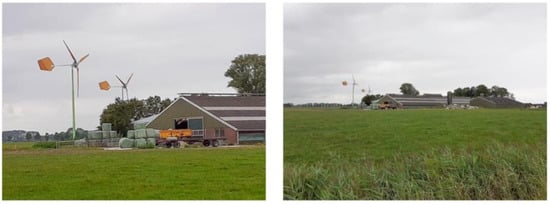
Figure 2.
A Groningen farm with two E.A.Z. turbines, up close and from a distance (pictures author’s own).
The company is still improving its product based on feedback from users and other stakeholders who experience the turbines’ effects. For instance, based on user feedback, they have reduced the noise of the blades. Furthermore, E.A.Z. is in close cooperation with Libau (the provincial committee for quality of the built environment) about the placement of the turbines and even tours with them through the landscape to discuss where they see or do not see fit for mini-turbines. Libau has also done some recommendations concerning the design of the turbine to make it less obtrusive, such as the reduction of the size of the tail vane.
Middag-Humsterland
Wind energy implementation is a sensitive and controversial issue in Middag-Humsterland. Even though the E.A.Z. developers took the characteristics of the Groningen landscape into consideration, some stakeholders feel turbines inevitably detract from the beauty of the landscape.
The Groningen region Middag-Humsterland is a so-called National Landscape. A Dutch National Landscape is a cultural landscape with rare mix of characteristics. Middag-Humsterland got its cultural heritage status due to its wide views over the meadows and characteristic villagescapes. Reminiscent of the past influence of the sea on the landscape, the farmland north of the Dutch city of Groningen is embossed by mounds, dikes, and salt marshes. This area is considered to be the oldest cultivated landscape in Europe, with a history dating back to the early Iron Age. It is mainly valued for its openness, quietness, organically shaped landscaped elements, and the presence of cultural heritage.
The status National Landscape dates back from the 2004 Land Use Memorandum Space (in Dutch: Nota Ruimte), in which the Dutch national government assigned 20 areas the status National Landscape to help safeguard and strengthen their core qualities [31]. However, today the status National Landscape is not accompanied by a special landscape conservation policy. Since the national government stopped its support in 2012, no special landscape policy has been made for Middag-Humsterland. Yet a foundation has been recently founded to change this and facilitate cooperation between the municipality Westerkwartier, the Province of Groningen, and some private initiatives.
3.2. Data Collection and Analysis
The data for the case studies consist of online available newspaper articles in Dutch newspapers including the local ones (via LexisNexis), policy documents, council notes, online news on websites, and face-to-face and phone interviews that are carried out with the main stakeholders in both cases. In total, six semi-structured interviews have been carried out for the E.A.Z. turbines in the Middag-Humsterland case and 12 for the Oostpolder case. The difference in the number of interviews is related to the different number of stakeholders involved (see Table 2).
Table 2.
Overview of interviewees.
The interview transcripts and the digitally retrieved documents have been thematically coded to elicit value perspectives with the concepts from Table 2.
4. Results
In this section, we present the results of the case studies. We show how and what values were included in the development process of the studied wind projects in Middag-Humsterland and the Oostpolder. For each case, we first discuss the value perspectives of the local stakeholders, and then the procedural mechanisms through which values were integrated, or not, in the design of the projects.
4.1. Case 1: Wind park Oostpolder
4.1.1. Value Perspectives
The local stakeholders involved in the value deliberation about improving the desirability of the Oostpolder project are the farmer-developers, the residents of the neighboring village, a few environmental NGOs, and the provincial government. The value perspectives of the local stakeholders are displayed in Table 3.
Table 3.
Value perspectives stakeholders.
The values that are threatened to be compromised in the Oostpolder are nature, economic, and livability values. Landscape values play less of a role here, because the landscape of the Oostpolder is already highly industrialized, and stakeholders are accustomed to the sight of wind turbines and other economic activities with a large visual impact.
Looking at inter-value conflicts, the economic profitability of the wind project for the farmer developers is at conflict with the nearby residents’ quietness and general tranquility and the property value of the houses. Furthermore, the economic profitability of the wind park for the farmer-developers is also in conflict with the value of the presence of protected birds and bats in the Wadden Sea region, represented by the environmental NGOs and the Province.
When it comes to intra-value conflicts, most prominent in the case study is the conflict about what economic distributional justice entails. The farmers are willing to provide a community benefit fund to ameliorate adverse economic effects such as loss of property value and other negative effects, but the residents feel that this is not sufficient compensation and would prefer to be compensated through a buy-out arrangement offered by the government.
4.1.2. Value Deliberation
This section discusses how stakeholders attempted to have their values better represented in the design of the wind project in the Oostpolder.
Sounding Board
An important mechanism for the farmer-developers in identifying and integrating values of local stakeholders has been the sounding board that has been installed by the Province. Through monthly meetings of the sounding board, the farmers are trying to create transparency and representation of the relevant stakeholders. They indicate that it is important to avoid distrust by the community and to take the input from the community seriously. They perceive good communication and adequate information provision as necessary to avoid both unexpected decisions for the community and opposition. However, the residents expected that they could actively collaborate from the beginning of the development processes, but this did not happen until the plans for placement were already in the stage of finalization. Furthermore, some of the residents indicated that, to their knowledge, none of the agreements or decisions made during the sounding board meetings are formally put on paper, and they doubt their influence. Additionally, a lack of clarity remained regarding the steps in the development trajectory, so residents did not know what to expect after a certain decision was made.
The involvement of the municipality, Province, and the NGO NMFG facilitated the communication within the sounding board, as they could act as intermediaries between the farmers and the residents during value deliberation. Especially, progress could be made towards ameliorating the intra-value conflict about the conception of economic distributional justice. A financial construction has been developed within the sounding board to increase the economic benefit for the community near the turbine. First, it was planned to use all the projected earnings from the community benefit as an investment, so the community can cooperatively own two of the turbines in the park. Unused capacity from the provincial repowering policy of the Province provides the legal opportunity for this. As not many owners of older wind turbines wanted to participate in Oostpolder, it has been decided by the Province that the residents of Oudeschip should have an opportunity to invest in the wind park and become co-owners. However, despite facilitation of such a construction by the NGO NMFG, this was too ambitious for the energy cooperative Oudeschip formed in 2018, and therefore a compromise has been decided upon. The cooperative gets 10% of the profits of the Oostpolder: 80% for distribution over the households and 20% to invest in projects.
One-on-One Discussions
One-on-one discussions were used to reduce the inter-value conflict between the economic profitability of the project and the deterioration of tranquility for the residents in Oudeschip. The farmers of Oostpolder visited the owners of the houses that were in the area where the noise of the turbines would exceed legal limits and had consultations with these owners to investigate if additional compensation could result in approval for replacing some of the existing turbines during the extension to increase capacity. Additional compensations can be found in insulation of the houses, additional monetary compensation, or maybe even a buy-out arrangement. Residents agreed to additional measures (the exact extent of the measures is unknown to the authors). An example of the additional measures is reducing the nuisance from the air traffic warning lights on top of the wind turbines. The lights of windfarm Oostpolder will be constantly burning instead of flashing, which attracts less attention. The farmers of Oostpolder also requested the wind turbine suppliers to investigate the usage of lamps with narrow beams of light, which are less visible from the ground.
Another design change resulting from the agreement between the farmer-developers and the respective residents is that the zoning plan of some houses has to be changed from residential property to business property of the windfarm. This step is necessary to receive the permits for the wind farm, because the legally allowed amount of noise for conventional residential houses is exceeded.
Enforcing Legal Authority
The measures the Province takes to enforce the Natura 2000 legislation to protect the nature value of the presence of protected birds and bats are based on the total of all the activities in the Eems Harbor region, not only the Oostpolder project. The protection measures that are taken by the Province are the declaration of a mandatory standstill provision during moments with many migratory birds or bats passing the wind turbines and the construction of a bird nesting island co-financed by the companies in the Eems Harbor.
These measures were adopted relatively easily, as the Province has the authority to protect nature values and can also ask for a financial contribution of the companies in the Eems Harbor, as their economic activities affect these values. For the companies involved, it is a trade-off: they are given the opportunity to operate in the area if they contribute to the conservation of its nature.
4.1.3. Case Conclusion
The case of wind park Oostpolder shows that the opportunities to influence the design of a larger wind park can be rather constrained, even in this project where initiators are looking for a dialogue with other stakeholders. One reason is the inequality between the developer and the other local stakeholders. Furthermore, in general, the local governments have no legal instruments, such as the repowering policy, to enforce resident participation.
However, at the same time, the case shows that when an effort is made to involve residents in the design process, this can result in modest changes to the design of the project, such as the modifications to air traffic lighting and larger financial compensation.
Furthermore, this case shows that the resolution of value conflicts is quite dependent on financial resources, and that design solutions through which a financial benefit can be realized for a limited cost can be implemented most easily.
Finally, the values that are enshrined in hard, legal norms, such as noise regulations and nature conservation, are easier to embed in the design than non-legal norms that resemble stakeholders’ preferences.
4.2. Case 2: A Small-Scale Wind Solution in a National Landscape
4.2.1. Value Perspectives
The local stakeholders involved in the value deliberation about the desirability of E.A.Z. turbines in Middag-Humsterland are the farmer-developers and their representative body LTO, residents concerned about the turbines, and Libau, the independent provincial committee for aesthetics of the built environment. E.A.Z. did not take an active role in the controversy. The value perspectives of the local stakeholders are shown in Table 4.
Table 4.
Value perspectives of stakeholders.
In this case study, economic, livability, and landscape values are at play. Nature values do not play a role here, because the E.A.Z. turbines do not affect the nature in the region.
Looking at inter-value conflict, the farmers’ economic values profitability and ownership are perceived by concerned residents to threaten the livability value quietness, and the landscape values cultural heritage value, uniqueness, quietness, openness, wideness, and organic shapes.
The landscape aspect of the inter-value conflict is largely fed by intra-value conflict. The main intra-value conflict at stake is the interpretation of the norms similarity and proportionality. While the farmers feel that the mini-turbines are proportional to other elements in the built environment of the farmscape, the concerned residents disagree and point out that the total height, including the blade length, is much higher than the stables and silos at the farms. Regarding similarity, the farmers feel that the turbine blends into the landscape due to the material choice and the size, which they compare to a large tree, whereas the concerned residents do not agree due to the movement of the blades and the modern look of the turbine.
Resultantly, the residents conceptualize touristic value as stemming from original landscape values that are diminished by the presence of E.A.Z. turbines, while the farmers feel that the mini-turbines strengthen the touristic value of the region by contributing to a change towards a sustainable agricultural landscape and can function at the farm as a cost-efficient, own energy source.
Libau postponed judgement and recognizes both perspectives.
4.2.2. Value Deliberation
This section discusses how stakeholders attempted to have their values better represented in the implementation process of wind energy in Middag-Humsterland. The deliberation mainly focused on whether the value of the landscape could be sufficiently conserved if E.A.Z. turbines would be implemented, and livability and economic values played a smaller role. The section outlays the different steps of the process by which it was decided if and under which conditions mini-turbines could have a place in the region.
Awareness Raising through Local Media
In the summer of 2016, a few villagers from Niehove, a mound village in the National Landscape Middag-Humsterland, read in the local newspaper about the announcement of four planned mini-turbines at farms. As their farmer-neighbors had not consulted them, and they felt confronted with a fait accompli, they expressed their concern in the local media and demanded the municipal council more clarity regarding the exact criteria for placement. The existing policy allowed for mini-turbines, but stated that intertwinement between characteristic landscape elements and turbines should be avoided. They doubted whether this would be possible at all in the National Landscape that was valued for its wideness and openness.
Agenda Setting in the Local Political Arena
At the next council meeting, the farmers and concerned residents were invited to present their arguments. After a short political swordplay, the mayor and aldermen of Zuidhorn, the municipality responsible for the permits, decided to take about five months for deliberation. In the deliberation period, the municipality looked into the impact of the E.A.Z. turbines with Libau, the visualization department of the nearby University of Groningen, and a sounding board.
Sounding Board
The municipality founded a sounding board to get input from different actors, and asked farmers, residents, and environmental and agricultural organizations to participate and a mediator to lead the process. E.A.Z. was requested to respect the societal discussion and not file new applications, which the company did. The sounding board was a good vehicle to facilitate an inclusive process. However, for concerned residents, it was hard to be informed about the ins and outs of the procedures. They feel that support from a professional adviser or an officer from the municipality would have been beneficial to level the playing field. Furthermore, within the sounding board, it was unclear how the advice to the local government would be constructed. The process evolved into preparing an advice by giving weight to the values of the majority, which led to a positive advice. This was not perceived to be fair by all stakeholders, as not all stakeholder groups were represented by an equal number of people.
Stakeholder Consultation to Inform Decision-Making in Local Political Arena
At the end of the deliberative process, the municipal government held a consultative meeting where stakeholders could express their thoughts, a positive advice of the sounding board was presented, and a visualization of the landscape effects was shown. A week later, the council decided that the landscape impact was acceptable, as the majority agreed with the farmers’ that the turbines were proportional and similar enough to the other landscape elements. Therefore, the policy remained supportive of mini-turbines.
However, as a result of the deliberative process, the council, advised by Libau, sharpened the design criteria that mini wind projects need to meet and installed a monitoring group. The new design criteria dictate that the mini-turbines should be placed at a spatially subordinate position and as a logical part of a farm to secure the values cultural heritage value, uniqueness, quietness, openness, wideness, and organic shapes. In short, this translated to concrete rules such as no placement of turbines in an open landscape, only as part of the building block (e.g., next to a stable).
Monitoring Group
A monitoring group with local stakeholders (consisting of a representative of LTO, one of the concerned residents, a representative of a local energy working group, and some vacant seats) was installed by the municipality to evaluate the policy in a year’s time.
When it comes to the implementation of the new placement criteria, the resident in the monitoring groups feels that the new stricter criteria are not followed rigorously enough. Furthermore, due to conflicting value perspectives and lack of trust because of an incident within the group, the monitoring group did not function well and has been terminated by its participants. Having or not having a mediator with no personal interest seemed to make a large difference between the sounding board and the monitoring group.
4.2.3. Case Conclusion
This case indicates that value sensitivity during the design phase of the technology needs to go hand in hand with value sensitivity of the implementer. Even in the case of a supposedly landscape and environmentally friendly wind turbine, new alignments are required if it comes to a specific new context such as a national landscape. The lack of consultation led to a societal discussion, which resulted in a deliberative process steered by the municipal government.
Quickly, the full value deliberation centered on whether the mini-turbines were deemed acceptable in terms of their effect on the landscape values in the region. The other value conflicts were side-lined and tied to the outcome of the decision regarding impact on landscape values. The landscape effects were mainly assessed in terms of similarity and proportionality, which were differently conceptualized by the farmers and the concerned residents.
During the deliberation, process was worked towards enlarging the sense of intersubjectivity. A main vehicle in the deliberation process was the sounding board. Despite perception of lacking a level playing field, this arena offered a chance to build a more broadly shared conception of whether the turbines were similar and proportional to other landscape elements or not. This led to new, sharpened design criteria for spatial integration of mini-turbines. While this did not resolve disagreement fully, conflict still helped to incentivize processes that contributed to enlarging the intersubjectivity required for a more concrete planning policy.
5. Conclusions and Discussion
We analyzed how a large-scale and a small-scale farmer-owned wind project were scrutinized by local residents and other stakeholders in the area. We used a value perspective to analyze perspectives of local stakeholders and conflicts. Here we present the conclusions to the research question of how wind projects can be made more sensitive to the values of local stakeholders by integrating these in project design.
We discuss our answer through five observations of how wind projects can be made more sensitive to the values of local stakeholders by integrating these in project design. These insights about negotiating acceptability through value sensitivity can also be used for implementation of other controversial energy technologies where developers, local owners or not, face potential opposition of the local stakeholders (e.g., largescale solar PV on fields or biogas).
Finally, we end the paper with a reflection on the influence of local ownership on the acceptability of the studied wind projects.
5.1. Levelling the Playing Field in Participative Environments
In these cases, negotiation of more value inclusive designs took place in various ways, such as through a sounding board, one-on-one stakeholder discussions, enforcement of legal authority, societal and political mobilization, stakeholder consultation, and a monitoring group. However, due to the difference in agency and power, co-design was only possible to some extent. In both cases, residents struggled with being informed about all procedures and with being seen as an equal stakeholder.
In a participative planning context such as a sounding board, the help of a neutral mediator [36], or even supportive intermediaries [37], can help. In the Oostpolder case, the NGO NMFG took on the support of the resident community in Oudeschip and facilitated the embedding of their values. In Middag-Humsterland, on the other hand, residents lacked a supportive intermediary that helped them voice their values and stated that such an intermediary could have helped them have a more equal standing.
5.2. Creating Intersubjectivity
Protecting some values and integrating them in design is complicated by the degree of subjectivity involved, such as landscape values and certain livability values [16]. Some of these values are very much individually, and sometimes elusively, conceptualized. Especially if values are hard or impossible to operationalize quantitively, some stakeholders could feel that the value is not sufficiently integrated in a design, whilst others may be satisfied based on the operationalization of the same qualitative criterium. Creating intersubjectivity through participative planning processes is important to create more widely shared value conceptualizations and enable embedding in design.
5.3. Overcoming Incommensurability
Our two cases show that value sensitivity can make wind projects more acceptable to local stakeholders, as more of their values get embedded in the design through consultation and negotiation. However, value sensitivity is no panacea for acceptance of outcome. It has to be recognized that not all value conflicts in local wind energy projects can be solved through making design choices that align conflicting values for various reasons, e.g., political or financial. Especially when multiple values or norms are involved, there is not a single norm that can function as a standard to resolve conflicts or make trade-offs.
Furthermore, certain values or even conceptualizations of values are incommensurable. The pursuit of a certain value from the perspective of one or more stakeholders then inevitably comprises or limits the ability to pursue certain other values [38].
Therefore, a methodology giving guidance in resolving value conflicts would be helpful. Research which explores how to come to a prioritization of values is therefore a very fruitful avenue for further research. For instance, Van de Kaa et al. uses the best–worst method, in which users or decision makers decide on the most and least important value and compare the rest of the values to these reference values [39].
5.4. Creating a Space for Constructive Conflict
Value conflicts between the stakeholders involved in local wind energy projects should not only be perceived as negative. Certainly, value conflicts require deliberation and can slow down or even stop projects that can contribute to sustainability. However, our cases show that value conflicts can also be productive. The ever-returning value conflict between landscape, economy, livability and nature values that accompanies the implementation of wind on land has created a market for alternative designs such as the small-scale E.A.Z. turbine and thereby expands the range of options for sustainable energy solutions. Furthermore, in both cases value conflicts led to design adjustments that made the wind project more aligned to local values or created a wider shared intersubjectivity on value conceptualizations. Cuppen found constructive conflict can even be used as a design tool to facilitate diversity of perspectives and avoid consensus being reached before diverging viewpoints are fully explored and understood [40]. Thus, our value analysis showed that conflicts teach developers that it leads to overall better solutions to start from an awareness of the values of all stakeholders that have to deal with the planned development.
5.5. Making “Neighbors” More Integral to the Planning Process
The space for a supra-legal degree of value sensitivity that was carefully constructed in both cases is by no means a norm and very dependent on efforts of local stakeholders such as a local government or the residents. For instance, it is easier for a stakeholder such as the Province to protect nature values that are enshrined in regulations than it is for residents of Middag-Humsterland to protect the landscape values, as these are not protected by hard norms.
Policy more supportive of participation and representation of stakeholders other than the developer would boost the design of more value-inclusive energy projects. In the Netherlands, steps towards better inclusion of local stakeholders are currently being experimented with. In the Dutch climate agreement, the ambition is formulated to realize a national average of 50% local co-ownership by 2030 for large RE projects [41]. This facilitates inclusion of local stakeholders from the start of the project on. However, this is only a partial solution, as it focuses mainly on potential co-owners. Hence, procedural innovation is also required to include values of non-owners in the planning process. Figuring out how this can be achieved is currently high on the agenda within the development of regional energy strategies, where various local stakeholders are involved in the planning process and invited to contribute to area-based plans for renewable energy integration. Here, identification of values, and mapping and discussing value conflicts, could be a helpful tool to better include situatedness and place-specificity in renewable energy planning.
5.6. A Reflection on the Relation between Local Ownership and Acceptability
We end this paper with a brief reflection on the influence of the local ownership component in the response to the studied farmer-owned wind projects. Generally, local ownership has been depicted as counteracting some of the objections to wind energy projects. Local owners could use their local network to reduce the scale of planning controversies [42]. Additionally, the contribution to local economic development through farmer income, and potentially also community benefit, can in some cases generate support [43].
However, in the studied locally-owned cases, conflict was still present. This can be partly explained by the observation that support is also affected by who benefits from local ownership, especially the extent to which the impacted community of place intersects with the community of interest that benefits from the development [3]. In the case of Middag-Humsterland and Oostpolder, the benefits only or mainly accrue to a few individuals within the community, which may limit acceptability.
Furthermore, and most importantly, our paper underlined that ownership is just one factor in acceptability. Values of local stakeholders are diverse and situated. What is acceptable is place-specific, e.g., past locally unwanted land uses such as in the Oostpolder case and the cultural heritage identity of Middag-Humsterland. Hence, our case studies confirm the importance of history, context, and geographic scale to favorability, and thereby, acceptability of outcome [3].
Author Contributions
conceptualization: E.C.v.d.W., H.J.v.d.W., R.B. and E.C.J.v.O.; data curation: E.C.v.d.W.; formal analysis: E.C.v.d.W. and R.B.; funding acquisition: H.J.v.d.W. and E.C.J.v.O.; investigation: E.C.v.d.W. and R.B.; methodology: E.C.v.d.W. and R.B.; project administration: H.J.v.d.W.; supervision: H.J.v.d.W. and E.C.J.v.O.; writing—original draft: E.C.v.d.W.; writing—review editing: E.C.v.d.W. All authors have read and agreed to the published version of the manuscript.
Funding
This research and the APC were funded by The Netherlands Organization for Scientific Research (NWO) grant number [313–99–304].
Acknowledgments
We would like to thank all the interviewees for generously sharing their time, experiences, and knowledge. We would also like to thank Anne Beaulieu for her constructive feedback on drafts of this paper.
Conflicts of Interest
The authors declare no conflict of interest. The funders had no role in the design of the study; in the collection, analyses, or interpretation of data; in the writing of the manuscript; or in the decision to publish the results.
References
- Wüstenhagen, R.; Wolsink, M.; Bürer, M.J. Social acceptance of renewable energy innovation: An introduction to the concept. Energy Policy 2007, 35, 2683–2691. [Google Scholar] [CrossRef]
- Rand, J.; Hoen, B. Thirty years of North American wind energy acceptance research: What have we learned? Energy Res. Soc. Sci. 2017, 29, 135–148. [Google Scholar] [CrossRef]
- Baxter, J.; Walker, C.; Ellis, G.; Devine-Wright, P.; Adams, M.; Fullerton, R.S. Scale, history and justice in community wind energy: An empirical review. Energy Res. Soc. Sci. 2020, 68, 101532. [Google Scholar] [CrossRef]
- Enevoldsen, P.; Sovacool, B.K. Examining the social acceptance of wind energy: Practical guidelines for onshore wind project development in France. Renew. Sustain. Energy Rev. 2016, 53, 178–184. [Google Scholar] [CrossRef]
- Batel, S. Research on the social acceptance of renewable energy technologies: Past, present and future. Energy Res. Soc. Sci. 2020, 68, 101544. [Google Scholar] [CrossRef]
- Taebi, B. Bridging the Gap between Social Acceptance and Ethical Acceptability. Risk Anal. 2016, 37, 1817–1827. [Google Scholar] [CrossRef] [PubMed]
- Fournis, Y.; Fortin, M.-J. From social ‘acceptance’to social ‘acceptability’of wind energy projects: Towards a territorial perspective. J. Environ. Plan. Manag. 2017, 60, 1–21. [Google Scholar] [CrossRef]
- Cowell, R.; Bristow, G.; Munday, M. Acceptance, acceptability and environmental justice: The role of community benefits in wind energy development. J. Environ. Plan. Manag. 2011, 54, 539–557. [Google Scholar] [CrossRef]
- Oosterlaken, I. Applying Value Sensitive Design (VSD) to Wind Turbines and Wind Parks: An Exploration. Sci. Eng. Ethic 2014, 21, 359–379. [Google Scholar] [CrossRef]
- Wolsink, M. Wind power implementation: The nature of public attitudes: Equity and fairness instead of ‘backyard motives’. Renew. Sustain. Energy Rev. 2007, 11, 1188–1207. [Google Scholar] [CrossRef]
- Liebe, U.; Bartczak, A.; Meyerhoff, J. A turbine is not only a turbine: The role of social context and fairness characteristics for the local acceptance of wind power. Energy Policy 2017, 107, 300–308. [Google Scholar] [CrossRef]
- Gross, C. Community perspectives of wind energy in Australia: The application of a justice and community fairness framework to increase social acceptance. Energy Policy 2007, 35, 2727–2736. [Google Scholar] [CrossRef]
- Van der Waal, E.C.; Van der Windt, H.J.; Van Oost, E.C.J. How Local Energy Initiatives Develop Technological Innovations: Growing an Actor Network. Sustainability 2018, 10, 4577. [Google Scholar]
- Borch, K. Mapping value perspectives on wind power projects: The case of the danish test centre for large wind turbines. Energy Policy 2018, 123, 251–258. [Google Scholar] [CrossRef]
- Künneke, R.; Mehos, D.C.; Hillerbrand, R.; Hemmes, K. Understanding values embedded in offshore wind energy systems: Toward a purposeful institutional and technological design. Environ. Sci. Policy 2015, 53, 118–129. [Google Scholar] [CrossRef]
- Frate, C.; Brannstrom, C.; De Morais, M.V.G.; Caldeira-Pires, A. Procedural and distributive justice inform subjectivity regarding wind power: A case from Rio Grande do Norte, Brazil. Energy Policy 2019, 132, 185–195. [Google Scholar] [CrossRef]
- Mouter, N.; De Geest, A.; Doorn, N. A values-based approach to energy controversies: Value-sensitive design applied to the Groningen gas controversy in the Netherlands. Energy Policy 2018, 122, 639–648. [Google Scholar] [CrossRef]
- Friedman, B.; Kahn, P.H.; Borning, A.; Huldtgren, A. Value Sensitive Design and Information Systems. In Early Engagement and New Technologies: Opening Up the Laboratory; Philosophy and Engineering: Reflections on Practice, Principles and Process; Springer: Berlin/Heidelberg, Germany, 2013; pp. 55–95. Available online: https://link.springer.com/chapter/10.1007/978-94-007-7844-3_4 (accessed on 22 October 2020).
- Musall, F.D.; Kuik, O. Local acceptance of renewable energy—A case study from southeast Germany. Energy Policy 2011, 39, 3252–3260. [Google Scholar] [CrossRef]
- Warren, C.R.; McFadyen, M. Does community ownership affect public attitudes to wind energy? A case study from south-west Scotland. Land Use Policy 2010, 27, 204–213. [Google Scholar] [CrossRef]
- Feather, N.T. Human Values and Their Relation to Justice. J. Soc. Issues 1994, 50, 129–151. [Google Scholar] [CrossRef]
- Rawls, J. A Theory of Justice; Harvard University Press: Cambridge, MA, USA, 1999. [Google Scholar]
- Bidwell, D. The role of values in public beliefs and attitudes towards commercial wind energy. Energy Policy 2013, 58, 189–199. [Google Scholar] [CrossRef]
- Jobert, A.; Laborgne, P.; Mimler, S. Local acceptance of wind energy: Factors of success identified in French and German case studies. Energy Policy 2007, 35, 2751–2760. [Google Scholar] [CrossRef]
- Yin, K.R. Case Study Research: Design and Methods, 5th ed.; Sage: Thousand Oaks, CA, USA, 2013. [Google Scholar]
- De Boer, J.; Zuidema, C.; Van Hoorn, A.; De Roo, G. The adaptation of Dutch energy policy to emerging area-based energy practices. Energy Policy 2018, 117, 142–150. [Google Scholar] [CrossRef]
- Renewables Now. Wind Enercon to Supply Turbines for Dutch Oostpolder Onshore Wind Project. 2019. Available online: https://renewablesnow.com/news/enercon-to-supply-turbines-for-dutch-oostpolder-onshore-wind-project-670870/ (accessed on 17 March 2020).
- Natuur Milieu. Windpark Oostpolder—Windopland—Windopland. Available online: https://www.windopland.info/in-de-praktijk/windpark-oostpolder/ (accessed on 14 August 2019).
- Innogy. Raad van State Geeft Groen Licht Voor Windpark Oostpolder. 2018. Available online: https://nieuws.innogynederland.nl/raad-van-state-geeft-groen-licht-voor-windpark-oostpolder/ (accessed on 17 March 2020).
- NWEA. Eemshaven (Groningen Seaports). Available online: https://nwea.nl/lid/groningen-seaports-n-v/ (accessed on 28 August 2019).
- Janssen, J.; Pieterse, N.; van den Broek, L. Nationale Landschappen: Beleidsdilemma’s in de praktijk. 2017. Available online: https://www.pbl.nl/sites/default/files/cms/publicaties/Bevindingen_Nationale_landschappen_01.pdf (accessed on 5 August 2019).
- Bijlsma, K. Strijd tegen molens in M.-Humsterland. Dagblad van het Noorden, 4 October 2017; 30. [Google Scholar]
- Bijlsma, K. Heldere blik op de horizon verdwijnt. Dagblad van het Noorden, 4 January 2017; 24. [Google Scholar]
- Streekkrant. Windmolenproblematiek in Niehove nog Niet Overgewaaid. 2018. Available online: http://destreekkrant.nu/2018/01/03/windmolenproblematiek-in-niehove-nog-niet-overgewaaid/ (accessed on 28 August 2019).
- Bootsma, C. Kleine windturbines moeten Middag-Humsterland redden. Dagblad van het Noorden, 15 June 2017; 30. [Google Scholar]
- Fast, S. Assessing public participation tools during wind energy siting. J. Environ. Stud. Sci. 2016, 7, 386–393. [Google Scholar] [CrossRef]
- Hargreaves, T.; Hielscher, S.; Seyfang, G.; Smith, A. Grassroots innovations in community energy: The role of intermediaries in niche development. Glob. Environ. Chang. 2013, 23, 868–880. [Google Scholar] [CrossRef]
- De Graaf, G.; Paanakker, H. Good Governance: Performance Values and Procedural Values in Conflict. Am. Rev. Public Adm. 2015, 45, 635–652. [Google Scholar] [CrossRef]
- Van De Kaa, G.; Rezaei, J.; Taebi, B.; Van De Poel, I.; Kizhakenath, A. How to Weigh Values in Value Sensitive Design: A Best Worst Method Approach for the Case of Smart Metering. Sci. Eng. Ethic 2019, 26, 475–494. [Google Scholar] [CrossRef]
- Cuppen, E. Diversity and constructive conflict in stakeholder dialogue: Considerations for design and methods. Policy Sci. 2011, 45, 23–46. [Google Scholar] [CrossRef]
- Participatiecoalitie. Factsheet 50% Eigendom van de Lokale Omgeving: Wat Betekent het en hoe kun je het Bereiken? Available online: https://departicipatiecoalitie.nl/wp-content/uploads/2020/02/Factsheet-50-eigendom-van-de-lokale-omgeving-PC-maart-2020.pdf (accessed on 20 October 2020).
- Toke, D.; Breukers, S.; Wolsink, M. Wind power deployment outcomes: How can we account for the differences? Renew. Sustain. Energy Rev. 2008, 12, 1129–1147. [Google Scholar] [CrossRef]
- Munday, M.; Bristow, G.; Cowell, R. Wind farms in rural areas: How far do community benefits from wind farms represent a local economic development opportunity? J. Rural. Stud. 2011, 27, 1–12. [Google Scholar] [CrossRef]
Publisher’s Note: MDPI stays neutral with regard to jurisdictional claims in published maps and institutional affiliations. |
© 2020 by the authors. Licensee MDPI, Basel, Switzerland. This article is an open access article distributed under the terms and conditions of the Creative Commons Attribution (CC BY) license (http://creativecommons.org/licenses/by/4.0/).