Abstract
In the post-COVID-19 era, virology-related research, which not only depends on the governments as its main source of funding but also requires international and interdisciplinary collaborations, is recognized as an essential defense for sustainability. Few published studies have examined the trend, but only for certain viruses before the mid-2010s. Moreover, it is challenging to define generally accepted virology-related research fields due to its broad spectrum. Thus, it is time that we confront the unprecedented pandemic to understand the status of nationally supported projects in developed nations to establish international collaborative research strategies from an interdisciplinary perspective. In this study, 32,365 national-funded projects were collected from the US, EU, and Japan and assigned to five scientific fields to conduct a cluster analysis. Then, an expert-based approach was utilized to define an individual cluster. Moreover, a comparative analysis between nations was carried out to determine if there was a competitive edge for collaboration. As a result, a framework for virology-related research areas was constructed to provide the status quo and differences between nations’ research capabilities, thereby eliciting practical global research and development (R&D) cooperation to achieve a common agenda and a direction for goals in the post-COVID-19 era. These findings have implications for viral response R&D, policy, and practice for future pandemics. A systematic approach based on scientific evidence and an R&D collaboration strategy between industry and academia is essential to resolve the interdisciplinary barriers between countries and promote sustainable virus R&D collaboration.
1. Introduction
The world is confronting a significant pandemic caused by SARS-CoV-2, the coronavirus causing COVID-19. Although historically, humans have survived various pandemics stemming from infectious diseases, the current pandemic’s rapid global transmission rate is unprecedented due to modern globalization. According to Johns Hopkins University [1], the pandemic has affected 188 countries and territories, with around 11,449,707 global cases of infections and more than 534,267 deaths. Many nations have started to avoid the threat of a second wave of infections by requiring or advising the use of facial masks and by practicing social distancing. The global economy could be impacted by a devastating $82.4 trillion (16.3 percent) economic loss related to the COVID-19 pandemic over the next five years in the event of an economic depression [2]. Namely, the global health crisis caused by the pandemic significantly slows the progress of sustainability.
Many nations have dramatically increased their government investments in science in the hope of taming the crisis. The United States has played a critical role in advancing science and has severely suffered an alarming loss of life from the virus in the world, determined to invest over $6 billion of funding dedicated to research and development (R&D) activities [3]. Despite a massive increase in national funding to aid R&D, it pales in comparison to the $2.8 trillion that the US government has authorized to protect its economy [4].
The process leading to the spread of the pandemic was complex but was generally driven by various underlying factors including climate change, urbanization, international travel and trade, land-use change, and the breakdown or complete lack of public health measures [5]. Consequently, many researchers have emphasized the study of the emergence and re-emergence of future pandemics [6]. Simultaneously, they argued that there are two best strategies in preparation for the next pandemic. One strategy is to shift the direction for governmental funding from short-term emergency funding to a longer-term strategy that supports more research, in virology [7,8,9]. The other strategy is to improve scientific cooperation which would require the development of an international research network [10,11,12,13]. While the COVID-19 pandemic has had severe negative impacts on people’s health and the global economy, developing anti-pandemic products as a global public good is an extraordinarily high-risk investment. Thus, it is necessary for many nations to consider international collaborative research to minimize government funding pressure on individual nations [13].
Simply put, virology is the scientific discipline concerned with studying the biology of viruses and viral diseases [14]. It requires the knowledge of the mechanism of a broad group of viral infections that are the cause of considerable morbidity and mortality worldwide in different human, animal, and plant populations [15]. It enables us to develop effective means for the prevention, diagnosis, and treatment of viral diseases through the production of vaccines, diagnostic reagents and techniques, and antiviral drugs [16]. In practice, virology research is required to be an interdisciplinary approach because it ranges from clinical findings, etiology, pathogenesis, epidemiology, prevention, and treatment of viral diseases to the molecular therapies for cancer and other viral and non-viral diseases [15]. It stands to reason that defining a broad spectrum of virology-related research fields derived from studies with viruses may seem difficult. In virology-related fields, few studies have conducted analyses based on scientific publications to measure the research productivity from the early-2000s to the mid-2010s [15,17] or to confine particular virus-related clusters such as coronaviruses, N1H1, Hepatitis B and C viruses, and human papillomavirus between 2000–2012 [18]. These studies focused on only some specific viruses before the mid-2010s with publications that had retrospective characteristics intrinsically [19] and belonged to one specific discipline [15], indicating the necessity and the directions of this research.
In order to establish an international collaborative research policy from an interdisciplinary perspective, it is necessary to start with an understanding of the current status of target groups or subjects [20,21]. Given the absence of commonly accepted research fields of virology, it is difficult to examine the current situation in a clear and comprehensive manner, thereby failing to secure the legitimacy of establishing research strategies or policies among relevant stakeholders and decision-makers [22,23]. Moreover, in order to overcome the intrinsic limitation of publication as a data source and to provide information for virology-related international collaboration, we not only used funding data that was recommended to be the most present-time-oriented scientific information-containing ones [19] between 2015–2018 but also applied an interdisciplinary approach to the funding data [24]. National-funded projects may be considered the outcome of their priority identified in national strategy (policy) where a nation (regions) confronts challenges and opportunities. Thus, we can gain insight into an individual national (regional) strategy established by the government’s priority areas (specific topics primarily). As a consequence, the aim of this study is to provide a framework to identify an interdisciplinary landscape of virology-related research areas with nationally-funded project data, and then to compare the strengths and weaknesses of nations to support a global collaborative research strategy. In order to accomplish that goal, specific questions are addressed as follows:
- What virus-related interdisciplinary research has been conducted amongst developed countries since 2015?
- What is the nationality of the organizations as partners for global collaboration in virus-related R&D fields?
- What differences exist amongst viruses-related R&D fields?
This paper consists of four sections. Following this general introduction, the “materials and methods” section describes the framework and methodology. The “results” section presents comparative results of the research profiling and machine learning analyses. The “conclusion and discussion” section reviews our research, identifies research limitations, and indicates promising research opportunities to pursue in the future.
2. Materials and Methods
2.1. Data Collection and Preprocessing
Many studies have indicated that the US, EU, and Japan have critical roles in the scientific and technological advancements in terms of R&D spending [25]. The data used in this study was collected from the global R&D database and was established on the basis of national research funding data stemmed from STAR METRICS of the US, CORDIS (Community Research and Development Information Service) of the EU, and KAKEN (Database of Grants-in-Aid for Scientific Research) of Japan. The global R&D database has been built and operated by the Korea Institute of Science and Technology Information (KISTI), funded internally by the Ministry of Science and ICT of Korea. It has data from approximately 1 million nationally funded projects between 2012–2018. The detailed process of database establishment was described by Heo et al. [24].
To collect virology-related research funding data that started between 2014 and 2018, a machine learning process, called the ASJC code (All Science Journal Classification Codes), was conducted to assign individual funding data into five scientific fields out of 344 scientific fields that were classified by Scopus [24] based on the similarity between their title and abstract and their funding data. In this study we used the funding data that were located in Virology (2406), Microbiology (2404), Immunology (2403), Applied Microbiology and Biotechnology (2402), Immunology and Microbiology (all) (2400), Immunology and Microbiology (miscellaneous) (2401), Epidemiology (2713), Infectious diseases (2725), and Microbiology (medical) (2726) fields. After removing duplicated data, organization, and funding of missing data, workshop/conference/seminar/symposium/congress-related data, etc., the final set of data used is displayed in Table 1.
Table 1.
Virology-related national-funded project data.
2.2. Co-Occurrence Matrix
As a way to identify virology-related R&D areas from an interdisciplinary perspective, a co-occurrence technique was used in terms of disciplines represented by the 344 ASJC codes by using the Vantage Point® system (Search Tech, Inc., Herndon, VA, USA, Version 12) as previously demonstrated [24]. The tool has been widely used to map the scientific landscape of medical research [26,27,28] and allows the co-occurrence matrix to be built showing the records in the dataset contained in two given lists as follows:
- The co-occurrence matrix: it shows the number of records in which the element i (from the first list) and the element j (from the second list) appear together where i,j = All Science Journal Classification Codes
Namely, the more often a group of ASJC codes appears, the higher the relevance of the projects that have these ASJC codes. For example, a group of projects that contain disciplines such as Virology (2406), Microbiology (2404), Immunology (2403) is more relevant than that of projects that have those such as Epidemiology (2713), Infectious diseases (2725), and Microbiology (medical) (2726).
2.3. Clustering, Network Visualization, Defining Virology-Related R&D Areas
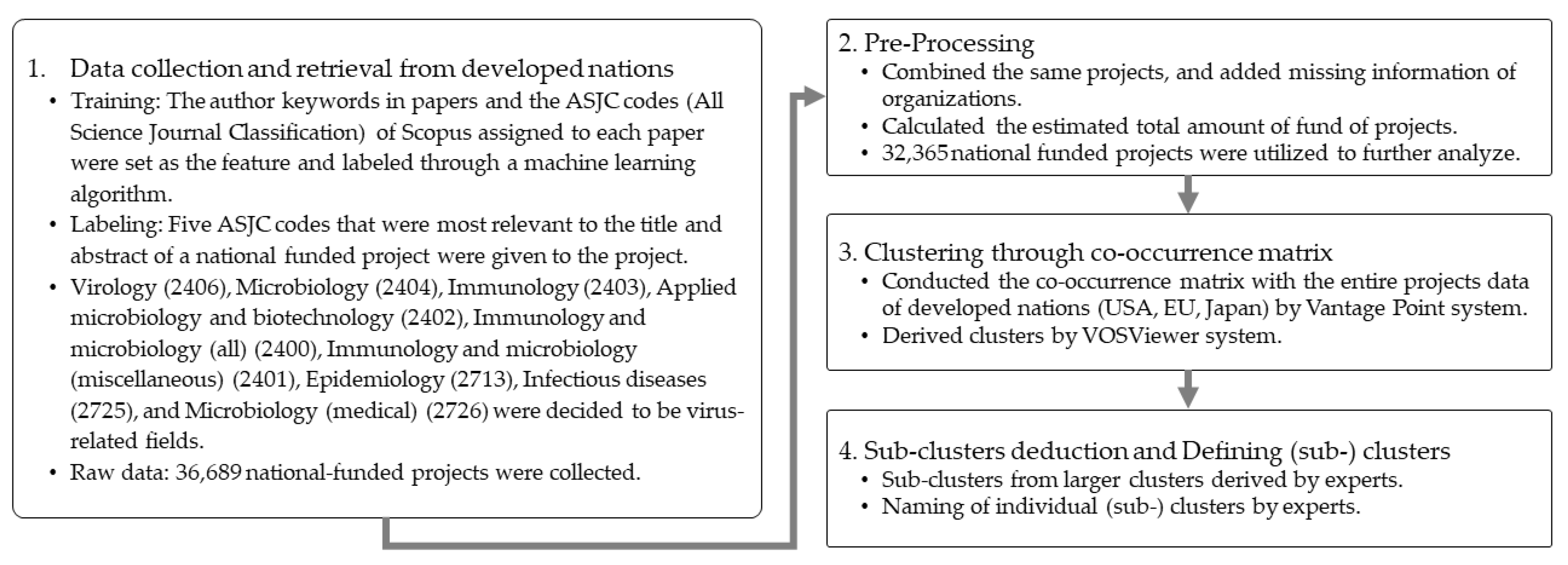
The network was built based on placing the degree of ASJC codes of projects into the co-occurrence matrix of projects. All nodes in the network were displayed under the field titles of ASJC codes, and the font size is related to the frequency of co-occurrence of each ASJC code. By visualizing this network structure, we can figure out the relationship between ASJC codes. The VOSViewer (Version 1.6.15, Leiden University, Leiden, The Netherlands) software was used as a network structure visualization tool and is widely used in bibliometric analyses, especially in cluster analyses [29]. The first step for constructing a map is to calculate the similarity matrix as input. The similarity matrix can be obtained from a co-occurrence matrix. The second step is to layout ASJC codes on the map based on the similarity matrix. ASJC codes that have a high similarity should be located close to each other, while ASJC codes that have a low similarity should be located far from each other. The VOS mapping technique is to minimize a weighted sum of the squared Euclidean distance between all pairs of ASJC codes. The higher the similarity between the two ASJC codes, the higher the weight of their squared distance in the summation. The constraint is imposed that the average distance between two ASJC codes must be equal to one in order to avoid trivial maps in which all ASJC codes have the same location. To solve the problem, VOSviewer employed that minimization of the objective functions is performed subject to the constraint. The constrained optimization problem is first converted into an unconstrained optimization problem. The latter problem is then solved using a majorization algorithm [30]. The resulting visualizations show the clustering of relevant multiple disciplines representing major research areas. The constructed clusters were initially conducted, and then more sub-clusters were derived from larger clusters through using the two types of software, as mentioned above. The definition of virology-related R&D areas can only be seen by looking directly at the R&D projects that were composed of actual clusters or sub-clusters through virology-related experts who can provide relevant knowledge and expertise for investigating particular research fields. Therefore, we first ascertained the approximate R&D area by grasping the component ASJC codes constituting each sub-cluster. After that, the contents of the titles and abstracts of the projects in the sub-clusters were checked, and the research fields of each sub-cluster were defined. In order to compare countries, the estimated total amount of funding for the US, EU and Japan’s projects in each (sub-) cluster were calculated individually, and a comparative ratio analysis was conducted to derive implications of the commonalities and differences between the US, EU, and Japan in virology-related research areas from an interdisciplinary perspective. The entire process is depicted in Figure 1.
Figure 1.
The workflow of collection of virology-related national-funded projects.
3. Results
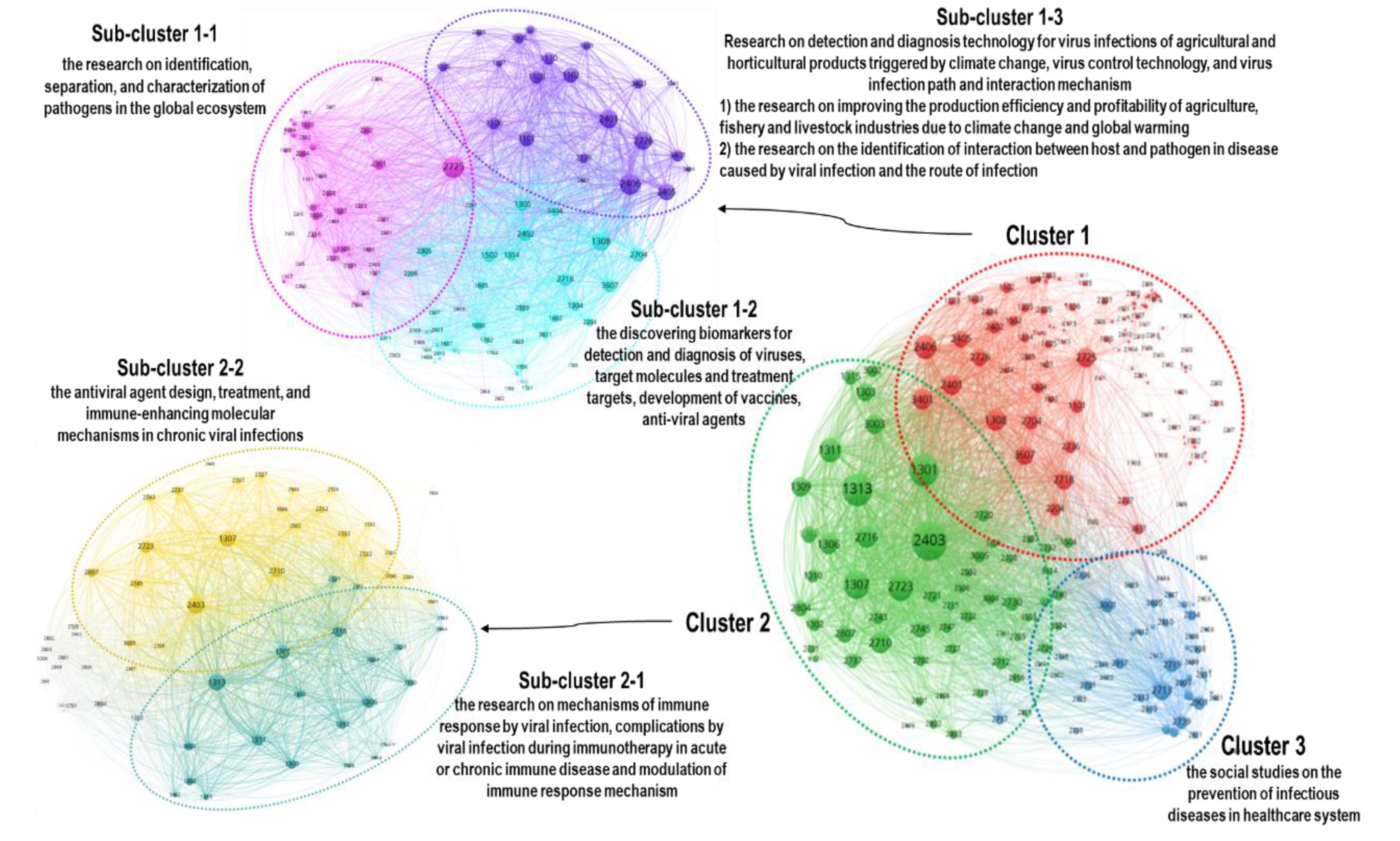
The network visualization of virology-related research fields is shown in Figure 2. In this study, an item (sometimes called a node) that is treated as the object of interest, is a discipline that is measured by an ASJC code. A link (sometimes called an edge), which implies a relationship between two items, is a co-occurrence link between disciplines (ASJC codes). The strength (sometimes called weight) of a link may, in this study, indicate the number of projects in which two disciplines (ASJC codes) occur together. The size of the label and the circles of a discipline (an ASJC code) is determined by the weight of the discipline. The higher the weight of a discipline (an ASJC code), the larger the label and the circles of a discipline (an ASJC code). The color of a discipline (an ASJC code) is determined by the cluster to which the discipline (the ASJC code) belongs. The broad spectrum of virology-related projects in cluster 1 can be considered part of the “One Health” perspective, which recognizes the interconnection/interactions between people, animals, plants, and their shared environment [31], and are conducted chiefly based on Infectious Diseases (2725), Virology (2406), and Clinical Biochemistry (1308). Research based on the viruses that exist on the Earth from a global ecosystem’s viewpoint is grouped under the sub-cluster 1-1. Research on vaccines for livestock, plant, and humans is grouped in the sub-cluster 1-2. There are two topics in the sub-cluster 1-3. One is associated with the efficient production of agriculture, fishery, and livestock under climate change and global warming. The other is related to research on viral infections that caused harmful productions. Thus, we labeled cluster 1-1, cluster 1-2, and cluster 1-3 as, “The research on identification, separation, and characterization of pathogens in the global ecosystem (sub-cluster 1-1)”, “The discovery of biomarkers for detection and diagnosis of viruses, target molecules and treatment targets, development of vaccines, and anti-viral agents (sub-cluster 1-2)”, and “Research on detection and diagnosis technology for virus infections of agricultural and horticultural products triggered by climate change, virus control technology, and virus infection path and interaction mechanism (sub-cluster 1-3)”, respectively. Two topics in the sub-cluster 1-3 were named, “The research on improving the production efficiency and profitability of agriculture, fishery, and livestock industries due to climate change and global warming (sub-cluster 1-3-1)” and “The research on the identification of the interaction between host and pathogen in disease caused by viral infections and the route of infection (sub-cluster 1-3-2)”, respectively.
Figure 2.
(Sub-) clusters of virology-related research fields.
The research on the immunosuppression for viral infected patients and that on traditional virology such as HIV, HSV, and HPV was linked to the cluster 2-1 and 2-1, respectively. Moreover, nationally funded projects in cluster 2 were generally carried out in terms of Molecular Medicine (1313), Immunology (2403), Biochemistry, Genetics and Molecular biology (1301). Thus, sub-cluster 2-1 was named, “The research on mechanisms of immune response by viral infection, complications by viral infection during immunotherapy in acute or chronic immune disease, and modulation of immune response mechanism.” Sub-cluster 2-2 was titled “Antiviral agent design, treatment, and immune-enhancing molecular mechanisms in chronic viral infections.”
In the cluster 3, there were some research topics that were related to the prevention of infectious diseases in the home care and management of patients, and patient care environment, hygiene, public health policy, management, and education and that was closely associated with Epidemiology (2713), Health Policy (2719), Public Health, Environmental and Occupational Health (2739), thereby incurring the name, “Social studies on the prevention of infectious diseases in healthcare system.” In the next subsection, detailed investigations for each cluster will be described.
3.1. Research Areas on Virology-Related National-Funded Projects of the US, EU, and Japan

3.1.1. The Research on Identification, Separation, and Characterization of Pathogens in the Global Ecosystem (sub-cluster 1-1)
The research on identification, separation, and characterization of pathogens in the global ecosystem (sub-cluster 1-1) is composed of 91 projects worth a total of $73,783,379.
The nationally represented funded projects are shown in Table 2. For example, the University of California Berkeley in the US spent $339,706 per year on the project titled, Engineering a Stable Water Microbiome in Direct Potable Reuse Distribution Systems between 2018–2021. The Woods Hole Oceanographic Institution in the US also conducted the project, Trace Element organic speciation along the US GEOTRACES Pacific Meridional Transect, spending $531,124 per year between 2018–2020. Meanwhile, Columbia University and Little Big Horn College completed their projects, Supply and Removal of Trace Elements in the Subtropical South Pacific between 2015–2016 and Particle Associated Livestock Pathogens in Surface Waters between 2017–2018, respectively.
Table 2.
The research on identification, separation, and characterization of pathogens in the global ecosystem (sub-cluster 1-1).
3.1.2. The Discovering Biomarkers for Detection and Diagnosis of Viruses, Target Molecules and Treatment Targets, Development of Vaccines, and Anti-Viral Agents (sub-cluster 1-2).
The discovering biomarkers for detection and diagnosis of viruses, target molecules and treatment targets, development of vaccines, anti-viral agents (sub-cluster 1-2) comprised of 67 projects worth $35,596,415. The representative nationally funded projects are indicated in Table 3. In the US, the CrossLife Technologies Inc. and Instadiagnostics Inc. committed to spending $224,929 yearly on their study of SBIR Phase I Rapid instrument free Nucleic Acid Test for Pathogens and Biothreats from 2017–2018 and $814,123 on SBIR Phase II Development of a Rapid Point of Care Diagnostic Technology Platform with the Diagnosis of Liver Cancer as the First Application between 2017–2019. In Japan, Nippon Veterinary and Life Science University finished The Development of Specific Anti-Coronavirus Drugs Using the Novel Glycosidase Inhibitors, spending $144,000 between 2016–2019. In the EU, The University of Warwick worked on a $110,023 project titled The Development of a Diamond-Based Nanopore Sensor for the Detection and Identification of DNA between 2014–2017. In Japan, Kobe Pharmaceutical University’s Efficient Creation of High-Performance Variant Antibody to a 1 Virions Direct Fluorescence Detection of Antibody Display Phage Keyed project had expenditures of $48,100 per year between 2016–2019.
Table 3.
The discovering biomarkers for detection and diagnosis of viruses, targeted molecules and treatment targets, development of vaccines, anti-viral agents (sub-cluster 1-2).
3.1.3. Research on Detection and Diagnosis Technology for Virus Infections of Agricultural and Horticultural Products Triggered by Climate Change, Virus Control Technology, and Virus Infection Path and Interaction Mechanism (sub-cluster 1-3)
Research on detection and diagnosis technology for virus infections of agricultural and horticultural products triggered by climate change, virus control technology, and virus infection path and interaction mechanism (sub-cluster 1-3) is composed of 107 projects worth $306,727,248 and may be divided into two topics: (1) research on improving the production efficiency and profitability of agriculture, fishery, and livestock industries due to climate change and global warming (sub-cluster 1-3-1); and (2) the research on the identification of interaction between host and pathogen in diseases caused by viral infections and the route of infection (sub-cluster 1-3-2).
The nationally represented funded projects of sub-cluster 1-3-1 are indicated in Table 4. In the US, the University of California, Riverside and Agricultural Research Service committed to spending $4 million per year on their study of Effectoromics of the Huanglongbing (HLB)-associated Pathogen from 2016–2021 and $3 million per year on Molecular Identification and Characterization of Bacterial and Viral Pathogens Associated with Foods between 2016–2021. In the EU, Wageningen University’s project, Targeted Disease Prophylaxis in European Fish Farming had expenditures of $1,885,337 per year between 2012–2017. It launched another project in 2017 titled, Program for Innovative Global Prevention of Streptococcus suis, with expenditures of $1,169,556 per year and is expected to be completed in 2021.
Table 4.
The research of improving the production efficiency and profitability of agriculture, fishery, and livestock industries due to climate change and global warming (sub-cluster 1-3-1).
The nationally funded projects represented in sub-cluster 1-3-2 are shown in Table 5. In the US, the Agricultural Research Service participated in the project, Biology Epidemiology and Management of Vector-Borne Viruses of Sugarbeet and Vegetable Crops with an expenditure of $2,445,554 per year between 2012–2017. It joined again for another project entitled, Identification Evaluation and Implementation of Biological Control Agents for Invasive Weeds of Southeastern Ecosystems spending $2.4 million per year between 2015–2020. In addition, Stanford University just finished its project, Mosquitoes meet Microfluidics: Novel Tools for Ecological Surveillance of Insect-Borne Disease with expenditures of $2.2 million per year between 2015. In Japan, The Forestry and Forest Products Research Institute’s project, the Elucidation of Factors in the Expansion of the Distribution Range and Population Size of the Socially Parasitic Hornet Vespa dybowskii at a cost of $50,700 per year between 2013–2016.
Table 5.
The research on the identification of interaction between host and pathogen in disease caused by viral infections and the routes of infection (sub-cluster 1-3-2).
3.1.4. The Research on Mechanisms of Immune Responses from Viral Infections, Complications by Viral Infections during Immunotherapy in Acute or Chronic Immune Diseases, and Modulation of Immune Response Mechanisms (sub-cluster 2-1).
The research on mechanisms of immune responses from a viral infection, complications by viral infection during immunotherapy in acute or chronic immune disease, and modulation of immune response mechanisms (sub-cluster 2-1) is composed of 271 projects worth $310,525,685. The nationally representative funded projects are indicated in Table 6. In the US, the Ohio State University and the Mayo Clinic committed to spending $344,230 per year on their studies of Modulation of Hormonal and Systemic Immunity by Hormonal Contraceptive Use from 2013-2018 and spent $1.5 million each year from 2015-2018 on their study Targeting Selective Gut Microbiome and their Metabolites for Therapeutic and Pathogenic Potential in Rheumatoid Arthritis. In the EU, Academisch Medisch Centrum completed a $2,243,984 per year project entitled, An Innovative Causal Therapy for Allergy: Safe and Rapid Induction of an Anti-Inflammatory Immune Response Using a Mutant Hypoallergen and Vitamin D3 between 2014–2019.
Table 6.
The research on mechanisms of immune response by viral infection, complications by viral infection during immunotherapy in acute or chronic immune disease, and modulation of immune response mechanism (sub-cluster 2-1).
3.1.5. The Antiviral Agent Design, Treatment, and Immune-Enhancing Molecular Mechanisms in Chronic Viral Infections (sub-cluster 2-2).
The antiviral agent design, treatment, and immune-enhancing molecular mechanisms in chronic viral infections research (sub-cluster 2-2) is comprised of 415 projects worth $486,769,774. The nationally representative funded projects are indicated in Table 7. In the US, the Dana-Farber Cancer Institute recently completed the Biochemical Mechanism of HIV DNA Integration project with expenditures of $562,169 per year between 2015–2020. In Japan, Hokkaido University finished the Novel Molecular Mechanisms of Antiviral Innate Immune Response, spending $53,300 per year and $144,000 per year between 2012–2015. In the EU, the Alma Mater Studiorum—Università di Bologna and Università degli Studi di Padova committed to spending $579,699 per year on their study of Oncolytic Herpesviruses Retargeted to Cancer Specific Receptors from 2014–2019 and spent $465,536 per year on G-Quadruplexes in the HIV1 Genome: Novel Targets for the Development of Selective Antiviral Drugs between 2014–2019.
Table 7.
The antiviral agent design, treatment, and immune-enhancing molecular mechanisms in chronic viral infections (sub-cluster 2-2).
3.1.6. Social Studies for the Prevention of Infectious Diseases in Healthcare Systems (cluster 3).
The social studies for the prevention of infectious diseases in healthcare systems (cluster 3) had 134 projects totaling $210,907,552. The nationally represented funded projects are indicated in Table 8. In the US, the Georgia Tech Research Corporation and the University of California, Irvine participated in the same research areas with their project titled, SCH INT Collaborative Research Smart Intervention Strategies for Hepatitis C Elimination with expenditures of $407,272 per year between 2017–2021 and Protect Trial Protecting Nursing Home Residents from Infections and Readmissions with costs of $2.3 million per year between 2015–2020, respectively. Prefectural University of Hiroshima’s project, Construction of Patient Hand Hygiene Promotion Strategy for the Healthcare-Associated Infection Baden Decrease spent $131,300 each year between 2013–2017.
Table 8.
The social studies on the prevention of infectious diseases in healthcare systems (cluster 3).
3.2. Comparison Among the US, EU, and Japan
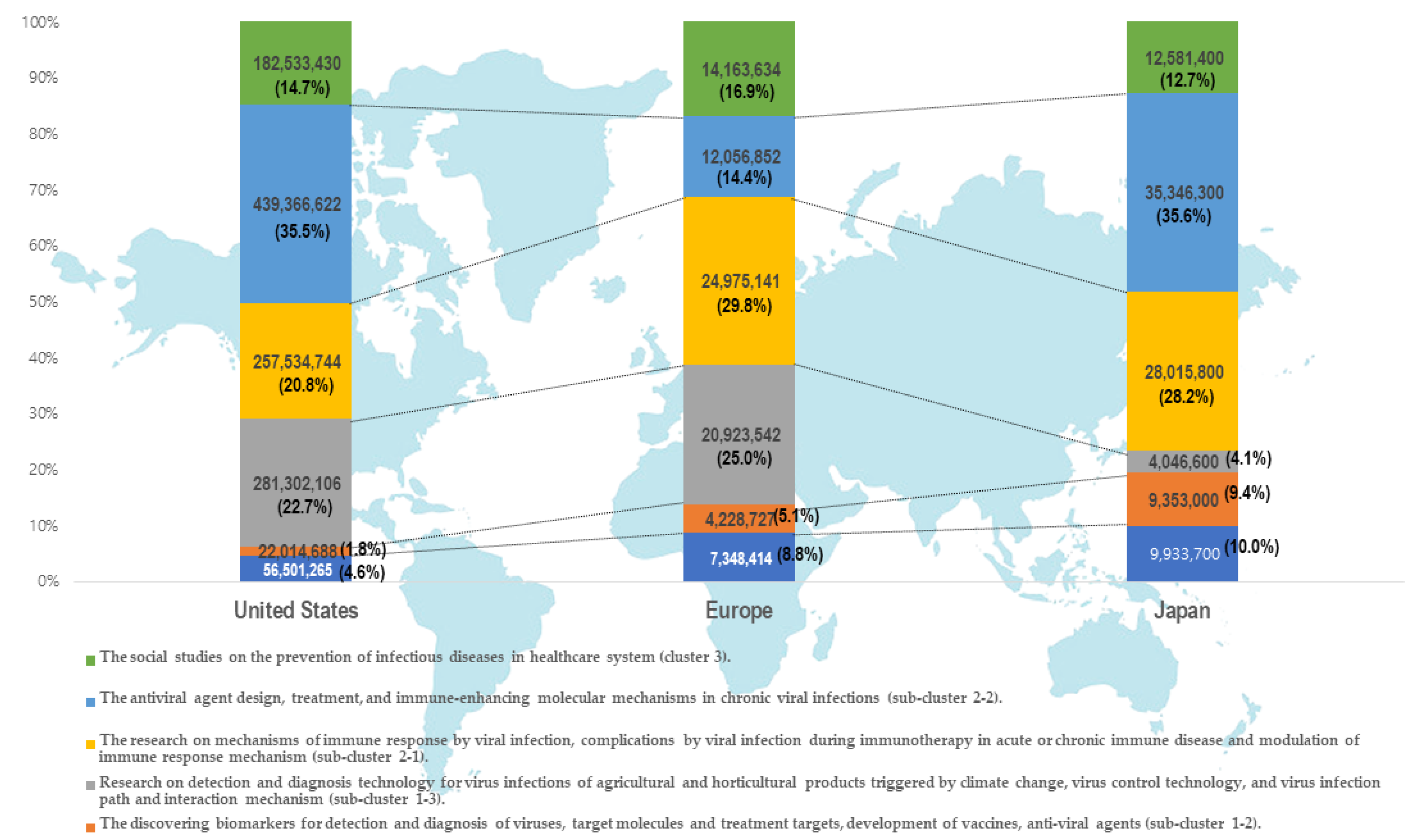
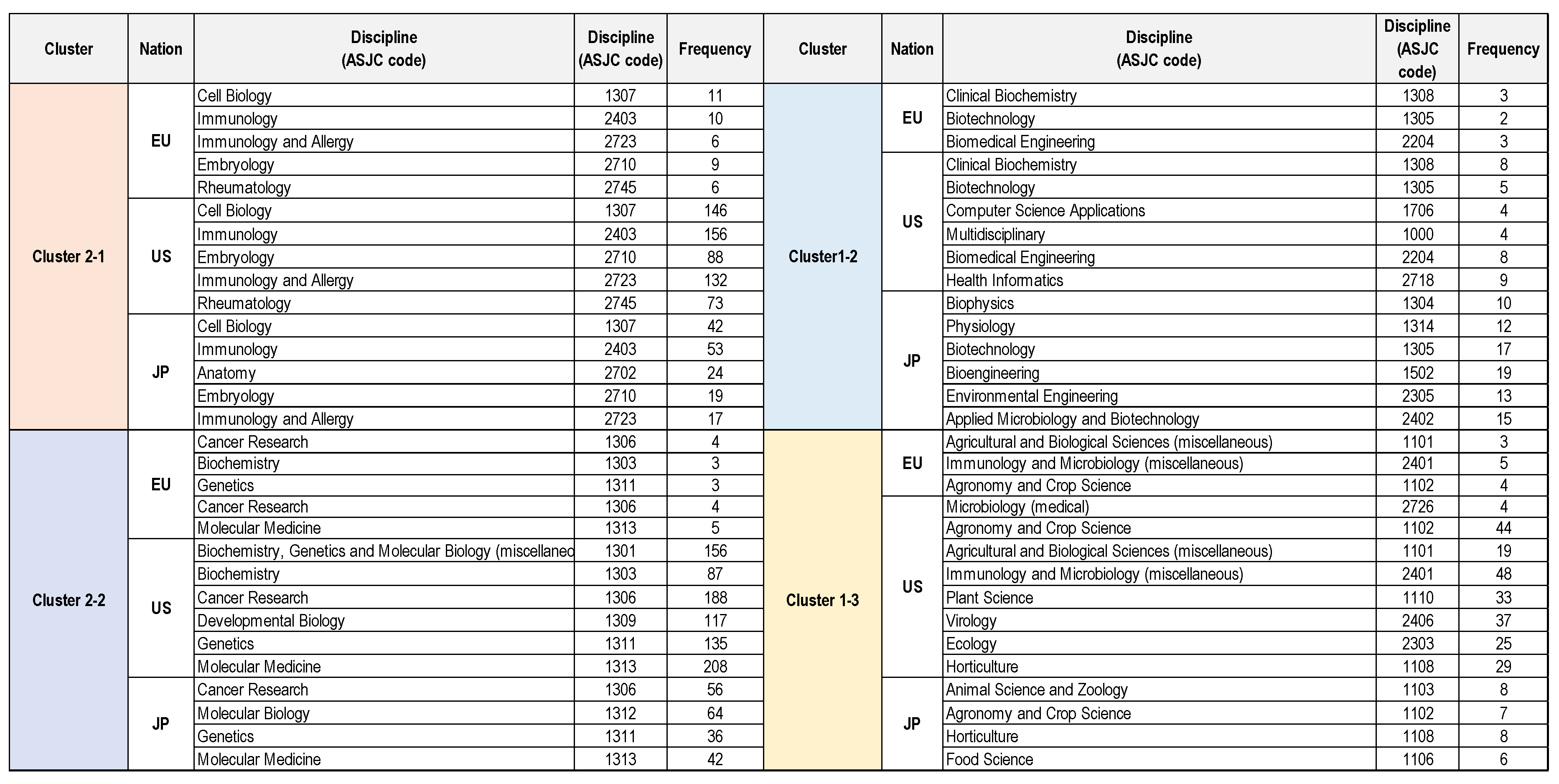
The estimated total R&D project funding of virology-related research fields and the frequency of disciplines (ASJC codes) of (sub-) clusters of virology-related research areas among the US, EU, and Japan are shown in Figure 3 and Figure 4, respectively.
Figure 3.
Estimated total R&D project funding of virology-related research fields among the US, EU, and Japan.
Figure 4.
The frequency of disciplines (ASJC codes) of (sub-) clusters of virology-related research areas.
The US and EU share the same interest in cluster 2. However, the US has heavily invested in research in cluster 2-2 (35.5%), which is specifically related to cancers and chronic viral diseases such as (HIV, HSV, HPV, HBV, HCV, etc.). When taking a closer look at the characteristics of disciplines (see Figure 4), the major disciplines of cluster 2-1 and cluster 2-2 are Immunology (2403), Cell Biology (1307), Immunology and Allergy (2723) and Cancer Research (1306), Biochemistry, Genetics and Molecular Biology (1301), and Molecular Medicine (1313), respectively. The EU has also shown a concentrated investment pattern in cluster 2, but unlike the United States, it invested mostly in cluster 2-1 (29.8%), or research areas for immune response regulations and control mechanisms as a policy for investment in research and development in response to viruses. In addition, the EU’s ratio of research areas for (sub-) cluster 1 and cluster 3 are evenly distributed compared to that of the US, which reflects the characteristics of balanced R&D funding. After taking these results into consideration, it is obvious that the US is unrivaled in the research area of immune responses to viral infections, control of immune responses and complications stemming from infections during immunologic inhibition therapy for chronic virus diseases; and antiviral preparation design, treatment, and immune-enhancing molecular mechanisms in chronic viral infections.
Meanwhile, the ratio of research areas of (sub-) cluster 1 and cluster 3 of the EU are evenly distributed compared to that of the US, which reflects the characteristics of balanced R&D funding that oriented on a common agenda as a nation. Although the funding patterns of research areas of Japan are likely to follow those of the US, there are two main differences compared to the US. The first one is that various projects in the cluster 1-3 of the US and EU were carried out on the basis of Agronomy and Crop Science (1102) and Agricultural and Biological Sciences (1101). Japan primarily investigated different disciplines such as Animal Science and Zoology (ASJC: 1103), Horticulture (ASJC: 1108), Food Science (ASJC: 1106). The other main difference is that many Japanese government-supported projects in cluster 1-2 were mostly fulfilled in terms of Bioengineering (1502), Biotechnology (1305), Applied Microbiology and Biotechnology (2402), Biophysics (1304) rather than focusing on Clinical Biochemistry (1308) and Biomedical Engineering (2204) like those of the US.
4. Discussions and Conclusions
It cannot be emphasized enough, that a better understanding of virology-related research is the fundamental weapon that protects us from future pandemics. From the viewpoint of virology-related experts who decide what to investigate, definitions of virology-related research areas may be varied, which may cause a disagreement as to what is the consensus on generally accepted R&D investment fields. Thus, the purpose of this study was to clarify virology-related research areas by analyzing nationally funded projects in leading nations since 2012, thereby providing evidence-based information to guide strategic global collaboration in time for the next pandemic.
The present study presents two important outcomes. The first one is that we demonstrated how to operationalize the procedure for identifying research areas where nations may be invested based on virology-related national funding data. Virology-related research is acknowledged as playing a fundamental role in protecting humanity from many critical infectious diseases. However, there is no consensus on generally accepted virology-related research fields, so researchers and decision-makers are confused when trying to establish strategies and policies. The result of the analysis explicitly verifies seven government-funded key research topics in the virology-related domains, indicates the core organizations in the main research areas for each nation, and induces the necessity for global collaboration based on the comparative analysis of nations. The procedure has the potential to be applied to any national science policies that are based on nationally funded projects. It is in line with the current trend of funding data-based research policies emphasized by prestigious scholars in science policy [19] and lays the groundwork for national science policies toward the global collaboration project. It can eventually improve the authority and legitimacy between stakeholders, including research experts, scientific advisors, and policymakers, who particularly work on controversial topics such as climate change, pandemics, and cyber-security, during the policy establishment process, thereby increasing their commitment to the policy implementation [22].
The other important outcome from this study is that this research enables research directors and/or policy decision-makers to debate the status quo of virology-related research areas at various levels. Thus, the results allow them to consider the framework for examining particular R&D issues on a micro level. For instance, an organization and/or a nation that is interested in vaccines for viral diseases may deliberate an R&D strategy using the information clusters. Moreover, they provide useful information in order to discuss the overarching goals of achieving a global defense strategy for the next pandemic on the basis of the comparative analysis. Our results indicate that the US has built national competitiveness in cluster 2. In contrast, the EU and Japan have relatively competitive edges in the social studies domains for the prevention of infectious diseases in healthcare systems (cluster 3) and discovering biomarkers for the detection and diagnosis of viruses, targeting molecules and treatment targets, the development of vaccines and anti-viral agents (sub-cluster 1-2), respectively. In a situation requiring exorbitant amounts of funding for taming the current coronavirus crisis and defending (re-) emerging potential lethal viruses, there is a need to establish a collaborative research policy that may accomplish the desired purpose of securing global human health and well-being; this may be accelerated by this study. As a consequence, this study may not only harmonize the operational and financial strategies in support of leading countries, increasing their efficiency and reducing the burden on countries, but it may also strengthen the collaboration among nations for better health to promote sustainability.
The limitations of this study present some challenging questions for future research. One inherent limitation concerns the US dataset that ranked the top shares of worldwide R&D expenditures rather than by country. Therefore, it causes a “home advantage” effect that underestimates the R&D activities of organizations operating outside of the home country due to the massive-scale funding data of the US, as Criscuolo [32] pointed out. It is desirable to collect more funding data from individual members of the EU, China, and South Korea in order to conduct a better comparative analysis among nations. The other limitation is that various cluster tools such as NetMiner, CiteSpace, and HistCite exist in the bibliometric research field. Each tool was developed by different, but similar algorithms so that it provides different clusters of closely associated items. Thus, it would be useful to examine a comparative study of the aforementioned tools.
Author Contributions
Conceptualization, D.L.; data curation, D.L.; formal analysis, D.L.; funding acquisition, K.K.; investigation, D.L.; methodology, J.K.; project administration, K.K.; resources, J.K.; software, J.K.; supervision, K.K.; validation, K.K.; visualization, J.K. and K.K.; writing—original draft, D.L. and K.K.; writing—review and editing, K.K. All authors have read and agreed to the published version of the manuscript.
Funding
This work was supported by the Korea Institute of Science and Technology Information (KISTI) granted by the Korean government (No. K-20-L03-C03-S01).
Conflicts of Interest
The authors declare no conflict of interest.
References
- COVID-19 Map—Johns Hopkins Coronavirus Resource Center. Available online: https://coronavirus.jhu.edu/map.html (accessed on 7 June 2020).
- World Economic Forum: $82 Trillion over 5 Years? Cambridge Study Counts the Cost of Coronavirus—CJBS Insight. Available online: https://insight.jbs.cam.ac.uk/2020/world-economic-forum-82-trillion-over-5-years-cambridge-study-counts-the-cost-of-coronavirus/ (accessed on 15 June 2020).
- Samp, T.; Phillips, S.R.; Bell, N.J. US $2T Stimulus COVID-19 Package Includes Significant R&D Funding, DLA Piper Global Law Firm. Available online: https://www.dlapiper.com/en/us/insights/publications/2020/04/us-2t-stimulus-covid-19-package-includes-significant-randd-funding/ (accessed on 3 June 2020).
- Azoulay, P.; Jones, B. Beat COVID-19 through Innovation. Science 2020, 368, 553. [Google Scholar] [CrossRef] [PubMed]
- Bogich, T.L.; Chunara, R.; Scales, D.; Chan, E.; Pinheiro, L.C.; Chmura, A.A.; Carroll, D.; Daszak, P.; Brownstein, J.S. Preventing Pandemics Via International Development: A Systems Approach. PLoS Med. 2012, 9, e1001354. [Google Scholar] [CrossRef] [PubMed]
- Peeri, N.C.; Shrestha, N.; Rahman, M.S.; Zaki, R.; Tan, Z.; Bibi, S.; Baghbanzadeh, M.; Aghamohammadi, N.; Zhang, W.; Haque, U. The SARS, MERS and Novel Coronavirus (COVID-19) Epidemics, the Newest and Biggest Global Health Threats: What Lessons Have We Learned? Int. J. Epidemiol. 2020, 49, 717–726. [Google Scholar] [CrossRef] [PubMed]
- Mims, C.A. Virology Research and Virulent Human Pandemics. Epidemiol. Infect. 1995, 115, 377–386. [Google Scholar] [CrossRef][Green Version]
- Diamond, M.S. Preparing for the Next Epidemic with Basic Virology. PLOS Pathog. 2015, 11, e1005182. [Google Scholar] [CrossRef]
- Carlson, C.J. From PREDICT to Prevention, One Pandemic Later. Lancet Microbe 2020, 1, e6–e7. [Google Scholar] [CrossRef]
- Oldstone, M.B.A.; Levine, A.J. Virology in the Next Millennium. Cell 2000, 100, 139–142. [Google Scholar] [CrossRef][Green Version]
- Coker, R.; Rushton, J.; Mounier-Jack, S.; Karimuribo, E.; Lutumba, P.; Kambarage, D.; Pfeiffer, D.U.; Stärk, K.; Rweyemamu, M. Towards a Conceptual Framework to Support One-Health Research for Policy on Emerging Zoonoses. Lancet Infect. Dis. 2011, 11, 326–331. [Google Scholar] [CrossRef]
- Destoumieux-Garzón, D.; Mavingui, P.; Boetsch, G.; Boissier, J.; Darriet, F.; Duboz, P.; Fritsch, C.; Giraudoux, P.; Le Roux, F.; Morand, S.; et al. The One Health Concept: 10 Years Old and a Long Road Ahead. Front. Vet. Sci. 2018, 5, 14. [Google Scholar] [CrossRef]
- Gates, B. Responding to Covid-19—A Once-in-a-Century Pandemic? N. Engl. J. Med. 2020, 382, 1677–1679. [Google Scholar] [CrossRef]
- Virology—Latest Research and News. Nature. Available online: https://www.nature.com/subjects/virology (accessed on 1 June 2020).
- Ruiz-Saenz, J.; Martinez-Gutierrez, M. Virology Research in a Latin American Developing Country: A Bibliometric Analysis of Virology in Colombia (2000–2013). J. Infect. Dev. Ctries. 2015, 9, 1226–1237. [Google Scholar] [CrossRef] [PubMed]
- Carter, J.B.; Saunders, V.A. Virology: Principles and Applications; John Wiley & Sons: Chichester, UK; Hoboken, NJ, USA, 2007. [Google Scholar]
- Vergidis, P.I.; Karavasiou, A.I.; Paraschakis, K.; Bliziotis, I.A.; Falagas, M.E. Bibliometric Analysis of Global Trends for Research Productivity in Microbiology. Eur. J. Clin. Microbiol. Infect. Dis. 2005, 24, 342–346. [Google Scholar] [CrossRef] [PubMed]
- Richardson, M. A decade’s Trends in Virology Research. Available online: https://www.researchtrends.com/issue-38-september-2014/a-decades-trends-in-virology-research/ (accessed on 3 June 2020).
- Rotolo, D.; Hicks, D.; Martin, B.R. What Is an Emerging Technology? Res. Policy 2015, 44, 1827–1843. [Google Scholar] [CrossRef]
- Olesk, D.M. Epidemiology and the Delivery of Health Care Services—Methods and Applications, 3rd ed.; Springer: New York, NY, USA, 2009; ISBN 978-144-190-163-7. [Google Scholar]
- Wittmann, R.; Reuter, M. Strategic Planning: How to Deliver Maximum Value through Effective Business Strategy, 1st ed.; Kogan Page: London, UK, 2008; ISBN 978-074-645-233-9. [Google Scholar]
- Haas, P. When does power listen to truth? A constructivist approach to the policy process. J. Eur. Public Policy 2004, 11, 569–592. [Google Scholar] [CrossRef]
- Hough, M.; Jackson, J.; Bradford, B. Legitimacy, trust and compliance: An empirical test of procedural justice theory using the European social survey. In Legitimacy and Criminal Justice: An international Exploration; Tankebe, J., Liebling, A., Eds.; Oxford University Press: Oxford, UK, 2013. [Google Scholar]
- Heo; Kang; Kim. National Scientific Funding for Interdisciplinary Research: A Comparison Study of Infectious Diseases in the US and EU. Sustainability 2019, 11, 4120. [Google Scholar] [CrossRef]
- Science and Engineering Indicators. Available online: https://www.nsf.gov/statistics/seind/#tabs-1 (accessed on 3 June 2020).
- Scheffer, T.; Leser, U. Data Mining and Text Mining for Bioinformatics. In Proceedings of the European Workshop on Data Mining and Text Mining for Bioinformatics, Dubrovnik, Croatia, 22 September 2003. [Google Scholar]
- Cabral, B.P.; da Graça Derengowski Fonseca, M.; Mota, F.B. The Recent Landscape of Cancer Research Worldwide: A Bibliometric and Network Analysis. Oncotarget 2018, 9, 30474–30484. [Google Scholar] [CrossRef]
- Castor, K.; Mota, F.B.; da Silva, R.M.; Cabral, B.P.; Maciel, E.L.; de Almeida, I.N.; Arakaki-Sanchez, D.; Andrade, K.B.; Testov, V.; Vasilyeva, I.; et al. Mapping the Tuberculosis Scientific Landscape among BRICS Countries: A Bibliometric and Network Analysis. Mem. Inst. Oswaldo Cruz 2020, 115, e190342. [Google Scholar] [CrossRef]
- Shah, S.H.H.; Lei, S.; Ali, M.; Doronin, D.; Hussain, S.T. Prosumption: Bibliometric Analysis Using HistCite and VOSviewer. Kybernetes 2019, 49, 1020–1045. [Google Scholar] [CrossRef]
- Van Eck, N.J.; Waltman, L. Software Survey: VOSviewer, a Computer Program for Bibliometric Mapping. Scientometrics 2010, 84, 523–538. [Google Scholar] [CrossRef]
- Munyua, P.M.; Njenga, M.K.; Osoro, E.M.; Onyango, C.O.; Bitek, A.O.; Mwatondo, A.; Muturi, M.K.; Musee, N.; Bigogo, G.; Otiang, E.; et al. Successes and Challenges of the One Health Approach in Kenya over the Last Decade. BMC Public Health 2019, 19 (Suppl. S3), 465. [Google Scholar] [CrossRef]
- Criscuolo, P. The “Home Advantage” Effect and Patent Families. A Comparison of OECD Triadic Patents, the USPTO and the EPO. Scientometrics 2006, 66, 23–41. [Google Scholar] [CrossRef]
© 2020 by the authors. Licensee MDPI, Basel, Switzerland. This article is an open access article distributed under the terms and conditions of the Creative Commons Attribution (CC BY) license (http://creativecommons.org/licenses/by/4.0/).