


Abstract
This paper addresses a compensation scheme for self-employed bus service requisition of rural passenger transport, and provides a theoretical basis and policy recommendations for the smooth implementation of self-employed bus service requisition process and the integration of urban–rural passenger transport resources. Using Chinese urban–rural passenger transport systems in ten cities or counties (including Shenyang, Liaoyang, Wuxi, Suzhou, Laiwu, Zouping, Wuhu, Guangde, Shuangliu, and Fuyang) as research objects, the compensation scheme for self-employed bus service requisition is explored from three aspects: the construction of compensation model, the estimation of compensation amount, and the determination of compensation mode. The conclusions drawn from this study are summarized as follows: (1) The compensation amount consists of the bus service residual value, the compensation for expected profit in the residual operation period, and the awarded amount for signing compensation agreements. (2) Whether or not bus owners accept the compensation amount is closely related to their psychological expectation threshold. Changes in the average profit of the bus service, the driver’s average wage, and the ticket-seller’s wage, have the greatest impact, the second greatest impact, and the smallest impact on their psychological expectation threshold, respectively. (3) Younger and more highly educated owners tend to accept “monetary compensation and reemployment placement”, while older and low educated owners prefer “monetary compensation and social security”. (4) High compensation fees, providing reemployment placement for drivers and ticket-sellers, and implementing monetary compensation in the form of an “expected income dividend installment” can enhance willingness to sign compensation agreements for self-employed bus service.
1. Introduction
Most cities in China are experiencing rapid urbanization. In the process of urbanization, a series of problems occur, such as serious waste of resources, deterioration of the ecological environment, and traffic congestion, which affect the sustainable development of society [1]. With the rapid growth of urbanization in China, a large proportion of the rural labor force has been transferred to urban areas. The links between urban and rural areas have become increasingly close, and the passenger flow between urban and rural areas is increasing. The integration of urban–rural passenger transport is an important way to narrow the urban–rural economic gap, to better meet the travel needs of urban–rural residents, and to improve travel efficiency, which is essential to achieve energy saving, environmental protection, and sustainable development [2]. In recent years, the Chinese government has launched various reforms to vigorously support urban–rural passenger transport service and promote the reform of urban–rural passenger transport service system. In March 2003, the document “Notice on Accelerating the Development of Rural Passenger Transport and the Pilot Work of Rural Passenger Transport Networking”, issued by the Ministry of Communications, put forward that 13 cities or counties in seven provinces in the eastern, central and western regions of China had been selected as pilot areas to carry out pilot work on urban–rural passenger transport integration. In November 2016, the Ministry of Communications, the National Development and Reform Commission, and the Ministry of Public Security issued the document “Guiding Opinions on Steadily Promoting the Integration of Urban and Rural Passenger Transport to Improve the Level of Public Service”. The guiding opinions had proposed to integrate urban–rural passenger transport resources, promote the integration of decentralized self-employed bus operators, improve the public transport service level, and support the sustainable development of urban–rural passenger transport.
Throughout the development of the model urban–rural passenger transport in the USA, the highway network extending in all directions has created favorable conditions for people to travel, most of the highway passenger transport is served by private cars. Urban-inter-city passenger transport in the USA is operated by private enterprises, which is scheduled and operated regularly, and private enterprises are directly responsible to passengers via operators [3]. Contrary to the development model of the USA, in Japan and Western Europe, rail transit between urban and rural areas is relatively developed, and the passenger flow between urban and rural areas is notably facilitated by the rail transit [4]. Most of foreign scholars’ research on passenger transport between urban and rural areas has focused mainly on the connection system of rail transit and hub points, hoping to achieve the integration of urban–rural passenger transport through a rational layout of the rail network and highway network [5,6,7]. Besides, a few scholars studied the impact of other modes of passenger transport, such as air passenger transport, on long-distance passenger transport [8]. There is huge gap between the urban and rural economies in China. The development mode of urban–rural passenger transport in China is different from those of developed countries. Urban–rural passenger transport in China is mostly operated by self-employed bus service. The ownership and operation rights of these self-employed bus service belong to individuals, and therefore individuals can decide the starting time and interval of the bus lines. Chinese scholars are now focused on research on the planning and network layout of the integration of urban–rural passenger transport [2,9]. In addition, many scholars have carried out research on pricing and subsidies of urban and rural passenger transport service. In the field of pricing research, pricing methods aimed at maximizing social equity and maximizing social welfare are two main research concerns. Among them, the most widely used methods for maximizing social equity is the marginal cost pricing method [10,11] and price-cap regulation method [12,13]; the most widely used method for maximizing social welfare is the Ramsey pricing method [14,15,16]. Besides, some scholars used price elasticity form the demand analysis method [17,18,19,20]. In terms of subsidy research, the subsidy mechanism for urban and rural passenger transport was established, the subsidy scale and scheme were quantified or proposed [21,22,23,24,25,26].
On a nationwide basis, urban–rural passenger transport service in China is at the stage of transformation from self-employed bus operation mode to public and corporate operation mode. Through the investigation and survey in many places (Shenyang, Liaoyang, Wuxi, Suzhou, Laiwu, Zouping, Wuhu, Guangde, Shuangliu, and Fuyang, etc.), it has been found that in the process of urban–rural passenger transport integration, the first important issue to be solved is implementation of the requisition of self-employed bus services, and integration of the decentralized individual operators of rural passenger transport. In the process of the self-employed bus service requisition, government’ compensation scheme for self-employed bus owners in rural passenger transport is the key aspect [26]. Properly resetting the self-employed bus owners is essential to maintain the stability of urban–rural passenger transport integration [26]. The core issue of the compensation scheme for self-employed bus service requisition is to determine the compensation model, compensation amount and compensation mode, which is related to whether the self-employed bus owners are willing to accept the compensation scheme proposed by the government, whose rationality and fairness play a vital role in promoting the transformation process of the whole urban–rural passenger transport.
At present, most of the existing studies in this field focus on the pricing and subsidy mechanism after urban–rural passenger transport integration has occurred, and there is a lack of research on the compensation for the requisition of rural passenger bus service. Now, in the areas which have completed the transformation of urban–rural passenger transport, the compensation standards for self-employed bus service requisition have been formulated in accordance with the actual situation, directly provided financial compensation or reemployment opportunities, which do not form a complete theoretical system. Moreover, the existing compensation standards for self-employed bus service requisition in all regions are almost unilaterally formulated by the government. Bus owners do not directly participate in the compensation process, which usually results in low compensation standards, leading to resistance from bus owners and encouraging social conflicts. Only when the compensation scheme for self-employed bus service requisition meet the interests of bus owners, will they be willing to sign a compensation agreement, allowing the process of self-employed bus service requisition to smoothly progress. Therefore, this paper looks at the compensation for self-employed bus service requisition in rural passenger transport, provide a theoretical basis and policy recommendations for the government to formulate the compensation standards for self-employed bus service requisition, so as to guide the healthy and orderly development of urban–rural passenger transport integration.
In China, the phenomenon of urban–rural passenger transport integration emerges under specific circumstance, while most foreign countries do not have an implementation process for urban–rural passenger transport integration. To our knowledge, no scholar has studied the compensation scheme for self-employed bus service requisition so far. We have searched and collated the research literature on land requisition compensation [27,28,29], and concluded that there are some similarities between land requisitioned farmers and bus service requisitioned owners: (1) Land requisitioned farmers mainly use land revenues as their main economic source, and bus service requisitioned owners mainly use bus service revenues as their economic source. After land requisition or bus service requisition, their economic sources of income and means of survival are removed and they need to consider reemployment and life security in the future. (2) They have low skill and education levels, can only engage in simple jobs, which makes it more difficult to find a job after land requisition or bus service requisition has occurred, the nature of the work they can engage in is relatively singular. (3) They are both socially vulnerable groups, but compared with land requisitioned farmers, bus service requisitioned owners fare much better, especially the original drivers, who have specific livelihood skills. Therefore, drawing on the relevant research results of land requisitioned compensation [27,28,29] and vehicle recycling [30], this paper studies the compensation scheme for self-employed bus service requisition in rural passenger transport.
To explore the compensation scheme for self-employed bus service requisition in urban–rural passenger transport integration, the data set of the self-employed bus service requisition and compensation scheme covering ten cities or counties (including Shenyang, Liaoyang, Wuxi, Suzhou, Laiwu, Zouping, Wuhu, Guangde, Shuangliu, and Fuyang) in China has been studied. Besides, the data set of the individuals’ socio-economic characteristics has been obtained. The data that this paper uses is one of our contributions. This study explores the compensation scheme for self-employed bus service requisition from three aspects: the construction of compensation model, the estimation of compensation amount and the determination of compensation mode. This is an area of innovation in research issues contributed by this paper.
The paper is structured in five sections. Section 2 introduces the materials and methodologies for determining the compensation model, compensation amount, and compensation mode. An empirical analysis is elaborated in Section 3, where the data source and results analysis are presented. Section 4 presents some comments and policy implications. Finally, the main conclusions are summarized, and an outlook for future research is presented.
2. Materials and Methodologies
Our objective is to explore the compensation scheme for self-employed bus service requisitions in urban–rural passenger transport integration. The compensation schemes are mainly explored from the perspective of the compensation model, compensation amount, and compensation mode. In this section, based on non-cooperative game theory, the basic model of bus service requisition compensation is proposed; then, two improved compensation models, fixed and variable number of vehicles, are established to maximize the payoff for all parties. We also estimate the compensation amount, discuss psychological expectation threshold of bus owners and its sensitivity analysis. Besides, the compensation mode is investigated and analyzed. More details are given in the following sections. The roadmap of the compensation scheme for self-employed bus service is shown in Figure 1.
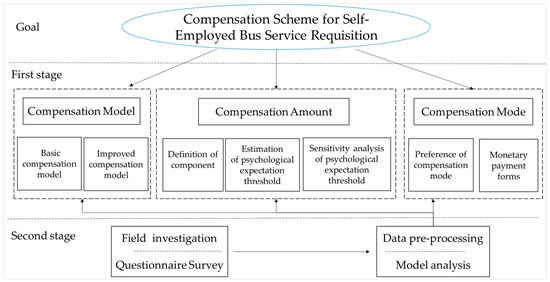
Figure 1.
Roadmap of the compensation scheme for self-employed bus service requisitions.
2.1. Construction of Compensation Model
2.1.1. Basic Compensation Model
The requisition process of self-employed bus services for rural passenger transport is actually a game between the government and bus owners. The government and bus owners represent different stakeholders, and they appear as two opposing interests in the requisition process of self-employed bus services. Therefore, based on non-cooperative game theory, this paper establishes the basic compensation model of self-employed bus services requisition. The two sides of the non-cooperative game are the government and bus owners, respectively. Non-cooperative game theory means that each participant independently proceeds from individual rationality and chooses the game so as to maximize their own interests, emphasizing individual rationality and individual optimal decision-making [31]. The outcome of the non-cooperative game may be efficient or inefficient. This theory mainly looks at how people make decisions to maximize their profits in situations where interests interact with each other.
In the process of urban–rural passenger transport integration, the government proposes the compensation for self-employed bus services requisition, and bus owners may choose to accept the compensation or not. Thus, assuming that the government’s compensation amount for self-employed bus service requisition is , the number of bus service requisition is , and the government’s revenue from bus services for other purposes after the requisition is . The bus owner’s investment in each bus is , which was completely destroyed after self-employed bus service requisition occurred. Furthermore, the compulsory requisition of self-employed bus service by the government may bring about certain social costs . These costs can be interpreted in reality as the protests of bus owners, public opinion, and criticism. The non-cooperative game between the government and the bus owners is shown in Table 1.

Table 1.
Non-cooperative game of self-employed bus services requisition compensation between the government and bus owners.
In the non-cooperative game model, if the government does not requisition self-employed bus service, the bus owner’s payoff is , and the government has no revenue. If the government requisitions self-employed bus service, no matter what strategy the bus owner adopts, the payoff of the bus owner is . However, the payoff of the government is different. In the case of the bus owner accepting the self-employed bus service requisition, the government’s payoff is . However, in the case that the owner does not accept the requisition, the government’s payoff is . In fact, can be regarded as the social cost of the acceptance degree of self-employed bus service requisition.
The management right of self-employed bus service for rural passenger transport belongs to the public, which can be enforced by the government. Therefore, when the government requisitions the self-employed bus service in rural passenger transport, the compensation strategy is only discussed. In order to control the cost and reduce the financial burden, the government certainly tries its best to reduce the cost of self-employed bus service requisition. Additionally, the government and bus owner represent different stakeholders. Thus, in this paper, a self-employed bus service requisition compensation model is established aimed at maximizing the benefits for different parties.
2.1.2. Improved Compensation Model
First, assuming that the purpose is to maximize the economic benefits after the self-employed bus service requisition, not to maximize the social benefits. That is, after the rural passenger bus services are requisitioned by the government, bus services that meet the operating conditions will be put into operation again, and the government will obtain the operating income to maximize it. To simplify the analysis, the following settings are used:
The parties of the game only include the government and bus owner.
- (1)
- represents the number of rural passenger bus requisitioned by the government. After the self-employed bus service requisition occurs, buses that meet the operating conditions will be put into operation again. After bus service are requisitioned by the government, the revenue of the bus services is , represents the average revenue of each bus after requisitioning.
- (2)
- represents the owner’s investment in each self-employed bus service. If the self-employed bus service is requisitioned by the government, all the investment will be completely destroyed.
- (3)
- The compensation amount given by the government for each self-employed bus service requisition is , which is the only cost paid by the government.
- (4)
- represents the social cost of each self-employed bus service requisition, where . If the owner fully accepts the compensation amount for the self-employed bus service requisition, then at this time.
According to the above assumptions, the payoff for the bus owner, the government, and society in the non-cooperative game are, respectively:
where, , and represent the payoff for the bus owner, the government, and society, respectively. is the sum of the bus owner’s and government’s payoffs.
• Fixed Number of Self-Employed Bus Requisitions
When the government implements a transformation of the rural passenger transport system, the goal is to achieve the maximum number of bus requisitions for which the compensation amount provided by the government is a certain amount, or to spend as less capital as possible to complete the requisition of all self-employed bus services. Thus, the requisition goals of the government refer to two scenarios.
When the government needs to requisition a fixed number of self-employed bus , the government can only adjust the compensation amount for bus service requisition. Under this circumstance, the compensation amount is discussed under the condition that the payoffs of the bus owner, the government, and society are all maximized.
(1) Maximizing the Bus Owner’s Payoff
By observing the bus owner’s payoff , it is found that the bus owner’s payoff increases with the increase of the compensation amount . Therefore, only when the compensation amount is the maximum value, can the bus owner’s payoff reach the maximum value. At the same time, the bus owner reduces loss by reducing the investment in the original operation of the bus service, thereby increasing the payoff.
(2) Maximizing the Government’s Payoff
The conditions for maximizing the government’s payoff are:
The calculation can be obtained by:
Equation (5) shows that the condition for maximizing the government’s payoff is that the social marginal cost of the self-employed bus service requisition is ; that is, the reduction of the social cost caused by the government increasing the compensation amount is exactly equal to the increase in the compensation amount .
(3) Maximizing the Social Payoff
The conditions for maximizing the social payoff are:
The calculation can be obtained by:
Equation (7) shows that the condition of maximizing social payoff is that the bus owner fully accepts the compensation amount ; that is, the condition of , is met at this time. It can be understood that the compensation amount for the bus service requisition proposed by the government meets the requirements of all bus owners. Due to the conditions of maximizing the government’s payoff and the social payoff, it is impossible to achieve these two conditions at the same time.
(4) Impact of Bus Owners on the Optimal Compensation Amount
According to the bus owner’s payoff , since the number of bus requisition is fixed, there are two ways to increase the bus owner’s payoff. The first way is by reducing the investment in the original bus service; the second is by forcing the government to change the optimal compensation amount by changing the social cost of bus service requisition. If the bus owner knows that his (or her) self-employed bus service is about to be requisitioned, the first way is likely to cause inefficient use of the bus service; however if the bus owner does not know that his (or her) self-employed bus service will be acquired, the first way is not relevant. Therefore, it is more practicable for bus owners to obtain a higher compensation amount to increase their payoff by adjusting the social cost when the government requisitions their self-employed bus services. In reality, bus owners often achieve this goal by way of rejecting the bus service requisition, appealing to higher authorities for help, and so on.
• Variable Number of Self-Employed Bus Requisitions
If the government can maximize the payoff by adjusting the compensation amount and the number of self-employed bus requisitions at the same time, the assumptions of the basic model need to be modified.
If the government compulsorily requisitions a self-employed bus service, the social cost will mainly consist of two parts: the social cost related to the compensation standard for the bus service requisition and the social cost related to the number of bus service requisitions, where , .
Then, the payoff for the bus owner, government, and society are as follows:
(1) Maximizing the Bus Owner’s Payoff
Equation (8) shows that when the number of self-employed bus requisitions is variable, if , the larger the value of and , the larger the bus owner’s payoff. If , the larger the value of , the smaller the value of , the larger the owner’s payoff.
(2) Maximizing the Government’s Payoff
The conditions for maximizing the government’s payoff are:
The calculation can be obtained as:
Formula (a) of Equation (12) is plugged into Formula (b), Equation (13) is got:
The partial derivative of Equation (13) can be obtained:
According to the hypothesis and , can be concluded. That is, as increases, the government’s optimal compensation amount for self-employed bus service requisitions will also rise. According to Equation (12), when the compensation amount increases, the number of self-employed bus requisition decreases accordingly.
(3) Maximizing the Social Payoff
The conditions for maximizing social revenue are:
The calculation can be obtained as:
Equation (16) shows that when the bus service requisition achieves the maximization of social payoff, the compensation amount for the bus service requisition should enable all bus owners to accept the bus service requisition, the compensation amount equals at this time. is plugged into Equation (16) in order to obtain . This shows that the optimal number of bus requisitioned by the government should make the social marginal cost equal to the gap between the average revenue after the bus service requisitions and the existing investment in the original bus services. The conditions of maximizing the government’s and social payoff mean that, these two conditions cannot be achieved at the same time.
(4) Impact of Bus Owners on the Optimal Compensation Amount
Since the number of bus requisitions is not fixed, bus owners can increase their own payoff in three ways. In addition to increasing the compensation amount and reducing the existing investment in the bus service, bus owners can also change the optimal number of bus requisitioned by the government to increase their payoff. When the compensation amount is greater than the existing investment , the bus owners should require the government to increase the number of bus requisition. When the compensation amount is less than the existing investment , the bus owners should require the government to decrease the number . As the compensation amount increases, and the number of vehicles acquired decreases, bus owner can double their earnings by forcing the government to increase the compensation amount for bus service requisitions. At the same time, bus owners can also achieve the same goal by adjusting the social cost of bus service requisition.
2.2. Estimation of Compensation Amount
2.2.1. Compensation Amount
Referring to the research results of the existing land requisition literature [27,28,29], combined with survey results from many places (such as Shenyang, Liaoyang, Huzhou, Wuxi, Suzhou, Laiwu, Zouping, Shuangliu, and Fuyang, etc.), the compensation amount for bus service requisitions is composed of three parts: the bus residual value , the compensation for expected profit in the residual operation period, and the awarded amount for signing compensation agreements, as shown in Figure 2.
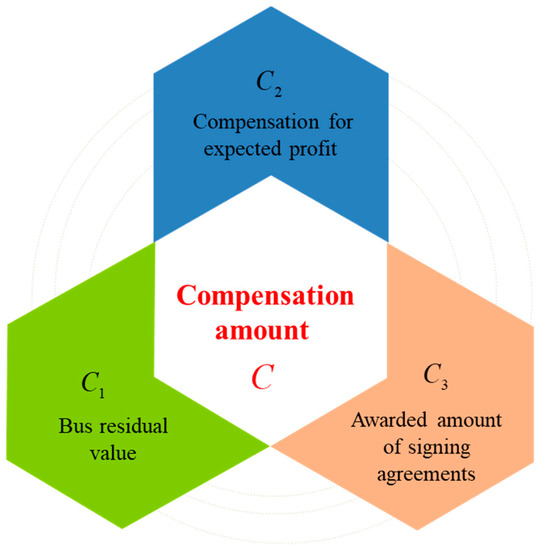
Figure 2.
Components of compensation amount for bus service requisitions.
The main factors affecting the bus service residual value are the purchasing price of the self-employed bus service, the residual use time of the bus service operations, and the bus condition (such as whether the certificate is complete, whether the technical condition is intact, etc). The residual value can be assessed and calculated by the local price departments or intermediaries with business qualification. The formula for calculating bus residual value is as follows:
The compensation for expected profit in the residual operation period is related to the average profit of the bus owners, while the profit of the bus owners is closely related to the size of the passenger flow of the bus lines for rural passenger transport (i.e., the cold and hotlines). It can be concluded that is closely related to the type of bus lines (the cold lines or the hotlines). Compared with the bus owners who operate the cold lines, the owners operating the hotlines have higher profit and expect to gain more compensation for expected profit in the operation period. Therefore, according to the type of bus line, is divided into two categories, and then bus owners are compensated according to these classifications. According to the passenger flow of bus line, the type of bus lines is divided by the department of bus industry. The formula of the compensation for the expected profit in the residual operation period is as follows:
where represents the residual time of the bus operation, for which the unit is month. and represent the expected average profit of the cold line and hotline in the residual operation period, respectively, for which the unit is ¥/month (the sign “¥” denotes “CNY”).
The award amount for signing the compensation agreement is divided into two parts: one is the one-time award , which is related to the time of signing the compensation agreement; the other is the reemployment transition subsidy , which is related to the time of signing the compensation agreement and the local minimum social wage standard. The formula of is as follows:
where and represent the one-time reward (¥) for signing the compensation agreement at time period and time period , respectively. is the time when the compensation agreement is issued. and represent the time limits stipulated by the government for signing the compensation agreement. is the minimum social wage standard (¥/month). and represent the transition period of reemployment selection (months). is the time of signing the compensation agreement by the bus owner.
The compensation amount for bus service requisitions can be obtained from Equations (17)–(19):
As can be seen from the above analysis, the compensation amount for bus service requisition is determined according to the type of the bus line and the time of signing the compensation agreement. This can be divided into the following six scenarios, as shown in Table 2.
Table 2.
The relationship between the type of bus lines, the time of signing the compensation agreement, and the compensation amount.
Scenario 1: When the bus line is the cold line and the time of signing the compensation is agreement , the bus owner obtains the compensation amount for the self-employed bus service requisition as follows:
Scenario 2: When the bus line is the cold line and the time of signing the compensation is agreement , the bus owner obtains the compensation amount as follows:
Scenario 3: When the bus line is the cold line and the time of signing the agreement is others, the bus owner obtains the compensation amount as follows:
Scenario 4: When the bus line is the hotline and the time of signing the agreement is , the bus owner obtains the compensation amount as follows:
Scenario 5: When the operation line is the hotline and the time of signing the agreement is , the owner obtains the compensation amount as follows:
Scenario 6: When the operation line is the hotline and the time of signing the agreement is others, the bus owner obtains the compensation amount as follows:
2.2.2. Estimation of Psychological Expectation Threshold
In theory, only when the compensation amount for self-employed bus service requisitions given by the government exceeds the psychological expectation threshold of the bus owner, is possible for the bus owners to sign the compensation agreement. If the compensation amount provided by the government is lower than the psychological expectation threshold , the requisition can only be completed through the government’s compulsory requisition. However, the compulsory requisition of rural passenger transport bus service is likely to cause an adverse social impact, and stimulate social contradictions and conflicts.
The psychological expectation threshold is related to the average profit of the bus service and the wages of the drivers and ticket-sellers after the bus service requisition. After the bus service requisition, the government guarantees the reemployment of the drivers and ticket-sellers, assuming that the driver’s wages for the original bus service are close to the average wages of drivers overall, and the ticket-seller’s wages for the original bus service are close to the average wage of employees overall. In the residual time of the bus service, . is calculated according to the following formula:
where represents the average monthly profit of the bus owner (¥/month). is the average driver’s salary (¥/month), and is the ticket-seller’s salary (¥/month). and represent the number of drivers and ticket-sellers allocated per bus, respectively. is the discount rate (%), . The average monthly profit is:
where is the average monthly revenue of the bus owner, which is mainly related to the passenger flow and fares. is the average monthly costs, which do not involve management costs for individually contracted bus services. Therefore, is mainly related to the fuel consumption, the maintenance costs, insurance costs, and other costs. and represent the passenger flow and the cost of the ith day, , is the total operating days of the current month.
Equation (28) is plugged into Equation (27), and Equation (29) is got. According to Equation (29), the psychological expectation threshold of the bus owner can be estimated.
2.2.3. Sensitivity Analysis of Psychological Expectation Threshold
According to Equation (27), the psychological expectation threshold is related to the average profit , the driver’s wage , and the ticket-seller’s wage after the bus service requisition. According to our survey, there is a huge gap among the average monthly profit of different bus owners; varies greatly. After the bus service requisition, the driver’s wage and the ticket-seller’s wage are closely related to the government’s compensation policy. Therefore, the sensitivity analysis between , , and is explored. Assuming that each bus is equipped with a driver and a ticket-seller.
(1) Sensitivity Analysis between and
If the percentage of the change in is , the change in is as follows:
(2) Sensitivity Analysis between and
If the percentage of the change in is , the change in is as follows:
(3) Sensitivity Analysis between and
If the percentage of the change in is , the change in is as follows:
2.3. Determination of Compensation Mode
After determining the compensation amount for the bus service requisition, another important problem to be solved is which kind of compensation modes should be adopted to distribute the compensation amount, so as to ensure the smooth progress of urban–rural passenger transport integration. From the results of a field investigation, the compensation modes are divided into three types in this paper. The first type is “all monetary compensation”, the second type is “monetary compensation and reemployment placement”, and the third type is “monetary compensation and social security”. In addition, the monetary payment forms of compensation mode are also addressed in this paper. The monetary payment forms are divided into two forms: “one-time monetary payment” and “expected income dividend installment”.
3. Empirical Analysis
3.1. Data Sources
Our objective in this paper is to explore the compensation scheme for self-employed bus service requisition in urban–rural passenger transport integration. According to this purpose, the field investigation covering urban–rural passenger transport systems during the period November 2014 to March 2015 in China was carried out. The interviews and surveys were conducted with the managers of urban–rural passenger transport departments and bus owners, and obtained data on the compensation scheme adopted by the government for self-employed bus service requisition in 10 cities or counties (including Shenyang, Liaoyang, Wuxi, Suzhou, Laiwu, Zouping, Wuhu, Guangde, Shuangliu, and Fuyang in China).
In addition, a questionnaire survey was conducted on the self-employed bus service requisitions with the bus owners. The main contents of the survey were divided into three parts:
(i) Background Characteristics of the Respondents
The background characteristics of the respondents were asked for, such as gender, age, income, education level, number of family members, and so on.
(ii) Basic Information Regarding the Self-Employed Bus Services
The basic information regarding the self-employed bus services mainly included the purchasing time, the purchasing price, the operation period, the cost and revenue of the operation, and so forth.
(iii) Basic Information on the Compensation Scheme
The basic information regarding the compensation scheme mainly included the view of compensation fee for self-employed bus service requisition, the situation of employment and resettlement, and so forth.
The distribution process of the data was divided into two stages. Before the formal survey, a small-scale pilot survey was organized to check whether the language of the questionnaire was concise and easy to be understood, whether there were errors in the content, and more importantly, to verify the reliability. After ensuring that there was no structural deviation in the questionnaire design, the second phase of the survey was started. In order to ensure the quality of the questionnaire and the integrity of the survey sample, the college students were selected as investigators, and the pre-investigation training was conducted with them to inform them of the key points and precautions of the survey.
According to previous field survey interviews and data availability, three cities or counties including Shenyang, Liaoyang, and Guangde, were selected as the survey scope. People who operated self-employed bus services in these three cities or counties were chosen as the subjects of this survey. As the research issues involved the compensation scheme, some self-employed bus owners were not willing to participate in this survey, making data collection difficult. Only 300 questionnaires were sent out and 286 questionnaires were recovered. Excluding the incorrect and unqualified samples, 262 valid questionnaires were obtained, with an effective rate of 91.6%. This indicates that this survey has a statistical significance.
3.2. Results Analysis
3.2.1. Measurements of Pet
In urban–rural passenger transport integration in Guangde County, the compensation scheme for self-employed bus service requisition was investigated. The results show that the average monthly profit (¥/month). The maximum value and minimum value of were 28,000 (¥/month) and 10,854 (¥/month), respectively. The monthly profit of different bus owners varied greatly. If a unified compensation amount was to be adopted, it would inevitably lead to unequal compensation. According to our survey, after the bus service requisition occurred, the average wage of drivers was 2555 (¥/month), the average wage of ticket-sellers was 530 (¥/month), and the average residual use time of the bus service was 12 months. Taking the long-term interest rate of the bank as the standard, the discount rate is taken as 3.0%. Assuming that each bus service was equipped with one driver and one ticket-seller. , , and were plugged into Equation (27), and found the value of the psychological expectation threshold :
However, the average compensation amount given by the government in Guangde County was 117,615(¥), there was a gap with the value of Pet, 139,083 (¥). That is, the average compensation amount is lower than the average psychological expectation threshold , and the bus owners are not willing to sign the bus requisition compensation agreements. This result is consistent with our survey results of bus owners’ views on the bus service requisition compensation fees provided by the government, as shown in Figure 3.
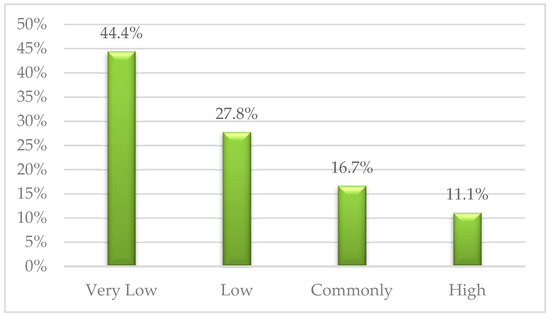
Figure 3.
Owners’ views on compensation fees for bus service requisitions.
As can be seen from Figure 3, nearly 50% (44.4%) of bus owners think that the government’s compensation amount for the bus service requisition is very low, and only about 11% of bus owners think that the government’s compensation amount is high. According to the study on the influencing factors of the willingness to sign the requisition agreement, whenever the factor affecting the “bus owner’s view on the compensation fee” is raised by one level, the bus owner’s willingness to sign a bus requisition agreement will increase by 3.543 times. Therefore, the government should increase the compensation amount, and then enhance the willingness of bus owners to sign the requisition agreements to ensure smooth urban–rural passenger transport integration in China.
3.2.2. Sensitivity Analysis of Pet
Based on our survey data of Shenyang, Liaoyang, and Guangde, China, different values of , and are taken to calculate the sensitivity analysis between , , and . The results are shown in Table 3 and Figure 4.
Table 3.
Effect of different volatility ranges of , , and .
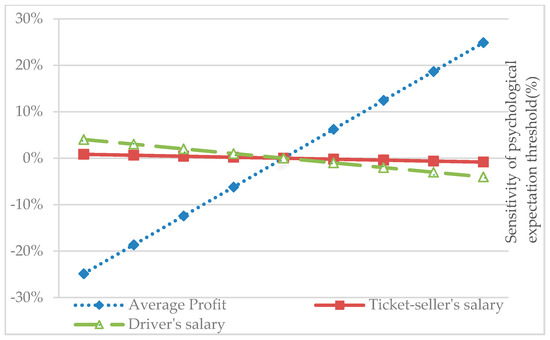
Figure 4.
Sensitivity analysis between , , and .
From Table 3 and Figure 4, it can be seen that when the change rate of x, y and z is the same, the change of the bus average profit has the greatest impact on , and its sensitivity is the greatest. The change of the driver’s average wage has the second greatest impact on , and the change of the ticket-seller’s average wage has the smallest impact on , and its sensitivity is the smallest.
Assuming that the psychological expectation threshold of the bus owner is 117,615 (¥), which equals the compensation amount given by the government in Guangde County. According to Equations (30)–(32), it is calculated as follows: x = −12.4%, y = 76.7%, z = 369.8%. That is, when the average monthly profit of the bus owner decreases by 12.4%, or the average driver’s wage increases by 76.7%, or the average ticket-seller’s wage increases by 369.8%, the psychological expectation threshold is equal to the compensation amount. At this time, bus owners are willing to accept the compensation amount provided by the government. It is difficult for the government to adjust the average profit of the bus owners through policies. However, the government can adjust the average drivers’ and ticket-sellers’ wage after the bus service requisitions through relevant policies. Therefore, if the government implements work for the drivers and ticket-sellers as soon as possible after the bus service requisition, so that the driver and ticket-sellers can obtain a higher salary, it will reduce the psychological expectation threshold of the bus owner, which is conducive to improving the willingness of the bus owner to sign the requisition agreement and ensure the smooth implementation of the integration of urban–rural passenger transport.
3.2.3. Compensation Mode
This paper has investigated and discussed the preference degree of self-employed bus owners for three types of the compensation modes in the process of urban–rural passenger transport integration. The results are shown in Table 4 and Figure 5.
Table 4.
Counts and percentages for bus owners’ compensation modes.
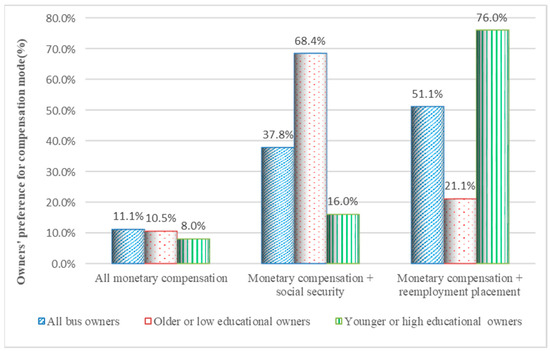
Figure 5.
Bus owners’ preferences for compensation modes.
As shown in Table 4 and Figure 5, more than half (51.1%) of bus owners preferred the compensation mode of “monetary compensation and reemployment placement”. More than one third (37.8%) of bus owners preferred “monetary compensation and social security”, while only a small percentage (11.1%) of bus owners wanted “all monetary compensation”. The results also show that the majority of older (over 50 years old) or low education (junior high school and lower) bus owners preferred “certain monetary compensation and social security”, while younger (less than 50 years old) or high education (senior high school and above) owners are more likely to accept “certain monetary compensation and reemployment placement”. The results of this survey are basically consistent with the actual situation. Although the mode of “certain monetary compensation and reemployment placement” has been adopted in many places, bus owners can only obtain reemployment placement qualifications if he (or she) meets the specific placement conditions, such as “age, education level, or the type of driver’s license”, generally chosen by the government. These placement conditions are very disadvantageous for older or low education bus owners. It is generally difficult for them to obtain reemployment placement qualifications. In real life, these bus owners have fewer opportunities to obtain reemployment. There are more difficulties and more worries for them in future life after the bus service requisition. Thus, the government needs to focus on the future living security situation of such bus owners and adopt a more appropriate compensation mode for such bus owners, such as the compensation mode of “monetary compensation and social security”.
The monetary payment forms of compensation modes were also investigated and discussed. The acceptance degree of bus owners was separately investigated if the compensation amount is provided by two way of “one-time monetary payment” and “expected income dividend installment “The results of our survey are shown in Figure 6 and Table 5.
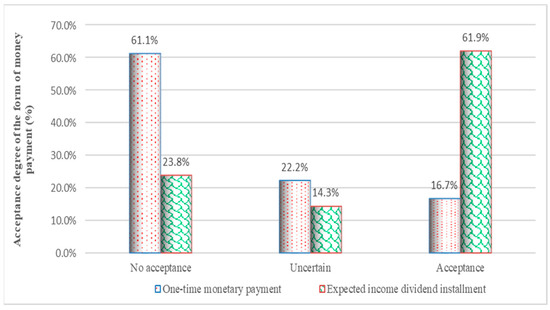
Figure 6.
Acceptance degree of the money payment form.
Table 5.
Acceptance degree of the money payment form.
As can be seen from Figure 6 and Table 5, most bus owners (61.9%) are more willing to accept the compensation amount in the form of “expected income dividend installments”. Therefore, in order to ensure smooth progress of the bus service requisitions, the government should adopt “expected income dividend installments” to distribute the compensation amount for the requisitions to bus owners.
4. Discussion
4.1. Improving the Compensation Standard and Diversifying the Compensation Modes
Our surveys show that, for self-employed bus owners, the operating revenue of the bus service they run is the most stable source of incomes for their families. Since the self-employed bus owners have relatively low education levels and singular professional skills, the singularity of monetary compensation is not enough to provide bus owners with continuous basic living security in the long run. After the compensation amount is exhausted, their limited means of livelihood will become difficult to manage. Therefore, in addition to the compensation mode of monetary payment, the government should also consider the local economic and social development levels, establish and improve the corresponding systems of reemployment and social security for self-employed bus owner, and fully protect their collective interests.
4.2. Ameliorating the Participation Effect of Bus Owners and Perfecting the Conflict Mediation Mechanism
Our survey results show that bus owners can adjust the social cost of the bus service requisitions, by rejecting the bus service requisition and appealing to higher authorities for help, to improve the compensation amount. Whether the rights and interests of bus owners can be effectively guaranteed will affect the smooth implementation of bus service requisition compensation. Thus, in the process of giving compensation for bus service requisition, the government should guarantee bus owners’ right to participate by electing a representative bus owner to participate in the formulation of the compensation plan. The government should comprehensively consider the opinions of bus owners when formulating the initial compensation plan, and announce it to the bus owner after its formulation. In addition, the government should organize a contradiction coordination group and even set up a special policy and legal consultation department. When the interests of bus owners and government conflict, mediators can provide relevant legal support and mediate interest disputes.
4.3. Improving the Information Transparency of the Compensation Scheme
The government should guarantee bus owners’ rights to know and supervise, ensure the transparency of the compensation information for the bus service requisition, and comprehensively supervise the compensation procedures and the implementation of compensation policies with the help of social forces. In addition, the government should strictly implement an announcement system for rural passenger bus service requisitions, publish the requisition plans and the compensation plans for rural passenger buses on time, and solicit opinions publicly according to the regulations and publish them on the websites, newspapers, magazines and other media of relevant government departments.
5. Conclusions
With the background of urban–rural passenger transport integration, this paper takes the self-employed bus owners of rural passenger transport in 10 cities or counties (including Shenyang, Liaoyang, Wuxi, Suzhou, Laiwu, Zouping, Wuhu, Guangde, Shuangliu, and Fuyang) as research objects, the compensation scheme for self-employed bus service requisition is addressed from three aspects: the construction of compensation model, the estimation of compensation amount and the determination of compensation mode. Our conclusions are summarized as follows:
When the number of self-employed bus requisition is fixed, there are two ways to increase bus owners’ payoffs. The first is by reducing the investment in the bus service; the second is by forcing the government to change the optimal compensation amount by changing the social cost of the requisition. However, when the number of self-employed bus requisition is variable, bus owners can increase their own payoffs in three ways. The first is by increasing the compensation amount, the second is by reducing the existing investment in the bus service, and the third is by changing the optimal number of bus requisition.
The compensation amount consists of three parts: the bus residual value, the compensation for expected profit in the residual operation period, and the awarded amount for signing the compensation agreement. According to the nature of bus line (the cold line or hotline) and the time of signing the compensation agreement, a calculation model for the compensation amount is proposed under six scenarios.
Whether or not a bus owner accepts the compensation amount given by the government is closely related to their psychological expectation threshold. Only when the compensation amount exceeds their psychological expectation threshold, can the owner sign the requisition agreement. The psychological expectation threshold is related to the average revenue of the bus owner, the wage of the drivers and ticket-sellers after the bus service requisition. It is found that a change of the average profit of the bus service, the driver’s average wage, and the ticket-seller’s wage, has the greatest impact, the second greatest impact, and the smallest impact on the psychological expectation threshold, respectively.
The government mainly adopts three types of the compensation modes: “all monetary compensation”, “monetary compensation and reemployment placement“, and “monetary compensation and social security”. The older or low education bus owners preferred “certain monetary compensation and social security”, while younger or high education owners are more likely to accept “certain monetary compensation and reemployment placement”. The government should provide different compensation modes for bus owners of different ages and education levels.
In addition, most bus owners preferred to receive monetary compensation in the form of “expected income dividend installments”. If the government can increase the compensation amount and provide reemployment placements for original drivers and ticket-sellers after the bus service requisition, the willingness of owners to sign the compensation agreements will be greatly enhanced.
Our objective of this paper is exploring the compensation scheme for self-employed bus service requisitions, which is the core issue to be solved in process of urban-rural passenger transport integration. The urban-rural passenger transport integration is an important way to narrow the urban-rural transport and economic gap, to better meet travel needs of urban-rural residents, and to improve travel efficiency, also essential to achieve energy saving, environmental protection and sustainable development. This study provides a reference for the formulation of the compensation scheme for self-employed bus service requisition, which will ensure their smooth implementation, and achieve the sustainable development of urban–rural passenger transport.
In this paper, single factor sensitivity analysis is used to discuss the sensitivity of the psychological expectation threshold. However, the sensitivity of psychological expectation threshold, which may be affected by many uncertain factors. In the future, the design thinking method described in Kostrzewski [32] could be utilized to examine users’ opinions of self-employed bus transport solutions. We may also use the simulation tool proposed by Papageorgiou et al. [33] and Kostrzewski [34] to implement the model of bus transport with the use of simulation methods across the country.
Author Contributions
C.Z. proposed and designed the research ideas and framework, written and revised the manuscript; Y.H. designed the survey, collected and analyzed the data; A.N. proposed the research framework, conducted discussions and proofread the manuscript; H.L. provided some comments and helped to edit the manuscript. All authors reviewed and approved the final manuscript.
Funding
This research was funded by Major Humanities and Social Sciences Project of Universities in Zhejiang Province, China (Grant No. 2018QN028).
Acknowledgments
The authors would like to thank the managers and respondents at rural passenger transport sector in China for providing data and information that were essential for this work. The authors would like to thank the anonymous referees for their helpful comments and valuable suggestions which have helped improve the content and composition substantially.
Conflicts of Interest
The authors declare no conflict of interest.
References
- Zhang, C.; Xiao, G.; Liu, Y.; Yu, F. The relationship between organizational forms and comprehensive effectiveness for public transport services in China? Transp. Res. Part A Policy Pract. 2018, 118, 783–802. [Google Scholar] [CrossRef]
- Ma, C.; Ma, C.; Ye, Q.; He, R.; Song, J. An improved genetic algorithm for the large-scale rural highway network layout. Math. Probl. Eng. 2014, 2014. [Google Scholar] [CrossRef]
- Timmermans, H. Decision Support Systems in Urban Planning; E. & F.N. Spon: London, UK, 2003. [Google Scholar]
- Roess, R.; Prassas, E.; McShane, W. Traffic Engineering (Fifth Edition); Pearson Education, Inc.: New York, NY, USA, 2004. [Google Scholar]
- O’Kelly, M.; Miller, H. The hub network design problem. A review and synthesis. J. Transp. Geogr. 1994, 2, 31–40. [Google Scholar] [CrossRef]
- Campbell, J.; O’Kelly, M. Twenty-five years of hub location research. transport. Science 2012, 46, 153–295. [Google Scholar]
- Papangelis, K.; Velaga, N.; Ashmore, F.; Sripada, S.; Nelson, J.; Beecroft, M. Exploring the rural passenger experience, information needs and decision making during public transport disruption. Res. Transp. Bus. Manag. 2016, 18, 57–69. [Google Scholar] [CrossRef]
- Gnap, J.; Settey, T.; Beňová, D. Examining the impact of air passenger transport on international long-distance regular bus transport in the Slovak Republic. MATEC Web Conf. 2018, 236, 02007. [Google Scholar] [CrossRef]
- Gong, L.Y.; Xu, Y.J.; Kong, Q.F.; Hu, T.J. Study on County planning of urban and rural passenger transport integration. Adv. Mater. Res. 2014, 962, 2590–2593. [Google Scholar] [CrossRef]
- Vuuren, D. Optimal pricing in railway passenger transport: Theory and practice in The Netherlands. Transp. Policy 2002, 9, 95–106. [Google Scholar] [CrossRef]
- Deb, K.; Filippini, M. Estimating welfare changes from efficient pricing in public bus transit in India. Transp. Policy 2011, 18, 23–31. [Google Scholar] [CrossRef][Green Version]
- Bly, P.; Oldfield, R. An analysic assessment of subsidies to bus services. Transp. Sci. 1986, 20, 200–212. [Google Scholar] [CrossRef]
- Anas, A. The optimal pricing, finance and supply of urban transportation in general equilibrium: A theoretical exposition. Econ. Transp. 2012, 1, 64–76. [Google Scholar] [CrossRef]
- Jørgensen, F.; Pedersen, H.; Solvoll, G. Ramsey pricing in practice: The case of the Norwegian ferries. Transp. Policy 2004, 11, 205–214. [Google Scholar] [CrossRef]
- Basso, L.; Guevara, C.; Gschwender, A.; Fuster, M. Congestion pricing, transit subsidies and dedicated bus lanes: Efficient and practical solutions to congestion. Transp. Policy 2011, 18, 676–684. [Google Scholar] [CrossRef]
- Tirachini, A.; Hensher, D.; Rose, M. Multimodal pricing and optimal design of urban public transport: The interplay between traffic congestion and bus crowding. Transp. Res. Part B Methodol. 2014, 61, 33–54. [Google Scholar] [CrossRef]
- Holmgren, J. Meta-analysis of public transport demand. Transp. Res. Part A Policy Pract. 2007, 41, 1021–1035. [Google Scholar] [CrossRef]
- Tsai, C.; Mulley, C.; Clifton, G. A review of pseudo panel data approach in estimating short-run and long-run public transport demand elasticities. Transp. Rev. 2014, 34, 102–121. [Google Scholar] [CrossRef]
- Kleinova, E. The Use of a consumer survey to determine the relevant market-case study for public transport between Prague and Most. Rev. Econ. Perspect. 2016, 16, 17–28. [Google Scholar] [CrossRef]
- Zhang, C.; Juan, Z.; Luo, Q.; Xiao, G. Performance evaluation of public transit systems using a combined evaluation method. Transp. Policy. 2016, 45, 156–167. [Google Scholar] [CrossRef]
- Borger, B.; Fosgerau, M. Information provision by regulated public transport companies. Transp. Res. Part B Methodol. 2012, 46, 492–510. [Google Scholar] [CrossRef]
- Tscharaktschiew, S.; Hirte, G. Should subsidies to urban passenger transport be increased? A spatial CGE analysis for a German metropolitan area. Transp. Res. Part A Policy Pract. 2012, 46, 285–309. [Google Scholar] [CrossRef]
- Qin, F.; Zhang, X. Designing an optimal subsidy scheme to reduce emissions for a competitive urban transport market. Sustainability 2015, 7, 11933–11948. [Google Scholar] [CrossRef]
- Hensher, D.; Ho, C.; Knowles, L. Efficient contracting and incentive agreements between regulators and bus operators: The influence of risk preferences of contracting agents on contract choice. Transp. Res. Part A Policy Pract. 2016, 87, 22–40. [Google Scholar] [CrossRef]
- Zou, W.; Yu, M.; Mizokami, S. Mechanism design for an incentive subsidy scheme for bus transport. Sustainability 2019, 11, 1740. [Google Scholar] [CrossRef]
- Li, X.; Shan, R.; Shang, J. Micro-economic based analysis of financial grant model for rural passenger. Transp. J. Highw. Transp. Res. Dev. 2008, 8, 25–154. [Google Scholar]
- Lin, L.; Jia, H.; Pan, Y.; Qiu, L.; Gan, M.; Lu, S.; Deng, J.; Yu, Z. Exploring the patterns and mechanisms of reclaimed arable land utilization under the requisition-compensation balance policy in Wenzhou, China. Sustainability 2018, 10, 75. [Google Scholar] [CrossRef]
- Chen, W.; Ye, X.; Li, J.; Fan, X.; Liu, Q.; Dong, W. Analyzing requisition-compensation balance of farmland policy in China through telecoupling: A case study in the middle reaches of Yangtze River Urban Agglomerations. Land Use Policy 2019, 83, 134–146. [Google Scholar] [CrossRef]
- Liu, L.; Liu, Z.; Gong, J.; Wang, L.; Hu, Y. Quantifying the amount, heterogeneity, and pattern of farmland: Implications for China’s requisition-compensation balance of farmland policy. Land Use Policy 2019, 81, 256–266. [Google Scholar] [CrossRef]
- Czwajda, L.; Kosacka-Olejnik, M.; Kudelska, I.; Kostrzewski, M.; Sethanan, K.; Pitakaso, R. Application of prediction markets phenomenon as decision support instrument in vehicle recycling sector. LogForum 2019, 15, 265–278. [Google Scholar] [CrossRef]
- Nash, J. Non-cooperative games. Ann. Math. 1951, 54, 286–295. [Google Scholar] [CrossRef]
- Kostrzewski, M. One design issue–Many solutions. Different perspectives of design thinking–Case Study. In Proceedings of the International Conference on Knowledge Management in Organizations, Zilina, Slovakia, 6–10 August 2018; pp. 179–190. [Google Scholar]
- Papageorgiou, G.; Damianou, P.; Pitsillides, A.; Aphamis, T.; Ioannou, P. Modelling and simulation of transportation systems: Planning for a bus priority system. In Proceedings of the 6th EUROSIM Congress on Modelling and Simulation, Ljubljana, Slovenia, 9–13 September 2007. [Google Scholar]
- Kostrzewski, M. Implementation of distribution model of an international company with use of simulation method. Procedia Eng. 2017, 192, 445–450. [Google Scholar] [CrossRef]
© 2019 by the authors. Licensee MDPI, Basel, Switzerland. This article is an open access article distributed under the terms and conditions of the Creative Commons Attribution (CC BY) license (http://creativecommons.org/licenses/by/4.0/).