


Abstract
According to the 2011 research report of the Food and Agricultural Organization (FAO) of the United Nations, one-third of the world’s edible fruits and vegetables are wasted every year, totaling about 1.3 billion metric ton. A source of such waste is ugly fruits and vegetables, which have the same nutritional value as that of normal fruits and vegetables, but are discarded due to poor appearance for selling. If consumers can rediscover their value, it will be one of the ways to change food waste. This study first explored related topics through the literature; then, it drew up an interview outline, obtained and ranked the key success factors for the evaluation indices through education and interviews with industry professionals, and summarized the key success factors of marketing ugly fruits and vegetables through questionnaire and experts interview perspectives that targeted consumer groups as the questionnaire respondents. The conclusion of the study provides suggestions for enterprises to innovate service marketing through the blueprint of service design, which hopes to reduce food waste and maintain a balance with the environment, in order to achieve the goal of environmental sustainability. The results show that if consumers understand the relevant issues and pay attention to the truth of vegetable and fruit production, they can use their consumption power to protect their own and environmental rights. However, the trust between producers and consumers requires strengthening. Reducing the unnecessary waste of food and labor is expected to create more ecological and environmental consumption patterns in the future.
1. Introduction
According to the “Report on Global Food Losses and Food Waste” published by Food and Agricultural Organization (FAO) of the United Nations [1], global food waste or loss is as high as 1.3 billion tons, accounting for one-third of the total production. The economic loss caused by food waste in the world every year is as high as EUR 750 billion. One of the most easily neglected topics in food waste is “ugly fruits and vegetables”, which are weeded out due to poor looks and abnormal appearance. Currently, most of the fruit and vegetable products on the market are products with standardized appearance and packaging, as well as complete appearance after screening. The rejected fruits and vegetables are not purchased due to the appearance of defects; their edible value is not actually affected by appearance, yet they are rejected. This phenomenon deserves attention. If the chances of discarding food are reduced, and the food can be used well, food waste will naturally decrease.
1.1. Research Background and Motives
At present, fruits and vegetables on the market are selected as standardized agricultural products after harvest, and the remaining ugly fruits and vegetables that fail to meet the standards of appearance are discarded. This kind of waste cannot be underestimated over the years. Therefore, this study hopes to understand the key factors of marketing ugly fruits and vegetables through the advice of relevant professionals and the opinions of major consumer groups, and plan innovative sales processes through service design blueprints in order to reduce waste and achieve the goal of environmental sustainability.
1.2. Research Purpose
Global food waste at present cannot be underestimated. The further consumers are from the correct perception, the more difficult it is for them to understand the seriousness of food waste. Therefore, this research took the ugly vegetable, which is edible but has been scrapped due to various factors, as the example in order to explore its key success factors and integrate the opinions of experts and consumers to develop more strategies to reduce food waste. Replanning through a service design blueprint not only provides reference to relevant companies for improving their service models, it also makes consumers begin to pay attention to food issues and understand the concept of environmental sustainability in order to reduce the problem of food waste. The main purposes of this research are to raise public awareness of environmental protection and environmental sustainability issues, enhance consumers’ environmental responsibility, and reduce food waste.
The purposes of this study are listed, as follows:
- Obtain expert opinions from education, industry, and marketing through research, and integrate key success marketing factors.
- Aggregate the factors into perspectives and design a questionnaire for application to key consumer groups, collect consumer preferences and opinions, and obtain the ranking of important evaluation indices through the analytical hierarchical process (AHP) method.
- Use the opinions of the analysis results to plan service design blueprints and provide innovative service modes for enterprise reference.
1.3. Research Scope and Limitations
To focus on the purposes, this study is limited to the following:
- Definition of ugly fruits and vegetables: the crops that do not meet purchasing conditions because of poor appearance, defective appearance, or shape, size, and appearance, which are also called off-grade products (products outside specifications), NT (No Good). The purpose of this study is to provide a solution to the topic of the waste of “edible but discarded fruits and vegetables products”. Therefore, only agricultural products that do not meet the purchasing conditions and are not dangerous to eat are the scope of this study.
- The main target group is consumers who regularly buy fruits and vegetables and pay close attention to relevant information in the long-term. As this research is a pilot study, the purpose is to synthesize the opinions of experts and major consumers, which can serve as a service design planning framework. Therefore, surveying the target customers will be beneficial to subsequent related marketing and product development references.
2. Literature Review
This research literature discussion is divided into three parts: food waste, service design, and key success factors. Firstly, we need to establish the importance of the research topic through the discussion of food waste. In order to provide a solution to the problem, we need key success factors to accurately plan the service design blueprint, provide a better service process, and then, provide solutions to reduce food waste.
2.1. Food Waste
According to Taiwan’s 2013 kitchen waste recovery and waste statistics of the Environmental Protection Administration [2], 96 kg of kitchen waste are produced in Taiwan per person per year, and the amount of food discarded per household per year is as high as NTD 30,000, which shows that food waste is serious.
Food waste occurs mostly in industrialized countries, where channel operators and consumers discard edible food. Under the global supply chain and modern commercial system, agricultural products that are visible in the market are goods that have been screened by quality control. In order to reduce control costs, share risks, and provide purchase rates, channel operators have set standardized standards for agricultural products for producers, and only farmers who meet the standards have the right of market entry. The production process of agricultural products is not as normalized, standardized, or quantified as that of industrial products; thus, unexpected factors, such as weather, disease, and insects will cause farmers to double their production to meet the contract quantity. Therefore, the average output of agricultural products will usually exceed the actual demand.
This kind of demand for the standardization of agricultural products by channel operators and retailers has become the main reason for a large amount of food waste. Through promotion, if consumers are stimulated to buy more food than they need, the unplanned food will instead increase their kitchen waste. Therefore, if the design of ugly fruits and vegetables marketing service is replanned through research, another solution can be provided.
2.2. Service Design
Service design can help the industry improve the existing service; it can make the service more effective, feasible, in line with demand, and efficient [3]. The process from purchase to use is a designable experience. Service design should be used as a strategy in production and consumption systems in order to bring about sustainable development opportunities for the environment and society. Service design is also a set of new design methods and tools that can integrate the value of intangible services and tangible products. Through overall experience design, products and services that are available, useful, and desirable at the customer end can be pursued, and feasibility, efficiency, and effectiveness at the enterprise end also be achieved. Therefore, in the competitive market, service design can be used as the basis for the future development of the enterprise. If this strategy can be applied to the vegetable and fruit supply chain, the network will be reconstructed according to the needs of consumers, a new business model will be created, and the goal of environmental sustainability will be further realized.
2.3. Key Success Factors
Key success factors (critical success factors) are commonly used concepts in the relationship between industrial characteristics and strategies [4]. They are also resources and related factors that enterprises must attach importance to in order to survive and improve competitiveness. The characteristics of key success factors are summarized through literature collection in this study, as follows [4]:
- They vary from industry to industry, and are not fixed. They will change with time, product, or market.
- The key success factors may be internal or external factors, as well as both positive and negative factors.
- When considering future development trends, if you do not understand the key success factors and invest hastily, you will threaten the survival of the enterprise.
- The enterprise’s strategy, environment, resources, operation, and other fields can be evaluated.
- Key success factors will change with the industrial life cycle, and there are different key success factors at different stages.
- Managers must conduct in-depth research, evaluation, and analysis, and should not regard everything as equally important. They should concentrate their efforts on specific key tasks, and firstly identify the key success factors of the industry as the strategic basis.
Key success factors are the variables in the operation and decision-making of an enterprise; thus, decision makers should put the correct resources into the key works, design strategies with competitive advantages according to the unique resource conditions, and improve them according to the disadvantages, in order to establish competitive advantage.
3. Research Method
This study was conducted in a parallel manner of qualitative and quantitative methods. After a relevant literature review and expert interviews, the key success factors of ugly fruits and vegetables marketing were summarized, the questionnaire perspectives were established, and then, the opinions of the main consumer target groups were obtained through the questionnaire survey. The weight rankings of the key success factors of ugly fruits and vegetables marketing were extracted through the analytic hierarchy process (AHP) in order to provide references for enterprises to develop innovative service marketing modes.
3.1. Interview
In order to explore the key success factors of marketing ugly fruits and vegetables, we must first understand the crisis brought about by the current global food issue, the development trends and current situations of related production and planting, and survey target consumer groups. Then, we need to provide innovative service modes for enterprise reference. Therefore, the opinions of experts on establishing and exploring the key success factors of marketing are very important. Thus, this research first used the qualitative research in-depth interview method with the interview objects, including scholars and industry-related personnel who are deeply involved in the food issue, to discuss the key success factors from a professional point of view, and summarize the different aspects as a questionnaire design framework. The questionnaire survey method of quantitative research was subsequently used to lock in the opinions of the major consumer groups. In addition to the opinions of experts in academic and industry circles, the focus of consumers’ attention can also be explored. The interviewed experts included experts from education and industry who study agricultural issues, as shown in Table 1. The objective was to extract the key success factors of ugly fruits and vegetables marketing from experts’ viewpoints in different fields as the basis for questionnaire design.
Table 1.
Respondents of Expert Interviews.
This research adopts semi-structured interviews and draws an expert interview outline according to the research purpose. The interview content includes current food waste topics, and the trends and strategies of ugly fruits and vegetables promotion and marketing. Refer to Section 4.2 for the interview codes.
3.2. Procedure and Steps of the Analytic Hierarchy Process
Using the analytic hierarchy process to analyze the questionnaire, we can know the weight and ranking of the key success factors of marketing by consumers. By decomposition at different levels and layers, complex problems can be systematized, and a selection scheme can be provided through comprehensive evaluation. These operation steps are conducted to determine the influential factors and establish hierarchical relationships according to the problem description. The relative importance of the decision attributes at each level is determined by using the paired comparison method and its scale. Based on this, a paired comparison matrix is established, the eigenvalues and eigenvectors of the matrix are calculated, and the weights of each attribute are obtained.
3.3. Evaluation Scale of the Analytic Hierarchy Process
The analysis of the analytic hierarchy process evaluates the relative importance among the factors of the same level in pairs. The ratio scale is divided into five items: equally important, slightly important, quite important, extremely important, and absolutely important, which are given the measurement values of 1, 3, 5, 7, and 9, respectively; the intermediate values of 2, 4, 6, and 8 are given on two scales. See the following Table 2 for a description of the evaluation scale of the analytic hierarchy process:
Table 2.
Evaluation Scale of the Analytic Hierarchy Process.
3.4. Questionnaire Survey
In order to obtain objective data, the questionnaire is used to standardize the data, the analysis results were compared, and the correctness of the data was enhanced. The test is divided into two stages: pre-test and the formal questionnaire. The pre-test determined whether the questionnaire’s meanings are clear and the result can be achieved. This study is divided into two stages. In the first stage, relevant factors were collected through literature and expert interviews, which are used as the basis of the questionnaire for the pre-test. After recovery, the data results were revised by experts to ensure that the topics were clear and flawless. In the second stage, formal tests were carried out for the main target groups, and consumers’ attention levels and the ranking of key success factors in marketing were obtained through the questionnaire.
4. Research Results and Analysis
4.1. Expert Interview
Four experts were interviewed in this study, including: National Taiwan University’s “Ugly Fruits and Vegetables Turnaround” Team; a professor at the Graduate Institute of Bio-Industry Management at National Chung-Hsing University; the president of the Taiwan Agricultural Extension Association; a farmer bazaar founder; the director of the Smart Farming 4.0 Office of Department of Bio-Communication at National Taiwan University; and the CEO of Good Will Foods, all of whom are experts with educational and marketing promotion practices.
4.2. Evaluation Indices
4.2.1. Discussion of Evaluation Index Literature
Based on a literature review, this study compiled the relevant perspectives and evaluation indices. After compilation, the framework of the strategic evaluation indices was initially drawn up, as shown in the following table. The framework was consulted with experts during interviews to confirm the questionnaire design framework.
4.2.2. Data Coding
Through coding, the interviews were summarized into three major levels: policy, marketing, and education. Key excerpts from expert interviews and suggestions for questionnaire revision are given in the following table.
This study summarized the proposed revision framework with reference to expert interviews and expert opinions. The revisions to the content perspective factors are listed as follows:
- Adjust the order of the relationships between different perspectives to make it easier for the respondents to enter the situation.
- Add the education perspective to the questionnaire structure.
After the suggestions given by the expert interview and the above-mentioned amendments, the revised contents are as follows. Table 3 is the preliminary table of evaluation indices, and Table 4 is consolidated table of evaluation indices suggested for expert interviews. In Table 5 shows the AHP hierarchical structure; 20 pre-test questionnaires were distributed.
Table 3.
Preliminary Table of Evaluation Indices.
Table 4.
Consolidated Table of Evaluation Indices Suggested for Expert interviews.
Table 5.
Analysis Hierarchy Process Pre-test Questionnaire Perspectives.
4.2.3. Pre-test Analysis Result
The purpose of the pre-test is to test the accuracy of the formal questionnaire. After 20 questionnaires were recovered, they were analyzed with Expert Choice software, and consistency was checked one by one. If the consistency index (C.I.) C.I. > 0, it means that the judgments before and after were inconsistent; thus, it should be corrected. By examining the appropriateness of the evaluation indices of the questionnaire, valid information can be obtained. Table 6 shows the pre-test result of consistency check consolidated table of consumer questionnaire.
Table 6.
Pre-test Result of Consistency Check Consolidated Table of Consumer Questionnaire.
Since it is difficult to achieve complete consistency by paired comparisons after decision making, it is necessary to carry out consistency checking. When C.I. = 0, it indicates complete consistency of judgment before and after, while C.I. > 0 indicates inconsistency of judgment before and after, which requires correction, and C.I. ≥ 0.1 is an allowable error.
Most of the tests for consistency in the recovered questionnaires were C.I. > 0; thus, it was necessary to readjust the evaluation index of the questionnaire structure and make statistics of each evaluation index, as shown in Table 7. An evaluation index with similar values makes it impossible for consumers to distinguish differences. Therefore, the evaluation indices were resummarized, and the questionnaire was revised again. The results of the discussion are as follows: yellow marks are deleted evaluation indices, bold bottom line marks are the merged evaluation indices, and red marks denote adjusted suitable perspectives to establish a complete questionnaire framework.
Table 7.
Statistics of Consistency Index Values.
4.3. Analysis Hierarchy Process Relationship Architecture
Based on the evaluation indices of the key success factors of ugly fruits and vegetables, the marketing is summarized and analyzed, and the analytic hierarchy process relationship architecture was established and analyzed.
Analysis Hierarchy Process Relationship Architecture Establishment
This research referred to the suggestions and amendments of expert interviews, and divided the target perspectives into “production and planting”, “policy making”, “brand image”, “marketing promotion”, and “education and advocacy”. The strategic evaluation of each perspective was reduced to three to four representative indices, and the questionnaire was designed based on this structure.
4.4. Weight Ranking of Key Success Factors for Ugly and Vegetables Marketing
Based on the literature and expert interviews, this study revised and established evaluation indices, and conducted a questionnaire survey with consumers who had buying habits and were concerned about fruit and vegetable information. The results were used to generalize the key points that consumers attach importance to, according to the analysis results.
4.4.1. Questionnaire Distribution and Recovery
Starting from 23 May 2017, this study distributed a total of 32 questionnaires, 27 of which were recovered for a recovery rate of 84%. There were 25 valid questionnaires and two invalid questionnaires, for an effective recovery rate of 78%. The test results of the questionnaire for the target consumer groups are summarized in Table 8, and the analysis and statistics of basic data are shown in Table 9.
Table 8.
Distribution and Recovery of Questionnaires.
Table 9.
Analysis and Statistics of Basic Data of Respondents.
4.4.2. Questionnaire Reliability Analysis
Table 10 shows the consolidated table of consistency verification. Table 11 shows reliability analysis through the consistency ratio measurement. If the consistency ratio verification standard is met, it indicates that the results are consistent, and it is an effective questionnaire. The following table shows the invalid questionnaires with gray background, which do not meet the standard.
Table 10.
Consolidated Table of Analysis Hierarchy Process (AHP) Target Consumer Group Questionnaire Consistency Verification.
Table 11.
AHP Consolidated Table of Target Consumer Group Questionnaire Judgment Matrix Consistency Verification.
The questionnaire was checked for consistency index consistency, in which the consistency ratio value of the target perspectives (production and planting) of Code C26 is 0.26, which was greater than 0.1, and the consistency ratio value of the target perspective (brand image) is 0.15, which was greater than 0.1, indicating that the questionnaire had poor consistency and was an invalid questionnaire. The questionnaire that passed the C.I. value consistency check was again analyzed for consistency ratio. Table 11 shows the overall consistency ratio table for each respondent, and the consistency ratio value of the target perspective (production and planting) of Code C13 was 0.1379, which was greater than 0.1, indicating that the questionnaire had poor consistency and was an invalid questionnaire. The Code C26 target perspective (production and planting) consistency ratio value was 0.4482, which was greater than 0.1, and the brand image target perspective consistency ratio value was greater than 0.1, indicating that the questionnaire was not consistent and also an invalid questionnaire. Therefore, the questionnaire data of Code C13 and C26 are not included in the comprehensive analysis scope of this study. The total number of valid samples of the questionnaire is 25, and the effective recovery rate is 78%.
4.5. Analysis Hierarchy Process Analysis Results
In this study, the pairwise comparison matrix was obtained through Expert Choice analysis. Then, the numerical values of the pairwise comparison matrix were used to obtain the priority vector and the maximum eigenvalue through the regularization operation of the geometric mean value of the column vector, where the priority vector was used to determine the weight ranking of the perspective factors and evaluation indices in the questionnaire.
4.5.1. Weight Analysis of Strategic Evaluation Indices under Total Target Perspective Factor
The C.R. value is C.I./R.I. and Table 12 shows that the C.R. value is 0.0014, which is less than 0.1, which indicates that all of the consumers have consistent and non-contradictory views on the strategic evaluation indices under the total perspective factor. In the evaluation perspective of production and planting, the relative weight value of “production and planting” is 0.297 and it is also the highest, followed by “education and advocacy” (relative weight = 0.293) with a slight difference, followed by “policy making” (relative weight = 0.158), “marketing promotion” (relative weight = 0.152), and “brand image” (relative weight = 0.100).
Table 12.
Pair Comparison Matrix and Weight Table for Strategy Indices of Total Perspectives.
4.5.2. Weight Analysis of Each Target Perspective
- (1)
- Analysis of the weights of strategic evaluation indices under the perspective factor of “production and planting”.
Table 13 shows that the C.R. value is 0.0081, which is less than 0.1, and indicates that there is no contradiction between the views of all of the consumers regarding the strategic evaluation index under the perspective factor of “production and planting”. In the production and planting evaluation perspective factor, the relative weight value of “using friendly farming method” is 0.494 and it is also the highest, followed by “production environment maintenance measures” (relative weight = 0.260) and “regular pesticide residue detection” (relative weight = 0.246).
Table 13.
Pair Comparison Matrix and Weight Table for Strategy Indices of “Production and Planting” Perspective.
- (2)
- Analysis on the weight of strategic evaluation indices under the perspective factor of “policy making”.
Table 14 shows that the C.R. value is 0.0033 and less than 0.1, which indicates that all of the consumers have consistent views on the strategic evaluation indices under the “policy making” perspective. In the policy making evaluation perspective, the relative weight values of “government set up organic standard certification” and “production and marketing history verification” are 0.351 and 0.327, respectively, which are higher, ranking first and second, followed by “establishing hierarchical purchasing mechanism” (relative weight = 0.210) and “setting up processing laboratories for renting professional equipment” (relative weight = 0.112).
Table 14.
Pair Comparison Matrix and Weight Table for Strategy Indices of “Policy Making” Perspective.
- (3)
- Analysis on the weight of strategic evaluation indices under the perspective factor of “brand image”.
Table 15 shows that the C.R. value is 0.0031 and less than 0.1, which indicates that all of the consumers have consistent views on the strategic evaluation index under the “brand image” perspective factor. In brand image evaluation construction, the relative weight value of “creating a brand story of ugly fruits and vegetables” is 0.359 in first place, followed by “building an innovative ugly vegetable brand C.I.S. (corporate identity system)” (relative weight = 0.239), “recyclable packaging design” (relative weight = 0.257), and “humorous packaging design” (relative weight = 0.145).
Table 15.
Pair Comparison Matrix and Weight Table for Strategy Indices of “Brand Image” Perspective.
- (4)
- Analysis on the weight of strategic evaluation index under the perspective factor of “marketing promotion”.
Table 16 shows that the C.R. value is 0.0015 and less than 0.1, which indicates that all of the consumers have consistent views on the strategic evaluation index under the “marketing promotion” perspective factor. In the marketing promotion evaluation perspective, the relative weight value of “promoting the concept of local production and local consumption” is 0.344 and it is also the most important, followed by “establishing a communication platform between production and consumption” (relative weight = 0.320), “promoting the concept of moral consumption” (relative weight = 0.204), and “humorous advertising marketing with ugliness as beauty” (relative weight = 0.132).
Table 16.
Pair Comparison Matrix and Weight Table for Strategy Indices of “Marketing Promotion” Perspective.
Table 17 shows that the C.R. value is 0.0004 and less than 0.1, which indicates that there is no contradiction between the views of all of the consumers on the strategic evaluation indices under the perspective factor of “education and advocacy “. In the education and advocacy evaluation perspective, the relative weight value of “advocating the idea of not wasting food” is 0.306 and it is the most important, followed by “advocating the importance of environmental protection” (relative weight = 0.271), “experiential education activities” (relative weight = 0.229), and “food and farming education course” (relative weight = 0.195). In Table 18 shows overall evaluation and analysis of key success factors of ugly fruits and vegetables marketing.
Table 17.
Pair Comparison Matrix and Weight Table for Strategy Indices of “Education and advocacy” Perspective.
Table 18.
Overall Evaluation and Analysis of Key Success Factors of Ugly Fruits and Vegetables Marketing.
4.6. Overall Evaluation and Analysis of Key Success Factors of Ugly Fruits and Vegetables Marketing
The hierarchical weight is also called the local priority, which is the weight of each interlevel factor of relative comparison. Bold type is used to indicate the most important value of each target perspective evaluation pointer. Moreover, overall weight is called global priority, which is the result of multiplying the weight of the previous level by the relative weights of the elements of the current level, in order to show the importance of the elements of the current level in the overall evaluation and analysis. The top five indices of the overall ranking are shown in bold red.
The most important strategic evaluation indices according to the ranking of target perspectives are:
- A.
- Evaluation index of “using friendly farming methods” for the target perspective of “production and planting”
- B.
- Evaluation index of “government establishing organic standard certification” in the target perspective of “policy making”
- C.
- Evaluation index of “creating a brand story of innovative ugly fruits and vegetables” in the target perspective of “brand image”
- D.
- Evaluation index of “promoting the concept of local production and local consumption” in the target perspective of “marketing promotion”
- E.
- Evaluation index of “advocating the concept of no waste of food” in the target perspective of “education and advocacy”
Based on the questionnaire analysis results of the evaluation of the overall target perspective, the top five key evaluation indices in the ranking are mostly concentrated in the target perspective of “production and planting” and “education and advocacy”, among which the top five key strategic evaluation indices in the ranking are:
- Evaluation index of “using friendly farming methods” for the target perspective of “production and planting”
- Evaluation index of “advocating the concept of no waste of food” in the target perspective of “education and advocacy”
- Evaluation index of “advocating importance of environmental protection” in the target perspective of “education and advocacy”
- Evaluation index of “production environment maintenance measures” in the target perspective of “education and advocacy”
- Evaluation index of “regular pesticide residue detection” for the target perspective of “production and planting”
The above investigation and analysis results can serve as reference for subsequent service design planning.
5. Conclusions and Suggestions
This study first summarized the key success factors and perspectives of ugly fruits and vegetables marketing through qualitative interviews and designed the questionnaire. By quantitative questionnaire survey and AHP hierarchical analysis, the priority weight values of each level of perspectives were obtained, the weight sequence of the evaluation indices was determined, and comprehensive evaluation was carried out to provide appropriate solutions.
This study summarized the key success factors of ugly fruits and vegetables marketing and the ranking of the weights of important evaluation indices through investigation, in order to grasp consumers’ behaviors and demands, use the service design process to help solve the problems related to the marketing and promotion of ugly fruits and vegetables, provide references to relevant enterprise, and increase consumers’ and enterprises’ attention to environmental sustainability. This study found that we must raise the correct consumption awareness according to the five aspects of production and planting, policy making, brand image, marketing and promotion, and education and advocacy.
The analysis results show that the key success factors of ugly fruits and vegetables marketing are linked to the strategic evaluation indices in each target perspective. From the level of “production and planting”, it can be seen that consumers pay attention to “using friendly farming methods” to plant crops, and the public sector’s support and “government establishes organic standard certification” are added to deepen consumers’ trust.
From the overall weight of the overall structure, we can see that consumers attach importance to “production and planting” and “education and advocacy”, which shows that consumers have the will to understand the origin of the commodity. At the same time, through the promotion of the origin story, we can also “create brand stories of ugly fruits and vegetables”, strengthen the uniqueness of local agricultural products, and achieve the goal of “advocating the concept of not wasting food” through promotion of the concept of “local production and local consumption” and the connection with the production end.
This type of research is a single-case exploratory inquiry, which mainly explored and studied a single case (ugly vegetables). The research conclusion is divided into two parts. First, in following Section 5.1 is the statistical analysis of the questionnaire, where the internal evaluation results of the target constructs of previous research are integrated, and the opinions of the consumer survey are sorted. The opinions mentioned in Section 5.1 are used as the main reference basis for the service design blueprint. Second, Section 5.2 summarizes the above analysis results and expert opinions for the preliminary planning of the Service Design Blueprint Proposal for Ugly Fruits and Vegetables Marketing.
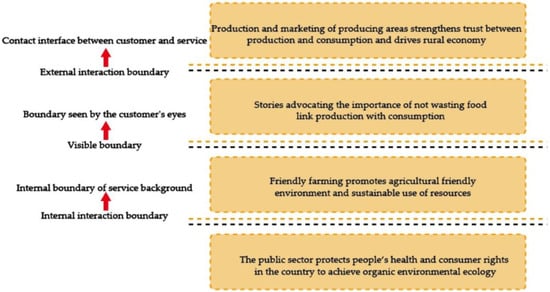
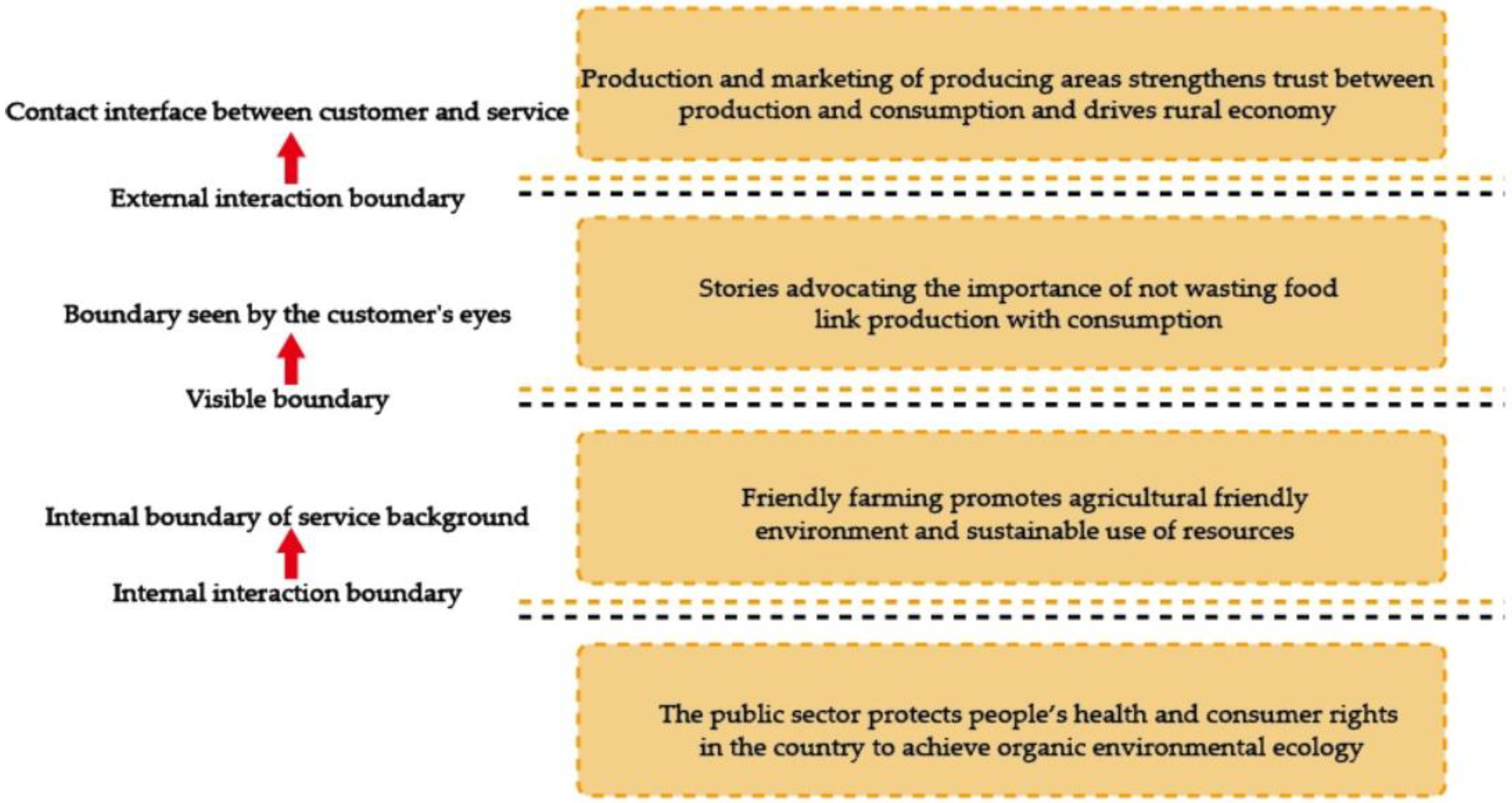
5.1. Preliminary Drafting of Service Design Blueprint Proposal for Ugly Fruits and Vegetables Marketing
Based on the analysis results, this research converted the contents into a service design blueprint, and integrated and connected the contact points of consumers, service stage, and service background with collaborative services, thus rendering the service design blueprint more relevant to the core requirements, and providing innovative service business models in an image-based manner for reference in subsequent research. As can be seen in Figure 1.
Figure 1.
Blueprint for Ugly Fruits and Vegetables Marketing Service.
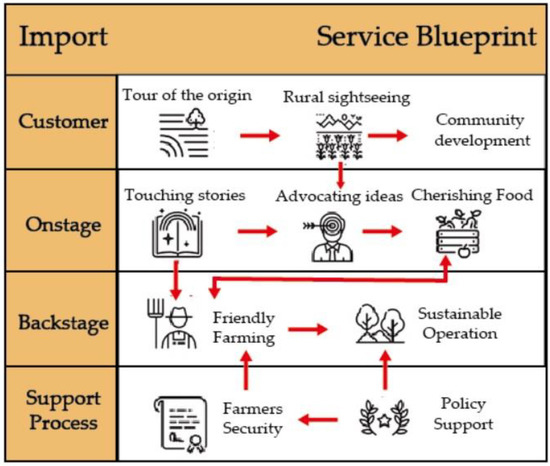
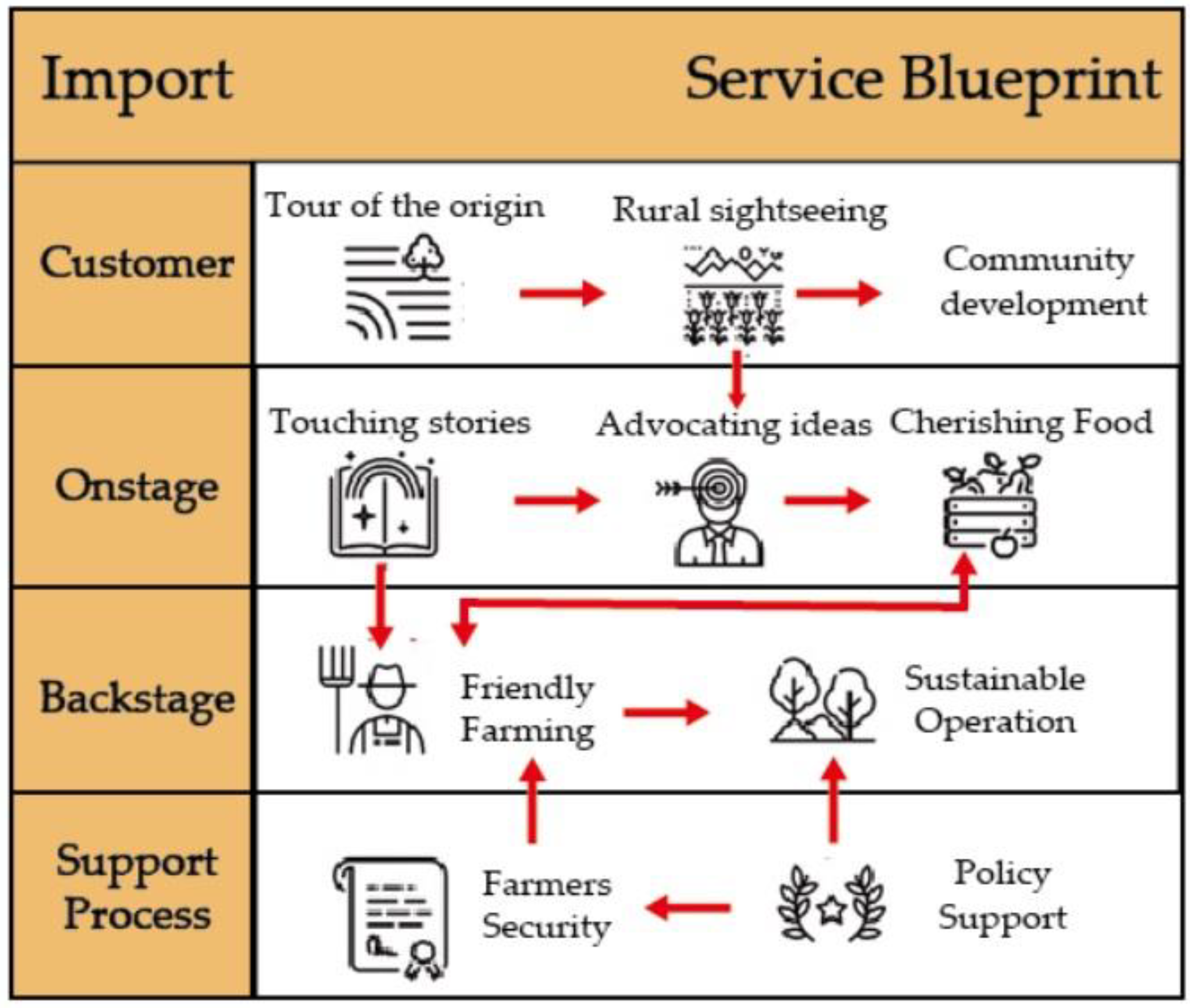
The customer service interface was used to explain the service design blueprint plan. Starting from the core of “promoting the concept of local production and local consumption, and planning a trip to the place of origin” as “advocating food not be wasted”, through the process design, consumers can have a personal experience that can drive the economic development of villages and communities. It can also allow producers and consumers to directly interact and communicate with each other, and enable consumers to experience the production story. From the policy level, and through the “establishment of organic standard certification” by government agencies, producers are guaranteed to operate “using friendly farming methods” and consumers are willing to purchase at ease, thus further reducing food waste and achieving the concept of environmental sustainability. As can be seen in Figure 2.
Figure 2.
Design Blueprint Integrating Ugly Fruits and Vegetables Marketing Service.
Based on the findings, this study proposed a reference scheme to solve the problem of food waste. Through this research, the key success factors of the marketing of ugly fruits and vegetables are summarized; then, the blueprint of a service design is planned, which can serve as reference for the management of relevant enterprises and the formulation of innovative strategies. Research shows that consumers’ cognition of agricultural production should start with education to teach them the correct concepts and values of ugly fruits and vegetables, establish trust between the production end and the consumption end through service design, arouse public attention to the current situation of food waste, and reduce waste from consumers, in order to achieve the goal of creating a sustainable environment and a friendly economic cycle.
5.2. Research Limitations and Suggestions for Future Research
This study is a pilot exploratory research that mainly aimed at the topic of ugly vegetable research, which has received little attention in the current literature. There are many research studies on food waste, but not many with ugly vegetables as the target while integrating marketing at the same time. Thus, the focus of this research is not on verifying hypotheses or confirming theories, but rather on trying to provide a preliminary cognition and understanding of this topic.
There are still many aspects of this research that can be further improved. This section proposes the following recommendations for future reference by follow-up studies for researchers interested in this topic or related topics.
- This research can serve as a pilot study, and follow-up related research can refer to this study and the planned service design blueprint for practical application or improvement of the service model of existing related industries in Taiwan. Moreover, whether the service process is optimized can be verified through actual operation.
- The present marketing of ugly fruits and vegetables in Taiwan is not mature. It is suggested that the opinions of experts and scholars in relevant research fields abroad can be added to follow-up research.
- It is suggested that follow-up in-depth studies can be conducted to investigate the status of production and cultivation of local agriculture or independent farmers in various regions.
- The subject of this research is the analysis of the “ugly vegetables” in the category of out-of-spec products. It is recommended that follow-up researchers can conduct more extensive and further investigations into all types of out-of-spec products.
- The conclusions of this research can also be provided to the education field and be actually taken as a reference for curriculum improvement and related activity planning. In response to the above research purposes, both consumers and producers can begin to pay attention to this topic in order to achieve the goal of environmental sustainability.
Author Contributions
Y.-L.L. designed and drafted the paper; Y.-L.L. and M.-U.W. collected and analyzed the data; J.-C.T. The article guides and provides valuable advice.
Funding
This research received no external funding.
Conflicts of Interest
The authors declare no conflict of interest.
References
- Food and Agriculture Organization of the U.N. Available online: http://www.fao.org/docrep/014/mb060e/mb060e00.pdf (accessed on 7 March 2015).
- Environmental Protection Administration Executive Yuan, R.O.C. (Taiwan). Environment Resource Database. Available online: https://erdb.epa.gov.tw/ENG/ (accessed on 14 March 2013).
- Stickdorn, M.; Schneider, J. This Is Service Design Thinking: Basics, Tools, Cases; China Productivity Center: New Taipei City, Taiwan, 2013. (Original work published 2011) (In Chinese, semantic translation). [Google Scholar]
- Lin, T.-W. Analysis of the Evaluation Criteria and Key Success Factors for Green Industries. Master’s Thesis, National Yunlin University of Science and Technology, Douliu, Taiwan, 2015. [Google Scholar]
- Satty, T.L. The Analytic Hierarchy Process; McGraw Hill, Inc.: New York, NY, USA, 1980. [Google Scholar]
- Council of Agriculture, Executive Yuan R.O.C. (Taiwan). Laws and Regulations Retrieving System. Available online: https://law.coa.gov.tw/GLRSnewsout/index.aspx (accessed on 25 March 2013).
- Taiwan Organic Information Portal. Available online: http://www.organic.org.tw (accessed on 8 September 2014).
- Ding, W.-H. Japan Farming Report. From News & Market. 2016. Available online: https://www.newsmarket.com.tw/blog/89589/ (accessed on 20 November 2016).
- Production and Marketing Record of Agricultural Products Verification Management Method. From Laws and Regulations Database of the R.O.C. Council of Agriculture, Executive Yuan, 2007. Available online: https://law.moj.gov.tw/ENG/index.aspx (accessed on 11 October 2015).
- Huang, Y.C. A Study on the Impact of Brand Image Effect on Customer Loyalty from the Viewpoint of Relationship Quality. Master’s Thesis, National Changhua University of Education, Changhua, Taiwan, 2012. Available online: https://hdl.handle.net/11296/gpky7c (accessed on 22 May 2013).
- Yao, B.H. The Ambrosial Palankeen of Taiwan. Master’s Thesis, National Taipei National University of the Arts, Taipei, Taiwan, 2008. [Google Scholar]
- Huang, S.N.; Lin, C.C. The Current Situation and the Future Vision of Organic Agriculture in Taiwan. Food and Agriculture Department, Council of Agriculture, Executive Yuan, 2003. Available online: https://www.ncl.edu.tw/ (accessed on 1 August 2018). (In Chinese, semantic translation).
- Chou, V. A Rising Center of Creativity Hot Taipei. Common Wealth Magazine, 2016. Available online: https://english.cw.com.tw/article/article.action?id=22 (accessed on 15 December 2016).
- Lee (Ed.) Branding and Marketing. Special Issue. Motive Business & Creative. 2014. Available online: http://www.motive.com.tw/?p=2198 (accessed on 15 December 2017).
- Council of Agriculture, Executive Yuan R.O.C. (Taiwan). Laws and Regulations Retrieving System. Available online: https://eng.coa.gov.tw/ws.php?id=2503698 (accessed on 19 May 2013).

© 2018 by the authors. Licensee MDPI, Basel, Switzerland. This article is an open access article distributed under the terms and conditions of the Creative Commons Attribution (CC BY) license (http://creativecommons.org/licenses/by/4.0/).