


Abstract
With the new round of global nuclear issues, the populace’s emotion has been tensed and discomposure has been trigged off. To accurately understand the sense of nuclear safety & security for the Chinese public and ensure that the government makes reasonable decisions regarding nuclear issues, a special questionnaire and evaluation has been carried out. With the use of the principles for sociology of security, the methods of questionnaires and SPSS, a three-dimension assessment system, which consists of knowledge and experience, internal, and external trust, and the way of perception, was constructed. This research shows that the state of Chinese populace’s sense of nuclear safety & security is generally as follows: their knowledge of nuclear safety & security and personal experience are still on a low to intermediate level; In terms of trust, it shows that the populace has lack of adequate trust in nuclear safety & security of neighboring countries or regions, as well as Chinese government’s countermeasures; in the way of perception of nuclear safety & security, the populace has few options of related information sources and though the sources are less reliable. Also, the size of the audience of nuclear safety & security is far short of what is desired. Finally, the comprehensive assessment holds that the current overall sense of security for the Chinese populace is on a low to intermediate level (40.71%). This paper points out that China should strengthen the popularization of the security of nuclear science to enhance public security confidence, also, further, more detailed and specific safeguarding measures regarding nuclear safety & security should be made to promote the development of nuclear safety & security affairs.
1. Introduction
In the course of international energy structure improvement, the utilization of nuclear energy accompanied by nuclear arms race has set off a new round of high tide. Apparently, all of them, including, but not limited to, nuclear devices, facilities, materials, environment, and activities related to it can be extremely destructive if they are out of or beyond control. With the advent of a new round of global nuclear issues, people have become increasingly aware of the nuclear risks. People became increasingly aware of the consequences of nuclear risks. The “Sense of Nuclear safety & security”, from a perspective of social psychology, refers to the populace’s perception of the security of nuclear devices, facilities, materials, environment, and nuclear activities existing globally, regionally or that are close to life. It can be measured and evaluated by public security satisfaction. Preceding related studies mostly focused on the opinion polls of nuclear issues, but a few specific measurements and evaluations to the sense of nuclear safety & security were conducted. Firstly, in this paper, based on the relevant researches in the past, a new three dimension evaluation system, which consists of knowledge and experience, domestic and overseas trust, and the way of perception, was built. Hereafter, a sampling questionnaire survey for urban Chinese residents was carried out. Next, in Part 3, questionnaire survey results were statistically analyzed. Finally, the total level for the current Chinese populace’s sense of nuclear safety & security and their prominent problems were discussed; some conclusions and the future improvements are discussed at the end of the paper.
2. Materials and Methods: Related Work, New Model and Survey
2.1. Related Work
Both domestic and foreign scholars have investigated the sense of public sense of nuclear safety & security [1,2,3,4,5,6,7,8,9,10,11]. Among them, scholars have studied the composition of the sense of informational users, which has two dimensions and six aspects, including the security technology, usability, and assurance, categorized into environmental factors and experience, preferences, and knowledge, categorized into personal factors. They have especially focused on comparing two aspects of the sense of security, which are emotion and trust [12]. This model was a great inspiration for this research.
The sense of nuclear safety & security is very unsystematically studied by some foreign scholars [12]. For example, some scholars have explored the perceptions of residents’ proximity to, and social risks caused by, a nuclear power station in a certain place in Britain. According to Wikipedia, during the period of 2005–2017, the polls of nuclear issues were conducted by the International Atomic Energy Association (the IAEA) [13], the European Union Institute of Nuclear Energy Research [14], the Soka Gakkai International Institute [15], the U.S. Nuclear Energy Research Institute [16], Pew Research Center [17], Gallup [18], and The Guardian [19], from which the public attitude and tendencies to the utilization of nuclear energy and nuclear safety were sampled and observed. The results of these public opinion surveys all show that there is a very low proportion of people in favor of nuclear power generation, and most people are against it and consider it as a threat. These surveys, while somewhat similar to our study, are not specific surveys on the issue of nuclear safety & security but rather purely opinion polls on general nuclear issues. In addition, there are very few domestic academic papers concerning this issue, but news reports on promoting a public sense of nuclear safety & security implied a systematic study on this issue [20,21]. This study is designed to shed some light on the research of the populace’s sense of nuclear safety & security in China.
2.2. New Constructed Evaluation Model
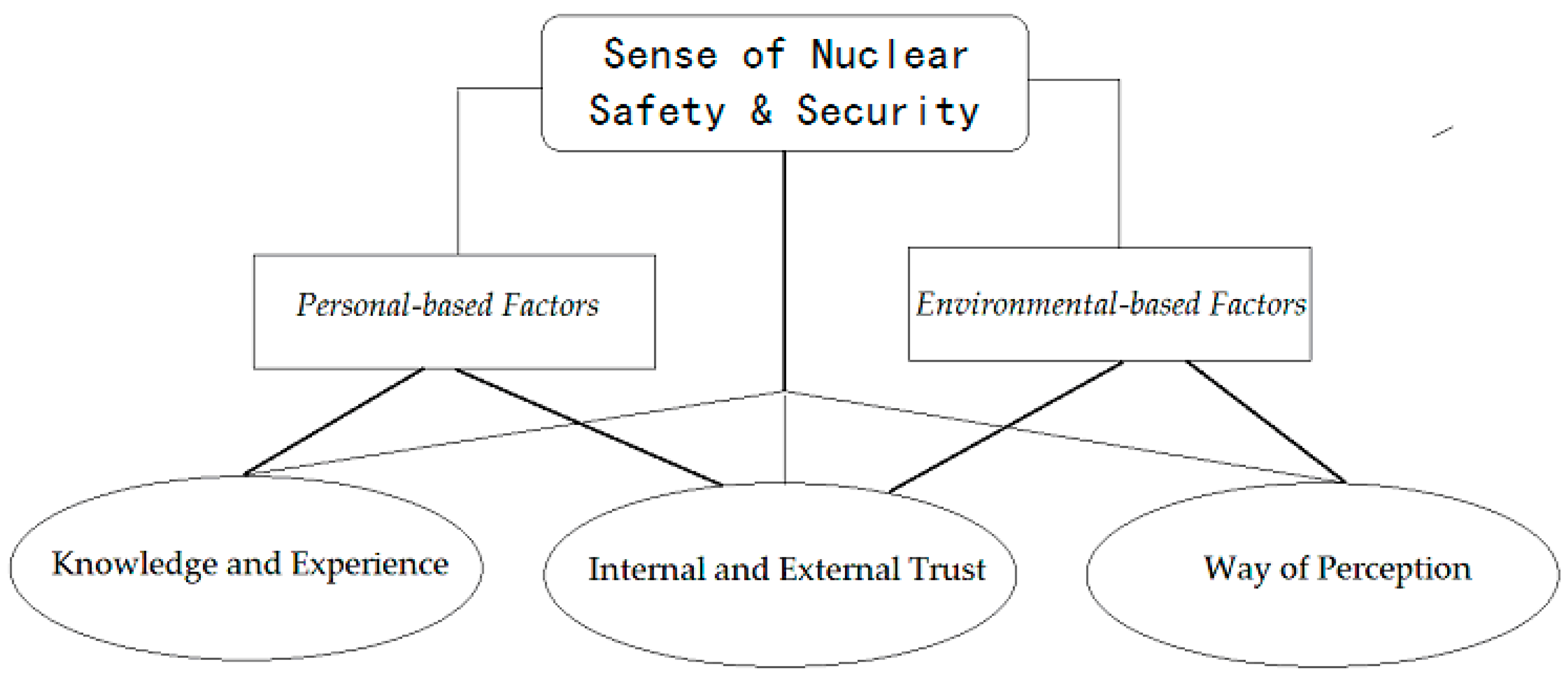
Based on the existing research findings on the sense of security, this paper, from the perspectives of cognitive psychology and sociology of safety and security [7], tries to categorize the factors that affect the current Chinese public’s sense of nuclear safety & security into three aspects, which are considered as three-dimensional so as to construct an evaluation model (Figure 1):
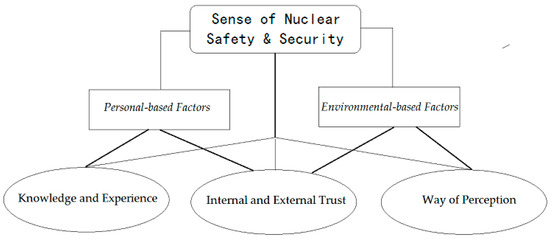
Figure 1.
Evaluation Model for the Populace’s Sense of Nuclear safety & security.
(1) Knowledge and experience. This refers to the public’s security knowledge on the level of nuclear devices, nuclear facilities, nuclear materials, the nuclear environment and nuclear activities, and their own life experiences, if any, with nuclear related issues.
(2) Internal and external trust. This is the core content of the assessment of the sense of security. Inner trust is self-confidence, i.e., you can be confident that you are not endangered by nuclear hazards. External trust is your personal trust in nuclear matters, nuclear activities, nuclear environment, and government nuclear safety & security policies.
(3) Ways of perception. This refers to public access to nuclear safety & security knowledge for enhancing their nuclear risk perception. It also includes people’s trust in media coverage of nuclear issues.
What needs to be explained is that knowledge and experience mainly come from personal-based factors; perception is mainly derived from environmental-based factors; the internal and external trust are formed under the joint action of individual cognition and the external environment.
2.3. Questionnaire Survey
The methods of the sampling survey, the questionnaire survey and SSPS (Solutions Statistical Package for the Social Sciences) have been mainly performed in this study.
Based on the evaluation model above, we designed 11 questions focusing on the public’s basic knowledge of nuclear matters, nuclear affairs, and the nuclear environment, the subjective assessment of the recent major nuclear activities and nuclear dangers, and the channels for public access to nuclear safety & security information and its credibility. The steps taken to develop this survey are showed in the following part. The analysis of the questionnaire results is conducted in the Section 3 and Section 4.
In the process of developing questionnaire survey, the following steps were used:
(1) Geographical (city) sample. The principle applied is to survey these residents in points involved in nuclear facilities, nuclear materials, nuclear stations, and nuclear activities. The sampled areas and cities with this principle are the Northeast (Dalian), North China (Beijing), Central South (Yiyang), South China (Guangzhou), Southwest (Chengdu), and Northwest (Shihezi).
(2) Demographic sample. One millionth of the total population by the end of 2016 in the local city is sampled to obtain the approximate sample size of each city.
(3) The survey method. The interviewer conducts a questionnaire survey for random passersby.
(4) Statistical Analysis. It is mainly done with SPSS tools.
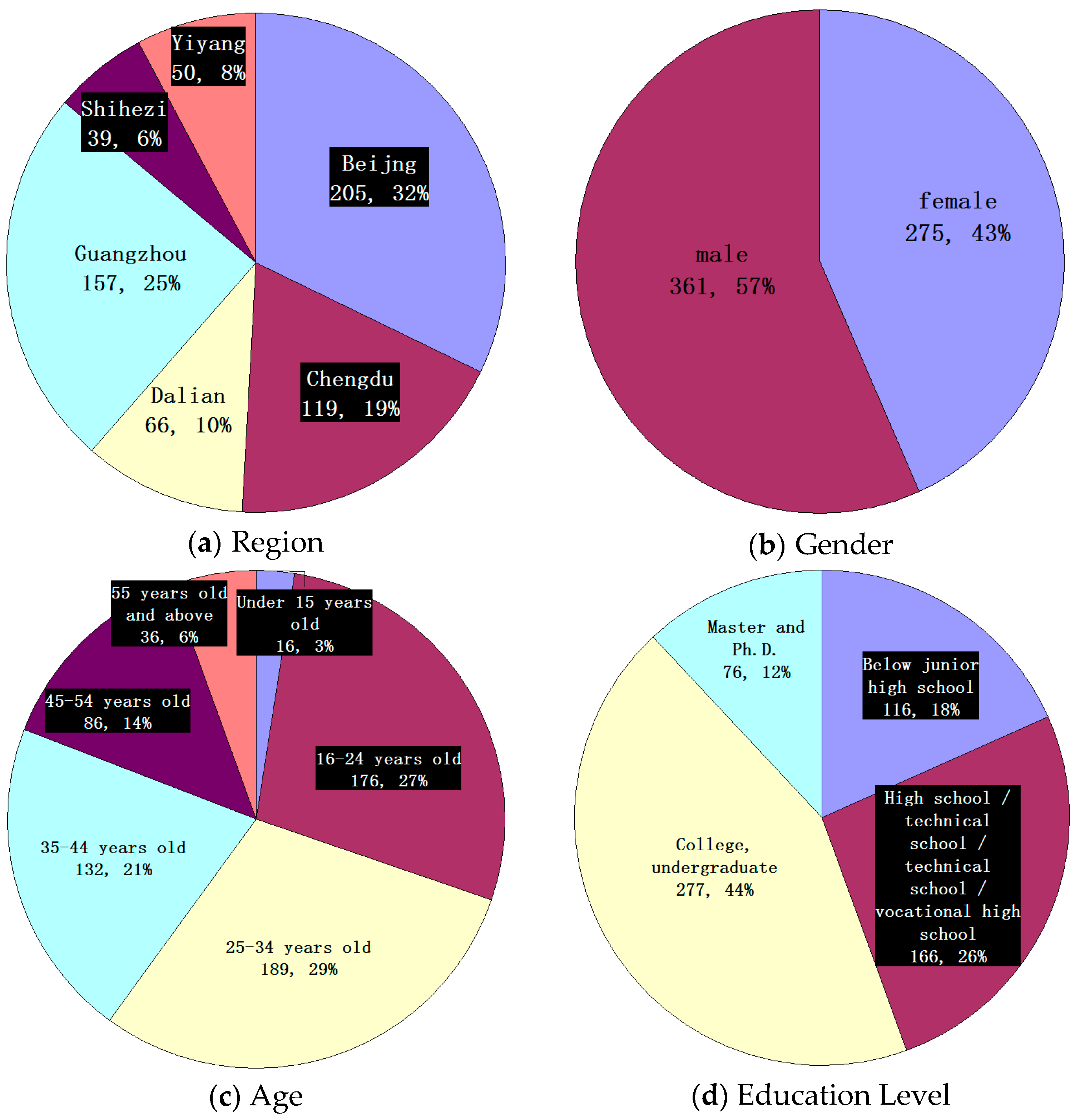
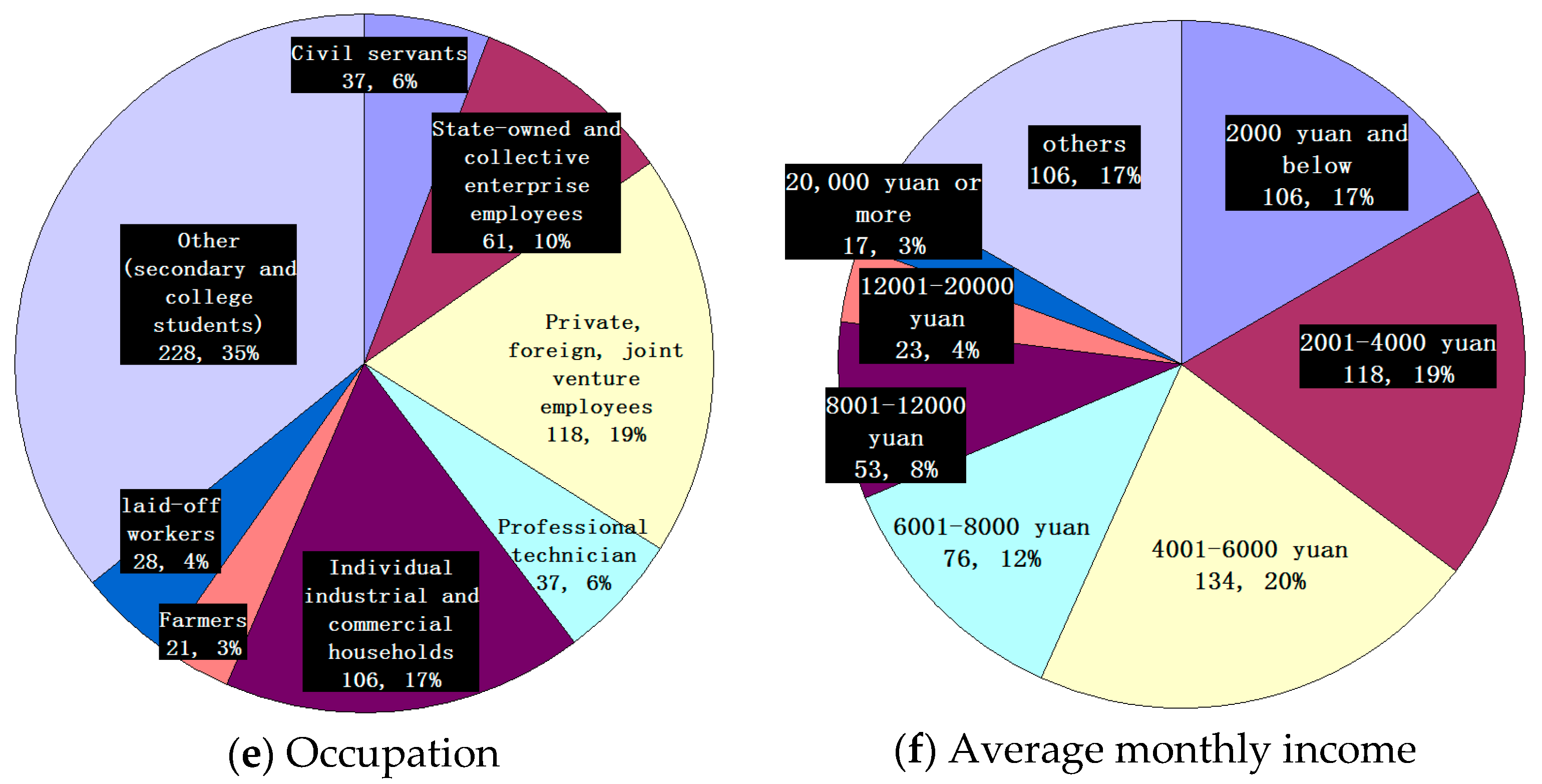
Finally, we received 636 samples. Figure 2a–f show the specific distribution of valid sample objects.
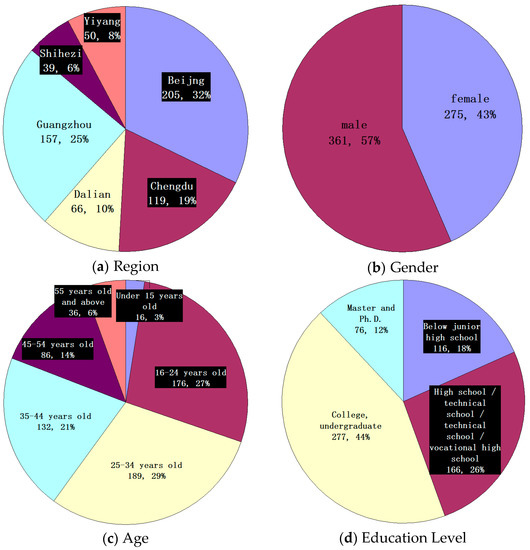
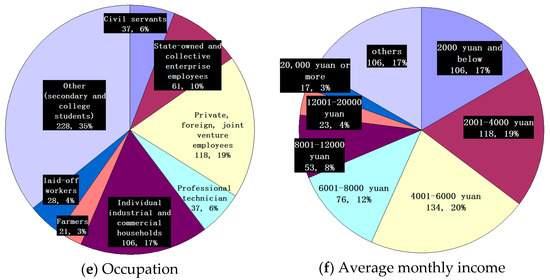
Figure 2.
Specific Sample Distribution (N = 636).
As shown in Figure 2a, the samples are highly representative in the geographical distribution. Beijing (32%), Guangzhou (25%), and Chengdu (19%), as the first-tier cities in China, have a relatively large population of permanent residents (living the local for more than 6 months in China).
As shown in Figure 2b, the majority of respondents are male (accounting for 56.8%), basically matching the gender characteristics of China’s urban population.
As shown in Figure 2c, the respondents are mostly aged between 16–45 (78.3%), basically in line with the demographic characteristics of the national economic and social activities.
As shown in Figure 2d, most respondents (43.6%) have college or undergraduate degrees, followed by those with high school, vocational high school, and technical qualifications (26.1%), and the percentage of those with a Masters or Ph. D degree is the least (12%) in the sample. The education attainment of the respondents is similar to the basic characteristics of the population of the first- and second-tier cities in this survey. This high level of education attainment lays a good foundation for evaluating the public’s sense of nuclear safety & security.
The occupational distribution of Figure 2e shows that most respondents are young students (35.9%), followed by workers in private-owned enterprises, foreign-funded enterprises and joint ventures (18.6%), and individual industrial and commercial households (16.7%).
According to the average monthly income of the respondents from the previous year, as shown in Figure 2f, the number of people 6000 Yuan is the largest, accounting for 56.3%; and 16.7% people is not sure of their income (i.e., others). This income composition has a certain relationship with the occupation characteristics of this sample--the majority respondents are of young students. The mid- and high-income earners with their income averaging between 6001–12,000 Yuan account for about 20%. This proportion is relatively high, which is certainly due to the proportion of respondents from the first- and second-tier cities (higher income than that of third and fourth-tier cities).
In addition, to watch the overall analysis in the Part 4, 100% of the public’s sense of safety & security is divided into three levels: 0–33% for the lower level, 34–67% for the mid-range level, and 68–100% for the higher level.
3. Questionnaire Survey Results
In this part, according to the above evaluation model (three dimensions of knowledge and experience, internal and external trust, and way of perception), a descriptive statistical analysis of the survey was conducted, and the results are shown as follows.
3.1. Knowledge and Experience
This section is mainly composed of the statistics about the system of knowledge and personal experience (Table 1, Table 2 and Table 3) involved in nuclear matters, expressed in terms of words and sentences, which are captured in questions A1–A18.

Table 1.
Public understanding level of the following words or events. (Single choice per line, N = 636, %).
Table 2.
Your intuition of the following statements. (Single choice per line, N = 636, %).
Table 3.
Which of the following things do you think contains nuclear radiation? (Multiple choice, N = 636, %).
According to the statistical results in Table 1, we took an average of 6 answers (A1–A6), in the order from the highest to the lowest: (just) heard about, 42.54%; more understand, 27.62%; don’t understand, 18.41%; totally unknown, 6.59%; and complete understand, 4.83%. The average sum of the answer ratios of “complete understanding” and “more understanding” is only 23.24%, which is low.
According to the statistical results in Table 2, the public has a relatively high answer ratio of 55.38% for A7, but the negative answer is not low (44.62%). This shows that the public are somewhat of ambiguity to this issue. When answering the question of A8, the public held a very high negative attitude of 71.88%, which is more correct. When the public answers A9, the negative exceeds 60%, but the affirmative answer is not low (nearly 40%), indicating that the public’s understanding of this issue is somewhat ambiguous. In general, the public has a relatively high recognition rate of A7–A9, and the average correct recognition rate of the three answers reaches 62.44%. However, some publics still have incorrect understanding.
From Table 3, the public has a relatively high recognition rate of nuclear radiation related to nuclear matters, and their response rates to A13, A10, A11, and A12 are 79.02%, 77.6%, 56.78%, and 52.68%, respectively, the average answer rate of 4 items is 66.52%. The response rates of nuclear radiation to other things are significantly less than 20%. They thought that a microwave oven, electric blanket, and hair dryer have nuclear radiation problems with a rate of 36.59%.
3.2. Internal and External Trust
Based on the above public perception of nuclear things and nuclear activities, this section examines the public’s inherent psychological confidence and external risks derived from nuclear things and nuclear activities, which is the core of the assessment to the sense of nuclear safety & security. It covers Table 4, Table 5, Table 6, Table 7 and Table 8 and its B1–B10 questions.
Table 4.
In your daily life, your worry level about the following nuclear-related things. (Single choice per line, N = 636, %).
Table 5.
The safety distance between nuclear power stations and residential areas. (Single choice per line, N = 636, %).
Table 6.
The populace’s sense of safety & security on nuclear activities neighboring countries. (Single choice per line, N = 636, %).
Table 7.
The populace’s sense of safety & security of nuclear-related occupational. (Single choice, N = 636, %).
Table 8.
Your opinion on the following statements. (Single choice per line, N = 636, %).
From Table 4, based on the average response rates from the four questions B1–B4, the public’s concerns about nuclear matters and nuclear activities in daily life are arranged in descending order: Very worried (31.27%), More Worried (23.59%), Modest (20.84%), Not Very Worried (18.35%), and No Worries (5.95%). The answer rate of “modest” is the highest, but the sum of the response rate of “very worried” and “more worried” is 44.43%. On the whole, the public is quite worried about the above nuclear matters and nuclear activities.
Table 5 shows that the public believes that the farer away the nuclear power station is located, the more secure the place is to live. For example, the response rates are 54.11% for over 150 km, 20.41% for 100–150 km, and 14.56% for 60–100 km. This shows that there is a clear correlation between the public’s sense of security and the safety distance of nuclear matters.
Table 6 shows that the Chinese people’s sense of security of the nuclear activities of neighboring countries in recent years (B6 Japan’s Ivorian and B7 North Korea nuclear test). The public’s average rate of response to the impact of the two nuclear activities on Chinese residents ranked from high to low are: More Impactful (31.71%, which is the highest), Modest (29.81%), Not Much Impact (17.5%), Very Impactful (15.7%), and No Impact (5.28%). Among them, the sum of the answer rates of “very impact” and “more impact” is 47.41%. It can be seen that the Chinese public is very worried about the nuclear safety issue in the two neighboring countries.
Table 7 examines the sense of security of the public in nuclear-related occupations. When asked whether they “are willing to engage themselves or their family member in nuclear occupations” (B8), up to 56.62% of the respondents held a negative attitude, while 38.64% consider “depending on the actual situation” and only 4.73% agree with this kind of occupation. It can be seen that the public is very sensitive to the safety & security of occupations involving the nuclear industry.
In Table 8, 42.5% of the respondents “agree” that nuclear safety & security measures are safe and trustworthy in our country (B9), 27.65% consider them as “modest”, 25.43% “completely agree” with them, and only 4.42% do “not agree” and “completely disagree” with these measures. Overall, there is a high level of security confidence in this area (67.93%).
In response to the question “I never think there is any nuclear damage in my daily life” (B10), 37.84% people answered “more agree” and “completely agree”, 34.34% of the respondents answered “modest”, and 27.82% people responded do “not agree” and “completely disagree”. It can be seen that the public feels more secure about the nuclear in daily life.
3.3. Ways of Perception
This section mainly discusses the ways and means of public access to nuclear safety and security (C1–C9) as well as public confidence in the media of nuclear communication (C9).
Table 9 shows some reference indicators (C1–C8), which mainly examine public perception channels of the sense of nuclear safety & security. In general, the public mainly obtains knowledge of nuclear safety and nuclear safety & security from the popular media. Currently, the mobile phone is the most frequently used (76.54%), followed by TV (73.39%), and the computer network (64.57%). The traditional ways, including the newspapers (31.97%) and radio (25.04%), have gradually declined. However, we can also conclude that there has been no public interest in the important and scientific methods of nuclear safety & security dissemination conducted by the government’s popular science activities, experts’ popular science lectures, and textbooks.
Table 9.
Sources of getting nuclear knowledge. (Multiple choice, N = 636, %).
Table 10 mainly examines the public’s trust in incidents such as media reports on nuclear contamination (C9). As high as 43.22% of the respondents think that the media coverage of these issues is “more fair and reasonable”, 20.98% of the people consider the media “did not make it clear”, 22.71% do not understand the media coverage of such matters, and only 13.09% of people think the media reports are “some exaggerated”. In general, the public shows a medium level of trust in the media coverage of the nuclear issue.
Table 10.
Credibility of media reports on nuclear contamination incidents. (Single choice per line, N = 636, %).
4. Discussion and Conclusions
Part 3 above has described the Chinese public’s sense of nuclear safety & security in detail from its underlying three dimensions: knowledge and experience, internal and external trust, and way of perception. Next, in order to reach a generalization from the previous thorough descriptive statistics, what we need to ask is how the overall state of Chinese public sense of nuclear safety is. Here, we select the indicators that are able to better reflect the sense of public security in A1–A18, B1–B10 and C1–C9 in Table 1, Table 2, Table 3, Table 4, Table 5, Table 6, Table 7, Table 8, Table 9 and Table 10 as the positive indicators to gauge the degree of “the overall sense of nuclear safety & security” for Chinese public (seen Table 11 in details). The formula is as follow:
Total = {[(A1 + A2 + A3 + A4 + A5 + A6)/6] + [(A7 + A8 + A9)/3] + [(A10 + A11 + A12 + A13)/4] + [(B1 + B2 + B3 + B4)/4] + B5 + [(B 6+ B7)/2] + B8 + B9 + B10 + C9}/10 × 100%
Table 11.
Current Chinese public’s overall sense of safety & security (%).
Table 11 shows that in the three dimensions of evaluation, the public has the highest rate of response to the knowledge and experience about nuclear safety and security (44.13%), followed by perceived response rate (43.22%), and the lowest rate is for the internal and external trust (37.48%). In the end, the comprehensive assessment holds that the current overall sense of nuclear safety & security for Chinese public is 40.71%, which is at the lower mid-range level. It is generally believed that if more than 70% of residents respond positively to the security issue, then people will feel relatively safe.
Compared with some foreign surveys in the same period, the overall level of nuclear safety & security for the Chinese public is similar to them, i.e., a 2016 Gallup poll of the American public revealed that public support for nuclear energy in the United States was at a record low of 44%, with the majority (54%) of respondents saying that they oppose nuclear energy. This was the first time that public opposition to nuclear power in the United States had achieved a majority in the 23 years of Gallup polling on the subject [18]. According to The Guardian, “A September poll by ReachTel found 73% of Australians support the ban on nuclear weapons and believe nuclear weapons pose a threat to global security.” [19].
Finally, a brief conclusion statement was made as following:
(1) Based on previous studies, the research group has constructed a new theoretical framework including three-factor dimensions of knowledge and experience, domestic and overseas trust, way of perception, for assessing the populace’s sense of nuclear security.
(2) Using the methods of regional sampling and the street interception investigation, the task group conducted a reasonable questionnaire survey on the current Chinese public’s sense of nuclear security.
(3) According to the findings of this study, at present, the overall sense of nuclear security level for Chinese public is moderate (40.71%). That is, less than 50% of people feel safe in regards to nuclear security.
(4) Judging from three dimensions, Chinese government and society still need to further improve ways of perception of nuclear security for its populace, broaden channels of information sources, strengthen the popularization of security of nuclear science to enhance public security confidence, also further more detailed and specific safeguarding measures regarding nuclear security should be made to promote the development of nuclear security affairs.
(5) Some academic issues require further researches and improvement.
Author Contributions
This research article was completed cooperatively by Y.Y. and F.L. Y.Y. conceived and designed the process of the whole research, including select topics, survey planning, questionnaire designing, statistical analysis, and composing the paper; F.L. was mainly involved in the questionnaire making, field surveys, and statistical analysis.
Funding
This research was funded by the Key Research Project of National Philosophy and Social Science Fund [16AZD020] and the Fundamental Research Funds for the Central Universities [3142015026/3142018057].
Acknowledgments
Thanks to Mr. Zhicheng Yan, Beijing Jiliu Information Technology Co., Ltd. for assisting in the survey and statistics.
Conflicts of Interest
The authors declare no conflict of interest.
References and Note
- Cameron, W.B.; McCormick, T.C. Concepts of Security and Insecurity. Am. J. Sociol. 1954, 59, 556–564. [Google Scholar] [CrossRef]
- Lee, B.A.; Guest, A.M. Determinants of Neighborhood Satisfaction: A Metropolitan-Level Analysis. Sociol. Q. 1983, 24, 287–303. [Google Scholar] [CrossRef]
- Chinese Ministry of Public Security Task Group. Investigation and Analysis of the Current Situation of Public Security in China. Sociol. Stud. 1989, 4, 35–42. [Google Scholar]
- John, V. Insecure Times: Conceptualizing Insecurity and Security. In Living with Insecurity in Contemporary Society; Hill, W.M., Ed.; Routledge: New York, NY, USA, 1999; pp. 1–3, 5–8. [Google Scholar]
- Wang, D.-W.; Zhang, P.-S.; Wang, J.-X. Research on Social Sense of Security for Chinese Residents. Stat. Res. 2002, 19, 24–29. [Google Scholar]
- Wang, J.-X. Attitudes towards Risks: A Study on Security of the Public. Society 2008, 28, 206–221. [Google Scholar]
- Yan, Y. Sociology of Safety and Security, 2nd ed.; China University of Political Science and Law Press: Beijing, China, 2013; pp. 122–126. [Google Scholar]
- Li, C. the Insecurity and Anxiety of the Middle Class in China. Beijing Cult. Rev. 2016, 8, 32–39. [Google Scholar]
- Jaki, T.; Allacher, P.; Horling, F. A false sense of security? Can tiered approach be trusted to accurately classify immunogenicity samples? J. Pharm. Biomed. Anal. 2016, 128, 166–173. [Google Scholar] [CrossRef] [PubMed]
- Corrigan, R. False sense of security. New Sci. 2017, 236, 24–25. [Google Scholar] [CrossRef]
- Murayama, Y.; Hikage, N.; Hauser, C.; Chakraborty, B.; Segawa, N. An Anshin Model for the Evaluation of the Sense of Security. In Proceedings of the 39th Hawaii International International Conference on Systems Science (HICSS-39 2006), Kauai, HI, USA, 4–7 January 2006. [Google Scholar]
- Murayama, Y.; Hikage, N.; Fujihara, Y.; Hauser, C. The Structure of the Sense of Security, Anshin. In Proceedings of the Second International Conference on Critical Information Infrastructures Security (CRITIS 2007), Málaga, Spain, 3–5 October 2007; Lopez, J., Hämmerli, B., Eds.; LNCS 5141. 2008; pp. 83–93. [Google Scholar]
- International Atomic Energy Agency. Global Public Opinion on Nuclear Issues and the IAEA: Final Report from 18 Countries Archived 2008-04-09 at the Wayback Machine; International Atomic Energy Agency: Vienna, Austria, 2005; p. 6. [Google Scholar]
- Majority of Europeans Oppose Nuclear Power. Available online: https://www.euractiv.com/section/eu-priorities-2020/news/majority-of-europeans-oppose-nuclear-power/ (accessed on 15 November 2017).
- “A Survey on Public Awareness of Nuclear Weapons in Six Countries”, published April 28, 2010. See also “Young people want nuclear disarmament: survey”, Toronto Sun (29 April 2010).
- Public Attitudes toward America’s Energy Options Report of the 2007 MIT Energy Survey. Available online: https://dspace.mit.edu/handle/1721.1/45068 (accessed on 15 November 2017).
- The Pew Research Center for the People and the Press. As Gas Prices Pinch, Support for Oil and Gas Production Grows; The Pew Research Center for the People and the Press: Washington, DC, USA, 2012. [Google Scholar]
- Gallup.com. For First Time, Majority in U.S. Oppose Nuclear Energy; Gallup, Inc.: Washington, DC, USA, 2017. [Google Scholar]
- Doherty, B. Nuclear annihilation ‘one tantrum away’, Nobel peace prize winner warns. The Guardian, 11 December 2017. [Google Scholar]
- Ritchie, V.; Guo, K.-S. The Chernobyl accident after the accident on the safety of nuclear power generation feel anxious. World Sci.-Tech. R D 1988, 6, 55–56. [Google Scholar]
- Liu, C. International Perspective: Difficult Refraction of Nuclear Power in Europe’s Difficulties. People’s Daily, 10 January 2012. [Google Scholar]
© 2018 by the authors. Licensee MDPI, Basel, Switzerland. This article is an open access article distributed under the terms and conditions of the Creative Commons Attribution (CC BY) license (http://creativecommons.org/licenses/by/4.0/).