


Abstract
The relatively low level of sustainability of major public projects has been subject to criticism by the community, increasing the pressure to incorporate the concept throughout the project lifecycle and the importance of understanding the perceptions of affected groups. The study undertook this task by compiling a list from the literature of the sustainability concerns that are associated with major public projects from their economic–social–environmental implications, identifying the relevant stakeholder groups in the Guangdong–Hong Kong–Macao Greater Bay Area and their levels of influence by interviews, and evaluating various sustainability objectives from a multi-stakeholder perspective via a questionnaire survey. The results were validated through a series of interviews with purposively selected experts. The study findings indicate the need for more consideration of social concerns in Guangdong province, the proper levels of public participation in Hong Kong in order to avoid excessive interruptions to the pace of project procurement, and that Macao may have to experience a relatively slow development of construction in order to balance the social/environmental requirements that are involved. These findings contribute to both the government and construction industry at large in delivering economically, socially, and environmentally sustainable major public projects in the Bay Area and China as a whole.
1. Introduction
China is experiencing the rapid development of major public projects throughout the country, and the Guangdong–Hong Kong–Macao Greater Bay Area is no exception [1]. As a national strategy of China, the development of the Guangdong–Hong Kong–Macao Greater Bay Area emphasizes the cooperation between the three regions in various respects, such as the delivery of major public projects [2]. Projects of this type are constructed with an area of more than 20,000 m2 and for office, commercial, tourism, science, education, culture, hygiene, communication, and transportation use [3]. Brookes and Locatelli [4] listed their features as large investment commitment, vast complexity (especially in organizational terms), and having a long-lasting impact on the regional economy, the environment, and society.
Despite the large impact of infrastructure projects in the Guangdong–Hong Kong–Macao Greater Bay Area as expected by Brookes and Locatelli [4], the relatively low level of project sustainability has been subject to some criticism by the community [5,6]. Such recent controversial cases as the Guangzhou waste-to-energy power plant project and the Guangzhou–Shenzhen–Hong Kong high-speed rail project have even further escalated the dissatisfaction of project stakeholders over the economic, social, and environmental issues [7]. This has increased the pressure to incorporate the concept of sustainability throughout the project lifecycle, making it important to have a better understanding the perceptions of affected groups in Guangdong province, Hong Kong, and Macao, of the various sustainability objectives that are needed.
To address the multiple sustainability objectives raised from the mega infrastructure project in the Guangdong–Hong Kong–Macao Greater Bay Area, this study first compiled a list from the literature of the sustainability concerns associated with major public projects from their economic–social–environmental implications. The relevant Guangdong–Hong Kong–Macao Greater Bay Area groups were then identified, and their influencing levels were quantified through interviews. The various sustainability objectives were next evaluated from a multi-stakeholder perspective by a questionnaire survey in the three different geographical areas. The results were then validated by experts purposively selected in the last phase of the work. The study’s findings contribute to both the government and construction industry at large in delivering economically, socially, and environmentally sustainable major public projects in the Bay Area and China as a whole.
2. Literature Review
2.1. Sustainability Objectives of Major Public Projects
The principles of sustainable development have been implemented in various sectors, including the construction industry [8]. Researchers across the world have identified the sustainability objectives of construction projects. Fernández-Sánchez and Rodríguez-López [9], for example, established the sustainable breakdown structure applicable to infrastructure projects from social, environmental, and economic perspectives, indicating that infrastructure sustainability, socially, covered areas such as culture, accessibility, participation, security, public utility, and social integration. The environmental indicators of green infrastructure projects, on the other hand, comprised soil, water, atmosphere, biodiversity, resources, and energy. Project stakeholders also pay attention to such items as costs, technical requirements, bureaucracy, social economy, and heritage, in order to achieve sustainability from the economic dimension [9]. Pakzad et al. [10] divided the key sustainability indicators of green infrastructure performance into four categories of (i) ecology (climate and microclimatic modifications, air quality improvement, carbon offset, reduced building energy use for heating and cooling, hydrological regulation, and biodiversity protection and enhancement; (ii) health (improving physical, social, and mental well-being); (iii) socio-cultural (food production, opportunities for recreation, tourism, and social interaction, and improving pedestrian ways and their connectivity); and (iv) economic (value of avoided CO2 emissions and carbon sequestration, value of avoided energy consumption, value of air pollutant removal/avoidance, and reducing the cost of using private motor cars by increased walking and cycling). Similar categories of construction sustainability for a variety of infrastructure projects can be found in Hatefi and Tamošaitiene [11], Mansourianfar and Haghshenas [12], and Yang et al. [13]. Although there are slight differences between these aforementioned studies over the classifications in infrastructure construction sustainability, the consensus is that sustainable construction projects should balance the environmental, economic, and social concerns of their stakeholder groups [8].
Based on the defined three major categories of construction sustainability (i.e., social, environmental, and economic aspects), a further 18 sustainability objectives of major public projects were identified through a global literature review and content analysis, by counting the number of times an item occurred. A similar technique was used by most of the selected literature for determining project sustainability factors. These were accordingly classified into the above three categories, as detailed in Table 1.

Table 1.
Sustainability objectives of major public projects [8,19,20,21,22,23,24,25,26,27,28,29].
2.2. Review of Methodology in Defining and Evaluating Sustainability Objectives for Major Public Projects
A multiple-phase methodology covering a literature review, interview, and/or questionnaire survey has been adopted in several existing studies that focused on defining and evaluating the sustainability indicator system for major public projects. For example, Diaz-Sarachaga et al. [14] developed a Sustainable Infrastructure Rating System by firstly defining the importance of sustainability indicators by collecting experts’ feedback. The rating system was then weighted adopting Analytical Hierarchy Process (AHP) and the Integrated Value Model for Sustainable Assessment [14]. The same three pillars of sustainability (i.e., social, environmental, and economic factors) were targeted by Yu et al. (2018) in developing the Construction Project Sustainability Assessing System [15]. Yu et al. adopted a questionnaire survey approach [15] to evaluate the suitability of these pre-established sustainability indicators. Hong and Lacouture compared a key performance indicator system between different countries [16] by involving the Delphi approach. Hatefi and Tamošaitiene performed a literature review, questionnaire survey, and assessment of sustainability criteria [11] for construction and infrastructure projects.
2.3. Sustainability of Major Public Projects in the Chinese Context
A few existing studies can be found that target developing the sustainability assessment system for China’s public or infrastructure projects. For example, Shen et al. [17] initiated the key assessment indicators (KAIs) for assessing the sustainability performance of infrastructure projects in China. Adopting a questionnaire survey approach by recruiting experts from government officials, industry professionals, and clients, the study of Shen et al. [17] served as one of the initial sustainability assessment systems in the Chinese context. The comparative study of sustainability for infrastructure projects performed by Hong and Lacouture [16] indicated that China’s sustainability indicator for infrastructure projects differed from that of United States, specifically in terms of special indicators of highway systems. Liu et al. [18] concluded that there had been growing interests for sustainability in new transport infrastructure projects in China. However, so far, there has still been limited development of a unified sustainability assessment system in the Chinese context. This might be due to the different social, political, cultural and environmental backgrounds of mainland China and Hong Kong/Macao (even in mainland China, the contexts could be different with regard to various provinces/cities). Regarding the project type, Li et al. [5] believed that mainland China put more emphasis on the delivery of transportation infrastructure, while office/commercial buildings dominate Hong Kong/Macao’s industry. On the other hand, cities in mainland China e.g., Nanjing, focused on education public project as compared with Shenzhen, where science buildings are the mainstream [5].
In the Guangdong–Hong Kong–Macao Greater Bay Area, a typical project of this type (perhaps the most controversial one) is the Guangzhou–Shenzhen–Hong Kong express rail link project (Hong Kong section), which has generated much debate among different groups over issues of family values, environmental impact, cost-effectiveness, and value for money [7]. These include the affected residents, the younger generation born after the 1980s (referred to as the after-80s), politicians, regulators, and professionals. This again indicates the importance of understanding the sustainability objectives of various stakeholder groups during the project lifecycle.
3. Research Design
3.1. Research Process
The study was conducted in four phases, as illustrated in Figure 1. The first phase involved reviewing the global literature to compile a list of the sustainability objectives of major public projects. For the next phase, a series of semi-structured interviews were organized to (i) confirm the suitability and practicality of various sustainable concerns (as identified in Phase 1) in the Chinese context; (ii) identify the project stakeholder groups involved; and (iii) analyze the impact level of each group quantitatively. In Phase 3, a questionnaire survey was carried out, and different sustainability objectives were evaluated from a multi-stakeholder perspective. The results were then validated in the final phase by purposively selected experts.
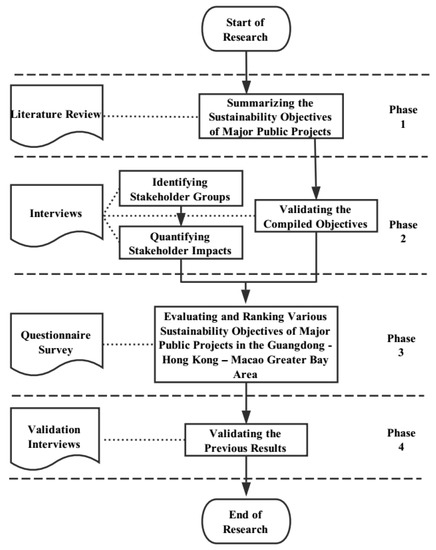
Figure 1.
Research flowchart.
3.2. Research Methods
A combination of construction management research methods was adopted, including a literature review, interviews, and a questionnaire survey. As a summary of the literature review is reported in the previous section, the following focuses on the latter two.
3.2.1. Interviews
Interviews were carried out in each of phases 2 and 4 to achieve different research objectives (as detailed in Figure 1). In Phase 2, these involved 26 purposively chosen experts with a minimum of five years’ working/research experience in public project delivery from government departments and groups of owners/contractors/designers/non-governmental organizations (NGOs)/academics (Table 2) [30]. The rest (the end-user group) had been frequent users of some certain public projects in mainland China, Hong Kong, or Macao. To ensure the representativeness and reliability of their comments necessitates a careful selection of the cases covering different types of public projects in the three regions i.e., two office buildings in Shenzhen and Hong Kong respectively, two commercial buildings in Hong Kong and Macao respectively, one tourism building in Guangzhou, two education and culture buildings in Guangzhou and Hong Kong, respectively, and one transportation project in Macao.
Table 2.
Profiles of the interviewees involved in phases 2 and 4.
The major stakeholder groups of public projects were first identified during this phase (through qualitative questions). To achieve the envisaged research aim, their impact levels were then assessed on a five-point Likert scale from 1 (very low) to 5 (very high) and based on their possibility of influence (P) and degree (D) in Guangdong province, Hong Kong, and Macao. This is in line with Olander’s study [31], in which stakeholder influence was analyzed in the context of construction project management. The quantitative process later gained popularity, as evidenced in the research of Li et al. [5]. As required by the interviewees to preserve anonymity, their positions and organizations were not linked to their evaluations.
The comprehensive impact level (CIL) of each stakeholder group (i) during public project delivery was obtained from:
The weighting (W) of stakeholder group i in evaluating project sustainability indicators is given by:
Equivalent formulae apply to the other stakeholder groups.
Phase 4 involved a series in interviews, with 25 different participants (based on the same selection criteria as used in Phase 2) constituting the validation panel (Table 2), who were invited to comment on the research results obtained from the previous phases. The interviews were conducted individually, and each lasted for around one hour and a half. To facilitate and expedite the interview process, all of the interviewees were sent a package of information in advance, which included the purpose of the interview, some background information, instructions for the exercise, and a brief description of the findings so far.
3.2.2. Questionnaire Survey
A questionnaire survey was conducted in Phase 3, soliciting comments from the various stakeholder groups. Before that, a pilot study involving 16 experts from eight different stakeholder groups was organized. This resulted in some changes to the original version of the questionnaire, such as the replacement of the previous five-point Likert scale by the current seven-point Likert scale in order to improve the degree of accuracy. A purposive sampling approach was used later on for the formal survey, with potential respondents being required to have at least two years’ working experience in public project construction in Guangdong province/Hong Kong/Macao, or have been users of public projects in the region. A total of 177 valid responses were obtained; the response rates for each stakeholder group are summarized in Table 3. The respondents evaluated the identified sustainability objectives according to a seven-point Likert scale from one (least important) to seven (most important).
Table 3.
Response rate of the questionnaire survey conducted in Phase 3 of the research.
The initial mean value (IMV) regarding the evaluation of each stakeholder group of each sustainability factor was calculated [17] and then adjusted by the weighting (W) of each stakeholder group in determining project overall sustainability, i.e.,
where the Adjusted Mean Value (AMV)xy means the adjusted mean value of item x as rated by stakeholder group y, Initial Mean Value (IMV)xy represents the initial mean value of item x as rated by stakeholder group y, and Wy denotes the weighting of stakeholder group y obtained through Equations (1) and (2).
4. Results
4.1. The Stakeholder Groups of Major Public Projects and Their Level of Impact
During the first round of interviews, the expert panel confirmed that the sustainability objectives of major public projects, as identified through the literature review, were suitable and practicable with regard to the economic–social–environmental background of China and the Guangdong–Hong Kong–Macao Greater Bay Area in particular. The major stakeholders were identified as shown in Table 3. Table 4, Table 5 and Table 6 summarize the possibility of influence (P) and degree (D) values of the various stakeholders, with the calculated comprehensive impact levels (CIL) and their weightings (W) shown in Table 7.
Table 4.
Influencing possibilities (P) and degrees (D) of various stakeholder groups of major public projects in Guangdong province.
Table 5.
Influencing possibilities (P) and degrees (D) of various stakeholder groups of major public projects in Hong Kong.
Table 6.
Influencing possibilities (P) and degrees (D) of various stakeholder groups of major public projects in Macao.
Table 7.
Comprehensive impact levels (CIL) of various stakeholder groups and their weightings (W).
The rankings of the three most influential stakeholder groups in Guangdong province and Macao are the same—the local government department was the first, followed by the owners and operators—with slight differences regarding their respective comprehensive impact levels and weighting. A notable feature is that the impact level of the end-users was rated as 4.058 (the second highest) in Hong Kong. However, this stakeholder group had a rating of 3.076 in Guangdong province, which was next to last on the list.
4.2. Assessment of Various Sustainability Objectives from a Multi-Stakeholder Perspective
The evaluations of the various stakeholder groups from Guangdong province, Hong Kong, and Macao on the economic, social, and environmental sustainability objectives based on the initial mean values (IMV) and project overall sustainability are listed in Table 7, Table 8 and Table 9 respectively. The most important economic factor evaluated by the respondents in the three geographical areas is EC5 (value-for-money during the proposed project(s) lifecycle) by the government department and owners, with adjusted mean values of 0.960 and 0.964 for Guangdong province, 0.849 and 0.940 for Hong Kong, and 0.906 and 0.930 for Macao (Table 8). In Guangdong province, the government department (ranked first) and owners (ranked second) are also the most positive groups promoting social sustainability (Table 9). Of the various factors involved, SO2 (creation of a safe, convenient, comfortable, and legible pedestrian circulation and transport network) is considered the most important, and SO5 (unique local characteristics) the least important in Guangdong province. In Hong Kong and Macao, the group of owners play a key role during socially sustainable construction, and most attention is paid to SO9 (effective public participation). From the environmental perspective (Table 10), the government department (in Guangdong province), end-users (in Hong Kong), and owners (in Macao) are the most concerned. The core issues are the prevention and mitigation measures against air, water, and noise pollution (in Guangdong province), and green design and construction (in Hong Kong and Macao).
Table 8.
Evaluation of various stakeholder groups on the economic sustainability objectives.
Table 9.
Evaluation of various stakeholder groups on the social sustainability objectives.
Table 10.
Evaluation of various stakeholder groups on the environmental sustainability objectives.
4.3. Prioritization of Various Sustainability Objectives
The adjusted mean values (AMV) of the various sustainability objectives obtained from Equation (3) and listed in Table 8, Table 9 and Table 10, are ranked between/within the various stakeholder groups in each region, as summarized in Table 11.
Table 11.
Prioritization of various sustainability objectives.
From the economic and social perspectives, Macao ranks the highest of the three regions at 6.004 and 5.852 respectively, while Guangdong province is the highest (6.291) for the environmental sustainability objectives, followed by economic and social issues. The ranking in Hong Kong is different, with social sustainability being the most critical, and economic issues being the least critical. In Macao, more attention is paid to achieving economic sustainability during project delivery, with environmental concern receiving the least attention.
5. Validation
In order to confirm the validity of the survey results, a series of semi-structured interviews were conducted, as detailed previously in Section 3. During the interviews, the interviewees were asked to assess the preliminary findings against different criteria, i.e., appropriateness, objectivity, practicality, and reliability, according to a scoring scale from one to five, where one represented “poor”, and five represented “excellent”. The assessments of the validation panel members showed that all of the criteria were rated above “4”, indicating their overall satisfaction of the survey findings (Table 12). Their comments that, “involving stakeholder impacts when prioritizing the sustainability objectives of major public projects is not only innovative, but also practical, as projects of this type emphasize public participation more”, illustrate the point. The detailed ways of how the results were interpreted by the interviewees were also explored and reported in the following section.
Table 12.
Results of the validation interviews conducted in Phase 4 of the research.
6. Discussion
All of the validation panel members considered it appropriate to divide the stakeholders into the eight groups in Table 3. The highest ranked comprehensive impact levels coming from government department/owners in all three regions were taken to confirm that administrative instructions are currently more effective than market demands to achieve sustainable project delivery economically, socially, and environmentally. The panel found the relatively low influence level of end-users in Guangdong province to be unsurprising, since end-users are traditionally ignored in construction practice in mainland China. Despite this, an apparent call has been increasingly observed for the input of end-users to be recognized by mainland construction industry practitioners. After all, they are true agents in realizing the economic, social, and environmental sustainability objectives that are involved. It is recommended for lessons on stakeholder participation to be learnt from Hong Kong so as to maximize the contribution of various relevant groups, especially the end-users.
The panel felt the prioritization of the various sustainability objectives in Guangdong province (with environmental concerns being the first, followed by economic and social concerns) should be viewed from both positive and negative perspectives. On the one hand, most practitioners (especially in government departments) of the construction industry in mainland China have shifted toward the notion that the overall industry must not be allowed to develop at the cost of the environment. Although ignoring environmental sustainability may speed up the development of the construction industry in the short run, this has been proven to be extremely naïve, as evidenced by the Yokkaichi asthma episode in Japan during the 1950s, for example. On the other hand, various so-called society-related sustainability objectives are still overlooked to some extent. Consequently, there have been such controversial cases as the construction of incineration plants in Guangdong, which was accompanied by vociferous local resistance. It was suggested that one way to cope with this, as learned from Hong Kong practice, is to increase participatory decision-making throughout the project lifecycle. This is especially important for public projects, since the core mission of delivering projects of this type ought to be to satisfy the community as much as possible. The amount of involvement of the public should be carefully designed to suit different project stages in order to optimize community input while not adversely influencing project progress. For Macao, it is seen as appropriate to place a greater emphasis on economic sustainable development given the status quo of the region. Simultaneously incorporating environmental and social concerns may be on the right track, even if it slows the pace of development.
7. Conclusions
Improving the sustainability of major public projects is crucial for the development of the global construction industry, with no exception to China and her Guangdong–Hong Kong–Macao Greater Bay Area specifically. However, it is rather difficult to satisfy all of the sustainability-related considerations during project delivery. Therefore, the prioritization of various sustainability objectives becomes the first step toward coping with such an issue. Through this, the efficiency and effectiveness of stakeholder participation are expected to improve, and the success rate of contemporary major public projects is expected to increase. As a result, this research targets the Guangdong–Hong Kong–Macao Greater Bay Area, and aims to rank various sustainability items from a multi-stakeholder perspective in the three regions. The interviews in this study identified the major stakeholder groups of public projects (i.e., government department, owners, designers, contractors, supervising engineers, operators, end-users, and non-governmental organizations), and their impact on project delivery. A questionnaire survey then assessed a list of 18 sustainability factors (compiled from a literature review) from the perspectives of the stakeholder groups in Guangdong, Hong Kong, and Macao. This led to the quantification of sustainability objectives in Guangdong province (environmental ranked higher than economic and social issues), Hong Kong (social followed by environmental and economic issues), and Macao (economic followed by social and environmental issues). The findings were then validated through a series of interviews, during which some suggestions for changes to the current approach to sustainable public project delivery in the Bay Area were proposed. These indicate the need for more consideration of social concerns in Guangdong province, the proper levels of public participation in Hong Kong (to avoid excessive interruptions to the pace of project procurement), and that Macao may have to experience a relatively slow development of construction in order to balance the social/environmental requirements that are involved.
Although the research is conducted based on the Bay Area in China, its findings as well as the methodology that was adopted are applicable worldwide, e.g., the 18 sustainability factors are consistent across the globe [32,33], even with slight changes in their priority levels due to contextual differences. Besides, incorporating the influencing levels of various stakeholder groups when quantifying sustainability objectives provides insights for policy makers/project initiators in different countries/regions to develop major public projects in a more sustainable manner. Future research needs to be directed at establishing a participatory evaluation model to assess the economic–social–environmental sustainability performance of major public projects.
Author Contributions
Conceptualization, H.L., T.Z.; investigation, H.L., T.Z.; Writing—Original draft preparation, H.L., R.J., X.N., M.S. and T.Z.
Funding
The study was supported by National Natural Science Foundation of China (Grant No. 71501074) and the State Key Lab of Subtropical Building Science, South China University of Technology, China (Grant No. 2016ZB16).
Acknowledgments
In this section you can acknowledge any support given which is not covered by the author contribution or funding sections. This may include administrative and technical support, or donations in kind (e.g., materials used for experiments).
Conflicts of Interest
The authors declare no conflict of interest. The funders had no role in the design of the study; in the collection, analyses, or interpretation of data; in the writing of the manuscript, or in the decision to publish the results.
References
- Li, T.H.Y.; Ng, S.T.; Skitmore, M. Modeling multi-stakeholder multi-objective decisions during public participation in major infrastructure and construction projects: A decision rule approach. J. Constr. Eng. Manag. 2016, 142, 04015087. [Google Scholar] [CrossRef]
- Huang, F.; Chen, H.Y.; Li, H.Y.; Mu, H.Q. Integrating Development of Guangdong-Hong Kong-Macao Greater Bay Area in the Context of Belt and Road Initiatives-1st Guangdong-Hong Kong-Macao Greater Bay Area Joint Symposium on the Belt and Road Initiatives: Enhancing the Strengths of Guangdong-Hong Kong-Macao Greater Bay Area Through Amalgamation and Complementarity. J. South China Univ. Technol. 2018, 20, 21–29. (In Chinese) [Google Scholar]
- Ling, F.Y.Y.; Ong, S.Y.; Ke, Y.; Wang, S.; Zou, P. Drivers and barriers to adopting relational contracting practices in public projects: Comparative study of Beijing and Sydney. Int. J. Proj. Manag. 2014, 32, 275–285. [Google Scholar] [CrossRef]
- Brookes, N.J.; Locatelli, G. Power plants as megaprojects: Using empirics to shape policy, planning, and construction management. Utilities Policy 2015, 36, 57–66. [Google Scholar] [CrossRef]
- Li, H.Y.; Ng, S.T.; Skitmore, M. Stakeholder Impact Analysis during Post-Occupancy Evaluation of Green Buildings—A Chinese Context. Build. Environ. 2018, 128, 89–95. [Google Scholar] [CrossRef]
- Chan, A.P.C.; Darko, A.; Effah, E.A. Strategies for promoting green building technologies adoption in the construction industry—An international study. Sustainability 2017, 9, 969. [Google Scholar] [CrossRef]
- Li, T.H.Y.; Ng, S.T.; Skitmore, M. Evaluating stakeholder satisfaction during public participation in major infrastructure and construction projects: A fuzzy approach. Autom. Constr. 2013, 29, 123–135. [Google Scholar] [CrossRef]
- Li, H.Y.; Zhang, X.L.; Ng, S.T.; Skitmore, M. Quantifying Stakeholder Influence in Decision/Evaluations relating to Sustainable Construction in China—A Delphi Approach. J. Clean. Prod. 2018, 173, 160–170. [Google Scholar] [CrossRef]
- Fernández-Sánchez, G.; Rodríguez-López, F. A methodology to identify sustainability indicators in construction project management—Application to infrastructure projects in Spain. Ecol. Indic. 2010, 10, 1193–1201. [Google Scholar] [CrossRef]
- Pakzad, P.; Osmond, P.; Corkery, L. Developing key sustainability indicators for assessing green infrastructure performance. Procedia Eng. 2017, 180, 146–156. [Google Scholar] [CrossRef]
- Hatefi, S.M.; Tamošaitiene, J. Construction Projects Assessment Based on the Sustainable Development Criteria by an Integrated Fuzzy AHP and Improved GRA Model. Sustainability 2018, 10, 991. [Google Scholar] [CrossRef]
- Mansourianfar, M.H.; Haghshenas, H. Micro-scale sustainability assessment of infrastructure projects on urban transportation systems: Case study of Azadi district, Isfahan, Iran. Cities 2018, 72, 149–159. [Google Scholar] [CrossRef]
- Yang, S.H.; Liu, J.Y.H.; Tran, N.H. Multi-Criteria Life Cycle Approach to Develop Weighting of Sustainability Indicators for Pavement. Sustainability 2018, 10, 2325. [Google Scholar] [CrossRef]
- Diaz-Sarachaga, J.M.; Jato-Espino, D.; Castro-Fresno, D. Methodology for the development of a new Sustainable Infrastructure Rating System for Developing Countries (SIRSDEC). Environ. Sci. Policy 2017, 69, 65–72. [Google Scholar] [CrossRef]
- Yu, W.D.; Cheng, S.T.; Ho, W.C.; Chang, Y.H. Measuring the Sustainability of Construction Projects throughout Their Lifecycle: A Taiwan Lesson. Sustainability 2018, 10, 1523. [Google Scholar] [CrossRef]
- Hong, Z.; Lacouture, D.C. Key performance indicators for infrastructure sustainability—A comparative study between China and the United States. Adv. Mater. Res. 2011, 250–253, 2984–2992. [Google Scholar]
- Shen, L.; Wu, Y.; Zhang, X. Key assessment indicators for the sustainability of infrastructure projects. J. Constr. Eng. Manag. 2011, 137, 441–451. [Google Scholar] [CrossRef]
- Liu, Y.; Van Nederveen, S.; Hertogh, M. Government’s perspective on BIM and sustainability in transport infrastructure in Europe and China. Life-Cycle of Engineering Systems: Emphasis on Sustainable Civil Infrastructure. In Proceedings of the 5th International Symposium on Life-Cycle Engineering, Delft, The Netherlands, 16–20 October 2016; pp. 632–639. [Google Scholar]
- Planning Department. Hong Kong 2030 Planning Vision and Strategy: A Desired Living Environment; Planning Department: Hong Kong, China, 2006. [Google Scholar]
- Civil Engineering and Development Department. Planning and Engineering Review of Potential Housing Sites in Tuen Mun East Area—Feasibility Study: Stage 1 Public Consultation Report; Civil Engineering and Development Department: Hong Kong, China, 2008. [Google Scholar]
- West Kowloon Cultural District Authority. Report on the Analysis of Views for the Stage 1 PE Exercise for the WKCD; West Kowloon Cultural District Authority: Hong Kong, China, 2010. [Google Scholar]
- Urban Renewal Authority. Urban Renewal Strategy; Urban Renewal Authority: Hong Kong, China, 2001. [Google Scholar]
- Maryland-National Capital Park and Planning Commission. Potomac Subregion Master Plan; Maryland-National Capital Park and Planning Commission: Langley Park, MD, USA, 2001. [Google Scholar]
- Tang, B.; Wong, S.; Lau, M.C. Social impact assessment and public participation in China: A case study of land requisition in Guangzhou. Environ. Impact Assess. Rev. 2008, 28, 57–72. [Google Scholar] [CrossRef]
- Lu, J.C.; Han, G.W.; Zheng, J.J. A Study on the Social Impact Assessment Index System of City Infrastructure Projects. Sci. Technol. Prog. Policy 2002, 19, 103–104. [Google Scholar]
- Wang, W.X.; Li, Q.M.; Li, J.H.; Yuan, J.F.; Li, X.G. Study of satisfaction evaluation model for large-scale construction project. J. Chongqing Jianzhu Univ. 2007, 29, 125–128. (In Chinese) [Google Scholar]
- Tanaka, M.T. Public Participation Using Consensus Building for Land Use Planning in the United States and Japan. Ph.D. Thesis, The University of Pennsylvania, Philadelphia, PA, USA, 2005. [Google Scholar]
- Tam, C.M.; Zeng, S.X.; Tong, T.K.L. Conflict analysis in public engagement program of urban planning in Hong Kong. J. Urban Plan. Dev. 2009, 135, 51–55. [Google Scholar] [CrossRef]
- Amado, M.P.; Santos, C.V.; Moura, E.B.; Silva, V.G. Public participation in sustainable urban planning. World Acad. Sci. Eng. Technol. 2009, 53, 597–603. [Google Scholar]
- Li, T.H.Y.; Ng, S.T.; Skitmore, M. Conflict or consensus: An investigation of stakeholder concerns during the participation process of major infrastructure and construction projects in Hong Kong. Habitat Int. 2012, 36, 333–342. [Google Scholar] [CrossRef]
- Olander, S. Stakeholder impact analysis in construction project management. Constr. Manag. Econ. 2007, 25, 277–287. [Google Scholar] [CrossRef]
- Valdes-Vasquez, R.; Klotz, L.E. Social sustainability considerations during planning and design: Framework of processes for construction projects. J. Constr. Eng. Manag. 2013, 139, 80–89. [Google Scholar] [CrossRef]
- Hou, Y. Establishing Social Impact Assessment Index System of Urban Infrastructure Projects. Soc. Perspect. 2016, 6, 227–228. (In Chinese) [Google Scholar]
© 2018 by the authors. Licensee MDPI, Basel, Switzerland. This article is an open access article distributed under the terms and conditions of the Creative Commons Attribution (CC BY) license (http://creativecommons.org/licenses/by/4.0/).