
Telehealth for Sexual and Reproductive Healthcare: Evidence Map of Effectiveness, Patient and Provider Experiences and Preferences, and Patient Engagement Strategies
 , , ,
, , ,
Abstract
1. Introduction
Key Questions
- How have effectiveness, harms, and acceptability of telehealth methods for SRH been studied?
- What are patient experiences, patient preferences, and patient choice in the context of telehealth utilization?
- What are provider experiences and preferences in the context of telehealth utilization?
- What are the barriers to and facilitators of telehealth methods for sexual and reproductive healthcare services?
- What are the patient engagement strategies for telehealth?
2. Methods
2.1. Selection Criteria
2.2. Peer-Reviewed Literature Search and Screening
2.3. Data Management, Risk of Bias Assessment, and Synthesis
3. Results
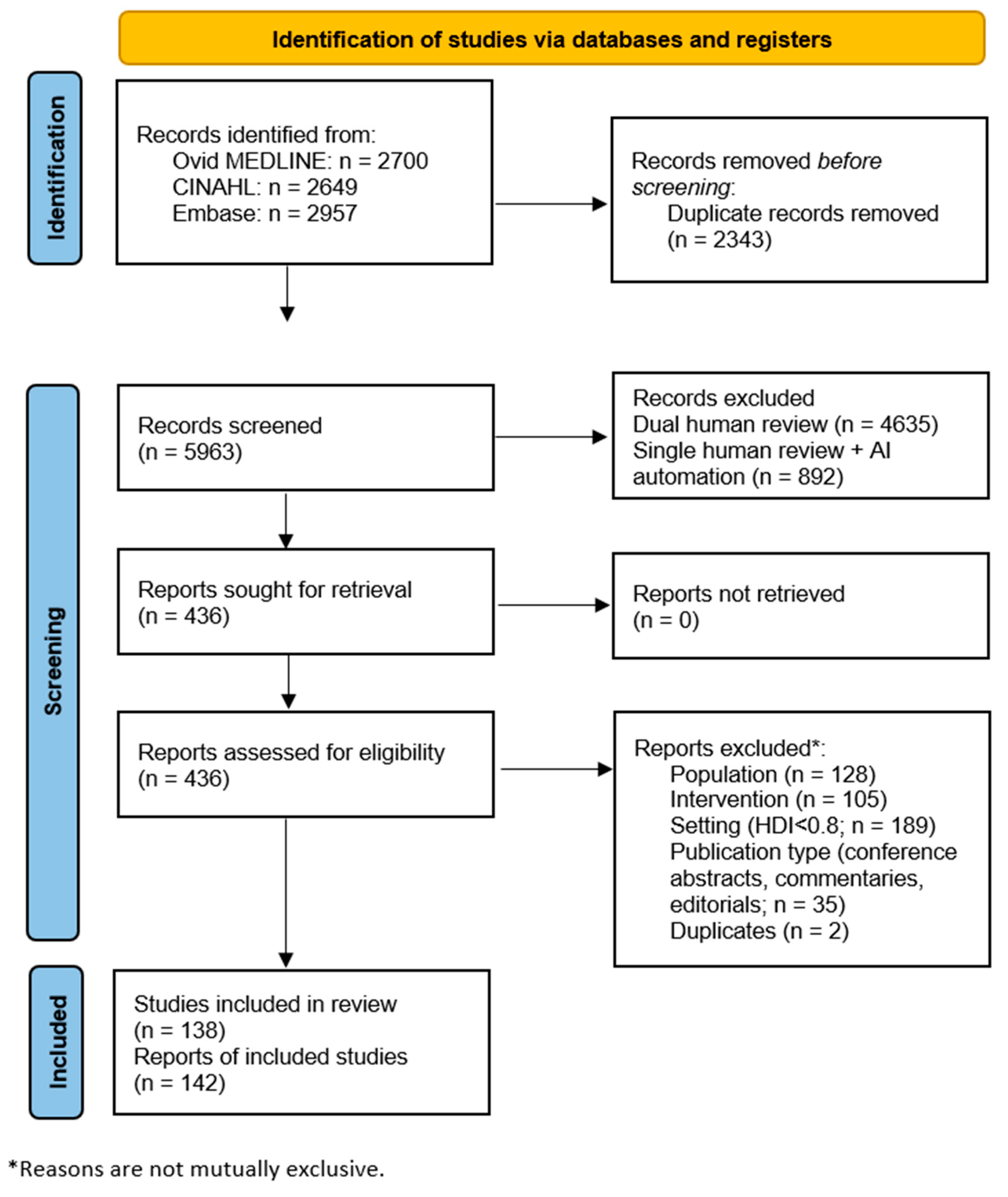
3.1. Results of the Literature Search
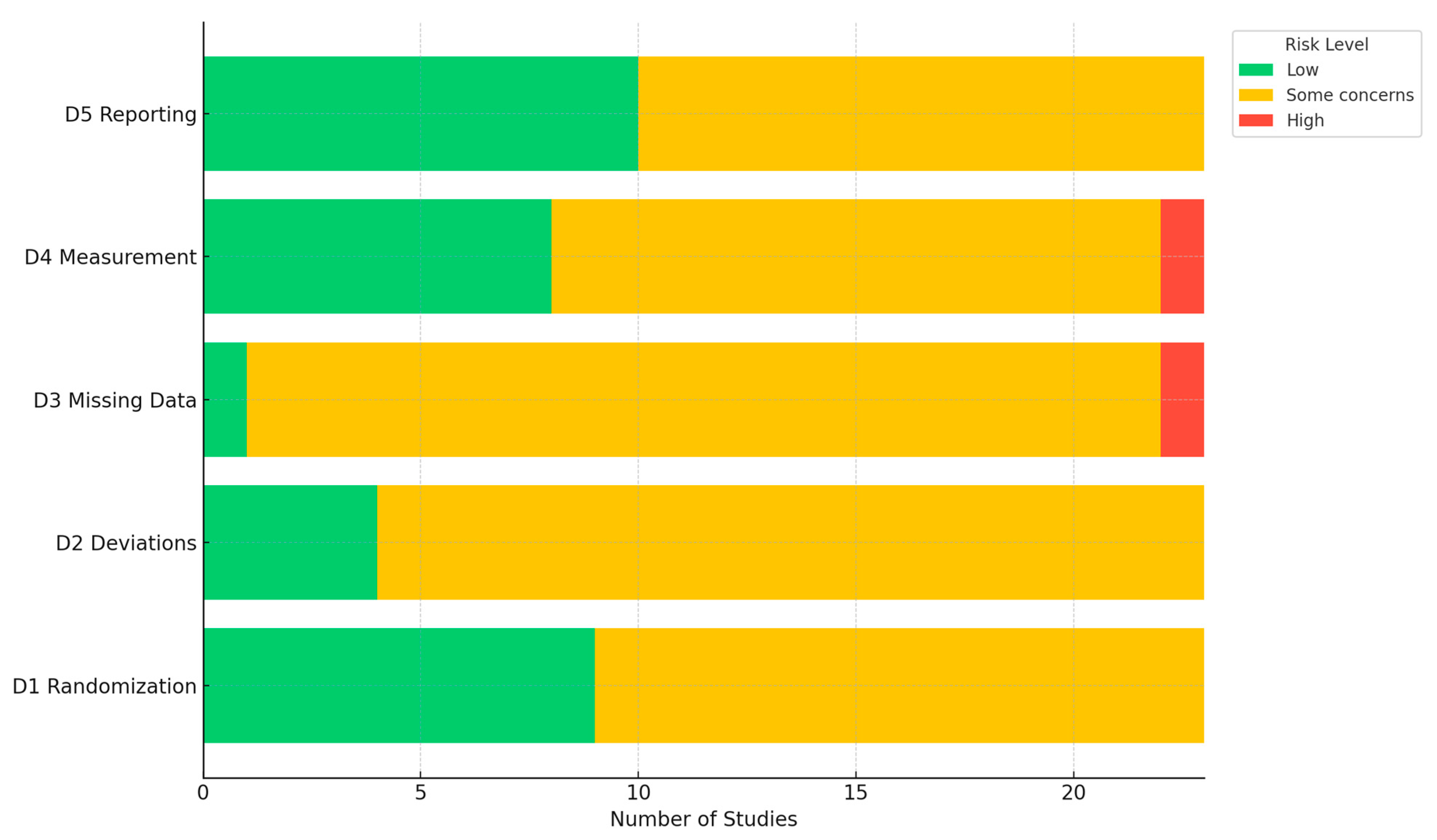
3.2. Risk of Bias Assessment
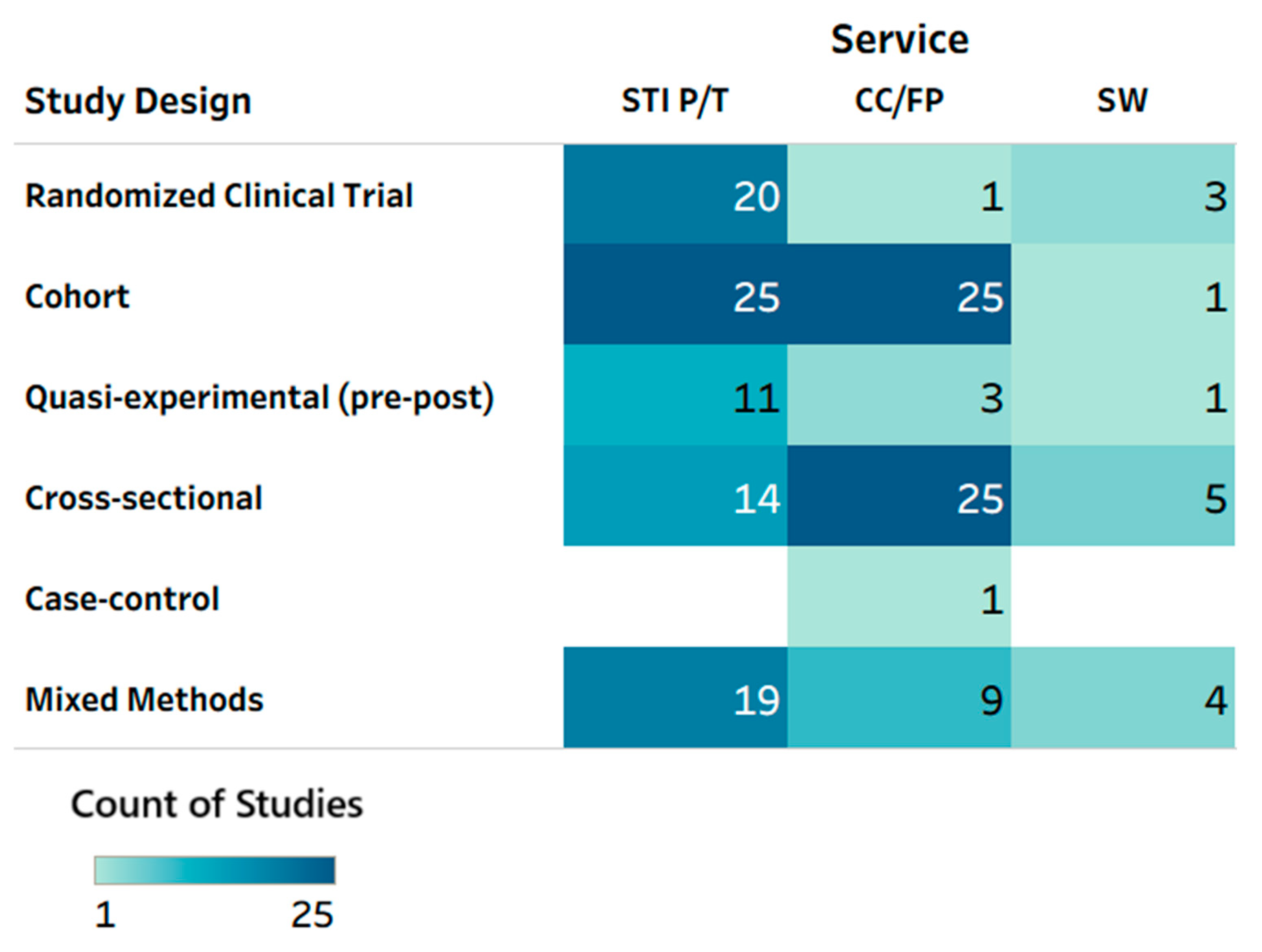
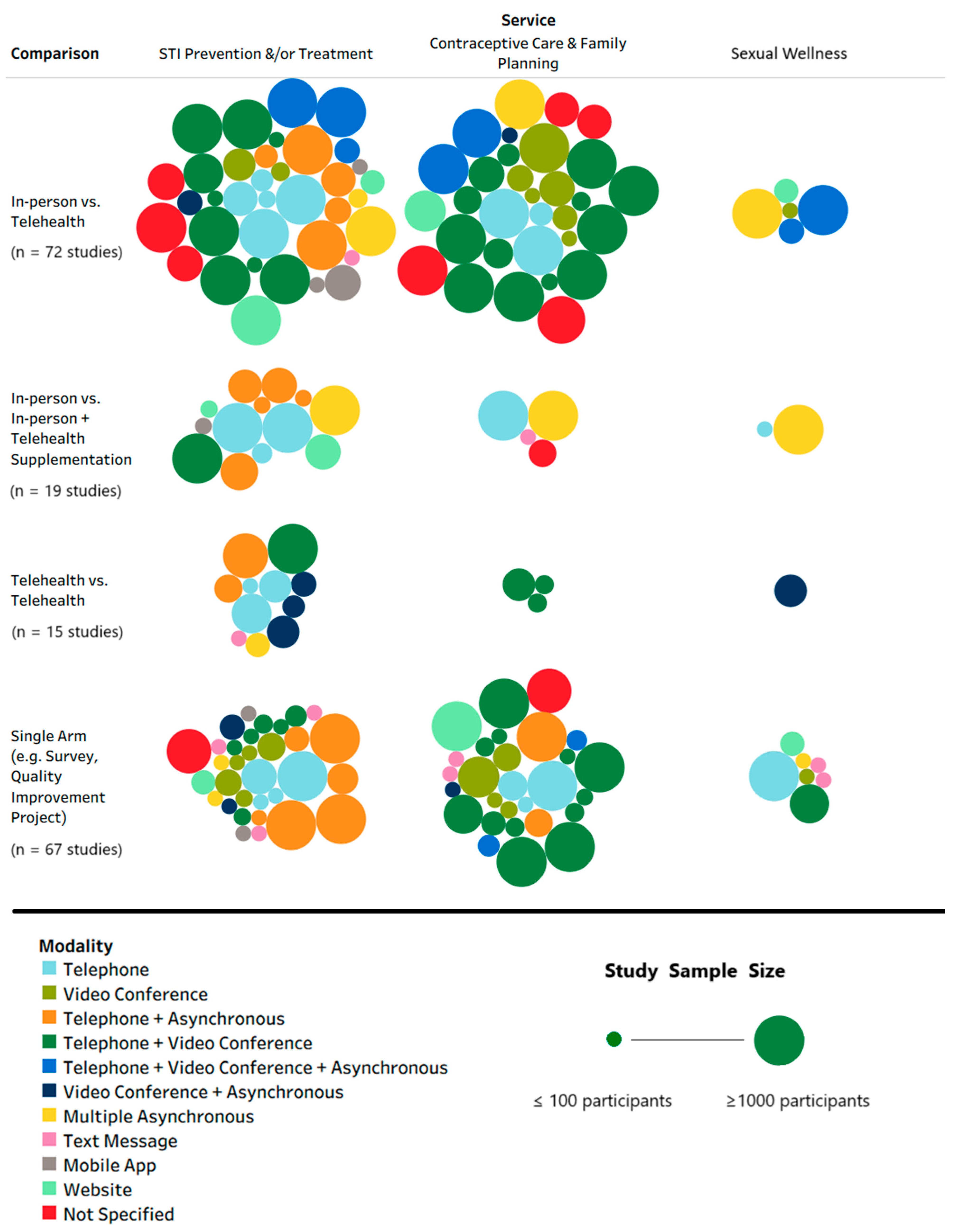
3.3. Key Question 1: Effectiveness, Harms, and Acceptability of Telehealth Interventions
3.4. Key Question 2: Patient Experiences, Preferences, and Choice
3.5. Key Question 3: Provider Experiences and Preferences
3.6. Key Question 4: Barriers and Facilitators for TeleSRH
3.7. Key Question 5: Patient Engagement Strategies
4. Discussion
4.1. Applicability of Findings
4.2. Implications for Practice and Policy
5. Conclusions
Supplementary Materials
Author Contributions
Funding
Institutional Review Board Statement
Informed Consent Statement
Data Availability Statement
Conflicts of Interest
Appendix A
Appendix B
- exp Reproductive Control Agents/
- exp Contraception Behavior/or exp Contraception/
- (contracept* or birth control).mp.
- exp Family Planning Services/
- family planning.mp.
- exp Gynecology/or exp Women’s Health/
- (gyn?ecolog* or (women* adj2 health)).mp.
- exp reproductive health/or exp sexual health/
- ((reproduct* adj health*) or (sexual* adj health*)).mp.
- exp Sexually Transmitted Diseases/
- (sexually transmitted disease* or sexually transmitted infection* or STD or STDs or STI or STIs).mp.
- exp Fertility/
- fertility.mp.
- exp Abortion, Induced/
- abortion*.mp.
- exp pregnancy, unplanned/or exp pregnancy, unwanted/
- ((unplanned or “not planned” or unwanted or “not want*”) adj3 pregnan*).mp.
- ((sexual or reproductive) adj2 (wellness or wellbeing or well-being)).mp.
- (preconception or pre-conception or prepregnancy or pre-pregnancy).mp.
- exp Papillomavirus Vaccines/or (papillomavirus vaccin* or HPV vaccin* or gardasil or papillomavirus immunis* or papillomavirus immuniz* or HPV immunis* or HPV immuniz*).mp.
- or/1–20
- (telemedicine or telemedical or telehealth or telephone or phone or phones or smartphone* or cell* device* or mobile device* or text messag* or SMS or texting or virtual* or remote* monitor* or ehealth or e-health or mhealth or m-health or mobile health or digital health).ti.
- exp *Telemedicine/or exp *Mobile Applications/or exp *Cell Phone/
- 22 or 23
- 21 and 24
- limit 25 to (English language and yr = “2017-Current”)
- exp contraceptive agent/or exp contraceptive behavior/or exp contraception/or birth control/
- (contracept* or birth control).mp.
- exp family planning/
- family planning.mp.
- exp gynecology/or exp women’s health/
- (gyn?ecolog* or (women* adj2 health)).mp.
- exp reproductive health/or exp sexual health/
- ((reproduct* adj health*) or (sexual* adj health*)).mp.
- exp sexually transmitted disease/
- (sexually transmitted disease* or sexually transmitted infection* or STD or STDs or STI or STIs).mp.
- exp fertility/
- fertility.mp.
- exp induced abortion/or exp abortive agent/
- abortion*.mp.
- exp unplanned pregnancy/or exp unwanted pregnancy/
- ((unplanned or “not planned” or unwanted or “not want*”) adj3 pregnan*).mp.
- ((sexual or reproductive) adj2 (wellness or wellbeing or well-being)).mp.
- (preconception or pre-conception or prepregnancy or pre-pregnancy).mp.
- exp Human papilloma virus vaccine/or (papillomavirus vaccin* or HPV vaccin* or gardasil or papillomavirus immunis* or papillomavirus immuniz* or HPV immunis* or HPV immuniz*).mp.
- or/1–19
- (telemedicine or telemedical or telehealth or telephone or phone or phones or smartphone* or cell* device* or mobile device* or text messag* or SMS or texting or virtual* or remote* monitor* or ehealth or e-health or mhealth or m-health or mobile health or digital health).ti.
- exp *telehealth/or exp *mobile application/or exp *mobile phone/
- 21 or 22
- 20 and 23
- limit 24 to (english language and yr = “2017-Current”)
- limit 25 to conference abstract status
- 25 not 26
- S1.
- (MH “Reproductive Control Agents+”)
- S2.
- (MH “Contraception+”)
- S3.
- (contracept* OR birth control)
- S4.
- (MH “Family Planning+”)
- S5.
- family planning
- S6.
- (MH “Gynecology”) OR (MH “Gynecologic Nursing”) OR (MH “Gynecologic Care”) OR (MH “OB-GYN Nurse Practitioners”)
- S7.
- (gyn#ecolog* OR (women* N2 health))
- S8.
- (MH “Reproductive Health”) OR (MH “Sexual Health”)
- S9.
- ((reproduct* N1 health*) OR (sexual* N1 health*))
- S10.
- (MH “Sexually Transmitted Diseases+”)
- S11.
- (sexually transmitted disease* OR sexually transmitted infection* OR STD OR STDs OR STI OR STIs)
- S12.
- (MH “Fertility+”)
- S13.
- fertility
- S14.
- (MH “Abortion, Induced+”)
- S15.
- abortion*
- S16.
- (MH “Pregnancy, Unplanned”) OR (MH “Pregnancy, Unwanted”)
- S17.
- ((unplanned OR “not planned” OR unwanted OR “not want*”) N3 pregnan*)
- S18.
- ((sexual OR reproductive) N2 (wellness OR wellbeing OR well-being))
- S19.
- (preconception OR pre-conception OR prepregnancy OR pre-pregnancy)
- S20.
- (MH “Papillomavirus Vaccine”)
- S21.
- (papillomavirus vaccin* OR HPV vaccin* OR gardasil or papillomavirus immunis* OR papillomavirus immuniz* OR HPV immunis* OR HPV immuniz*)
- S22.
- S1 OR S2 OR S3 OR S4 OR S5 OR S6 OR S7 OR S8 OR S9 OR S10 OR S11 OR S12 OR S13 OR S14 OR S15 OR S16 OR S17 OR S18 OR S19 OR S20 OR S21
- S23.
- (MM “Telehealth+”)
- S24.
- (MM “Mobile Applications”)
- S25.
- (MM “Cellular Phone+”)
- S26.
- TI (telemedicine OR telemedical OR telehealth OR telephone* OR phone OR phones OR smartphone* OR cell* device* OR mobile device* OR text messag* OR SMS OR texting OR virtual* OR remote* monitor* OR ehealth OR e-health OR mhealth OR m-health OR mobile health OR digital health)
- S27.
- S23 OR S24 OR S25 OR 26
- S28.
- S22 AND S27
References
- Mawson, R.L.; Hodges, V.; Salway, S.; Mitchell, C. Understanding access to sexual and reproductive health in general practice using an adapted Candidacy Framework: A systematic review and qualitative evidence synthesis. Br. J. Gen. Pract. 2025. Epub ahead of printing. [Google Scholar] [CrossRef] [Scilit] [PubMed] [PubMed Central]
- Hart, J.; Crear-Perry, J.; Stern, L. US Sexual and Reproductive Health Policy: Which Frameworks Are Needed Now, and Next Steps Forward. Am. J. Public Health 2022, 112, S518–S522. [Google Scholar] [CrossRef] [Scilit] [PubMed] [PubMed Central]
- Adler, A.; Biggs, M.A.; Kaller, S.; Schroeder, R.; Ralph, L. Changes in the Frequency and Type of Barriers to Reproductive Health Care Between 2017 and 2021. JAMA Netw. Open 2023, 6, e237461. [Google Scholar] [CrossRef] [Scilit] [PubMed] [PubMed Central]
- Cantor, A.; Nelson, H.D.; Pappas, M.; Atchison, C.; Hatch, B.; Huguet, N.; Flynn, B.; McDonagh, M. Effectiveness of Telehealth for Women’s Preventive Services [Internet]; Agency for Healthcare Research and Quality (US): Rockville, MD, USA, 2022; (Comparative Effectiveness Review, No. 256). Available online: https://www.ncbi.nlm.nih.gov/books/NBK581511/ (accessed on 1 January 2024). [CrossRef] [Scilit]
- Goldstein, K.M.; Zullig, L.L.; Dedert, E.A.; Alishahi Tabriz, A.; Brearly, T.W.; Raitz, G.; Sata, S.S.; Whited, J.D.; Bosworth, H.B.; Gordon, A.M.; et al. Telehealth Interventions Designed for Women: An Evidence Map. J. Gen. Intern Med. 2018, 33, 2191–2200. [Google Scholar] [CrossRef] [Scilit] [PubMed] [PubMed Central]
- Muheriwa-Matemba, S.R.; Alcena-Stiner, D.C.; Glazier, A.; LeBlanc, N.M. Telehealth use for sexual and reproductive health promotion and care during the early phase of COVID-19 pandemic: A descriptive-interpretive qualitative study of healthcare providers’ perspectives and experiences in Western-Central New York State. PLoS Glob. Public Health 2024, 4, e0003259. [Google Scholar] [CrossRef] [Scilit] [PubMed] [PubMed Central]
- Gajarawala, S.N.; Pelkowski, J.N. Telehealth Benefits and Barriers. J. Nurse Pract. 2021, 17, 218–221. [Google Scholar] [CrossRef] [Scilit] [PubMed] [PubMed Central]
- Polinski, J.M.; Barker, T.; Gagliano, N.; Sussman, A.; Brennan, T.A.; Shrank, W.H. Patients’ Satisfaction with and Preference for Telehealth Visits. J. Gen. Intern. Med. 2016, 31, 269–275. [Google Scholar] [CrossRef] [Scilit] [PubMed] [PubMed Central]
- Mair, F.; Whitten, P. Systematic review of studies of patient satisfaction with telemedicine. BMJ 2000, 320, 1517–1520. [Google Scholar] [CrossRef] [Scilit] [PubMed] [PubMed Central]
- Kruse, C.S.; Krowski, N.; Rodriguez, B.; Tran, L.; Vela, J.; Brooks, M. Telehealth and patient satisfaction: A systematic review and narrative analysis. BMJ Open 2017, 7, e016242. [Google Scholar] [CrossRef] [Scilit] [PubMed] [PubMed Central]
- Wosik, J.; Fudim, M.; Cameron, B.; Gellad, Z.F.; Cho, A.; Phinney, D.; Curtis, S.; Roman, M.; Poon, E.G.; Ferranti, J.; et al. Telehealth transformation: COVID-19 and the rise of virtual care. J. Am. Med. Inf. Assoc. 2020, 27, 957–962. [Google Scholar] [CrossRef] [Scilit] [PubMed] [PubMed Central]
- Shaver, J. The State of Telehealth Before and After the COVID-19 Pandemic. Prim. Care 2022, 49, 517–530. [Google Scholar] [CrossRef] [Scilit] [PubMed] [PubMed Central]
- Ezeamii, V.C.; Okobi, O.E.; Wambai-Sani, H.; Perera, G.S.; Zaynieva, S.; Okonkwo, C.C.; Ohaiba, M.M.; William-Enemali, P.C.; Obodo, O.R.; Obiefuna, N.G. Revolutionizing Healthcare: How Telemedicine Is Improving Patient Outcomes and Expanding Access to Care. Cureus 2024, 16, e63881. [Google Scholar] [CrossRef] [Scilit] [PubMed] [PubMed Central]
- Abernethy, A.; Adams, L.; Barrett, M.; Bechtel, C.; Brennan, P.; Butte, A.; Faulkner, J.; Fontaine, E.; Friedhoff, S.; Halamka, J.; et al. The Promise of Digital Health: Then, Now, and the Future. NAM Perspect. 2022, 2022, 10–31478. [Google Scholar] [CrossRef] [Scilit] [PubMed] [PubMed Central]
- Khalil, H.; Welch, V.; Grainger, M.; Campbell, F. Methodology for mapping reviews, evidence maps, and gap maps. Res. Synth. Methods 2025, 16, 786–796. [Google Scholar] [CrossRef] [Scilit]
- Tricco, A.C.; Lillie, E.; Zarin, W.; O’Brien, K.K.; Colquhoun, H.; Levac, D.; Moher, D.; Peters, M.D.J.; Horsley, T.; Weeks, L.; et al. PRISMA Extension for Scoping Reviews (PRISMA-ScR): Checklist and Explanation. Ann. Intern. Med. 2018, 169, 467–473. [Google Scholar] [CrossRef] [Scilit] [PubMed]
- McGowan, J.; Sampson, M.; Salzwedel, D.M.; Cogo, E.; Foerster, V.; Lefebvre, C. PRESS Peer Review of Electronic Search Strategies: 2015 Guideline Statement. J. Clin. Epidemiol. 2016, 75, 40–46. [Google Scholar] [CrossRef] [Scilit] [PubMed]
- Parikh, R.R.; Troester, A.; Southwell, B.; Ester, E.; Sultan, S.; Claussen, A.M.; Greeno, E.; Arsoniadis, E.; Church, T.R.; Wilt, T.J.; et al. Treatment of Stages I–III Squamous Cell Anal Cancer: A Systematic Review [Internet]; Agency for Healthcare Research and Quality (US): Rockville, MD, USA, 2024; Report No.: AHRQ 24-EHC026; Report No.: PCORI 2024-SR-03. [Google Scholar] [PubMed]
- Adams, A.M.; Wu, H.; Zhang, F.R.; Wajsberg, J.R.; Bruney, T.L. Postpartum Care in the Time of COVID-19: The Use of Telemedicine for Postpartum Care. Telemed. J. e-Health 2023, 29, 235–241. [Google Scholar] [CrossRef] [Scilit] [PubMed]
- Anderson, K.; Coskun, R.; Jimenez, P.; Omurtag, K. Satisfaction with new patient telehealth visits for reproductive endocrinology patients in the era of COVID-19. J. Assist. Reprod. Genet. 2022, 39, 1571–1576. [Google Scholar] [CrossRef] [Scilit]
- Arias, M.P.; Wang, E.; Leitner, K.; Sannah, T.; Keegan, M.; Delferro, J.; Iluore, C.; Arimoro, F.; Streaty, T.; Hamm, R.F. The impact on postpartum care by telehealth: A retrospective cohort study. Am. J. Obs. Gynecol. MFM 2022, 4, 100611. [Google Scholar] [CrossRef] [Scilit]
- Baker, D.P.; Ussher, G.R.; Rimes, K.A. Development of a text-based chatroom HIV prevention and confidence-building intervention for same-sex attracted young males in South England. J. HIVAIDS Soc. Serv. 2021, 20, 262–270. [Google Scholar] [CrossRef] [Scilit]
- Bauermeister, J.A.; Muessig, K.E.; LeGrand, S.; Flores, D.D.; Choi, S.K.; Dong, W.; Sallabank, G.; Hightow-Weidman, L.B. HIV and Sexuality Stigma Reduction Through Engagement in Online Forums: Results from the HealthMPowerment Intervention. AIDS Behav. 2019, 23, 742–752. [Google Scholar] [CrossRef] [Scilit]
- Beatty, K.E.; Smith, M.G.; Khoury, A.J.; Ventura, L.M.; Ariyo, T.; de Jong, J.; Surles, K.; Rahman, A.; Slawson, D. Telehealth for Contraceptive Care During the Initial Months of the COVID-19 Pandemic at Local Health Departments in 2 US States: A Mixed-Methods Approach. J. Public Health Manag. Pract. 2022, 28, 299–308. [Google Scholar] [CrossRef] [Scilit] [PubMed]
- Becker, E.R.; Shegog, R.; Savas, L.S.; Frost, E.L.; Coan, S.P.; Healy, C.M.; Spinner, S.W.; Vernon, S.W. Parents’ Experience with a Mobile Health Intervention to Influence Human Papillomavirus Vaccination Decision Making: Mixed Methods Study. JMIR Pediatr. Parent. 2022, 5, e30340. [Google Scholar] [CrossRef] [Scilit] [PubMed]
- Bernard-Genest, M.P.; Ruel-Laliberte, J.; Lapointe-Milot, K. Effect of educative reminder telephone calls on human papillomavirus immunization rate: A randomized controlled trial. Womens Health Lond. Engl. 2021, 17, 17455065211003820. [Google Scholar] [CrossRef] [Scilit] [PubMed]
- Bissessor, M.; Bradshaw, C.S.; Fairley, C.K.; Chen, M.Y.; Chow, E.P. Provision of HIV test results by telephone is both safe and efficient for men who have sex with men. Int. J. STD AIDS 2017, 28, 39–44. [Google Scholar] [CrossRef] [Scilit]
- Buchanan, C.R.M.; Tomaszewski, K.; Chung, S.E.; Upadhya, K.K.; Ramsey, A.; Trent, M.E. Why Didn’t You Text Me? Poststudy Trends from the DepoText Trial. Clin. Pediatr. 2018, 57, 82–88. [Google Scholar] [CrossRef] [Scilit]
- Carey, M.P.; Dunne, E.M.; Norris, A.; Dunsiger, S.; Rich, C.; Rosen, R.K.; Chan, P.; Salmoirago-Blotcher, E. Telephone-Delivered Mindfulness Training to Promote Medication Adherence and Reduce Sexual Risk Behavior Among Persons Living with HIV: An Exploratory Clinical Trial. AIDS Behav. 2020, 24, 1912–1928. [Google Scholar] [CrossRef] [Scilit]
- Chasco, E.E.; Hoth, A.B.; Cho, H.; Shafer, C.; Siegler, A.J.; Ohl, M.E. Mixed-Methods Evaluation of the Incorporation of Home Specimen Self-Collection Kits for Laboratory Testing in a Telehealth Program for HIV Pre-exposure Prophylaxis. AIDS Behav. 2021, 25, 2463–2482. [Google Scholar] [CrossRef] [Scilit]
- Cheng, Y.; Boerma, C.; Peck, L.; Botfield, J.R.; Estoesta, J.; McGeechan, K. Telehealth sexual and reproductive health care during the COVID-19 pandemic. Med. J. Aust. 2021, 215, 371–372. [Google Scholar] [CrossRef] [Scilit]
- Clure, C.; Sheeder, J.; Teal, S.; Cohen, R. Telemedicine to improve reproductive health care for rural Coloradans: Perceptions of interest and access. J. Rural Health 2023, 39, 172–178. [Google Scholar] [CrossRef] [Scilit]
- Comfort, A.B.; Rao, L.; Goodman, S.; Raine-Bennett, T.; Barney, A.; Mengesha, B.; Harper, C.C. Assessing differences in contraceptive provision through telemedicine among reproductive health providers during the COVID-19 pandemic in the United States. Reprod. Health 2022, 19, 99. [Google Scholar] [CrossRef] [Scilit] [PubMed]
- Comstock, E.; James, C.; Hegarty, R.; Flores, Y.; Amoroso, A.; Talwani, R.; Wilson, E. Pre-Exposure Prophylaxis (PrEP) Safety and Tolerability in Individuals ≥ 45 Years Old. J. AIDS HIV Treat. 2021, 3, 27–30. [Google Scholar] [CrossRef] [Scilit]
- Day, S.; Kinsella, R.; Jones, S.; Tittle, V.; Suchak, T.; Forbes, K. Safeguarding outcomes of 16 and 17-year-old service users of Sexual Health London (SHL.uk), a pan-London online sexual health service. Int. J. STD AIDS 2020, 31, 1373–1379. [Google Scholar] [CrossRef] [Scilit] [PubMed]
- Day, S.; Smith, J.; Perera, S.; Jones, S.; Kinsella, R. Beyond the binary: Sexual health outcomes of transgender and non-binary service users of an online sexual health service. Int. J. STD AIDS 2021, 32, 896–902. [Google Scholar] [CrossRef] [Scilit] [PubMed]
- Doolittle, J.; Jackson, E.M.; Gill, B.; Vij, S.C. The Omission of Genitourinary Physical Exam in Telehealth Pre-Vasectomy Consults Does Not Reduce Rates of Office Procedure Completion. Urology 2022, 167, 19–23. [Google Scholar] [CrossRef] [Scilit]
- Ellison, J.; Cole, M.B.; Thompson, T.A. Association of Telehealth Reimbursement Parity with Contraceptive Visits During the COVID-19 Pandemic. JAMA Netw. Open 2022, 5, e226732. [Google Scholar] [CrossRef] [Scilit]
- Engen, J.; Black, A.; Holdsworth, G.; Howroyd, C.; Courtenay, M.; Baraitser, P. Photodiagnosis of genital herpes and warts within a specialist online sexual health service: An observational (mixed methods) study of user experience and clinical outcomes. BMJ Open 2021, 11, e042160. [Google Scholar] [CrossRef] [Scilit]
- Estcourt, C.S.; Gibbs, J.; Sutcliffe, L.J.; Gkatzidou, V.; Tickle, L.; Hone, K.; Aicken, C.; Lowndes, C.M.; Harding-Esch, E.M.; Eaton, S.; et al. The eSexual Health Clinic system for management, prevention, and control of sexually transmitted infections: Exploratory studies in people testing for Chlamydia trachomatis. Lancet Public Health 2017, 2, e182–e190. [Google Scholar] [CrossRef] [Scilit]
- Fernandez, M.E.; Savas, L.S.; Atkinson, J.S.; Ricks, K.B.; Ibekwe, L.N.; Jackson, I.; Castle, P.E.; Jobe, D.; Vernon, S.W. Evaluation of a 2-1-1 Telephone Navigation Program to Increase Cancer Control Behaviors: Results from a Randomized Controlled Trial. Am. J. Health Promot. 2022, 36, 1083–1093. [Google Scholar] [CrossRef] [Scilit]
- Fuchs, J.D.; Stojanovski, K.; Vittinghoff, E.; Fuchs, J.D.; Stojanovski, K.; Vittinghoff, E.; McMahan, V.M.; Hosek, S.G.; Amico, K.R.; Kouyate, A.; et al. A Mobile Health Strategy to Support Adherence to Antiretroviral Preexposure Prophylaxis. AIDS Patient Care STDs 2018, 32, 104–111. [Google Scholar] [CrossRef] [Scilit]
- Glasner, S.; Patrick, K.; Ybarra, M.; Reback, C.J.; Ang, A.; Kalichman, S.; Bachrach, K.; Garneau, H.C.; Venegas, A.; Rawson, R.A. Promising outcomes from a cognitive behavioral therapy text-messaging intervention targeting drug use, antiretroviral therapy adherence, and HIV risk behaviors among adults living with HIV and substance use disorders. Drug Alcohol. Depend. 2022, 231, 109229. [Google Scholar] [CrossRef] [Scilit]
- Gorman, J.R.; Drizin, J.H.; Smith, E.; Corey, S.; Temple, M.; Rendle, K.A. Feasibility of Mindful After Cancer: Pilot Study of a Virtual Mindfulness-Based Intervention for Sexual Health in Cancer Survivorship. J. Sex. Med. 2022, 19, 1131–1146. [Google Scholar] [CrossRef] [Scilit]
- Groos, A.; Peardon-Freeman, S.; McFarlane, K.; Braithwaite, S.; Gajjar, D.; Murch, P. Free online chlamydia and gonorrhoea urine test request in Queensland: Sexually transmissible infections testing can be hard for young people even if the process is easy. Sex. Health 2020, 17, 543–546. [Google Scholar] [CrossRef] [Scilit] [PubMed]
- Henderson, L.; Gibbs, J.; Quinn, J.; Ramasami, S.; Estcourt, C. Maintaining access to HIV pre- exposure prophylaxis in a pandemic: A service evaluation of telephone-based pre-exposure prophylaxis provision. Int. J. STD AIDS 2022, 33, 718–721. [Google Scholar] [CrossRef] [Scilit]
- Heumann, C.L.; Katz, D.A.; Dombrowski, J.C.; Bennett, A.B.; Manhart, L.E.; Golden, M.R. Comparison of In-Person Versus Telephone Interviews for Early Syphilis and Human Immunodeficiency Virus Partner Services in King County, Washington (2010–2014). Sex. Transm. Dis. 2017, 44, 249–254. [Google Scholar] [CrossRef] [Scilit]
- Hill, B.J.; Lock, L.; Anderson, B. Racial and ethnic differences in family planning telehealth use during the onset of the COVID-19 response in Arkansas, Kansas, Missouri, and Oklahoma. Contraception 2021, 104, 262–264. [Google Scholar] [CrossRef] [Scilit] [PubMed]
- Horwood, J.; Brangan, E.; Manley, P.; Horner, P.; Muir, P.; North, P.; Macleod, J. Management of chlamydia and gonorrhoea infections diagnosed in primary care using a centralised nurse-led telephone-based service: Mixed methods evaluation. BMC Fam. Pract. 2020, 21, 265. [Google Scholar] [CrossRef] [Scilit]
- Hoth, A.B.; Shafer, C.; Dillon, D.B.; Mayer, R.; Walton, G.; Ohl, M.E. Iowa TelePrEP: A Public- Health-Partnered Telehealth Model for Human Immunodeficiency Virus Preexposure Prophylaxis Delivery in a Rural State. Sex. Transm. Dis. 2019, 46, 507–512. [Google Scholar] [CrossRef] [Scilit] [PubMed]
- Hurtado, A.C.M.; Crowley, S.M.; Landry, K.M.; Landry, M.S. Telehealth contraceptive care in 2018: A quality improvement study of barriers to access and patient satisfaction. Contraception 2022, 112, 81–85. [Google Scholar] [CrossRef] [Scilit]
- Jain, T.; Mehrotra, A. Comparison of Direct-to-Consumer Telemedicine Visits with Primary Care Visits. JAMA Netw. Open 2020, 3, e2028392. [Google Scholar] [CrossRef] [Scilit]
- Jasper, W.; Macdonald, M.; Luxmanan, D.; Foley, E.; Patel, R. Telephone-triage services do not lead to an increased wait time for assessment of gonorrhoea in symptomatic patients. Int. J. STD AIDS 2021, 32, 852–855. [Google Scholar] [CrossRef] [Scilit] [PubMed]
- Johnson, E.K. Telemedicine and direct to consumer advertising attitudes and the future of telehealth: Women report telemedicine as a comfortable option for accessing birth control. Health Mark. Q. 2023, 40, 309–325. [Google Scholar] [CrossRef] [Scilit]
- Kalichman, S.C.; Cherry, C.; Kalichman, M.O.; Eaton, L.A.; Kohler, J.J.; Montero, C.; Schinazi, R.F. Mobile Health Intervention to Reduce HIV Transmission: A Randomized Trial of Behaviorally Enhanced HIV Treatment as Prevention (B-TasP). J. Acquir. Immune Defic. Syndr. 2018, 78, 34–42. [Google Scholar] [CrossRef] [Scilit] [PubMed]
- Katz, M.; Newmark, R.L.; Aronstam, A.; O’Grady, N.; Strome, S.; Rafie, S.; Karlin, J. An implementation project to expand access to self-administered depot medroxyprogesterone acetate (DMPA). Contraception 2020, 102, 392–395. [Google Scholar] [CrossRef] [Scilit]
- Lindberg, L.D.; Mueller, J.; Haas, M.; Jones, R.K. Telehealth for Contraceptive Care During the COVID-19 Pandemic: Results of a 2021 National Survey. Am. J. Public Health 2022, 112, S545–S554. [Google Scholar] [CrossRef] [Scilit]
- Liu, A.Y.; Vittinghoff, E.; von Felten, P.; Rivet Amico, K.; Anderson, P.L.; Lester, R.; Andrew, E.; Estes, I.; Serrano, P.; Brothers, J.; et al. Randomized Controlled Trial of a Mobile Health Intervention to Promote Retention and Adherence to Preexposure Prophylaxis Among Young People at Risk for Human Immunodeficiency Virus: The EPIC Study. Clin. Infect. Dis. 2019, 68, 2010–2017. [Google Scholar] [CrossRef] [Scilit]
- Llewellyn, C.D.; Abraham, C.; Pollard, A.; Jones, C.I.; Bremner, S.; Miners, A.; Smith, H. A randomised controlled trial of a telephone administered brief HIV risk reduction intervention amongst men who have sex with men prescribed post-exposure prophylaxis for HIV after sexual exposure in the UK: Project PEPSE. PLoS ONE 2019, 14, e0216855. [Google Scholar] [CrossRef] [Scilit]
- Martinez, K.A.; Rastogi, R.; Lipold, L.; Rothberg, M.B. Response to requests for contraception in one direct-to-consumer telemedicine service. Contraception 2020, 101, 350–352. [Google Scholar] [CrossRef] [Scilit]
- McCulloch, H.; Syred, J.; Holdsworth, G.; Howroyd, C.; Ardines, E.; Baraitser, P. Communication strategies used to obtain clinical histories before remotely prescribing antibiotics for postal treatment of uncomplicated genital chlamydia: Service evaluation. J. Med. Internet Res. 2020, 22, e15970. [Google Scholar] [CrossRef] [Scilit]
- McLaughlin, E.J.; Ellett, L.C.; Readman, E.; Mooney, S. Telehealth for gynaecology outpatients during the COVID-19 pandemic: Patient and clinician experiences. Aust. N. Z. J. Obstet. Gynaecol. 2022, 62, 553–559. [Google Scholar] [CrossRef] [Scilit] [PubMed]
- Nadarzynski, T.; Bayley, J.; Llewellyn, C.; Kidsley, S.; Graham, C.A. Acceptability of artificial intelligence (AI)-enabled chatbots, video consultations and live webchats as online platforms for sexual health advice. BMJ Sex. Reprod. Health 2020, 46, 210–217. [Google Scholar] [CrossRef] [Scilit] [PubMed]
- Nimbi, F.M.; Rossi, R.; Simonelli, C. Telephone sexual counseling and current technologies: Are helplines still effective in the social media era? Sexologies 2018, 27, 162–170. [Google Scholar] [CrossRef] [Scilit]
- O’Malley, T.L.; Horowitz, K.R.; Burke, J.G. Information seeking from a sexual health textline: Utilisation and perceptions of helpfulness among young people. Sex. Educ. 2022, 22, 217–227. [Google Scholar] [CrossRef] [Scilit]
- Quirke, S.; Quinn, L.; Hegarty, D.; Loy, A.; Lyons, F.; Mulcahy, F.; Devitt, E. Virtual HIV pre-exposure prophylaxis outpatient service in the era of COVID-19. Int. J. STD AIDS 2021, 32, 100–103. [Google Scholar] [CrossRef] [Scilit]
- Refugio, O.N.; Kimble, M.M.; Silva, C.L.; Lykens, J.E.; Bannister, C.; Klausner, J.D. Brief Report: PrEPTECH: A Telehealth-Based Initiation Program for HIV Pre-exposure Prophylaxis in Young Men of Color Who Have Sex with Men. A Pilot Study of Feasibility. J. Acquir. Immune Defic. Syndr. 2019, 80, 40–45. [Google Scholar] [CrossRef] [Scilit] [PubMed]
- Rose, S.B.; Garrett, S.M.; Hutchings, D.; Lund, K.; Kennedy, J.; Pullon, S.R.H. Clinician education, advice and SMS/text reminders improve test of reinfection rates following diagnosis of Chlamydia trachomatis or Neisseria gonorrhoeae: Before and after study in primary care. BMJ Sex. Reprod. Health 2020, 46, 32–37. [Google Scholar] [CrossRef] [Scilit] [PubMed]
- Shanks, S.; Morelli, A.; Ardines, E.; Holdsworth, G.; Baraitser, P. Two-Way Text Messaging to Support Self-Care and Delivery of an Online Sexual Health Service: Mixed Methods Evaluation. JMIR mHealth uHealth 2020, 8, e17191. [Google Scholar] [CrossRef] [Scilit]
- Shin, R.J.; Yao, M.; Akesson, C.; Blazel, M.; Mei, L.; Brant, A.R. An exploratory study comparing the quality of contraceptive counseling provided via telemedicine versus in-person visits. Contraception 2022, 112, 86–92. [Google Scholar] [CrossRef] [Scilit]
- Shrier, L.A.; Burke, P.J.; Parker, S.; Edwards, R.; Jonestrask, C.; Pluhar, E.; Harris, S.K. Development and pilot testing of a counseling-plus- mHealth intervention to reduce risk for pregnancy and sexually transmitted infection in young women with depression. mHealth 2020, 6, 17. [Google Scholar] [CrossRef] [Scilit]
- Smiley, Y.; Sadeghi, N.; Jolda, C.; Chokshi, B. Parenting in a Pandemic: Needs of Teen Parents During COVID-19. Clin. Pediatr. 2021, 60, 559–563. [Google Scholar] [CrossRef] [Scilit]
- Staras, S.A.S.; Richardson, E.; Merlo, L.J.; Bian, J.; Thompson, L.A.; Krieger, J.L.; Gurka, M.J.; Sanders, A.H.; Shenkman, E.A. A feasibility trial of parent HPV vaccine reminders and phone-based motivational interviewing. BMC Public Health 2021, 21, 109. [Google Scholar] [CrossRef] [Scilit]
- Steiner, R.J.; Zapata, L.B.; Curtis, K.M.; Whiteman, M.K.; Brittain, A.W.; Tromble, E.; Keys, K.R.; Fasula, A.M. COVID-19 and Sexual and Reproductive Health Care: Findings from Primary Care Providers Who Serve Adolescents. J. Adolesc. Health 2021, 69, 375–382. [Google Scholar] [CrossRef] [Scilit] [PubMed]
- Stephenson, R.; Todd, K.; Kahle, E.; Sullivan, S.P.; Miller-Perusse, M.; Sharma, A.; Horvath, K.J. Project Moxie: Results of a Feasibility Study of a Telehealth Intervention to Increase HIV Testing Among Binary and Nonbinary Transgender Youth. AIDS Behav. 2020, 24, 1517–1530. [Google Scholar] [CrossRef] [Scilit] [PubMed]
- Stephenson, R.; Sullivan, S.P.; Mitchell, J.W.; Johnson, B.A.; Sullvian, P.S. Efficacy of a Telehealth Delivered Couples’ HIV Counseling and Testing (CHTC) Intervention to Improve Formation and Adherence to Safer Sexual Agreements Among Male Couples in the US: Results from a Randomized Control Trial. AIDS Behav. 2022, 26, 2813–2824. [Google Scholar] [CrossRef] [Scilit]
- Stifani, B.M.; Avila, K.; Levi, E.E. Telemedicine for contraceptive counseling: An exploratory survey of US family planning providers following rapid adoption of services during the COVID-19 pandemic. Contraception 2021, 103, 157–162. [Google Scholar] [CrossRef] [Scilit] [PubMed]
- Stifani, B.M.; Smith, A.; Avila, K.; Boos, E.W.; Ng, J.; Levi, E.E.; Benfield, N.C. Telemedicine for contraceptive counseling: Patient experiences during the early phase of the COVID-19 pandemic in New York City. Contraception 2021, 104, 254–261. [Google Scholar] [CrossRef] [Scilit]
- Stifani, B.M.; Smith, A.; Avila, K.; Levi, E.E.; Benfield, N.C. Telemedicine for Contraceptive Counseling During the COVID-19 Pandemic: Referral Patterns and Attendance at Follow-Up Visits. Telemed. J. e-Health 2022, 28, 1517–1524. [Google Scholar] [CrossRef] [Scilit]
- Sullivan, S.P.; Sullivan, P.S.; Stephenson, R. Acceptability and Feasibility of a Telehealth Intervention for STI Testing Among Male Couples. AIDS Behav. 2021, 25, 4029–4043. [Google Scholar] [CrossRef] [Scilit] [PubMed]
- Taylan, S.; Akıl, Y. The Effect of Postoperative Telephone Counseling on the Sexual Life of Patients with a Bowel Stoma: A Randomized Controlled Trial. Ostomy Wound Manag. 2019, 65, 14–29. [Google Scholar] [CrossRef] [Scilit]
- Thompson, T.A.; Ahrens, K.A.; Coplon, L. Virtually possible: Using telehealth to bring reproductive health care to women with opioid use disorder in rural Maine. mHealth 2020, 6, 41. [Google Scholar] [CrossRef] [Scilit]
- Wang, Z.; Lau, J.T.F.; Ip, T.K.M.; Yu, Y.; Fong, F.; Fang, Y.; Mo, P.K. Two Web-Based and Theory-Based Interventions with and without Brief Motivational Interviewing in the Promotion of Human Papillomavirus Vaccination Among Chinese Men Who Have Sex with Men: Randomized Controlled Trial. J. Med. Internet Res. 2021, 23, e21465. [Google Scholar] [CrossRef] [Scilit] [PubMed]
- Wigfall, L.T. eHealth Communication with Clients at Community-Based HIV/AIDS Service Organizations in the Southern United States: Cross-Sectional Survey. JMIR Form. Res. 2020, 4, e17154. [Google Scholar] [CrossRef] [Scilit] [PubMed]
- Willoughby, J.F.; Muldrow, A. SMS for sexual health: A comparison of service types and recommendations for sexual health text message service providers. Health Educ. J. 2017, 76, 231–243. [Google Scholar] [CrossRef] [Scilit]
- Wilson, E.; Free, C.; Morris, T.P.; Syred, J.; Ahamed, I.; Menon-Johansson, A.S.; Palmer, M.J.; Barnard, S.; Rezel, E.; Baraitser, P. Internet-accessed sexually transmitted infection (e-STI) testing and results service: A randomised, single-blind, controlled trial. PLoS Med. 2017, 14, e1002479. [Google Scholar] [CrossRef] [Scilit]
- Wood, S.M.; White, K.; Peebles, R.; Pickel, J.; Alausa, M.; Mehringer, J.; Dowshen, N. Outcomes of a Rapid Adolescent Telehealth Scale-Up During the COVID-19 Pandemic. J. Adolesc. Health 2020, 67, 172–178. [Google Scholar] [CrossRef] [Scilit] [PubMed]
- Yarger, J.; Hopkins, K.; Elmes, S.; Rossetto, I.; De La Melena, S.; McCulloch, C.E.; White, K.; Harper, C.C. Perceived Access to Contraception via Telemedicine Among Young Adults: Inequities by Food and Housing Insecurity. J. Gen. Intern. Med. 2023, 38, 302–308. [Google Scholar] [CrossRef] [Scilit]
- Allison, W.E.; Choi, A.N.; Kawasaki, K.; Desai, A.; Melhado, T.V. Accessing Care During the COVID-19 Pandemic Using Telemedicine: Perspectives from People with HIV. Health Promot. Pract. 2023, 24, 982–989. [Google Scholar] [CrossRef] [Scilit] [PubMed]
- Andrade, E.A.; Betancourt, G.; Morales, G.; Zapata, O.; Marrero, L.; Rivera, S.; Nieves, E.; Miranda, C.; Diaz, C.; Beil, R.; et al. A Community-Based Pre-Exposure Prophylaxis Telehealth Program Focused on Latinx Sexual Minority Men. AIDS Patient Care STDs 2023, 37, 517–524. [Google Scholar] [CrossRef] [Scilit] [PubMed]
- Avalos, L.A.; Oberman, N.; Gomez, L.; Quesenberry, C.P.; Sinclair, F.; Kurtovich, E.; Gunderson, E.P.; Hedderson, M.M.; Stark, J. Group Multimodal Prenatal Care and Postpartum Outcomes. JAMA Netw. Open 2024, 7, e2412280. [Google Scholar] [CrossRef] [Scilit] [PubMed]
- Barth, S.K.; Saulters, K.J.; Balba, G.P.; Monroe, A.K.; Horberg, M.A.; Kumar, P.N.; Greenberg, A.E.; Castel, A.D.; DC Cohort Executive Committee. Mixed Methods Analysis of Telehealth Experience, Satisfaction, and Quality of Care During the COVID Pandemic Among Persons with HIV in Washington, DC. AIDS Behav. 2024, 28, 912–923. [Google Scholar] [CrossRef] [Scilit] [PubMed]
- Beatty, K.; Smith, M.G.; Khoury, A.J.; Ventura, L.M.; Ariyo, O.; de Jong, J.; Surles, K.; Slawson, D. Contraceptive care service provision via telehealth early in the COVID-19 pandemic at rural and urban federally qualified health centers in 2 southeastern states. J. Rural Health 2023, 39, 160–171. [Google Scholar] [CrossRef] [Scilit] [PubMed]
- Beck, E.; Mandalia, S.; Yfantopoulos, P.; Jones, C.; Bremner, S.; Fatz, D.; Vera, J.; Whetham, J. The efficiency of the EmERGE pathway of care for people living with HIV in England. AIDS Care 2023, 35, 899–908. [Google Scholar] [CrossRef] [Scilit] [PubMed]
- Bielick, C.; Canan, C.; Ingersoll, K.; Waldman, A.L.; Schwendinger, J.; Dillingham, R. Three-Year Follow-up of PositiveLinks: Higher Use of mHealth Platform Associated with Sustained HIV Suppression. AIDS Behav. 2024, 28, 2708–2718. [Google Scholar] [CrossRef] [Scilit] [PubMed]
- Bryson, A.E.; Milliren, C.E.; Borzutzky, C.; Golub, S.A.; Pitts, S.A.B.; Di Vasta, A.D. Telemedicine for Adolescent and Young Adult Long-Acting Reversible Contraception Follow-Up Care amidst a Global Pandemic. J. Pediatr. Adolesc. Gynecol. 2023, 36, 51–57. [Google Scholar] [CrossRef] [Scilit] [PubMed]
- Bryson, A.E.; Milliren, C.E.; Borzutzky, C.; Golub, S.A.; Pitts, S.A.B.; Di Vasta, A.D. Adolescent and young adult long-acting reversible contraception post-insertion visit attendance before and after COVID-19. Int. J. Adolesc. Med. Health 2024, 36, 55–60. [Google Scholar] [CrossRef] [Scilit] [PubMed]
- Bryson, A.E.; Milliren, C.E.; Golub, S.A.; Maslyanskaya, S.; Escovedo, M.; Borzutzky, C.; Pitts, S.A.; Di Vasta, A.D. Telemedicine for Adolescent and Young Adult Long-Acting Reversible Contraception Post-insertion Visits: Outcomes over 1 Year. J. Pediatr. Adolesc. Gynecol. 2024, 37, 438–443. [Google Scholar] [CrossRef] [Scilit] [PubMed]
- Bullo, M.; Kierszenowicz, T.; Acosta, M.C.; Rolon, M.J.; Cecchini, D.; Rodriguez, C.; Scapellato, P.; Bottaro, E.; Losso, M.H. Telemedicine in HIV health care during the COVID-19 pandemic: An implementation research study in Buenos Aires, Argentina. HIV Med. 2024, 25, 927–934. [Google Scholar] [CrossRef] [Scilit] [PubMed]
- Chernick, L.S.; Bugaighis, M.; Hochster, D.; Daylor, V.; Gorroochurn, P.; Schnall, R.; Stockwell, M.S.; Bell, D. A Randomized Controlled Trial of a Digital Intervention to Improve the Sexual Health of Adolescent and Young Adult Male Emergency Department Patients. J. Adolesc. Health 2025, 76, 140–147. [Google Scholar] [CrossRef] [Scilit] [PubMed]
- Fox, G.; Lynn, T.; van der Werff, L.; Kennedy, J. Does telemedicine hold the key for reproductive health care? A quantitative examination of women’s intentions toward use and accurate information disclosure. Health Serv Res. 2025, 60, e14403. [Google Scholar] [CrossRef] [Scilit] [PubMed] [PubMed Central]
- Cox, A.L.; Tsang, D.; Spacek, L.A.; Daskalakis, C.; Coppock, D. The Impact of Telemedicine on Human Immunodeficiency Virus (HIV)-Related Clinical Outcomes During the COVID-19 Pandemic. AIDS Behav. 2024, 28, 2438–2443. [Google Scholar] [CrossRef] [Scilit] [PubMed]
- Davis, S.A.; Knoll, H.; Ireland, C.; Frayne, D. A Quality Improvement Innovation for Reproductive Health Planning in the Time of COVID. Matern. Child Health J. 2023, 27, 1450–1453. [Google Scholar] [CrossRef] [Scilit] [PubMed]
- Dunn, R.C.; Stegall, C.J.; Creel, C.; Fuchs, C.J.; Menzies, B.E.; Summers, N.A. Evaluating the delivery of care by telemedicine for incarcerated people living with HIV: A cohort study. BMC Infect. Dis. 2024, 24, 717. [Google Scholar] [CrossRef] [Scilit] [PubMed]
- El-Nahal, W.G.; Chander, G.; Jones, J.L.; Fojo, A.T.; Keruly, J.C.; Manabe, Y.C.; Moore, R.D.; Gebo, K.A.; Lesko, C.R. Telemedicine Use Among People with HIV in 2021: The Hybrid-Care Environment. J. Acquir. Immune Defic. Syndr. 2023, 92, 223–230. [Google Scholar] [CrossRef] [Scilit] [PubMed]
- Ereme, K.; Akullo, K.; Class, Q.A.; Hinz, E. Patient Perceived Quality of Virtual Group Contraception Counseling. Open Access J. Contracept. 2024, 15, 99–105. [Google Scholar] [CrossRef] [Scilit] [PubMed]
- Erenrich, R.K.; Braun, R.A.; Torres-Mendoza, D.M.; Stevenson, O.L.; Doan, T.-H.P.; Klausner, J.D. Effectiveness of PrEPTECH: Findings from a 180-Day Randomized Controlled Trial of a Pre-Exposure Prophylaxis Telehealth Intervention. J. Acquir. Immune Defic. Syndr. 2024, 95, 463–469. [Google Scholar] [CrossRef] [Scilit] [PubMed]
- Fitch, K.; Bohn, J.A.; Emerson, J.B.; Boniface, E.R.; Bruegl, A. Acceptability of human papillomavirus self-collection and the role of telehealth: A prospective, randomized study stratified by menopausal status. Int. J. Gynecol. Cancer 2024, 34, 19–27. [Google Scholar] [CrossRef] [Scilit] [PubMed]
- Flynn, A.N.; Koelper, N.C.; Sonalkar, S. Telephone-Based Intervention to Improve Family Planning Care in Pregnancies of Unknown Location: Retrospective Pre-Post Study. J. Med. Internet Res. 2023, 25, e42559. [Google Scholar] [CrossRef] [Scilit] [PubMed]
- Fonner, V.; Agostini, T.; Desai, R.; Hartzell, P.; Martin, L.; Meissner, E.G. Implementation of free-draft text messaging to enhance care retention and satisfaction for persons living with HIV infection. AIDS Care 2024, 36, 452–462. [Google Scholar] [CrossRef] [Scilit] [PubMed]
- Freeman, E.; Paul, R.; Dorsey, M.; Madden, T. Comparison of interpersonal quality of contraceptive counseling delivered via telehealth versus in person. Contraception 2023, 128, 110129. [Google Scholar] [CrossRef] [Scilit] [PubMed]
- Freeman, E.; Paul, R.; Dorsey, M.; Nigaglioni Rivera, A.; Reeves, J.A.; Madden, T. Demographic differences between patients selecting video or telephone for contraceptive counseling via telehealth. Contraception 2025, 141, 110699. [Google Scholar] [CrossRef] [Scilit] [PubMed]
- Gass, S.-J.; Yelverton, V.; Ostermann, J.; Weissman, S.; Albrecht, H. Which Features of Telehealth in HIV Care Are Most Important? A Mixed-Methods Study with HIV Care Providers and People Living with HIV in South Carolina. Sex. Transm. Dis. 2024, 51, e17–e25. [Google Scholar] [CrossRef] [Scilit] [PubMed]
- Gerke, D.R.; Glotfelty, J.; Slovacek, S.; Freshman, M.; Schlueter, J.; Plax, K. More than just Reminders: Using text Messaging to Improve HIV care Outcomes Among Youth and Young Adults Living with HIV. AIDS Behav. 2023, 27, 2988–2996. [Google Scholar] [CrossRef] [Scilit] [PubMed]
- Greenwell, K.; Fugit, R.; Nicholson, L.; Wright, J. A Retrospective Comparison of HIV Pre-exposure Prophylaxis (PrEP) Outcomes Between a Pharmacist-led Telehealth Clinic and In-person Clinic in a Veteran Population. AIDS Behav. 2023, 27, 3678–3686. [Google Scholar] [CrossRef] [Scilit] [PubMed]
- Ham, L.; Montoya, J.L.; Serrano, V.; Yeager, S.; Paltin, D.; Pasipanodya, E.C.; Marquine, M.J.; Hoenigl, M.; Ramers, C.B.; Kua, J.; et al. High Psychosocial Burden Relates to Poorer Antiretroviral Treatment Adherence Among Black/African American People with HIV. AIDS Patient Care STDs 2023, 37, 103–113. [Google Scholar] [CrossRef] [Scilit] [PubMed]
- Hernandez, H.; Bernstein, A.P.; Zhu, E.; Saba, B.; Rapoport, E.; Najari, B.B. No Detectable Association Between Virtual Setting for Vasectomy Consultation and Vasectomy Completion Rate. Urol. Pract. 2024, 11, 72–75. [Google Scholar] [CrossRef] [Scilit] [PubMed]
- Hickey, M.D.; Sergi, F.; Zhang, K.; Spinelli, M.A.; Black, D.; Sola, C.; Blaz, V.; Nguyen, J.Q.; Oskarsson, J.; Gandhi, M.; et al. Pragmatic randomized trial of a pre-visit intervention to improve the quality of telemedicine visits for vulnerable patients living with HIV. J. Telemed. Telecare 2023, 29, 187–195. [Google Scholar] [CrossRef] [Scilit] [PubMed]
- Higgins, D.M.; Riba, A.; Alderton, L.; Wendel, K.A.; Scanlon, J.; Weise, J.; Gibson, N.; Obafemi, O. Evaluation of the Impact and Outcomes of a Rapid Transition to Telehealth PrEP Delivery at a Sexual Health Clinic During the COVID-19 Pandemic. Sex. Transm. Dis. 2023, 50, 816–820. [Google Scholar] [CrossRef] [Scilit] [PubMed]
- Homkham, N.; Manojai, N.; Patpeerapong, P.; Apiputthipan, R.; Srikummoon, P.; Kummaraka, U.; Chiawkhun, P.; Rankantha, A.; Traisathit, P. A comparative study of transgender women accessing HIV testing via face-to-face and telemedicine services in Chiang Mai, Thailand during the COVID-19 pandemic and their risk of being HIV-positive. BMC Public Health 2023, 23, 2161. [Google Scholar] [CrossRef] [Scilit] [PubMed]
- Houang, S.T.; Kafka, J.M.; Choi, S.K.; Meanley, S.P.; Muessig, K.E.; Bauermeister, J.A.; Hightow-Weidman, L.B. Co-occurring Epidemic Conditions Among Southern U.S. Black Men Who Have Sex with Men in an Online eHealth Intervention. AIDS Behav. 2023, 27, 641–650. [Google Scholar] [CrossRef] [Scilit] [PubMed]
- Kalichman, S.C.; Kalichman, M.O.; Eaton, L.A. Phone-Delivered Intervention to Improve HIV Care for Young People Living with HIV: Trial to Inform Implementation and Utility. J. Acquir. Immune Defic. Syndr. 2023, 94, 227–234. [Google Scholar] [CrossRef] [Scilit] [PubMed]
- Kim, A.E.; Anderson-Bialis, J.; Citro, L.; Gracia, C.R. Patient satisfaction with telemedicine and in-person visits in reproductive endocrinology and infertility clinics. Reprod. Biomed. Online 2023, 47, 103286. [Google Scholar] [CrossRef] [Scilit] [PubMed]
- Kishkovich, T.P.; James, K.E.; Orona, K.C.; Bernstein, S.N.; Cohen, J.L.; Clapp, M.A. Telehealth use and receipt of recommended services within one-year postpartum. J. Telemed. Telecare 2025, 31, 1454–1461. [Google Scholar] [CrossRef] [Scilit] [PubMed]
- Klotz, S.A.; Chan, C.B.; Bianchi, S.; Egurrola, C.; York, L.D. The Genie Is Out of the Bottle: Telemedicine Is More Effective Than Brick-and-Mortar Clinics in the Care of HIV-Infected Outpatients. Am. J. Med. 2023, 136, 360–364. [Google Scholar] [CrossRef] [Scilit] [PubMed]
- Knox, J.; Aharonovich, E.; Zingman, B.S.; Stohl, M.; Walsh, C.; Elliott, J.C.; Fink, D.S.; Durant, S.; Menchaca, R.; Sharma, A.; et al. HealthCall: Smartphone Enhancement of Brief Interventions to Improve HIV Medication Adherence Among Patients in HIV Care. AIDS Behav. 2024, 28, 1912–1922. [Google Scholar] [CrossRef] [Scilit] [PubMed]
- Kumar, N.R.; Arias, M.P.; Leitner, K.; Wang, E.; Clement, E.G.; Hamm, R.F. Assessing the impact of telehealth implementation on postpartum outcomes for Black birthing people. Am. J. Obstet. Gynecol. MFM 2023, 5, 100831. [Google Scholar] [CrossRef] [Scilit] [PubMed]
- Lagon, E.P.; Mauney, L.; Onwuzurike, C.; Shahawy, S.; Schaefer, K.; Starosta, A.; Ye, S.; Bartz, D.; Schantz-Dunn, J. An assessment of postpartum contraception rates with evolving care during the COVID-19 pandemic. Sex. Reprod. Healthc. 2023, 36, 100844. [Google Scholar] [CrossRef] [Scilit] [PubMed]
- Lersten, I.; Fought, A.; Yannetsos, C.; Sheeder, J.; Roeca, C. Patient perspectives of telehealth for fertility care: A national survey. J. Assist. Reprod. Genet. 2023, 40, 1369–1376. [Google Scholar] [CrossRef] [Scilit] [PubMed]
- Maier, M.C.; Gold, M.A.; Vacca, S.H.; Garbers, S. Mixed-methods Exploration of Telehealth-supported Long-acting Reversible Contraceptive Services in School-based Health Centers: How Much Added Value? J. Pediatr. Healthc. 2023, 37, 599–608. [Google Scholar] [CrossRef] [Scilit] [PubMed]
- Martinez-Andres, J.; Fairley, C.K.; Krulic, T.; Ong, J.J.; Owen, L.; McNulty, A.; Bissessor, M.; Thng, C.; Bell, C.; Ratnayake, M.; et al. Telehealth for HIV care and management among people living with HIV in Australia: Results from an online survey. Sex. Health 2024, 21, SH24067. [Google Scholar] [CrossRef] [Scilit] [PubMed]
- Martínez-Riveros, H.; Díaz, Y.; Montoro-Fernandez, M.; Moreno-Fornés, S.; González, V.; Muntada, E.; Romano-deGea, P.; Muñoz, R.; Hoyos, J.; Casabona, J.; et al. An Online HIV Self-Sampling Strategy for Gay, Bisexual and Other Men Who Have Sex with Men and Trans Women in Spain. J. Community Health 2024, 49, 535–548. [Google Scholar] [CrossRef] [Scilit] [PubMed]
- Masters, M.C.; Rivera, J.; Calamari, M.; Wright, K.; Janulis, P.; Rusie, L.; Bannon, J.; Milne, P.; Galvin, S.R.; Molina, E.G.; et al. Telemedicine and HIV Care Quality Measures During the COVID-19 Pandemic. J. Acquir. Immune Defic. Syndr. 2023, 94, 46–52. [Google Scholar] [CrossRef] [Scilit] [PubMed]
- Mastorino, L.; Delmonte, S.; Ribero, S.; Quaglino, P.; Testi, R.; Dal Conte, I. The Limitation of Accessing Hospital Services Due to COVID-19 Pandemic: A Pilot Study of the Telephone Triage to Re-Organize the Access to a Center for Sexual Health in Northwest Italy. Sex. Transm. Dis. 2023, 50, 603–606. [Google Scholar] [CrossRef] [Scilit] [PubMed]
- McKellar, M.S.; Des Marais, A.C.; Chen, H.; Choi, Y.; Lilly, R.; Ayers, D.; Bennett, J.; Kestner, L.; Perry, B.; Poley, S.; et al. Providing medication for opioid use disorder and HIV pre-exposure prophylaxis at syringe services programs via telemedicine: A pilot study. Harm Reduct. J. 2024, 21, 69. [Google Scholar] [CrossRef] [Scilit] [PubMed]
- Merz-Herrala, A.A.; Kerns, J.L.; Logan, R.; Gutierrez, S.; Marshall, C.; Diamond-Smith, N. Contraceptive care in the United States during the COVID-19 pandemic: A social media survey of contraceptive access, telehealth use and telehealth quality. Contraception 2023, 123, 110000. [Google Scholar] [CrossRef] [Scilit] [PubMed]
- Meurice, M.E.; Mody, S.K.; Nodora, J.; Marengo, A.; Averbach, S. Social determinants of choosing telemedicine for contraceptive care: A retrospective cohort study. Contraception 2024, 134, 110414. [Google Scholar] [CrossRef] [Scilit] [PubMed]
- Monaco, A.E.; Westhoff, C.L. Evaluating virtual visits for contraceptive counseling: An exploratory study using the Person-Centered Contraceptive Counseling (PCCC) scale, a patient-reported outcome measure. Contraception 2024, 137, 110443. [Google Scholar] [CrossRef] [Scilit] [PubMed]
- Phianphitthayakul, O.-A.; Li, J.; Rongkapich, R.; Karroon, P.; Vatrasresth, J.; Jaisamrarn, U.; Santibenchakul, S. Client experiences with telehealth using LINE for consultation and assessment of adverse effects of contraceptive implants during the COVID-19 pandemic in Thailand. Digit. Health 2023, 9, 20552076231203877. [Google Scholar] [CrossRef] [Scilit] [PubMed]
- Raphael, M.; Abacan, A.; Cotter, S.; Smith, P.B.; Chacko, M.R. Telehealth for Reproductive Health Services for Economically Disadvantaged Youth. J. Adolesc. Health 2024, 75, 958–964. [Google Scholar] [CrossRef] [Scilit] [PubMed]
- Ratcliffe, J.; Paer, J.; Quigee, D.; Carnevale, C.; Richards, P.; Lasota, E.; Dandan, N.; Scherer, M.; Gordon, P.; Cohall, A.; et al. Examining Patient Preferences for Express, Telemedicine, and Standard Visits in a Sexual Health Clinic in New York City. Sex. Transm. Dis. 2024, 51, 28–32. [Google Scholar] [CrossRef] [Scilit] [PubMed]
- Reback, C.J.; Cain, D.; Rusow, J.A.; Benkeser, D.; Schader, L.; Gwiazdowski, B.A.; Skeen, S.J.; Hannah, M.; Belzer, M.; Castillo, M.; et al. Technology-Based Interventions, with a Stepped Care Approach, for Reducing Sexual Risk Behaviors and Increasing PrEP Initiation Among Transgender and Gender Expansive Youth and Young Adults. AIDS Behav. 2024, 28, 3956–3969. [Google Scholar] [CrossRef] [Scilit] [PubMed]
- Reyes, E.; Silvis, J.; Gandhi, M.; Shi, Y.; Greene, M. Telehealth access and experiences of older adults with HIV during the COVID-19 pandemic: Lessons for the future. J. Am. Geriatr. Soc. 2024, 72, 2816–2824. [Google Scholar] [CrossRef] [Scilit] [PubMed]
- Ridgway, J.P.; Massey, R.; Mason, J.A.; Devlin, S.; Friedman, E.E. Measuring Retention in HIV Care in the First Year of the COVID-19 Pandemic: The Impact of Telehealth. AIDS Behav. 2023, 27, 1403–1408. [Google Scholar] [CrossRef] [Scilit] [PubMed]
- Russell, A.; Tasker, S.; Nichols, K.; Tweed, M.; Darking, M.; Whetham, J.; Richardson, D. Returning home sampling kits for STI and HIV testing in people using a digital health HIV-PrEP pathway (PrEP-EmERGE). Sex. Transm. Infect. 2023, 99, 289–290. [Google Scholar] [CrossRef] [Scilit] [PubMed]
- Saffati, G.; Naeem, T.; Kassab, J.; Orozco Rendon, D.; Green, C.; Liphsultz, L.I.; Khera, M. Will you go the distance? A satisfaction survey of telemedicine in sexual medicine. Sex. Med. 2023, 11, qfad060. [Google Scholar] [CrossRef] [Scilit] [PubMed]
- Aksut, R.S.; Inam, O. Evaluation of telemedicine for contraceptive counseling given to pregnant women during the COVID-19 pandemic: A randomized controlled trial. Health Care Women Int. 2024, 46, 115–133. [Google Scholar] [CrossRef] [Scilit] [PubMed]
- Sohail, M.; Long, D.; Kay, E.; Levitan, E.B.; Batey, D.S.; Reed-Pickens, H.; Rana, A.; Carodine, A.; Nevin, C.; Eady, S.; et al. Role of Visit Modality in the HIV-Related No-Shows During the COVID-19 Pandemic: A Multisite Retrospective Cohort Study. AIDS Behav. 2023, 27, 2478–2487. [Google Scholar] [CrossRef] [Scilit] [PubMed]
- Sonubi, T.; Sheik-Mohamud, D.; Ratna, N.; Bell, J.; Talebi, A.; Mercer, C.H.; Sinka, K.; Migchelsen, S.J.; Folkard, K.; Mohammed, H. STI testing, diagnoses and online chlamydia self-sampling among young people during the first year of the COVID-19 pandemic in England. Int. J. STD AIDS 2023, 34, 841–853. [Google Scholar] [CrossRef] [Scilit] [PubMed]
- Sothornwit, J.; Kaewrudee, S.; Somboonporn, W.; Seanbon, O.; Ngamjarus, C. Implementing the individualized postpartum care with telemedicine during the COVID-19 pandemic at tertiary hospital in Thailand. Heliyon 2023, 9, e16242. [Google Scholar] [CrossRef] [Scilit] [PubMed]
- Stigliani, S.; Massarotti, C.; Maccarini, E.; Sozzi, F.; Rebora, S.; Scaruffi, P.; Anserini, P. Telehealth for infertile patients during SARS-CoV-2 pandemic: Far, and yet close. Minerva Obstet. Gynecol. 2023, 75, 405–411. [Google Scholar] [CrossRef] [Scilit] [PubMed]
- Tewari, S.; Coyne, K.D.; Weinerman, R.S.; Findley, J.; Kim, S.T.; Flyckt, R.L.R. Racial disparities in telehealth use during the coronavirus disease 2019 pandemic. Fertil. Steril. 2023, 120, 880–889. [Google Scholar] [CrossRef] [Scilit] [PubMed]
- Thomas, H.N.; Brotto, L.A.; de Abril Cameron, F.; Yabes, J.; Thurston, R.C. A virtual, group-based mindfulness intervention for midlife and older women with low libido lowers sexual distress in a randomized controlled pilot study. J. Sex. Med. 2023, 20, 1060–1068. [Google Scholar] [CrossRef] [Scilit] [PubMed]
- Vatrasresth, J.; Prapaisilp, P.; Sukrong, M.; Sinthuchai, N.; Karroon, P.; Maitreechit, D.; Ittipuripat, S.; Kuptarak, A.; Sathitloetsakun, S.; Santibenchakul, S.; et al. Acceptability of telemedicine for follow up after contraceptive implant initiation at an obstetrics and gynecologic training center. BMC Health Serv. Res. 2023, 23, 817. [Google Scholar] [CrossRef] [Scilit] [PubMed]
- Walker, D.; Moucheraud, C.; Butler, D.; Takayama, C.; Shoptaw, S.; Currier, J.S.; Gladstein, J.; Hoffman, R. Telemedicine for HIV care: A cross-sectional survey of people living with HIV receiving care at two federally qualified health centers in Los Angeles during a mature phase of the COVID-19 pandemic. BMC Infect. Dis. 2024, 24, 1481. [Google Scholar] [CrossRef] [Scilit] [PubMed]
- White, J.; Rahman, F.; Petrella, F.; Rivero, M.-J.; Deebel, N.; Arbeleaz, M.C.S.; Ledesma, B.; Kohn, T.; Ramasamy, R. Telehealth Sterilization Consultation Does Not Impact Likelihood of Vasectomy: A Retrospective Institutional Analysis. Urology 2023, 176, 79–81. [Google Scholar] [CrossRef] [Scilit] [PubMed]
- Wollum, A.; Zuniga, C.; Grindlay, K.; Grossman, D. Who Accesses Birth Control Online? An Analysis of Requests for Contraception Submitted to an Online Prescribing Platform in the United States. Women’s Health Issues 2023, 33, 25–35. [Google Scholar] [CrossRef] [Scilit] [PubMed]
- Wray, T.B.; Chan, P.A.; Klausner, J.D.; Ward, L.M.; Ocean, E.M.S.; Carr, D.J.; Guigayoma, J.P.; Nadkarni, S. The effects of regular home delivery of HIV self-testing and follow-up counselling on HIV testing and prevention outcomes in men who have sex with men who test infrequently in the United States: A pragmatic, virtual randomized controlled trial. J. Int. AIDS Soc. 2024, 27, e26318. [Google Scholar] [CrossRef] [Scilit] [PubMed]
- Yarger, J.; Hopkins, K.; Elmes, S.; Rossetto, I.; Van Liefde, D.; De La Melena, S.; Harper, C.C. Use of telemedicine to obtain contraception among young adults: Inequities by health insurance. Contraception 2024, 134, 110419. [Google Scholar] [CrossRef] [Scilit] [PubMed]
- Yelverton, V.; Ostermann, J.; Natafgi, N.; Olatosi, B.; Weissman, S.; Albrecht, H. Disparities in Telehealth Use in HIV Care During the COVID-19 Pandemic: Study Findings from South Carolina. Telemed. J. e-Health 2024, 30, 1594–1599. [Google Scholar] [CrossRef] [Scilit] [PubMed]
- Lewin, S.; Booth, A.; Glenton, C.; Munthe-Kaas, H.; Rashidian, A.; Wainwright, M.; Bohren, M.A.; Tunçalp, Ö.; Colvin, C.J.; Garside, R.; et al. Applying GRADE-CERQual to qualitative evidence synthesis findings: Introduction to the series. Implement. Sci. IS 2018, 13, 2. [Google Scholar] [CrossRef] [Scilit]
- Bajwa, J.; Munir, U.; Nori, A.; Williams, B. Artificial intelligence in healthcare: Transforming the practice of medicine. Future Healthc. J. 2021, 8, e188–e194. [Google Scholar] [CrossRef] [Scilit] [PubMed] [PubMed Central]
- Mennella, C.; Maniscalco, U.; De Pietro, G.; Esposito, M. Ethical and regulatory challenges of AI technologies in healthcare: A narrative review. Heliyon 2024, 10, e26297. [Google Scholar] [CrossRef] [Scilit] [PubMed] [PubMed Central]



| Include | Exclude | |
|---|---|---|
| Population | All Patient Populations | No Exclusions Based on Patient Population |
| Interventions | Studies related to delivery of sexual and reproductive health services via telehealth * Sexual and reproductive health services or interventions
|
Telehealth * that is exclusively clinician-to-clinician communication
Interventions without bi-directional communication between the patient and the healthcare team (e.g., one way email or text messages) Peer-led interventions (i.e., no clinician involvement) Pregnancy care Interventions or services that do not explicitly include family planning, contraception, STI prevention, or sexual wellness related care |
| Comparators |
Studies related to effectiveness:
| No comparator-based exclusions. |
| Outcomes | All patient-related and provider-related outcomes relevant to key questions and interventions mentioned above | Outcomes not relevant to the key questions. Cost analyses |
| Timing | No restrictions of the timing of interventions and outcomes. Manuscript publication dates 2017–2025 | Publication date prior to 2017 |
| Study design | All primary research study designs involving quantitative and mixed-methods research. | Reviews of any type (e.g., systematic, scoping, narrative), qualitative research, non-research publications |
| Clinical setting | All healthcare settings:
Individuals providing care include a broad range of healthcare workers (physicians, nurses, pharmacists, counselors, etc.) No geographic restriction; can be urban, suburban, or rural | Studies of healthcare services delivered outside of healthcare settings (e.g., social services, churches, exclusively academic settings) |
| Country setting | Countries with 2022 United Nations HDI designation of very high (0.8 or above) | Countries with 2022 United Nations HDI designation of less than very high (below 0.8) |
| Publication types | Peer-reviewed research studies | Editorial, commentary, non-peer-reviewed publication, any type of review article (e.g., systematic review) |
Disclaimer/Publisher’s Note: The statements, opinions and data contained in all publications are solely those of the individual author(s) and contributor(s) and not of MDPI and/or the editor(s). MDPI and/or the editor(s) disclaim responsibility for any injury to people or property resulting from any ideas, methods, instructions or products referred to in the content. |
© 2026 by the authors. Licensee MDPI, Basel, Switzerland. This article is an open access article distributed under the terms and conditions of the Creative Commons Attribution (CC BY) license.
Share and Cite
Parikh, R.R.; Shetty, N.U.; Singhal, C.; Patel, P.; Manghani, P.; Pillai, A.A.; Chocontá-Piraquive, L.A.; Butler, M.E. Telehealth for Sexual and Reproductive Healthcare: Evidence Map of Effectiveness, Patient and Provider Experiences and Preferences, and Patient Engagement Strategies. Clin. Pract. 2026, 16, 14. https://doi.org/10.3390/clinpract16010014
Parikh RR, Shetty NU, Singhal C, Patel P, Manghani P, Pillai AA, Chocontá-Piraquive LA, Butler ME. Telehealth for Sexual and Reproductive Healthcare: Evidence Map of Effectiveness, Patient and Provider Experiences and Preferences, and Patient Engagement Strategies. Clinics and Practice. 2026; 16(1):14. https://doi.org/10.3390/clinpract16010014
Chicago/Turabian StyleParikh, Romil R., Nishka U. Shetty, Chinar Singhal, Prachi Patel, Priyanka Manghani, Ashwin A. Pillai, Luz Angela Chocontá-Piraquive, and Mary E. Butler. 2026. "Telehealth for Sexual and Reproductive Healthcare: Evidence Map of Effectiveness, Patient and Provider Experiences and Preferences, and Patient Engagement Strategies" Clinics and Practice 16, no. 1: 14. https://doi.org/10.3390/clinpract16010014
APA StyleParikh, R. R., Shetty, N. U., Singhal, C., Patel, P., Manghani, P., Pillai, A. A., Chocontá-Piraquive, L. A., & Butler, M. E. (2026). Telehealth for Sexual and Reproductive Healthcare: Evidence Map of Effectiveness, Patient and Provider Experiences and Preferences, and Patient Engagement Strategies. Clinics and Practice, 16(1), 14. https://doi.org/10.3390/clinpract16010014