


Ventricular Asystole During Le Fort I Orthognathic Surgery: A Case Consistent with Trigeminocardiac Reflex and a Mini Review
 ,
,
Abstract
1. Introduction
2. Case Presentation
3. Literature Review and Discussion
3.1. Epidemiology
3.2. Diagnostic Criteria
- Plausibility: a clear temporal and anatomical link—the response follows ≤5 s after stimulation of a trigeminal branch (or Gasserian ganglion/brainstem nuclei), and alternative causes (e.g., pain response) are excluded.
- Reversibility: abolition of the stimulus leads to resolution of the hemodynamic/autonomic changes (recognizing rare “point-of-no-return” reports where asystole persists despite cessation [18].
- Repetition: the phenomenon reappears with repeated stimulation (ethical/practical limits often preclude testing).
- Prevention: attenuation or absence of the response with gentler manipulation, local nerve block, or anticholinergic premedication (these are not absolute and may fail).
3.3. Classification
3.4. Orthognathic Triggers and Risk Factors
3.5. Anesthetic Considerations in This Case
3.6. Management and Prevention Strategies
- Identification of high-risk moments—The anesthesia team should be alerted before pterygomaxillary disjunction, maxillary down-fracture, or the placement of retractors and bite blocks, which are high-risk moments for TCR [24]. Gentle, gradual manipulation rather than abrupt traction may reduce the reflex [29].
- Pharmacologic prophylaxis—A mandibular nerve block (e.g., Gow-Gates) or local infiltration may attenuate afferent input and reduce TCR episodes during BSSO in selected patients but does not eliminate risk [23,30]. Prophylactic atropine or glycopyrrolate reduces TCR-related bradycardia in ocular surgery, yet the benefit in long orthognathic cases is uncertain [31].
- Optimization of physiological parameters—Maintain oxygenation, normocapnia, and adequate anesthetic depth; avoid excessive opioids and β-blockers when feasible [4].
- Team communication—Surgeons and anesthetists must coordinate to anticipate TCR and prepare to intervene quickly [7].
3.7. Literature Review of Reported Cases
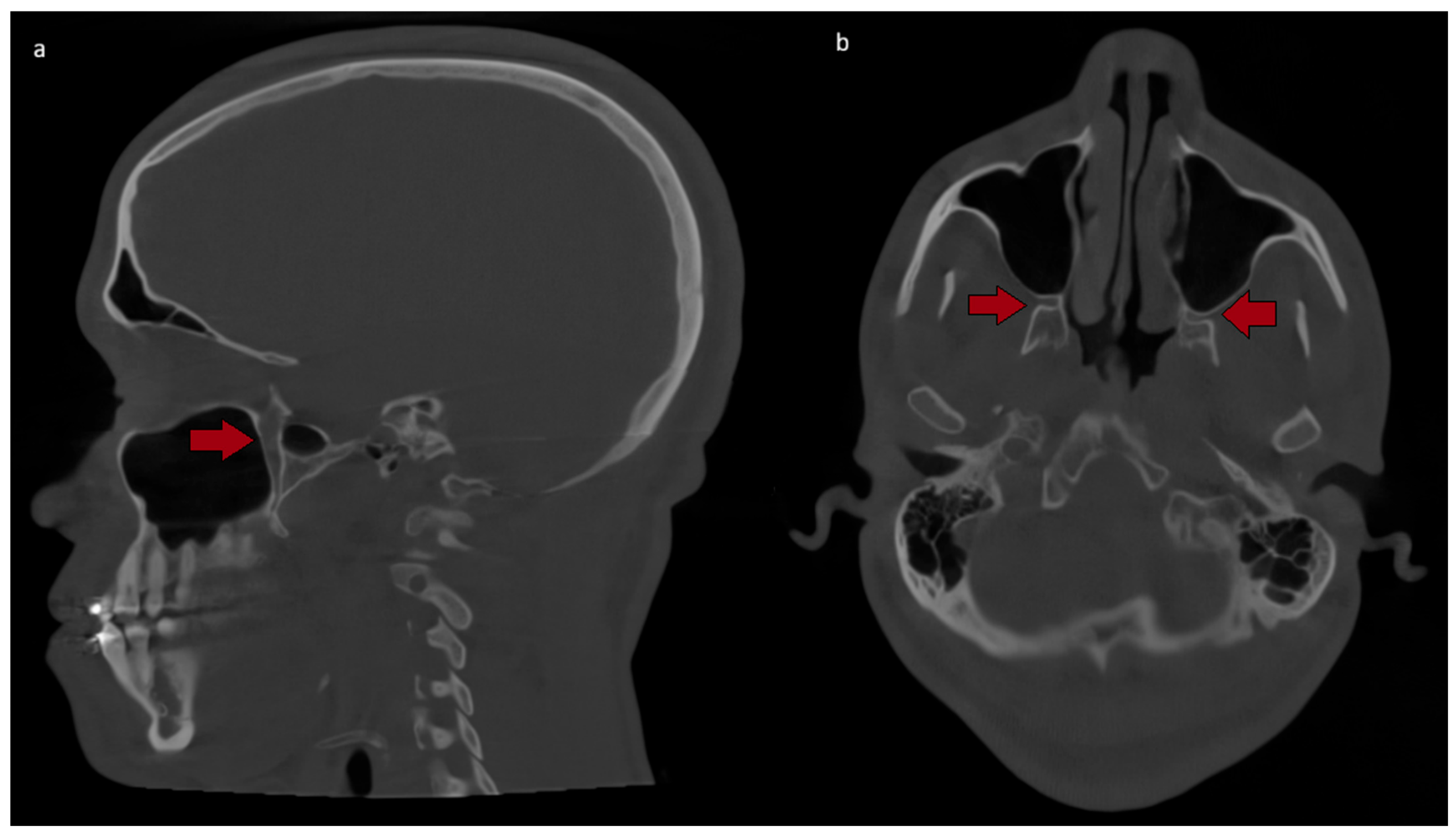
- Anticipate TCR during Le Fort I osteotomy: Surgeons should be aware that lateral nasal osteotomy, pterygomaxillary disjunction. Anticipate TCR during Le Fort I osteotomy: Surgeons should be aware that lateral nasal osteotomy, pterygomaxillary disjunction and maxillary down-fracture may elicit TCR-type events, particularly in young male patients. Anticipatory communication with anesthesia team is vital. Preoperative CBCT (Figure 1) can help visualize the posterior maxillary wall, pterygomaxillary junction, and their proximity to the pterygopalatine fossa, reinforcing awareness of this high-risk anatomic zone during planning and execution of the osteotomies.
- Monitor closely: Continuous heart rate and blood pressure monitoring allows prompt detection of bradycardia or asystole. Arterial lines are recommended for high-risk cases.
- Prevent and prepare: Consider regional nerve blocks (e.g., mandibular nerve block) selectively—especially during BSSO—recognizing variable efficacy and limited data for routine prophylaxis.
- Manage promptly: Stop the stimulus, administer atropine or glycopyrrolate, and be prepared to initiate CPR if asystole persists.
- Refined surgical technique: Surgeons should prioritize gentle, controlled, and intermittent manipulation of tissues, with an immediate cessation of the surgical stimulus upon any physiological sign of the reflex.
- Team-based approach: Fostering seamless communication and a shared understanding of TCR between surgeons and anesthesiologists is non-negotiable for ensuring a rapid and effective response to any event.
- Inform the patient: Discuss the rare risk of TCR and potential intra-operative complications during informed consent.
3.8. Limitations
4. Conclusions
Author Contributions
Funding
Institutional Review Board Statement
Informed Consent Statement
Data Availability Statement
Conflicts of Interest
References
- Meuwly, C.; Chowdhury, T.; Sandu, N.; Golanov, E.; Erne, P.; Rosemann, T.; Schaller, B. Definition and Diagnosis of the Trigeminocardiac Reflex: A Grounded Theory Approach for an Update. Front. Neurol. 2017, 8, 533. [Google Scholar] [CrossRef]
- Aschner, B. About a hitherto unpredictable reflex of the eye on the circulatory system and respiration: Disappearance of the radial pulse upon pressure on the eye. Vienna Kiln Wochenscr 1908, 21, 1529–1530. [Google Scholar]
- Shelly, M.; Church, J. Bradycardia and facial surgery. Anaesthesia 1988, 43, 422. [Google Scholar] [CrossRef]
- Bhargava, D.; Thomas, S.; Chakravorty, N.; Dutt, A. Trigeminocardiac Reflex: A Reappraisal with Relevance to Maxillofacial Surgery. J. Maxillofac. Oral Surg. 2014, 13, 373–377. [Google Scholar] [CrossRef]
- Bohluli, B.; Ashtiani, A.K.; Khayampoor, A.; Sadr-Eshkevari, P. Trigeminocardiac reflex: A MaxFax literature review. Oral Surg. Oral Med. Oral Pathol. Oral Radiol. Endodontol. 2009, 108, 184–188. [Google Scholar] [CrossRef]
- Morey, T.E.; Bjoraker, D.G. Asystole during Temporomandibular Joint Arthrotomy. Anesthesiology 1996, 85, 1488–1491. [Google Scholar] [CrossRef]
- Ortiz-Peces, L.; Álvaro-Martínez, M.; Moreiras-Sánchez, Á.D.; Chacón-Ferrer, G.; Andura-Correas, M.; Castillo-Pardo de Vera, J.L.; Ortiz-González, L.; Cebrián-Carretero, J.L. Trigeminocardiac reflex in bimaxillary orthognathic surgery: Case review. Med. Oral Patol. Oral. Cir. Bucal 2025, 30, e523–e527. [Google Scholar] [CrossRef]
- Wang, W.; Cai, H.; Ding, H.; Xu, X. Case report: 2 cases of cardiac arrest caused by rhino-cardiac reflex while disinfecting nasal cavity before endonasal transsphenoidal endoscopic pituitary surgery. BMC Anesthesiol. 2021, 21, 18. [Google Scholar] [CrossRef]
- Sohrabi, C.; Mathew, G.; Maria, N.; Kerwan, A.; Franchi, T.; Agha, R.A. The SCARE 2023 guideline: Updating consensus Surgical CAse REport (SCARE) guidelines. Int. J. Surg. 2023, 109, 1136–1140. [Google Scholar] [CrossRef]
- Singh, G.P.; Chowdhury, T. Brain and heart connections: The trigeminocardiac reflex! J. Neuroanaesth. Crit. Care 2017, 4, 71–77. [Google Scholar] [CrossRef]
- Schaller, B.; Cornelius, J.F.; Prabhakar, H.; Koerbel, A.; Gnanalingham, K.; Sandu, N.; Ottaviani, G.; Filis, A.; Buchfelder, M. The trigemino-cardiac reflex: An update of the current knowledge. J. Neurosurg. Anesth. 2009, 21, 187–195. [Google Scholar] [CrossRef] [PubMed]
- Shanab, H.G.; Albargi, H.H. Incidence of trigeminocardiac reflex in maxillofacial surgery: A retrospective study. J. Health Spec. 2016, 4, 151–156. [Google Scholar] [CrossRef]
- Schaller, B.; Probst, R.; Strebel, S.; Gratzl, O. Trigeminocardiac reflex during surgery in the cerebellopontine angle. J. Neurosurg. 1999, 90, 215–220. [Google Scholar] [CrossRef]
- Bohluli, B.; Bayat, M.; Sarkarat, F.; Moradi, B.; Tabrizi, M.H.; Sadr-Eshkevari, P. Trigeminocardiac reflex during Le Fort I osteotomy: A case-crossover study. Oral Surg. Oral Med. Oral Pathol. Oral Radiol. Endodontol. 2010, 110, 178–181. [Google Scholar] [CrossRef]
- Bohluli, B.; Sadr-Eshkevari, P.; Rashad, A.; Schaller, B.; Maurer, P. In reply. J. Oral Maxillofac. Surg. 2011, 69, 2484–2485. [Google Scholar] [CrossRef]
- Abdulazim, A.; Prochnow, N.; Taeihagh, T. TCR or Not TCR? J. Oral Maxillofac. Surg. 2011, 69, 2483–2484. [Google Scholar] [CrossRef]
- Meuwly, C.; Golanov, E.; Chowdhury, T.; Erne, P.; Schaller, B. Trigeminal cardiac reflex: New thinking model about the definition based on a literature review. Medicine 2015, 94, e484. [Google Scholar] [CrossRef]
- Rath, G.P.; Chaturvedi, A.; Chouhan, R.S.; Prabhakar, H. Transient cardiac asystole in transsphenoidal pituitary surgery: A case report. J. Neurosurg. Anesthesiol. 2004, 16, 299–301. [Google Scholar] [CrossRef] [PubMed]
- Chowdhury, T.; Mendelowith, D.; Golanov, E.; Spiriev, T.; Arasho, B.; Sandu, N.; Sadr-Eshkevari, P.; Meuwly, C.; Schaller, B. Trigeminocardiac reflex: The current clinical and physiological knowledge. J. Neurosurg. Anesth. 2015, 27, 136–147. [Google Scholar] [CrossRef]
- Ragno, J.R., Jr.; Marcoot, R.M.; Taylor, S.E. Asystole during Le Fort I osteotomy. J. Oral Maxillofac. Surg. 1989, 47, 1082–1083. [Google Scholar] [CrossRef]
- Maharaj, K.; Cedrola, R.; Mirza, T. Asystole during Le Fort 1 osteotomy: The trigeminovagal reflex. Ann. R. Coll. Surg. Engl. 2020, 102, e1–e3. [Google Scholar] [CrossRef]
- Baronos, S.; Fong, W.; Saggese, N.P.; Luke, J.; Ahmed, K.; Yarmush, J. Asystole in Orthognathic Surgery: A Case Report. A&A Pract. 2019, 12, 249–251. [Google Scholar]
- Campbell, R.; Rodrigo, D.; Cheung, L. Asystole and bradycardia during maxillofacial surgery. Anesth. Prog. 1994, 41, 13–16. [Google Scholar]
- Lübbers, H.T.; Zweifel, D.; Grätz, K.W.; Kruse, A. Classification of potential risk factors for trigeminocardiac reflex in craniomaxillofacial surgery. J. Oral Maxillofac. Surg. 2010, 68, 1317–1321. [Google Scholar] [CrossRef]
- Etezadi, F.; Orandi, A.A.; Orandi, A.H.; Najafi, A.; Amirjamshidi, A.; Pourfakhr, P.; Khajavi, M.R.; Abbassioun, K. Trigeminocardiac reflex in neurosurgical practice: An observational prospective study. Surg. Neurol. Int. 2013, 4, 116. [Google Scholar] [CrossRef]
- Arasho, B.; Sandu, N.; Spiriev, T.; Prabhakar, H.; Schaller, B. Management of the trigeminocardiac reflex: Facts and own experience. Neurol. India 2009, 57, 375–380. [Google Scholar] [CrossRef]
- Blanc, V.F. Trigeminocardiac reflexes. Can. J. Anaesth. 1991, 38, 696–699. [Google Scholar] [CrossRef]
- Prabhakar, H.; Ali, Z.; Rath, G.P. Trigemino-cardiac reflex may be refractory to conventional management in adults. Acta Neurochir. 2008, 150, 509–510. [Google Scholar] [CrossRef]
- Blanc, V.F.; Hardy, J.F.; Milot, J.; Jacob, J.L. The oculocardiac reflex: A graphic and statistical analysis in infants and children. Can. Anaesth. Soc. J. 1983, 30, 360–369. [Google Scholar] [CrossRef]
- Bohluli, B.; Schaller, B.J.; Khorshidi-Khiavi, R.; Dalband, M.; Sadr-Eshkevari, P.; Maurer, P. Trigeminocardiac reflex, bilateral sagittal split ramus osteotomy, Gow-Gates block: A randomized controlled clinical trial. J. Oral Maxillofac. Surg. 2011, 69, 2316–2320. [Google Scholar] [CrossRef]
- Hunsley, J.E.; Bush, G.H.; Jones, C.J. A study of glycopyrrolate and atropine in the suppression of the oculocardiac reflex during strabismus surgery in children. Br. J. Anaesth. 1982, 54, 459–464. [Google Scholar] [CrossRef]
- Hasegawa, R.; Hasegawa, S.; Miyachi, H.; Watanabe, S.; Nakaya, S.; Goto, M. Bradycardia and hypotension associated with trigeminocardiac reflex during orthognathic surgery: Two case reports. Ann. Med. Surg. 2025, 87, 4618–4622. [Google Scholar] [CrossRef] [PubMed]
- Precious, D.S.; Skulsky, F.G. Cardiac dysrhythmias complicating maxillofacial surgery. Int. J. Oral Maxillofac. Surg. 1990, 19, 279–282. [Google Scholar] [CrossRef] [PubMed]
- Lang, S.; Lanigan, D.T.; van der Wal, M. Trigeminocardiac reflexes: Maxillary and mandibular variants of the oculocardiac reflex. Can. J. Anaesth. 1991, 38, 757–760. [Google Scholar] [CrossRef] [PubMed]
- Sanuki, T.; Yamamoto, N.; Miki, M.; Sugioka, S.; Kotani, J. Trigeminovagal reflex caused by stimulation of the mandibular division of the trigeminal nerve under general anesthesia: A case report. Oral Sci. Int. 2009, 6, 109–111. [Google Scholar] [CrossRef]
- Miyamoto, J.; Mano, T.; Horinaga, D. A case of bradycardia caused by trigeminocardiac reflex during orthognathic surgery. Jpn. J. Oral Maxillofac. Surg. 2012, 58, 439–442. [Google Scholar] [CrossRef]
- Wakasugi, Y.; Goto, T.; Ichinohe, T. A case of sinus arrest caused by trigeminovagal reflex in sagittal split ramus osteotomy. J. Jpn. Dent. 2013, 41, 193–194. [Google Scholar]
- Kumasaka, A.; Miura, Y. Two cases of trigeminocardiac reflex during sagittal split ramus osteotomy. J. Jpn. Dent. 2013, 41, 47–48. [Google Scholar]
- Kim, H. Sudden arrhythmia followed by bradycardia during sagittal split ramus osteotomy: Trigeminocardiac reflex. BMJ Case Rep. 2019, 12, e232784. [Google Scholar] [CrossRef]
- Sugiyama, S.; Iwai, T.; Honda, K.; Mitsudo, K. Trigeminocardiac reflex during bilateral sagittal split osteotomy. J. Dent. Sci. 2020, 16, 782. [Google Scholar] [CrossRef]
- Alshalawi, H.; Fatani, B.; Alotaibi, M.; Assiri, Z.A. Trigeminal Cardiac Reflux During Le Fort I Osteotomy: A Case Report. Cureus 2024, 16, e61665. [Google Scholar] [CrossRef] [PubMed]

| Time | Anesthetic Events | Surgical Events | Vitals | Notes |
|---|---|---|---|---|
| 07:41–08:15 | OR arrival; induction (propofol 150 mg, fentanyl 100 µg, midazolam 2 mg, rocuronium 50 mg); nasotracheal intubation; antibiotic (ampicillin–sulbactam 3 g IV). | Prep/drape; circumvestibular incision; local anesthesia (2% lidocaine w/epinephrine) for bilateral IAN blocks and local infiltration. | Baseline HR 74; BP 146/97; SpO2 100%. | — |
| 08:15–09:10 | Labetalol 5 mg IV; hydralazine 5 mg IV; IV fluids (LR). | Exposure; stepped Le Fort I osteotomies with reciprocating saw (right then left). | HR 80–90; intermittent hypertension (up to ~160/141); SpO2 100%. | — |
| 09:10–09:24 | Hydralazine 5 mg IV; fentanyl 50 µg IV; rocuronium 20 mg IV. | Pterygomaxillary separation (Burton osteotome) and guarded left lateral nasal wall osteotomy (no down-fracture). | HR 74–83; BP 109/67–119/74; SpO2 99–100%. | Index stimulation period. |
| 09:25–09:26 | Code start; epinephrine 1 mg IV; CPR. | All surgical maneuvers halted. | Asystole; SpO2 99–100%; ROSC achieved in <1 min (HR ~37 at ROSC). | Suspected V2-mediated TCR. |
| 09:31–11:20 | Atropine 0.2 mg IV x2; ephedrine 10 mg IV; norepinephrine infusion (09:46–09:53); arterial line/IV access; transfer intubated to SICU. | Hemostasis and closure; Surgiflo/Avitene at pterygomaxillary junctions; throat pack removed; case aborted. | HR 48–67; BP nadir ~75/64 improving to 128/75; SpO2 99–100%. | Down-fracture not completed. |
| Year, Author | Sex | Age | Race | Surgery | Index Event | Manifestation | Management and Outcome |
|---|---|---|---|---|---|---|---|
| 1989, Ragno et al. * [20] | M | 17 | Caucasian | LF 1 | During down-fracture of the maxilla | Asystole (several seconds) | Surgery was stopped; atropine 0.4 mg; glycopyrrolate 0.3 mg; surgery completed uneventfully. |
| 1990, Precious et al. * [33] | Six cases; details not provided | LF 1 | Maxillary mobilization and advancement | Asystole or bradycardia (20–40 bpm) | Glycopyrrolate 0.2 mg; chest compression. | ||
| 1991, Lang et al. (Cases #1) * [34] | F | 28 | Caucasian | LF 1 | Pterygomaxillary osteotomy | Asystole | Surgery was stopped; atropine 0.6 mg. |
| 1992, Lang et al. (Cases #2) * [34] | F | 26 | Caucasian | LF 1, BSSO, genioplasty | Placement of retractor during BSSO | Asystole | Surgery was stopped; inferior alveolar nerve block; atropine 0.6 mg; surgery completed uneventfully. |
| 1993, Lang et al. (three cases) [34] | F | 38 | Caucasian | LF 1 and BSSO | Forward traction of the maxilla during Le Fort I | Bradycardia (95 to 65 bpm) | Surgery was stopped; atropine 1.2 mg; surgery completed uneventfully. |
| 1994, Campbell * et al. [23] | F | 35 | Chinese | LF 1 and Hofer | Maxillary tuberosity osteotomy | Asystole (10 s) | Surgery was stopped; O2 100%; atropine 0.6 mg; surgery completed uneventfully. |
| 2009, Sanuki et al. * [35] | F | 31 | BSSRO | Mandibular soft tissue dissection | Asystole (8 s) | Surgery was stopped; atropine 0.5 mg; local anesthesia; surgery completed uneventfully. | |
| 2012, Miyamoto et al. [36] | F | 18 | LF 1, BSSRO, genioplasty | Suturing the mandibular mucoperiosteal flap | Bradycardia | Surgery was stopped; atropine; cardiac massage; surgery completed uneventfully. | |
| 2013, Wakasugi et al. * [37] | M | 21 | LF 1, BSSRO | Manipulation of the mandible | Asystole | Interruption of the surgery. | |
| 2013, Kumasaka et al. [38] | F | 18 | LF 1, BSSRO | Placing a retractor along the medial aspect of the mandibular ramus | Bradycardia, hypotension | Interruption of the surgery; anticholinergic drugs. | |
| 2013, Kumasaka et al. [38] | M | 39 | BSSRO | Placing a retractor along the medial aspect of the mandibular ramus | Bradycardia | Interruption of the surgery. | |
| 2019, Baronos et al. * [22] | M | 26 | Asian | LF 1, BSSO, genioplasty | Placement of bite block towards end of surgery | Asystole (10 s); severe bradycardia (30–40 bpm) with repeat placement of bite block | Surgery was stopped; glycopyrrolate 0.4 mg. |
| 2019, Kim et al. [39] | M | 23 | BSSO | Miniplate fixation during BSSO | Bradycardia (HR 25–30 bpm) | Surgery was stopped; lidocaine (80 mg) and glycopyrrolate (0.2 mg); surgery completed uneventfully. | |
| 2020, Sugiyama et al. [40] | F | 31 | LF 1 and BSSO | Splitting of the mandibular ramus | Bradycardia (29 bpm) | Surgery was stopped; atropine 0.5 mg; local anesthesia; surgery completed uneventfully. | |
| 2020, Maharaj et al. [21] | M | 45 | LF 1 and BSSO | Mobilization of the maxilla with Rowe’s dis-impaction forceps | Bradycardia | Surgery was stopped; surgery completed uneventfully. | |
| 2024, Alshalawi et al. [41] | M | 32 | Saudi | LF 1, BSSO, genioplasty | Down-fracture of the maxilla | Bradycardia (25 bpm) | Surgery was stopped; atropine 0.5 mg ×2; surgery completed uneventfully. |
| 2024, Ortiz-Peces et al. [7] | M | 36 | Caucasian | LF 1 and BSSO | Mandibular nerve disjunction in BSSO; pterygomaxillary disjunction | Bradycardia (35 bpm); asystole (5 s) | Surgery was stopped; atropine 0.5 mg; surgery completed uneventfully. |
| 2025, Hasegawa et al. (Case 1) [32] | F | 39 | LF 1 and BSSRO | Down-fracture of the maxilla | Bradycardia (46 bpm) | Surgery was stopped; supplemental local anesthesia; surgery completed uneventfully. | |
| 2025, Hasegawa et al. (Case 2) [32] | M | 26 | LF 1 and BSSRO | Splitting of the left mandibular ramus while autologous blood transfusion was being given | Bradycardia (52 bpm); hypotension (54/25 mmHg) | Autotransfusion was paused; 4 mg ephedrine was administered; surgery completed uneventfully. | |
| 2025, Current case * | M | 32 | African American | LF 1 | Lateral nasal osteotomy | Asystolic arrest; code and ROSC within <1 min (exact asystole duration unknown) | Surgery was stopped; epinephrine 1 mg; chest compression; surgery abandoned. |
Disclaimer/Publisher’s Note: The statements, opinions and data contained in all publications are solely those of the individual author(s) and contributor(s) and not of MDPI and/or the editor(s). MDPI and/or the editor(s) disclaim responsibility for any injury to people or property resulting from any ideas, methods, instructions or products referred to in the content. |
© 2026 by the authors. Licensee MDPI, Basel, Switzerland. This article is an open access article distributed under the terms and conditions of the Creative Commons Attribution (CC BY) license.
Share and Cite
Ghosh, S.; Armanious, S.; Nair, A.; Ulku, Z.; Sultan, D.; Pellecchia, R. Ventricular Asystole During Le Fort I Orthognathic Surgery: A Case Consistent with Trigeminocardiac Reflex and a Mini Review. Clin. Pract. 2026, 16, 13. https://doi.org/10.3390/clinpract16010013
Ghosh S, Armanious S, Nair A, Ulku Z, Sultan D, Pellecchia R. Ventricular Asystole During Le Fort I Orthognathic Surgery: A Case Consistent with Trigeminocardiac Reflex and a Mini Review. Clinics and Practice. 2026; 16(1):13. https://doi.org/10.3390/clinpract16010013
Chicago/Turabian StyleGhosh, Sucharu, Sandra Armanious, Anirudh Nair, Zeynep Ulku, Daniel Sultan, and Robert Pellecchia. 2026. "Ventricular Asystole During Le Fort I Orthognathic Surgery: A Case Consistent with Trigeminocardiac Reflex and a Mini Review" Clinics and Practice 16, no. 1: 13. https://doi.org/10.3390/clinpract16010013
APA StyleGhosh, S., Armanious, S., Nair, A., Ulku, Z., Sultan, D., & Pellecchia, R. (2026). Ventricular Asystole During Le Fort I Orthognathic Surgery: A Case Consistent with Trigeminocardiac Reflex and a Mini Review. Clinics and Practice, 16(1), 13. https://doi.org/10.3390/clinpract16010013

