
You are currently viewing a new version of our website. To view the old version click .

Journal of Xenobiotics, Volume 12, Issue 1

March 2022 - 6 articles

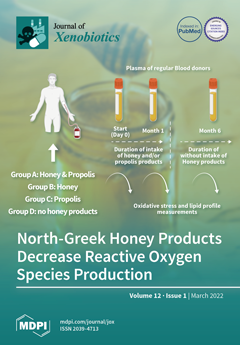
Cover Story: Honey products contain many compounds, such as vitamins, enzymes, and minerals, which make honey and its products great antioxidants with critical roles in health status. Eighty regular blood donor volunteers were divided into four groups: group A (n = 20) consumed two spoons of Greek honey and one drop of propolis per day for 1 month, group B (n = 20) consumed two spoons of honey per day for 1 month, group C (n = 20) consumed one drop of propolis per day, and group D (n = 20) did not consume any Greek honey products. In the present study, statistically significant decreases in reactive oxygen species statuses were found after small doses of honey product consumption, indicating that a diet with a small doses of honey products would be beneficial after blood donation. View this paper
  • Issues are regarded as officially published after their release is announced to the table of contents alert mailing list .
  • You may sign up for email alerts to receive table of contents of newly released issues.
  • PDF is the official format for papers published in both, html and pdf forms. To view the papers in pdf format, click on the "PDF Full-text" link, and use the free Adobe Reader to open them.

Articles (6)

  • Perspective
  • Open Access
20 Citations
5,864 Views
8 Pages

Impact of Cumulative Environmental and Dietary Xenobiotics on Human Microbiota: Risk Assessment for One Health

  • Pilar Ortiz,
  • Alfonso Torres-Sánchez,
  • Ana López-Moreno,
  • Klara Cerk,
  • Ángel Ruiz-Moreno,
  • Mercedes Monteoliva-Sánchez,
  • Antonis Ampatzoglou,
  • Margarita Aguilera and
  • Agnieszka Gruszecka-Kosowska

17 March 2022

Chemical risk assessment in the context of the risk analysis framework was initially designed to evaluate the impact of hazardous substances or xenobiotics on human health. As the need of multiple stressors assessment was revealed to be more reliable...

  • Review
  • Open Access
21 Citations
14,896 Views
12 Pages

7 February 2022

Psychedelics extracted from plants have been used in religious, spiritual, and mystic practices for millennia. In 1957, Dr. Hofmann identified and synthesized the prodrug psilocybin, a substance present in more than 200 species of psychedelic mushroo...

  • Review
  • Open Access
98 Citations
14,028 Views
20 Pages

Glyphosate vs. Glyphosate-Based Herbicides Exposure: A Review on Their Toxicity

  • Carlos Martins-Gomes,
  • Tânia L. Silva,
  • Tatiana Andreani and
  • Amélia M. Silva

17 January 2022

Glyphosate-based herbicide has been the first choice for weed management worldwide since the 1970s, mainly due to its efficacy and reported low toxicity, which contributed to its high acceptance. Many of the recent studies focus solely on the persist...

  • Article
  • Open Access
8 Citations
4,988 Views
8 Pages

Effects of Greek Honey and Propolis on Oxidative Stress and Biochemical Parameters in Regular Blood Donors

  • Ioannis Tsamesidis,
  • Chinedu O. Egwu,
  • Diana Samara,
  • Dimitra Vogiatzi,
  • Athanasios Lettas and
  • Evgenia Lymperaki

4 January 2022

Background and objectives: Honey products contain a lot of compounds, such as vitamins, enzymes, and minerals, which make honey and its products a great antioxidant with a critical role in health status. It is well accepted that honey and propolis ca...

  • Review
  • Open Access
36 Citations
7,412 Views
12 Pages

21 December 2021

Microplastics (MPs) are ubiquitous in environmental media, and their harmful effects on MPs on the ecosystem have attracted more and more attention. Once released into the environment, MPs can trigger oxidative degradation through ultraviolet (UV) to...

Get Alerted

Add your email address to receive forthcoming issues of this journal.

XFacebookLinkedIn
J. Xenobiot. - ISSN 2039-4713