


Next Issue
Volume 17, May
Previous Issue
Volume 17, March


Int. J. Plant Biol., Volume 17, Issue 4 (April 2026) – 12 articles
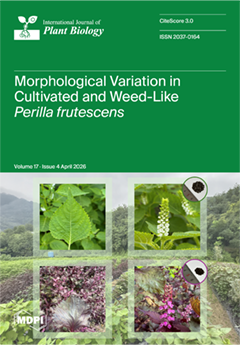
Cover Story (view full-size image): Perilla frutescens (L.) Britton is an economically and culturally important crop in East Asia, cultivated for edible oil, leafy vegetables, and medicinal uses. This study investigated morphological variation in cultivated and weedy forms of Perilla frutescens collected from South Korea and Japan. Clear morphological differentiation was observed between cultivated and weedy forms in both varieties, particularly in pigmentation, plant fragrance, and seed-related traits. Analyses of qualitative and quantitative traits revealed substantial phenotypic diversity within Perilla germplasm. These findings highlight the importance of both cultivated and weedy accessions as valuable genetic resources and provide useful insights for germplasm conservation, evolutionary studies, and the development of improved Perilla cultivars through future breeding programs. View this paper
  • Issues are regarded as officially published after their release is announced to the table of contents alert mailing list.
  • You may sign up for e-mail alerts to receive table of contents of newly released issues.
  • PDF is the official format for papers published in both, html and pdf forms. To view the papers in pdf format, click on the "PDF Full-text" link, and use the free Adobe Reader to open them.
Order results
Result details
Section
Select all
Export citation of selected articles as:
20 pages, 3024 KB  
Article
Genetic Variability and Trait Associations in Ethiopian and Exotic Lentil (Lens culinaris) Germplasm
by Nigussie Kefelegn, Solomon Benor, Gizachew Haile Gidamo, Asnake Fikre, Ming Pei You and Martin J. Barbetti
Int. J. Plant Biol. 2026, 17(4), 35; https://doi.org/10.3390/ijpb17040035 - 21 Apr 2026
Viewed by 1153
Abstract
Yield is a complex trait influenced by multiple components and their genetic behavior. Therefore, this study was designed to understand the complex nature of yield by uncovering relationships among traits and estimating the genetic parameters of lentil germplasm. One hundred and ninety-two lentil [...] Read more.
Yield is a complex trait influenced by multiple components and their genetic behavior. Therefore, this study was designed to understand the complex nature of yield by uncovering relationships among traits and estimating the genetic parameters of lentil germplasm. One hundred and ninety-two lentil (Lens culinaris) germplasm samples were evaluated at Jamma and Enewari (field experiment) and at Debre Birehan agricultural research center (pot experiment) in Amhara Region, Ethiopia, in 2024 and 2025. An alpha lattice design was used for both set of experiment, and data on 12 agronomic traits were collected. Genetic parameter estimations, correlation, path, principal component and cluster analyses were performed in R. The results revealed substantial phenotypic and genetic variation among the evaluated germplasm, with high broad-sense heritability for flowering, maturity, and seed size traits, and moderate heritability for seeds per plant, plant height, harvest index, and yield. Yield exhibited a strong phenotypic correlation with harvest index (r = 0.78 in field and r = 0.95 in pots), biomass (r = 0.77 in the field and r = 0.78 in pots), seeds per plant (r = 0.42 in the field and r = 0.60 in pots), and podding (r = 0.45 in the field and r = 0.69 in pots). Similarly, genotypic correlations were high with harvest index (r = 0.83 in the field and r = 0.96 in pots), biomass (r = 0.75 in the field and r = 0.80 in pots), seeds per plant (r = 0.0.59 in the field and r = 0.58 in pots), and podding (r = 0.39 in the field and r = 0.68 in pot), and both their direct and indirect effects on yield were significantly high. Therefore, indirect selection through traits such as pods per plant, harvest index, biomass, and seeds per plant would be more effective and reliable for improving seed yield than direct selection for yield itself as this is highly affected by environmental variations. Full article
(This article belongs to the Section Plant Biochemistry and Genetics)
Show Figures

Figure 1

16 pages, 1167 KB  
Article
Diversity of Coffea canephora Genotypes from the Robusta and Conilon Botanical Groups at the Seedling Stage
by Pablo Santana Vial, Niquisse José Alberto, Emanoel Chequetto, Wellington Castrillon Grélla, Laís da Silva Magevski, Militino Paiva Carrafa, Edilson Romais Schmildt, Deurimar Herênio Gonçalves Júnior and Fábio Luiz Partelli
Int. J. Plant Biol. 2026, 17(4), 34; https://doi.org/10.3390/ijpb17040034 - 21 Apr 2026
Viewed by 669
Abstract
This study evaluated the morphological development of 23 Coffea canephora clones in Espírito Santo to identify materials with superior vigor and quality for commercial and breeding purposes. Seedlings from cuttings were arranged in a completely randomized design with ten replicates and assessed at [...] Read more.
This study evaluated the morphological development of 23 Coffea canephora clones in Espírito Santo to identify materials with superior vigor and quality for commercial and breeding purposes. Seedlings from cuttings were arranged in a completely randomized design with ten replicates and assessed at the commercial dispatch stage. Shoot and root growth, biomass, leaf area (LA), Dickson Quality Index (DQI), structural ratios (shoot/root ratio, SRR; height/diameter ratio, HDR), and anatomical traits were measured. Data were analyzed using analysis of variance with Scott–Knott clustering, Pearson correlation, and Principal Component Analysis (PCA). Significant variability was observed among clones. Clones 88, VR3, 8, and LB33 showed the highest stem diameter (SD), total dry mass (TDM), LA, and DQI, with balanced shoot and root development. Leaf area correlated strongly with SD, number of leaves (NL), biomass, and DQI, confirming its role as a seedling quality indicator. PCA identified two groups: a high-performance group with greater vigor and biomass, and a lower-performance group including clones 7, MR04, and VR4. The convergence of methods confirms the robustness of the results. Overall, clones 88, VR3, 8, and LB33 demonstrate superior agronomic potential at the seedling stage, offering promising options for nurseries, growers, and clonal selection programs. Full article
(This article belongs to the Section Plant Reproduction)
Show Figures

Figure 1

21 pages, 1594 KB  
Article
Bifurcaria bifurcata Aqueous Extract as Bio-Elicitors for Enhanced Resistance and Growth Promotion in Potato Plants Against Dickeya dadantii-Induced Soft Rot Disease
by Fatima Lakhdar, Bouchra Benhniya, Jamal Bouhraoua, Selma Mabrouki, Nazha Samri, Badr-ddine El Mouns, Taoufik Hachimi, Nabila Boujaber, Omar Assobhei and Samira Etahiri
Int. J. Plant Biol. 2026, 17(4), 33; https://doi.org/10.3390/ijpb17040033 - 21 Apr 2026
Cited by 1 | Viewed by 719
Abstract
Phytopathogenic diseases are a major limiting factor in agricultural production. Therefore, scientific research continues to focus on developing effective techniques to mitigate their impact on crop productivity. Seaweed extracts, used as nutritional supplements, organic fertilizers, or bio-pesticides, have demonstrated their ability to enhance [...] Read more.
Phytopathogenic diseases are a major limiting factor in agricultural production. Therefore, scientific research continues to focus on developing effective techniques to mitigate their impact on crop productivity. Seaweed extracts, used as nutritional supplements, organic fertilizers, or bio-pesticides, have demonstrated their ability to enhance plant growth, increase yield, and alleviate the effects of abiotic stress. This study aimed to evaluate the effect of the aqueous extract of Bifurcaria bifurcata, collected from the Atlantic coast of Sidi Bouzid (El Jadida, Morocco), on the growth of Solanum tuberosum L., as well as its bactericidal activity against soft rot caused by Dickeya dadantii. The chemical Characterization revealed that Bifurcaria bifurcata aqueous extract is rich in polar and hydrophilic functional groups. In addition, this extract is particularly rich in phenolic metabolites, particularly phenolic acids, such as p-coumaric acid, ferulic acid, vanillic acid, and caffeic acid, which are known for their potential antimicrobial mechanisms. However, the treatment with 4 g/L extract resulted in a significant reduction in disease symptoms (>60%) and enhanced plant growth parameters, including 21% increase in plant height and 33% increase in leaf number. POX activity increased 6-fold (from 0.12 to 0.7 µmol/min/mg protein), indicating successful elicitation of plant defense mechanisms. The Bifurcaria bifurcata extract could act as novel activators of plant defense mechanisms and serve as potential alternatives to chemical pesticides. Full article
(This article belongs to the Section Plant–Microorganisms Interactions)
Show Figures

Figure 1

33 pages, 21318 KB  
Article
Contrasting Physiological, Photosynthetic, and Growth Adaptations of Plants to a Wide Range of Nitrogen, Phosphorus, and Potassium Availability
by Mingcan Fu, Xianbin Liu, Chengyu Zhang, Jian Ding, Bin Liu, Xiangqian Wu and Zhiyang Wang
Int. J. Plant Biol. 2026, 17(4), 32; https://doi.org/10.3390/ijpb17040032 - 16 Apr 2026
Viewed by 962
Abstract
Systematic comparisons of how plants with contrasting ecological strategies respond to extremely wide nutrient availability gradients remain limited. We investigated the physiological, photosynthetic, and growth adaptations of four plant species representing distinct ecological strategies: Triticum aestivum L. (C3 annual crop), Zea mays L. [...] Read more.
Systematic comparisons of how plants with contrasting ecological strategies respond to extremely wide nutrient availability gradients remain limited. We investigated the physiological, photosynthetic, and growth adaptations of four plant species representing distinct ecological strategies: Triticum aestivum L. (C3 annual crop), Zea mays L. (C4 annual crop), Ipomoea aquatica Forssk. (C3 annual/perennial aquatic vegetable), and Canna glauca L. (C3 perennial wetland ornamental). Plants were grown hydroponically under nitrogen (N), phosphorus (P), and potassium (K) gradients ranging from 0% to 500% of standard Hoagland nutrient solution. The study results showed that all measured plant traits exhibited characteristic unimodal dose–response patterns. Optimal performance mostly occurred at 100–150% nutrient availability gradients. Severe inhibition or mortality occurred at extreme gradients. Simultaneously, different plant species displayed markedly varying response amplitudes and nutrient-specific sensitivities. Z. mays showed the highest nutrient use efficiency and broadest optimal ranges, particularly for N and K. C. glauca exhibited extraordinary N responsiveness (32-fold increase in photosynthetic rate) but narrow optimal ranges (e.g., 1.01 ± 0.15 μmol CO2/(m2·s) at the 1% N treatment vs. 32.52 ± 3.33 μmol CO2/(m2·s) at the 150% N treatment). I. aquatica showed pronounced P limitation with broad tolerance to supra-optimal N and K. T. aestivum displayed moderate responses with clear sensitivity to N limitation. Root–shoot ratios declined systematically with increasing nutrient availability across all plant species, following negative exponential functions. The results of data analyses revealed significant effects of N, P, and K availability on all the determined plant traits. Correlation analyses demonstrated tight coupling effects among physiological, photosynthetic, and growth traits, indicating integrated whole-plant responses to nutrient variations. These findings reveal that plant ecological strategy systematically modulates nutrient response patterns and provide a quantitative framework for species-specific nutrient management. This study provides a theoretical basis for precision fertilization of aquatic vegetables and wetland plants, and more broadly support species-specific nutrient management in controlled-environment agriculture. Full article
(This article belongs to the Section Plant Physiology)
Show Figures

Figure 1

13 pages, 1201 KB  
Article
Genome-Wide Identification, Expression and Localization Analysis of the Glycinin Family in Soybean
by Shitong Chang, Wanlong Li, Zhou Liu, Xiaomei Zhou and Xiaoxi Shen
Int. J. Plant Biol. 2026, 17(4), 31; https://doi.org/10.3390/ijpb17040031 - 14 Apr 2026
Viewed by 602
Abstract
Soybean (Glycine max L. Merr.) is one of the most important legume crops globally, providing high-quality plant protein and oil for humans and livestock, and playing a crucial role in nitrogen fixation within agricultural ecosystems. The seeds contain about 35–40% protein by [...] Read more.
Soybean (Glycine max L. Merr.) is one of the most important legume crops globally, providing high-quality plant protein and oil for humans and livestock, and playing a crucial role in nitrogen fixation within agricultural ecosystems. The seeds contain about 35–40% protein by dry weight, with 65–80% of this being seed storage proteins (SSPs). These proteins mainly consist of 11S globulin (glycinin) and 7S β-conglycinin, which accumulate significantly in protein bodies during seed development, providing essential nitrogen and amino acids for seed germination and early seedling growth. Additionally, the composition and structure of SSPs directly determine the nutritional value, processing functionalities (such as emulsification, gelation, and solubility), and potential allergenicity of soybean products. In this study, we conducted a detailed analysis of the structural characteristics, chromosomal localization, phylogenetic relationships, and tissue expression patterns of members of the soybean Gy gene family, laying a theoretical foundation for further exploration of the biological functions of Gy genes in soybeans. We performed comprehensive genomic identification, expression analysis, and subcellular localization of the soybean Gy gene family. The results showed that the seven soybean Gy genes are unevenly distributed across different chromosomes and exhibit distinct expression patterns in soybean seeds, suggesting they may have different roles during seed development. Subcellular localization experiments indicated that the GmGy1 gene might play an important role during seed development. These findings provide significant insights into the functions of the Gy gene family in soybean growth and development and offer potential candidate gene targets for soybean molecular breeding. Full article
(This article belongs to the Section Plant Biochemistry and Genetics)
Show Figures

Figure 1

17 pages, 2206 KB  
Article
Enhancing the Growth and the Yield of Greenhouse Zucchini (Cucurbita pepo L.) Cultivars Using Desalinated Seawater in Semi-Arid Regions
by Khadija Khouya, Houda Taimourya, Soumia El Malahi, Jamaâ Zim, Ibtissam Lahrach, Aya Elatrassi, Bahija Zakri, Abdellah Benbya, Khadija Basaid, Ouiam Lahlou, Yasmina Imani and Mounia Ennami
Int. J. Plant Biol. 2026, 17(4), 30; https://doi.org/10.3390/ijpb17040030 - 13 Apr 2026
Viewed by 865
Abstract
Climate change exacerbates water scarcity in semi-arid and arid regions, particularly across the Mediterranean Basin, posing severe challenges to food security and freshwater availability. Non-conventional water resources, such as desalinated seawater, are increasingly considered for supplementing irrigation; however, their exclusive use can induce [...] Read more.
Climate change exacerbates water scarcity in semi-arid and arid regions, particularly across the Mediterranean Basin, posing severe challenges to food security and freshwater availability. Non-conventional water resources, such as desalinated seawater, are increasingly considered for supplementing irrigation; however, their exclusive use can induce osmotic stress, nutrient imbalances, and soil alkalinity, thereby limiting crop performance. This study evaluated the agronomic, and physiological impacts of blending freshwater (FW) and desalinated seawater (DSW) for two zucchini (Cucurbita pepo L.) cultivars, Radia and Kayssar, under greenhouse conditions. Five irrigation regimes were tested: T1 (FW100%), T2 (FW75%-DSW25%), T3 (FW50%-DSW50%), T4 (FW25%-DSW75%), and T5 (DSW100%). Moderate blending, particularly T2 and T3, optimized vegetative growth, biomass accumulation, and reproductive performance, maximum yields were obtained under T3, reaching 6.65 kg/plant for Radia and 5.49 kg/plant for Kayssar, while fruit quality, including caliber and soluble solids content (°Brix), was also highest under this regime. These findings support the suggestion that implementing such combined/blended irrigation regimes can enhance vegetative growth, yield, and fruit quality in the face of increasing water scarcity and energy constraints. Full article
(This article belongs to the Section Plant Response to Stresses)
Show Figures

Figure 1

23 pages, 7792 KB  
Article
Hydrogen Sulfide-Mediated Physiological, Biochemical, and Ultrastructural Modifications Enhance Drought Tolerance in Common Bean (Phaseolus vulgaris L.)
by Abdul Rehaman, Syed Nazar ul Islam, Arif Tasleem Jan, Sajid Khan, Mohd Asgher and Nafees A. Khan
Int. J. Plant Biol. 2026, 17(4), 29; https://doi.org/10.3390/ijpb17040029 - 13 Apr 2026
Viewed by 502
Abstract
The common bean (Phaseolus vulgaris L.cv. BR-104) is the most widely cultivated legume crop and serves as a major dietary protein source worldwide. However, climate change-induced drought poses a severe threat to its productivity by disrupting key physiological and biochemical processes. Therefore, [...] Read more.
The common bean (Phaseolus vulgaris L.cv. BR-104) is the most widely cultivated legume crop and serves as a major dietary protein source worldwide. However, climate change-induced drought poses a severe threat to its productivity by disrupting key physiological and biochemical processes. Therefore, identifying effective strategies to enhance drought resilience in the common bean is of considerable importance. The present study investigates the regulatory role of hydrogen sulfide (H2S) in improving drought tolerance. Polyethylene glycol (15% PEG) induced drought stress markedly reduced phenotypic changes (leaf area (LA), plant dry weight (PDW), root length (RL), and shoot length (SL) by 18.6, 20.5, 30.3 and 17.5% respectively), photosynthetic efficiency (Fv/Fm by 28.4%), and photosynthetic pigment concentrations (chlorophyll and carotenoids by 25.6 and 36%, respectively), while significantly elevating oxidative stress markers (H2O2 and TBARS by 137.1% and 169.8%, respectively), leading to impaired stomatal movement and damaged chloroplast structure. Exogenous H2S application as sodium hydrogen sulfide (200 µM NaHS; H2S donor) effectively alleviated drought-induced oxidative damage by boosting endogenous H2S and GSH levels, upregulating activity of antioxidative enzymes, SOD, APX, and GR, thereby promoting reactive oxygen species (ROS) scavenging, and minimizing lipid peroxidation. Moreover, H2S maintained photosynthetic efficiency via improved stomatal openings and chloroplast structure, thus sustaining chlorophyll levels and stabilizing photosystem-II functionality. Enhanced proline accumulation following NaHS application led to improved osmotic adjustment, thereby contributing to overall stress tolerance. The use of a H2S scavenger at 100 µM HT (Hypotaurine) suppressed the mitigating effects of H2S, confirming the role of H2S in enhancing drought tolerance in the common bean. Collectively, these findings highlight the potential effect of H2S as a regulatory signaling molecule to enhance drought resilience in the common bean under drought stress conditions. Further research should explore integrating H2S-based treatments with breeding programs and agronomic practices to develop sustainable strategies to improve drought resilience in legumes and other staple crops under changing climatic conditions. Full article
(This article belongs to the Section Plant Response to Stresses)
Show Figures

Figure 1

14 pages, 3208 KB  
Article
Comparative Analysis of In Vitro vs. In Vivo dsRNA Production for CHS Silencing and Downstream Flavonoid Pathway Suppression in Arabidopsis thaliana
by Andrey R. Suprun, Stanislava A. Vinogradova, Konstantin V. Kiselev, Nikolay N. Nityagovsky and Alexandra S. Dubrovina
Int. J. Plant Biol. 2026, 17(4), 28; https://doi.org/10.3390/ijpb17040028 - 13 Apr 2026
Viewed by 732
Abstract
Exogenously induced RNA interference (exoRNAi) is a powerful biotechnology tool for precise gene regulation. The plant chalcone synthase (CHS) gene serves as a valuable model for molecular biology due to its central role in flavonoid biosynthesis. However, there are currently very [...] Read more.
Exogenously induced RNA interference (exoRNAi) is a powerful biotechnology tool for precise gene regulation. The plant chalcone synthase (CHS) gene serves as a valuable model for molecular biology due to its central role in flavonoid biosynthesis. However, there are currently very few studies addressing the advantages and disadvantages of in vitro (enzymatic) or in vivo (bacterial) methods for producing double-stranded RNA (dsRNA) for exogenous application. This study aims to optimize and compare the two methods for producing dsRNAs targeting the Arabidopsis thaliana CHS gene: enzymatic synthesis in vitro using a commercial kit and bacterial synthesis in vivo using an engineered E. coli HT115 (DE3) system. Bacterial synthesis conditions were optimized with respect to IPTG concentration and cultivation time, and the resulting dsRNA preparations were purified and quality-controlled. Their biological activities were assessed by treating A. thaliana plants and analyzing the effects on AtCHS gene expression and flavonoid production using qRT-PCR and HPLC-MS. The results demonstrated that purified AtCHS-dsRNA from both methods effectively suppressed AtCHS expression and downstream flavonoid biosynthetic gene expression, leading to significant reductions in anthocyanins and flavanols. This study confirmed the efficacy of exogenous dsRNAs in regulating plant metabolic pathways and provided a comparative analysis of dsRNA synthesis methods, highlighting their benefits and limitations for practical applications in plant biology and protection. Full article
(This article belongs to the Topic New Trends in Crop Breeding and Sustainable Production)
Show Figures

Figure 1

14 pages, 2607 KB  
Article
Phytotoxicity of Green-Synthesized Ag-Zn Nanoparticles in Maize Seedlings Using Response Surface Method
by Eugenia León-Jiménez, Federico A. Gutiérrez-Miceli, Esaú Ruíz-Sánchez, Daniel González-Mendoza, Benjamín Valdez-Salas, María C. Luján-Hidalgo, Joaquín A. Montes-Molina and Angel M. Herrera-Gorocica
Int. J. Plant Biol. 2026, 17(4), 27; https://doi.org/10.3390/ijpb17040027 - 8 Apr 2026
Viewed by 669
Abstract
The use of nanoparticles (NPs) synthesized from plant extracts is an alternative to conventional pesticides for the control of agricultural pests. This study aimed to optimize the conditions of synthesis of silver–zinc nanoparticles (Ag-ZnNPs) using extracts of Ocimum basilicum L. and Crotalaria longirostrata [...] Read more.
The use of nanoparticles (NPs) synthesized from plant extracts is an alternative to conventional pesticides for the control of agricultural pests. This study aimed to optimize the conditions of synthesis of silver–zinc nanoparticles (Ag-ZnNPs) using extracts of Ocimum basilicum L. and Crotalaria longirostrata Hook. & Arn. and to evaluate their phytotoxic impact on maize seedlings. The Ag-ZnNPs (Ag-Zn nanoparticles) were synthesized by redox reaction between metal ions and reducing metabolites present in the extracts. A response surface methodology (RSM) with three factors (extract concentration, heating time and pressure) was applied to determine the optimal synthesis conditions. The phytotoxicity of nanoparticles (NPs) on maize seedlings was subsequently evaluated on root growth, oxidative stress enzymes (CAT, POD, and APX), and physiology of seedlings. Nanoparticles synthesized from C. longirostrata extract demonstrated superior properties, with an optimization of synthesis (R2 = 95.3%) where the extract concentration (1:4 v/v; p < 0.01) was the critical factor influencing the reduction of metallic ions to nanoparticles. These NPs exhibited superior stability, smaller size (<100 nm), and zeta potential greater than 30 mV compared with O. basilicum extracts. Their NPs exhibited poorer optimization of synthesis (R2 = 43.8%) without the effect of any of the variables evaluated. Essentially, C. longirostrata NPs showed no phytotoxic effects on maize seedlings’ physiological parameters and enhanced root growth (117.2 mm) without negatively affecting photosynthesis (PSII 70-81 FvFm). Ag-ZnNPs synthesized with C. longirostrata exhibited optimal stability and size, along with no observed possible phytotoxicity effects, unlike O. basilicum NPs, which cause stress on maize seedlings. Therefore, Crotalaria longirostrata NPs could represent a promising material for agricultural pest control, with no apparent adverse effect on maize crops. Full article
(This article belongs to the Section Plant Response to Stresses)
Show Figures

Figure 1

13 pages, 688 KB  
Article
Morphological Variation Among Commercial Cultivars and Weed-Like Accessions of Perilla frutescens Collected in South Korea and Japan
by Da Hyeon Lee, Jungeun Cho, Hyeon Park, Tae Hyeon Heo and Ju Kyong Lee
Int. J. Plant Biol. 2026, 17(4), 26; https://doi.org/10.3390/ijpb17040026 - 7 Apr 2026
Cited by 1 | Viewed by 559
Abstract
This study evaluated morphological variation in 45 accessions of cultivated Perilla frutescens var. frutescens (PFF) and var. crispa (PFC) collected from South Korea and Japan, together with their weedy counterparts, var. frutescens (WPFF) and var. crispa (WPFC) from South Korea, using ten quantitative [...] Read more.
This study evaluated morphological variation in 45 accessions of cultivated Perilla frutescens var. frutescens (PFF) and var. crispa (PFC) collected from South Korea and Japan, together with their weedy counterparts, var. frutescens (WPFF) and var. crispa (WPFC) from South Korea, using ten quantitative and ten qualitative traits. Clear morphological differentiation was observed between cultivated and weedy forms in both varieties, particularly in pigmentation, plant fragrance, and seed-related traits. PFF cultivars were characterized by predominantly green pigmentation, a typical frutescens aroma, and significantly larger and heavier seeds, suggesting stronger phenotypic differentiation in leaf and seed utilization. In contrast, PFC cultivars showed substantial morphological overlap with WPFC and WPFF accessions, indicating comparatively weaker phenotypic differentiation. Principal component analysis showed that the first principal component (PC1) explained 25.7% of the total phenotypic variance and was strongly associated with five quantitative traits (plant height, inflorescence length, floret number, seed size, and 100-seed weight) and five qualitative traits (adaxial and abaxial leaf color, flower color, seed color, and seed hardness). Along PC1, PFF cultivars formed a well-defined cluster, whereas PFC cultivars and the weedy WPFF and WPFC accessions exhibited broader dispersion, reflecting greater morphological variability. These results provide morphological insights into the differentiation between cultivated and weedy Perilla accessions and indicate potential domestication-related patterns. However, these interpretations are based primarily on morphological observations, and further genetic and evolutionary studies will be necessary to clarify the domestication history of these taxa. The identified trait complexes provide a useful phenotypic foundation for marker-assisted breeding, informed cultivar selection, and effective germplasm conservation and management. Full article
(This article belongs to the Section Plant Ecology and Biodiversity)
Show Figures

Figure 1

21 pages, 2452 KB  
Article
In Vitro Plantlet Regeneration and Accumulation of Phenolic Compounds in Microshoots of Astragalus glycyphyllos L.
by Ulyana Panova, Olga Kotsupiy, Evgeniya Karpova and Elena Ambros
Int. J. Plant Biol. 2026, 17(4), 25; https://doi.org/10.3390/ijpb17040025 - 30 Mar 2026
Viewed by 691
Abstract
Astragalus glycyphyllos (Fabaceae) is known to be a source of flavones, flavonols, and isoflavones, and its in vitro culture may promote the efficiency and sustainability of obtaining pharmacologically valuable fractions. The aim of this study was to develop an effective plantlet regeneration protocol [...] Read more.
Astragalus glycyphyllos (Fabaceae) is known to be a source of flavones, flavonols, and isoflavones, and its in vitro culture may promote the efficiency and sustainability of obtaining pharmacologically valuable fractions. The aim of this study was to develop an effective plantlet regeneration protocol for A. glycyphyllos, providing the accumulation of phenolic compounds and antioxidants in cultured tissues. The results show a maximum seed germination rate (67.8%) after scarification (mechanical with sandpaper followed by treatment with 50% sulfuric acid) and subsequent sterilization with 1.1% sodium hypochlorite solution. The maximum regeneration rate (95%) was achieved on Murashige and Skoog medium supplemented with 0.5 mg·L−1 thidiazuron. A thidiazuron concentration of 0.05 mg·L−1, combined with a twofold increase in iron chelate content, induced the maximum yield of total flavonoids (8.74 mg·g−1 DW), and significant levels of total phenolics (4.15 mg·g−1) and antioxidants (1.83 mg AAE·g−1) in the microshoot tissues. HPLC analysis showed kaempferol glycosides (1.51 mg·g−1) and acylated kaempferol glycosides (2.76 mg·g−1) as major components. Formononetin in a modest amount (0.09 mg·g−1) was detected in hydrolyzed extracts. The phenolic profiles of the microshoots and native plants coincided in hydroxycinnamic acid composition; meanwhile, quercetin glycosides were present only in in situ plants, and formononetin was found only in the plantlets. The results confirm the prospects of biotechnological methods for the industrial production of standardized medicinal raw materials. Full article
(This article belongs to the Section Plant Reproduction)
Show Figures

Graphical abstract

22 pages, 1972 KB  
Review
Wheat Blast: A Threat to Wheat Production in Zambia Under Climate Change
by Patrick Chiza Chikoti, Batiseba Tembo, Xinyao He, David Paul Hodson, Aakash Chawade and Pawan K. Singh
Int. J. Plant Biol. 2026, 17(4), 24; https://doi.org/10.3390/ijpb17040024 - 24 Mar 2026
Viewed by 863
Abstract
Wheat blast, caused by Magnaporthe oryzae pathotype Triticum (MoT), is an emerging fungal disease that poses a serious threat to global wheat production. In Zambia, where wheat is increasingly becoming a vital component for food and nutritional security, the emergence and spread of [...] Read more.
Wheat blast, caused by Magnaporthe oryzae pathotype Triticum (MoT), is an emerging fungal disease that poses a serious threat to global wheat production. In Zambia, where wheat is increasingly becoming a vital component for food and nutritional security, the emergence and spread of wheat blast is a growing concern under the influence of climate and agricultural practices changes. This review assesses the risk of wheat blast expansion in Zambia by examining regional climatic trends, future climate projections, crop suitability, and the ecological requirements of MoT. Potential disease hotspots are identified, and integrated management strategies, including chemical, cultural, and biotechnological approaches are evaluated. The review highlights the urgent need for coordinated disease surveillance, the development and deployment of resistant cultivars, and climate-resilient farming practices. By consolidating current knowledge and outlining sustainable management strategies, this paper aims to support effective disease mitigation and safeguard wheat production in Zambia in the face of climate change. Full article
(This article belongs to the Section Plant–Microorganisms Interactions)
Show Figures

Figure 1

Previous Issue
Next Issue
Back to TopTop
