
Article

Comparative Analysis of In Vitro vs. In Vivo dsRNA Production for CHS Silencing and Downstream Flavonoid Pathway Suppression in Arabidopsis thaliana

by
Andrey R. Suprun
1,*,
Stanislava A. Vinogradova
2,
Konstantin V. Kiselev
1,
Nikolay N. Nityagovsky
1 and
Alexandra S. Dubrovina
1
1
Federal Scientific Center of the East Asia Terrestrial Biodiversity, Far Eastern Branch of the Russian Academy of Sciences, 690022 Vladivostok, Russia
2
Department of Medical Biology and Biotechnology, Molecular Biotechnology, Far Eastern Federal University, 690922 Vladivostok, Russia
*
Author to whom correspondence should be addressed.
Int. J. Plant Biol. 2026, 17(4), 28; https://doi.org/10.3390/ijpb17040028
Submission received: 2 March 2026 / Revised: 8 April 2026 / Accepted: 9 April 2026 / Published: 13 April 2026
(This article belongs to the Topic New Trends in Crop Breeding and Sustainable Production)

Abstract

Exogenously induced RNA interference (exoRNAi) is a powerful biotechnology tool for precise gene regulation. The plant chalcone synthase (CHS) gene serves as a valuable model for molecular biology due to its central role in flavonoid biosynthesis. However, there are currently very few studies addressing the advantages and disadvantages of in vitro (enzymatic) or in vivo (bacterial) methods for producing double-stranded RNA (dsRNA) for exogenous application. This study aims to optimize and compare the two methods for producing dsRNAs targeting the Arabidopsis thaliana CHS gene: enzymatic synthesis in vitro using a commercial kit and bacterial synthesis in vivo using an engineered E. coli HT115 (DE3) system. Bacterial synthesis conditions were optimized with respect to IPTG concentration and cultivation time, and the resulting dsRNA preparations were purified and quality-controlled. Their biological activities were assessed by treating A. thaliana plants and analyzing the effects on AtCHS gene expression and flavonoid production using qRT-PCR and HPLC-MS. The results demonstrated that purified AtCHS-dsRNA from both methods effectively suppressed AtCHS expression and downstream flavonoid biosynthetic gene expression, leading to significant reductions in anthocyanins and flavanols. This study confirmed the efficacy of exogenous dsRNAs in regulating plant metabolic pathways and provided a comparative analysis of dsRNA synthesis methods, highlighting their benefits and limitations for practical applications in plant biology and protection.

1. Introduction

RNA interference (RNAi) is a fundamental biological process that has transformed in recent decades from an object of basic research into a powerful tool in biotechnology and plant protection. This phenomenon, first discovered in the study of transgenic petunia plants overexpressing the chalcone synthase (CHS) gene, has opened new horizons in understanding the mechanisms of gene expression regulation in eukaryotes [1]. The CHS gene remains an important model for RNAi studies due to its key role in flavonoid biosynthesis and its clear phenotypic expression upon silencing [2]. This enzyme catalyzes the first specific reaction of the flavonoid biosynthetic pathway, i.e., the condensation of 4-coumaroyl-CoA with three molecules of malonyl-CoA to form naringenin chalcone [3]. Flavonoids derived from this compound perform various functions in plants, including UV protection, pathogen defense, pollinator attraction, and others [4,5]. Studying the regulation of CHS expression by RNAi offers a deeper insight into the mechanisms behind this process and assists to the development of new strategies to control plant metabolic pathways.
The essence of RNAi is the specific suppression of gene expression at the post-transcriptional level through the degradation of mRNAs complementary to the introduced small interfering RNAs (siRNAs) [6]. The molecular mechanism of this process is remarkably conserved among eukaryotes and involves several key steps. Initially, long double-stranded RNAs (dsRNAs) are recognized and cleaved by the RNase III enzyme Dicer into short fragments of 21–24 nucleotides [2,7]. These siRNAs are then loaded into the RNA-induced silencing complex (RISC), a multiprotein complex where one strand of the RNA serves as a “guide” for searching for complementary mRNA sequences. After binding to the target mRNA, the Argonaute protein, which is a key component of RISC, cleaves it leading to the termination of synthesis of the corresponding protein [8,9].
Topical application of dsRNA to induce RNAi-mediated gene silencing in plants and their pathogens represents an innovative non-transgenic approach in agriculture and plant biotechnology [6,10,11]. This technique, known as spray-induced gene silencing (SIGS) or exogenous RNA interference (exoRNAi), offers the potential to protect crops from pathogens, increase crop yields, and modulate other economically valuable plant traits, offering an alternative to traditional genetic modification [12]. However, the path from laboratory research to widespread practical application of RNAi-based approaches in agriculture is associated with a number of serious technological challenges. A central challenge is the development of cost-effective methods for the production of large quantities of stable dsRNA. Currently, there are two main approaches to dsRNA synthesis: (1) enzymatic synthesis in vitro using T7 phage RNA polymerase [2,13,14]; (2) bacterial synthesis in vivo using modified E. coli strains or other microorganisms [15,16,17,18]. Each of these methods has its own advantages and limitations. In vitro synthesis produces highly purified dsRNA preparations (up to 99% purity), is highly reproducible, and allows precise control over the length and sequence of the synthesized molecules. However, the cost of 1 mg of dsRNA obtained in vitro using commercial kits (e.g., MEGAscript RNAi Kit) is approximately 100–130 USD, making this method economically impractical for large-scale application in agriculture [5]. Furthermore, scaling up of in vitro synthesis is limited by the volume of reaction mixtures and the high cost of enzymes and nucleotides. In turn, in vivo synthesis in bacterial systems is a more cost-effective alternative: the cost of 1 mg of dsRNA obtained through the bacterial method is estimated at 5–10 USD [19]. Bacterial systems are easily scalable using standard fermentation equipment, making them more promising for industrial production. However, the main disadvantages of this approach are the need for additional purification of the target dsRNA from bacterial nucleic acids and endotoxins, as well as variability in the yield of the target product depending on the cultivation conditions [18,20,21].
The aim of this study was to compare in vitro and in vivo methods for the synthesis of dsRNAs, with a specific focus on their efficacy and precision. We utilize dsRNAs encoding the Arabidopsis thaliana CHS gene as a model system to facilitate this comparative analysis. The AtCHS gene, pivotal in the biosynthesis of flavonoids, serves as an exemplar to investigate the differences in silencing efficiency and potential advantages of these approaches. In addition, the effect of AtCHS inhibition on the expression of other genes involved in anthocyanin biosynthesis, including chalcone isomerase (CHI), flavanone-3-hydroxylase (F3H), flavonol synthase (FLS), dihydroflavonol reductase (DFR), and anthocyanidin synthase (ANS), was investigated. The effects of exogenous AtCHS-dsRNAs on anthocyanin accumulation in A. thaliana tissues were assessed. Thus, the present work systematized the efficiency of in vitro and in vivo methods for generating AtCHS-dsRNA and analyzed the consequences of their application in relation to the expression of anthocyanin pathway genes and phenotypic manifestations in A. thaliana plants.

2. Materials and Methods

2.1. Plant Materials

To ensure sterility, wild-type A. thaliana (cv. Columbia) seeds were sterilized using a vapor-phase method as described previously [22]. The sterilized seeds were then plated onto solid ½ Murashige and Skoog (MS) medium and stratified for two days at 4 °C. After stratification, the plates were transferred to a growth chamber (Sanyo MLR-352, Panasonic, Osaka, Japan) set to 22 °C with a light cycle of 16 h (120 μmol·m−2·s−1 light intensity). One week later, the seedlings were transplanted into 7 cm × 7 cm pots containing 100 g of nutrient-rich soil. Pots were watered from the bottom with filtered water, then covered with plastic film. The plants were grown in the same growth chamber for an additional three weeks at 22 °C without further irrigation. Four-week-old A. thaliana plants were then subjected to dsRNA treatment. Following treatment, the plants were transferred to a different growth chamber (KS-200, Smolenskoye SKTB SPU, Smolensk, Russia) and incubated for seven days, either under control conditions (22 °C, 16 h light cycle) or anthocyanin-inducing conditions (7 °C, 23 h light cycle), without additional watering. Each independent experiment consisted of two (n = 2) biologically independent plants per treatment group; the experiment was performed in triplicate.

2.2. Isolation and Sequencing of the AtCHS Transcript

The full-length AtCHS coding cDNA sequence (AT5G13930.1, 1188 bp) was amplified using RT-PCR with A. thaliana RNA samples. The RT-PCR was performed using a Bio-Rad T100 thermocycler (Hercules, CA, USA) and the primers listed in Table S1. The RT-PCR products were subcloned into pJET1.2/blunt and sequenced according to the previously described method [22].

2.3. Obtaining AtCHS-dsRNA

The target region of the AtCHS gene was selected after analysis using SciTool RNAi Design (https://www.idtdna.com/site/order/designtool/index/DSIRNA_CUSTOM (accessed on 8 April 2026)) to identify regions with a higher probability of generating small interfering RNA (siRNA). Potential off-target effects were assessed by performing an NCBI BLASTn search of dsRNA sequences against the Arabidopsis genome using default parameters, except for the word size set to 16.

2.3.1. In Vitro Synthesis

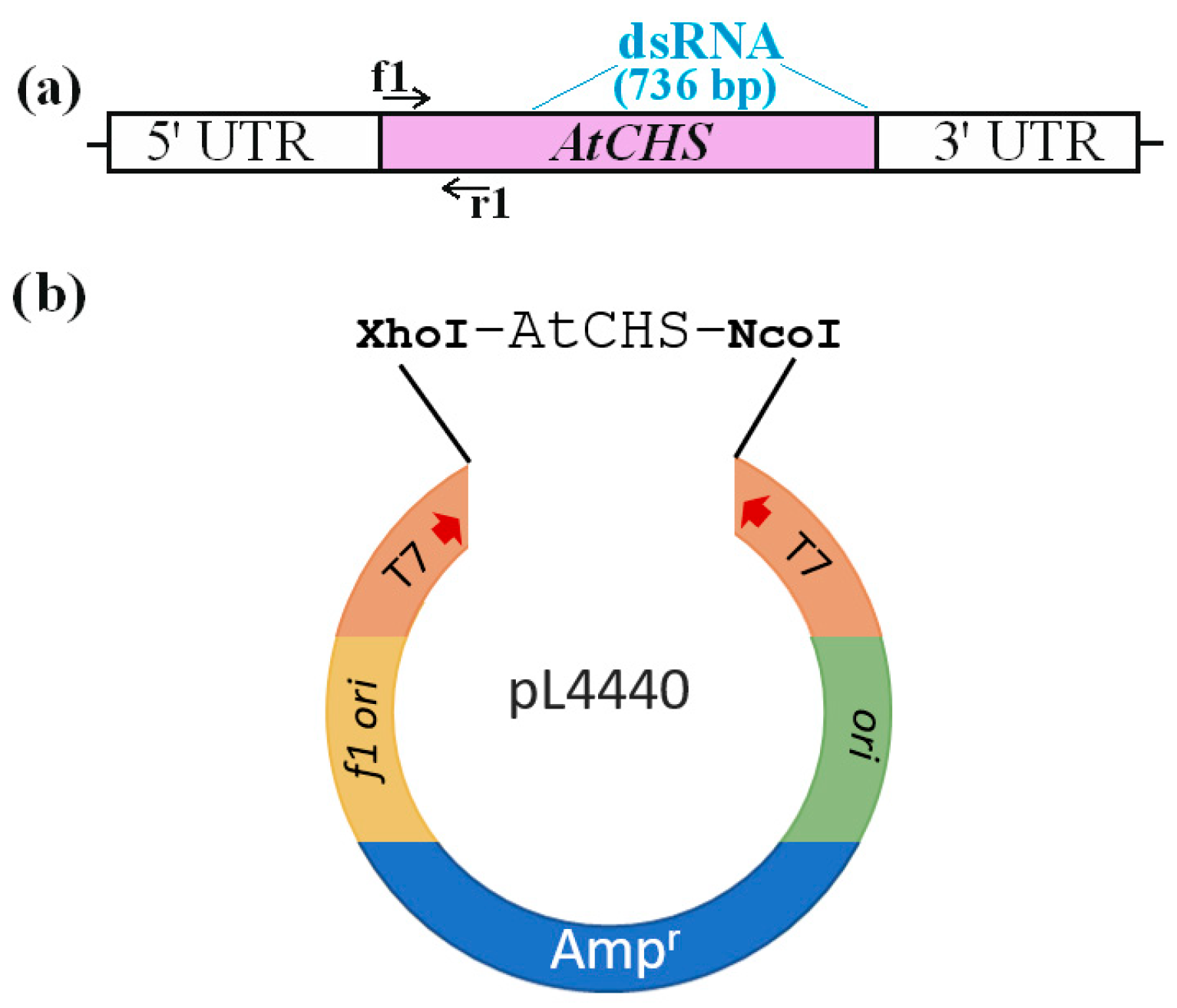
AtCHS-dsRNA was synthesized using the MEGAscript RNAi kit (Thermo Fisher Scientific, Waltham, MA, USA). The fragment of the AtCHS gene (Figure 1a) was amplified by PCR, including T7 promoter sequences on both the 5′ and 3′ ends, using the primers listed in Table S1. The resulting PCR product was used as a template to synthesize dsRNA in vitro following the manufacturer’s instructions. To remove any residual DNA, DNase I was added to the reaction mixture, followed by dsRNA purification by means of chloroform extraction. The dsRNA was then precipitated and dissolved in 30 μL of nuclease-free water, and its concentration was measured using a NanoDrop spectrophotometer (Thermo Fisher Scientific, Waltham, MA, USA). The integrity of the dsRNA was confirmed by means of electrophoresis in 2% agarose gel and visualization under UV light.

2.3.2. In Vivo Synthesis and Purification of dsRNA

The complete coding sequence of the AtCHS gene was PCR amplified using the Arabidopsis cDNA template and primers listed in Table S1. The fragment was then amplified using primers containing NcoI and XhoI restriction sites, followed by ligation into the pL4440 vector using the restriction enzymes (Figure 1b). The resultant plasmid was transformed into RNase III-deficient E. coli HT115 (DE3) using heat shock.
A strain of E. coli HT115 (DE3) containing the pL4440/AtCHS vector was grown on solid Luria–Bertani (LB) medium supplemented with ampicillin (100 μg/mL) and tetracycline (12.5 μg/mL). To produce AtCHS-dsRNA, E. coli HT115 (DE3) pL4440/AtCHS was incubated in 20 mL of liquid LB medium with ampicillin (100 μg/mL) and tetracycline (12.5 μg/mL) for 12 h at 37 °C and 300 rpm. The culture was then diluted 5-fold by adding 80 mL of fresh LB medium containing ampicillin and tetracycline. Subsequently, it was incubated for two hours under the same conditions for bacterial adaptation. When the OD600 reached 1.5, IPTG (0.5 mM) was added and incubation continued. Overnight incubation for 12 h with 0.5 mM IPTG did not lead to increased RNA production, but rather a decrease in RNA levels was observed.
After incubation, some E. coli HT115 (DE3) pL4440/AtCHS were diluted in fresh LB medium to an OD600 = 1 and spun at 4000 g for 2 min. They were dissolved in 15% glycerol in LB nutrient medium and frozen. 100 µL was used for plant treatment. Another part of the bacteria was spun down in 50 mL Falcon tubes at 4000 g for 2 min at 4 °C. The pellet was dissolved in 6 mL of CTAB buffer for RNA extraction and mixed until a homogeneous mass was formed. The mixture was heated at 65 °C for 5 min with occasional stirring. Then, 5 mL of chloroform was added and gently mixed for 5 min. The solution was centrifuged at 10,000 g at 4 °C for 10 min. The supernatant was collected, and 0.3 V 10 M LiCl was added overnight at 4 °C. After centrifugation at 10,000 g for 15 min at 4 °C, all liquid was removed and the pellet was dissolved in 300 μL of sterile water. Then, 900 μL of 95% ethanol was added, and it was incubated at −20 °C for 2 h. After another round of centrifugation, the pellet was dried and resuspended as before. The concentration was determined using a NanoDrop spectrophotometer (Thermo Fisher Scientific, Waltham, MA, USA).
Then, RNase and DNase treatments were performed. First, 20 µL of DNase Buffer (×10) and 10 µL of DNase were added to 170 µL of RNA. The mixture was incubated at 37 °C for 30 min. Next, 20 µL of 5 M NaCl and 10 µL of RNase (previously diluted 200 times) were added. The mixture was incubated at 37 °C for 30 min. Notably, the NaCl concentration should exceed 0.3 mM for RNase cleavage of ssRNA, since at lower NaCl concentrations, both ssRNA and dsRNA are cleaved. After incubation, 0.1 V (23 μL) of 3 M sodium acetate (pH = 5.2) and 2.5 V (575 μL) of 95% ethanol were added and mixed. The solution was then incubated at −20 °C for 10 min. Then, the samples were centrifuged at 10,000 g at 4 °C for 10 min. The pellet was dried and dissolved in 100 μL of sterile water for the following concentration determination.

2.4. Surface Treatment of Plants

To treat the leaves of A. thaliana plants, dsRNA was dissolved in water to a concentration of 0.35 μg/μL dsRNAs. Next, 100 μL of each dsRNA per plant was applied using sterile brushes to the leaf surface of four-week-old A. thaliana plants. However, because AtCHS-dsRNA only constitutes a fraction of the crude bacterial RNA extract, a higher dsRNA concentration (0.7 μg/μL) was used (100 μL of each dsRNA per individual plant, i.e., 70 μg). For plant treatment with E. coli, 100 μL of bacteria with an OD = 1 in 15% glycerol solution in LB medium were used. Control plants were treated with 100 μL of water and 15% glycerol. It is important to note that the plants were not watered immediately before and after treatment, and the treatment was carried out in the evening.
Since anthocyanin synthesis and expression of anthocyanin biosynthetic genes in A. thaliana are low under control culture conditions, we divided the plants into two groups after dsRNA treatment. The first group was kept under control conditions (22 °C, 16 h light cycle), while the second group was exposed to anthocyanin-inducing conditions (7 °C, 23 h light cycle) for seven days.

2.5. Total RNA Isolation and Reverse Transcription

For RNA extraction, one leaf from each A. thaliana plant was collected prior to treatment and on day 7 after treatment. Total RNA was isolated using the method described in [23]. cDNA was synthesized using the MMLV RT Kit (Evrogen, Moscow, Russia) in a reaction volume of 40 μL containing first-strand synthesis buffer, 4 μL of the dNTP mixture (10 mM each), 1.5 μL of the oligo-(dT)15 primer (100 μM), 4 μL of DTT (dithiothreitol, 20 mM), and 3.4 μL of MMLV reverse transcriptase (100 units/μL). The mixture was incubated for 80 min at 37 °C. The resulting products were amplified by means of PCR to check for genomic DNA contamination using primers specific for the AtGAPDH gene (NM_111283) (Table S1).

2.6. Gene Expression Analysis

Quantitative real-time PCR (qRT-PCR) was performed using an intercalating dye, SYBR Green I, and a commercial PCR kit from Evrogen (Moscow, Russia) according to the instructions of the manufacturer. Amplification and detection were performed on a thermal cycler (DNA Technology, Moscow, Russia) equipped with a fluorescence detector. Two reference genes were used for data normalization, including AtGAPDH (NM_111283) and AtUBQ (NM_001084884) (Table S1). The expression level of the genes was calculated using the 2−∆∆CT method [24]. The average value of expression level after water treatment in control conditions was taken as the unit (basal expression level).

2.7. Qualitative and Quantitative Determination of Flavonoids

For HPLC-MS analysis, samples of treated A. thaliana leaves (100 mg FW) were frozen at −20 °C and homogenized using a pestle and mortar. The ground tissue was weighted and extracted for 24 h at 4 °C in 2 mL of methanol containing 1% (v/v) hydrochloric acid. The mixture was then centrifuged at 13,500 rpm for 15 min, and 1 mL of the supernatant was transferred to another glass tube. The samples were filtered through a 0.25 μm nylon membrane before analysis.
Identification of all compounds was performed on a 1260 Infinity HPLC analytical system (Agilent Technologies, Santa Clara, CA, USA) coupled with a Bruker HCT ultra PTM Discovery System mass spectrometer (Bruker Daltonik GmbH, Bremen, Germany) equipped with an electrospray ionization (ESI) source. The data on anthocyanins were recorded in positive ion mode in accordance with the previously described conditions [23]. Quantitative determination of all compounds by means of HPLC with diode array detection (HPLC-DAD) was performed on an LC-20AD XR HPLC system (Shimadzu, Kyoto, Japan). Spectral data were recorded in the range of 200–800 nm. Chromatograms obtained at 510 nm were used for quantitative calculations of anthocyanins, while those at 340 nm were employed for quantification of flavones. Chromatographic separation was performed on a Shim-pack GIST C18 column (150 mm × 2.1 mm, particle size 3 μm; Shimadzu, Kyoto, Japan) as described [23]. The content of anthocyanins and flavones was determined by means of the external standard method using four-point calibration curves constructed using commercially available standards. Cyanidin chloride, quercetin and kaempferol from Sigma-Aldrich (St. Louis, MO, USA) were used as reference standards.

2.8. Statistical Analysis

The data are presented as means ± SE. A two-way analysis of variance with Tukey’s post hoc test (p < 0.05) was used to compare multiple groups (gene expression, flavonoid content depending on treatment option). The paired Student’s t-test was used for pairwise comparisons (quantity depending on induction time, IPTG concentration). The threshold level of statistical significance (p-value) was set at 0.05. For each type of experiment, at least three independent replicates were performed, within which several technical replicates were included. Statistical analyses and visualizations were performed in R using the agricolae (version 1.3.7) [25] and ggplot2 (version 4.0.1) [26] packages, respectively.

3. Results

3.1. Synthesis and Optimization of AtCHS-dsRNA Production In Vitro and In Vivo

The target site for RNA interference of the AtCHS gene of A. thaliana was selected using the online tool SciTool RNA Design, which allows for the identification of regions with a high probability of effective processing into small interfering RNAs. To minimize off-target effects, the sequences of the selected dsRNAs were analyzed for potential homology with other genes in the A. thaliana genome. The sequence chosen for dsRNA synthesis showed no significant homology with any other genes except for the target AtCHS.
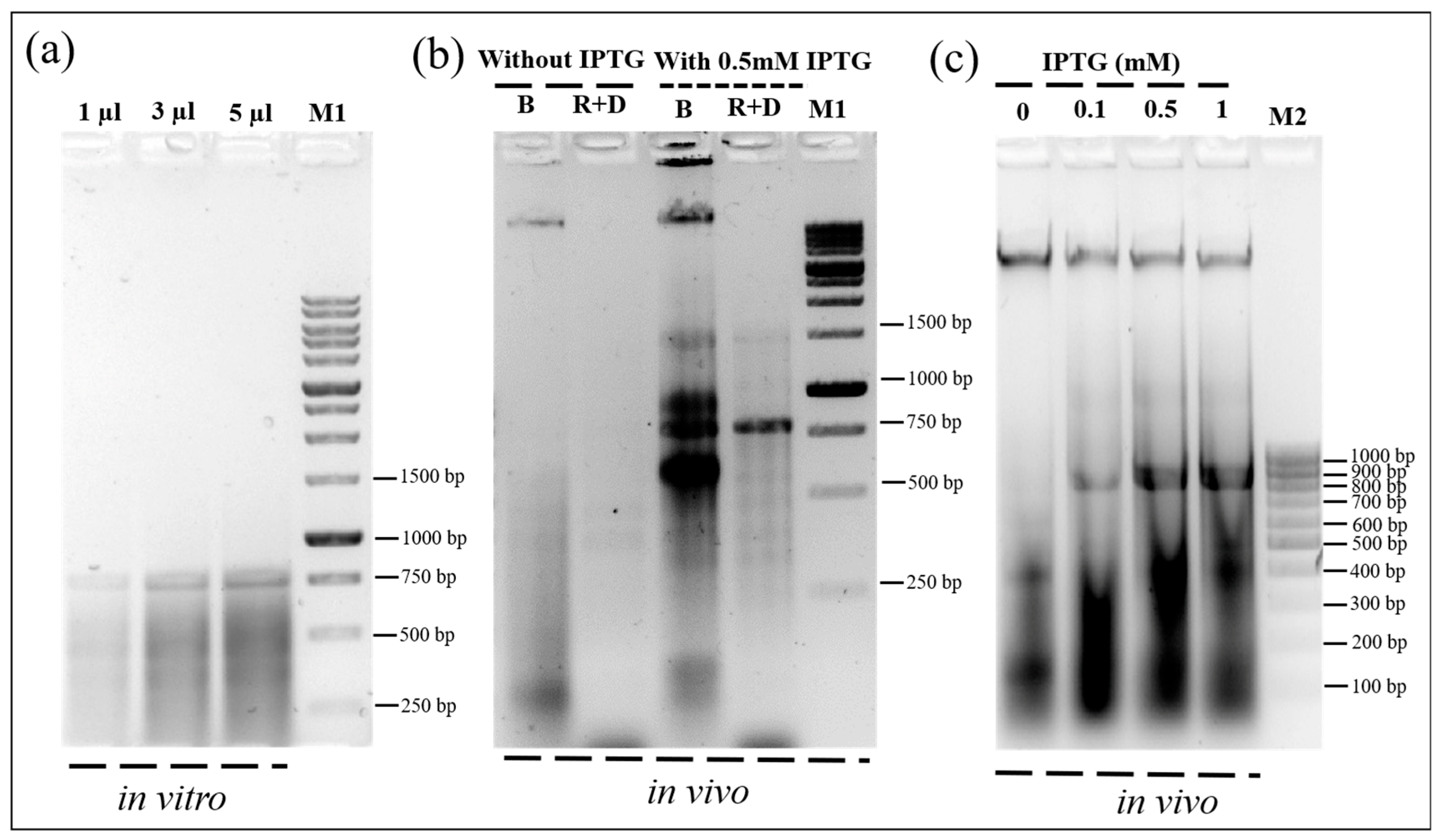
AtCHS-dsRNA was synthesized in vitro using the commercial MEGAscript RNAi kit and in vivo in an E. coli HT115 (DE3) system. After synthesis, the samples were treated with DNase and RNase to remove contaminating nucleic acids, such as DNA and single-stranded RNA (ssRNA). The quality of the resulting double-stranded RNA (dsRNA) preparations was assessed by means of electrophoresis in 2% agarose gel. The results of electrophoretic analysis showed the presence of clear specific bands in the samples synthesized in vitro (Figure 2a). During in vivo synthesis in E. coli in the absence of IPTG (Isopropyl β-D-1-thiogalactopyranoside), AtCHS-dsRNA production was not observed (Figure 2b). However, upon addition of 0.5 mM IPTG, RNA accumulation occurred with a size corresponding to the expected size of AtCHS-dsRNA of about 750 bp (Figure 2b). Also, non-specific products were detected in the low- and high-molecular regions. Subsequent treatment with DNase and RNase led to the disappearance of the non-specific signal, confirming the specificity of the synthesized target dsRNA (Figure 2b).
Then, we investigated the effect of IPTG concentration on the efficiency of AtCHS-dsRNA synthesis (Figure 2c). The use of IPTG at a concentration of 0.5 mM was the most optimal, since 0.1 mM IPTG resulted in a noticeably lower signal intensity of the dsRNA and 1 mM IPTG did not lead to a significant increase in the accumulation of the target product (Figure 2c). Thus, we demonstrated the dependence of the level of AtCHS-dsRNA synthesis in E. coli on the concentration of IPTG in the culture medium.
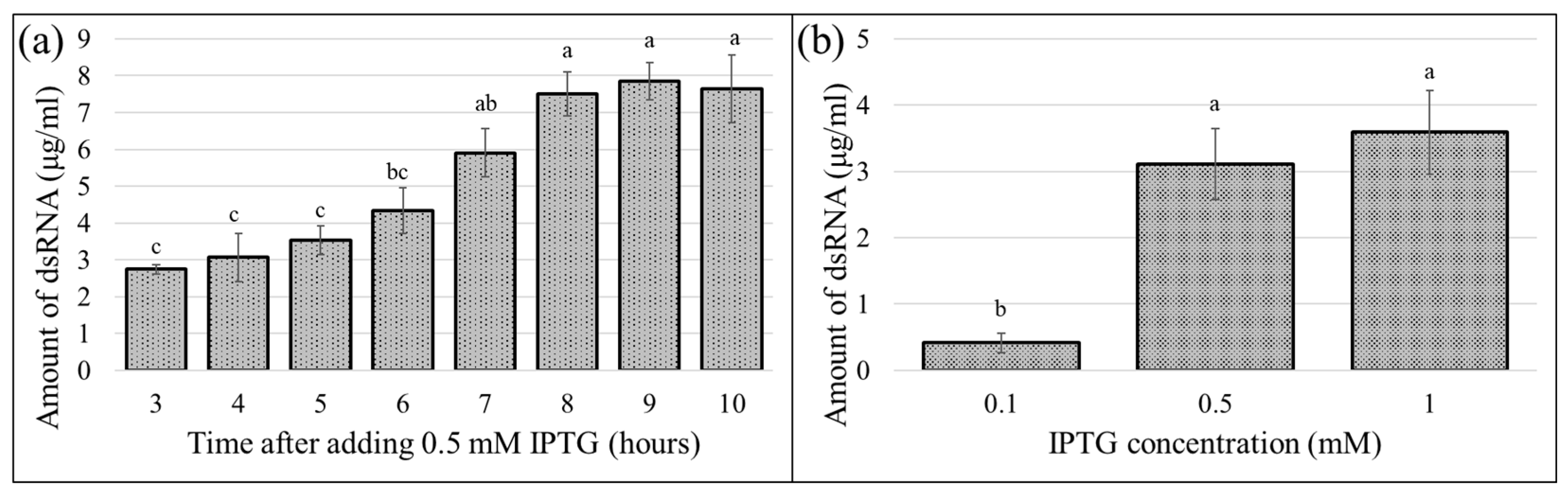
In the course of the study, the dependence of the dsRNA yield on the duration of bacterial cell cultivation was investigated. The maximum yield of the target product (7.8 ± 0.5 μg/mL of culture medium) was detected with a 9 h incubation period after IPTG induction (Figure 3a). Thus, 784 μg of total RNA was isolated from 100 mL of culture medium. However, only a portion of it corresponded to the target AtCHS-dsRNA. It was shown that after treatment of the total RNA fraction with RNase and DNase, the RNA content in the sample was reduced by 2.3 times to 381 μg (Table 1). An alternative and more effective approach was in vitro dsRNA synthesis using the commercial MEG-Ascript RNAi Kit, which allowed production of 336.16 ± 60.43 μg of the dsRNA in 60 μL of the reaction mixture (Figure 3a). Thus, using a single kit allows for the production of approximately 22 mg of dsRNA (Table 1).
Despite the apparent decrease in the total yield compared to the bacterial system, the in vitro method has significant advantages, including a reduction in synthesis time (up to 4 h versus 48 h for bacterial expression). Additional experiments showed that increasing the time of bacterial cultivation with IPTG over 10 h did not lead to an increase in the dsRNA concentration, and in some cases, its decrease was observed, probably due to cell lysis and RNA degradation (Figure 3a).
Quantitative analysis revealed a significant effect of the IPTG inducer concentration on the productivity of the system (Figure 3b). When using 0.1 mM IPTG, the dsRNA yield was only 0.42 ± 0.15 μg/mL, while increasing the concentration to 1 mM ensured a significant increase in productivity to 3.59 ± 0.63 μg/mL (Figure 3b). The optimal compromise between the efficiency of synthesis and economic feasibility was recognized as a concentration of 0.5 mM IPTG, which was used in subsequent experiments.

3.2. Effect of AtCHS-dsRNA on the Accumulation of Flavonoids

To test the ability of exogenous AtCHS-dsRNA obtained in vitro and in vivo to regulate secondary metabolism both before and after treatment with RNase and DNase, as well as E. coli HT115 (DE3) bacteria containing the pL4440/AtCHS plasmid, we used visual inspection and high-performance liquid chromatography coupled to a mass spectrometer (HPLC-MS).
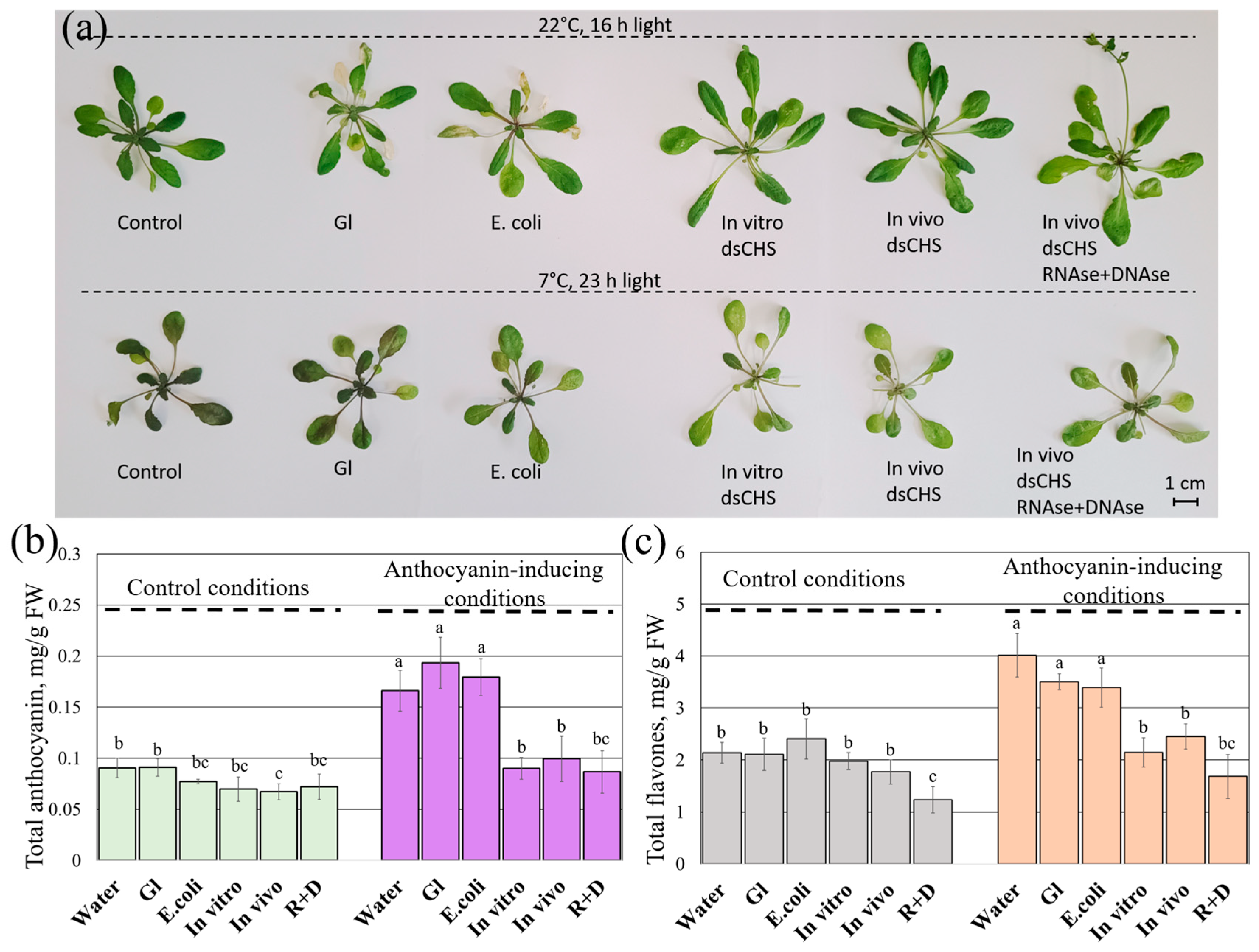
Treatment of leaves with AtCHS-dsRNA resulted in a visible lightening of color both under control and anthocyanin-inducing conditions compared to plants treated with water, LB medium, and 15% glycerol solution (Figure 4a). The use of E. coli bacterial suspension caused the death of lower leaves of plants under control conditions (Figure 4a).
Seven cyanidin-derived anthocyanins (Tables S2 and S3, Figure S1) and five flavonoid compounds (kaempferol hexoside dideoxyhexoside, quercetin-3-O-glucuronide, kaempferol-3-O-hexoside, kaempferol-3,7-O-diramnoside, and quercetin) (Figure S2) were identified in A. thaliana leaves by means of HPLC-MS. Growing plants under anthocyanin-inducing conditions (7 °C, 23 h light) was accompanied by a considerable increase in the content of anthocyanins (up to 0.19 mg/g FW) and flavonoids (up to 4 mg/g FW) in the control groups treated with water or with 15% glycerol solution in LB nutrient medium (Figure 4b,c). Treatment by E. coli HT115 (DE3) bacteria containing the pL4440/AtCHS plasmid did not significantly change the content of anthocyanins and flavonoids. In contrast, the use of both in vitro and in vivo synthesized AtCHS-dsRNA effectively suppressed the biosynthesis of the investigated secondary metabolites by 1.5–2.4 times (Figure 4b,c). Under control conditions (22 °C, 16 h light), the suppression effect on anthocyanin and flavone content was less pronounced (in 1.1–1.6 times) and was statistically significant only for the in vivo synthesized total AtCHS-dsRNA in the case of anthocyanins and flavonoids (Figure 4b,c, Figures S1 and S2).

3.3. Effect of Exogenous AtCHS-dsRNA on the Expression of Flavonoid Biosynthetic Genes

We analyzed the effect of in vitro and in vivo produced AtCHS-dsRNAs on the expression of flavonoid biosynthetic genes, including AtCHS, AtCHI, AtF3H, AtFLS, AtDFR, and AtANS. These genes are the key enzymes of flavonoid biosynthesis, including anthocyanins and flavonols [27].
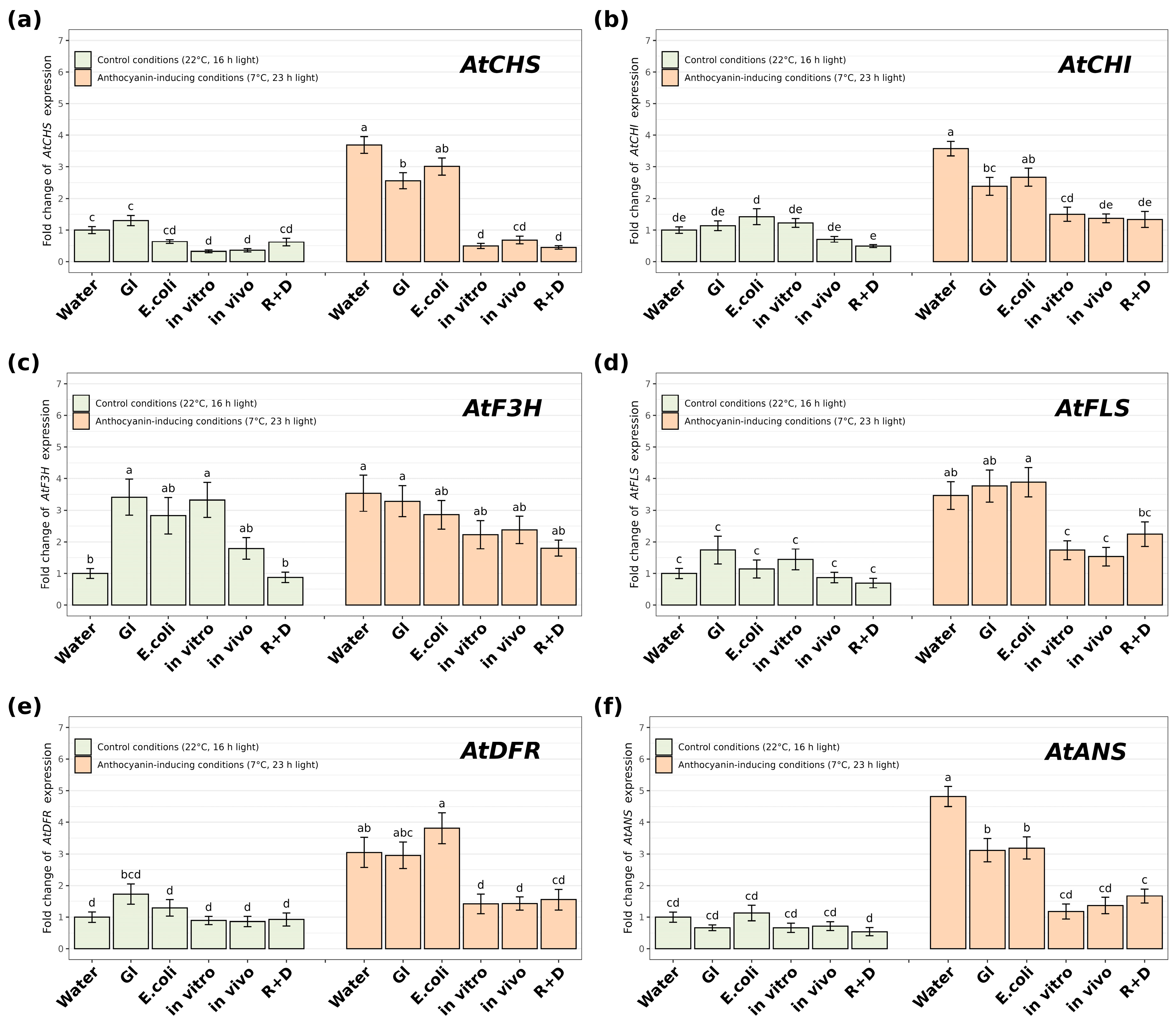
Analyses by means of qRT-PCR showed that growing A. thaliana under anthocyanin-inducing conditions resulted in significantly higher mRNA levels of the AtCHS, AtCHI, AtF3H, AtFLS, AtDFR, and AtANS genes in both control and E. coli-treated plants (Figure 5). Exogenous AtCHS-dsRNA obtained in vitro and in vivo significantly reduced the expression of only the AtCHS gene (by 3.1- and 2.8-fold, respectively) under the control conditions compared to water-treated control plants (Figure 5a). On the 7th day after treatment with E. coli HT115 (DE3) pL4440/AtCHS, as well as water and 15% glycerol solution, there was a significant increase in the expression of the AtCHS, AtCHI, AtF3H, AtFLS, AtDFR, and AtANS genes (in 3.2–4.7 times) under the anthocyanin-inducing conditions (Figure 4). Under the anthocyanin-inducing conditions, AtCHS-dsRNA obtained both in vitro and in vivo, tested before and after treatment with RNase and DNase, resulted in a decrease in the expression of the AtCHS (up to 7.5 times), AtCHI (up to 2.6 times), AtFLS (up to 2.4 times), AtDFR (up to 2.2 times), and AtANS (up to 4.1 times) genes compared to control plants on day 7 after treatment (Figure 5). Thus, regulation of AtCHS gene expression by exogenous AtCHS-dsRNA affects not only the target gene but also the downstream flavonoid biosynthetic genes. This finding indicated the possibility of regulating individual pathways of secondary metabolite biosynthesis via the inhibition of only some important pathway-related genes.

4. Discussion

The RNAi phenomenon has revolutionized genetic research by enabling targeted gene silencing in various organisms. SIGS, or exoRNAi, is a novel RNAi-based technology that uses exogenous dsRNA treatment for manipulating plant traits and plant protection [6,28,29]. This alternative approach to traditional genetic modification offers a promising solution for agricultural challenges [30]. However, the widespread use of SIGS in the agro-industrial complex is currently seriously limited by two main factors: the high cost of producing large quantities of dsRNA and the technological difficulties of scaling up existing synthesis methods [6,31].
Modern approaches to dsRNA production can be divided into two main categories: in vitro (extracellular systems) and in vivo (cellular systems) synthesis. The in vitro method using DNA-dependent RNA polymerases of bacteriophages (T7, T3, SP6) is rightfully considered the “gold standard” for research applications [10,32]. This approach ensures the production of drugs of exceptional purity (up to 99%) and allows precise control over the length and sequence of synthesized molecules, and also ensures high reproducibility of results [33]. However, the high cost of commercial in vitro synthesis kits and the limited scalability of the process made this method economically unviable for large-scale agricultural applications [6]. For example, we calculated that 1 mg of dsRNA costs approximately $100 using the MEGAscript RNAi kit (Thermo Fisher Scientific, Waltham, MA, USA) and $130 using the T7 in vitro transcription kit from Biolabmix (Novosibirsk, Russia). As demonstrated in this study, the dsRNAs obtained in vivo and in vitro effectively induce RNA interference of the target AtCHS gene. However, in our opinion, the most convenient method for producing dsRNA is in vitro synthesis using commercial kits, while in vivo synthesis is more promising for widespread use.
In vivo synthesis in genetically modified microorganisms appears to be a more promising direction for solving problems of the agroindustrial complex. In this work, a system based on E. coli HT115 (DE3) with the pL4440 plasmid was successfully characterized and optimized. Critical parameters for the induction of dsRNA synthesis were determined: the optimal IPTG concentration of 0.5 mM and the cultivation duration of 9 h. Under optimal conditions, we were able to obtain 7.84 ± 0.49 μg/mL. These results are fully consistent with modern global trends in the development of bacterial dsRNA production systems, which include the creation of specialized strains with deleted RNase III genes [18,34,35]. For example, the BL21 (DE3) Δrnc strain exhibits a three-fold increase in production yield (up to 4.23 μg/mL) compared to the standard L4440-HT115 (DE3) system (1.3 μg/mL) [34]. Particular attention should be paid to promising areas of in vivo system optimization that have been actively developing in recent years. These include replacing the expensive and toxic inducer IPTG with economical and safe alternatives such as lactose or skim milk components [19]. da Rosa et al. (2024) showed that the use of lactose as an inducer of synthesis allowed an increase in the efficiency of dsRNA production by 10 times, to 53.3 µg/mL [19]. Thus, when choosing an effective technology for producing dsRNA in a bacterial system, the cost of 1 mg of dsRNA is approximately $5–10, which is at least 10 times more profitable than in vitro production. According to the calculations, 70 μg of dsRNA is required for exogenous treatments of one tomato plant [23]. Considering that there are about 30 thousand plants growing on one hectare, 2.1 g of dsRNA would be required to treat the entire area. At the current cost, this amounts to at least $10,500, which makes the method economically impractical for widespread use. Therefore, the key task of further research is the search for cheaper sources of dsRNA preparations. The most promising areas of future research seem to be the development of hybrid technologies that combine the advantages of different approaches, the creation of effective systems for delivering dsRNA to plant tissues, a comprehensive study of the stability of the silencing effect, and optimization of target sequences to ensure maximum specificity and efficiency.
The result of our study is not only a demonstration of the efficiency of AtCHS gene expression suppression, regardless of the dsRNA synthesis method, but also the identification of cascade regulation or transcriptional co-regulation of the entire flavonoid biosynthesis metabolic pathway. This functional effect, accompanied by visible lightening of plant pigmentation, was sustained throughout the entire 7-day observation period post-treatment. The duration of this silencing effect is consistent with previous studies showing that exogenously applied dsRNA can persist on plant surfaces for days to weeks under controlled laboratory conditions, suggesting that the persistent presence of dsRNA may contribute to the long-lasting silencing we observed [6]. The observed decrease in the mRNA level of the AtCHI, AtFLS, AtDFR, and AtANS genes indicated the presence of complex regulatory relationships, whereby inhibition of a key enzyme initiates a sequential disruption of the entire biochemical cascade. It has previously been shown that exposure to CHS-specific nucleotide sequences leads to suppression of AtCHS expression and a decrease in anthocyanin accumulation in Arabidopsis, tomato, and transgenic petunia plants [4,36,37], and, in citrus fruits, to a significant decrease in flavonoid production [38]. However, until now, there was no evidence that the suppression of the CHS gene affects the expression of the AtCHI, AtFLS, AtDFR, and AtANS genes. Thus, this discovery is of fundamental importance for understanding the principles of organization and regulation of plant metabolic networks and is of practical value for the development of strategies for targeted modulation of secondary metabolism.

5. Conclusions

This study provides a direct, concentration-normalized comparison of in vitro and in vivo dsRNA production for exogenous RNA interference in A. thaliana. Using the CHS gene as a model, we demonstrate that both methods yield biologically active dsRNA capable of suppressing target gene expression and reducing flavonoid accumulation. Quantitative data show that the MEGAscript in vitro system produces 22 mg pure dsRNA per kit. By contrast, the optimized E. coli HT115 (DE3) system produces 7.8 mg total RNA per liter of culture, of which only 3.8 mg is target dsRNA after RNase/DNase treatment. Despite lower purity, the bacterially produced dsRNA (both crude and purified) effectively silenced AtCHS expression (2.8 to 7.5-fold reduction) and reduced anthocyanins and flavanols by 1.5 to 2.4-fold under inducing conditions. However, expanding the practical application of exoRNAi in agriculture requires focusing efforts on overcoming existing technological limitations and developing cost-effective solutions for large-scale production. Successful solution of these problems will open new horizons for the creation of sustainable and environmentally friendly farming systems based on the principles of precise regulation of plant physiology.

Supplementary Materials

The following supporting information can be downloaded at https://www.mdpi.com/article/10.3390/ijpb17040028/s1. Figure S1: Anthocyanin content; Figure S2: Flavone content; Table S1: Primers used in this work; Table S2: MS/MS spectra of anthocyanins identified in A. thaliana; Table S3: List of anthocyanins identified in the A. thaliana; Table S4: Two-way ANOVA and Tukey’s HSD test results of quantitative real-time PCR.

Author Contributions

A.R.S. was responsible for research design, data analysis, and paper preparation. S.A.V. was responsible for RNA isolation and qRT-PCRs. A.S.D. and K.V.K. were responsible for research design, data interpretation, and paper preparation. N.N.N. was responsible for statistical analysis. All authors have read and agreed to the published version of the manuscript.

Funding

The research was supported by a grant from the Russian Science Foundation (grant number 25-26-20013, https://rscf.ru/prjcard_int?25-26-20013) (accessed on 26 September 2025) and the Government of Primorsky Krai (grant number 30-2025-005021).

Data Availability Statement

The data presented in this study are available within the article and Supplementary Materials.

Acknowledgments

Access to the article publisher sites for data analysis was provided by the Ministry of Science and Higher Education of the Russian Federation (theme number 124012200181-4).

Conflicts of Interest

We declare that we have no conflicts of interest.

References

  1. Napoli, C.; Lemieux, C.; Jorgensen, R. Introduction of a Chimeric Chalcone Synthase Gene into Petunia Results in Reversible Co-Suppression of Homologous Genes in Trans. Plant Cell 1990, 2, 279–289. [Google Scholar] [CrossRef]
  2. Nityagovsky, N.N.; Kiselev, K.V.; Suprun, A.R.; Dubrovina, A.S. Exogenous dsRNA Induces RNA Interference of a Chalcone Synthase Gene in Arabidopsis thaliana. Int. J. Mol. Sci. 2022, 23, 5325. [Google Scholar] [CrossRef] [PubMed]
  3. Morita, H.; Abe, I.; Noguchi, H. 1.06–Plant Type III PKS. In Comprehensive Natural Products II; Liu, H.-W., Mander, L., Eds.; Elsevier: Oxford, UK, 2010; pp. 171–225. [Google Scholar]
  4. Kiselev, K.V.; Suprun, A.R.; Aleynova, O.A.; Ogneva, Z.V.; Kalachev, A.V.; Dubrovina, A.S. External dsRNA Downregulates Anthocyanin Biosynthesis-Related Genes and Affects Anthocyanin Accumulation in Arabidopsis thaliana. Int. J. Mol. Sci. 2021, 22, 6749. [Google Scholar] [CrossRef] [PubMed]
  5. Khalid, M.; Saeed-ur-Rahman; Bilal, M.; Huang, D. Role of Flavonoids in Plant Interactions with the Environment and against Human Pathogens—A Review. J. Integr. Agric. 2019, 18, 211–230. [Google Scholar] [CrossRef]
  6. Dubrovina, A.S.; Suprun, A.R.; Kiselev, K.V. Regulation of Plant Genes with Exogenous RNAs. Int. J. Mol. Sci. 2025, 26, 6773. [Google Scholar] [CrossRef]
  7. Cisneros, A.E.; De La Torre-Montaña, A.; Carbonell, A. Systemic Silencing of an Endogenous Plant Gene by Two Classes of Mobile 21-nucleotide Artificial Small RNAs. Plant J. 2022, 110, 1166–1181. [Google Scholar] [CrossRef]
  8. Betti, F.; Ladera-Carmona, M.J.; Weits, D.A.; Ferri, G.; Iacopino, S.; Novi, G.; Svezia, B.; Kunkowska, A.B.; Santaniello, A.; Piaggesi, A.; et al. Exogenous miRNAs Induce Post-Transcriptional Gene Silencing in Plants. Nat. Plants 2021, 7, 1379–1388. [Google Scholar] [CrossRef]
  9. Borges, F.; Martienssen, R.A. The Expanding World of Small RNAs in Plants. Nat. Rev. Mol. Cell Biol. 2015, 16, 727–741. [Google Scholar] [CrossRef]
  10. Rodríguez Melo, J.; Mammarella, F.; Ariel, F. Exogenous RNAs: Promising Tools for the Second Green Revolution. J. Exp. Bot. 2023, 74, 2323–2337. [Google Scholar] [CrossRef]
  11. Morozov, S.Y.; Solovyev, A.G.; Kalinina, N.O.; Taliansky, M.E. Double-Stranded RNAs in Plant Protection Against Pathogenic Organisms and Viruses in Agriculture. Acta Naturae 2019, 11, 13–21. [Google Scholar] [CrossRef]
  12. Wang, M.; Jin, H. Spray-Induced Gene Silencing: A Powerful Innovative Strategy for Crop Protection. Trends Microbiol. 2017, 25, 4–6. [Google Scholar] [CrossRef] [PubMed]
  13. Sundaresha, S.; Bairwa, A.; Tomar, M.; Kumar, R.; Venkatasalam, E.P.; Sagar, V.; Bhardwaj, V.; Sharma, S. In Vitro Method for Synthesis of Large-Scale dsRNA Molecule as a Novel Plant Protection Strategy. In Plant Gene Silencing: Methods and Protocols; Mysore, K.S., Senthil-Kumar, M., Eds.; Methods in Molecular Biology; Humana: New York, NY, USA, 2022; pp. 211–226. [Google Scholar]
  14. Chen, N.; Dai, X.; Hu, Q.; Tan, H.; Qiao, L.; Lu, L. Sprayable Double-Stranded RNA Mediated RNA Interference Reduced Enzymatic Browning of Fresh-Cut Potatoes. Postharvest Biol. Technol. 2023, 206, 112563. [Google Scholar] [CrossRef]
  15. Mo, Q.; Beibei, L.; Sun, Y.; Wu, X.; Song, L.; Cai, R.; Tang, X. Screening and Production of dsRNA Molecules for Protecting Cucumis Sativus Against Cucumber Mosaic Virus Through Foliar Application. Plant Biotechnol. Rep. 2022, 16, 409–418. [Google Scholar] [CrossRef]
  16. Delgado-Martín, J.; Ruiz, L.; Janssen, D.; Velasco, L. Exogenous Application of dsRNA for the Control of Viruses in Cucurbits. Front. Plant Sci. 2022, 13, 895953. [Google Scholar] [CrossRef]
  17. Wuthisathid, K.; Chaijarasphong, T.; Chotwiwatthanakun, C.; Somrit, M.; Sritunyalucksana, K.; Itsathitphaisarn, O. Co-Expression of Double-Stranded RNA and Viral Capsid Protein in the Novel Engineered Escherichia coli DualX-B15(DE3) Strain. BMC Microbiol. 2021, 21, 88. [Google Scholar] [CrossRef]
  18. Guan, R.; Chu, D.; Han, X.; Miao, X.; Li, H. Advances in the Development of Microbial Double-Stranded RNA Production Systems for Application of RNA Interference in Agricultural Pest Control. Front. Bioeng. Biotechnol. 2021, 9, 753790. [Google Scholar] [CrossRef]
  19. da Rosa, J.; Viana, A.J.C.; Ferreira, F.R.A.; Koltun, A.; Mertz-Henning, L.M.; Marin, S.R.R.; Rech, E.L.; Nepomuceno, A.L. Optimizing dsRNA Engineering Strategies and Production in E. coli HT115 (DE3). J. Ind. Microbiol. Biotechnol. 2024, 51, kuae028. [Google Scholar] [CrossRef]
  20. Gan, D.; Zhang, J.; Jiang, H.; Jiang, T.; Zhu, S.; Cheng, B. Bacterially Expressed dsRNA Protects Maize against SCMV Infection. Plant Cell Rep. 2010, 29, 1261–1268. [Google Scholar] [CrossRef]
  21. Mohd Kamal, K.; Mahamad Maifiah, M.H.; Abdul Rahim, N.; Hashim, Y.Z.H.-Y.; Abdullah Sani, M.S.; Azizan, K.A. Bacterial Metabolomics: Sample Preparation Methods. Biochem. Res. Int. 2022, 2022, 9186536. [Google Scholar] [CrossRef]
  22. Dubrovina, A.S.; Aleynova, O.A.; Ogneva, Z.V.; Suprun, A.R.; Ananev, A.A.; Kiselev, K.V. The Effect of Abiotic Stress Conditions on Expression of Calmodulin (CaM) and Calmodulin-like (CML) Genes in Wild-Growing Grapevine Vitis amurensis. Plants 2019, 8, 602. [Google Scholar] [CrossRef]
  23. Suprun, A.R.; Kiselev, K.V.; Dubrovina, A.S. Exogenously Induced Silencing of Four MYB Transcription Repressor Genes and Activation of Anthocyanin Accumulation in Solanum lycopersicum. Int. J. Mol. Sci. 2023, 24, 9344. [Google Scholar] [CrossRef]
  24. Livak, K.J.; Schmittgen, T.D. Analysis of Relative Gene Expression Data Using Real-Time Quantitative PCR and the 2(-Delta Delta C(T)) Method. Methods 2001, 25, 402–408. [Google Scholar] [CrossRef] [PubMed]
  25. de Mendiburu, F. Statistical Procedures for Agricultural Research, Version 1.3-7; CRAN (The Comprehensive R Archive Network): Vienna, Austria, 2006.
  26. Wickham, H.; Averick, M.; Bryan, J.; Chang, W.; McGowan, L.; François, R.; Grolemund, G.; Hayes, A.; Henry, L.; Hester, J.; et al. Welcome to the Tidyverse. J. Open Source Softw. 2019, 4, 1686. [Google Scholar] [CrossRef]
  27. Chaves-Silva, S.; dos Santos, A.L.; Chalfun-Júnior, A.; Zhao, J.; Peres, L.E.P.; Benedito, V.A. Understanding the Genetic Regulation of Anthocyanin Biosynthesis in Plants–Tools for Breeding Purple Varieties of Fruits and Vegetables. Phytochemistry 2018, 153, 11–27. [Google Scholar] [CrossRef] [PubMed]
  28. Zhao, X.; Liu, Z.; Liu, Y.; Lu, M.; Xu, J.; Wu, F.; Jin, W. Development and Application of an RNA Nanostructure to Induce Transient RNAi in Difficult Transgenic Plants. Biotechnol. J. 2024, 19, 2400024. [Google Scholar] [CrossRef]
  29. Cedillo-Jimenez, C.A.; Guevara-Gonzalez, R.G.; Cruz-Hernandez, A. Exogenous dsRNA Sequence Based on miR1917 Downregulates Its Target Gene Related to Ethylene Signaling in Tomato Seedlings and Fruit. Sci. Hortic. 2024, 331, 113090. [Google Scholar] [CrossRef]
  30. Hamdan, M.F.; Tan, B.C. Genetic Modification Techniques in Plant Breeding: A Comparative Review of CRISPR/Cas and GM Technologies. Hortic. Plant J. 2025, 11, 1807–1829. [Google Scholar] [CrossRef]
  31. Pal, G.; Ingole, K.D.; Yavvari, P.S.; Verma, P.; Kumari, A.; Chauhan, C.; Chaudhary, D.; Srivastava, A.; Bajaj, A.; Vemanna, R.S. Exogenous Application of Nanocarrier-Mediated Double-Stranded RNA Manipulates Physiological Traits and Defence Response against Bacterial Diseases. Mol. Plant Pathol. 2024, 25, e13417. [Google Scholar] [CrossRef]
  32. Takiff, H.E.; Chen, S.M.; Court, D.L. Genetic Analysis of the Rnc Operon of Escherichia coli. J. Bacteriol. 1989, 171, 2581–2590. [Google Scholar] [CrossRef]
  33. Zotti, M.; dos Santos, E.A.; Cagliari, D.; Christiaens, O.; Taning, C.N.T.; Smagghe, G. RNA Interference Technology in Crop Protection against Arthropod Pests, Pathogens and Nematodes. Pest Manag. Sci. 2018, 74, 1239–1250. [Google Scholar] [CrossRef]
  34. Ma, Z.; Zhou, H.; Wei, Y.; Yan, S.; Shen, J. A Novel Plasmid–Escherichia coli Systemproduces Large Batch dsRNAs for Insect Genesilencing. Pest Manag. Sci. 2020, 76, 2505–2512. [Google Scholar] [CrossRef]
  35. Fadeev, R.R. The Optimized Method to Isolate Heterologous DSRNA Expressed in Escherichia coli Ht115(De3). Agric. Biol. 2024, 59, 460–472. [Google Scholar] [CrossRef]
  36. Elomaa, P.; Helariutta, Y.; Kotilainen, M.; Teeri, T.H. Transformation of Antisense Constructs of the Chalcone Synthase Gene Superfamily into Gerbera Hybrida: Differential Effect on the Expression of Family Members. Mol. Breed. 1996, 2, 41–50. [Google Scholar] [CrossRef]
  37. Dao, T.T.H.; Linthorst, H.J.M.; Verpoorte, R. Chalcone Synthase and Its Functions in Plant Resistance. Phytochem. Rev. 2011, 10, 397–412. [Google Scholar] [CrossRef]
  38. Wang, Z.; Yu, Q.; Shen, W.; El Mohtar, C.A.; Zhao, X.; Gmitter, F.G. Functional Study of CHS Gene Family Members in Citrus Revealed a Novel CHS Gene Affecting the Production of Flavonoids. BMC Plant Biol. 2018, 18, 189. [Google Scholar] [CrossRef]
Figure 1. (a) The coding region of the AtCHS gene along with the dsRNA and primer positions; (b) schematic diagram of the vector L4440/AtCHS. f1, r1—primers for qRT-PCR estimation of AtCHS expression after dsRNA treatments; UTR—untranslated region, AMPr—ampicillin resistance gene.
Ijpb 17 00028 g001
Figure 2. Electrophoretic analysis of dsRNA in 2% agarose gel. (a) In vitro dsRNA synthesis using the MEGAscript RNAi Kit; (b) dsRNA expressed in E. coli HT115 (DE3) pL4440/AtCHS without IPTG and with 0.5 mM IPTG induction; (c) dsRNA produced by E. coli HT115 (DE3) pL4440/AtCHS at different IPTG concentrations (0, 0.1, 0.5, and 1 mM). B—total bacterial RNA before DNase and RNase treatment; R + D—total bacterial RNA after DNase and RNase treatment; M1—molecular mass marker at 10,000 bp; M2—molecular mass marker at 1000 bp. The size of AtCHS-dsRNA is 756 bp.
Ijpb 17 00028 g002
Figure 3. The amount of dsRNA (μg/mL) from 1 mL of E. coli HT115 (DE3) pL4440/AtCHS bacterial culture, depending on (a) the duration of cultivation after adding 0.5 mM IPTG and (b) the IPTG concentration (0.1, 0.5, and 1 mM). Results are presented as mean ± SE. Means in each figure followed by the same letter were not different when using Student’s t-test (p < 0.05).
Ijpb 17 00028 g003
Figure 4. (a) Arabidopsis thaliana plants on day 7 after dsRNA treatment and cultivation under control conditions (22 °C, 16 h light) and anthocyanin-inducing (7 °C, 23 h light) conditions. (b) The total anthocyanin content. (c) The total flavone content. Water—A. thaliana treated with sterile water; Gl—A. thaliana treated with 15% glycerol solution in LB nutrient medium; E. coliA. thaliana treated with E. coli HT115 (DE3) pL4440/AtCHS; In vitro—A. thaliana exogenously treated with AtCHS-dsRNA produced in vitro using the MEGAscript RNAi Kit; In vivo—A. thaliana exogenously treated with bacterially produced dsRNA before DNase and RNase treatment; R + D—A. thaliana exogenously treated with bacterial dsRNA after DNase and RNase treatment. The data are presented as mean ± SE (three independent experiments). Means followed by the same letter were not different using two-way ANOVA with Tukey’s HSD post hoc test. p < 0.05 was considered statistically significant.
Ijpb 17 00028 g004
Figure 5. Relative fold change mRNA levels of (a) AtCHS; (b) AtCHI; (c) AtF3H; (d) AtFLS; (e) AtDFR; and (f) AtANS in A. thaliana after treatment with control (22 °C, 16 h light) and anthocyanin-inducing (7 °C, 23 h light) conditions. Water—A. thaliana plants treated with sterile water; Gl—A. thaliana treated with 15% glycerol solution in LB nutrient medium; E. coliA. thaliana treated with E. coli HT115 (DE3) pL4440/AtCHS; In vitro—A. thaliana treated with exogenous AtCHS-dsRNA produced in vitro using MEGAscript RNAi Kit; In vivo—A. thaliana treated with bacterial RNA before DNase and RNase treatment; R + D—bacterial RNA after DNase and RNase treatment. The data are presented as mean ± SE (three independent experiments). Means followed by the same letter were not different using two-way ANOVA with Tukey’s HSD post hoc test. p < 0.05 was considered statistically significant.
Ijpb 17 00028 g005
Table 1. Characterization of in vitro and in vivo dsRNA synthesis methods with assessment of product yield, purity, and cost-effectiveness.
SystemType of RNA MeasuredQuantification MethodYieldCost of 1 mg
dsRNA *
MEGAscript RNAi Kit (Thermo Fisher Scientific) dsRNA fragment of the AtCHS geneSpectrophotometry (NanoDrop) and electrophoresis in 2% agarose gel22 mg dsRNA per kit100–130 USD
E. coli HT115(DE3) with plasmid pL4440/AtCHSTotal RNA before RNase and DNase treatment7.8 mg dsRNA per 1 L of bacterial culture5–7 USD
Total RNA after RNase and DNase treatment3.8 mg dsRNA per 1 L of bacterial culture
* The MEGAscript RNAi Kit (Thermo Fisher Scientific) costs ~1000 USD (excluding logistics and taxes); The cost of 1 L of bacterial culture is ~18–25 USD.
Disclaimer/Publisher’s Note: The statements, opinions and data contained in all publications are solely those of the individual author(s) and contributor(s) and not of MDPI and/or the editor(s). MDPI and/or the editor(s) disclaim responsibility for any injury to people or property resulting from any ideas, methods, instructions or products referred to in the content.