
The Impact of Successful Transurethral Indwelling Catheter Removal on Health-Related Quality of Life in Patients Undergoing Neurological Rehabilitation
 , , , , and
Abstract
1. Introduction
2. Materials and Methods
2.1. Patients and Assessments
2.2. Statistical Analysis
3. Results
3.1. Patients’ Characteristics and Results of MMST and DemTect
3.2. Changes in the SF-36 Health-Related Quality of Life After TUIC Removal
3.3. Comparison of the SF-36 HRQoL Between Urinary Continent and Incontinent Patients
4. Discussion
4.1. Main Findings
4.2. Findings in the Context of Existing Evidence
4.3. Implications for Clinical Practice
5. Conclusions
6. Limitations
Author Contributions
Funding
Institutional Review Board Statement
Informed Consent Statement
Data Availability Statement
Conflicts of Interest
Abbreviations
| BP | Bodily Pain |
| CAUTI | Catheter Associated Urinary Tract Infection |
| COVID-19 | Corona Virus Disease 2019 |
| GH | General Health |
| HRQoL | Health Related Quality of Life |
| ICIQ-SF UI | International Continence Society Questionnaire |
| ICIQ Cog | International Consultation on Incontinence Questionnaire Cognitively Impaired Elderly |
| MCS | Mental Component Summary |
| MH | Mental Health |
| NLUTD | Neurogenic Lower Urinary Tract Dysfunction |
| PCS | Physical Component Summary |
| PF | Physical Functioning |
| RE | Role-Emotional |
| RP | Role-Physical |
| SF | Social Functioning |
| SF-36 | Short Form 36 Health Survey |
| TUIC | Transurethral Indwelling Catheter |
| VT | Vitality |
References
- Cowey, E.; Smith, L.N.; Booth, J.; Weir, C.J. Urinary catheterization in acute stroke: Clinical realities. A mixed methods study. Clin. Rehabil. 2012, 26, 470–479. [Google Scholar] [CrossRef] [PubMed]
- Meddings, J.; Saint, S.; Fowler, K.E.; Gaies, E.; Hickner, A.; Krein, S.L.; Bernstein, S.J. The Ann Arbor Criteria for Appropriate Urinary Catheter Use in Hospitalized Medical Patients: Results Obtained by Using the RAND/UCLA Appropriateness Method. Ann. Intern. Med. 2015, 162, S1–S34. [Google Scholar] [CrossRef] [PubMed]
- Blok, B.; Kessler, T.M.; Hamid, R.; Hentzen, C.; Karsenty, G.; Musco, S.; Padilla Fernandez, B.Y.; Panicker, J.N.; de Keijzer, P.; van der Vorm, A.; et al. EAU Guidelines on Neuro-Urology 2024; EAU Guidelines Office: Arnhem, The Netherlands, 2024. Available online: https://uroweb.org/guidelines/neuro-urology (accessed on 23 November 2025).
- Brittain, K.R.; Perry, S.I.; Peet, S.M.; Shaw, C.; Dallosso, H.; Assassa, R.P.; Williams, K.; Jagger, C.; Potter, J.F.; Castleden, C.M. Prevalence and impact of urinary symptoms among community-dwelling stroke survivors. Stroke 2000, 31, 886–891. [Google Scholar] [CrossRef] [PubMed]
- Fry, C.H.; Fluck, A.; Affley, B.; Kakar, P.; Sharma, P.; Fluck, D.; Han, T.S. Urinary incontinence indicates mortality, disability, and infections in hospitalised stroke patients. BJU Int. 2024, 133, 604–613. [Google Scholar] [CrossRef]
- Cameron, A.P.; Werneburg, G.T. Foley Catheter Management: A Review. JAMA Surg. 2025, 160, 701–707. [Google Scholar] [CrossRef]
- Trautner, B.W.; Saint, S.; Fowler, K.E.; Van, J.; Rosen, T.; Colozzi, J.; Chopra, V.; Lescinskas, E.; Krein, S.L. What do patients say about their experience with urinary catheters and peripherally inserted central catheters? Am. J. Infect. Control 2019, 47, 1130–1134. [Google Scholar] [CrossRef]
- Mehdi, Z.; Birns, J.; Bhalla, A. Post-stroke urinary incontinence. Int. J. Clin. Pract. 2013, 67, 1128–1137. [Google Scholar] [CrossRef]
- Agapiou, E.; Pyrgelis, E.-S.; Mavridis, I.N.; Meliou, M.; Wimalachandra, W.S.B. Bladder dysfunction following stroke: An updated review on diagnosis and management. Bladder 2024, 11, e21200005. [Google Scholar] [CrossRef]
- Watkins, C.; Tishkovskaya, S.; Brown, C.; Sutton, C.; Garcia, Y.S.; Forshaw, D.; Prescott, G.; Thomas, L.; Roffe, C.; Booth, J.; et al. Systematic voiding programme in adults with urinary incontinence following acute stroke: The ICONS-II RCT. Health Technol. Assess. 2022, 26, 1–88. [Google Scholar] [CrossRef]
- Cotterill, N.; Fowler, S.; Avery, M.; Cottenden, A.M.; Wilde, M.; Long, A.; Fader, M.J. Development and psychometric evaluation of the ICIQ-LTCqol: A self-report quality of life questionnaire for long-term indwelling catheter users. Neurourol. Urodyn. 2016, 35, 423–428. [Google Scholar] [CrossRef]
- Youssef, N.; Shepherd, A.; Best, C.; Hagen, S.; Mackay, W.; Waddell, D.; El Sebaee, H. The Quality of Life of Patients Living with a Urinary Catheter and Its Associated Factors: A Cross-Sectional Study in Egypt. Healthcare 2023, 11, 2266. [Google Scholar] [CrossRef] [PubMed]
- Christiaans, C.H.H.; van Veen, F.E.E.; Scheepe, J.R.; Blok, B.F.M. Patient satisfaction, quality of life, and catheter-related complications in long-term urinary catheter users: A nationwide survey. World J. Urol. 2025, 43, 470. [Google Scholar] [CrossRef] [PubMed]
- Folstein, M.F.; Folstein, S.E.; McHugh, P.R. “Mini-mental state”: A practical method for grading the cognitive state of patients for the clinician. J. Psychiatr. Res. 1975, 12, 189–198. [Google Scholar] [CrossRef] [PubMed]
- Kalbe, E.; Kessler, J.; Calabrese, P.; Smith, R.; Passmore, A.P.; Brand, M.; Bullock, R. DemTect: A new, sensitive cognitive screening test to support the diagnosis of mild cognitive impairment and early dementia. Int. J. Geriatr. Psychiatry 2004, 19, 136–143. [Google Scholar] [CrossRef]
- Bullinger, M. Erfassung der gesundheitsbezogenen Lebensqualität mit dem SF-36-Health Survey. Bundesgesundheitsblatt-Gesundheitsforschung-Gesundheitsschutz 2000, 43, 190–197. [Google Scholar] [CrossRef]
- Avery, K.; Donovan, J.; Peters, T.J.; Shaw, C.; Gotoh, M.; Abrams, P. ICIQ: A brief and robust measure for evaluating the symptoms and impact of urinary incontinence. Neurourol. Urodyn. 2004, 23, 322–330. [Google Scholar] [CrossRef]
- International Consultation on Incontinence. International Consultation on Incontinence Questionnaire-Urinary Incontinence Short Form (ICIQ-UI SF). Available online: https://iciq.net/iciq-ui-sf (accessed on 24 November 2025).
- Hays, R.D.; Sherbourne, C.D.; Mazel, R.M. The RAND 36-Item Health Survey 1.0. Health Econ. 1993, 2, 217–227. [Google Scholar] [CrossRef]
- Ware, J.E. SF-36 health survey update. Spine 2000, 25, 3130–3139. [Google Scholar] [CrossRef]
- R Core Team. R: A Language and Environment for Statistical Computing; R Foundation for Statistical Computing: Vienna, Austria, 2019. Available online: https://www.r-project.org/ (accessed on 25 June 2025).
- Gould, C.V.; Umscheid, C.A.; Agarwal, R.K.; Kuntz, G.; Pegues, D.A. Guideline for prevention of catheter-associated urinary tract infections 2009. Infect. Control Hosp. Epidemiol. 2010, 31, 319–326. [Google Scholar] [CrossRef]
- Greene, M.T.; Kiyoshi-Teo, H.; Reichert, H.; Krein, S.; Saint, S. Urinary Catheter Indications in the United States: Results from a National Survey of Acute Care Hospitals. Infect. Control Hosp. Epidemiol. 2014, 35, S96–S98. [Google Scholar] [CrossRef][Green Version]
- Menzel, V.; Kontschak, L.; Sondermann, M.; Grabbert, M.; Borkowetz, A.; Mehralivand, S.; Eisenmenger, N.; Huber, J.; Thomas, C.; Schultz-Lampel, D.; et al. Urodynamik in Deutschland: Indikationen und Anwendung im urologischen Klinik- und Praxisalltag. Urologie 2025, 64, 793–802. [Google Scholar] [CrossRef] [PubMed]
- Rao, C.; Taheem, M.; Nnorom, I.; Veer, S.; Mahesan, T.; Faure Walker, N.; Nitkunan, T. Suprapubic catheter insertion: A multicentre review on mortality during short-, medium- and long-term follow-up. Ann. R. Coll. Surg. Engl. 2025. [Google Scholar] [CrossRef] [PubMed]
- Martín-Losada, L.; Solís-Muñoz, M.; González-Blázquez, C.; Del Serrano-Gallardo, M.P.; Parro-Moreno, A.I. Factors associated with the success of a prompted voiding programme for restoring urinary continence upon discharge among hospitalised older adults: Pilot study. Enferm. Clin. 2025, 35, 102139. [Google Scholar] [CrossRef]
- Quast, J.; Knobloch, M.J.; Patterson, E.; Purvis, S.; Shirley, D.; Safdar, N. Understanding Inpatient Perceptions of Indwelling Urinary Catheters Using the Health Belief Model. Infect. Control Hosp. Epidemiol. 2016, 37, 1098–1100. [Google Scholar] [CrossRef]
- Araki, I.; Beppu, M.; Kajiwara, M.; Mikami, Y.; Zakoji, H.; Fukasawa, M.; Takeda, M. Prevalence and impact on generic quality of life of urinary incontinence in Japanese working women: Assessment by ICI questionnaire and SF-36 Health Survey. Urology 2005, 66, 88–93. [Google Scholar] [CrossRef]
- Mastroianni, R.; Iannuzzi, A.; Ragusa, A.; Tuderti, G.; Anceschi, U.; Bove, A.M.; Brassetti, A.; D’Annunzio, S.; Ferriero, M.; Misuraca, L.; et al. Impact of pad wetness on health-related quality of life after radical cystectomy and orthotopic neobladder. World J. Urol. 2025, 43, 548. [Google Scholar] [CrossRef]
- Braun, A.E.; Washington, S.L.; Cowan, J.E.; Hampson, L.A.; Carroll, P.R. Impact of Stress Urinary Incontinence After Radical Prostatectomy on Time to Intervention, Quality of Life and Work Status. Urology 2023, 180, 242–248. [Google Scholar] [CrossRef]
- Akkoç, Y.; Bardak, A.N.; Ersöz, M.; Yılmaz, B.; Yıldız, N.; Erhan, B.; Tunç, H.; Koklu, K.; Alemdaroğlu, E.; Dogan, A.; et al. Post-stroke lower urinary system dysfunction and its relation with functional and mental status: A multicenter cross-sectional study. Top. Stroke Rehabil. 2019, 26, 136–141. [Google Scholar] [CrossRef]
- Kumar, R.; Kumar Maurya, P.; Kumar Singh, A.; Qavi, A.; Kulshreshtha, D.; Sen, M. Prevalence of hospital-acquired infection among patients with acute neurological conditions in the ICU. J. Clin. Neurosci. 2025, 134, 111072. [Google Scholar] [CrossRef]
- Vu Minh Arnell, M.; Seljee Svedberg, K.; Lindehall, B.; Möller, A.; Abrahamsson, K. Health-related quality of life compared to life situation and incontinence in adults with myelomeningocele: Is SF-36 a reliable tool? J. Pediatr. Urol. 2013, 9, 559–566. [Google Scholar] [CrossRef]
- Ho-Yin, P.L.; Man-Wah, P.; Shing-Kai, Y. Effects of aging on generic SF-36 quality of life measurements in Hong Kong Chinese women with urinary incontinence. Acta Obstet. Gynecol. Scand. 2003, 82, 275–279. [Google Scholar] [CrossRef]
- Wiedemann, A.; Gedding, C.; Heese, M.; Stein, J.; Manseck, A.; Kirschner-Hermanns, R.; Karstedt, H.; Schorn, A.; Wagner, A.; Moll, V.; et al. Lebensqualität bei Trägern eines suprapubischen oder transurethralen Harnblasenkatheters als lebenslange Dauerversorgung. Urologe A 2022, 61, 18–30. [Google Scholar] [CrossRef] [PubMed]
- Talley, K.M.C.; Davis, N.J.; Peden-McAlpine, C.; Martin, C.L.; Weinfurter, E.V.; Wyman, J.F. Navigating through incontinence: A qualitative systematic review and meta-aggregation of the experiences of family caregivers. Int. J. Nurs. Stud. 2021, 123, 104062. [Google Scholar] [CrossRef] [PubMed]
- Di Rosa, M.; Lamura, G. The impact of incontinence management on informal caregivers’ quality of life. Aging Clin. Exp. Res. 2016, 28, 89–97. [Google Scholar] [CrossRef] [PubMed]
- Miu, D.K.Y.; Lau, S.; Szeto, S.S.L. Etiology and predictors of urinary incontinence and its effect on quality of life. Geriatr. Gerontol. Int. 2010, 10, 177–182. [Google Scholar] [CrossRef]
- Volz-Sidiropoulou, E.; Rings, T.; Wagg, A.S.; Leistner, N.; Gauggel, S.; Kirschner-Hermanns, R. Development and initial psychometric properties of the ‘ICIQ-Cog’: A new assessment tool to measure the disease-related impact and care effort associated with incontinence in cognitively impaired adults. BJU Int. 2018, 122, 309–316. [Google Scholar] [CrossRef]
- Avery, M.; Cotterill, N.; Fader, M.; Macaulay, M.; Kirschner-Hermanns, R.; Murphy, C. Measuring the impact of managing incontinence on people with dementia and informal caregivers: Cognitive debriefing interviews of ‘ICIQ-Cog’ (English translation). Continence 2025, 13, 101739. [Google Scholar] [CrossRef]
- Arndt, D.; Hering, T. Arbeitsbelastung und psychische Gesundheit von Pflegekräften in Deutschland während der COVID-19-Pandemie—Ein Scoping-Review. Bundesgesundheitsblatt-Gesundheitsforschung-Gesundheitsschutz 2025, 68, 130–140. [Google Scholar] [CrossRef]
- Wu, X.; Bai, C.; Tan, Y.; Zhang, M.; Wang, H.; Liu, J.; Wang, W. Analysis of facilitators and barriers to early urinary catheter removal in postoperative patients by spine surgery nurses: A qualitative study based on the COM-B model in China. BMC Nurs. 2025, 24, 451. [Google Scholar] [CrossRef]
- Harper, L.; Kalfa, N.; Beckers, G.M.A.; Kaefer, M.; Nieuwhof-Leppink, A.J.; Fossum, M.; Herbst, K.W.; Bagli, D. The impact of COVID-19 on research. J. Pediatr. Urol. 2020, 16, 715–716. [Google Scholar] [CrossRef]
- Raynaud, M.; Goutaudier, V.; Louis, K.; Al-Awadhi, S.; Dubourg, Q.; Truchot, A.; Brousse, R.; Saleh, N.; Giarraputo, A.; Debiais, C.; et al. Impact of the COVID-19 pandemic on publication dynamics and non-COVID-19 research production. BMC Med. Res. Methodol. 2021, 21, 255. [Google Scholar] [CrossRef]


| Variable | Total | TUIC Removal | |
|---|---|---|---|
| Unsuccessful | Successful | ||
| n = 33 | n = 12 | n = 21 | |
| Mean (SD) | Mean (SD) | Mean (SD) | |
| Min; Max | Min, Max | Min, Max | |
| Median (Q1, Q3) | Median (Q1, Q3) | Median (Q1, Q3) | |
| Age | 68.1 (12.4) | 72.6 (8.9) | 65.5 (13.5) |
| 41; 85 | 59; 85 | 41; 85 | |
| 67 (58.5, 79.0) | 72.5 (65.1, 80.1) | 62.0 (55.0, 78.0) | |
| MMSE | 24.6 (4.7) | 24.3 (5.3) | 24.8 (4.5) |
| 14.0, 30.0 | 14.0, 30.0 | 15.0, 30.0 | |
| 26.0 (21.0, 29.5) | 25.0 (21.0, 29.8) | 26.0 (21.5, 29.5) | |
| DemTect | 9.9 (3.9) | 10.1 (3.8) | 9.9 (4.1) |
| 1.0, 17.0 | 1.0, 14.0 | 4.0, 17.0 | |
| 10.0 (7.0, 13.0) | 11.5 (7.5, 13.0) | 10.0 (6.0, 14.0) | |
| Gender | n (%) | n | n |
| Male/female | Male/female | Male/female | |
| 24 (73%)/9 (27%) | 9 (75%)/3 (25%) | 15 (71.4%)/6 (28.6%) | |
| TUIC Removal (n = 21) | |||||
|---|---|---|---|---|---|
| SF-36 Subscales | SF-36Pre | SF-36Post | Diff SF-36Post-Pre | ||
| Mean (SD) | Mean (SD) | Mean (SD) | Mean Diff. | Adjusted Mean Diff. | |
| Min, Max | Min, Max | Min, Max | 95% CI | 95% CI | |
| Median (Q1, Q3) | Median (Q1, Q3) | Median (Q1, Q3) | p-Value | p-Value | |
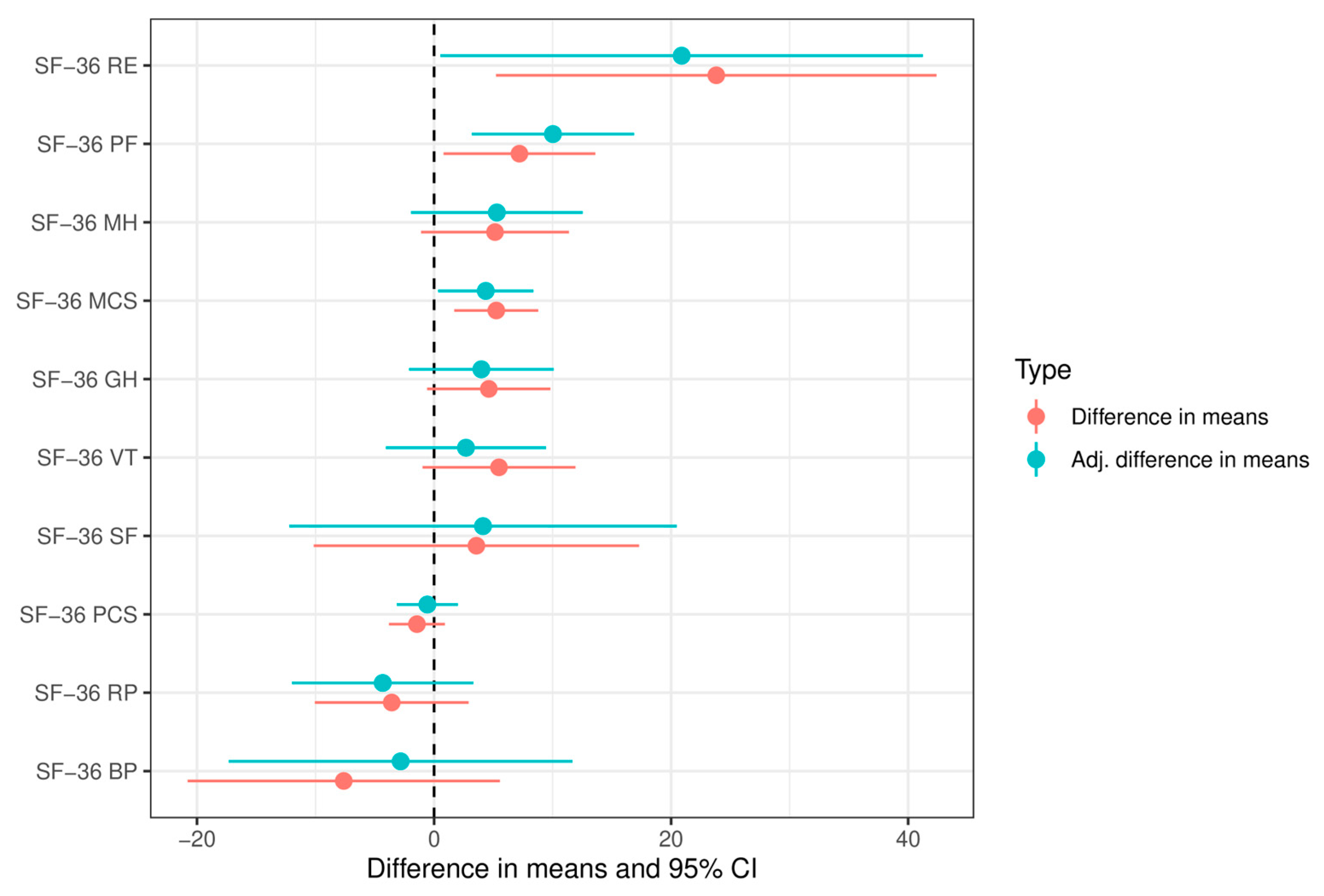
| SF-36 PF | 10.0 (14.0) | 17.2 (22.7) | 7.2 (14.3) | 7.2 | 10.0 |
| 0.0, 50.0 | 0.0, 70.0 | −15.0, 55.0 | 0.8; 13.6 | 3.18; 16.88 | |
| 5.0 (0.0, 10.0) | 5.0 (5.0, 15.0) | 5.0 (0.0, 10.0) | p = 0.029 | p = 0.007 | |
| SF-36 RP | 10.7 (20.3) | 7.1 (14.0) | −3.6 (22.8) | −3.57 | −4.33 |
| 0.0, 75.0 | 0.0, 50.0 | −75.0, 25.0 | −10.06; 2.91 | −11.98; 3.32 | |
| 0.0 (0.0, 25.0) | 0.0 (0.0, 0.0) | 0.0 (0.0, 0.0) | p = 0.263 | p = 0.249 | |
| SF-36 BP | 62.8 (38.3) | 55.1 (38.3) | −7.6 (30.7) | −7.62 | 2.82 |
| 0.0, 100.0 | 0.0, 100.0 | −100.0, 68.0 | −20.79; 5.56 | −17.31; 11.67 | |
| 62.0 (32.0, 100.0) | 61.0 (22.0, 100.0) | 0.0 (−20.0, 0.0) | p = 0.241 | p = 0.687 | |
| SF-36 GH | 41.0 (13.1) | 45.6 (12.6) | 4.6 (13.2) | 4.62 | 3.99 |
| 20.0, 62.0 | 25.0, 77.0 | −20.0, 30.0 | −0.58; 9.82 | −2.1; 10.09 | |
| 40.0 (30.0, 50.0) | 47.0 (35.0, 52.0) | 2.0 (−3.0, 12.0) | p = 0.079 | p = 0.185 | |
| SF-36 VT | 44.5 (24.6) | 50.0 (19.7) | 5.5 (17.3) | 5.48 | 2.69 |
| 10.0, 95.0 | 20.0, 80.0 | −25.0, 45.0 | −0.98; 11.93 | −4.06; 9.45 | |
| 45.0 (25.0, 60.0) | 45.0 (40.0, 65.0) | 5.0 (0.0, 15.0) | p = 0.092 | p = 0.412 | |
| SF-36 SF | 47.6 (35.7) | 51.2 (38.1) | 3.6 (31.4) | 3.57 | 4.1 |
| 0.0, 100.0 | 0.0, 100.0 | −75.0, 50.0 | −10.15; 17.3 | −12.21; 20.47 | |
| 50.0 (12.5, 87.5) | 62.5 (0.0, 87.5) | 0.0 (0.0, 12.5) | p = 0.592 | p = 0.601 | |
| SF-36 RE | 46.0 (46.5) | 69.8 (45.8) | 23.8 (46.1) | 23.81 | 20.89 |
| 0.0, 100.0 | 0.0, 100.0 | −66.7, 100.0 | 5.23; 42.39 | 0.54; 41.24 | |
| 33.3 (0.0, 100.0) | 100.0 (0.0, 100.0) | 0.0 (0.0, 66.7) | p = 0.015 | p = 0.045 | |
| SF-36 MH | 57.3 (29.2) | 62.5 (25.3) | 5.1 (15.3) | 5.14 | 5.3 |
| 4.0, 100.0 | 12.0, 96.0 | −16.0, 36.0 | −1.1; 11.38 | −1.95; 12.54 | |
| 56.0 (36.0, 76.0) | 72.0 (48.0, 76.0) | 8.0 (−8.0, 16.0) | p = 0.101 | p = 0.141 | |
| SF-36 PCS | 27.4 (6.7) | 25.9 (6.0) | −1.4 (6.1) | −1.44 | −0.57 |
| 15.5, 40.0 | 17.5, 37.2 | −15.6, 8.4 | −3.81; 0.92 | −3.14; 2.01 | |
| 26.0 (22.5, 31.4) | 25.3 (21.5, 29.8) | 0.7 (−3.2, 2.0) | p = 0.216 | p = 0.649 | |
| SF-36 MCS | 45.3 (17.7) | 50.5 (14.2) | 5.2 (9.5) | 5.25 | 4.36 |
| 17.9, 76.1 | 20.2, 68.9 | −7.2, 35.4 | 1.7; 8.8 | 0.34; 8.38 | |
| 44.8 (29.5, 60.1) | 52.1 (41.5, 60.5) | 4.7 (−2.0, 10.6) | p = 0.006 | p = 0.035 | |
| SF-36 Subscale | SF-36Post Mean (SD) Min, Max Median (Q1, Q3) Continent (n = 11) | SF-36Post Mean (SD) Min, Max Median (Q1, Q3) Incontinent (n = 10) | Mean Diff. 95% CI p-Value | Adjusted Mean Diff. 95% CI p-Value |
|---|---|---|---|---|
| SF-36 PF | 27.3 (27.8) | 6.1 (5.2) | −21.15 | −15.97 |
| 0.0, 70.0 | 0.0, 15.0 | (−39.98; −2.31) | (−36.82; 4.87) | |
| 10.0 (5.0, 60.0) | 5.0 (5.0, 6.3) | p = 0.031 | p = 0.124 | |
| SF-36 RP | 6.8 (16.2) | 7.5 (12.1) | 0.68 | 0.08 |
| 0.0, 50.0 | 0.0, 25.0 | (−12.31; 13.67) | (−15.08; 15.24) | |
| 0.0 (0.0, 0.0) | 0.0 (0.0, 25.0) | p = 0.914 | p = 0.991 | |
| SF-36 BP | 69.7 (34.5) | 39.1 (37.3) | −30.63 | −42.7 |
| 0.0, 100.0 | 0.0, 100.0 | (−63.62; 2.36) | (−77.34; −8.06) | |
| 72.0 (41.0, 100.0) | 26.5 (12.0, 64.0) | p = 0.067 | p = 0.019 | |
| SF-36 GH | 45.5 (14.6) | 45.7 (10.7) | 0.15 | −0.85 |
| 25.0, 77.04 | 30.0, 60.0 | (−11.48; 11.79) | (−14.41; 12.71) | |
| 7.0 (32.0, 52.0) | 48.5 (35.0, 55.0) | p = 0.978 | p = 0.896 | |
| SF-36 VT | 54.1 (22.5) | 45.5 (16.2) | −8.59 | −10.31 |
| 20.0, 80.0 | 20.0, 70.0 | (−26.43; 9.25) | (−29.56; 8.94) | |
| 45.0 (35.0, 80.0) | 42.5 (40.0, 60.0) | p = 0.325 | p = 0.274 | |
| SF-36 SF | 51.1 (38.1) | 51.3 (40.2) | 0.11 | 1.31 |
| 0.0, 100.0 | 0.0, 100.0 | (−35.79; 36.01) | (−39.83; 42.46) | |
| 62.5 (0.0, 87.5) | 56.3 (0.0, 87.5) | p = 0.995 | p = 0.947 | |
| SF-36 RE | 72.7 (46.7) | 66.7 (47.1) | −6.06 | −3.46 |
| 0.0, 100.0 | 0.0, 100.0 | (−49.02; 36.9) | (−51.47; 0 44.55) | |
| 100.0 (0.0, 100.0) | 100.0 (0.0, 100.0) | p = 0.771 | p = 0.881 | |
| SF-36 MH | 62.2 (24.2) | 62.8 (27.8) | 0.62 | −8.14 |
| 12.0, 96.0 | 12.0, 96.0 | (−23.39; 24.63) | (−33.48; 17.2) | |
| 64.0 (48.0, 76.0) | 72.0 (36.0, 84.0) | p = 0.957 | p = 0.507 | |
| SF-36 PCS | 29.7 (5.22) | 21.9 (3.72) | −7.8 | −7.76 |
| 21.7, 37.2 | 17.5, 28.1 | (−11.92; −3.67) | (−12.47; −3.05) | |
| 29.8 (25.3, 33.9) | 21.2 (18.5, 24.9) | p = 0.001 | p = 0.003 | |
| SF-36 MCS | 49.7 (15.09) | 51.5 (13.87) | 1.78 | −0.28 |
| 20.2, 68.9 | 27.4, 68.9 | (−11.45; 15.01) | (−14.97; 14.4) | |
| 52.1 (41.5, 60.5) | 54.7 (38.3, 62.0) | p = 0.782 | p = 0.968 |
| SF-36 Subscale | Continent (n = 11) Diff SF-36Post-Pre Mean (SD) Min, Max Median (Q1, Q3) | Incontinent (n = 10) Diff SF-36Post-Pre Mean (SD) Min, Max Median (Q1, Q3) | Mean Diff. 95% CI p-Value | Adjusted Mean Diff. 95% CI p-Value |
|---|---|---|---|---|
| SF-36 PF | 13.2 (16.7) | 0.6 (6.95) | −12.56 | −11.36 |
| 0.0, 55.0 | −15.0, 10.0 | (−24.42; −0.7) | (−24.42; 1.7) | |
| 5.0 (0.0, 20.0) | 0.0 (0.0, 5.0) | p = 0.04 | p = 0.084 | |
| SF-36 RP | −4.5 (15.08) | −2.5 (29.93) | 2.05 | 4.4 |
| −25.0, 25.0 | −75.0, 25.0 | (−20.64; 24.73) | (−20.16; 28.96) | |
| 0.0 (−25.0, 0.0) | 0.0 (0.0, 25.0) | p = 0.849 | p = 0.71 | |
| SF-36 BP | −3.1 (27.34) | −12.6 (34.8) | −9.51 | −11.78 |
| −39.0, 68.0 | −100.0, 21.0 | (−38.51; 19.49) | (−41.92; 18.37) | |
| 0.0 (−22.0, 0.0) | 0.0 (−20.0, 2.0) | p = 0.49 | p = 0.421 | |
| SF-36 GH | 3.4 (13.54) | 6.0 (13.5) | 2.64 | 5.28 |
| −20.0, 22.0 | −10.0, 30.0 | (−9.74; 15.01) | (−8.71; 19.28) | |
| 2.0 (−3.0, 17.0) | 5.0 (−5.0, 10.0) | p = 0.66 | p = 0.437 | |
| SF-36 VT | 7.7 (18.08) | 3.0 (17.03) | −4.73 | −2.16 |
| −15.0, 45.0 | −25.0, 30.0 | (−20.77; 11.31) | (−19.85; 15.52) | |
| 0.0 (0.0, 15.0) | 7.5 (−10.0, 15.0) | p = 0.545 | p = 0.799 | |
| SF-36 SF | 8 (37.2) | −1.3 (24.62) | −9.2 | −11.25 |
| −75.0, 50.0 | −62.5, 37.5 | (−37.95; 19.54) | (−44.8; 22.3) | |
| 12.5 (−12.5, 50.0) | 0.0 (0.0, 0.0) | p = 0.509 | p = 0.489 | |
| SF-36 RE | 39.4 (46.71) | 6.7 (41.0) | −32.73 | −18.5 |
| 0.0, 100.0 | −66.7, 100.0 | (−72.79; 7.33) | (−61.93; 24.86) | |
| 0.0 (0.0, 100.0) | 0.0 (0.0, 0.0) | p = 0.104 | p = 0.38 | |
| SF-36 MH | 7.6 (17.93) | 2.4 (12.25) | −5.24 | −6.22 |
| −16.0, 36.0 | −16.0, 20.0 | (−19.22; 8.75) | (−22.64; 10.2) | |
| 8.0 (−8.0, 20.0) | 4.0 (−8.0, 12.0) | p = 0.441 | p = 0.435 | |
| SF-36 PCS | −1.2 (6.9) | −1.7 (5.43) | −0.56 | −0.74 |
| −14.3, 8.4 | −15.6, 2.9 | (−6.22; 5.09) | (−6.81; 5.33) | |
| 0.7 (−8.1, 2.5) | −0.7 (−3.2, 1.8) | p = 0.837 | p = 0.801 | |
| SF-36 MCS | 8.0 (11.08) | 2.2 (6.71) | −5.79 | −4.28 |
| −6.0, 35.46.3 | −7.2, 14.2 | (−14.15; 2.57) | (−13.92; 5.35) | |
| (0.3, 13.6) | 1.8 (−2.8, 4.7) | p = 0.162 | p = 0.361 |
Disclaimer/Publisher’s Note: The statements, opinions and data contained in all publications are solely those of the individual author(s) and contributor(s) and not of MDPI and/or the editor(s). MDPI and/or the editor(s) disclaim responsibility for any injury to people or property resulting from any ideas, methods, instructions or products referred to in the content. |
© 2026 by the authors. Licensee MDPI, Basel, Switzerland. This article is an open access article distributed under the terms and conditions of the Creative Commons Attribution (CC BY) license.
Share and Cite
Jaekel, A.K.; Pickermann, M.; Walter, A.K.; Butscher, A.-L.; Bitter, J.; Winterhagen, F.I.; Kirschner-Hermanns, R.; Knüpfer, S.C. The Impact of Successful Transurethral Indwelling Catheter Removal on Health-Related Quality of Life in Patients Undergoing Neurological Rehabilitation. Neurol. Int. 2026, 18, 12. https://doi.org/10.3390/neurolint18010012
Jaekel AK, Pickermann M, Walter AK, Butscher A-L, Bitter J, Winterhagen FI, Kirschner-Hermanns R, Knüpfer SC. The Impact of Successful Transurethral Indwelling Catheter Removal on Health-Related Quality of Life in Patients Undergoing Neurological Rehabilitation. Neurology International. 2026; 18(1):12. https://doi.org/10.3390/neurolint18010012
Chicago/Turabian StyleJaekel, Anke K., Manuel Pickermann, Ann Katrin Walter, Anna-Lena Butscher, John Bitter, Franziska I. Winterhagen, Ruth Kirschner-Hermanns, and Stephanie C. Knüpfer. 2026. "The Impact of Successful Transurethral Indwelling Catheter Removal on Health-Related Quality of Life in Patients Undergoing Neurological Rehabilitation" Neurology International 18, no. 1: 12. https://doi.org/10.3390/neurolint18010012
APA StyleJaekel, A. K., Pickermann, M., Walter, A. K., Butscher, A.-L., Bitter, J., Winterhagen, F. I., Kirschner-Hermanns, R., & Knüpfer, S. C. (2026). The Impact of Successful Transurethral Indwelling Catheter Removal on Health-Related Quality of Life in Patients Undergoing Neurological Rehabilitation. Neurology International, 18(1), 12. https://doi.org/10.3390/neurolint18010012