
Evaluating the Usability of a Remote Ischemic Conditioning Device for Pre-Hospital Stroke Management: Insights from Paramedic Simulations


Abstract
1. Introduction
2. Materials and Methods
2.1. Study Design, Setting, and Participants
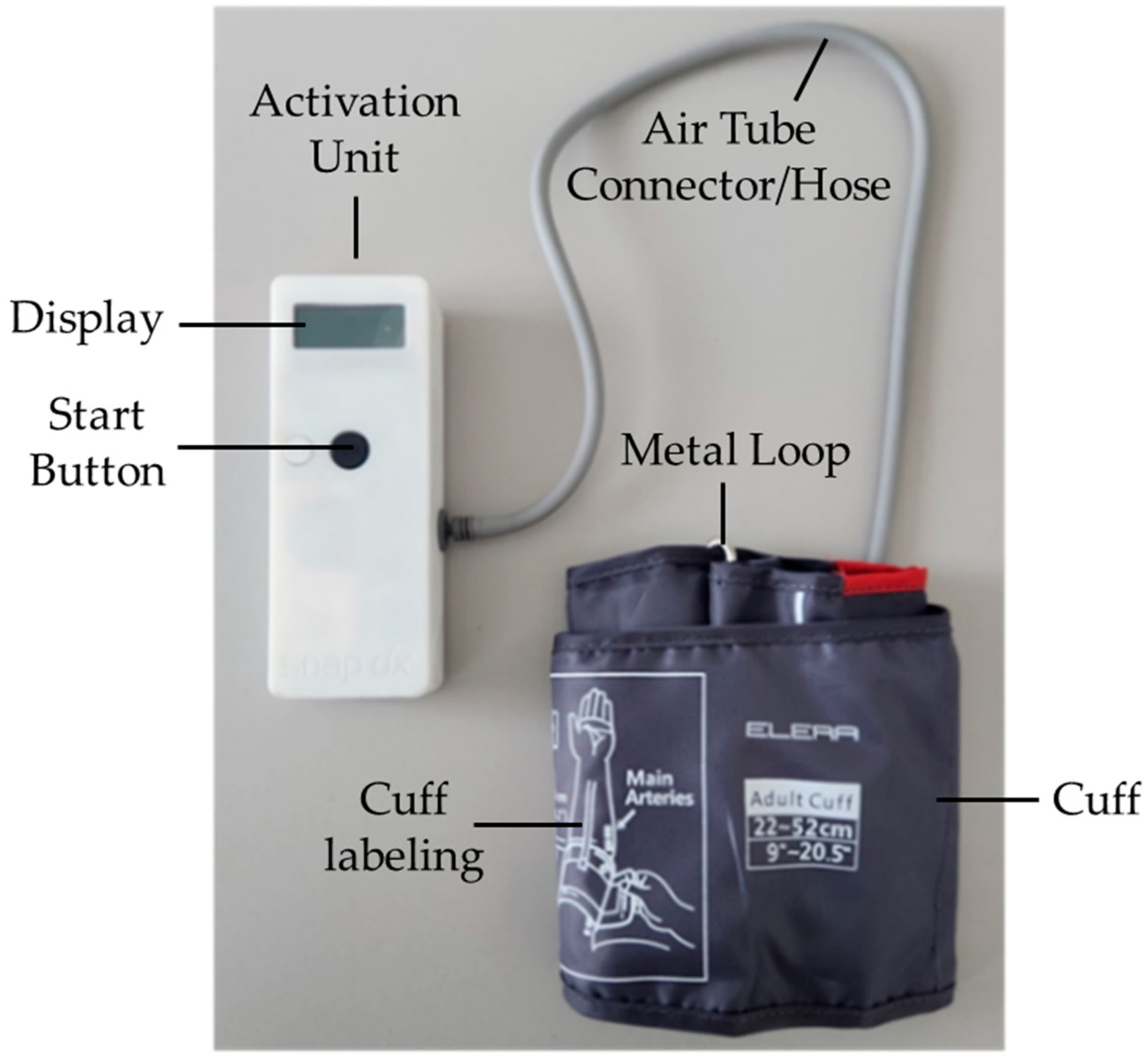
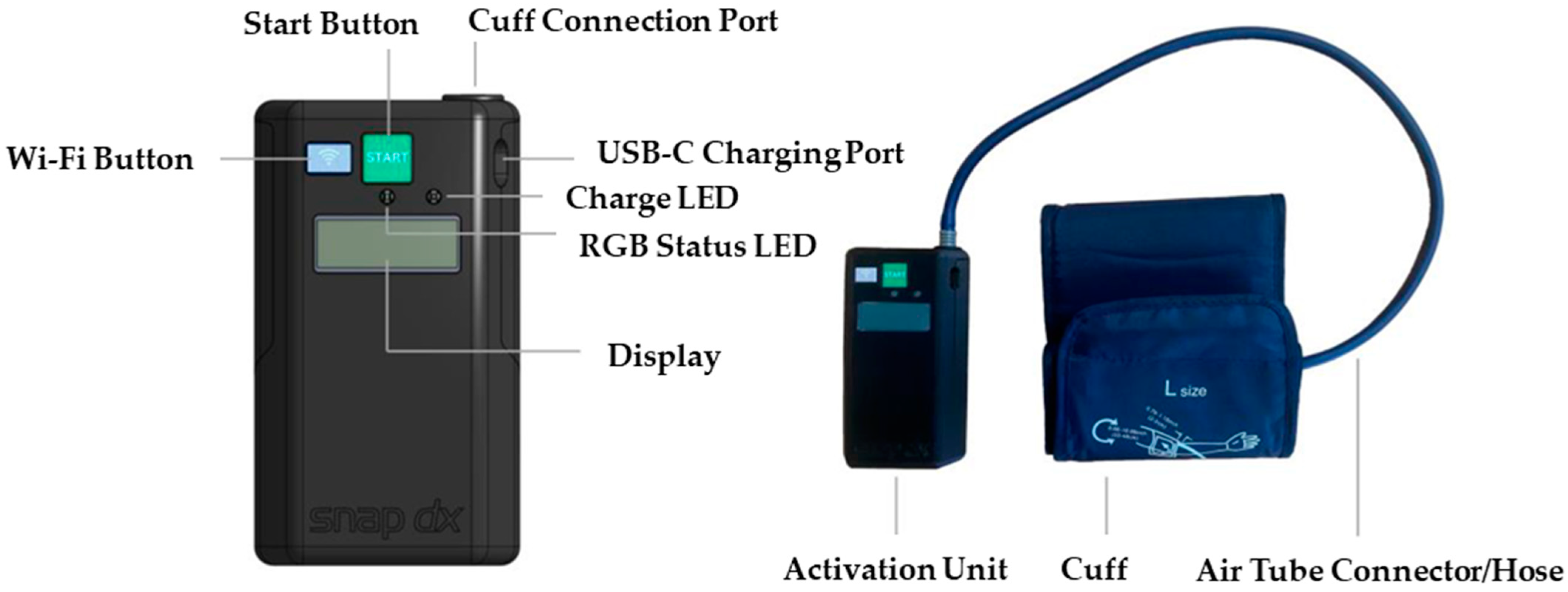
2.2. The RICovery Device Prototype
2.3. Simulation Scenario
2.4. Data Collection and Analysis
- The System Usability Scale (SUS)—a standardized 10-item questionnaire that provides a quantitative measure of the usability of a system or technology; each item is rated on a scale from 1 (strongly disagree) to 5 (strongly agree), with responses producing a composite score from 0 to 100 (highest degree of usability);
- The NASA Task Load Index (NASA-TLX)—a subjective rating scale that measures the perceived demands (mental, physical, and temporal), effort, and frustration experienced during a task, and successfulness in accomplishing it; each item is rated on a scale from 0 (very low) to 20 (very high);
- A bespoke Device Validation Checklist—a structured instrument assessing seven specific components of the RIC device, rated on a 3-point scale—not acceptable, acceptable but improvements could be made, and acceptable; open text entry boxes were included to allow for further clarification;
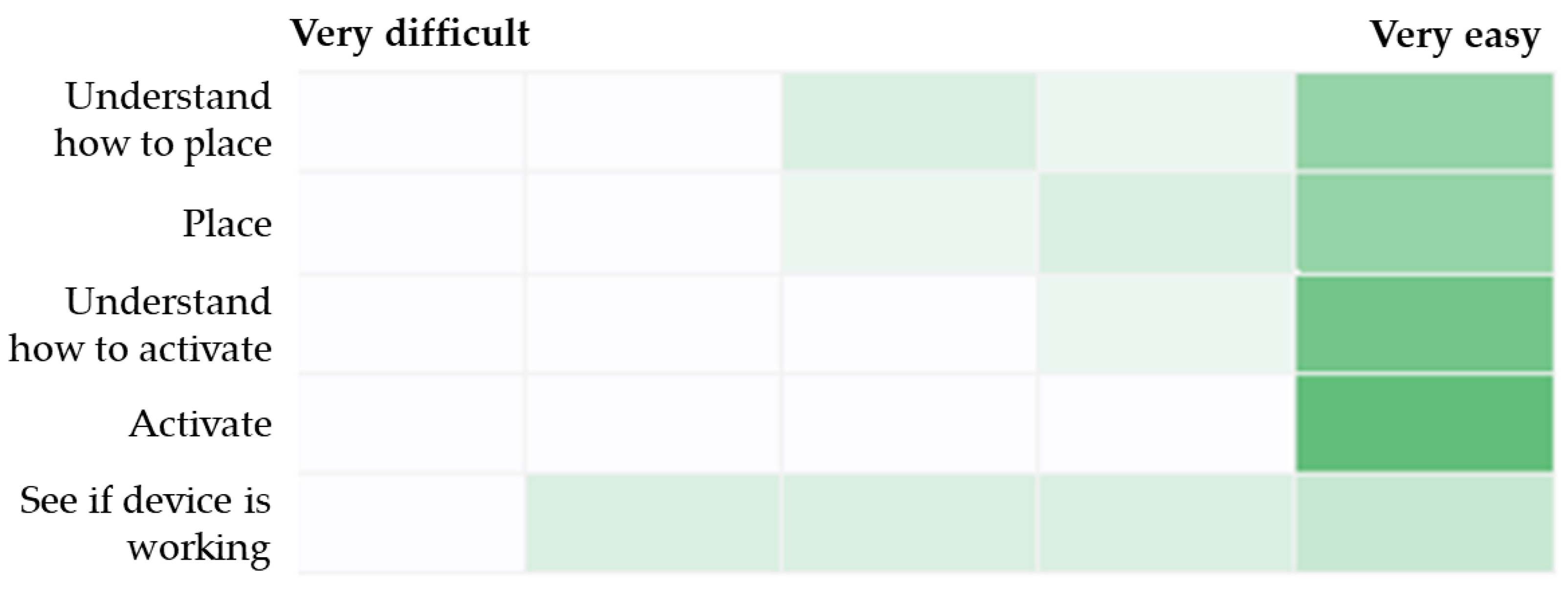
- Additional custom assessment items—five items developed based on the Post-Task Single Ease Questions [31], asking about different aspects of ease of device use on a scale from 1 (very difficult) to 5 (very easy), and two binary (yes/no) questions on liking the device and willingness to use it in daily work.
3. Results
3.1. Questionnaire Findings
3.2. Observation and Interview Findings
I would have liked to know more about why we were using it. Again, that’s […] 50 percent of using anything is the explanation of the patient and being able to answer all those questions. So, in the training, I just would have liked more, more context into why we’re using this. Are there specific cases we’re using this and […] what evidence is there, um, that justifies us using this in that case?(P3_930)
I don’t know exactly how successful these things are at reducing or helping with strokes. Um, if there, if it comes out that they are really successful, maybe that will be a higher priority on my list, but currently it’s kind of an extra thing, as far as I’m concerned.(P8_1400)
4. Discussion
4.1. Strengths and Limitations
4.2. Practical Implications of Study Findings
5. Conclusions
Supplementary Materials
Author Contributions
Funding
Institutional Review Board Statement
Informed Consent Statement
Data Availability Statement
Acknowledgments
Conflicts of Interest
Appendix A
- Treat the following simulation as a real 911 ambulance call.
- You are operating under AHS Medical Control Protocols.
- You’ll be functioning as one-half of a Basic Life Support ambulance.
- You have been provided with a RIC device. We ask that you use the device when providing care. Please use the device in any way that you see fit.
- What you see in the scenario is what you get. If you need more resources or information, ask for it.
References
- Gomez, C.R. Editorial: Time is brain! J. Stroke Cerebrovasc. Dis. 1993, 3, 1–2. [Google Scholar] [CrossRef] [PubMed]
- Glober, N.K.; Sporer, K.A.; Guluma, K.Z.; Serra, J.P.; Barger, J.A.; Brown, J.F.; Gilbert, G.H.; Koenig, K.L.; Rudnick, E.M.; Salvucci, A.A. Acute Stroke: Current Evidence-based Recommendations for Prehospital Care. West J. Emerg. Med. 2016, 17, 104–128. [Google Scholar] [CrossRef] [PubMed]
- Kobayashi, A.; Czlonkowska, A.; Ford, G.A.; Fonseca, A.C.; Luijckx, G.J.; Korv, J.; Perez de la Ossa, N.; Price, C.; Russell, D.; Tsiskaridze, A.; et al. European Academy of Neurology and European Stroke Organization consensus statement and practical guidance for pre-hospital management of stroke. Eur. J. Neurol. 2018, 25, 425–433. [Google Scholar] [CrossRef] [PubMed]
- Baldereschi, M.; Piccardi, B.; Di Carlo, A.; Lucente, G.; Guidetti, D.; Consoli, D.; Provinciali, L.; Toni, D.; Sacchetti, M.L.; Polizzi, B.M.; et al. Relevance of prehospital stroke code activation for acute treatment measures in stroke care: A review. Cerebrovasc. Dis. 2012, 34, 182–190. [Google Scholar] [CrossRef] [PubMed]
- Sangari, A.; Akhoundzadeh, K.; Vahedian, M.; Sharifipour, E. Effect of pre-hospital notification on delays and neurological outcomes in acute ischemic stroke. Australas. Emerg. Care 2022, 25, 172–175. [Google Scholar] [CrossRef]
- Varjoranta, T.; Raatiniemi, L.; Majamaa, K.; Martikainen, M.; Liisanantti, J.H. Prehospital and hospital delays for stroke patients treated with thrombolysis: A retrospective study from mixed rural-urban area in Northern Finland. Australas. Emerg. Care 2019, 22, 76–80. [Google Scholar] [CrossRef]
- Holodinsky, J.K.; Williamson, T.S.; Demchuk, A.M.; Zhao, H.; Zhu, L.; Francis, M.J.; Goyal, M.; Hill, M.D.; Kamal, N. Modeling Stroke Patient Transport for All Patients with Suspected Large-Vessel Occlusion. JAMA Neurol. 2018, 75, 1477–1486. [Google Scholar] [CrossRef]
- Fassbender, K.; Walter, S.; Grunwald, I.Q.; Merzou, F.; Mathur, S.; Lesmeister, M.; Liu, Y.; Bertsch, T.; Grotta, J.C. Prehospital stroke management in the thrombectomy era. Lancet Neurol. 2020, 19, 601–610. [Google Scholar] [CrossRef]
- Gardiner, F.W.; Coleman, M.; Teoh, N.; Harwood, A.; Coffee, N.T.; Gale, L.; Bishop, L.; Laverty, M. Aeromedical retrievals of people for mental health care and the low level of clinical support in rural and remote Australia. Med. J. Aust. 2019, 211, 351–356. [Google Scholar] [CrossRef]
- Fassbender, K.; Walter, S.; Liu, Y.; Muehlhauser, F.; Ragoschke, A.; Kuehl, S.; Mielke, O. “Mobile stroke unit” for hyperacute stroke treatment. Stroke 2003, 34, e44. [Google Scholar] [CrossRef]
- Calderon, V.J.; Kasturiarachi, B.M.; Lin, E.; Bansal, V.; Zaidat, O.O. Review of the Mobile Stroke Unit Experience Worldwide. Interv. Neurol. 2018, 7, 347–358. [Google Scholar] [CrossRef] [PubMed]
- Navi, B.B.; Audebert, H.J.; Alexandrov, A.W.; Cadilhac, D.A.; Grotta, J.C.; PRESTO (Prehospital Stroke Treatment Organization) Writing Group. Mobile Stroke Units: Evidence, Gaps, and Next Steps. Stroke 2022, 53, 2103–2113. [Google Scholar] [CrossRef] [PubMed]
- Li, Q.; Guo, J.; Chen, H.S.; Blauenfeldt, R.A.; Hess, D.C.; Pico, F.; Khatri, P.; Campbell, B.C.V.; Feng, X.; Abdalkader, M.; et al. Remote Ischemic Conditioning with Medical Management or Reperfusion Therapy for Acute Ischemic Stroke: A Systematic Review and Meta-Analysis. Neurology 2024, 102, e207983. [Google Scholar] [CrossRef] [PubMed]
- Hess, D.C.; Khan, M.B.; Hoda, N.; Morgan, J.C. Remote ischemic conditioning: A treatment for vascular cognitive impairment. Brain Circ. 2015, 1, 133–139. [Google Scholar] [CrossRef]
- Heusch, G.; Bøtker, H.E.; Przyklenk, K.; Redington, A.; Yellon, D. Remote ischemic conditioning. J. Am. Coll. Cardiol. 2015, 65, 177–195. [Google Scholar] [CrossRef]
- Stokfisz, K.; Ledakowicz-Polak, A.; Zagorski, M.; Zielinska, M. Ischaemic preconditioning—Current knowledge and potential future applications after 30 years of experience. Adv. Med. Sci. 2017, 62, 307–316. [Google Scholar] [CrossRef]
- Zhao, W.; Jiang, F.; Li, S.; Liu, G.; Wu, C.; Wang, Y.; Ren, C.; Zhang, J.; Gu, F.; Zhang, Q.; et al. Safety and efficacy of remote ischemic conditioning for the treatment of intracerebral hemorrhage: A proof-of-concept randomized controlled trial. Int. J. Stroke 2022, 17, 425–433. [Google Scholar] [CrossRef]
- Blauenfeldt, R.A.; Hjort, N.; Valentin, J.B.; Homburg, A.M.; Modrau, B.; Sandal, B.F.; Gude, M.F.; Hougaard, K.D.; Damgaard, D.; Poulsen, M.; et al. Remote Ischemic Conditioning for Acute Stroke: The RESIST Randomized Clinical Trial. JAMA 2023, 330, 1236–1246. [Google Scholar] [CrossRef]
- Chen, H.S.; Cui, Y.; Li, X.Q.; Wang, X.H.; Ma, Y.T.; Zhao, Y.; Han, J.; Deng, C.Q.; Hong, M.; Bao, Y.; et al. Effect of Remote Ischemic Conditioning vs Usual Care on Neurologic Function in Patients with Acute Moderate Ischemic Stroke: The RICAMIS Randomized Clinical Trial. JAMA 2022, 328, 627–636. [Google Scholar] [CrossRef]
- Hougaard, K.D.; Hjort, N.; Zeidler, D.; Sorensen, L.; Norgaard, A.; Hansen, T.M.; von Weitzel-Mudersbach, P.; Simonsen, C.Z.; Damgaard, D.; Gottrup, H.; et al. Remote ischemic perconditioning as an adjunct therapy to thrombolysis in patients with acute ischemic stroke: A randomized trial. Stroke 2014, 45, 159–167. [Google Scholar] [CrossRef]
- Blauenfeldt, R.A.; Mortensen, J.K.; Hjort, N.; Valentin, J.B.; Homburg, A.M.; Modrau, B.; Sandal, B.F.; Gude, M.F.; Berhndtz, A.B.; Johnsen, S.P.; et al. Effect of Remote Ischemic Conditioning in Ischemic Stroke Subtypes: A Post Hoc Subgroup Analysis From the RESIST Trial. Stroke 2024, 55, 874–879. [Google Scholar] [CrossRef]
- Purroy, F.; Arque, G.; Mauri, G.; García-Vázquez, C.; Vicente-Pascual, M.; Pereira, C.; Vazquez-Justes, D.; Torres-Querol, C.; Vena, A.; Abilleira, S.; et al. REMOTE Ischemic Perconditioning Among Acute Ischemic Stroke Patients in Catalonia: REMOTE-CAT PROJECT. Front. Neurol. 2020, 11, 569696. [Google Scholar] [CrossRef]
- Ganesh, A.; Barber, P.; Black, S.E.; Corbett, D.; Field, T.S.; Frayne, R.; Hachinski, V.; Ismail, Z.; Mai, L.M.; McCreary, C.R.; et al. Trial of remote ischaemic preconditioning in vascular cognitive impairment (TRIC-VCI): Protocol. BMJ Open 2020, 10, e040466. [Google Scholar] [CrossRef]
- Tsai, I.C.; Wang, C.D.; Chen, P.T. Strategies for Medical Device Development: User and Stakeholder Perceptions. J. Healthc. Eng. 2023, 2023, 6724656. [Google Scholar] [CrossRef]
- Jaspers, M.W. A comparison of usability methods for testing interactive health technologies: Methodological aspects and empirical evidence. Int. J. Med. Inform. 2009, 78, 340–353. [Google Scholar] [CrossRef]
- Gosbee, J.; Klancher, J.; Arnecke, B.; Wurster, H.; Scanlon, M. The Role of Usability Testing in Healthcare Organizations. Proc. Hum. Factors Ergon. Soc. Annu. Meet. 2001, 45, 1308–1311. [Google Scholar] [CrossRef]
- Maramba, I.; Chatterjee, A.; Newman, C. Methods of usability testing in the development of eHealth applications: A scoping review. Int. J. Med. Inform. 2019, 126, 95–104. [Google Scholar] [CrossRef]
- Corry, M.D.; Frick, T.W.; Hansen, L. User-centered design and usability testing of a web site: An illustrative case study. Educ. Technol. Res. Dev. 1997, 45, 65–76. [Google Scholar] [CrossRef]
- Nielsen, J. How Many Test Users in a Usability Study? Nielsen Norman Group: Fremont, CA, USA, 2012; Available online: https://www.nngroup.com/articles/how-many-test-users/ (accessed on 28 June 2024).
- Nielsen, J. Heuristic evaluation. In Usability Inspection Methods; Nielsen, J., Mack, R.L., Eds.; John Wiley & Sons: New York, NY, USA, 1994; pp. 25–62. [Google Scholar]
- Sauro, J.; Dumas, J.S. Comparison of three one-question, post-task usability questionnaires. In Proceedings of the SIGCHI Conference on Human Factors in Computing Systems, Boston, MA, USA, 4–9 April 2009. [Google Scholar]
- Chapman Smith, S.N.; Brown, P.C.; Waits, K.H.; Wong, J.S.; Bhatti, M.S.; Toqeer, Q.; Ricks, J.V.; Stockner, M.L.; Habtamu, T.; Seelam, J.; et al. Development and Evaluation of a User-Centered Mobile Telestroke Platform. Telemed. e-Health 2019, 25, 638–648. [Google Scholar] [CrossRef]
- Rådestad, M.; Lennquist Montán, K.; Rüter, A.; Castrén, M.; Svensson, L.; Gryth, D.; Fossum, B. Attitudes Towards and Experience of the Use of Triage Tags in Major Incidents: A Mixed Method Study. Prehosp. Disaster. Med. 2016, 31, 376–385. [Google Scholar] [CrossRef]
- Sujan, M.A.; Embrey, D.; Huang, H. On the application of Human Reliability Analysis in healthcare: Opportunities and challenges. Reliab. Eng. Syst. Saf. 2020, 194, 106189. [Google Scholar] [CrossRef]



| Age, mean (SD; range) | 35.6 (11.3; 21–57) |
| Sex, N (%) | |
| Female | 5 (55.6) |
| Male | 4 (44.4) |
| Certification, N (%) | |
| Primary Care Paramedic | 5 (55.6) |
| Advanced Care Paramedic | 4 (44.4) |
| Years of professional experience, mean (SD; range) | 10.0 (10.3; 0–32) |
| Primary Area of Work, N (%) | |
| Urban | 5 (55.6) |
| Rural with or without urban | 4 (44.4) |
| Prior usability testing experience, N(%) | |
| Of any medical device | 2 (22.2) |
| Of an RIC device | 2 (22.2) |
| Mean (SD) (N = 9) | Range (N = 9) | |
|---|---|---|
| SUS | 85.3 (12.0) | 67.5–97.5 |
| Would Use Frequently | 4.0 (1.5) | 2–5 |
| Found Device Complex | 1.2 (0.4) | 1–2 |
| Device Was Easy to Use | 4.9 (0.3) | 4–5 |
| Would need Support from Technical Person | 1.1 (0.3) | 1–2 |
| Functions Were Well Integrated | 3.8 (1.4) | 1–5 |
| Device was Inconsistent | 2.2 (0.8) | 1–4 |
| Most People would Learn to Use Device Quickly | 5.0 (0.0) | 5–5 |
| Found Device Cumbersome | 1.3 (0.7) | 1–3 |
| Felt Confident Using Device | 3.9 (1.3) | 1–5 |
| Needed to Learn a Lot Before Using Device | 1.3 (0.5) | 1–2 |
| NASA-TLX | ||
| Mental Demand | 0.9 (0.8) | 0–2 |
| Physical Demand | 1.0 (0.9) | 0–2 |
| Temporal Demand | 3.6 (5.3) | 0–15 |
| Effort | 0.9 (1.3) | 0–4 |
| Frustration | 3.9 (6.3) | 0–20 |
| Performance | 13.4 (8.0) | 0–20 |
| Subtheme | Elucidation/Key Points | Related Recommendations | Exemplar Quotes |
|---|---|---|---|
| Ease of device use | Opinion that the RIC device was easy to operate and/or that providing the treatment was a low-demand task | Not applicable | […] in terms of actually ease of use—no issues at all. It’s basically the same as a blood pressure cuff. So, we do that every day. There is literally one button to press, so it’s mental load is very low. Um, I didn’t feel like it interfered with my treatments. (P1_800) […] it’s very simple to use. It’s not something I had to continually pay attention to, which I liked. (P7_1330) |
| Device reliability and monitoring | Statements and observations indicating participants’ uncertainty as to whether the device was functioning as intended. | Improving the clarity of the device display, including: a larger screen; use of color indicator lights (e.g., green when working correctly, red if error occurs); providing information on the cuff’s inflation status. | It was hard to see the screen. It was the only thing that I found difficult and then there wasn’t anything, like, I think throughout it might have worked a couple times, but then it just kind of stopped working, so, and then I wasn’t sure if it was gonna, like, supposed to work or not. I don’t know. (P2_830) |
| Cuff placement challenges due to metal loop | Statements and observations indicating issues with placing the cuff due to the incorporated metal loop. The loop reduced users’ freedom of movement and in some situations introduced a challenge of having to unthread and rethread the cuff. | Switching to a single contiguous Velcro cuff, as is currently used by paramedics for blood pressure monitoring. | I wish the cuff was like the ones we have on blood pressures that […] you don’t have to run the straps through a loop to go back around. Just cause then like, I had already put the IV on, I put the lead on for my ECG and then I had to, I went to just slide the cuff over, I went, ‘oh, I can’t do that’, so I had to open the cuff, put it on, run it through that [loop]. (P8_1400) |
| Activation unit placement | Statements and observations indicating variability and uncertainty regarding placement of the activation unit in the ambulance so as to avoid any damage to the device. With limited free surface area, some participants placed the unit on the patient, yet considered this as potentially disrespectful and disagreeable to the patient. | Enabling attachment of the activation unit to the cuff or integrating the two components. Making the device hose longer. | I wish the cord was a little longer maybe, just cause, I had to set it on the patient or beside. Like, I feel like in the real world I wouldn’t want to set it on the patient, I guess I could, but probably want to set it bedside, so the longer cord might be helpful just so it’s not hanging off of them. (P8_1400) |
| Cable management | Identifying the risk of the RIC device hose becoming detached from the activation unit, pinched, or severed. Monitoring for this was considered an additional attentional demand alongside watchfulness of other standard equipment cables. | Enabling attachment of the activation unit to the cuff or integrating the two components. Making the device hose shorter. | I don’t know if that would be better. It’s a lot of cables running and, um, cable management is important to me, but I know, especially when I was new, My cables were all over the place and then you’re getting them caught in wheels, you’re getting them caught when you’re lifting and lowering, um, they fall, they become, they unhook, those kind of things. (P3_930) |
| Device robustness | Concerns regarding the robustness of the device. Given the circumstances in which paramedics work, accidents involving the device were viewed as inevitable. | Constructing the activation unit casing of more durable materials, making it more resistant to damage and preferably waterproof. | We tend to drop things in puddles, in the snow, or lose them, leave them on scenes. I know, they fall out of a bag or something like that. (P3_930) |
| Unintentional device activation | Identifying the risk of unintentionally pressing the activation button. | Turning the device on and off should require a longer press of the button. Adding a protective cover over the activation button. | […] that on-off button is quite sensitive, so it’s easy to accidentally bump it. And then it’s on, but then you turn it off by accident, as it’s, you’re trying to move the patient, and it’s kind of just getting in the way. (Confederate) |
| Device labeling | Overall opinion that the labeling on the device was simple and easy to understand, although certain issues were identified, including a nonobvious indication of the direction in which the cuff should be applied and potential to confuse the RIC device with a blood pressure monitor. | Adding a “This side to patient” label on the cuff. Adding an apparent label or distinct coloring so the device would not be confused with a blood pressure monitor. Adding step-by-step instructions on how to apply and operate the device on the back of the activation unit. | And you see that on a blood pressure cuff as well too, it says this side to patient, and it shows like, how to put the cuff on, written on the cuff… (Confederate) |
| Device size and weight | Overall opinion is that the device is advantageously small and light, supporting ease of transfer and storage. Some participants suggested a slightly higher weight could be beneficial, assuming an association with improved durability and being treated with more care and respect by users. | Potentially making the device slightly heavier. | […] the size is good. It would fit in lots of different kits. I was able to fit in my cargo pocket. (Confederate) I wasn’t sure if I was going to break it if it dropped. I’m not sure if it’s fragile or not. (P5_1200) |
| Cuff sizes | Recognizing that the one provided cuff size may not be suitable for all patients, particularly those who are obese. | Providing multiple, different sized cuffs with the device. | […] I feel like if someone is quite overweight or edematous that’s going to make it harder to put it on the lower extremity because you’ll need like a bigger cuff if that’s possible too to have a variety of cuff sizes. (P1_800) |
| Subtheme | Elucidation/Key Points | Related Recommendations | Exemplar Quotes |
|---|---|---|---|
| Optimal storage | Opinions regarding where the device should be stored when not in use, which related to defining the timepoint of treatment initiation. Suggestions included storage in theprimary kit for initiating treatment on scene/as soon as possible or in the monitor case for initiating treatment in the ambulance. | Not applicable | I’d probably keep it just down, I wouldn’t put it on top of my kit, because I feel like a stroke patient, it’s not something I go to every day, right, so I’d put it probably somewhere where I know where it is, but I’d have to maybe pull, maybe under the IV kit or something, just so it’s, I know where it is quickly to grab it, but it’s not like the first thing I’m going to grab, right. (P8 _1400) |
| Decision-making around RIC initiation | Lack of specific guidelines related to uncertainty in participants’ decision-making. Two users applied the device on-scene and six in the ambulance. Factors considered in making this decision included the following: Assumed time-sensitiveness of treatment (only factor favoring on-scene initiation); Prioritizing life-saving procedures, linked to avoiding delay in hospital transport; Following the Vital Signs, Oxygen, Monitor, IV, Treatment (VOMIT) protocol; Practical consideration, including risk of damaging device and/or detaching hose during stretcher transfer. | Providing evidence-based guidance as to when the RIC treatment should ideally be initiated. | Um, I didn’t, honestly, it didn’t even pop into my mind, like, I know it was there to use the device, but again, my priority is getting the patient to the hospital because that’s, like, the life saving treatment. […] It would have been something that I think would be nice to know, like, do we, is it an on-scene thing, or is it a, you know, in transport? Um, once we got into the back, I think it, because obviously knowing it’s a study, I was like trying to prioritize getting it on sooner rather than later. (P1_800) |
| Interference with other procedures | Concerns about RIC interfering with the execution or effects of other procedures, including blood pressure monitoring, establishing bilateral IV access, and delivery of IV drugs. | Providing evidence-based guidelines regarding simultaneous placement of an IV and RIC cuff, and IV drug delivery with RIC. Placing the RIC cuff on lower rather than upper limbs. | If it needs to be on the unaffected arm, then it would be difficult to do serial blood pressures and run IVs. Because the IV also has to be on the unaffected arm. (P6_1230) |
| Use of multiple RIC devices | Most participants found this feasible and were willing to use multiple devices if this translated to increased benefit to the patient. Some, however, expressed concern for excess task demands, having to activate and monitor multiple devices and manage more cables. | Enabling attachment of activations unit to the cuffs or integrating the two components. Having a single activation unit for multiple cuffs. | I think you would definitely need more hands in the back if you’re going to be applying multiple. But if this can be done en route, very easily. Um, yeah, then I don’t see, I think it would just take time. (P7_1330) |
| Subtheme | Elucidation/Key Points | Related Recommendations | Exemplar Quotes |
|---|---|---|---|
| Concerns over patients’ tolerance of RIC | Anticipating that for some patients (particularly elderly) the cuff may cause bruising or skin tears and induce discomfort that is difficult to tolerate. This in turn could lead to increased patient fear, confusion, volatility or aggression, refusing the RIC treatment, and jeopardizing rapport between the patient and paramedic. | Placing the RIC cuff on a lower rather than upper limb (assumed to be better tolerated). Having the option to inflate the cuff to a pressure lower than 200 mgHg. | […] multiple times I’ve had patients that don’t like the blood pressure cuff and they’re pulling at it and pulling at it and pulling at it. Where they’re like, ah, this hurts! And then they escalate. And then, you know, it might be something like that. That, like, the patient just getting frustrated and exploding because of the pain that it’s causing. And then the medic trying to calm him down, calm him down, explain why they’re doing it, and then it gets in the way of the relationship. (Confederate) |
| Strategies for improving patient adherence | Emphasizing the importance of communicating with patients about the treatment and maintaining a positive relationship to help manage discomfort and improve adherence. | Displaying information on the cuff’s inflation status to inform patients about the stage of treatment progress. Providing paramedics with comprehensive information on RIC to facilitate answering patient questions and providing reassurance, and conveying anticipated benefits of treatment adherence. | So, with a, a stroke it would probably stay away with from like sedative agents and things to calm them down. So it would probably be pain management. I, having experience with, with taking blood pressures with seniors, or patients, especially with high cuff pressures, it is uncomfortable in tourniquets, so usually it’s just some calming measures and pain control. […] Especially when they know the risks and the benefits, so it’s really an understanding, it’s an education. (P6_1230) |
Disclaimer/Publisher’s Note: The statements, opinions and data contained in all publications are solely those of the individual author(s) and contributor(s) and not of MDPI and/or the editor(s). MDPI and/or the editor(s) disclaim responsibility for any injury to people or property resulting from any ideas, methods, instructions or products referred to in the content. |
© 2024 by the authors. Licensee MDPI, Basel, Switzerland. This article is an open access article distributed under the terms and conditions of the Creative Commons Attribution (CC BY) license (https://creativecommons.org/licenses/by/4.0/).
Share and Cite
Drozdowska, B.A.; Lam, K.; Doolan, C.; Violato, E.; Ganesh, A. Evaluating the Usability of a Remote Ischemic Conditioning Device for Pre-Hospital Stroke Management: Insights from Paramedic Simulations. Neurol. Int. 2024, 16, 1405-1420. https://doi.org/10.3390/neurolint16060105
Drozdowska BA, Lam K, Doolan C, Violato E, Ganesh A. Evaluating the Usability of a Remote Ischemic Conditioning Device for Pre-Hospital Stroke Management: Insights from Paramedic Simulations. Neurology International. 2024; 16(6):1405-1420. https://doi.org/10.3390/neurolint16060105
Chicago/Turabian StyleDrozdowska, Bogna Anna, Kaden Lam, Cody Doolan, Efrem Violato, and Aravind Ganesh. 2024. "Evaluating the Usability of a Remote Ischemic Conditioning Device for Pre-Hospital Stroke Management: Insights from Paramedic Simulations" Neurology International 16, no. 6: 1405-1420. https://doi.org/10.3390/neurolint16060105
APA StyleDrozdowska, B. A., Lam, K., Doolan, C., Violato, E., & Ganesh, A. (2024). Evaluating the Usability of a Remote Ischemic Conditioning Device for Pre-Hospital Stroke Management: Insights from Paramedic Simulations. Neurology International, 16(6), 1405-1420. https://doi.org/10.3390/neurolint16060105