


Abstract
In the last few years, blockchain has emerged as a cutting-edge technology whose main advantages are transparency, traceability, immutability, enhanced efficiency, and trust, thanks to its decentralized nature. Although many people still identify blockchain with cryptocurrencies and the financial sector, it has many prospective applications beyond digital currency that can serve as use cases for which traditional infrastructures have become obsolete. Governments have started exploring its potential application to public services provision, as confirmed by the increasing number of adoption initiatives, projects, and tests. As the current public administration is often perceived as slow, bureaucratic, lacking transparency, and failing to involve citizens in decision-making processes, blockchain can establish itself as a tool that enables a process of disintermediation, which can revolutionize the way in which public services are managed and provided. In this paper, we will provide a survey of the main application areas which are likely to benefit from blockchain implementation, together with examples of practical implementations carried out by both state and local governments. Later, we will discuss the main challenges that may prevent its widespread adoption, such as government expenditure, technological maturity, and lack of public awareness. Finally, we will wrap up by providing indications on future areas of research for blockchain-based technologies.
1. Introduction
Blockchain is a distributed ledger technology (DLT), which relies on the computing primitives of cryptography and digital signatures. Each user who participates in the blockchain is uniquely identified by an address derived from his/her public key. The distinctive element of this technology is the absence of a central authority, meaning that transactions are stored by all users connected to the network. As the name suggests, a blockchain can be thought of as a chain of blocks. Each block contains three types of information: data (about the transaction being carried out), a hash code, which uniquely identifies the transaction, and the hash code of the previous block. In order for a block to be added to the chain, it has to be approved by the majority of validator nodes, who must reach a consensus on the integrity of all transactions within the block. Due to the strong computational and mathematical backbone, blockchain technology stands out for being immutable (once a transaction is added to the blockchain it cannot be further modified), transparent (it has a distributed nature, meaning that each participant has a full copy of the ledger), traceable (it is possible to reconstruct the history of all transactions), efficient (it lacks a central authority as peers work together to validate transactions), and reliable (thanks to the encryption of transactional data). These distinctive features make blockchain technology suitable for use cases and applications that range across a variety of domains (see, e.g., [1,2] for an overview), including the ones where confidentiality of sensitive information is paramount. Ensuring the confidentiality of sensitive information within blockchain technology necessitates the deployment, as anticipated, of sophisticated cryptographic methods and stringent access control protocols. Notably, the usage of asymmetric encryption, where each participant is equipped with a pair of cryptographic keys: a public key for general dissemination and a private key kept confidential. Transactions are encrypted using the recipient’s public key, ensuring that only the corresponding private key can decrypt the data, thereby safeguarding unauthorized access. Hashing algorithms play a critical role in preserving data confidentiality by transforming sensitive information into fixed-size hash values, which are then stored on the blockchain. This ensures data integrity while making it infeasible to reverse-engineer the original information from the hash. Employing permissioned blockchains adds another layer of security by limiting network access to verified and trusted participants only, thus preventing unauthorized entities from joining.
Public services provision is one of the main sectors that is likely to benefit from its adoption, as evidenced by the growing number of successful implementations. Blockchain could be used as a tool to ensure the integrity of procedures and administrative concessions, reducing fraud and errors while enhancing transparency, traceability, people’s trust in processes, and improving public service delivery in terms of productivity and effectiveness, aspects which tend to alter the trust of citizens and stakeholders towards public services [3,4]. In this survey, we are not interested in the cryptocurrency side of the blockchain, nor in its technological implementations, for which we refer the interested reader to landmark resources such as [5,6]. Rather, we focus on blockchain technology as the main driver for the digital transformation of government infrastructure (both at the state and local levels) and discovering the applications and domains within the public services umbrella that can benefit from blockchain technology.
We argue that the usage of blockchain technology within public services can foster the concept of servitization from a mere industrial perspective [7] to a more comprehensive public services perspective, where public administration is seen as a service provider to citizens. Broadly speaking, servitization is a strategic approach in which companies evolve from merely selling products to offering comprehensive solutions that integrate both products and services. This business model focuses on enhancing customer value and fostering long-term relationships by providing services such as maintenance, repair, consulting, and customization. By shifting towards servitization, companies can create new revenue streams, improve customer loyalty, and gain a competitive edge in saturated markets. This approach allows businesses to differentiate themselves by ensuring that their offerings are not just about the product itself but also about the continuous support and value-added services that accompany it, ultimately leading to a more sustainable and customer-centric business model. The concept of servitization can extend beyond the industrial sector and be effectively applied to public services, enhancing the quality and efficiency of service delivery. In the public sector, servitization involves integrating various services to provide comprehensive solutions that better meet the needs of citizens. For example, healthcare can encompass not only medical treatments but also preventive care, health education, and remote monitoring, creating a holistic approach to patient wellness. Similarly, in public transportation, servitization can combine traditional transit services with real-time traffic updates, ride-sharing options, and smart ticketing systems, offering a seamless travel experience. By adopting a servitization model, public services can become more responsive, personalized, and proactive, ultimately leading to higher citizen satisfaction and more effective use of resources. In this regard, blockchain technology (thanks to its aforementioned peculiarities) can act as a catalyst for the servitization of public services. By recalling the previous healthcare example, the blockchain can securely manage patient records, streamline billing processes, and ensure the authenticity of pharmaceuticals, thereby improving service integration and patient outcomes. Similarly, in public transportation, the blockchain can facilitate seamless ticketing, optimize route planning, and enhance data sharing among different transport providers, leading to a more efficient and user-friendly travel experience.
This review is structured as follows: in Section 2, we provide the reader with a brief glossary of the main emerging technologies that can leverage the blockchain infrastructure. In Section 3, we compare our review with existing ones, highlighting our contribution. In Section 4, we describe the research methodology that allowed us to collect and filter all research papers that will be discussed and presented within the review. In Section 5, we dive into nine different applications that stem from the analysis of the technical literature in which the blockchain has been used (in a more or less prototypical way). Finally, Section 6 and Section 7 present the challenges (both under an implementation viewpoint and a practical viewpoint) and the conclusions, respectively.
2. Blockchain-Related Technologies
2.1. Smart Contracts
A smart contract can be thought of as a computer code (consisting of a series of if–then rules) that is stored on a blockchain platform and that automatically executes an agreement. This code can either replace or complement traditional text-based contracts between parties. When some predefined conditions specified by the parties are met, the code is automatically executed (without the need for a third party to intervene). Hence, all of its steps are triggered. Additionally, smart contracts can be programmed with rigorous access-control rules, automating permissions and ensuring that data are only accessible under predefined conditions. Smart contracts are written in programming languages that are suitable for being executed on the blockchain, with Solidity being one of the most popular examples. In the case of the Ethereum blockchain [6], smart contracts are executed on the Ethereum virtual machine (EVM) after paying a fee (referred to as gas) for the contract to be added to the chain and executed upon it. According to [8], the main benefits brought by smart contracts over traditional contracting are reduced risk, lower administrative costs, enhanced business process efficiency, and confidence between parties in no-trust contracting contexts.
2.2. NFTs
Non-fungible tokens (NFTs) are digital assets such as photos, videos, and audio files that are unique and cannot be replaced, unlike traditional blockchain-based cryptocurrencies, which can be traded or exchanged with one another [9]. What makes an NFT unique is the digital signature it contains. This identification data makes it easy to transfer tokens between users and to verify ownership, enhancing the efficiency of trading and reducing the likelihood of fraud [10,11]. From a technical viewpoint, NFTs are implemented as smart contracts on blockchain platforms like Ethereum. In addition to keeping track of ownership, these smart contracts define the logic according to which NFTs are created, managed, and transferred. NFTs often include metadata that provide additional information on the tokenized assets they represent such as the title, description, and creator. These metadata are typically stored off-chain using decentralized storage solutions. NFTs are associated with specific Ethereum addresses that represent their owners. Transfer of ownership involves updating the smart contract underlying the NFT to transfer the control of the token from the seller to the buyer. Concerning application scenarios, NFTs are adopted in domains that range across a variety of industries, such as digital art, gaming, collectibles, and real estate.
2.3. DAOs
As stated in [6], a decentralized autonomous organization (DAO) is a blockchain-based system that enables people to coordinate and govern themselves, mediated by a set of self-executing rules deployed on a public blockchain and whose governance is decentralized (meaning that there is no central control). Although there is no unambiguous definition, it is still possible to identify some common distinctive characteristics in the academic literature on DAOs, namely the possibility for people acting towards a common goal to coordinate and self-govern themselves online, a public blockchain with smart contracts capabilities, a smart contract that provides for the rules to regulate interaction among people, independence from central control, transparency, security, and decentralization, which are inherited from blockchain technology.
2.4. Metaverse
The concept of the Metaverse refers to a virtual world environment where people are free to interact just like they do in the real world. As stated in [12], it is a byword for a future version of the Internet using virtual reality (VR) and augmented reality (AR) to interact rather than desktops, laptops, and mobile phones. AR enhances the real-world perception thanks to digital elements that are overlaid in the real-world environment, whereas VR refers to immersive computer-generated environments. Based on these two enabling technologies, according to [13], the Metaverse tries to combine multiple shared virtual universes to provide a comprehensive virtual experience with a realistic approach. It has many potential applications in the contexts of work, healthcare, education, environment, and urban planning, where it could be leveraged to address social, humanitarian, and environmental challenges with the aim of improving people’s well-being.
3. Related Works
Let us compare our findings with related reviews to delve into the unique contributions of our paper (see also Table 1 for a summary). In [14], the authors conducted an LR (including 32 papers published between 2016 and 2022) to address the data security concerns of thousands of individuals. To answer research questions concerning blockchain implementations in certain sectors of public administration and its challenges/disadvantages, the authors assessed existing literature following Kitchenham’s guidelines [15]. The main contribution of this paper is that it provides a comprehensive overview of blockchain adoption in public administration, focusing on potential applications as well as the stakeholders involved. The SLR was performed following a five-step guideline based on the Petersen principle [16]. The authors identified the following public services potentially affected by the blockchain, and real-world implementations are mentioned for some sectors of public administration.
In [17], the authors propose an SLR (including 21 papers published between 2016 and 2017) that focuses on current research topics, challenges, and future directions for blockchain adoption in e-governments. The authors performed it by following Kitchenham’s guidelines. The vast majority of papers included in the review are conceptual; that is, they are not linked to practical implementations or empirical evidence. Challenges are organized using the TOE (technology–organization–environment) framework, and the main challenges identified are technology immaturity, organizational readiness and acceptability, regulatory uncertainty, and accessibility.
In [18], the author conducts a survey of different blockchain use cases: notary (time-stamping) and (land and real estate) registry services, digital identity management, digital certificates and records, (multi-party and omni-purpose) platforms supporting a wide range of applications, digital sovereign fiat currencies (CBDCs), and international financial transactions. Illustrative examples are provided for each of the identified use cases. After presenting several use cases, the author chooses to focus on sovereign digital currency, digital identity management (seen as a prerequisite for other use cases), and blockchain as an omni-purpose platform that can be integrated to accommodate emerging applications/use cases.
The authors in [19] present, to the best of our knowledge, the first SLR (including 92 papers, updated as of June 2020) on the use of blockchain technology across all the main public services. The authors followed the PRISMA guidelines [20] to address the main research questions concerning public services that are likely to be affected by blockchain and the risks/costs/benefits of blockchain technology for governments/civil servants/citizens. The 92 records included in the review are presented in terms of the field/journal of application, country of publication, method of analysis (theoretical vs. empirical), content (using a word cloud), and public services potentially affected. According to the authors, one of the main limitations of this work is its theoretical/abstract nature and the lack of empirical analyses focusing on cases that have already been implemented.
In [21], the authors conduct a literature review (including 19 works published between 2015 and 2020) to identify e-government services that are likely to benefit from blockchain adoption, the types of technologies for the proposed solutions, and their corresponding maturity levels. Examples of case studies/real-world implementations are provided for each identified e-government service.
In [22], the authors conduct an SLR (including 89 works published between 2008 and August 2020) of blockchain-based G2C e-government services to identify which use case-independent requirements the latter need to fulfill. The review was carried out following Kitchenham’s guidelines. Requirements are categorized by user/system/data.
In [23], the authors propose a stratified SLR of research articles published between 2013 and 2021 to identify the past (2013–2016), present (2017–2020), and future (2021–) trends of blockchain application to government organizations and public services. Relevant peer-reviewed works were first selected following a structured approach based on inclusion and exclusion criteria, and then they were categorized by type, year, source, subject area, country of publication, and author. The authors identified the following:
- Past trend:
- Despite increasing interest by researchers, the use of blockchain for governmental organizations was negligible because of security-related issues. Nevertheless, researchers started proposing the use of blockchain technology in the context of e-voting/sharing economy;
- Present trend:
- Governmental organizations have started exploring blockchain adoption beyond financial services through pilot projects in several domains.
After discussing past and present trends, the paper mentions other application areas of blockchain for government organizations, such as property transfer, identity management, and healthcare benefit provisions.
The LR in [24] presents smart contracts as a tool that can ensure the integrity of procedures and administrative concessions, enhancing transparency, traceability, and people’s trust in processes. Several blockchain applications are subsequently mentioned: e-voting, e-government (in which Estonia is mentioned as a leading example concerning blockchain adoption to facilitate data exchange between public administration entities), blockchain-based property registry (to reduce the delay between the signing and registering of a contract), public procurement (Spanish initiatives involving a decentralized registry of offers are mentioned as a tool to allow automated validation of offerings through smart contracts), and property registration (assets are “tokenized” and transmitted through smart contracts which verify the identity of the buyer and seller and automatically register the property on behalf of the new owner). The paper ends with a high-level description of different country-level initiatives involving blockchain in public procurement.
In [8], the authors present a 252-article (published between 2012 and 2022) LR on the use of smart contracts and their significance in the context of blockchain technology. Concerning the research methodology, the authors carried out an extensive search of related literature on Scopus following a structured approach. The number of papers initially selected was narrowed down using inclusion and exclusion criteria. After categorizing relevant sources by subject area, publication year, and country of publication, the authors discuss smart contracts in terms of potential applications, advantages, limitations, and threats.
Finally, in [25], the authors conduct a 19-core article SLR (following Kitchenham’s guidelines), followed by a template analysis technique to identify recurrent themes in the under-investigated field of e-participation; that is, the participation of citizens in e-government services delivery. E-participation is examined in terms of stakeholders involved/preconditions that affect their participation, participation methods, and outcomes.
As per the above discussion of the 10 (S)LR, summarized in Table 1, [14,17,22,25] follow Kitchenham’s recommendations to assess the related literature, with [19] adopting the PRISMA guidelines. In terms of time, Refs. [8,14] are the most up-to-date literature reviews as they consider articles published up to 2022. Concerning the technological aspect, the vast majority of existing works focus solely on blockchain, with [8,24] also discussing smart contracts and their significance in the context of blockchain technology. From a research topic perspective, Refs. [8,14,18,19,23,24] provide a comprehensive overview of potential blockchain applications, whereas [17,21,22,25] concentrate on e-government services, their requirements [22], and the sub-topic of e-participation [25]. Regarding the method of analysis, the majority of reviews adopt a theoretical/conceptual approach, with only [14,18,21,23,24] providing empirical examples of real-world implementations and pilot projects.
Taking into account already existing literature reviews’ distinctive elements, ours stands out for considering not only blockchain technology and smart contracts in a narrow sense but also other blockchain-enabled technologies such as SSI (self-sovereign identity), smart cities, the Metaverse (and its foundational technologies), NFTs and DAOs, and their respective impact on public services provision. Our survey comprises works published up to the end of 2023, contributing to enriching the existing body of knowledge, particularly for smart contracts and the Metaverse. From a content perspective, our work has adopted a mixed conceptual/empirical approach, explaining first how application areas are likely to benefit from blockchain and blockchain-related technology adoption and then providing examples of real-world implementations for each of them, contributing to addressing the lack of studies that focus on cases that are already implemented, as pointed out in [17,19]. Finally, when selecting the pool of relevant references to conduct the literature review, the vast majority of existing works focus only on peer-reviewed articles that are made available through reliable sources like Scopus, Google Scholar, IEEE, ACM, SpringerLink, ScienceDirect, and Web of Science, neglecting what is often referred to as “gray literature”. Our work represents a step forward in this sense insofar as it also considers reports, working papers, and government documents to provide a more detailed overview of blockchain adoption for public service delivery. To summarize, our survey aims to answer the following research questions (RQ):
- RQ1:
- What is the current state-of-the-art in research on blockchain technology and its application towards public services?
- RQ2:
- What are the main application areas in government and public sectors that are likely to benefit from blockchain technology?
- RQ3:
- Are there any real-world implementations and case studies, or are blockchain and public services just research topics?
- RQ4:
- Are there any challenges that may prevent the widespread adoption of blockchain technology in public services?

Table 1.
Breakdown of existing literature reviews on the same or similar topics.
Table 1.
Breakdown of existing literature reviews on the same or similar topics.
| Reference | Distinctive Traits | Literature from | Main Areas and Topics | Research Theme |
|---|---|---|---|---|
| [14] | Existing literature (2016–2022) is assessed following Kitchenham’s and Petersen’s guidelines. | IEEE, ACM, ScienceDirect, Google Scholar, SpringerLink | Records management, healthcare, International Trade and Customs, voting, environmental protection, public procurement, food safety, digital identities, social protection, energy, education, community engagement, public accounting, tax system, public safety, agriculture, real estate | The paper discusses public services that are potentially affected by Blockchain, the extent to which public administration sectors are ready to reap the benefits of Blockchain technology, the different actors involved in Blockchain adoption and the challenges that the latter poses in terms of data privacy and security concerns. |
| [17] | Related literature (2016–2017) is assessed following Kitchenham’s guidelines. The vast majority of papers included in the review are conceptual. | Scopus, SpringerLink, ScienceDirect | e-government, healthcare, educational services, smart cities, supply chain, digital identity, e-voting, tax system | This paper focuses on Blockchain implementation in the e-government domain. It adopts a conceptual approach, discussing technological, organizational and environmental challenges that need to be addressed to achieve a widespread adoption. |
| [18] | Survey of different Blockchain use cases, with a focus on sovereign digital currency, digital identity management and Blockchain as an omni-purpose platform. | Web of Science, Scopus | Notary and estate registry, digital identity, digital certificates, sovereign digital currency | The paper discusses how Blockchain characteristics can be leveraged to benefit government and public service applications, focusing on the entanglement among building blocks such as digital identity, digital registry and digital certificates that is needed to provide primary services such as time-stamped registries and data management platforms relying on a single source of truth. |
| [19] | The first literature review (updated as of June 2020) on the use of Blockchain technology across all main public services. The authors followed PRISMA guidelines to assess RQs. The authors identify the lack of empirical analyses as one of the main limitations of their study. | Web of Science, Scopus, Google Scholar, IEEE, blockchain experts | Public records management, healthcare, international trade and customs, voting, environmental protection, public procurement, food safety, digital identities, energy and social protection | This LR addresses the main public services that are likely to benefit from Blockchain adoption. Furthermore, it discusses potential benefits, as well as costs and risks for the three main stakeholders involved in public services provision: government, civil servants and citizens. |
| [21] | This LR (works published between 2015 and 2020) focuses on e-government services. | Scopus | Authentication, data sharing, e-voting, land property services, e-delivery, human resources management and government contracting | The authors conduct a LR to determine which are the main e-government applications that are likely to be enhanced thanks to Blockchain adoption. Each service is discussed in terms of blockchain frameworks that have been proposed for it, the maturity of technological solutions and case studies that revolve around it. |
| [22] | It focuses on works published between 2008 and 2020. It is conducted following Kitchenham’s guidelines. | Web of Science, Business Source Premier, ACM, IEEE | e-voting, land and property management, smart cities, digital identities, education, taxation, fund tracking | This paper focuses on the use-case independent data/user/system characteristics and requirements that Blockchain-backed G2C e-government services need to fulfill, requirements that are fundamental in order to develop and deploy compliant services. |
| [23] | Peer-reviewed articles (2013–2021) are selected following a structured approach based on inclusion and exclusion criteria. | Scopus | Digital currency, e-voting, shared economy, property titles, identity management, privacy protection, health records | This systematic review introduces the past and present applications of Blockchain technology in public sectors, as well as the future trend for Blockchain in governmental organizations. |
| [24] | It mentions several Blockchain applications that are likely to benefit from the use of smart contracts. | – | Smart contracts, e-voting, e-government, property registry, public procurement, property registration | This paper argues the possibility of implementing smart contracts to enhance the transparency and efficiency of traditional public procurement procedures which are characterized by high levels of corruption. After discussing the main benefits of Blockchain and smart contracts for public service provision, the authors provide examples of ongoing projects worldwide which are examined in terms of application area and maturity of the technological solution adopted. Finally, recommendations are offered to determine the most suitable type of platform depending on the application. |
| [8] | It presents a 252-articles (2012–2022) review on the use of smart contracts and their significance for Blockchain technology. | Scopus | Smart contracts, healthcare, potential study, supply chain, energy, rights and data sharing, construction payment | The authors of this paper conduct a LR to assess the current status of smart contracts, their advantages and limitations in the context of Blockchain technology, as well as their challenges and possible future developments. |
| [25] | It is conducted following Kitchenham’s guidelines and a template analysis technique to identify recurrent themes. It focuses on the under-investigated topic of e-participation. | Web of Science, Scopus, Google Scholar | e-participation, e-government | This SLR investigates citizen participation in the delivery of e-government services. The topic of "e-participation" is analyzed in terms of stakeholders involved, participation’s pre-conditions, methods and outcomes. |
| This work | It entails reputable sources published up to the end of 2023. It is conducted following PRISMA 2020 guidelines. It adopts a mixed theoretical/empirical approach. | Google Scholar, Scopus, ArXiv, ResearchGate + reliable articles, press conference releases, and public statements issued by local governments (so called “gray literature”, that is often neglected) | Smart contracts, NFTs, DAOs, Metaverse, smart cities, servitization, digital records management, e-government services, taxation, e-learning, e-procurement, digital identity ownership, assistance to those in need, sustainability | Our survey conceives Blockchain (and Blockchain-related technologies) as the main driver of governments’ digital transformation and addresses application areas, within the public services domain, that can benefit from its adoption. After providing examples of real-world implementations at both country and local level for each of the identified application scenarios, we discuss technological, regulatory and social hurdles that future research must address in order for Blockchain technology to fully revolutionize the way in which public services are traditionally administered. |
| Reference | Research Question(s) | |||
| [14] | - What are current research topics in Blockchain Technology and Public Administration? | |||
| - How can we easily implement blockchain solutions in certain sector of public administration? | ||||
| - Who is involved in blockchain in public administration? | ||||
| - What are the challenges/disadvantages of current implementations of blockchain technology in the public administration? | ||||
| [17] | - What is the current state of the art in research and which are the main challenges faced in adopting blockchain technologies in the domain of e-Government? | |||
| [18] | None | |||
| [19] | - What are the main public services potentially affected by blockchain? - What are the main potential benefits, costs and risks of blockchain in public services for governments, civil servants and citizens? | |||
| [21] | - Which type of e-government service is provided? | |||
| - Which blockchain technology frameworks are used and with what characteristics? | ||||
| - What is the maturity level of the proposed solution in e-government? | ||||
| - What is the case study of the proposed solution? | ||||
| [22] | - Which requirements do blockchain-based G2C e-government services need to fulfill? | |||
| [23] | - What are the applications of blockchain in government and public sectors in the past (period 2013–2016) and the present (period 2017–2020)? | |||
| - What is the future of blockchain technology in government organizations? | ||||
| [24] | None | |||
| [8] | - What is the present condition of the field of study? | |||
| - How significant are smart contracts in blockchain technology? | ||||
| - What challenges do smart contracts in the blockchain often encounter? | ||||
| - In what ways will smart contracts in the blockchain develop in the near future? | ||||
| [25] | - What are the motivations and barriers to participate in e-government service delivery from the citizens’ perspective? | |||
| - What are the most fitting methods to include the citizens in e-government service delivery? | ||||
| - What is the impact of citizen participation in e-government service delivery and what dimensions are impacted | ||||
| This work | - What is the current state of the art in research on Blockchain technology and its application towards public services? | |||
| - What are the main application areas in government and public sectors that are likely to benefit from Blockchain technology? | ||||
| - Are there any real-world implementations and case studies or Blockchain and public services are just research topics? | ||||
| - Are there any challenges that may prevent the widespread adoption of Blockchain technology in public services? | ||||
4. Research Methodology
To provide a detailed overview of blockchain’s state-of-the-art in public service delivery, we employed a systematic approach to gather and analyze relevant literature. We systematically searched relevant papers from recognized databases, including Google Scholar, Scopus, and ArXiv (Cornell University Library). To enhance our search comprehensiveness, we also included sources from the social network ResearchGate. In addition to these reputable sources of research literature, we expanded our search to encompass reliable articles, press conference releases, and public statements issued by local governments. These sources often document experimentation and implementation for which scholarly articles are not available but still offer trustworthy and valuable information regarding application scenarios and trials.
We employed a detailed strategy to identify relevant literature. Initially, we conducted a broad search using predefined keywords related to blockchain and public services. Each selected reference was then quickly skimmed to summarize its main content in terms of keywords, allowing us to identify common topics and themes. To ensure the inclusion of only pertinent studies, we applied specific eligibility criteria. Studies were included if they focused on blockchain applications in public services, were published in peer-reviewed journals, or represented credible sources of grey literature (e.g., government reports and press releases). We excluded sources that did not directly pertain to our research context or lacked sufficient methodological rigor. In Figure 1, we summarize our flow diagram.
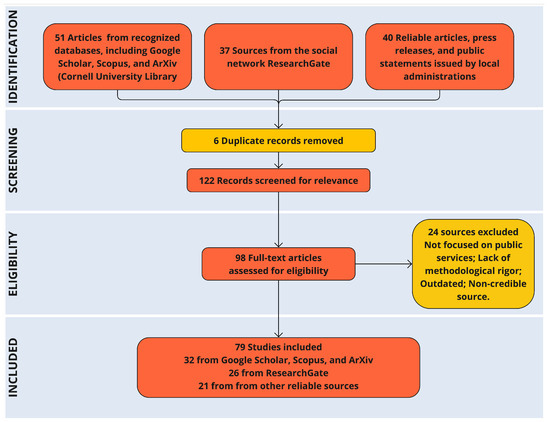
Figure 1.
The supporting PRISMA flow diagram behind our survey.
Following the initial selection, we reduced the number of references by eliminating those that did not meet our eligibility criteria. This refinement process significantly reduced the collection of references. To systematically categorize the information, we developed a comprehensive organizational framework. This involved arranging our sources into three distinct categories: the technological tools employed (such as smart contracts, the Metaverse, smart cities, and SSI), the geographical location of the experiments (such as Italy, Europe, and other global regions), and the specific applications addressed (including digital identity management, public records management, and social welfare processes). This structured approach allowed us to synthesize the literature effectively, providing a transparent and comprehensive understanding of how blockchain technology can be applied to public service delivery in alignment with the PRISMA 2020 guidelines [20]. To present our findings, we leverage three different “maps”, arranging our sources in terms of technology (i.e., technological tools employed), geography (i.e., where the experiment has been carried out), and functionality (i.e., what application has been tackled).
For what concerns the first map, we identified four main technologies: smart contracts, the Metaverse (including its enabling technologies), smart cities and self-sovereign identity (SSI). For each of these technologies, we listed the relevant sources we found: [8,24,26,27,28,29,30,31,32,33,34,35,36,37,38,39] for the first; [12,13,40,41,42,43,44,45,46,47,48,49,50,51,52,53] for the second technology; [30,35] for the third; [30,32,37,54,55,56] concerning SSI. A pictorial representation of the distribution of the sources across the four main technologies is provided in Figure 2.
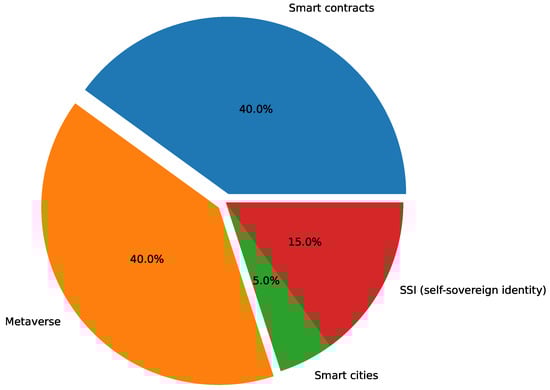
Figure 2.
Distribution of the sources across the identified four main technologies.
Regarding the geographic map, we organized the references according to three main geographic areas, namely “Italy”, “Europe”, and “World”, highlighting [28,29,33,57,58,59,60,61,62] for Italy, [26,31,37,54,63,64,65,66,67] for Europe, and [13,35,41,42,43,47,48,49,50,52,53,55,56,62,68,69,70,71,72,73] for “World”. A pictorial representation of the distribution of the sources across these three geographical areas is provided in Figure 3, with a more detailed breakdown in Figure 4 (Italy and Europe) and Figure 5 (the rest of the world).
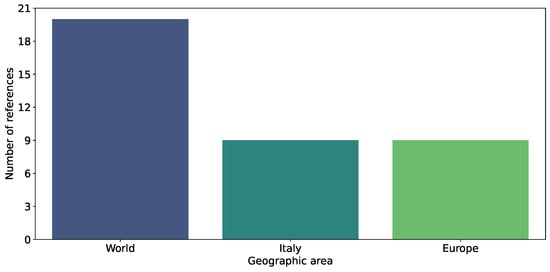
Figure 3.
Distribution of the sources across the three geographical areas.

Figure 4.
Frequency heatmap for the number of sources (Italy and Europe).
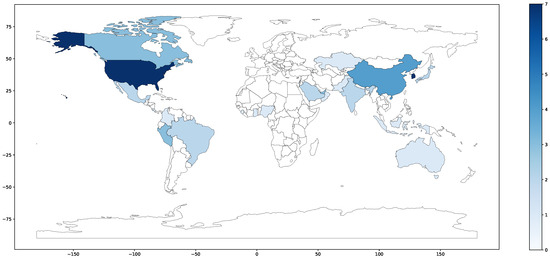
Figure 5.
Frequency heatmap for the number of sources (the rest of the world).
Concerning the chart arranged by functionality, we first distinguished the retrieved references into those focusing on a particular functionality, highlighting [21,25,27,29,31,32,33,34,37,42,48,58,59,66,67,73], and those providing a comprehensive overview of the different functionalities that may benefit from blockchain-related technology implementation, emphasizing [13,19,24,26,43,44,45,47,50,53,55,56,62,63,64,65,68,69,71,74] as relevant sources. For the former kind of references, we then identified six main subject areas: public records issuance/management [34,37,58,73], social benefit processes [31,33,59,66], public procurement [32], e-government (with the latter including e-voting and other governmental applications) [21,25,27,29,42,48,67], healthcare/emergency [36,49,51,52], and supply chain/trade operations [67,75], see Figure 6 for an overview. On the other hand, references embracing multiple functionalities were summarized in terms of keywords from which eight functional areas were extracted: thematic areas, along with their respective meaningful keywords, are summarized in Table 2. Thematic areas were highlighted to simplify the process of acknowledging references pertaining to the same functionality. This helped us to rank different functionalities by taking into account the number of references relating to each.
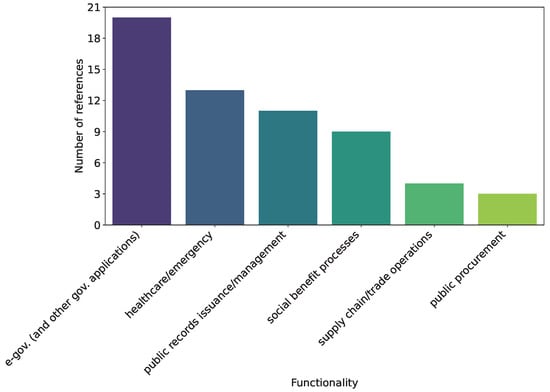
Figure 6.
Distribution of the sources according to their functionalities.
Table 2.
Functional areas and their respective keywords.
The three charts that we obtained were used as a starting point for how to arrange our survey. After acknowledging that the vast majority of existing literature either focuses on a specific technology/functionality/real-world implementation or provides a high-level review of different public sector domains for which blockchain technology could turn out to be useful, we decided to put together a review that stands out for its peculiarity of bringing together, for each functionality, both vertical (that focus on the functionality) and horizontal (that mention the functionality among prospective application areas) works, in addition to providing examples of real-world implementations. Therefore, the following section is organized by functionality, discussing each in terms of potential applications, as well as existing implementations at both the country and local levels.
5. Applications
5.1. E-Government, e-Voting, and Other Governmental Applications
The all-encompassing term “e-government” refers to the use of information and communication technologies (ICT) to enhance citizen participation and the efficiency, effectiveness, and transparency of public services provided. In [21], the authors observe that, since 2018, there has been a rise in interest in blockchain technology, as confirmed by the increasing number of papers and articles. However, only a small fraction of the proposed solutions have reached the prototyping stage. There are still issues concerning data protection and integration with other technologies in the context of public services provision that have to be addressed. Estonia is mentioned in [65,69] as being one of the forerunners of blockchain adoption in the public sector. All Estonian organizations rely heavily on a data exchange infrastructure that allows them to communicate and exchange sensitive data safely. Blockchain could be used as a tool to move beyond an outdated framework based on isolated silos by leveraging its immutability to reduce accountability and auditing costs. Furthermore, blockchain has advantages in terms of disintermediation, process streamlining, efficiency, cost reduction, and trust. All these features make it a suitable choice for public administrative bodies, as the increasing number of implementations, projects, and tests confirm. According to [62], from 2020 to 2022, blockchain adoption has moved from an initial phase of hype to a mature stage, as evidenced by the growing number of initiatives. The majority of solutions are aimed at “notarizing” existing processes, making them more secure, verifiable, and transparent.
The authors in [74] discuss electronic voting systems as one of the main areas of potential blockchain application and present the technology as a database management solution that can facilitate public service provisions while still ensuring security and data integrity. In [27], the authors present “Crypto-voting”, an e-voting system based on blockchain technology that aims to safeguard vote privacy against cyberattacks. The system relies on sidechain technology, which consists of a main permissioned blockchain and a subordinate blockchain that communicate with each other according to synchronization criteria. The two sidechains serve different purposes: the first is used to store eligible voters and their votes, whereas the second is used to count votes and publish results, and smart contracts are used to manage voting procedures. The Italian Municipality of Naples conducted its own trial with the aim of evaluating blockchain in the context of e-voting. As explained in [29], the task force responsible for the implementation proposed a system based on a permissionless blockchain, separating the voter’s identification by the polling station’s president from the preference expressed in the polling booth. The electronic vote becomes not only legitimate but also immutable thanks to a permissionless system that does not require third-party intermediation for granting the required authorizations. All in all, blockchain in the public sector is leveraged to provide transparent and verifiable information to citizens and to promote the integration of resources by different administrative bodies.
Blockchain can also act as an enabling tool, facilitating other technologies which contribute to enhancing public service provisions. An example is represented by smart contracts, self-executing agreements written in computer code that do not require the intermediation of a third party and that are triggered once some predefined conditions are met (cf. Section 2.1). As stated in [24], smart contracts could be used as a tool to ensure the integrity of procedures and administrative concessions, enhancing transparency and people’s trust in processes given the fact that a computer program executes a series of semantically and syntactically valid instructions, which leave no space for human interpretation. Ethereum and Lisk are recommended as platform alternatives as they support smart contracts (the former) and decentralized applications (the latter), in addition to both being enabled by public blockchains with unrestricted access.
The Metaverse (cf. Section 2.4) is another virtuous example of blockchain-enabled technology. Ref. [42] presents it as a technical design based on five main building blocks (decentralization, perception, exploration, hardware, and software), in which distributed communities (i.e., DAOs) can adopt their own system of governance without the need for third-party resources [46]. In [43], the authors examine several use cases and implementations of the Metaverse around the globe, with Seoul being a pioneer in the adoption of such technology for remote governance, allowing citizens and civil servants to interact with each other through virtual town halls and offices to improve the efficiency and effectiveness of public services provision [47]. Ref. [45] acknowledges that there is still a research gap concerning how the technology could be applied to the public sector in general and e-government in particular. Nevertheless, it has the potential to transform public service delivery, offering a more user-centric experience thanks to the integration of data and technology and increasing accessibility to public services through virtual town halls.
VR, also in the context of the Metaverse, is the final example of ICT that has potential use cases that could benefit e-government. According to [44], it enables government agencies and public administration to engage citizens in a wide range of activities and utilize their “collective wisdom” to develop solutions that address societal problems [25,48]. The technology could be leveraged to enable community meetings in virtual spaces and enhance coordination between governmental agencies and communication between administrative bodies and citizens. As some of the key requirements for VR adoption concern data security and identification, blockchain technology could be leveraged thanks to its security, integrity, verifiability, and transparency.
5.2. Social Welfare and Social Protection Processes
In a modern society characterized by social inequalities, social welfare and social protection play a fundamental role. Although the two terms are often used interchangeably, they have different meanings. Social welfare refers to the overall well-being of individuals in a society and includes all services aimed at helping those in need, whereas social protection focuses on helping those who are vulnerable and facing critical risks such as poverty, unemployment, and illnesses. As mentioned in [19], in terms of social protection, blockchain could be leveraged to disintermediate governmental transfers to citizens, transforming the way social policy is implemented thanks to its security and transparency in handling transfers [35]. Ref. [26], which explores Estonia’s blockchain project in general, focuses on organizations from the social welfare and healthcare sector in particular. For example, the Health Insurance Fund, an organization responsible for the provision of health insurance, benefits, and digital prescriptions, is planning to expand its platform with e-consultation services and nationwide databases, relying on distinctive blockchain features to enhance accountability and reduce costs. Thanks to improvements in traceability enabled by blockchain, each health item could be marked with a code which would be used to verify its authenticity and composition [36]. The Unemployment Insurance Fund is likely to experience similar advantages thanks to the adoption of technology. Several European countries have started conducting experiments regarding the implementation of blockchain in this area. For example, Ref. [64] mentions that the German Office for Refugees proposed a blockchain-based solution aimed at simplifying the asylum process by making public authorities issue digital certificates whose authenticity and integrity can be easily verified [66].
Initiatives can also be found at the local level. In Northern Italy, the municipality of Cinisello Balsamo, as explained in [59], was among the first in the European Union to adopt blockchain to simplify administrative procedures. Its “free nursery” trial measure was aimed at simplifying access to the calls, cutting administrative steps, and relying on blockchain technology to verify eligibility thanks to digital certificates stored in one’s digital wallet. Chieti, a city in Central Italy, is another virtuous example that is worth mentioning. As reported in [33], the municipality experimented with blockchain for the registration of practices such as maternity allowance, access to home care services for the disabled and the elderly, access to transportation services for the disabled, and applications for obtaining home educational assistance for people with sensory disabilities, all practices of great social relevance whose transparency and security are a key priority for citizens. The authors in [31], in collaboration with the Danish Syddjurs municipality, implemented a prototype for a specific social benefit process (compensation for earnings lost due to the caring of a child with a long-term illness) as an Ethereum-based smart contract that acts as an intermediary between the citizen, the municipal government caseworker, and the Appeals Board. The proposed system consists of a back-end of smart contracts written in Solidity, a front-end of web apps that communicate with the blockchain through the MetaMask library and a local database for the municipal government. As sensitive data are involved in the process, the system only stores a hash of the information, whereas a full copy is stored locally by the municipality.
Finally, blockchain-based technologies such as the Metaverse find applications in the social welfare context, as evidenced in both [43,49] concerning healthcare provision.
5.3. Education and Training
Although the link with the educational sector might not seem obvious, blockchain technology has the potential to revolutionize the way in which education is traditionally administered. Thanks to its distinctive features of security, integrity, and transparency, blockchain may act as a hosting platform for academic credentials, records, curricula, and certifications. As reported in [64], the University of Lille (France) issued digital academic credentials whose authenticity can be easily verified on the blockchain and the EBSI (European Blockchain Services Infrastructure), an EU-wide infrastructure that aims to enhance collaboration between country-level public administrations, piloting a cross-border solution involving more than 12 countries.
Blockchain-based technologies, such as smart contracts and the Metaverse, may also disrupt the educational sector thanks to innovative use cases that go beyond the issuance of digital academic credentials. Ref. [43] mentions Shanghai as a virtuous example of a country that is building up its own Metaverse infrastructure for education [50]. Dubai is taking it one step further by experimenting with the Metaverse as a platform for training employees, with the expectation to create more than 40,000 virtual jobs by the end of 2028. Ref. [45] presents training and education as use cases with the potential to benefit the public sector for public service delivery, with prospective applications for distance learning, making educational resources more affordable and enabling a more immersive learning experience [51]. Virtual reality, one of the key Metaverse-enabling technologies, finds application in this domain as well. As stated in [44], one of the possible applications of this quite recent technology is in the context of training and education, where it could be helpful for emergency services training [52] and to visualize damages to public infrastructures within the scope of public utilities.
5.4. Digital Identity Management
As the name already suggests, digital identity is nothing more than a digital representation of a person’s physical identity, which enables access to services once it has been verified. According to [62,74], public areas of potential blockchain application involve decentralized systems for personal identification, digital signature, and access authorization, with clear advantages in terms of disintermediation, process simplification, trust, and decreased costs. Ref. [19] states that digital identity could be transformed into a more efficient and accessible public service thanks to blockchain adoption. For example, governments may save large sums of money by employing physical office spaces for verification and call centers [55]. As mentioned in [30], blockchain technology can take it one step further, enabling a decentralized digital identity referred to as self-sovereign identity (SSI) through a public–private key pair for enhanced security, which allows citizens to exert full control over their personal information, overcoming the limitations of traditional centralized infrastructures. As discussed in [54,56], centralized storage solutions pose challenges in terms of a single point of failure and raise concerns regarding privacy and government control over everyone’s data. SSI could prevent surveillance and misuse from happening thanks to the possibility of tracking access to someone’s information and the validity of credentials. The Italian Ministry of Economy and Finance, in [28], acknowledges that the EU has well understood the potential of blockchain in this context, deciding to launch a pan-European project called Poseidon that aims to build a platform for the management and protection of personal data. The platform, initially accessible to public administration employees through the use of smart contracts and blockchain to implement the principles of transparency and encryption, provides them with more control over their digital identity by enabling them to determine who can process their data, grant or revoke permissions, and decide on the removal of their personal information from the platform. This EU-wide initiative has paved the way for several initiatives at the local level. In [64], identity management is mentioned as one of the key use cases that could benefit from blockchain adoption, and the government of Catalunya is presented as a municipality that deployed a solution to offer students discounts on utilities using their digital identity. Refs. [19,26,63] introduce Estonia’s e-residency program as a good example of how blockchain could change the traditional way in which citizens and public sector bodies interact, diminishing costs required to promote public services and reducing the administrative burden on both the state and citizens.
5.5. Public Procurement
Public procurement refers to the purchase of goods, services, and works by governments and state-owned enterprises. Notably, as public procurement is carried out using taxpayers’ money, governments are expected to perform it efficiently and with high standards of conduct to safeguard public interest and ensure the quality of public service provisions. This is when blockchain comes into play, thanks to its potential to make public service delivery more efficient and transparent, addressing corruption and other concerns [76]. Ref. [19] identifies public procurement as one of the key functionalities that are likely to benefit from blockchain implementation. As stated in [19], governments and state-owned enterprises could display their expenses on a public ledger available to all citizens. This would enhance transparency and accountability while still ensuring anonymity, thanks to the platform’s design [70]. Smart contracts are one of the main tools that could be leveraged to achieve enhanced transparency. Ref. [24] mentions several Spanish initiatives involving a decentralized registry of offers as a tool to allow automated validation of offerings through smart contracts. The authors in [32] take it one step further by proposing a prototype that relies on smart contracts to automatize the recording of some transactions in order to address the challenges of human fallibility, improper information disclosure, and hidden agreements that characterize any public procurement procedure. The prototype works as follows: during the bidding phase, a smart contract is used in order to ensure that no price information is transmitted or stored and that a company cannot change the price once it has submitted an offer. After an offering period, the smart contract executes itself and declares a preliminary winner (the supplier offering the lowest price), whose compliance with legal requirements is verified in the subsequent step. The supplier habilitation phase involves the concept of self-sovereign identity (SSI), with each vendor being associated with a digital identity with blockchain-stored certifications that can be bound to it. A smart contract executes itself in order to check whether participating companies comply with all general and tender-specific requirements. During the delivery verification stage of the process, a smart contract is used to randomly select two or more auditors that are responsible for evaluating the quality of delivered goods, services, and works.
5.6. Public Records Management
The all-embracing term “public record” refers to any piece of personal information that has been processed and stored by a public office. Within this context, blockchain technology could be used to provide access to information stored in a single location, moving beyond a scenario in which different pieces of personal information are usually stored in different databases that do not communicate with each other. The so-called “integration of resources”, namely the enhanced information exchange and cooperation between different public organizations, is one of the key benefits that the technology could bring. Refs. [68,74] mention civil registration, the storage of birth/marriage/death certificates, as one of the main areas of blockchain application. By storing information in a decentralized way, the technology could prevent unauthorized access, thereby preventing the records from being tampered with. Ref. [19] identifies public record management as the main sector that could potentially be affected by blockchain technology, with the latter being used to make records more accessible, reducing the cost of registering information and ensuring that records are kept up to date. Blockchain-based technologies could also be leveraged for asset registration. Ref. [24] highlights the use of smart contracts for property registration to verify the identity of the buyer and seller and automatically register the property on behalf of the new owner [71]. Land registry is cited by both [63,64] as a field where blockchain technology could be exploited as well, with the latter reporting Sweden’s experimentation of a blockchain-based solution for the transfer of land titles, reducing the amount of time required for property registration from 4 months to a few days, leading to time and cost savings [37].
5.7. Certificate Issuance
Among several fields, blockchain technology finds application in the context of certificate issuance, where it has the potential to transform public administration by improving transparency and efficiency of public services. Ref. [34] focuses on the integration of Ethereum and a decentralized file storage system, the Interplanetary File System (IFS), for birth certificate issuance through the Notarial office. The system works as follows: a resident uploads relevant documents on IFPS (an off-chain solution to incur lower gas fees) to generate a hash and then uploads the hash on Ethereum. A smart contract sends the hash to the Notarial Office, which decrypts it on IFPS to verify identity. The key advantage of the proposed solution is that documents and data are stored across a decentralized network of nodes, thereby preventing any attempt at tampering. Ethereum-based smart contracts supplement this with timestamped, immutable records of transactions, thus guaranteeing the preservation of historical data. Initiatives within the context of certificate issuance can also be found at the Italian Level. As reported in [58], the municipality of Bari has experimented with blockchain technology to digitize the issuance of guarantee insurance policies, with the aim of dematerializing the issuance process and uniquely certifying the contractor’s possession of guarantees.
5.8. Tax Collection
As evidenced in [63], blockchain technology could be leveraged to enhance the overall functioning of the tax system. Ref. [75] highlights how blockchain could bring benefits to governments in terms of cooperation between different tax authorities and customs agencies. Thanks to the technology’s distinctive features of transparency and traceability, blockchain could empower tax authorities to detect fraud and errors more efficiently and effectively [72], as shown in Ref. [67]. Furthermore, it could also be used to improve inter-agency coordination thanks to its decentralized nature. The potential use of the technology within this context is also examined in [74], which mentions the “UK to trial Blockchain in welfare payments” project as an example of a distributed-ledger solution to support the realization of tasks in relation to tax collection.
5.9. Sustainability
Within the context of blockchain technology used in the public sector, the all-encompassing term “sustainability” is used with the connotation of urban planning and food production/recycling. As reported in [68], blockchain finds application in the field of agriculture, where it could be used to ensure the traceability of food origins. In Southern Italy, as explained in [57], the municipality of Cosenza has launched a trial of blockchain technology for the reuse of food stocks close to expiration from large retailers, in collaboration with NTT Data, the University of Calabria, and Banco Alimentare (a non-profit Italian food bank foundation). The technology is being leveraged to certify food donations from supermarkets, canteens, and stores.
In the area of urban planning, the Metaverse is one of the most promising blockchain-based technologies, together with its enabling technologies, such as VR, as mentioned in both [44,45]. Ref. [43] discusses several real-world implementations, such as on the small island of Tuvalu (Pacific Ocean), which is using the Metaverse to recreate its physical assets in a virtual world to preserve them against threats such as climate change, as well as Shanghai and Saudi Arabia, with the latter allowing people to “live” in the Metaverse while the city (Neom) is being built [53].
6. Challenges and Future Directions
Despite its clear advantages in terms of security, integrity, immutability, transparency, and traceability, there are still challenges that have to be addressed if the widespread adoption of blockchain technology in the public sector is to be achieved. In the following, we stratify the challenges into three main categories: technological, legal and regulatory, and social.
From a technical perspective, key research priorities include addressing scalability challenges as blockchain networks expand [2], improving interoperability between different platforms (also off-chain hosting) [77], and enhancing the security and privacy of blockchain applications to prevent breaches and hacking attacks [17,78]. As far as the latter is concerned, blockchains should feature robust protocols (e.g., validation protocols), accounting for the high energy consumption of (some) blockchain validation processes [1]. As explained in [68], the technology is still immature concerning applications that go beyond the financial context as the vast majority of the proposed solutions are still in a conceptual/experimental phase and only a small percentage of them have reached the evaluation/prototyping stage [21]. This will provide policymakers with practical, evidence-based insights regarding the benefits, risks, and costs of blockchain in public services. Furthermore, it poses challenges in terms of a lack of public awareness and potential failures, which may expose sensitive information, making it difficult to identify the institutions responsible for managing the system in a decentralized scenario such as the one that blockchain technology enables [21].
On the legal and regulatory front, future research endeavours must investigate the appropriate frameworks to govern the use of blockchain in the public sector, ensuring compliance with data privacy laws and addressing liability concerns. As blockchain disrupts traditional models of public service delivery, legal scholars will need to tackle novel questions around the role of public authorities and the legal status of decentralized, blockchain-based systems. For example, Ref. [19] describes legal uncertainty as one of the major barriers to achieving extensive adoption, as blockchain agreements still do not have the legal value of a contract [73] and identifying which jurisdiction applies in the context of international blockchains is challenging [79]. Issues have also emerged from real-world experimentations. As mentioned in [31], one of the main implementation challenges is the dichotomy between the need for immutable contracts on the one hand [38,39] and the need to support constantly changing laws and reverse cases that were decided in an unlawful manner on the other. For example, within the context of smart contracts, there are conflicting requirements related to the nature of blockchain technologies that need to be addressed as they need to be immutable and outside the government’s control when running but also editable when laws change and when there is a mistake that may lead to unlawful behavior.
Finally, from a social standpoint, understanding the impact of blockchain on public trust, acceptance, and governance is crucial [22]. Organizational and societal implications of blockchain’s decentralized and transparent nature must be studied, exploring how it may reshape the relationship between citizens and their governments [17]. Investigating strategies to build trust in blockchain-based public services will be essential for driving widespread adoption.
7. Conclusions
Blockchain technology has the potential to revolutionize the way in which several domains, such as public services provision, are traditionally administered. Thanks to its clear advantages in terms of transparency, integrity, immutability, traceability, and efficiency, blockchain could be exploited to provide and manage public services without the intervention of third parties, thus contributing to enhancing people’s perception of public administration. After quickly presenting the main distinctive features of blockchain and blockchain-enabled technologies, we outlined the research methodology that allowed us to identify potential research gaps that were used as a starting point for how to arrange our discussion. The survey we put together stands out for combining, for each functional area, both vertical and horizontal works, in addition to providing examples of real-world implementations, compared to traditional works that focus on a selected technology/functionality/implementation. Although blockchain technology could disrupt public service delivery, there are still many challenges to its widespread adoption that have to be dealt with, the most relevant being the technology’s immaturity and lack of public awareness, not to mention legal uncertainty and the risk of data breaches that could involve sensitive information stored on the Blockchain. There is an obvious research gap concerning the challenges that this cutting-edge technology poses. Future research should focus on how these issues could be mediated. Only if challenges which stem from the technology’s characterizing features are to be coped with can the full potential of blockchain in transforming people’s way of interacting with public administration and improving their societal well-being be unlocked.
Author Contributions
Conceptualization, A.M.; Data Curation, L.C. and A.M.; Investigation, L.C. and A.M.; Methodology, G.P., L.C. and A.M.; Project Administration, A.M.; Resources, L.C. and A.M.; Supervision, A.M.; Validation: G.P., L.C. and A.M.; Visualization: L.C. and A.M.; Writing—original draft: L.C. and A.M.; Writing—review and editing: L.C. and A.M. All authors have read and agreed to the published version of the manuscript.
Funding
This research received no external funding.
Data Availability Statement
No new data were created or analyzed in this study.
Conflicts of Interest
The authors declare no conflicts of interest.
Abbreviations
The following abbreviations are used in this manuscript:
| AR | Augmented Reality |
| DAO | Decentralized Autonomous Organization |
| DLT | Distributed Ledger Technology |
| EBSI | European Blockchain Services Infrastructure |
| EU | European Union |
| EVM | Ethereum Virtual Machine |
| G2C | Government-to-Citizen |
| ICT | Information and Communication Technologies |
| IPFS | InterPlanetary File System |
| LR | Literature Review |
| NFT | Non-Fungible Token |
| RQ | Research Question |
| SLR | Systematic Literature Review |
| SSI | Self-Sovreign Identity |
| UK | United Kingdom |
| VR | Virtual Reality |
References
- Casino, F.; Dasaklis, T.K.; Patsakis, C. A systematic literature review of blockchain-based applications: Current status, classification and open issues. Telemat. Inform. 2019, 36, 55–81. [Google Scholar] [CrossRef]
- Dasaklis, T.K.; Voutsinas, T.G.; Tsoulfas, G.T.; Casino, F. A Systematic Literature Review of Blockchain-Enabled Supply Chain Traceability Implementations. Sustainability 2022, 14, 2439. [Google Scholar] [CrossRef]
- Ariley, G. Why People (Dis)like the Public Service: Citizen Perception of the Public Service and the NPM Doctrine. Politics Policy 2011, 39, 997–1019. [Google Scholar] [CrossRef]
- Meijer, A. Understanding the Complex Dynamics of Transparency. Public Adm. Rev. 2013, 73, 429–439. [Google Scholar] [CrossRef]
- Antonopoulos, A.M. Mastering Bitcoin: Programming the Open Blockchain, 3rd ed.; O’Reilly Media: Newton, MA, USA, 2023. [Google Scholar]
- Antonopoulos, A.M.; Wood, G. Mastering Ethereum: Building Smart Contracts and DApps, 1st ed.; O’Reilly Media: Newton, MA, USA, 2019. [Google Scholar]
- Bagozi, A.; Bianchini, D.; De Antonellis, V.; Garda, M.; Melchiori, M. Services as Enterprise Smart Contracts in the Digital Factory. In Proceedings of the 2019 IEEE International Conference on Web Services (ICWS), Milan, Italy, 8–13 July 2019; pp. 224–228. [Google Scholar] [CrossRef]
- Taherdoost, H. Smart Contracts in Blockchain Technology: A Critical Review. Information 2023, 14, 117. [Google Scholar] [CrossRef]
- Rivero Moreno, L.D. Art on the chain? On the possibilities of new media art preservation on the Web3. Digit. Creat. 2024, 1–13. [Google Scholar] [CrossRef]
- Zarifis, A.; Cheng, X. The business models of NFTs and fan tokens and how they build trust. J. Electron. Bus. Digit. Econ. 2022, 1, 138–151. [Google Scholar] [CrossRef]
- Juan, A.A.; Perez-Bernabeu, E.; Li, Y.; Martin, X.A.; Ammouriova, M.; Barrios, B.B. Tokenized Markets Using Blockchain Technology: Exploring Recent Developments and Opportunities. Information 2023, 14, 347. [Google Scholar] [CrossRef]
- Sparkes, M. What is a metaverse. New Sci. 2021, 251, 18. [Google Scholar] [CrossRef]
- Iqbal, M.Z.; Campbell, A.G. Metaverse as Tech for Good: Current Progress and Emerging Opportunities. Virtual Worlds 2023, 2, 326–342. [Google Scholar] [CrossRef]
- Aliti, A.; Leka, E.; Luma, A.; Trpkovska, M.A. A Systematic Literature Review on Using Blockchain Technology in Public Administration. In Proceedings of the 2022 45th Jubilee International Convention on Information, Communication and Electronic Technology (MIPRO), Opatija, Croatia, 23–27 May 2022; pp. 1031–1036. [Google Scholar] [CrossRef]
- Kitchenham, B.; Pearl Brereton, O.; Budgen, D.; Turner, M.; Bailey, J.; Linkman, S. Systematic literature reviews in software engineering – A systematic literature review. Inf. Softw. Technol. 2009, 51, 7–15. [Google Scholar] [CrossRef]
- Petersen, K.; Feldt, R.; Mujtaba, S.; Mattsson, M. Systematic mapping studies in software engineering. In Proceedings of the 12th International Conference on Evaluation and Assessment in Software Engineering, Swindon, GBR, EASE’08, Bari, Italy, 26–27 June 2008; pp. 68–77. [Google Scholar]
- Batubara, F.R.; Ubacht, J.; Janssen, M. Challenges of blockchain technology adoption for e-government: A systematic literature review. In Proceedings of the 19th Annual International Conference on Digital Government Research: Governance in the Data Age, dg.o ’18, New York, NY, USA, 30 May–3 June 2018. [Google Scholar] [CrossRef]
- Datta, A. Blockchain Enabled Digital Government and Public Sector Services: A Survey. In Blockchain and the Public Sector: Theories, Reforms, and Case Studies; Reddick, C.G., Rodríguez-Bolívar, M.P., Scholl, H.J., Eds.; Springer International Publishing: Cham, Switzerland, 2021; pp. 175–195. [Google Scholar] [CrossRef]
- Cagigas, D.; Clifton, J.; Diaz-Fuentes, D.; Fernández-Gutiérrez, M. Blockchain for Public Services: A Systematic Literature Review. IEEE Access 2021, 9, 13904–13921. [Google Scholar] [CrossRef]
- Liberati, A.; Altman, D.G.; Tetzlaff, J.; Mulrow, C.; Gøtzsche, P.C.; Ioannidis, J.P.A.; Clarke, M.; Devereaux, P.J.; Kleijnen, J.; Moher, D. The PRISMA Statement for Reporting Systematic Reviews and Meta-Analyses of Studies That Evaluate Health Care Interventions: Explanation and Elaboration. PLoS Med. 2009, 6, 1–28. [Google Scholar] [CrossRef]
- Lykidis, I.; Drosatos, G.; Rantos, K. The Use of Blockchain Technology in e-Government Services. Computers 2021, 10, 168. [Google Scholar] [CrossRef]
- Amend, J.; Kaiser, J.; Uhlig, L.; Urbach, N.; Völter, F. What Do We Really Need? A Systematic Literature Review of the Requirements for Blockchain-Based E-government Services. In Innovation Through Information Systems; Ahlemann, F., Schütte, R., Stieglitz, S., Eds.; Springer International Publishing: Cham, Switzerland, 2021; pp. 398–412. [Google Scholar]
- Verma, S.; Sheel, A. Blockchain for government organizations: Past, present and future. J. Glob. Oper. Strateg. Sourc. 2022, 15, 406–430. [Google Scholar] [CrossRef]
- Triana Casallas, J.A.; Cueva-Lovelle, J.M.; Rodríguez Molano, J.I. Smart Contracts with Blockchain in the Public Sector. Int. J. Interact. Multimed. Artif. Intell. 2020, 6, 63–72. [Google Scholar] [CrossRef]
- Simonofski, A.; Snoeck, M.; Vanderose, B.; Crompvoets, J.; Habra, N. Reexamining E-participation: Systematic Literature Review on Citizen Participation in E-government Service Delivery. In Proceedings of the 23rd Americas Conference on Information Systems, Boston, MA, USA, 10–12 August 2017; pp. 1–10. [Google Scholar]
- Jalakas, P. Blockchain from public administration perspective: Case of Estonia. Master’s Thesis, Tallinn University of Technology, Tallinn, Estonia, 2018. [Google Scholar]
- Fusco, F.; Lunesu, M.I.; Pani, F.E.; Pinna, A. Crypto-voting, a Blockchain based e-Voting System. In Proceedings of the 10th International Joint Conference on Knowledge Discovery, Knowledge Engineering and Knowledge Management (IC3K 2018)—KMIS. INSTICC, SciTePress, Seville, Spain, 18–20 September 2018; pp. 223–227. [Google Scholar] [CrossRef]
- Identità Digitale, con Poseidon il MEF Sperimenta Nuovi Servizi per 2 Milioni di Dipendenti Pubblici. Available online: https://www.mef.gov.it/ufficio-stampa/comunicati/2018/Identita-digitale-con-Poseidon-il-MEF-sperimenta-nuovi-servizi-per-2-milioni-di-dipendenti-pubblici/ (accessed on 20 May 2024). (In Italian)
- Gruppo di Studio Volontario su Blockchain (trasparenza) e Criptovalute (Pagamenti) [Delibera n.465 del 05/10/2018]. Available online: https://www.comune.napoli.it/blockchain (accessed on 20 May 2024). (In Italian).
- Rotuna, C.; Gheorghita, A.; Zamfiroiu, A.; Smada, D.M. Smart City Ecosystem Using Blockchain Technology. Inform. Econ. 2019, 23, 41–50. [Google Scholar] [CrossRef]
- Krogsbøll, M.; Borre, L.H.; Slaats, T.; Debois, S. Smart Contracts for Government Processes: Case Study and Prototype Implementation (Short Paper). In Financial Cryptography and Data Security; Bonneau, J., Heninger, N., Eds.; Springer International Publishing: Cham, Switzerland, 2020; pp. 676–684. [Google Scholar]
- Weingärtner, T.; Batista, D.; Köchli, S.; Voutat, G. Prototyping a Smart Contract Based Public Procurement to Fight Corruption. Computers 2021, 10, 85. [Google Scholar] [CrossRef]
- Mangrovia Blockchain Solutions al fianco del Comune di Chieti nel Processo di Digitalizzazione. Available online: https://www.comune.chieti.it/notizie/mangrovia-blockchain-solutions-al-fianco-del-comune-di-chieti-nel-processo-di-digitalizzazione.html (accessed on 20 May 2024). (In Italian).
- Abdelhamid, I.R.; Abdel Halim, I.T.; Ibrahim, I.A.; Amin Ali, A.E.M. Redefining Governmental Services Through Blockchain and Smart Contracts. Math. Model. Eng. Probl. 2023, 10, 1515–1528. [Google Scholar] [CrossRef]
- Kundu, D. Blockchain and Trust in a Smart City. Environ. Urban. ASIA 2019, 10, 31–43. [Google Scholar] [CrossRef]
- Radanović, I.; Likić, R. Opportunities for Use of Blockchain Technology in Medicine. Appl. Health Econ. Health Policy 2018, 16, 583–590. [Google Scholar] [CrossRef] [PubMed]
- McMurren, J.; Young, A.; Verhulst, S. Addressing Transaction Costs Through Blockchain and Identity in Swedish Land Transfers. Blockchange Report October 2018. 2018. Available online: https://blockchan.ge/blockchange-land-registry.pdf (accessed on 6 August 2024).
- Mavridou, A.; Laszka, A. Designing Secure Ethereum Smart Contracts: A Finite State Machine Based Approach. In Financial Cryptography and Data Security; Meiklejohn, S., Sako, K., Eds.; Springer: Berlin/Heidelberg, Germany, 2018; pp. 523–540. [Google Scholar] [CrossRef]
- Mavridou, A.; Laszka, A.; Stachtiari, E.; Dubey, A. VeriSolid: Correct-by-Design Smart Contracts for Ethereum. In Financial Cryptography and Data Security; Goldberg, I., Moore, T., Eds.; Springer International Publishing: Cham, Switzerland, 2019; pp. 446–465. [Google Scholar] [CrossRef]
- Duan, H.; Li, J.; Fan, S.; Lin, Z.; Wu, X.; Cai, W. Metaverse for Social Good: A University Campus Prototype. In Proceedings of the 29th ACM International Conference on Multimedia, MM ’21, Virtual Event, 20–24 October 2021; ACM: New York, NY, USA, 2021; pp. 153–161. [Google Scholar] [CrossRef]
- Seoul to Provide Public Services through Its Own Metaverse Platform. Available online: https://english.seoul.go.kr/seoul-to-provide-public-services-through-its-own-metaverse-platform/ (accessed on 20 May 2024).
- Yfantis, V.; Ntalianis, K. Exploring the Potential Adoption of Metaverse in Government. In Data Intelligence and Cognitive Informatics; Jacob, I.J., Kolandapalayam Shanmugam, S., Izonin, I., Eds.; Springer: Singapore, 2023; pp. 815–824. [Google Scholar]
- Naqvi, N. Metaverse for Public Good: Embracing the Societal Impact of Metaverse Economies. J. Br. Blockchain Assoc. 2023, 6, 1–17. [Google Scholar] [CrossRef]
- Baldauf, M.; Zimmermann, H.D.; Baer-Baldauf, P.; Bekiri, V. Virtual Reality for Smart Government – Requirements, Opportunities, and Challenges. In HCI in Business, Government and Organizations; Nah, F., Siau, K., Eds.; Springer: Cham, Switzerland, 2023; pp. 3–13. [Google Scholar] [CrossRef]
- Distor, C.; Ben Dhaou, S.; Nielsen, M.M. Metaverse vs. Metacurse: The Role of Governments and Public Sector Use Cases. Available online: https://ceur-ws.org/Vol-3449/paper8.pdf (accessed on 6 August 2024).
- Nabben, K. Building the metaverse: ’crypto states’ and corporates compete, down to the hardware. SSRN 2022. [Google Scholar] [CrossRef]
- South Korea Launches Online Metaverse Replica of Capital City Seoul to Improve Public Services. Available online: https://forkast.news/south-korea-metaverse-capital-city-seoul/ (accessed on 20 May 2024).
- Leible, S.; Ludzay, M.; Götz, S.; Kaufmann, T.; Meyer-Lüters, K.; Tran, M.N. ICT Application Types and Equality of E-Participation—A Systematic Literature. In Proceedings of the Pacific Asia Conference on Information Systems, Virtual Even, 5–9 July 2022; pp. 1–17. [Google Scholar]
- Wang, G.; Badal, A.; Jia, X.; Maltz, J.S.; Mueller, K.; Myers, K.J.; Niu, C.; Vannier, M.; Yan, P.; Yu, Z.; et al. Development of metaverse for intelligent healthcare. Nat. Mach. Intell. 2022, 4, 922–929. [Google Scholar] [CrossRef]
- Shanghai Starts Metaverse Services at 20 Urban Spots as Part of Pilot Program. Available online: https://www.globaltimes.cn/page/202301/1283918.shtml (accessed on 20 May 2024).
- Iwanaga, J.; Muo, E.C.; Tabira, Y.; Watanabe, K.; Tubbs, S.J.; D’Antoni, A.V.; Rajaram-Gilkes, M.; Loukas, M.; Khalil, M.K.; Tubbs, R.S. Who really needs a Metaverse in anatomy education? A review with preliminary survey results. Clin. Anat. 2023, 36, 77–82. [Google Scholar] [CrossRef] [PubMed]
- Israeli Metaverse Startup Saves Lives on Earth and heads for Space. Available online: https://www.timesofisrael.com/spotlight/israeli-metaverse-startup-saves-lives-on-earth-and-heads-for-space/ (accessed on 20 May 2024).
- Saudi Arabia’s New Metaverse Will Help Design $500bn City IRL. Available online: https://wired.me/technology/saudi-arabias-new-metaverse-will-help-design-500bn-city-irl/ (accessed on 20 May 2024).
- Mahula, S.; Tan, E.; Crompvoets, J. With blockchain or not? Opportunities and challenges of self-sovereign identity implementation in public administration: Lessons from the Belgian case. In Proceedings of the DG.O2021: The 22nd Annual International Conference on Digital Government Research, DG.O’21, Omaha, NE, USA, 9–11 June 2021; ACM: New York, NY, USA, 2021; pp. 495–504. [Google Scholar] [CrossRef]
- Wolfond, G. A Blockchain Ecosystem for Digital Identity: Improving Service Delivery in Canada’s Public and Private Sectors. Technol. Innov. Manag. Rev. 2017, 7, 35–40. [Google Scholar] [CrossRef]
- Pöhn, D.; Grabatin, M.; Hommel, W. eID and Self-Sovereign Identity Usage: An Overview. Electronics 2021, 10, 2811. [Google Scholar] [CrossRef]
- Blockchain e Solidarietà: NTT DATA, Comune di Cosenza e Unical Sperimentano una Nuova Tecnologia per il Riutilizzo delle Scorte di Cibo della Grande Distribuzione. Partner Operativo il Banco Alimentare. Available online: http://www.comune.cosenza.it/it/novita/page/blockchain-e-solidarieta-ntt-data-comune-di-cosenza-e-unical-sperimentano-una-nuova-tecnologia-per-il-riutilizzo-delle-scorte-di-cibo-della-grande-distribuzione-partner-operativo-il-banco-alimentare (accessed on 20 May 2024). (In Italian).
- PA Digitale: Il Comune di Bari Avvia con SIA il Primo Progetto Blockchain in Italia per Certificare L’autenticità e il Rilascio di Polizze Fideiussorie Attraverso L’utilizzo di Smart Contract. Available online: https://www.comune.bari.it/-/pa-digitale-il-comune-di-bari-avvia-con-sia-il-primo-progetto-blockchain-in-italia-per-certificare-l-autenticita-e-il-rilascio-di-polizze-fideiussorie (accessed on 20 May 2024). (In Italian).
- Bertani, D. Nidi Gratis. Sperimentazione con Tecnologia Blockchain a Cinisello Balsamo. Available online: https://www.lombardianotizie.online/nidi-gratis-sperimentazione-con-blockchain/ (accessed on 20 May 2024). (In Italian).
- Treiblmaier, H.; Sillaber, C. A Case Study of Blockchain-Induced Digital Transformation in the Public Sector. In Blockchain and Distributed Ledger Technology Use Cases: Applications and Lessons Learned; Treiblmaier, H., Clohessy, T., Eds.; Springer International Publishing: Cham, Switzerland, 2020; pp. 227–244. [Google Scholar] [CrossRef]
- 80 Comuni Italiani Pionieri dell’Innovazione Sperimentano le Blockchain per Monitorare la Sostenibilità dei Territori. Available online: https://www.comunisostenibili.eu/2023/01/24/80-comuni-italiani-pionieri-dellinnovazione-sperimentano-le-blockchain-per-monitorare-la-sostenibilita-dei-territori/ (accessed on 20 May 2024). (In Italian).
- Righetti, R. Blockchain in the Public Sector: An International Census and a Case Study of Public Administration Collaboration. Master’s Thesis, Polytechnic University of Milan, Milan, Italy, 2023. [Google Scholar]
- The UK Government Chief Scientific Adviser. Distributed Ledger Technology: Beyond Block Chain; Government Office for Science: London, UK, 2016. [Google Scholar]
- Martin Bosch, J.; Tangi, L.; Burian, P. European Landscape on the Use of Blockchain Technology by the Public Sector; JRC131202; Publications Office of the European Union: Luxembourg, Luxembourg, 2022. [Google Scholar] [CrossRef]
- Lember, V.; Kattel, R.; Tõnurist, P. Public Administration, Technology and Administrative Capacity. Available online: https://ideas.repec.org/p/tth/wpaper/71.html (accessed on 6 August 2024).
- Guggenmos, F.; Lockl, J.; Rieger, A.; Wenninger, A.; Fridgen, G. How to develop a GDPR-compliant blockchain solution for cross-organizational workflow management: Evidence from the German asylum procedure. In Proceedings of the 53rd Hawaii International Conference on System Sciences, Maui, Hawaii, USA, 7–10 January 2020; pp. 4023–4032. [Google Scholar]
- Hyvärinen, H.; Risius, M.; Friis, G. A Blockchain-Based Approach Towards Overcoming Financial Fraud in Public Sector Services. Bus. Inf. Syst. Eng. 2017, 59, 441–456. [Google Scholar] [CrossRef]
- Navadkar, V.H.; Nighot, A.; Wantmure, R. Overview of blockchain technology in government/public sectors. Int. Res. J. Eng. Technol. 2018, 5, 2287–2292. [Google Scholar]
- Martinovic, I.; Kello, L.; Sluganovic, I. Blockchains for Governmental Services: Design Principles, Applications, and Case Studies; Working Paper Series no. 7; University of Oxford: Oxford, UK, 2017. [Google Scholar]
- Abelseth, B. Blockchain Tracking and Cannabis Regulation: Developing a permissioned blockchain network to track Canada’s cannabis supply chain. Dalhous. J. Interdiscip. Manag. 2018, 14, 1–11. [Google Scholar] [CrossRef]
- Berryhill, J.; Bourgery, T.; Hanson, A. Blockchains Unchained: Blockchain Technology and its Use in the Public Sector. Available online: https://www.oecd-ilibrary.org/governance/blockchains-unchained_3c32c429-en (accessed on 6 August 2024).
- Chang, Y.; Iakovou, E.; Shi, W. Blockchain in global supply chains and cross border trade: A critical synthesis of the state-of-the-art, challenges and opportunities. Int. J. Prod. Res. 2020, 58, 2082–2099. [Google Scholar] [CrossRef]
- Lemieux, V.L. Blockchain and Public Record Keeping: Of Temples, Prisons, and the (Re)Configuration of Power. Front. Blockchain 2019, 2. [Google Scholar] [CrossRef]
- Rot, A.; Sobińska, M.; Hernes, M.; Franczyk, B. Digital Transformation of Public Administration Through Blockchain Technology. In Towards Industry 4.0—Current Challenges in Information Systems; Hernes, M., Rot, A., Jelonek, D., Eds.; Springer International Publishing: Cham, Switzerland, 2020; pp. 111–126. [Google Scholar] [CrossRef]
- van Engelenburg, S.; Janssen, M.; Klievink, B. Design of a software architecture supporting business-to-government information sharing to improve public safety and security. J. Intell. Inf. Syst. 2019, 52, 595–618. [Google Scholar] [CrossRef]
- Jarrahi, M.H. Artificial intelligence and the future of work: Human-AI symbiosis in organizational decision making. Bus. Horizons 2018, 61, 577–586. [Google Scholar] [CrossRef]
- Lafourcade, P.; Lombard-Platet, M. About blockchain interoperability. Inf. Process. Lett. 2020, 161, 105976. [Google Scholar] [CrossRef]
- Islam, M.R.; Rahman, M.M.; Mahmud, M.; Rahman, M.A.; Mohamad, M.H.S.; Embong, A.H. A Review on Blockchain Security Issues and Challenges. In Proceedings of the 2021 IEEE 12th Control and System Graduate Research Colloquium (ICSGRC), Shah Alam, Malaysia, 7 August 2021; pp. 227–232. [Google Scholar] [CrossRef]
- Davidson, S.; De Filippi, P.; Potts, J. Blockchains and the economic institutions of capitalism. J. Institutional Econ. 2018, 14, 639–658. [Google Scholar] [CrossRef]
Disclaimer/Publisher’s Note: The statements, opinions and data contained in all publications are solely those of the individual author(s) and contributor(s) and not of MDPI and/or the editor(s). MDPI and/or the editor(s) disclaim responsibility for any injury to people or property resulting from any ideas, methods, instructions or products referred to in the content. |
© 2024 by the authors. Licensee MDPI, Basel, Switzerland. This article is an open access article distributed under the terms and conditions of the Creative Commons Attribution (CC BY) license (https://creativecommons.org/licenses/by/4.0/).