
You are currently viewing a new version of our website. To view the old version click .
Future Internet
  • Article
  • Open Access

26 November 2021

Adaptive Multi-Grained Buffer Management for Database Systems
and
1
School of Computer Science and Technology, University of Science and Technology of China, Hefei 230026, China
2
Key Laboratory of Electromagnetic Space Information, China Academy of Sciences, Hefei 230027, China
*
Author to whom correspondence should be addressed.
This article belongs to the Section Big Data and Augmented Intelligence

Abstract

The traditional page-grained buffer manager in database systems has a low hit ratio when only a few tuples within a page are frequently accessed. To handle this issue, this paper proposes a new buffering scheme called the AMG-Buffer (Adaptive Multi-Grained Buffer). AMG-Buffer proposes to use two page buffers and a tuple buffer to organize the whole buffer. In this way, the AMG-Buffer can hold more hot tuples than a single page-grained buffer. Further, we notice that the tuple buffer may cause additional read I/Os when writing dirty tuples into disks. Thus, we introduce a new metric named clustering rate to quantify the hot-tuple rate in a page. The use of the tuple buffer is determined by the clustering rate, allowing the AMG-Buffer to adapt to different workloads. We conduct experiments on various workloads to compare the AMG-Buffer with several existing schemes, including LRU, LIRS, CFLRU, CFDC, and MG-Buffer. The results show that AMG-Buffer can significantly improve the hit ratio and reduce I/Os compared to its competitors. Moreover, the AMG-Buffer achieves the best performance on a dynamic workload as well as on a large data set, suggesting its adaptivity and scalability to changing workloads.

1. Introduction

Buffer manager is a key component in DBMSs (Database Management Systems) [1,2,3]. A conventional buffer manager organizes the buffer into a collection of fixed-sized pages. Each page in the buffer maintains a flag indicating whether the page is clean or dirty. If the page is updated in the buffer, it becomes a dirty page; otherwise, it is a clean page. When reading a page into the buffer but the buffer is full, the buffer manager has to select a page in the buffer as the victim page and evict it out of the buffer to make free space. In general, the efficiency of a buffer manager is highly impacted by the buffer replacement policy [1].
So far, many buffer replacement policies have been proposed, e.g., LRU (Least Recently Used) [1] and LIRS (Low Inter-reference Recency Set) [2] for hard disks, as well as CFLRU (Clean-First LRU) [4] and CFDC (Clean First Dirty Clustering) [5] for SSDs (Solid State Drives). However, we notice that a user request to data is typically issued with tuple granularity. For example, a SELECT query in relational databases aims to retrieve a set of tuples but not a bunch of pages. A page size is commonly much larger than a tuple size, e.g., the default page size of MySQL is 16 KB but a tuple usually has tens or hundreds of bytes. If a user query requests only a few tuples within a page, buffering the entire page will make memory inefficient [6,7,8]. As a result, the conventional page-grained buffer retains both hot tuples (frequently requested) and cold tuples in the memory, but the cold tuples do not help improve query performance, which will decrease the hit ratio and worsen the time performance.
To improve the traditional page-grained buffer manager, this paper proposes an adaptive multi-grained buffer management scheme called AMG-Buffer (Adaptive Multi-Grained Buffer). The key idea of AMG-Buffer is to organize the buffer into a page buffer and a tuple buffer and adaptively choose the page buffer or the tuple buffer according to a new metric called clustering rate, which quantifies the hot-tuple rate within a page. Briefly, we make the following contributions in this paper.
  • We propose AMG-Buffer to use two page buffers and a tuple buffer for organizing the buffer pool. AMG-Buffer can adapt to access patterns and choose either the page buffering scheme or the tuple-based scheme according to the user request.
  • We present a detailed architecture and detailed algorithms for the AMG-Buffer, including the algorithms of reading a tuple and writing a tuple. In addition, we propose an efficient algorithm to adjust the size of the tuple buffer, which can improve the space efficiency of the buffer and make the AMG-Buffer adapt to dynamic workloads.
  • We conduct experiments over various workloads to evaluate the performance of the AMG-Buffer. We compare our proposal with five existing buffer management schemes. The results show that the AMG-Buffer can significantly improve the hit ratio and reduce the I/Os. Moreover, the experiment on a dynamic workload and a large dataset suggests the adaptivity and scalability of AMG-Buffer.
The remainder of the paper is structured as follows. Section 2 briefly reviews the related work. Section 3 presents the details of AMG-Buffer. Section 4 reports the detailed experimental results, and finally, in Section 5 we conclude the entire paper and discuss future work.

3. Adaptive Multi-Grained Buffer Management

3.1. Architecture of AMG-Buffer

Traditional database buffer manager uses fixed-sized pages to organize the buffer pool, e.g., the buffer pages in MySQL have 16 KB. However, a user query focuses on tuples (records) rather than pages. For example, an SQL query “SELECT * FROM students WHERE age = 20” aims to return the student tuples with an age of 20. Moreover, as a page size is typically larger than a tuple size, the traditional page-grained buffer management will become inefficient when a user query requests only a few tuples within a page. This is because the page-grained buffer manager retains both hot tuples (frequently requested) and cold tuples in a page. However, cold tuples occupy buffer space but do not help improve query performance, which results in the degrading of the hit ratio of buffer management and ultimately worsens the time performance of buffer management.
To overcome the problem of the page-grained buffer manager, we propose AMG-Buffer to use both page buffers and tuple buffers to organize the buffer, i.e., it can intelligently determine whether we should use a page-grained buffering scheme or a tuple-grained scheme. The idea and contributions of AMG-Buffer can be summarized as follows.
(1)
AMG-Buffer proposes to use both a page buffer and a tuple buffer to organize the whole buffer space. The hot or dirty tuples in the page buffer will be moved to the tuple buffer if the page in the page buffer is evicted out. Thus, the buffered page can be released to offer more buffer space for subsequent requests. With such a mechanism, AMG-Buffer can hold more hot tuples than the conventional page-based buffer, yielding the increasing of hit ratio and overall performance. Note that the requests to hot tuples will still hit in the tuple buffer.
(2)
We notice that when the tuple buffer manages hot tuples that come from different pages, it loses the benefit of spatial locality, which worses the efficiency of the memory. Furthermore, writing dirty tuples may incur additional read I/Os. In other words, either the page buffer or the tuple buffer is not efficient for all access patterns. Thus, AMG-Buffer introduces clustering rate to quantify the hot-tuple rate on a page.
Definition 1.
Clustering Rate. The clustering rate of a page refers to the ratio of the hot tuples within the page. A higher clustering rate means the page contains more hot tuples, and the page is more suitable to be managed by a page-grained buffer manager. On the other hand, a lower clustering rate means that a tuple buffer should be more efficient.
(3)
We develop algorithms to automatically perform tuple migration in AMG-Buffer according to the clustering rate of buffered pages. We experimentally demonstrate that the proposed AMG-Buffer can outperform both conventional buffering schemes, such as like LRU and LIRS, and SSD-aware buffering policies like CFDC and CFLRU. We also show that AMG-Buffer performs better than the non-adaptive multi-grained buffer manager.
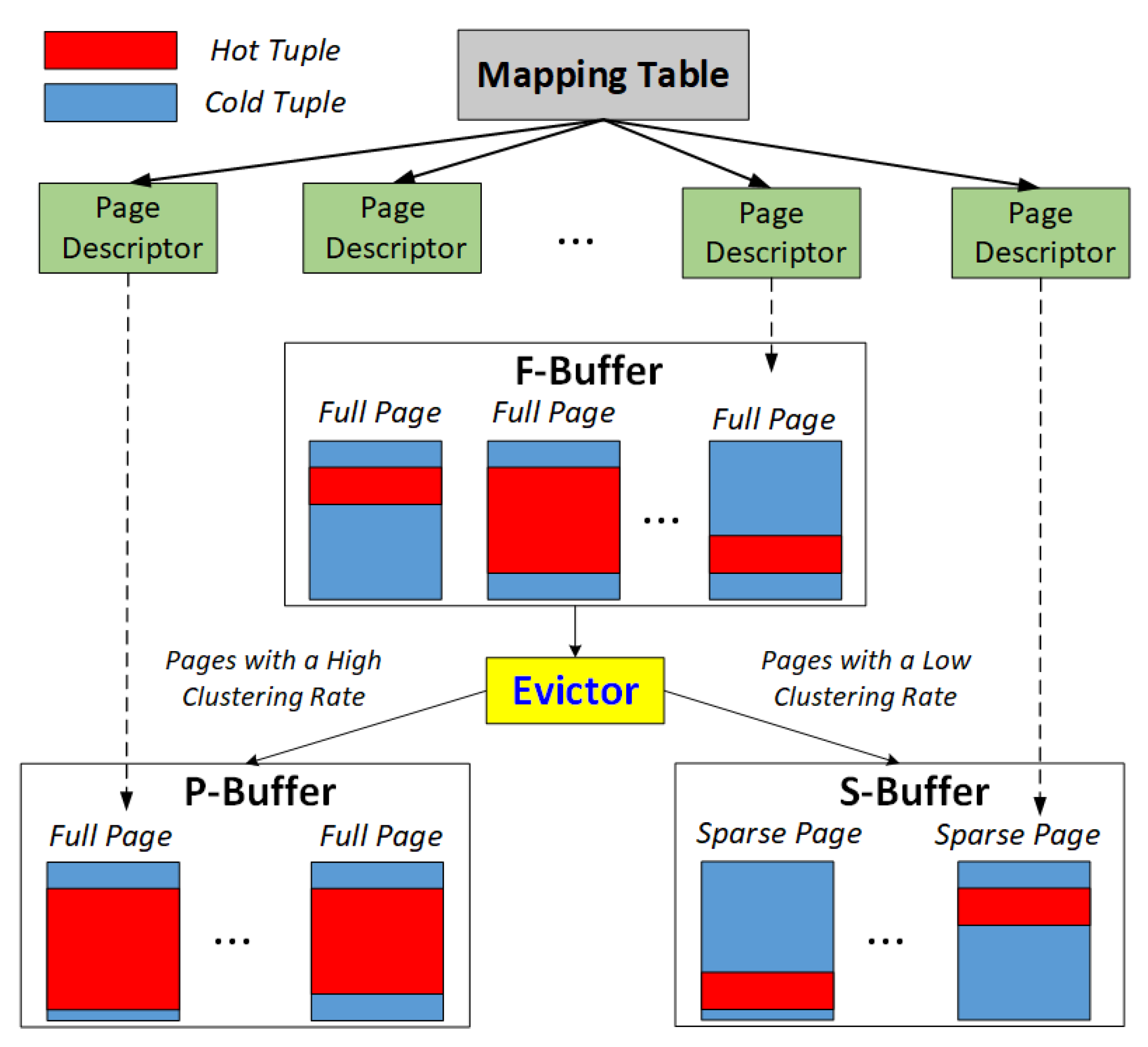
Figure 1 shows the general architecture of AMG-Buffer. It is composed of three sub-buffers, in which F-Buffer and P-Buffer are page buffers and S-Buffer is a tuple buffer. The F-Buffer is used to read pages from the disk. It is a page buffer because pages swapping between memory and disks must be performed with the page granularity. The P-Buffer is used to cache the pages with a high clustering rate because the tuples inside those pages have similar hotness. Thus, a page-grained buffering scheme is more suitable for the pages in the P-Buffer. The S-Buffer is a tuple buffer consisting of the hot or dirty tuples of the pages evicted out of the F-Buffer.
Figure 1. The architecture of AMG-Buffer.
When a page is evicted out of the F-Buffer, it will be moved to either the P-Buffer or the S-Buffer, according to its clustering rate. To be more specific, if the evicted page has a high clustering rate, it will be directly moved into the P-Buffer. Otherwise, if the page has a low clustering rate, we will move the hot or dirty tuples on the page to the S-Buffer. By keeping the hot tuples of the victim page in the S-Buffer, we can release the page space in the F-Buffer but keep a high hit ratio. The reason for migrating dirty tuples is to reduce the write operations to disks. In such a case, the S-Buffer can be regarded as an update buffer for dirty tuples. The dirty tuples in the S-Buffer will be written back to disks in a batch (for example, when the S-Buffer is full).
The buffer replacement process of AMG-Buffer can be described as follows. When a page in the F-Buffer is replaced, AMG-Buffer checks the clustering rate of the page. If the clustering rate is over a pre-defined threshold, we move the page to the P-Buffer and release the page space in the F-Buffer; otherwise, we move the hot or dirty tuples in the evicted page (in the F-Buffer) to the S-Buffer.
The S-Buffer uses a dynamic memory allocation strategy to allocate memory space to tuples. The tuples extracted from the same page are logically grouped as a virtual page named Sparse Page, as shown in Figure 1. Moreover, to access the tuples in the S-Buffer, we maintain a page descriptor for each sparse page to store its memory address. Each page in the F-Buffer and the P-Buffer also has a corresponding page descriptor. As Figure 1 shows, we use a mapping table to index all page descriptors. In addition, we use an LRU list to organize all the pages in each sub-buffer.
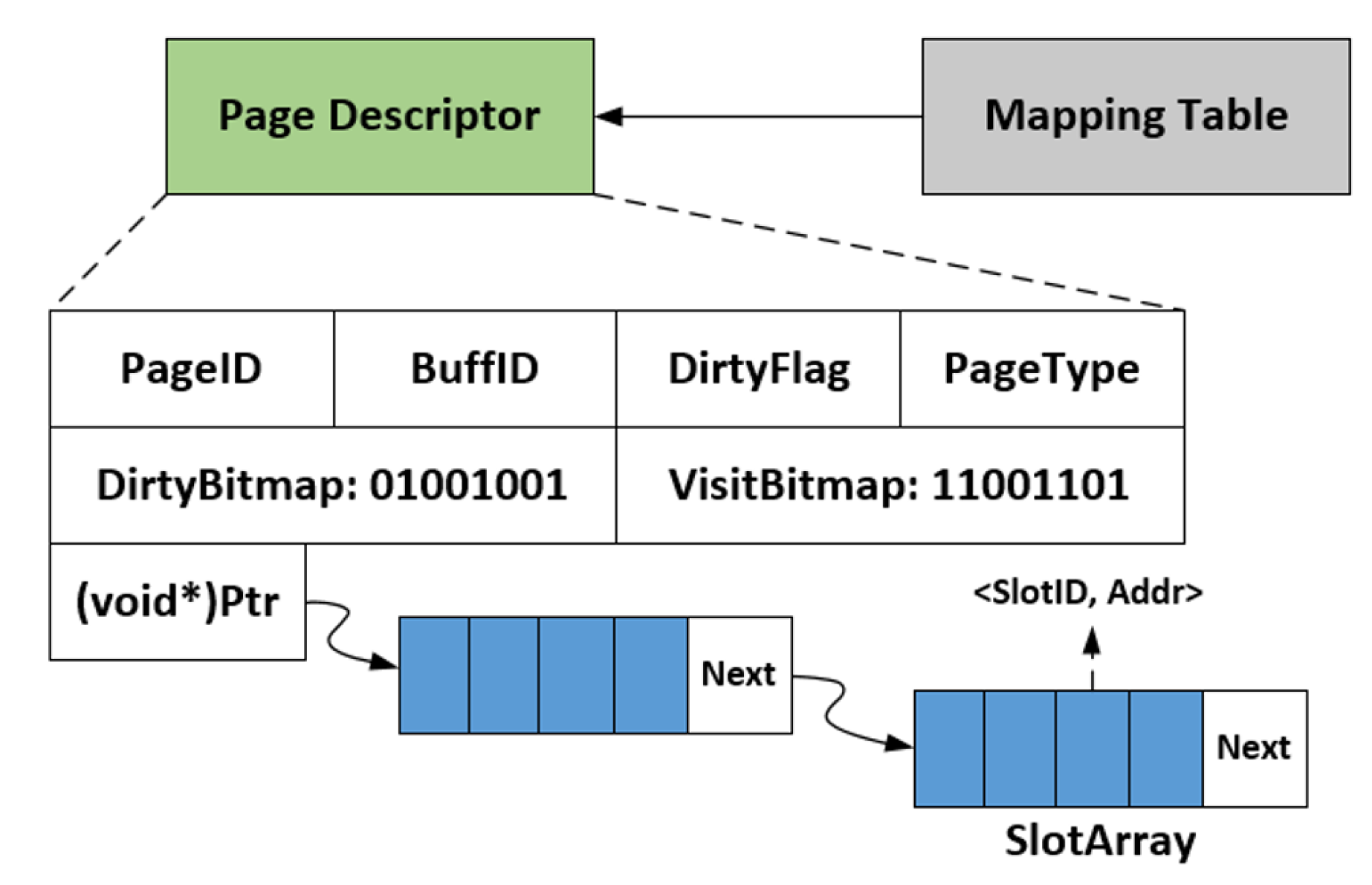
Figure 2 shows the data structure of the page descriptor in AMG-Buffer. The meanings of elements in the page descriptor are as follows.
Figure 2. The structure of page descriptor.
(1) PageID is the unique identifier of a page.
(2) BuffID indicates the buffer frame identifier in the F-Buffer. BuffID is only valid when the page is in the F-Buffer.
(3) VisitBitmap marks the tuples that have been accessed since the page was read into the F-Buffer.
(4) DirtyBitmap is used to mark dirty tuples.
(5) DirtyFlag is used to indicate whether the page contains dirty tuples.
(6) PageType indicates whether the page is in the F-Buffer or the S-Buffer.
(7) SlotArray is a set of <SlotID, Addr>, which stores the pointers pointing to the tuples in the S-Buffer.
Note that the pages in the P-Buffer can be directly migrated from the F-Buffer by changing the PageType (see Figure 2) and moving the descriptor from the LRU list of the F-Buffer to the LRU list of the P-Buffer. Thus, we need not perform tuple migrations for those pages.

3.2. Operations of AMG-Buffer

First, we access the mapping table to determine whether the page descriptor has been loaded in the memory. Next, according to PageType in the page descriptor, we can know whether the page is in the F-Buffer, the P-Buffer, or the S-Buffer. If the page is in the F-Buffer or the P-Buffer, we can retrieve the page address based on BuffID of the corresponding page descriptor. If the page is in the S-Buffer, we need to check the tuple’s existence using VisitBitmap.

3.2.1. Read-Tuple Operation

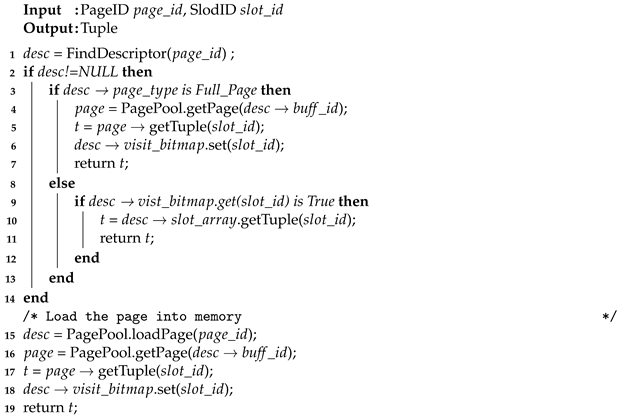
Algorithm 1 shows the read-tuple operation of AMG-Buffer. We first get the page descriptor via the mapping table. If not found, we load the original page from SSDs and place it into the F-Buffer. Otherwise, we determine which sub-buffer the tuple is placed in by checking PageType. If the page is in the F-Buffer or the P-Buffer, the PageType is Full_Page and we read the tuple from the intact page and update VisitBitmap. If not, the PageType is Sparse_Page and we need to check the existence of the tuple through VisitBitmap, i.e., if the bit corresponding to the tuple is 1, we can get the memory address of the tuple by looking up in SlotArray; if not, we reload the original page into the F-Buffer and read the target tuple.
Algorithm 1: Read Tuple
Futureinternet 13 00303 i001

3.2.2. Tuple Migration

When loading a target page into the F-Buffer, we need to perform a migrating operation to move a victim page into the P-Buffer or the S-Buffer for releasing the space of the F-Buffer. When the clustering rate of the victim page is below the threshold, i.e., the page has a low clustering rate, we perform a tuple migration operation to move the hot or dirty tuples in the victim page to the S-Buffer. In our implementation, we use the widely-used LRU policy to select a victim page in the F-Buffer. LRU is a popular and efficient buffer replacement algorithm that has been adopted by Oracle, MySQL, PostgreSQL, etc. We identify the hot or dirty tuples by checking the VisitBitmap. If a tuple is hot (frequently accessed) or dirty, the bit in the VisitBitmap that belongs to the page descriptor of the page containing the tuple is set to 1. Thus, by checking the VisitBitmap, we can quickly know whether the tuple needs to be migrated or not. If the bit is 1, we copy the tuple to the S-Buffer and add a <SlotID, Addr> pair into the SlotArray in the page descriptor.

3.2.3. Merging

The merging operation aims to reduce redundant data in the buffer. This operation is triggered when a page is loaded into the F-Buffer, and there is a sparse page with the same PageID in the S-Buffer. During a merging operation, we visit the DirtyBitmap in the page descriptor to determine whether a tuple on the page is dirty. If a tuple is dirty, we read the dirty tuple via the SlotArray and copy it to the page in the F-Buffer. After that, we delete all tuples pointed by SlotArray to release the memory space of the S-Buffer.

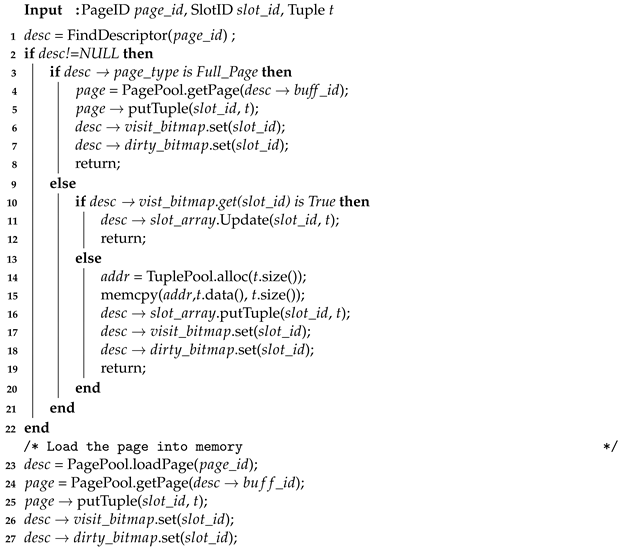
3.2.4. Write-Tuple Operation

Algorithm 2 shows the write-tuple operation. This operation is similar to the read-tuple operation. First, we find the page descriptor via the mapping table. If the descriptor is in the F-buffer, we update the page containing the tuple in the F-Buffer directly. We also update both VisitBitmap and DirtyBitmap. On the other hand, if the descriptor belongs to the S-Buffer but the tuple is not in the S-Buffer (the bit of the tuple in the VisitBitmap is 0), we allocate space and write the tuple in the S-Buffer and update the page descriptor, including VisitBitmap and DirtyBitmap. Note that when the S-Buffer is full, we will evict a sparse page from the S-Buffer via the LRU algorithm. Because a sparse page in the S-Buffer only contains some tuples of a normal page, we need to reload the original page and synchronous the dirty tuples to keep consistency. After that, we write the modified page into SSDs.
Algorithm 2: Write Tuple
Futureinternet 13 00303 i002

3.3. Adjustment of the P-Buffer

One key issue in AMG-Buffer is to determine the appropriate size of the P-Buffer. Allocating a large P-Buffer is not effective if most pages in the F-Buffer have a low clustering rate. On the contrary, if most pages have a high clustering rate, we need to allocate a large P-Buffer.
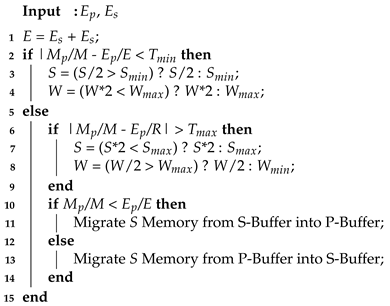
The F-Buffer is used to collect history access information and determine where the page belongs. Thus, the size of the F-Buffer is static in AMG-Buffer. We denote the memory space of both the P-Buffer and the S-Buffer as M. Next, we let W be the time window for adjustment and S be the migration unit for tuning the size ratio of P-Buffer and S-Buffer. M p denotes the size of the P-Buffer. Then, the proportion of the P-Buffer is M p / M . The basic idea of the tuning algorithm is that the buffer absorbing new tuples frequently requires more memory space to the cache. Thus, we count the number of pages that enter the P-Buffer, which is denoted as E p . Similarly, the number of pages that enter the S-Buffer in the time window is E s .
Here, we set two thresholds to trigger the adjustment, namely, T m i n and T m a x . If | M p / M E p / E | is below T m i n , we do not take any actions to resize the P-Buffer. To avoid frequent adjustments, we extend W to 2 W (but not exceed W m a x ) and shorten S to S / 2 (but not less than S m i n ). If | M p / M E p / E | is more than T m a x , we first resize the P-Buffer, and then we shorten W to W / 2 (but not less than W m i n ) and extend S to 2 S (but not more than S m a x ). Then, we resize the P-Buffer as well as the S-Buffer by adding or removing S memory space. Algorithm 3 summarizes the process of adjusting the size ratio of the P-Buffer and the S-Buffer in AMG-Buffer.
Algorithm 3: Adjust the P-Buffer
Futureinternet 13 00303 i003
Our experimental results show that the proposed adjusting algorithm can make AMG-Buffer adaptive to the change of access patterns. For example, when the workload changes from requesting the pages with a high clustering rate to requesting the pages with a low clustering rate, our algorithm can dynamically adjust the size of the P-Buffer and the S-Buffer to make the whole buffer work efficiently for the current workload. In particular, when requests focus on the pages with a high clustering rate, we will increase the size of the P-Buffer; otherwise, we will increase the size of the S-Buffer.
The current adjusting scheme is actually an empirical algorithm. Although our experiments suggest the effectiveness of the algorithm, it is more attractive to employ a machine-learning algorithm [29,30] to make AMG-Buffer learn the access pattern, which can be further used to adjust the size of the P-Buffer.

3.4. Theoretical Analysis

In this section, we theoretically analyze the efficiency of AMG-Buffer. The parameters of the buffer manager are shown in Table 1, which will be used in the following analysis. First, we assume that the buffer size is 20% of the database size. The access pattern has a locality of 80–20, which is set according to the Pareto Principle, meaning that 80% of the requests access 20% of the tuples.
Table 1. Parameters of the buffer manager.
Since the hot tuples are randomly stored in pages, we can infer that the rate of the hot tuples in one page is about 20%. For the traditional buffer manager, the number of the hot tuples that the buffer can hold is estimated by Equation (1).
M P · 0.2 · P T = 0.2 · M T
For AMG-Buffer, we assume that the sizes of the F-Buffer, the P-Buffer, and the S-Buffer are 20%, 40%, and 40% of the memory size, respectively. Additionally, the number of the hot tuples that the F-Buffer can hold is estimated by Equation (2).
M P · ( 0.2 + 0.4 ) · 0.2 · P T = 0.12 · M T
When a page is evicted out of the F-Buffer, the probability of the page’s hot tuples having been accessed is about 80%. Thus, the number of the hot tuples that the S-Buffer can hold is estimated by Equation (3).
M P · 0.4 · 0.8 · P T = 0.32 · M T
As we assume that the access locality is 80–20, we can infer the hot tuples in the database is 0.2 · D , and 80% of the requests can be answered by these hot tuples. Thus, we can estimate the hit ratio of the traditional buffer manager and AMG-Buffer by Equations (4) and (5), respectively.
0.2 · M T 0.2 · D T · 0.8 + ( 1 0.2 ) · M T 0.8 · D T · 0.2 = M D ( M < D )
0.44 · M T 0.2 · D T · 0.8 + ( 1 0.44 ) · M T 0.8 · D T · 0.2 = 1.9 · M D ( M < 5 · D 11 )
We summarize the analysis result in Table 2, which indicates that AMG-Buffer can maintain more hot tuples than the traditional buffer manager. To this end, when processing the same requests, AMG-Buffer can maintain a higher hit ratio than the traditional buffer manager.
Table 2. Theoretical comparison between LRU and AMG-Buffer.

4. Performance Evaluation

In this section, we conduct extensive experiments to evaluate AMG-Buffer using various workloads to demonstrate our proposal’s superiority.

4.1. Settings

We conduct all experiments on a PC powered with a processor of Intel Core i5-6200U 2.30 GHz, 8 GB DDR4 DRAM, and an SSD (Samsung 860 EVO) of 500 GB. The operating system is Ubuntu 8.4. We use the direct I/O mode in Linux to eliminate the influence of the file-system cache. We use a dataset of 1 GB and a buffer pool of 128 MB (10% of the data set) by default for all experiments. Additionally, we use the tuple size of 128 B and the page size of 4 KB by default.
Traditional buffer managements are usually evaluated using page-grained requests, such as <page id, request type>. In this paper, we need to use tuple-grained requests consisting of a tuple id and a request type. As there is no open-source workload satisfying our experiments’ need, we generate tailor-made traces to verify the performance of AMG-Buffer.
In the following experiments, we evaluate the effectiveness of AMG-Buffer by comparing it with various buffer management schemes, including LRU [1], LIRS [2], CFLRU [4], CFDC [5], and MG-Buffer [7]. For emulating various real circumstances, we change workloads with different read/write ratios and hybrid ratios. At last, we evaluate AMG-Buffer under dynamic workloads and a large data set. Note that for SSD-based databases, the overhead of disk I/Os costs is still the main bottleneck. Thus, we focus on I/O costs and ignore the overhead of migration and merging operations.

4.2. Workloads

The target trace file has a sequence of read-write operations on tuples. We divide the storage device pages into two types, namely, hot pages and cold pages. The size of hot pages accounts for 20%, which will absorb 80% of query operations, meaning most queries will concentrate on the hot pages. We define two types of queries, namely, narrow-queries ( N Q s ) and wide-queries ( W Q s ). Every N Q reads or writes one tuple of the page; every W Q reads or writes several tuples of the page. For simplification, we define the ratio of N Q s among all queries ( N Q s+ W Q s ) as hybrid ratio. We build various workloads by configuring different hybrid ratios and different read-write ratios, as shown in Table 3. In the trace names, the character R represents the read ratio and the symbol H represents the hybrid ratio. For example, in the “R20-H50” workload, “R20” means that the read ratio is 20% among all requests and “H50” means that the hybrid ratio is 50% ( N Q s account for 50%).
Table 3. Characteristics of the workloads.
To demonstrate the effectiveness of AMG-Buffer, we conduct experiments under various workloads and settings, including different memory sizes, hybrid ratios, and read/write ratios. In addition, we also evaluate the adaptivity of AMG-Buffer using dynamically changing workloads. Finally, we test the performance of AMG-Buffer using a large data set to see whether AMG-Buffer can adapt to large data sets.

4.3. Hit Ratio

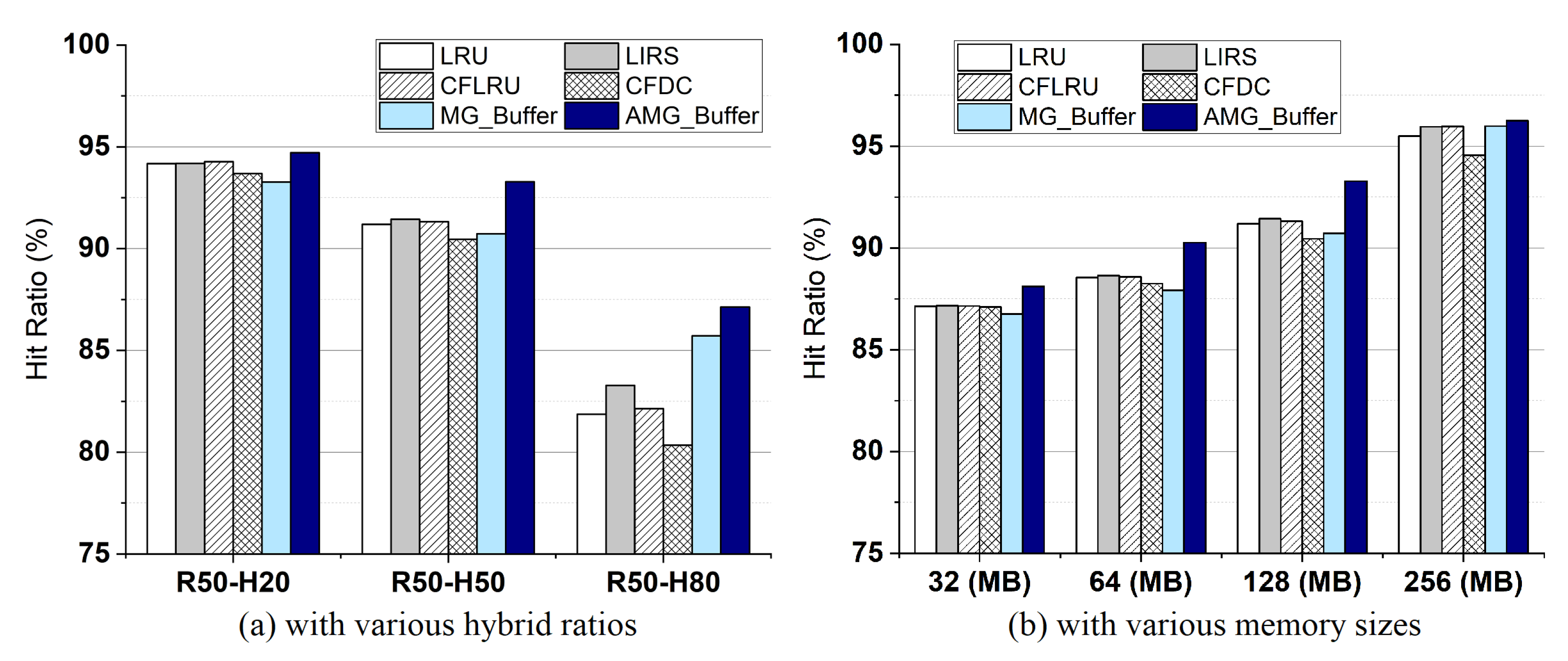
Figure 3a shows the hit ratios of all compared algorithms, where the hybrid ratio varies from 20% to 80%. Note that, in our workloads, a W Q query consists of several tuple accesses within a page. Thus, for a W Q query, even if the first tuple misses, the other tuples can hit in memory, which only causes one I/O operation. This leads to high hit ratios for all algorithms. Along with the hybrid ratio increasing, the hit ratios of all algorithms decreases. Compared with traditional ones, due to the tuple-grained buffer, MG-Buffer and AMG-Buffer can saves more hot tuples in memory. Furthermore, AMG-Buffer saves the benefits of spatial locality. Hence, AMG-Buffer can achieve a higher hit ratio than other algorithms, especially for “R50-H80”. In Figure 3b, we set the hybrid ratio to 50% (H50) and increase the memory size from 0.25 to 2 times the default size. AMG-Buffer still achieves a slightly higher hit ratio than others.
Figure 3. Comparison of hit ratios.

4.4. I/Os

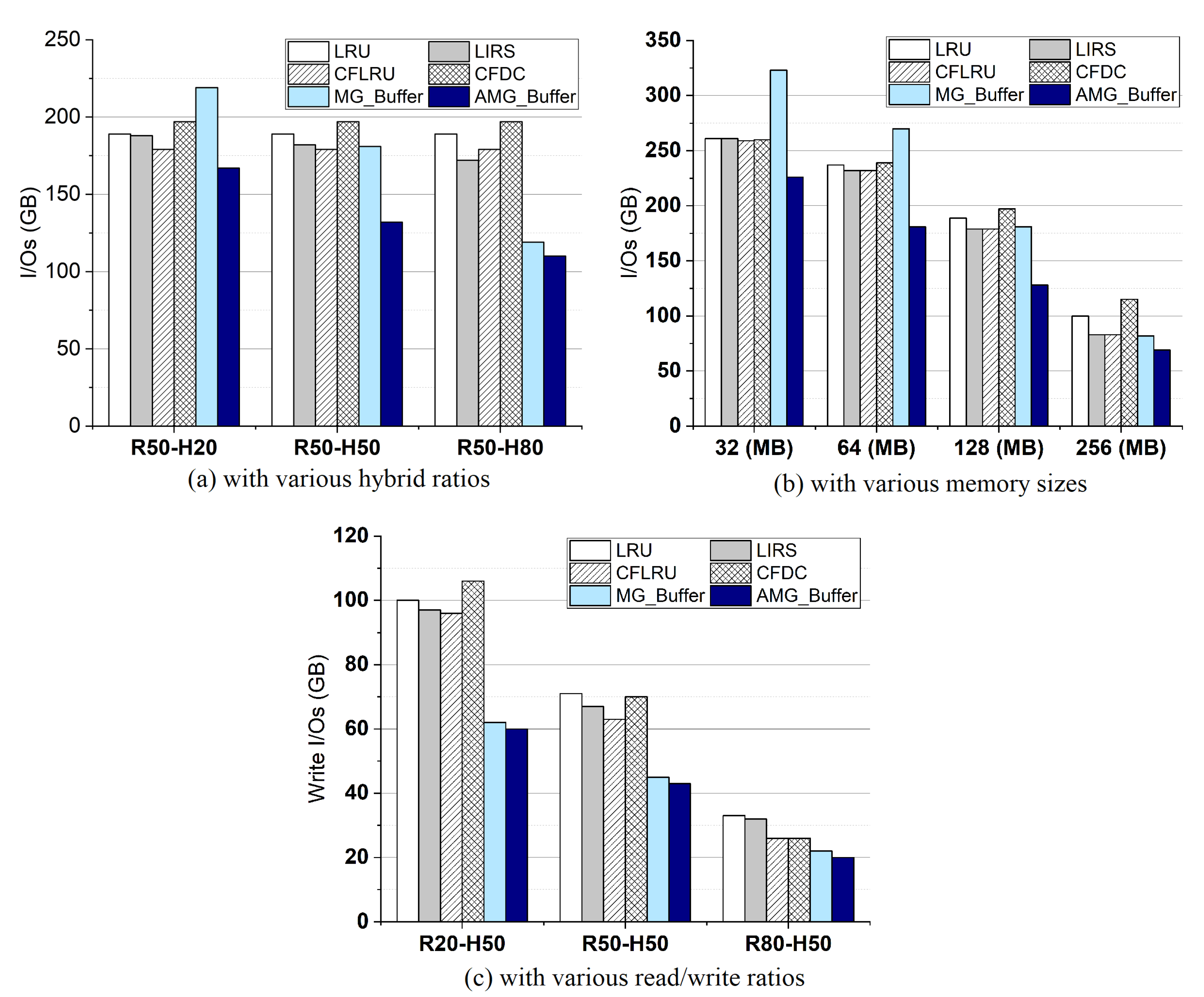
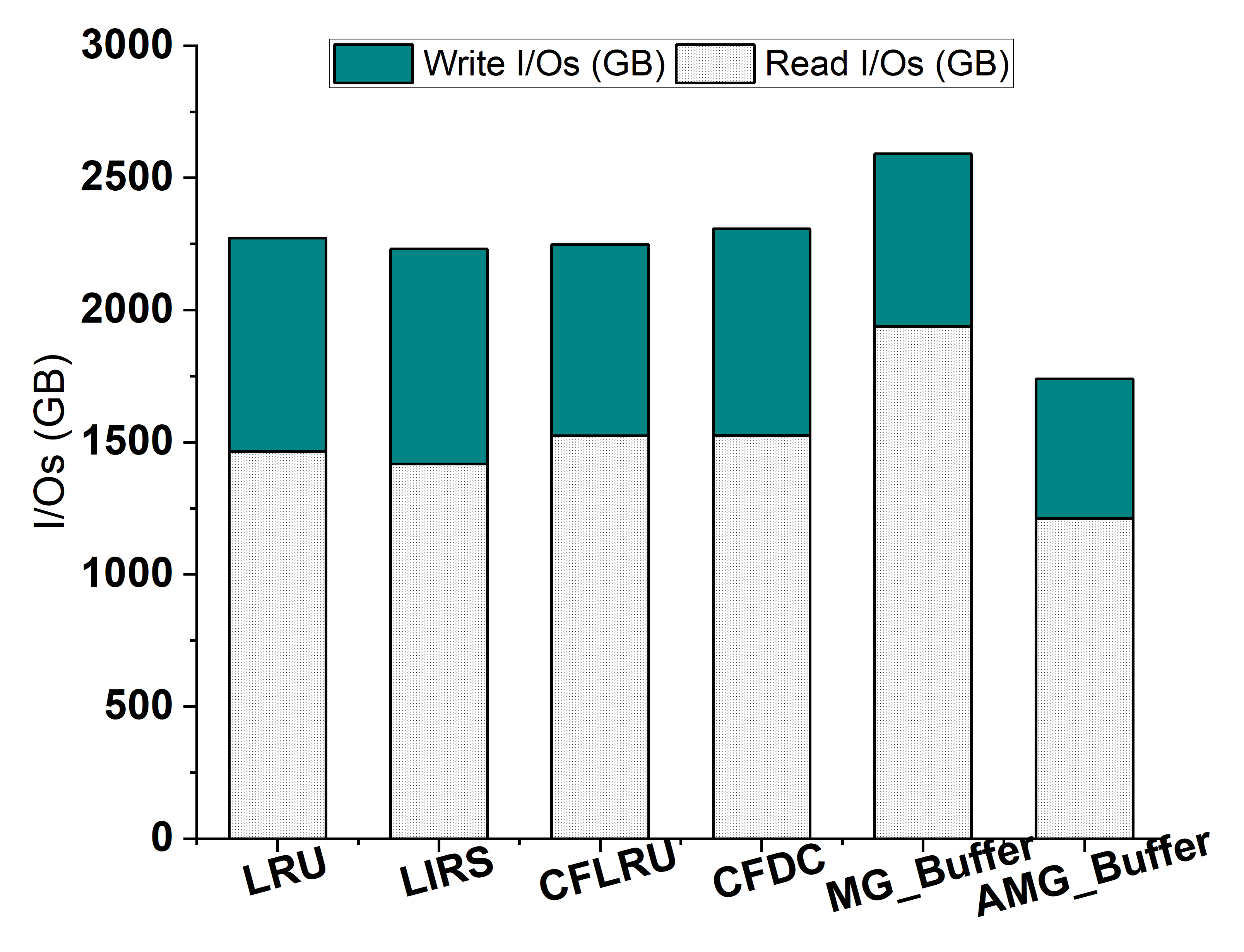
Figure 4a shows the I/Os for all algorithms with a varying hybrid ratio. First, MG-Buffer causes more I/Os when meeting many W Q s , compared with page-grained buffers (e.g., LRU, LIRS, CFLRU, and CFDC). This is because MG-Buffer loses the benefits of spatial locality. Furthermore, MG-Buffer incurs more additional I/Os when writing incomplete dirty pages. Compared to MG-Buffer, AMG-Buffer can distinguish pages by clustering rates to choose the page-grained buffer or tuple-grained buffer, which alleviates these problems. For different hybrid ratios, compared with others, AMG-Buffer can achieve the least I/Os. Figure 4b shows the I/Os under different buffer sizes. When the buffer size is less than 128 MB, MG-Buffer incurs more I/Os than traditional ones and AMG-Buffer reduces I/O costs by up to 13% (32 MB) and 23% (64 MB) than others. When the buffer size is larger than or equals 128 MB, both AMG-Buffer and MG-Buffer have fewer I/Os than LRU, CFLRU and CFDC due to caching more hot tuples, but AMG-Buffer reduces I/Os by 29% (128 MB) and 15% (256 MB) compared to MG-Buffer. Figure 4c shows the write I/Os of all algorithms under different read/write ratios. Both AMG-Buffer and MG-Buffer have fewer write I/Os than LRU, CFLRU, and CFDC and are friendly to SSDs. When we set the read ratio to 20% (R20), 50% (R50), and 80% (R80), AMG-Buffer reduces write I/Os by up to 39%, 37% and 38%, respectively, compared to traditional ones. All results demonstrate that AMG-Buffer can retain the benefit of both the tuple-grained and the page-grained buffer management policy.
Figure 4. Comparison of I/Os.

4.5. Workload Adaptivity

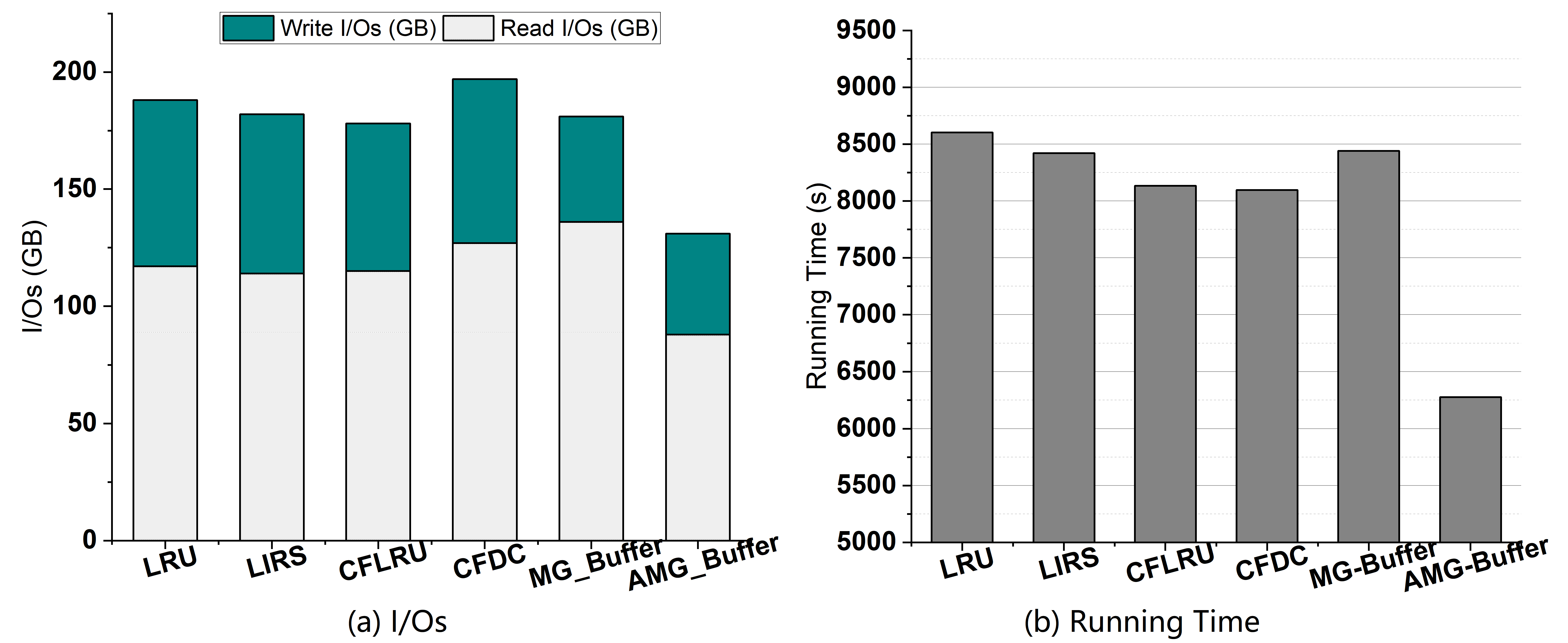
In this experiment, we aim to verify the adaptivity of AMG-Buffer for dynamic workloads. First, we run all algorithms with a balanced workload R50-H50. As shown in Figure 5a, AMG-Buffer reduces both write and read operations. Compared to traditional algorithms and MG-Buffer, AMG-Buffer reduces up to 29% and 27% overall I/Os, respectively, yielding a high-performance improvement on the balanced workload. We also report the time performance in Figure 5b, which confirms that AMG-Buffer has the best time performance among all algorithms. In particular, AMG-Buffer can save more dirty tuples in the buffer and has fewer write I/Os than traditional ones. Moreover, AMG-Buffer avoids the additional read I/Os when writing incomplete dirty pages, resulting in higher performance than MG-Buffer.
Figure 5. Performance on the balance workload.
We can see that the results in Figure 5a,b are very consistent, indicating that the I/O cost dominates the overall time performance. Hence, in the following experiments, we only report the I/O cost.
To evaluate the performance of the adaptivity of AMG-Buffer and the adjustment scheme of the P-Buffer, we simulate the change of workloads by varying the hybrid ratio ( N Q / W Q ) to generate a dynamic workload. Dynamic workloads are very common in real applications. For example, user queries in an E-Business platform may be changed by holidays or other events. Thus, a static buffer management policy like LRU is not suitable for dynamic workloads.
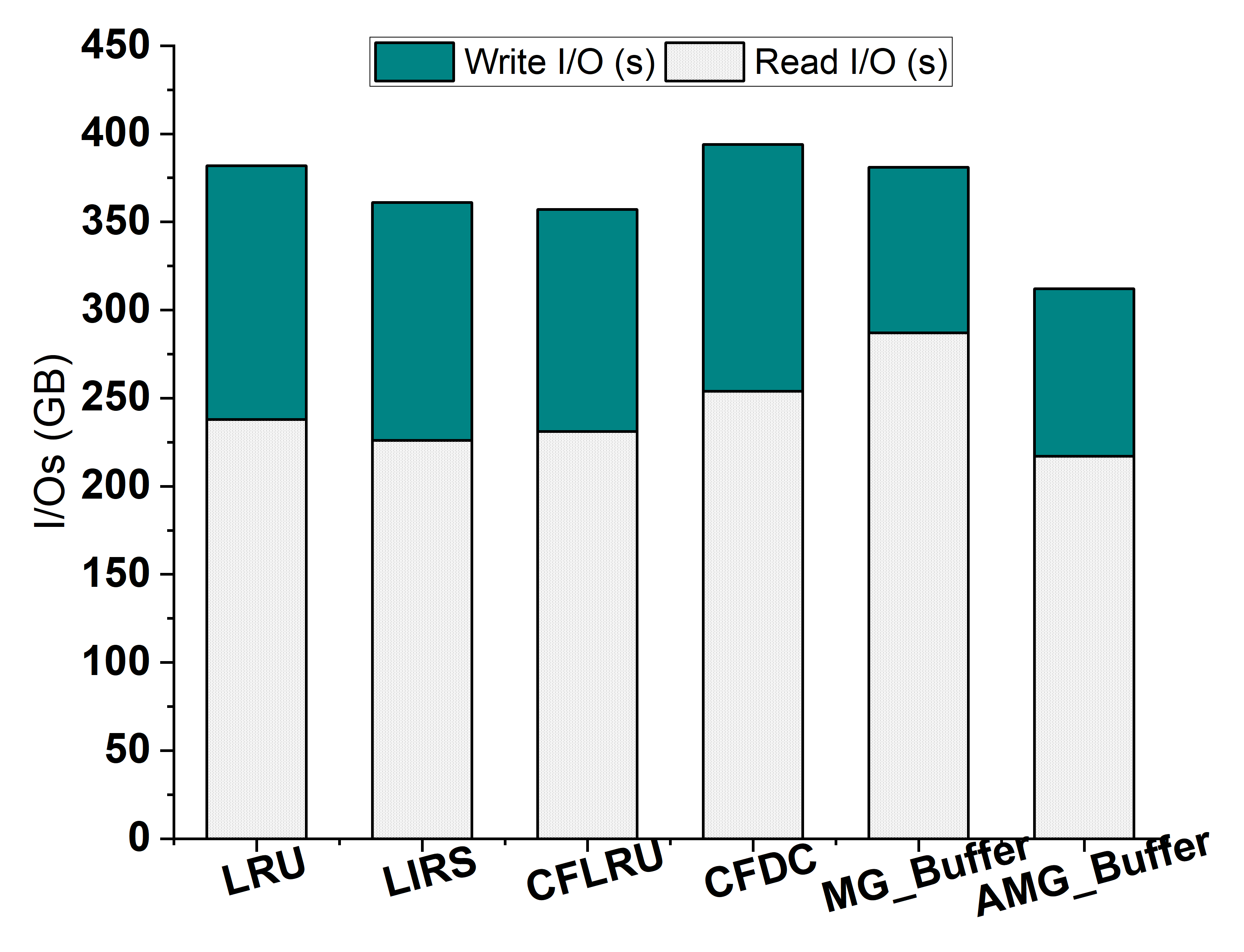
Next, we evaluate AMG-Buffer on a dynamic workload. To generate the dynamic work changing with time, we divide the queries in the trace file into epochs, each of which consists of 1 million queries. We prepare 100 epochs in the dynamic workload, i.e., the workload consists of 100 million queries in total. Then, we randomly set the hybrid ratio in each epoch from 10/90 to 90/10. Figure 6 shows the total I/Os for AMG-Buffer and its competitors. Although MG-Buffer has fewer write I/Os than LRU, LIRS, CFLRU, and CFDC, it suffers from high read I/Os. When the requested pages exhibit a high clustering rate, MG-Buffer will cause many additional read I/O operations. On the contrary, AMG-Buffer achieves the best performance on the dynamic workload due to its adaptive use of the P-Buffer and the S-Buffer.
Figure 6. Performance on the dynamic workload.

4.6. Performance on a Large Data Set

To see the performance of AMG-Buffer on large data sets, in this experiment, we use a large data set whose size is 16 GB. The buffer size is set to 10% of the data set size. The page size and the tuple size are the same as before. We use the default balanced workload (R50-H50) in this experiment. Figure 7 shows the I/Os comparison between AMG-Buffer and the other algorithms, which presents a similar result as previous experiments. When running on the large data set, AMG-Buffer reduces the I/Os by up to 33% than traditional buffering schemes and MG-Buffer, which shows that AMG-Buffer can adapt to large databases in real scenarios.
Figure 7. Performance on a large data set.
Especially, we can see from Figure 7 that AMG-Buffer still keeps the lowest read I/Os and write I/Os among all algorithms, indicating that AMG-Buffer is not only effective at improving the overall performance of buffer management but also friendly to write operations. Such a feature is useful for write-sensitive storage devices like SSDs.

5. Conclusions

In this paper, we propose an adaptive multi-grained buffer manager called AMG-Buffer for database systems. We first notice that the page-grained buffer management schemes like LRU work poorly when users only request very few tuples within one page. Based on such an observation, we propose to use both page-grained and tuple-grained buffers to offer high efficiency for the buffer manager. In particular, we divide the entire buffer into two page-grained buffers, called F-Buffer and P-Buffer, and one tuple-grained buffer called S-Buffer. A page is first buffered in the F-Buffer. When a page is evicted out of the F-Buffer, we either move the page to the P-Buffer or move the hot or dirty tuples on the page to the tuple-grained S-Buffer. To adaptively determine whether a page-grained movement or a tuple-grained movement should be performed to replace a page from the F-Buffer, we introduce a new concept named clustering rate for every page in the F-Buffer, which is used to adaptively determine the data moving strategy when a page replacement occurs in the F-Buffer. We perform a page-grained migration policy that directly moves the pages with a high clustering rate in the F-Buffer to the P-Buffer. Moreover, we perform a tuple-grained migration policy to move the hot or dirty tuples on the pages with a low clustering rate from the F-Buffer to the S-buffer. We also develop an effective algorithm to adjust the size of the P-Buffer for dynamic workloads. We conduct extensive experiments on various kinds of workloads and settings. The results in terms of hit ratio, I/Os, and run time all suggest the efficiency and effectiveness of AMG-Buffer. As a result, the AMG-Buffer algorithm achieves the best performance in all experiments. Moreover, in the dynamic workload, AMG-Buffer still outperforms the other schemes, showing that AMG-Buffer can adapt to different kinds of workloads.
Although this work focuses on optimizing the performance of the buffer manager on HHD-based databases, some techniques are also friendly to SSD-based databases. In the future, we will improve the AMG-Buffer design to make it applicable to different kinds of storage, such as magnetic disks, SSDs, hybrid storage [31], and persistent memory [32]. Another relevant issue is investigating a learned strategy [33,34,35] to implement the adaptive mechanism in AMG-Buffer. It has been a hot topic in recent years to use machine learning models for optimizing database components [36]. In future work, it will be possible to consider a machine-learning-based approach to provide a more general solution to selecting the migration granularity for page replacements.

Author Contributions

Conceptualization, X.W. and P.J.; methodology, X.W.; software, X.W.; validation, X.W. and P.J.; formal analysis, X.W.; investigation, X.W.; data curation, X.W.; writing—original draft preparation, X.W.; writing—review and editing, P.J.; supervision, P.J.; funding acquisition, P.J. All authors have read and agreed to the published version of the manuscript.

Funding

This research was funded by the National Science Foundation of China (No. 62072419).

Data Availability Statement

Not applicable, the study does not report any data.

Conflicts of Interest

The authors declare no conflict of interest.

References

  1. Effelsberg, W.; Härder, T. Principles of Database Buffer Management. ACM Trans. Database Syst. 1984, 9, 560–595. [Google Scholar] [CrossRef]
  2. Jiang, S.; Zhang, X. LIRS: An efficient low inter-reference recency set replacement policy to improve buffer cache performance. ACM SIGMETRICS Perform. Eval. Rev. 2002, 30, 31–42. [Google Scholar] [CrossRef]
  3. Johnson, T.; Shasha, D.E. 2Q: A Low Overhead High Performance Buffer Management Replacement Algorithm. In Proceedings of the Twentieth International Conference on Very Large Databases, Santiago, Chile, 12–15 September 1994; pp. 439–450. [Google Scholar]
  4. Park, S.; Jung, D.; Kang, J.; Kim, J.; Lee, J. CFLRU: A replacement algorithm for flash memory. In Proceedings of the 2006 International Conference on Compilers, Architecture and Synthesis for Embedded Systems, Seoul, Korea, 22–25 October 2006; pp. 234–241. [Google Scholar]
  5. Ou, Y.; Härder, T.; Jin, P. CFDC: A Flash-Aware Buffer Management Algorithm for Database Systems. In East European Conference on Advances in Databases and Information Systems; Springer: Berlin/Heidelberg, Germany, 2010; pp. 435–449. [Google Scholar]
  6. Meng, Q.; Zhou, X.; Wang, S.; Huang, H.; Liu, X. A Twin-Buffer Scheme for High-Throughput Logging. In International Conference on Database Systems for Advanced Applications; Springer: Cham, Switzerland, 2018; pp. 725–737. [Google Scholar]
  7. Wang, X.; Jin, P.; Liu, R.; Zhang, Z.; Wan, S.; Hua, B. MG-Buffer: A Read/Write-Optimized Multi-Grained Buffer Management Scheme for Database Systems. In Proceedings of the 2019 IEEE 21st International Conference on High Performance Computing and Communications; IEEE 17th International Conference on Smart City; IEEE 5th International Conference on Data Science and Systems (HPCC/SmartCity/DSS), Zhangjiajie, China, 10–12 August 2019; pp. 1212–1219. [Google Scholar]
  8. Tan, Y.; Wang, B.; Yan, Z.; Srisa-an, W.; Chen, X.; Liu, D. APMigration: Improving Performance of Hybrid Memory Performance via An Adaptive Page Migration Method. IEEE Trans. Parallel Distrib. Syst. 2020, 31, 266–278. [Google Scholar] [CrossRef]
  9. Ding, X.; Shan, J.; Jiang, S. A General Approach to Scalable Buffer Pool Management. IEEE Trans. Parallel Distrib. Syst. 2016, 27, 2182–2195. [Google Scholar] [CrossRef]
  10. Tan, J.; Zhang, T.; Li, F.; Chen, J.; Zheng, Q.; Zhang, P.; Qiao, H.; Shi, Y.; Cao, W.; Zhang, R. iBTune: Individualized Buffer Tuning for Large-scale Cloud Databases. Proc. VLDB Endow. 2019, 12, 1221–1234. [Google Scholar] [CrossRef] [Green Version]
  11. Jiang, Z.; Zhang, Y.; Wang, J.; Xing, C. A Cost-aware Buffer Management Policy for Flash-based Storage Devices. In International Conference on Database Systems for Advanced Applications; Springer: Cham, Switzerland, 2015; pp. 175–190. [Google Scholar]
  12. Kallman, R.; Kimura, H.; Natkins, J.; Pavlo, A.; Rasin, A.; Zdonik, S.B.; Jones, E.P.C.; Madden, S.; Stonebraker, M.; Zhang, Y.; et al. H-store: A high-performance, distributed main memory transaction processing system. Proc. VLDB Endow. 2008, 1, 1496–1499. [Google Scholar] [CrossRef]
  13. Leis, V.; Haubenschild, M.; Kemper, A.; Neumann, T. LeanStore: In-Memory Data Management beyond Main Memory. In Proceedings of the 2018 IEEE 34th International Conference on Data Engineering (ICDE), Paris, France, 16–19 April 2018; pp. 185–196. [Google Scholar]
  14. Neumann, T.; Freitag, M.J. Umbra: A Disk-Based System with In-Memory Performance. In Proceedings of the CIDR, 2020; Available online: http://cidrdb.org/cidr2020/papers/p29-neumann-cidr20.pdf (accessed on 24 November 2021).
  15. Diaconu, C.; Freedman, C.; Ismert, E.; Larson, P.; Mittal, P.; Stonecipher, R.; Verma, N.; Zwilling, M. Hekaton: SQL server’s memory-optimized OLTP engine. In Proceedings of the 2013 ACM SIGMOD International Conference on Management of Data, New York, NY, USA, 22–27 June 2013; pp. 1243–1254. [Google Scholar]
  16. Färber, F.; Cha, S.K.; Primsch, J.; Bornhövd, C.; Sigg, S.; Lehner, W. SAP HANA database: Data management for modern business applications. SIGMOD Rec. 2011, 40, 45–51. [Google Scholar] [CrossRef]
  17. Jin, P.; Yang, C.; Wang, X.; Yue, L.; Zhang, D. SAL-Hashing: A Self-Adaptive Linear Hashing Index for SSDs. IEEE Trans. Knowl. Data Eng. 2020, 32, 519–532. [Google Scholar] [CrossRef]
  18. Yang, C.; Jin, P.; Yue, L.; Yang, P. Efficient Buffer Management for Tree Indexes on Solid State Drives. Int. J. Parallel Program. 2016, 44, 5–25. [Google Scholar] [CrossRef]
  19. Jin, P.; Yang, C.; Jensen, C.S.; Yang, P.; Yue, L. Read/write-optimized tree indexing for solid-state drives. VLDB J. 2016, 25, 695–717. [Google Scholar] [CrossRef]
  20. Zhao, H.; Jin, P.; Yang, P.; Yue, L. BPCLC: An Efficient Write Buffer Management Scheme for Flash-Based Solid State Disks. Int. J. Digit. Content Technol. Its Appl. 2010, 4, 123–133. [Google Scholar]
  21. Wang, S.; Lu, Z.; Cao, Q.; Jiang, H.; Yao, J.; Dong, Y.; Yang, P. BCW: Buffer-Controlled Writes to HDDs for SSD-HDD Hybrid Storage Server. In Proceedings of the 18th USENIX Conference on File and Storage Technologies (FAST 20), Santa Clara, CA, USA, 24–27 February 2020; pp. 253–266. [Google Scholar]
  22. Choi, J.; Kim, K.M.; Kwak, J.W. WPA: Write Pattern Aware Hybrid Disk Buffer Management for Improving Lifespan of NAND Flash Memory. IEEE Trans. Consum. Electron. 2020, 66, 193–202. [Google Scholar] [CrossRef]
  23. Li, Z.; Jin, P.; Su, X.; Cui, K.; Yue, L. CCF-LRU: A new buffer replacement algorithm for flash memory. IEEE Trans. Consum. Electron. 2009, 55, 1351–1359. [Google Scholar] [CrossRef]
  24. On, S.T.; Gao, S.; He, B.; Wu, M.; Luo, Q.; Xu, J. FD-Buffer: A Cost-Based Adaptive Buffer Replacement Algorithm for FlashMemory Devices. IEEE Trans. Comput. 2014, 63, 2288–2301. [Google Scholar] [CrossRef]
  25. Jin, P.; Ou, Y.; Härder, T.; Li, Z. AD-LRU: An efficient buffer replacement algorithm for flash-based databases. Data Knowl. Eng. 2012, 72, 83–102. [Google Scholar] [CrossRef]
  26. DeBrabant, J.; Pavlo, A.; Tu, S.; Stonebraker, M.; Zdonik, S.B. Anti-Caching: A New Approach to Database Management System Architecture. Proc. VLDB Endow. 2013, 6, 1942–1953. [Google Scholar] [CrossRef] [Green Version]
  27. Zheng, S.; Shen, Y.; Zhu, Y.; Huang, L. An Adaptive Eviction Framework for Anti-caching Based In-Memory Databases. In International Conference on Database Systems for Advanced Applications; Springer: Cham, Switzerland, 2018; pp. 247–263. [Google Scholar]
  28. Zhang, H.; Chen, G.; Ooi, B.C.; Wong, W.; Wu, S.; Xia, Y. “Anti-Caching”-based elastic memory management for Big Data. In Proceedings of the 2015 IEEE 31st International Conference on Data Engineering, Seoul, Korea, 13–17 April 2015; pp. 1268–1279. [Google Scholar]
  29. Ma, L.; Ding, B.; Das, S.; Swaminathan, A. Active Learning for ML Enhanced Database Systems. In Proceedings of the 2020 ACM SIGMOD International Conference on Management of Data, Portland, OR, USA, 14–19 June 2020; pp. 175–191. [Google Scholar]
  30. Hashemi, M.; Swersky, K.; Smith, J.A.; Ayers, G.; Litz, H.; Chang, J.; Kozyrakis, C.; Ranganathan, P. Learning Memory Access Patterns. In Proceedings of the International Conference on Machine Learning, 28–30 September 2018; pp. 1919–1928. Available online: http://proceedings.mlr.press/v80/hashemi18a/hashemi18a.pdf (accessed on 24 November 2021).
  31. Jin, P.; Yang, P.; Yue, L. Optimizing B+-tree for hybrid storage systems. Distrib. Parallel Databases 2015, 33, 449–475. [Google Scholar] [CrossRef]
  32. van Renen, A.; Leis, V.; Kemper, A.; Neumann, T.; Hashida, T.; Oe, K.; Doi, Y.; Harada, L.; Sato, M. Managing Non-Volatile Memory in Database Systems. In Proceedings of the 2018 International Conference on Management of Data, Houston, TX, USA, 10–15 June 2018; pp. 1541–1555. [Google Scholar]
  33. Shi, Z.; Huang, X.; Jain, A.; Lin, C. Applying Deep Learning to the Cache Replacement Problem. In Proceedings of the 52nd Annual IEEE/ACM International Symposium on Microarchitecture, 2018; pp. 413–425. Available online: https://dl.acm.org/doi/10.1145/3352460.3358319 (accessed on 24 November 2021).
  34. Vila, P.; Ganty, P.; Guarnieri, M.; Köpf, B. CacheQuery: Learning replacement policies from hardware caches. In Proceedings of the 41st ACM SIGPLAN Conference on Programming Language Design and Implementation, London, UK, 15–20 June 2020; pp. 519–532. [Google Scholar]
  35. Yuan, Y.; Jin, P. Learned buffer management: A new frontier: Work-in-progress. In Proceedings of the 2021 International Conference on Hardware/Software Codesign and System Synthesis, Virtual Event, 10–13 October 2021; pp. 25–26. [Google Scholar]
  36. Jasny, M.; Ziegler, T.; Kraska, T.; Röhm, U.; Binnig, C. DB4ML—An In-Memory Database Kernel with Machine Learning Support. In Proceedings of the 2020 ACM SIGMOD International Conference on Management of Data, Portland, OR, USA, 14–19 June 2020; pp. 159–173. [Google Scholar]
Publisher’s Note: MDPI stays neutral with regard to jurisdictional claims in published maps and institutional affiliations.

Article Metrics

Citations

Article Access Statistics

Multiple requests from the same IP address are counted as one view.