You are currently viewing a new version of our website. To view the old version click .
Future Internet
  • Article
  • Open Access

22 October 2020

Learning a Hierarchical Global Attention for Image Classification


,
,
and
1
Shenyang University of Chemical Technology, Shenyang 110000, China
2
NTIS Center, Korea Institute of Science and Technology Information, Seoul 02792, Korea
*
Author to whom correspondence should be addressed.
This article belongs to the Section Big Data and Augmented Intelligence

Abstract

To classify the image material on the internet, the deep learning methodology, especially deep neural network, is the most optimal and costliest method of all computer vision methods. Convolutional neural networks (CNNs) learn a comprehensive feature representation by exploiting local information with a fixed receptive field, demonstrating distinguished capacities on image classification. Recent works concentrate on efficient feature exploration, which neglect the global information for holistic consideration. There is large effort to reduce the computational costs of deep neural networks. Here, we provide a hierarchical global attention mechanism that improve the network representation with restricted increase of computation complexity. Different from nonlocal-based methods, the hierarchical global attention mechanism requires no matrix multiplication and can be flexibly applied in various modern network designs. Experimental results demonstrate that proposed hierarchical global attention mechanism can conspicuously improve the image classification precision—a reduction of 7.94% and 16.63% percent in Top 1 and Top 5 errors separately—with little increase of computation complexity (6.23%) in comparison to competing approaches.

1. Introduction

To classify the image material on the internet, the deep learning/neural network methodology is the most optimal but also the costliest of all computer vision methods. Convolutional neural network (CNN) has been proved as a powerful tool for different computer vision tasks [1]. In CNN, filters extract the information from features with learned adaptive weights and bias [2]. By building the network deeper or wider, the accumulation of filters demonstrates a significant improvement in feature representation. Different from fully connection networks, the filters in CNN have fixed receptive fields to concentrate on the local information from features, saving the parameters and making it possible to build the network deeper [3]. Recently, researchers concentrate on well-designed network architectures for efficient feature exploration [4,5]. The elaborate network designs are composed of depth-wise and channel-wise convolutional layers and effectively exploit the features with modified filters [6]. As the receptive fields and network depths are fixed, these works almost neglect the global information for holistic consideration.
Attention mechanism has been introduced to address this issue [7,8]. As a weighting component for importance distribution, attentions are usually calculated as non-negative feature maps from a Sigmoid activation. To consider the global information, global average pooling is introduced to measure the information from the entire feature map [7]. After pooling, the feature maps will be compressed into a fixed size vector according to the channels. Then, fully connection layers with activation functions are utilized for nonlinear exploration. This channel-wise attention mechanism applies pooling to information evaluation, which treats the spatial information of features equally. In fact, the intrinsic property of pooling operation neglects the diversity of spatial information. Another global attention mechanism termed as non-local attention is proposed based on the matrix multiplication [9]. Due to the characteristic of matrix multiplication, all the spatial information will be considered for holistic consideration. Non-local attention has been proved as an effective design for network representation improvement. However, the matrix multiplication will result in a large memory consumption and high computation complexity. All of this will be further elaborated/introduced in the Related Works.
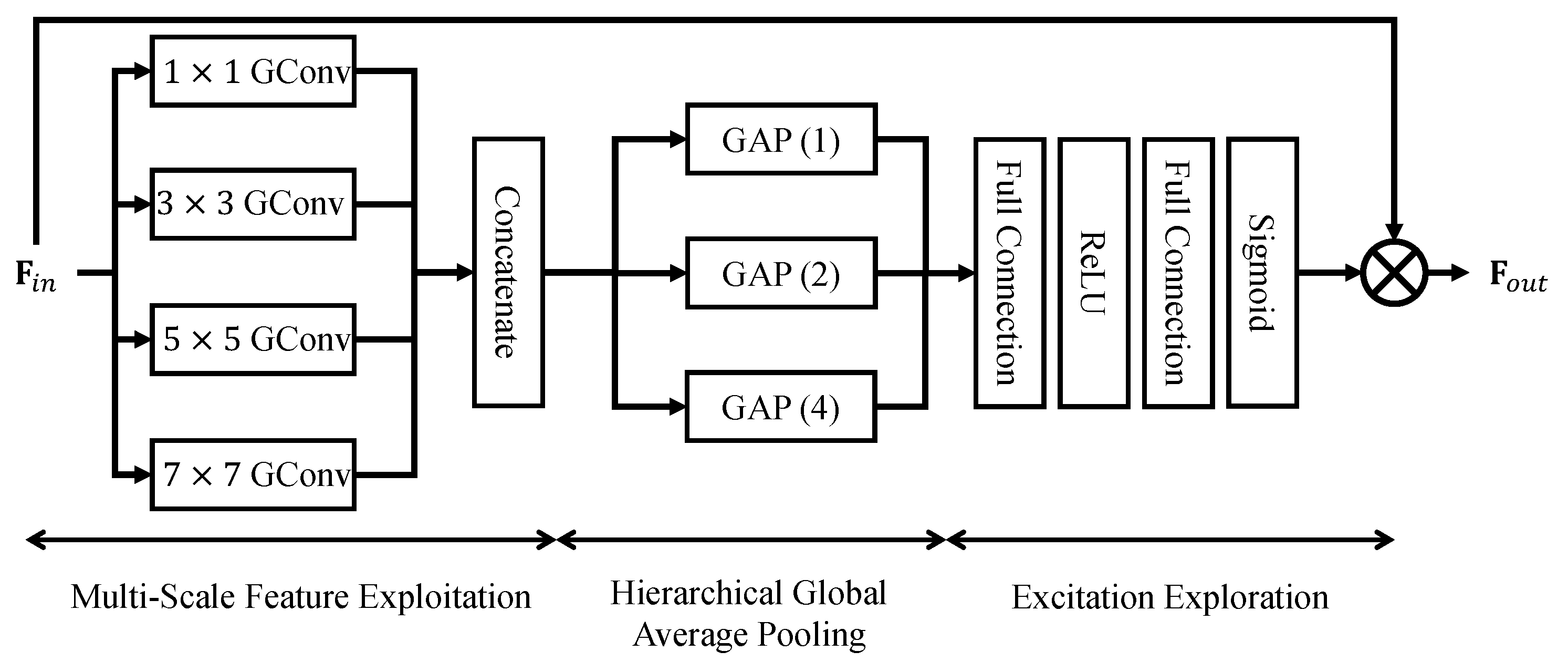
To reduce the CNN costs and provide better classification performance, we devise an improvement of attention mechanism for comprehensive information consideration. In the proposed hierarchical global attention (HGA) mechanism, multi-scale structure has been proved as an effective mechanism for hierarchical information exploration. We hold to the notion that features from different scales obtain various information, and the multi-scale structure can comprehensively exploit the features for better representation. Global average pooling is a suitable operation to estimate the information from different feature maps, which lacks the spatial-wise consideration. By combining the global average pooling and multi-scale structure, the attention mechanism can learn a comprehensive relations among different feature maps. Then, the nonlinear exploration will find a more adaptive representation of features. The holistic design of proposed HGA mechanism is shown in Figure 1. There are few parameters and restricted computation complexity in HGA, which makes it possible for flexible plug-and-play in exist effective network structures. To address this point, we provide several patterns for flexibly applying HGA to the existing network backbones. Experimental results shows HGA can boost the image classification capacity for different advanced network structures.
Figure 1. Structure of proposed hierarchical global attention mechanism (HGA). There are three modules in our proposed HGA: Multi-Scale Feature Exploitation (MFE), Hierarchical Global Average Pooling (HAP), and Excitation Exploration (EE).
The contributions of our work can be summarized as follows.
  • We propose a hierarchical global attention (HGA) mechanism for comprehensive information consideration. The HGA hierarchically finds the spatial-wise relations among features with multi-scale structure design and utilizes nonlinear exploration to learn an adaptive attention.
  • We provide several patterns for applying HGA to exist network backbones, which demonstrates its flexible applications for different structures.
  • Experimental results show HGA can boost the image classification capacity for different advanced network structures with restricted computation complexity and parameters.

3. Hierarchical Global Attention

As shown in Figure 1, there are three modules for proposed HGA. First, the multi-scale information will be extracted by convolutional layers with different kernel sizes. After exploitation, the feature maps will be concatenated for a comprehensive consideration. Global average pooling operations with different window sizes provide another multi-scale way for hierarchical global attention, which act as an pyramid structure. Finally, a squeezing-and-excitation way is regarded for adaptive information learning. Herein, the three modules are termed as multi-scale feature exploitation (MFE), hierarchical global average pooling (HAP), and excitation exploration (EE).

3.1. Multi-Scale Feature Exploitation

Let us denote the input tensor of HGA as F i n R H × W × C . The MFE module extracts local information with four convolutional layers. For each convolutional kernel f i , where i denotes the kernel size, the exploited multi-scale features are
[ F 1 , F 3 , F 5 , F 7 ] = [ F i n f 1 , F i n f 3 , F i n f 5 , F i n f 7 ] ,
where ⊗ denotes the group convolution operation. After the exploitation, these multi-scale features will be concatenated as one tensor, where
F M F E = C o n c a t ( [ F 1 , F 3 , F 5 , F 7 ] ) .
F M F E holds the shape R H × W × 4 C , which holds the same resolution F i n , and four times channels from different scales.

3.2. Hierarchical Global Average Pooling

After exploitation, the multi-scale features contain various information for adaptive learning. These features concentrate on the diversity of local spatial signals, while the global information is omitted. Global average pooling (GAP) has proved to be an efficient method for the global signal measurement [7]. To address the global multi-scale information, HAP module applies GAP layers with different window sizes to information extraction. The multi-scale feature F M F E will be processed as
[ F G 1 , F G 2 , F G 4 ] = G A P 1 ( F M F E ) , G A P 2 ( F M F E ) , G A P 4 ( F M F E ) ,
where G A P j ( · ) denotes the GAP layer with windows size as j.
Notice that F G 1 , F G 2 , and F G 4 holds the different sizes. The channel number of three tensors are same, while the spatial resolutions vary. To jointly consider the multi-scale global information, F G 1 , F G 2 , and F G 4 will be resized as 1 × 1 × ( j C ) separately. The resized tensors will be concatenated as a joint vector F G , which contains the multi-scale global information.

3.3. Excitation Exploration

EE module is designed to explore the correlations among multi-scale global information. In the vector F G , each value denotes the global information measurement from different scales. To find the correlations, two fully connection layers with a ReLU activation is utilized to suppress the information distribution, and explore the importance of different channels. The operations can be demonstrated as
F s u p p r e s s = F C 21 c 1 4 c ( F G ) ,
F e x c i t a t i o n = F C 1 4 c c ( R e L U ( F s u p r e s s ) ) ,
where F C c i n c o u t ( · ) denotes the fully connection layer with input channel size c i n and output channel size c o u t . The suppressed channel number is set as 1 4 c , which is smaller than c for analyzing the computation complexity and representation performance. ReLU activation is applied for introducing the nonlinear relation. After suppression, the vector F s u p p r e s s will be excited to the same channel size as the input tensor F i n . Finally, a Sigmoid activation is applied for the non-negativity. The attention vector after EE module is considered as
F a t t e n t i o n = σ ( F s u p p r e s s ) ,
where σ denotes the Sigmoid activation. Finally, the output after HGA is
F o u t = F i n F i n ,
where ⊙ denotes the channel-wise multiplication.

4. Implementation and Discussion

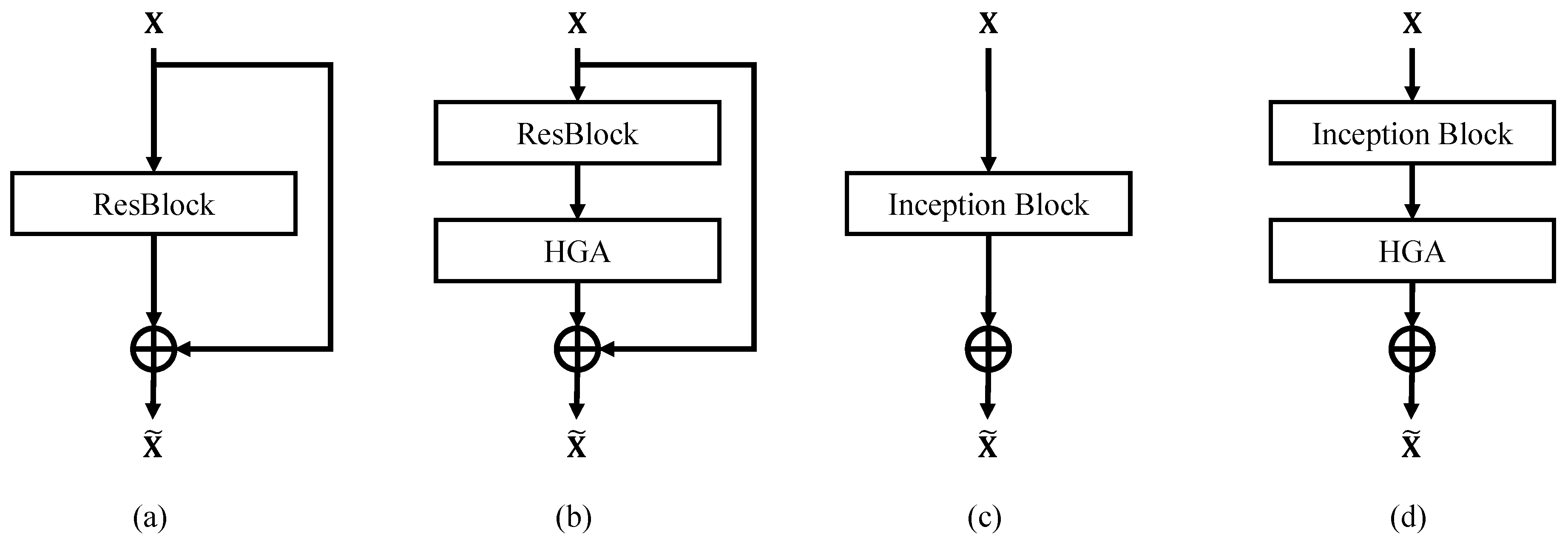
As an efficient component, HGA can be flexibly applied in different network designs. ResNet [18] and InceptionNet [14] are two classical network design patterns from which most recent networks are derived. From this point of view, we provide the applications of HGA on the two patterns, which are demonstrated in Figure 2. Figure 2a,c denotes the vanilla block designs in ResNet and Inception Net. Figure 2b,d denotes the applications of HGA. In ResNet, HGA is applied in the main path after the ResBlock processing. On one hand, this pattern could find the inherent correlations after feature exploration. On the other hand, applying HGA on main path could preserve the identical information and gradient transmission on the shortcut. Different from ResNet, in Inception Net, the HGA is applied after the Inception Block. In Inception Block, the identical information transmission is utilized by 1 × 1 convolutional layer. The HGA does not omit the identical transmission in Inception Net. It is because the 1 × 1 convolution will change the distribution of information from different channels.
Figure 2. Applications of HGA on different network designs. (a) The vanilla ResBlock [15]. (b) The application of HGA on ResBlock. (c) The vanilla Inception Block [14]. (d) The application of HGA on Inception Block.
From the design, HGA is an efficient component with restricted parameters and computation complexity. Suppose the input F i n is with size H × W × C , then the FLOPs cost on MFE module is
F L O P M F E = 2 H W C ( 1 2 + 3 2 + 5 2 + 7 2 ) .
After concatenation, there are three GAP layers for global information measurement. The FLOPs cost on HAP module is
F L O P H A P = 3 H W C .
Finally, there are two full connection layers and two activation functions in EE module. The FLOPs cost on EE module is
F L O P E E = 85 2 C 2 .
The entire FLOP cost of HGA is,
F L O P H G A = F L O P M F E + F L O P H A P + F L O P E E .
Notice that there is no bias in both group convolutions and the full connection layers. On one hand, it will save the parameters and computation cost. On the other hand, the bias setting will modify the distribution of feature maps.
The parameters of HGA are
P a r a m H G A = ( 1 2 + 3 2 + 5 2 + 7 2 ) C + 11 2 C 2 .
The left-hand side of Equation (12) denotes the parameters of MFE module and the right-hand side denotes the EE module. There is no parameter in HAP module, where only the GAP layers exist.

5. Experiments

5.1. Results

To demonstrate the capacity of HGA, we evaluate the image classification performance on ImageNet [11] 2012 dataset. The ImageNet dataset contains 1.28 million images for training and around 50,000 images for validation, which cover 1000 different classes. Top-1 and top-5 error are considered as the indicators of classification capacity. The images are augmented by randomly cropping, flipping, and rotation. Training data are resized as 224 × 224 to suit the origin settings of baseline network. The parameters are updated by SGD optimizer with learning rate as l r = 0.6 and shrunk 10 times for every 30 epochs. We totally update the model for 100 epochs.
For a better representation of the HGA embedding method, we provide the details on two modern backbones, which is shown in Table 1. As there are a large number of filters in the deeper layers, a linear transformation is applied for dimension reduction. In the table, H G A ( a , b , c ) denotes a three-step operation. First, a full connection (FC) layer is conducted to shrink the dimension from a to b, then an HGA attention with b channels is utilized. After the attention mechanism, the dimension will be restored from b to c with a FC layer.
Table 1. The embedding methods of HGA for different modern backbones.
Herein, we consider the error rate as the indicator for different networks. In fact, statistically significant is a less concerned indicator for deep learning-based image classification. On one hand, Top-1 and Top-5 error (%) can well describe the performance for practical applications. On the other hand, CNN has a good generalization ability and performs well on different classification datasets. Usually when a network works well on one class, it will also work well on another one. In this situation, Analysis of Variance (ANOVA) may be not useful for evaluating the network performance. From this point of view, we only compare the numeric values but not perform the statistically significant test.
We compare the single-crop error rates on the ImageNet validation set and adopt better values between the reported results from their origin papers and our reproduction version. The results are shown in Table 2. We apply the HGA to five modern backbones: ResNet-50, ResNet-101, ResNet-152, ResNeXt-50, and ResNeXt-101, which have proved to be remarkable design patterns. From the results, HGA provides a significant performance improvement with restricted increase on FLOPs and parameters. Notice that the accuracy rates from vanilla models are reported from the origin paper, and the HGA versions are trained by ourselves. From the numerical comparison with vanilla models, HGA achieves average 7.94% improvement on Top 1 error and 16.63% on Top 5 error. The FLOPs of HGA version only increases 6.23% on average. Furthermore, we also compare our HGA with recent elaborate attention mechanism SENet [7] and SKNet [35]. The results are shown in Table 3. From the results, HGA achieves better classification accuracy than other attention mechanisms. To demonstrate the generalization ability of HGA, we perform the comparisons on CIFAR-10 and CIFAR-100 dataset in Table 4, which shows the superior capacity of our HGA.
Table 2. Single-crop error rates of different models on ImageNet dataset.
Table 3. Comparisons of different attention mechanism on ImageNet dataset.
Table 4. Top 1 error(%) of different attention mechanism on CIFAR-10 and CIFAR-100 dataset.

5.2. Ablation Study

Investigation on different modules. To demonstrate the effectiveness of three different modules, we rebuild the HGA with different module combinations. The results are shown in Table 5. From the table, we can find that MFE plays as a critical role for performance improvement. On one hand, MFE extracts the multi-scale information from input features which provides a diverse comprehension. On the other hand, the MFE module increases the network depth, which helps to enhance the representation.
Table 5. Comparisons of different module combinations.
Investigation on HGA module. To further explore the capacity of HGA module, we modify the multi-scale extraction with different convolutional layers, which are shown in Table 6. From the result, we can find that the larger filters will help more on the accuracy improvement. Different filter sizes will exploit different scale information, and the HGA module can comprehensively exploit the multi-scale feature for better representation and semantic understanding.
Table 6. Investigation on HGA module.

6. Conclusions

In this paper, we introduced a hierarchical global attention mechanism termed HGA for the image classification issue, considering the multi-scale correlations between different feature maps. There are three modules in HGA for adaptive multi-scale information exploration and finding the attention among features. As an efficient network component, HGA could be flexibly applied in various network design patterns, which was demonstrated in both computational complex analysis and the experimental results. We performed the experiments with several modern network design patterns, the experiment results showed HGA as an effective component for better image classification performance.

Author Contributions

Conceptualization, K.C.; data curation, J.G.; formal analysis, K.-n.C.; methodology, L.D. All authors have read and agreed to the published version of the manuscript.

Funding

This work is supported by the China-Korea Young Scientist Exchange Program (2020), Science Foundation of Shenyang University of Chemical Technology under grant No. LQ2020020.

Conflicts of Interest

The authors declare no conflict of interest.

References

  1. Lecun, Y.; Bottou, L.; Bengio, Y.; Haffner, P. Gradient-based learning applied to document recognition. Proc. IEEE 1998, 86, 2278–2324. [Google Scholar] [CrossRef]
  2. Florea, G.; Mihailescu, R.C. Deep Learning for Group Activity Recognition in Smart Office Environments. Future Internet 2020, 12, 133. [Google Scholar] [CrossRef]
  3. Song, X.; Yang, H.; Zhou, C. Pedestrian Attribute Recognition with Graph Convolutional Network in Surveillance Scenarios. Future Internet 2019, 11, 245. [Google Scholar] [CrossRef]
  4. Liu, W.; Qian, J.; Yao, Z.; Pan, J. Convolutional Two-Stream Network Using Multi-Facial Feature Fusion for Driver Fatigue Detection. Future Internet 2019, 11, 115. [Google Scholar] [CrossRef]
  5. Song, A.; Wu, Z.; Ding, X.; Hu, Q.; Di, X. Neurologist Standard Classification of Facial Nerve Paralysis with Deep Neural Networks. Future Internet 2018, 10, 111. [Google Scholar] [CrossRef]
  6. Roychowdhury, S.; Hage, P.; Vasquez, J. Azure-Based Smart Monitoring System for Anemia-Like Pallor. Appl. Sci. 2020, 10, 1681. [Google Scholar] [CrossRef]
  7. Hu, J.; Shen, L.; Sun, G. Squeeze-and-Excitation Networks. In Proceedings of the 2018 IEEE Conference on Computer Vision and Pattern Recognition, CVPR 2018, Salt Lake City, UT, USA, 18–22 June 2018; pp. 7132–7141. [Google Scholar] [CrossRef]
  8. Wang, F.; Jiang, M.; Qian, C.; Yang, S.; Li, C.; Zhang, H.; Wang, X.; Tang, X. Residual Attention Network for Image Classification. In Proceedings of the 2017 IEEE Conference on Computer Vision and Pattern Recognition, CVPR 2017, Honolulu, HI, USA, 21–26 July 2017; pp. 6450–6458. [Google Scholar] [CrossRef]
  9. Wang, X.; Girshick, R.B.; Gupta, A.; He, K. Non-Local Neural Networks. In Proceedings of the 2018 IEEE Conference on Computer Vision and Pattern Recognition, CVPR 2018, Salt Lake City, UT, USA, 18–22 June 2018; pp. 7794–7803. [Google Scholar]
  10. Krizhevsky, A.; Hinton, G. Learning Multiple Layers of Features from Tiny Images; Technically Report; Computer Science Department, University of Toronto: Toronto, ON, USA, 2009; Volume 1. [Google Scholar]
  11. Deng, J.; Dong, W.; Socher, R.; Li, L.; Li, K.; Li, F. ImageNet: A large-scale hierarchical image database. In Proceedings of the 2009 IEEE Computer Society Conference on Computer Vision and Pattern Recognition (CVPR 2009), Miami, FL, USA, 20–25 June 2009; pp. 248–255. [Google Scholar] [CrossRef]
  12. Krizhevsky, A.; Sutskever, I.; Hinton, G.E. ImageNet Classification with Deep Convolutional Neural Networks. In Proceedings of the Advances in Neural Information Processing Systems 25: 26th Annual Conference on Neural Information Processing Systems 2012, Lake Tahoe, NV, USA, 3–6 December 2012. [Google Scholar]
  13. Simonyan, K.; Zisserman, A. Very Deep Convolutional Networks for Large-Scale Image Recognition. In Proceedings of the 3rd International Conference on Learning Representations, ICLR 2015, San Diego, CA, USA, 7–9 May 2015. [Google Scholar]
  14. Szegedy, C.; Liu, W.; Jia, Y.; Sermanet, P.; Reed, S.E.; Anguelov, D.; Erhan, D.; Vanhoucke, V.; Rabinovich, A. Going deeper with convolutions. In Proceedings of the IEEE Conference on Computer Vision and Pattern Recognition, CVPR 2015, Boston, MA, USA, 7–12 June 2015; pp. 1–9. [Google Scholar] [CrossRef]
  15. He, K.; Zhang, X.; Ren, S.; Sun, J. Deep Residual Learning for Image Recognition. In Proceedings of the IEEE Conference on Computer Vision and Pattern Recognition (CVPR), Boston, MA, USA, 7–12 June 2015. [Google Scholar]
  16. Gao, S.; Cheng, M.; Zhao, K.; Zhang, X.; Yang, M.; Torr, P.H.S. Res2Net: A New Multi-scale Backbone Architecture. IEEE Trans. Pattern Anal. Mach. Intell. 2019. [Google Scholar] [CrossRef] [PubMed]
  17. Xie, S.; Girshick, R.B.; Dollár, P.; Tu, Z.; He, K. Aggregated Residual Transformations for Deep Neural Networks. In Proceedings of the 2017 IEEE Conference on Computer Vision and Pattern Recognition, CVPR 2017, Honolulu, HI, USA, 21–26 July 2017; pp. 5987–5995. [Google Scholar] [CrossRef]
  18. Zhang, H.; Wu, C.; Zhang, Z.; Zhu, Y.; Zhang, Z.; Lin, H.; Sun, Y.; He, T.; Mueller, J.; Manmatha, R.; et al. ResNeSt: Split-Attention Networks. arXiv 2020, arXiv:2004.08955. [Google Scholar]
  19. Huang, G.; Liu, Z.; van der Maaten, L.; Weinberger, K.Q. Densely Connected Convolutional Networks. In Proceedings of the 2017 IEEE Conference on Computer Vision and Pattern Recognition, CVPR 2017, Honolulu, HI, USA, 21–26 July 2017; pp. 2261–2269. [Google Scholar] [CrossRef]
  20. Zagoruyko, S.; Komodakis, N. Wide Residual Networks. In Proceedings of the British Machine Vision Conference 2016, BMVC 2016, York, UK, 19–22 September 2016. [Google Scholar]
  21. Han, D.; Kim, J.; Kim, J. Deep Pyramidal Residual Networks. In Proceedings of the 2017 IEEE Conference on Computer Vision and Pattern Recognition, CVPR 2017, Honolulu, HI, USA, 21–26 July 2017; pp. 6307–6315. [Google Scholar] [CrossRef]
  22. Larsson, G.; Maire, M.; Shakhnarovich, G. FractalNet: Ultra-Deep Neural Networks without Residuals. In Proceedings of the 5th International Conference on Learning Representations, ICLR 2017, Toulon, France, 24–26 April 2017. [Google Scholar]
  23. Zhang, T.; Qi, G.; Xiao, B.; Wang, J. Interleaved Group Convolutions for Deep Neural Networks. arXiv 2017, arXiv:1707.02725. [Google Scholar]
  24. Xie, G.; Wang, J.; Zhang, T.; Lai, J.; Hong, R.; Qi, G. IGCV2: Interleaved Structured Sparse Convolutional Neural Networks. arXiv 2018, arXiv:1804.06202. [Google Scholar]
  25. Sun, K.; Li, M.; Liu, D.; Wang, J. IGCV3: Interleaved Low-Rank Group Convolutions for Efficient Deep Neural Networks. In Proceedings of the British Machine Vision Conference 2018, BMVC 2018, Newcastle, UK, 3–6 September 2018. [Google Scholar]
  26. Chollet, F. Xception: Deep Learning with Depthwise Separable Convolutions. In Proceedings of the 2017 IEEE Conference on Computer Vision and Pattern Recognition, CVPR 2017, Honolulu, HI, USA, 21–26 July 2017; pp. 1800–1807. [Google Scholar] [CrossRef]
  27. Zhang, X.; Li, Z.; Loy, C.C.; Lin, D. PolyNet: A Pursuit of Structural Diversity in Very Deep Networks. In Proceedings of the 2017 IEEE Conference on Computer Vision and Pattern Recognition, CVPR 2017, Honolulu, HI, USA, 21–26 July 2017; pp. 3900–3908. [Google Scholar] [CrossRef]
  28. Xie, L.; Yuille, A.L. Genetic CNN. In Proceedings of the IEEE International Conference on Computer Vision, ICCV 2017, Venice, Italy, 22–29 October 2017; pp. 1388–1397. [Google Scholar] [CrossRef]
  29. Zoph, B.; Vasudevan, V.; Shlens, J.; Le, Q.V. Learning Transferable Architectures for Scalable Image Recognition. In Proceedings of the 2018 IEEE Conference on Computer Vision and Pattern Recognition, CVPR 2018, Salt Lake City, UT, USA, 18–22 June 2018; pp. 8697–8710. [Google Scholar] [CrossRef]
  30. Liu, C.; Zoph, B.; Neumann, M.; Shlens, J.; Hua, W.; Li, F.; Yuille, A.L.; Huang, J.; Murphy, K. Progressive Neural Architecture Search. In Proceedings of the Computer Vision—ECCV 2018—15th European Conference, Munich, Germany, 8–14 September 2018. [Google Scholar]
  31. Tan, M.; Chen, B.; Pang, R.; Vasudevan, V.; Sandler, M.; Howard, A.; Le, Q.V. MnasNet: Platform-Aware Neural Architecture Search for Mobile. In Proceedings of the IEEE Conference on Computer Vision and Pattern Recognition, CVPR 2019, Long Beach, CA, USA, 16–20 June 2019; pp. 2820–2828. [Google Scholar] [CrossRef]
  32. Zhong, Z.; Yan, J.; Wu, W.; Shao, J.; Liu, C. Practical Block-Wise Neural Network Architecture Generation. In Proceedings of the 2018 IEEE Conference on Computer Vision and Pattern Recognition, CVPR 2018, Salt Lake City, UT, USA, 18–22 June 2018; pp. 2423–2432. [Google Scholar] [CrossRef]
  33. Baker, B.; Gupta, O.; Naik, N.; Raskar, R. Designing Neural Network Architectures using Reinforcement Learning. In Proceedings of the 5th International Conference on Learning Representations, ICLR 2017, Toulon, France, 24–26 April 2017. [Google Scholar]
  34. Liu, H.; Simonyan, K.; Yang, Y. DARTS: Differentiable Architecture Search. In Proceedings of the 7th International Conference on Learning Representations, ICLR 2019, New Orleans, LA, USA, 6–9 May 2019. [Google Scholar]
  35. Li, X.; Wang, W.; Hu, X.; Yang, J. Selective Kernel Networks. In Proceedings of the IEEE Conference on Computer Vision and Pattern Recognition, CVPR 2019, Long Beach, CA, USA, 16–20 June 2019; pp. 510–519. [Google Scholar] [CrossRef]
Publisher’s Note: MDPI stays neutral with regard to jurisdictional claims in published maps and institutional affiliations.

Article Metrics

Citations

Article Access Statistics

Multiple requests from the same IP address are counted as one view.