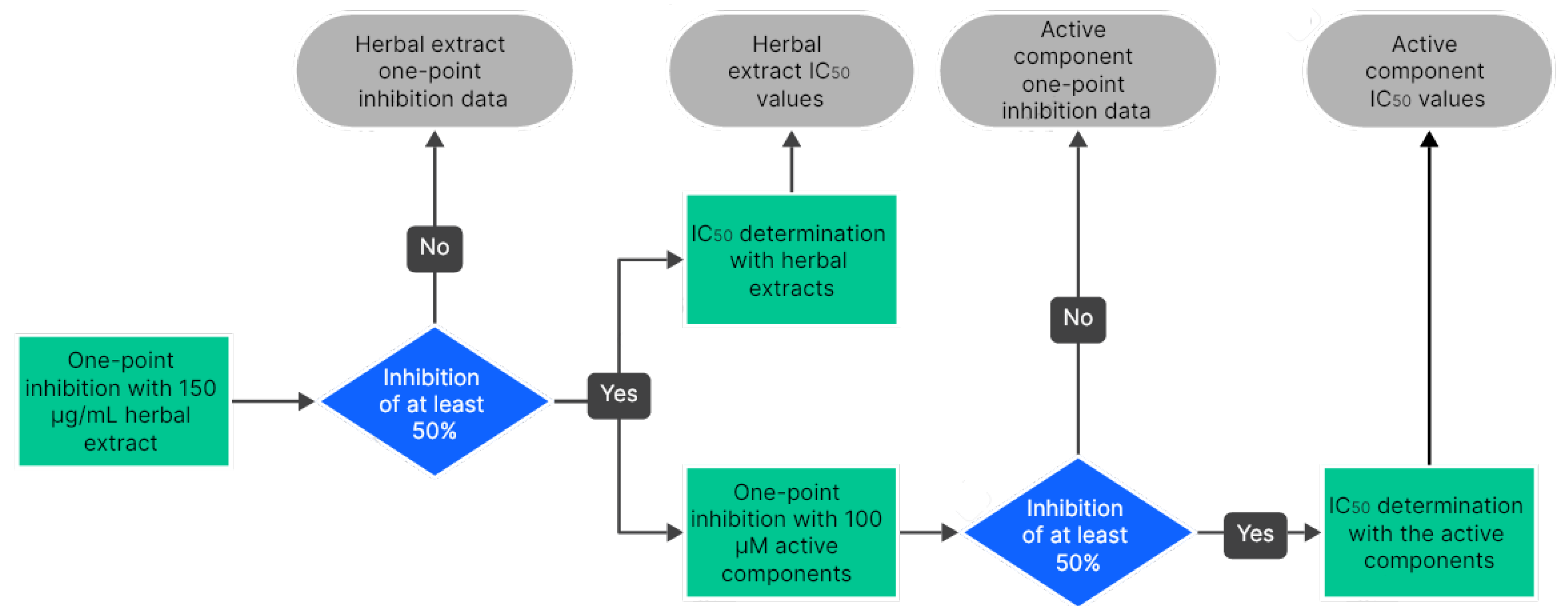
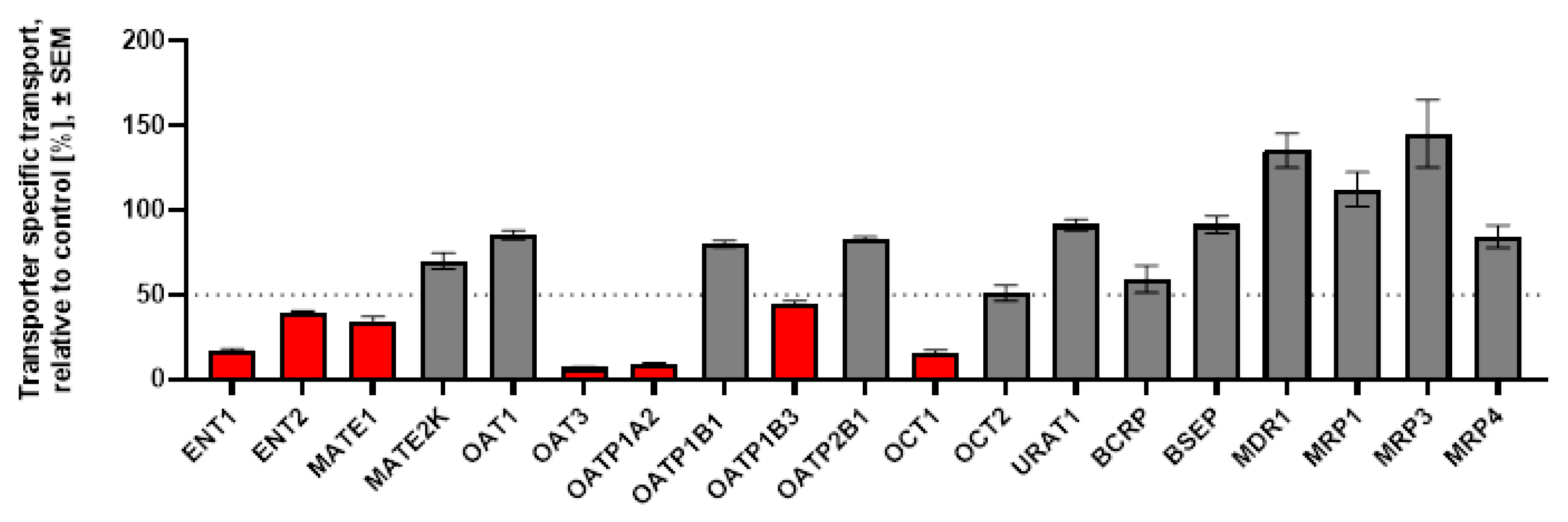
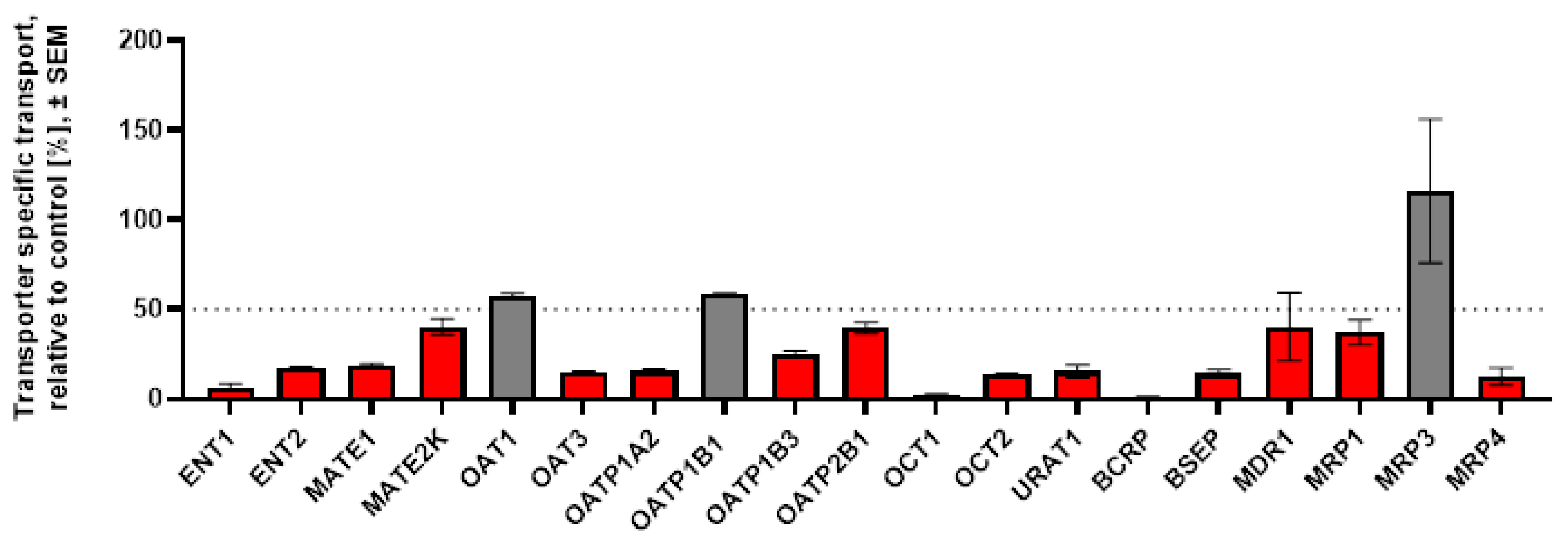
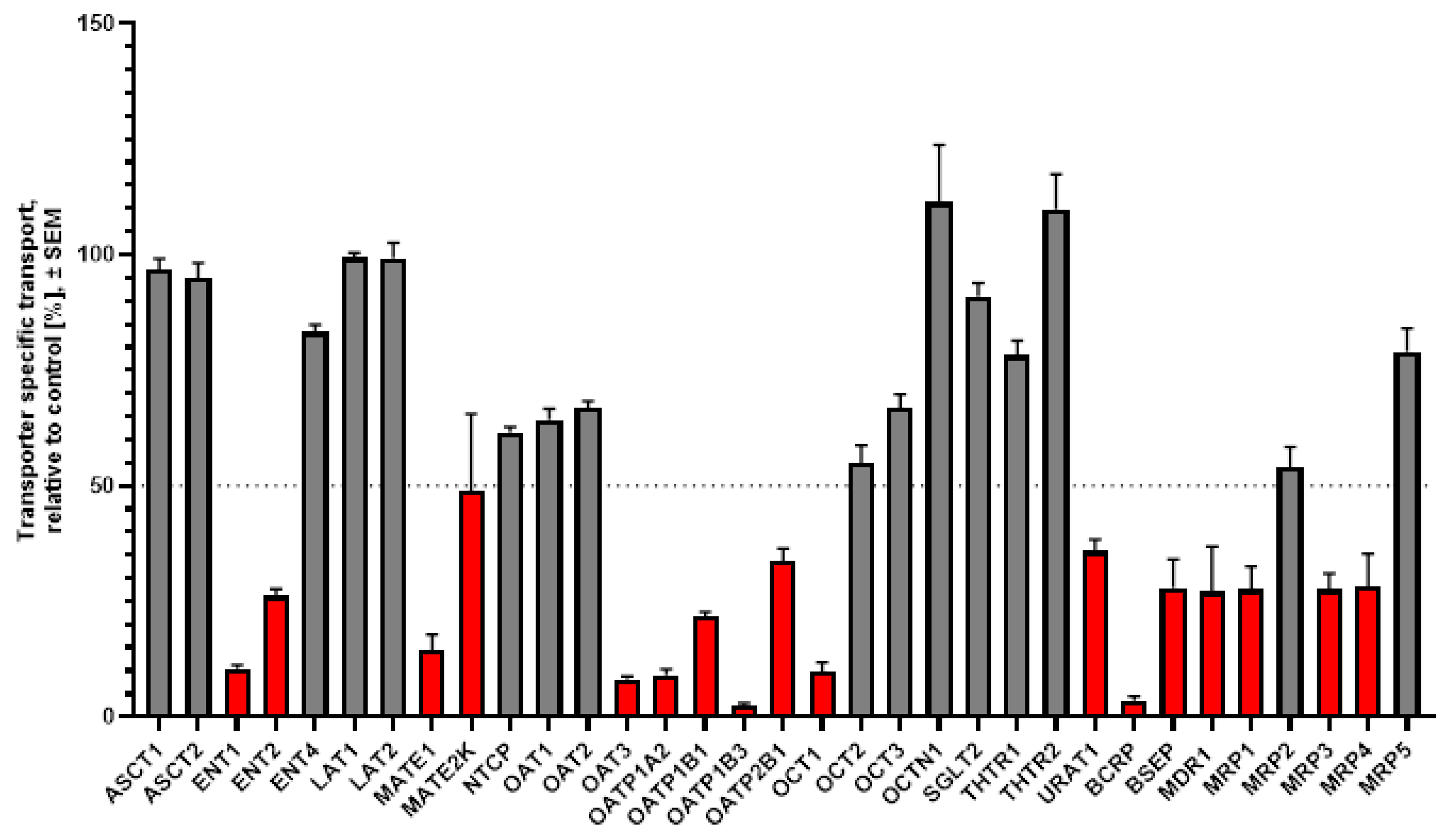
Ginger and Its Purified Major Components Inhibit Clinically Relevant Uptake and Efflux Transporters In Vitro


 , , , ,
Abstract
1. Introduction
2. Materials and Methods
2.1. Preparation of Zingiber officinale Extracts
2.2. Quantitative Analysis of the Extract
2.3. Cell Line Generation, Cell Culturing, and Membrane Preparation
2.4. Transporter Inhibition Assays
2.5. Calculations
2.6. Risk Assessment
2.7. Antiproliferative Assays
2.8. Acute Toxicity Assays
3. Results
3.1. One-Point Inhibition Studies with Zingiber officinale Extract
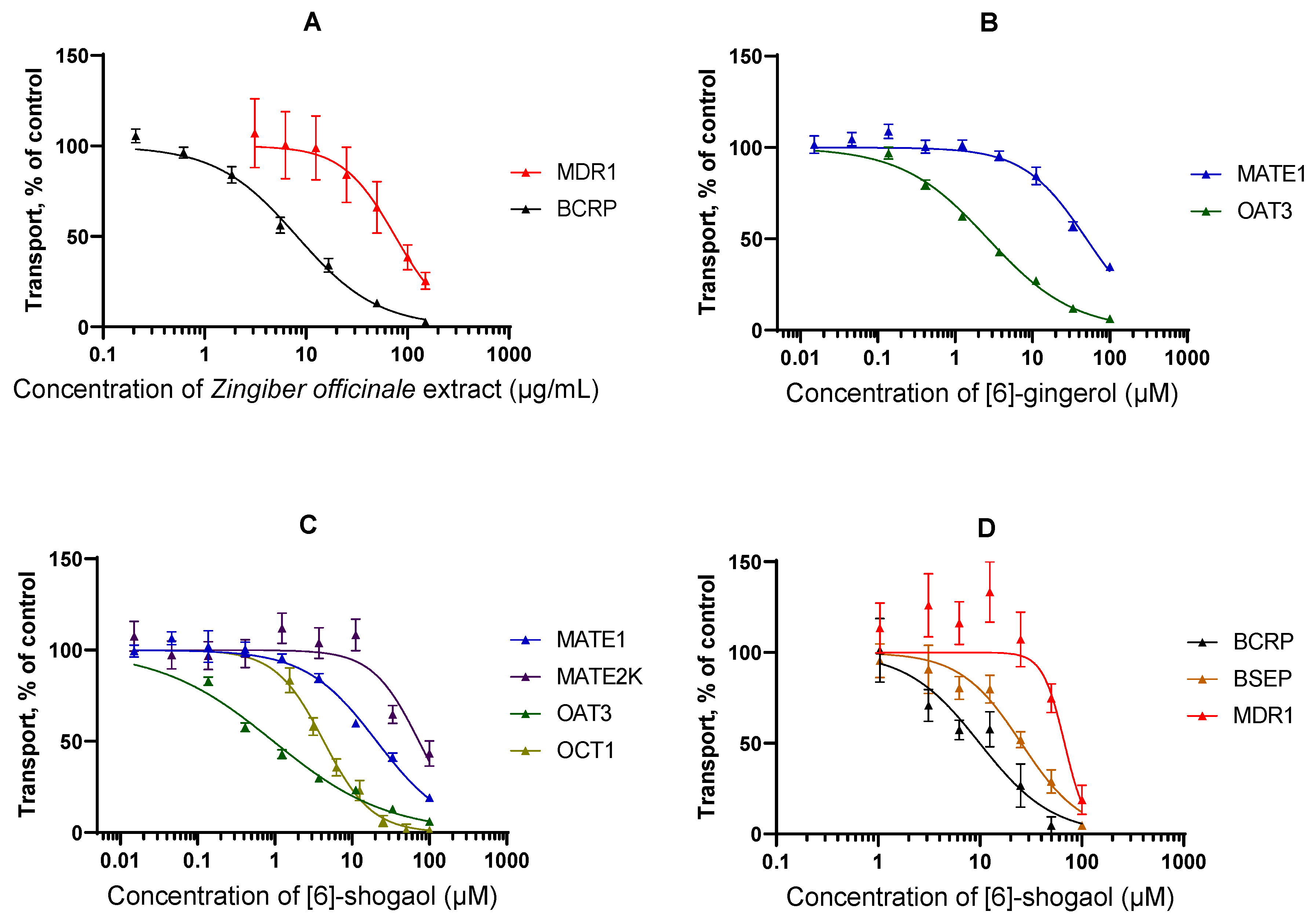
3.2. IC50 Measurements with Zingiber officinale Extract
3.3. One-Point Inhibition Studies with [6]-Gingerol and [6]-Shogaol
3.4. IC50 Measurements with [6]-Gingerol and [6]-Shogaol
3.5. Risk Assessment of Transporter Interactions
3.6. Antiproliferative Properties of the Tested Substances
3.7. Acute Toxicity
4. Discussion
Supplementary Materials
Author Contributions
Funding
Institutional Review Board Statement
Informed Consent Statement
Data Availability Statement
Conflicts of Interest
Abbreviations
| SLC | Solute carrier |
| ABC | ATP-binding cassette |
| HDI | Herb–drug interaction |
| MDR1 | Multidrug resistance 1 |
| BCRP | Breast cancer resistance protein |
| OAT | Organic anion transporter |
| URAT | Urate transporter |
| OCT | Organic cation transporter |
| BSEP | Bile salt export pump |
| ENT | Equilibrative nucleoside transporter |
| DDI | Drug–drug interaction |
| MRP | Multidrug resistance protein |
| OATP | Organic anion transporting polypeptide |
| MATE | Multidrug and toxin extrusion transporter |
| CYP | Cytochrome P450 |
| HPLC | High-Pressure Liquid Chromatography |
| LOD | Limit of detection |
| LOQ | Limit of quantification |
| PTFE | Polytetrafluoroethylene |
| DAD | Diode array detector |
| SD | Standard deviation |
| HEK293 | Human embryonic kidney 293 |
| MDCKII | Madin-Darby canine kidney strain II |
| DMEM | Dulbecco’s Modified Eagle Medium |
| FBS | Fetal bovine serum |
| E3S | Estrone-3-sulfate |
| NMQ | N-methyl-quinidine |
| CCK-8 | Cholecystokinin octapeptide |
| MPP+ | 1-methyl-4-phenylpyridinium |
| DHEAS | Dehydroepiandrosterone sulfate |
| E217βG | Estradiol 17β-D-glucuronide |
| TC | Taurocholic acid |
| AMG | α-D-glucopyranoside |
| TEA | Tetraethylammonium |
| HBSS | Hanks’ Balanced Salt Solution |
| KH | Krebs–Henseleit |
| ICH | International Council for Harmonization |
| DMSO | Dimethyl sulfoxide |
| DILI | Drug-induced liver injury |
| AUC | Area under the curve |
References
- Matin, M.; Yeung, A.W.K.; Joshi, T.; Tzvetkov, N.T.; Bin Matin, F.; Strzałkowska, N.; Ksepka, N.; Wysocki, K.; Tomasik, C.; Mickael, M.-E.; et al. Ginger: A Total-Scale Analysis of the Scientific Literature on a Widely Used Spice and Phytotherapeutic. Anim. Sci. Pap. Rep. 2024, 42, 349–364. [Google Scholar] [CrossRef] [Scilit]
- Ali, B.H.; Blunden, G.; Tanira, M.O.; Nemmar, A. Some Phytochemical, Pharmacological and Toxicological Properties of Ginger (Zingiber officinale Roscoe): A Review of Recent Research. Food Chem. Toxicol. 2008, 46, 409–420. [Google Scholar] [CrossRef] [Scilit] [PubMed]
- Zhang, C.; Rao, A.; Chen, C.; Li, Y.; Tan, X.; Long, J.; Wang, X.; Cai, J.; Huang, J.; Luo, H.; et al. Pharmacological Activity and Clinical Application Analysis of Traditional Chinese Medicine Ginger from the Perspective of One Source and Multiple Substances. Chin. Med. 2024, 19, 97. [Google Scholar] [CrossRef] [Scilit] [PubMed]
- Attallah, K.A.; El-Dessouki, A.M.; Abd-Elmawla, M.A.; Ghaiad, H.R.; Abo-Elghiet, F.; Mustafa, A.M.; El-Shiekh, R.A.; Elosaily, H. The Therapeutic Potential of Naturally Occurring 6-Shogaol: An Updated Comprehensive Review. Inflammopharmacology 2025. online ahead of print. [Google Scholar] [CrossRef] [Scilit]
- Figueroa-González, G.; Quintas-Granados, L.I.; Reyes-Hernández, O.D.; Caballero-Florán, I.H.; Peña-Corona, S.I.; Cortés, H.; Leyva-Gómez, G.; Habtemariam, S.; Sharifi-Rad, J. Review of the Anticancer Properties of 6-shogaol: Mechanisms of Action in Cancer Cells and Future Research Opportunities. Food Sci. Nutr. 2024, 12, 4513–4533. [Google Scholar] [CrossRef] [Scilit] [PubMed]
- Shanmugam, K.R.; Shanmugam, B.; Venkatasubbaiah, G.; Ravi, S.; Reddy, K.S. Recent Updates on the Bioactive Compounds of Ginger (Zingiber officinale) on Cancer: A Study with Special Emphasis of Gingerol and Its Anticancer Potential. In Handbook of Oxidative Stress in Cancer: Therapeutic Aspects; Springer Nature: Singapore, 2022; pp. 1–18. [Google Scholar]
- Rafieipour, N.; Gharbi, N.; Rahimi, H.; Kohansal, A.; Sadeghi-Dehsahraei, H.; Fadaei, M.; Tahmasebi, M.; Momeni, S.A.; Ostovar, N.; Ahmadi, M.; et al. Ginger Intervention on Body Weight and Body Composition in Adults: A GRADE-Assessed Systematic Review and Dose-Response Meta-Analysis of 27 Randomized Controlled Trials. Nutr. Rev. 2024, 82, 1651–1665. [Google Scholar] [CrossRef] [Scilit]
- El Gayar, M.H.; Aboromia, M.M.M.; Ibrahim, N.A.; Abdel Hafiz, M.H. Effects of Ginger Powder Supplementation on Glycemic Status and Lipid Profile in Newly Diagnosed Obese Patients with Type 2 Diabetes Mellitus. Obes. Med. 2019, 14, 100094. [Google Scholar] [CrossRef] [Scilit]
- Garza-Cadena, C.; Ortega-Rivera, D.M.; Machorro-García, G.; Gonzalez-Zermeño, E.M.; Homma-Dueñas, D.; Plata-Gryl, M.; Castro-Muñoz, R. A Comprehensive Review on Ginger (Zingiber officinale) as a Potential Source of Nutraceuticals for Food Formulations: Towards the Polishing of Gingerol and Other Present Biomolecules. Food Chem. 2023, 413, 135629. [Google Scholar] [CrossRef] [Scilit]
- Sun, X.; Nie, F.; Sun, J.; Zhang, J.; Wang, Y. Medicinal Plants for Chemotherapy-Induced Nausea and Vomiting: A Systematic Review of Antiemetic, Chemosensitizing, and Immunomodulatory Mechanisms. Ther. Clin. Risk Manag. 2025, 21, 1187–1218. [Google Scholar] [CrossRef] [Scilit]
- Pashaei, S.; Akyüz, N.; Ersoy, Y.E. The Effect of Ginger and Mint on Postoperative Nausea and Vomiting in Patients Undergoing Total Thyroidectomy. J. Perianesth. Nurs. 2025, 40, 1451–1459. [Google Scholar] [CrossRef] [Scilit]
- Sajjad, B.; Aftab, A.; Yousaf, Z.; Maqbool, Z.; Sun, W.; Rizwana, H. Phytochemical Investigation of Ginger: Unveiling Therapeutic Compounds With Multiple Health Applications. Int. J. Food Sci. 2025, 2025, 4311760. [Google Scholar] [CrossRef] [Scilit]
- Yoon, D.; Choi, B.; Kim, H.; Lee, D.Y. Metabolic Differences in Zingiber officinale Roscoe by Geographical Origin Determined via Multiplatform Metabolomics and Method for Simultaneous Analysis of Six Phenolic Compounds. J. Food Sci. 2024, 89, 7452–7463. [Google Scholar] [CrossRef] [Scilit] [PubMed]
- Boubker, A.; El Ouardi, A.; El Kamli, T.; Kaicer, M.; Kichou, F.; Errafii, K.; El Hamidi, A.; Ben Aakame, R.; Sifou, A. Integrated Phytochemical Profiling, UPLC-HRMS Characterization, and Bioactivity Evaluation of Zingiber officinale and Piper nigrum. Int. J. Mol. Sci. 2025, 26, 7782. [Google Scholar] [CrossRef] [Scilit] [PubMed]
- Yücel, Ç.; Karatoprak, G.Ş.; Açıkara, Ö.B.; Akkol, E.K.; Barak, T.H.; Sobarzo-Sánchez, E.; Aschner, M.; Shirooie, S. Immunomodulatory and Anti-Inflammatory Therapeutic Potential of Gingerols and Their Nanoformulations. Front. Pharmacol. 2022, 13, 902551. [Google Scholar] [CrossRef] [Scilit] [PubMed]
- Bischoff-Kont, I.; Primke, T.; Niebergall, L.S.; Zech, T.; Fürst, R. Ginger Constituent 6-Shogaol Inhibits Inflammation- and Angiogenesis-Related Cell Functions in Primary Human Endothelial Cells. Front. Pharmacol. 2022, 13, 844767. [Google Scholar] [CrossRef] [Scilit]
- Rasheed, H.; Ahmed, S.; Sharma, A. Changing Trends Towards Herbal Supplements: An Insight into Safety and Herb-Drug Interaction. Curr. Pharm. Biotechnol. 2024, 25, 285–300. [Google Scholar] [CrossRef] [Scilit]
- Giacomini, K.M.; Huang, S.-M.; Tweedie, D.J.; Benet, L.Z.; Brouwer, K.L.R.; Chu, X.; Dahlin, A.; Evers, R.; Fischer, V.; Hillgren, K.M.; et al. Membrane Transporters in Drug Development. Nat. Rev. Drug Discov. 2010, 9, 215–236. [Google Scholar] [CrossRef] [Scilit]
- ICH M12 Drug Interaction Studies Guidance for Industry ICH-Multidisciplinary. Available online: https://www.fda.gov/media/161199/download (accessed on 14 May 2025).
- Liu, X. Transporter-Mediated Drug-Drug Interactions and Their Significance. Adv. Exp. Med. Biol. 2019, 1141, 241–291. [Google Scholar] [CrossRef] [Scilit]
- Müller, J.; Keiser, M.; Drozdzik, M.; Oswald, S. Expression, Regulation and Function of Intestinal Drug Transporters: An Update. Biol. Chem. 2017, 398, 175–192. [Google Scholar] [CrossRef] [Scilit]
- König, J.; Müller, F.; Fromm, M.F. Transporters and Drug-Drug Interactions: Important Determinants of Drug Disposition and Effects. Pharmacol. Rev. 2013, 65, 944–966. [Google Scholar] [CrossRef] [Scilit]
- Jetter, A.; Kullak-Ublick, G.A. Drugs and Hepatic Transporters: A Review. Pharmacol. Res. 2020, 154, 104234. [Google Scholar] [CrossRef] [Scilit]
- Lee, W.; Kim, R.B. Transporters and Renal Drug Elimination. Annu. Rev. Pharmacol. Toxicol. 2004, 44, 137–166. [Google Scholar] [CrossRef] [Scilit] [PubMed]
- Husain, I.; Dale, O.R.; Idrisi, M.; Gurley, B.J.; Avula, B.; Katragunta, K.; Ali, Z.; Chittiboyina, A.; Noonan, G.; Khan, I.A.; et al. Evaluation of the Herb–Drug Interaction (HDI) Potential of Zingiber officinale and Its Major Phytoconstituents. J. Agric. Food Chem. 2023, 71, 7521–7534. [Google Scholar] [CrossRef] [Scilit] [PubMed]
- Li, M.; Chen, P.; Yue, Q.; Li, J.; Chu, R.; Zhang, W.; Wang, H. Pungent Ginger Components Modulates Human Cytochrome P450 Enzymes in Vitro. Acta Pharmacol. Sin. 2013, 34, 1237–1242. [Google Scholar] [CrossRef] [Scilit] [PubMed]
- Zhou, S.-F.; Qiu, J.; Zhou, Z.-W.; He, Z.; Zhang, X.; Zhu, S. Estimation of the Binding Modes with Important Human Cytochrome P450 Enzymes, Drug Interaction Potential, Pharmacokinetics, and Hepatotoxicity of Ginger Components Using Molecular Docking, Computational, and Pharmacokinetic Modeling Studies. Drug Des. Devel. Ther. 2015, 9, 841. [Google Scholar] [CrossRef] [Scilit]
- Young, H.-Y.; Liao, J.-C.; Chang, Y.-S.; Luo, Y.-L.; Lu, M.-C.; Peng, W.-H. Synergistic Effect of Ginger and Nifedipine on Human Platelet Aggregation: A Study in Hypertensive Patients and Normal Volunteers. Am. J. Chin. Med. 2006, 34, 545–551. [Google Scholar] [CrossRef] [Scilit]
- Sarkadi, B.; Price, E.M.; Boucher, R.C.; Germann, U.A.; Scarborough, G.A. Expression of the Human Multidrug Resistance CDNA in Insect Cells Generates a High Activity Drug-Stimulated Membrane ATPase. J. Biol. Chem. 1992, 267, 4854–4858. [Google Scholar] [CrossRef] [Scilit]
- Zick, S.M.; Djuric, Z.; Ruffin, M.T.; Litzinger, A.J.; Normolle, D.P.; Alrawi, S.; Feng, M.R.; Brenner, D.E. Pharmacokinetics of 6-Gingerol, 8-Gingerol, 10-Gingerol, and 6-Shogaol and Conjugate Metabolites in Healthy Human Subjects. Cancer Epidemiol. Biomark. Prev. 2008, 17, 1930–1936. [Google Scholar] [CrossRef] [Scilit]
- Yu, Y.; Zick, S.; Li, X.; Zou, P.; Wright, B.; Sun, D. Examination of the Pharmacokinetics of Active Ingredients of Ginger in Humans. AAPS J. 2011, 13, 417. [Google Scholar] [CrossRef] [Scilit]
- Levita, J.; Syafitri, D.; Supu, R.; Mutakin, M.; Megantara, S.; Febrianti, M.; Diantini, A. Pharmacokinetics of 10-gingerol and 6-shogaol in the Plasma of Healthy Subjects Treated with Red Ginger (Zingiber officinale Var. Rubrum) Suspension. Biomed. Rep. 2018, 9, 474–482. [Google Scholar] [CrossRef] [Scilit]
- Schoenknecht, C.; Andersen, G.; Schmidts, I.; Schieberle, P. Quantitation of Gingerols in Human Plasma by Newly Developed Stable Isotope Dilution Assays and Assessment of Their Immunomodulatory Potential. J. Agric. Food Chem. 2016, 64, 2269–2279. [Google Scholar] [CrossRef] [Scilit]
- Schwertner, H.A.; Rios, D.C. High-Performance Liquid Chromatographic Analysis of 6-Gingerol, 8-Gingerol, 10-Gingerol, and 6-Shogaol in Ginger-Containing Dietary Supplements, Spices, Teas, and Beverages. J. Chromatogr. B 2007, 856, 41–47. [Google Scholar] [CrossRef] [Scilit]
- Ding, G.; Naora, K.; Hayashibara, M.; Katagiri, Y.; Kano, Y.; Iwamoto, K. Pharmacokinetics of (6)-Gingerol after Intravenous Administration in Rats. Chem. Pharm. Bull. 1991, 39, 1612–1614. [Google Scholar] [CrossRef] [Scilit] [PubMed]
- Szilvásy, N.; Lajer, P.; Horváth, A.; Veres, K.; Hohmann, J.; Schelz, Z.; Minorics, R.; Zupkó, I.; Gáborik, Z.; Kis, E.; et al. Modulation of Multispecific Transporters by Uncaria Tomentosa Extract and Its Major Phytoconstituents. Pharmaceutics 2024, 16, 1363. [Google Scholar] [CrossRef] [Scilit] [PubMed]
- Nyirenda, K.K.; Mponda, J.; Chikowe, I.; Kawonga, E.; Gomani Phiri, N.T.; Msukwa, M.; Phiri, C.; Roe, A.L.; Paine, M.F.; Gurley, B.; et al. An Exploratory Evaluation of the Interaction Risk between Herbal Products and Pharmaceutical Medicines Used Concurrently for Disease Management in Blantyre, Malawi. Pharm. Biol. 2025, 63, 877–895. [Google Scholar] [CrossRef] [Scilit] [PubMed]
- Revol, B.; Gautier-Veyret, E.; Arrivé, C.; Fouilhé Sam-Laï, N.; McLeer-Florin, A.; Pluchart, H.; Pinsolle, J.; Toffart, A.-C. Pharmacokinetic Herb-Drug Interaction between Ginger and Crizotinib. Br. J. Clin. Pharmacol. 2020, 86, 1892–1893. [Google Scholar] [CrossRef] [Scilit]
- Taskar, K.S.; Yang, X.; Neuhoff, S.; Patel, M.; Yoshida, K.; Paine, M.F.; Brouwer, K.L.R.; Chu, X.; Sugiyama, Y.; Cook, J.; et al. Clinical Relevance of Hepatic and Renal P-Gp/BCRP Inhibition of Drugs: An International Transporter Consortium Perspective. Clin. Pharmacol. Ther. 2022, 112, 573–592. [Google Scholar] [CrossRef] [Scilit]
- Li, Z.; Du, X.; Tian, S.; Fan, S.; Zuo, X.; Li, Y.; Wang, R.; Wang, B.; Huang, Y. Pharmacokinetic Herb-Drug Interactions: Altered Systemic Exposure and Tissue Distribution of Ciprofloxacin, a Substrate of Multiple Transporters, after Combined Treatment with Polygonum Capitatum Buch.-Ham. Ex D. Don Extracts. Front. Pharmacol. 2022, 13, 1033667. [Google Scholar] [CrossRef] [Scilit]
- Stieger, B.; Mahdi, Z.M.; Jäger, W. Intestinal and Hepatocellular Transporters: Therapeutic Effects and Drug Interactions of Herbal Supplements. Annu. Rev. Pharmacol. Toxicol. 2017, 57, 399–416. [Google Scholar] [CrossRef] [Scilit]
- Chen, Y.; Li, H.; Wang, K.; Wang, Y. Recent Advances in Synthetic Drugs and Natural Actives Interacting with OAT3. Molecules 2023, 28, 4740. [Google Scholar] [CrossRef] [Scilit]
- Thakur, A.; Singh, D.K.; Hart, K.D.; Kis, E.; Gáborik, Z.; Denton, T.T.; Clarke, J.D.; Paine, M.F.; Prasad, B. From Discovery to Translation: Endogenous Substrates of OAT1 and OAT3 as Clinical Biomarkers for Renal Secretory Function. Clin. Pharmacol. Ther. 2025. preprint. [Google Scholar] [CrossRef] [Scilit]
- Ni, Y.; Duan, Z.; Zhou, D.; Liu, S.; Wan, H.; Gui, C.; Zhang, H. Identification of Structural Features for the Inhibition of OAT3-Mediated Uptake of Enalaprilat by Selected Drugs and Flavonoids. Front. Pharmacol. 2020, 11, 802. [Google Scholar] [CrossRef] [Scilit] [PubMed]
- Liu, Q.; Wang, C.; Meng, Q.; Huo, X.; Sun, H.; Peng, J.; Ma, X.; Sun, P.; Liu, K. MDR1 and OAT1/OAT3 Mediate the Drug-Drug Interaction between Puerarin and Methotrexate. Pharm. Res. 2014, 31, 1120–1132. [Google Scholar] [CrossRef] [Scilit] [PubMed]
- Selen, A.; Amidon, G.L.; Wellingx, P.G. Pharmacokinetics of Probenecid Following Oral Doses to Human Volunteers. J. Pharm. Sci. 1982, 71, 1238–1242. [Google Scholar] [CrossRef] [Scilit] [PubMed]
- Lombardo, F.; Berellini, G.; Obach, R.S. Trend Analysis of a Database of Intravenous Pharmacokinetic Parameters in Humans for 1352 Drug Compounds. Drug Metab. Dispos. 2018, 46, 1466–1477. [Google Scholar] [CrossRef] [Scilit]
- Duan, P.; Li, S.; Ai, N.; Hu, L.; Welsh, W.J.; You, G. Potent Inhibitors of Human Organic Anion Transporters 1 and 3 from Clinical Drug Libraries: Discovery and Molecular Characterization. Mol. Pharm. 2012, 9, 3340–3346. [Google Scholar] [CrossRef] [Scilit]
- Woodhead, J.L.; Yang, K.; Siler, S.Q.; Watkins, P.B.; Brouwer, K.L.R.; Barton, H.A.; Howell, B.A. Exploring BSEP Inhibition-Mediated Toxicity with a Mechanistic Model of Drug-Induced Liver Injury. Front. Pharmacol. 2014, 5, 240. [Google Scholar] [CrossRef] [Scilit]
- Garcia de Lomana, M.; Gadaleta, D.; Raschke, M.; Fricke, R.; Montanari, F. Predicting Liver-Related In Vitro Endpoints with Machine Learning to Support Early Detection of Drug-Induced Liver Injury. Chem. Res. Toxicol. 2025, 38, 656–671. [Google Scholar] [CrossRef] [Scilit]
- Morgan, R.E.; van Staden, C.J.; Chen, Y.; Kalyanaraman, N.; Kalanzi, J.; Dunn, R.T.; Afshari, C.A.; Hamadeh, H.K. A Multifactorial Approach to Hepatobiliary Transporter Assessment Enables Improved Therapeutic Compound Development. Toxicol. Sci. 2013, 136, 216–241. [Google Scholar] [CrossRef] [Scilit]
- National Institute of Diabetes and Digestive and Kidney Diseases. LiverTox: Clinical and Research Information on Drug-Induced Liver Injury. Ginger. 2012; [Updated 10 February 2024]. Available online: https://www.ncbi.nlm.nih.gov/books/nbk600585/ (accessed on 1 September 2025).
- Zhou, S.; Zeng, S.; Shu, Y. Drug-Drug Interactions at Organic Cation Transporter 1. Front. Pharmacol. 2021, 12, 628705. [Google Scholar] [CrossRef] [Scilit]
- Matthaei, J.; Kuron, D.; Faltraco, F.; Knoch, T.; Dos Santos Pereira, J.; Abu Abed, M.; Prukop, T.; Brockmöller, J.; Tzvetkov, M. OCT1 Mediates Hepatic Uptake of Sumatriptan and Loss-of-function OCT1 Polymorphisms Affect Sumatriptan Pharmacokinetics. Clin. Pharmacol. Ther. 2016, 99, 633–641. [Google Scholar] [CrossRef] [Scilit]
- Miner, J.N.; Tan, P.K.; Hyndman, D.; Liu, S.; Iverson, C.; Nanavati, P.; Hagerty, D.T.; Manhard, K.; Shen, Z.; Girardet, J.-L.; et al. Lesinurad, a Novel, Oral Compound for Gout, Acts to Decrease Serum Uric Acid through Inhibition of Urate Transporters in the Kidney. Arthritis Res. Ther. 2016, 18, 214. [Google Scholar] [CrossRef] [Scilit] [PubMed]
- Hau, R.K.; Wright, S.H.; Cherrington, N.J. Addressing the Clinical Importance of Equilibrative Nucleoside Transporters in Drug Discovery and Development. Clin. Pharmacol. Ther. 2023, 114, 780–794. [Google Scholar] [CrossRef] [Scilit] [PubMed]
- Jouan, E.; Moreau, A.; Bruyere, A.; Alim, K.; Denizot, C.; Parmentier, Y.; Fardel, O. Differential Inhibition of Equilibrative Nucleoside Transporter 1 (ENT1) Activity by Tyrosine Kinase Inhibitors. Eur. J. Drug Metab. Pharmacokinet. 2021, 46, 625–635. [Google Scholar] [CrossRef] [Scilit] [PubMed]
- Scalise, M.; Console, L.; Cosco, J.; Pochini, L.; Galluccio, M.; Indiveri, C. ASCT1 and ASCT2: Brother and Sister? SLAS Discov. 2021, 26, 1148–1163. [Google Scholar] [CrossRef] [Scilit]
- Boswell-Casteel, R.C.; Hays, F.A. Equilibrative Nucleoside Transporters—A Review. Nucleosides Nucleotides Nucleic Acids 2017, 36, 7–30. [Google Scholar] [CrossRef] [Scilit]
- Zhou, M.; Xia, L.; Wang, J. Metformin Transport by a Newly Cloned Proton-Stimulated Organic Cation Transporter (Plasma Membrane Monoamine Transporter) Expressed in Human Intestine. Drug Metab. Dispos. 2007, 35, 1956–1962. [Google Scholar] [CrossRef] [Scilit]
- del Amo, E.M.; Urtti, A.; Yliperttula, M. Pharmacokinetic Role of L-Type Amino Acid Transporters LAT1 and LAT2. Eur. J. Pharm. Sci. 2008, 35, 161–174. [Google Scholar] [CrossRef] [Scilit]
- Chien, H.-C.; Colas, C.; Finke, K.; Springer, S.; Stoner, L.; Zur, A.A.; Venteicher, B.; Campbell, J.; Hall, C.; Flint, A.; et al. Reevaluating the Substrate Specificity of the L-Type Amino Acid Transporter (LAT1). J. Med. Chem. 2018, 61, 7358–7373. [Google Scholar] [CrossRef] [Scilit]
- Motohashi, H.; Inui, K. Multidrug and Toxin Extrusion Family SLC47: Physiological, Pharmacokinetic and Toxicokinetic Importance of MATE1 and MATE2-K. Mol. Aspects Med. 2013, 34, 661–668. [Google Scholar] [CrossRef] [Scilit]
- Anwer, M.S.; Stieger, B. Sodium-Dependent Bile Salt Transporters of the SLC10A Transporter Family: More than Solute Transporters. Pflugers Arch. 2014, 466, 77–89. [Google Scholar] [CrossRef] [Scilit]
- Li, T.-T.; An, J.-X.; Xu, J.-Y.; Tuo, B.-G. Overview of Organic Anion Transporters and Organic Anion Transporter Polypeptides and Their Roles in the Liver. World J. Clin. Cases 2019, 7, 3915–3933. [Google Scholar] [CrossRef] [Scilit]
- Ye, J.; Liu, Q.; Wang, C.; Meng, Q.; Sun, H.; Peng, J.; Ma, X.; Liu, K. Benzylpenicillin Inhibits the Renal Excretion of Acyclovir by OAT1 and OAT3. Pharmacol. Rep. 2013, 65, 505–512. [Google Scholar] [CrossRef] [Scilit]
- Samodelov, S.L.; Kullak-Ublick, G.A.; Gai, Z.; Visentin, M. Organic Cation Transporters in Human Physiology, Pharmacology, and Toxicology. Int. J. Mol. Sci. 2020, 21, 7890. [Google Scholar] [CrossRef] [Scilit] [PubMed]
- Abdul-Ghani, M.A.; DeFronzo, R.A. Dapagliflozin for the Treatment of Type 2 Diabetes. Expert Opin. Pharmacother. 2013, 14, 1695–1703. [Google Scholar] [CrossRef] [Scilit] [PubMed]
- Ganapathy, V.; Smith, S.B.; Prasad, P.D. SLC19: The Folate/Thiamine Transporter Family. Pflügers Arch. Eur. J. Physiol. 2004, 447, 641–646. [Google Scholar] [CrossRef] [Scilit] [PubMed]
- Liang, X.; Chien, H.-C.; Yee, S.W.; Giacomini, M.M.; Chen, E.C.; Piao, M.; Hao, J.; Twelves, J.; Lepist, E.-I.; Ray, A.S.; et al. Metformin Is a Substrate and Inhibitor of the Human Thiamine Transporter, THTR-2 (SLC19A3). Mol. Pharm. 2015, 12, 4301–4310. [Google Scholar] [CrossRef] [Scilit]
- Jamshidi, N.; Nigam, K.B.; Nigam, S.K. Loss of the Kidney Urate Transporter, Urat1, Leads to Disrupted Redox Homeostasis in Mice. Antioxidants 2023, 12, 780. [Google Scholar] [CrossRef] [Scilit]
- Mao, Q.; Unadkat, J.D. Role of the Breast Cancer Resistance Protein (BCRP/ABCG2) in Drug Transport—An Update. AAPS J. 2015, 17, 65–82. [Google Scholar] [CrossRef] [Scilit]
- Kubitz, R.; Dröge, C.; Stindt, J.; Weissenberger, K.; Häussinger, D. The Bile Salt Export Pump (BSEP) in Health and Disease. Clin. Res. Hepatol. Gastroenterol. 2012, 36, 536–553. [Google Scholar] [CrossRef] [Scilit]
- Mollazadeh, S.; Sahebkar, A.; Hadizadeh, F.; Behravan, J.; Arabzadeh, S. Structural and Functional Aspects of P-Glycoprotein and Its Inhibitors. Life Sci. 2018, 214, 118–123. [Google Scholar] [CrossRef] [Scilit]
- Toyoda, Y.; Hagiya, Y.; Adachi, T.; Hoshijima, K.; Kuo, M.T.; Ishikawa, T. MRP Class of Human ATP Binding Cassette (ABC) Transporters: Historical Background and New Research Directions. Xenobiotica 2008, 38, 833–862. [Google Scholar] [CrossRef] [Scilit]
- Kiser, J.; Carten, M.; Aquilante, C.; Anderson, P.; Wolfe, P.; King, T.; Delahunty, T.; Bushman, L.; Fletcher, C. The Effect of Lopinavir/Ritonavir on the Renal Clearance of Tenofovir in HIV-Infected Patients. Clin. Pharmacol. Ther. 2008, 83, 265–272. [Google Scholar] [CrossRef] [Scilit]
- Reid, G.; Wielinga, P.; Zelcer, N.; de Haas, M.; van Deemter, L.; Wijnholds, J.; Balzarini, J.; Borst, P. Characterization of the Transport of Nucleoside Analog Drugs by the Human Multidrug Resistance Proteins MRP4 and MRP5. Mol. Pharmacol. 2003, 63, 1094–1103. [Google Scholar] [CrossRef] [Scilit]




| Zick et al. | Yu et al. | Levita et al. | ||||
|---|---|---|---|---|---|---|
| Cmax (Uncon) | Cmax (Total) | Cmax (Uncon) | Cmax (Total) | Cmax (Uncon) | Cmax (Total) | |
| [6]-gingerol | ND | 0.85 | ND | 0.71 | - | - |
| [6]-shogaol | ND | 0.15 | 0.011 | 0.14 | 0.453 | - |
| Best-Fit Values (µg/mL) | 95% Confidence Interval | ||
|---|---|---|---|
| Uptake transporters | ENT1 | 10.76 | 8.999 to 12.87 |
| ENT2 | 48.76 | 44.92 to 53.03 | |
| OAT3 | 8.395 | 7.285 to 9.656 | |
| OATP1A2 | 18.95 | 17.84 to 20.13 | |
| OATP1B1 | 32.75 | 26.88 to 40.22 | |
| OATP1B3 | 24.29 | 22.02 to 26.78 | |
| OATP2B1 | 67.06 | 45.76 to 108.7 | |
| MATE1 | 24.96 | 18.52 to 33.96 | |
| MATE2K | 147.7 | 117.0 to 227.3 | |
| OCT1 | 18.61 | 16.60 to 20.87 | |
| URAT1 | 55.53 | 45.13 to 69.99 | |
| Efflux transporters | BCRP | 8.144 | 6.477 to 10.26 |
| BSEP | 43.9 | 31.52 to 63.46 | |
| MDR1 | 75.75 | 64.61 to 88.98 | |
| MRP1 | 60.87 | 40.33 to 95.67 | |
| MRP3 | 67.06 | 48.61 to 99.26 | |
| MRP4 | 72.54 | 59.55 to 88.47 | |
| Best-Fit Values (µM) | 95% Confidence Interval | |||
|---|---|---|---|---|
| [6]-gingerol | Uptake transporters | ENT1 | 25.89 | 20.68 to 32.54 |
| ENT2 | 75.55 | 71.40 to 80.24 | ||
| MATE1 | 49.74 | 38.63 to 66.01 | ||
| OAT3 | 2.655 | 2.153 to 3.276 | ||
| OATP1A2 | 41.33 | 37.03 to 46.22 | ||
| OATP1B3 | 76.66 | 63.13 to 98.53 | ||
| OCT1 | 13.75 | 12.73 to 14.84 | ||
| [6]-shogaol | Uptake transporters | ENT1 | 11.62 | 9.711 to 13.91 |
| ENT2 | 38.2 | 27.40 to 55.49 | ||
| MATE1 | 20.75 | 16.83 to 25.72 | ||
| MATE2K | 72.99 | 46.21 to 140.0 | ||
| OAT3 | 0.956 | 0.651 to 1.378 | ||
| OATP1A2 | 35 | 27.71 to 44.76 | ||
| OATP1B3 | 19.2 | 17.07 to 21.63 | ||
| OATP2B1 | 90.99 | 66.09 to 157.3 | ||
| OCT1 | 4.287 | 3.796 to 4.832 | ||
| OCT2 | 24.43 | 17.93 to 33.55 | ||
| URAT1 | 5.887 | 3.539 to 9.732 | ||
| Efflux transporters | BCRP | 9.931 | 6.072 to 15.68 | |
| BSEP | 25.45 | 19.93 to 32.28 | ||
| MDR1 | 67.64 | 41.55 to 141.0 | ||
| MRP1 | 73.19 | 60.69 to 91.81 | ||
| MRP4 | 23.81 | 16.69 to 33.89 | ||
| [6]-Gingerol | [6]-Shogaol | |||||
|---|---|---|---|---|---|---|
| Transporter | IC50 (µM) | Cmax/IC50 | Cmax,u/IC50 | IC50 (µM) | Cmax/IC50 | Cmax,u/IC50 |
| MATE1 | 49.74 | 0.058 | 0.005 | 20.75 | 0.079 | 0.006 |
| MATE2K | - | - | - | 72.99 | 0.022 | 0.002 |
| OAT3 | 2.66 | 1.09 | 0.087 | 0.96 | 1.717 | 0.137 |
| OCT2 | - | - | - | 24.43 | 0.067 | 0.005 |
| BCRP | - | - | - | 9.93 | 0.165 | 0.013 |
| MDR1 | - | - | - | 67.64 | 0.024 | 0.002 |
| OATP1A2 * | 41.33 | 0.07 | 0.006 | 35.00 | 0.047 | 0.004 |
| URAT1 * | - | - | - | 5.89 | 0.279 | 0.022 |
| [6]-Gingerol | [6]-Shogaol | |||||||
|---|---|---|---|---|---|---|---|---|
| Transporter | IC50 (µM) | Cmax/IC50 | Cmax,u/IC50 | Cin,max,u/IC50 | IC50 (µM) | Cmax/IC50 | Cmax,u/IC50 | Cin,max,u/IC50 |
| MDR1 | - | - | - | - | 67.64 | 0.024 | 0.002 | N/A |
| BCRP | - | - | - | - | 9.931 | 0.165 | 0.013 | N/A |
| BSEP * | - | - | - | - | 25.45 | 0.064 | 0.005 | N/A |
| OATP1B3 | - | - | - | - | 19.20 | N/A | N/A | 0.054 |
| OATP1A2 * | 41.33 | N/A | N/A | 0.030 | 35.00 | N/A | N/A | 0.029 |
| OCT1 * | 13.75 | N/A | N/A | 0.089 | 4.287 | N/A | N/A | 0.240 |
| Extract | [6]-Gingerol | [6]-Shogaol | ||||
|---|---|---|---|---|---|---|
| Transporter | IC50 (µg/mL) | Cint/IC50 | IC50 (µM) | Cint/IC50 | IC50 (µM) | Cint/IC50 |
| BCRP | 8.144 | 982.3 | - | - | 9.93 | 65.6 |
| MDR1 | 75.75 | 105.6 | - | - | 67.64 | 9.64 |
Disclaimer/Publisher’s Note: The statements, opinions and data contained in all publications are solely those of the individual author(s) and contributor(s) and not of MDPI and/or the editor(s). MDPI and/or the editor(s) disclaim responsibility for any injury to people or property resulting from any ideas, methods, instructions or products referred to in the content. |
© 2026 by the authors. Licensee MDPI, Basel, Switzerland. This article is an open access article distributed under the terms and conditions of the Creative Commons Attribution (CC BY) license.
Share and Cite
Varga, T.; Szilvásy, N.; Schelz, Z.; Kanizsainé Minorics, R.; Veres, K.; Temesszentandrási-Ambrus, C.; Tátrai, P.; Hohmann, J.; Gáborik, Z.; Kis, E. Ginger and Its Purified Major Components Inhibit Clinically Relevant Uptake and Efflux Transporters In Vitro. Pharmaceutics 2026, 18, 149. https://doi.org/10.3390/pharmaceutics18020149
Varga T, Szilvásy N, Schelz Z, Kanizsainé Minorics R, Veres K, Temesszentandrási-Ambrus C, Tátrai P, Hohmann J, Gáborik Z, Kis E. Ginger and Its Purified Major Components Inhibit Clinically Relevant Uptake and Efflux Transporters In Vitro. Pharmaceutics. 2026; 18(2):149. https://doi.org/10.3390/pharmaceutics18020149
Chicago/Turabian StyleVarga, Tamás, Nóra Szilvásy, Zsuzsanna Schelz, Renáta Kanizsainé Minorics, Katalin Veres, Csilla Temesszentandrási-Ambrus, Péter Tátrai, Judit Hohmann, Zsuzsanna Gáborik, and Emese Kis. 2026. "Ginger and Its Purified Major Components Inhibit Clinically Relevant Uptake and Efflux Transporters In Vitro" Pharmaceutics 18, no. 2: 149. https://doi.org/10.3390/pharmaceutics18020149
APA StyleVarga, T., Szilvásy, N., Schelz, Z., Kanizsainé Minorics, R., Veres, K., Temesszentandrási-Ambrus, C., Tátrai, P., Hohmann, J., Gáborik, Z., & Kis, E. (2026). Ginger and Its Purified Major Components Inhibit Clinically Relevant Uptake and Efflux Transporters In Vitro. Pharmaceutics, 18(2), 149. https://doi.org/10.3390/pharmaceutics18020149