Fluorinated Rh(I)–NHC Compounds as Potential Antibacterials Against Multidrug-Resistant Klebsiella pneumoniae Clinical Isolates Producing ESBL

 , , , , ,
  and
and 
Abstract
1. Introduction
2. Results and Discussion
2.1. Synthesis and Characterization of the Rh(I)–NHC Complexes
2.2. Isolation and Characterization of MDR Klebsiella pneumoniae
2.3. Antibacterial Activity Evaluation (MIC/MBC)
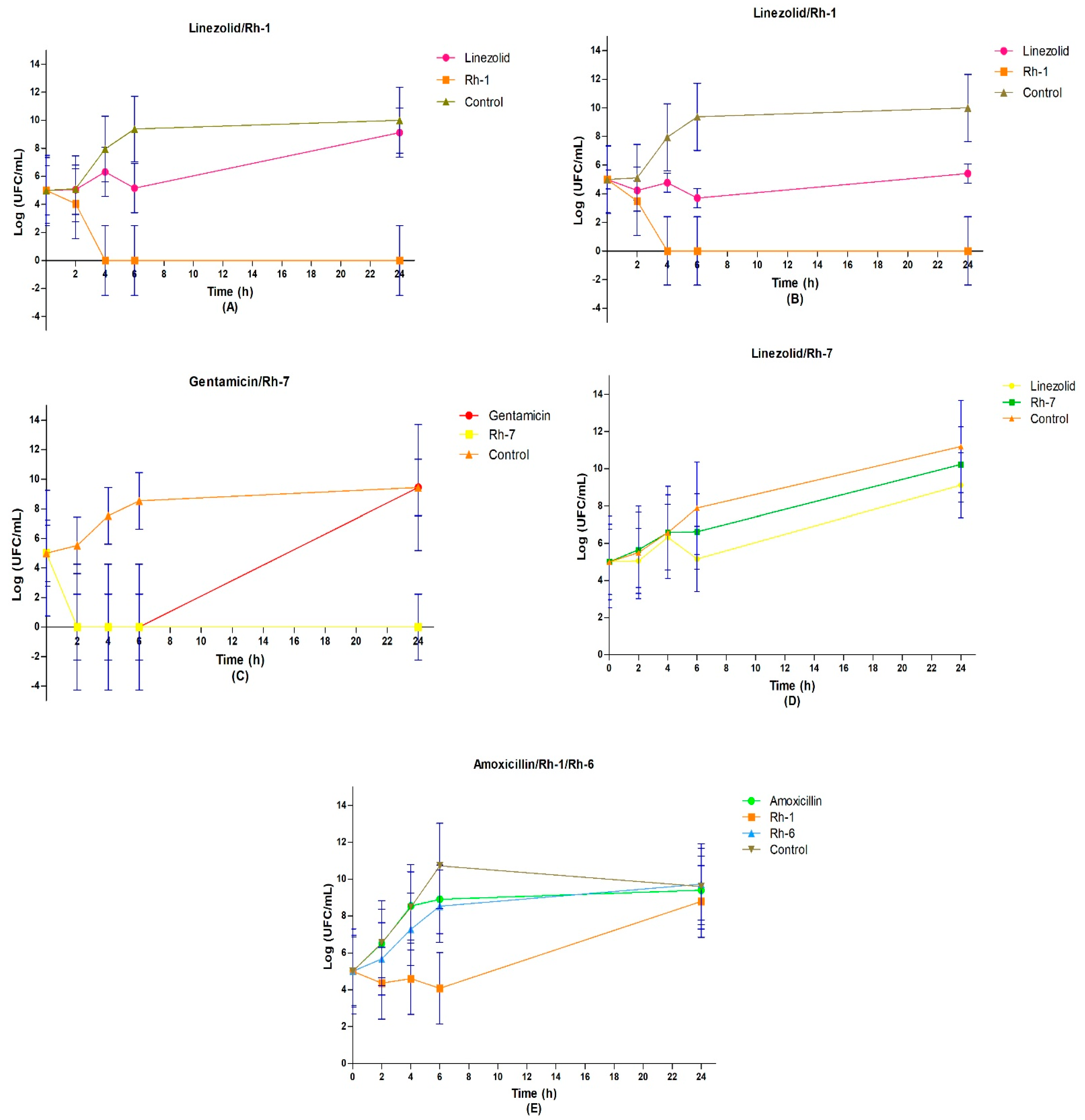
2.4. Time–Killing Kinetics of Rh(I)–NHC Complexes
2.5. ADMET Prediction/Pharmacokinetic Parameters
3. Conclusions
Supplementary Materials
Author Contributions
Funding
Institutional Review Board Statement
Data Availability Statement
Acknowledgments
Conflicts of Interest
References
- van Duin, D.; Paterson, D.L. Multidrug-Resistant Bacteria in the Community: Trends and Lessons Learned. Infect. Dis. Clin. N. Am. 2016, 30, 377–390. [Google Scholar] [CrossRef] [Scilit]
- Spellberg, B.; Blaser, M.; Guidos, R.J.; Boucher, H.W.; Bradley, J.S.; Eisenstein, B.I.; Gerding, D.; Lynfield, R.; Reller, L.B.; Rex, J.; et al. Combating antimicrobial resistance: Policy recommendations to save lives. Clin. Infect. Dis. 2011, 52 (Suppl. S5), S397–S428. [Google Scholar] [CrossRef] [Scilit] [PubMed]
- Rodriguez-Villodres, A.; Martin-Gandul, C.; Penalva, G.; Guisado-Gil, A.B.; Crespo-Rivas, J.C.; Pachon-Ibanez, M.E.; Lepe, J.A.; Cisneros, J.M. Prevalence and Risk Factors for Multidrug-Resistant Organisms Colonization in Long-Term Care Facilities Around the World: A Review. Antibiotics 2021, 10, 680. [Google Scholar] [CrossRef] [Scilit]
- Medina, E.; Pieper, D.H. Tackling Threats and Future Problems of Multidrug-Resistant Bacteria. Curr. Top. Microbiol. Immunol. 2016, 398, 3–33. [Google Scholar] [CrossRef] [Scilit] [PubMed]
- Tigabu, A.; Getaneh, A. Staphylococcus aureus, ESKAPE Bacteria Challenging Current Health Care and Community Settings: A Literature Review. Clin. Lab. 2021, 67, 1539–1549. [Google Scholar] [CrossRef] [Scilit]
- Santajit, S.; Indrawattana, N. Mechanisms of Antimicrobial Resistance in ESKAPE Pathogens. Biomed. Res. Int. 2016, 2016, 2475067. [Google Scholar] [CrossRef] [Scilit]
- Rice, L.B. Federal funding for the study of antimicrobial resistance in nosocomial pathogens: No ESKAPE. J. Infect. Dis. 2008, 197, 1079–1081. [Google Scholar] [CrossRef] [Scilit]
- Bush, K.; Jacoby, G.A. Updated functional classification of beta-lactamases. Antimicrob. Agents Chemother. 2010, 54, 969–976. [Google Scholar] [CrossRef] [Scilit]
- Rice, L.B. Progress and challenges in implementing the research on ESKAPE pathogens. Infect. Control Hosp. Epidemiol. 2010, 31 (Suppl. S1), S7–S10. [Google Scholar] [CrossRef] [Scilit] [PubMed]
- Tacconelli, E.; Cataldo, M.A.; Dancer, S.J.; De Angelis, G.; Falcone, M.; Frank, U.; Kahlmeter, G.; Pan, A.; Petrosillo, N.; Rodriguez-Bano, J.; et al. ESCMID guidelines for the management of the infection control measures to reduce transmission of multidrug-resistant Gram-negative bacteria in hospitalized patients. Clin. Microbiol. Infect. 2014, 20 (Suppl. S1), 1–55. [Google Scholar] [CrossRef] [Scilit]
- CDC. Antibiotic Resistance Threats in the United States, 2019; U.S. Department of Health and Human Services, CDC: Atlanta, GA, USA, 2019.
- Jacoby, G.A. AmpC beta-lactamases. Clin. Microbiol. Rev. 2009, 22, 161–182. [Google Scholar] [CrossRef] [Scilit]
- Gonzalez, A.C.; Nieves, B.; Solorzano, M.; Cruz, J.; Puig, J.; Moreno, M. Characterization of extended-spectrum beta-lactamases-producing Klebsiella pneumoniae isolates of two intensive care units. Rev. Chilena Infectol. 2013, 30, 374–380. [Google Scholar] [CrossRef] [Scilit]
- Ho, J.; Tambyah, P.A.; Paterson, D.L. Multiresistant Gram-negative infections: A global perspective. Curr. Opin. Infect. Dis. 2010, 23, 546–553. [Google Scholar] [CrossRef] [Scilit]
- Zhao, W.H.; Hu, Z.Q. Epidemiology and genetics of CTX-M extended-spectrum beta-lactamases in Gram-negative bacteria. Crit. Rev. Microbiol. 2013, 39, 79–101. [Google Scholar] [CrossRef] [Scilit] [PubMed]
- Bonnet, R. Growing group of extended-spectrum beta-lactamases: The CTX-M enzymes. Antimicrob. Agents Chemother. 2004, 48, 1–14. [Google Scholar] [CrossRef] [Scilit]
- Babic, M.; Hujer, A.M.; Bonomo, R.A. What’s new in antibiotic resistance? Focus on beta-lactamases. Drug. Resist. Updat. 2006, 9, 142–156. [Google Scholar] [CrossRef] [Scilit]
- Uc-Cachon, A.H.; Gracida-Osorno, C.; Luna-Chi, I.G.; Jimenez-Guillermo, J.G.; Molina-Salinas, G.M. High Prevalence of Antimicrobial Resistance Among Gram-Negative Isolated Bacilli in Intensive Care Units at a Tertiary-Care Hospital in Yucatan Mexico. Medicina 2019, 55, 588. [Google Scholar] [CrossRef] [Scilit] [PubMed]
- de Kraker, M.E.; Stewardson, A.J.; Harbarth, S. Will 10 Million People Die a Year due to Antimicrobial Resistance by 2050? PLoS Med. 2016, 13, e1002184. [Google Scholar] [CrossRef] [Scilit]
- Durdu, B.; Meric Koc, M.; Hakyemez, I.N.; Akkoyunlu, Y.; Daskaya, H.; Sumbul Gultepe, B.; Aslan, T. Risk Factors Affecting Patterns of Antibiotic Resistance and Treatment Efficacy in Extreme Drug Resistance in Intensive Care Unit-Acquired Klebsiella pneumoniae Infections: A 5-Year Analysis. Med. Sci. Monit. 2019, 25, 174–183. [Google Scholar] [CrossRef] [Scilit] [PubMed]
- Frei, A. Metal Complexes, an Untapped Source of Antibiotic Potential? Antibiotics 2020, 9, 90. [Google Scholar] [CrossRef] [Scilit]
- Liang, J.; Sun, D.; Yang, Y.; Li, M.; Li, H.; Chen, L. Discovery of metal-based complexes as promising antimicrobial agents. Eur. J. Med. Chem. 2021, 224, 113696. [Google Scholar] [CrossRef] [Scilit]
- Patra, M.; Gasser, G.; Metzler-Nolte, N. Small organometallic compounds as antibacterial agents. Dalton Trans. 2012, 41, 6350–6358. [Google Scholar] [CrossRef] [Scilit]
- Ma, D.L.; Wang, M.; Mao, Z.; Yang, C.; Ng, C.T.; Leung, C.H. Rhodium complexes as therapeutic agents. Dalton Trans. 2016, 45, 2762–2771. [Google Scholar] [CrossRef] [Scilit]
- Chandra, S.; Tyagi, M.; Agrawal, S. Spectral and antimicrobial studies on tetraaza macrocyclic complexes of PdII, PtII, RhIII and IrIII metal ions. J. Saudi Chem. Soc. 2011, 15, 49–54. [Google Scholar] [CrossRef] [Scilit]
- Beloglazkina, E.K.; Manzheliy, E.A.; Moiseeva, A.A.; Maloshitskaya, O.A.; Zyk, N.V.; Skvortsov, D.A.; Osterman, I.A.; Sergiev, P.V.; Dontsova, O.A.; Ivanenkov, Y.A.; et al. Synthesis, characterisation, cytotoxicity and antibacterial activity of ruthenium(II) and rhodium(III) complexes with sulfur-containing terpyridines. Polyhedron 2016, 107, 27–37. [Google Scholar] [CrossRef] [Scilit]
- Fandzloch, M.; Augustyniak, A.W.; Dobrzanska, L.; Jedrzejewski, T.; Sitkowski, J.; Wypij, M.; Golinska, P. First dinuclear rhodium(II) complexes with triazolopyrimidines and the prospect of their potential biological use. J. Inorg. Biochem. 2020, 210, 111072. [Google Scholar] [CrossRef] [Scilit] [PubMed]
- Aradhyula, B.P.R.; Joshi, N.; Poluri, K.M.; Kollipara, M.R. Synthesis and antibacterial studies of rhodium and iridium complexes comprising of dipyridyl hydrazones. J. Mol. Struct. 2018, 1164, 191–199. [Google Scholar] [CrossRef] [Scilit]
- Mansouri, G.; Heidarizadi, F.; Naghipour, A.; Notash, B. Synthesis, characterization and antibacterial study of cyclometalated rhodium(III) complex containing dithiocarbamate. J. Mol. Struct. 2016, 1121, 128–134. [Google Scholar] [CrossRef] [Scilit]
- Vaidya, M.; McBain, A.J.; Banks, C.E.; Whitehead, K.A. Single and combined antimicrobial efficacies for nine metal ion solutions against Klebsiella pneumoniae, Acinetobacter baumannii and Enterococcus faecium. Int. Biodeterior. Biodegrad. 2019, 141, 39–43. [Google Scholar] [CrossRef] [Scilit]
- Dizaj, S.M.; Lotfipour, F.; Barzegar-Jalali, M.; Zarrintan, M.H.; Adibkia, K. Antimicrobial activity of the metals and metal oxide nanoparticles. Mater. Sci. Eng. C 2014, 44, 278–284. [Google Scholar] [CrossRef] [Scilit]
- Ott, I. Metal N-heterocyclic carbene complexes in medicinal chemistry. Adv. Inorg. Chem. 2020, 75, 121–148. [Google Scholar] [CrossRef] [Scilit]
- Bernier, C.M.; DuChane, C.M.; Martinez, J.S.; Falkinham, J.O.; Merola, J.S. Synthesis, Characterization, and Antimicrobial Activity of RhIII and IrIII N-Heterocyclic Carbene Piano-Stool Complexes. Organometallics 2021, 40, 1670–1681. [Google Scholar] [CrossRef] [Scilit]
- Simpson, P.V.; Schmidt, C.; Ott, I.; Bruhn, H.; Schatzschneider, U. Synthesis, cellular uptake and biological activity against pathogenic microorganisms and cancer cells of rhodium and iridium N-heterocyclic carbene complexes bearing charged substituents. Eur. J. Inorg. Chem. 2013, 2013, 5547–5554. [Google Scholar] [CrossRef] [Scilit]
- Streciwilk, W.; Terenzi, A.; Cheng, X.; Hager, L.; Dabiri, Y.; Prochnow, P.; Bandow, J.E.; Wolfl, S.; Keppler, B.K.; Ott, I. Fluorescent organometallic rhodium(I) and ruthenium(II) metallodrugs with 4-ethylthio-1,8-naphthalimide ligands: Antiproliferative effects, cellular uptake and DNA-interaction. Eur. J. Med. Chem. 2018, 156, 148–161. [Google Scholar] [CrossRef] [Scilit]
- Cetinkaya, B.; Cetinkaya, E.; Küçükbay, H.; Durmaz, R. Antimicrobial activity of carbene complexes of rhodium(I) and ruthenium(II). Arzneimittelforschung 1996, 46, 821–823. [Google Scholar]
- Wang, J.; Sánchez-Roselló, M.; Aceña, J.L.; Del Pozo, C.; Sorochinsky, A.E.; Fustero, S.; Soloshonok, V.A.; Liu, H. Fluorine in pharmaceutical industry: Fluorine-containing drugs introduced to the market in the last decade (2001–2011). Chem. Rev. 2014, 114, 2432–2506. [Google Scholar] [CrossRef] [Scilit]
- Zhou, Y.; Wang, J.; Gu, Z.; Wang, S.; Zhu, W.; Acenã, J.L.; Soloshonok, V.A.; Izawa, K.; Liu, H. Next Generation of Fluorine-Containing Pharmaceuticals, Compounds Currently in Phase II-III Clinical Trials of Major Pharmaceutical Companies: New Structural Trends and Therapeutic Areas. Chem. Rev. 2016, 116, 422–518. [Google Scholar] [CrossRef] [Scilit] [PubMed]
- Isanbor, C.; O’Hagan, D. Fluorine in medicinal chemistry: A review of anti-cancer agents. J. Fluorine Chem. 2006, 127, 303–319. [Google Scholar] [CrossRef] [Scilit]
- Kirk, K.L. Fluorine in medicinal chemistry: Recent therapeutic applications of fluorinated small molecules. J. Fluorine Chem. 2006, 127, 1013–1029. [Google Scholar] [CrossRef] [Scilit]
- Müller, K.; Faeh, C.; Diederich, F. Fluorine in pharmaceuticals: Looking beyond intuition. Science 2007, 317, 1881–1886. [Google Scholar] [CrossRef] [Scilit]
- Rufino-Felipe, E.; Colorado-Peralta, R.; Reyes-Márquez, V.; Valdés, H.; Morales-Morales, D. Fluorinated-NHC transition metal complexes: Leading characters as potential anticancer metallodrugs. Anti-Cancer Agents Med. Chem. 2021, 21, 938–948. [Google Scholar] [CrossRef] [Scilit] [PubMed]
- Turcio-García, L.Á.; Valdés, H.; Hernández-Ortega, S.; Canseco-Gonzalez, D.; Morales-Morales, D. Arylation of aldehydes catalyzed by fluorinated NHC–Rh(I) complexes. New J. Chem. 2022, 46, 16789–16800. [Google Scholar] [CrossRef] [Scilit]
- Turcio-García, L.Á.; Valdés, H.; Arenaza-Corona, A.; Hernández-Ortega, S.; Morales-Morales, D. Electronic properties and supramolecular study of selenoureas with fluorinated-NHC ligands derived from imidazo [1,5-a]pyridines. New J. Chem. 2023, 47, 2090–2095. [Google Scholar] [CrossRef] [Scilit]
- Yang, H.; Lou, C.; Sun, L.; Li, J.; Cai, Y.; Wang, Z.; Li, W.; Liu, G.; Tang, Y. admetSAR 2.0: Web-service for prediction and optimization of chemical ADMET properties. Bioinformatics 2019, 35, 1067–1069. [Google Scholar] [CrossRef] [Scilit]
- SwissADME. Available online: http://www.swissadme.ch/index.php#/ (accessed on 1 December 2024).



| Compound | MIC/MBC (µg/mL) | ||||||
|---|---|---|---|---|---|---|---|
| ATCC 25923 | ATCC 29213 | ATCC 43300 | ATCC 25922 | ATCC 29212 | ATCC 700603 | Streptococcus spp. | |
| 1 | NT | >250/>250 | NT | >250/>250 | NT | >250/>250 | NT |
| 2 | |||||||
| 3 | |||||||
| 4 | |||||||
| 5 | |||||||
| 6 | |||||||
| 7 | |||||||
| 8 | >250/>250 | 250/250 | >250/>250 | >250/>250 | >250/>250 | ||
| 9 | NT | >250/>250 | NT | NT | NT | ||
| 10 | |||||||
| 11 | |||||||
| Rh–1 | 250/250 | 62.5/62.5 | 250/250 | 250/250 | 62.5/62.5 | 250/250 | |
| Rh–2 | NT | >250/>250 | NT | >250/>250 | NT | NT | |
| Rh–3 | 250/250 | 250/250 | 250/250 | >250/>250 | >250/>250 | ||
| Rh–4 | 250/>250 | 250/250 | 250/250 | ||||
| Rh–5 | 62.5/62.5 | >250/>250 | 62.5/62.5 | 15.6/15.6 | |||
| Rh–6 | 62.5/250 | 62.5/62.5 | 250/>250 | 62.5/62.5 | |||
| Rh–7 | NT | 3.9/15.6 | NT | 250/250 | NT | NT | |
| Rh–8 | >250/>250 | >250/>250 | >250 | ||||
| Rh–9 | 62.5/62.5 | 250/250 | 250/250 | 62.5/62.5 | 62.5/62.5 | ||
| Rh–10 | 15.6/62.5 | ||||||
| Rh–11 | 15.6/15.6 | 62.5/62.5 | 250/>250 | 0.97/15.6 | 15.6/15.6 | ||
| LIN | 4/>32 | 1/8 | 4/>32 | >32/>32 | 2/>32 | NT | 1/8 |
| GEN | 1/1 | 1/1 | >32/>32 | 0.25/1 | 4/16 | 0.5/0.5 | <0.125/<0.125 |
| AMOX | <4/<4 | <4/<4 | 32/32 | <4/<4 | 4/4 | >256/>256 | 32/32 |
| Compound | MIC/MBC (µg/mL) | |||||
|---|---|---|---|---|---|---|
| U–13685 | H–9871 | U–13815 | H–9866 | H–166 | S–401 | |
| 1 | >250/>250 | |||||
| 2 | ||||||
| 3 | ||||||
| 4 | ||||||
| 5 | ||||||
| 6 | ||||||
| 7 | ||||||
| 8 | ||||||
| 9 | ||||||
| 10 | ||||||
| 11 | ||||||
| Rh–1 | 250/250 | 250/250 | 250/250 | >250/>250 | >250/>250 | >250/>250 |
| Rh–2 | >250/>250 | >250/>250 | >250/>250 | |||
| Rh–3 | 250/250 | 250/250 | 62.5/62.5 | |||
| Rh–4 | >250/>250 | >250/>250 | 250/250 | |||
| Rh–5 | 250/250 | |||||
| Rh–6 | 250/>250 | >250/>250 | ||||
| Rh–7 | >250/>250 | |||||
| Rh–8 | ||||||
| Rh–9 | ||||||
| Rh–10 | ||||||
| Rh–11 | 250/250 | 250/>250 | 250/250 | |||
| GEN | <0.125/<0.125 | 1/1 | 1/1 | <0.125/<0.125 | 0.5/0.5 | <0.125/<0.125 |
| AMOX | 64/64 | >256/>256 | >256/>256 | 128/128 | >256/>256 | >256/>256 |
| MODEL | Azolium Salts | Rh(I)–NHC Complexes | ZP | CP | ||||||||||||||||||||
|---|---|---|---|---|---|---|---|---|---|---|---|---|---|---|---|---|---|---|---|---|---|---|---|---|
| 1 | 2 | 3 | 4 | 5 | 6 | 7 | 8 | 9 | 10 | 11 | Rh–1 | Rh–2 | Rh–3 | Rh–4 | Rh–5 | Rh–6 | Rh–7 | Rh–8 | Rh–9 | Rh–10 | Rh–11 | |||
| ADMETsaR | ||||||||||||||||||||||||
| Human intestinal absorption | + | + | – | – | + | + | + | + | + | + | + | + | – | + | + | – | + | + | + | – | + | – | + | + |
| Human oral bioavailability | + | + | + | + | + | + | + | + | + | + | + | + | + | – | – | + | + | + | + | – | + | + | + | + |
| Blood–brain barrier | + | + | + | + | + | + | + | + | + | + | + | + | + | + | + | + | + | + | + | + | + | + | + | + |
| Mutagenesis (AMES) | + | + | + | + | + | + | + | – | – | + | – | – | – | – | – | – | – | – | – | – | – | – | + | – |
| Acute oral toxicity (c) kg/mol | (III) | (III) | (III) | (III) | (III) | (III) | (III) | (III) | (III) | (III) | (III) | (III) | (III) | (III) | (III) | (III) | (III) | (III) | (III) | (III) | (III) | (III) | (III) | (III) |
| Permeability/ Caco–2 | + | + | + | + | + | + | + | + | + | + | + | + | + | + | + | + | + | + | – | – | – | – | + | + |
| Carcinogenicity | – | – | – | – | – | – | – | – | – | – | – | – | – | – | – | – | – | – | – | – | – | – | – | + |
| Hepatotoxicity | – | – | – | + | + | – | + | – | – | – | – | – | – | – | – | + | – | – | – | – | – | – | + | – |
| Fish aquatic toxicity | + | + | + | + | + | + | + | + | + | + | + | + | + | + | + | + | + | + | + | + | + | + | – | + |
| Crustacean aquatic toxicity | + | + | + | + | + | + | + | + | + | + | + | + | + | + | + | + | + | + | + | + | + | + | – | + |
| SwissADME | ||||||||||||||||||||||||
| Solubility in water (Log S) SILICOS–IT (–) | 3.78 | 4.07 | 4.07 | 4.07 | 4.35 | 4.35 | 4.62 | 4.67 | 4.67 | 4.67 | 5.53 | 6.10 | 6.74 | 6.74 | 6.74 | 7.0 | 7.0 | 7.26 | 7.29 | 7.29 | 7.29 | 8.10 | 5.0 | 2.1 |
| Gastrointestinal absorption | + | + | – | – | – | + | + | + | + | + | + | + | – | – | – | – | – | – | – | – | – | – | + | + |
| Similarity to drugs “LIPINSKI” | + | + | + | + | + | + | + | + | + | + | + | + | + | + | + | + | + | + | – | – | – | – | + | + |
| Synthetic accessibility | 1.77 | 1.81 | 2.19 | 2.11 | 2.25 | 1.97 | 1.90 | 1.86 | 1.94 | 2.30 | 2.16 | 3.56 | 4.09 | 4.10 | 4.12 | 4.13 | 4.10 | 4.12 | 4.14 | 4.18 | 4.24 | 4.33 | 2.67 | / |
| Lead resemblance | – | – | – | – | – | – | – | – | – | – | – | – | – | – | – | – | – | – | – | – | – | – | – | – |
Disclaimer/Publisher’s Note: The statements, opinions and data contained in all publications are solely those of the individual author(s) and contributor(s) and not of MDPI and/or the editor(s). MDPI and/or the editor(s) disclaim responsibility for any injury to people or property resulting from any ideas, methods, instructions or products referred to in the content. |
© 2025 by the authors. Licensee MDPI, Basel, Switzerland. This article is an open access article distributed under the terms and conditions of the Creative Commons Attribution (CC BY) license (https://creativecommons.org/licenses/by/4.0/).
Share and Cite
Turcio-García, L.Á.; Parra-Unda, R.; Valdés, H.; Hernández-Ortega, S.; Valenzuela-Ramirez, G.G.; Ahumada-Santos, Y.P.; Sánchez-Lugo, Y.; Reyes-Márquez, V.; Morales-Morales, D. Fluorinated Rh(I)–NHC Compounds as Potential Antibacterials Against Multidrug-Resistant Klebsiella pneumoniae Clinical Isolates Producing ESBL. Pharmaceutics 2025, 17, 973. https://doi.org/10.3390/pharmaceutics17080973
Turcio-García LÁ, Parra-Unda R, Valdés H, Hernández-Ortega S, Valenzuela-Ramirez GG, Ahumada-Santos YP, Sánchez-Lugo Y, Reyes-Márquez V, Morales-Morales D. Fluorinated Rh(I)–NHC Compounds as Potential Antibacterials Against Multidrug-Resistant Klebsiella pneumoniae Clinical Isolates Producing ESBL. Pharmaceutics. 2025; 17(8):973. https://doi.org/10.3390/pharmaceutics17080973
Chicago/Turabian StyleTurcio-García, Luis Ángel, Ricardo Parra-Unda, Hugo Valdés, Simón Hernández-Ortega, Gladymar Guadalupe Valenzuela-Ramirez, Yesmi Patricia Ahumada-Santos, Yesenia Sánchez-Lugo, Viviana Reyes-Márquez, and David Morales-Morales. 2025. "Fluorinated Rh(I)–NHC Compounds as Potential Antibacterials Against Multidrug-Resistant Klebsiella pneumoniae Clinical Isolates Producing ESBL" Pharmaceutics 17, no. 8: 973. https://doi.org/10.3390/pharmaceutics17080973
APA StyleTurcio-García, L. Á., Parra-Unda, R., Valdés, H., Hernández-Ortega, S., Valenzuela-Ramirez, G. G., Ahumada-Santos, Y. P., Sánchez-Lugo, Y., Reyes-Márquez, V., & Morales-Morales, D. (2025). Fluorinated Rh(I)–NHC Compounds as Potential Antibacterials Against Multidrug-Resistant Klebsiella pneumoniae Clinical Isolates Producing ESBL. Pharmaceutics, 17(8), 973. https://doi.org/10.3390/pharmaceutics17080973