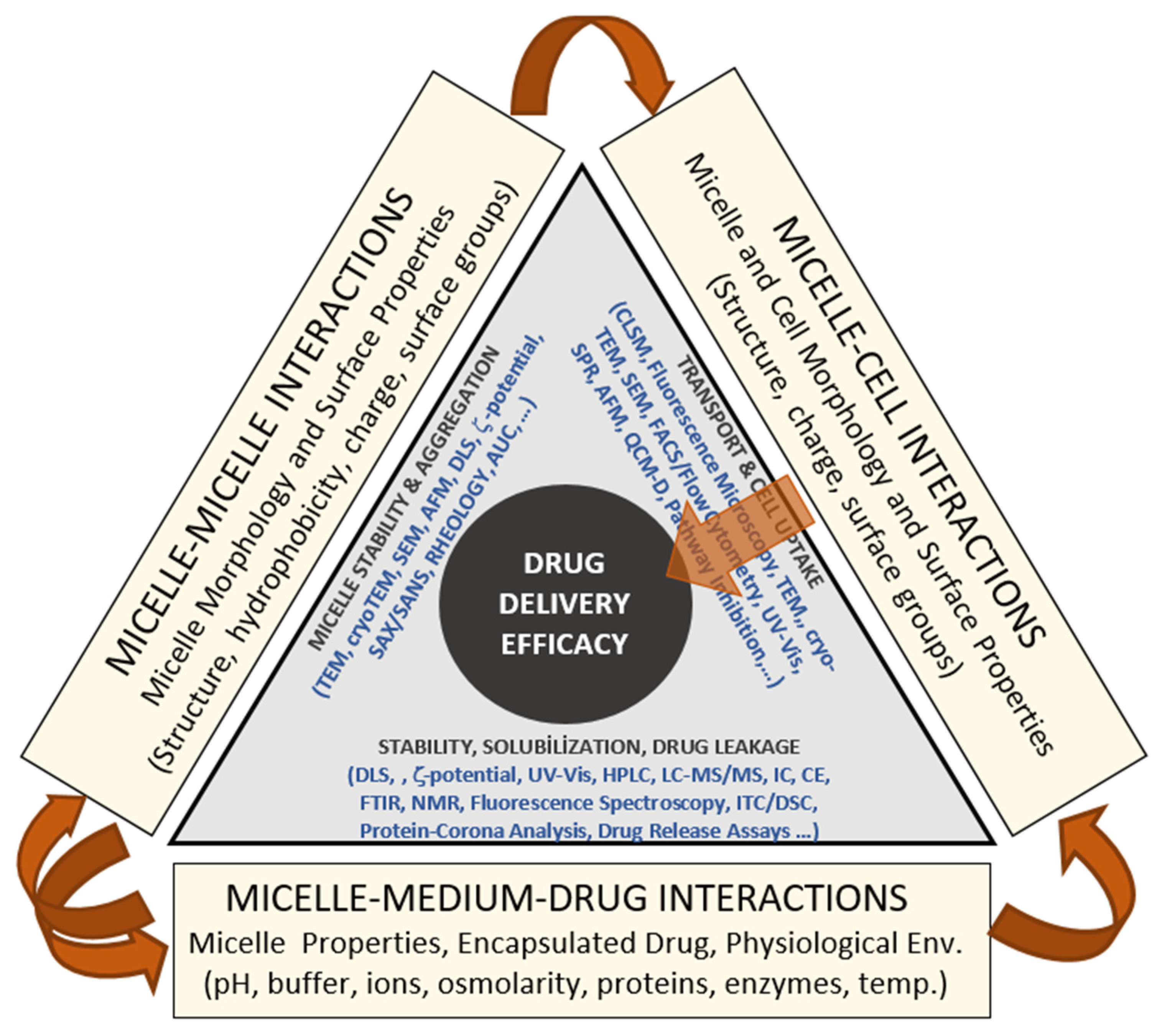


Comparative Stability of Synthetic and Natural Polymeric Micelles in Physiological Environments: Implications for Drug Delivery


Abstract
1. Introduction
2. Formation of Micellar Drug-Delivery Vehicles
3. Requirements for Micellar Drug-Delivery Vehicles
4. Natural Polymers (Biopolymers)

| Type | Origin | Examples | References |
|---|---|---|---|
| Polysaccharides | Plant | Cellulose, Starch, Pectin, Mannan | [103,104,105,106,107,108,109,110] |
| Animal | Chitin/Chitosan, Heparin, Hyaluronan | [20,64,85,111,112,113,114] | |
| Microbial | Dextran, Pullulan | [84,115,116,117,118,119,120] | |
| Algal | Fucoidan, Agar/Agarose, Carrageenan, Alginate | [121,122,123,124,125,126,127,128] | |
| Proteins | Animal | Collagen, Gelatin, Fibrin, Silk | [129,130,131,132,133,134,135,136,137] |
| Microbially fermented | Microbial | Polyhydroxy-alkanoates | [138,139,140,141] |
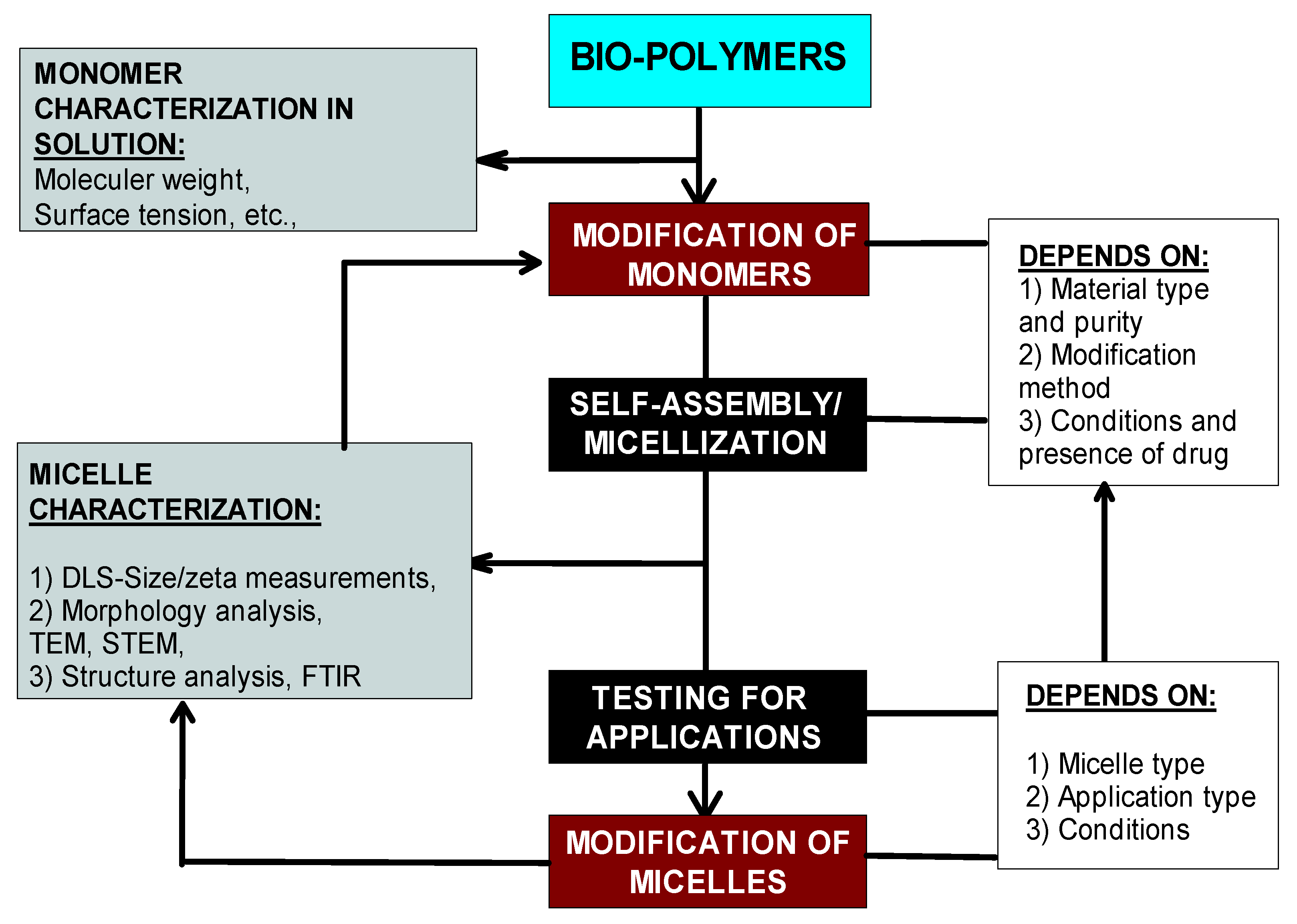
5. Modification of Biopolymers for Micellization to Use as Drug Delivery Vehicles
| Name of Amphiphilic Copolymer Micelle | Drug/ Molecule | Size (nm) | ZP (mV) | EE (%) | CMC (mg/mL) | Ref. |
|---|---|---|---|---|---|---|
| Stearyl-grafted chitosan | Atorvastatin | 97.19 | −8.27 | 10.4–35.0 | 6.9 × 10⁻³–21 × 10−3 | [64] |
| N-phthaloyl-carboxymethyl chitosan | L floxin and BSA | 60–90 30–200 | - | 8.5 52.0 | 0.20 | [112] |
| Cholesteryl hemisuccinate (CHS)-conjugated chitosan | Docetaxel | 303 | +21.3 | NA | NA | [229] |
| Stearic acid-grafted chitosan oligosaccharide | Docetaxel | 20.4 | +53.1 | 55.0 | 0.022 | [68] |
| Water-soluble N-palmitoyl chitosan | Ibuprofen | ~150.0 | - | ~50.0 | 2.0 × 10⁻³–37.2 × 10⁻³ | [212] |
| Folate-modified N-Succinyl-N′-Octyl Chitosan | 10 Hydroxyca-camptothecin | 100–200 | −20.0 to +38.0 | 57.0–58.0 | - | [230] |
| N-succinyl-N′-octyl chitosan micelles | Docetaxel | 100–200 | - | 36.4 a | 5.9 × 10⁻³– 3.1 × 10⁻² | [231] |
| Fatty acid grafted chitosan-based copolymer micelles | Cefiximetrihy-drate | 520 | +42 | 38–52 | NA | [111] |
| Grafting oleic acid (OA) on the chitosan (CS) skeleton and penetrating (PEN) and (MAN) conjugation. | pVGF | 199.8 ± 15.7 nm | Positive | NA | NA | [232] |
| Redox-sensitive chitosan derivative (y cholesterol, sulfhydryl, and mPEG (mPEG-CS(SH)-CHO)) | Paclitaxel | 158 | +26.9 | 88.3 | NA | [233] |
| O-methyl-O′-succinylpolyethylene glycol- and oleic acid-grafted chitosan | Camptothecin | 140 nm | Positive | 78 | 0.150–0.147 0.076–0.065 | [234] |
| LA–CMCS (Linoleic acid–carboxymethyl chitosan) | Paclitaxel | 93–119 | −16 to −29 | 56–67 | ~11–18 × 10−3 | [235] |
| CS–g–OA (Oleic acid-grafted chitosan) | Coumarin-6 | 335.5/491 | +20.5 to +38.5 | 29 | 0.5748 | [236] |
| CS–SA–DA (Succinic anhydride and deoxycholic acid-modified chitosan) | Curcumin | 228/269 | −44 to −29 | 80.8 | 0.093 | [237] |
| LCNE–LA (Low-MW chitosan–nicotinic acid–lipoic acid conjugate) | Doxorubicin | 218/254 | +26/35.2 | 92 | 0.1808 | [238] |
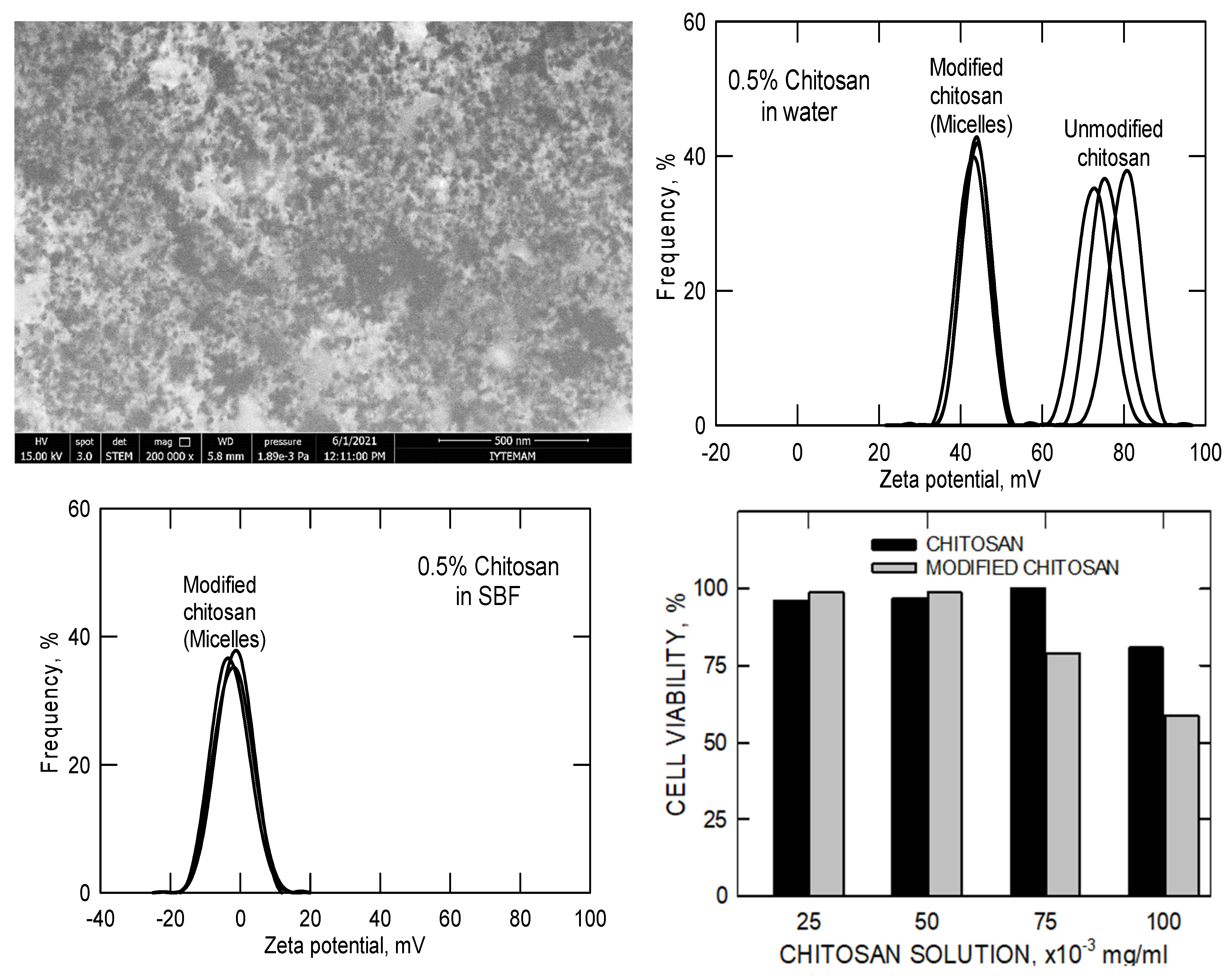
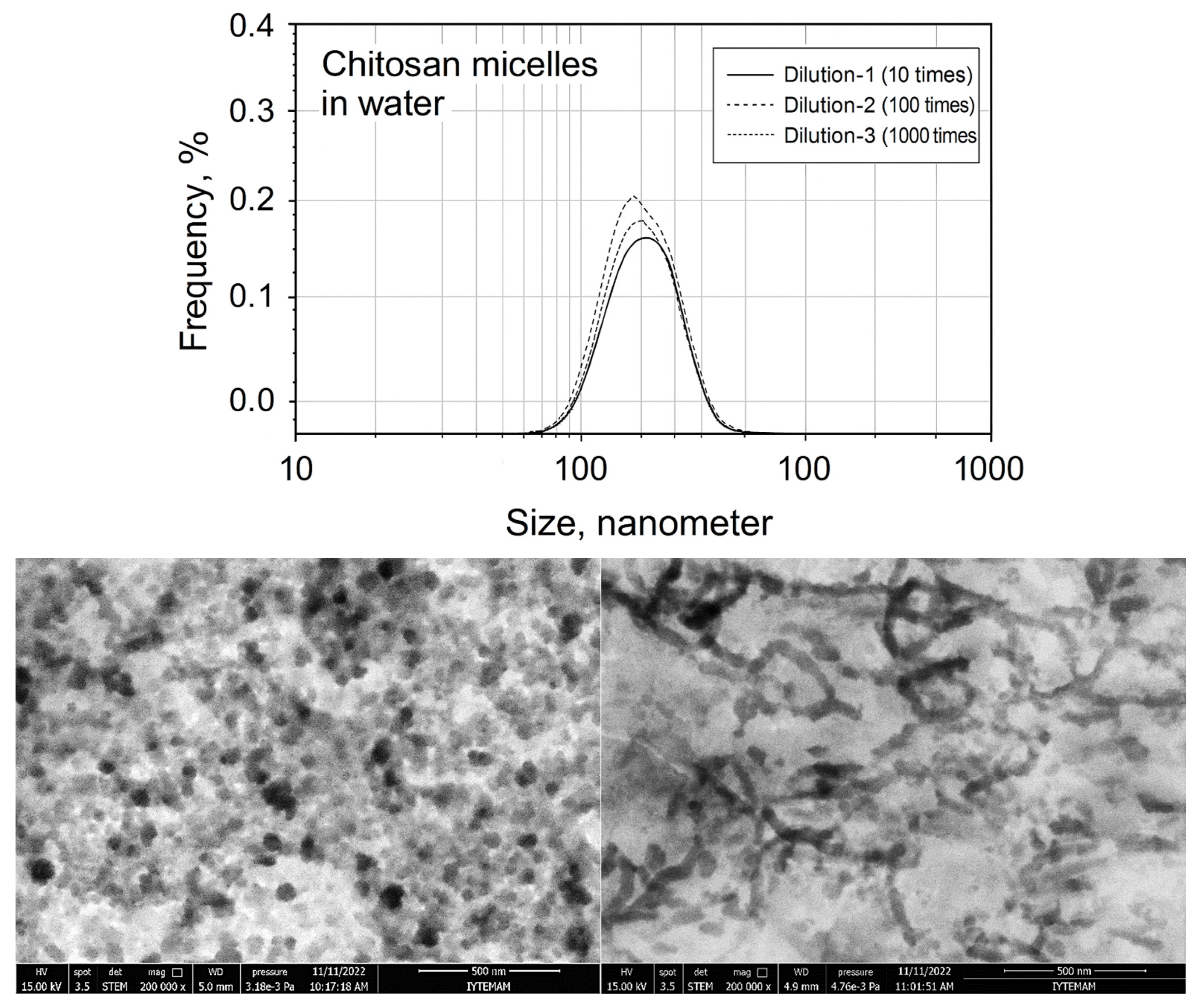
6. Characterization of Biopolymers and Their Micelles
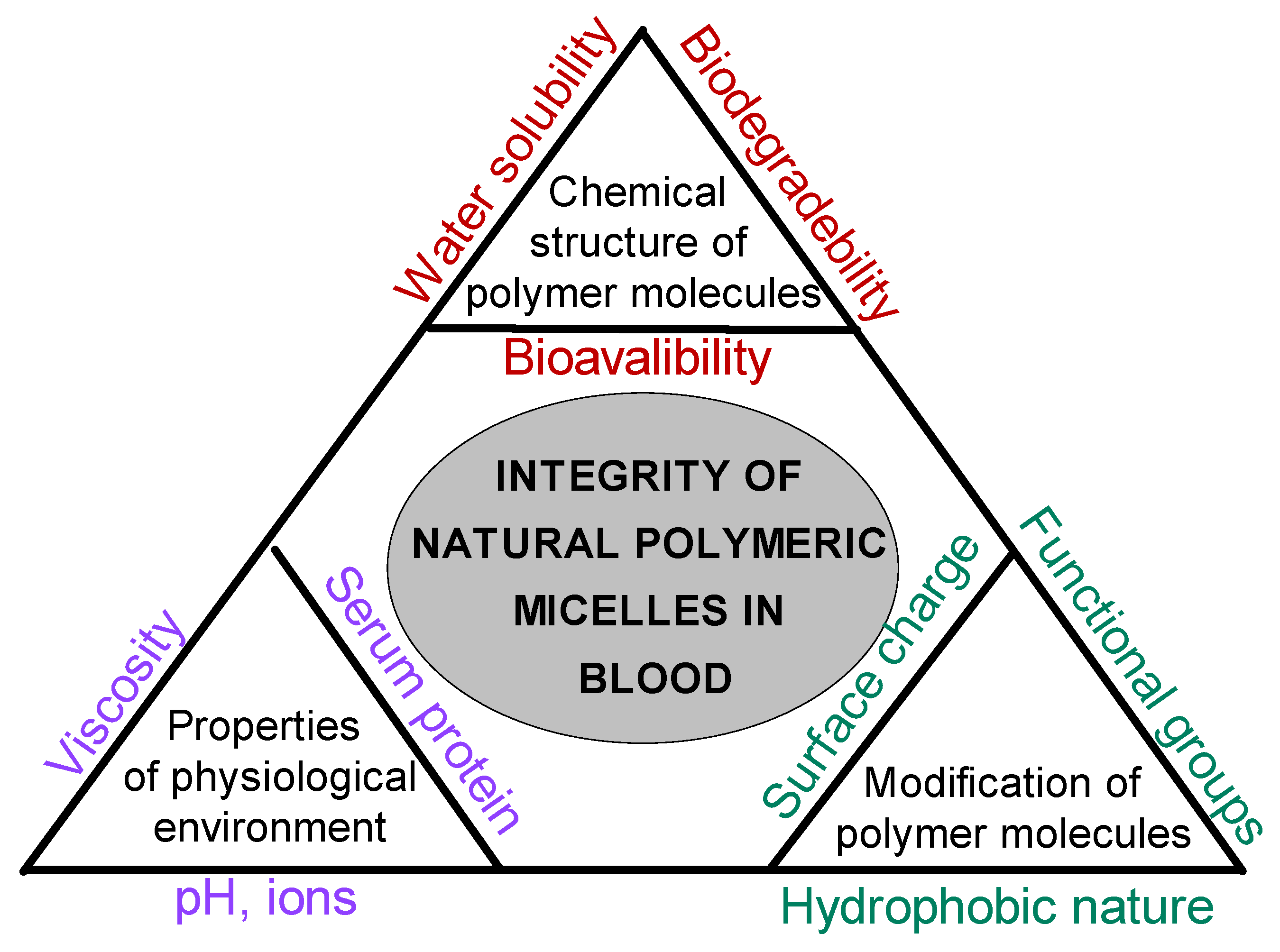
7. Stability of Natural Polymeric Micelles
8. Conclusions
- Synthetic polymeric micelles generally lack stability under physiological dilution conditions, leading to disassembly upon administration.
- Natural polymeric micelles tend to exhibit improved stability under dilution compared to synthetic counterparts; however, they remain susceptible to destabilization upon interaction with serum proteins.
- Both synthetic and natural polymeric micelles experience structural compromise in the presence of blood proteins, which poses a significant challenge for systemic administration.
Author Contributions
Funding
Acknowledgments
Conflicts of Interest
References
- Tiwari, G.; Tiwari, R.; Sriwastawa, B.; Bhati, L.; Pandey, S.; Pandey, P.; Bannerjee, S.K. Drug delivery systems: An updated review. Int. J. Pharm. Investig. 2012, 2, 2–11. [Google Scholar] [CrossRef] [PubMed]
- Deshmukh, A.S.; Chauhan, P.N.; Noolvi, M.N.; Chaturvedi, K.; Ganguly, K.; Shukla, S.S.; Nadagouda, M.N.; Aminabhavi, T.M. Polymeric micelles: Basic research to clinical practice. Int. J. Pharm. 2017, 532, 249–268. [Google Scholar] [CrossRef] [PubMed]
- Kapse, A.; Anup, N.; Patel, V. Polymeric micelles: A ray of hope among new drug delivery systems. In A Volume in Advances in Pharmaceutical Product Development and Research; Tekade, R.K., Ed.; Academic Press: Cambridge, MA, USA, 2020; pp. 235–289. [Google Scholar]
- Simões, S.M.; Figueiras, A.R.; Veiga, F.; Concheiro, A.; Alvarez-Lorenzo, C. Polymeric micelles for oral drug administration enabling locoregional and systemic treatments. Expert. Opin. Drug Deliv. 2015, 12, 297–318. [Google Scholar] [CrossRef] [PubMed]
- Hwang, D.; Ramsey, J.; Kabanov, A. Polymeric micelles for the delivery of poorly soluble drugs: From nanoformulation to clinical approval. Adv. Drug Deliv. Rev. 2020, 156, 80–118. [Google Scholar] [CrossRef]
- Duplâtre, G.; Marques, M.F.; da Graça Miguel, M. Size of sodium dodecyl sulfate micelles in aqueous solutions as studied by positron annihilation lifetime spectroscopy. J. Phys. Chem. A 1996, 100, 16608–16612. [Google Scholar] [CrossRef]
- Mazer, N.A.; Benedek, G.B.; Carey, M.C. An investigation of the micellar phase of sodium dodecyl sulfate in aqueous sodium chloride solutions using quasielastic light scattering spectroscopy. J. Phys. Chem. A 1976, 80, 1075–1085. [Google Scholar] [CrossRef]
- Santos, M.S.; Tavares, F.W.; Biscaia, E.C., Jr. Molecular thermodynamics of micellization: Micelle size distributions and geometry transitions. Braz. J. Chem. Eng. 2016, 33, 515–523. [Google Scholar] [CrossRef]
- Movassaghian, S.; Merkel, O.; Torchilin, V. Applications of polymer micelles for imaging and drug delivery. Wiley Interdiscip. Rev. Nanomed. Nanobiotechnol. 2015, 7, 691–707. [Google Scholar] [CrossRef]
- Talelli, M.; Barz, M.; Rijcken, C. Core-crosslinked polymeric micelles: Principles, preparation, biomedical applications, and clinical translation. Nano Today 2015, 10, 93–117. [Google Scholar] [CrossRef]
- Muftuoglu, A.E.; Tasdelen, M.A.; Yagci, Y. Radical Polymerization, Process, and Technology. In Handbook of Vinyl Polymers; Mishra, M., Yagci, Y., Eds.; CRC Press: Boca Raton, FL, USA, 2019. [Google Scholar]
- Subramani, K.; Ahmed, W. Nanoparticulate drug delivery systems for oral cancer treatment. In Emerging Nanotechnologies in Dentistry Processes, Materials and Applications Micro and Nano Technologies; Subramani, K., Ahmed, W., Eds.; William Andrew Publishing: New York, NY, USA, 2012; pp. 333–345. [Google Scholar]
- Atanase, L.I. Micellar drug delivery systems based on natural biopolymers. Polymers 2021, 13, 477. [Google Scholar] [CrossRef]
- Cihan, E.; Polat, M.; Polat, H. Designing of spherical chitosan nano-shells with micellar cores for solvation and safe guarded delivery of strongly lipophilic drugs. Colloids Surf. A Physicochem. Eng. Asp. 2017, 529, 815–823. [Google Scholar] [CrossRef]
- Polat, H.; Kutluay, G.; Polat, M. Analysis of dilution-induced disintegration of micellar drug carriers in the presence of inter and intra micellar species. Colloids Surf. A Physicochem. Eng. Asp. 2020, 601, 124989. [Google Scholar] [CrossRef]
- Polat, M.; Kurt, A.N.O.; Ozdamar, B.A.; Polat, H. Synthesis of pristine chitosan foams with enhanced pore structure, surface area, and mechanical for tissue engineering. Mater. Res. Express 2025, 12, 105401. [Google Scholar] [CrossRef]
- Kedar, U.; Phutane, P.; Shidhaye, S. Advances in polymeric micelles for drug delivery and tumor targeting. Nanomed. Nanotechnol. Biol. Med. 2010, 6, 714–729. [Google Scholar] [CrossRef] [PubMed]
- Dand, N.M.; Patel, P.B.; Ayre, A.P. Polymeric micelles as a drug carrier for tumor targeting. Chron Young Sci. 2013, 4, 94. [Google Scholar]
- Rapoport, N. Physical stimuli-responsive polymeric micelles for anti-cancer drug delivery. Prog. Polym. Sci. 2007, 32, 962–990. [Google Scholar] [CrossRef]
- Liu, J.; Liang, N.; Li, S. Tumor-targeting and redox-sensitive micelles based on hyaluronic acid conjugate for delivery of paclitaxel. J. Biomater. Appl. 2020, 34, 1458–1469. [Google Scholar] [CrossRef]
- Cai, Y.; Xu, Z.; Shuai, Q. Tumor-targeting peptide-functionalized PEG-PLA micelles for efficient drug delivery. Biomater. Sci. 2020, 8, 2274–2282. [Google Scholar] [CrossRef]
- Yang, Y.; Long, Y.; Wang, Y. Enhanced anti-tumor and anti-metastasis therapy for triple-negative breast cancer by CD44 receptor-targeted hybrid self-delivery micelles. Int. J. Pharm. 2020, 577, 119085. [Google Scholar] [CrossRef]
- Weng, J.; Huang, Z.; Pu, X.; Chen, X.; Yin, G.; Tian, Y.; Song, Y. Preparation of polyethylene glycol-polyacrylic acid block copolymer micelles with pH/hypoxic dual-responsive for tumor. Colloids Surf. B 2020, 191, 110943. [Google Scholar] [CrossRef]
- Yang, H.; Khan, A.; Liu, M.; Fu, M.; Ji, J.; Chi, L.; Zhai, G. Stimuli-responsive polymeric micelles for the delivery of paclitaxel. J. Drug Deliv. Sci. Technol. 2020, 56, 101523. [Google Scholar] [CrossRef]
- Croy, S.R.; Kwon, G.S. Polymeric micelles for drug delivery. Curr. Pharm. Des. 2006, 12, 4669–4684. [Google Scholar] [CrossRef] [PubMed]
- Cormode, D.; Naha, P.; Fayad, Z. Nanoparticle contrast agents for computed tomography: A focus on micelles. Contrast Media Mol. Imaging 2014, 9, 37–52. [Google Scholar] [CrossRef]
- Al Zaki, A.; Joh, D.; Cheng, Z.; De Barros, A.L.; Kao, G.; Dorsey, J.; Tsourkas, A. Gold-loaded polymeric micelles for computed tomography-guided radiation therapy treatment and radiosensitization. ACS Nano 2014, 8, 104–112. [Google Scholar] [CrossRef]
- Annapragada, A.V.; Hoffman, E.; Divekar, A.; Karathanasis, E.; Ghaghada, K.B. High-resolution CT vascular imaging using blood pool contrast agents. Methodist Debakey Cardiovasc. J. 2012, 8, 18–22. [Google Scholar] [CrossRef]
- Owen, S.C.; Chan, D.P.; Shoichet, M.S. Polymeric micelle stability. Nano Today 2012, 7, 53–65. [Google Scholar] [CrossRef]
- Bader, H.; Ringsdorf, H.; Schmidt, B. Watersoluble polymers in medicine. Angew. Makromolek Chem. 1984, 123, 457–485. [Google Scholar] [CrossRef]
- Glavas, L.; Odelius, K.; Albertsson, A.C. Tuning loading, and release by modification of micelle core crystallinity and preparation. Polym. Adv. Technol. 2015, 26, 880–888. [Google Scholar] [CrossRef]
- Polat, H.; Chander, S. Adsorption of PEO/PPO triblock copolymers and wetting of coal. Colloid Surface A 1999, 146, 199–212. [Google Scholar] [CrossRef]
- Mourya, V.K.; Inamdar, N.; Nawale, R.B.; Kulthe, S.S. Polymeric micelles: General considerations and their applications. Indian J. Pharm. Educ. Res. 2012, 45, 128–138. [Google Scholar]
- Lee, H.; Zeng, F.; Dunne, M.; Allen, C. Methoxy poly (ethylene glycol)-block-poly (δ-valerolactone) copolymer micelles for the formulation of hydrophobic drugs. Biomacromolecules 2005, 6, 3119–3128. [Google Scholar] [CrossRef]
- Mondon, K.; Gurney, R.; Möller, M. Colloidal drug delivery systems-recent advance with polymeric micelles. Chim. Int. J. Chem. 2008, 62, 832–840. [Google Scholar] [CrossRef]
- Cai, S.; Vijayan, K.; Cheng, D.; Lima, E.M.; Discher, D.E. Micelles of different morphologies-advantages of worm-like filomicelles of PEO-PCL in paclitaxel delivery. Pharm. Res. 2007, 24, 2099–2109. [Google Scholar] [CrossRef]
- Maeda, H. Macromolecular therapeutics in cancer treatment: The EPR effect and beyond. J. Control Release 2012, 164, 138–144. [Google Scholar] [CrossRef] [PubMed]
- Luo, Z.; Jiang, J. pH-sensitive drug loading/releasing in amphiphilic copolymer PAE–PEG: Integrating molecular dynamics and dissipative particle dynamics simulations. J. Control Release 2012, 162, 185–193. [Google Scholar] [CrossRef] [PubMed]
- Siretli, Ç. Synthesis of Silica Nanoparticles with Custom-Made Morphology for Controlled Drug Delivery. Master’s Thesis, İzmir Institute of Technology, Urla-Izmir, Turkey, 2012. [Google Scholar]
- Dobrovolskaia, M.A.; McNeil, S.E. Immunological properties of engineered nanomaterials. Nat. Nanotechnol. 2007, 2, 469–478. [Google Scholar] [CrossRef]
- Abuchowski, A.; Van Es, T.; Palczuk, N.T.; Davis, F.F. Alteration of immunological properties of bovine serum albumin by covalent attachment of polyethylene glycol. J. Biol. Chem. 1977, 252, 3578–3581. [Google Scholar] [CrossRef]
- Naahidi, S.; Jafari, M.; Edalat, F.; Raymond, K.; Khademhosseini, A.; Chen, P. Biocompatibility of engineered nanoparticles for drug delivery. J. Control Release 2013, 166, 182–194. [Google Scholar] [CrossRef] [PubMed]
- Sundar, D.S.; Antoniraj, M.G.; Kumar, C.S.; Mohapatra, S.S.; Houreld, N.N.; Ruckmani, K. Recent trends of biocompatible and biodegradable nanoparticles in drug delivery: A review. Curr. Med. Chem. 2016, 23, 3730–3751. [Google Scholar] [CrossRef]
- Makadia, H.K.; Siegel, S.J. Poly Lactic-co-Glycolic Acid (PLGA) as Biodegradable Controlled Drug Delivery Carrier. Polymers 2011, 3, 1377–1397. [Google Scholar] [CrossRef]
- Liu, J.S.; Wang, J.H.; Zhou, J.; Tang, X.H.; Xu, L.; Shen, T.; Wu, X.Y.; Hong, Z. Enhanced brain delivery of lamotrigine with Pluronic P123-based nanocarrier. Int. J. Nanomed. 2014, 4, 3923–3935. [Google Scholar] [CrossRef] [PubMed]
- Liu, Z.; Liu, D.; Wang, L.; Zhang, J.; Zhang, N. Docetaxel-loaded pluronic p123 polymeric micelles: In vitro and in vivo evaluation. Int. J. Mol. Sci. 2011, 12, 1684–1686. [Google Scholar] [CrossRef]
- Polat, H.; Eren, M.Ç.; Polat, M. The effect of protein BSA on the stability of lipophilic drug (docetaxel)-loaded polymeric micelles. Colloids Surf. A Physicochem. Eng. Asp. 2021, 631, 127712. [Google Scholar] [CrossRef]
- Linse, P.; Malmsten, M. Temperature-dependent micellization in aqueous block copolymer solutions. Macromolecules 1992, 25, 5434–5439. [Google Scholar] [CrossRef]
- Mortensen, K.; Brown, W.; Nordén, B. Inverse melting transition and evidence of three-dimensional cubatic structure in a block-copolymer micellar system. Phys. Rev. Lett. 1992, 68, 2340–2343. [Google Scholar] [CrossRef]
- Alexandridis, P.; Hatton, T.A. Poly (ethylene oxide)-poly (propylene oxide)-poly (ethylene oxide) block copolymer surfactants in aqueous solutions and at interfaces: Thermodynamics, structure, dynamics, and modeling. Colloids Surf. A Physicochem. Eng. Asp. 1995, 96, 1–46. [Google Scholar] [CrossRef]
- Alexandridis, P. Poly(ethylene oxide) poly(propylene oxide) block copolymer surfactants. J. Colloid Interface Sci. 1997, 2, 478–489. [Google Scholar] [CrossRef]
- Verma, P.; Nath, S.; Singh, P.K.; Kumbhakar, M.; Pal, H. Effects of the block size of pluronic polymers on the water structure in the corona region and its effect on the electron transfer reactions. J. Phys. Chem. B 2008, 112, 6363–6372. [Google Scholar] [CrossRef]
- Sturcova, A.; Schmidt, P.; Dybal, J. Role of hydration and water coordination in micellization of Pluronic block copolymers. J. Colloid Interface Sci. 2010, 352, 415–423. [Google Scholar] [CrossRef]
- Xiong, X.B.; Falamarzian, A.; Garg, S.M.; Lavasanifar, A. Engineering of amphiphilic block copolymers for polymeric micellar drug and gene delivery. J. Control Release 2011, 155, 248–261. [Google Scholar] [CrossRef]
- Kadam, Y.; Yerramilli, U.; Bahadur, A.; Bahadur, P. Micelles from PEO-PPO-PEO block copolymers as nanocontainers for solubilization of a poorly water-soluble drug hydrochlorothiazide. Colloids Surf. B Biointerfaces 2011, 83, 49–57. [Google Scholar] [CrossRef]
- Zhang, W.; Shi, Y.; Chen, Y.; Ye, J.; Sha, X.; Fang, X. Multifunctional Pluronic P123/F127 mixed polymeric micelles loaded with paclitaxel for the treatment of multidrug-resistant tumors. Biomaterials 2011, 32, 2894–2906. [Google Scholar] [CrossRef]
- Zhang, M.; Djabourov, M.; Bourgaux, C.; Bouchemal, K. Nanostructured fluids from pluronic® mixtures. Int. J. Pharm. 2013, 454, 599–610. [Google Scholar] [CrossRef] [PubMed]
- Lee, E.S.; Oh, Y.T.; Youn, Y.S.; Nam, M.; Park, B.; Yun, J.; Kim, J.H.; Song, H.T.; Oh, K.T. Binary mixing of micelles using Pluronics for a nano-sized drug delivery system. Colloids Surf. B Biointerfaces 2011, 82, 190–195. [Google Scholar] [CrossRef]
- Zhiqi, H.; Alexandridis, H.P. micellization thermodynamics of pluronic P-123 (EO20PO70EO20) amphiphilic block copolymer in aqueous ethylammonium nitrate (EAN) solutions. Polymers 2018, 10, 32. [Google Scholar]
- Sang, X.; Yang, Q.; Shi, G.; Zhang, L.; Wang, D.; Ni, C. Preparation of pH/redox dual responsive polymeric micelles with enhanced stability and drug-controlled release. Mater. Sci. Eng. C Mater. Biol. Appl. 2018, 91, 727–733. [Google Scholar] [CrossRef]
- Hsu, H.J.; Han, Y.; Cheong, M.; Král, P.; Hong, S. Dendritic PEG outer shells enhance serum stability of polymeric micelles. Nanomedicine 2018, 14, 1879–1889. [Google Scholar] [CrossRef] [PubMed]
- Kim, S.; Shi, Y.; Kim, J.Y.; Park, K.; Cheng, J.X. Overcoming the barriers in micellar drug delivery: Loading efficiency, in vivo stability, and micelle-cell interaction. Expert. Opin. Drug Deliv. 2012, 7, 49–62. [Google Scholar] [CrossRef]
- Qiu, L.Y.; Bae, Y.H. Polymer architecture and drug delivery. Pharm. Res. 2006, 23, 1–30. [Google Scholar] [CrossRef] [PubMed]
- Mekhail, G.M.; Kamel, A.O.; Awad, G.A.; Mortada, N.D. Anticancer effect of atorvastatin nanostructured polymeric micelles based on stearyl-grafted chitosan. Int. J. Biol. Macromol. 2012, 51, 351–363. [Google Scholar] [CrossRef]
- Diezi, T.A.; Bae, Y.; Kwon, G.S. Enhanced stability of PEG-block-poly (N-hexyl stearate l-aspartamide) micelles in the presence of serum proteins. Mol. Pharm. 2010, 7, 1355–1360. [Google Scholar] [CrossRef]
- Van Domeselaar, G.H.; Kwon, G.S.; Andrew, L.C.; Wishart, D.S. Application of solid phase peptide synthesis to engineering PEO-peptide block copolymers for drug delivery. Colloids Surf. B 2003, 30, 323–334. [Google Scholar] [CrossRef]
- Emami, J.; Rezazadeh, M.; Rostami, M.; Hassanzadeh, F.; Sadeghi, H.; Mostafavi, A.; Minaiyan, M.; Lavasanifar, A. Co-delivery of paclitaxel and α-tocopherol succinate by novel chitosan-based polymeric micelles for improving micellar stability and efficacious combination therapy. Drug Dev. Ind. Pharm. 2015, 41, 1137–1147. [Google Scholar] [CrossRef]
- Ye, Y.Q.; Yang, F.L.; Hu, F.Q.; Du, Y.Z.; Yuan, H.; Yu, H.Y. Core-modified chitosan-based polymeric micelles for controlled release of doxorubicin. Int. J. Pharm. 2008, 352, 294–301. [Google Scholar] [CrossRef] [PubMed]
- Mittal, A.; Chitkara, D. Structural modifications in polymeric micelles to impart multifunctionality for improved drug delivery. Ther. Deliv. 2016, 7, 73–87. [Google Scholar] [CrossRef] [PubMed]
- Yokoyama, M. Polymeric micelles as a new drug carrier system and their required considerations for clinical trials. Expert. Opin. Drug Deliv. 2010, 7, 145–158. [Google Scholar] [CrossRef]
- Lu, Y.; Zhang, E.; Yang, J.; Cao, Z. Strategies to improve micelle stability for drug delivery. Nano Res. 2018, 11, 4985–4998. [Google Scholar] [CrossRef]
- Shuai, X.; Merdan, T.; Schaper, A.K.; Xi, F.; Kissel, T. Core-cross-linked polymeric micelles as paclitaxel carriers. Bioconjug. Chem. 2004, 15, 441–448. [Google Scholar] [CrossRef] [PubMed]
- Cajot, S.; Lautram, N.; Passirani, C.; Jérôme, C. Design of reversibly core cross-linked micelles sensitive to reductive environment. J. Control Release 2011, 152, 30–36. [Google Scholar] [CrossRef]
- Wang, B.; Chen, K.; Yang, R.; Yang, F.; Liu, J. Stimulus-responsive polymeric micelles for the light-triggered release of drugs. Carbohydr. Polym. 2014, 103, 510–519. [Google Scholar] [CrossRef]
- Thurmond, K.B.; Huang, H.; Clark, C.G., Jr.; Kowalewski, T.; Wooley, K.L. Shell cross-linked polymer micelles: Stabilized assemblies with great versatility and potential. Colloids Surf. B Biointerfaces 1999, 16, 45–54. [Google Scholar] [CrossRef]
- Rolland, A.; O’mullane, J.; Goddard, P.; Brookman, L.; Petrak, K. New macromolecular carriers for drugs. I. Preparation and characterization of poly (oxyethylene-b-isoprene-b-oxyethylene) block copolymer aggregates. J. Appl. Polym. Sci. 1992, 44, 1195–1203. [Google Scholar] [CrossRef]
- Wang, Y.C.; Li, Y.; Sun, T.M.; Xiong, M.H.; Wu, J.; Yang, Y.Y.; Wang, J. Core-shell-corona micelle stabilized by reversible cross-linkage for intracellular drug delivery. Macromol. Rapid Commun. 2010, 31, 1201–1206. [Google Scholar] [CrossRef]
- Lee, S.J.; Min, K.H.; Lee, H.J.; Koo, A.N.; Rim, H.P.; Jeon, B.J.; Jeong, S.Y.; Heo, J.S.; Lee, S.C. Ketal cross-linked poly (ethylene glycol)-poly (amino acid) s copolymer micelles for efficient intracellular delivery of doxorubicin. Biomacromolecules 2011, 12, 1224–1233. [Google Scholar] [CrossRef] [PubMed]
- Lin, M.; Dai, Y.; Xia, F.; Zhang, X. Advances in non-covalent crosslinked polymer micelles for biomedical applications. Mater. Sci. Eng. C Mater. Biol. Appl. 2021, 119, 111626. [Google Scholar] [CrossRef]
- Lee, J.; Cho, E.C.; Cho, K. Incorporation and release behavior of hydrophobic drug in functionalized poly (D, L-lactide)-block-poly (ethylene oxide) micelles. J. Control Release 2004, 94, 323–335. [Google Scholar] [CrossRef]
- Glavas, L.; Olsén, P.; Odelius, K.; Albertsson, A.C. Achieving micelle control through core crystallinity. Biomacromolecules 2013, 14, 4150–4156. [Google Scholar] [CrossRef] [PubMed]
- Lavasanifar, A.; Samuel, J.; Kwon, S.G. The effect of alkyl core structure on micellar properties of poly (ethylene oxide)-block-poly(L-aspartamide) derivatives. Colloids Surf. B 2001, 22, 115–126. [Google Scholar] [CrossRef] [PubMed]
- Dong, X.P.; Guo, X.L.; Liu, G.Q.; Fan, A.; Wang, Z.; Zhao, Y. When self-assembly meets topology: An enhanced micelle stability. Chem. Comm. 2017, 53, 3822–3825. [Google Scholar] [CrossRef]
- Blanco-Fernandez, B.; Concheiro, A.; Makwana, H.; Fernandez-Trillo, F.; Alexander, C.; Alverez-Lorenzo, C. Dually sensitive dextran-based micelles for methotrexate delivery. RSC Adv. 2017, 7, 14448–14460. [Google Scholar] [CrossRef]
- Debele, T.A.; Mekuria, S.L.; Tsai, H.C. Synthesis and characterization of redox-sensitive heparin-β-sitosterol micelles: Their application as carriers for the pharmaceutical agent, doxorubicin, and investigation of their antimetastatic activities in vitro. Mater. Sci. Eng. C Mater. Biol. Appl. 2017, 75, 1326–1338. [Google Scholar] [CrossRef]
- Gao, X.; Yu, Z.; Liu, B.; Yang, J.; Yang, X.; Yu, Y. A smart drug delivery system responsive to pH/enzyme stimuli based on hydrophobic modified sodium alginate. Eur. Polym. J. 2020, 133, 109779. [Google Scholar] [CrossRef]
- Han, S.S.; Li, Z.Y.; Zhu, J.Y.; Han, K.; Zeng, Z.Y.; Hong, W.; Li, W.X.; Jia, H.Z.; Liu, Y.; Zhuo, R.X.; et al. Dual-ph sensitive charge-reversal polypeptide micelles for tumor-triggered targeting uptake and nuclear drug delivery. Small 2015, 11, 2443–2454. [Google Scholar] [CrossRef]
- Kadekar, S.; Nawale, G.N.; Rangasami, V.K.; Le Joncour, V.; Laakkonen, P.; Hilborn, J.; Varghese, O.P.; Oommen, O.P. Redox responsive Pluronic micelle mediated delivery of function al. siRNA: A modular nano-assembly for targeted delivery. Biomater. Sci. 2021, 11, 3939–3944. [Google Scholar] [CrossRef]
- Kim, A.; Miura, Y.; Ishii, T.; Mutaf, O.F.; Nishimaya, N.; Cabral, H.; Kataoka, K. Intracellular delivery of charge-converted monoclonal antibodies by combinatorial design of block/homo polyion complex micelles. Biomacromolecules 2016, 17, 446–453. [Google Scholar] [CrossRef]
- Tian, Q.; Fei, C.; Yin, H.; Feng, Y. Stimuli-responsive polymer wormlike micelles. Prog. Polym. Sci. 2019, 89, 108–132. [Google Scholar] [CrossRef]
- Chiang, Y.T.; Yen, Y.W.; Lo, C.L. Reactive oxygen species and glutathione dual redox-responsive micelles for selective cytotoxicity of cancer. Biomaterials 2015, 61, 150–161. [Google Scholar] [CrossRef] [PubMed]
- Sarisozen, C.; Joshi, U.; Mendes, L.P. Stimuli-responsive polymeric micelles for extracellular and intracellular drug delivery. In Stimuli Responsive Polymeric Nanocarriers for Drug Delivery Applications; Makhlouf, A., Abu-Thabit, Y., Eds.; Woodhead Publishing: Cambridge, UK, 2019; pp. 269–304. [Google Scholar]
- Aravamudhan, A.; Ramos, D.M.; Nada, A.A.; Kumbar, S. Natural polymers: Polysaccharides and their derivatives for biomedical applications. In Natural and Synthetic Biomedical Polymers; Kumbar, S.G., Laurencin, C.T., Deng, M., Eds.; Elsevier: Amsterdam, The Netherlands, 2014; pp. 67–89. [Google Scholar]
- O’Brien, F.J. Biomaterials & scaffolds for tissue engineering. Mater. Today 2011, 14, 88–95. [Google Scholar] [CrossRef]
- Silva, T.H.; Alves, A.; Ferreira, B.M.; Oliveria, J.M.; Reys, L.L.; Ferreira, R.J.F.; Sousa, R.A.; Silva, S.S.; Mano, J.F.; Reis, R.L. Materials of marine origin: A review on polymers and ceramics of biomedical interest. Int. Mater. Rev. 2012, 57, 276–306. [Google Scholar] [CrossRef]
- Salerno, A.; Pascual, C.D. Bio-based polymers, supercritical fluids, and tissue engineering. Process Biochem. 2015, 50, 826–838. [Google Scholar] [CrossRef]
- Hutmacher, D.W.; Goh, J.C.H.; Teoh, S.H. An introduction to biodegradable materials for tissue engineering applications. Ann. Acad. Med. Singap. 2001, 30, 183–191. [Google Scholar] [CrossRef]
- Garg, T.; Rath, G.; Goyal, A.K. Biomaterials-based nanofiber scaffold: Targeted and controlled carrier for cell and drug delivery. J. Drug Target 2015, 23, 202–221. [Google Scholar]
- Nikolova, M.P.; Chavali, M.S. Recent advances in biomaterials for 3D scaffolds: A review. Bioact. Mater. 2019, 4, 271–292. [Google Scholar] [CrossRef]
- Qu, H.; Fu, H.; Han, Z.; Sun, Y. Biomaterials for bone tissue engineering scaffolds: A review. RSC Adv. 2019, 9, 26252–26262. [Google Scholar] [CrossRef]
- Shick, T.; Kadir, A.A.; Ngadiman, N.; Ma’aram, A. A review of biomaterials scaffold fabrication in additive manufacturing for tissue engineering. J. Bioact. Compat. Polym. 2019, 34, 415–435. [Google Scholar] [CrossRef]
- Williams, D.F. Challenges with the development of biomaterials for sustainable tissue engineering. Front. Bioeng. Biotechnol. 2019, 7, 127. [Google Scholar] [CrossRef] [PubMed]
- Song, Y.; Zhang, L.; Gan, W.; Zhou, J.; Zhang, L. Self-assembled micelles based on hydrophobically modified quaternized cellulose for drug delivery. Colloids Surf. B Biointerfaces 2011, 83, 313–320. [Google Scholar]
- Hsieh, M.F.; Cuong, N.V.; Chen, C.H.; Chen, Y.T.; Yeh, J.M. Nano-sized micelles of block copolymers of methoxy poly (ethylene glycol)-poly(epsilon-caprolactone)-graft-2-hydroxyethyl cellulose for doxorubicin delivery. J. Nanosci. Nanotechnol. 2008, 8, 2362–2368. [Google Scholar]
- Lu, A.; Petit, E.; Jelonek, K.; Orchel, A.; Kasperczyk, J.; Wang, Y.; Su, F.; Li, S. Self-assembled micelles prepared from bio-based hydroxypropyl methylcellulose and polylactide amphiphilic block copolymers for anti-tumor drug release. Int. J. Biol. Macromol. 2020, 154, 39–47. [Google Scholar] [CrossRef] [PubMed]
- Besheer, A.; Hause, G.; Kressler, J.; Mäder, K. Hydrophobically modified hydroxyethyl starch: Synthesis, characterization, and aqueous self-assembly into nano-sized polymeric micelles and vesicles. Biomacromolecules 2007, 8, 359–367. [Google Scholar] [CrossRef] [PubMed]
- Ju, B.; Yan, D.; Zhang, S. Micelles self-assembled from thermoresponsive 2-hydroxy-3-butoxypropyl starches for drug delivery. Carbohydr. Polym. 2012, 87, 1404–1409. [Google Scholar] [CrossRef]
- Lu, W.H.; Zhang, L.M.; Wang, C.; Chen, R.F. Preparation and properties of new micellar drug carriers based on hydrophobically modified amylopectin. Carbohydr. Polym. 2011, 83, 1499–1506. [Google Scholar] [CrossRef]
- Ha, W.; Wu, H.; Wang, X.L.; Peng, S.L.; Ding, L.S.; Zhang, S.; Li, B.J. Self-aggregates of cholesterol-modified carboxymethyl konjac glucomannan conjugate: Preparation, characterization, and preliminary assessment as a carrier of etoposide. Carbohydr. Polym. 2011, 86, 513–519. [Google Scholar]
- Ferreira, S.A.; Pereira, P.; Sampaio, P.; Coutinho, P.J.; Gama, F.M. Supramolecular assembled nanogel made of mannan. J. Colloid Interface Sci. 2011, 361, 97–108. [Google Scholar] [CrossRef]
- Anirudhan, T.S.; Parvathy, J.; Nair, A.S. Evaluation of micellar architecture based on functionalized chitosan for the in vitro release of an antibiotic. Des. Monomers Polym. 2016, 19, 99–107. [Google Scholar] [CrossRef]
- Peng, X.; Zhang, L. Self-assembled micelles of N-phthaloyl-carboxymethyl chitosan for drug delivery. Colloids Surf. A Physicochem. Eng. 2009, 337, 21–25. [Google Scholar] [CrossRef]
- Qiu, L.; Shan, X.; Long, M.; Ahmed, K.S.; Zhao, L.; Mao, J.; Zhang, H.; Sun, C.; You, C.; Lv, G.; et al. Elucidation of cellular uptake and intracellular trafficking of heparosan polysaccharide-based micelles in various cancer cells. Int. J. Biol. Macromol. 2019, 130, 755–764. [Google Scholar] [CrossRef]
- Yan, X.; Yang, Y.; He, L.; Peng, D.; Yin, D. Gambogic acid grafted low molecular weight heparin micelles for targeted treatment in a hepatocellular carcinoma model with an enhanced anti-angiogenesis effect. Int. J. Pharm. 2017, 522, 110–118. [Google Scholar] [CrossRef] [PubMed]
- Zhao, Z.; Yao, X.; Zhang, Z.; Chen, L.; He, C.; Chen, X. Boronic acid shell-crosslinked dextran-b-PLA micelles for acid-responsive drug delivery. Macromol. Biosci. 2014, 14, 1609–1618. [Google Scholar] [CrossRef]
- Raza, K.; Kumar, N.; Misra, C.; Kaushik, L.; Guru, S.K.; Kumar, P.; Malik, R.; Bhushan, S.; Katare, O.P. Dextran-PLGA-loaded docetaxel micelles with enhanced cytotoxicity and better pharmacokinetic profile. Int. J. Biol. Macromol. 2016, 88, 206–212. [Google Scholar] [CrossRef]
- Chen, X.; Yao, X.; Chen, L. Intracellular pH-sensitive dextran-based micelles as efficient drug delivery platforms. Polym. Int. 2015, 64, 430–436. [Google Scholar] [CrossRef]
- Seo, S.; Lee, C.S.; Jung, Y.S.; Na, K. Thermo-sensitivity and triggered drug release of polysaccharide nanogels derived from pullulan-g-poly (L-lactide) copolymers. Carbohydr. Polym. 2012, 87, 1105–1111. [Google Scholar]
- Sarika, P.R.; James, N.R.; Nishna, N.; Kumar, P.R.A.; Raj, D.K. Galactosylated pullulan-curcumin conjugate micelles for site-specific anticancer activity to hepatocarcinoma cells. Colloids Surf. B Biointerfaces 2015, 133, 347–355. [Google Scholar] [CrossRef] [PubMed]
- Jeong, Y.I.; Choi, K.C.; Song, C.E. Doxorubicin release from core-shell type nanoparticles of poly (DL-lactide-co-glycolide)-grafted dextran. Arch. Pharm. Res. 2006, 29, 712–719. [Google Scholar] [CrossRef]
- Shu, G.; Lu, C.; Wang, Z.; Du, Y.; Xu, X.; Xu, M.; Zhao, Z.; Chen, M.; Dai, Y.; Weng, Q.; et al. Fucoidan-based micelles as P-selectin targeted carriers for synergistic treatment of acute kidney injury. Nanomedicine 2021, 32, 102342. [Google Scholar] [CrossRef] [PubMed]
- Phan, N.H.; Ly, T.T.; Pham, M.N.; Luu, T.D.; Vo, T.V.; Tran, P.H.L.; Tran, T.T.D. A comparison of fucoidan conjugated to paclitaxel and curcumin for the dual delivery of cancer therapeutic agents. Anticancer Agents Med. Chem. 2018, 18, 1349–1355. [Google Scholar] [CrossRef]
- Lopez-Heredia, M.A.; Łapa, A.; Mendes, A.C.; Balcaen, L.; Samal, S.K.; Chai, F.; Van der Voort, P.; Stevens, C.; Parakhonskiy, B.; Chronakis, I.S.; et al. Bioinspired, biomimetic, double-enzymatic mineralization of hydrogels for bone regeneration with calcium carbonate. Mater. Lett. 2017, 190, 13–16. [Google Scholar] [CrossRef]
- Awadhiya, A.; Kumar, D.; Rathore, K.; Fatma, B.; Verma, V. Synthesis and characterization of agarose-bacterial cellulose biodegradable composites. Polymer Bull. 2017, 74, 2887–2903. [Google Scholar] [CrossRef]
- Necas, J.; Bartosikova, L. Carrageenan: A review. Vet. Med. 2013, 58, 187–205. [Google Scholar] [CrossRef]
- Tobacman, J. Review of harmful gastrointestinal effects of carrageenan in animal experiments. Environ. Health Perspect. 2001, 109, 983–994. [Google Scholar] [CrossRef]
- Yu, N.; Li, G.; Gao, Y.; Jiang, H.; Tao, Q. Thermo-sensitive complex micelles from sodium alginate-graft-poly(N-isopropyl acrylamide) for drug release. Int. J. Biol. Macromol. 2016, 86, 296–301. [Google Scholar] [CrossRef] [PubMed]
- Lachowicz, D.; Karabasz, A.; Bzowska, M.; Szuwarzyński, M.; Karewicz, A.; Nowakowska, M. Blood-compatible, stable micelles of sodium alginate-curcumin bioconjugate for anti-cancer applications. Eur. Polym. J. 2019, 13, 208–219. [Google Scholar] [CrossRef]
- Govindharaj, M.; Roopavath, U.; Rath, S. Valorization of discarded Marine Eel fish skin for collagen extraction as a 3D printable blue biomaterial for tissue engineering. J. Clean. Prod. 2019, 210, 412–419. [Google Scholar] [CrossRef]
- Fernández-Cervantes, I.; Rodríguez-Fuentes, N.; León-Deniz, L.V.; Quintana, L.E.A.; Cervantes-Uc, L.M.; Kao, W.H.; Cerón-Espinosa, J.D.; Cauich-Rodríguez, J.V.; Castaño-Meneses, V.M. Cell-free scaffold from jellyfish Cassiopea andromeda (Cnidaria; Scyphozoa) for skin tissue engineering. Mater. Sci. Eng. C Mater. Biol. Appl. 2020, 111, 110748. [Google Scholar] [CrossRef]
- Coelho, R.C.G.; Marques, A.L.P.; Oliveira, S.M.; Diogo, G.S.; Pirraco, R.P.; Moreira-Silva, J.; Xavier, J.C.; Reis, R.L.; Silva, T.H.; Mano, J.F. Extraction and characterization of collagen from Antarctic and Sub-Antarctic squid and its potential application in hybrid scaffolds for tissue engineering. Mater. Sci. Eng. C Mater. Biol. App. 2017, 78, 787–795. [Google Scholar] [CrossRef]
- Ali, M.; Mousa, H.; Blaudez, F.; El-Sadek, M.S.A.; Mohamed, M.A.; Abdel-Jaber, G.T.; Abdal-hay, A. Dual nanofiber scaffolds composed of polyurethane- gelatin/nylon 6- gelatin for bone tissue engineering. Colloids Surf. A Physicochem. Eng. 2020, 597, 124817. [Google Scholar] [CrossRef]
- Chawla, D.; Kaur, T.; Joshi, A.; Singh, N. 3D bioprinted alginate-gelatin based scaffolds for soft tissue engineering. Int. J. Biol. Macromol. 2019, 144, 560–567. [Google Scholar] [CrossRef]
- Luetchford, K.A.; Chaudhuri, J.B.; De Bank, P.A. Silk fibroin/gelatin microcarriers as scaffolds for bone tissue engineering. Mater. Sci. Eng. C Mater. Biol. Appl. 2020, 106, 110116. [Google Scholar] [CrossRef]
- Bonhome-Espinosa, A.B.; Campos, F.; Durand-Herrera, D.; Sanchez, J.D.; Schaub, S.; Durán, J.D.G.; Lopez-Lopez, M.T.; Carriel, V. In vitro characterization of a novel magnetic fibrin-agarose hydrogel for cartilage tissue engineering. J. Mech. Behav. Biomed. Mater. 2020, 104, 103619. [Google Scholar] [CrossRef] [PubMed]
- Du, J.; Zhu, T.; Yu, H.; Zhu, J.; Sun, C.; Wang, J.; Chen, S.; Wang, J.; Guo, X. Potential applications of three-dimensional structure of silk fibroin/poly (ester-urethane) urea nanofibrous scaffold in heart valve tissue engineering. Appl. Surf. Sci. 2018, 447, 269–278. [Google Scholar] [CrossRef]
- Zhang, X.; Jia, C.; Qiao, X.; Liu, T.; Sun, K. Silk fibroin microfibers and chitosan modified poly (glycerol sebacate) composite scaffolds for skin tissue engineering. Polym. Test. 2017, 62, 88–95. [Google Scholar] [CrossRef]
- Zhao, K.; Deng, Y.; Chen, J.C.; Chen, G.Q. Polyhydroxyalkanoate (PHA) scaffolds with good mechanical properties and biocompatibility. Biomaterials 2003, 24, 1041–1045. [Google Scholar] [CrossRef]
- Zhao, J.; Duan, K.; Zhang, J.W.; Xiong, L. The influence of polymer concentrations on the structure and mechanical properties of porous polycaprolactone-coated hydroxyapatite scaffolds. Appl. Surf. Sci. 2010, 256, 4586–4590. [Google Scholar] [CrossRef]
- You, M.; Peng, G.; Li, J.; Ping, M.; Zhihui, W.; Weiliang, S.; Siwu, P.; Chen, G.Q. Chondrogenic differentiation of human bone marrow mesenchymal stem cells on polyhydroxyalkanoate (PHA) scaffolds coated with PHA granule binding protein PhaP fused with RGD peptide. Biomaterials 2011, 32, 2305–2313. [Google Scholar] [CrossRef]
- Corre, Y.M.; Bruzaud, S.; Audic, J.L.; Grohens, Y. Morphology and functional properties of commercial polyhydroxyalkanoates: A comprehensive and comparative study. Polym. Test. 2012, 31, 226–235. [Google Scholar] [CrossRef]
- Märtson, M.; Viljanto, J.; Hurme, T.; Laippala, P.; Saukko, P. Is cellulose sponge degradable or stable as implantation material? An in vivo subcutaneous study in the rat. Biomaterials 1999, 20, 1989–1995. [Google Scholar] [CrossRef]
- Zhou, C.; Shi, Q.; Guo, W.; Terrell, L.; Qureshi, A.T.; Hayes, D.J.; Wu, Q. Electrospun bio-nanocomposite scaffolds for bone tissue engineering by cellulose nanocrystals reinforcing maleic anhydride grafted PLA. ACS Appl. Mater. Interfaces 2013, 5, 3847–3854. [Google Scholar] [CrossRef]
- Wang, T.; Drzal, L.T. Cellulose-nanofiber-reinforced poly (lactic acid) composites prepared by a water-based approach. ACS Appl. Mater. Interfaces 2012, 4, 5079–5085. [Google Scholar] [CrossRef] [PubMed]
- Ullah, S.; Chen, X. Fabrication, applications and challenges of natural biomaterials in tissue engineering. Appl. Mater. Today 2020, 20, 100656. [Google Scholar] [CrossRef]
- Holappa, J.; Nevalainen, T.; Soininen, P.; Másson, M.; Järvinen, T. Synthesis of novel quaternary chitosan derivatives via N-Chloroacyl-6-O-triphenyl methyl chitosans. Biomacromolecules 2006, 7, 407–410. [Google Scholar] [CrossRef]
- Mourya, V.K.; Inamdar, N.N. Chitosan-modifications and applications: Opportunities galore. React. Funct. Polym. 2008, 68, 1013–1051. [Google Scholar] [CrossRef]
- Zong, Z.; Kimura, Y.; Takahashi, M.; Yamane, H. Characterization of chemical and solid-state structures of acylated chitosans. Polymer 2000, 41, 899–906. [Google Scholar] [CrossRef]
- Zhang, M.; Hirano, S. Novel N-unsaturated fatty acyl and N-trimethylacetyl derivatives of chitosan. Carbohydr. Polym. 1995, 26, 205–209. [Google Scholar] [CrossRef]
- Hirano, S.; Yamaguchi, Y.; Kamiya, M. Novel N-saturated-fatty-acyl derivatives of chitosan soluble in water and in aqueous acid and alkaline solutions. Carbohydr. Polym. 2002, 48, 203–207. [Google Scholar] [CrossRef]
- Yang, J.; Li, J. Self-assembled cellulose materials for biomedicine: A review. Carbohydr. Polym. 2018, 181, 264–274. [Google Scholar] [CrossRef]
- Guo, Y.; Zhang, J.; Wang, L.; Ge, W.; Chen, M.; Wang, X.; Sun, R. Preparation of fluorescent core/shell nanoparticles from amphiphilic cellulose-based copolymers for tumor cell imaging. J. Control. Release 2015, 213, e132. [Google Scholar] [CrossRef] [PubMed]
- Wang, X.; Guo, Y.; Li, D.; Chen, H.; Sun, R.C. Fluorescent amphiphilic cellulose nanoaggregates for sensing trace explosives in aqueous solution. Chem. Comm. 2012, 48, 5569–5571. [Google Scholar] [CrossRef] [PubMed]
- Moccelini, S.K.; Franzoi, A.C.; Vieira, I.C.; Dupont, J.; Scheeren, C.W. A novel support for laccase immobilization: Cellulose acetate modified with ionic liquid and application in biosensor for methyldopa detection. Biosens. Bioelectron. 2011, 26, 3549–3554. [Google Scholar] [CrossRef]
- Tosh, B.; Saikia, C.N.; Dass, N.N. Homogeneous esterification of cellulose in the lithium chloride–N, N-dimethylacetamide solvent system: Effect of temperature and catalyst. Carbohydr. Res. 2000, 327, 345–352. [Google Scholar] [CrossRef]
- Cao, Y.; Li, H.; Zhang, J. Homogeneous synthesis and characterization of cellulose acetate butyrate (CAB) in 1-allyl-3-methylimidazolium chloride (AmimCl) ionic liquid. Ind. Eng. Chem. Res. 2011, 50, 7808–7814. [Google Scholar] [CrossRef]
- Crépy, L.; Miri, V.; Joly, N.; Martin, P.; Lefebvre, J. Effect of side chain length on structure and thermomechanical properties of fully substituted cellulose fatty esters. Carbohydr. Polym. 2011, 83, 1812–1820. [Google Scholar] [CrossRef]
- Cao, X.; Sun, S.; Peng, X.; Zhong, L.; Sun, R.; Jiang, D. Rapid synthesis of cellulose esters by transesterification of cellulose with vinyl esters under the catalysis of NaOH or KOH in DMSO. J. Agric. Food Chem. 2014, 61, 2489–2495. [Google Scholar] [CrossRef] [PubMed]
- Abdel-Halim, E.S. Chemical modification of cellulose extracted from sugarcane bagasse: Preparation of hydroxyethyl cellulose. Arab. J. Chem. 2014, 7, 362–371. [Google Scholar] [CrossRef]
- Roy, D.; Guthrie, J.T.; Perrier, S. Graft polymerization: Grafting poly (styrene) from cellulose via reversible addition-fragmentation chain transfer (RAFT) polymerization. Macromolecules 2005, 38, 10363–10372. [Google Scholar] [CrossRef]
- Carlmark, A.; Larsson, E.; Malmström, E. Grafting of cellulose by ring-opening polymerization—A review. Eur. Polym. J. 2012, 48, 1646–1659. [Google Scholar] [CrossRef]
- Guo, Y.; Wang, X.; Shu, X.; Shen, Z.; Sun, R.C. Self-assembly and paclitaxel loading capacity of cellulose-graft-poly (lactide) nanomicelles. J. Agric. Food Chem. 2012, 60, 3900–3908. [Google Scholar] [CrossRef]
- Yang, Y.; Guo, Y.; Sun, R.; Wang, X. Self-assembly and β-carotene loading capacity of hydroxyethyl cellulose-graft-linoleic acid nanomicelles. Carbohydr. Polym. 2016, 145, 56–63. [Google Scholar] [CrossRef]
- Yuan, W.; Yuan, J.; Zhang, F.; Xie, X. Syntheses, characterization, and in vitro degradation of ethyl cellulose-graft-poly(epsilon-caprolactone)-block-poly(L-lactide) copolymers by sequential ring-opening polymerization. Biomacromolecules 2007, 8, 1101–1108. [Google Scholar] [CrossRef]
- Guo, Y.; Wang, X.; Shen, Z.; Shu, X.; Sun, R. Preparation of cellulose-graft-poly (ɛ-caprolactone) nanomicelles by homogeneous ROP in ionic liquid. Carbohydr. Polym. 2013, 92, 77–83. [Google Scholar] [CrossRef] [PubMed]
- Carlmark, A.; Malmström, E. Atom transfer radical polymerization from cellulose fibers at ambient temperature. J. Am. Chem. Soc. 2002, 124, 900–901. [Google Scholar] [CrossRef]
- Li, S.; Xiao, M.; Zheng, A.; Xiao, H. Cellulose microfibrils grafted with PBA via surface-initiated atom transfer radical polymerization for biocomposite reinforcement. Biomacromolecules 2011, 12, 3305–3312. [Google Scholar] [CrossRef]
- Zhong, J.F.; Chai, X.S.; Fu, S.Y. Homogeneous grafting poly (methyl methacrylate) on cellulose by atom transfer radical polymerization. Carbohydr. Polym. 2012, 87, 1869–1873. [Google Scholar] [CrossRef]
- Lin, C.; Zhan, H.; Liu, M.; Habibi, Y.; Fu, S.; Lucia, L.A. RAFT synthesis of the cellulose-g-polymethylmethacrylate copolymer in an ionic liquid. J. Appl. Polym. Sci. 2013, 127, 4840–4849. [Google Scholar] [CrossRef]
- Hufendiek, A.; Trouillet, V.; Meier, M.A.; Barner-Kowollik, C. Temperature responsive cellulose-graft-copolymers via cellulose functionalization in an ionic liquid and RAFT polymerization. Biomacromolecules 2014, 15, 2563–2572. [Google Scholar] [CrossRef] [PubMed]
- Barsbay, M.; Kodama, Y.; Güven, O. Functionalization of cellulose with epoxy groups via γ-initiated RAFT-mediated grafting of glycidyl methacrylate. Cellulose 2014, 21, 4067–4079. [Google Scholar] [CrossRef]
- Xiaojun, L.I.; Minghui, Y.I.N.; Zhang, G.; Zhang, F. Synthesis and characterization of novel temperature and pH responsive hydroxylpropyl cellulose-based graft copolymers. Chin. J. Chem. Eng. 2009, 17, 145–149. [Google Scholar]
- Yang, L.; Zhang, J.M.; He, J.S.; Zhang, J.; Gan, Z.H. Synthesis and characterization of temperature-sensitive cellulose-graft-poly (N-isopropylacrylamide) copolymers. Chin. J. Polym. Sci. 2015, 33, 1640–1649. [Google Scholar] [CrossRef]
- Porsch, C.; Hansson, S.; Nordgren, N.; Malmstrom, E. Thermo-responsive cellulose-based architectures: Tailoring LCST using poly (ethylene glycol) methacrylates. Polym. Chem. 2011, 2, 1114–1123. [Google Scholar] [CrossRef]
- Huang, Y.; Kang, H.; Li, G.; Wang, C.; Huang, Y.; Liu, R. Synthesis and photosensitivity of azobenzene functionalized hydroxypropyl cellulose. RSC Adv. 2013, 3, 15909–15916. [Google Scholar] [CrossRef]
- Yang, L.; Kuang, J.; Wang, J.; Li, Z.; Zhang, L. Loading and in vitro controlled release of indomethacin using amphiphilic cholesteryl-bearing carboxymethylcellulose derivatives. Macromol. Biosci. 2008, 10, 279–286. [Google Scholar] [CrossRef]
- Wen, Y.; Oh, J.K. Intracellular delivery cellulose-based bionanogels with dual temperature/pH-response for cancer therapy. Colloids Surf. B Biointerfaces 2015, 133, 246–253. [Google Scholar] [CrossRef]
- Yuan, W.; Zou, H.; Shen, J. Amphiphilic graft copolymers with ethyl cellulose backbone: Synthesis, self-assembly and tunable temperature-CO2 response. Carbohydr. Polym. 2016, 136, 216–223. [Google Scholar] [CrossRef]
- Dou, H.; Jiang, M.; Peng, H.; Chen, D.; Hong, Y. pH-dependent self-assembly: Micellization and micelle-hollow-sphere transition of cellulose-based copolymers. Angew. Chem. Int. Ed. Engl. 2003, 42, 1516–1519. [Google Scholar] [CrossRef]
- Wei, Y.; Cheng, F.; Hou, G.; Sun, S. Amphiphilic cellulose: Surface activity and aqueous self-assembly into nano-sized polymeric micelles. React. Funct. Polym. 2008, 68, 981–989. [Google Scholar] [CrossRef]
- Liu, S.; Zhang, L.; Chen, X.; Chu, T.; Guo, Y.; Niu, M. Cationic micelles self-assembled from quaternized cellulose-g-oligo (ε-caprolactone) amphiphilic copolymers. Eur. Polym. J. 2019, 119, 385–392. [Google Scholar] [CrossRef]
- Lee, J.S.; Go, D.H.; Bae, J.W.; Lee, S.J.; Park, K.D. Heparin conjugated polymeric micelle for long-term delivery of basic fibroblast growth factor. J. Control Release 2007, 117, 204–209. [Google Scholar] [CrossRef] [PubMed]
- Mei, L.; Liu, Y.; Zhang, H.; Zhang, Z.; Gao, H.; He, Q. Antitumor and antimetastasis activities of heparin-based micelle served as both carrier and drug. ACS Appl. Mater. Interfaces 2016, 8, 9577–9589. [Google Scholar] [CrossRef]
- Abdulkarim, A.; Isa, M.T.; Abdulsalam, S.; Muhammad, A.J.; Ameh, A.O. Extraction and characterisation of chitin and chitosan from mussel shell. Extraction 2013, 3, 108–114. [Google Scholar]
- Situ, J.Q.; Ye, Y.Q.; Zhu, X.L.; Yu, R.S.; You, J.; Yuan, H.; Hu, F.Q.; Du, Y.Z. Specific targeting of A54 homing peptide-functionalized dextran-g-poly (lactic-co-glycolic acid) micelles to tumor cells. Int. J. Nanomed. 2015, 10, 665. [Google Scholar]
- Sun, H.; Guo, B.; Li, X.; Cheng, R.; Meng, F.; Liu, H.; Zhong, Z. Shell-sheddable micelles based on dextran-SS-poly(epsilon-caprolactone) diblock copolymer for efficient intracellular release of doxorubicin. Biomacromolecules 2010, 11, 848–854. [Google Scholar] [CrossRef]
- Zhang, Z.; Chen, X.; Gao, X.; Yao, X.; Chen, L.; He, C.; Chen, X. Targeted dextran-b-poly (ε-caprolactone) micelles for cancer treatments. RSC Adv. 2015, 5, 18593–18600. [Google Scholar] [CrossRef]
- Li, B.; Wang, Q.; Wang, X.; Wang, C.; Jiang, X. Preparation, drug release and cellular uptake of doxorubicin-loaded dextran-b-poly(ɛ-caprolactone) nanoparticles. Carbohydr. Polym. 2013, 93, 430–437. [Google Scholar] [CrossRef]
- Wu, X.; Chen, X.; Hu, P.; Hou, M.; Dong, Y.; Wei, Y. Antifouling zwitterionic dextran micelles for efficient loading DOX. Carbohydr. Polym. 2018, 191, 136–141. [Google Scholar] [CrossRef]
- Du, Y.Z.; Weng, Q.; Yuan, H.; Hu, F.Q. Synthesis and antitumor activity of stearate-g-dextran micelles for intracellular doxorubicin delivery. ACS Nano 2010, 4, 6894–6902. [Google Scholar] [CrossRef]
- Li, S.; Yi, J.; Li, W.; Wang, Z. Synthesis and characterization of three novel amphiphilic dextran self-assembled micelles as potential drug delivery system. J. Mater. Sci. 2017, 52, 12593–12607. [Google Scholar] [CrossRef]
- Varshosaz, J.; Hassanzadeh, F.; Aliabadi, H.S.; Nayebsadrian, M.; Banitalebi, M.; Rostami, M. Synthesis and characterization of folate-targeted dextran/retinoic acid micelles for doxorubicin delivery in acute leukemia. Biomed. Res. Int. 2014, 2014, 525684. [Google Scholar] [CrossRef]
- Yao, X.; Chen, L.; Chen, X.; He, C.; Zheng, H.; Chen, X. Intercellular pH-responsive histidine modified dextran-g-cholesterol micelle for anticancer drug delivery. Colloids Surf. B Biointerfaces 2014, 121, 36–43. [Google Scholar] [CrossRef] [PubMed]
- Pelletier, S.; Hubert, P.; Lapicque, F.; Payan, E.; Dellacherie, E. Amphiphilic derivatives of sodium alginate and hyaluronate: Synthesis and physicochemical properties of aqueous dilute solutions. Carbohydr. Polym. 2000, 43, 343–349. [Google Scholar] [CrossRef]
- De Boisseson, M.R.; Leonard, M.; Hubert, P.; Marchal, P.; Stequert, A.; Castel, C.; Favre, E.; Dellacherie, E. Physical alginate hydrogels based on hydrophobic or dual hydrophobic/ionic interactions: Bead formation, structure, and stability. J. Colloid Interface Sci. 2004, 273, 131–139. [Google Scholar] [CrossRef] [PubMed]
- Galant, C.; Kjøniksen, A.L.; Nguyen, G.T.; Knudsen, K.D.; Nyström, B. Altering associations in aqueous solutions of a hydrophobically modified alginate in the presence of beta-cyclodextrin monomers. J. Phys. Chem. B 2006, 110, 190–195. [Google Scholar] [CrossRef]
- Broderick, E.; Lyons, H.; Pembroke, T.; Byrne, H.; Murray, B.; Hall, M. The characterization of a novel, covalently modified, amphiphilic alginate derivative, which retains gelling and non-toxic properties. J. Colloid Interface Sci. 2006, 298, 154–161. [Google Scholar] [CrossRef]
- Babak, V.G.; Skotnikova, E.A.; Lukina, I.G.; Pelletier, S.; Hubert, P.; Dellacherie, E. Hydrophobically associating alginate derivatives: Surface tension properties of their mixed aqueous solutions with oppositely charged surfactants. J. Colloid Interface Sci. 2000, 225, 505–510. [Google Scholar] [CrossRef]
- Wu, J.; Wu, Z.; Zhang, R.; Yuan, S.; Lu, Q.; Yu, Y. Synthesis and micelle properties of the hydrophobic modified alginate. Int. J. Polym. Mater. Polym. 2017, 66, 742–747. [Google Scholar] [CrossRef]
- Yu, Y.; Leng, C.; Liu, Z.; Jıa, F.; Zheng, Y.; Yuan, K.; Yan, S. Preparation and characterization of biosurfactant based on hydrophobically modified alginate. Colloid J. 2014, 76, 622–627. [Google Scholar] [CrossRef]
- Ghahramanpoor, M.K.; Najafabadi, S.A.H.; Abdouss, M.; Bagheri, F.; Eslaminejad, M.B. A hydrophobically-modified alginate gel system: Utility in the repair of articular cartilage defects. J. Mater. Sci. Mater. Med. 2011, 22, 2365. [Google Scholar] [CrossRef] [PubMed]
- Kapishon, V.; Whitney, R.A.; Champagne, P.; Cunningham, M.F.; Neufeld, R.J. Polymerization induced self-assembly of alginate based amphiphilic graft copolymers synthesized by single electron transfer living radical polymerization. Biomacromolecules 2015, 16, 2040–2048. [Google Scholar] [CrossRef]
- Fernando, I.P.S.; Kim, D.; Nah, J.W.; Jeon, Y.J. Advances in functionalizing fucoidans and alginates (bio)polymers by structural modifications: A review. Chem. Eng. J. 2019, 355, 33–48. [Google Scholar] [CrossRef]
- Laroche, C.; Delattre, C.; Mati-Baouche, N.; Salah, R.; Ursu, A.V.; Moulti-Mati, F.; Pierre, P.M.G. Bioactivity of chitosan and its derivatives. Curr. Org. Chem. 2018, 22, 641–667. [Google Scholar] [CrossRef]
- Brasselet, C.; Pierre, G.; Dubessay, P.; Dols-Lafargue, M.; Coulon, J.; Maupeu, J.; Vallet-Courbin, A.; de Baynast, H.; Doco, T.; Michaud, P.; et al. Modification of chitosan for the generation of functional derivatives. Appl. Sci. 2019, 9, 1321. [Google Scholar] [CrossRef]
- Xie, Y.; Qiao, H.; Su, Z.; Chen, M.; Ping, Q.; Sun, M. PEGylated carboxymethyl chitosan/calcium phosphate hybrid anionic nanoparticles mediated hTERT siRNA delivery for anticancer therapy. Biomaterials 2014, 35, 7978–7991. [Google Scholar] [CrossRef]
- Pallela, R.; Venkatesan, J.; Bhatnagar, I. Applications of marine collagen-based scaffolds in bone tissue engineering. In Marine biomaterials: Characterization, Isolation and Applications; Kim, S.K., Ed.; CRC Press: Boca Raton, FL, USA, 2013; pp. 519–528. [Google Scholar]
- Tong, Y.; Wang, S.; Xu, J.; Chua, B.; He, C. Synthesis of O, O′-dipalmitoyl chitosan and its amphiphilic properties and capability of cholesterol absorption. Carbohydr. Polym. 2005, 60, 229–233. [Google Scholar] [CrossRef]
- Desbrieres, J.; Martinez, C.; Rinaudo, M. Hydrophobic derivatives of chitosan: Characterization and rheological behaviour. Int. J. Biol. Macromol. 1996, 19, 21–28. [Google Scholar] [CrossRef]
- Sajomsang, W.; Tantayanon, S.; Tangpasuthadol, V.; Thatte, M. Daly, Synthesis and characterization of N-aryl chitosan derivatives. Int. J. Biol. Macromol. 2008, 43, 79–87. [Google Scholar] [CrossRef]
- Sajomsang, W. Synthetic methods and applications of chitosan containing pyridylmethyl moiety and its quaternized derivatives: A review. Carbohydr. Polym. 2010, 80, 631–647. [Google Scholar] [CrossRef]
- Philippova, O.E.; Korchagina, E.V. Chitosan and its hydrophobic derivatives: Preparation and aggregation in dilute aqueous solutions. Polym. Sci. A 2012, 54, 552–572. [Google Scholar] [CrossRef]
- Barbosa, M.; Vale, N.; Costa, F.M.; Martins, M.C.; Gomes, P. Tethering antimicrobial peptides onto chitosan: Optimization of azide-alkyne “click” reaction conditions. Carbohydr. Polym. 2017, 165, 384–393. [Google Scholar] [CrossRef] [PubMed]
- Hu, D.; Wang, H.; Wang, L. Physical properties and antibacterial activity of quaternized chitosan/carboxymethyl cellulose blend films. LWT–Food Sci. Technol. 2016, 65, 398–405. [Google Scholar] [CrossRef]
- Huo, M.; Zhang, Y.; Zhou, J.; Zou, A.; Yu, D.; Wu, Y.; Li, J.; Li, H. Synthesis and characterization of low-toxic amphiphilic chitosan derivatives and their application as micelle carrier for antitumor drug. Int. J. Pharm. 2010, 394, 162–173. [Google Scholar] [CrossRef] [PubMed]
- Guo, H.; Zhang, D.; Li, C.; Jia, L.; Liu, G.; Hao, L.; Zheng, D.; Shen, J.; Li, T.; Guo, Y.; et al. Self-assembled nanoparticles based on galactosylated O-carboxymethyl chitosan-graft-stearic acid conjugates for delivery of doxorubicin. Int. J. Pharm. 2013, 458, 31–38. [Google Scholar] [CrossRef]
- Jiang, C.; Wang, H.; Zhang, X.; Sun, Z.; Wang, F.; Cheng, J.; Xie, H.; Yu, B.; Zhou, L. Deoxycholic acid–modified chitooligosaccharide/mPEG-PDLLA mixed micelles loaded with paclitaxel for enhanced antitumor efficacy. Int. J. Pharm. 2014, 475, 60–68. [Google Scholar] [CrossRef]
- Sonaje, K.; Lin, K.J.; Tseng, M.T.; Wey, S.P.; Su, F.Y.; Chuang, E.Y.; Hsu, C.W.; Chen, C.T.; Sung, H.W.V. Effects of chitosan-nanoparticle-mediated tight junction opening on the oral absorption of endotoxins. Biomaterials 2011, 32, 8712–8721. [Google Scholar] [CrossRef] [PubMed]
- Sogias, I.A.; Williams, A.C.; Khutoryanskiy, V.V. Why is chitosan mucoadhesive. Biomacromolecules 2008, 9, 1837–1842. [Google Scholar] [CrossRef]
- Silva, D.S.; Almeida, A.; Prezotti, F.; Cury, B.; Campana-Filho, S.P.; Sarmento, B. Synthesis and characterization of 3, 6-O, O-dimyristoyl chitosan micelles for oral delivery of paclitaxel. Colloids Surf. B Biointerfaces 2017, 152, 220–228. [Google Scholar] [CrossRef]
- Du, Y.Z.; Wang, L.; Yuan, H.; Hu, F.Q. Linoleic acid-grafted chitosan oligosaccharide micelles for intracellular drug delivery and reverse drug resistance of tumor cells. Int. J. Biol. Macromol. 2011, 48, 215–222. [Google Scholar] [CrossRef] [PubMed]
- Woraphatphadung, T.; Sajomsang, W.; Gonil, P.; Saesoo, P.; Opanasopit, P. Synthesis and characterization of pH-responsive N-naphthyl-N, O-succinyl chitosan micelles for oral meloxicam delivery. Carbohydr. Polym. 2015, 121, 99–106. [Google Scholar] [CrossRef]
- Akiyoshi, K.; Deguchi, S.; Moriguchi, N.; Yamaguchi, S.; Sunamoto, J. Self-aggregates of hydrophobized polysaccharides in water. Formation and characteristics of nanoparticles. Macromolecules 1993, 26, 3062–3068. [Google Scholar] [CrossRef]
- Akiyoshi, K.; Kobayash, S.; Shichibe, S.; Mix, D.; Baudys, M.; Kim, S.W.; Sunamoto, J. Self-assembled hydrogel nanoparticle of cholesterol-bearing pullulan as a carrier of protein drugs: Complexation and stabilization of insulin. J. Control Release 1998, 54, 313–320. [Google Scholar] [CrossRef]
- Akiyoshi, K.; Nishikawa, T.; Shichibe, S.; Junzo, S. Stabilization of insulin upon supramolecular complexation with hydrophobized polysaccharide nanoparticle. Chem. Lett. 1995, 24, 707–708. [Google Scholar] [CrossRef]
- Akiyoshi, K.; Yamaguchi, S.; Sunamoto, J. Self-aggregates of hydrophobic polysaccharide derivatives. Chem. Lett. 1991, 20, 1263–1266. [Google Scholar] [CrossRef]
- Morimoto, N.; Nomura, S.I.M.; Miyazawa, N.; Akiyoshi, K. Nanogel engineered designs for polymeric drug delivery. In Polymeric Drug Delivery II; Svenson, S., Ed.; ACS Symposium Series; ACS Publications: Washington, DC, USA, 2006; pp. 88–101. [Google Scholar]
- Zlotnikov, I.D.; Streltsov, D.A.; Ezhov, A.A.; Kudryashova, E.V. Smart pH- and Temperature-Sensitive Micelles Based on Chitosan Grafted with Fatty Acids to Increase the Efficiency and Selectivity of Doxorubicin and Its Adjuvant Regarding the Tumor Cells. Pharmaceutics 2023, 15, 1135. [Google Scholar] [CrossRef] [PubMed]
- Mu, C.F.; Cui, F.; Yin, Y.M.; Cho, H.J.; Kim, D.D. Docetaxel-loaded chitosan-cholesterol conjugate-based self-assembled nanoparticles for overcoming multidrug resistance in cancer cells. Pharmaceutics 2020, 12, 783. [Google Scholar] [CrossRef]
- Zhu, H.; Cao, J.; Cui, S.; Qian, Z.; Gu, Y. Enhanced tumor targeting and antitumor efficacy via hydroxycamptothecin-encapsulated folate-modified N-succinyl-N′-octyl chitosan micelles. J. Pharm. Sci. 2013, 102, 1318–1332. [Google Scholar] [CrossRef]
- Xu, X.; Li, L.; Zhou, J.; Lu, S.; Yang, J.; Yin, X.; Ren, J. Preparation and characterization of N-succinyl-N′-octyl chitosan micelles as doxorubicin carriers for effective anti-tumor activity. Colloids Surf. B Biointerfaces 2007, 55, 222–228. [Google Scholar]
- Gothwal, A.; Lamptey, R.N.L.; Singh, J. Multifunctionalized cationic chitosan polymeric micelles polyplexed with pVGF for noninvasive delivery to the mouse brain through the intranasal route for developing therapeutics for Alzheimer’s Disease. Mol. Pharm. 2023, 20, 3009–3019. [Google Scholar] [CrossRef] [PubMed]
- Han, Y.; Liang, N.; Yan, P.; Kawashima, Y.; Cui, F.; Sun, S. A chitosan-based micellar system as nanocarrier for the delivery of paclitaxel. Polymers 2020, 12, 380. [Google Scholar] [CrossRef]
- Almeida, A.; Araújo, M.; Novoa-Carballal, R.; Andrade, F.; Gonçalves, H.; Reis, R.L.; Lúcio, M.; Schwartz, S., Jr.; Sarmento, B. Novel amphiphilic chitosan micelles as carriers for hydrophobic anticancer drugs. Mater. Sci. Eng. C Mater. Biol. Appl. 2020, 112, 110920. [Google Scholar] [CrossRef] [PubMed]
- Mubeen, I.; Khalid, M.; Khan, I.U.; Shah, S.N.A.; Nazir, S.; Rehman, M.F.U.; Ranjha, N.M.; Ahmad, M. Conjugated Linoleic Acid–Carboxymethyl Chitosan Polymeric Micelles to Improve the Solubility and Oral Bioavailability of Paclitaxel. Pharmaceutics 2024, 16, 342. [Google Scholar] [CrossRef]
- Yuan, Y.; Chen, Q.; Wang, Z.; Mi, Y.; Dong, F.; Tan, W.; Guo, Z. Low molecular weight chitosan based GSH-responsive self-assembled cationic micelle with enhanced anti-tumor effect by combining oxidative damage and chemotherapy. Int. J. Biol. Macromol. 2024, 231, 131736. [Google Scholar] [CrossRef]
- Zegarra-Urquia, C.L.; Zhang, D.; Aguilar, M.R.; García-Fernández, L.; Zaragoza-Contreras, E.A. Development of Fatty Acid-Grafted Chitosan Micellar Systems for the Encapsulation of Hydrophobic Drugs. SSRN 2024, Preprint. Available online: https://ssrn.com/abstract=5601966 (accessed on 16 August 2025).
- Chen, Q.; Jiang, Y.; Yuan, L.; Liu, L.; Zhu, X.; Chen, R.; Wang, Z.; Wu, K.; Luo, H.; Ouyang, Q. Preparation, Characterization, and Antioxidant Properties of Self-Assembled Nanomicelles of Curcumin-Loaded Amphiphilic Modified Chitosan. Molecules 2024, 29, 2693. [Google Scholar] [CrossRef]
- Eren, M.C. Micellar Carrier Systems for Anticancer Drugs Using Natural Polymers. Ph.D. Thesis, Izmir Institute of Technology, Urla-Izmir, Turkey, 2024. [Google Scholar]
- Zeybek, N.; Polat, H.; Gulec, S.; Buyukkileci, A.O. Development of xylan-coated acid-resistant micellar drug carriers for colon-targeted oral delivery. Int. J. Polym. Mater. Polym. Biomater. 2024, 74, 474–483. [Google Scholar] [CrossRef]
- Eren, M.C.; Polat, H.; Polat, M. Investigating the Integrity of Drug-Loaded Chitosan Micelles in Body Fluids Due to Dilution and Protein Interactions. 2025, in preparation to be submitted.
- Manojlović, J.Ž. The Krafft Temperature of Surfactant Solutions. Therm. Sci. 2012, 16 (Suppl. S2), S631–S640. [Google Scholar] [CrossRef]
- Zhu, X.; Zhang, C.; Wu, X.; Tang, X.; Ping, Q. Preparation, physical properties, and stability of gambogic acid-loaded micelles based on chitosan derivatives. Drug Dev. Ind. Pharm. 2008, 34, 2–9. [Google Scholar] [CrossRef] [PubMed]


Disclaimer/Publisher’s Note: The statements, opinions and data contained in all publications are solely those of the individual author(s) and contributor(s) and not of MDPI and/or the editor(s). MDPI and/or the editor(s) disclaim responsibility for any injury to people or property resulting from any ideas, methods, instructions or products referred to in the content. |
© 2025 by the authors. Licensee MDPI, Basel, Switzerland. This article is an open access article distributed under the terms and conditions of the Creative Commons Attribution (CC BY) license (https://creativecommons.org/licenses/by/4.0/).
Share and Cite
Polat, H.; Eren, M.C.; Polat, M.; Koss, K.M.; Polat, O.K. Comparative Stability of Synthetic and Natural Polymeric Micelles in Physiological Environments: Implications for Drug Delivery. Pharmaceutics 2025, 17, 1439. https://doi.org/10.3390/pharmaceutics17111439
Polat H, Eren MC, Polat M, Koss KM, Polat OK. Comparative Stability of Synthetic and Natural Polymeric Micelles in Physiological Environments: Implications for Drug Delivery. Pharmaceutics. 2025; 17(11):1439. https://doi.org/10.3390/pharmaceutics17111439
Chicago/Turabian StylePolat, Hurriyet, Merve Cevik Eren, Mehmet Polat, Kyle M. Koss, and Onur K. Polat. 2025. "Comparative Stability of Synthetic and Natural Polymeric Micelles in Physiological Environments: Implications for Drug Delivery" Pharmaceutics 17, no. 11: 1439. https://doi.org/10.3390/pharmaceutics17111439
APA StylePolat, H., Eren, M. C., Polat, M., Koss, K. M., & Polat, O. K. (2025). Comparative Stability of Synthetic and Natural Polymeric Micelles in Physiological Environments: Implications for Drug Delivery. Pharmaceutics, 17(11), 1439. https://doi.org/10.3390/pharmaceutics17111439