


Drug-Drug Interactions Between HIV Antivirals and Concomitant Drugs in HIV Patients: What We Know and What We Need to Know

 , ,
, ,  ,
,  , , , and
Abstract
1. Introduction
2. Studies Investigating DDIs Between HAART and Co-Administered Drugs in Healthy Subjects
3. Studies Investigating DDIs Between HAART and Co-Administered Drugs in HIV+ Patients
4. Studies Investigating DDIs Between HAART and Co-Administered Drugs in HIV Patients with Coinfection
5. Studies Investigating DDIs Between HAART and Co-Administered Drugs Used for the Treatment of HCV in Healthy and HIV/HCV Co-Infected Patients
6. Discussion and Conclusions
Author Contributions
Funding
Institutional Review Board Statement
Informed Consent Statement
Data Availability Statement
Conflicts of Interest
References
- Deeks, S.G.; Lewin, S.R.; Havlir, D.V. The end of AIDS: HIV infection as a chronic disease. Lancet 2013, 382, 1525–1533. [Google Scholar] [CrossRef] [Scilit] [PubMed]
- Poorolajal, J.; Hooshmand, E.; Mahjub, H.; Esmailnasab, N.; Jenabi, E. Survival rate of AIDS disease and mortality in HIV-infected patients: A meta-analysis. Public Health 2016, 139, 3–12. [Google Scholar] [CrossRef] [Scilit] [PubMed]
- Lu, D.Y.; Wu, H.Y.; Yarla, N.S.; Xu, B.; Ding, J.; Lu, T.R. HAART in HIV/AIDS Treatments: Future Trends. Infect. Disord.-Drug Targets 2018, 18, 15–22. [Google Scholar] [CrossRef] [Scilit] [PubMed]
- Kis, O.; Robillard, K.; Chan, G.N.; Bendayan, R. The complexities of antiretroviral drug-drug interactions: Role of ABC and SLC transporters. Trends Pharmacol. Sci. 2010, 31, 22–35. [Google Scholar] [CrossRef] [Scilit]
- Noubary, F.; Hughes, M.D. Assessing agreement in the timing of treatment initiation determined by repeated measurements of novel versus gold standard technologies with application to the monitoring of CD4 counts in HIV-infected patients. Stat. Med. 2010, 29, 1932–1946. [Google Scholar] [CrossRef] [Scilit] [PubMed]
- Aoko, A.; Pals, S.; Ngugi, T.; Katiku, E.; Joseph, R.; Basiye, F.; Kimanga, D.; Kimani, M.; Masamaro, K.; Ngugi, E.; et al. Retrospective longitudinal analysis of low-level viremia among HIV-1 infected adults on antiretroviral therapy in Kenya. eClinicalMedicine 2023, 63, 102166. [Google Scholar] [CrossRef] [Scilit] [PubMed]
- So-Armah, K.; Benjamin, L.A.; Bloomfield, G.S.; Feinstein, M.J.; Hsue, P.; Njuguna, B.; Freiberg, M.S. HIV and cardiovascular disease. Lancet HIV 2020, 7, e279–e293. [Google Scholar] [CrossRef] [Scilit]
- Conti, V.; Sellitto, C.; Torsiello, M.; Manzo, V.; De Bellis, E.; Stefanelli, B.; Bertini, N.; Costantino, M.; Maci, C.; Raschi, E.; et al. Identification of Drug Interaction Adverse Events in Patients With COVID-19: A Systematic Review. JAMA Netw. Open 2022, 5, e227970. [Google Scholar] [CrossRef] [Scilit] [PubMed]
- Conti, V.; Bertini, N.; Ricciardi, R.; Stefanelli, B.; De Bellis, E.; Sellitto, C.; Cascella, M.; Sabbatino, F.; Corbi, G.; Pagliano, P.; et al. Adverse events related to drug-drug interactions in COVID-19 patients. A persistent concern in the post-pandemic era: A systematic review. Expert Opin. Drug Metab. Toxicol. 2024, 20, 275–292. [Google Scholar] [CrossRef] [Scilit]
- Nguyen, T.; McNicholl, I.; Custodio, J.M.; Szwarcberg, J.; Piontkowsky, D. Drug Interactions with Cobicistat- or Ritonavir-Boosted Elvitegravir. AIDS Rev. 2016, 18, 101–111. [Google Scholar] [PubMed]
- Galli, L.; Parisi, M.R.; Poli, A.; Menozzi, M.; Fiscon, M.; Garlassi, E.; Francisci, D.; Di Biagio, A.; Sterrantino, G.; Fornabaio, C.; et al. Burden of Disease in PWH Harboring a Multidrug-Resistant Virus: Data From the PRESTIGIO Registry. Open Forum Infect. Dis. 2020, 7, ofaa456. [Google Scholar] [CrossRef] [Scilit]
- Richetta, C.; Tu, N.Q.; Delelis, O. Different Pathways Conferring Integrase Strand-Transfer Inhibitors Resistance. Viruses 2022, 14, 2591. [Google Scholar] [CrossRef] [Scilit] [PubMed]
- Atkinson, M.J.; Petrozzino, J.J. An evidence-based review of treatment-related determinants of patients’ nonadherence to HIV medications. AIDS Patient Care STDs 2009, 23, 903–914. [Google Scholar] [CrossRef] [Scilit] [PubMed]
- Oliva-Moreno, J.; Trapero-Bertran, M. Economic Impact of HIV in the Highly Active Antiretroviral Therapy Era—Reflections Looking Forward. AIDS Rev. 2018, 20, 226–235. [Google Scholar] [CrossRef] [Scilit] [PubMed]
- Maio, S.; Baldacci, S.; Simoni, M.; Angino, A.; Martini, F.; Cerrai, S.; Sarno, G.; Pala, A.; Bresciani, M.; Paggiaro, P.; et al. Impact of asthma and comorbid allergic rhinitis on quality of life and control in patients of Italian general practitioners. J. Asthma 2012, 49, 854–861. [Google Scholar] [CrossRef] [Scilit]
- Smith, D.E.; Woolley, I.J.; Russell, D.B.; Bisshop, F.; Furner, V. HIV in practice: Current approaches and challenges in the diagnosis, treatment and management of HIV infection in Australia. HIV Med. 2018, 19 (Suppl. S3), 5–23. [Google Scholar] [CrossRef] [Scilit]
- Abel, S.; Russell, D.; Taylor-Worth, R.J.; Ridgway, C.E.; Muirhead, G.J. Effects of CYP3A4 inhibitors on the pharmacokinetics of maraviroc in healthy volunteers. Br. J. Clin. Pharmacol. 2008, 65 (Suppl. S1), 27–37. [Google Scholar] [CrossRef] [Scilit] [PubMed]
- Anderson, M.S.; Hanley, W.D.; Moreau, A.R.; Jin, B.; Bieberdorf, F.A.; Kost, J.T.; Wenning, L.A.; Stone, J.A.; Wagner, J.A.; Iwamoto, M. Effect of raltegravir on estradiol and norgestimate plasma pharmacokinetics following oral contraceptive administration in healthy women. Br. J. Clin. Pharmacol. 2011, 71, 616–620. [Google Scholar] [CrossRef] [Scilit] [PubMed]
- Ankrom, W.; Jackson Rudd, D.; Zhang, S.; Fillgrove, K.L.; Gravesande, K.N.; Matthews, R.P.; Brimhall, D.; Stoch, S.A.; Iwamoto, M.N. A phase 1, open-label study to evaluate the drug interaction between islatravir (MK-8591) and the oral contraceptive levonorgestrel/ethinyl estradiol in healthy adult females. J. Int. AIDS Soc. 2021, 24, e25858. [Google Scholar] [CrossRef] [Scilit]
- Blonk, M.; Colbers, A.; Poirters, A.; Schouwenberg, B.; Burger, D. Effect of ginkgo biloba on the pharmacokinetics of raltegravir in healthy volunteers. Antimicrob. Agents Chemother. 2012, 56, 5070–5075. [Google Scholar] [CrossRef] [Scilit] [PubMed]
- Blonk, M.I.; Langemeijer, C.C.; Colbers, A.P.; Hoogtanders, K.E.; van Schaik, R.H.; Schouwenberg, B.J.; Burger, D.M. Pharmacokinetic drug-drug interaction study between raltegravir and citalopram. Antivir. Ther. 2016, 21, 143–152. [Google Scholar] [CrossRef] [Scilit] [PubMed]
- Brüggemann, R.J.; van Luin, M.; Colbers, E.P.; van den Dungen, M.W.; Pharo, C.; Schouwenberg, B.J.; Burger, D.M. Effect of posaconazole on the pharmacokinetics of fosamprenavir and vice versa in healthy volunteers. J. Antimicrob. Chemother. 2010, 65, 2188–2194. [Google Scholar] [CrossRef] [Scilit]
- Elliot, E.R.; Bisdomini, E.; Penchala, S.D.; Khoo, S.; Nwokolo, N.; Boffito, M. Pharmacokinetics (PK) of ethinylestradiol/levonorgestrel co-administered with atazanavir/cobicistat. HIV Res. Clin. Pract. 2019, 20, 82–91. [Google Scholar] [CrossRef] [Scilit]
- Fang, A.F.; Damle, B.D.; LaBadie, R.R.; Crownover, P.H.; Hewlett, D.; Glue, P.W. Significant decrease in nelfinavir systemic exposure after omeprazole coadministration in healthy subjects. Pharmacotherapy 2008, 28, 42–50. [Google Scholar] [CrossRef] [Scilit] [PubMed]
- Fichtenbaum, C.J.; Gerber, J.G.; Rosenkranz, S.L.; Segal, Y.; Aberg, J.A.; Blaschke, T.; Alston, B.; Fang, F.; Kosel, B.; Aweeka, F.; et al. Pharmacokinetic interactions between protease inhibitors and statins in HIV seronegative volunteers: ACTG Study A5047. AIDS 2002, 16, 569–577. [Google Scholar] [CrossRef] [Scilit] [PubMed]
- Garrison, K.; Humeniuk, R.; West, S.; Wei, L.; Ling, J.; Graham, H.; Martin, H.; Stamm, L.; Mathias, A. Lack of clinically relevant drug interactions between bictegravir/emtricitabine/tenofovir alafenamide and ledipasvir/sofosbuvir or sofosbuvir/velpatasvir/voxilaprevir. J. Int. AIDS Soc. 2017, 21 (Suppl. S8), 170–171. [Google Scholar]
- Huang, F.; Allen, L.; Huang, D.B.; Moy, F.; Vinisko, R.; Nguyen, T.; Rowland, L.; MacGregor, T.R.; Castles, M.A.; Robinson, P. Evaluation of steady-state pharmacokinetic interactions between ritonavir-boosted BILR 355, a non-nucleoside reverse transcriptase inhibitor, and lamivudine/zidovudine in healthy subjects. J. Clin. Pharm. Ther. 2012, 37, 81–88. [Google Scholar] [CrossRef] [Scilit] [PubMed]
- Iwamoto, M.; Wenning, L.A.; Petry, A.S.; Laethem, M.; De Smet, M.; Kost, J.T.; Breidinger, S.A.; Mangin, E.C.; Azrolan, N.; Greenberg, H.E.; et al. Minimal effects of ritonavir and efavirenz on the pharmacokinetics of raltegravir. Antimicrob. Agents Chemother. 2008, 52, 4338–4343. [Google Scholar] [CrossRef] [Scilit] [PubMed]
- Iwamoto, M.; Wenning, L.A.; Nguyen, B.Y.; Teppler, H.; Moreau, A.R.; Rhodes, R.R.; Hanley, W.D.; Jin, B.; Harvey, C.M.; Breidinger, S.A.; et al. Effects of omeprazole on plasma levels of raltegravir. Clin. Infect. Dis. 2009, 48, 489–492. [Google Scholar] [CrossRef] [Scilit] [PubMed]
- Jacobs, B.S.; Colbers, A.P.; Velthoven-Graafland, K.; Schouwenberg, B.J.; Burger, D.M. Effect of fosamprenavir/ritonavir on the pharmacokinetics of single-dose olanzapine in healthy volunteers. Int. J. Antimicrob. Agents 2014, 44, 173–177. [Google Scholar] [CrossRef] [Scilit] [PubMed]
- Jann, M.W.; Spratlin, V.; Momary, K.; Zhang, H.; Turner, D.; Penzak, S.R.; Wright, A.; VanDenBerg, C. Lack of a pharmacokinetic drug-drug interaction with venlafaxine extended-release/indinavir and desvenlafaxine extended-release/indinavir. Eur. J. Clin. Pharmacol. 2012, 68, 715–721. [Google Scholar] [CrossRef] [Scilit] [PubMed]
- Jiang, F.; Desta, Z.; Shon, J.H.; Yeo, C.W.; Kim, H.S.; Liu, K.H.; Bae, S.K.; Lee, S.S.; Flockhart, D.A.; Shin, J.G. Effects of clopidogrel and itraconazole on the disposition of efavirenz and its hydroxyl metabolites: Exploration of a novel CYP2B6 phenotyping index. Br. J. Clin. Pharmacol. 2013, 75, 244–253. [Google Scholar] [CrossRef] [Scilit] [PubMed]
- Justesen, U.S.; Klitgaard, N.A.; Brosen, K.; Pedersen, C. Pharmacokinetic interaction between amprenavir and delavirdine after multiple-dose administration in healthy volunteers. Br. J. Clin. Pharmacol. 2003, 55, 100–106. [Google Scholar] [CrossRef] [Scilit] [PubMed]
- Kaeser, B.; Zandt, H.; Bour, F.; Zwanziger, E.; Schmitt, C.; Zhang, X. Drug-drug interaction study of ketoconazole and ritonavir-boosted saquinavir. Antimicrob. Agents Chemother. 2009, 53, 609–614. [Google Scholar] [CrossRef] [Scilit]
- Kakuda, T.N.; Schöller-Gyüre, M.; De Smedt, G.; Beets, G.; Aharchi, F.; Peeters, M.P.; Vandermeulen, K.; Woodfall, B.J.; Hoetelmans, R.M. Assessment of the steady-state pharmacokinetic interaction between etravirine administered as two different formulations and tenofovir disoproxil fumarate in healthy volunteers. HIV Med. 2009, 10, 173–181. [Google Scholar] [CrossRef] [Scilit]
- Kakuda, T.N.; Woodfall, B.; De Marez, T.; Peeters, M.; Vandermeulen, K.; Aharchi, F.; Hoetelmans, R.M. Pharmacokinetic evaluation of the interaction between etravirine and rifabutin or clarithromycin in HIV-negative, healthy volunteers: Results from two Phase 1 studies. J. Antimicrob. Chemother. 2014, 69, 728–734. [Google Scholar] [CrossRef] [Scilit] [PubMed]
- Kasserra, C.; O’Mara, E. Pharmacokinetic interaction of vicriviroc with other antiretroviral agents: Results from a series of fixed-sequence and parallel-group clinical trials. Clin. Pharmacokinet. 2011, 50, 267–280. [Google Scholar] [CrossRef] [Scilit] [PubMed]
- Kearney, B.P.; Mathias, A.; Mittan, A.; Sayre, J.; Ebrahimi, R.; Cheng, A.K. Pharmacokinetics and safety of tenofovir disoproxil fumarate on coadministration with lopinavir/ritonavir. J. Acquir. Immune Defic. Syndr. 2006, 43, 278–283. [Google Scholar] [CrossRef] [Scilit]
- la Porte, C.; Verweij-van Wissen, C.; van Ewijk, N.; Aarnoutse, R.; Koopmans, P.; Reiss, P.; Stek, M.; Hekster, Y.; Burger, D. Pharmacokinetic interaction study of indinavir/ritonavir and the enteric-coated capsule formulation of didanosine in healthy volunteers. J. Clin. Pharmacol. 2005, 45, 211–218. [Google Scholar] [CrossRef] [Scilit]
- Luo, Y.; Chen, W.; Yang, G.; Zou, C.; Huang, J.; Kuang, Y.; Shen, K.; Zhang, B.; Yang, S.; Xiang, H.; et al. Study on Pharmacokinetic Interactions Between HS-10234 and Emtricitabine in Healthy Subjects: An Open-Label, Two-Sequence, Self-Controlled Phase I Trial. Infect. Dis. Ther. 2022, 11, 175–186. [Google Scholar] [CrossRef] [Scilit] [PubMed]
- Mallikaarjun, S.; Wells, C.; Petersen, C.; Paccaly, A.; Shoaf, S.E.; Patil, S.; Geiter, L. Delamanid Coadministered with Antiretroviral Drugs or Antituberculosis Drugs Shows No Clinically Relevant Drug-Drug Interactions in Healthy Subjects. Antimicrob. Agents Chemother. 2016, 60, 5976–5985. [Google Scholar] [CrossRef] [Scilit] [PubMed]
- Matthews, R.; Rudd, D.; Fillgrove, K.; Fox-Bosetti, S.; Levine, V.; Zhang, S.; Tomek, C.; Stoch, A.; Iwamoto, M. No Difference in MK-8591 and Doravirine Pharmacokinetics After Co-Administration. Open Forum Infect. Dis. 2018, 5 (Suppl. S1), S203. [Google Scholar] [CrossRef] [Scilit]
- Moltó, J.; Bailón, L.; Pérez-Mañá, C.; Papaseit, E.; Miranda, C.; Martín, S.; Mothe, B.; Farré, M. Absence of drug-drug interactions between γ-hydroxybutyric acid (GHB) and cobicistat. J. Antimicrob. Chemother. 2021, 77, 181–184. [Google Scholar] [CrossRef] [Scilit] [PubMed]
- Morris, C.A.; Lopez-Lazaro, L.; Jung, D.; Methaneethorn, J.; Duparc, S.; Borghini-Fuhrer, I.; Pokorny, R.; Shin, C.S.; Fleckenstein, L. Drug-drug interaction analysis of pyronaridine/artesunate and ritonavir in healthy volunteers. Am. J. Trop. Med. Hyg. 2012, 86, 489–495. [Google Scholar] [CrossRef] [Scilit]
- Neely, M.; Decosterd, L.; Fayet, A.; Lee, J.S.; Margol, A.; Kanani, M.; di Iulio, J.; von Schoen-Angerer, T.; Jelliffe, R.; Calmy, A. Pharmacokinetics and pharmacogenomics of once-daily raltegravir and atazanavir in healthy volunteers. Antimicrob. Agents Chemother. 2010, 54, 4619–4625. [Google Scholar] [CrossRef] [Scilit] [PubMed]
- Patel, P.; Song, I.; Borland, J.; Patel, A.; Lou, Y.; Chen, S.; Wajima, T.; Peppercorn, A.; Min, S.S.; Piscitelli, S.C. Pharmacokinetics of the HIV integrase inhibitor S/GSK1349572 co-administered with acid-reducing agents and multivitamins in healthy volunteers. J. Antimicrob. Chemother. 2011, 66, 1567–1572. [Google Scholar] [CrossRef] [Scilit] [PubMed]
- Pene Dumitrescu, T.; Greene, T.J.; Joshi, S.R.; Xu, J.; Johnson, M.; Halliday, F.; Butcher, L.; Zimmerman, E.; Webster, L.; Pham, T.T.; et al. Lack of pharmacokinetic interaction between the HIV-1 maturation inhibitor GSK3640254 and combination oral contraceptives in healthy women. Br. J. Clin. Pharmacol. 2022, 88, 1704–1712. [Google Scholar] [CrossRef] [Scilit]
- Ramanathan, S.; Abel, S.; Tweedy, S.; West, S.; Hui, J.; Kearney, B.P. Pharmacokinetic interaction of ritonavir-boosted elvitegravir and maraviroc. J. Acquir. Immune Defic. Syndr. 2010, 53, 209–214. [Google Scholar] [CrossRef] [Scilit] [PubMed]
- Ramanathan, S.; Kakuda, T.N.; Mack, R.; West, S.; Kearney, B.P. Pharmacokinetics of elvitegravir and etravirine following coadministration of ritonavir-boosted elvitegravir and etravirine. Antivir. Ther. 2008, 13, 1011–1017. [Google Scholar] [CrossRef] [Scilit] [PubMed]
- Ross, L.L.; Song, I.H.; Arya, N.; Choukour, M.; Zong, J.; Huang, S.P.; Eley, T.; Wynne, B.; Buchanan, A.M. No clinically significant pharmacokinetic interactions between dolutegravir and daclatasvir in healthy adult subjects. BMC Infect. Dis. 2016, 16, 347. [Google Scholar] [CrossRef] [Scilit] [PubMed]
- Rudd, D.J.; Zhang, S.; Fillgrove, K.L.; Fox-Bosetti, S.; Matthews, R.P.; Friedman, E.; Armas, D.; Stoch, S.A.; Iwamoto, M. Lack of a Clinically Meaningful Drug Interaction Between the HIV-1 Antiretroviral Agents Islatravir, Dolutegravir, and Tenofovir Disoproxil Fumarate. Clin. Pharmacol. Drug Dev. 2021, 10, 1432–1441. [Google Scholar] [CrossRef] [Scilit]
- Sanchez, R.I.; Yee, K.L.; Fan, L.; Cislak, D.; Martell, M.; Jordan, H.R.; Iwamoto, M.; Khalilieh, S. Evaluation of the Pharmacokinetics of Metformin Following Coadministration With Doravirine in Healthy Volunteers. Clin. Pharmacol. Drug Dev. 2020, 9, 107–114. [Google Scholar] [CrossRef] [Scilit]
- Schöller-Gyüre, M.; Kakuda, T.N.; De Smedt, G.; Vanaken, H.; Bouche, M.P.; Peeters, M.; Woodfall, B.; Hoetelmans, R.M. A pharmacokinetic study of etravirine (TMC125) co-administered with ranitidine and omeprazole in HIV-negative volunteers. Br. J. Clin. Pharmacol. 2008, 66, 508–516. [Google Scholar] [CrossRef] [Scilit]
- Schöller-Gyüre, M.; van den Brink, W.; Kakuda, T.N.; Woodfall, B.; De Smedt, G.; Vanaken, H.; Stevens, T.; Peeters, M.; Vandermeulen, K.; Hoetelmans, R.M. Pharmacokinetic and pharmacodynamic study of the concomitant administration of methadone and TMC125 in HIV-negative volunteers. J. Clin. Pharmacol. 2008, 48, 322–329. [Google Scholar] [CrossRef] [Scilit]
- Sekar, V.; Spinosa-Guzman, S.; De Paepe, E.; Stevens, T.; Tomaka, F.; De Pauw, M.; Hoetelmans, R.M. Pharmacokinetics of multiple-dose darunavir in combination with low-dose ritonavir in individuals with mild-to-moderate hepatic impairment. Clin. Pharmacokinet. 2010, 49, 343–350. [Google Scholar] [CrossRef] [Scilit] [PubMed]
- Song, I.; Borland, J.; Arya, N.; Wynne, B.; Piscitelli, S. Pharmacokinetics of dolutegravir when administered with mineral supplements in healthy adult subjects. J. Clin. Pharmacol. 2015, 55, 490–496. [Google Scholar] [CrossRef] [Scilit] [PubMed]
- Song, I.; Borland, J.; Chen, S.; Guta, P.; Lou, Y.; Wilfret, D.; Wajima, T.; Savina, P.; Peppercorn, A.; Castellino, S.; et al. Effects of enzyme inducers efavirenz and tipranavir/ritonavir on the pharmacokinetics of the HIV integrase inhibitor dolutegravir. Eur. J. Clin. Pharmacol. 2014, 70, 1173–1179. [Google Scholar] [CrossRef] [Scilit] [PubMed]
- Song, I.; Borland, J.; Chen, S.; Lou, Y.; Peppercorn, A.; Wajima, T.; Min, S.; Piscitelli, S.C. Effect of atazanavir and atazanavir/ritonavir on the pharmacokinetics of the next-generation HIV integrase inhibitor, S/GSK1349572. Br. J. Clin. Pharmacol. 2011, 72, 103–108. [Google Scholar] [CrossRef] [Scilit]
- Song, I.; Borland, J.; Chen, S.; Patel, P.; Wajima, T.; Peppercorn, A.; Piscitelli, S.C. Effect of food on the pharmacokinetics of the integrase inhibitor dolutegravir. Antimicrob. Agents Chemother. 2012, 56, 1627–1629. [Google Scholar] [CrossRef] [Scilit]
- Song, I.; Weller, S.; Patel, J.; Borland, J.; Wynne, B.; Choukour, M.; Jerva, F.; Piscitelli, S. Effect of carbamazepine on dolutegravir pharmacokinetics and dosing recommendation. Eur. J. Clin. Pharmacol. 2016, 72, 665–670. [Google Scholar] [CrossRef] [Scilit]
- Song, I.H.; Borland, J.; Chen, S.; Savina, P.; Peppercorn, A.F.; Piscitelli, S. Effect of prednisone on the pharmacokinetics of the integrase inhibitor dolutegravir. Antimicrob. Agents Chemother. 2013, 57, 4394–4397. [Google Scholar] [CrossRef] [Scilit]
- Song, I.H.; Borland, J.; Chen, S.; Wajima, T.; Peppercorn, A.F.; Piscitelli, S.C. Dolutegravir Has No Effect on the Pharmacokinetics of Oral Contraceptives With Norgestimate and Ethinyl Estradiol. Ann. Pharmacother. 2015, 49, 784–789. [Google Scholar] [CrossRef] [Scilit]
- Song, I.H.; Zong, J.; Borland, J.; Jerva, F.; Wynne, B.; Zamek-Gliszczynski, M.J.; Humphreys, J.E.; Bowers, G.D.; Choukour, M. The Effect of Dolutegravir on the Pharmacokinetics of Metformin in Healthy Subjects. J. Acquir. Immune Defic. Syndr. 2016, 72, 400–407. [Google Scholar] [CrossRef] [Scilit] [PubMed]
- Song, I.; Min, S.S.; Borland, J.; Lou, Y.; Chen, S.; Ishibashi, T.; Wajima, T.; Piscitelli, S.C. Lack of interaction between the HIV integrase inhibitor S/GSK1349572 and tenofovir in healthy subjects. J. Acquir. Immune Defic. Syndr. 2010, 55, 365–367. [Google Scholar] [CrossRef] [Scilit] [PubMed]
- Trezza, C.; Ford, S.L.; Gould, E.; Lou, Y.; Huang, C.; Ritter, J.M.; Buchanan, A.M.; Spreen, W.; Patel, P. Lack of effect of oral cabotegravir on the pharmacokinetics of a levonorgestrel/ethinyl oestradiol-containing oral contraceptive in healthy adult women. Br. J. Clin. Pharmacol. 2017, 83, 1499–1505. [Google Scholar] [CrossRef] [Scilit] [PubMed]
- van Luin, M.; Colbers, A.; Verwey-van Wissen, C.P.; van Ewijk-Beneken-Kolmer, E.W.; van der Kolk, M.; Hoitsma, A.; da Silva, H.G.; Burger, D.M. The effect of raltegravir on the glucuronidation of lamotrigine. J. Clin. Pharmacol. 2009, 49, 1220–1227. [Google Scholar] [CrossRef] [Scilit] [PubMed]
- Vourvahis, M.; Langdon, G.; Labadie, R.R.; Layton, G.; Ndongo, M.N.; Banerjee, S.; Davis, J. Pharmacokinetic effects of coadministration of lersivirine with raltegravir or maraviroc in healthy subjects. Antimicrob. Agents Chemother. 2012, 56, 887–892. [Google Scholar] [CrossRef] [Scilit] [PubMed]
- Walimbwa, S.I.; Lamorde, M.; Waitt, C.; Kaboggoza, J.; Else, L.; Byakika-Kibwika, P.; Amara, A.; Gini, J.; Winterberg, M.; Chiong, J.; et al. Drug Interactions between Dolutegravir and Artemether-Lumefantrine or Artesunate-Amodiaquine. Antimicrob. Agents Chemother. 2019, 63, e01310–e01318. [Google Scholar] [CrossRef] [Scilit]
- Wenning, L.A.; Friedman, E.J.; Kost, J.T.; Breidinger, S.A.; Stek, J.E.; Lasseter, K.C.; Gottesdiener, K.M.; Chen, J.; Teppler, H.; Wagner, J.A.; et al. Lack of a significant drug interaction between raltegravir and tenofovir. Antimicrob. Agents Chemother. 2008, 52, 3253–3258. [Google Scholar] [CrossRef] [Scilit] [PubMed]
- Zhou, X.J.; Fielman, B.A.; Lloyd, D.M.; Chao, G.C.; Brown, N.A. Pharmacokinetics of telbivudine in healthy subjects and absence of drug interaction with lamivudine or adefovir dipivoxil. Antimicrob. Agents Chemother. 2006, 50, 2309–2315. [Google Scholar] [CrossRef] [Scilit]
- Zhu, L.; Brüggemann, R.J.; Uy, J.; Colbers, A.; Hruska, M.W.; Chung, E.; Sims, K.; Vakkalagadda, B.; Xu, X.; van Schaik, R.H.; et al. CYP2C19 Genotype-Dependent Pharmacokinetic Drug Interaction Between Voriconazole and Ritonavir-Boosted Atazanavir in Healthy Subjects. J. Clin. Pharmacol. 2017, 57, 235–246. [Google Scholar] [CrossRef] [Scilit] [PubMed]
- Zhu, L.; Hruska, M.; Hwang, C.; Shah, V.; Furlong, M.; Hanna, G.J.; Bertz, R.; Landry, I.S. Pharmacokinetic interactions between BMS-626529, the active moiety of the HIV-1 attachment inhibitor prodrug BMS-663068, and ritonavir or ritonavir-boosted atazanavir in healthy subjects. Antimicrob. Agents Chemother. 2015, 59, 3816–3822. [Google Scholar] [CrossRef] [Scilit] [PubMed]
- Zhu, L.; Persson, A.; Mahnke, L.; Eley, T.; Li, T.; Xu, X.; Agarwala, S.; Dragone, J.; Bertz, R. Effect of low-dose omeprazole (20 mg daily) on the pharmacokinetics of multiple-dose atazanavir with ritonavir in healthy subjects. J. Clin. Pharmacol. 2011, 51, 368–377. [Google Scholar] [CrossRef] [Scilit]
- Blonk, M.; van Beek, M.; Colbers, A.; Schouwenberg, B.; Burger, D. Pharmacokinetic Drug-Drug Interaction Study Between Raltegravir and Atorvastatin 20 mg in Healthy Volunteers. J. Acquir. Immune Defic. Syndr. 2015, 69, 44–51. [Google Scholar] [CrossRef] [Scilit] [PubMed]
- Ford, S.L.; Sutton, K.; Lou, Y.; Zhang, Z.; Tenorio, A.; Trezza, C.; Patel, P.; Spreen, W. Effect of Rifampin on the Single-Dose Pharmacokinetics of Oral Cabotegravir in Healthy Subjects. Antimicrob. Agents Chemother. 2017, 61, e00487-17. [Google Scholar] [CrossRef] [Scilit] [PubMed]
- Garraffo, R.; Lavrut, T.; Ferrando, S.; Durant, J.; Rouyrre, N.; MacGregor, T.R.; Sabo, J.P.; Dellamonica, P. Effect of tipranavir/ritonavir combination on the pharmacokinetics of tadalafil in healthy volunteers. J. Clin. Pharmacol. 2011, 51, 1071–1078. [Google Scholar] [CrossRef] [Scilit]
- Kakuda, T.N.; Van Solingen-Ristea, R.M.; Onkelinx, J.; Stevens, T.; Aharchi, F.; De Smedt, G.; Peeters, M.; Leopold, L.; Hoetelmans, R.M. The effect of single- and multiple-dose etravirine on a drug cocktail of representative cytochrome P450 probes and digoxin in healthy subjects. J. Clin. Pharmacol. 2014, 54, 422–431. [Google Scholar] [CrossRef] [Scilit] [PubMed]
- Wire, M.B.; Magee, M.; Ackerman, P.; Llamoso, C.; Moore, K. Evaluation of the pharmacokinetic drug-drug interaction between the antiretroviral agents fostemsavir and maraviroc: A single-sequence crossover study in healthy participants. HIV Res. Clin. Pract. 2021, 23, 1–8. [Google Scholar] [CrossRef] [Scilit]
- Dooley, K.E.; Park, J.G.; Swindells, S.; Allen, R.; Haas, D.W.; Cramer, Y.; Aweeka, F.; Wiggins, I.; Gupta, A.; Lizak, P.; et al. Safety, tolerability, and pharmacokinetic interactions of the antituberculous agent TMC207 (bedaquiline) with efavirenz in healthy volunteers: AIDS Clinical Trials Group Study A5267. J. Acquir. Immune Defic. Syndr. 2012, 59, 455–462. [Google Scholar] [CrossRef] [Scilit] [PubMed]
- Dooley, K.E.; Sayre, P.; Borland, J.; Purdy, E.; Chen, S.; Song, I.; Peppercorn, A.; Everts, S.; Piscitelli, S.; Flexner, C. Safety, tolerability, and pharmacokinetics of the HIV integrase inhibitor dolutegravir given twice daily with rifampin or once daily with rifabutin: Results of a phase 1 study among healthy subjects. J. Acquir. Immune Defic. Syndr. 2013, 62, 21–27. [Google Scholar] [CrossRef] [Scilit]
- Ford, S.L.; Lou, Y.; Lewis, N.; Kostapanos, M.; D’Amico, R.; Spreen, W.; Patel, P. Effect of rifabutin on the pharmacokinetics of oral cabotegravir in healthy subjects. Antivir. Ther. 2019, 24, 301–308. [Google Scholar] [CrossRef] [Scilit] [PubMed]
- Hogeland, G.W.; Swindells, S.; McNabb, J.C.; Kashuba, A.D.; Yee, G.C.; Lindley, C.M. Lopinavir/ritonavir reduces bupropion plasma concentrations in healthy subjects. Clin. Pharmacol. Ther. 2007, 81, 69–75. [Google Scholar] [CrossRef] [Scilit] [PubMed]
- Kearney, B.P.; Mathias, A. Lack of effect of tenofovir disoproxil fumarate on pharmacokinetics of hormonal contraceptives. Pharmacotherapy 2009, 29, 924–929. [Google Scholar] [CrossRef] [Scilit]
- Khalilieh, S.; Yee, K.L.; Sanchez, R.I.; Triantafyllou, I.; Fan, L.; Maklad, N.; Jordan, H.; Martell, M.; Iwamoto, M. Results of a Doravirine-Atorvastatin Drug-Drug Interaction Study. Antimicrob. Agents Chemother. 2017, 61, e01364-16. [Google Scholar] [CrossRef] [Scilit] [PubMed]
- van der Lee, M.J.; Blenke, A.A.; Rongen, G.A.; Verwey-van Wissen, C.P.; Koopmans, P.P.; Pharo, C.; Burger, D.M. Interaction study of the combined use of paroxetine and fosamprenavir-ritonavir in healthy subjects. Antimicrob. Agents Chemother. 2007, 51, 4098–4104. [Google Scholar] [CrossRef] [Scilit]
- Weiner, M.; Egelund, E.F.; Engle, M.; Kiser, M.; Prihoda, T.J.; Gelfond, J.A.; Mac Kenzie, W.; Peloquin, C.A. Pharmacokinetic interaction of rifapentine and raltegravir in healthy volunteers. J. Antimicrob. Chemother. 2014, 69, 1079–1085. [Google Scholar] [CrossRef] [Scilit] [PubMed]
- Yu, C.Y.; Campbell, S.E.; Sponseller, C.A.; Small, D.S.; Medlock, M.M.; Morgan, R.E. Steady-state pharmacokinetics of darunavir/ritonavir and pitavastatin when co-administered to healthy adult volunteers. Clin. Drug Investig. 2014, 34, 475–482. [Google Scholar] [CrossRef] [Scilit] [PubMed]
- Brooks, K.M.; George, J.M.; Pau, A.K.; Rupert, A.; Mehaffy, C.; De, P.; Dobos, K.M.; Kellogg, A.; McLaughlin, M.; McManus, M.; et al. Cytokine-Mediated Systemic Adverse Drug Reactions in a Drug-Drug Interaction Study of Dolutegravir With Once-Weekly Isoniazid and Rifapentine. Clin. Infect. Dis. 2018, 67, 193–201. [Google Scholar] [CrossRef] [Scilit]
- Gordon, L.A.; Kumar, P.; Brooks, K.M.; Kellogg, A.; McManus, M.; Alfaro, R.M.; Nghiem, K.; George, J.M.; Lozier, J.; Penzak, S.R.; et al. Antiretroviral Boosting Agent Cobicistat Increases the Pharmacokinetic Exposure and Anticoagulant Effect of Dabigatran in HIV-Negative Healthy Volunteers. Circulation 2016, 134, 1909–1911. [Google Scholar] [CrossRef] [Scilit]
- Khalilieh, S.; Yee, K.L.; Sanchez, R.I.; Vaynshteyn, K.; Fan, L.; Searle, S.; Bouhajib, M.; Iwamoto, M. Evaluation of the Pharmacokinetic Interaction Between Doravirine and Methadone. Clin. Pharmacol. Drug Dev. 2020, 9, 151–161. [Google Scholar] [CrossRef] [Scilit]
- Khalilieh, S.G.; Yee, K.L.; Sanchez, R.I.; Liu, R.; Fan, L.; Martell, M.; Jordan, H.; Iwamoto, M. Multiple Doses of Rifabutin Reduce Exposure of Doravirine in Healthy Subjects. J. Clin. Pharmacol. 2018, 58, 1044–1052. [Google Scholar] [CrossRef] [Scilit] [PubMed]
- Majeed, S.R.; West, S.; Ling, K.H.; Das, M.; Kearney, B.P. Confirmation of the drug-drug interaction potential between cobicistat-boosted antiretroviral regimens and hormonal contraceptives. Antivir. Ther. 2019, 24, 557–566. [Google Scholar] [CrossRef] [Scilit] [PubMed]
- El Bouzidi, K.; Jose, S.; Phillips, A.N.; Pozniak, A.; Ustianowski, A.; Gompels, M.; Winston, A.; Schaap, A.; Dunn, D.T.; Sabin, C.A.; et al. First-line HIV treatment outcomes following the introduction of integrase inhibitors in UK guidelines. AIDS 2020, 34, 1823–1831. [Google Scholar] [CrossRef] [Scilit] [PubMed]
- Elliot, E.R.; Neary, M.; Else, L.; Khoo, S.; Moyle, G.; Carr, D.F.; Wang, X.; Mcclure, M.; Boffito, M.; Owen, A. Genetic influence of ABCG2, UGT1A1 and NR1I2 on the plasma pharmacokinetics of dolutegravir. J. Antimicrob. Chemother. 2020, 75, 1259–1266. [Google Scholar] [CrossRef] [Scilit]
- Available online: https://www.accessdata.fda.gov/drugsatfda_docs/label/2014/204790s001lbl.pdf (accessed on 29 November 2024).
- Available online: https://www.ema.europa.eu/en/medicines/human/EPAR/tivicay (accessed on 29 November 2024).
- Reese, M.J.; Savina, P.M.; Generaux, G.T.; Tracey, H.; Humphreys, J.E.; Kanaoka, E.; Webster, L.O.; Harmon, K.A.; Clarke, J.D.; Polli, J.W. In vitro investigations into the roles of drug transporters and metabolizing enzymes in the disposition and drug interactions of dolutegravir, a HIV integrase inhibitor. Drug Metab. Dispos. Biol. Fate Chem. 2013, 41, 353–361. [Google Scholar] [CrossRef] [Scilit] [PubMed]
- Agarwala, S.; Gray, K.; Wang, Y. Pharmacokinetic effect of omeprazole on atazanavir co-administered with ritonavir in healthy subjects. In Proceedings of the 12th Conference on Retroviruses and Opportunistic Infections, Boston, MA, USA, 22–25 February 2005. [Google Scholar]
- Wrishko, R.E.; Dingemanse, J.; Yu, A.; Darstein, C.; Phillips, D.L.; Mitchell, M.I. Pharmacokinetic interaction between tadalafil and bosentan in healthy male subjects. J. Clin. Pharmacol. 2008, 48, 610–618. [Google Scholar] [CrossRef] [Scilit] [PubMed]
- Fletcher, C.V.; Acosta, E.P.; Cheng, H.; Haubrich, R.; Fischl, M.; Raasch, R.; Mills, C.; Hu, X.J.; Katzenstein, D.; Remmel, R.P.; et al. ACTG Protocol TeamCompeting drug-drug interactions among multidrug antiretroviral regimens used in the treatment of HIV- infected subjects: ACTG 884. AIDS 2000, 16, 2495–2501. [Google Scholar] [CrossRef] [Scilit]
- Goebel, F.D.; MacGregor, T.R.; Sabo, J.P.; Castles, M.; Johnson, P.A.; Legg, D.; McCallister, S. Pharmacokinetic characterization of three doses of tipranavir boosted with ritonavir on highly active antiretroviral therapy in treatment-experienced HIV-1 patients. HIV Clin. Trials 2010, 11, 28–38. [Google Scholar] [CrossRef] [PubMed]
- Sekar, V.; Lefebvre, E.; Mariën, K.; De Pauw, M.; Vangeneugden, T.; Pozniak, A.; Hoetelmans, R.M. Pharmacokinetic interaction between nevirapine and darunavir with low-dose ritonavir in HIV-1-infected patients. Br. J. Clin. Pharmacol. 2009, 68, 116–119. [Google Scholar] [CrossRef] [Scilit]
- Vogler, M.A.; Patterson, K.; Kamemoto, L.; Park, J.G.; Watts, H.; Aweeka, F.; Klingman, K.L.; Cohn, S.E. Contraceptive efficacy of oral and transdermal hormones when co-administered with proteaseinhibitors in HIV-1-infected women: Pharmacokinetic results of ACTG trial A5188. J. Acquir. Immune Defic. Syndr. 2010, 55, 473–482. [Google Scholar] [CrossRef] [Scilit] [PubMed]
- DuBois, B.N.; Atrio, J.; Stanczyk, F.Z.; Cherala, G. Increased exposure of norethindrone in HIV+ women treated with ritonavir-boosted atazanavir therapy. Contraception 2015, 91, 71–75. [Google Scholar] [CrossRef] [Scilit] [PubMed]
- Luque, A.E.; Cohn, S.E.; Park, J.G.; Cramer, Y.; Weinberg, A.; Livingston, E.; Klingman, K.L.; Aweeka, F.; Watts, D.H. Depot medroxyprogesterone acetate in combination with a twice-daily lopinavir-ritonavir-based regimen in HIV-infected women showed effective contraception and a lack of clinically significant interactions, with good safety and tolerability: Results of the ACTG 5283 study. Antimicrob. Agents Chemother. 2015, 59, 2094–2210. [Google Scholar]
- Rudek, M.A.; Moore, P.C.; Mitsuyasu, R.T.; Dezube, B.J.; Aboulafia, D.; Gerecitano, J.; Sullivan, R.; Cianfrocca, M.E.; Henry, D.H.; Ratner, L.; et al. A phase 1/pharmacokinetic study of sunitinib in combination with highly active antiretroviral therapy in human immunodeficiency virus-positive patients with cancer: AIDS Malignancy Consortium trial AMC 061. Cancer 2014, 120, 1194–1202. [Google Scholar] [CrossRef] [Scilit] [PubMed]
- Ruxrungtham, K.; Boyd, M.; Bellibas, S.E.; Zhang, X.; Dorr, A.; Kolis, S.; Kinchelow, T.; Buss, N.; Patel, I.H. Lack of interaction between enfuvirtide and ritonavir or ritonavir-boosted saquinavir in HIV-1-infected patients. J. Clin. Pharmacol. 2004, 44, 793–803. [Google Scholar] [CrossRef] [Scilit] [PubMed]
- Vieira, C.S.; Bahamondes, M.V.; de Souza, R.M.; Brito, M.B.; Rocha Prandini, T.R.; Amaral, E.; Bahamondes, L.; Duarte, G.; Quintana, S.M.; Scaranari, C.; et al. Effect of antiretroviral therapy including lopinavir/ritonavir or efavirenz on etonogestrel-releasing implant pharmacokinetics in HIV-positive women. J. Acquir. Immune Defic. Syndr. 2014, 66, 378–385. [Google Scholar] [CrossRef] [Scilit]
- Yang, J.; Wei, G.; Gui, F.; Zhao, Y.; Chen, T.; Tan, J. Safety and efficacy of pharmacotherapy containing INSTIs and chemotherapy drugs in people living with HIV and concomitant colorectal cancer. AIDS Res. Ther. 2022, 19, 45. [Google Scholar] [CrossRef] [Scilit]
- Neary, M.; Chappell, C.A.; Scarsi, K.K.; Nakalema, S.; Matovu, J.; Achilles, S.L.; Chen, B.A.; Siccardi, M.; Owen, A.; Lamorde, M. Effect of patient genetics on etonogestrel pharmacokinetics when combined with efavirenz or nevirapine ART. J. Antimicrob. Chemother. 2019, 74, 3003–3010. [Google Scholar] [CrossRef] [Scilit]
- Perram, J.; O’Dwyer, E.; Holloway, C. Use of dabigatran with antiretrovirals. HIV Med. 2019, 20, 344–346. [Google Scholar] [CrossRef] [Scilit] [PubMed]
- Benesic, A.; Zilly, M.; Kluge, F.; Weissbrich, B.; Winzer, R.; Klinker, H.; Langmann, P. Lipid lowering therapy with fluvastatin and pravastatin in patients with HIV infection and antiretroviral therapy: Comparison of efficacy and interaction with indinavir. Infection 2004, 32, 229–233. [Google Scholar] [CrossRef] [Scilit]
- Atwine, D.; Baudin, E.; Gelé, T.; Muyindike, W.; Mworozi, K.; Kyohairwe, R.; Kananura, K.; Orikiriza, P.; Nyehangane, D.; K T Nanjebe, D.; et al. Effect of high-dose rifampicin on efavirenz pharmacokinetics: Drug-drug interaction randomized trial. J. Antimicrob. Chemother. 2020, 75, 1250–1258. [Google Scholar] [CrossRef] [Scilit] [PubMed]
- de Kock, L.; Sy, S.K.; Rosenkranz, B.; Diacon, A.H.; Prescott, K.; Hernandez, K.R.; Yu, M.; Derendorf, H.; Donald, P.R. Pharmacokinetics of para-aminosalicylic acid in HIV-uninfected and HIV- coinfected tuberculosis patients receiving antiretroviral therapy, managed for multidrug-resistant and extensively rug-resistant tuberculosis. Antimicrob. Agents Chemother. 2014, 58, 6242–6250. [Google Scholar] [CrossRef] [Scilit] [PubMed]
- López-Cortés, L.F.; Ruiz-Valderas, R.; Viciana, P.; Alarcón-González, A.; Gómez-Mateos, J.; León-Jimenez, E.; Sarasanacenta, M.; López-Pua, Y.; Pachón, J. Pharmacokinetic interactions between efavirenz and rifampicin in HIV-infected patients with tuberculosis. Clin. Pharmacokinet. 2002, 41, 681–690. [Google Scholar] [CrossRef] [Scilit]
- Zhang, C.; Denti, P.; Decloedt, E.H.; Ren, Y.; Karlsson, M.O.; McIlleron, H. Model-based evaluation of the pharmacokinetic differences between adults and children for lopinavir and ritonavir in combination with rifampicin. Br. J. Clin. Pharmacol. 2013, 76, 741–751. [Google Scholar] [CrossRef] [Scilit] [PubMed]
- Podany, A.T.; Leon-Cruz, J.; Hakim, J.; Supparatpinyo, K.; Omoz-Oarhe, A.; Langat, D.; Mwelase, N.; Kanyama, C.; Gupta, A.; Benson, C.A.; et al. Nevirapine pharmacokinetics in HIV-infected persons receiving rifapentine and isoniazid for TB prevention. J. Antimicrob. Chemother. 2021, 76, 718–721. [Google Scholar] [CrossRef] [Scilit] [PubMed]
- Wallender, E.; Vucicevic, K.; Jagannathan, P.; Huang, L.; Natureeba, P.; Kakuru, A.; Muhindo, M.; Nakalembe, M.; Havlir, D.; Kamya, M.; et al. Predicting Optimal Dihydroartemisinin-Piperaquine Regimens to Prevent Malaria During Pregnancy for Human Immunodeficiency Virus-Infected Women Receiving Efavirenz. J. Infect. Dis. 2018, 217, 964–972. [Google Scholar] [CrossRef] [Scilit] [PubMed]
- Scarsi, K.K.; Smeaton, L.M.; Podany, A.T.; Olefsky, M.; Woolley, E.; Barr, E.; Pham, M.; Mawlana, S.; Supparatpinyo, K.; Gatechompol, S.; et al. Pharmacokinetics of dose-adjusted levonorgestrel emergency contraception combined with efavirenz-based antiretroviral therapy or rifampicin-containing tuberculosis regimens. Contraception 2023, 121, 109951. [Google Scholar] [CrossRef] [Scilit] [PubMed]
- Byakika-Kibwika, P.; Lamorde, M.; Mayito, J.; Nabukeera, L.; Namakula, R.; Mayanja-Kizza, H.; Katabira, E.; Ntale, M.; Pakker, N.; Ryan, M.; et al. Significant pharmacokinetic interactions between artemether/lumefantrine and efavirenz or nevirapine in HIV-infected Ugandan adults. J. Antimicrob. Chemother. 2012, 67, 2213–2221. [Google Scholar] [CrossRef] [Scilit]
- Meyers, T.; Samson, P.; Acosta, E.P.; Moye, J.; Townley, E.; Bradford, S.; Marillo, L.; Denson, K.; Hovind, L.; Sise, T.; et al. Pharmacokinetics and safety of a raltegravir-containing regimen in HIV-infected children aged 2–12 years on rifampicin for tuberculosis. AIDS 2019, 33, 2197–2203. [Google Scholar] [CrossRef] [Scilit]
- Ren, Y.; Nuttall, J.J.; Egbers, C.; Eley, B.S.; Meyers, T.M.; Smith, P.J.; Maartens, G.; McIlleron, H.M. Effect of rifampicin on lopinavir pharmacokinetics in HIV-infected children with tuberculosis. J. Acquir. Immune Defic. Syndr. 2008, 47, 566–569. [Google Scholar] [CrossRef] [Scilit] [PubMed]
- Ren, Y.; Nuttall, J.J.; Eley, B.S.; Meyers, T.M.; Smith, P.J.; Maartens, G.; McIlleron, H.M. Effect of rifampicin on efavirenz pharmacokinetics in HIV-infected children with tuberculosis. J. Acquir. Immune Defic. Syndr. 2009, 50, 439–443. [Google Scholar] [CrossRef] [Scilit] [PubMed]
- Scarsi, K.K.; Fehintola, F.A.; Ma, Q.; Aweeka, F.T.; Darin, K.M.; Morse, G.D.; Akinola, I.T.; Adedeji, W.A.; Lindegardh, N.; Tarning, J.; et al. Disposition of amodiaquine and desethylamodiaquine in HIV-infected Nigerian subjects on nevirapine-containing antiretroviral therapy. J. Antimicrob. Chemother. 2014, 69, 1370–1376. [Google Scholar] [CrossRef] [Scilit] [PubMed]
- Sevene, E.; Banda, C.G.; Mukaka, M.; Maculuve, S.; Macuacua, S.; Vala, A.; Piqueras, M.; Kalilani-Phiri, L.; Mallewa, J.; Terlouw, D.J.; et al. Efficacy and safety of dihydroartemisinin-piperaquine for treatment of Plasmodium falciparum uncomplicated malaria in adult patients on antiretroviral therapy in Malawi and Mozambique: An open label non-randomized interventional trial. Malar. J. 2019, 18, 277. [Google Scholar] [CrossRef] [Scilit] [PubMed]
- Tanuma, J.; Sano, K.; Teruya, K.; Watanabe, K.; Aoki, T.; Honda, H.; Yazaki, H.; Tsukada, K.; Gatanaga, H.; Kikuchi, Y.; et al. Pharmacokinetics of rifabutin in Japanese HIV-infected patients with or without antiretroviral therapy. PLoS ONE 2013, 8, e70611. [Google Scholar] [CrossRef] [Scilit]
- van der Laan, L.E.; Garcia-Prats, A.J.; Schaaf, H.S.; Winckler, J.L.; Draper, H.; Norman, J.; Wiesner, L.; McIlleron, H.; Denti, P.; Hesseling, A.C. Pharmacokinetics and Drug-Drug Interactions of Abacavir and Lamuvudine Co-administered With Antituberculosis Drugs in HIV-Positive Children Treated for Multidrug-Resistant Tuberculosis. Front. Pharmacol. 2021, 12, 722204. [Google Scholar] [CrossRef] [Scilit] [PubMed]
- Narita, M.; Stambaugh, J.J.; Hollender, E.S.; Jones, D.; Pitchenik, A.E.; Ashkin, D. Use of rifabutin with protease inhibitors for human immunodeficiency virus- infected patients with tuberculosis. Clin. Infect. Dis. 2000, 30, 779–783. [Google Scholar] [CrossRef] [Scilit] [PubMed]
- Moh, R.; Danel, C.; Sorho, S.; Sauvageot, D.; Anzian, A.; Minga, A.; Gomis, O.B.; Konga, C.; Inwoley, A.; Gabillard, D.; et al. Haematological changes in adults receiving a zidovudine-containing HAART regimen in combination with cotrimoxazole in Côte Ivoire. Antivir. Ther. 2005, 10, 615–624. [Google Scholar] [CrossRef] [Scilit] [PubMed]
- Liou, B.H.; Cheng, C.N.; Lin, Y.T.; Lin, Y.J.; Chuang, Y.C.; Lin, K.Y.; Liu, W.C.; Lin, S.W.; Kuo, C.H.; Sun, H.Y.; et al. Short-course daily isoniazid and rifapentine for latent tuberculosis infection in people living with HIV who received coformulated bictegravir/emtricitabine/tenofovir alafenamide. J. Int. AIDS Soc. 2021, 24, e25844. [Google Scholar] [CrossRef] [Scilit]
- Martinson, N.A.; Moultrie, H.; van Niekerk, R.; Barry, G.; Coovadia, A.; Cotton, M.; Violari, A.; Gray, G.E.; Chaisson, R.E.; McIntyre, J.A.; et al. HAART and risk of tuberculosis in HIV-infected South African children: A multi-site retrospective cohort. Int. J. Tuberc. Lung Dis. 2009, 13, 862–867. [Google Scholar]
- Available online: https://www.codifa.it/farmaci/r/rifadin-rifampicina-antitubercolari-antileprotici (accessed on 29 November 2024).
- Available online: https://ec.europa.eu/health/documents/community-register/2005/2005122310825/anx_10825_it.pdf (accessed on 29 November 2024).
- Available online: https://ec.europa.eu/health/documents/community-register/2006/2006102715208/anx_15208_it.pdf (accessed on 29 November 2024).
- Available online: https://www.novartis.com/us-en/sites/novartis_us/files/coartem.pdf (accessed on 29 November 2024).
- Stafford, K.A.; Rikhtegaran Tehrani, Z.; Saadat, S.; Ebadi, M.; Redfield, R.R.; Sajadi, M.M. Long-term follow-up of elite controllers: Higher risk of complications with HCV coinfection, no association with HIV disease progression. Medicine 2017, 96, e7348. [Google Scholar] [CrossRef] [Scilit] [PubMed]
- American Association for the Study of Liver Diseases and the Infectious Diseases Society of America: Hepatitis C Virus Guidance Panel. Hepatitis C guidance 2018 update: AASLD-IDSA recommendations for testing, managing, and treating hepatitis C virus infection. Clin. Infect. Dis. 2018, 67, 1477–1492. [Google Scholar] [CrossRef] [Scilit] [PubMed]
- Soriano, V.; Labarga, P.; Fernandez-Montero, J.V.; Mendoza, C.; Benítez-Gutiérrez, L.; Peña, J.M.; Barreiro, P. Drug interactions in HIV-infected patients treated for hepatitis C. Expert Opin. Drug Metab. Toxicol. 2017, 13, 807–816. [Google Scholar] [CrossRef] [Scilit] [PubMed]
- Carrat, F.; Bani-Sadr, F.; Pol, S.; Rosenthal, E.; Lunel-Fabiani, F.; Benzekri, A.; Morand, P.; Goujard, C.; Pialoux, G.; Piroth, L.; et al. Pegylated interferon alfa-2b vs standard interferon alfa-2b, plus ribavirin, for chronic hepatitis C in HIV-infected patients: A randomized controlled trial. JAMA 2004, 292, 2839–2848. [Google Scholar] [CrossRef] [Scilit]
- Chung, R.T.; Andersen, J.; Volberding, P.; Robbins, G.K.; Liu, T.; Sherman, K.E.; Peters, M.G.; Koziel, M.J.; Bhan, A.K.; Alston, B.; et al. Peginterferon Alfa-2a plus ribavirin versus interferon alfa-2a plus ribavirin for chronic hepatitis C in HIV-coinfected persons. N. Engl. J. Med. 2004, 351, 451–459. [Google Scholar] [CrossRef] [Scilit] [PubMed]
- Torriani, F.J.; Rodriguez-Torres, M.; Rockstroh, J.K.; Lissen, E.; Gonzalez-García, J.; Lazzarin, A.; Carosi, G.; Sasadeusz, J.; Katlama, C.; Montaner, J.; et al. Peginterferon Alfa-2a plus ribavirin for chronic hepatitis C virus infection in HIV-infected patients. N. Engl. J. Med. 2004, 351, 438–450. [Google Scholar] [CrossRef] [Scilit] [PubMed]
- Hulskotte, E.G.; Feng, H.P.; Xuan, F.; van Zutven, M.G.; Treitel, M.A.; Hughes, E.A.; O’Mara, E.; Youngberg, S.P.; Wagner, J.A.; Butterton, J.R. Pharmacokinetic interactions between the hepatitis C virus protease inhibitor boceprevir and ritonavir-boosted HIV-1 protease inhibitors atazanavir, darunavir, and lopinavir. Clin. Infect. Dis. 2013, 56, 718–726. [Google Scholar] [CrossRef] [Scilit] [PubMed]
- Mogalian, E.; Stamm, L.M.; Osinusi, A.; Brainard, D.M.; Shen, G.; Ling, K.H.J.; Mathias, A. Drug-Drug Interaction Studies Between Hepatitis C Virus Antivirals Sofosbuvir/Velpatasvir and Boosted and Unboosted Human Immunodeficiency Virus Antiretroviral Regimens in Healthy Volunteers. Clin. Infect. Dis. 2018, 67, 934–940. [Google Scholar] [CrossRef] [Scilit]
- Custodio, J.M.; Chuck, S.K.; Chu, H.; Cao, H.; Ma, G.; Flaherty, J.; Ling, J.; Kearney, B.P. Lack of clinically important PK interaction between coformulated ledipasvir/sofosbuvir and rilpivirine/emtricitabine/tenofovir alafenamide. Pharmacol. Res. Perspect. 2017, 5, e00353. [Google Scholar] [CrossRef] [Scilit]
- de Kanter, C.T.; Blonk, M.I.; Colbers, A.P.; Schouwenberg, B.J.; Burger, D.M. Lack of a clinically significant drug-drug interaction in healthy volunteers between the hepatitis C virus protease inhibitor boceprevir and the HIV integrase inhibitor raltegravir. Clin. Infect. Dis. 2013, 56, 300–306. [Google Scholar] [CrossRef] [Scilit] [PubMed]
- Feng, H.P.; Guo, Z.; Ross, L.L.; Fraser, I.; Panebianco, D.; Jumes, P.; Fandozzi, C.; Caro, L.; Talaty, J.; Ma, J.; et al. Assessment of drug interaction potential between the HCV direct-acting antiviral agents elbasvir/grazoprevir and the HIV integrase inhibitors raltegravir and dolutegravir. J. Antimicrob. Chemother. 2019, 74, 710–717. [Google Scholar] [CrossRef] [Scilit] [PubMed]
- Johnson, M.; Borland, J.; Chen, S.; Savina, P.; Wynne, B.; Piscitelli, S. Effects of boceprevir and telaprevir on the pharmacokinetics of dolutegravir. Br. J. Clin. Pharmacol. 2014, 78, 1043–1049. [Google Scholar] [CrossRef] [Scilit]
- Kakuda, T.N.; Leopold, L.; Nijs, S.; Vandevoorde, A.; Crauwels, H.M.; Bertelsen, K.M.; Stevens, M.; Witek, J.; van Delft, Y.; Tomaka, F.; et al. Pharmacokinetic interaction between etravirine or rilpivirine and telaprevir in healthy volunteers: A randomized, two-way crossover trial. J. Clin. Pharmacol. 2014, 54, 563–573. [Google Scholar] [CrossRef] [Scilit] [PubMed]
- Gutierrez-Valencia, A.; Ruiz-Valderas, R.; Torres-Cornejo, A.; Viciana, P.; Espinosa, N.; Castillo-Ferrando, J.R.; Lopez-Cortes, L.F. Role of ritonavir in the drug interactions between telaprevir and ritonavir-boosted atazanavir. Clin. Infect. Dis. 2014, 58, 268–273. [Google Scholar] [CrossRef] [Scilit] [PubMed]
- Venuto, C.S.; Cramer, Y.S.; Rosenkranz, S.L.; Sulkowski, M.; Wyles, D.L.; Cohen, D.E.; Schmidt, J.; Alston-Smith, B.L.; Morse, G.D. Raltegravir pharmacokinetics before and during treatment with ombitasvir, paritaprevir/ritonavir plus dasabuvir in adults with human immunodeficiency virus-1 and hepatitis C virus coinfection: AIDS Clinical Trials Group sub-study A5334s. Br. J. Clin. Pharmacol. 2020, 86, 132–142. [Google Scholar] [CrossRef] [Scilit] [PubMed]
- Khatri, A.; Dutta, S.; Wang, H.; Podsadecki, T.; Trinh, R.; Awni, W.; Menon, R. Evaluation of Drug-Drug Interactions Between Hepatitis C Antiviral Agents Ombitasvir, Paritaprevir/Ritonavir, and Dasabuvir and HIV-1 Protease Inhibitors. Clin. Infect. Dis. 2016, 62, 972–979. [Google Scholar] [CrossRef] [Scilit]
- Feng, H.P.; Caro, L.; Fandozzi, C.; Chu, X.; Guo, Z.; Talaty, J.; Panebianco, D.; Dunnington, K.; Du, L.; Hanley, W.D.; et al. Pharmacokinetic Interactions between the Hepatitis C Virus Inhibitors Elbasvir and Grazoprevir and HIV Protease Inhibitors Ritonavir, Atazanavir, Lopinavir, and Darunavir in Healthy Volunteers. Antimicrob. Agents Chemother. 2019, 63, e02142-18. [Google Scholar] [CrossRef] [Scilit] [PubMed]
- Bifano, M.; Hwang, C.; Oosterhuis, B.; Hartstra, J.; Grasela, D.; Tiessen, R.; Velinova-Donga, M.; Kandoussi, H.; Sevinsky, H.; Bertz, R. Assessment of pharmacokinetic interactions of the HCV NS5A replication complex inhibitor daclatasvir with antiretroviral agents: Ritonavir-boosted atazanavir, efavirenz and tenofovir. Antivir. Ther. 2013, 18, 931–940. [Google Scholar] [CrossRef] [Scilit]
- Sabo, J.P.; Kort, J.; Ballow, C.; Haschke, M.; Battegay, M.; Fuhr, R.; Girlich, B.; Schobelock, M.; Feifel, U.; Lang, B.; et al. Clinical assessment of potential drug interactions of faldaprevir, a hepatitis C virus protease inhibitor, with darunavir/ritonavir, efavirenz, and tenofovir. Clin. Infect. Dis. 2014, 59, 1420–1428. [Google Scholar] [CrossRef] [Scilit] [PubMed]
- Ashby, J.; Garvey, L.; Erlwein, O.W.; Lamba, H.; Weston, R.; Legg, K.; Latch, N.; McClure, M.O.; Dickinson, L.; D’Avolio, A.; et al. Pharmacokinetic and safety profile of raltegravir and ribavirin, when dosed separately and together, in healthy volunteers. J. Antimicrob. Chemother. 2011, 66, 1340–1345. [Google Scholar] [CrossRef] [Scilit] [PubMed]
- Joseph, D.; Rose, P.; Strelkowa, N.; Schultz, A.; Garcia, J.; Elgadi, M.; Huang, F. Effect of faldaprevir on raltegravir pharmacokinetics in healthy volunteers. J. Clin. Pharmacol. 2015, 55, 384–391. [Google Scholar] [CrossRef] [Scilit]
- Khatri, A.; Dutta, S.; Dunbar, M.; Podsadecki, T.; Trinh, R.; Awni, W.; Menon, R. Evaluation of Drug-Drug Interactions between Direct-Acting Anti-Hepatitis C Virus Combination Regimens and the HIV-1 Antiretroviral Agents Raltegravir, Tenofovir, Emtricitabine, Efavirenz, and Rilpivirine. Antimicrob. Agents Chemother. 2016, 60, 2965–2971. [Google Scholar] [CrossRef] [Scilit]
- Feng, H.P.; Guo, Z.; Caro, L.; Talaty, J.E.; Mangin, E.; Panebianco, D.; Fandozzi, C.; Zhu, Y.; Marshall, W.; Huang, X.; et al. Assessment of Drug Interaction Potential Between the Hepatitis C Virus Direct-Acting Antiviral Agents Elbasvir/Grazoprevir and the Nucleotide Analog Reverse-Transcriptase Inhibitor Tenofovir Disoproxil Fumarate. Clin. Pharmacol. Drug Dev. 2019, 8, 962–970. [Google Scholar] [CrossRef] [Scilit] [PubMed]
- Kosloski, M.P.; Oberoi, R.; Wang, S.; Viani, R.M.; Asatryan, A.; Hu, B.; Ding, B.; Qi, X.; Kim, E.J.; Mensa, F.; et al. Drug-Drug Interactions of Glecaprevir and Pibrentasvir Coadministered With Human Immunodeficiency Virus Antiretrovirals. J. Infect. Dis. 2020, 221, 223–231. [Google Scholar] [CrossRef] [Scilit]
- Ankrom, W.; Sanchez, R.I.; Yee, K.L.; Fan, L.; Mitra, P.; Wolford, D.; Triantafyllou, I.; Sterling, L.M.; Stoch, S.A.; Iwamoto, M.; et al. Investigation of Pharmacokinetic Interactions between Doravirine and Elbasvir-Grazoprevir and Ledipasvir-Sofosbuvir. Antimicrob. Agents Chemother. 2019, 63, e02491-18. [Google Scholar] [CrossRef] [Scilit] [PubMed]
- Poizot-Martin, I.; Marimoutou, C.; Benhaim, S.; Drogoul-Vey, M.P.; Dinh, T.; Vion-Dury, F.; Frixon-Marin, V.; Tamalet, C.; Gastaut, J.A. Efficacy and tolerance of HCV treatment in HIV-HCV coinfected patients: The potential interaction of PI treatment. HIV Clin. Trials 2003, 4, 262–268. [Google Scholar] [CrossRef] [Scilit] [PubMed]
- MacBrayne, C.E.; Marks, K.M.; Fierer, D.S.; Naggie, S.; Chung, R.T.; Hughes, M.D.; Kim, A.Y.; Peters, M.G.; Brainard, D.M.; Seifert, S.M.; et al. Effects of sofosbuvir-based hepatitis C treatment on the pharmacokinetics of tenofovir in HIV/HCV-coinfected individuals receiving tenofovir disoproxil fumarate. J. Antimicrob. Chemother. 2018, 73, 2112–2119. [Google Scholar] [CrossRef] [Scilit]
- Rodriguez-Torres, M.; Gaggar, A.; Shen, G.; Kirby, B.; Svarovskaia, E.; Brainard, D.; Symonds, W.T.; McHutchison, J.G.; Gonzalez, M.; Rodriguez-Orengo, J. Sofosbuvir for chronic hepatitis C virus infection genotype 1–4 in patients coinfected with HIV. J. Acquir. Immune Defic. Syndr. 2015, 68, 543–549. [Google Scholar] [CrossRef] [Scilit]
- Zeng, H.; Li, L.; Hou, Z.; Zhang, Y.; Tang, Z.; Liu, S. Direct-acting Antiviral in the Treatment of Chronic Hepatitis C: Bonuses and Challenges. Int. J. Med. Sci. 2020, 17, 892–902. [Google Scholar] [CrossRef] [Scilit] [PubMed]
- Rice, D.P.; Faragon, J.J.; Banks, S.; Chirch, L.M. HIV/HCV Antiviral Drug Interactions in the Era of Direct-acting Antivirals. J. Clin. Transl. Hepatol. 2016, 4, 234–240. [Google Scholar] [PubMed]
- Wilby, K.J.; Greanya, E.D.; Ford, J.A.; Yoshida, E.M.; Partovi, N. A review of drug interactions with boceprevir and telaprevir: Implications for HIV and transplant patients. Ann. Hepatol. 2012, 11, 179–185. [Google Scholar] [CrossRef] [Scilit]
- Bifano, M.; Sevinsky, H.; Stonier, M.; Jiang, H.; Bertz, R.J. Daclatasvir, an HCV NS5A replication complex inhibitor, has minimal effect on pharmacokinetics of midazolam, a sensitive probe for cytochrome P450 3A4. In Proceedings of the 8th International Workshop on Clinical Pharmacology of Hepatitis Therapy, Cambridge, MA, USA, 26–27 June 2013. [Google Scholar]
- Brainard, D.M.; Wenning, L.A.; Stone, J.A.; Wagner, J.A.; Iwamoto, M. Clinical pharmacology profile of raltegravir, an HIV-1 integrase strand transfer inhibitor. J. Clin. Pharmacol. 2011, 51, 1376–1402. [Google Scholar] [CrossRef] [Scilit]
- Minuesa, G.; Arimany-Nardi, C.; Erkizia, I.; Cedeño, S.; Moltó, J.; Clotet, B.; Pastor-Anglada, M.; Martinez-Picado, J. P-glycoprotein (ABCB1) activity decreases raltegravir disposition in primary CD4+P-gphigh cells and correlates with HIV-1 viral load. J. Antimicrob. Chemother. 2016, 71, 2782–2792. [Google Scholar] [CrossRef] [Scilit] [PubMed]
- King, J.R.; Menon, R.M. Ombitasvir/Paritaprevir/Ritonavir and Dasabuvir: Drug Interactions With Antiretroviral Agents and Drugs forSubstance Abuse. Clin. Pharmacol. Drug Dev. 2017, 6, 201–205. [Google Scholar] [CrossRef] [Scilit] [PubMed]
- Li, H.; Huang, M.H.; Jiang, J.D.; Peng, Z.G. Hepatitis C: From inflammatory pathogenesis to anti-inflammatory/hepatoprotective therapy. World J. Gastroenterol. 2018, 24, 5297–5311. [Google Scholar] [CrossRef] [Scilit]
- Thakkar, N.; Slizgi, J.R.; Brouwer, K.L.R. Effect of Liver Disease on Hepatic Transporter Expression and Function. J. Pharm. Sci. 2017, 106, 2282–2294. [Google Scholar] [CrossRef] [Scilit]
- Wang, L.; Collins, C.; Kelly, E.J.; Chu, X.; Ray, A.S.; Salphati, L.; Xiao, G.; Lee, C.; Lai, Y.; Liao, M.; et al. Transporter Expression in Liver Tissue from Subjects with Alcoholic or Hepatitis C Cirrhosis Quantified by Targeted Quantitative Proteomics. Drug Metab. Dispos. Biol. Fate Chem. 2016, 44, 1752–1758. [Google Scholar] [CrossRef] [Scilit] [PubMed]
- Platt, L.; Easterbrook, P.; Gower, E.; McDonald, B.; Sabin, K.; McGowan, C.; Yanny, I.; Razavi, H.; Vickerman, P. Prevalence and burden of HCV co-infection in people living with HIV: A global systematic review and meta-analysis. Lancet. Infect. Dis. 2016, 16, 797–808. [Google Scholar] [CrossRef] [Scilit] [PubMed]
- Zarębska-Michaluk, D.; Rzymski, P.; Kanecki, K.; Tyszko, P.; Lewtak, K.; Goryński, P.; Genowska, A.; Parczewski, M.; Flisiak, R. Hospitalizations and deaths among people coinfected with HIV and HCV. Sci. Rep. 2024, 14, 28586. [Google Scholar] [CrossRef] [Scilit] [PubMed]
- Available online: https://www.accessdata.fda.gov/drugsatfda_docs/label/2006/020154s50,20155s39,20156s40,21183s16lbl.pdf (accessed on 29 November 2024).
- Sulkowski, M.; Pol, S.; Mallolas, J.; Fainboim, H.; Cooper, C.; Slim, J.; Rivero, A.; Mak, C.; Thompson, S.; Howe, A.Y.; et al. Boceprevir versus placebo with pegylated interferon alfa-2b and ribavirin for treatment of hepatitis C virus genotype 1 in patients with HIV: A randomised, double-blind, controlled phase 2 trial. Lancet. Infect. Dis. 2013, 13, 597–605. [Google Scholar] [CrossRef] [Scilit] [PubMed]
- Sulkowski, M.S.; Sherman, K.E.; Dieterich, D.T.; Bsharat, M.; Mahnke, L.; Rockstroh, J.K.; Gharakhanian, S.; McCallister, S.; Henshaw, J.; Girard, P.M.; et al. Combination therapy with telaprevir for chronic hepatitis C virus genotype 1 infection in patients with HIV: A randomized trial. Ann. Intern. Med. 2013, 159, 86–96. [Google Scholar] [CrossRef] [Scilit] [PubMed]
- Scott, J.A.; Chew, K.W. Treatment optimization for HIV/HCV co-infected patients. Ther. Adv. Infect. Dis. 2017, 4, 18–36. [Google Scholar] [CrossRef] [Scilit]
- Kirby, B.J.; Symonds, W.T.; Kearney, B.P.; Mathias, A.A. Pharmacokinetic, Pharmacodynamic, and Drug-Interaction Profile of the Hepatitis C Virus NS5B Polymerase Inhibitor Sofosbuvir. Clin. Pharmacokinet. 2015, 54, 677–690. [Google Scholar] [CrossRef] [Scilit] [PubMed]
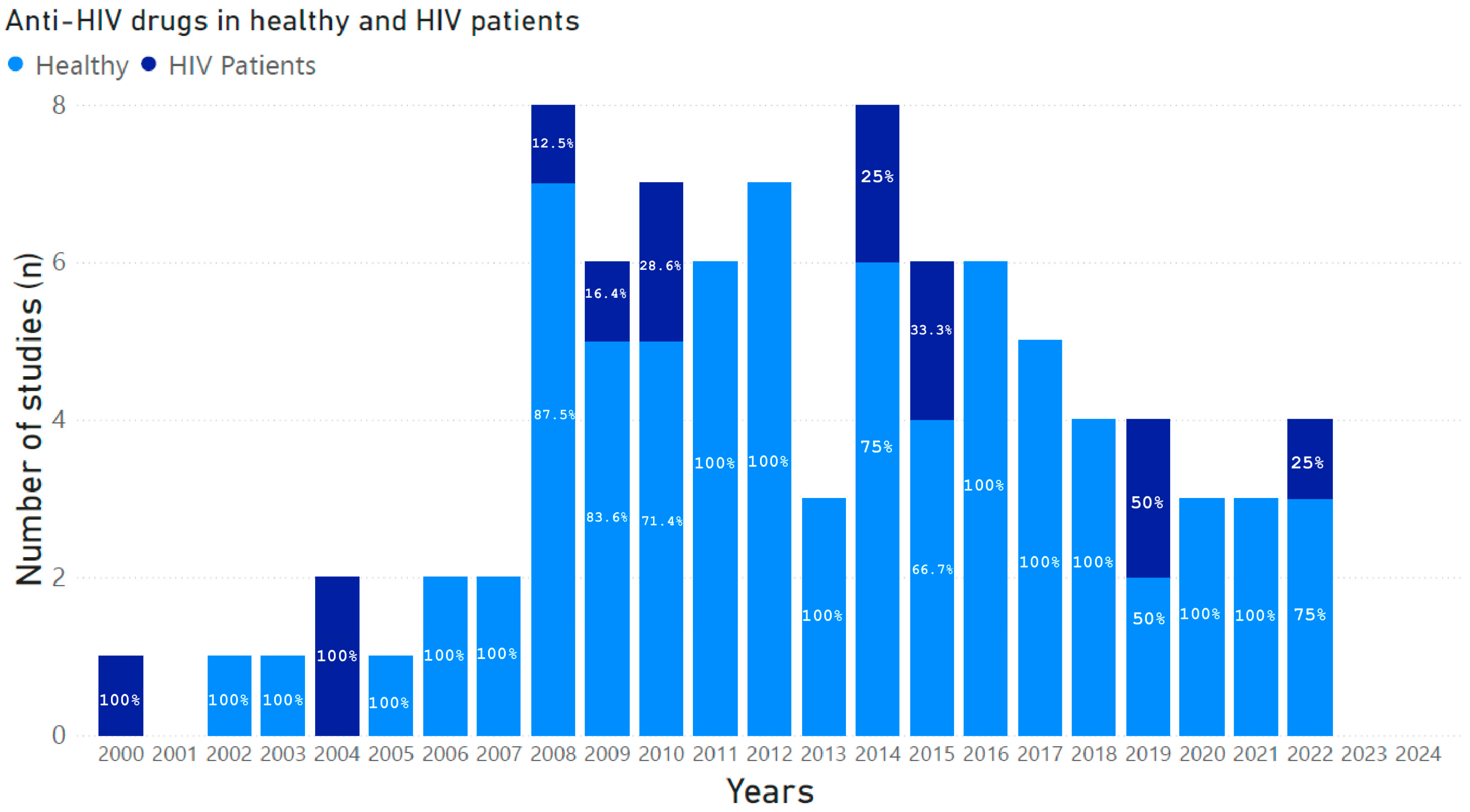
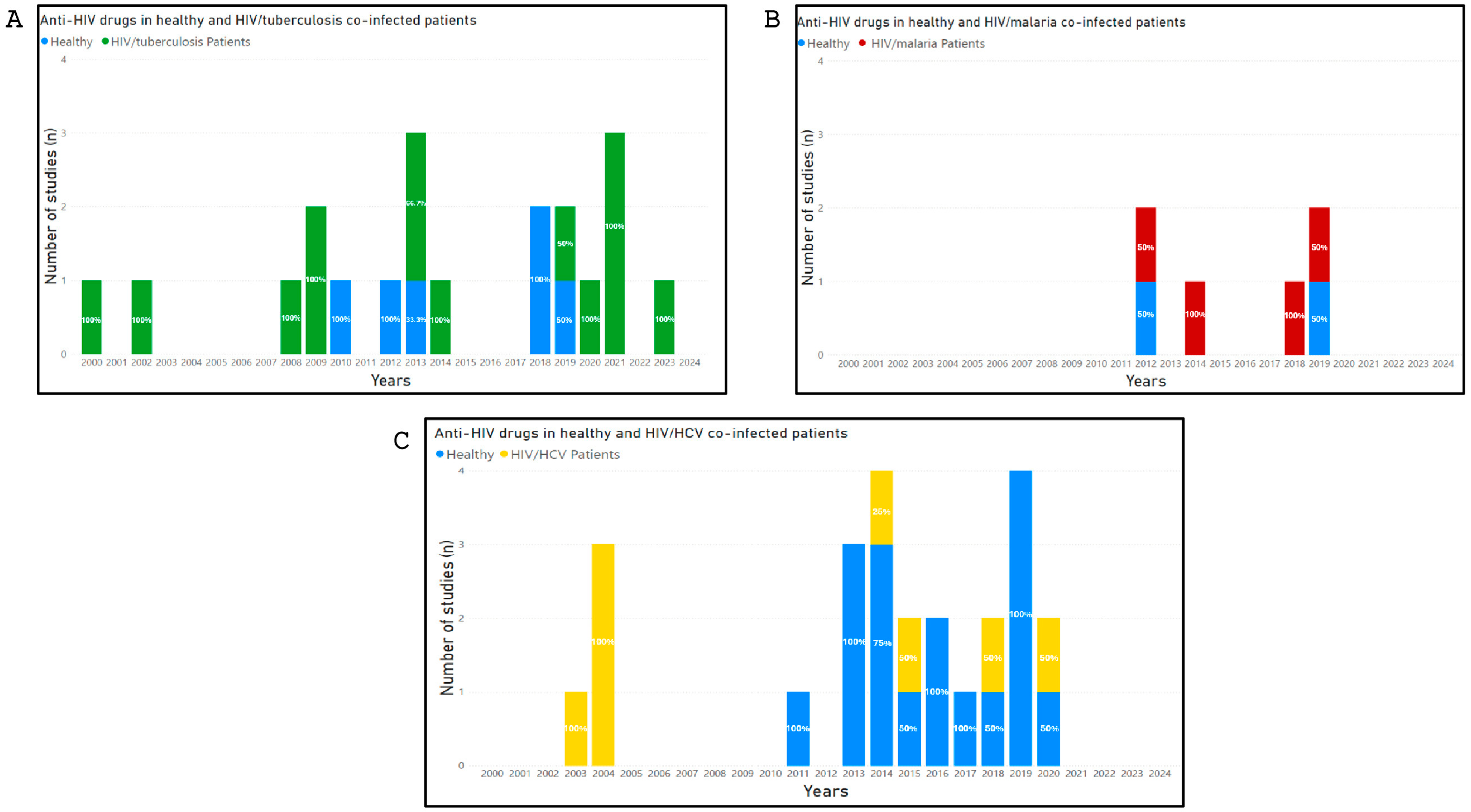

| References | Study Design | Country | Patients (n) | Sex (F%) | Range Age (Years) | Median Age(Years) | Drugs Involved | Follow-Up | Outcomes | Main Results and Conclusion |
|---|---|---|---|---|---|---|---|---|---|---|
| Abel et al. [17] (2008) | RCT with placebo | EU | 80 | 22.5 | 18–45 | NA | TPV, SQV, KCZ, MVC | 7 and 10 days after the final dose of study medication | Influence of CYP3A4 inhibitors on the PK of MVC | CYP3A4 inhibitors can increase MVC exposure. Adjustment of the MVC dose during co-administration with SQV can compensate this effect. TPV/r does not affect PK of MVC. |
| Anderson et al. [18] (2011) | RCT with placebo | EU | 20 | 100 | 18–38 | NA | RAL, EE, NGM | 28 days | Effect of RAL on the PK of the estrogen and progestin components of NGM-EE | RAL has no clinically significant effect on the PK of EE and NGM and the co-administration is generally well tolerated. No dose adjustment are required. |
| Ankrom et al. [19] (2021) | RCT | USA | 14 | 100 | 50–64 | 55.5 | ISL (MK-8591), LNG/EE | NA | DDIs between ISL and the COC LNG | Co-administration of ISL (MK-8591) with LNG/EE doesn’t require dose adjustment. |
| Blonk et al. [20] (2012) | RCT | EU | 18 | 50 | 18–55 | NA | Ginkgo biloba, RAL | 36 days | Effect of ginkgo biloba on the PK of RAL | Ginkgo biloba does not decrease RAL exposure. No serious adverse events are recorded. |
| Blonk et al. [21] (2016) | RCT | EU | 24 | 45.8 | 18–53 | NA | RAL, CIT | NA | DDIs and tolerability of concomitant administration of CIT and RAL | RAL does not impact the PK of CIT or its metabolite, desmethylcitalopram. CIT does not significantly alter the PK of RAL. The combination is well tolerated, allowing for administration without the need of dose adjustment. |
| Brüggemann et al. [22] (2010) | RCT | EU | 24 | 41.7 | 18–55 | NA | POS, FPV | 17 days | Interaction between FPV/RTV and POS | Due to PK reasons, FPV should not be used concomitantly with POS. |
| Elliot et al. [23] (2018) | RCT | Africa | 14 | 100 | 19–35 | 31 | EE/LNG with ATV/COBI | NA | PK of EE/LNG co-administered with ATV/COBI | The findings indicated that co-administering EE/LNG with ATV/COBI does not significantly alter LNG concentrations but results in a 25% reduction in EE C24 levels. |
| Fang et al. [24] (2008) | RCT | USA | 20 | NA | 18–48 | NA | NFV, OME | NA | Effect of OME on the multiple-dose PK and safety of NFV | OME/NFV combination can decrease the levels of NFV and its active form. |
| Fichtenbaum et al. [25] (2002) | RCT | USA | 56 | 59 | 19–56 | 32 | PIs, statins | Days 1–4 and 15–18 | DDI between PIs and statins | Simvastatin should be avoided, and caution should be exercised when using ATO in individuals taking RTV and SQV. It may be necessary to adjust the dosage of pravastatin when it is is used concomitantly with RTV and SQV, while no dose adjustment is required in combination with NFV. |
| Garrison et al. [26] (2017) | RCT with placebo | EU | 42 | NA | NA | NA | BIC/FCT/TAF and LDV/SOF or SOF/VEL/VOX | NA | DDIs between EMPA and verapamil, ramipril, or digoxin | No clinically significant DDIs were observed. |
| Huang et al. [27] (2012) | RCT with placebo | USA | Tot: 51 -G1: 39 -G2: 12 | -G1: 74–G2: 92 | 18–60 | NA | RTV-boosted BILR 355, 3TC/ZDV | days 7 and 14 | Effect of BILR 355 on 3TC/ZVD | The simultaneous use of BILR 355 with 3TC/ZDV leads to a slight reduction in BILR 355 exposure and a 45% rise in 3TC exposure. |
| Iwamoto et al. [28] (2008) | RCT with placebo | USA | 28 | 0 | 18–41 | NA | RTV, EFV, RAL | NA | Effects of RTV and EFV on the PK of RAL | No dosage adjustment is necessary when RAL is coadministered with RTV or EFV. |
| Iwamoto et al. [29] (2009) | RCT with placebo | USA | 14 | 50 | 22–51 | OME, RAL | NA | Effects of OME in population taking RAL | RAL plasma levels increased when it is coadministered with OME in healthy individuals, likely due to enhanced RAL bioavailability resulting from elevated gastric pH. | |
| Jacobs et al. [30] (2014) | RCT | EU | 24 | 54.2 | 26–50 | 42 | FPV/r, OLZ | NA | Effect of FPV/r on the PK of OLZ | FPV/r 700/100 mg b.i.d. seems to accelerate the metabolism of OLZ. Therefore, is suggest an increase of the OLZ dosage by 50% in case of co-administration with a RTV-boosted PI. |
| Jann et al. [31] (2012) | RCT | USA | 24 | 37.5 | NA | NA | VNF XR/IDV, desvenlafaxine XR/IDV | NA | Effects of VNF XR capsules and desvenlafaxine XR upon IDV PK | VNF XR and desvenlafaxine XR do not affect the metabolism of IDV. There is no evidence of a PK DDIs between VNF XR and IDV, nor between desvenlafaxine XR and IDV. |
| Jiang et al. [32] (2013) | RCT with placebo | Asia | 17 | 0 | NA | NA | CLO, ITR, EFV | 8 weeks | Effects of CLO and ITR on the disposition of EFV | CLO pretreatment decreases AUC, C(max) and Ae for 8,14-dihydroxyefavirenz, compared with placebo. |
| Justesen et al. [33] (2003) | RCT | EU | 18 | 0 | 23–30 | NA | APV, DLV | On day 10 and day 20 | Evaluate safety and PK interaction between APV and DLV | APV significantly enhances the metabolism of DLV by inducing hepatic CYP3A4 activity. Conversely, DLV inhibits the metabolism of APV. Therefore, combining APV and DLV twice daily is discouraged when relying on DLV for its ARV effect. |
| Kaeser et al. [34] (2009) | RCT | EU | 42 | 4.8 | 19–62 | NA | KCZ and RTV-boosted SQV | 15 to 21 days after the last dose | DDI study of KCZ and RTV-boosted SQV | No dose adjustment is necessary for SQV/RTV (1000/100 mg twice daily) when taken alongside 200 mg of KCZ once daily. However, using high doses of KCZ (>200 mg/day) is not advised in this combination. |
| Kakuda et al. [35] (2009) | RCT | USA | 40 | 12.5 | -G1: 19–55 -G2: 19–54 | 42 | ETR, TDF | NA | PK interaction between ETR and TDF | No dosage adjustment is required when ETR and TDF are taken together. |
| Kakuda et al. [36] (2014) | RCT | USA | Tot: 32 -G1 (RFB/ETR): 16 -G2 (ETR/CLR): 16 | 3.1 | 18–55 | NA | ETR, RFB or CLR | (A) 14–21 days (B) 8–13 days | Interaction between ETR and RFB or CLR | ETR and CLR can be taken together without changes in dosage. |
| Kasserra et al. [37] (2011) | RCT | USA | 150 | 50.7 | 18–55 | NA | VVC, ATV, DRV, FPV, IDV, NFV, SQV, TPV, RTV, LPV, ZDV/3TC, TDF | 29–35 days | Interaction of VVC with other ARV agents (ATV, FPV, IDV, NFV, SQV, DRV, TPV) | No adjustments in dosage or monitoring of VVC levels are required when it is administered alongside any of the ARV drugs |
| Kearney et al. [38] (2006) | RCT | USA | 27 | 59 | 19–59 | NA | TDF, LPV/r | 14 days | PK and safety of TDF on coadministration with LPV/r | The concurrent use of TDF and LPV/r leads to higher steady-state levels of TFV, likely due to enhanced absorption. However, this rise is considered clinically insignificant. |
| La Porte et al. [39] (2005) | RCT | USA | 8 | 37.5 | 18–57 | 33 | IDV/r, didanosine | NA | PK interaction between IDV/r and didanosine | The daily dose of 400 mg enteric-coated DDL and 1200/400 mg of IDV/r once daily at breakfast do not reduce the absorption levels of either DDL or IDV. Therefore, this regimen can be taken with food. |
| Luo et al. [40] (2022) | RCT | Asia | 36 | 25 | 18–55 | NA | HS-10234 (novel prodrug of TFV) and FCT | 8 days after the last dose | PK Interactions Between HS-10234 and FCT | No dose adjustments are advised when HS-10234 is combined with FCT. |
| Mallikaarjun et al. [41] (2016) | RCT with placebo | USA | 55 | 33 | 18–45 | NA | DLM, RTV, RIF, TFV, EFV, LPV/r | NA | DDI between DLM with ARV drugs or antituberculosis | When DLM is taken together with ARVs or antituberculosis medications, it does not exhibit any clinically significant DDIs in healthy individuals. |
| Matthews et al. [42] (2018) | RCT with placebo | EU | 14 | NA | 19–55 | NA | MK-8591 and DOR | NA | PK of MK-8591 and DOR after co-administration | When MK-8591 and DOR are administered together, no clinically significant differences in PK are observed. |
| Moltó et al. [43] (2021) | RCT with placebo | EU | 15 | 50 | 23–31 | 28 | COBI, GHB | NA | DDI between GHB and COBI | The study does not identify any PK or PD DDI between COBI and GHB. |
| Morris et al. [44] (2012) | RCT | USA | 34 | 41.2 | 18–55 | NA | PA, RTV, DHA | NA | DDI between PA and RTV | RTV and PA, when used together, affect the exposure levels of artesunate, DHA, and RTV itself. |
| Neely et al. [45] (2010) | RCT | USA | 19 | 65 | 24–51 | 28,6 | RAL, ATV | NA | PK and pharmacogenomics of once-daily RAL and ATV | Although the production of plasma RAL-glucuronide is decreased, the RAL plasma levels showed only minor (statistically insignificant) increases when administered once daily with ATV. |
| Patel et al. [46] (2011) | RCT | USA | 28, 12 | 0. 14 | NA | NA | S/GSK1349572, antacids (maalox advanced maximum strength), OME and multivitamins | NA | PK of S/GSK1349572 with acid-reducing agents and multivitamins | S/GSK1349572 (DTG) can be taken together with proton pump inhibitors and multivitamins without adjusting the dose. However, it should be taken either two hours before or six hours after antacids. |
| Pene Dumitrescu et al. [47] (2022) | RCT | USA | 17 | 100 | 18–50 | NA | GSK3640254, EE, LNG | 14 days | PK DDIs between the HIV-1 maturation inhibitor GSK3640254 and COC | The coadministration of ethinyl estradiol/levonorgestrel with GSK3640254 does not impact the pharmacokinetics or pharmacodynamics of ethinyl estradiol and levonorgestrel in healthy female subjects. No significant tolerability issues are observed. |
| Ramanathan et al. [48] (2010) | RCT | USA | 36 | NA | 18–45 | NA | RTV-boosted EVG (EVG/r) and MVC | NA | PK DDI between RTV-boosted EVG and MVC | When EVG and RTV are co-administered, their PK remain unchanged, while MVC exposures are 2 to 4 times higher, probably due to RTV-mediated inhibition of CYP3A and P-gp. It is recommended to reduce the dose of MVC to 150 mg. Headache is the most reported adverse event related to all treatments. |
| Ramanathan et al. [49] (2008) | RCT | NA | 34 | NA | 18–45 | NA | EVG, ETR | NA | PK of EVG and ETR following coadministration of RTV-boosted EVG (EVG/r) and ETR | No significant DDI between EVG/r and ETR are observed. |
| Ross et al. [50] (2016) | RCT with placebo | USA | 12 | 25 | 18–65 | NA | DTG, DCV | NA | PK interactions between DTG and DCV | DTG and DCV can be used together without requiring dose adjustment. |
| Rudd et al. [51] (2021) | RCT | USA | 12 | 58 | 18–55 | 39 | ISL, DTG, TDF | NA | DDI between ISL, DTG and TDF | No significant changes in the PK of ISL, DTG, or TDF are observed when these drugs are administered together. ISL demonstrates good tolerability whether given alone or in combination with DTG and TDF. |
| Sanchez et al. [52] (2020) | RCT | USA | 14 | 35.7 | 19–55 | NA | DOR and MET | NA | MET PK after coadministration with DOR | DOR does not significantly alter the PK of MET. MET is well tolerated when administered either alone or with DOR. |
| Schöller-Gyüre et al. [53] (2008) | RCT with placebo | EU | 19 | 36.8 | 18–55 | 49 | ETR, RAN, OME | 31 days | PK of ETR (TMC125) co-administered with RAN and OME | ETR can be safely used together with proton pump inhibitors and H(2) antagonists without requiring dose adjustments. |
| Schöller-Gyüre et al. [54] (2008) | RCT | EU | 16 | 0 | 36–55 | 42 | ETR, MTD | NA | Evaluation of concomitant administration of MTD and TMC125 | The concurrent use of ETR and MTD is generally safe and well tolerated ETR does significantly affect the pharmacodynamics of MTD. Therefore, no changes in MTD dosage are required. |
| Sekar et al. [55] (2010) | RCT | USA | 27 | NA | 33–55 | 30 | DRV/RTV, RFB | NA | PK of DRV/r and RFB | DRV/r may be administered together with RFB, if the dosage of RFB is adjusted to 150 mg, alongside with increased vigilance for possible RFB-related adverse events. |
| Song et al. [56] (2015) | RCT | USA | 24 | 42 | 18–65 | NA | DTG, mineral supplements | NA | PK of DTG administered with mineral supplements | DTG at a dosage of 50 mg is well tolerated when taken with 1200 mg calcium carbonate or 324 mg ferrous fumarate. Under fasted condition, DTG should be taken two hours before or six hours after calcium or iron supplements. |
| Song et al. [57] (2014) | RCT | USA | 12 | 0 | 20–65 | 36,5 | EFV, TPV/r, DTG | NA | Effects of EFV and TPV/r on the PK of DTG | DTG should be administered at an increased dose of 50 mg twice daily when used in combination with EFV or TPV/r. |
| Song et al. [58] (2011) | RCT | USA | 24 | 12 | 18–61 | NA | ATV, ATV/r, DTG (S/GSK1349572) | NA | Effect of ATV and ATV/r on the PK of S/GSK1349572 | The pairing of S/GSK1349572 with ATV/r or ATV is generally well tolerated, with all adverse events being mild or moderate. The most common adverse event is ocular icterus. |
| Song et al. [59] (2012) | RCT | USA | 24 | 58.3 | NA | NA | DTG, food | 7 to 14 days | Food effect on the PK of DTG | Consuming food slightly raises DTG exposure from 33% to 66%, depending on the fat content of the meal. This is not expected to affect safety. |
| Song et al. [60] (2016) | RCT | USA | 16 | 87.5 | 18–65 | NA | CBZ, DTG | 7 to 14 days | Effect of carbamazepine on PK of DTG | CBZ greatly lowers the levels of DTG. DTG-naive individuals, who are also taking CBZ, should receive 50 mg DTG twice daily instead of once daily, which is the recommended dose for other strong inducers of UGT1A/CYP3A enzymes. |
| Song et al. [61] (2013) | RCT with placebo | USA | 12 | 58.3 | 23–38 | NA | Prednisone, DTG | 10 days | Effect of prednisone on the PK of DTG | The use of DTG at 50 mg per day and prednisone at 60 mg per day, followed by a 5-day cone, is well tolerated among healthy participants. |
| Song et al. [62] (2015) | RCT with placebo | USA | 16 | 100 | NA | NA | DTG, NGM/EE | 7 to 14 days | DTG effect on the PK of NGM/EE | DTG does not impact the PK or PD of NGM/EE. Therefore, no dose adjustment is required. |
| Song et al. [63] (2016) | RCT | USA | 15 | 27 | 18–65 | NA | DTG, MET | NA | Effect of DTG on PK of MET | DTG has been found to substantially elevate MET plasma levels, partly due to inhibition of OCT2. To ensure optimal glycemic control when initiating or discontinuing DTG in patients taking MET, adjusting the MET dosage is advised. |
| Song et al. [64] (2010) | RCT | USA | 15 | 6 | 20–58 | 39 | S/GSK1349572, TFV, TDF | NA | DDI between S/GSK1349572, TFV and TDF | S/GSK1349572 and TDF are well tolerated overall, with few adverse events recorded. They can be coadministered without requiring any dose adjustments. |
| Trezza et al. [65] (2017) | RCT | USA | 20 | 100 | 18–39 | NA | CAB, LNG, EE | NA | PK DDI between CAB and LNG/EE | Repeated doses of oral CAB do not show any notable impact on the PK or PD of LNG and EE. |
| Van Luin et al. [66] (2009) | RCT | EU | 24 | 0 | 20–52 | NA | RAL, LTG | NA | Effect of RAL on the glucuronidation of LTG | RAL has no effect on the glucuronidation process of LTG. |
| Vourvahis et al. [67] (2012) | RCT with placebo | USA/EU | 32 | NA | 18–55 | NA | LRV, RAL, MVC | NA | PK Effects of coadministration of LRV with RAL or MVR | LRV demonstrated overall good tolerability and seems compatible for concurrent use with RAL or MVC without requiring dose adjustments |
| Walimbwa et al. [68] (2019) | RCT | Africa/EU | 48 | NA | ≥18 | NA | DTG, AL or AS/AQ | NA | DDI between DTG and AL or AS/AQ | DTG does not affect the levels of AL or AS/AQ significantly. Standard doses of these antimalarial regimens should be maintained when DTG is taken. |
| Weening et al. [69] (2008) | RCT | USA | 35 | NA | 22–68 | NA | RAL, TFV | NA | DDI between RAL and TFV | Co-administration of RAL and TDF does not change the PK of either drug, which can therefore be co-administered without dose adjustment. |
| Zhou et al. [70] (2006) | RCT | USA | 32 | 50 | 18–65 | NA | TBV, 3TC, ADV | NA | PK of TBV with 3TC or ADV | The results support the use of combination therapy or switch between TBV, 3TC, and ADV in the treatment of chronic hepatitis B virus infection. |
| Zhu et al. [71] (2017) | RCT | USA | 32 | 12 | 18–45 | 29 | VRC, ATV/r | NA | PK and DDI between VRC and ATV/r | Co-administration of VRC and ATV/r is not recommended unless the potential benefits outweigh the risks. |
| Zhu et al. [72] (2015) | RCT | USA | 36 | 18 | 18–49 | 30 | BMS-663068, ATV, RTV, ATV/r | NA | PK DDI between BMS-626529 and ATV/r | Comparing BMS-663068 alone and in combination with ATV/r, in combination the maximum concentration (Cmax) and (AUC) of BMS-626529 in plasma increases. Co-administration with RTV results in a 53% increase in Cmax and 45% increase in AUC of BMS-626529. Systemic exposures of ATV and RTV remained stable whether BMS-663068 is administered with ATV/r. The addition of ATV to the combination of BMS-663068+RTV does not further increase the exposure to BMS-626529. |
| Zhu et al. [73] (2011) | RCT | USA | 56 | NA | 18–50 | NA | ATV/r, OME | NA | Effect of OME on PK of multiple dose ATV/r | A daily dose of 20 mg OME has a significantly milder impact on the PK of ATV compared to the previously noted effects of 40 mg OME. |
| Blonk et al. [74] (2015) | Crossover CT | EU | 24 | 54.2 | 18–55 | NA | RAL, ATO | 14 days | Influence of ATO on the PK of RAL and viceversa | ATO 20 mg does not significantly impact the PK of RAL, and RAL similarly does not affect ATO. Both drugs are well tolerated when taken together and do not require dose adjustments. |
| Ford et al. [75] (2017) | Crossover CT | EU | 15 | 33 | 21–65 | NA | RIF, CAB | 10 to 14 days | Effect of RIF on the Single-Dose PK of oral CAB | Co-administration of CAB with RIF do not affect the maximum plasma concentration of CAB. RIF induced the metabolism of CAB, resulting in an increased clearance and a significant reduction in CAB exposure. RIF is also expected to increase the clearance of CAB when administered as a long-acting injectable drug. Therefore, the concomitant use of RIF with the oral, long-acting formulations of CAB is not currently recommended. |
| Garraffo et al. [76] (2011) | Crossover CT | NA | 17 | 0 | 20–40 | 26 | TPV/r, TAD | 19 days | Effects of TPV 500 mg and RTV 200 mg combination on the PK of TAD 10 mg | DDIs between a single dose of TAD and TPV/r affects the PK of TPV/r by slightly decreasing patient exposure both during initial dosing and at steady state. Co-administration of TAD significantly increase exposure when given with the initial dose of TPV/r, but this effect diminishes once steady state of TPV/r is achieved. Although ARV activity may remain unaffected, initial TAD doses should be reduced during the initiation of TPV/r therapy, with the option to resume the full dose once steady state is attained. |
| Kakuda et al. [77] (2014) | Crossover CT with placebo | USA | Tot: 30 -G1: 14 -G2: 16 | 0 | -G1: 21–49 -G2: 18–46 | -G1: 34 -G1: 31 | ETR, digoxin | 14 days | Effect of single- and multiple-dose of ETR on digoxin in healthy subjects | The AUC0–8 h of digoxin showes a slight increase when coadministered with ETR. |
| Wire et al. [78] (2021) | Crossover CT | USA | 14 | NA | NA | NA | FTR, MVC | NA | PK DDIs between FTR and MVC | The simultaneous use of FTR and MVC does not lead to significant alterations in the exposure levels of MVC or FTR. These drugs can be given together without requiring any dose adjustments. |
| Dooley et al. [79] (2012) | Phase 1 PK DDI trial with placebo | EU | 37 | 8 | 19–62 | 44 | BDQ, EFV | A dose of 400 mg once daily for two weeks followed by 200 mg thrice weekly | DDI between BDQ and EFV | Single-dose BDQ is well tolerated with steady-state EFV. |
| Dooley et al. [80] (2013) | Phase I PK DDI study | USA | 21 | 2 | 18–55 | NA | DTG, RIF, RFB | NA | Effect of RIF or RFB on the PK of DTG | Regimens including twice-daily DTG and RIF or DTG and RFB once-daily could offer a novel therapeutic option for patients needing simultaneous management of HIV and TB. |
| Ford et al. [81] (2019) | Phase I, single centre, open label, fixed-sequence, two period study | USA | 15 | 0 | NA | NA | RFB, CAB | days 14 and 28 | Effects of RFB on the PK of oral CAB | Oral CAB can be safely used alongside RFB without the need of dose adjustment. |
| Hogeland et al. [82] (2007) | Open-label, sequential design, three phases | USA | 12 | 16.6 | 22–40 | NA | LPV/r, BUP | Every day for 2 weeks | Effect of LPV/r and BUP | The simultaneous use of LPV/r and BUP leads to reduced levels of BUP and its active metabolite hydroxybupropion, potentially requiring a doubling of the BUP dose. |
| Kearney et al. [83] (2009) | Open-label, fixed-sequence, PK DDI study | USA | 20 | 100 | 19–45 | NA | TDF, HCs (i.e., NGM-EE oral contraceptive) | 28 days | Effect of TDF for PK of HCs | No clinically significant DDI between TDF and NGM-EE occurred. Both drugs are well tolerated when coadministered. TDF is unlikely to affect the PK of HCs. |
| Khalilieh et al. [84] (2017) | Open-label, two-period, two-treatment, fixed-sequence, PK study with placebo | USA | 16 | 50 | 20–45 | NA | DOR, ATO | NA | DOR-ATO DDIs | DOR does not significantly impact the PK of ATO. |
| van der Lee et al. [85] (2007) | Open-label, multiple-dose, two-arm, two-sequence with placebo | EU | 26 | 69.2 | 18–65 | PAX, FPV/r | NA | PK DDI between PAX and FPV/r | Combining FPV/r with PAX leads to a notable reduction in PAX levels, decreasing exposure by 55%. | |
| Weiner et al. [86] (2014) | Open-label, fixed-sequence, three-period, PK study | USA | 21 | 49.2 | 25–39 | 30 | RPT, RAL | NA | PK DDIs between RPT and RAL | The combination of RAL and RPT is well tolerated. |
| Yu et al. [87] (2014) | Single-centre, open-label, multi-dose, fixed-sequence, PK study | USA | 28 | 25 | NA | NA | DRV, RTV, DRV/r, PTV | NA | PK interaction of DRV/r and PTV | DRV/r reduces the overall exposure to PTV by 26%, with similar peak exposures observed. PTV does not affect the PK of DRV or RTV. Therefore, DDI between PTV and DRV/r are negligible. |
| Brooks et al. [88] (2018) | Single-center, open-label, fixed-sequence, DDI study | USA | 4 | 75 | 21–44 | NA | DTG, INH, RPT | 22, 26, 30, 33, and 40 days | PK DDIs between INH and RPT with DTG | The concurrent administration of DTG with once-weekly INH-RPT caused severe and unforeseen toxicities due to the release of endogenous cytokines. |
| Gordon et al. [89] (2016) | Open-label, single-sequence DDI study | USA | 16 | NA | NA | NA | COBI, DABI | NA | Effect of COBI on DABI | COBI Increases the exposure and the anticoagulant effect of DABI. |
| Khalilieh et al. [90] (2020) | Open-label, multiple-dose, DDI study | USA | 14 | 50 | 20–59 | 35 | DOR and MTD | 14 days | DDI between DOR and MTD | Co-administration of DOR/MTD has no significant impact on the PK properties of either. Overall, it is well tolerated. No serious adverse effects, and no participant discontinued treatment. |
| Khalilieh et al. [91] (2018) | Open-label, 2-period, fixed-sequence, DDI study | USA | 18 | 16.7 | 20–55 | NA | RFB, DOR | 14 days | Effect of RFB on DOR | DOR can be taken together with RFB if the DOR dosage is increased from 100 mg once a day to 100 mg twice a day. |
| Majeed et al. [92] (2019) | Open-label, two cohort fixed-sequence, DDI study | USA | 36 | 100 | 18–45 | NA | COBI with ATV or DRV and drospirenone/EE | NA | DDI between COBI-boosted ARV regimens and HCs | Clinical monitoring of drospirenone-related hyperkalemia is recommended with DRV+COBI. ATV+COBI should not be used in combination with drospirenone. |
| References | Study Type | Country | Patients (n) | Sex (F%) | Range Years | Median (Years) | Drugs Involved | Follow-Up | Outcomes | Main Results and Conclusions |
|---|---|---|---|---|---|---|---|---|---|---|
| Fletcher et al. [100] (2000) | RCT | USA | Tot: 37 -G1(SQV/r+DLV): 6 -G2(SQV/r+ADV): 7 -G3(SQV/r+ADV + DLV): 5 -G4(SQV/NFV+DLV): 7 -G5(SQV/NFV+ADV): 6 -G6(SQV/NFV DLV+ADV): 6 | -G1: 50 -G2: 25 -G3: 50 -G4: 25 -G5: 25 -G6: 25 | NA | 39.5 | SQV/r, SQV/NFV, DLV, ADV, | NA | Evaluation of the steady-state concentrations of SQV, RTV, NFV, DLV and ADV in combination drug regimens | SQV concentrations does not vary when used in combination with RTV or NFV. The addition of ADV to DLV significantly reduces both SQV and DLV concentrations. |
| Goebel et al. [101] (2010) | RCT | EU | Tot: 208 -G1(TPV/r 1250/100 mg): 58 -G2(TPV/r 750/100 mg): 63 -G3(TPV/r 250/200 mg): 87 | -G1: 22.4 -G2: 14.3 -G3: 12.6 | 18–75 | -G1: 43 -G2: 39 -G3: 39 | TPV/r and existing HAART regimen (AZT/3TC/ABC; AZT/3TC/EFV; AZT/3TC/NVP; d4T/3TC/EFV; d4T/3TC/NVP; d4T//EFV; d4T/ddI/NVP) | 22 days for most HAART regimens 21 days EFV | PK effects of TPV/r co-administered with HAART; safety and efficacy of HAART | Co-administration of TPV/r is safe and effective, with a low potential for clinically significant DDIs, when integrated into HAART regimens containing NVP, EFV, 3TC, d4T, or ddI. |
| Sekar et al. [102] (2009) | RCT | USA | 19 | 26 | 33–56 | 43 | NVP, DRV/r | 14 days | PK and DDIs between DRV/r and NVP | No significant DDIs between DRV/r and NVP. No dosage adjustments are necessary. |
| Wenning A. et. [69] (2008, study B) | Study B: RCT with placebo | USA | Study B: 104 | 4 | 22–68 | NA | RAL, TDF, 3TC | NA | PK and DDIs between RAL and TDF | The co-administration of RAL and TDF does not significantly affect the PK of either drug. RAL and TDF can be administered together without any dose adjustments. |
| Vogler et al. [103] (2010) | PK study | USA | Tot: 32 -G1(LPV/r, EE, NGMN): 8 -G2(EE, NGMN): 24 | -G1: 100 -G2: 100 | 18–49 | -G1: 28 -G2: 31 | LPV/r and EE and NGMN administered transdermally | 4 weeks | PK and DDIs between LPV/r and EE and NGMN administered transdermally. | A significant difference in patch EE and NGMN concentrations has been observed in LPV/r-treated subjects. These patients show low levels of EE and high levels of NGMN. while maintaining contraceptive efficacy. |
| DuBois et al. [104] (2015) | PK study | USA | Tot: 27 -G1 (NETA+ RTV+ATV): 10 -G2 (NETA): 17 | -G1: 100 -G2: 100 | -G1: 18–44 -G2: 18–44 | -G1: 37.5 -G2: 37.9 | NETA with RTV-boosted ATV therapy | 21 days | PK of NETA | Progestin-only contraceptives show higher drug exposure when co-administered with RTV-enhanced ATV regimens. |
| Luque et al. [105] (2015) | PK study | USA | 25 | 100 | 15–47 | 32 | DMPA, LPV/r | 12 weeks | PK, DDIs and safety of LPV/r and DMPA | The simultaneous administration of LPV/r and DMPA determines a significant increase in DMPA exposure. Despite this, MPA is relatively well tolerated. The most side effects reported are mild or moderate irregular vaginal bleedings. |
| Rudek et al. [106] (2014) | PK study | USA | 19 | 0 | 38–71 | 54 | HAART, sunitinib | 12 months | PK, safety and efficacy of HAART and sunitinib | Patients not in treatment with RTV tolerate sunitinib 50 mg/day and show toxicities comparable to those found in patients receiving a RTV-based HAART in treatment with sunitinib at the dosage of 37.5 mg/day. The recommended dosage for patients taking RTV is 37.5 mg daily after a 4-week on/2-week off regimen. |
| Ruxrungtham et al. [107] (2004) | Pk study | Asia | Tot: 25 -G1(RTV+ENF): 12 -G2(SQV/r+ENF): 13 | -G1: 50 -G2: 54 | -G1: 18–64 -G2: 18–64 | NA | RTV, SQV/r, ENF | 15 days | PK and DDIs between RTV, SQV/r and ENF | The co-administration of RTV or SQV/r does not significantly affect the PK of ENF. No serious ADRs or treatment discontinuations have been recorded. |
| Vieira et al. [108] (2014) | Prospective interventional PK study | USA | Tot: 45 -G1(LPV/r, AZT/3TC, ENG): 15 -G2(EFV, AZT/3TC, ENG): 15 -G3(ENG): 15 | -G1: 100 -G2: 100 -G3: 100 | 18–40 | -G1: 27.1 -G2: 34.5 -G3: 28.8 | LPV/r, EFV, AZT, 3TC, ENG | 6 months | PK and DDIs between LPV/r or EFV, and ENG-releasing implant | The simultaneous use of EFV reduces the bioavailability of ENG, potentially compromising its contraceptive effectiveness. In contrast, the combination of LPV/r enhances the bioavailability of ENG, indicating that this antiretroviral regimen does not negatively affect the efficacy of the ENG implant. |
| Yang et al. [109] (2022) | Retrospective cohort observational study. | Asia | Tot: 66 -G1(DTG/3TC/TDF): 20 -G2(DTG/ABT): 24 -G3 (BIC/TAF/FTC): 22 | -G1: 35 -G2: 25 -G3: 63.6 | -G1: 44–74 -G2: 45–85 -G3: 33–74 | NA | INSTI-based regimens | 6 month | Safety and efficacy between HAART and chemotherapy | The majority of AEs recorded during treatment are grade 1–2. Grade 3–4 AEs occur in 9.09% of patients, while no grade 5 AEs have been observed. HAART including DTG or BIC are effective choices for patients with HIV and colorectal cancer. |
| Neary et al. [110] (2019) | Pgx study | Africa | Tot: 57 -G1(ETON): 19 -G2 (ETON+ EFV): 19 -G3(ETON+ NVP): 19 | -G1: 100 -G2: 100 -G3: 100 | -G1: 24–30 -G2: 23–35 -G3: 28–35 | -G1: 27 -G2: 29 -G3: 32 | ETON, EFV or NVP | 24 weeks | Influence of Pgx on the DDIs between ENG and EFV or NVP-based HAART. | Co-administration of EFV and ETON causes harmful DDIs regardless of the patient’s genetic background. These are worse in women with allelic variants of CYP2B6 gene. |
| Perram et al. [111] (2019) | DDIs study | Australia | 14 | 0 | 50–81 | NA | Dabigatran, HAART | 12 months | DDIs between dabigatran and HAART | No DDIs have been shown and no thromboembolic or hemorrhagic events have been observed. |
| Benesic et al. [112] (2004) | DDIs study | EU | Tot: 25 -G1 (HAART+FLUV): 12 -G2 (HAART+PRAV): 13 | -G1: 25 -G2: 15 | NA | NA | FLUV and PRAV with HAART | 72 weeks | Effectiveness of FLUV and PRAV; DDIs between FLUV and PRAV with HAART | HAART therapy with FLUV and PRAV is effective in reducing total cholesterol and LDL levels. No effects on triglycerides, HDL or IDV plasma levels have been observed. |
| References | Study Type | Country | Patients (n) | Sex (F%) | Range (Years) | Median (Years) | Type of Co-Infection | Drugs Involved | Follow-Up | Outcomes | Main Results and Conclusions |
|---|---|---|---|---|---|---|---|---|---|---|---|
| Atwine et al. [113] (2020) | RCT | Africa | Tot: 97-G1 (600 mg EFV+ 600 mg RIF): 33 -G2(1200 mg EFV+ 600 mg RIF): 31 -G3(1200 mg EFV+ 800 mg RIF): 33 | -G1: 12.1 -G2: 29 -G3: 39.4 | NA | -G1: 34.1 -G2: 33.4 -G3: 32.3 | TB | RIF, EFV | 28 weeks | PK parameters of EFV; RIF Cmax; treatment adherence and safety | Co-administration of a doubled dose of RIF with EFV in HIV/TB co-infected patients is generally well tolerated. RIF dose doubling is safe and effective for the treatment of TB and HAART. |
| De Kock et al. [114] (2014) | RCT | Africa | 73 | 46.6 | 18–64 | 33 | TB | PAS, EFV | 12 weeks | PK of PAS; DDIs between PAS and EFV; tolerance and safety | PAS concentrations are lower in patients co-infected with HIV and TB, and the use of EFV with PAS may contribute to this reduction, although the exact mechanism of the drug interaction remains unclear. When HAART includes EFV, administering 4 g of PAS twice daily seems to be both effective and well-tolerated, whereas higher doses, such as 12 g once daily, show reduced effectiveness. |
| Lopez-Cortes et al. [115] (2002) | RCT | EU | 24 | 14.3 | 22–58 | 37 | TB | EFV, RIF | 6 months | PK interactions between EFV and RIF | EFV daily dose of 800 mg in patients with HIV and TB may increase the efficacy of therapy when co-administered with RIF. RIF can be used with EFV without requiring dosage changes. |
| Zhang et al. [116] (2013) | RCT | Africa | Tot: 95 -G1(Children): 74 -G2(Adults): 21 | -G1: 42.1 -G2: 18.9 | NA | -G1: 21 months -G2: 36years | TB | LPV/r, RIF | 1 month | Influence of RIF on PK of LPV/r | In children, LPV bioavailability decreases more with RTV than in adults. RIF increases LPV and RTV clearance more in adults compared to children. |
| Podany et al. [117] (2021) | RCT | USA | 78 | 78 | 13–66 | 40 | TB | NVP, EFV, RPT, INH | 4 weeks | PK and efficacy and safety of RPT and INH vs. the standard INH regimes in association with HAART | High-dose RPT modestly decreases EFV clearance. Therapeutic targets are achieved without EFV dose adjustments. |
| Wallender et al. [118] (2018) | RCT with placebo | Africa | 83 | 100 | 16–43 | NA | Malaria | DHA-PQ, EFV | 40 weeks of gestation | PK and DDIs between EFV and DHA-PQ | In HIV+ pregnant women taking EFV, daily low-dose DHA-PQ offers better protection against parasitemia and shows lower toxicity risks compared to monthly dosing schedules. |
| Scarsi et al. [119] (2023) | RCT | Africa, Asia and USA | Tot: 118 -G1(LNG 1.5 mg + DGT): 32 -G2(LNG1.5 mg +EFV): 17 -G3(LNG 3 mg+EFV): 35 -G4(LNG 3 mg+RIF): 34 | -G1: 62.5 -G2: 47.1 -G3: 60 -G4: 50 | -G1: 18–55 -G2: 20–58 -G3: 22–54 -G4: 19–60 | -G1: 34 -G2: 42 -G3: 36 -G4: 25 | TB | LNG, EFV and RIF | 12 months | PK of LNG and EFV or RIF | Doubling the dose of LNG-based emergency contraceptive increases LNG exposure in the first 8 h in subjects receiving EFV-based ART or RIF -based TB therapy. |
| Byakika-Kibwika et al. [120] (2012) | PK study | Africa | Tot: 58 -G1(AL+ EFV): 30 -G2 (AL+NVP): 28 | -G1: 63 -G2: 96 | NA | -G1: 38 -G2: 33 | Malaria | AL, EFV, NVP | 10 weeks | DDIs between AL and EFV or NVP | Co-administration of AL with EFV or NVP leads to a significant reduction in the exposure levels of artemether and its active metabolite, dihydroartemisinin. Additionally, lumefantrine exposure is significantly decreased when taken with EFV, while the reduction with NVP is not statistically significant. |
| Meyers et al. [121] (2019) | PK study | Africa | Tot: 26 -G1(2–5 years): 12 -G2 (6–12 years): 14 | G1: 41.6 -G2: 50 | -G1: 2 -5 -G2: 6–12 | -G1: 3 -G2: 8 | TB | RAL, RIF, EFV, LPV/r, NRTIs | 12 weeks following the cessation of RAL | PK and safety of RAL and RIF | Administration of 12 mg/kg RAL chewable twice daily safely achieves PK targets in HIV/TB children |
| Ren et al. [122] (2008) | PK study | Africa | Tot: 30 -G1(RIF and LPV/r): 15 -G2(LPV/r): 15 | -G1: 53 -G2: 67 | NA | -G1: 16 -G2: 29 | TB | RIF, LPV/r | 20 weeks | PK of LPV/r and RIF | The reduction in LPV Cmin caused by RIF can be attenuated by adding RTV to LPV. An adjusted dose of LPV/r results in adequate Cmin of LPV in most HIV-infected children co-administered with RIF. |
| Ren et al. [123] (2009) | Observational PK study. | Africa | 15 | NA | NA | 6.3 | TB | EFV, RIF | 78 weeks | PK of RIF and EFV | Co-administration of RIF and EFV does not lead to a significant decrease in estimated Cmin levels of EFV in children co-infected with HIV and TB. Therefore, no significant DDIs were detected between RIF and EFV. |
| Scarsi et al. [124] (2014) | Observational PK study. | Africa | 21 | 71.4 | NA | 39.7 | Malaria | AZT, NVP, 3TC, AS/AQ | 6 days | DDIs between AS/AQ and HAART; PK of HAART and AQ (DEAQ metabolite) | Patients on AZT-based ART show reduced exposure to AQ and its active metabolite DEAQ, with possible reduction of AS/AQ effectiveness. |
| Sevene et al. [125] (2019) | PK study | Africa | Tot: 221 -G1 (EFV+ DPQ): 160 -G2 (NVP+DPQ): 61 | -G1: 66.5 -G2: 75.4 | 15–65 | -G1: 38.6 -G2: 47 | Malaria | DPQ, EFV, NVP | 63 days | Efficacy and safety of DPQ in patients on EFV- or NVP-based HAART; PK interactions between HAART and DPQ | Treatment with DPQ is highly effective and safe for adult HIV+ patients receiving EFV or NVP-based HAART with uncomplicated malaria, despite known PK interactions. A prolongation of the QTc has been observed, with spontaneous resolution within 14 days. |
| Tanuma et al. [126] (2013) | PK study | Asia | 16 | 0 | 23–60 | 36 | TB | RFB, LPV/r | 2 years | PK of two RFB regimens (300 mg/day RFB alone versus 150 mg every other day) in combination with LPV/r | A dose of RFB of 150 mg taken every other day, combined with a LPV/r-based HAART, produces a similar AUC as that observed with a standard dose of 300 mg daily. The use of the reduced dose results in a lower exposure to RFB. |
| van der Laan et al. [127] (2021) | Prospective PK study | Africa | 54 | 53.7 | 0–15 | 5.7 | TB | PZA, TRD, EMB, ETA, INH, 3TC, ABC | 52 weeks | PK and DDIs between ABC and 3TC | The TB treatment regimen including PZA, EMB, ETA, INH, TRD, do not have a significant impact on the PK of 3TC or ABC. |
| Narita et al. [128] (2000) | DDI study | USA | 25 | 36 | 27–65 | 36 | TB | RFB with PIs (IDV or NFV) or NNRTI | 13 months | DDIs between RFB and PIs or NNRTI | The combination of RFB and PI is effective in HIV/TB co-infection. RFB retains its bactericidal activity, while PI maintains viral suppression without exacerbating side effects. |
| Moh et al. [129] (2005) | DDI study | Africa | 498 | 72 | 29–41 | 34 | Hepatitis B | AZT, 3TC, EFV, TMP-SMX | 6 months. | DDIs between AZT-based HAART and TMP-SMX; incidence of hematological disorders. | Co-administration of TMP-SMX and AZT leads to a significant increase in grade 3–4 neutropenia, which resolves after TMP-SMX discontinuation. |
| Liou et al. [130] (2021) | Observational prospective study | Asia | 48 | 2.1 | 37–51 | 41.0 | LTBI | INH, RPT, BIC/FTC/TAF | 52 weeks | Safety and tolerability of RPT-INH treatment in HIV+ patients with LTBI also receiving BIC/FTC/TAF therapy. | Treatment with RPT-INH in combination with BIC/FTC/TAF is well tolerated. Therefore, it has significant effects on BIC trough plasma concentrations. |
| Martinson et al. [131] (2009) | Retrospective cohort study | Africa | 1132 | 50.3 | NA | 6.3 | TB | RFB, RIF, INH, PZA, EMB, LPV/r, EFV, RAL 3TC, d4T, AZT, NVP | 12 weeks | HAART efficacy in reducing the incidence of TB | In HIV+ children, HAART is associated with a 70% reduction in the risk of childhood TB incidence. |
| References (Years) | Study Type | Country | Patients (n) | Sex (F%) | Median Age (Years) | Age Range (Years) | Drugs Involved | Follow-Up | Outcomes | Main Results and Conclusion |
|---|---|---|---|---|---|---|---|---|---|---|
| HIV/HCV coinfected patients | ||||||||||
| Poizot-Martin et al. [161] (2003) | Retrospective and prospective study | EU | Tot: 62 -G1(IFN+RBV): 42 -G2(PegIFN+RBV): 20 | -G1: 28.1 -G2: 20 | -G1: 36 -G2: 37 | -G1: 34–40 -G2: 33–40 | IFN alpha-2b (peg or not) plus RBV and HAART | At least 6 and up to 12 months | Therapeutic success | HAART with PI is associated with HCV therapeutic failure (p = 0.049). |
| Carrat et al. [139] (2004) | RCT | EU | Tot: 412 HAART with -G1(pegIFN alfa-2b+RBV): 205 -G2(IFNalfa-2b+RBV): 207 | -G1: 23 -G2: 29 | NA | NA | PegINF alfa-2b or IFN alfa-2b plus RBV with HAART | 72 weeks | Virologic efficacy and safety | Predictors of response included no treatment with PIs. Serious AEs were much more frequent than reported among HIV-negative patients. Mitochondrial toxicity was particularly frequent in patients receiving DDI. |
| Chung et al. [140] (2004) | RCT | USA | Tot: 133 HAART with -G1(pegIFN alfa-2b+RBV): 66 -G2(IFNalfa-2b+RBV): 67 | -G1: 21 -G2: 15 | -G1: 45 -G2: 44 | NA | PegINF alfa-2b or IFN alfa-2b plus RBV with HAART | 24 weeks | Virologic efficacy and safety | In multivariate analysis, the use or non-use of any ARV therapy and the use or non-use of PIs are not predictive of a SVR. Only one episode of pancreatitis occurred that required hospitalization and discontinuation of treatment. The subject was also receiving didanosine. |
| Torriani et al. [141] (2004) | RCT with placebo | USA | Tot: 860 HAART with -G1(PegIFN alfa-2b+RBV): 289 -G2(PegIFN alfa-2b+placebo): 286 -G3(IFN+RBV): 285 | -G1: 20 -G2: 18 -G3: 19 | NA | NA | PegINF alfa-2b or IFN alfa-2b plus RBV with HAART | 72 weeks | SVR and safety | The use or non-use of any ARV therapy is not predictive of a SVR. |
| Gutierrez-Valencia et al. [149] (2014) | PK study | EU | Tot: 14 | 0 | 47 | 42–56 | TVR + PegIFN-alpha and RBV with RTV-boosted HIV-PIs | NA | PK | Co-administration of TVR and unboosted ATV results in increased exposure of both drugs compared with co-administration with RTV. |
| Venuto et al. [150] (2020) | PK study | USA | Tot: 11 | 18 | 44.8 | NA | OBV/PTV/r + DSV and RAL | 35 days | PK | The plasma concentrations of RAL of co-infected patients is, in most cases, lower after initiation of HCV therapy; however, the confidence intervals are wide. |
| MacBrayne et al. [162] (2018) | NA | USA | Tot: 37 TDF with: -G1 (SOF+RBV): 15 -G2 (SOF+LPV): 22 | 0 | NA | NA | SOF/RVB, SOF/LPV and TDF | 12 weeks | Measurement of tenofovir levels in plasma, tenofovir diphosphate in dried blood spots, and tenofovir diphosphate in PBMCs | In patients taking SOF/RVB, tenofovir diphosphate is 4.3-fold higher (p = 0.0001) in dried blood spots and 2.3-fold higher (p = 0.03) in PBMCs versus study entry. In patients taking SOF/LPV, tenofovir diphosphate is 17.8-fold higher (p < 0.0001) in dried blood spots versus study entry. Tenofovir plasma concentrations are 2.1-fold higher (p = 0.0005). |
| Rodriguez-Torres et al. [163] (2015) | NA | USA | Tot: 38 -G1 (SOF+EFV/FTC/TDF): 12 -G2 (SOF+EFV/ZDV/3TC): 4 -G3 (SOF+ ATV/r/FTC/TDF): 8 -G4 (SOF+DRV/r/FTC/TDF): 7 -G5 (SOF+FTC/TDF/RAL): 7 | -G1: 16.7 -G2: 0 -G3: 12.5 -G4: 14.3 -G5: 14.3 | NA | -G1: 41–70 -G2: 51–64 -G3: 37–53 -G4: 42–54 -G5: 31–58 | SOF and EFV, 3TC, TDF, ZDV, FTC, ATV, RTV, DRV, RAL | NA | Efficacy and safety | No clinically significant DDIs were observed between SOF and the anti-HIV evaluated. |
| Healthy volunteers | ||||||||||
| Hulskotte et al. [142] (2013) | RCT | EU | Tot: 39 -G1 (BOC+ATV-r): 13 -G2 (BOC+LPV-r): 13 -G3 (BOC+DRV-r): 13 | -G1: 31 -G2: 38 -G3: 38 | NA | NA | BOC, RTV-boosted PIs | 31 days | PK and safety | BOC reduces the exposure of all PI/r and itself. Treatments are well tolerated with no unexpected AEs. |
| Khatri et al. A [151] (2016) | PK studies | USA | Tot: 144 -G1(3D+ DRVb or DRV+rc): 36 -G2(3D+DRV+rd): 24 -G3(3D+ATVb orATV+rd): 48 -G4(3D+LPV/rd): 24 -G5(3D+LPV/rc): 12 | -G1: 6 -G2: 29 -G3: 33 -G4: 8 -G5: 25 | NA | 33–38 | OBV, PTV/r, and DSV (3D regimen) with ATV, DRV, LPV/r | 28 days | PK, safety and tolerability | Evening administration of ATV/r or LPV/r with the 3D regimen is not recommended, given the higher exposure to PTV and/or ritonavir found. An increase in total bilirubin levels is identified in the ATV arm. |
| Feng et al. A [152] (2019) | PK study | EU | Tot: 79 -G1(GZR+RTV): 10 -G2(GZR+ATV/r: 13 -G3(GZR+LPV/r): 13 -G4(GZR+DRV/r): 13 -G5(EBR+ATV/r): 10 -G6(EBR+LPV/r): 10 -G7(EBR+DRV/r): 10 | -G1: 0 -G2: 31 -G3: 46 -G4: 31 -G5: 40 -G6: 40 -G7: 40 | -G1: 30.7 -G2: 40 -G3: 37 -G4: 44 -G5: 31 -G6: 35 -G7: 34 | -G1: 24–44 -G2: 25–49 -G3: 39–47 -G4: 28–55 -G5: 20–48 -G6: 21–52 -G7: 23–49 | EBR and GZR with RTV and RTV-boosted HIV-PIs | NA | PK and safety | Coadministration of EBR-GZR with PI/r is contraindicated, due to an increase in GZR exposure. HIV treatment regimens without RTV-boosted HIV-PIs should be considered. |
| Kosloski et al. [159] (2020) | PK-DDI study | USA | Tot: 165 GLE and PIB with: -G1(EVG/c/FTC/TAF): 24 -G2(ABC/DTG/3TC): 24 -G3(RAL): 12 -G4(RPV): 24 -G5(DRV/r): 24 -G6(ATV/r): 24 -G7(LPV/r): 21) -G8(EFV/FTC/TDF): 12 | -G1: 8 -G2: 4 -G3: 8 -G4: 38 -G5: 25 -G6: 42 -G7: 24 -G8: 0 | NA | NA | GLE and PIB with ARV regimens | NA | Potential DDI and systemic drug exposure | The AUC of GLE is increased more than 4-fold when taken together with RTV-boosted HIV-PIs, while PIB concentrations are not affected. In contrast, GLE and PIB exposure may be significantly reduced by concomitant intake of EFV. Increases in alanine transaminase have occurred in combination with ATV/r. |
| Bifano et al. B [153] (2013) | PK studies | USA | Tot: 52 -G1(DCV+ATV/r): 14 -G2(DCV+EFV): 17 -G3(DCV+TDF): 21 | -G1: 21 -G2: 9 -G3: 5 | NA | -G1: 8–43 -G2: 18–48 -G3: 20–49 | DCV and ATV/r, EFV and TDF. | 22 days | PK and safety | Dose adjustment of DCV to 30 mg once daily with ATV/r and 90 mg once daily with EFV should normalize AUC to target exposure. DCV is well tolerated in combination with all three ARVs studied. |
| Sabo et al. [154] (2014) | PK studies | USA and EU | Tot: 45 -G1(DRV/r+FDV): 14 -G2(FDV + EFV): 15 -G3(FalFDVdaprevir + TDF): 16 | -G1: 14.3 -G2: 40 -G3: 18.7 | -G1: 42.0 -G2: 31 -G3: 37 | -G1: 20–55 -G2: 20–53 -G3: 25–54 | FDV with DRV/r, EFV, tenofovir | 22 days | PK and safety | Co-administration of EFV and FDV results in a relevant decrease in FDV exposure. This decrease could be managed by using the higher dose among the 2 doses of FDV tested in the phase 3 studies. |
| Mogalian et al. [143] (2018) | RCT | USA | Tot: 237 SOF/VEL With or Without -G1(EFV/FTC/TDF): 30 -G2(FTC/RPV/TDF): 24 -G3(DTG): 24 -G4(FTC/TDF+RAL): 30 -G5(EVG/c/FTC/TAF): 23 -G6(EVG/c/FTC/TDF): 24 -G7 (ATV+RTV+FTC/TDF: 24 -G8 (DRV+RTV+FTC/TDF: 30 -G9 (LPV/RTV+FTC/TDF: 23 | -G1: 40 -G2: 42 -G3: 42 -G4: 40 -G5: 37 -G6: 46 -G7: 29 -G8: 45 -G9: 50 | NA | -G1: 19–45 -G2: 22–45 -G3: 22–44 -G4: 21–45 -G5: 20–44 -G6: 21–45 -G7: 26–45 -G8: 20–45 -G9: 22–44 | SOF/VEL with multiple ARV regimens | NA | PK, safety and tolerability | Use of SOF/VEL with EFV-containing regimens is not recommended due to an approximate 50% reduction in VEL exposure. |
| Ashby et al. [155] (2011) | PK study | EU | Tot: 14 | 29 | NA | NA | RVB, RAL | 35 days | PK and safety | Cmax decreases and Tmax increases when RBV is taken together with RAL. However, this is unlikely to have clinical significance or impact on the antiviral effects of RBV. |
| Joseph et al. [156] (2015) | PK study | USA | Tot: 24 | 50 | NA | NA | FDV, RAL | NA | PK and safety | Compared with RAL alone, co-administration with FDV results in a 2.7-fold and 2.5-fold increase in the mean AUC and Cmax of RAL, respectively. The incidence of AEs is higher during combination treatment than during treatment with RAL alone. No serious AEs are reported. |
| Khatri et al. B [157] (2016) | PK studies | USA | Tot: 66 -G1(3D+FTC+TDF): 18 -G2(3D+RPV): 20 -G3(2D+EFV/TDF/FTC): 16 -G4(3D+RAL): 12 | -G1: 0 -G2: 25 -G3: 6.3 -G4: 33.3 | NA | NA | OBV, PTV/r, and DSV (3D or 2D regimen)with RAL, TDF, FTC, EFV and RPV | 21 days | PK and safety | Exposure to RAL increased when the drug is administered with the 3D regimen. Increased exposure to RPV may raise the potential for ADRs when RPV is administered with the 3D regimen. Concomitant use of the 2D regimen and EFV/TDF/FTC has been discontinued due to intolerability and adverse events. |
| Feng et al. [158] (2019) | PK study | USA | Tot: 36 -G1(EBR+TDF): 10 -G2(GZR+TDF): 12 -G3(EBR-GZR+TDF): 14 | -G1: 40 -G2: 25 -G3: 43 | NA | -G1: 21–53 -G2: 22–50 -G3: 20–55 | EBR-GZR and TDF | NA | PK and safety | EBR and/or GZR co-administration with TDF did not result in significant alterations in TDF exposure and is generally well tolerated, with no deaths or serious AEs. |
| Ankrom et al. [160] (2019) | PK- DDI studies | USA | Tot: 26 -G1:(EBR+GZR): 12 -G2(LDV+SOF): 14 | -G1: 58.3 -G2: 14.3 | -G1: 29 -G2: 36 | -G1: 25–55 -G2: 25–60 | DOR, EBR/GZR, SOF /LDV | NA | PK | No significant PK interactions have beeen observed when DOR is coadministered with anti HCV EBR/GZR or LDV/SOF. DOR can be taken alongside HCV regimens without requiring dose adjustments. |
| Custodio et al. [144] (2017) | RCT | USA | Tot: 42 | 28.6 | NA | 18–45 | SOF/VEL, RPV/F/TAF | 30 days after discontinuation of study drug | PK and safety | The Cmax and AUC of tenofovir, the main metabolite of TAF, increased by 62% and 75%, respectively. However, the resulting absolute tenofovir exposures were not considered clinically relevant. |
| De Kanter et al. [145] (2013) | RCT | EU | Tot: 24 | 50 | NA | 20–55 | BOC, RAL | NA | DDI between BOC and RAL | RAL can be recommended for combined HIV/HCV treatment including BOC. |
| Feng et al. [146] (2019) | RCT | USA | Tot: 34 -G1(EBR+RAL): 10 -G2(GZR+RAL): 12 -G3(EBR-GZR+DTG): 12 | -G1: 40 -G2: 42 -G3: 33 | NA | -G1: 20–47 -G2: 21–51 -G3: 27–52 | EBR-GZR and DTG or RAL | NA | PK and safety | No clinically significant DDIs were found between EBR or GZR with RAL or DTG. The treatments are well tolerated. |
| Johnson et al. [147] (2014) | RCT | USA | Tot: 32 -G1(DTG+BOC): 16 -G2(DTG+TPV): 16 | -G1: 38 -G2: 44 | NA | NA | BOC and TPV, DTG | 14 days | PK | DTG can be given concurrently with BOC or TPV to HIV/HCV coinfected patients without requiring dose adjustments. |
| Kakuda et al. [148] (2014) | RCT | USA and EU | Tot: 33 -G1(etravirine with/without TVR): 17 -G2(rilpivirine with/without TVR): 16 | -G1: 64.7 -G2: 50 | -G1: 48.0 -G2: 41.5 | -G1: 18–54 -G2: 23–52 | TVR, RPV or etravirine | 19 days | PK | TVR does not affect the PK of etravirine but increases the Cmin, Cmax, and AUC of rilpivirine by 93%, 49%, and 78%, respectively. This interaction does not appear to be clinically relevant, and dose adjustment is not necessary when co-administered. |
Disclaimer/Publisher’s Note: The statements, opinions and data contained in all publications are solely those of the individual author(s) and contributor(s) and not of MDPI and/or the editor(s). MDPI and/or the editor(s) disclaim responsibility for any injury to people or property resulting from any ideas, methods, instructions or products referred to in the content. |
© 2024 by the authors. Licensee MDPI, Basel, Switzerland. This article is an open access article distributed under the terms and conditions of the Creative Commons Attribution (CC BY) license (https://creativecommons.org/licenses/by/4.0/).
Share and Cite
De Bellis, E.; Donnarumma, D.; Zarrella, A.; Mazzeo, S.M.; Pagano, A.; Manzo, V.; Mazza, I.; Sabbatino, F.; Corbi, G.; Pagliano, P.; et al. Drug-Drug Interactions Between HIV Antivirals and Concomitant Drugs in HIV Patients: What We Know and What We Need to Know. Pharmaceutics 2025, 17, 31. https://doi.org/10.3390/pharmaceutics17010031
De Bellis E, Donnarumma D, Zarrella A, Mazzeo SM, Pagano A, Manzo V, Mazza I, Sabbatino F, Corbi G, Pagliano P, et al. Drug-Drug Interactions Between HIV Antivirals and Concomitant Drugs in HIV Patients: What We Know and What We Need to Know. Pharmaceutics. 2025; 17(1):31. https://doi.org/10.3390/pharmaceutics17010031
Chicago/Turabian StyleDe Bellis, Emanuela, Danilo Donnarumma, Adele Zarrella, Salvatore Maria Mazzeo, Annarita Pagano, Valentina Manzo, Ines Mazza, Francesco Sabbatino, Graziamaria Corbi, Pasquale Pagliano, and et al. 2025. "Drug-Drug Interactions Between HIV Antivirals and Concomitant Drugs in HIV Patients: What We Know and What We Need to Know" Pharmaceutics 17, no. 1: 31. https://doi.org/10.3390/pharmaceutics17010031
APA StyleDe Bellis, E., Donnarumma, D., Zarrella, A., Mazzeo, S. M., Pagano, A., Manzo, V., Mazza, I., Sabbatino, F., Corbi, G., Pagliano, P., Filippelli, A., & Conti, V. (2025). Drug-Drug Interactions Between HIV Antivirals and Concomitant Drugs in HIV Patients: What We Know and What We Need to Know. Pharmaceutics, 17(1), 31. https://doi.org/10.3390/pharmaceutics17010031

