


Evaluation of Cognitive Functions in People Living with HIV Before and After COVID-19 Infection

 , , , and
Abstract
1. Introduction
2. Materials and Methods
2.1. Study Design
2.2. Statistical Analysis
3. Results
4. Discussion
5. Conclusions
Supplementary Materials
Author Contributions
Funding
Institutional Review Board Statement
Informed Consent Statement
Data Availability Statement
Conflicts of Interest
Abbreviations
| PLWHIV | People living with HIV |
| MOCA | Montreal Cognitive Assessment |
| HABI | HIV-associated brain injury |
| cART | Combined antiretroviral treatment |
| HADS | Hospital anxiety and depression scale |
| PBMC | Peripheral blood mononuclear cell |
| PWID | People who inject drugs |
| ABC | Abacavir |
| 3TC | Lamivudine |
| TXF | Tenofovir alafenamide or disoproxil |
| FTC | Emtricitabine |
| INSTI | Integrase strand transfer inhibitor |
| PI | Protease inhibitor |
| NNRTI | Non-nucleoside reverse transcriptase inhibitor |
References
- de Camargo Vicioli, L.B.; de Souza, E.L.D.R. Brief communication: Comorbidities and aging in people living with HIV. AIDS Res. Ther. 2024, 21, 77. [Google Scholar] [CrossRef] [PubMed]
- Moschopoulos, C.D.; Alford, K.; Antoniadou, A.; Vera, J.H. Cognitive impairment in people living with HIV: Mechanisms, controversies, and future perspectives. Trends Mol. Med. 2024, 30, 1076–1089. [Google Scholar] [CrossRef]
- Nightingale, S.; Ances, B.; Cinque, P.; Dravid, A.; Dreyer, A.J.; Gisslén, M.; Joska, J.A.; Kwasa, J.; Meyer, A.-C.; Mpongo, N.; et al. Cognitive impairment in people living with HIV: Consensus recommendations for a new approach. Nat. Rev. Neurol. 2023, 19, 424–433. [Google Scholar] [CrossRef] [PubMed]
- Agarwal, R.; Aujla, R.S.; Gupta, A.; Kumar, M. Determining the Neurocognitive Status and the Functional Ability of Patients to Screen for HIV-Associated Neurocognitive Disorder (HAND). Dement. Neurocogn. Disord. 2020, 19, 19–27. [Google Scholar] [CrossRef] [PubMed]
- British HIV Association (BHIVA). BHIVA Guidelines for the Routine Investigation and Monitoring of Adult HIV-1-Positive Individuals 2016 (2019 Interim Update). Available online: https://www.bhiva.org/monitoring-guidelines (accessed on 28 October 2024).
- Thompson, M.A.; Horberg, M.A.; Agwu, A.L.; Colasanti, J.A.; Jain, M.K.; Short, W.R.; Singh, T.; Aberg, J.A. Primary Care Guidance for Persons With Human Immunodeficiency Virus: 2020 Update by the HIV Medicine Association of the Infectious Diseases Society of America. Clin. Infect. Dis. 2021, 73, e3572–e3605. [Google Scholar] [CrossRef]
- World Health Organization (WHO). Consolidated Guidelines on HIV Prevention, Diagnosis, Treatment and Care for Key Populations. Available online: https://www.who.int/publications/i/item/9789241511124 (accessed on 28 October 2024).
- Basoulis, D.; Mastrogianni, E.; Voutsinas, P.M.; Psichogiou, M. HIV and COVID-19 Co-Infection: Epidemiology, Clinical Characteristics, and Treatment. Viruses 2023, 15, 577. [Google Scholar] [CrossRef] [PubMed]
- Furlanis, G.; Buoite Stella, A.; Torresin, G.; Michelutti, M.; Ajčević, M.; Manganotti, P. Neurological long-COVID: Associations among fatigue, dysautonomia, depression, and subjective memory complaints. Clin. Neurol. Neurosurg. 2024, 246, 108522. [Google Scholar] [CrossRef] [PubMed]
- Schild, A.K.; Scharfenberg, D.; Regorius, A.; Klein, K.; Kirchner, L.; Yasemin, G.; Lülling, J.; Meiberth, D.; Schweitzer, F.; Fink, G.R.; et al. Six-month follow-up of multidomain cognitive impairment in non-hospitalized individuals with post-COVID-19 syndrome. Eur. Arch. Psychiatry Clin. Neurosci. 2024, 274, 1945–1957. [Google Scholar] [CrossRef]
- Ehler, J.; Klawitter, F.; von Möllendorff, F.; Zacharias, M.; Fischer, D.-C.; Danckert, L.; Bajorat, R.; Hackenberg, J.; Bertsche, A.; Loebermann, M.; et al. No substantial neurocognitive impact of COVID-19 across ages and disease severity: A multicenter biomarker study of SARS-CoV-2 positive and negative adult and pediatric patients with acute respiratory tract infections. Infection 2024. [Google Scholar] [CrossRef] [PubMed]
- Knapp, S.A.B.; Austin, D.S.; Aita, S.L.; Caron, J.E.; Owen, T.; Borgogna, N.C.; Del Bene, V.A.; Roth, R.M.; Milberg, W.P.; Hill, B.D. Neurocognitive and psychiatric outcomes associated with postacute COVID-19 infection without severe medical complication: A meta-analysis. J. Neurol. Neurosurg. Psychiatry 2024, 95, 1207–1216. [Google Scholar] [CrossRef]
- Gupta, A.; Goyal, A.; Rajan, R.; Vishnu, V.Y.; Kalaivani, M.; Tandon, N.; Srivastava, M.V.P.; Gupta, Y. Validity of Montreal Cognitive Assessment to Detect Cognitive Impairment in Individuals with Type 2 Diabetes. Diabetes Ther. 2024, 15, 1155–1168. [Google Scholar] [CrossRef]
- Lim, X.R.; Chew, P.O.K.; Lim, G.H.; Low, Y.L.; Lim, J.W.P.; Ni Ong, H.; Law, W.G.; Tan, J.W.L.; Thong, B.Y.; Chia, F.L.-A.; et al. Montreal cognitive assessment as a screening instrument for cognitive impairment in systemic lupus erythematosus patients without overt neuropsychiatric manifestations. Lupus 2022, 31, 1759–1769. [Google Scholar] [CrossRef] [PubMed]
- Nasreddine, Z.S.; Phillips, N.A.; Bédirian, V.; Charbonneau, S.; Whitehead, V.; Collin, I.; Cummings, J.L.; Chertkow, H. The Montreal Cognitive Assessment, MoCA: A brief screening tool for mild cognitive impairment. J. Am. Geriatr. Soc. 2005, 53, 695–699. [Google Scholar] [CrossRef] [PubMed]
- Rosca, E.C.; Albarqouni, L.; Simu, M. Montreal Cognitive Assessment (MoCA) for HIV-Associated Neurocognitive Disorders. Neuropsychol. Rev. 2019, 29, 313–327. [Google Scholar] [CrossRef] [PubMed]
- Biagianti, B.; Di Liberto, A.; Nicolò Edoardo, A.; Lisi, I.; Nobilia, L.; de Ferrabonc, G.D.; Zanier, E.R.; Stocchetti, N.; Brambilla, P. Cognitive Assessment in SARS-CoV-2 Patients: A Systematic Review. Front. Aging Neurosci. 2022, 14, 909661. [Google Scholar] [CrossRef] [PubMed]
- Basoulis, D.; Pantazis, N.; Paraskevis, D.; Iliopoulos, P.; Papadopoulou, M.; Akinosoglou, K.; Hatzakis, A.; Daikos, G.L.; Psichogiou, M. HIV RNA/DNA Levels at Diagnosis Can Predict Immune Reconstitution: A Longitudinal Analysis. Microorganisms 2023, 11, 1510. [Google Scholar] [CrossRef] [PubMed]
- Poptsi, E.; Moraitou, D.; Eleftheriou, M.; Kounti-Zafeiropoulou, F.; Papasozomenou, C.; Agogiatou, C.; Bakoglidou, E.; Batsila, G.; Liapi, D.; Markou, N.; et al. Normative Data for the Montreal Cognitive Assessment in Greek Older Adults With Subjective Cognitive Decline, Mild Cognitive Impairment and Dementia. J. Geriatr. Psychiatry Neurol. 2019, 32, 265–274. [Google Scholar] [CrossRef]
- Konstantopoulos, K.; Vogazianos, P.; Doskas, T. Normative Data of the Montreal Cognitive Assessment in the Greek Population and Parkinsonian Dementia. Arch. Clin. Neuropsychol. 2016, 31, 246–253. [Google Scholar] [CrossRef] [PubMed]
- Janssen, M.A.; Bosch, M.; Koopmans, P.P.; Kessels, R.P. Validity of the Montreal Cognitive Assessment and the HIV Dementia Scale in the assessment of cognitive impairment in HIV-1 infected patients. J. Neurovirol. 2015, 21, 383–390. [Google Scholar] [CrossRef] [PubMed]
- Zigmond, A.S.; Snaith, R.P. The hospital anxiety and depression scale. Acta Psychiatr. Scand. 1983, 67, 361–370. [Google Scholar] [CrossRef] [PubMed]
- World Health Organization. COVID-19 Therapeutic Trial Synopsis. Available online: https://www.who.int/publications/i/item/covid-19-therapeutic-trial-synopsis (accessed on 28 October 2024).
- 36th Panehellenic AIDS Conference, 29/11–1/12/2024, Athens, Greece, Abstract Book p. 24. Available online: https://aids2024.fohevents.gr/?page_id=269 (accessed on 17 December 2024).
- Yan, C.Y.; Cooley, S.A.; Ances, B.M. Veterans Aging Cohort Study Index 2.0 Shows Improved Discrimination of Neurocognitive Impairment and Frailty in People with HIV. J. Acquir. Immune Defic. Syndr. 2024, 97, 63–67. [Google Scholar] [CrossRef] [PubMed]
- Babu, H.; Rachel, G.; Neogi, U.; Palaniappan, A.N.; Narayanan, A.; Ponnuraja, C.; Sundaraj, V.; Viswanathan, V.K.; Kumar, C.P.G.; Tripathy, S.P.; et al. Accelerated cognitive aging in chronically infected HIV-1 positive individuals despite effective long-term antiretroviral therapy. Metab. Brain Dis. 2024, 40, 32. [Google Scholar] [CrossRef] [PubMed]
- Trunfio, M.; Vuaran, E.; Vai, D.; Quarta, C.; Di Stefano, A.; Imperiale, D.; Cinnirella, G.; Bonora, S.; Di Perri, G.; Letendre, S.L.; et al. Symptomatic and Asymptomatic Neurocognitive Impairment, ART Adherence and HIV Control: A 4-Year Observational Study. AIDS Behav. 2024, 28, 3643–3654. [Google Scholar] [CrossRef] [PubMed]
- Garabet, R.; Dampier, W.; Tillman, S.; Malone, K.; Szep, Z.; Althoff, A.; Pirrone, V.; Nonnemacher, M.R.; Wigdahl, B.; Schultheis, M.; et al. CD4 nadir and neurocognitive trajectories in people living with HIV. J. Neurovirol. 2024, 30, 423–433. [Google Scholar] [CrossRef]
- Muñoz-Moreno, J.A.; Pérez-Álvarez, N.; Muñoz-Murillo, A.; Prats, A.; Garolera, M.; Jurado, M.; Fumaz, C.R.; Negredo, E.; Ferrer, M.J.; Clotet, B. Classification models for neurocognitive impairment in HIV infection based on demographic and clinical variables. PLoS ONE 2014, 9, e107625. [Google Scholar] [CrossRef] [PubMed]
- Vassallo, M.; Fabre, R.; Durant, J.; Lebrun-Frenay, C.; Joly, H.; Ticchioni, M.; DeSalvador, F.; Harvey-Langton, A.; Dunais, B.; Laffon, M.; et al. A decreasing CD4/CD8 ratio over time and lower CSF-penetrating antiretroviral regimens are associated with a higher risk of neurocognitive deterioration, independently of viral replication. J. Neurovirol. 2017, 23, 216–225. [Google Scholar] [CrossRef] [PubMed]
- Valcour, V.G.; Ananworanich, J.; Agsalda, M.; Sailasuta, N.; Chalermchai, T.; Schuetz, A.; Shikuma, C.; Liang, C.-Y.; Jirajariyavej, S.; Sithinamsuwan, P.; et al. HIV DNA reservoir increases risk for cognitive disorders in cART-naïve patients. PLoS ONE 2013, 8, e70164. [Google Scholar] [CrossRef]
- Wilcox, D.R.; Rudmann, E.A.; Ye, E.; Noori, A.; Magdamo, C.; Jain, A.; Alabsi, H.; Foy, B.; Triant, V.A.; Robbins, G.K.; et al. Cognitive concerns are a risk factor for mortality in people with HIV and coronavirus disease 2019. AIDS 2023, 37, 1565–1571. [Google Scholar] [CrossRef]
- Peluso, M.J.; Spinelli, M.A.; Deveau, T.M.; Forman, C.A.; Munter, S.E.; Mathur, S.; Tang, A.F.; Lu, S.; Goldberg, S.A.; Arreguin, M.I.; et al. Postacute sequelae and adaptive immune responses in people with HIV recovering from SARS-CoV-2 infection. AIDS 2022, 36, F7–F16. [Google Scholar] [CrossRef] [PubMed]
- Peluso, M.J.; Deveau, T.M.; Munter, S.E.; Ryder, D.; Buck, A.; Beck-Engeser, G.; Chan, F.; Lu, S.; Goldberg, S.A.; Hoh, R.; et al. Chronic viral coinfections differentially affect the likelihood of developing long COVID. J. Clin. Investig. 2023, 133, e163669. [Google Scholar] [CrossRef] [PubMed]
- Global Burden of Disease Long COVID Collaborators; Wulf Hanson, S.; Abbafati, C.; Aerts, J.G.; Al-Aly, Z.; Ashbaugh, C.; Ballouz, T.; Blyuss, O.; Bobkova, P.; Bonsel, G.; et al. Estimated Global Proportions of Individuals With Persistent Fatigue, Cognitive, and Respiratory Symptom Clusters Following Symptomatic COVID-19 in 2020 and 2021. JAMA 2022, 328, 1604–1615. [Google Scholar] [CrossRef]

| N = 116 | |
|---|---|
| Male gender | 106 (91.4) |
| Age at testing | 47.6 ± 10.9 |
| Education < 13 years | 38 (32.8) |
| HIV acquisition | |
| MSM | 83 (71.6) |
| PWID | 11 (9.5) |
| Heterosexual | 14 (12.1) |
| Unknown | 6 (5.2) |
| Other | 2 (1.7) |
| Psychiatric history | 18 (15.5) |
| Neurological history | 5 (4.3) |
| CD4 count at HIV diagnosis | 356 (176–520) |
| Log HIV RNA at HIV diagnosis | 4.8 ± 0.9 |
| Log HIV DNA at HIV diagnosis | 2.6 ± 0.6 |
| AIDS diagnosis concurrent with HIV | 17 (14.7) |
| CD4 count at testing | 814 (560–984) |
| AIDS diagnosis at testing | 29 (25) |
| Years with HIV at testing | 8 (6–12) |
| Years with AIDS at testing | 6.5 (3–9) |
| HIV Treatment | |
| Backbone | |
| ABC/3TC | 11 (9.5) |
| TXF/XTC | 100 (86.2) |
| Other | 5 (4.3) |
| 3rd agent | |
| INSTI | 62 (53.4) |
| Boosted PI | 10 (8.6) |
| NNRTI | 39 (33.6) |
| Other/combination | 3 (2.6) |
| MOCA test | |
| Visuospatial | 4 (3–5) |
| Naming | 3 (3–3) |
| Attention | 6 (5–6) |
| Language | 2 (1–3) |
| Abstraction | 1 (0–2) |
| Memory Index Score | 11 (8–13) |
| Orientation | 6 (6–6) |
| Final Score | 24 (22–26) |
| Normal cognitive performance (>25) | 41 (35.3) |
| Mild impairment (18–25) | 67 (57.8) |
| Moderate impairment (10–17) | 8 (6.9) |
| Severe impairment (<10) | 0 (0) |
| N = 60 | |
|---|---|
| Male gender | 55 (91.7) |
| Education < 13 years | 19 (31.7) |
| HIV acquisition | |
| MSM | 48 (80) |
| PWID | 3 (5) |
| Heterosexual | 7 (11.7) |
| Uknown | 1 (1.7) |
| Other | 1 (1.7) |
| Psychiatric history | 11 (18.3) |
| Neurological history | 2 (3.3) |
| CD4 count at HIV diagnosis | 347 (138–553) |
| Log HIV RNA at HIV diagnosis | 4.8 ± 0.9 |
| Log HIV DNA at HIV diagnosis | 2.7 ± 0.6 |
| AIDS diagnosis concurrent with HIV | 9 (15) |
| HIV Treatment | |
| Backbone | |
| ABC/3TC | 6 (10) |
| TXF/XTC | 52 (86.7) |
| Other | 2 (3.3) |
| 3rd agent | |
| INSTI | 36 (60) |
| Boosted PI | 5 (8.3) |
| NNRTI | 16 (26.7) |
| Other/combination | 1 (1.7) |
| COVID-19 history | 37 (61.7) |
| Anosmia | 16 (26.7) |
| Brain Fog | 3 (5) |
| Severity | |
| Asymptomatic | 4 (6.7) |
| Symptomatic, no treatment | 28 (46.7) |
| Symptomatic, treated | 3 (5) |
| Hospitalized | 2 (3.3) |
| HADS scale | |
| Depression, median score | 4 (1–5) |
| 0–7 | 53 (88.3) |
| 8–10 | 5 (8.3) |
| 11–15 | 2 (3.3) |
| ≥16 | 0 (0) |
| Anxiety, median score | 4 (2–7) |
| 0–7 | 49 (81.7) |
| 8–10 | 5 (8.3) |
| 11–15 | 5 (8.3) |
| ≥16 | 1 (1.7) |
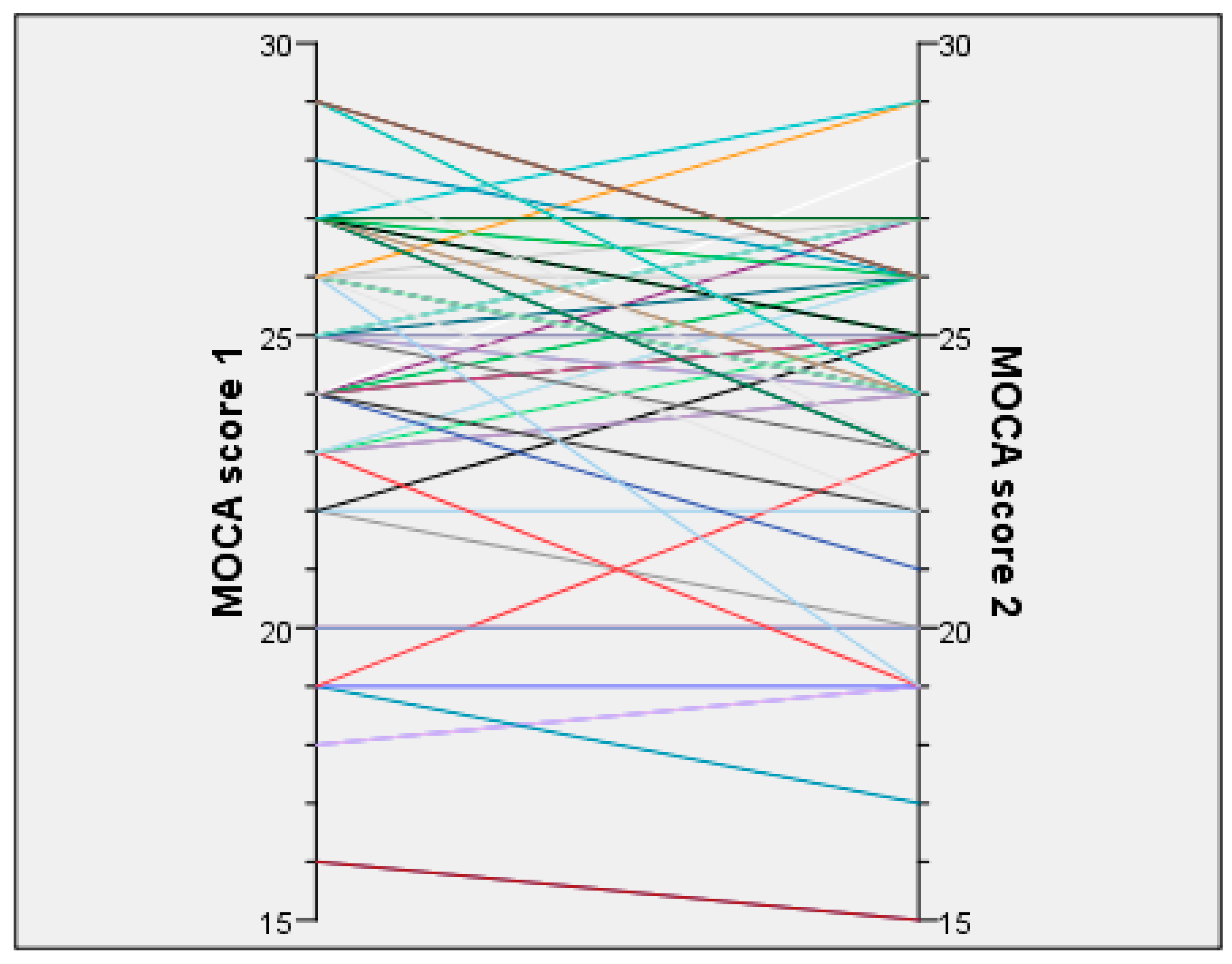
| MOCA Test 1 (n = 60) | MOCA Test 2 (n = 60) | p | |
|---|---|---|---|
| Age at testing | 46.8 ± 10.2 | 49.9 ± 10.3 | <0.001 |
| CD4 at testing | 817 (578–984) | 812 (566–978) | 0.301 |
| AIDS diagnosis at testing | 17 (28.3) | 17 (28.3) | 1 |
| Years with HIV | 8 (5–12) | 11 (8–15) | <0.001 |
| Years with AIDS | 4 (2–9) | 8 (5–12) | <0.001 |
| Years under treatment | 7 (4–10) | 10 (8–14) | <0.001 |
| Visuospatial | 4 (3–5) | 4 (3–4) | 0.826 |
| Naming | 3 (3–3) | 3 (3–3) | 0.083 |
| Attention | 6 (5–6) | 6 (5–6) | 0.976 |
| Language | 2 (1–3) | 2 (1–3) | 0.617 |
| Abstraction | 1 (0–2) | 1 (1–2) | 0.116 |
| Memory Index Score | 13 (9–14) | 13 (11–15) | 0.002 |
| Orientation | 6 (6–6) | 6 (6–6) | 0.083 |
| Score | 24 (22–26) | 25 (23–27) | 0.02 |
| Normal cognitive performance (>25) | 20 (33.3) | 28 (46.7) | |
| Mild impairment (18–25) | 37 (61.7) | 30 (50) | |
| Moderate impairment (10–17) | 3 (5) | 2 (3.3) | |
| Severe impairment (<10) | 0 (0) | 0 (0) |
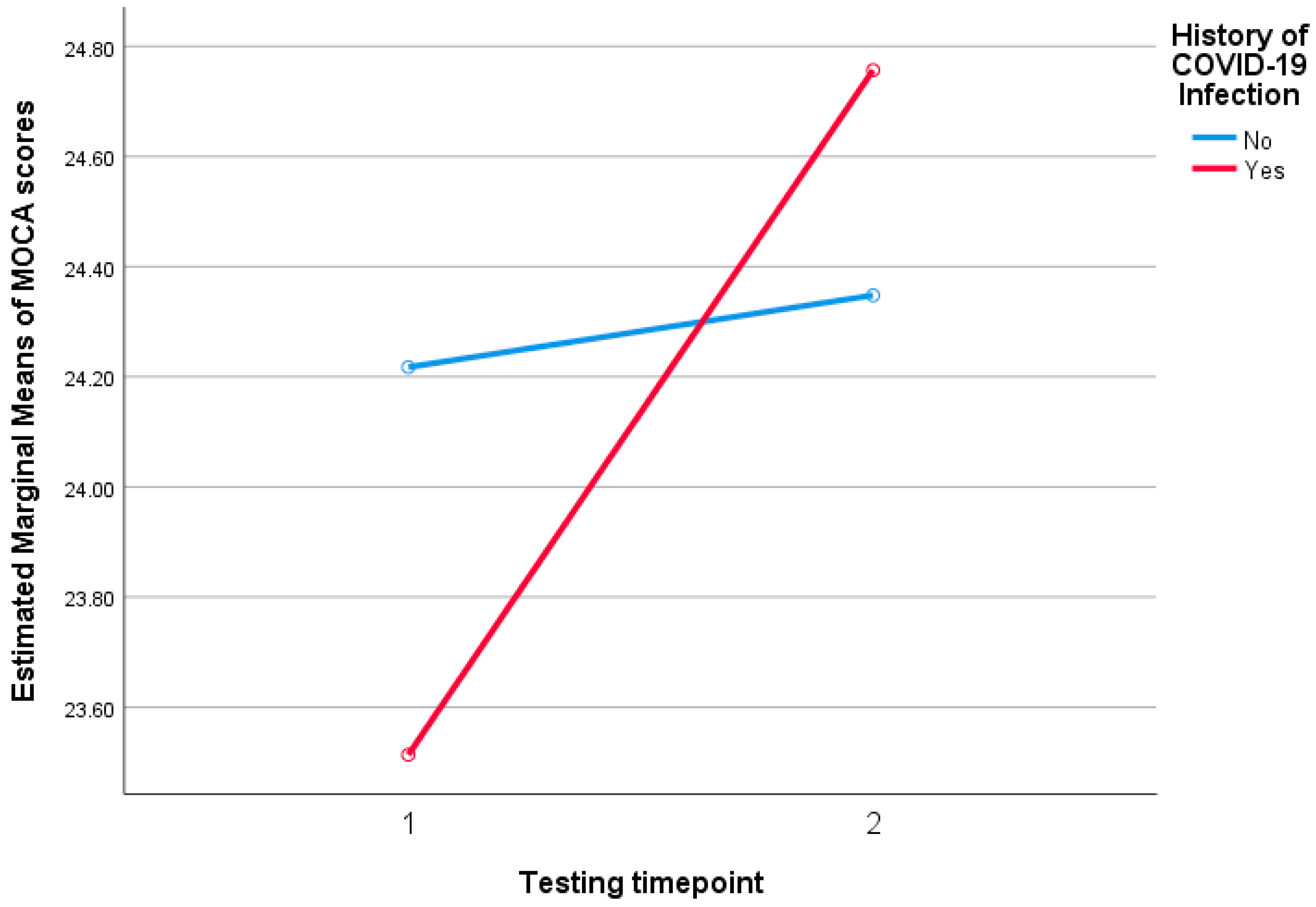
| Non-COVID-19 (n = 23) | COVID-19 (n = 37) | p | |
|---|---|---|---|
| Male gender | 22 (95.7) | 33 (89.2) | 0.640 |
| Education < 13 years | 9 (39.1) | 10 (27) | 0.397 |
| HIV acquisition | 0.631 | ||
| MSM | 19 (82.6) | 29 (78.4) | |
| PWID | 2 (8.7) | 1 (2.7) | |
| Heterosexual | 2 (8.7) | 5 (13.5) | |
| Uknown | 0 (0) | 1 (2.7) | |
| Other | 0 (0) | 1 (2.7) | |
| Psychiatric history | 3 (13) | 8 (22.2) | 0.502 |
| Neurological history | 1 (4.3) | 1 (2.7) | 1 |
| CD4 count at HIV diagnosis | 182 (83–519) | 386 (270–554) | 0.106 |
| Log HIV RNA at HIV diagnosis | 5 ± 0.8 | 4.7 ± 0.9 | 0.276 |
| Log HIV DNA at HIV diagnosis | 2.5 ± 0.8 | 2.8 ± 0.4 | 0.416 |
| AIDS diagnosis concurrent with HIV | 5/8 (62.5) | 4/9 (44.4) | 0.637 |
| HIV Treatment | |||
| Backbone | 0.911 | ||
| ABC/3TC | 2 (8.7) | 4 (10.8) | |
| TXF/XTC | 21 (91.3) | 31 (83.8) | |
| Other | 0 (0) | 2 (5.4) | |
| 3rd agent | 0.533 | ||
| INSTI | 13 (56.5) | 23 (62.2) | |
| Boosted PI | 2 (8.7) | 3 (8.1) | |
| NNRTI | 6 (26.1) | 7 (18.9) | |
| Other/combination | 0 (0) | 1 (2.7) | |
| Depression, median | 3 (1–7) | 4 (1–5) | 0.860 |
| Depression, strata | 0.121 | ||
| 0–7 | 18 (78.3) | 35 (94.6) | |
| 8–10 | 4 (17.4) | 1 (2.7) | |
| 11–15 | 1 (4.3) | 1 (2.7) | |
| ≥16 | 0 (0) | 0 (0) | |
| Anxiety, median | 4 (2–8) | 4 (2–6) | 0.982 |
| Anxiety, strata | 0.099 | ||
| 0–7 | 17 (73.9) | 32 (86.5) | |
| 8–10 | 1 (4.3) | 4 (10.8) | |
| 11–15 | 4 (17.4) | 1 (2.7) | |
| ≥16 | 1 (4.3) | 0 (0) | |
| 1st MOCA test | |||
| Age at testing | 49.6 ± 10.8 | 45 ± 9.5 | 0.09 |
| CD4 at testing | 643 (456–928) | 861 (612–1067) | 0.093 |
| AIDS diagnosis at testing | 8 (34.8) | 9 (25) | 0.557 |
| Years with HIV | 7 (4–12) | 8 (6–12) | 0.374 |
| Years with AIDS | 4 (2–5) | 8 (2–10) | 0.370 |
| Years under treatment | 6 (4–11) | 7 (5–10) | 0.543 |
| Visuospatial | 4 (3–5) | 4 (3–5) | 0.862 |
| Naming | 3 (3–3) | 3 (3–3) | 0.248 |
| Attention | 6 (5–6) | 6 (5–6) | 0.611 |
| Language | 2 (1–3) | 2 (1–3) | 0.911 |
| Abstraction | 1 (0–2) | 1 (0–2) | 0.961 |
| Memory Index Score | 13 (9–14) | 12 (9–14) | 0.326 |
| Orientation | 6 (6–6) | 6 (6–6) | 0.740 |
| MOCA Score | 25 (23–26) | 24 (22–26) | 0.412 |
| Categories | 0.971 | ||
| Normal cognitive performance (>25) | 8 (34.8) | 12 (32.4) | |
| Mild impairment (18–25) | 14 (60.9) | 23 (62.2) | |
| Moderate impairment (10–17) | 1 (4.3) | 2 (5.4) | |
| Severe impairment (<10) | 0 (0) | 0 (0) | |
| 2nd MOCA test | |||
| Age at testing | 52.8 ± 10.8 | 48.1 ± 9.6 | 0.086 |
| CD4 at testing | 689 (495–899) | 817 (665–1035) | 0.108 |
| AIDS diagnosis at testing | 8 (34.8) | 9 (25) | 0.557 |
| Years with HIV | 10 (8–15) | 11 (10–15) | 0.213 |
| Years with AIDS | 8 (5–9) | 11 (5–14) | 0.332 |
| Years under treatment | 9 (8–14) | 10 (7–14) | 0.569 |
| Visuospatial | 4 (3–4) | 4 (3–4) | 0.401 |
| Naming | 3 (3–3) | 3 (3–3) | 0.634 |
| Attention | 6 (5–6) | 6 (5–6) | 0.440 |
| Language | 2 (1–3) | 2 (1–3) | 0.444 |
| Abstraction | 1 (0–2) | 1 (1–2) | 0.342 |
| Memory Index Score | 13 (10–14) | 14 (11–15) | 0.304 |
| Orientation | 6 (6–6) | 6 (6–6) | 0.165 |
| MOCA Score | 25 (22–27) | 24 (23–27) | 0.597 |
| Categories | 0.891 | ||
| Normal cognitive performance (>25) | 10 (43.5) | 18 (48.6) | |
| Mild impairment (18–25) | 12 (52.2) | 18 (48.6) | |
| Moderate impairment (10–17) | 1 (4.3) | 1 (2.7) | |
| Severe impairment (<10) | 0 (0) | 0 (0) |
Disclaimer/Publisher’s Note: The statements, opinions and data contained in all publications are solely those of the individual author(s) and contributor(s) and not of MDPI and/or the editor(s). MDPI and/or the editor(s) disclaim responsibility for any injury to people or property resulting from any ideas, methods, instructions or products referred to in the content. |
© 2025 by the authors. Licensee MDPI, Basel, Switzerland. This article is an open access article distributed under the terms and conditions of the Creative Commons Attribution (CC BY) license (https://creativecommons.org/licenses/by/4.0/).
Share and Cite
Basoulis, D.; Mastrogianni, E.; Eliadi, I.; Platakis, N.; Platis, D.; Psichogiou, M. Evaluation of Cognitive Functions in People Living with HIV Before and After COVID-19 Infection. Viruses 2025, 17, 135. https://doi.org/10.3390/v17010135
Basoulis D, Mastrogianni E, Eliadi I, Platakis N, Platis D, Psichogiou M. Evaluation of Cognitive Functions in People Living with HIV Before and After COVID-19 Infection. Viruses. 2025; 17(1):135. https://doi.org/10.3390/v17010135
Chicago/Turabian StyleBasoulis, Dimtrios, Elpida Mastrogianni, Irene Eliadi, Nikolaos Platakis, Dimitris Platis, and Mina Psichogiou. 2025. "Evaluation of Cognitive Functions in People Living with HIV Before and After COVID-19 Infection" Viruses 17, no. 1: 135. https://doi.org/10.3390/v17010135
APA StyleBasoulis, D., Mastrogianni, E., Eliadi, I., Platakis, N., Platis, D., & Psichogiou, M. (2025). Evaluation of Cognitive Functions in People Living with HIV Before and After COVID-19 Infection. Viruses, 17(1), 135. https://doi.org/10.3390/v17010135

