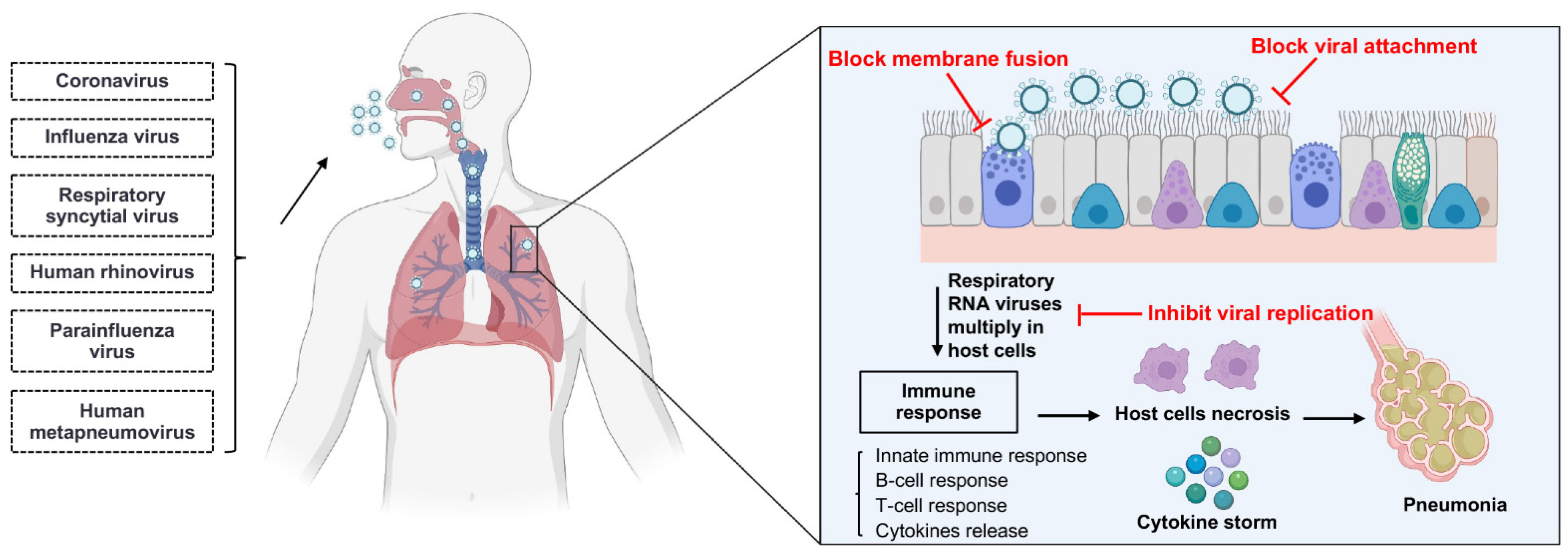
Single-Domain Antibodies as Therapeutics for Respiratory RNA Virus Infections


Abstract
1. Introduction
2. Single-Domain Antibodies
3. The Mechanisms of Single-Domain Antibodies Inhibiting Respiratory RNA Virus Infections
4. Coronaviruses
5. Influenza Viruses
6. Respiratory Syncytial Virus
7. Other Respiratory RNA Viruses
8. Conclusions and Perspectives
Author Contributions
Funding
Conflicts of Interest
References
- Jordan, P.C.; Stevens, S.K.; Deval, J. Nucleosides for the treatment of respiratory RNA virus infections. Antivir. Chem. Chemother. 2018, 26, 2040206618764483. [Google Scholar] [CrossRef] [Scilit] [PubMed]
- Sullivan, S.J.; Jacobson, R.M.; Dowdle, W.R.; Poland, G.A. 2009 H1N1 influenza. Mayo Clin. Proc. 2010, 85, 64–76. [Google Scholar] [CrossRef] [Scilit] [PubMed]
- Kikkert, M. Innate Immune Evasion by Human Respiratory RNA Viruses. J. Innate Immun. 2020, 12, 4–20. [Google Scholar] [CrossRef] [Scilit] [PubMed]
- Abdelrahman, Z.; Li, M.; Wang, X. Comparative Review of SARS-CoV-2, SARS-CoV, MERS-CoV, and Influenza A Respiratory Viruses. Front. Immunol. 2020, 11, 552909. [Google Scholar] [CrossRef] [Scilit] [PubMed]
- Shadman, K.A.; Wald, E.R. A review of palivizumab and emerging therapies for respiratory syncytial virus. Expert Opin. Biol. 2011, 11, 1455–1467. [Google Scholar] [CrossRef] [Scilit] [PubMed]
- Samaranayake, H.; Wirth, T.; Schenkwein, D.; Raty, J.K.; Yla-Herttuala, S. Challenges in monoclonal antibody-based therapies. Ann. Med. 2009, 41, 322–331. [Google Scholar] [CrossRef] [Scilit]
- Respaud, R.; Vecellio, L.; Diot, P.; Heuze-Vourc’h, N. Nebulization as a delivery method for mAbs in respiratory diseases. Expert Opin. Drug Deliv. 2015, 12, 1027–1039. [Google Scholar] [CrossRef] [Scilit]
- Voss, J.E. Engineered single-domain antibodies tackle COVID variants. Nature 2021, 595, 176–178. [Google Scholar] [CrossRef] [Scilit]
- Hamers-Casterman, C.; Atarhouch, T.; Muyldermans, S.; Robinson, G.; Hamers, C.; Songa, E.B.; Bendahman, N.; Hamers, R. Naturally occurring antibodies devoid of light chains. Nature 1993, 363, 446–448. [Google Scholar] [CrossRef] [Scilit]
- Greenberg, A.S.; Avila, D.; Hughes, M.; Hughes, A.; McKinney, E.C.; Flajnik, M.F. A new antigen receptor gene family that undergoes rearrangement and extensive somatic diversification in sharks. Nature 1995, 374, 168–173. [Google Scholar] [CrossRef] [Scilit]
- Rossotti, M.A.; Belanger, K.; Henry, K.A.; Tanha, J. Immunogenicity and humanization of single-domain antibodies. FEBS J. 2021. [Google Scholar] [CrossRef] [Scilit] [PubMed]
- Wolfson, W. Ablynx makes nanobodies from llama bodies. Chem. Biol. 2006, 13, 1243–1244. [Google Scholar] [CrossRef] [Scilit] [PubMed]
- Klarenbeek, A.; El Mazouari, K.; Desmyter, A.; Blanchetot, C.; Hultberg, A.; de Jonge, N.; Roovers, R.C.; Cambillau, C.; Spinelli, S.; Del-Favero, J.; et al. Camelid Ig V genes reveal significant human homology not seen in therapeutic target genes, providing for a powerful therapeutic antibody platform. MAbs 2015, 7, 693–706. [Google Scholar] [CrossRef] [Scilit] [PubMed]
- Detalle, L.; Stohr, T.; Palomo, C.; Piedra, P.A.; Gilbert, B.E.; Mas, V.; Millar, A.; Power, U.F.; Stortelers, C.; Allosery, K.; et al. Generation and Characterization of ALX-0171, a Potent Novel Therapeutic Nanobody for the Treatment of Respiratory Syncytial Virus Infection. Antimicrob. Agents Chemother. 2016, 60, 6–13. [Google Scholar] [CrossRef] [Scilit] [PubMed]
- Xu, J.; Xu, K.; Jung, S.; Conte, A.; Lieberman, J.; Muecksch, F.; Lorenzi, J.C.C.; Park, S.; Schmidt, F.; Wang, Z.; et al. Nanobodies from camelid mice and llamas neutralize SARS-CoV-2 variants. Nature 2021, 595, 278–282. [Google Scholar] [CrossRef] [Scilit]
- Wu, Y.; Li, C.; Xia, S.; Tian, X.; Kong, Y.; Wang, Z.; Gu, C.; Zhang, R.; Tu, C.; Xie, Y.; et al. Identification of Human Single-Domain Antibodies against SARS-CoV-2. Cell Host Microbe 2020, 27, 891–898.e5. [Google Scholar] [CrossRef] [Scilit]
- Wu, Y.; Li, Q.; Kong, Y.; Wang, Z.; Lei, C.; Li, J.; Ding, L.; Wang, C.; Cheng, Y.; Wei, Y.; et al. A highly stable human single-domain antibody-drug conjugate exhibits superior penetration and treatment of solid tumors. Mol. Ther. 2022. [Google Scholar] [CrossRef] [Scilit]
- Khodabakhsh, F.; Behdani, M.; Rami, A.; Kazemi-Lomedasht, F. Single-Domain Antibodies or Nanobodies: A Class of Next-Generation Antibodies. Int. Rev. Immunol. 2018, 37, 316–322. [Google Scholar] [CrossRef] [Scilit]
- Muyldermans, S. Nanobodies: Natural single-domain antibodies. Annu. Rev. Biochem. 2013, 82, 775–797. [Google Scholar] [CrossRef] [Scilit]
- Wu, Y.; Jiang, S.; Ying, T. Single-Domain Antibodies as Therapeutics against Human Viral Diseases. Front. Immunol. 2017, 8, 1802. [Google Scholar] [CrossRef] [Scilit]
- Bao, G.; Tang, M.; Zhao, J.; Zhu, X. Nanobody: A promising toolkit for molecular imaging and disease therapy. EJNMMI Res. 2021, 11, 6. [Google Scholar] [CrossRef] [Scilit] [PubMed]
- Wang, J.; Kang, G.; Yuan, H.; Cao, X.; Huang, H.; de Marco, A. Research Progress and Applications of Multivalent, Multispecific and Modified Nanobodies for Disease Treatment. Front. Immunol. 2021, 12, 838082. [Google Scholar] [CrossRef] [Scilit] [PubMed]
- Wu, X.; Cheng, L.; Fu, M.; Huang, B.; Zhu, L.; Xu, S.; Shi, H.; Zhang, D.; Yuan, H.; Nawaz, W.; et al. A potent bispecific nanobody protects hACE2 mice against SARS-CoV-2 infection via intranasal administration. Cell Rep. 2021, 37, 109869. [Google Scholar] [CrossRef] [Scilit] [PubMed]
- Laursen, N.S.; Friesen, R.H.E.; Zhu, X.; Jongeneelen, M.; Blokland, S.; Vermond, J.; van Eijgen, A.; Tang, C.; van Diepen, H.; Obmolova, G.; et al. Universal protection against influenza infection by a multidomain antibody to influenza hemagglutinin. Science 2018, 362, 598–602. [Google Scholar] [CrossRef] [Scilit] [PubMed]
- Li, C.; Zhan, W.; Yang, Z.; Tu, C.; Hu, G.; Zhang, X.; Song, W.; Du, S.; Zhu, Y.; Huang, K.; et al. Broad neutralization of SARS-CoV-2 variants by an inhalable bispecific single-domain antibody. Cell 2022, 185, 1389–1401.e18. [Google Scholar] [CrossRef] [Scilit]
- Duggan, S. Caplacizumab: First Global Approval. Drugs 2018, 78, 1639–1642. [Google Scholar] [CrossRef] [Scilit]
- Ruiz-Lopez, E.; Schuhmacher, A.J. Transportation of Single-Domain Antibodies through the Blood-Brain Barrier. Biomolecules 2021, 11, 1131. [Google Scholar] [CrossRef] [Scilit]
- Keyaerts, M.; Xavier, C.; Heemskerk, J.; Devoogdt, N.; Everaert, H.; Ackaert, C.; Vanhoeij, M.; Duhoux, F.P.; Gevaert, T.; Simon, P.; et al. Phase I Study of 68Ga-HER2-Nanobody for PET/CT Assessment of HER2 Expression in Breast Carcinoma. J. Nucl. Med. 2016, 57, 27–33. [Google Scholar] [CrossRef] [Scilit]
- Larios Mora, A.; Detalle, L.; Gallup, J.M.; Van Geelen, A.; Stohr, T.; Duprez, L.; Ackermann, M.R. Delivery of ALX-0171 by inhalation greatly reduces respiratory syncytial virus disease in newborn lambs. MAbs 2018, 10, 778–795. [Google Scholar] [CrossRef] [Scilit]
- Nambulli, S.; Xiang, Y.; Tilston-Lunel, N.L.; Rennick, L.J.; Sang, Z.; Klimstra, W.B.; Reed, D.S.; Crossland, N.A.; Shi, Y.; Duprex, W.P. Inhalable Nanobody (PiN-21) prevents and treats SARS-CoV-2 infections in Syrian hamsters at ultra-low doses. Sci. Adv. 2021, 7, eabh0319. [Google Scholar] [CrossRef] [Scilit]
- Marasco, W.A.; Sui, J. The growth and potential of human antiviral monoclonal antibody therapeutics. Nat. Biotechnol. 2007, 25, 1421–1434. [Google Scholar] [CrossRef] [Scilit] [PubMed]
- Dimitrov, D.S. Virus entry: Molecular mechanisms and biomedical applications. Nat. Rev. Microbiol. 2004, 2, 109–122. [Google Scholar] [CrossRef] [Scilit] [PubMed]
- Jacobs, S.E.; Lamson, D.M.; St. George, K.; Walsh, T.J. Human rhinoviruses. Clin. Microbiol. Rev. 2013, 26, 135–162. [Google Scholar] [CrossRef] [Scilit]
- Ballegeer, M.; Saelens, X. Cell-Mediated Responses to Human Metapneumovirus Infection. Viruses 2020, 12, 542. [Google Scholar] [CrossRef] [Scilit] [PubMed]
- Russell, E.; Ison, M.G. Parainfluenza Virus in the Hospitalized Adult. Clin. Infect. Dis. 2017, 65, 1570–1576. [Google Scholar] [CrossRef] [Scilit]
- Miller, K.; McGrath, M.E.; Hu, Z.; Ariannejad, S.; Weston, S.; Frieman, M.; Jackson, W.T. Coronavirus interactions with the cellular autophagy machinery. Autophagy 2020, 16, 2131–2139. [Google Scholar] [CrossRef] [Scilit]
- Te Velthuis, A.J.; Fodor, E. Influenza virus RNA polymerase: Insights into the mechanisms of viral RNA synthesis. Nat. Rev. Microbiol. 2016, 14, 479–493. [Google Scholar] [CrossRef] [Scilit]
- Battles, M.B.; McLellan, J.S. Respiratory syncytial virus entry and how to block it. Nat. Rev. Microbiol. 2019, 17, 233–245. [Google Scholar] [CrossRef] [Scilit]
- Wrapp, D.; De Vlieger, D.; Corbett, K.S.; Torres, G.M.; Wang, N.; Van Breedam, W.; Roose, K.; van Schie, L.; Team, V.-C.C.-R.; Hoffmann, M.; et al. Structural Basis for Potent Neutralization of Betacoronaviruses by Single-Domain Camelid Antibodies. Cell 2020, 181, 1004–1015.e15. [Google Scholar] [CrossRef] [Scilit]
- Gaiotto, T.; Ramage, W.; Ball, C.; Risley, P.; Carnell, G.W.; Temperton, N.; Engelhardt, O.G.; Hufton, S.E. Nanobodies mapped to cross-reactive and divergent epitopes on A(H7N9) influenza hemagglutinin using yeast display. Sci. Rep. 2021, 11, 3126. [Google Scholar] [CrossRef] [Scilit]
- Huo, J.; Le Bas, A.; Ruza, R.R.; Duyvesteyn, H.M.E.; Mikolajek, H.; Malinauskas, T.; Tan, T.K.; Rijal, P.; Dumoux, M.; Ward, P.N.; et al. Neutralizing nanobodies bind SARS-CoV-2 spike RBD and block interaction with ACE2. Nat. Struct. Mol. Biol. 2020, 27, 846–854. [Google Scholar] [CrossRef] [Scilit] [PubMed]
- Wei, G.; Meng, W.; Guo, H.; Pan, W.; Liu, J.; Peng, T.; Chen, L.; Chen, C.Y. Potent neutralization of influenza A virus by a single-domain antibody blocking M2 ion channel protein. PLoS ONE 2011, 6, e28309. [Google Scholar] [CrossRef] [Scilit] [PubMed]
- Vanderlinden, E.; Naesens, L. Emerging antiviral strategies to interfere with influenza virus entry. Med. Res. Rev. 2014, 34, 301–339. [Google Scholar] [CrossRef] [Scilit]
- Koenig, P.A.; Das, H.; Liu, H.; Kummerer, B.M.; Gohr, F.N.; Jenster, L.M.; Schiffelers, L.D.J.; Tesfamariam, Y.M.; Uchima, M.; Wuerth, J.D.; et al. Structure-guided multivalent nanobodies block SARS-CoV-2 infection and suppress mutational escape. Science 2021, 371, eabe6230. [Google Scholar] [CrossRef] [Scilit] [PubMed]
- Yang, Z.; Wang, Y.; Jin, Y.; Zhu, Y.; Wu, Y.; Li, C.; Kong, Y.; Song, W.; Tian, X.; Zhan, W.; et al. A non-ACE2 competing human single-domain antibody confers broad neutralization against SARS-CoV-2 and circulating variants. Signal Transduct. Target. Ther. 2021, 6, 1–5. [Google Scholar] [CrossRef] [Scilit] [PubMed]
- Cardoso, F.M.; Ibanez, L.I.; Van den Hoecke, S.; De Baets, S.; Smet, A.; Roose, K.; Schepens, B.; Descamps, F.J.; Fiers, W.; Muyldermans, S.; et al. Single-domain antibodies targeting neuraminidase protect against an H5N1 influenza virus challenge. J. Virol. 2014, 88, 8278–8296. [Google Scholar] [CrossRef] [Scilit] [PubMed]
- Ashour, J.; Schmidt, F.I.; Hanke, L.; Cragnolini, J.; Cavallari, M.; Altenburg, A.; Brewer, R.; Ingram, J.; Shoemaker, C.; Ploegh, H.L. Intracellular expression of camelid single-domain antibodies specific for influenza virus nucleoprotein uncovers distinct features of its nuclear localization. J. Virol. 2015, 89, 2792–2800. [Google Scholar] [CrossRef] [Scilit]
- Cui, J.; Li, F.; Shi, Z.L. Origin and evolution of pathogenic coronaviruses. Nat. Rev. Microbiol. 2019, 17, 181–192. [Google Scholar] [CrossRef] [Scilit]
- Tortorici, M.A.; Veesler, D. Structural insights into coronavirus entry. Adv. Virus Res. 2019, 105, 93–116. [Google Scholar] [CrossRef] [Scilit]
- Raj, V.S.; Mou, H.; Smits, S.L.; Dekkers, D.H.; Muller, M.A.; Dijkman, R.; Muth, D.; Demmers, J.A.; Zaki, A.; Fouchier, R.A.; et al. Dipeptidyl peptidase 4 is a functional receptor for the emerging human coronavirus-EMC. Nature 2013, 495, 251–254. [Google Scholar] [CrossRef] [Scilit]
- Hartenian, E.; Nandakumar, D.; Lari, A.; Ly, M.; Tucker, J.M.; Glaunsinger, B.A. The molecular virology of coronaviruses. J. Biol. Chem. 2020, 295, 12910–12934. [Google Scholar] [CrossRef] [Scilit] [PubMed]
- Chi, X.; Liu, X.; Wang, C.; Zhang, X.; Li, X.; Hou, J.; Ren, L.; Jin, Q.; Wang, J.; Yang, W. Humanized single domain antibodies neutralize SARS-CoV-2 by targeting the spike receptor binding domain. Nat. Commun. 2020, 11, 4528. [Google Scholar] [CrossRef] [Scilit] [PubMed]
- Hanke, L.; Das, H.; Sheward, D.J.; Perez Vidakovics, L.; Urgard, E.; Moliner-Morro, A.; Kim, C.; Karl, V.; Pankow, A.; Smith, N.L.; et al. A bispecific monomeric nanobody induces spike trimer dimers and neutralizes SARS-CoV-2 in vivo. Nat. Commun. 2022, 13, 155. [Google Scholar] [CrossRef] [Scilit] [PubMed]
- Mast, F.D.; Fridy, P.C.; Ketaren, N.E.; Wang, J.; Jacobs, E.Y.; Olivier, J.P.; Sanyal, T.; Molloy, K.R.; Schmidt, F.; Rutkowska, M.; et al. Highly synergistic combinations of nanobodies that target SARS-CoV-2 and are resistant to escape. ELife 2021, 10, e73027. [Google Scholar] [CrossRef] [Scilit]
- Li, J.-F.; He, L.; Deng, Y.-Q.; Qi, S.-H.; Chen, Y.-H.; Zhang, X.-L.; Hu, S.-X.; Fan, R.-W.; Zhao, G.-Y.; Qin, C.-F. Generation and Characterization of a Nanobody Against SARS-CoV. Virol. Sin. 2021, 36, 1484–1491. [Google Scholar] [CrossRef] [Scilit]
- Stalin Raj, V.; Okba, N.M.A.; Gutierrez-Alvarez, J.; Drabek, D.; van Dieren, B.; Widagdo, W.; Lamers, M.M.; Widjaja, I.; Fernandez-Delgado, R.; Sola, I.; et al. Chimeric camel/human heavy-chain antibodies protect against MERS-CoV infection. Sci. Adv. 2018, 4, eaas9667. [Google Scholar] [CrossRef] [Scilit]
- Zhao, G.; He, L.; Sun, S.; Qiu, H.; Tai, W.; Chen, J.; Li, J.; Chen, Y.; Guo, Y.; Wang, Y.; et al. A Novel Nanobody Targeting Middle East Respiratory Syndrome Coronavirus (MERS-CoV) Receptor-Binding Domain Has Potent Cross-Neutralizing Activity and Protective Efficacy against MERS-CoV. J. Virol. 2018, 92, e00837-18. [Google Scholar] [CrossRef] [Scilit]
- Sun, D.; Sang, Z.; Kim, Y.J.; Xiang, Y.; Cohen, T.; Belford, A.K.; Huet, A.; Conway, J.F.; Sun, J.; Taylor, D.J.; et al. Potent neutralizing nanobodies resist convergent circulating variants of SARS-CoV-2 by targeting diverse and conserved epitopes. Nat. Commun. 2021, 12, 4676. [Google Scholar] [CrossRef] [Scilit]
- Esparza, T.J.; Martin, N.P.; Anderson, G.P.; Goldman, E.R.; Brody, D.L. High affinity nanobodies block SARS-CoV-2 spike receptor binding domain interaction with human angiotensin converting enzyme. Sci. Rep. 2020, 10, 22370. [Google Scholar] [CrossRef] [Scilit]
- Esparza, T.J.; Chen, Y.; Martin, N.P.; Bielefeldt-Ohmann, H.; Bowen, R.A.; Tolbert, W.D.; Pazgier, M.; Brody, D.L. Nebulized delivery of a broadly neutralizing SARS-CoV-2 RBD-specific nanobody prevents clinical, virological and pathological disease in a Syrian hamster model of COVID-19. bioRxiv 2021, 14, 1. [Google Scholar] [CrossRef] [Scilit]
- Guttler, T.; Aksu, M.; Dickmanns, A.; Stegmann, K.M.; Gregor, K.; Rees, R.; Taxer, W.; Rymarenko, O.; Schunemann, J.; Dienemann, C.; et al. Neutralization of SARS-CoV-2 by highly potent, hyperthermostable, and mutation-tolerant nanobodies. EMBO J. 2021, 40, e107985. [Google Scholar] [CrossRef] [Scilit] [PubMed]
- Gai, J.; Ma, L.; Li, G.; Zhu, M.; Qiao, P.; Li, X.; Zhang, H.; Zhang, Y.; Chen, Y.; Ji, W.; et al. A potent neutralizing nanobody against SARS-CoV-2 with inhaled delivery potential. MedComm 2021, 2, 101–113. [Google Scholar] [CrossRef] [Scilit] [PubMed]
- Li, T.; Cai, H.; Yao, H.; Zhou, B.; Zhang, N.; van Vlissingen, M.F.; Kuiken, T.; Han, W.; GeurtsvanKessel, C.H.; Gong, Y.; et al. A synthetic nanobody targeting RBD protects hamsters from SARS-CoV-2 infection. Nat. Commun. 2021, 12, 4635. [Google Scholar] [CrossRef] [Scilit] [PubMed]
- Hong, J.; Kwon, H.J.; Cachau, R.; Chen, C.Z.; Butay, K.J.; Duan, Z.; Li, D.; Ren, H.; Liang, T.; Zhu, J.; et al. Camel nanobodies broadly neutralize SARS-CoV-2 variants. BioRxiv Prepr. Serv. Biol. 2021. [Google Scholar] [CrossRef] [Scilit]
- Haga, K.; Takai-Todaka, R.; Matsumura, Y.; Song, C.; Takano, T.; Tojo, T.; Nagami, A.; Ishida, Y.; Masaki, H.; Tsuchiya, M.; et al. Nasal delivery of single-domain antibody improves symptoms of SARS-CoV-2 infection in an animal model. PLoS Pathog. 2021, 17, e1009542. [Google Scholar] [CrossRef] [Scilit]
- Custodio, T.F.; Das, H.; Sheward, D.J.; Hanke, L.; Pazicky, S.; Pieprzyk, J.; Sorgenfrei, M.; Schroer, M.A.; Gruzinov, A.Y.; Jeffries, C.M.; et al. Selection, biophysical and structural analysis of synthetic nanobodies that effectively neutralize SARS-CoV-2. Nat. Commun. 2020, 11, 5588. [Google Scholar] [CrossRef] [Scilit]
- Chen, X.; Gentili, M.; Hacohen, N.; Regev, A. A cell-free nanobody engineering platform rapidly generates SARS-CoV-2 neutralizing nanobodies. Nat. Commun. 2021, 12, 5506. [Google Scholar] [CrossRef] [Scilit]
- Ma, H.; Zeng, W.; Meng, X.; Huang, X.; Yang, Y.; Zhao, D.; Zhou, P.; Wang, X.; Zhao, C.; Sun, Y.; et al. Potent Neutralization of SARS-CoV-2 by Hetero-bivalent Alpaca Nanobodies Targeting the Spike Receptor-Binding Domain. J. Virol. 2021, 95, e02438-20. [Google Scholar] [CrossRef] [Scilit]
- Lu, Q.; Zhang, Z.; Li, H.; Zhong, K.; Zhao, Q.; Wang, Z.; Wu, Z.; Yang, D.; Sun, S.; Yang, N.; et al. Development of multivalent nanobodies blocking SARS-CoV-2 infection by targeting RBD of spike protein. J. Nanobiotechnol. 2021, 19, 33. [Google Scholar] [CrossRef] [Scilit]
- Ye, G.; Gallant, J.P.; Massey, C.; Shi, K.; Tai, W.; Zheng, J.; Odle, A.E.; Vickers, M.A.; Shang, J.; Wan, Y.; et al. The Development of a Novel Nanobody Therapeutic for SARS-CoV-2. bioRxiv 2020. [Google Scholar] [CrossRef] [Scilit]
- Zupancic, J.M.; Desai, A.A.; Schardt, J.S.; Pornnoppadol, G.; Makowski, E.K.; Smith, M.D.; Kennedy, A.A.; de Mattos Barbosa, M.G.; Cascalho, M.; Lanigan, T.M.; et al. Directed evolution of potent neutralizing nanobodies against SARS-CoV-2 using CDR-swapping mutagenesis. Cell Chem. Biol. 2021, 28, 1379–1388.e7. [Google Scholar] [CrossRef] [Scilit] [PubMed]
- Huo, J.; Mikolajek, H.; Le Bas, A.; Clark, J.J.; Sharma, P.; Kipar, A.; Dormon, J.; Norman, C.; Weckener, M.; Clare, D.K.; et al. A potent SARS-CoV-2 neutralising nanobody shows therapeutic efficacy in the Syrian golden hamster model of COVID-19. Nat. Commun. 2021, 12, 5469. [Google Scholar] [CrossRef] [Scilit] [PubMed]
- Xiang, Y.; Nambulli, S.; Xiao, Z.; Liu, H.; Sang, Z.; Duprex, W.P.; Schneidman-Duhovny, D.; Zhang, C.; Shi, Y. Versatile, Multivalent Nanobody Cocktails Efficiently Neutralize SARS-CoV-2. bioRxiv 2020. [Google Scholar] [CrossRef] [Scilit]
- Dong, J.; Huang, B.; Wang, B.; Titong, A.; Gallolu Kankanamalage, S.; Jia, Z.; Wright, M.; Parthasarathy, P.; Liu, Y. Development of humanized tri-specific nanobodies with potent neutralization for SARS-CoV-2. Sci. Rep. 2020, 10, 17806. [Google Scholar] [CrossRef] [Scilit]
- Dong, J.; Huang, B.; Jia, Z.; Wang, B.; Gallolu Kankanamalage, S.; Titong, A.; Liu, Y. Development of multi-specific humanized llama antibodies blocking SARS-CoV-2/ACE2 interaction with high affinity and avidity. Emerg. Microbes Infect. 2020, 9, 1034–1036. [Google Scholar] [CrossRef] [Scilit]
- Schoof, M.; Faust, B.; Saunders, R.A.; Sangwan, S.; Rezelj, V.; Hoppe, N.; Boone, M.; Billesbølle, C.B.; Puchades, C.; Azumaya, C.M.; et al. An ultrapotent synthetic nanobody neutralizes SARS-CoV-2 by stabilizing inactive Spike. Science 2020, 370, 1473–1479. [Google Scholar] [CrossRef] [Scilit]
- Tillib, S.V.; Ivanova, T.I.; Vasilev, L.A.; Rutovskaya, M.V.; Saakyan, S.A.; Gribova, I.Y.; Tutykhina, I.L.; Sedova, E.S.; Lysenko, A.A.; Shmarov, M.M.; et al. Formatted single-domain antibodies can protect mice against infection with influenza virus (H5N2). Antivir. Res. 2013, 97, 245–254. [Google Scholar] [CrossRef] [Scilit]
- Ramage, W.; Gaiotto, T.; Ball, C.; Risley, P.; Carnell, G.W.; Temperton, N.; Cheung, C.Y.; Engelhardt, O.G.; Hufton, S.E. Cross-Reactive and Lineage-Specific Single Domain Antibodies against Influenza B Hemagglutinin. Antibodies 2019, 8, 14. [Google Scholar] [CrossRef] [Scilit]
- Voronina, D.V.; Shcheblyakov, D.V.; Esmagambetov, I.B.; Derkaev, A.A.; Popova, O.; Shcherbinin, D.N. Development of Neutralizing Nanobodies to the Hemagglutinin Stem Domain of Influenza A Viruses. Acta Nat. 2021, 13, 33–41. [Google Scholar] [CrossRef] [Scilit]
- Hufton, S.E.; Risley, P.; Ball, C.R.; Major, D.; Engelhardt, O.G.; Poole, S. The breadth of cross sub-type neutralisation activity of a single domain antibody to influenza hemagglutinin can be increased by antibody valency. PLoS ONE 2014, 9, e103294. [Google Scholar] [CrossRef] [Scilit]
- Del Rosario, J.M.M.; Smith, M.; Zaki, K.; Risley, P.; Temperton, N.; Engelhardt, O.G.; Collins, M.; Takeuchi, Y.; Hufton, S.E. Protection from Influenza by Intramuscular Gene Vector Delivery of a Broadly Neutralizing Nanobody Does Not Depend on Antibody Dependent Cellular Cytotoxicity. Front. Immunol. 2020, 11, 627. [Google Scholar] [CrossRef] [Scilit] [PubMed]
- Gaiotto, T.; Hufton, S.E. Cross-Neutralising Nanobodies Bind to a Conserved Pocket in the Hemagglutinin Stem Region Identified Using Yeast Display and Deep Mutational Scanning. PLoS ONE 2016, 11, e0164296. [Google Scholar] [CrossRef] [Scilit]
- De Vlieger, D.; Hoffmann, K.; Van Molle, I.; Nerinckx, W.; Van Hoecke, L.; Ballegeer, M.; Creytens, S.; Remaut, H.; Hengel, H.; Schepens, B.; et al. Selective Engagement of FcgammaRIV by a M2e-Specific Single Domain Antibody Construct Protects Against Influenza A Virus Infection. Front. Immunol. 2019, 10, 2920. [Google Scholar] [CrossRef] [Scilit] [PubMed]
- Van Hoecke, L.; Verbeke, R.; De Vlieger, D.; Dewitte, H.; Roose, K.; Van Nevel, S.; Krysko, O.; Bachert, C.; Schepens, B.; Lentacker, I.; et al. mRNA Encoding a Bispecific Single Domain Antibody Construct Protects against Influenza A Virus Infection in Mice. Mol. Nucleic Acids 2020, 20, 777–787. [Google Scholar] [CrossRef] [Scilit] [PubMed]
- Xun, G.; Song, X.; Hu, J.; Zhang, H.; Liu, L.; Zhang, Z.; Gong, R. Potent Human Single-Domain Antibodies Specific for a Novel Prefusion Epitope of Respiratory Syncytial Virus F Glycoprotein. J. Virol. 2021, 95, e0048521. [Google Scholar] [CrossRef] [Scilit]
- Rossey, I.; Gilman, M.S.; Kabeche, S.C.; Sedeyn, K.; Wrapp, D.; Kanekiyo, M.; Chen, M.; Mas, V.; Spitaels, J.; Melero, J.A.; et al. Potent single-domain antibodies that arrest respiratory syncytial virus fusion protein in its prefusion state. Nat. Commun. 2017, 8, 14158. [Google Scholar] [CrossRef] [Scilit]
- Rossey, I.; Hsieh, C.L.; Sedeyn, K.; Ballegeer, M.; Schepens, B.; McLellan, J.S.; Saelens, X. A vulnerable, membrane-proximal site in human respiratory syncytial virus F revealed by a prefusion-specific single-domain antibody. J. Virol. 2021, 95, e02279-20. [Google Scholar] [CrossRef] [Scilit]
- Hultberg, A.; Temperton, N.J.; Rosseels, V.; Koenders, M.; Gonzalez-Pajuelo, M.; Schepens, B.; Ibanez, L.I.; Vanlandschoot, P.; Schillemans, J.; Saunders, M.; et al. Llama-derived single domain antibodies to build multivalent, superpotent and broadened neutralizing anti-viral molecules. PLoS ONE 2011, 6, e17665. [Google Scholar] [CrossRef] [Scilit]
- Schepens, B.; Ibanez, L.I.; De Baets, S.; Hultberg, A.; Bogaert, P.; De Bleser, P.; Vervalle, F.; Verrips, T.; Melero, J.; Vandevelde, W.; et al. Nanobodies(R) specific for respiratory syncytial virus fusion protein protect against infection by inhibition of fusion. J. Infect. Dis. 2011, 204, 1692–1701. [Google Scholar] [CrossRef] [Scilit]
- He, L.; Tai, W.; Li, J.; Chen, Y.; Gao, Y.; Li, J.; Sun, S.; Zhou, Y.; Du, L.; Zhao, G. Enhanced Ability of Oligomeric Nanobodies Targeting MERS Coronavirus Receptor-Binding Domain. Viruses 2019, 11, 166. [Google Scholar] [CrossRef] [Scilit]
- Chouchane, L.; Grivel, J.C.; Farag, E.; Pavlovski, I.; Maacha, S.; Sathappan, A.; Al-Romaihi, H.E.; Abuaqel, S.W.; Ata, M.M.A.; Chouchane, A.I.; et al. Dromedary camels as a natural source of neutralizing nanobodies against SARS-CoV-2. JCI Insight 2021, 6, e145785. [Google Scholar] [CrossRef] [Scilit] [PubMed]
- Hanke, L.; Vidakovics Perez, L.; Sheward, D.J.; Das, H.; Schulte, T.; Moliner-Morro, A.; Corcoran, M.; Achour, A.; Karlsson Hedestam, G.B.; Hallberg, B.M.; et al. An alpaca nanobody neutralizes SARS-CoV-2 by blocking receptor interaction. Nat. Commun. 2020, 11, 4420. [Google Scholar] [CrossRef] [Scilit] [PubMed]
- Pymm, P.; Adair, A.; Chan, L.J.; Cooney, J.P.; Mordant, F.L.; Allison, C.C.; Lopez, E.; Haycroft, E.R.; O’Neill, M.T.; Tan, L.L.; et al. Nanobody cocktails potently neutralize SARS-CoV-2 D614G N501Y variant and protect mice. Proc. Natl. Acad. Sci. USA 2021, 118, e2101918118. [Google Scholar] [CrossRef] [Scilit] [PubMed]
- Taubenberger, J.K.; Kash, J.C. Influenza virus evolution, host adaptation, and pandemic formation. Cell Host Microbe 2010, 7, 440–451. [Google Scholar] [CrossRef] [Scilit]
- Petrova, V.N.; Russell, C.A. The evolution of seasonal influenza viruses. Nat. Rev. Microbiol. 2018, 16, 47–60. [Google Scholar] [CrossRef]
- Krammer, F.; Smith, G.J.D.; Fouchier, R.A.M.; Peiris, M.; Kedzierska, K.; Doherty, P.C.; Palese, P.; Shaw, M.L.; Treanor, J.; Webster, R.G.; et al. Influenza. Nat. Rev. Dis. Primers 2018, 4, 3. [Google Scholar] [CrossRef] [Scilit]
- Wang, Y.; Hu, D.; Wu, Y.; Ying, T. Recent advances in “universal” influenza virus antibodies: The rise of a hidden trimeric interface in hemagglutinin globular head. Front. Med. 2020, 14, 149–159. [Google Scholar] [CrossRef] [Scilit]
- Uyeki, T.M. Influenza. Ann. Intern. Med. 2017, 167, ITC33–ITC48. [Google Scholar] [CrossRef] [Scilit]
- Sedeyn, K.; Saelens, X. New antibody-based prevention and treatment options for influenza. Antivir. Res. 2019, 170, 104562. [Google Scholar] [CrossRef] [Scilit]
- McAuley, J.L.; Gilbertson, B.P.; Trifkovic, S.; Brown, L.E.; McKimm-Breschkin, J.L. Influenza Virus Neuraminidase Structure and Functions. Front. Microbiol. 2019, 10, 39. [Google Scholar] [CrossRef] [Scilit]
- Chen, Y.-Q.; Wohlbold, T.J.; Zheng, N.-Y.; Huang, M.; Huang, Y.; Neu, K.E.; Lee, J.; Wan, H.; Rojas, K.T.; Kirkpatrick, E.; et al. Influenza Infection in Humans Induces Broadly Cross-Reactive and Protective Neuraminidase-Reactive Antibodies. Cell 2018, 173, 417–429.e10. [Google Scholar] [CrossRef] [Scilit] [PubMed]
- Manzoor, R.; Igarashi, M.; Takada, A. Influenza A Virus M2 Protein: Roles from Ingress to Egress. Int. J. Mol. Sci. 2017, 18, 2649. [Google Scholar] [CrossRef] [Scilit] [PubMed]
- Wei, C.J.; Crank, M.C.; Shiver, J.; Graham, B.S.; Mascola, J.R.; Nabel, G.J. Next-generation influenza vaccines: Opportunities and challenges. Nat. Rev. Drug. Discov. 2020, 19, 239–252. [Google Scholar] [CrossRef] [Scilit] [PubMed]
- Schmidt, F.I.; Hanke, L.; Morin, B.; Brewer, R.; Brusic, V.; Whelan, S.P.; Ploegh, H.L. Phenotypic lentivirus screens to identify functional single domain antibodies. Nat. Microbiol. 2016, 1, 16080. [Google Scholar] [CrossRef] [Scilit]
- Hanke, L.; Knockenhauer, K.E.; Brewer, R.C.; van Diest, E.; Schmidt, F.I.; Schwartz, T.U.; Ploegh, H.L. The Antiviral Mechanism of an Influenza A Virus Nucleoprotein-Specific Single-Domain Antibody Fragment. mBio 2016, 7, e01569-16. [Google Scholar] [CrossRef] [Scilit]
- Borchers, A.T.; Chang, C.; Gershwin, M.E.; Gershwin, L.J. Respiratory syncytial virus—A comprehensive review. Clin. Rev. Allergy Immunol. 2013, 45, 331–379. [Google Scholar] [CrossRef] [Scilit]
- Cunningham, S.; Piedra, P.A.; Martinon-Torres, F.; Szymanski, H.; Brackeva, B.; Dombrecht, E.; Detalle, L.; Fleurinck, C.; Cunningham, S.; Piedra, P.A.; et al. Nebulised ALX-0171 for respiratory syncytial virus lower respiratory tract infection in hospitalised children: A double-blind, randomised, placebo-controlled, phase 2b trial. Lancet Respir. Med. 2021, 9, 21–32. [Google Scholar] [CrossRef] [Scilit]
- Touabi, L.; Aflatouni, F.; McLean, G.R. Mechanisms of Rhinovirus Neutralisation by Antibodies. Viruses 2021, 13, 360. [Google Scholar] [CrossRef] [Scilit]
- Smith, T.J.; Olson, N.H.; Cheng, R.H.; Chase, E.S.; Baker, T.S. Structure of a human rhinovirus-bivalently bound antibody complex: Implications for viral neutralization and antibody flexibility. Proc. Natl. Acad. Sci. USA 1993, 90, 7015–7018. [Google Scholar] [CrossRef] [Scilit]
- Dong, Y.; Liu, Y.; Jiang, W.; Smith, T.J.; Xu, Z.; Rossmann, M.G. Antibody-induced uncoating of human rhinovirus B14. Proc. Natl. Acad. Sci. USA 2017, 114, 8017–8022. [Google Scholar] [CrossRef] [Scilit]
- Traub, S.; Nikonova, A.; Carruthers, A.; Dunmore, R.; Vousden, K.A.; Gogsadze, L.; Hao, W.; Zhu, Q.; Bernard, K.; Zhu, J.; et al. An anti-human ICAM-1 antibody inhibits rhinovirus-induced exacerbations of lung inflammation. PLoS Pathog. 2013, 9, e1003520. [Google Scholar] [CrossRef] [Scilit]
- Pawelczyk, M.; Kowalski, M.L. The Role of Human Parainfluenza Virus Infections in the Immunopathology of the Respiratory Tract. Curr. Allergy Asthma Rep. 2017, 17, 16. [Google Scholar] [CrossRef] [Scilit] [PubMed]
- Boonyaratanakornkit, J.; Singh, S.; Weidle, C.; Rodarte, J.; Bakthavatsalam, R.; Perkins, J.; Stewart-Jones, G.B.E.; Kwong, P.D.; McGuire, A.T.; Pancera, M.; et al. Protective antibodies against human parainfluenza virus type 3 infection. MAbs 2021, 13, 1912884. [Google Scholar] [CrossRef] [Scilit] [PubMed]
- Skiadopoulos, M.H.; Biacchesi, S.; Buchholz, U.J.; Amaro-Carambot, E.; Surman, S.R.; Collins, P.L.; Murphy, B.R. Individual contributions of the human metapneumovirus F, G, and SH surface glycoproteins to the induction of neutralizing antibodies and protective immunity. Virology 2006, 345, 492–501. [Google Scholar] [CrossRef] [Scilit]
- Cherry, J.D.; Krogstad, P. SARS: The first pandemic of the 21st century. Pediatr. Res. 2004, 56, 1–5. [Google Scholar] [CrossRef] [Scilit] [PubMed]
- Fineberg, H.V. Pandemic preparedness and response--lessons from the H1N1 influenza of 2009. N. Engl. J. Med. 2014, 370, 1335–1342. [Google Scholar] [CrossRef] [Scilit] [PubMed]
- Zumla, A.; Hui, D.S.; Perlman, S. Middle East respiratory syndrome. Lancet 2015, 386, 995–1007. [Google Scholar] [CrossRef] [Scilit]
- Cao, Y.; Wang, J.; Jian, F.; Xiao, T.; Song, W.; Yisimayi, A.; Huang, W.; Li, Q.; Wang, P.; An, R.; et al. Omicron escapes the majority of existing SARS-CoV-2 neutralizing antibodies. Nature 2022, 602, 657–663. [Google Scholar] [CrossRef]
- Cele, S.; Jackson, L.; Khoury, D.S.; Khan, K.; Moyo-Gwete, T.; Tegally, H.; San, J.E.; Cromer, D.; Scheepers, C.; Amoako, D.G.; et al. Omicron extensively but incompletely escapes Pfizer BNT162b2 neutralization. Nature 2022, 602, 654–656. [Google Scholar] [CrossRef]
- Jin, Y.; Lei, C.; Hu, D.; Dimitrov, D.S.; Ying, T. Human monoclonal antibodies as candidate therapeutics against emerging viruses. Front. Med. 2017, 11, 462–470. [Google Scholar] [CrossRef] [Scilit]
- Ying, T.; Gong, R.; Ju, T.W.; Prabakaran, P.; Dimitrov, D.S. Engineered Fc based antibody domains and fragments as novel scaffolds. Biochim. Biophys. Acta 2014, 1844, 1977–1982. [Google Scholar] [CrossRef] [Scilit] [PubMed]
- Ying, T.; Ju, T.W.; Wang, Y.; Prabakaran, P.; Dimitrov, D.S. Interactions of IgG1 CH2 and CH3 Domains with FcRn. Front. Immunol. 2014, 5, 146. [Google Scholar] [CrossRef] [Scilit] [PubMed]
- Rondon, A.; Mahri, S.; Morales-Yanez, F.; Dumoulin, M.; Vanbever, R. Protein Engineering Strategies for Improved Pharmacokinetics. Adv. Funct. Mater. 2021, 31, 2101633. [Google Scholar] [CrossRef] [Scilit]


| Respiratory RNA Virus | Genome | Family | Envelope | Potential Viral Targets for Developing sdAbs |
|---|---|---|---|---|
| Coronavirus | Positive-sense, single-stranded RNA genome | Coronaviridae | Enveloped | S protein (RBD) |
| Influenza virus | Negative-sense, single-stranded, segmented RNA genome | Orthomyxoviridae | Enveloped |
HA, NA, M2, NP |
| Respiratory syncytial virus | Negative-sense, single-stranded, non-segmented RNA genome | Pneumoviridae | Enveloped | F protein |
| Human rhinovirus | Positive-sense, single-stranded RNA genome | Picornaviridae | Non-enveloped | VP1, VP2, VP3 |
| Parainfluenza virus | Negative-sense, single-stranded RNA genome | Paramyxoviridae | Enveloped | HN, F protein |
| Human metapneumovirus | Negative-sense, single-stranded, non-segmented RNA genome | Pneumoviridae | Enveloped | F protein |
| Respiratory RNA Virus | sdAbs | Form | Origin | Binding Region | Affinity (KD) | Neutralizing Activity (IC50) | Antiviral Activity in Animal Model | Reference |
|---|---|---|---|---|---|---|---|---|
| SARS-CoV-1 | VHH-72 | Monomer | Immunized llama | RBD | 1.15 nM | N/A | N/A | [39] |
| S1-1, S1-RBD-6, S1-39 | Monomer | Immunized llama | RBD | N/A | Pseudoviruses: 8.6 nM, 89.7 nM, 22.1 nM | N/A | [54] | |
| S14 | Monomer | Immunized alpaca | RBD | 0.143 nM | Pseudoviruses: 4.93 ng/mL | N/A | [55] | |
| 5F8 | Monomer | Synthetic humanized nanobody library | RBD | 239.2 nM | N/A | N/A | [52] | |
| MERS-CoV | VHH-83 | Monomer | Immunized dromedary camel | RBD | 0.103 ± 0.141 nM | Authentic viruses: 30 pM (PRNT50) | Prophylactic in K18 transgenic mouse at 200 μg pre mouse | [56] |
| NbMS10 | Monomer | Immunized llama | RBD | 0.87 nM | Pseudoviruses: 3.52 μg/mL | Prophylactic and therapeutic in hDPP4-Tg mice at 10 mg/kg | [57] | |
| VHH-55 | Monomer | Immunized llama | RBD | 0.079 nM | Pseudoviruses: 0.014 µg/mL | N/A | [39] | |
| SARS-CoV-2 | VHH-72 | Monomer | Immunized llama | RBD-SD1 | 38.6 nM | Pseudoviruses: 0.2 µg/mL | N/A | [39] |
| Nb21 | Monomer | Immunized llama | RBD | <1 pM | Pseudoviruses: 0.0495 nM Authentic viruses: 0.022 n | N/A | [30,58] | |
| Nb12, Nb30 | Monomer | Immunized nanomouse | RBD | 30 nM, 6.55 nM | Pseudoviruses: 11.7 nM, 6.9 nM | N/A | [15] | |
| Nb15, Nb17, Nb19, Nb56 | Monomer | Immunized llama | RBD | 8.15 nM, 5.59 nM, 4.72 nM, 3.26 nM | Pseudoviruses: 0.4 nM, 0.6 nM, 0.3 nM, 0.9 nM | N/A | [15] | |
| NIH-CoVnb-112 | Monomer | Immunized llama | RBD | 4.94 nM | Pseudoviruses: 0.323 µg/mL (23.1 nM) | Prophylactic and therapeutic in a hamster model administrated via nebulization | [59,60] | |
| Re9F06 | Monomer | Immunized alpaca | RBD | 4 nM | Authentic viruses with D614G mutation: 17 nM | N/A | [61] | |
| Nb11-59 | Monomer | Immunized camel | RBD | 21.6 nM | Authentic viruses: 0.55 μg/mL | N/A | [62] | |
| VHH E, VHH U, VHH V, VHH W | Monomer | Immunized camel | RBD | 1.86 nM, 21.4 nM, 8.92 nM, 22.2 nM | Pseudoviruses: 60 nM, 286 nM, 198 nM, 257 nM Authentic viruses: 48 nM, 185 nM, 142 nM, 81 nM | N/A | [44] | |
| H11-H4, H11-D4 | Monomer | Non-immunized llama | RBD | 12 ± 1.5 nM, 39 ± 2 nM | (Fused with Fc of human IgG1) Authentic viruses: 6 nM, 18 nM | N/A | [41] | |
| MR3 | Monomer | Non-immunized camels | RBM | 1.0 nM | Pseudoviruses: 0.42 μg/mL | Prophylactic in hamster model at 2.5 mg of divalent MR3 | [63] | |
| 7A3 | Monomer | Non-immunized camels | RBD | 0.2 nM | N/A | Prophylactic in K18-hACE2 mice at 10 mg/kg | [64] | |
| N3113 | Monomer | Fully human VHs library | RBD | 57.01 ± 1.52 nM | Pseudoviruses:18.9 μg/mL | N/A | [16] | |
| n3113.1 | Monomer | Fully human VHs library | RBD | 63.8 nM | Pseudoviruses:6 μg/mL | Prophylactic and therapeutic in a hACE2-transgenic mouse model at 40 mg/kg | [45] | |
| K-874A | Monomer | Synthetic VHH-cDNA display | S1 | 1.4 nM | Authentic viruses: 5.74 ± 2.6 μg/mL | Prophylactic and therapeutic in the Syrian hamster model at 30 mg/kg | [65] | |
| Sb23 | Monomer | Synthetic nanobody library | RBD | 10.6 ± 2.0 nM | Pseudoviruses: 0.6 μg/mL | N/A | [66] | |
| 1E2, 2F2, 3F11, 4D8, 5F8 | Monomer | Synthetic humanized nanobody library | RBD | 35.52 nM, 5.175 nM, 3.349 nM, 6.028 nM, 0.996 nM | Pseudoviruses: 5.324 μg/mL, 0.742 μg/mL, 0.066 μg/mL, 0.781 μg/mL, 0.072 μg/mL Authentic viruses: 18.47 μg/mL, 22.62 μg/mL, 28.64 μg/mL, 9.628 μg/mL, 39.28 μg/mL | N/A | [52] | |
| SR6v15 | Monomer | Cell-free Library (nanobody, non-immune) | RBD | 2.18 nM | Pseudoviruses: 3.591 ± 0.043 nM | N/A | [67] | |
| aRBD-2-5, aRBD-2-7 | Dimer | Immunized alpaca | RBD | 0.0592 nM, 0.252 nM | Authentic viruses: 0.00122 µg/mL (0.043 nM), 0.00318 µg/mL (0.111 nM) | N/A | [68] | |
| Nb91-Nb3-hFc | Dimer | non-immunized Bactrian camel | RBD | N/A | Pseudoviruses: 1.54 nM | N/A | [69] | |
| Nanosota-AC-Fc | Dimer | non-immunized llamas and alpacas | RBD | 15.7 pM | Pseudoviruses: 0.27 μg/mL | N/A | [70] | |
| bn03 | Dimer | Fully human VHs library | RBD | <1 nM | Pseudoviruses: 0.11–0.76 μg/mL | Therapeutic in hACE2-transgenic mice model administrated by inhalation | [25] | |
| KC3.ep3 (Fc-fusion proteins) | Dimer | Synthetic nanobody library | RBD | 34 ± 1 pM | Pseudoviruses: 1.82 ± 1.09 ng/mL, Authentic Viruses: 38.53 ± 3.98 ng/mL | N/A | [71] | |
| Nb15-NbH-Nb15 | Trimer | Immunized Alpaca | RBD | 0.541 nM | Pseudoviruses: 0.4 ng/mL | Prophylactic and therapeutic in hACE2 transgenic mice at 10 mg/kg via intranasal administration | [23] | |
| C5-trimer | Trimer | Immunized Llama | RBD | 18 pM | Authentic Viruses: 18 pM (Victoria-B), 25 pM (Alpha- B1.1.7) | Prophylactic and therapeutic in the Syrian hamster model of COVID-19 administrated via the intranasal route | [72] | |
| PiN-21 | Trimer | Immunized llama | RBD | N/A | Pseudoviruses: 1.321 pM Authentic viruses: 6.039 pM | Prophylactic and therapeutic in Syrian hamsters administrated via nebulization | [30,73] | |
| 3F-1B-2A-Fc | Trimer | Non-immunized llama | RBD | 0.0468 nM | Pseudoviruses: 6.44 nM | N/A | [74,75] | |
| Nb6-tri | Trimer | Synthetic nanobody library | RBD | 41 nM | Pseudoviruses: 1.2 nM Authentic viruses: 140 nM | N/A | [76] | |
| Influenza virus | NB7-14 | Monomer | Immunized alpaca | H7 head region of HA | 2.63 nM | Pseudoviruses: 17 nM | N/A | [40] |
| aHA-7 | Trimer | Immunized camel | H5 head region of HA | N/A | Authentic viruses: 4.2 nM | Prophylactic in mice infected with lethal H5N2 virus administered intranasally at 50 μg pre mouse | [77] | |
| Vic 2a-6 | Monomer | Immunized alpaca | IBV head region of HA | 0.08 nM | Pseudoviruses: 10 nM | N/A | [78] | |
| Vic 1b-10 | Monomer | Immunized alpaca | IBV stem region of HA | 0.28 nM | Pseudoviruses: 0.2 nM | N/A | [78] | |
| 2F2, H1.2, G2.3 | Monomer | Immunized alpaca | H1 stem domain of HA | 15.7 nM, 3.65 nM, 5.54 nM | N/A | N/A | [79] | |
| R1a-B6 | Monomer | Immunized alpaca | H1, H5, H9 stem regions of HA | 0.86 nM (H1), 0.52 nM (H5), 6.89 nM (H9) | Authentic viruses: 3.2 ± 0.5 nM (H1), 5.5 ± 0.9 nM (H5), 182.2 ± 25.2 nM (H9) | Prophylactic in mice infected with lethal influenza virus by AAV-Mediated delivery | [80,81,82] | |
| SD36 | Monomer | Immunized llama | Influenza A group 2 virus stem region of HA | N/A | Pseudoviruses: 10–100 nM | N/A | [24] | |
| SD38 | Monomer | Immunized llama | Influenza A group 1 virus stem region of HA | N/A | Pseudovirus: 10–100 nM | N/A | [24] | |
| SD38-SD36 | Dimer | Immunized llama | IAV stem region of HA | N/A | Pseudovirus: 1–100 nM | N/A | [24] | |
| SD83-SD84 | Dimer | Immunized llama | IBV stem region of HA | N/A | Pseudovirus: 1–100 nM | N/A | [24] | |
| N1-3-VHHb | Dimer | Immunized alpaca | H5 NA | 0.37 nM | Authentic viruses: 7.6 ± 3.0 nM | Prophylactic in mice infected with lethal H5N1 virus administered intranasally at 60 μg pre mouse | [46] | |
| M2-7A | Monomer | Synthetic camel VHH libraries | M2 | 39.5 nM | N/A | Therapeutic in mice infected with lethal H1N1 virus at 200 μg pre mouse | [42] | |
| FcgRIV VHH-M2e VHH | Dimer | Immunized llama | M2e | 729.9 nM | N/A | Prophylactic and therapeutic in mice infected with lethal H3N2 virus at 50 μg pre mouse | [83,84] | |
| αNP-VHH1 | Monomer | Immunized alpaca | NP | N/A | N/A | N/A | [47] | |
| Respiratory syncytial virus | m17, m35 | Monomer | Human antibody VH library | Prefusion F | 0.544 nM, 0.386 nM | Authentic viruses: 0.67 μg/mL, 0.70 μg/mL | N/A | [85] |
| F-VHH-4, F-VHH-L66 | Monomer | Immunized llama | Prefusion F | <18 pM, 154 pM | Authentic viruses: <0.1 nM | Prophylactic in mice challenged with RSV at 30 μg pre mouse | [86] | |
| F-VHH-Cl184 | Monomer | Immunized llama | Prefusion F | 84 pM | Authentic viruses: 0.4 nM (RSV-A), 21.6 nM (RSV-B) | N/A | [87] | |
| F-VHHb | Dimer | Immunized llama | F | 1.78 nM | Authentic virus: 0.14 nM (RSV-A), 103 nM (RSV-B) | Prophylactic and therapeutic in mice infected with RSV at 60 μg pre mouse | [88,89] | |
| ALX-0171 | Trimer | Immunized llama | F | 0.113 nM | Authentic virus: 0.1 ± 0.07 nM (RSV-A), 0.4 ± 0.2 nM (RSV-B) | Therapeutic in cotton rats challenged with RSV Tracy by inhalation | [14] |
Publisher’s Note: MDPI stays neutral with regard to jurisdictional claims in published maps and institutional affiliations. |
© 2022 by the authors. Licensee MDPI, Basel, Switzerland. This article is an open access article distributed under the terms and conditions of the Creative Commons Attribution (CC BY) license (https://creativecommons.org/licenses/by/4.0/).
Share and Cite
Huang, K.; Ying, T.; Wu, Y. Single-Domain Antibodies as Therapeutics for Respiratory RNA Virus Infections. Viruses 2022, 14, 1162. https://doi.org/10.3390/v14061162
Huang K, Ying T, Wu Y. Single-Domain Antibodies as Therapeutics for Respiratory RNA Virus Infections. Viruses. 2022; 14(6):1162. https://doi.org/10.3390/v14061162
Chicago/Turabian StyleHuang, Keke, Tianlei Ying, and Yanling Wu. 2022. "Single-Domain Antibodies as Therapeutics for Respiratory RNA Virus Infections" Viruses 14, no. 6: 1162. https://doi.org/10.3390/v14061162
APA StyleHuang, K., Ying, T., & Wu, Y. (2022). Single-Domain Antibodies as Therapeutics for Respiratory RNA Virus Infections. Viruses, 14(6), 1162. https://doi.org/10.3390/v14061162