Vegetative and Reproductive Responses from Full Sunlight to Shade of a Pantropical Herbaceous Plant in Caatinga Vegetation
 , , , , , , , and
Abstract
1. Introduction
2. Materials and Methods
2.1. Selected Species
2.2. Experiment Installing
2.3. Data Collection
2.4. Data Analysis
3. Results
3.1. Vegetative Traits
3.2. Reproductive Traits
3.3. Vegetative and Reproductive Phenology
4. Discussion
5. Conclusions
Author Contributions
Funding
Data Availability Statement
Acknowledgments
Conflicts of Interest
Abbreviations
| TLA | Total Leaf Area |
| TLP | Total Leaf Production |
| RGR | Relative Growth Rate |
| RGRheight | Relative Growth Rate in Height |
| RGRdiameter | Relative Growth Rate in Diameter |
| TDM | Total Dry Matter |
| LDM | Leaf Dry Matter |
| SDM | Stem Dry Matter |
| RDM | Root Dry Matter |
| PC | Pot Capacity |
| Fr | Fruit |
| Fl | Flower |
| S | Seeds |
References
- Araújo, E.L.; Castro, C.C.; Albuquerque, U.P. Dynamics of Brazilian Caatinga—A review concerning the plants, environment, and people. Funct. Ecosyst. Communities 2007, 1, 15–28. [Google Scholar]
- Silva, K.A.; Andrade, J.R.; Santos, J.M.F.; Lopes, C.G.; Ferraz, E.M.N.; Albuquerque, U.P.; Araújo, E.L. Effect of temporal variation in precipitation on the demography of four herbaceous populations in a tropical dry forest area in Northeastern Brazil. Rev. Biol. Trop. 2015, 63, 903–914. [Google Scholar] [CrossRef] [Scilit]
- Silva, J.J.; Duarte, E.F.; Kiill, L.H.P.; Gomes, R.A.; Dantas, B.F.; Pelacani, C.R.; Funch, L.S. Phenological dynamics of four populations of Handroanthus spongiosus in seasonally dry tropical forest in Brazil. Flora 2023, 306, 152371. [Google Scholar] [CrossRef] [Scilit]
- Araújo, E.L.; Nogueira, R.J.M.C.; Silva, S.I.; Silva, K.A.; Santos, A.V.C.; Santiago, G.A. Ecofisiologia de plantas da Caatinga e implicações na dinâmica das populações e do ecossistema. In Biodiversidade, Potencial Econômico e Processos Eco-Fisiológicos em Ecossistemas Nordestinos; Moura, N.A., Ed.; Comunigraf: Recife, Brasil, 2008; pp. 329–361. [Google Scholar]
- Sagar, R.; Pandey, A.; Singh, J.S. Composition, species diversity, and biomass of the herbaceous community in dry tropical forest of northern India in relation to soil moisture and light intensity. Environmentalist 2012, 32, 485–493. [Google Scholar] [CrossRef] [Scilit]
- Balfour, K.C.; Greco, D.A.; Gridzak, R.; Piggott, G.; Schamp, B.S.; Aarssen, L.W. Smaller species experience mild adversity under shading in an old-field plant community. Ecol. Evol. 2022, 12, e9006. [Google Scholar] [CrossRef] [Scilit]
- Govaert, S.; Meeussen, C.; Vanneste, T.; Bollmann, K.; Brunet, J.; Calders, K.; Cousins, S.A.; De Pauw, K.; Diekmann, M.; Graae, B.J.; et al. Trait–micro-environment relationships of forest herb communities across Europe. Glob. Ecol. Biogeogr. 2024, 33, 286–302. [Google Scholar] [CrossRef] [Scilit]
- Heger, T. Light availability experienced in the field affects ability of following generations to respond to shading in an annual grassland plant. J. Ecol. 2016, 104, 1432–1440. [Google Scholar] [CrossRef] [Scilit]
- Díaz-Barradas, M.C.; Zunzunegui, M.; Alvarez-Cansino, L.; Esquivias, M.P.; Valera, J.; Rodríguez, H. How do Mediterranean shrub species cope with shade? Ecophysiological response to different light intensities. Plant Biol. 2018, 20, 296–306. [Google Scholar] [CrossRef] [Scilit]
- Depauw, L.; Perring, M.P.; Landuyt, D.; Maes, S.L.; Blondeel, H.; De Lombaerde, E.; Brūmelis, G.; Brunet, J.; Closset-Kopp, D.; Czerepko, J.; et al. Light availability and land-use history drive biodiversity and functional changes in forest herb layer communities. J. Ecol. 2020, 108, 1411–1425. [Google Scholar] [CrossRef] [Scilit]
- Valladares, F.; Niinemets, Ü. Shade tolerance, a key plant feature of complex nature and consequences. Annu. Rev. Ecol. Evol. Syst. 2008, 39, 237–257. [Google Scholar] [CrossRef] [Scilit]
- Passos, W.R.S.; Nascimento, R.P.O.; Sousa, L.R.; Aguiar, B.A.S.; Lacerda, M.J.; Lopes, C.G.R. Estratégias de uma herbácea de florestas secas da sombra ao sol: é melhor investir em fixar carbono ou reservar água? Rev. Trópica Ciênc. Agrár. Biol. 2024, 15, 42–47. [Google Scholar]
- Araujo, V.K.R.; Santos, J.M.F.; Araújo, E.L.; Pimentel, R.M.M.; Silva, K.A. Influence of leaf morphometric variations on the growth of seedlings and juveniles of woody species in a semiarid environment. Braz. J. Bot. 2017, 40, 1019–1028. [Google Scholar] [CrossRef] [Scilit]
- de Souza Aguiar, B.A.; dos Santos Soares, E.S.; de Araujo, V.K.R.; dos Santos, J.M.F.F.; dos Santos, D.M.; Santos, A.M.M.; da Silva, K.A.; de Souza, J.T.; de Lima Araújo, E. The effect of reducing soil water availability on the growth and reproduction of a drought-tolerant herb. Acta Oecol. 2020, 107, 103617. [Google Scholar] [CrossRef] [Scilit]
- Aguiar, B.A.S.; Lopes, C.G.R.; Sousa, G.M.; Medeiros, M.J.L.E.; Silva, K.A.; Araujo, E.L. Effect of simulated extreme rainfall on the vegetative phenology of perennial and annual herbaceous plants from a Brazilian dry forest. Plant Biol. 2024, 27, 1–10. [Google Scholar] [CrossRef] [Scilit]
- Aguiar, B.A.S.; Oliveira, M.G.B.; Santos, J.M.F.F.; Lopes, C.G.R.; Medeiros, M.J.L.E.; Andrade, J.R.; Silva, K.A.; Araújo, E.L. What is the current status of phenological studies of herbaceous species from tropical dry forests and savannas in the Neotropical region? J. Environ. Anal. Prog. 2025, 10, 213–223. [Google Scholar] [CrossRef] [Scilit]
- Evans, J.; Poorter, H.J.P.C. Photosynthetic acclimation of plants to growth irradiance: The relative importance of specific leaf area and nitrogen partitioning in maximizing carbon gain. Plant Cell Environ. 2001, 24, 755–767. [Google Scholar] [CrossRef] [Scilit]
- Zhao, D.; Hao, Z.; Tao, J. Effects of shade on plant growth and flower quality in the herbaceous peony (Paeonia lactiflora Pall.). Plant Physiol. Biochem. 2012, 61, 187–196. [Google Scholar] [CrossRef] [Scilit] [PubMed]
- Andrade, J.R.; Silva, K.A.; Santos, J.M.F.; Santos, D.M.; Guerra, T.P.; Araújo, E.L. Influence of microhabitats on the performance of herbaceous species in areas of mature and secondary forest in the semiarid region of Brazil. Rev. Biol. Trop. 2015, 63, 357–368. [Google Scholar]
- Lugassi-Ben-Hamo, M.; Kitron, M.; Bustan, A.; Zaccai, M. Effect of shade regime on flower development, yield and quality in lisianthus. Sci. Hortic. 2010, 124, 248–253. [Google Scholar] [CrossRef] [Scilit]
- Cai, Z.Q. Shade delayed flowering and decreased photosynthesis, growth and yield of Sacha Inchi (Plukenetia volubilis). Ind. Crops Prod. 2011, 34, 1235–1237. [Google Scholar] [CrossRef] [Scilit]
- Takeno, K. Stress-induced flowering: The third category of flowering response. J. Exp. Bot. 2016, 67, 4925–4934. [Google Scholar] [CrossRef] [Scilit] [PubMed]
- Meekins, J.F.; McCarthy, B.C. Responses of the biennial forest herb Alliaria petiolata to variation in population density, nutrient addition and light availability. J. Ecol. 2000, 88, 447–463. [Google Scholar] [CrossRef] [Scilit]
- Alberti, L.F.; Morellato, L.P.C. Influence of natural gaps and anthropic trails in the reproductive phenology of Gymnanthes concolor (Spreng.) Müll. Arg. (Euphorbiaceae). Braz. J. Bot. 2008, 31, 53–59. [Google Scholar] [CrossRef] [Scilit]
- Richardson, A.D.; Keenan, T.F.; Migliavacca, M.; Ryu, Y.; Sonnentag, O.; Toomey, M. Climate change, phenology, and phenological control of vegetation feedbacks to the climate system. Agric. For. Meteorol. 2013, 169, 156–173. [Google Scholar] [CrossRef] [Scilit]
- Marengo, J.A.; Torres, R.R.; Alves, L.M. Drought in Northeast Brazil—Past, present, and future. Theor. Appl. Climatol. 2017, 129, 1189–1200. [Google Scholar] [CrossRef] [Scilit]
- Marengo, J.A.; Costa, M.C.; Cunha, A.P.; Espinoza, J.C.; Jimenez, J.C.; Libonati, R.; Miranda, V.; Trigo, I.F.; Sierra, J.P.; Geirinhas, J.L.; et al. Climatological patterns of heatwaves during winter and spring 2023 and trends for the period 1979–2023 in central South America. Front. Clim. 2025, 7, 1529082. [Google Scholar] [CrossRef] [Scilit]
- Ripple, W.J.; Wolf, C.; Gregg, J.W.; Rockström, J.; Newsome, T.M.; Law, B.E.; Marques, L.; Lenton, T.M.; Xu, C.; Huq, S.; et al. The 2023 state of the climate report: Entering uncharted territory. BioScience 2023, 73, 841–850. [Google Scholar] [CrossRef] [Scilit]
- Caretta, M.A.; Mukherji, A.; Arfanuzzaman, M.; Betts, R.A.; Gelfan, A.; Hirabayashi, Y.; Lissner, T.K.; Liu, J.; Lopez Gunn, E.; Morgan, R.; et al. Climate Change 2022: Impacts, Adaptation and Vulnerability; Pörtner, H.O., Roberts, D.C., Tignor, M., Poloczanska, E.S., Mintenbeck, K., Alegría, A., Craig, M., Langsdorf, S., Löschke, S., Möller, V., et al., Eds.; Cambridge University Press: Cambridge, UK; New York, NY, USA, 2022; pp. 551–712. [Google Scholar]
- Lebrija-Trejos, E.; Pérez-García, E.A.; Meave, J.A.; Poorter, L.; Bongers, F. Environmental changes during secondary succession in a tropical dry forest in Mexico. J. Trop. Ecol. 2011, 27, 477–489. [Google Scholar] [CrossRef] [Scilit]
- Alvarez-Añorve, M.Y.; Quesada, M.; Sánchez-Azofeifa, G.A.; Avila-Cabadilla, L.D.; Gamon, J.A. Functional regeneration and spectral reflectance of trees during succession in a highly diverse tropical dry forest ecosystem. Am. J. Bot. 2012, 99, 816–826. [Google Scholar] [CrossRef] [Scilit]
- Albuquerque, U.P.; Araújo, E.L.; Castro, C.C.; Alves, R.R.N. People and natural resources in the Caatinga. In Caatinga: The Largest Tropical Dry Forest Region in South America; Silva, J.M.C., Leal, I.R., Tabarelli, M., Eds.; Springer: Cham, Switzerland, 2017; pp. 303–333. [Google Scholar]
- Souza, J.D.D.; Aguiar, B.A.D.; Santos, D.M.D.; Araujo, V.K.R.D.; Simões, J.A.; Andrade, J.R.D.; Araújo, E.L. Dynamics in the emergence of dormant and non-dormant herbaceous species from the soil seed bank from a Brazilian dry forest. J. Plant Ecol. 2020, 13, 256–265. [Google Scholar] [CrossRef] [Scilit]
- Fernandes, M.F.; Cardoso, D.; Pennington, R.T.; Queiroz, L.P. The origins and historical assembly of the Brazilian Caatinga seasonally dry tropical forests. Front. Ecol. Evol. 2022, 10, 723286. [Google Scholar] [CrossRef] [Scilit]
- Daru, B.H.; Davies, T.J.; Willis, C.G.; Meineke, E.K.; Ronk, A.; Zobel, M.; Antonelli, A.; Davis, C.C. Widespread homogenization of plant communities in the Anthropocene. Nat. Commun. 2021, 12, 6983. [Google Scholar] [CrossRef] [Scilit] [PubMed]
- Díaz, S.; Malhi, Y. Biodiversity: Concepts, patterns, trends, and perspectives. Annu. Rev. Environ. Resour. 2022, 47, 31–63. [Google Scholar] [CrossRef] [Scilit]
- Nyffeler, R.; Eggli, U. Disintegrating Portulacaceae: A new familial classification of the suborder Portulacineae (Caryophyllales) based on molecular and morphological data. Taxon 2010, 59, 227–240. [Google Scholar] [CrossRef] [Scilit]
- Herrera, A.; Ballestrini, C.; Montes, E. What is the potential for dark CO2 fixation in the facultative crassulacean acid metabolism species Talinum triangulare? J. Plant Physiol. 2015, 174, 55–61. [Google Scholar] [CrossRef] [Scilit] [PubMed]
- Fru, B.S.; Francis, N.A.; Angwafo, T.E.; Precillia, T.N. Waterleaf (Talinum triangulare) response to biochar application in a humid-tropical forest soil. J. Soil Sci. Environ. Manag. 2017, 8, 95–103. [Google Scholar]
- Alexandre, E.C.F.; Pereira, L.S.; Andrade, J.W.D.S.; Vasconcelos-Filho, S.C.; Jakelaitis, A. Plant biometric characterization and leaf micromorphometry of Talinum triangulare (Jacq.) Willd. cultivated under shade. Rev. Ceres 2018, 65, 44–55. [Google Scholar] [CrossRef] [Scilit]
- Hassemer, G. Talinaceae in Flora e Funga do Brasil. Jardim Botânico do Rio de Janeiro. 2020. Available online: https://floradobrasil2020.jbrj.gov.br/FB24347 (accessed on 24 December 2025).
- Ndaeyo, N.U.; Ikeh, A.O.; Nkeme, K.K.; Akpan, E.A.; Udoh, E.I. Growth and foliar yield responses of waterleaf (Talinum triangulare Jacq.) to complementary application of organic and inorganic fertilizers in an ultisol. Am. J. Exp. Agric. 2013, 3, 324–335. [Google Scholar] [CrossRef] [Scilit]
- Santos, J.M.F.; Santos, D.M.; Lopes, C.G.; Silva, K.A.; Sampaio, E.V.S.B.; Araújo, E.L. Natural regeneration of the herbaceous community in a semiarid region in Northeastern Brazil. Environ. Monit. Assess. 2013, 185, 8287–8302. [Google Scholar] [CrossRef] [Scilit]
- Santos, M.V.F.D.; Lira, M.A.D.; Dubeux-Junior, J.C.B.; Guim, A.; Mello, A.C.L.D.; Cunha, M.V.D. Potential of Caatinga forage plants in ruminant feeding. Rev. Bras. Zootec. 2010, 39, 204–215. [Google Scholar] [CrossRef] [Scilit]
- Agbonon, A.; Eklu-Gadegbeku, K.; Aklikokou, K.; Gbeassor, M.; Akpagana, K.; Tam, T.W.; Arnason, J.T.; Foster, B.C. In vitro inhibitory effect of West African medicinal and food plants on human cytochrome P450 3A subfamily. J. Ethnopharmacol. 2010, 128, 390–394. [Google Scholar] [CrossRef] [Scilit] [PubMed]
- Swarna, J.; Ravindhran, R. In vitro propagation and assessment of genetic integrity of Talinum triangulare (Jacq.) Willd.: A valuable medicinal herb. Acta Physiol. Plant. 2012, 34, 1987–1996. [Google Scholar] [CrossRef] [Scilit]
- Landrum, J.V. Four succulent families and 40 million years of evolution and adaptation to xeric environments: What can stem and leaf anatomical characters tell us about their phylogeny? Taxon 2002, 51, 463–473. [Google Scholar] [CrossRef] [Scilit]
- Valerio, R.; Ramírez, N. Depresión exogámica y biología reproductiva de Talinum paniculatum (Jacq.) Gaertner (Portulacaceae). Acta Bot. Venez. 2003, 26, 111–124. [Google Scholar]
- Mendoza, F.M.; Wood, J.R. Taxonomic revision of Talinum (Talinaceae) in Bolivia with a note on the occurrence of Phemeranthus (Montiaceae). Kew Bull. 2013, 68, 233–247. [Google Scholar] [CrossRef] [Scilit]
- Radford, P.J. Growth analysis formulae—Their use and abuse. Crop Sci. 1967, 7, 171–175. [Google Scholar] [CrossRef] [Scilit]
- Duncan, W.G.; Hesketh, J.D. Net photosynthetic rates, relative leaf growth rates, and leaf numbers of 22 races of maize grown at eight temperatures. Crop Sci. 1968, 8, 670–674. [Google Scholar] [CrossRef] [Scilit]
- Bugbee, B. Growth analysis and yield components. In Units, Symbols, and Terminology for Plant Physiology; Salisbury, F.B., Ed.; Oxford University Press: Oxford, UK, 1996; pp. 43–54. [Google Scholar]
- Bencke, C.S.; Morellato, L.P.C. Comparison of two methods of plant phenology estimation, their interpretation and representation. Braz. J. Bot. 2002, 25, 269–275. [Google Scholar] [CrossRef] [Scilit]
- Morellato, L.P.C.; Talora, D.C.; Takahasi, A.; Bencke, C.C.; Romera, E.C.; Zipparro, V.B. Phenology of Atlantic rain forest trees: A comparative study. Biotropica 2000, 32, 811–823. [Google Scholar] [CrossRef] [Scilit]
- Morellato, L.P.C.; Alberti, L.F.; Hudson, I.L. Applications of circular statistics in plant phenology: A case studies approach. In Phenological Research; Hudson, I., Keatley, M., Eds.; Springer: Dordrecht, The Netherlands, 2010; pp. 339–359. [Google Scholar]
- Kovach, W.L. Oriana—Circular Statistics for Windows, Version 4.02; Kovach Computing Services: Pentraeth, UK, 2011.
- Cavagnaro, J.B.; Trione, S.O. Physiological, morphological and biochemical responses to shade of Trichloris crinita, a forage grass from the arid zone of Argentina. J. Arid Environ. 2007, 68, 337–347. [Google Scholar] [CrossRef] [Scilit]
- Valadão, M.B.X.; Marimon Junior, B.H.; Morandi, P.S.; Reis, S.M.; Oliveira, B.D.; Oliveira, E.A.; Marimon, B.S. Initial development and biomass partitioning of Physocalymma scaberrimum Pohl (Lythraceae) under different shading levels. Sci. For. 2014, 42, 129–139. [Google Scholar]
- Gratani, L. Plant phenotypic plasticity in response to environmental factors. Adv. Bot. 2014, 2014, 208747. [Google Scholar] [CrossRef] [Scilit]
- Holmgren, M.; Gómez-Aparicio, L.; Quero, J.L.; Valladares, F. Non-linear effects of drought under shade: Reconciling physiological and ecological models in plant communities. Oecologia 2012, 169, 293–305. [Google Scholar] [CrossRef] [Scilit]
- Prider, J.N.; Facelli, J.M. Interactive effects of drought and shade on three arid zone chenopod shrubs with contrasting distributions in relation to tree canopies. Funct. Ecol. 2004, 18, 67–76. [Google Scholar] [CrossRef] [Scilit]
- Poorter, L. Leaf traits show different relationships with shade tolerance in moist versus dry tropical forests. New Phytol. 2009, 181, 890–900. [Google Scholar] [CrossRef] [Scilit] [PubMed]
- Abraham, E.M.; Kyriazopoulos, A.P.; Parissi, Z.M.; Kostopoulou, P.; Karatassiou, M.; Anjalanidou, K.; Katsouta, C. Growth, dry matter production, phenotypic plasticity, and nutritive value of three natural populations of Dactylis glomerata L. under various shading treatments. Agrofor. Syst. 2014, 88, 287–299. [Google Scholar] [CrossRef] [Scilit]
- Poorter, H.; Niklas, K.J.; Reich, P.B.; Oleksyn, J.; Poot, P.; Mommer, L. Biomass allocation to leaves, stems and roots: Meta-analyses of interspecific variation and environmental control. New Phytol. 2012, 193, 30–50. [Google Scholar] [CrossRef] [Scilit]
- Segrestin, J.; Navas, M.L.; Garnier, E. Reproductive phenology as a dimension of the phenotypic space in 139 plant species from the Mediterranean. New Phytol. 2020, 225, 740–753. [Google Scholar] [CrossRef] [Scilit] [PubMed]
- Morellato, L.P.C.; Alberton, B.; Alvarado, S.T.; Borges, B.; Buisson, E.; Camargo, M.G.G.; Cancian, L.F.; Carstensen, D.W.; Escobar, D.F.; Leite, P.T.; et al. Linking plant phenology to conservation biology. Biol. Conserv. 2016, 195, 60–72. [Google Scholar] [CrossRef] [Scilit]
- Del Pino, G.A.; Brandt, A.J.; Burns, J.H. Light heterogeneity interacts with plant-induced soil heterogeneity to affect plant trait expression. Plant Ecol. 2015, 216, 439–450. [Google Scholar] [CrossRef] [Scilit]




| Category | Traits | SS | TSS | Error | SM | F | p | η2 |
|---|---|---|---|---|---|---|---|---|
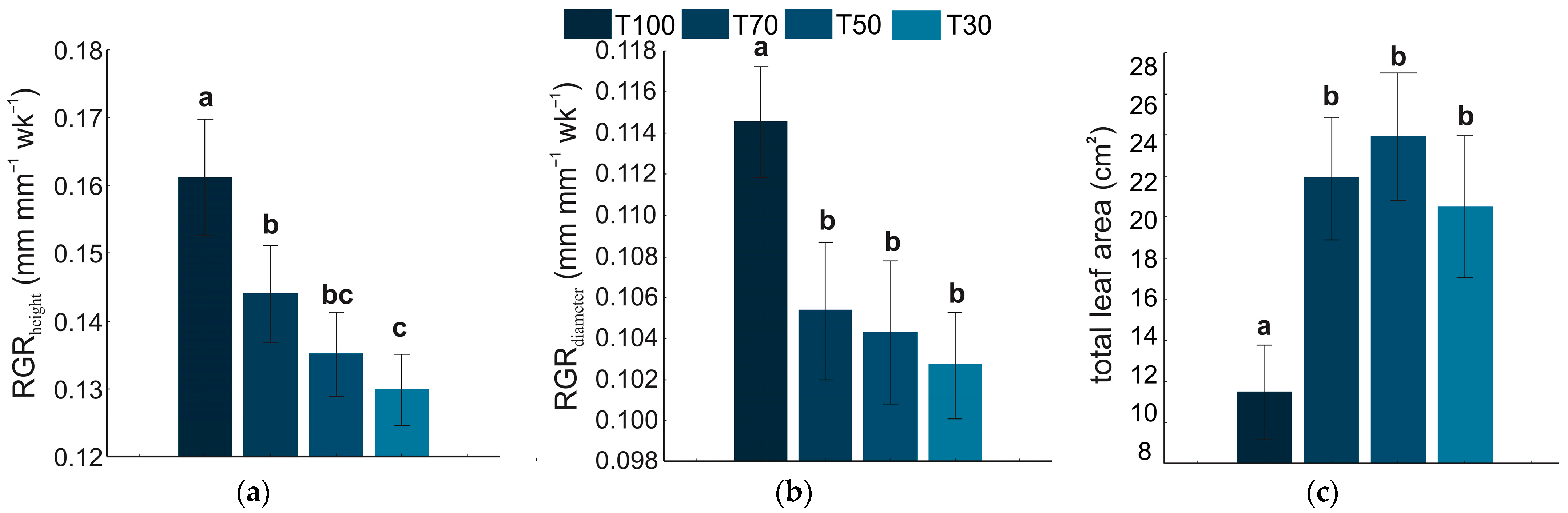
| Vegetative traits | RGRh | 0.01 | 0.05 | 0.039 | 0.005 | 16.46 | <0.01 | 0.28 |
| RGRd | 0.002 | 0.01 | 0.007 | 0.002 | 12.79 | <0.01 | 0.22 | |
| TLA | 2714.8 | 10,157.9 | 7443 | 904.9 | 14.10 | <0.01 | 0.51 | |
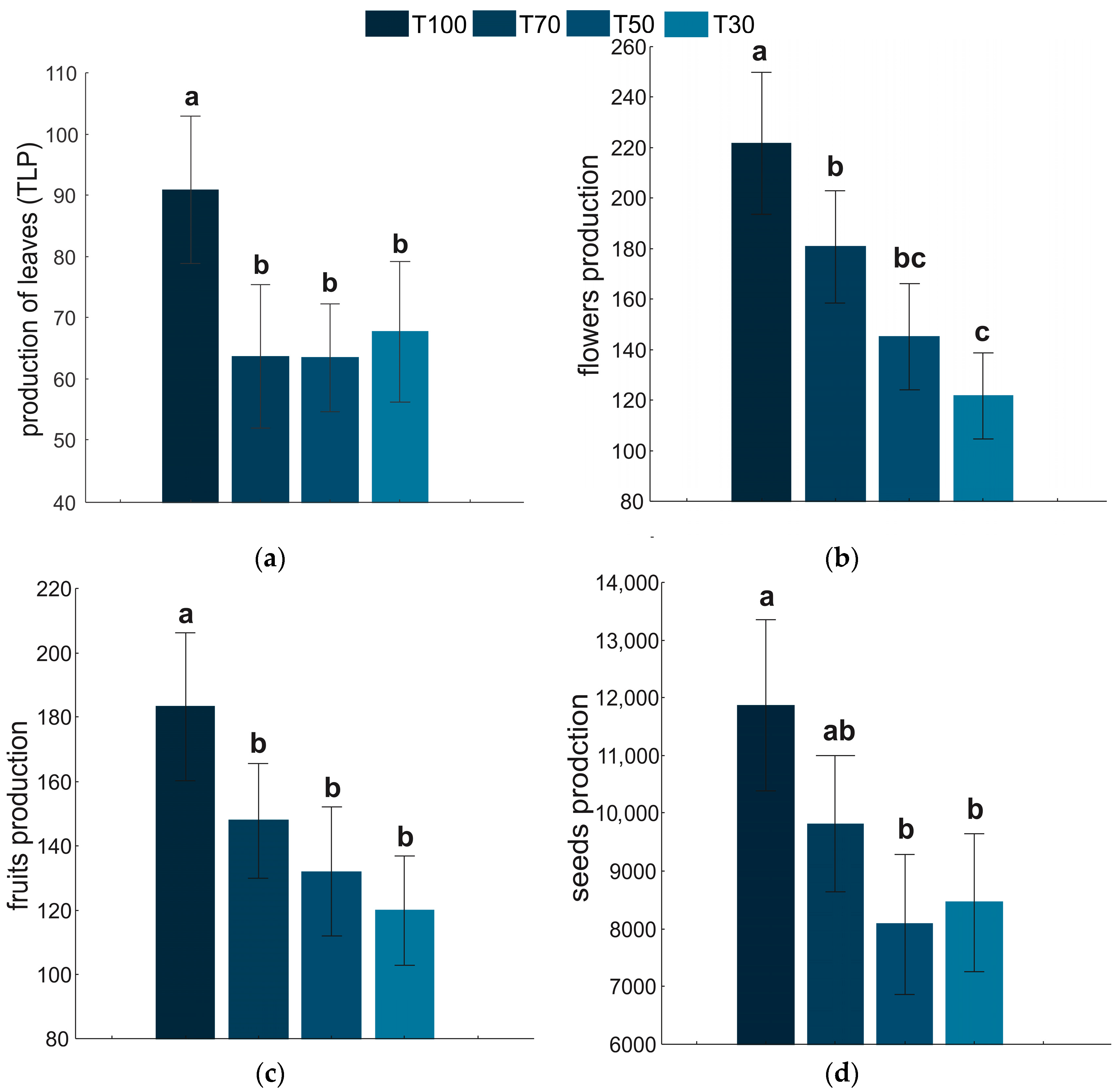
| TLP | 15,468.9 | 117,599.1 | 102,130.2 | 5156.3 | 5.85 | <0.01 | 0.10 | |
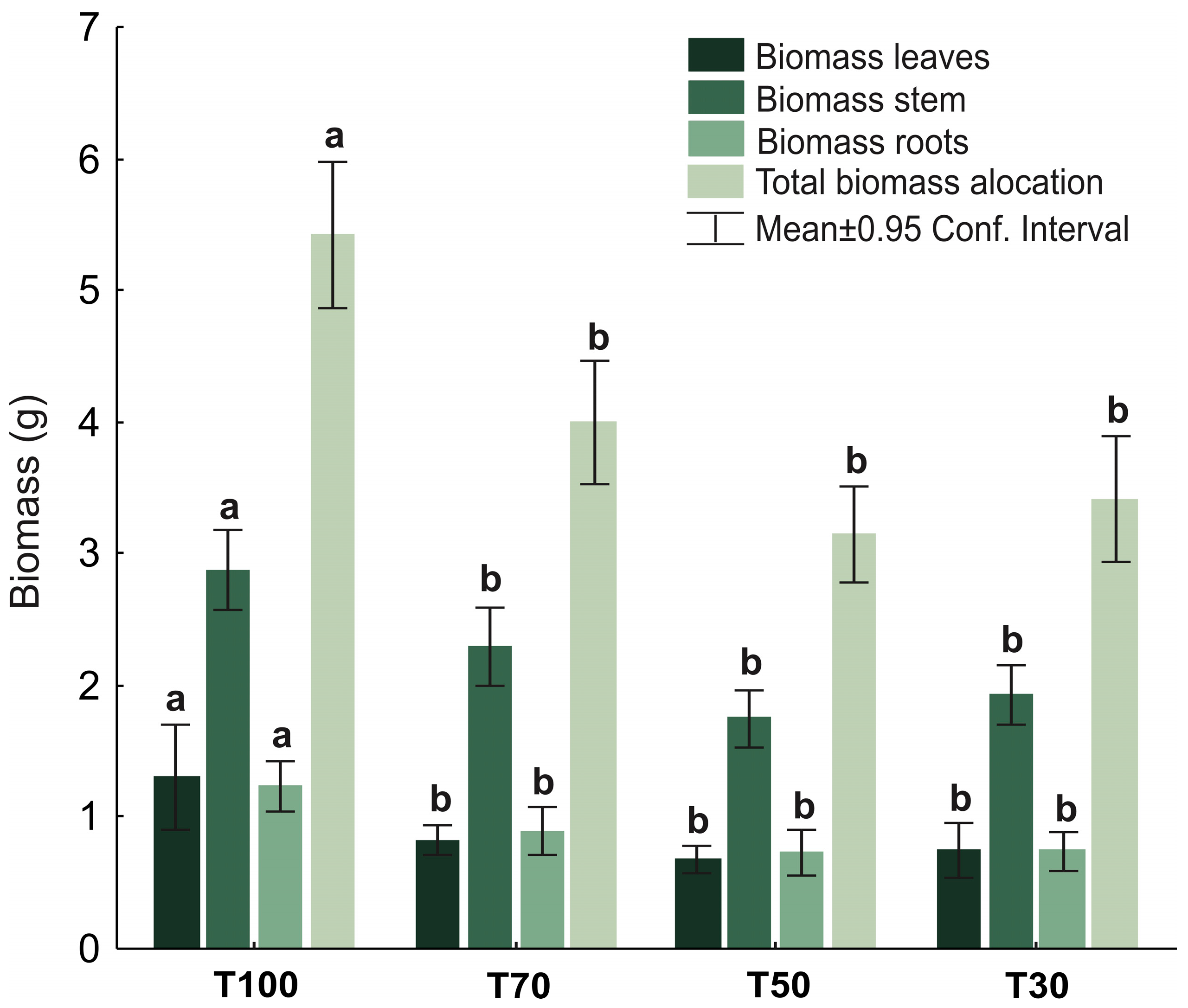
| Total biomass alocation | 89.74 | 256.69 | 166.9 | 29.91564 | 19.71 | <0.01 | 0.59 | |
| Biomass leaves (LDM) | 7.22 | 51.87 | 44.6 | 2.4 | 5.93 | <0.01 | 0.37 | |
| Biomass stem (SDM) | 21.44 | 75.06 | 53.6 | 53.6 | 14.66 | <0.01 | 0.53 | |
| Biomass roots (RDM) | 4.95 | 28.03 | 23.08 | 1.65 | 7.86 | <0.01 | 0.42 | |
| Reproductive traits | Flowers production | 166,075 | 558,257 | 392,181 | 55,358 | 15.66 | <0.01 | 0.54 |
| Fruits production | 65,864 | 359,415 | 293,552 | 21,955 | 8.30 | <0.01 | 0.42 | |
| Seeds production | 256,591,300 | 1.51 × 10⁹ | 1.25 × 10⁹ | 85,530,433 | 7.57 | <0.01 | 0.41 | |
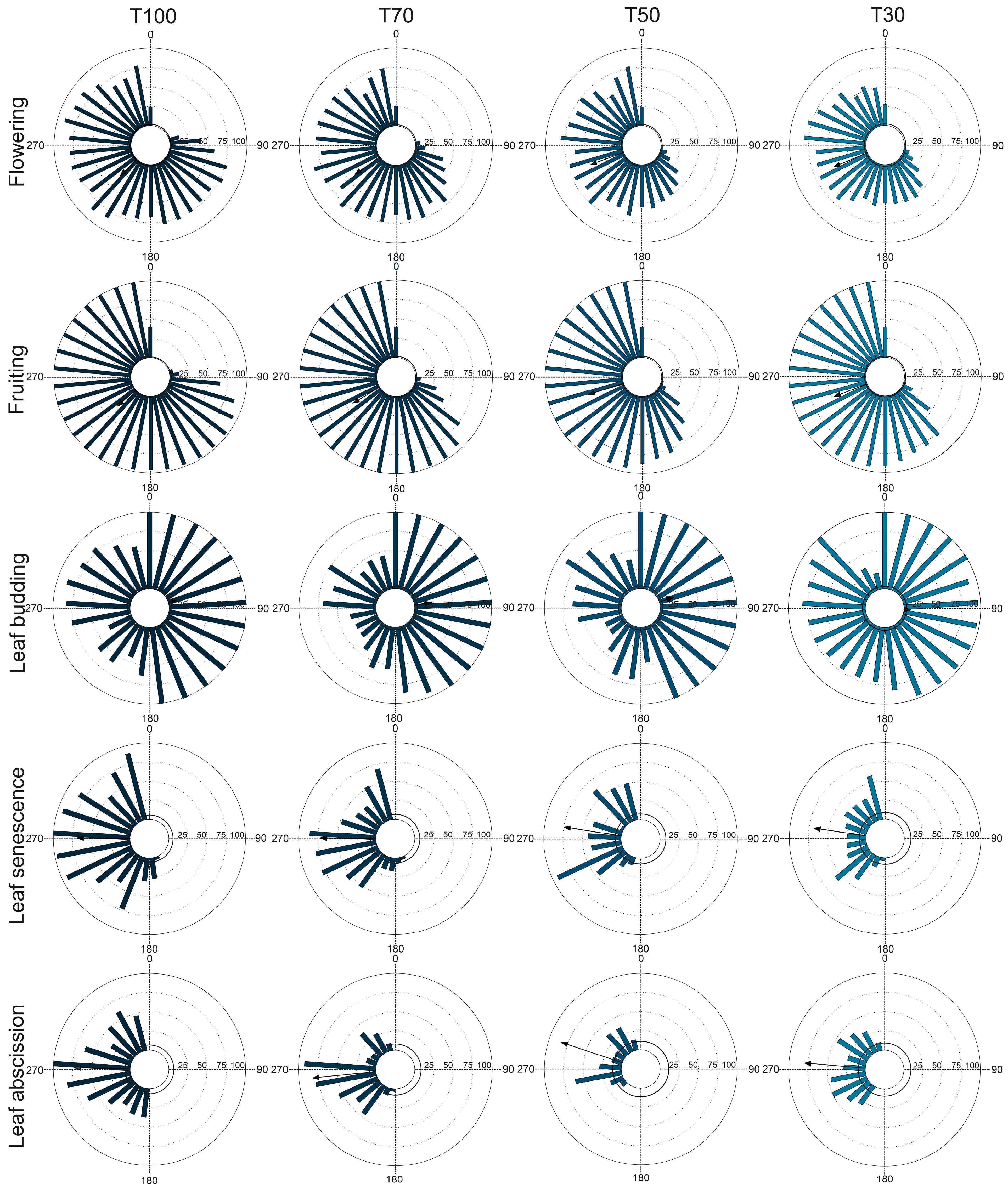
| Flowering | 37,971.9 | 711,651 | 749,623 | 12,657.3 | 11.95 | <0.01 | 0.22 | |
| Phenological traits | Fruiting | 16,747.6 | 1,327,268 | 1,310,521 | 5582.5 | 2.86 | 0.03 | 0.11 |
| Leaf budding | 1673.4 | 56,657.7 | 54,984.3 | 557.8 | 0.97 | 0.40 | - | |
| Leaf senescence | 6875.9 | 93,614.5 | 86,738.5 | 2291.9 | 2.53 | 0.06 | - | |
| Leaf abscission | 3769.5 | 57,922.9 | 54,153.3 | 1256.5 | 2.22 | 0.08 | - |
| Treatment | Flowers | Fruits | Seeds | |||
|---|---|---|---|---|---|---|
| tp | Mean ± SE | tp | Mean ± SE | tp | Mean ± SE | |
| T100 | 6.652 | 221.7 ± 75.4 | 5.493 | 183.1 ± 61.3 | 357.045 | 11,864.8 ± 3974.3 |
| T70 | 5.242 | 180.7 ± 58.6 | 4.287 | 147.8 ± 46.7 | 282.942 | 9815.7 ± 3106.3 |
| T50 | 4.059 | 144.9 ± 54.2 | 3.697 | 132 ± 51.2 | 251.396 | 8080.5 ± 3134.8 |
| T30 | 3.409 | 121.7 ± 43.7 | 3.358 | 119.9 ± 44 | 238.418 | 8454.9 ± 3104 |
| Phenophases | Variable | Treatments | |||
|---|---|---|---|---|---|
| T100 | T70 | T50 | T30 | ||
| Flowering | Observations | 9922 | 8543 | 7161 | 6691 |
| Mean angle (μ) | 224.8° * | 235.2° * | 249.2° * | 247.7° * | |
| Circular standard deviation | 88.8° | 78.4° | 71.7° | 70° | |
| Length of mean vector (r) | 0.3 | 0.39 | 0.45 | 0.47 | |
| Fruiting | Observations | 12,303 | 11,311 | 10,101 | 10,372 |
| Mean angle (μ) | 228.5° * | 239° * | 251.6° * | 248.6° * | |
| Circular standard deviation | 86.7° | 77.2° | 69.5° | 71.8° | |
| Length of mean vector (r) | 0.31 | 0.4 | 0.47 | 0.45 | |
| Leaf budding | Observations | 2090 | 1862 | 1917 | 2086 |
| Mean angle (μ) | 72.3° * | 81.2° * | 71.9° * | 92.9° * | |
| Circular standard deviation | 116.7° | 99.7° | 104.6° | 128.4° | |
| Length of mean vector (r) | 0.12 | 0.22 | 0.18 | 0.08 | |
| Leaf senescence | Observations | 918 | 629 | 454 | 383 |
| Mean angle (μ) | 270.6° * | 270.6° * | 278.9° * | 278.3° * | |
| Circular standard deviation | 49.7° | 46.5° | 43.9° | 49.8° | |
| Length of mean vector (r) | 0.686 | 0.719 | 0.745 | 0.684 | |
| Leaf abscission | Observations | 646 | 423 | 229 | 339 |
| Mean angle (μ) | 271.5° * | 264.4° * | 288.7° * | 274.6° * | |
| Circular standard deviation | 45.6° | 36.4° | 34.3° | 38.6° | |
| Length of mean vector (r) | 0.72 | 0.81 | 0.83 | 0.79 | |
Disclaimer/Publisher’s Note: The statements, opinions and data contained in all publications are solely those of the individual author(s) and contributor(s) and not of MDPI and/or the editor(s). MDPI and/or the editor(s) disclaim responsibility for any injury to people or property resulting from any ideas, methods, instructions or products referred to in the content. |
© 2026 by the authors. Licensee MDPI, Basel, Switzerland. This article is an open access article distributed under the terms and conditions of the Creative Commons Attribution (CC BY) license.
Share and Cite
Aguiar, B.A.d.S.; Soares, E.S.d.S.; Souza, J.D.d.; Simões, J.A.; Santos, D.M.d.; Araujo, V.K.R.d.; Santos, J.M.F.F.d.; Lopes, C.G.R.; Araújo, E.d.L. Vegetative and Reproductive Responses from Full Sunlight to Shade of a Pantropical Herbaceous Plant in Caatinga Vegetation. Forests 2026, 17, 153. https://doi.org/10.3390/f17020153
Aguiar BAdS, Soares ESdS, Souza JDd, Simões JA, Santos DMd, Araujo VKRd, Santos JMFFd, Lopes CGR, Araújo EdL. Vegetative and Reproductive Responses from Full Sunlight to Shade of a Pantropical Herbaceous Plant in Caatinga Vegetation. Forests. 2026; 17(2):153. https://doi.org/10.3390/f17020153
Chicago/Turabian StyleAguiar, Bruno Ayron de Souza, Elda Simone dos Santos Soares, José Djalma de Souza, Júlia Arruda Simões, Danielle Melo dos Santos, Vanessa Kelly Rodrigues de Araujo, Josiene Maria Falcão Fraga dos Santos, Clarissa Gomes Reis Lopes, and Elcida de Lima Araújo. 2026. "Vegetative and Reproductive Responses from Full Sunlight to Shade of a Pantropical Herbaceous Plant in Caatinga Vegetation" Forests 17, no. 2: 153. https://doi.org/10.3390/f17020153
APA StyleAguiar, B. A. d. S., Soares, E. S. d. S., Souza, J. D. d., Simões, J. A., Santos, D. M. d., Araujo, V. K. R. d., Santos, J. M. F. F. d., Lopes, C. G. R., & Araújo, E. d. L. (2026). Vegetative and Reproductive Responses from Full Sunlight to Shade of a Pantropical Herbaceous Plant in Caatinga Vegetation. Forests, 17(2), 153. https://doi.org/10.3390/f17020153