


Abstract
One of the most important by-products generated in the forestry industry is the bark obtained during the debarking process. Pine (Pinus radiata D. Don) and eucalyptus (Eucalyptus globulus L.) are the main important tree species exploited in the Chilean forestry industry. The bark of P. radiata D. Don is an interesting source of extracts, rich in condensed tannins, with potential uses in biopolymer and bioadhesive preparation. Conversely, the E. globulus bark extracts are rich in hydrolyzable tannins with few applications. Nevertheless, the forest industry generates a high volume of these by-products, simultaneously. Then, it is interesting to determine a suitable process for the joint valorization of both forest by-products at a large scale. In this work, alkaline extraction (NaOH and Na2SO3) was performed at a pilot scale of a mixture of E. globulus and P. radiata barks prepared at different ratios (0%–100%). The effect of bark mixture composition on the resulting extract’s properties was evaluated. All extracts were characterized according to their chemical composition by FTIR-ATR, MALDI-TOF, and molecular weight distribution (GPC). In addition, the Stiasny number was tested to determine the potential use of extracts in bioadhesive formulation. The self-condensation reaction of resulting extracts was studied using Dynamic Mechanical Analysis (DMA) and Automated Bond Evaluation System (ABES) techniques. Results show a good interaction between condensed and hydrolyzable tannins from both species’ barks. It also demonstrated the potential application of the obtained extracts, for a bark ratio of 50:50, in the formulation of bioadhesives for particleboard manufacture. The obtained product showed a similar performance to that of the bioadhesive formulated with the extract obtained using only P. radiata bark.
Keywords:
MALDI-TOF; DMA; biomass; tannins; polyphenols; particleboard; glyoxal; FTIR-ATR; tree barks 1. Introduction
Forestry sector in Chile is one of the most relevant for the country’s economy. The main uses of forests are for lumber and paper production. During wood processing, a significant amount of by-products, such as bark and wood chips, are obtained. These products are typically discarded or burned, resulting in environmental and economic losses. However, recent research has shown that bark and other forestry by-products can be valorized or converted into fine chemical products through biorefinery processes [1,2,3].
One example of bark valorization is the extraction of tannins, which are polyphenolic compounds that have interesting industrial applications, such as leather tanning and the production of wood adhesives, paints, anticorrosive, foams, biocomposite materials, etc. [1,4,5]. Tannins can be extracted from bark using aqueous or organic solvents such as ethanol or methanol [6,7].
Another example of bark valorization is the extraction of lignin, which is a complex natural macromolecule that offers wood its structural strength. Lignin can be extracted from bark using alkaline solutions, such as sodium hydroxide, followed by a precipitation step to separate the lignin from the other components of the bark. Lignin has potential applications in the production of biofuels, plastics, adhesives and other materials [8,9,10].
In addition to tannins and lignin, bark also contains other potentially valuable com-pounds, such as flavonoids, terpenoids, and phenolic acids [6,11]. These compounds have various biological activities, including antioxidant, anti-inflammatory, and antimicrobial effects, making them attractive for use in the food, pharmaceutical, and cosmetic industries [12].
According to the European Circular Economy action plan 2020, for achieving cleaner and more sustainable production, the valorization of forest lignocellulosic biomass has raised a lot of interest [1]. It has mainly focused on developing environmentally friendly processes with low-waste products and developing solutions that allow reducing toxic compounds in the working environment. This way, the environmental impact and the carbon footprint of the forest sector can be reduced. One of the manufacturing sectors that are changing is the wood-based panel industry. Among wood-based panel products are particleboard, plywood, fibreboard, and oriented strand board. For the production of all of them, it is necessary to use synthetic oil-derived adhesive resins with environmentally questioned components (formaldehyde, phenols, etc.). These components have a very good performance as an adhesive resin, which makes it difficult to replace them with natural products. In addition, with the rising prices of all the oil-based resins, it is also important to consider the challenge of improving the economics of the process.
The use of radiata pine bark as a source of extracts with high phenolic content has been previously studied by some authors [13]. The extracts obtained showed a significant percentage of condensed tannins, which have traditionally been the most interesting product for use in wood adhesive formulations [14,15]. Other pine bark extracts were used to obtain wood-based adhesives with high-performance properties, and it was even possible to produce exterior-grade plywood using these extracts with alternative formaldehyde hardeners such as hexamethylenetetramine [2].
The potential of eucalyptus bark, as a source of extracts with applicability in the materials industry, has also been studied previously [3,16]. The extracts obtained from E. globulus bark are mostly composed of hydrolyzable tannins [17], and the potential applicability of this type to tannins in adhesive formulations has been little studied [4]. However, previous work from our team [5] demonstrated that it could be possible to obtain a bioadhesive with a good performance by mixing extracts from E. globulus bark (hydrolyzable tannins) and chestnut shell (condensed tannins). These extracts were combined, with a formaldehyde alternative hardener (tris(hydroxymethyl)nitromethane), in the formulations of bioadhesives in particleboard production. To the best of our knowledge, there is no work that characterizes the extracts obtained from the mixture of materials, such as the E. globulus bark and the P. radiata bark, which are sources of hydrolyzable and condensed tannins, respectively.
This work aims to evaluate the influence of P. radiata and E. globulus bark ratio, used for extract preparation, on the physicochemical properties of the obtained extracts. In addition, the resulting extracts were studied for potential use as bioadhesive and biopolymer formulations. For this purpose, different bark ratios were evaluated (0%–100%) and resulting extracts, obtained at pilot scale, were characterized by different physicochemical techniques. The self-condensation reaction of resulting extracts was studied using Dynamic Mechanical Analysis (DMA), and Automated Bond Evaluation System (ABES) techniques.
The present work shows that it is possible to design a process to make viable the valorization of P. radiata and E. globulus bark, together, and that the extracts obtained from the mixture of both materials have a similar behavior to that of those extracts obtained only using P. radiata bark. In addition, the viability of using extracts obtained only with P. radiata bark and with a 50% mixture of both barks for the bioadhesive formulations was demonstrated. In this context, glyoxal was chosen as a formaldehyde alternative hardener for the formulations of bioadhesives for particleboard production.
2. Materials and Methods
2.1. Raw Material
The P. radiata bark was supplied by the company Arauco and E. globulus bark was supplied by Forestal Collicura Ltd., a company located in the Biobio region of Chile.
Both barks were ground in a shredder-cutting mill and sieved. Particle sizes between 1 and 4 mm were selected as raw material to obtain the extracts that were used in the study.
2.2. Pilot Scale Extraction
The extractions were performed on a pilot plant scale (Figure 1). For all extraction experiments, the solid/liquid ratio was set at 1/10 (w/w) and aqueous solutions of sodium sulfite or sodium hydroxide were used, with an extraction temperature of 90 °C. The materials were combined with water at room temperature, heated, and sodium sulfite and sodium hydroxide solutions were added after the temperature reached 90 °C. After 1 h of extraction, the suspension was vacuum filtered, the solid residue was washed under water flow, and the aqueous extract solutions were dried in a spray dryer (BHS Büttner-Schilde-Haas AG, Bad Hersfeld, Germany).
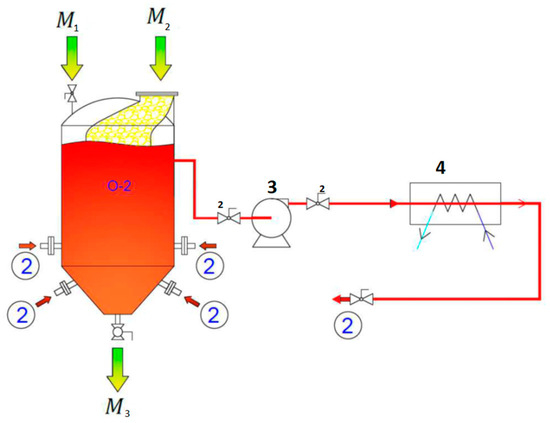
Figure 1.
A flow chart of the bark extraction process in a pilot plant. Main equipment: O-2: steel reactor; 2: valves; 3: pump; 4: heat exchanger; M1: solvent mass; M2: biomass; M3: extracts.
Extraction experiments were performed in triplicate and the results of product analysis (FTIR, ABES, and extraction yield) were averaged. The extraction conditions used are shown in Table 1.

Table 1.
Extraction conditions for P. radiata and E. globulus bark.
The extraction yield was determined as the difference between the dry material weight at the start of the process and the dry material weight at the end of the process (Equation (1)).
2.3. Stiasny Number
The Stiasny number measures the content of formaldehyde-condensable compounds in the extracts. It was determined according to the method proposed by Yazaki and Hillis [18]. The extract (0.25 mg) was dissolved in distilled water (100 mL) and 2.5 mL of 10 M HCl (Panreac, Barcelona, Spain), and 5 mL of 37% formaldehyde (Panreac, Barcelona, Spain) were added. The mixture was heated under reflux for 30 min. The suspension was filtered through a sintered glass filter, the precipitate was washed with hot water and then dried at 105 °C to constant mass. Analyses were performed in triplicate and the mean value was calculated.
2.4. Molecular Weight Distribution by Gel Permeation Chromatography (GPC)
The GPC analysis was performed using a Shimadzu (Kyoto, Japan) chromatograph equipped with a diode array and ultraviolet detectors. The column used was a HP-PL gel 5 µm mixed-D protected with a PL gel 5 µm guard column. THF was used as eluent, and the conditions used were a flow rate of 1 mL/min, a column temperature of 30 °C, an injection volume of 20 µL, and detection at 270 nm with a bandwidth of 15 nm. Calibration curves were generated using polystyrene standards. Prior to GPC analysis, the spray-dried extracts were acetylated. A total of 20 ± 1 mg of the extracts were reacted with pyridine–acetic anhydride (4 mL, 1:1) overnight. The mixture was added to 40 mL of distilled water and the precipitate was collected by vacuum filtration through a 20 m nylon filter. Acetylated extracts were diluted in THF (2–5 mg/mL) for the GPC analysis.
2.5. Fourier Transform Infrared Spectroscopy (FTIR) Assay
FTIR spectra were recorded on a VERTEX 70 FTIR spectrometer (BRUKER, Billerica, MA, USA) equipped with a high sensitivity DLaTGS detector at room temperature.
Samples were measured in ATR mode using an A225/Q PLATINUM ATR diamond crystal with a single reflection accessory. Spectra were recorded from 4000 to 400 cm−1 with a resolution of 4 cm−1. All spectra were recorded and processed using OPUS 7.0 software.
2.6. Mass Spectrometric Analysis by Matrix-Assisted Laser Desorption/Ionization Time-of-Flight (MALDI-TOF)
PB (100% pine bark), EB (100% eucalyptus bark) and PBE1 (50% pine and 50% eucalyptus bark) extracts were analyzed according to the method used in previous work (Vázquez et al., 2013). The spectra were recorded on a Kratos Kompact MALDI 4 instrument (Bruker, Billerica, MA, USA). The irradiation source was a pulsed nitrogen laser with a wavelength of 337 nm, and the laser pulse duration was 3 ns. Measurements performed under the following conditions: positive polarity; linear trajectory; high mass (20 kV acceleration voltage); 100–150 pulses per spectrum. The delayed extraction technique was used with delay times of 200–800 ns.
The bark extracts of P. radiata and E. globulus (PB, EB and PBE1) were dissolved in acetone (4 mg/mL), and then the sample solutions were mixed with a 2,5-dihydroxy benzoic acid acetone solution (10 mg/mL acetone) used as a matrix. NaCl was added to the matrix to promote ion generation. The sample and matrix solutions were mixed in equal parts and between 0.5 and 1 mL of the resulting solution was applied to the MALDI target. After evaporation of the solvent, the MALDI target was placed in the spectrometer.
2.7. Thermogravimetric Analysis (TGA)
Thermal stability was evaluated by thermogravimetric analysis (TGA) performed on a NETZSCH TGA instrument (TG 209 F3 Tarsus, Hamburg, Germany). Samples of 6 ± 2 mg were heated at a rate of 10 °C/min from 25 to 600 °C under a nitrogen atmosphere at a flow rate of 20 mL/min.
2.8. Automated Bond Evaluation System (ABES) Test
An ABES instrument (Adhesive Evaluation Systems, Corvallis, OR, USA) was used to evaluate the maximum strength of the wood–adhesive–wood system at defined temperature and pressing time conditions [19].
The wood veneer samples (Fagus sylvatica L., thickness 0.7 mm) were stored in a conditioned chamber for one week at 20 °C and 53% relative humidity prior to testing. Test pieces consisted of 117 mm × 20 mm strips, cut with an ABES-specific pneumatically-operated sample cutter (supplied by Adhesive Evaluation Systems, Corvallis, OR, USA).
Two peeled strips of wood veneer were bonded together along the fibre direction with an overlap 100 mm2 using 20 mg of adhesive. Analyses were performed at 100 and 120 °C after 30, 60, 90, 120 s pressing time. Measurements were repeated five times for each data point.
2.9. Dynamic Mechanical Analysis Experiments
The dynamic mechanical analysis (DMA) experiments were performed using a TA DMA 2980 instrument (TA instruments, New Castle, DE, USA). A small amount of adhesive (10–20 mg) was applied to the surface of two maple veneer wood samples (58 mm (length) × 1.1 mm (width) × 0.5 mm (thickness)), which were then stacked as a sandwich. Both ends of the sample were clamped to a rigid frame with a torque of 60 cNm, and the drive shaft was clamped to the center of the sample. The deformation mode used on the sample is known as dual cantilever bending. The operating conditions used in this test were a frequency of 1 Hz, a maximum force of 0.05 N, and a maximum deformation amplitude of 15 µm. With respect to the temperature conditions studied, the following procedure was followed:
- (1)
- Stabilization at 35 °C;
- (2)
- Isotherm at 35 °C for 30 s;
- (3)
- Heating ramp at 2 °C/min up to 180 °C.
2.10. Manufacture and Testing of Particleboard
Wood particles (P. radiata) were mixed with a bioadhesive formulated with the extracts of pine bark (PB) and the extract obtained with pine and eucalyptus bark (PBE1 50:50). The bioadhesive was formulated using glyoxal (40% solution, Sigma-Aldrich, St. Louis, MO, USA) as a hardener, following the formulations previously developed in other research [5]. Wood particles were mixed with the bioadhesive (10% mass of resin solids/mass of dry wood) in a laboratory glue mixer. The glued mat was pressed using a Becker & van Hüllen press (Krefeld, Germany) at 2 MPa and 195 °C with a pressing factor of 0.4 min/mm to obtain one layer 300 mm × 300 mm × 14 mm particleboards, with a target density between 650 and 670 kg m−3.
The particleboards were evaluated by physical and mechanical tests according to European standards: density (EN 323: 1993, [20]) and internal bond strength (EN 319: 1993, [21]). The boards were classified according to EN 312: 2010, [22].
3. Results and Discussion
3.1. Characterization of P. radiata and E. globulus Bark
The valorization of lignocellulosic by-products produced in an industrial process begins with their characterization. This helps to understand and determine their most suitable industrial applications. FTIR-ATR spectroscopy was used to analyze the original P. radiata and E. globulus bark (PB and EB) and the extraction residues (PBER and EBER) obtained from the extraction process. The spectra of PB, PBER, EB, and EBER are shown in Figure 2 and Figure 3.
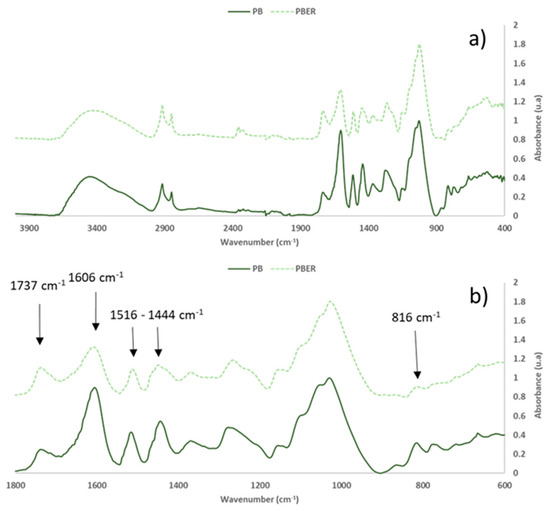
Figure 2.
FTIR spectra: solid P. radiata bark (PB) and the extraction residue (PBER) (a) (4000–400 cm−1) and (b) (1800–600 cm−1).
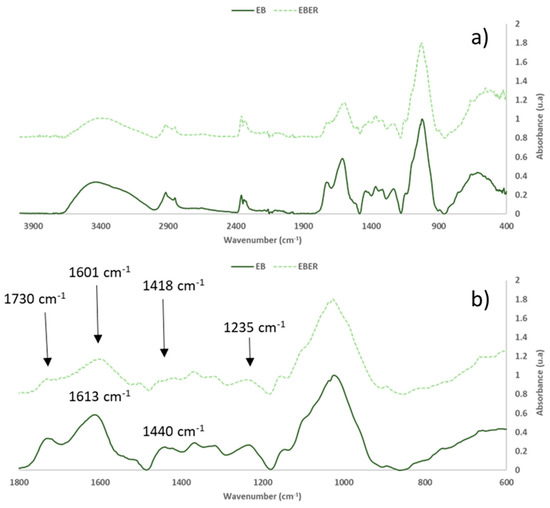
Figure 3.
FTIR spectra: solid E. globulus bark (EB) and the extraction residue (EBER) (a) (4000–400 cm−1) and (b) (1800–600 cm−1).
Based on the intensity of the vibration bands in the PB, EB and EBER, PBER spectra, the most abundant compounds in both materials were cellulose, hemicelluloses, and lignin. However, bands from other low molecular weight sugars and polyphenolic compounds were also detected. FTIR bands of these materials were assigned and summarized in Table 2 [2,23,24,25,26,27,28,29]. To facilitate the analysis, the FTIR spectra were normalized based on the most intense bands of the C-O, C-C, and C-C-O stretching vibrations of cellulose, hemicelluloses, and lignin, which appear at 1025–1035 cm−1 [30].
Table 2.
FTIR peak assignment of P. radiata bark after and before the extraction process.
For pine bark, the main differences in the spectra were associated with the extraction process. The distinct band intensity was influenced by the presence of extractable compounds in the samples. The bands assigned to the phenolic compounds at 1444, 1516, and 1606 cm−1, respectively, showed a lower intensity in the solid residue spectra. This result indicates that the pilot-scale extraction process was successful in removing a large percentage of the phenolic components from the pine bark. It was also noticeable that the band around 1738 cm−1, which is characteristic of the hemicellulose content, did not decrease in intensity in the solid residue spectrum. It suggests that at tested extraction conditions, a low proportion of hemicellulose was degraded.
In the case of the eucalyptus bark, a low reduction in the phenolic characteristic bands intensity was observed and affected only the ones associated with the aromatic polyphenol ring vibration at 1600 cm−1. Previous studies have characterized the aqueous extracts obtained from E. globulus bark [17,31] and determined a significant amount of gallotannins (hydrolyzable tannins) in the extracts. Gallotannins are polymers formed when gallic acid, a phenolic compound monomer, esterifies and binds to the hydroxyl group of a polyol carbohydrate such as glucose.
The most important structural feature of gallotannins is the presence of carboxylic groups, which can be detected in FTIR-ATR spectra by their deformation vibrational modes at 1710–1720 cm−1 and 1240–1250 cm−1 [23,24]. The reduction in the intensity of these bands, due to the extraction process, suggests that the methodology used is effective in recovering these types of compounds.
3.2. Characterization of P. radiata and E. globulus Bark Extracts
The influence of the P. radiata and E. globulus bark used as raw material, on the extraction yield of the pilot scale extraction process, and on the properties of the obtained extracts is shown in Table 3.
Table 3.
Extraction yield and characterization of P. radiata and E. globulus bark extracts.
The feasibility of transferring a forest by-product valorization process, from the pilot-scale to the industrial level, is conditioned by the extraction yield, production costs, and the obtained products’ properties.
In Table 3, it can be seen that both the extraction yield and the Stiasny number were influenced by the proportions of P. radiata and E. globulus bark used in the extraction process. The extraction yield increased as the percentage of P. radiata bark increased, with values ranging from 8.41 ± 0.32% for PEB1 (50% P. radiata bark, 50% E. globulus bark) to 14.30 ± 0.28% for PB (100% P. radiata bark). The Stiasny number indicates the reactivity of an extract with formaldehyde [15], and it is often used as an indicator of the usability of a reactive polyphenolic adhesive, regardless of the formulation that involves reaction with formaldehyde [16,32]. Yazaki and Collins [32] estimated that the minimum Stiasny value to produce high-quality adhesives is around 65%. The Stiasny number of the extracts decreased as the percentage of E. globulus bark increased, with values ranging from 79.24 ± 1.6% for PB to 30.42 ± 1.1% for EB (100% E. globulus bark). Previous work has shown that the bark of E. globulus is mainly composed of hydrolysable gallotannins [16]. The reactivity of formaldehyde with hydrolysable tannins is low, which is the main reason for the decrease in the Stiasny number [5].
The molecular weight distribution of tannin extracts was analyzed by gel permeation chromatography (GPC). The molecular weights, Mn and Mw, and the polydispersity (PD) are important parameters for the application of tannin extracts. These parameters have a significant influence on the reactivity and viscosity of the extracts and hence on the products formulated with these extracts, such as bioadhesives, coatings, or paints. The proportions of P. radiata and E. globulus bark used in the extraction process affected the molecular weight of the extracts. The extracts obtained from mixtures of pine and eucalyptus bark had lower Mw and Mn values than those obtained from single materials. However, no clear tendency was determined between the proportion of pine or eucalyptus bark used as raw material and the polydispersity of the extracts obtained.
3.3. Characterization of Eucalyptus and Pine Bark Extracts by FTIR-ATR
The influence of the percentage of eucalyptus or pine bark used as raw materials on the chemical composition of the extracts was evaluated by FTIR-ATR. Figure 4 shows the FTIR spectra of the extracts EB, PB, PBE1 (50:50), PBE2 (60:40), PBE3 (70:30) and PBE4 (80:20) with the intensity values normalized to the aromatic polyphenol ring vibration at 1600 cm−1 [1].
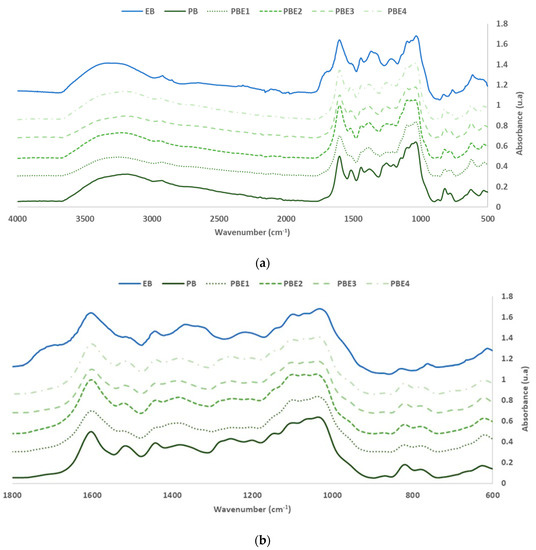
Figure 4.
FTIR spectra of P. radiata bark and P. radiata-E. globulus bark extracts, dried (a) (4000–400 cm−1); (b) (1800–600 cm−1).
Table 4 shows the characterization of the main peaks extracts with the intensity values normalized to the aromatic polyphenol ring vibration at 1600 cm−1. The band assignment was performed based on previous studies [2,30,33,34,35,36].
Table 4.
FTIR peak assignment of P. radiata, E. globulus bark and P. radiata-E. globulus bark extracts.
The PB extracts are mainly composed of condensed tannins. The bands associated with condensed tannins in the spectrum appear at 1604–1518 and 1443 cm−1, due to the C=C stretching vibrations of the phenolic aromatic ring and the C-H bending vibrations of the CH2 groups; at 1063 cm−1 of the C-O stretching vibration of the primary alcohol and at 1145 cm−1 of the C-O stretching and O-H bending vibration of the tertiary alcohol [38,39].
Regarding bands associated with condensed tannins, in the extracts obtained from barks mixtures, a decrease in their intensity was observed when the eucalyptus bark content increased in the raw material use for extraction.
Hydrolysable tannins are mainly composed of gallic or ellagic acid moieties linked to different sugar units. Their most relevant structural feature is the presence of carboxylic groups, which were detected in the FTIR-ATR EB spectra for their deformation vibrational modes at 1715 cm−1 together with the band at 1222 cm−1 due to the C-O stretching vibration [23]. The presence of both bands together with the band at 869 cm−1, due to the aromatic C–H out-of-plane bending vibrations, confirms the presence of a significant amount of hydrolysable tannins in the eucalyptus bark extract. The influence of the percentage of pine and eucalyptus bark used to obtain the extracts on the content of hydrolysable tannins in the extract was also demonstrated, decreasing with the percentage of pine bark content used to obtain the extract.
3.4. Characterization of Eucalyptus and Pine Bark Extracts by MALDI-TOF
MALDI-MS is a highly sensitive and effective technique for the analysis of non-volatile molecules, especially for the detection of oligomers such as proanthocyanidins, also known as condensed tannins. Figure 5 shows the MALDI-TOF spectrum of the extracts obtained from the P. radiata and E. globulus barks extracts, and from the mixture of 50% P. radiata bark and 50% E. globulus bark.
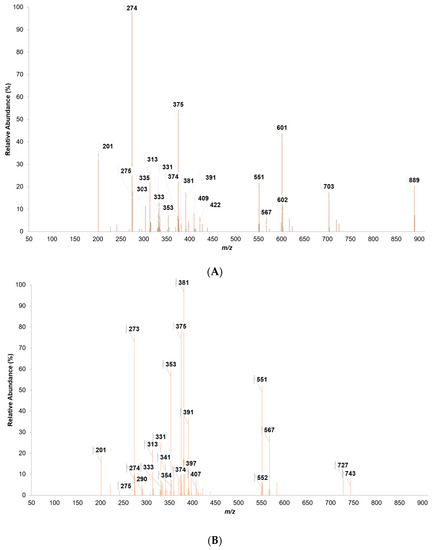
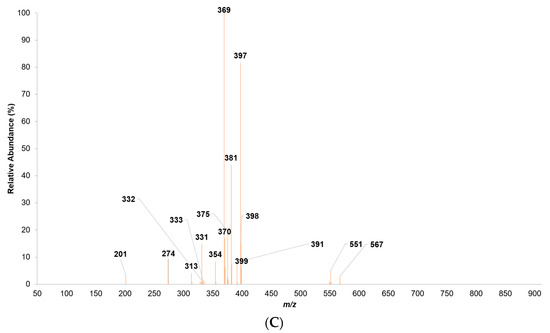
Figure 5.
MALDI-TOF spectrum of (A) P. radiata bark extract, (B) E. globulus bark extract, (C) a mixture of 50% P. radiata bark and 50% E. globulus bark extract.
Table 5 shows the characterization of the main peaks of P. radiata bark, E. globulus bark, and P. radiata-E. globulus bark extracts.
Table 5.
Main peaks of P. radiata bark, E. globulus bark, and P. radiata-E. globulus bark extracts.
Pine bark is a rich source of proanthocyanidins, especially procyanidins and, to a lesser extent, prodelphinidins [40]. The extract of P. radiata bark obtained under alkaline conditions is mainly composed of fisetinidol and catechin structures, which are condensed tannin monomers. MALDI-TOF analysis of the tannins in Aleppo pine (Pinus halepensis) bark showed similar results, with oligomeric tannins consisting of a mixture of catechin/epicatechin and fisetinidol/robinetinidin units [41].
The high abundance of condensed tannins in this extract confirms the FTIR-ATR analysis and justifies the high Stiasny number obtained for this sample. However, the use of Na2SO3 as extracting agent results in a significant amount of sulfited polyphenolic compounds, which may make the extract solution less viscous and products made with these extracts less resistant to water when used in bioadhesive formulations. In contrast, the bark extract of E. globulus has a higher content of hydrolysable extractable polyphenols (gallotannins) with a high concentration of quercetin and isorhamnetin components [17]. The extract obtained from the mixture of E. globulus and P. radiata bark, extracted under alkaline conditions, is mainly composed of catechin and isorhamnetin structures, which are the typical monomers of condensed tannins.
The data presented in this table indicate that the PB, EB, and PB/EB extracts contain different compounds, including sugars, stilbenes, fisetinidol, gallocatechin, isorhamnetin, and galic acid. Our analysis shows that the PB extract has a higher relative abundance of sugar compounds, stilbene compounds, and fisetinidol compounds compared to the EB extract. For example, the sugar + Na-2H+/stilbene compound has a relative abundance of 35% in the PB extract and 19% in the EB extract, while the fisetinidol compound has a relative abundance of 100% in the PB extract and 76% in the EB extract. In contrast, the EB extract has a higher relative abundance of gallocatechin compounds, isorhamnetin compounds, and galic acid compounds compared to the PB extract. For example, the gallocatechin + Na + 2H+ compound has a relative abundance of 25% in the EB extract and 21% in the PB extract, while the isorhamnetin + 2H+ compound has a relative abundance of 15% in the EB extract and no detectable presence in the PB extract. The PB/EB extract, on the other hand, contains a higher relative abundance of catechin compounds and quercetin compounds compared to the PB and EB extracts. For example, the catechin + SO3 1H+ compound has a relative abundance of 100% in the PB/EB extract, but has no detectable presence in the PB and EB extracts. Similarly, the quercetin + fisetinidol + 1H+ + SO3 compound has a relative abundance of 18% in the PB/EB extract, but no detectable presence in the PB and EB extracts. These results provide insights into the chemical composition of the different extracts and suggest that they may have different biological effects. These differences could be an added value to the new products (biopolymers, coatings, wood-composites, etc.) produced with them due to the influence on the antioxidant or antibacterial capacity of the material.
3.5. Characterization of the Reactivity of P. radiata and E. globulus Bark Extracts
3.5.1. Evaluation of the Curing Reaction by DMA
The DMA technique was used to evaluate the curing self-condensation reaction of the extracts obtained from the bark of P. radiata and E. globulus, as well as that of the extracts obtained from the combinations of both barks.
This technique allows the evaluation of the mechanical hardening rate, characterizing the hardening in terms of the rate of stiffness development. The self-condensation reaction of extract solutions with 30% solids content was evaluated.
Figure 6 shows the temperature-dependent variation of the storage modulus (E′) for the extracted solution (40% w/w) and the variation of the tan (δ) with time and temperature for EB, PB, and PBE1-PBE4 extracts.
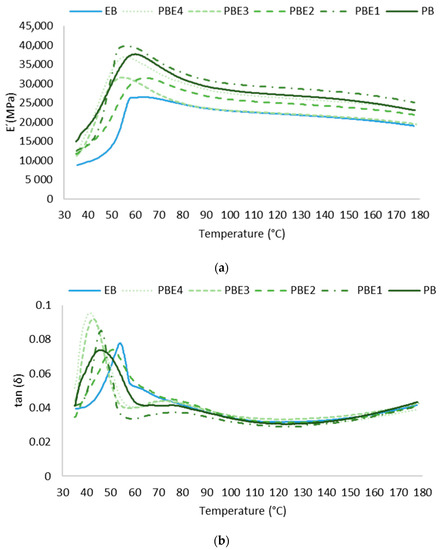
Figure 6.
Self-condensation curing reaction studied by DMA: (a) Time and temperature variation of in storage modulus (E′) for EB, PB, and PBE1-PBE4 extracts, (b) Variation of tan (δ) with time and temperature for EB, PB, and PBE1-PBE4 extracts.
Table 6 shows the variation of the storage modulus (E′) of P. radiata and E. globulus bark extracts varies with time and temperature.
Table 6.
Variation of the storage modulus (E′) with time/temperature of P. radiata and E. globulus bark extracts.
The results show the influence of the percentage of eucalyptus and pine bark extracts used as raw material to obtain the extracts on their self-condensation curing reaction.
The maximum stiffness corresponding to the end point of the curing reaction (E′ max) was obtained for the extracts from (50/50) P. radiata and E. globulus barks (2208 MPa) and for the extracts obtained from P. radiata bark (2126 MPa). However, the extracts obtained from E. globulus bark alone showed a lower E′max value (1610 MPa).
Taking into account the variation of the storage modulus ∆E′, we could arrive at a similar conclusion. An increase in the initial E. globulus bark percentage produces a decrease in ∆E′ obtained when the percentage of eucalyptus bark was low (20%–30%). However, this effect change when the eucalyptus bark used as raw material in the extraction process was higher (40%–50%) due to the interaction between the hydrolyzable and condensed tannins from the obtained extracts [5].
In addition, an effect on the characteristic temperatures of the curing reaction, including the tan (δ) temperature and the temperature at which the highest value of E′ was obtained, was seen based on the proportion of pine and eucalyptus bark extracts used as the raw material. The extracts that need the highest temperature for the curing reaction were those obtained from E. globulus bark (EB) and were generally lower for the extracts obtained from P. radiata bark only (PB) and from mixtures of P. radiata bark and E. globulus bark, with the only exception of the extracts obtained from 70% P. radiata bark and 30% E. globulus bark (PBE3). This is due to the interaction between the hydrolyzable and condensed tannins present in the extracts, which proved to be an important factor in the curing reaction temperatures.
This information will be useful to determine the influence of the percentage of each bark used as raw material in the extraction process on the applicability of the extract in the formulation of bioadhesives and biopolymers.
3.5.2. Evaluation of the Curing Reaction by ABES
The ABES equipment was used to complete the evaluation of the self-condensation curing reaction of the extracts obtained from the mixtures of P. radiata bark and E. globulus bark (PBE1-4) in terms of the shear strength of wood-adhesive bonds. This method allows the evaluation of the development of the bond strength under controlled hot-pressing conditions. Different pressing times (from 30 to 120 s) were tested at constant temperatures of 100 °C and 120 °C (Figure 7). The adhesive behavior was evaluated for the aqueous solutions (30% solids content) of the four extracts obtained from mixtures of P. radiata and E. globulus bark (self-condensation reaction).
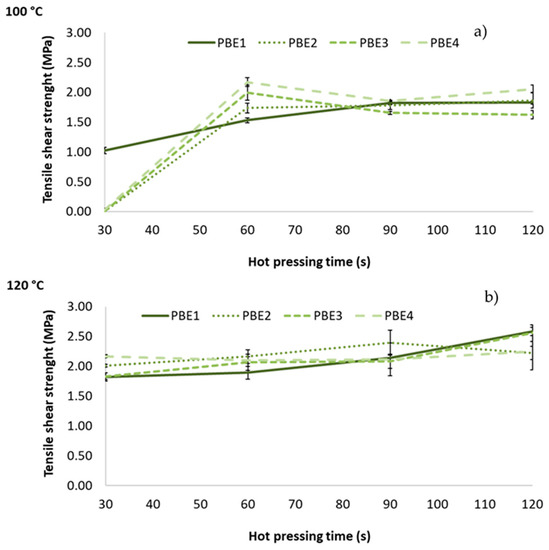
Figure 7.
Shear strength development as a function of hot-pressing time for PBE1-PBE4 solutions at (a) 100 °C and (b) 120 °C.
Regarding the influence of the pressing temperature on the adhesive behavior, the bonding performance obtained with the adhesive increased with temperature for low pressing times. However, for pressing times higher than 60 s, the temperature influence was very low. This was in correlation with the results obtained by DMA, which indicated that for all the extracts tested, the self-condensation curing reaction temperatures were lower than the 100 °C tested. The low reaction temperatures recorded for tannin extracts are a great advantage for their future application in the formulation of bioadhesives. This is due to the environmental and economic impact that pressing at high temperatures industrially entails at this time.
The only difference between the extracts tested was observed at the lowest temperature and pressing time. It was determined that the amount of eucalyptus bark used in the extraction process had a detrimental effect on the adhesion behavior. According to DMA, this may be related to the increased temperature required for the self-condensation reaction of the hydrolyzable tannins.
The ABES results confirmed the feasibility of using the extracts obtained from the mixtures of both barks in the formulation of bioadhesives to be used as binders in the production of wood-based products.
3.5.3. Evaluation of the Thermostability of Pine and Eucalyptus Extracts by TGA
To complete the study, the thermostability of the extracts obtained from the bark of P. radiata and of the mixtures of both barks were evaluated by thermogravimetric analysis (TGA). Figure 8 shows the thermograms (TG and DTG) obtained for the PB and PBE1-4 extracts analyzed as spray-dried powders.
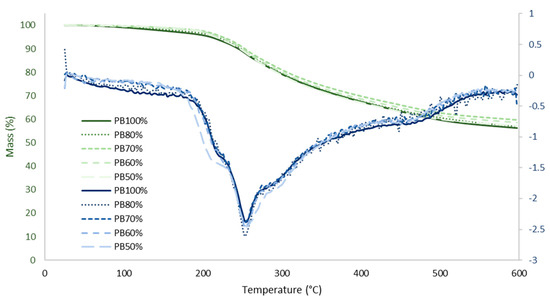
Figure 8.
TG (green lines) and DTG (blue lines) curves of PB and PBE1-4 extracts analyzed as spray-dried powder. Note: Blue lines represent the first derivatives (DTG) illustrating the decomposition temperatures (Td) of the extracts.
The degradation temperature (Td) was obtained from the peak of the first derivative (DTG) curve. The temperatures corresponding to the 5, 10 and 30% of weight loss (Td 5%, Td 10% and Td 30%, respectively) were determined from the TGA-thermogram (Figure 9).
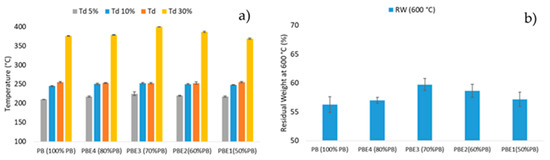
Figure 9.
Thermal properties of PB and PBE1-4 extracts as spray-dried powder. (a) Temperature of degradation (Td 5%, Td 10%, Td 30% and Td) for the PB and PBE1-4 extracts; (b) Residual weight at 600 °C (Rw) for the PB and PBE1-4 extracts.
Regarding the stability of the different extracts evaluated, it was observed that in all cases, the polyphenols from the extracts had a high thermostability, regardless of the percentage of PB and EB used to obtain the extracts.
The first degradation step (Td) was around 215 ± 5 °C for all extracts and was attributed to the degradation of carbohydrates and other compounds with lower thermal resistance present in the extracts [42].
To evaluate the most thermally stable components present in the extracts (that are associated with the polyphenolic content), the Rw and Td 30% were evaluated. In this case, the differences between the samples due to the percentage of pine or eucalyptus bark used were more sensitive, with the PBE3 (PB 70%) and PBE2 (PB 60%) extracts showing high thermal stability.
3.5.4. Bioadhesive Formulation and Particleboard Performance
In order to evaluate the feasibility of using the extracts obtained from Eucalyptus and Pinus bark mixtures, particleboards were produced using bioadhesives formulated with the studied extracts.
Table 7 shows the results of the particleboards bonded with the bioadhesive formulated with the extract obtained only from P. radiata bark (PB) and the extract obtained from the mixtures of P. radiata and E. globulus bark in equal proportions (PBE1).
Table 7.
Results of particleboards (300 mm × 300 mm × 14 mm) bonded with PB and PBE1 extracts.
In both cases, the bioadhesives were formulated using glyoxal as a hardener following the procedure developed in previous works [5].
Regardless of the extracts used in the formulation of the bioadhesives as binders, all the particleboards produced by this method achieved the internal bond values required by EN 312 [22] to be classified as general-purpose boards for use in dry conditions (type P1). This indicates that both extracts can be effectively used in the production of particleboards. This result confirms the copolymerization process that occurs between the condensed and hydrolysable tannin, which was detected in previous works [5].
The feasibility of obtaining extracts from the combination of different raw materials is a good alternative to the expensive industrial separation process and could improve the global valorization of the main forestry industrial by-products. Future research could investigate the potential use of these extracts as components in the formulations of other bioadhesives, biopolymers and other types of composite materials.
4. Conclusions
This work demonstrates that it is possible to add value to the main by-products of the Chilean forestry industry, namely the barks of P. radiata and E. globulus.
The extracts of mixed barks, obtained by alkaline extraction at pilot scale, were characterized in terms of Stiasny number, molecular weight distribution, and reactivity. Results show their viability to be used as components in the formulation of bioadhesives and biopolymers solutions.
The chemical composition of the extracts obtained from both barks and of the mixtures of both barks were characterized by several techniques. It was determined that the alkaline extracts of P. radiata bark were mainly composed of condensed tannins and the ones from E. globulus bark were composed of hydrolysable tannins.
The effect of the percentage of E. globulus bark used as raw material in the extraction process on the self-condensation hardening reaction and the thermostability of the extracts obtained was demonstrated. In addition, it was shown that there exists an interaction between the condensed and hydrolysable tannins from Pinus and Eucalyptus bark.
Particleboards produced using bioadhesives formulated with extracts from P. radiata bark (PB) and extracts from mixtures of P. radiata and E. globulus bark in equal parts (PBE1) achieved the internal bond values required by EN 312 to be classified as boards for general purpose for use in dry conditions (Type P1).
Further research could investigate the potential applications of these extracts in the manufacture of biocomposites and other products. This could include exploring the potential economic and environmental benefits of using forest by-products in this way. In addition, studies comparing the performance of products made with these extracts to those made with traditional adhesives could provide valuable information for industrial applications. Overall, the findings of this study highlight the potential for using forestry by-products in the development of new bioadhesives and other value-added products.
Author Contributions
Conceptualization, J.S., D.E.-A., C.F. and L.H.C.; funding acquisition, J.M.M. and L.H.C.; investigation J.S., D.E.-A.; methodology, J.S.; project administration, L.H.C. and J.M.M.; supervision L.H.C.; validation, C.F. and G.C.-B.; writing—original draft, J.S. and D.E.-A.; writing—review and editing, J.S., D.E.-A., C.F., J.M.M., J.G.-Á., G.C.-B. and L.H.C. All authors have read and agreed to the published version of the manuscript.
Funding
This work was financially supported by: LA/P/0045/2020 (ALiCE) and UIDB/00511/2020-UIDP/00511/2020 (LEPABE) funded by national funds through FCT/MCTES (PIDDAC); Project FWFI (SI I&DT-Projects in co-promotion, POCI-01-0247-FEDER-048235) in the scope of Portugal 2020, co-funded by FEDER (Fundo Europeu de Desenvolvimento Regional) under the framework of POCI (Programa Operacional Competitividade e Internacionalização).
Data Availability Statement
Data is contained within the article.
Acknowledgments
The authors wish to thank FWFI-FRESHWOOD FORMS INDUSTRY for the support with data and materials. The authors also want to thank the use of RIAIDT-USC analytical facilities. Danilo Escobar-Avello, Cecilia Fuentealba and Gustavo Cabrera-Barjas would like to thank ANID BASAL FB210015 CENAMAD and ANID BASAL ACE210012. Danilo Escobar-Avello also thanks to ANID FONDECYT de Postdoctorado 2023 (3230782).
Conflicts of Interest
The authors declare no conflict of interest.
References
- Santos, J.; Pereira, J.; Ferreira, N.; Paiva, N.; Ferra, J.; Magalhães, F.D.; Martins, J.M.; Dulyanska, Y.; Carvalho, L.H. Valorisation of Non-Timber by-Products from Maritime Pine (Pinus pinaster, Ait) for Particleboard Production. Ind. Crops Prod. 2021, 168, 113581. [Google Scholar] [CrossRef]
- Santos, J.; Delgado, N.; Fuentes, J.; Fuentealba, C.; Vega-Lara, J.; García, D.E. Exterior Grade Plywood Adhesives Based on Pine Bark Polyphenols and Hexamine. Ind. Crops Prod. 2018, 122, 340–348. [Google Scholar] [CrossRef]
- Neiva, D.M.; Araújo, S.; Gominho, J.; Carneiro, A.d.C.; Pereira, H. Potential of Eucalyptus globulus Industrial Bark as a Biorefinery Feedstock: Chemical and Fuel Characterization. Ind. Crops Prod. 2018, 123, 262–270. [Google Scholar] [CrossRef]
- Das, A.K.; Islam, M.N.; Faruk, M.O.; Ashaduzzaman, M.; Dungani, R. Review on Tannins: Extraction Processes, Applications and Possibilities. S. Afr. J. Bot. 2020, 135, 58–70. [Google Scholar] [CrossRef]
- Santos, J.; Antorrena, G.; Freire, M.S.; Pizzi, A.; González-Álvarez, J. Environmentally Friendly Wood Adhesives Based on Chestnut (Castanea sativa) Shell Tannins. Eur. J. Wood Wood Prod. 2017, 75, 89–100. [Google Scholar] [CrossRef]
- García, D.E.; Fuentealba, C.A.; Salazar, J.P.; Pérez, M.A.; Escobar, D.; Pizzi, A. Mild Hydroxypropylation of Polyflavonoids Obtained under Pilot-Plant Scale. Ind. Crops Prod. 2016, 87, 350–362. [Google Scholar] [CrossRef]
- Abilleira, F.; Varela, P.; Cancela, Á.; Álvarez, X.; Sánchez, Á.; Valero, E. Tannins Extraction from Pinus pinaster and Acacia dealbata Bark with Applications in the Industry. Ind. Crops Prod. 2021, 164, 113394. [Google Scholar] [CrossRef]
- García, D.E.; Gavino, J.; Escobar, D.; Cancino, R.A. Maleinated Polyflavonoids and Lignin as Functional Additives for Three Kinds of Thermoplastics. Iran. Polym. J. 2017, 26, 295–304. [Google Scholar] [CrossRef]
- Peredo, K.; Escobar, D.; Vega-Lara, J.; Berg, A.; Pereira, M. Thermochemical Properties of Cellulose Acetate Blends with Acetosolv and Sawdust Lignin: A Comparative Study. Int. J. Biol. Macromol. 2016, 83, 403–409. [Google Scholar] [CrossRef]
- Vavilala, S.L.; Siddhesh, B.; Ghag, J.S.D. Chapter 9—Lignin: Understanding and Exploring Its Potential for Biofuel Production. In Woodhead Publishing Series in Energy, Advanced Bioprocessing for Alternative Fuels, Biobased Chemicals, and Bioproducts; Majid, H., Ed.; Woodhead Publishing: Sawston, UK, 2019; pp. 165–186. [Google Scholar]
- Tanase, C.; Cosarcă, S.; Muntean, D.L. A Critical Review of Phenolic Compounds Extracted from the Bark of Woody Vascular Plants and Their Potential Biological Activity. Molecules 2019, 24, 1182. [Google Scholar] [CrossRef]
- Escobar-Avello, D.; Mardones, C.; Saéz, V.; Riquelme, S.; von Baer, D.; Lamuela-Raventós, R.M.; Vallverdú-Queralt, A. Pilot-Plant Scale Extraction of Phenolic Compounds from Grape Canes: Comprehensive Characterization by LC-ESI-LTQ-Orbitrap-MS. Food Res. Int. 2021, 143, 110265. [Google Scholar] [CrossRef]
- Yazaki, Y. Utilization of Flavonoid Compounds from Bark and Wood: A Review. Nat. Prod. Commun. 2015, 10, 513–520. [Google Scholar] [CrossRef]
- Vázquez, G.; González-Alvarez, J.; Freire, S.; López-Suevos, F.; Antorrena, G. Characteristics of Pinus pinaster Bark Extracts Obtained under Various Extraction Conditions. Holz Als Roh-Und Werkst. 2001, 59, 451–456. [Google Scholar] [CrossRef]
- Chupin, L.; Motillon, C.; Charrier-El Bouhtoury, F.; Pizzi, A.; Charrier, B. Characterisation of Maritime Pine (Pinus pinaster) Bark Tannins Extracted under Different Conditions by Spectroscopic Methods, FTIR and HPLC. Ind. Crops Prod. 2013, 49, 879–903. [Google Scholar] [CrossRef]
- Vázquez, G.; González-Alvarez, J.; Santos, J.; Freire, M.S.; Antorrena, G. Evaluation of Potential Applications for Chestnut (Castanea Sativa) Shell and Eucalyptus (Eucalyptus globulus) Bark Extracts. Ind. Crops Prod. 2009, 29, 364–370. [Google Scholar] [CrossRef]
- Vázquez, G.; Santos, J.; Freire, M.S.; Antorrena, G.; González-Álvarez, J. Extraction of Antioxidants from Eucalyptus (Eucalyptus globulus) Bark. Wood Sci. Technol. 2012, 46, 443–457. [Google Scholar] [CrossRef]
- Yazaki, Y.; Hillis, W.E. Molecular Size Distribution of Radiata Pine Bark Extracts and Its Effect on Properties. Holzforschung 1980, 34, 125–130. [Google Scholar] [CrossRef]
- Costa, N.A. Evaluation of Bonding Performance of Amino Polymers Using ABES. J. Adhes. 2014, 37–41. [Google Scholar] [CrossRef]
- EN 323:1993; Wood-Based Panels—Determination of Density. European Commission: Brussels, Belgium, 1993.
- EN 319:1993; Particleboards and Fibreboards—Determination of Tensile Strength Perpendicular. European Commission: Brussels, Belgium, 1993.
- EN 312:2010; Particleboards—Specifications. European Commission: Brussels, Belgium, 2010.
- Grasel, F.D.S.; Ferrão, M.F.; Wolf, C.R. Development of Methodology for Identification the Nature of the Polyphenolic Extracts by FTIR Associated with Multivariate Analysis. Spectrochim. Acta—Part A Mol. Biomol. Spectrosc. 2016, 153, 94–101. [Google Scholar] [CrossRef]
- Santos, J.; Escobar-Avello, D.; Magalhães, F.D.; Manuel, J.; González-álvarez, J.; De, L.H. High-Value Compounds Obtained from Grape Canes (Vitis Vinifera L.) by Steam Pressure Alkali Extraction. Food Bioprod. Process. 2022, 133, 153–167. [Google Scholar] [CrossRef]
- Poletto, M.; Ornaghi Júnior, H.L.; Zattera, A.J. Native Cellulose: Structure, Characterization and Thermal Properties. Materials 2014, 7, 105. [Google Scholar] [CrossRef] [PubMed]
- Yemele, M.C.N.; Koubaa, A.; Cloutier, A.; Soulounganga, P.; Wolcott, M. Effect of Bark Fiber Content and Size on the Mechanical Properties of Bark/HDPE Composites. Compos. Part A Appl. Sci. Manuf. 2010, 41, 131–137. [Google Scholar] [CrossRef]
- Kačík, F.; Ďurkovič, J.; Kačíková, D. Chemical Profiles of Wood Components of Poplar Clones for Their Energy Utilization. Energies 2012, 5, 5243–5256. [Google Scholar] [CrossRef]
- Li, X.; Wei, Y.; Xu, J.; Xu, N.; He, Y. Quantitative Visualization of Lignocellulose Components in Transverse Sections of Moso Bamboo Based on FTIR Macro- and Micro-Spectroscopy Coupled with Chemometrics. Biotechnol. Biofuels 2018, 11, 263. [Google Scholar] [CrossRef] [PubMed]
- Santos, J.; Pereira, J.; Escobar-Avello, D.; Ferreira, I.; Vieira, C.; Magalh, D.; Martins, J.M.; Carvalho, L.H. Grape Canes (Vitis Vinifera L.) Applications on Packaging and Particleboard Industry: New Bioadhesive Based on Grape Extracts and Citric Acid. Polymers 2022, 14, 1137. [Google Scholar] [CrossRef]
- Xu, F.; Yu, J.; Tesso, T.; Dowell, F.; Wang, D. Qualitative and Quantitative Analysis of Lignocellulosic Biomass Using Infrared Techniques: A Mini-Review. Appl. Energy 2013, 104, 801–809. [Google Scholar] [CrossRef]
- Vázquez, G.; Fontenla, E.; Santos, J.; Freire, M.S.; González-Álvarez, J.; Antorrena, G. Antioxidant Activity and Phenolic Content of Chestnut (Castanea Sativa) Shell and Eucalyptus (Eucalyptus globulus) Bark Extracts. Ind. Crops Prod. 2008, 28, 279–285. [Google Scholar] [CrossRef]
- Yazaki, Y.; Collins, P.J.; Iwashina, T. Extractives from Blackbutt {Eucalyptus pilularis) Wood Which Affect Gluebond Quality of Phenolic Resins. Holzforschung 1993, 47, 412–418. [Google Scholar] [CrossRef]
- Hospodarova, V.; Singovszka, E.; Stevulova, N. Characterization of Cellulosic Fibers by FTIR Spectroscopy for Their Further Implementation to Building Materials. Am. J. Anal. Chem. 2018, 09, 303–310. [Google Scholar] [CrossRef]
- Özgenç, Ö.; Durmaz, S.; Kustas, S. Chemical Analysis of Tree Barks Using ATR-FTIR Spectroscopy and Conventional Techniques. BioResources 2017, 12, 9143–9151. [Google Scholar] [CrossRef]
- Traore, M.; Kaal, J. Differentiation between Pine Woods According to Species and Growing Location Using FTIR-ATR. Wood Sci. Technol. 2018, 52, 487–504. [Google Scholar] [CrossRef]
- Kim, S.; Kim, H.J. Curing Behavior and Viscoelastic Properties of Pine and Wattle Tannin-Based Adhesives Studied by Dynamic Mechanical Thermal Analysis and FT-IR-ATR Spectroscopy. J. Adhes. Sci. Technol. 2003, 17, 1369–1383. [Google Scholar] [CrossRef]
- Tondi, G.; Petutschnigg, A. Middle Infrared (ATR FT-MIR) Characterization of Industrial Tannin Extracts. Ind. Crops Prod. 2015, 65, 422–428. [Google Scholar] [CrossRef]
- Ricci, A.; Parpinello, G.P.; Olejar, K.J.; Kilmartin, P.A.; Versari, A. Attenuated Total Reflection Mid-Infrared (ATR-MIR) Spectroscopy and Chemometrics for the Identification and Classification of Commercial Tannins. Appl. Spectrosc. 2015, 69, 1243–1250. [Google Scholar] [CrossRef]
- Soto, R.; Freer, J.; Baeza, J. Evidence of Chemical Reactions between Di- and Poly-Glycidyl Ether Resins and Tannins Isolated from Pinus radiata D. Don Bark. Bioresource 2005, 96, 95–101. [Google Scholar] [CrossRef]
- Jerez, M.; Sineiro, J.; Guitian, E.; Nunez, M.J. Identification of Polymeric Procyanidins from Pine Bark by Mass Spectrometry. Rapid Commun. Mass Spectrom. 2010, 23, 4013–4018. [Google Scholar] [CrossRef]
- Abdalla, S.; Pizzi, A.; Ayed, N.; Charrier-El Bouhtoury, F.; Charrier, B.; Bahabri, F.; Ganash, A. MALDI-TOF Analysis of Aleppo Pine (Pinus halepensis) Bark Tannin. BioResources 2014, 9, 3396–3406. [Google Scholar] [CrossRef]
- Akbar, J.; Iqbal, M.S.; Massey, S.; Masih, R. Kinetics and Mechanism of Thermal Degradation of Pentose- and Hexose-Based Carbohydrate Polymers. Carbohydr. Polym. 2012, 90, 1386–1393. [Google Scholar] [CrossRef]
Disclaimer/Publisher’s Note: The statements, opinions and data contained in all publications are solely those of the individual author(s) and contributor(s) and not of MDPI and/or the editor(s). MDPI and/or the editor(s) disclaim responsibility for any injury to people or property resulting from any ideas, methods, instructions or products referred to in the content. |
© 2023 by the authors. Licensee MDPI, Basel, Switzerland. This article is an open access article distributed under the terms and conditions of the Creative Commons Attribution (CC BY) license (https://creativecommons.org/licenses/by/4.0/).