


What Corporate Social Responsibility (CSR) Disclosures Do Chinese Forestry Firms Make on Social Media? Evidence from WeChat


Abstract
1. Introduction
2. Literature Review and Theoretical Background
2.1. Corporate Disclosure on Social Media
2.2. CSR Disclosure in the Forestry Industry
3. Research Design
3.1. Data Sources
3.2. Content Analysis
3.3. Descriptions of Variables
4. Results
4.1. Content Analysis of CSR Disclosures on Social Media
4.1.1. Total and Level-1 Dimension Analysis on Social Media
4.1.2. Analysis of the Level-2 Environment Subdimension Analysis on Social Media
4.1.3. Analysis of the Level-2 Customer Subdimension Analysis on Social Media
4.1.4. Analysis of the Level-2 Employee Subdimension on Social Media
4.1.5. Analysis of the Level-2 Supplier Subdimension on Social Media
4.1.6. Analysis of the Level-2 Community Subdimension on Social Media
4.1.7. Analysis of the Level-2 Government Subdimension on Social Media
4.1.9. Summary of the Analysis of CSR Disclosures on Social Media
4.2. Comparative Analysis of CSR Disclosure between Social Media and CSR Reports
4.2.1. Total and Level-1 Dimension Analysis on CSR Reports
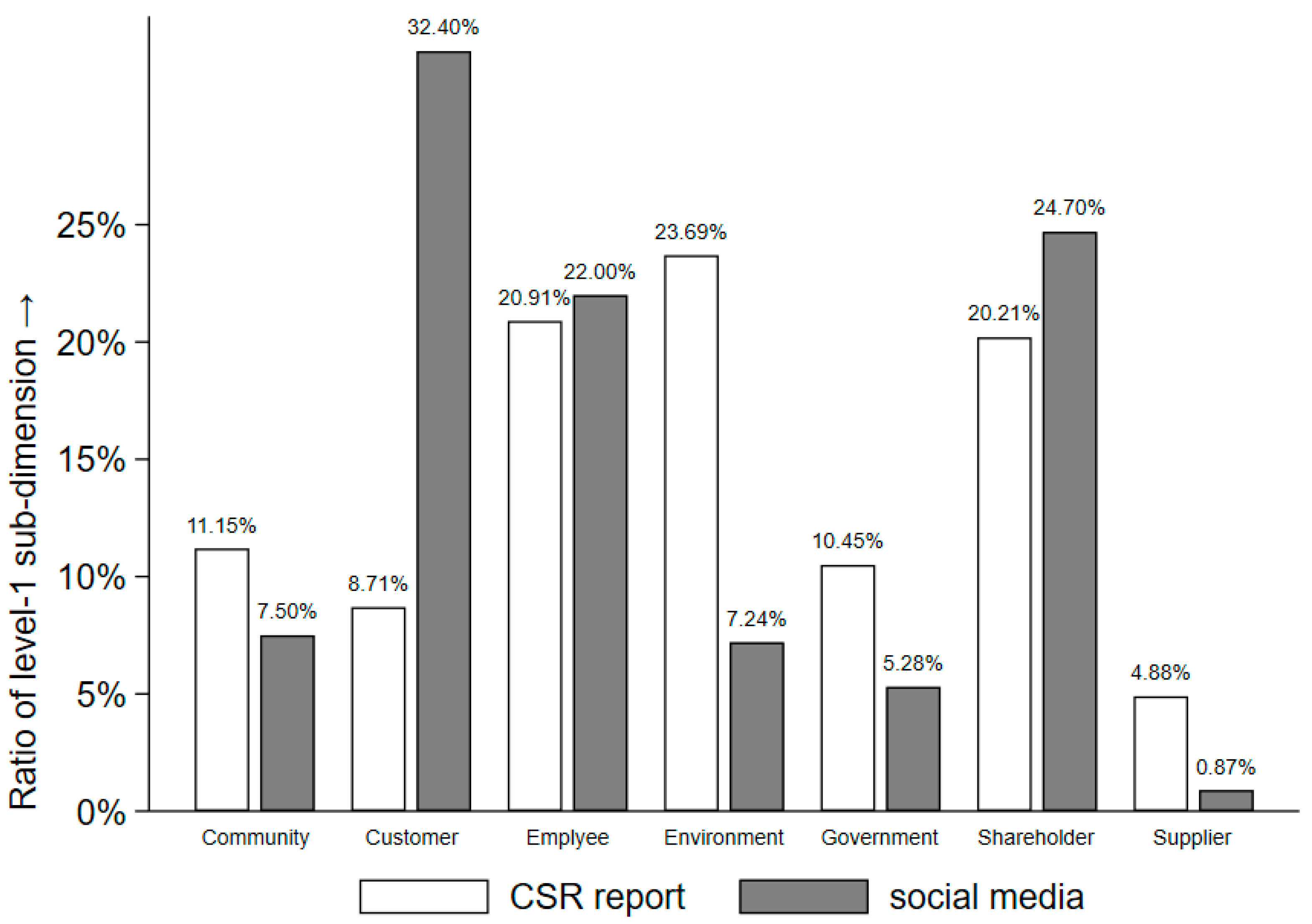
4.2.2. Comparison between CSR Disclosure under Social Media and CSR Reports
5. Discussion and Conclusions
Author Contributions
Funding
Institutional Review Board Statement
Data Availability Statement
Conflicts of Interest
Appendix A

| Level-1 Indicators. | Definitions | Level-2 Indicators | Definitions | Keywords for Identification | Examples of Scoring |
|---|---|---|---|---|---|
| EP | Environment Protection | EP1 | Environment management system | Environmental management objectives, environment protection certification for firms, low-carbon green certification and awards, building eco-industrial chains, et al. | Chenming Paper (000488) reported: “Chenming Group was the first in its industry to pass the ISO14001 environmental management system certification in China”. We marked 1 point for the EP1. |
| EP2 | Environmental impact assessment of new investment project | New construction projects are expected to reduce pollution emissions and are expected to improve the environment of a region, et al. | Yuntou Ecology (002200) reported: “After the project is completed, it can effectively collect and treat domestic sewage from the new urban area of Tonghai County, Xiushan Street, Jiulong Street, Sijie Town, and other areas, reducing the pollution caused by domestic sewage discharged directly into Qilu Lake”. We marked 1 point for the EP2. | ||
| EP3 | Forest biodiversity conservation | n. a. | n. a. | ||
| EP4 | Environment protection investment | Amount of investment in environmental protection projects, amount of investment in environmental protection projects, et al. | Chenming Paper (000488) reported: “We have invested more than 8 billion RMB in environmental protection projects, taking the green low-carbon cycle development path”. We marked 2 points for the EP4. | ||
| EP5 | Sustainable forest management | Conservation of forest resources, et al. | Yueyang Forest and Paper (600963) reported: “We placed the ‘first workshop’ in the forested hills to feed the forest with paper and promote paper with the forest to achieve the effect of flourishing forest and paper”. We marked 1 point for the EP5. | ||
| EP6 | Forest certification | Forest stewardship council, et al. | Sun Paper (002078) reported: “FSC-certified ‘ Happy Sunshine’ household paper received positive feedback from the public”. We marked 1 point for the EP6. | ||
| EP7 | The quantity, kind, and risk to human and environment of toxic or exhaust emission | Type or number of harmful substances emitted, et al. | Fenglin Group (601996) reported: “Exhaust gas and wastewater emissions are better than national standards, especially the particulate matter emission concentration is about 3.5mg/mL”. We marked 2 points for the EP7. | ||
| EP8 | Research, development, application, and sale of the environment production and devices | Opening and production of environmentally friendly products, application of environmental technology, renewal of environmental protection equipment, environmental certification of products, production of environmental protection, recycling of old furniture and other forest products, et al. | Chenming Paper (000488) reported: “The company is actively promoting the application of zero-water discharge technology and has visited several countries to learn about wastewater treatment and recycling technology”. We marked 1 point for the EP8. | ||
| EP9 | Energy resources conservation | Save heavy oil, save water, save electricity, save paper resources, et al. | Chenming Paper (000488) reported: “We are the first one in the industry to put into operation a water reuse project, with a reuse rate of over 40% and water consumption per ton of paper reduced to less than half of the international standard level”. We marked 2 points for the EP9. | ||
| EP10 | Reduce pollution and decrease drain | Reduction of carbon emissions, reduction of emissions of other gases and substances, reuse of waste, et al. | Yueyang Forest and Paper (600963) reported: “We made construction of deep sewage treatment upgrade project and fluidized bed boiler ultra-low emission project, with a significant reduction in sewage COD and nitrogen oxide emission concentration”. We marked 1 point for the EP10. | ||
| EP11 | Ecology restoration | Forest restoration, land loss reduction, ecological protection, et al. | Chenming Paper (000488) reported: “Retirement of the forest will have created 3.25 million mu of completed forest land all returned to Huanggang, not cutting a tree in the old areas, production of raw materials is imported wood chips”. We marked 2 points for the EP11. | ||
| EP12 | Volunteer working for environmental protection | External sanitation and cleaning work, tree planting activities, et al. | Fujian Jinsen (002679) reported: “When the 33rd International Volunteer Day, the Party Committee of Jinsen Group organized volunteers to carry out “clean up the home” environmental protection volunteer work in the co-construction community—Dongmen Community “. We marked 1 point for the EP12. | ||
| EP0 | Other environment-related | Green and sustainable development strategies, promotion of green and environmental protection concepts, environmental education, elimination of backward production capacity, et al. | Chenming Paper (000488) reported: “Chenming Group has eliminated 2.72 million tons of backward production capacity, with an elimination rate of 27%”. 2 points for the EP0. | ||
| CU | Customers | CU1 | Product quality management system | Quality supervision, measurement management system in production department, standardized operation, quality management system certification, FSC-COC chain-of-custody system certification, et al. | Sophia (002572) reported: “Sophia has got ISO 9001 quality management system certification multiple times”. We marked 1 point for the CU1. |
| CU2 | After-sale service system | Content of after-sales service, customer satisfaction, et al. | Sophia (002572) reported: “From the preparation of materials, the plate has been attached to the exclusive QR code, and this QR code will be the identity card of this piece of plate, and after that, sealing, punching, packaging, and other links, until the terminal sales, all the information of the original plate can be tracked at any time. This is more conducive to ensuring stable quality and good after-sales service”. We marked 1 point for the CU2. | ||
| CU3 | Dispute settlement mechanism | n. a. | n. a. | ||
| CU4 | Information provision of the product and services | Product exhibitions, marketing information, display and promotion of products and services and design concepts, product advertising information, et al. | Qumei Home Furnishings (603818) reported: “During the 3rd season of the national sofas sales promotion, Qumei’s new fashion series of sofa start from as low as 3999 RMB, with a variety of colors and moods for customers”. We marked 2 points for the CU4. | ||
| CU5 | Privacy protection of customer | n. a. | n. a. | ||
| CU6 | Forest products and other green marketing | Green communication, green marketing activities for forest products, et al. | Qumei Home Furnishings (603818) reported: “The national launch ceremony of Qumei Home furnishings’ ‘Trade-in’ sixth season large green series activities were successfully held at the ‘2018 Beijing International Home Furnishings Exhibition and Intelligent Life Festival’. Immediately afterward, the green life advocated by ‘Trade-in’ swept the country with a prairie momentum, and dealers in over 300 cities responded positively”. We marked 2 points for the CU6. | ||
| CU0 | Other customer-related | Customer relationship management activities, dealer conferences, customer visits and communications, customer evaluations of products or services, and other information on customer-related activities, et al. | Fujian Jinsen (002679) reported: “On the morning of August 3, in the 9th-floor conference room of Hua Hong Technology, the company’s fourth logging area timber production and sales tender will be successfully concluded. All the publicized bids were invited, with an area of 1522 m2 and a timber volume of 12,103 m3, and the bid amounted to 9.5 million RMB, an increase of 21.3% over the previous year”. We marked 2 points for the CU0. | ||
| EM | Employees | EM1 | Abidance by rule and laws | Enterprise compliance with labor laws, et al. | Minfeng Special Paper (600235) reported: “The third staff congress of the company was held in the East Conference Room of the Administration Building, and more than 110 staff representatives from all units and departments of the company attended the meeting. The General Assembly considered a new round of Collective Contract. Since the last round of Collective Contract was signed, the Company has been able to strictly implement the content of the terms and conditions of the contract, and no violation of the contract has occurred in the past three years”. We marked 2 points for the EM1. |
| EM2 | Percent of contract signing | n. a. | n. a. | ||
| EM3 | Coverage of social insurance | Employee social insurance, et al. | Yutong Technology (002831) reported: “Does the Yuxinyutong Personnel Workers Commercial Insurance take effect immediately after taking out the policy? Sickness death and total disability and critical illness are subject to a 30-day waiting period, and cases occurring within 30 days of enrollment will not be paid. Accidental death and disablement are effective immediately”. We marked 1 point for the EM3. | ||
| EM4 | Equal employment institution | Male and female employee ratio, et al. | Chenming Paper (000488) reported, “Chenming has more than 3160 female employees, accounting for 31% of the total staff”. We marked 2 points for the EM4. | ||
| EM5 | Staff development training | Staff training (skill-based), staff training seminars and events, et al. | Yutong Technology (002831) reported: “The Group’s Human Resources Management Center brought the course to Vietnam on August 24–August 25. Thirty-six grassroots management cadres (managers, section chiefs and reserve section chiefs) from Yutong Vietnam and Yuzhan Vietnam attended the training, with an attendance rate of 90%”. We marked 2 points for the EM5. | ||
| EM6 | Occupational health and safe producing | Improvement of work and production environment, employee medical check-ups, safety education and drills, safety hazard inspections, operational and production safety regulations, et al. | Mcc Meili Paper (000815) reported: “From April 2-4, Meili Cloud organized relevant leaders and safety managers, totaling 70 people, to conduct safety qualification certificate review and certification training at the Zhongwei Safety Production Training Center”. We marked 2 points for the EM6. | ||
| EM7 | Staff relation management | Commendation of employees, recruitment, senior management retirement, employee cultural and entertainment activities, employee care, condolence to employees, corporate culture construction, employee stock ownership, firm internal journals, et al. | Yuntou Ecology (002200) reported: “This staff sports game had 31 participating delegations, more than 860 athletes and 60 referees, as well as more than 100 staff performance teams and 60 volunteer teams, which was a high participation, high quality, and high-level sports event”. We marked 2 points for the EM7. | ||
| EM0 | Other employee-related | Promotion of academic qualifications, et al. | Fenglin Group (002078) reported: “Eleven employees of Fenglin factory were happy to get their Adult Education undergraduate certificates, and everyone happily took a group photo in front of the company”. We marked 2 points for the EM0. | ||
| SU | Suppliers | SU1 | Responsibility purchasing system | Responsible purchasing, et al. | Minfeng Special Paper (600235) reported: “The company sent an auditor to conduct a comprehensive audit of the purchasing, production, inventory and sales practices of FSC products produced by Minfeng Special Paper in the past year”. We marked 1 point for the SU1. |
| SU2 | Credit rating | n. a. | n. a. | ||
| SU3 | Contradict performance rate | n. a. | n. a. | ||
| SU4 | The openness of procurement policy | Number and amount of material procurement, procurement project signing ceremony, et al. | Chenming Paper (000488) reported: “The raw materials for the project are purchased and self-made cellulose-dissolving wood pulp. The purchased portion is procured uniformly in the market through the procurement channel of the group company; the self-made pulp is provided by the existing pulp-making project under construction, which has stable production and can ensure a reliable supply of fiber raw materials for the project”. We marked 1 point for the SU4. | ||
| SU5 | The legality of forest product procurement | Wood procurement information, paper procurement information, et al. | Mcc Meili Paper (000815) reported, “We expect to import about 15.5 million tons of waste paper for the year, down about 10 million tons from last year”. We marked 2 points for the SU5. | ||
| SU6 | Supplier qualification evaluation | Selection of high-quality suppliers, et al. | Sophia (002572) reported: “Mr. Jiang Ganjun, Chairman of the Board of Directors, Mr. Ke Jiansheng, President of the Company, and other senior executives presented awards to outstanding suppliers on behalf of the Company”. We marked 1 point for the SU6. | ||
| SU0 | Other supplier-related | Bidding information, supplier conferences, supplier relationship management, et al. | Sophia (002572) reported: “In 2018 Annual Sophia Home Supplier Conference, nearly 600 supplier representatives attended the conference to discuss how to cooperate closely with the upstream and downstream of the home furnishing industry in the context of the new era for win-win development”. We marked 2 points for the SU0. | ||
| CO | Community | CO1 | The effect of enterprise operation on community | Promotion of employment, poverty alleviation, disaster relief, product support for local, social public welfare activities, et al. | Chenming Paper (000488) reported, “Zhanjiang Chenming built the largest plant of new wall material in Zhanjiang City, all of which digests solid waste such as ash slag generated from power plants and uses it as raw material to produce lightweight bricks for sale to urban areas, supporting Zhanjiang’s urban construction”. We marked 1 point for the CO1. |
| CO2 | Staff localization policy | n. a. | n. a. | ||
| CO3 | Localization procurement policy | n. a. | n. a. | ||
| CO4 | Donations institution and amount | Donations institution and amount, et al. | Jingxing Paper (002067) reported: “Company Chairman Zhu Zailong donated RMB 600,000 to Zhang Lou Primary School on behalf of the company”. We marked 2 points for the CO4. | ||
| CO5 | The policy of support for volunteer activity | n. a. | n. a. | ||
| CO6 | The data of staff volunteer activity | Employee volunteer activity records, employee donations, and other employee volunteer activities, et al. | Sun Paper (002078) reported: “Chen Wenjun, the company’s vice president, took the lead in making donations for the disaster area, and more than 400 Sun people donated in order”. We marked 2 points for the CO6. | ||
| CO0 | Other community-related | Communication and cooperation with local educational institutions, cooperation with local NGOs, et al. | Sun Paper (002078) reported: “A group of 24 people from the School of Light Industry Science and Engineering of Shaanxi University of Science and Technology came to Shandong Sun Paper Co. for exchange and study”. We marked 2 points for the CO0. | ||
| GO | Government | GO1 | Enterprise management abided by rule | Policy support, response to policy calls, clean and anti-corruption, protection of intellectual property rights, et al. | Yueyang Forest and Paper (600963) reported, “Discipline Inspection Committee of Yueyang Forest and Pape issued the Notice on the Implementation Plan of Yueyang Forest and Paper’s 2018 ‘Anti-Corruption and Integrity Propaganda and Education Month’ Activities “. We marked 1 point for the GO1. |
| GO2 | Tax payment | Tax recognition, tax payment amount, et al. | Yinhua Lifestyle Technology (600978) reported: “Taxes paid are 2.1 billion RMB”. We marked 2 points for the GO2. | ||
| GO3 | Employment security policy | n. a. | n. a. | ||
| GO4 | Employment amount over the report periods | Number of employees in the enterprise, et al. | UE Furniture (603600) reports, “The company employs nearly 4500 people”. We marked 2 points for the GO4. | ||
| GO0 | Other government-related | Participation in local or national People’s Congress, communication and cooperation with the government, governmental officer visits, party organization building, party member activities, et al. | Yuntou Ecology (002200) reported, “On June 30, the Party Committee of Yuntou Ecology organized party education for all party members and cadres of the company to further strengthen their ideal beliefs and awareness of purpose and to remember the responsibilities and obligations of party members by watching the red movie ‘Unforgettable Years’ and revisiting the historical stories of party building during the Yan’an period”. We marked 1 point for the GO0. | ||
| SH | Shareholders | SH1 | Investor relation management | Holding of senior management meetings, executive appointments, general meeting of stockholders, corporate investment activities, mergers and acquisitions or creation of subsidiaries, formulation of corporate strategies, strategic cooperation between other enterprises, changes in corporate shares, changes on shareholder holdings, annual planning, financing activities such as issuance of bond, the shareholding of distributors, dividends, et al. | Chenming Paper (000488) reported: “Chenming will acquire 1.369 billion shares of Nanyue Bank with 2.546 billion RMB, accounting for 14.55% of the total share capital of Nanyue Bank, through a series of combined operations such as ‘Subscription to privately issued shares + Public purchase’ by its subsidiary”. We marked 2 points for the SH1. |
| SH2 | Growth potential | Project information, production capacity, sales growth, new production lines, technological breakthroughs, description of company status, company development history, talent reserves, et al. | Chenming Paper (000488) reported: “Zhanjiang Chenming invested a total of 26.5 billion yuan to build these four integrated pulp and paper production lines, of which the first phase production line and the fourth phase production line are the cultural paper production lines and white cardboard production lines with the widest paper width, the fastest speed, and the highest single-machine capacity in the world”. We marked 2 points for the SH2. | ||
| SH3 | Profitability | Financial indicators such as profit and operating income, brand value, et al. | Chenming Paper (000488) reported: “The project will achieve annual sales revenue of approximately RMB 9904 million and net profit of approximately RMB 1016 million upon completion”. We marked 2 points for the SH3. | ||
| SH4 | Safety | Safety of financing, safety of operation, Safety of production materials such as inventory, et al. | Guangdong Ganhua (000576) reported: “The diversified business model would also strengthen the company’s financial soundness, enhance the company’s anti-risk capability, and help protect the interests of the shareholders, especially the small and medium-sized shareholders”. We marked 1 point for the SH4. | ||
| SH0 | Other shareholder-related | Hold or participate in academic activities, external publicity of corporate culture, social interviews of executives, et al. | Yueyang Forest and Paper (600963) reported: “Yueyang Forest and Paper, upholding the essence of history and culture and shouldering the burden of sustainable development, gathered with nearly 400 partners to talk about the future”. We marked 2 points for the SH0. |
Appendix B
| ID | Firms | WeChat Name | Websites of the CSR Report |
|---|---|---|---|
| 000488 | Chenming Paper Group Co., Ltd. | 晨鸣集团 | |
| 000576 | Guangdong Ganhua Co., Ltd. | 广东甘化000576 | |
| 000815 | Mcc Meili Cloud Computing Industry Investment Co., Ltd. | 中冶美利云产业投资股份有限公司 | http://www.cninfo.com.cn/new/disclosure/detail?stockCode=000815&announcementId=1206091798&orgId=gssz0000815&announcementTime, accessed on 25 April 2019. |
| 000833 | Guangxi Guitang (Group) Co., Ltd. | 粤桂股份 | |
| 002067 | Zhejiang Jingxing Paper Co., Ltd. | 景兴纸业002067 | http://www.cninfo.com.cn/new/disclosure/detail?stockCode=002067&announcementId=1206113242&orgId=9900000601&announcementTime, accessed on 27 April 2019. |
| 002078 | Shandong Sun Paper Co., Ltd. | 山东太阳纸业股份有限公司 | http://www.cninfo.com.cn/new/disclosure/detail?stockCode=002078&announcementId=1206020135&orgId=9900001223&announcementTime, accessed on 16 April 2019. |
| 002200 | Yuntou Ecology Co., Ltd. | 云投生态 | |
| 002228 | Yueyang Forest and Paper Co., Ltd. | 合兴包装ips | |
| 002235 | Anne Co., Ltd. | 安妮股份 | |
| 002303 | Meiyingsen Group Co., Ltd. | 美盈森集团 | |
| 002521 | Qifeng New Material Co., Ltd. | 齐峰新材 | |
| 002572 | Sophia Household Co., Ltd. | 索菲亚家居 | http://www.cninfo.com.cn/new/disclosure/detail?stockCode=002572&announcementId=1205874312&orgId=9900019037&announcementTime, accessed on 5 March 2019. |
| 002679 | Fujian Jinsen Forestry Co., Ltd. | 福建金森集团 | |
| 002798 | D&O Home Collection Group Co., Ltd. | 帝王洁具monarch | |
| 002831 | Shenzhen YUTO Packaging Technology Co., Ltd. | 裕同科技 | |
| 002853 | Guangdong Piano Home Co., Ltd. | 皮阿诺家居 | |
| 600076 | Kangxin New Materials Co. Ltd. | 康欣新材料股份有限公司 | |
| 600235 | Minfeng Special Paper Co., Ltd. | 民丰特纸 | |
| 600321 | Rightway Holding Co., Ltd. | 正源股份 | |
| 600356 | Mudanjiang Hengfeng Paper Co., Ltd. | 牡丹江恒丰纸业股份有限公司 | http://www.cninfo.com.cn/new/disclosure/detail?stockCode=600356&announcementId=1206117239&orgId=gssh0600356&announcementTime, accessed on 27 April 2019. |
| 600433 | Guangdong Guanhao High-Tech Co., Ltd. | 广东冠豪高新技术股份有限公司 | http://www.cninfo.com.cn/new/disclosure/detail?stockCode=600433&announcementId=1205903842&orgId=gssh0600433&announcementTime, accessed on 18 March 2019. |
| 600963 | Yueyang Forest and Paper Co., Ltd. | 百年岳纸千载文章 | |
| 600978 | Yinhua Lifestyle Technology Co., Ltd. | 宜华生活创享优悦 | |
| 601996 | Guangxi Fenglin Wood Industry Co., Ltd. | 丰林集团 | http://www.fenglingroup.com/shzrbg/info_31.aspx?itemid=3137, accessed on 18 March 2019. |
| 603022 | Shanghai XTL Packaging Co., Ltd. | 新通联xtl | |
| 603165 | Rongsheng Environmental Protection Technology Co., Ltd. | 荣晟环保 | http://www.cninfo.com.cn/new/disclosure/detail?stockCode=603165&announcementId=1205931681&orgId=9900030004&announcementTime, accessed on 23 March 2019. |
| 603180 | Gold kitchen cabinet Home Technology Co., Ltd. | 金牌厨柜官方号 | |
| 603208 | Oupai Group Co., Ltd. | 欧派 | |
| 603226 | Vohringer Home Technology Co., Ltd. | 菲林格尔vohringer | CSR report provided by China Forest Products Industry Association |
| 603313 | Mlily Furniture Co., Ltd. | mlily梦百合 | |
| 603326 | OLO Furniture Co., Ltd. | olo我乐家居 | |
| 603389 | A-Zenith Furniture Co., Ltd. | a-zenith亚振 | |
| 603600 | UE Furniture Co., Ltd. | 永艺股份 | |
| 603801 | ZBOM Furniture Co., Ltd. | 志邦家居 | |
| 603816 | KUKA Home Co., Ltd. | 顾家家居 | http://www.cninfo.com.cn/new/disclosure/detail?stockCode=603816&announcementId=1206054348&orgId=9900027317&announcementTime, accessed on 19 April 2019. |
| 603818 | Qumei Home Furnishings Group Co., Ltd. | 曲美家居 | http://www.qumei.com/upload/files/2020/3/b259ecb270526e84.pdf, accessed on 19 April 2019. |
References
- UN. Available online: https://www.un.org/zh/desa/un-adopts-new-global-goals (accessed on 1 June 2022).
- Reinhard, A. Innovation Management and Corporate Social Responsibility; Springer Nature: Cham, Switzerland, 2019. [Google Scholar]
- Ghardallou, W.; Alessa, N. Corporate Social Responsibility and Firm Performance in GCC Countries: A Panel Smooth Transition Regression Model. Sustainability 2022, 14, 7908. [Google Scholar] [CrossRef] [Scilit]
- Ghardallou, W. Corporate Sustainability and Firm Performance: The Moderating Role of CEO Education and Tenure. Sustainability 2022, 14, 3513. [Google Scholar] [CrossRef] [Scilit]
- Campbell, J.L. Why would corporations behave in socially responsible ways? an institutional theory of corporate social responsibility. Acad. Manag. Rev. 2007, 32, 946–967. [Google Scholar] [CrossRef] [Scilit]
- Schröter, D.; Cramer, W.; Leemans, R.; Prentice, I.C.; Araújo, M.B.; Arnell, N.W.; Bondeau, A.; Bugmann, H.; Carter, T.R.; Gracia, C.A.; et al. Ecosystem Service Supply and Vulnerability to Global Change in Europe. Science 2005, 310, 1333–1337. [Google Scholar] [CrossRef] [Scilit] [PubMed]
- Davies, A.L. Long-term approaches to native woodland restoration: Palaeoecological and stakeholder perspectives on Atlantic forests of Northern Europe. Forest Ecol. Manag. 2011, 261, 751–763. [Google Scholar] [CrossRef] [Scilit]
- D Amato, D.; Li, N.; Rekola, M.; Toppinen, A.; Lu, F. Linking forest ecosystem services to corporate sustainability disclosure: A conceptual analysis. Ecosyst. Serv. 2015, 14, 170–178. [Google Scholar] [CrossRef] [Scilit]
- Korhonen, J.; Zhang, Y.; Toppinen, A. Examining timberland ownership and control strategies in the global forest sector. Forest Policy Econ. 2016, 70, 39–46. [Google Scholar] [CrossRef] [Scilit]
- Lu, F.; Wen, Z.; D’Amato, D.; Toppinen, A. Corporate Social Responsibility in the Wood-Based Panel Industry: Main Strategies from Four Enterprises in China. Forest Prod. J. 2018, 68, 163–171. [Google Scholar] [CrossRef] [Scilit]
- Amin, M.H.; Mohamed, E.K.A.; Elragal, A. CSR disclosure on Twitter: Evidence from the UK. Int. J. Account. Inf. Syst. 2021, 40, 100500. [Google Scholar] [CrossRef] [Scilit]
- She, C.; Michelon, G. Managing stakeholder perceptions: Organized hypocrisy in CSR disclosures on Facebook. Crit. Perspect. Account. 2019, 61, 54–76. [Google Scholar] [CrossRef] [Scilit]
- Elliott, W.B.; Grant, S.M.; Hodge, F.D. Negative News and Investor Trust: The Role of $Firm and #CEO Twitter Use. J. Account. Res. 2018, 56, 1483–1519. [Google Scholar] [CrossRef] [Scilit]
- Prokofieva, M. Twitter-Based Dissemination of Corporate Disclosure and the Intervening Effects of Firms’ Visibility: Evidence from Australian-Listed Companies. J. Inform. Syst. 2014, 29, 107–136. [Google Scholar] [CrossRef] [Scilit]
- Ettredge, M.; Richardson, V.J.; Scholz, S. Dissemination of information for investors at corporate Web sites. J. Account. Public Pol. 2002, 21, 357–369. [Google Scholar] [CrossRef] [Scilit]
- Rahman, A.R.; Debreceny, R.S. Institutionalized Online Access to Corporate Information and Cost of Equity Capital: A Cross-Country Analysis. J. Inform. Syst. 2013, 28, 43–74. [Google Scholar] [CrossRef] [Scilit]
- Xiao, J.Z.; Yang, H.; Chow, C.W. The determinants and characteristics of voluntary Internet-based disclosures by listed Chinese companies. J. Account. Public Pol. 2004, 23, 191–225. [Google Scholar] [CrossRef] [Scilit]
- Lyon, T.P.; Montgomery, A.W. Tweetjacked: The Impact of Social Media on Corporate Greenwash. J. Bus. Ethics 2013, 118, 747–757. [Google Scholar] [CrossRef] [Scilit]
- Zheng, B.; Liu, H.; Davison, R.M. Exploring the relationship between corporate reputation and the public’s crisis communication on social media. Public Relat. Rev. 2018, 44, 56–64. [Google Scholar] [CrossRef] [Scilit]
- Blankespoor, E.; Miller, G.S.; White, H.D. The Role of Dissemination in Market Liquidity: Evidence from Firms’ Use of Twitter™. Account. Rev. 2013, 89, 79–112. [Google Scholar] [CrossRef] [Scilit]
- Yang, J.H.; Liu, S. Accounting narratives and impression management on social media. Account. Bus. Res. 2017, 47, 673–694. [Google Scholar] [CrossRef] [Scilit]
- Ang, J.S.; Hsu, C.; Tang, D.; Wu, C. The Role of Social Media in Corporate Governance. Account. Rev. 2020, 96, 1–32. [Google Scholar] [CrossRef] [Scilit]
- Kesavan, R.; Bernacchi, M.D.; Mascarenhas, O.A. Word of mouse: CSR communication and the social media. Int. Manag. Rev. 2013, 9, 58–66. [Google Scholar]
- Manetti, G.; Bellucci, M. The use of social media for engaging stakeholders in sustainability reporting. Account. Audit. Account. J. 2016, 29, 985–1011. [Google Scholar] [CrossRef] [Scilit]
- Khanal, A.; Akhtaruzzaman, M.; Kularatne, I. The influence of social media on stakeholder engagement and the corporate social responsibility of small businesses. Corp. Soc. Responsib. Environ. Manag. 2021, 28, 1921–1929. [Google Scholar] [CrossRef] [Scilit]
- Lee, K.; Oh, W.; Kim, N. Social Media for Socially Responsible Firms: Analysis of Fortune 500’s Twitter Profiles and their CSR/CSIR Ratings. J. Bus. Ethics 2013, 118, 791–806. [Google Scholar] [CrossRef] [Scilit]
- Ahmad, N.; Naveed, R.T.; Scholz, M.; Irfan, M.; Usman, M.; Ahmad, I. CSR Communication through Social Media: A Litmus Test for Banking Consumers’ Loyalty. Sustainability 2021, 13, 2319. [Google Scholar] [CrossRef] [Scilit]
- Ali, I.; Jiménez-Zarco, A.I.; Bicho, M. Using Social Media for CSR Communication and Engaging Stakeholders; Emerald Group Publishing Limited: Bingley, UK, 2015; Volume 7, pp. 165–185. [Google Scholar] [CrossRef] [Scilit]
- Araujo, T.; Kollat, J. Communicating effectively about CSR on Twitter. Internet Res. 2018, 28, 419–431. [Google Scholar] [CrossRef] [Scilit]
- Fatma, M.; Ruiz, A.P.; Khan, I.; Rahman, Z. The effect of CSR engagement on eWOM on social media. Int. J. Organ. Anal. 2020, 28, 941–956. [Google Scholar] [CrossRef] [Scilit]
- Dutot, V.; Lacalle Galvez, E.; Versailles, D.W. CSR communications strategies through social media and influence on e-reputation. Manag. Dec. 2016, 54, 363–389. [Google Scholar] [CrossRef] [Scilit]
- Pizzi, S.; Moggi, S.; Caputo, F.; Rosato, P. Social media as stakeholder engagement tool: CSR communication failure in the oil and gas sector. Corp. Soc. Responsib. Environ. Manag. 2021, 28, 849–859. [Google Scholar] [CrossRef] [Scilit]
- Russo, S.; Schimperna, F.; Lombardi, R.; Ruggiero, P. Sustainability performance and social media: An explorative analysis. Meditari Account. Res. 2022, 30, 1118–1140. [Google Scholar] [CrossRef] [Scilit]
- Vidal, N.G.; Kozak, R.A. The recent evolution of corporate responsibility practices in the forestry sector. Int. For. Rev. 2008, 10, 1–13. [Google Scholar] [CrossRef] [Scilit]
- Colaço, R.; Simão, J. Disclosure of corporate social responsibility in the forestry sector of the Congo Basin. Forest Policy Econ. 2018, 92, 136–147. [Google Scholar] [CrossRef] [Scilit]
- D’Amato, D.; Korhonen, J.; Toppinen, A. Circular, Green, and Bio Economy: How Do Companies in Land-Use Intensive Sectors Align with Sustainability Concepts? Ecol. Econ. 2019, 158, 116–133. [Google Scholar] [CrossRef] [Scilit]
- Wang, L.; Juslin, H. Corporate Social Responsibility in the Chinese Forest Industry: Understanding Multiple Stakeholder Perceptions. Corp. Soc. Responsib. Environ. Manag. 2013, 20, 129–145. [Google Scholar] [CrossRef] [Scilit]
- Hansen, E.; Panwar, R.; Vlosky, R. The Global Forest Sector: Changes, Practices, and Prospects. Anesthesiology 2013, 21, 322. [Google Scholar]
- Panwar, R.; Hansen, E.; Kozak, R. Evaluating Social and Environmental Issues by Integrating the Legitimacy Gap With Expectational Gaps: An Empirical Assessment of the Forest Industry. Bus. Soc. 2012, 53, 853–875. [Google Scholar] [CrossRef] [Scilit]
- Li, N.; Toppinen, A.; Tuppura, A.; Puumalainen, K.; Hujala, M. Determinants of sustainability disclosure in the global forest industry. Electron. J. Bus. Ethics Organ. Stud. 2011, 16, 33–40. [Google Scholar]
- Lu, F.; Kozak, R.; Toppinen, A.; D Amato, D.; Wen, Z. Factors Influencing Levels of CSR Disclosure by Forestry Companies in China. Sustainability 2017, 9, 1800. [Google Scholar] [CrossRef] [Scilit]
- Lu, F.; Wang, Z.; Toppinen, A.; D Amato, D.; Wen, Z. Managerial Risk Perceptions of Corporate Social Responsibility Disclosure: Evidence from the Forestry Sector in China. Sustainability 2021, 13, 6811. [Google Scholar] [CrossRef] [Scilit]
- Deng, D.; Liu, L.Y.J.; Wen, S. The Impact of Accountability-Oriented Control Aspects of Variance Investigation on Budgetary Slack and Moderating Effect of Moral Development. Front. Psychol. 2020, 11, 583643. [Google Scholar] [CrossRef] [Scilit]
- Kassinis, G.; Panayiotou, A. Visuality as Greenwashing: The Case of BP and Deepwater Horizon. Organ. Environ. 2017, 31, 25–47. [Google Scholar] [CrossRef] [Scilit]
- Deng, D.; Li, C.; Zu, Y.; Liu, L.Y.J.; Zhang, J.; Wen, S. A Systematic Literature Review on Performance Evaluation of Power System From the Perspective of Sustainability. Front. Environ. Sci. 2022, 10, 914. [Google Scholar] [CrossRef] [Scilit]
| Variable | Level Annotation | Definition |
|---|---|---|
| Content variables for CSR disclosure on social media | ||
| WeChat_All | Summary of level-1 variable for social media | Total level of CSR disclosure on social media, equal to the sum of seven level-1 content variable for tweets. |
| ep_w | Level-1 variable for social media | The level of the social media environment dimension CSR disclosure, equal to the sum disclosure scores of all subdimensions of the environment on social media. |
| cu_w | Level-1 variable for social media | The level of the social media customer dimension CSR disclosure, equal to the sum disclosure scores of all subdimensions of the customer on social media. |
| em_w | Level-1 variable for social media | The level of the social media employee dimension CSR disclosure, equal to the sum disclosure scores of all subdimensions of the employee on social media. |
| su_w | Level-1 variable for social media | The level of the social media supplier dimension CSR disclosure, equal to the sum disclosure scores of all subdimensions of the supplier on social media. |
| co_w | Level-1 variable for social media | The level of the social media community dimension CSR disclosure, equal to the sum disclosure scores of all subdimensions of the community on social media. |
| go_w | Level-1 variable for social media | The level of the social media government dimension CSR disclosure, equal to the sum disclosure scores of all subdimensions of the government on social media. |
| sh_w | Level-1 variable for social media | The level of the social media shareholder dimension CSR disclosure, equal to the sum disclosure scores of all subdimensions of the shareholder on social media. |
| ep1_w/ep2_w/ep4_w/ep5_w/ep6_w/ep7_w/ep8_w/ep9_w/ep10_w/ep11_w/ep12_w/ep0_w | Level-2 variable for social media | The level of environment disclosure of the level-2 subdimension on social media, equal to the sum of the scores of the information of the level-2 subdimension of the environment. For example, the variable ep1_w is equal to the sum of the qualitative and quantitative scores of the level-2 subdimension indicator EP1 “Environment management system”. The description of the level-2 subdimension indicators are shown in |
| cu1_w/cu2_w/cu4_w/cu6_w/cu0_w | Level-2 variable for social media | The level of customer disclosure of the level-2 subdimension on social media, equal to the sum of the scores of the information of the level-2 subdimension of the customer. For example, the variable cu1_w is equal to the sum of the qualitative and quantitative scores of the level-2 subdimension indicator CU1 “Product quality management system”. The description of level-2 subdimension indicator are shown in |
| em1_w/em3_w/ep4_w/em5_w/ep6_w/ep7_w/em0_w | Level-2 variable for social media | The level of employee disclosure of the level-2 subdimension on social media, equal to the sum of the scores of the information of the level-2 subdimension of the employee. For example, the variable em1_w is equal to the sum of the qualitative and quantitative scores of the level-2 subdimension indicator EM1 “Abidance by rule and laws”. The description of level-2 subdimension indicators are shown in |
| su1_w/su4_w/su5_w/su6_w/su0_w | Level-2 variable for social media | The level of supplier disclosure of the level-2 subdimension on social media, equal to the sum of the scores of the information of the level-2 subdimension of the supplier. For example, the variable su1_w is equal to the sum of the qualitative and quantitative scores of the level-2 subdimension indicator SU1 “Responsibility purchasing system”. The description of level-2 subdimension indicators are shown in |
| co1_w/co4_w/co6_w/co0_w | Level-2 variable for social media | The level of community disclosure of the level-2 subdimension on social media, equal to the sum of the scores of the information of the level-2 subdimension of the community. For example, the variable co1_w is equal to the sum of the qualitative and quantitative scores of the level-2 subdimension indicator CO1 “The effect of enterprise operation on community”. The description of level-2 subdimension indicators are shown in |
| go1_w/go2_w/go4_w/go0_w | Level-2 variable for social media | The level of government disclosure of the level-2 subdimension on social media, equal to the sum of the scores of the information of the level-2 subdimension of the government. For example, the variable go1_w is equal to the sum of the qualitative and quantitative scores of the level-2 subdimension indicator GO1 “Enterprise management abided by rule”. The description of level-2 subdimension indicators are shown in |
| sh1_w/sh2_w/sh3_w/sh4_w/sh0_w | Level-2 variable for social media | The level of shareholder disclosure of the level-2 subdimension on social media, equal to the sum of the scores of the information of the level-2 subdimension of the shareholder. For example, the variable sh1_w is equal to the sum of the qualitative and quantitative scores of the level-2 subdimension indicator SH1 “Investor relation management”. The description of level-2 subdimension indicators are shown in |
| Content variables for CSR disclosure on CSR report | ||
| Report_All | Summary of level-1 variable for the CSR report | Total level of CSR disclosure on the CSR report, equal to the sum of the seven level-1 content variables for the CSR report. |
| ep_r | Level-1 variable for CSR report | The level of CSR report environment dimension CSR disclosure, equal to the sum disclosure scores of all subdimensions of the environment on social media. |
| cu_r | Level-1 variable for CSR report | The level of the CSR report customer dimension CSR disclosure, equal to the sum disclosure scores of all subdimensions of the customer on social media. |
| em_r | Level-1 variable for CSR report | The level of the CSR report employee dimension CSR disclosure, equal to the sum disclosure scores of all subdimensions of the employee on social media. |
| su_r | Level-1 variable for CSR report | The level of the CSR report supplier dimension CSR disclosure, equal to the sum disclosure scores of all subdimensions of the supplier on social media. |
| co_r | Level-1 variable for CSR report | The level of the CSR report community dimension CSR disclosure, equal to the sum disclosure scores of all subdimensions of the community on social media. |
| go_r | Level-1 variable for CSR report | The level of the CSR report government dimension CSR disclosure, equal to the sum disclosure scores of all subdimensions of the government on social media. |
| sh_r | Level-1 variable for CSR report | The level of the CSR report shareholder dimension CSR disclosure, equal to the sum disclosure scores of all subdimensions of the shareholder on social media. |
| Variable | N | Mean | Ratio | Sd | Min | P50 | Max | |
|---|---|---|---|---|---|---|---|---|
| (1) | WeChat_All | 36 | 103.3 | 100.00% | 97.87 | 2 | 72.5 | 470 |
| (2) | ep_w | 36 | 8.14 | 7.88% | 12.14 | 0 | 2 | 50 |
| (3) | cu_w | 36 | 27.06 | 26.20% | 39.61 | 0 | 8.5 | 171 |
| (4) | em_w | 36 | 24.42 | 23.64% | 40.2 | 0 | 5 | 218 |
| (5) | su_w | 36 | 0.64 | 0.62% | 1.33 | 0 | 0 | 6 |
| (6) | co_w | 36 | 5.17 | 5.00% | 6.35 | 0 | 3 | 27 |
| (7) | go_w | 36 | 8.78 | 8.50% | 14.17 | 0 | 3 | 67 |
| (8) | sh_w | 36 | 29.14 | 28.21% | 36.42 | 0 | 18.5 | 141 |
| Variable | N | Mean | Ratio | Sd | Min | P50 | Max | |
|---|---|---|---|---|---|---|---|---|
| (1) | ep_w | 36 | 8.14 | 100.00% | 12.14 | 0 | 2 | 50 |
| (2) | ep1_w | 36 | 0.67 | 8.23% | 1.2 | 0 | 0 | 5 |
| (3) | ep2_w | 36 | 0.08 | 0.98% | 0.5 | 0 | 0 | 3 |
| (4) | ep4_w | 36 | 1.25 | 15.36% | 3.15 | 0 | 0 | 12 |
| (5) | ep5_w | 36 | 0.14 | 1.72% | 0.59 | 0 | 0 | 3 |
| (6) | ep6_w | 36 | 0.19 | 2.33% | 0.52 | 0 | 0 | 2 |
| (7) | ep7_w | 36 | 0.11 | 1.35% | 0.4 | 0 | 0 | 2 |
| (8) | ep8_w | 36 | 2.19 | 26.90% | 3.4 | 0 | 1 | 12 |
| (9) | ep9_w | 36 | 0.72 | 8.85% | 2.01 | 0 | 0 | 11 |
| (10) | ep10_w | 36 | 0.94 | 11.55% | 2.29 | 0 | 0 | 10 |
| (11) | ep11_w | 36 | 0.28 | 3.44% | 0.74 | 0 | 0 | 3 |
| (12) | ep12_w | 36 | 0.42 | 5.16% | 1.13 | 0 | 0 | 6 |
| (13) | ep0_w | 36 | 1.14 | 14.00% | 2.18 | 0 | 0 | 10 |
| Variable | N | Mean | Ratio | Sd | Min | P50 | Max | |
|---|---|---|---|---|---|---|---|---|
| (1) | cu_w | 36 | 27.06 | 100.00% | 39.61 | 0 | 8.5 | 171 |
| (2) | cu1_w | 36 | 0.81 | 2.99% | 1.69 | 0 | 0 | 8 |
| (3) | cu2_w | 36 | 0.39 | 1.44% | 1.4 | 0 | 0 | 8 |
| (4) | cu4_w | 36 | 23.22 | 85.81% | 37.3 | 0 | 5 | 169 |
| (5) | cu6_w | 36 | 0.33 | 1.22% | 1.2 | 0 | 0 | 6 |
| (6) | cu0_w | 36 | 2.31 | 8.54% | 3.54 | 0 | 0.5 | 13 |
| Variable | N | Mean | Ratio | Sd | Min | P50 | Max | |
|---|---|---|---|---|---|---|---|---|
| (1) | em_w | 36 | 24.42 | 100.00% | 40.2 | 0 | 5 | 218 |
| (2) | em1_w | 36 | 0.08 | 0.33% | 0.37 | 0 | 0 | 2 |
| (3) | em3_w | 36 | 0.17 | 0.70% | 0.74 | 0 | 0 | 4 |
| (4) | em4_w | 36 | 0.06 | 0.25% | 0.33 | 0 | 0 | 2 |
| (5) | em5_w | 36 | 2.58 | 10.57% | 6.81 | 0 | 0 | 39 |
| (6) | em6_w | 36 | 3.19 | 13.06% | 6.06 | 0 | 0 | 31 |
| (7) | em7_w | 36 | 18.25 | 74.73% | 28.33 | 0 | 4.5 | 148 |
| (8) | em0_w | 36 | 0.08 | 0.33% | 0.37 | 0 | 0 | 2 |
| Variable | N | Mean | Ratio | Sd | Min | P50 | Max | |
|---|---|---|---|---|---|---|---|---|
| (1) | su_w | 36 | 0.64 | 100.00% | 1.33 | 0 | 0 | 6 |
| (2) | su1_w | 36 | 0.03 | 4.69% | 0.17 | 0 | 0 | 1 |
| (3) | su4_w | 36 | 0.14 | 21.88% | 0.42 | 0 | 0 | 2 |
| (4) | su5_w | 36 | 0.11 | 17.19% | 0.4 | 0 | 0 | 2 |
| (5) | su6_w | 36 | 0.03 | 4.69% | 0.17 | 0 | 0 | 1 |
| (6) | su0_w | 36 | 0.33 | 51.56% | 1.01 | 0 | 0 | 5 |
| Variable | N | Mean | Ratio | Sd | Min | P50 | Max | |
|---|---|---|---|---|---|---|---|---|
| (1) | co_w | 36 | 5.17 | 100.00% | 6.35 | 0 | 3 | 27 |
| (2) | co1_w | 36 | 3.31 | 64.02% | 4.08 | 0 | 2 | 14 |
| (3) | co4_w | 36 | 0.56 | 10.83% | 1.83 | 0 | 0 | 10 |
| (4) | co6_w | 36 | 0.67 | 12.96% | 1.41 | 0 | 0 | 6 |
| (5) | co0_w | 36 | 0.64 | 12.38% | 1.64 | 0 | 0 | 9 |
| Variable | N | Mean | Ratio | Sd | Min | P50 | Max | |
|---|---|---|---|---|---|---|---|---|
| (1) | go_w | 36 | 8.78 | 100.00% | 14.17 | 0 | 3 | 67 |
| (2) | go1_w | 36 | 1.86 | 21.18% | 3.21 | 0 | 0 | 13 |
| (3) | go2_w | 36 | 0.33 | 3.76% | 0.99 | 0 | 0 | 5 |
| (4) | go4_w | 36 | 0.11 | 1.25% | 0.46 | 0 | 0 | 2 |
| (5) | go0_w | 36 | 6.47 | 73.69% | 11.22 | 0 | 1.5 | 52 |
| Variable | N | Mean | Ratio | Sd | Min | P50 | Max | |
|---|---|---|---|---|---|---|---|---|
| (1) | sh_w | 36 | 29.14 | 100.00% | 36.42 | 0 | 18.5 | 141 |
| (2) | sh1_w | 36 | 4.56 | 15.65% | 7.58 | 0 | 2.5 | 42 |
| (3) | sh2_w | 36 | 12.89 | 44.23% | 16.59 | 0 | 7.5 | 68 |
| (4) | sh3_w | 36 | 2.86 | 9.81% | 4.52 | 0 | 1 | 20 |
| (5) | sh4_w | 36 | 1.56 | 5.35% | 3.36 | 0 | 0 | 13 |
| (6) | sh0_w | 36 | 7.28 | 24.98% | 10.06 | 0 | 4.5 | 41 |
| Variable | N | Mean | Ratio | Sd | Min | P50 | Max | |
|---|---|---|---|---|---|---|---|---|
| (1) | Report_All | 11 | 26.09 | 100% | 7.739 | 20 | 23 | 46 |
| (2) | ep_r | 11 | 6.18 | 23.69% | 3.156 | 2 | 5 | 12 |
| (3) | cu_r | 11 | 2.27 | 8.71% | 1.737 | 0 | 2 | 6 |
| (4) | em_r | 11 | 5.46 | 20.91% | 2.339 | 3 | 5 | 10 |
| (5) | su_r | 11 | 1.27 | 4.88% | 1.104 | 0 | 1 | 3 |
| (6) | co_r | 11 | 2.91 | 11.15% | 1.3 | 1 | 4 | 4 |
| (7) | go_r | 11 | 2.73 | 10.45% | 2.37 | 0 | 2 | 6 |
| (8) | sh_r | 11 | 5.27 | 20.21% | 2.453 | 2 | 6 | 8 |
Publisher’s Note: MDPI stays neutral with regard to jurisdictional claims in published maps and institutional affiliations. |
© 2022 by the authors. Licensee MDPI, Basel, Switzerland. This article is an open access article distributed under the terms and conditions of the Creative Commons Attribution (CC BY) license (https://creativecommons.org/licenses/by/4.0/).
Share and Cite
Zhong, M.; Lu, F.; Zhu, Y.; Chen, J. What Corporate Social Responsibility (CSR) Disclosures Do Chinese Forestry Firms Make on Social Media? Evidence from WeChat. Forests 2022, 13, 1842. https://doi.org/10.3390/f13111842
Zhong M, Lu F, Zhu Y, Chen J. What Corporate Social Responsibility (CSR) Disclosures Do Chinese Forestry Firms Make on Social Media? Evidence from WeChat. Forests. 2022; 13(11):1842. https://doi.org/10.3390/f13111842
Chicago/Turabian StyleZhong, Ma, Feifei Lu, Yunfu Zhu, and Jingru Chen. 2022. "What Corporate Social Responsibility (CSR) Disclosures Do Chinese Forestry Firms Make on Social Media? Evidence from WeChat" Forests 13, no. 11: 1842. https://doi.org/10.3390/f13111842
APA StyleZhong, M., Lu, F., Zhu, Y., & Chen, J. (2022). What Corporate Social Responsibility (CSR) Disclosures Do Chinese Forestry Firms Make on Social Media? Evidence from WeChat. Forests, 13(11), 1842. https://doi.org/10.3390/f13111842

