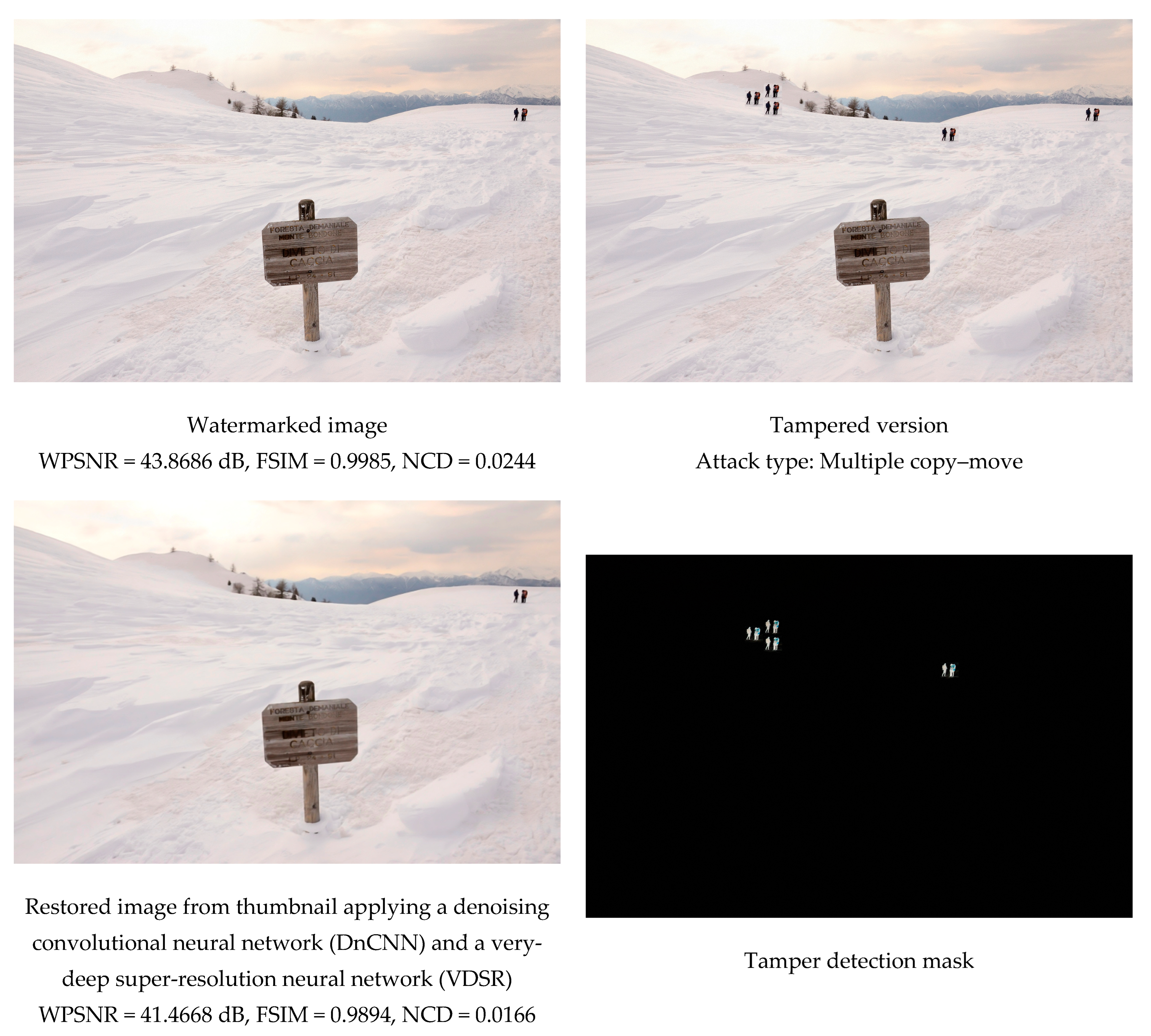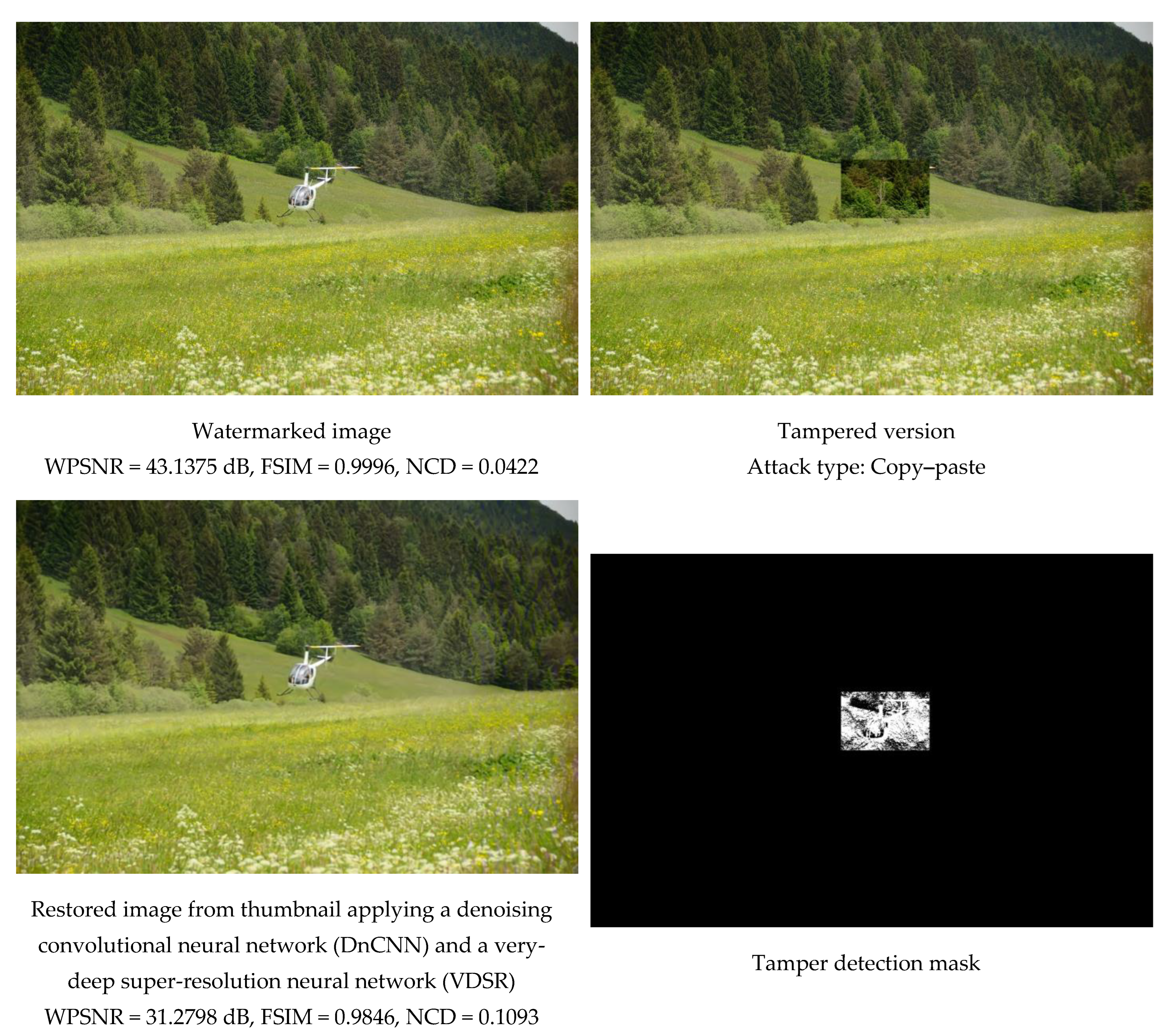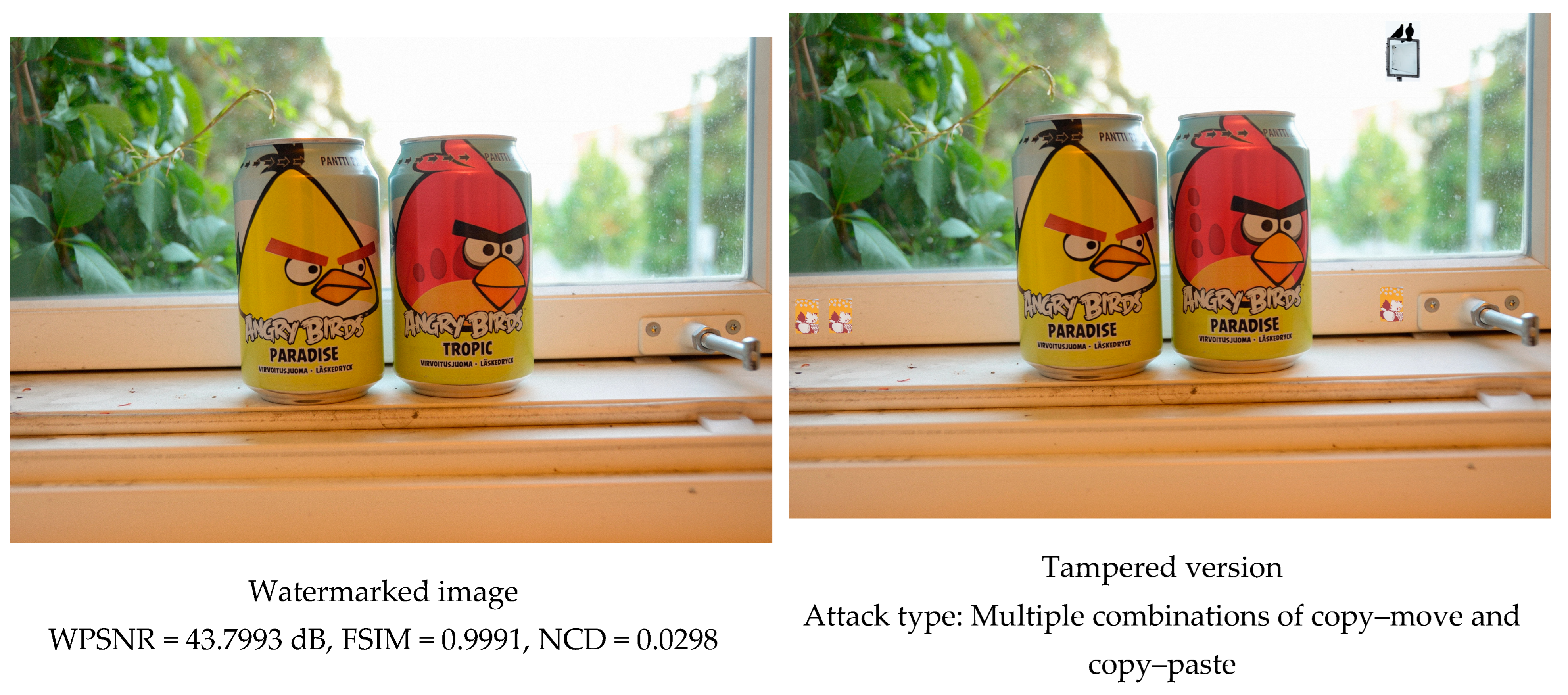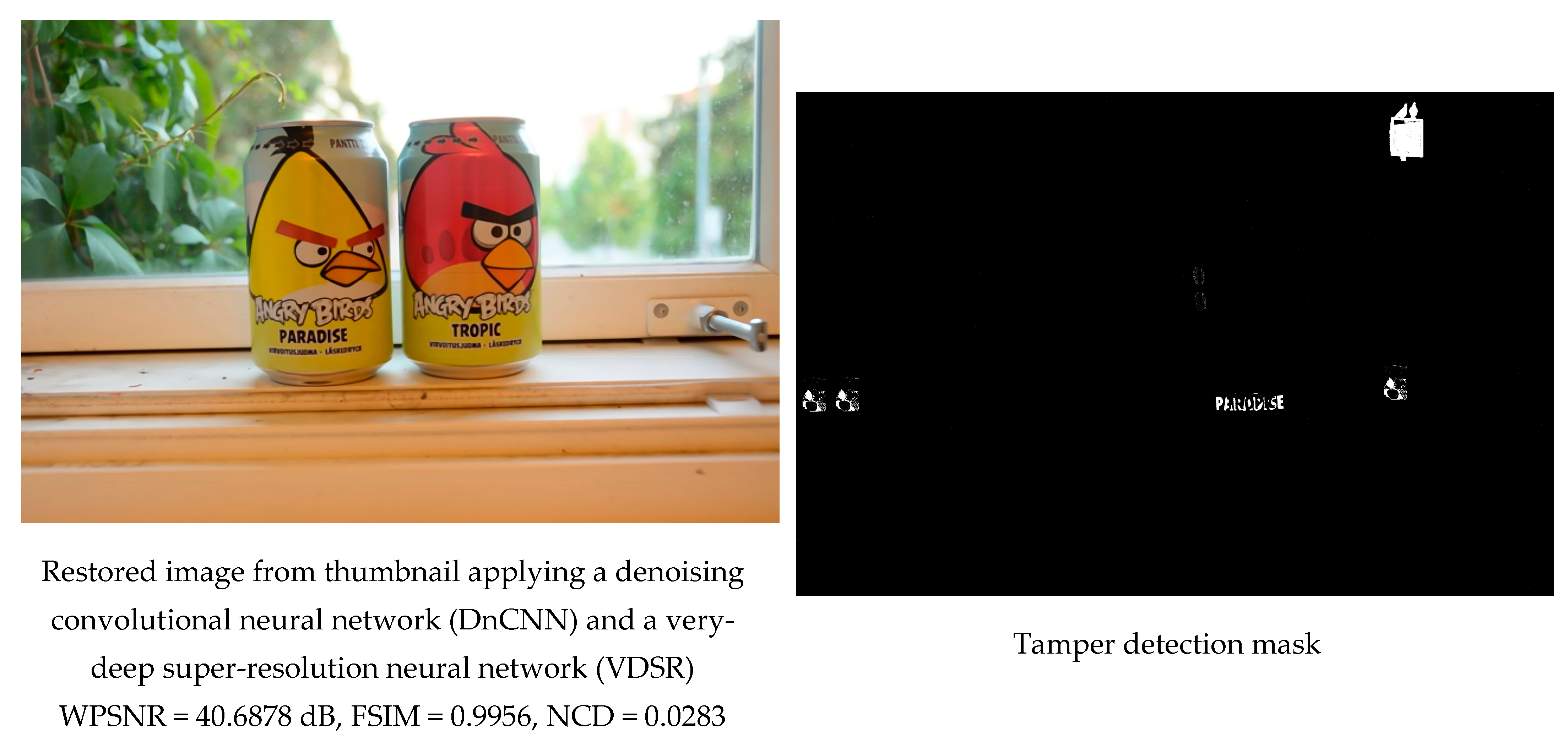


Semi-Fragile Watermarking Scheme for High-Resolution Color Images: Tamper Identification, Ownership Authentication, and Self-Recovery
 , ,
, ,  and
and
Abstract
1. Introduction
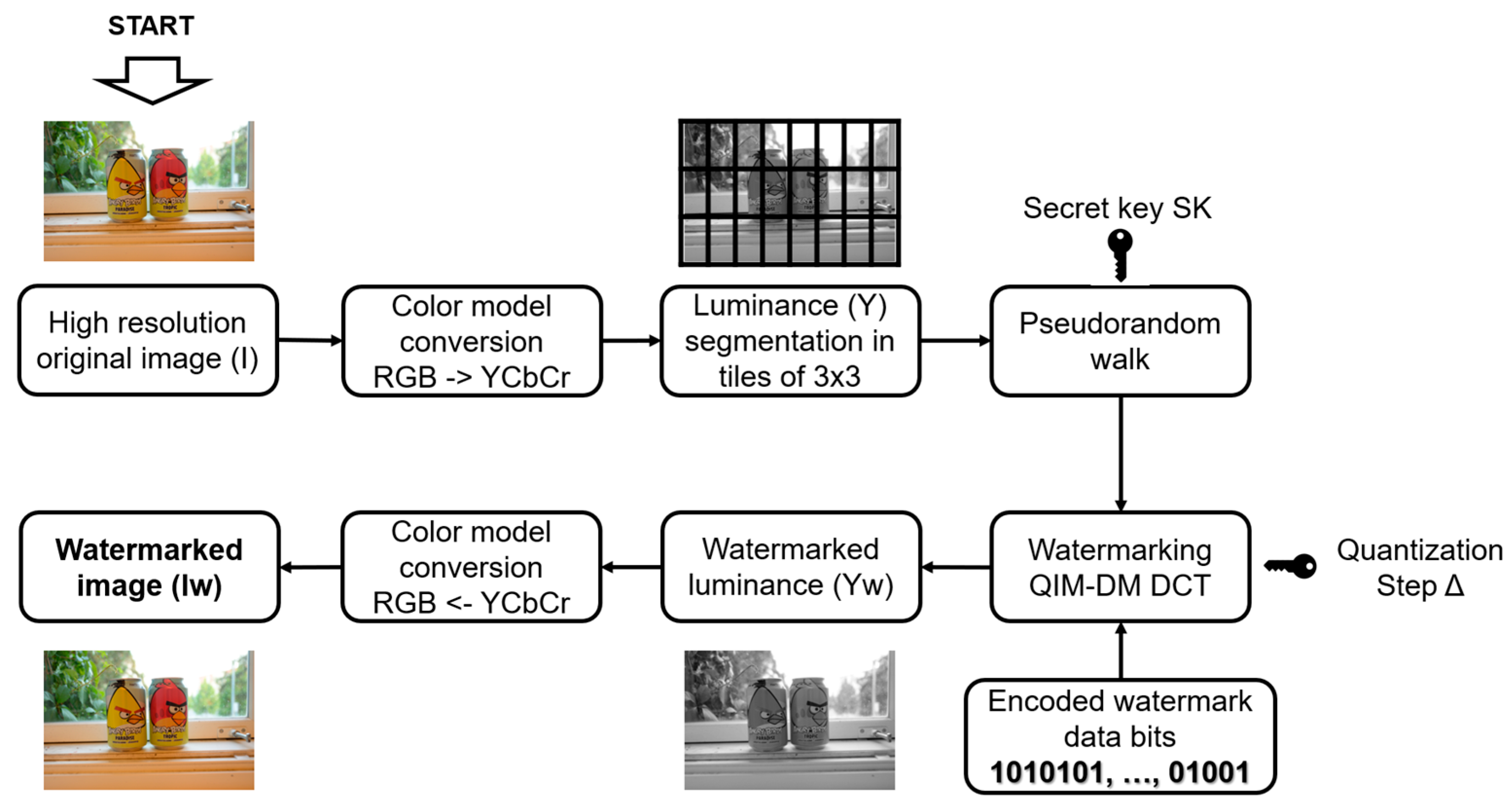
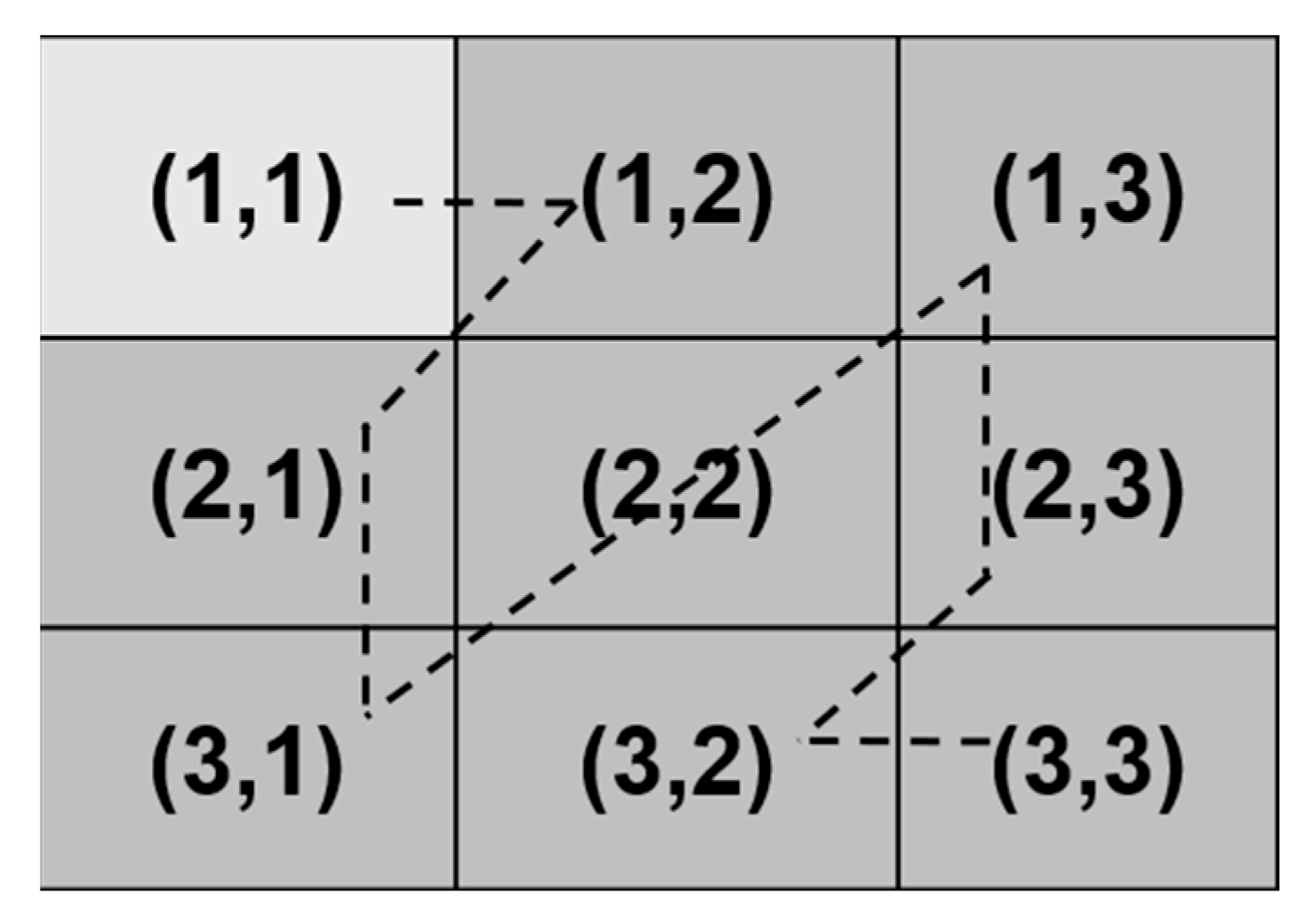
- The development of an embedding strategy that maximizes payload capacity while maintaining visual quality and improving resilience against JPEG lossy compression. This approach employs 3 × 3 2D-DCT blocks to encapsulate two bits of data within a pair of designated AC coefficients via QIM-DM.
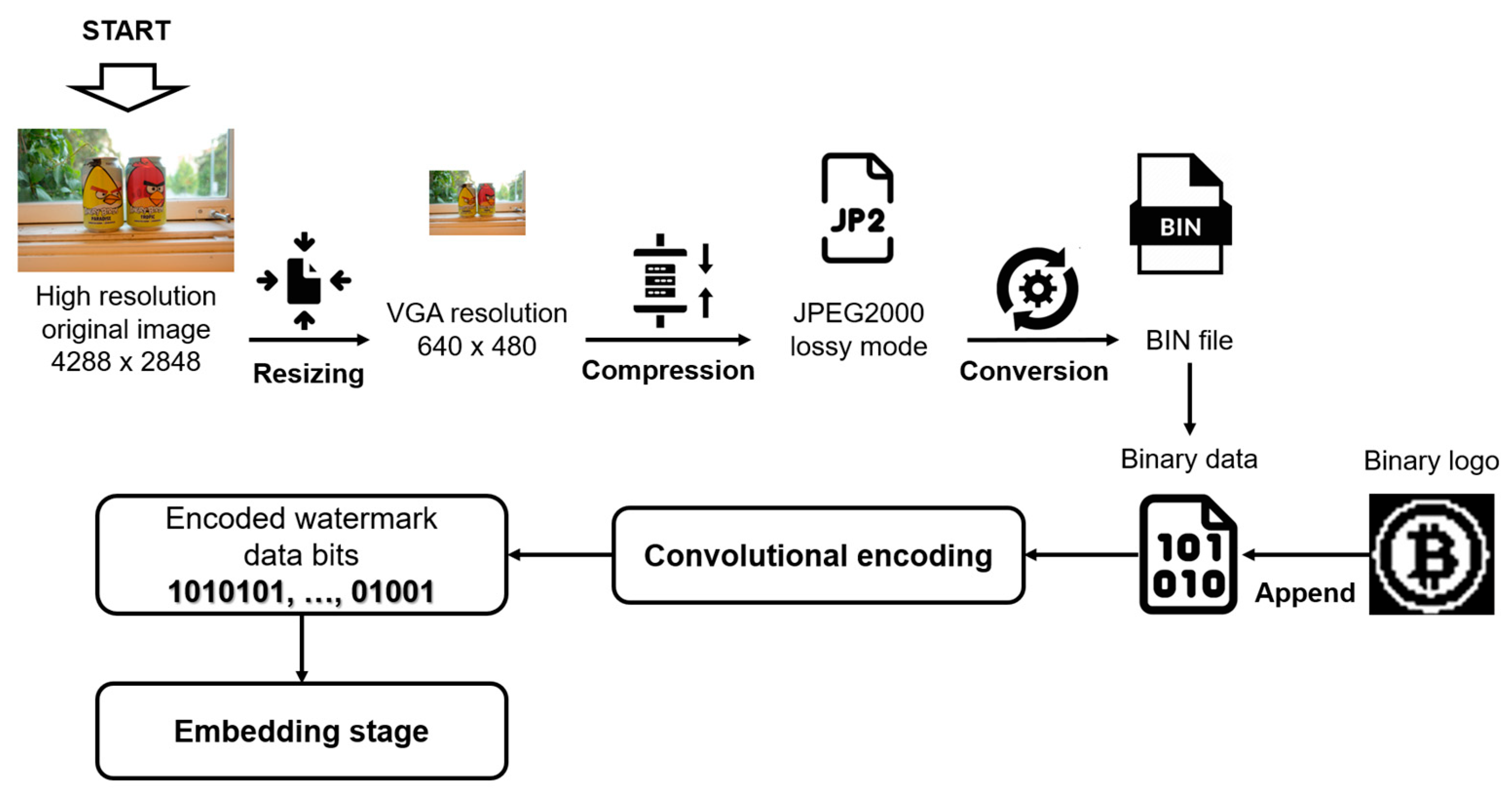
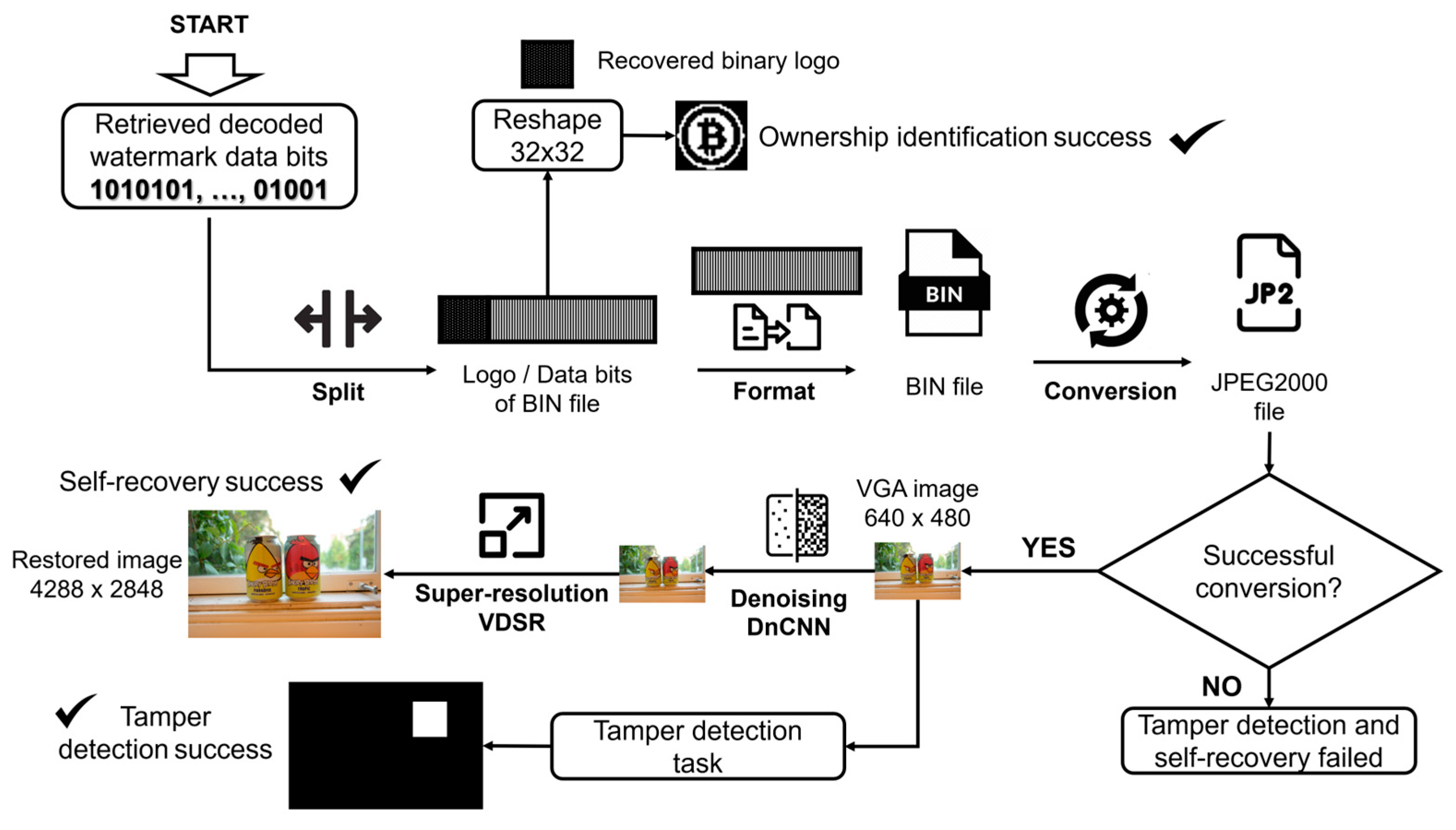
- The development of a specific criterion for generating thumbnail images that retains both the luminance and color fidelity of the source image. This criterion is based on the VGA standard resolution and utilizes the JPEG2000 lossy algorithm. The process enables us to minimize the payload required while simultaneously allowing for the restoration of the thumbnail image to its original spatial resolution. The DnCNN and VDSR neural network architectures support this approach, which aims to preserve an acceptable level of visual quality.
- Our proposal avoids implementing two separate watermarking algorithms, which is typical of hybrid methods that combine a robust watermarking algorithm with a fragile one to enhance their effectiveness. Instead, the proposed method utilizes a single semi-fragile watermarking technique to achieve ownership authentication, tamper detection, and self-recovery of content. This approach creates a unique watermark derived from the binary data of the logo and the binarization of the thumbnail image.
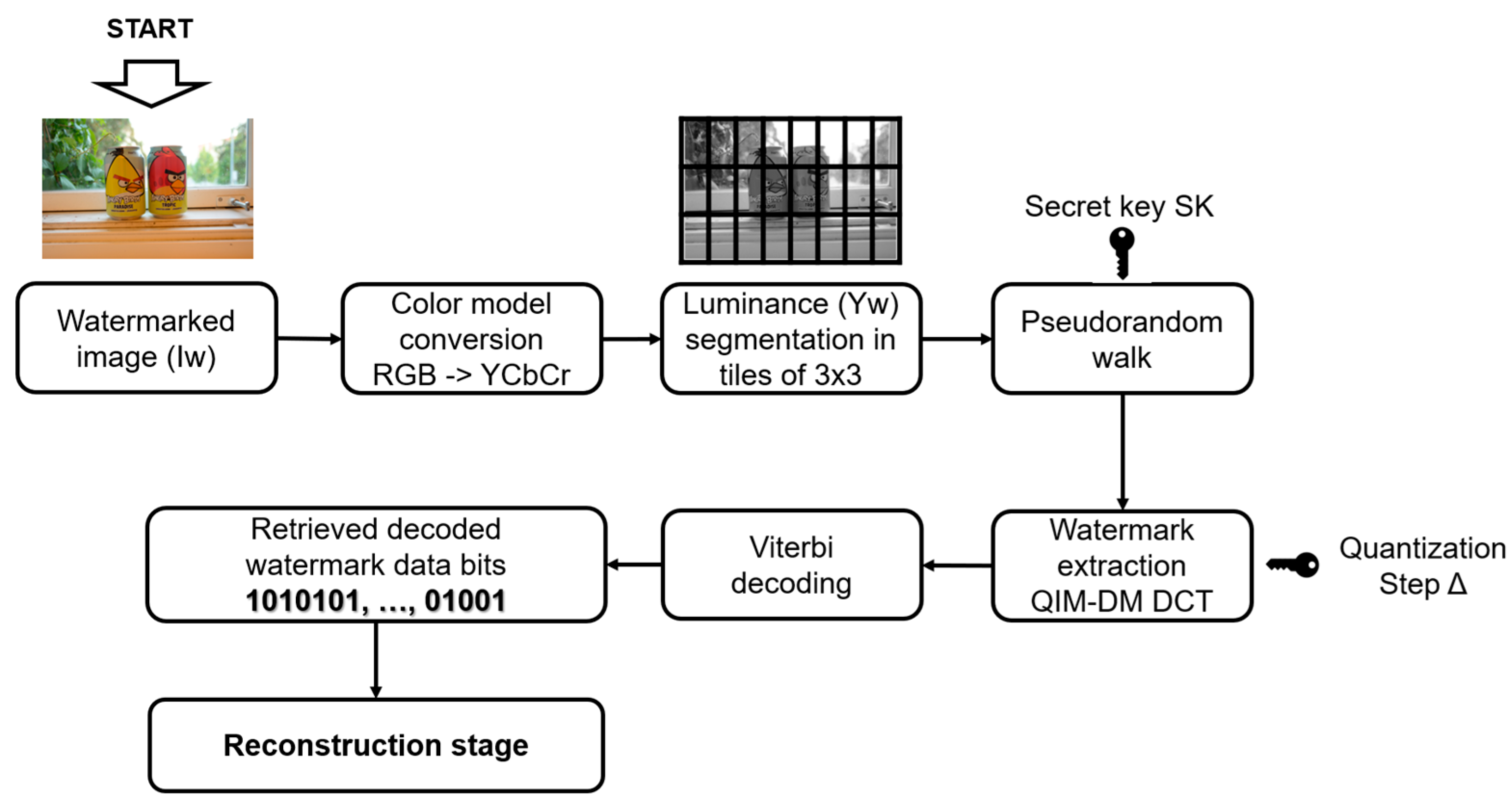
- The proposal employs convolutional encoding along with the Viterbi decoding algorithm to enhance robustness against cropping, copy–move, copy–paste, compression, filtering, and image noise corruption.
- The application is performed on high-resolution color images.
2. Related Works
3. Materials and Methods
3.1. Watermark Generation
3.2. Watermark Embedding
3.3. Watermark Extraction
3.4. Reconstruction of Watermark’s Information: Ownership Authentication, Tamper Detection, and Self-Recovery
4. Experimental Results
4.1. Experimental Setup
4.2. Parameter Settings
4.2.1. Setting the Size of DCT-Blocks and Selecting AC Coefficients
4.2.2. Setting of Image Resolution and JPEG2000 Compression Ratio to Thumbnail Image Design
4.2.3. Set of Quantization Step Δ
4.3. Imperceptibility Analysis
4.4. Robustness Analysis
4.5. Self-Recovery and Tamper Detection Analysis
4.6. Security Analysis
4.7. Performance Comparison
5. Conclusions and Future Directions
Author Contributions
Funding
Data Availability Statement
Acknowledgments
Conflicts of Interest
References
- Barni, M.; Bartolini, F. Applications. In Watermarking Systems Engineering: Enabling Digital Assets Security and Other Applications; CRC Press: Boca Raton, FL, USA, 2004. [Google Scholar] [CrossRef] [Scilit]
- Bas, P.; Furon, T.; Cayre, F.; Doërr, G.; Mathon, B. A quick tour of watermarking techniques. In Watermarking Security Fundamentals, Secure Design and Attacks; Springer: Berlin/Heidelberg, Germany, 2016; pp. 13–31. [Google Scholar] [CrossRef] [Scilit]
- Cox, I.J.; Miller, M.L.; Bloom, J.A.; Fridrich, J.; Kalker, T. Digital Watermarking and Steganography, 2nd ed.; Morgan Kaufmann Publishers: San Francisco, CA, USA, 2009. [Google Scholar] [CrossRef] [Scilit]
- Ji, L.; Kumar, S. Robust digital watermarking techniques for protecting copyright applied to digital data: A survey. Turk. J. Comput. Math. Educ. 2021, 12, 3819–3825. [Google Scholar] [CrossRef] [Scilit]
- Chennamma, H.R.; Madhushree, B. A comprehensive survey on image authentication for tamper detection with localization. Multimed. Tools Appl. 2023, 82, 1873–1904. [Google Scholar] [CrossRef] [Scilit]
- Madhushree, B.; Basanth Kumar, H.B.; Chennamma, H.R. An exhaustive review of authentication, tamper detection with localization and recovery techniques for medical images. Multimed. Tools Appl. 2024, 83, 39779–39821. [Google Scholar] [CrossRef] [Scilit]
- Zheng, L.; Zhang, Y.; Thing, V.L. A survey on image tampering and its detection in real-world photos. J. Vis. Commun. Image Represent. 2019, 58, 380–399. [Google Scholar] [CrossRef] [Scilit]
- Melman, A.; Evsutin, O. Methods for countering attacks on image watermarking schemes: Overview. J. Vis. Commun. Image 2024, 99, 104073. [Google Scholar] [CrossRef] [Scilit]
- Awasthi, D.; Tiwari, A.; Khare, P.; Srivastava, V.K. A comprehensive review on optimization-based image watermarking techniques for copyright protection. Expert Syst. Appl. 2024, 242, 122830. [Google Scholar] [CrossRef] [Scilit]
- Aminuddin, A.; Ernawan, F. AuSR1: Authentication and self-recovery using a new image inpainting technique with LSB shifting in fragile image watermarking. J. King Saud Univ.-Comput. Inf. Sci. 2022, 34, 5822–5840. [Google Scholar] [CrossRef] [Scilit]
- Azeroual, A.; Afdel, K. Real-time image tamper localization based on fragile watermarking and Faber-Schauder wavelet. AEU-Int. J. Electron. Commun. 2017, 79, 207–218. [Google Scholar] [CrossRef] [Scilit]
- Adi, P.W.; Sugiharto, A.; Hakim, M.M.; Setiadi, D.R.I.M.; Winarno, E. Efficient fragile watermarking for image tampering detection using adaptive matrix on chaotic sequencing. Intell. Syst. Appl. 2025, 26, 200530. [Google Scholar] [CrossRef] [Scilit]
- Bhalerao, S.; Ansari, I.A.; Kumar, A. A secure image watermarking for tamper detection and localization. J. Ambient Intell. Hum. Comput. 2021, 12, 1057–1068. [Google Scholar] [CrossRef] [Scilit]
- Bouarroudj, R.; Souami, F.; Bellala, F.Z.; Zerrouki, N.; Harrou, F.; Sun, Y. Secure and reversible fragile watermarking for accurate authentication and tamper localization in medical images. Comput. Electr. Eng. 2025, 123, 110072. [Google Scholar] [CrossRef] [Scilit]
- Singh, D.; Singh, S.K.; Udmale, S.S. An efficient self-embedding fragile watermarking scheme for image authentication with two chances for recovery capability. Multimed. Tools Appl. 2023, 82, 1045–1066. [Google Scholar] [CrossRef] [Scilit]
- Xia, X.; Zhang, S.; Wang, K.; Gao, T. A novel color image tampering detection and self-recovery based on fragile watermarking. J. Inf. Secur. Appl. 2023, 78, 103619. [Google Scholar] [CrossRef] [Scilit]
- Sivasubramanian, N.; Konganathan, G. A novel semi fragile watermarking technique for tamper detection and recovery using IWT and DCT. Computing 2020, 102, 1365–1384. [Google Scholar] [CrossRef] [Scilit]
- Benrhouma, O. Cryptanalysis and improvement of a semi-fragile watermarking technique for tamper detection and recovery. Multimed. Tools Appl. 2023, 82, 22149–22174. [Google Scholar] [CrossRef] [Scilit]
- Ouyang, J.; Huang, J.; Wen, X.; Shao, Z. A semi-fragile watermarking tamper localization method based on QDFT and multi-view fusion. Multimed. Tools Appl. 2023, 82, 15113–15141. [Google Scholar] [CrossRef] [Scilit]
- Nanammal, V.; Rajalakshmi, S.; Remya, V.; Ranjith, S. ViTU-net: A hybrid deep learning model with patch-based LSB approach for medical image watermarking and authentication using a hybrid metaheuristic algorithm. Comput. Biol. Med. 2025, 194, 110393. [Google Scholar] [CrossRef] [Scilit]
- Amrullah, A.; Ernawan, F.; Raffei, A.F.M.; Chuin, L.S. TDSF: Two-phase tamper detection in semi-fragile watermarking using two-level integer wavelet transform. Eng. Sci. Technol. Int. J. 2025, 61, 101909. [Google Scholar] [CrossRef] [Scilit]
- Vaidya, S.P.; Kandala, R.N.V.P.S.; Chandra Mouli, P.V.S.S.R.; Zaini, H.G.; Jaffar, A.; Paramasivam, P.; Ghoneim, S.S.M. A robust fragile watermarking approach for image tampering detection and restoration utilizing hybrid transforms. Sci. Rep. 2025, 15, 17645. [Google Scholar] [CrossRef] [Scilit]
- Tahaoglu, G.; Ustubioglu, B.; Ulutas, G.; Ulutas, M.; Nabiyev, V.V. Robust Copy-Move Forgery Detection Technique Against Image Degradation and Geometric Distortion Attacks. Wirel. Pers. Commun. 2023, 131, 2919–2947. [Google Scholar] [CrossRef] [Scilit]
- Ying, Q.; Hu, X.; Zhang, X.; Qian, Z.; Li, S.; Zhang, X. RWN: Robust Watermarking Network for Image Cropping Localization. In Proceedings of the 2022 IEEE International Conference on Image Processing (ICIP), Bordeaux, France, 16–19 October 2022; pp. 301–305. [Google Scholar] [CrossRef] [Scilit]
- Arevalo-Ancona, R.E.; Cedillo-Hernandez, M. Robust zero-watermarking based on dual branch neural network for ownership authentication, auxiliary information delivery and tamper detection. Egypt. Inform. J. 2025, 30, 100650. [Google Scholar] [CrossRef] [Scilit]
- Ramirez-Rodriguez, A.E.; Arevalo-Ancona, R.E.; Perez-Meana, H.; Cedillo-Hernandez, M.; Nakano-Miyatake, M. AISMSNet: Advanced Image Splicing Manipulation Identification Based on Siamese Networks. Appl. Sci. 2024, 14, 5545. [Google Scholar] [CrossRef] [Scilit]
- Lee, C.-W. A distortion-free authentication method for color images with tampering localization and self-recovery. Signal Process. Image Commun. 2024, 124, 117116. [Google Scholar] [CrossRef] [Scilit]
- Li, M.; Yue, Y. Security Analysis and Improvement of Dual Watermarking Framework for Multimedia Privacy Protection and Content Authentication. Mathematics 2023, 11, 1689. [Google Scholar] [CrossRef] [Scilit]
- Al-Otum, H.M.; Ellubani, A.A.A. Secure and effective color image tampering detection and self restoration using a dual watermarking approach. Optik 2022, 262, 169280. [Google Scholar] [CrossRef] [Scilit]
- Laishram, D.; Manglem Singh, K. A watermarking scheme for source authentication, ownership identification, tamper detection and restoration for color medical images. Multimed. Tools Appl. 2021, 80, 23815–23875. [Google Scholar] [CrossRef] [Scilit]
- Pal, P.; Jana, B.; Bhaumik, J. An Image Authentication and Tampered Detection Scheme Exploiting Local Binary Pattern Along with Hamming Error Correcting Code. Wirel. Pers. Commun. 2021, 121, 939–961. [Google Scholar] [CrossRef] [Scilit]
- Sharma, S.; Zou, J.J.; Fang, G. A Novel Multipurpose Watermarking Scheme Capable of Protecting and Authenticating Images with Tamper Detection and Localisation Abilities. IEEE Access 2022, 10, 85677–85700. [Google Scholar] [CrossRef] [Scilit]
- Sinhal, R.; Ansari, I.A. Multipurpose Image Watermarking: Ownership Check, Tamper Detection and Self-recovery. Circuits Syst. Signal Process. 2022, 41, 3199–3221. [Google Scholar] [CrossRef] [Scilit]
- Bei, Y.-L.; Zhu, X.-R.; Zhang, Q.; Qiao, S. A Robust Image Watermarking Algorithm Based on Content Authentication and Intelligent Optimization. In Proceedings of the 5th International Conference on Control and Computer Vision (ICCCV 2022), New York, NY, USA, 19–21 August 2022; Association for Computing Machinery: New York, NY, USA, 2022; pp. 164–170. [Google Scholar] [CrossRef] [Scilit]
- Meng, B.; Yuan, X. Robust and fragile watermarking for medical imaging. In Proceedings of the Sixteenth International Conference on Signal Processing Systems (ICSPS 2024), Kunming, China, 15–17 November 2024; SPIE: Washington, DC, USA, 2024; p. 135595. [Google Scholar] [CrossRef] [Scilit]
- Chen, B.; Wornell, G.W. Quantization index modulation: A class of provably good method for digital watermarking and information embedding. IEEE Trans. Inf. Theor. 2001, 47, 1423–1443. [Google Scholar] [CrossRef] [Scilit]
- Cedillo-Hernandez, M.; Cedillo-Hernandez, A.; Nakano-Miyatake, M.; Perez-Meana, H. Improving the management of medical imaging by using robust and secure dual watermarking. Biomed. Signal Process. Control 2020, 56, 101695. [Google Scholar] [CrossRef] [Scilit]
- Odenwalder, J.P. Optimal Decoding of Convolutional Codes. Ph.D. Dissertation, University of California, Los Angeles, CA, USA, 1970. [Google Scholar]
- Viterbi, A. Error bounds for convolutional codes and an asymptotically optimum decoding algorithm. IEEE Trans. Inf. Theory 1967, 13, 260–269. [Google Scholar] [CrossRef] [Scilit]
- Zhang, K.; Zuo, W.; Chen, Y.; Meng, D.; Zhang, L. Beyond a Gaussian Denoiser: Residual Learning of Deep CNN for Image Denoising. IEEE Trans. Image Process. 2017, 26, 3142–3155. [Google Scholar] [CrossRef] [Scilit]
- Grubinger, M.; Clough, P.; Müller, H.; Deselaers, T. The IAPR TC-12 Benchmark: A New Evaluation Resource for Visual Information Systems. In Proceedings of the OntoImage 2006 Language Resources for Content-Based Image Retrieval, Genoa, Italy, 22 May 2006; Volume 5, p. 10. Available online: http://www.lrec-conf.org/proceedings/lrec2006/workshops/W02/RealFinalOntoImage2006-2.pdf (accessed on 3 November 2025).
- Kim, J.; Lee, J.K.; Lee, K.M. Accurate Image Super-Resolution Using Very Deep Convolutional Networks. In Proceedings of the 2016 IEEE Conference on Computer Vision and Pattern Recognition (CVPR), Las Vegas, NV, USA, 27–30 June 2016; pp. 1646–1654. [Google Scholar] [CrossRef] [Scilit]
- He, K.; Zhang, X.; Ren, S.; Sun, J. Delving Deep into Rectifiers: Surpassing Human-Level Performance on ImageNet Classification. In Proceedings of the 2015 IEEE International Conference on Computer Vision (ICCV), Santiago, Chile, 13–16 December 2015; pp. 1026–1034. [Google Scholar] [CrossRef] [Scilit]
- Board, C.A. IEEE Standard for Camera Phone Image Quality. In IEEE Stdandard 1858-2016 (Incorporating IEEE Stdandard 1858-2016/Cor. 1-2017); IEEE: New York, NY, USA, 2017; pp. 1–146. [Google Scholar] [CrossRef] [Scilit]
- Taubman, D.S.; Marcellin, M.W. JPEG2000: Standard for interactive imaging. Proc. IEEE 2002, 90, 1336–1357. [Google Scholar] [CrossRef] [Scilit]
- Taubman, D.S.; Marcellin, M.W. Image Compression Fundamentals, Standards and Practice. In The Springer International Series in Engineering and Computer Science; Springer: New York, NY, USA, 2001; ISBN 978-0-7923-7519-7. [Google Scholar] [CrossRef] [Scilit]
- Gonzalez, R.C.; Woods, R.E. Digital Image Processing, 4th ed.; Pearson Education: New York, NY, USA, 2018; p. 1022p. [Google Scholar]
- Liang, Q.; Xiang, S. Invertible Color-to-Grayscale Conversion Using Lossy Compression and High-Capacity Data Hiding. IEEE Trans. Circuits Syst. Video Technol. 2022, 32, 7373–7385. [Google Scholar] [CrossRef] [Scilit]
- Fragoso-Navarro, E.; Garcia-Ugalde, F.; Cedillo-Hernandez, M. Improved protection for colour images via invertible colour-to-grey, image distortion, and visible-imperceptible watermarking. IET Image Process. 2024, 18, 3854–3863. [Google Scholar] [CrossRef] [Scilit]
- Dang-Nguyen, D.-T.; Pasquini, C.; Conotter, V.; Boato, G. RAISE—A Raw Images Dataset for Digital Image Forensics; ACM Multimedia Systems; MMSys ’15. In Proceedings of the 6th ACM Multimedia Systems Conference, Portland, OR, USA, 18–20 March 2015; pp. 219–224. [Google Scholar] [CrossRef] [Scilit]
- Moldovanu, S.; Michis, F.A.; Moraru, L. An invisible DWT watermarking algorithm using noise removal with application to dermoscopic images. J. Phys. Conf. Ser. 2021, 1730, 012010. [Google Scholar] [CrossRef] [Scilit]
- Sara, U.; Akter, M.; Uddin, M.S. Image Quality Assessment through FSIM, SSIM, MSE and PSNR—A Comparative Study. J. Comput. Commun. 2019, 7, 8–18. [Google Scholar] [CrossRef]
- Chang, H.-A.; Chen, H.H. Stochastic Color Interpolation for Digital Cameras. IEEE Trans. Circuits Syst. Video Technol. 2007, 17, 964–973. [Google Scholar] [CrossRef] [Scilit]
- Control Random Number Generator, Matlab Help Center. Available online: https://mathworks.com/help/matlab/ref/rng.html (accessed on 17 December 2025).



| Work | Features | Year | Description |
|---|---|---|---|
| [17,18] | Modality: Semi-fragile Purpose: Tamper detection with recovery capability | 2020, 2023 | The work described in [17] refers to a semi-fragile watermarking method that utilizes the frequency domain (Discrete Cosine Transform (DCT) and Integer Wavelet Transform (IWT)). The system employs a dual-watermarking approach for content authentication and recovery. Specifically, the authentication watermark is embedded within the IWT domain to create the final watermarked image, whereas the recovery data is generated and hidden within the DCT domain. As stated by the authors in [17], performance was evaluated using Normalized Hamming Similarity (NHS) and counterfeit detection mapping to identify manipulations. The work presented in [18] offers a security analysis of [17], identifying several vulnerabilities and demonstrating successful cryptanalysis. In this context, the findings in [18] build upon those of [17] by addressing the security vulnerabilities linked to the use of chaotic maps, which exploit their pseudo-random properties. The method outlined in [18] was tested against various tampering attacks and, according to the authors, shows high effectiveness in both tamper detection and image recovery. Both methodologies were assessed using grayscale images with dimensions of 512 by 512 pixels. |
| [19] | Modality: Semi-fragile Purpose: Tamper localization | 2023 | The work in [19] describes a semi-fragile watermarking technique designed for forgery localization. This method incorporates the Quaternion Discrete Fourier Transform (QDFT) alongside multi-view fusion. It involves embedding two distinct watermark signals within the QDFT domain: one to improve resilience against geometric distortions and the other to safeguard the image’s original content. The authors report that this approach improves counterfeit localization by an average of 11.17% compared to existing methods. Validation of this technique was performed using the CASIA v1.0 dataset, the RAISE dataset, and ten standard 512 × 512 color image pairs. |
| [21] | Modality: Semi-fragile Purpose: Tamper detection with recovery capability | 2025 | This research introduces a two-stage method for tamper detection that uses a two-level IWT decomposition, an exclusive-OR logical operation, and Least Significant Bit (LSB) substitution to ensure highly precise localization of alterations. The first phase involves inspecting four distinct segments to identify any modified bits; a segment is flagged if even one bit has been tampered with. The second phase then confirms which of these flagged segments have indeed been altered. The authors also use Normalized Hamming Similarity (NHS) to distinguish between intentional (malicious) and accidental data modifications. Lost content is recovered using an image inpainting technique. This method demonstrated a tamper detection accuracy of roughly 98.3% during object manipulation tests, where the tampering rate was approximately 12.1%. The experimental set consisted of fifteen 512 × 512 grayscale images. |
| [22] | Modality: Robust-fragile Purpose: Ownership authentication and tamper detection with recovery capability | 2025 | A novel hybrid scheme that combines robust and fragile watermarking for ownership verification is presented in [22]. This technique uses small, 128 × 128-pixel watermarks, which are embedded into 4 × 4 blocks of the Discrete Wavelet Transform (DWT) coefficients. To enhance the recovery stage, K-means clustering is applied to process every 2 × 2 sub-block of the image. The fragile watermarking combines Schur decomposition, authenticated block bits, and LSB replacement to embed both authentication and recovery data directly into the original image’s spatial domain. The authors contend that this integration is essential for efficient forgery detection, as established dependencies among blocks facilitate more precise tampering localization. Furthermore, the K-means algorithm improves the recovery performance and achieves better results in manipulation detection and image restoration. Experiments were conducted using fifteen 512 × 512 grayscale images. |
| [25] | Modality: Robust zero-watermarking Purpose: Ownership authentication, auxiliary information delivery, and tamper detection | 2025 | In [25], the authors propose a robust zero-watermarking technique that employs a dual-branch neural network for ownership verification, integrates auxiliary data, and localizes tampering. The system generates three distinct zero-watermarking codes: a binary logo for proving ownership, a QR code for embedding supplementary information, and a halftone version of the original image for counterfeit detection. A key advantage of this method is the complete preservation of the original image. It demonstrates strong resilience against common geometric distortions, signal processing attacks, and complex hybrid attacks, achieving high performance metrics where the Bit Error Rate (BER) is low, and the Normalized Correlation (NC) is near or equal to 1. Across multiple benchmarks, including the MIC-F2000, Realistic Tampering, Columbia, CASIA V2, and a Custom High-Resolution Database, the reported average tamper detection accuracy is 98.7% or greater. |
| [27] | Modality: Robust zero-watermarking Purpose: Tampering localization with self-recovery | 2024 | This study introduces a zero-watermarking technique for color images focused on tamper detection and self-recovery. The method integrates secret sharing, data compression, and image interpolation. It relies on authentication signals, which perform both detection and recovery functions, utilizing a (k, n) threshold scheme. The secret shares are randomly hidden within the alpha channel of the original image, which is stored in the Portable Network Graphics (PNG) format. The authors assert that these authentication signals are effective not only for identifying tampered blocks but also for determining the precise colors within a defined palette required to restore the corrupted image block. The experimental validation employed color images with dimensions of 550 × 322 and 512 × 512 pixels. |
| Average Total Amount of Encoded Watermark Data Bits We in All Images into Dataset | Total Capacity Block Segmentation 8 × 8 4 Bits Concealed per Block | Total Capacity Block Segmentation 3 × 3 2 Bits Concealed per Block |
|---|---|---|
| 2,198,128 bits | 763,264 bits | 2,713,827 bits |
| Average Total Amount of Encoded Watermark We in All Images into Dataset | Average Visual Quality After Reconstruction Procedure WPSNR (dB) | |||||
|---|---|---|---|---|---|---|
| Total Capacity of Proposed Method | HD (1280 × 720) | VGA (640 × 480) | CIF (352 × 288) | HD (1280 × 720) | VGA (640 × 480) | CIF (352 × 288) |
| = 2,713,827 bits | 6,610,063 Bits | 2,198,128 bits | 720,077 bits | 39.82 dB | 34.56 dB | 31.60 dB |
| Average Total Amount of Encoded Watermark We in All Images into Dataset | Average Visual Quality After Reconstruction Procedure WPSNR (dB) | |||||
|---|---|---|---|---|---|---|
| Total Capacity of Proposed Method | JPEG2000 Compression Ratio 1:5 | JPEG2000 Compression Ratio 1:10 | JPEG2000 Compression Ratio 1:15 | JPEG2000 Compression Ratio 1:5 | JPEG2000 Compression Ratio 1:10 | JPEG2000 Compression Ratio 1:15 |
| 2,713,827 bits | 4,293,292 bits | 2,198,128 bits | 1,464,463 bits | 34.65 dB | 34.56 dB | 34.24 dB |
| WPSNR (dB) | FSIM | NCD | ||||||||||
|---|---|---|---|---|---|---|---|---|---|---|---|---|
| Step ∆ | Median | Quartiles | Whiskers | Outliers | Median | Quartiles | Whiskers | Outliers | Median | Quartiles | Whiskers | Outliers |
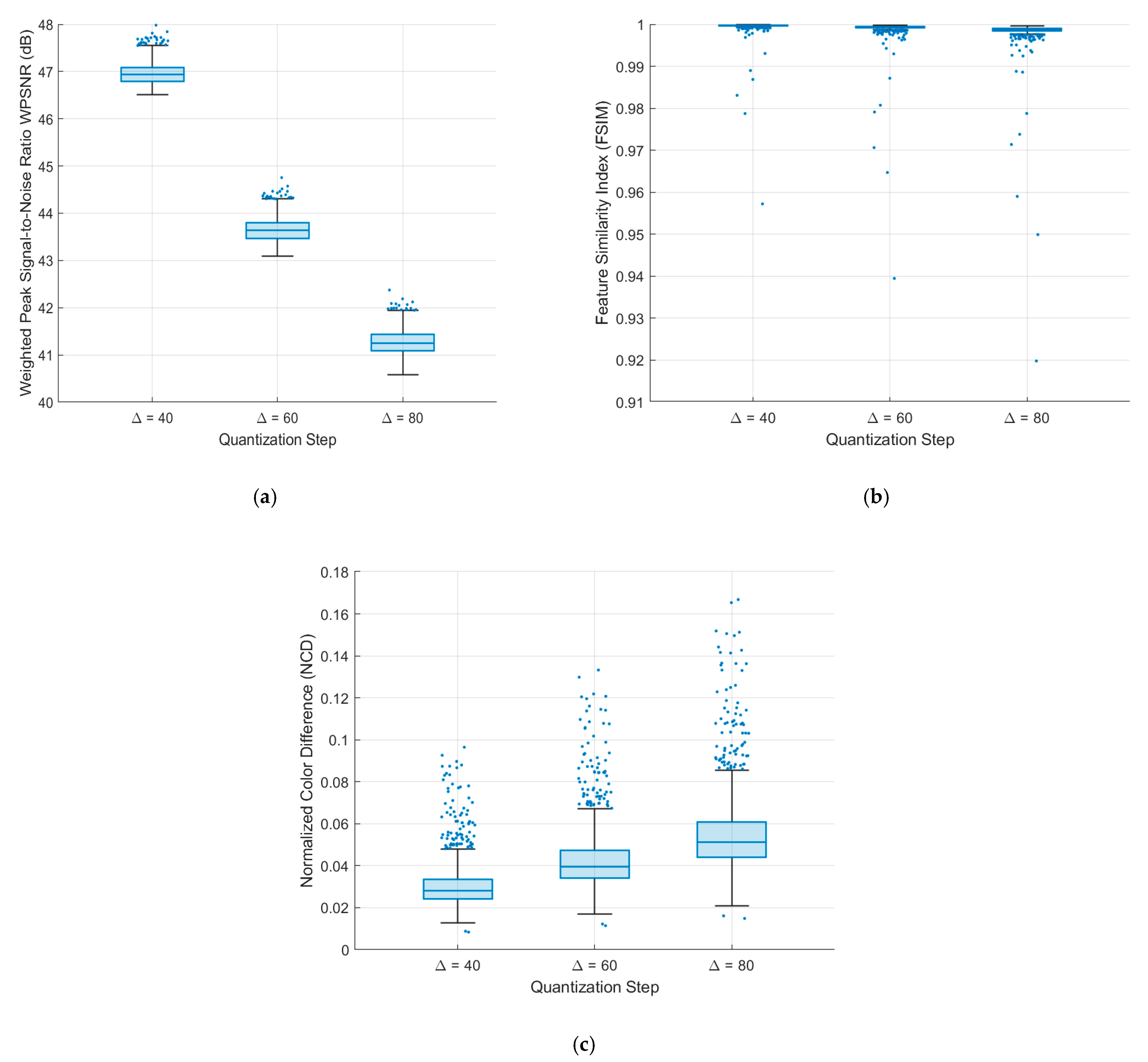
| 40 | 46.94 | 46.79 47.09 | 46.51 47.55 | 27 | 0.9997 | 0.9996 0.9998 | 0.9994 0.9999 | 72 | 0.02808 | 0.02411 0.03365 | 0.01287 0.04794 | 85 |
| 60 | 43.64 | 43.46 43.80 | 43.10 44.30 | 23 | 0.9993 | 0.9992 0.9995 | 0.9987 0.9998 | 66 | 0.03960 | 0.03405 0.04734 | 0.01693 0.06720 | 81 |
| 80 | 41.26 | 41.09 41.43 | 40.58 41.94 | 17 | 0.9988 | 0.9985 0.9990 | 0.9976 0.9997 | 63 | 0.05114 | 0.04413 0.06071 | 0.02092 0.08543 | 83 |
| Parameter | Value |
|---|---|
| Binary logo | 32 × 32 pixels in size |
| Spatial resolution of thumbnail | VGA (640 × 480) |
| JPEG2000 compression ratio of thumbnail | Lossy compression, ratio 1:10 |
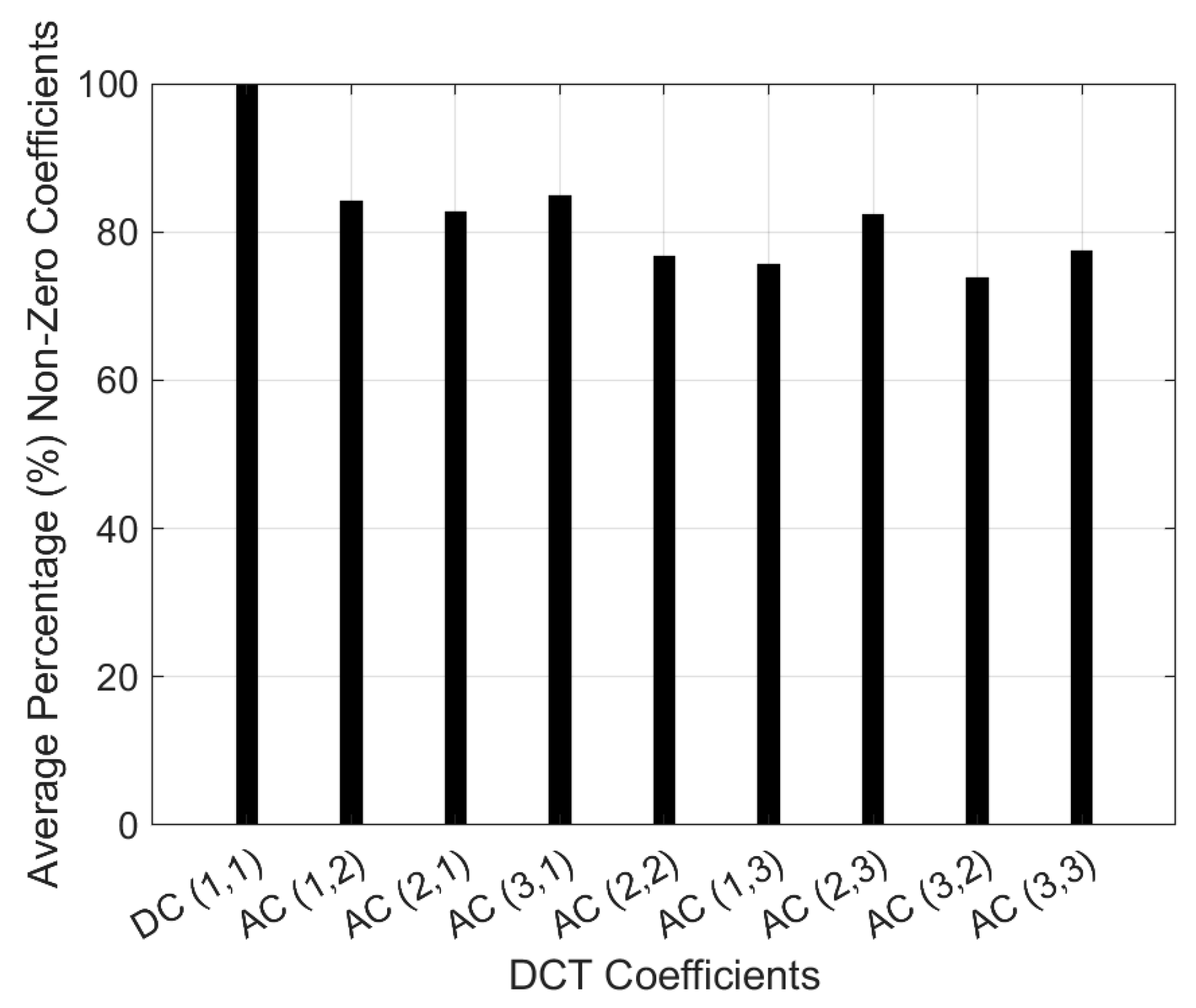
| DCT block-segmentation to embedding procedure | 3 × 3 |
| DCT coefficients | AC (1, 2), AC (3, 1) |
| Image dataset | 1735 high resolution color images in TIFF format with 4288 × 2848 pixels |
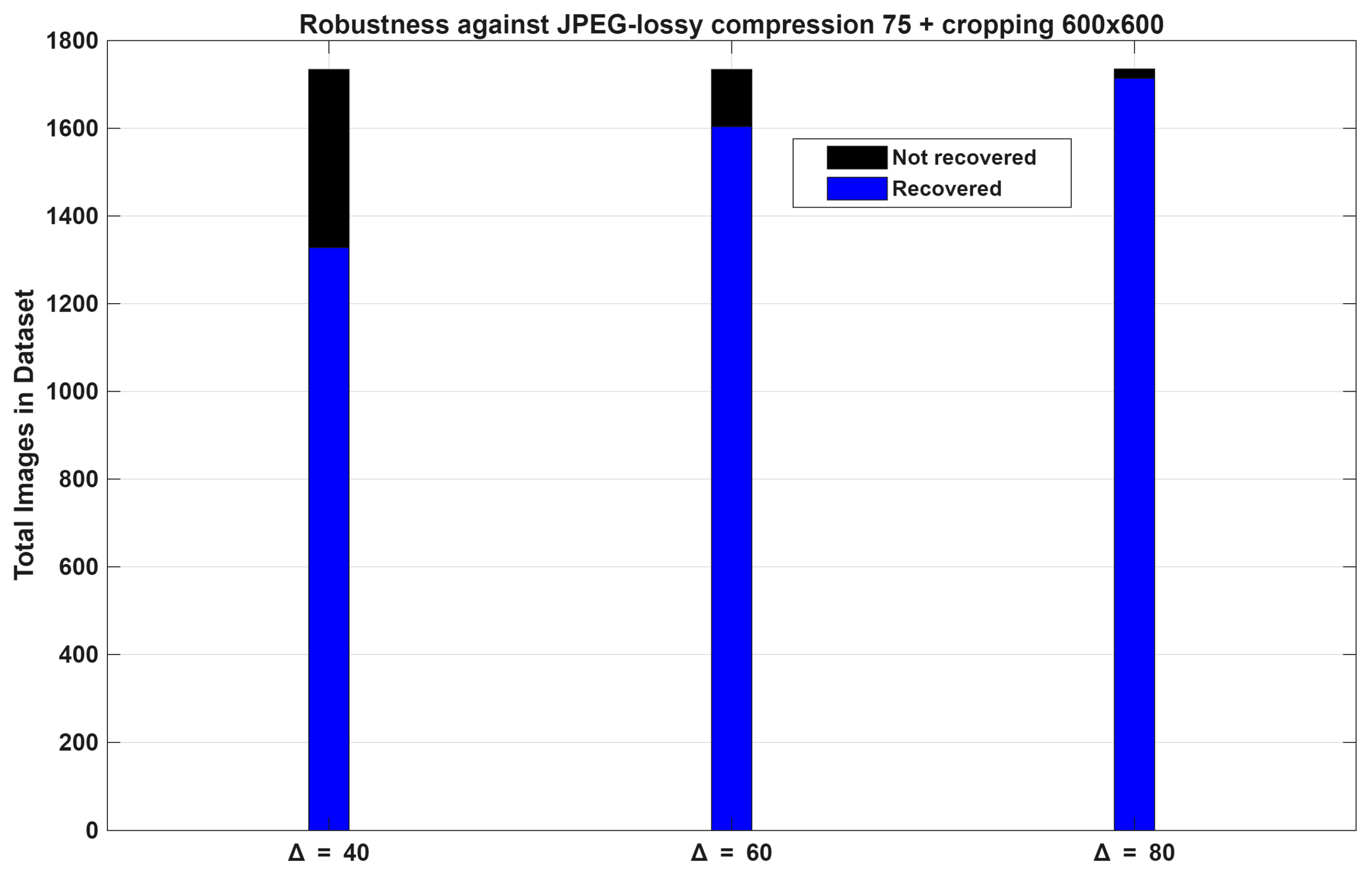
| Quantization step ∆ | 60 |
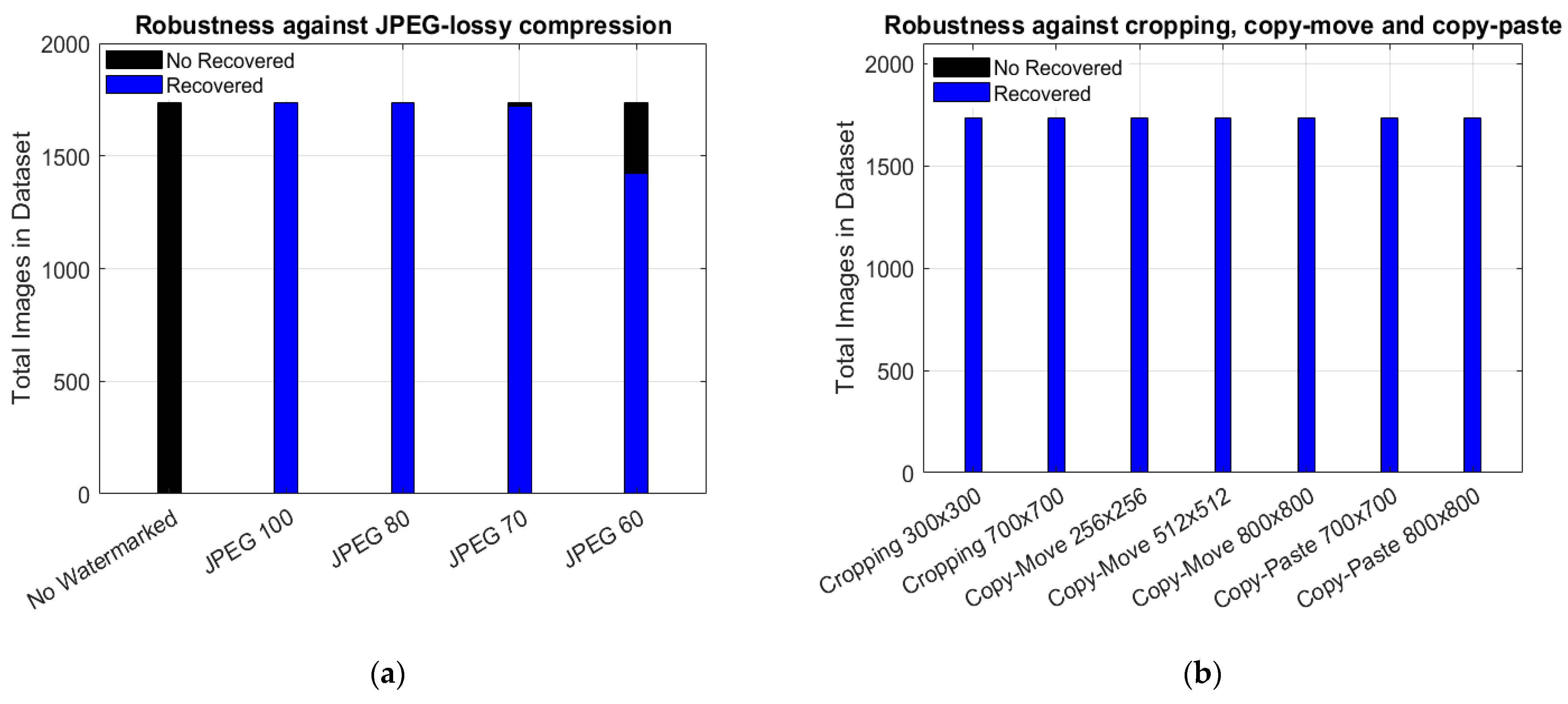
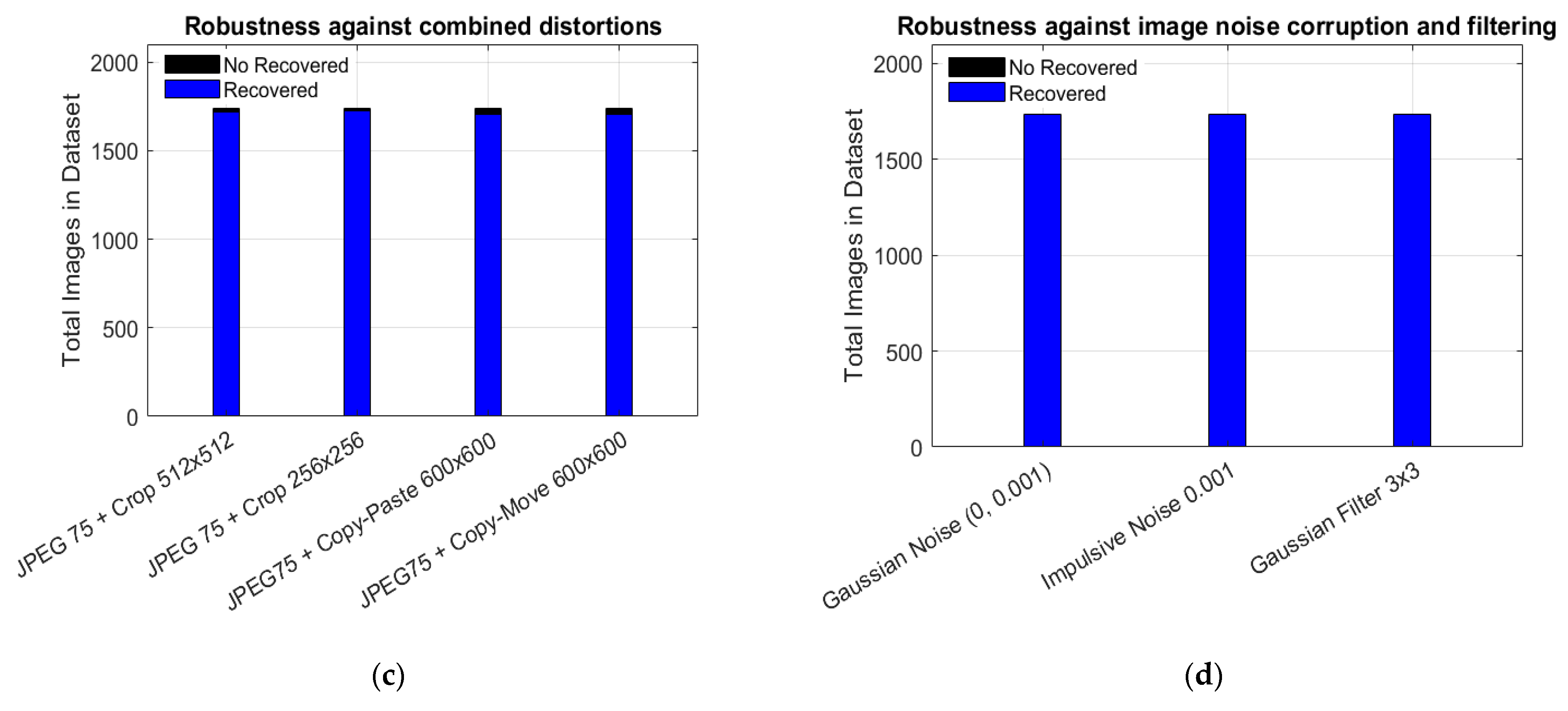
| Distortion | Thumbnail Recovered | Thumbnail Not Recovered | Distortion | Thumbnail Recovered | Thumbnail Not Recovered |
|---|---|---|---|---|---|
| JPEG 100 | 1735 | 0 | Copy–paste 700 × 700 | 1735 | 0 |
| JPEG 80 | 1735 | 0 | Copy–paste 800 × 800 | 1733 | 2 |
| JPEG 70 | 1719 | 16 | JPEG75 + crop 512 × 512 | 1715 | 20 |
| JPEG 60 | 1424 | 311 | JPEG75 + crop 256 × 256 | 1726 | 9 |
| Crop 300 × 300 | 1735 | 0 | JPEG75 + copy–paste 600 × 600 | 1705 | 30 |
| Crop 700 × 700 | 1735 | 0 | JPEG75 + copy–move 600 × 600 | 1703 | 32 |
| Copy–move 256 × 256 | 1735 | 0 | Gaussian noise (0, 0.001) | 1735 | 0 |
| Copy–move 512 × 512 | 1735 | 0 | Impulsive noise 0.001 | 1735 | 0 |
| Copy–move 800 × 800 | 1734 | 1 | Gaussian filter 3 × 3 | 1735 | 0 |
| Distortion | BCR | Distortion | BCR |
|---|---|---|---|
| JPEG 100 | 1 | Copy–paste 700 × 700 | 1 |
| JPEG 80 | 1 | Copy–paste 800 × 800 | 0.9995 |
| JPEG 70 | 0.9998 | JPEG75 + crop 512 × 512 | 0.9999 |
| JPEG 60 | 0.9993 | JPEG75 + crop 256 × 256 | 0.9999 |
| Crop 500 × 500 | 1 | JPEG75 + copy–paste 600 × 600 | 0.9998 |
| Crop 800 × 800 | 1 | JPEG75 + copy–move 600 × 600 | 0.9998 |
| Copy–move 256 × 256 | 0.9999 | Gaussian noise (0, 0.001) | 1 |
| Copy–move 512 × 512 | 0.9999 | Impulsive noise 0.001 | 1 |
| Copy–move 1000 × 1000 | 0.9996 | Gaussian filter 3 × 3 | 1 |
| Method | Domain | Spatial Resolution | Recover Information | Capabilities | Average Imperceptibility | Robustness |
|---|---|---|---|---|---|---|
| [17,18] | DCT IWT | -512 × 512 -8 bit/pixel | Luminance | -Tamper detection -Self recovery | PSNR = 42.46 dB SSIM = 0.9916 | -Collage attack -Copy–paste -Text addition -JPEG lossy mode -Cropping -Rotation -Impulsive noise |
| [19] | QDFT | -512 × 512 -24 bit/pixel | N/A | -Tamper detection | PSNR = 40.12 dB SSIM = 0.9749 | -Copy–paste -Sharpen -Gaussian, impulsive, and speckle noises -Histogram equalization -Contrast enhancement -Brightness -JPEG lossy mode -Median filtering -Combined attacks |
| [21] | IWT | -512 × 512 -8 bit/pixel | Luminance | -Tamper detection -Self recovery | PSNR = 54.73 dB WPSNR = 55.18 dB SSIM = 0.9987 | -Collage attack -Copy–paste -Text addition -Cropping -Object manipulation -Impulsive noise |
| [22] | DWT | -512 × 512 -8 bit/pixel | Luminance | -Tamper detection -Self recovery - Ownership authentication | PSNR = 47.48 dB SSIM = 0.9981 | -Copy–move -Copy–move -Splicing -Text addition -Impulsive and Gaussian noises -Mean and median filtering -Cropping -Rotation -Scaling -Translation |
| [25] | Distortion-free watermarking by double branch neural network | -Versatile resolution -24 bit/pixel | Halftone luminance | -Tamper detection -Self recovery -Ownership authentication | N/A | -Rotation -Scaling -Affine transformation -Translation -Cropping -JPEG lossy mode -Noise corruption -Histogram equalization -Blurring -Filtering -Sharpening -Combined attacks -Copy–move -Copy–paste |
| [27] | Secret sharing via distortion-free watermarking | -550 × 322 -512 × 512 -32 bit/pixel | Color | -Tamper detection -Self recovery | N/A | -Superimposing and Painting |
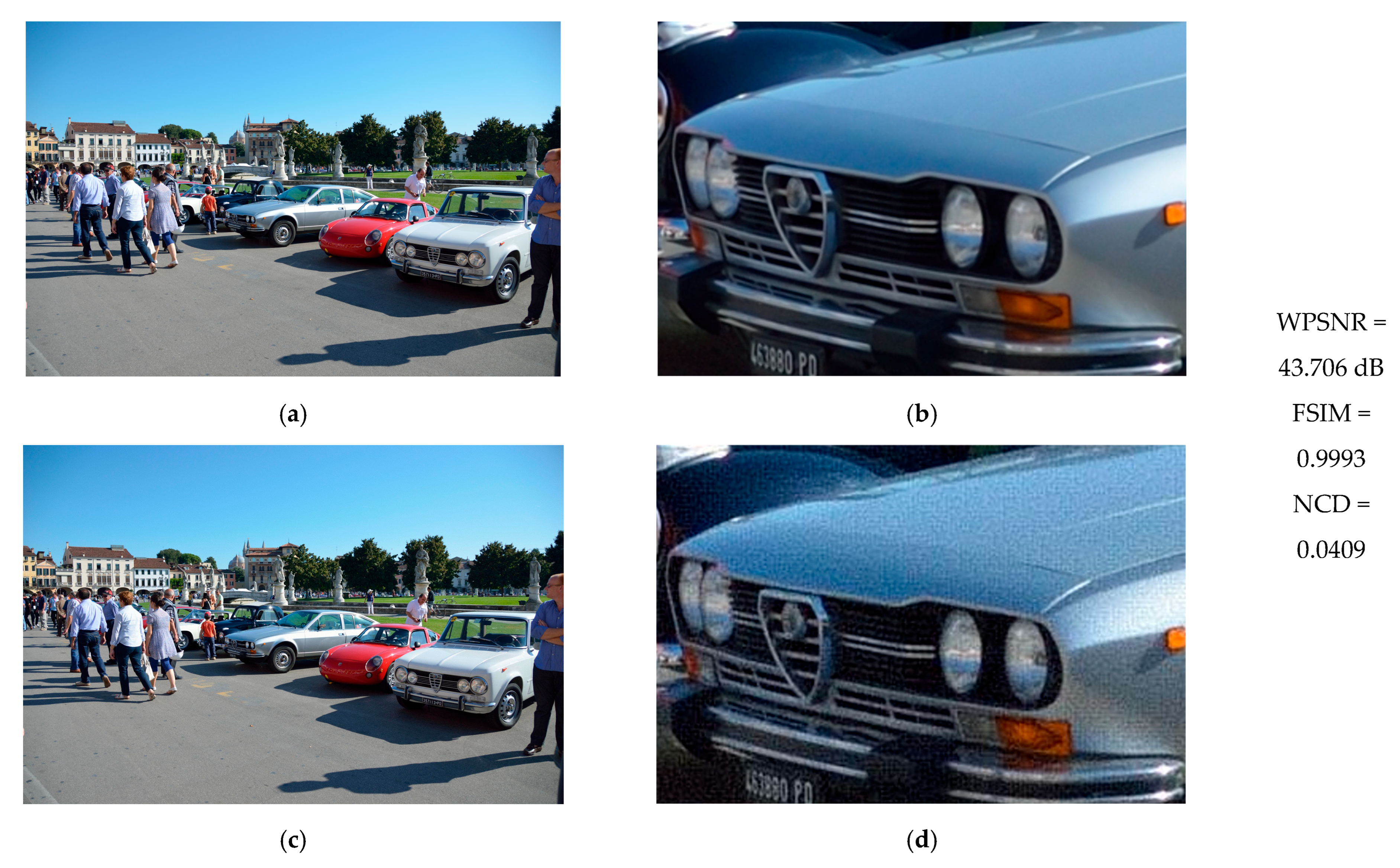
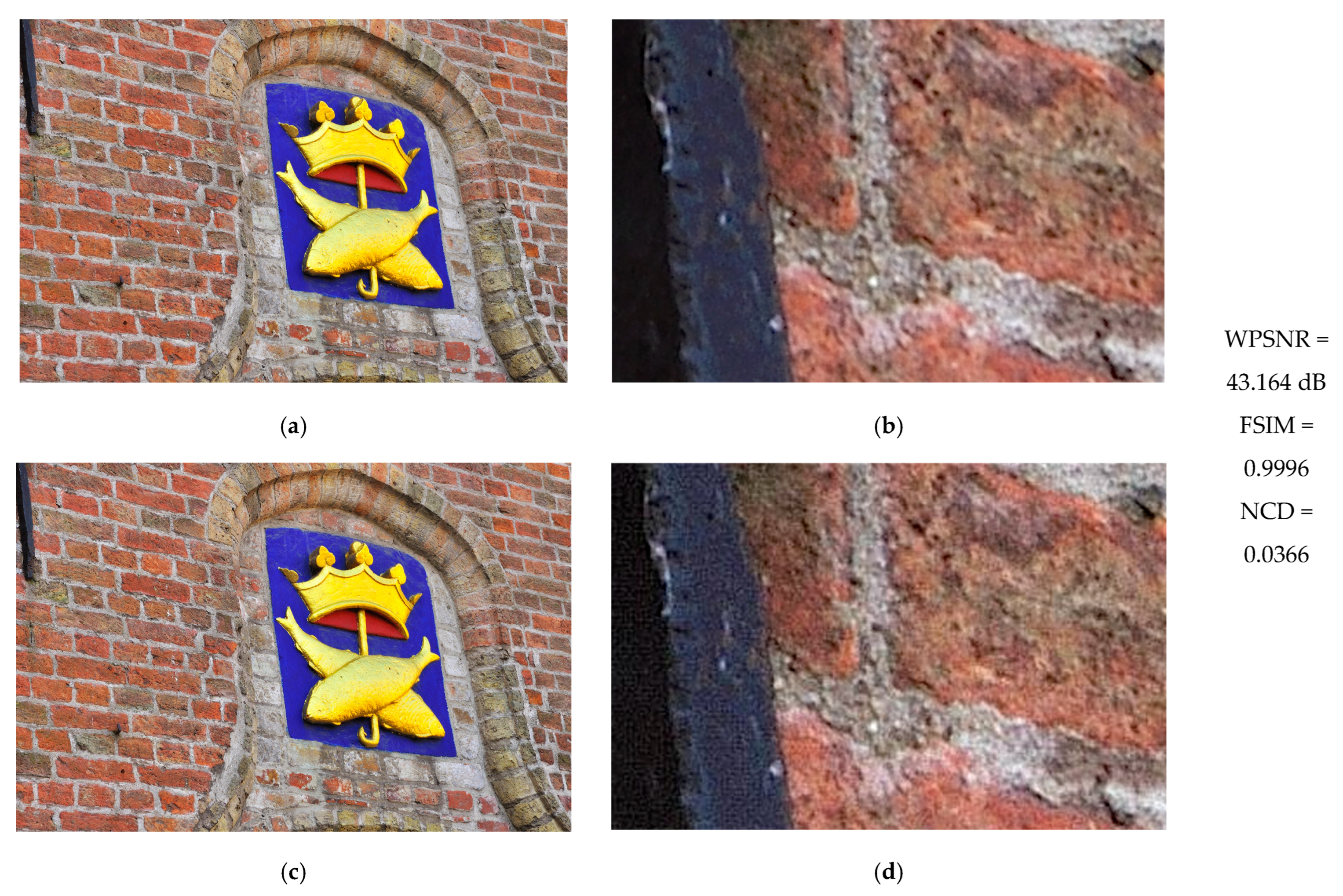
| Proposed Method | DCT | -4288 × 2848 -24 bit/pixel | Color | -Tamper detection -Self recovery -Ownership authentication | WPSNR = 43.64 dB FSIM = 0.9993 NCD = 0.03960 | -JPEG lossy mode -Copy–move -Copy–paste -Collage attack -Impulsive noise -Gaussian noise -Cropping -JPEG75 + Copy–move -JPEG75 + Copy–paste -JPEG75 + Cropping -Gaussian filtering |
Disclaimer/Publisher’s Note: The statements, opinions and data contained in all publications are solely those of the individual author(s) and contributor(s) and not of MDPI and/or the editor(s). MDPI and/or the editor(s) disclaim responsibility for any injury to people or property resulting from any ideas, methods, instructions or products referred to in the content. |
© 2025 by the authors. Licensee MDPI, Basel, Switzerland. This article is an open access article distributed under the terms and conditions of the Creative Commons Attribution (CC BY) license.
Share and Cite
Cedillo-Hernandez, M.; Cedillo-Hernandez, A.; Garcia-Ugalde, F.J.; Sanchez-Garcia, J.C. Semi-Fragile Watermarking Scheme for High-Resolution Color Images: Tamper Identification, Ownership Authentication, and Self-Recovery. Algorithms 2026, 19, 28. https://doi.org/10.3390/a19010028
Cedillo-Hernandez M, Cedillo-Hernandez A, Garcia-Ugalde FJ, Sanchez-Garcia JC. Semi-Fragile Watermarking Scheme for High-Resolution Color Images: Tamper Identification, Ownership Authentication, and Self-Recovery. Algorithms. 2026; 19(1):28. https://doi.org/10.3390/a19010028
Chicago/Turabian StyleCedillo-Hernandez, Manuel, Antonio Cedillo-Hernandez, Francisco Javier Garcia-Ugalde, and Juan Carlos Sanchez-Garcia. 2026. "Semi-Fragile Watermarking Scheme for High-Resolution Color Images: Tamper Identification, Ownership Authentication, and Self-Recovery" Algorithms 19, no. 1: 28. https://doi.org/10.3390/a19010028
APA StyleCedillo-Hernandez, M., Cedillo-Hernandez, A., Garcia-Ugalde, F. J., & Sanchez-Garcia, J. C. (2026). Semi-Fragile Watermarking Scheme for High-Resolution Color Images: Tamper Identification, Ownership Authentication, and Self-Recovery. Algorithms, 19(1), 28. https://doi.org/10.3390/a19010028