
Article

A New Genetic Algorithm-Based Optimization Methodology for Energy Efficiency in Buildings

by
Luis Angel Iturralde Carrera
1,
Omar Rodríguez-Abreo
1,*,
Jose Manuel Álvarez-Alvarado
1,
Gerardo I. Pérez-Soto
1,*,
Carlos Gustavo Manriquez-Padilla
2 and
Juvenal Rodríguez-Reséndiz
1
1
Facultad de Ingeniería, Universidad Autónoma de Querétaro, Querétaro 76010, Mexico
2
Engineering Faculty, Campus San Juan del Rio, Autonomous University of Queretaro, Av. Rio Moctezuma 249, San Juan del Rio 76807, Mexico
*
Authors to whom correspondence should be addressed.
Algorithms 2026, 19(1), 27; https://doi.org/10.3390/a19010027 (registering DOI)
Submission received: 29 November 2025 / Revised: 13 December 2025 / Accepted: 16 December 2025 / Published: 26 December 2025

Abstract

This study aims to develop a methodology for implementing solar photovoltaic systems (SSFV) in Caribbean hotels. It begins with an analysis of building characteristics to design and size the SSFV, considering panel support structures, system layout, and grid integration. The methodology also evaluates economic and environmental impacts at both company and national levels. Machine learning analysis identified the variables (Degree Days (DG) and Hotel Days Occupied (HDO)) H D O × D G as key determinants of energy consumption, with a high coefficient of determination ( R 2 = 0.97). Implementing a target energy-saving line achieved a 5.3% reduction (1028 kWh) relative to the baseline. Using a genetic algorithm to optimize the SSFV azimuth angle increased photovoltaic energy production by 14.75%, enhancing efficiency and installation area use. Economic assessments showed a challenging scenario for hotels, with a negative internal rate of return of −10%, a 17 year payback period, and a net present value of USD 20,000. However, on a national scale, significant annual savings of USD 225,990.8 from reduced fuel imports were projected. Additionally, carbon emissions reductions of 18,751.4 tons ( t C O 2 ) were estimated. The findings highlight the feasibility and benefits of SSFV implementation, emphasizing its potential to improve energy efficiency, reduce costs, and enhance sustainability in the Caribbean hotel sector.

1. Introduction

The implementation of energy management systems aims to improve energy efficiency through measurable reductions in energy consumption and associated emissions, while fostering systematic decision-making based on quantitative performance indicators. In recent years, these systems have increasingly been complemented by Frequency Response Evaluation (FRE), allowing buildings not only to manage energy demand but also to interact more effectively with modern energy systems. Together, energy management frameworks and FRE constitute key pillars in the design and operation of sustainable buildings, particularly in the context of low-carbon and nearly zero-energy targets aligned with global sustainable development objectives.
The integration of renewable energy sources within energy management systems has gained significant momentum. Among the available options, solar energy stands out as one of the most viable solutions due to its wide availability and low environmental impact [1]. The global photovoltaic market has experienced accelerated growth, driven by increasing energy demand, rising fossil fuel prices, and the need to reduce greenhouse gas emissions [2,3,4]. In this context, photovoltaic systems have become a central element in strategies aimed at improving building energy performance.
The ISO 50001:2018  [5] standard provides a structured framework for organizations seeking to achieve sustained improvements in energy efficiency, leading to quantifiable economic, operational, and environmental benefits [6,7]. Within this framework, several energy performance indicators have been proposed for buildings, such as kWh m 2 , kWh HDO , and  kWh person  [8,9,10]. However, these indicators often neglect relevant climatic and operational factors, resulting in limited predictive capability. Previous studies have shown that indicators with correlation coefficients of R 2 > 0.65 can be considered acceptable, while values exceeding R 2 > 0.85 indicate strong predictive potential [9,11,12,13]. This highlights the need for performance indicators that better capture the interaction between climate, system design, and energy production in photovoltaic applications.
The performance of photovoltaic systems is strongly influenced by local climatic conditions, including solar irradiance and ambient temperature [14,15]. Due to the progressive depletion of fossil fuel resources, photovoltaic technologies have become essential components of national and regional energy strategies. Consequently, many governments promote their deployment not only in ground-mounted installations but also on building rooftops, where energy can be generated directly at the point of consumption, reducing transmission losses and improving overall system efficiency [16].
A photovoltaic module consists of interconnected solar cells arranged in series and parallel configurations. The efficiency of these cells decreases with increasing operating temperature [17]. Although higher temperatures slightly increase the short-circuit current, they cause a more pronounced reduction in open-circuit voltage and fill factor, leading to a net decrease in power output [18]. Direct solar radiation further elevates cell temperature, negatively affecting performance, particularly under high irradiance conditions [19,20,21]. In addition, partial shading significantly impacts photovoltaic efficiency and lifespan, potentially causing hot spots and irreversible damage to modules [22,23,24].
The efficiency of standalone solar photovoltaic systems (SSFV) is influenced by multiple factors, including system orientation and layout, shading conditions, climatic variables, and installation geometry [25,26,27,28,29]. As a result, building-integrated photovoltaic and photovoltaic–thermal solutions, such as Building-Integrated Photovoltaic–Thermal (BiPVT) systems, have been increasingly adopted to enhance energy utilization and system performance.
To address the complexity of photovoltaic system design, numerous optimization techniques have been proposed, including Genetic Algorithms (GA), Pattern Search Optimization (PS), Simulated Annealing (SA), Differential Evolution (DE), Artificial Bee Colony (ABC), Flower Pollination Algorithm (FPA), and other hybrid and stochastic methods [30,31,32,33,34,35]. Despite this wide range of approaches, no single optimization technique has been universally identified as optimal for SSFV systems under all operating and climatic conditions, highlighting the need for tailored methodologies that integrate modeling, optimization, and validation.
In this context, the present work aims to develop a comprehensive methodology for the integration of energy management principles with SSFV systems in buildings. The proposed approach combines system modeling, artificial intelligence-based optimization, and economic and environmental assessments to support informed decision-making and improve the overall performance of photovoltaic installations.
This article is structured as follows: Section 1 presents the motivation for integrating SSFV systems within energy efficiency frameworks and reviews the relevant state-of-the-art. Section 2 describes the proposed methodology, including energy assessment, SSFV design, and economic–environmental evaluation. Section 3 presents the main results related to performance indicators, system modeling, optimization, and feasibility analysis. Section 4 discusses the results in comparison with the existing literature, and Section 5 summarizes the main findings, limitations, and future research directions.

2. Materials and Methods

It should be clarified that, for the veracity of this methodology, all equations were extracted from reliable references, among which we have [36,37,38,39,40,41,42,43,44].
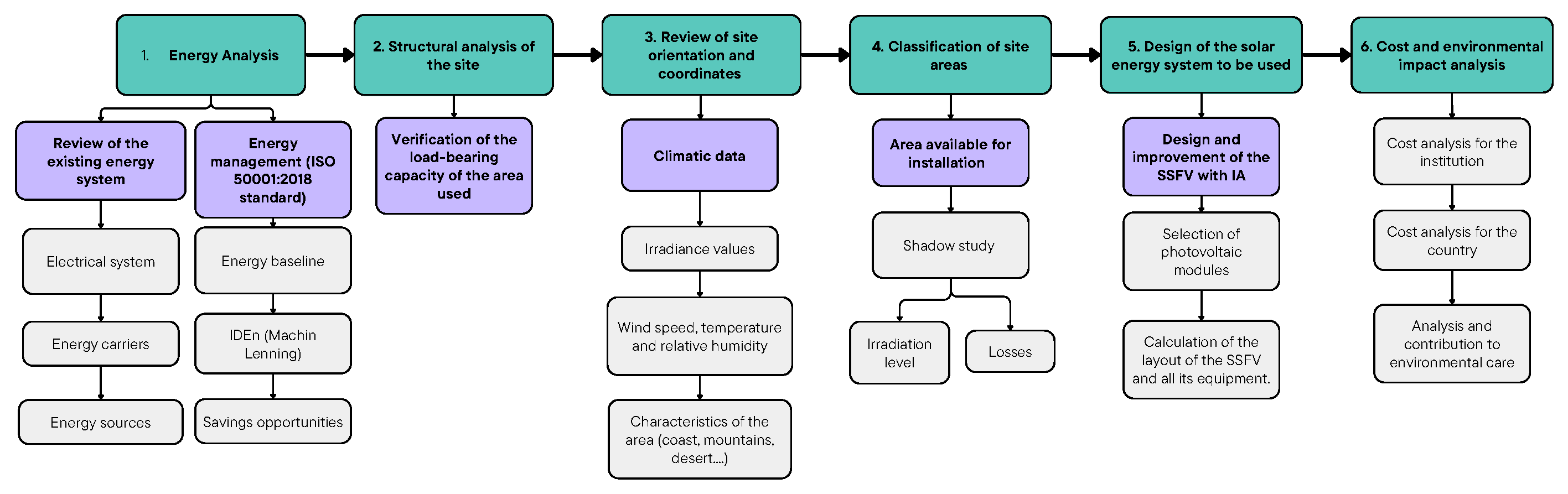
The methodology includes an energy analysis of the facility to identify and propose the main savings opportunities, with the objective of reducing consumption and developing an energy performance indicator. Structural resistance studies of the building will be carried out, and the solar panel supports will be designed according to the specific conditions and characteristics of the site. The particularities of the existing electrical system will also be considered. Subsequently, the sizing and optimization of the integrated system as a whole will be carried out, evaluating its economic and environmental viability; see Figure 1.
Figure 1 presents the overall methodological pipeline adopted in this study. The proposed approach follows a sequential and interdependent structure in which each stage provides the necessary inputs for the subsequent analysis. First, an energy performance assessment is conducted based on ISO 50001:2018 to identify the main energy drivers and establish the baseline and energy performance indicator. This step defines the operational and climatic variables that characterize the building’s energy behavior.
Subsequently, a structural analysis is carried out to evaluate the mechanical feasibility and safety of the photovoltaic support system. This stage is essential, as the structural configuration directly constrains the allowable geometry, inclination, and installation conditions of the photovoltaic modules. The results of the structural analysis, therefore, serve as mandatory input parameters for the solar simulation and optimization stages.
Once the structural feasibility is confirmed, photovoltaic simulations are performed to assess the energy generation potential under different configurations. These simulations provide the fitness function used in the genetic algorithm, which is applied to optimize the azimuth orientation of the photovoltaic system. Finally, the optimized solution is evaluated from economic and environmental perspectives to assess its overall feasibility and contribution to energy efficiency and emission reduction.

2.1. Energy Management System Model ISO 50001 Energy

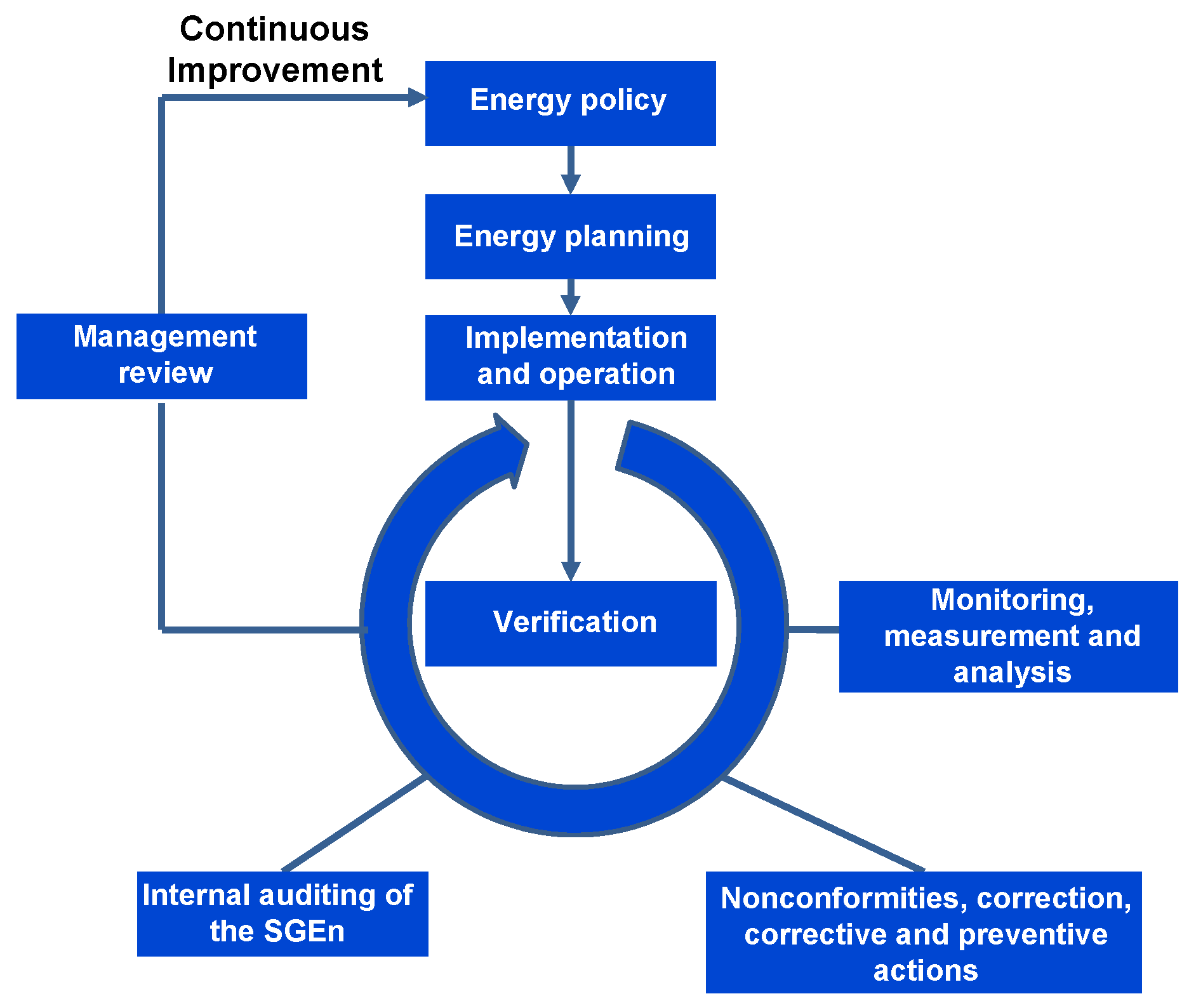
ISO 50001:2018, titled “Energy Management Systems—Requirements with Guidance for Use,” provides a framework for developing energy policies, processes, procedures, and activities aimed at achieving an organization’s energy goals. The standard requires organizations to define their intended energy performance and implement measures to meet their established objectives, as illustrated in the accompanying Figure 2.
ISO 50001:2018 is based on the Plan–Do–Check–Act (PDCA) continuous improvement cycle, integrating energy management into the daily practices of organizations.

2.1.1. Energy Planning

The methodology employed in this research is rooted in the planning phase of ISO 50001:2018 [5], as illustrated in Figure 3. It emphasizes conducting an energy review to assess energy consumption and usage patterns, identify areas with significant energy utilization, and pinpoint key opportunities for improvement. The process culminates in the integration of renewable energy sources, specifically through the implementation of solar photovoltaic systems.

2.1.2. General Requirements

The hotel is committed to ensuring the satisfaction of its customers’ expectations in all its tourist facilities and through the performance of its staff, emphasizing hospitality, ethical, and cultural values. It prioritizes the constant improvement of the quality of its services through the implementation of ISO 9000  [5] Quality Management Systems focused on the efficiency and effectiveness of processes, the commitment of its employees, and their continuous training, always with a focus on environmental protection.

2.1.3. Study of Energy Consumption and Production in the Company

This research focuses on the energy planning stage of ISO 50001:2018, aiming to define the baseline and target energy lines, along with the energy performance indicator for a hotel facility. A literature review identified well-established energy management indicators for hotels; however, this study incorporates the variable Room-Days-Occupied (RDO) to accurately establish the baseline and performance indicator. Significant energy uses were identified and evaluated, considering operation modes, control parameters, and equipment performance during 2021–2023. The methodology aligns with energy management standards in the review stage, achieving a baseline and target line with a higher determination coefficient ( R 2 ) than those in previous studies. Linear regression with multiple variables was used for validation. The study also highlights general savings opportunities.

2.1.4. Energy Baseline and Target

The baseline and target energy will be calculated by processing the data with machine learning in order to obtain a more accurate and faster response. With these results, it will be possible to predict and evaluate the behavior and possible improvements in energy consumption in the hotel through energy efficiency, and in turn, it is the basis for the design of the energy performance indicator.

2.1.5. Calculation of the Variable Degree Days

Degree Days ( D G d ) represent the heating or cooling demands (measured in degrees Celsius or Kelvin) required to maintain a comfortable environment during a specific period, typically a month, although they can also be calculated weekly or even hourly [45].
For a day, the Degree Days are determined by Equation (1) as follows:
D G d = ( T d T r )
For a month, the Degree Days are determined by Equation (2) as follows:
D G = D G d
where
  • D G : Degree Days accumulated over the month;
  • T d : Daily average temperature for each day of the month (°C);
  • T r : Reference temperature (18 °C).

2.1.6. Energy Performance Indicator Calculation

The EnPI serves as a tool for tracking energy consumption across different months of the year. The energy baseline curve represents the optimal energy performance of the hotel, where values below the curve indicate efficient energy use, while values above suggest poor performance. The Theoretical Energy Performance Indicator (EntPI) for the hotel is derived by correlating the energy equation with the organization’s independent variable. In this analysis, the Degree Day and HDO products are utilized, as shown in Equation (3).
E n t P I = E t D G × H D O

2.2. Review of Previous Structural Studies Executed for the Entity

A review of previous structural studies executed for the entity is an essential step in understanding its historical organizational framework and operational trends. By analyzing past assessments, valuable insights can be gained regarding the evolution of the entity’s structure, including strengths, recurring challenges, and the effectiveness of previous interventions. This retrospective examination allows stakeholders to identify patterns, measure the success of implemented strategies, and determine areas requiring further analysis or modification. Such a review ensures that future structural decisions are informed by a comprehensive understanding of the entity’s past, fostering continuity and strategic alignment with its goals.
  • Request a structural or structural characteristics study of the company from the company.
    Having direct access to a study that examines the structural and organizational characteristics of the company is vital for understanding its current operational framework. This information is essential for identifying how resources are distributed, how teams or departments are interconnected, and whether the company’s structure aligns with its strategic objectives. Requesting this study directly from the company ensures that the information is accurate, up-to-date, and reflects internal perspectives, making it a critical tool for effective decision-making and planning.
  • In the absence of such a study, request from competent entities.
    If the company has not conducted or does not have access to a comprehensive structural analysis, seeking assistance from specialized external entities becomes necessary. External experts bring an impartial perspective and the technical expertise needed to evaluate the company’s organizational framework. These entities can provide a thorough and objective assessment that fills existing knowledge gaps, ensuring that any analysis or recommendations are based on reliable and professional insights. This step is crucial to gaining a complete understanding of the company’s structure in the absence of internal documentation.

2.3. Review of Site Orientation and Coordinates

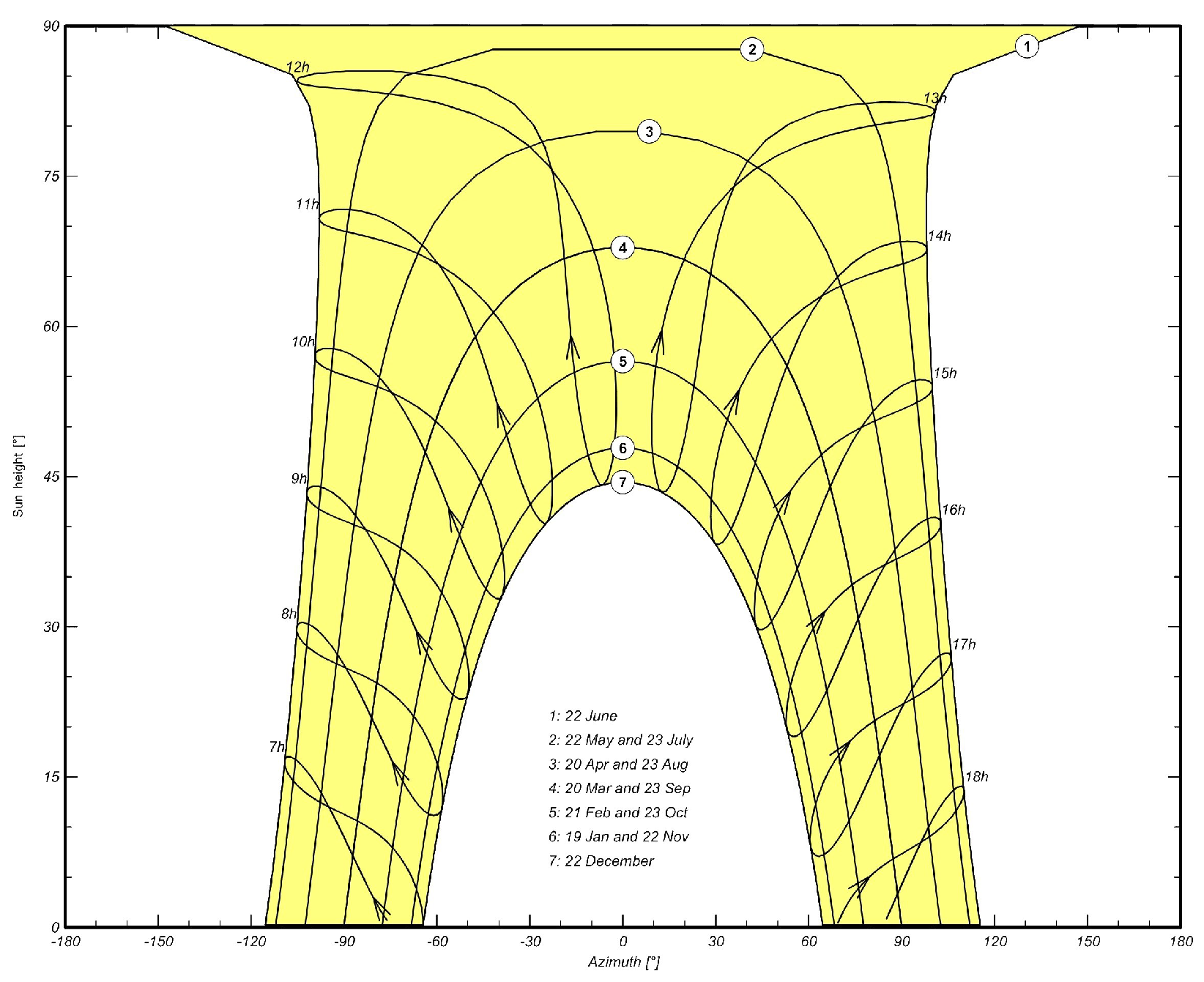
Figure 4 shows how the incidence of solar radiation varies throughout the day, taking into account the trajectory of the sun and the obstacles present. In Figure 4, the areas with optimal conditions for the installation of the SSFV are highlighted in brown, as well as the recommended areas for the placement of the panels. This analysis has allowed us to identify the largest area available to maximize the efficiency of the system, minimizing the incidence of shadows on the PVs (solar paths at Punta Gorda, (Lat. 22.1148° N, long. −80.4332° W, alt. 16 m)— Legal Time).
In conclusion, the site has ideal irradiation and air quality characteristics, where at the same time there are high levels of relative humidity and temperature, which increase the level of diffuse irradiation, which is less used by the solar modules, and the high temperatures affect the efficiency of the system since they increase the resistance of the conductors and also decrease the generation of electricity.

2.3.1. Calculation of Structure Support

The following aspects are taken into account for the dimensioning and calculation of the support structure:
  • Weight of the structure;
  • Own weight of the panel;
  • Load on the beams;
  • Load on the beams;
  • Load due to wind action;
  • Calculation of joint resistance.

2.3.2. Eigenweight of the Panels

Using (4), the weight of the panels is calculated.
P = P p A
where
  • A—area;
  • P p —Weight of a solar panel.

2.3.3. Load on the Beams

Using Equation (5), the load on the beams is calculated.
N = P ( p + a ) T p L v + W c
where
  • N—Load on the beam;
  • P ( p + a ) —proper weight of the panel plus accessories;
  • T p —total panels on the beam;
  • L v —beam length;
  • W c —linear weight of conductor gauge.
The velocity of the winds impinging on the front of the panels is determined by Equation (6) as follows:
V f = V c o s ( ϕ )
where
  • V—wind speed;
  • ϕ —angle between the wind direction and the panel;
  • V f —Wind force on panels.

2.3.4. Load Due to Wind Action

To determine the force exerted by the winds on the panels, Equation (7) is used.
F = ρ × C d × A × V f 2 2
where
  • ρ —Density of the air at sea level;
  • C d —Coefficient of resistance of flat surfaces;
  • A—Projected area of the panel;
  • V f —Frontal wind speed.
Wind load is calculated using the NC 285:2003 for the wind load calculation method.
The wind pressure on the panels and the fastening structures is obtained by Equations (6) and (7).
q = q 10 × C j × C a × C k × C p × C w × C e a
where
  • q 10 —Basic characteristic wind pressure for a 25 year recurrence.
q 10 = V V 2 1.6 × 10 3
where
  • V v —wind speed in the territory;
  • Cj—recurrence coefficient for 25 years;
  • k—site coefficient considering exposed site;
  • Ca—height coefficient;
  • Cp—gust coefficient;
  • Cea—area reduction coefficient;
  • Cw—shape coefficient.

2.3.5. Calculation of the Resistance of the Connections

In this case, the main failure is the breakage of the bolt in tension, so the resistance condition will be as follows:
d 1 = 4 P σ a π
where
  • d 1 —bolt diameter to the outside of the fillet (nominal diameter);
  • P—Axial load to which the joint is subjected;
  • [ σ a ]—admissible breaking stress.
It is obvious that in addition to tensile failure of the bolt, other failures can occur, such as shearing of the bolt head, shearing of the bolt thread, shearing of the nut thread, bending, or crushing of the thread turns.
The calculation of the shear of the bolt head is performed to avoid shearing of the bolt head by the cylindrical surface as in Equations (11) and (12).
σ c = P 0.5 d 0 h π < σ a
where
  • σ c : Shear stress exerted;
  • d 0 : Diameter of the bolt to the base of the fillet;
  • h: Screw head height;
  • [ σ a ] : Allowable shear stress.
Shear stress:
σ c = P 0.5 d 1 H π β < σ a
where
  • H—thread height;
  • β —thread height filling coefficient ( β = 1 for triangular threads).
For the calculation of the bending turns, it is assumed that these deployed are a cantilever beam. The load distributed on the surface of the turn is substituted by the concentrated force P z (z—number of turns of the thread) and applied to half of the working height of the turn ( l = t 2 2 ); see Equation (13).
σ f = 3 P × t 2 d 1 π z b < σ a
where
  • σ f —bending stress exerted;
  • t 2 —half of the working height of the loop;
  • b—Theoretical distance between the fillets;
  • [ σ a ]—allowable bending stress.

2.3.6. Cost and Environmental Impact Analysis

For the development of the cost analysis, the criteria given by [40] are as follows:
In the economic evaluation, all costs related to the implementation of photovoltaic technology, such as panels, mounting structures, wiring, fixings, and inverters, will be included. In addition, factors such as bank tax, inflation, discount rate, and the lifetime of the panels will be considered. This will provide an accurate estimate of the time required to recover the investment and the potential profits to be generated.
The economic calculations will be based on the lowest solar radiation conditions and peak sunlight hours, reflecting the minimum generation and delivery capacity of the SSFV, as well as the maximum daily recorded consumption. By determining the savings generated by the SSFV and applying the institution’s electricity tariff, the monetary income can be calculated using Equation (14).
I n = E g T e
where
  • I n —Income;
  • E g —Electricity generated;
  • T e —Electricity rate.

2.3.7. Determination of the Net Present Value

The net present value (VPN) is determined; see Equation (15).
V P N = K 0 + F c i ( 1 + D ) i
where
  • K 0 —initial investment;
  • Fc—cash flow;
  • D—Actual discount rate used.

2.3.8. Determination of the Internal Rate of Return (TIR)

It is defined as the discount rate that reduces the Net Present Value to zero.
The TIR indicates the percentage or interest rate obtained on the outstanding balance to be recovered from an investment so that at the end of the evaluation period or useful life, such balance is zero (Equation (16)).
V P N = K 0 + F c i ( 1 + T I R ) i

2.3.9. Determination of the Real Investment Recovery Period (PRI)

It is the payback time of the initial investment for a discount rate D considered. It is calculated as the time for which the TIR becomes zero. It is determined from Equation (17).
0 = K 0 + F c i ( 1 + D ) i
To calculate the PRI, annual cash flows are gradually added to the initial investment until the result reaches zero, indicating that the investment has been recovered.

2.3.10. Cost–Benefit Ratio (RCB)

The RCB is determined as the ratio between the Net Present Value of Costs (VPNC) and the Net Present Value of Benefits (VPNB) (Equation (18)).
R C B = V P N C V P N B

2.4. Environmental Analysis and Contribution

  • Analyzing the problem in terms of fuel not burned to produce the same amount of energy.
  • Therefore, from the fuel saved, the amount of C O 2 no longer emitted to the atmosphere can be obtained in C O 2 per year.

2.4.1. Quantity of Fuel Saved

Analyzing the problem in terms of fuel left unburned to produce the same amount of energy, this can be calculated by Equation (19):
C a = E × g 1000
where
  • C a —fuel saved;
  • E—energy generated;
  • g—specific fuel consumption of generator sets.

2.4.2. Quantity of C O 2 Not Emitted to the Atmosphere

From the fuel saved, the amount of C O 2 stopped from being emitted to the atmosphere in t/year can be obtained by Equation (20):
R = C a k ρ
where
  • R— C O 2 not emitted;
  • K—coefficient that allows relating the unburned fuel to the tons of C O 2 not discharged into the atmosphere;
  • ρ —fuel density.

3. Results

3.1. Energy Analysis and Indicator Design

3.1.1. Statistical Analysis in the Specialized Software R-Studio

After these first results, the design of a new indicator and a statistical and correlation analysis of the data in the specialized software R-Studio v9 were continued.
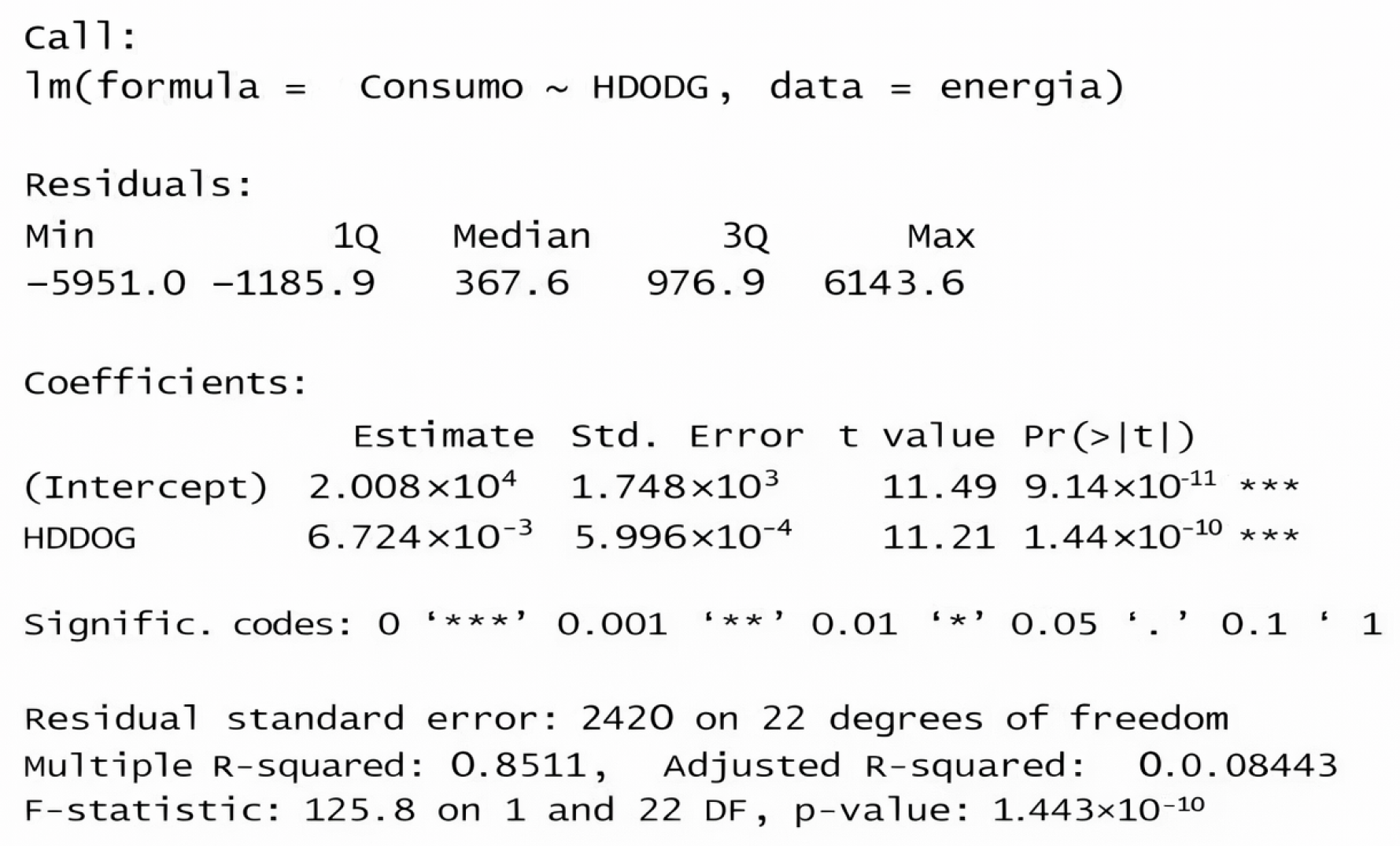
The results shown in Figure 5 confirm that there is a good correlation of the data of R 2  = 0.851. It can be seen that the p-value is small, thus rejecting the null hypothesis and affirming that there is a relationship between y and x. Regarding the intercept, it is significant, so we can appreciate that this line does not pass through the origin (we reject H0: the line passes through the origin). In this case, we can affirm that there is energy not associated with production.
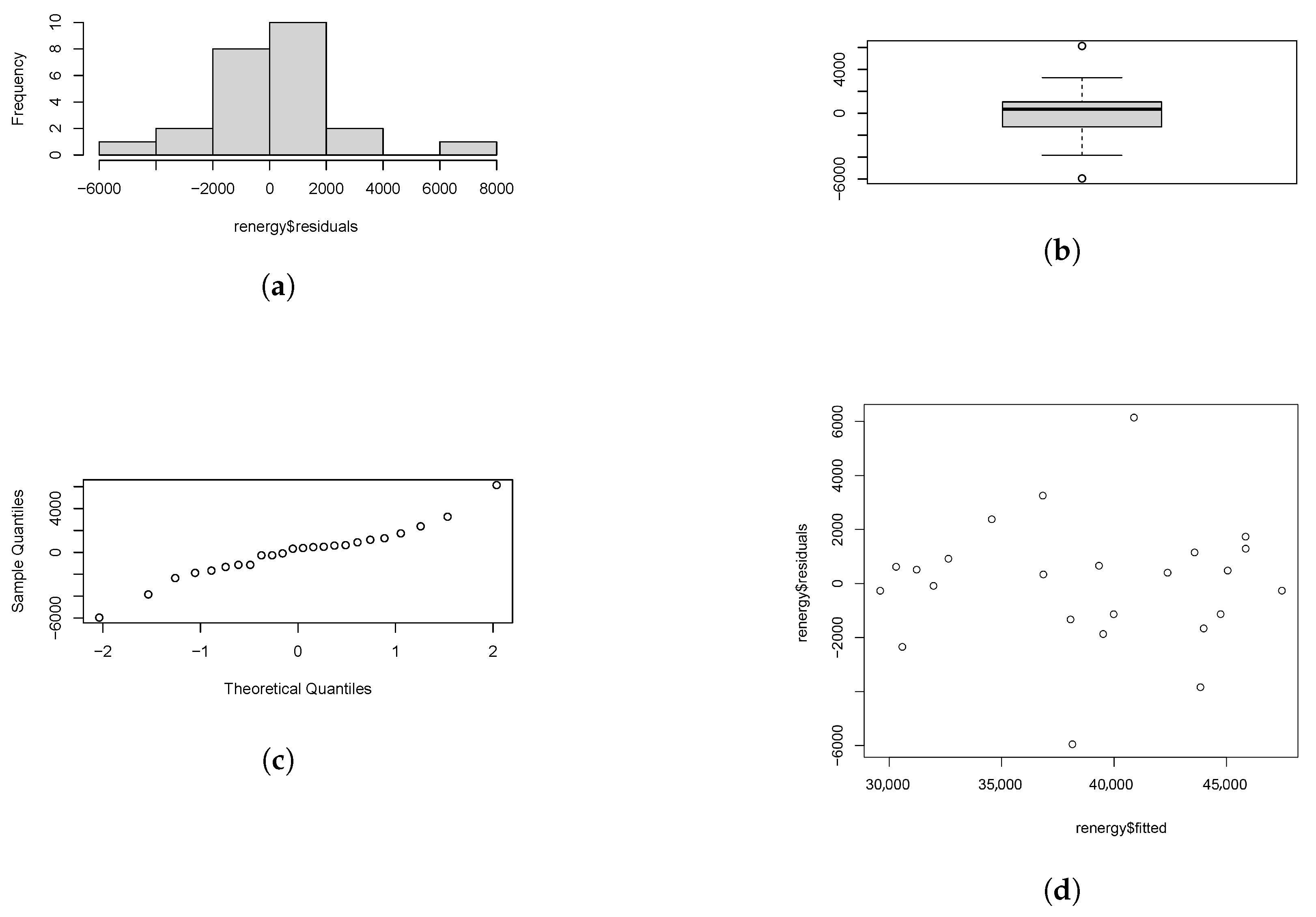
The residual plots in Figure 6. Show the presence of residuals; the data do not completely follow the Gaussian bell shape; the symmetry with respect to 0 is not total. We see that the residuals follow a fairly linear behavior (normal Q-Q plot). There is dispersion of the values (width of the box and length of the whiskers), and outliers are observed.

3.1.2. Energy Performance Indicator

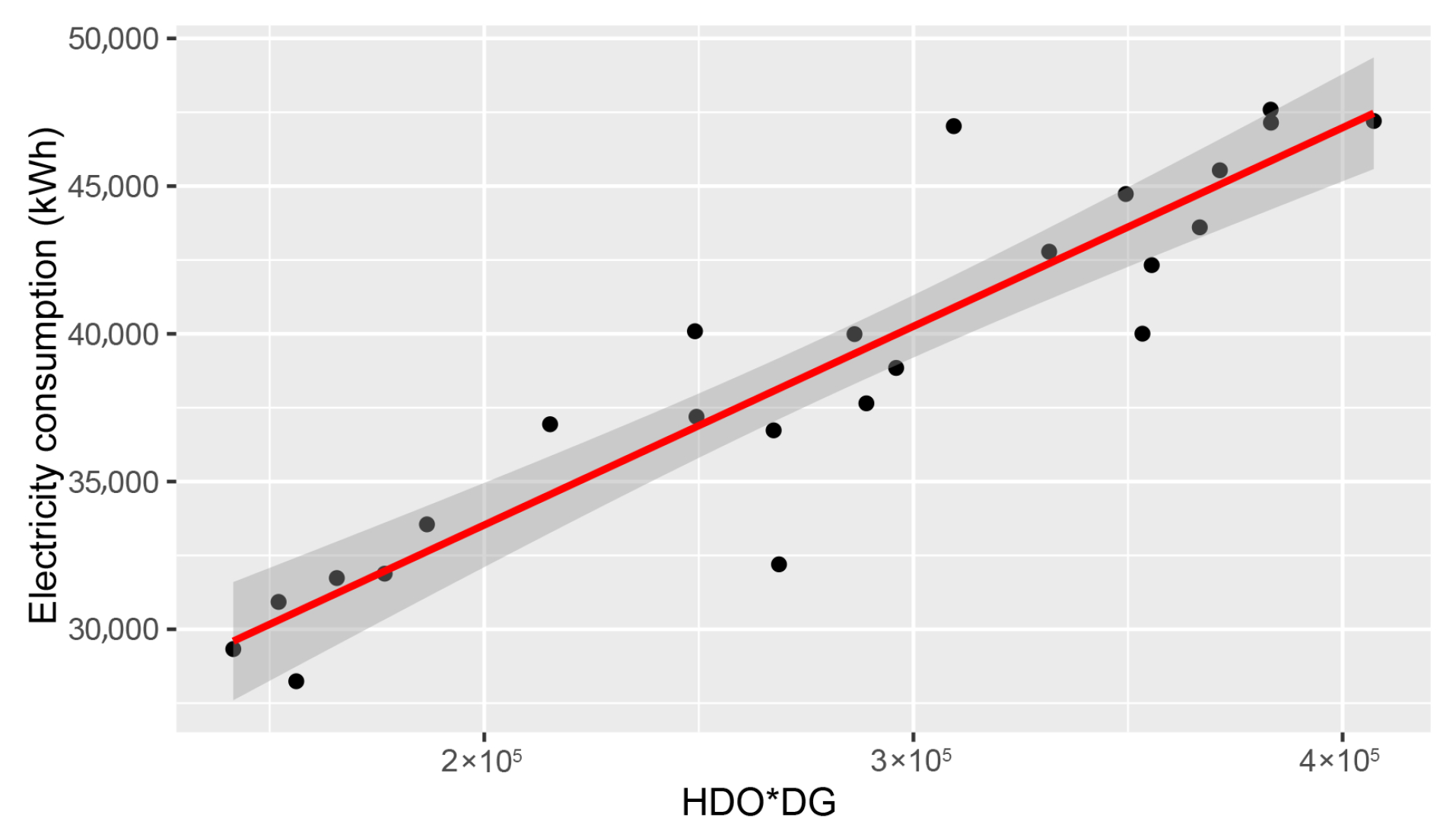
Figure 7 illustrates the correlation between room occupancy days adjusted with Degree Days ( H D O × D G ) and electricity consumption (kWh), based on historical data from 2018 and 2019. The correlation coefficient exceeds 0.75, indicating a strong relationship. The results highlight an increase in the correlation between energy consumption and hotel activity, primarily due to the significant impact of high temperatures in the Caribbean. This leads to increased use of air conditioning, which constitutes one of the largest energy loads in the facility.
To improve the correlation of the previous graph, 8.33% of the data were filtered. A new baseline and the corresponding target line were obtained for this case.
  • The energy baseline has equation and correlation: y = 0.0657x + 20,500 and R 2 = 0.93;
  • The target line has equation and correlation: y = 0.0647x + 19,412 and R 2 = 0.97;
  • With the target line obtained, there is an improvement in the correlation of the data and a 5.3% decrease in energy not associated with the process, with an energy saving of 1088 kWh.

3.2. SSFV Sizing and Optimization

For the sizing and optimization of the SSFV, several phases were carried out, including points 2 to 6 of the proposed methodology; see Figure 1.

Results of the Calculation of the Support to Be Used

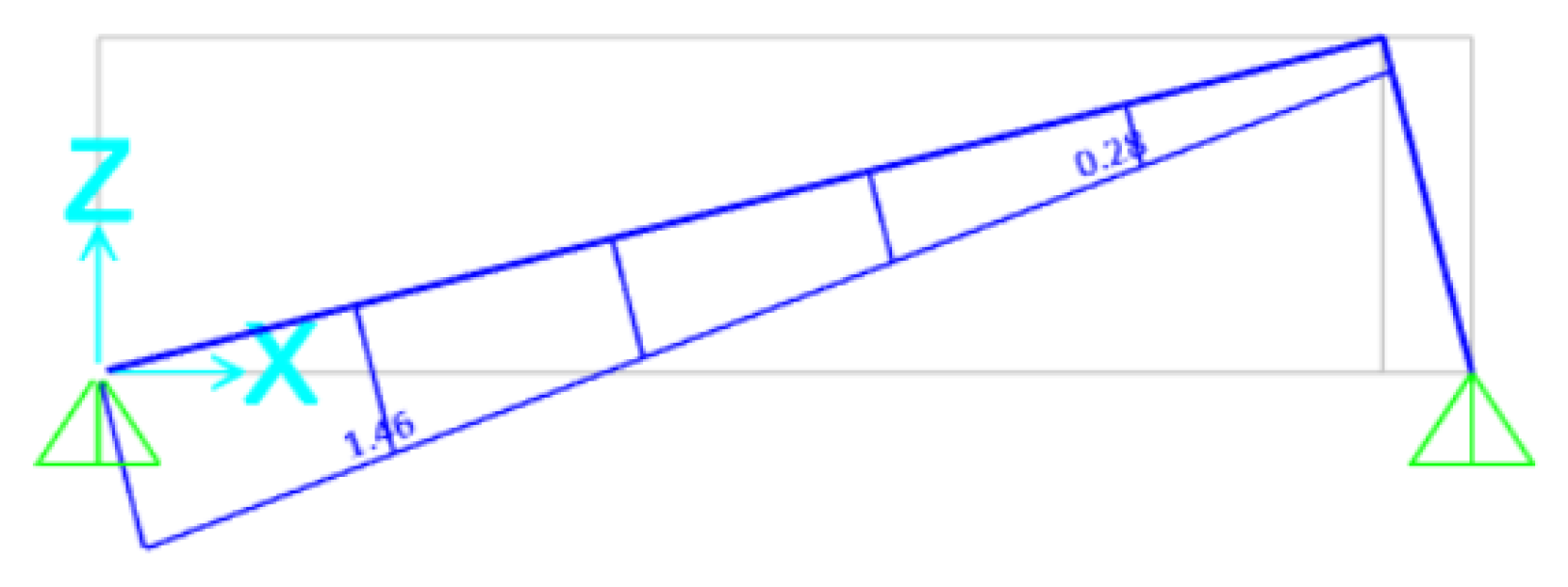
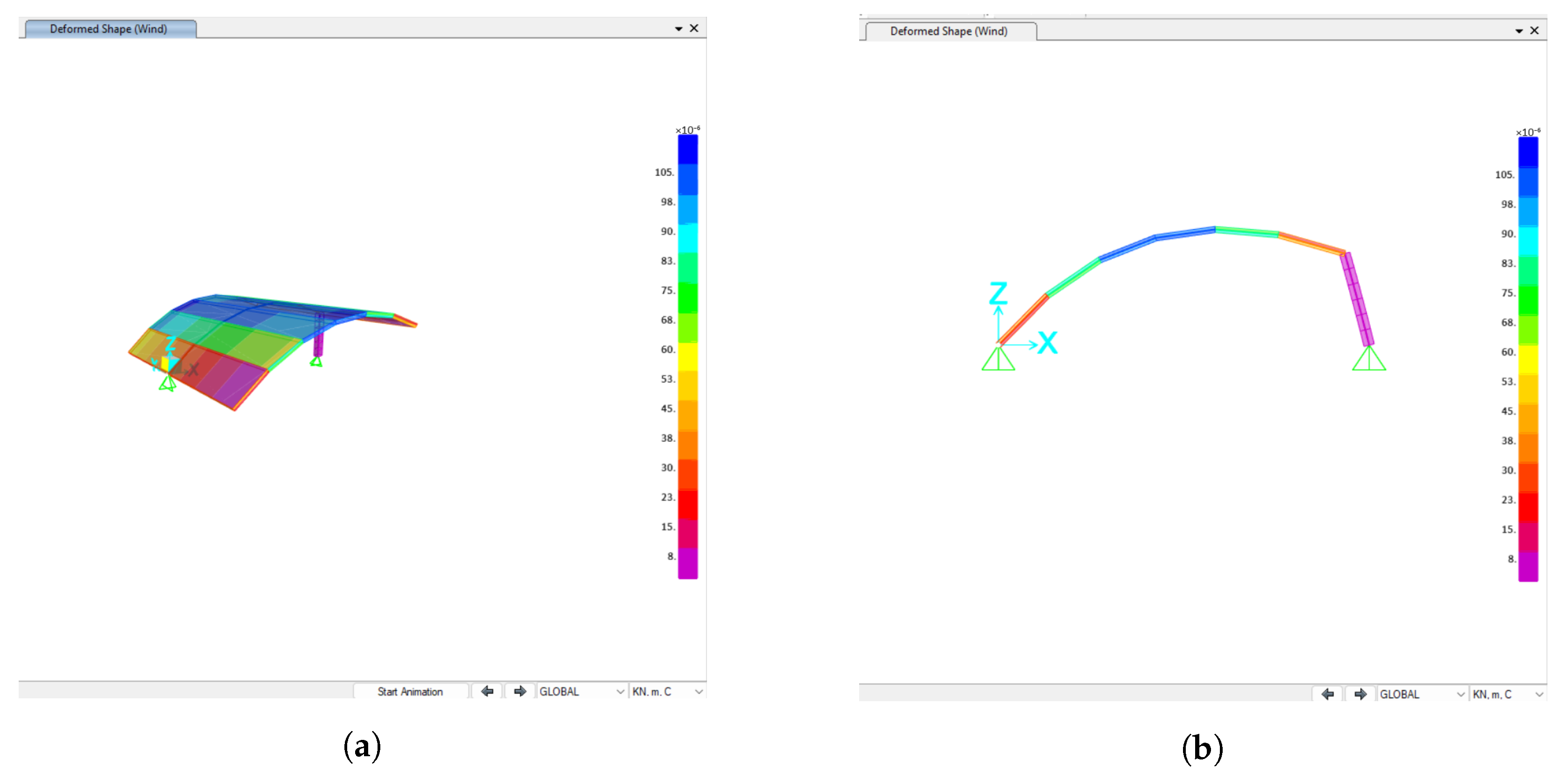
Figure 8 shows the application of wind loads in SAP2000, where the distributed suction load is represented with negative values in the wind direction on the positive X-axis. This visual representation illustrates how the influence of the suction wind on the structure is modeled.
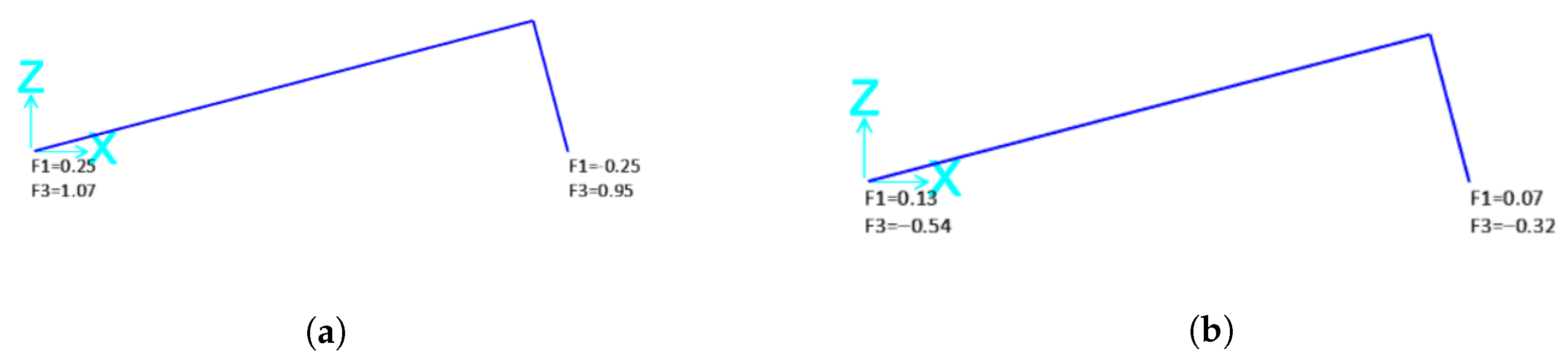
The structural analysis performed in SAP2000 has allowed the reactions to be obtained on the supports of the structure in response to the applied loads. Figure 9 shows the reactions generated by the dead load, i.e., the structure’s own weight, while Figure 9 presents the reactions due to the wind load. These reactions have been decomposed into their vertical and horizontal components, which have made it possible to evaluate the overall stability and equilibrium of the structure. Breakdown of reactions in these principal axes is essential to ensure that the structure is able to adequately resist and transmit the loads to the supporting elements.
The program has generated Figure 10 that represents the deformed shape of the structure under the action of the applied loads. These visualizations allow the identification of the zones that experience the largest displacements and deformations. The maximum deformation values obtained are in the range from [minimum value] to [maximum value], which is considered acceptable according to the criteria established in the current standards. However, the behavior of the slab in the presence of suction phenomena, which can generate deformations and internal stresses in the structure, has been analyzed. The results obtained show that the suction deformation values remain within the permissible limits established in the applicable design codes.

3.3. Classification of the Site Areas and Shadow Study

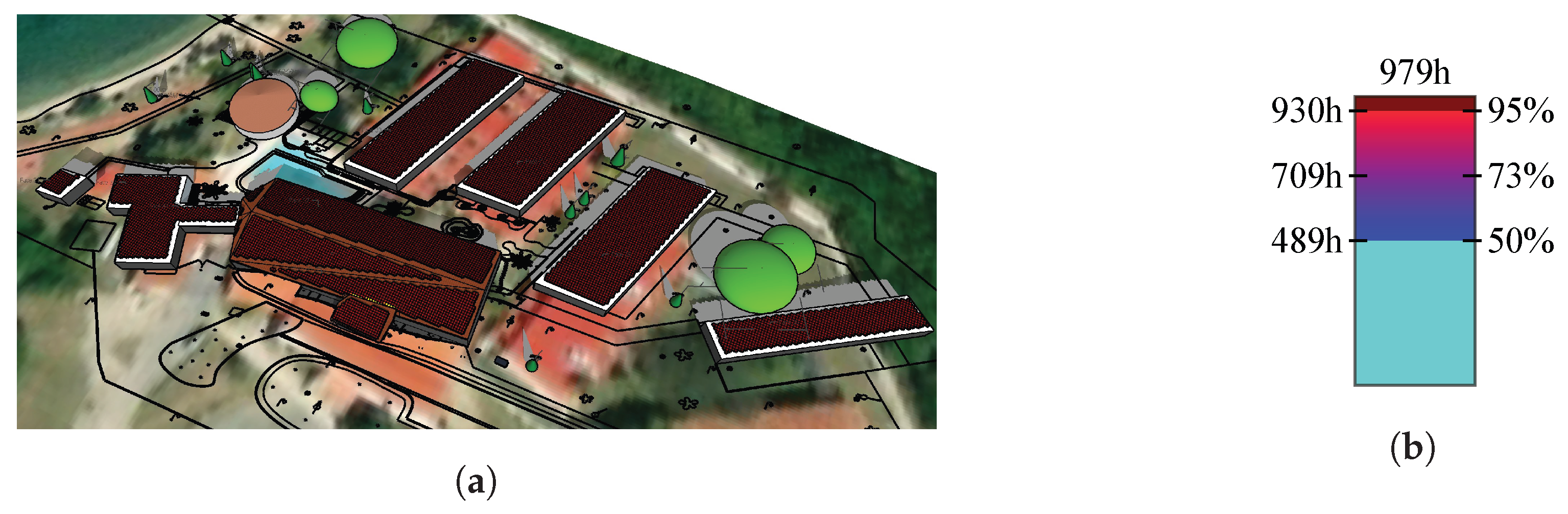
Figure 11 shows how the incidence of solar radiation varies throughout the day, taking into account the path of the sun and the obstacles present. In Figure 11, the areas with optimal conditions for the installation of the SSFV are highlighted in brown, as well as the recommended areas for the placement of the panels. This analysis has allowed us to identify the largest available area to maximize the efficiency of the system, minimizing the incidence of shadows on photovoltaics.
In conclusion, the site has ideal characteristics of irradiation and air quality, where at the same time there are high levels of relative humidity and temperature, which increase the level of diffuse irradiation, which is less exploited by the solar modules, and the high temperatures affect the efficiency of the system as they increase the resistance of the conductors and also decrease the generation of electricity.

3.4. Photovoltaic Array Analysis and Optimization

The objective of this section is to perform an analysis of all variants according to the azimuth that this SSFV can have. For this purpose, the following procedure was carried out:
  • A total of 360 simulations were carried out in the SketchUp 2023 software, with its link in Skelion, to detect the number of modules and the spaces between them that could best occupy the available area.
  • 360 simulations were performed in PVsyst 7.3 with the objective of adjusting the best possible electrical arrangement, selecting the inverters in the most convenient way.
  • A model describing this process was estimated with the help of machine learning and statistically analyzed. After validation, the optimization process was performed.
The following machine learning pseudocode was used to perform correlation studies between the variables in the following three phases: first, the analysis of 360 degrees; second, the first 180 degrees; and third, the last 180 degrees. In this way, a more precise and detailed review of the behavior of the variables can be assessed and carried out.
  • Import necessary libraries (pandas, numpy, matplotlib, seaborn, and sklearn).
  • Define the function ‘ p e r f o r m a n a l y s i s ’ that performs data analysis:
    a. Print the loaded data.
    b. Calculate and plot the correlation matrix between variables.
    c. Separate the features (X) and the target variable (y).
    d. Initialize a linear regression model without an intercept.
    e. Train the model with the data.
    f. Obtain the model coefficients.
    g. Print the model coefficients.
    h. Define and print the model equation.
    i. Make predictions with the model.
    j. Calculate and print the R 2 value.
    k. Plot the actual and predicted data.
    l. Plot the model equation.
  • Load the data from a CSV file.
  • Divide the Production column (kWh/year) by 1000.
  • Perform the analysis on all data by calling p e r f o r m a n a l y s i s ( d f ) .
  • Perform the analysis on the first 180 data points by calling p e r f o r m a n a l y s i s ( d f f i r s t 180 ) .
  • Perform the analysis on the last 180 data points by calling ‘ p e r f o r m a n a l y s i s ( d f l a s t 180 ) ’.

3.4.1. 360 Degree Analysis

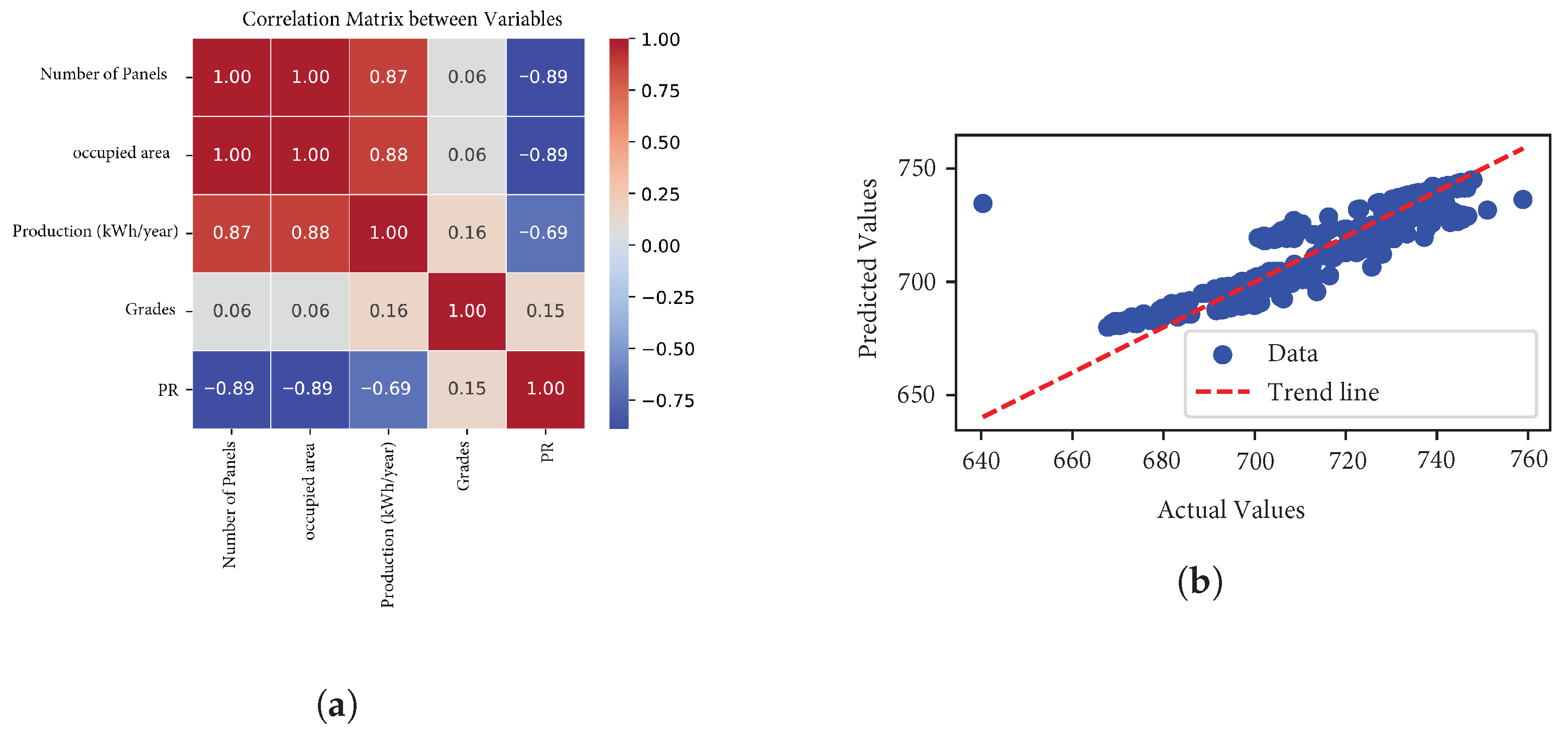
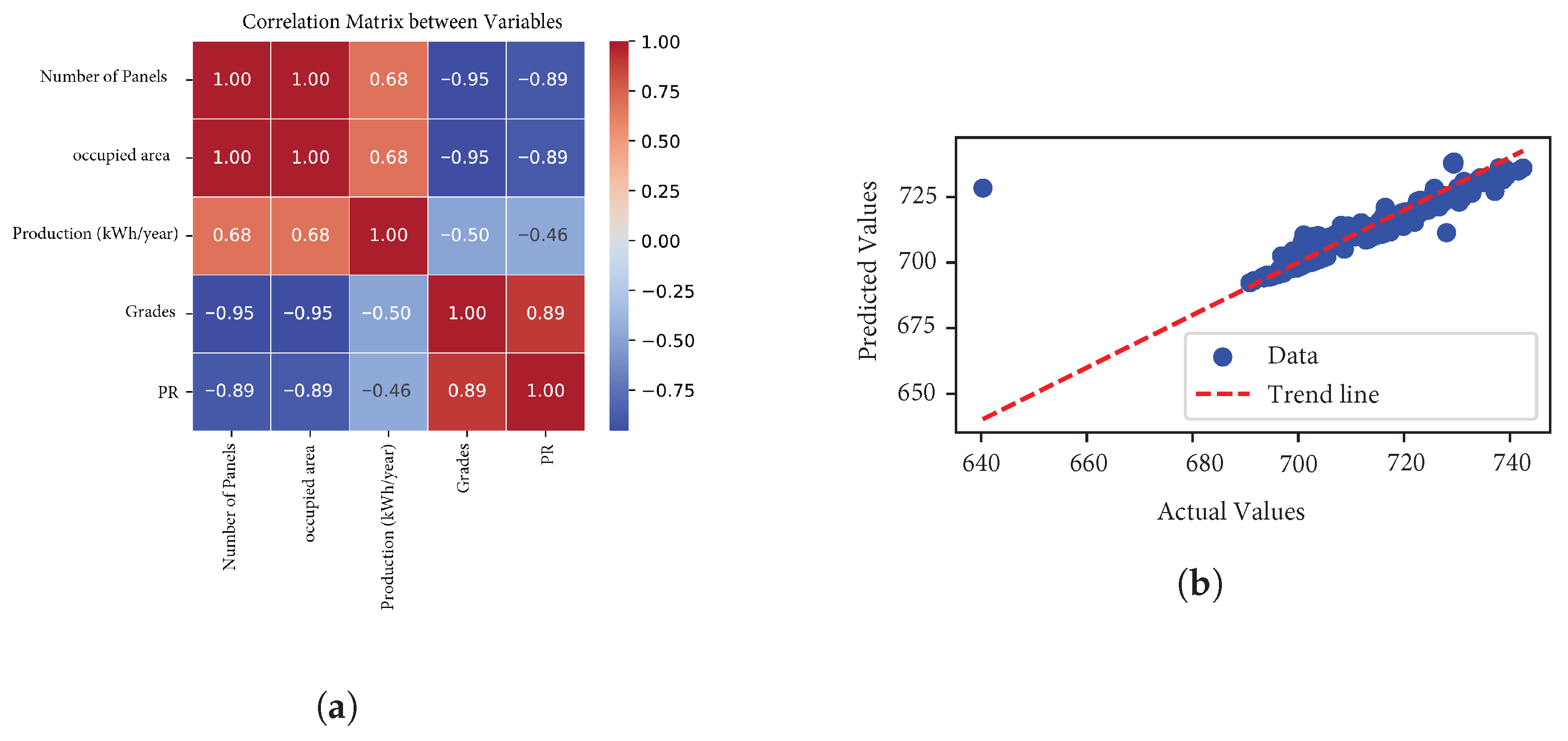
The following graph shows a correlation above the allowed parameters with an R 2 greater than 0.80 between the variables, except for those related to the degrees, which are below 0.15. These are expected results since there is a direct relationship between the production and the number of solar panels, and ,in turn, the occupied area depends directly on the number of modules.
A multivariate linear regression analysis was performed to find a model that describes the sizing behavior. The following results were obtained; see Figure 12.
In Equations (21)–(23), the independent variables represent the main energy drivers identified during the analysis. Specifically, X 1 corresponds to Degree Days (DG), which capture the influence of outdoor climatic conditions; X 2 represents Hotel Days Occupied (HDO), associated with the operational activity level of the building; X 3 corresponds to the installed capacity of the photovoltaic system; and X 4 represents the energy generated by the photovoltaic system. The dependent variable y represents the total electrical energy consumption of the building.
Model equation:
y = ( 0.1464 X 1 ) + ( 0.1062 X 2 ) + ( 0.0162 X 3 ) + ( 4.3208 X 4 )
The value of R 2 is 0.79.
The model has an acceptably good fit, since the value of R 2 is relatively high, suggesting that the predictor variables provide a good explanation of the variability in the dependent variable, but it still leaves a high margin of error.

3.4.2. First 180 Degrees Analysis

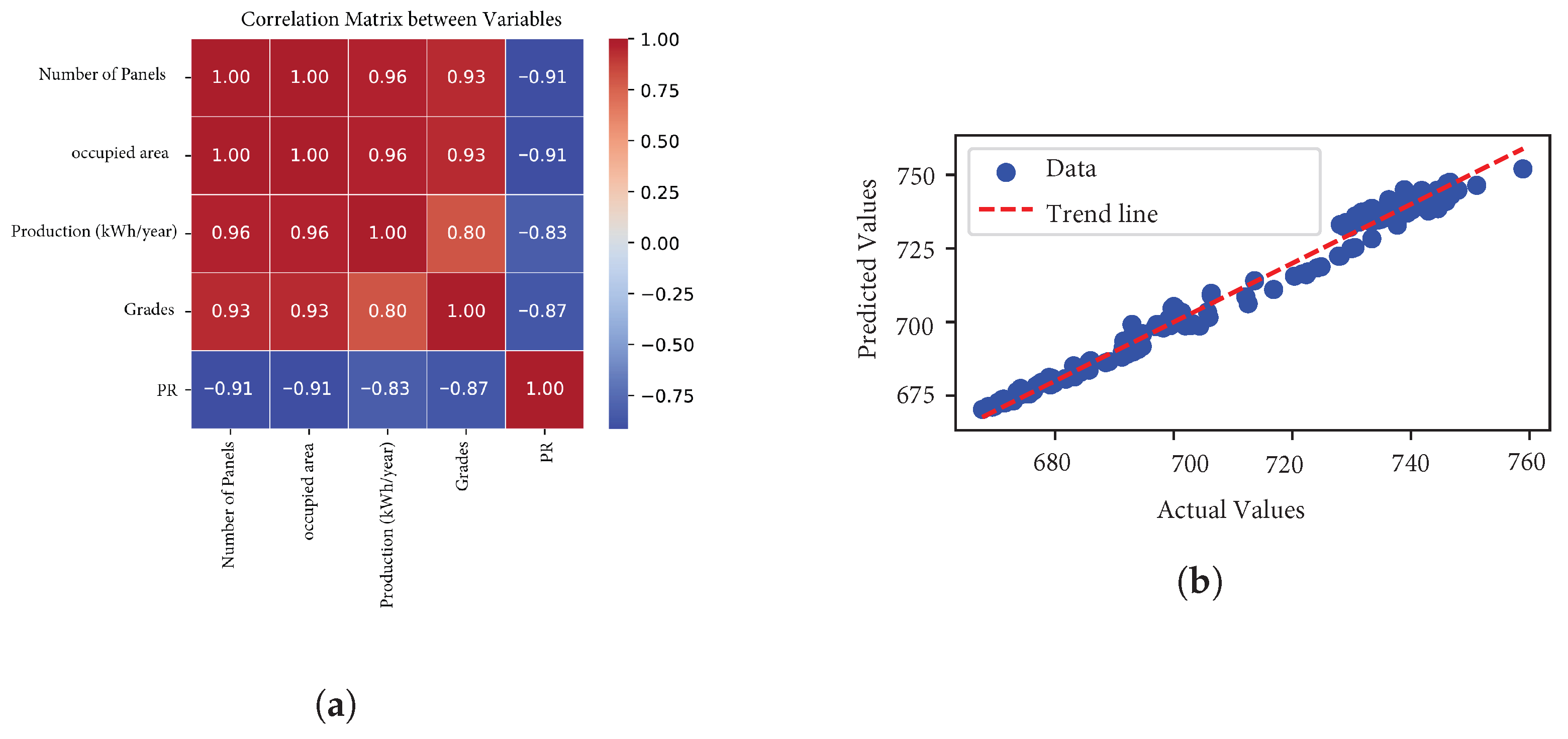
The following graph shows a correlation above the allowed parameters with an R 2 higher than 0.80 between all variables. The analysis has a linear behavior, hence the good correlation and a stable and increasing behavior.
A multivariate linear regression analysis was performed to find a model that describes the sizing behavior. The following results were obtained; see Figure 13.
In Equations (21)–(23), the independent variables represent the main design, operational, climatic, and performance-related factors considered in the analysis. Specifically, X 1 corresponds to the number of photovoltaic panels, reflecting the system size; X 2 represents the occupied area associated with the photovoltaic installation; X 3 corresponds to the annual energy production of the system in kilowatthours per year; and X 4 represents the Degree Days (Grades), which capture the influence of outdoor climatic conditions. The dependent variable y represents the performance indicator evaluated in the regression model.
This behavior is associated with interaction effects and partial multicollinearity among the independent variables, which can alter the sign and magnitude of regression coefficients without affecting the physical consistency of the model. In this context, the negative sign of X 2 reflects a conditional marginal effect in the presence of the remaining variables, rather than an inverse direct relationship between hotel occupancy and energy consumption.
Model equation:
y = ( 3.1102 X 1 ) + ( 0.9018 X 2 ) + ( 0.3604 X 3 ) + ( 1.7391 X 4 )
The value of R 2 is 0.9851.
The model has a very good fit, as the value of R 2 indicates that approximately 98.51% of the variability in the response variable is explained by the linear regression model.

3.4.3. Analysis of 180 to 360 Degrees

The following graph shows a correlation above the allowed parameters with an R 2 less than 0.50 between the variables Production-Grades and Production-PR; less than 0.68 between the Production-Quantity of panels and the Production-Occupied area; all others are above 0.80. The analysis has a linear and increasing behavior with some outliers, as shown in the graph in Figure 14.
A multivariate linear regression analysis was performed to find a model that describes the sizing behavior. The following results were obtained; see Figure 14.
The combined analysis of Equations (21)–(23) demonstrates that the modeled system behavior results from the simultaneous interaction of climatic, operational, design, and performance-related variables. Therefore, the interpretation of individual regression coefficients should be carried out within a multivariable context, considering marginal effects and interdependencies among predictors rather than evaluating each coefficient in isolation.
Model equation:
y = ( 0.7963 X 1 ) + ( 0.0151 X 2 ) + ( 0.4050 X 3 ) + ( 0.3856 X 4 )
The value of R 2 is 0.69.
The model has an acceptable fit, since the value of R 2 indicates that approximately 69% of the variability in the response variable is explained by the linear regression model. This is due to the outliers it possesses, due to the characteristics of the facility’s positioning. Angles such as these do not favor the sizing and utilization of the area.

3.4.4. Optimization Process

For the optimization process, a genetic algorithm was implemented with the objective of finding the maximum of the designed model describing the data. The condition established was an efficiency greater than 91.56%, in addition to looking for a combination that maximized both the production and the occupied area in relation to the azimuthal angle, taking as a reference the previous analyses. The pseudocode used is described below.
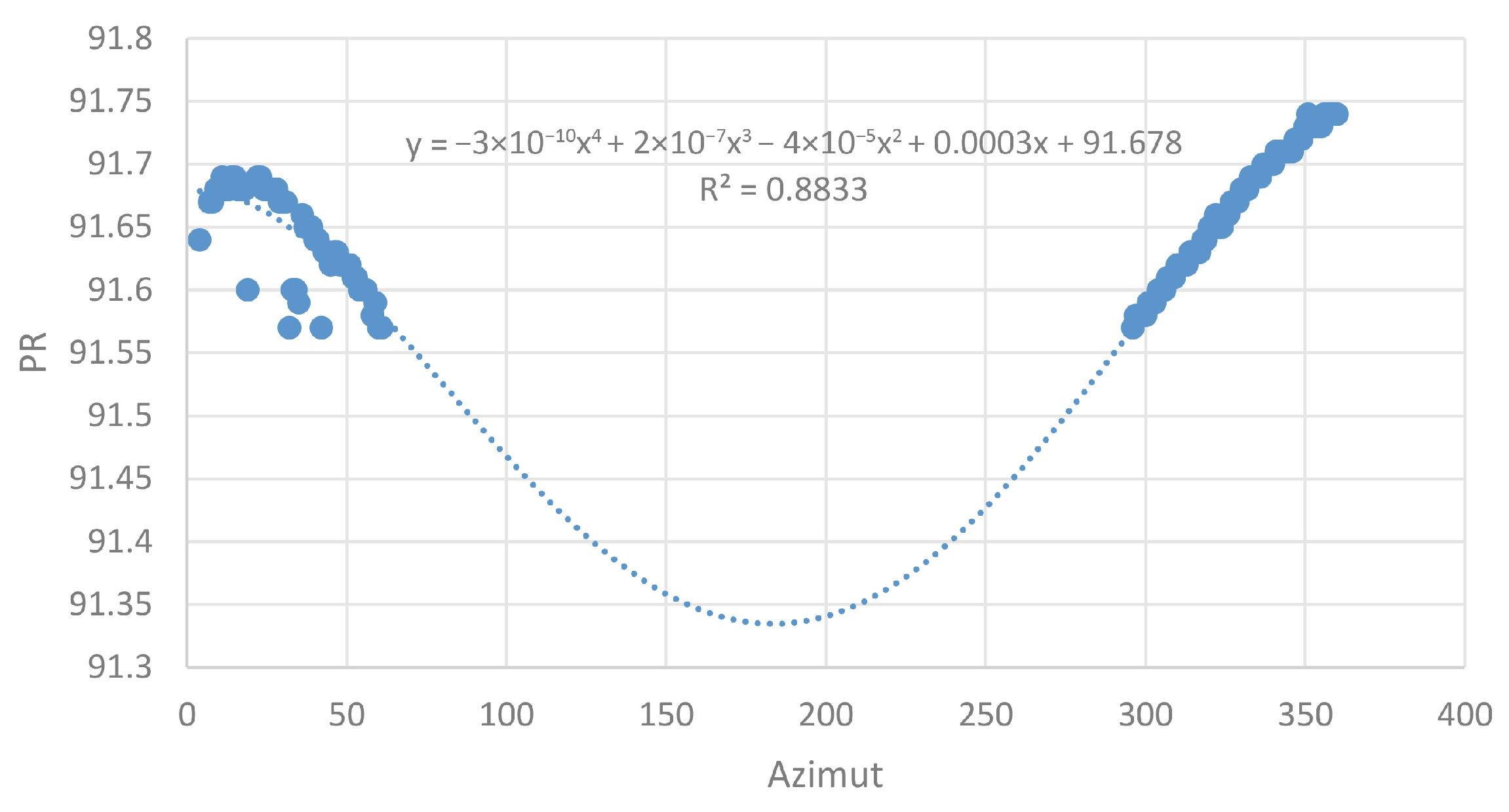
Figure 15 describes the behavior and models the data obtained in the software simulations that have efficiencies equal to or greater than the northern hemisphere standard location to the south, which is a target for improvement.
This code implements a genetic algorithm for the optimization of an objective function. Below is the description of it.

3.4.5. Defined Functions

  • POBLACION_INICIAL: Generates an initial population of random solutions within the specified limits.
  • OPERADOR_CRUCE: Performs the crossing of individuals of the population, generating new individuals from the combination of characteristics of two randomly selected individuals.
  • OPERADOR_MUTACION: Applies random mutations to the individuals of the population, introducing genetic variability in the population.
  • OBJETIVO_V1: Calculates the value of the objective function for each individual in the population. In this case, the objective function is a specific cubic function.
  • SELECCION_V1: Performs the selection of individuals for the next generation based on the value of the objective function. Individuals with higher objective function values are preferred.

3.4.6. Algorithm Parameters

  • G: number of generations;
  • mu: population size;
  • limits: Limits for the generation of random numbers;
  • var: standard deviation for the mutation.

3.4.7. Variable Initialization

Arrays are initialized to store the current population (xp), the cross population (xc), the mutated population (xh), as well as the values of the objective function for the current population (yp) and the mutated population (yh).

3.4.8. Algorithm Execution

An initial population is generated using the function POBLATION_INITIAL. It then iterates through a fixed number of generations (G). In each generation, crossover, mutation, and evaluation of the current and mutated population are performed. Finally, individuals are selected for the next generation based on the value of the objective function.
The optimization yielded the selection of a maximum in the modeled function of the SSFV sizing behavior. In this case, the variables of azimuth and annual energy production in alternating current are presented; the values are x = 6.15 and y = 91.68. To validate these results, an analysis of the function and data was carried out and compared with the result obtained. For the sake of argument, the final sizing will be carried out in SketchUp 2023 and PVsyst 7.3. Both programs will provide the final values, taking the results of the algorithm as a reference.

3.4.9. Validation of Results

For the validation and final sizing of the SSFV, a sizing was performed in the SketchUp 2023 software; the results will be simulated in the PVsyst 7.3 software, where we will have as results the number of modules, system efficiency, production, and reduction of pollutant emissions.
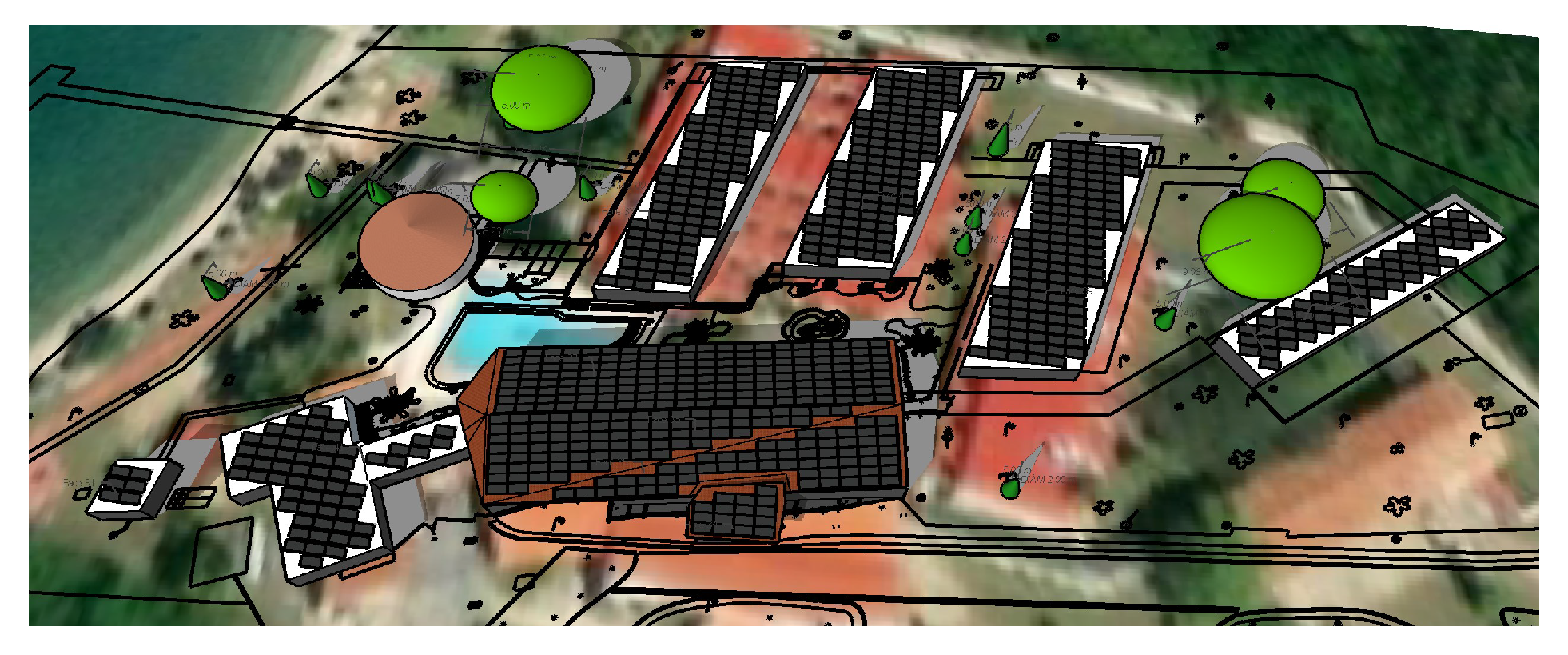
Figure 16 shows the sizing of the PVSS after the results obtained with the AI. For the adjustments, it was decided to maintain and maximize the area of the main building with a north-south orientation. For this purpose, a coplanar system was used that maintains the roof characteristics and adjusts to the roof area where the greatest amount of space is used. The angle of inclination used is 15 degrees, which is within the permissible range in Cuba with respect to latitude. The efficiency is compensated during the dimensioning and the confection of the photovoltaic array. The other areas maintain the angles defined with the genetic algorithm.
After the above analysis, we went on to perform the sizing and PV array in PVsyst 7.3 software in order to analyze the power system, its efficiency, losses, and power generation.
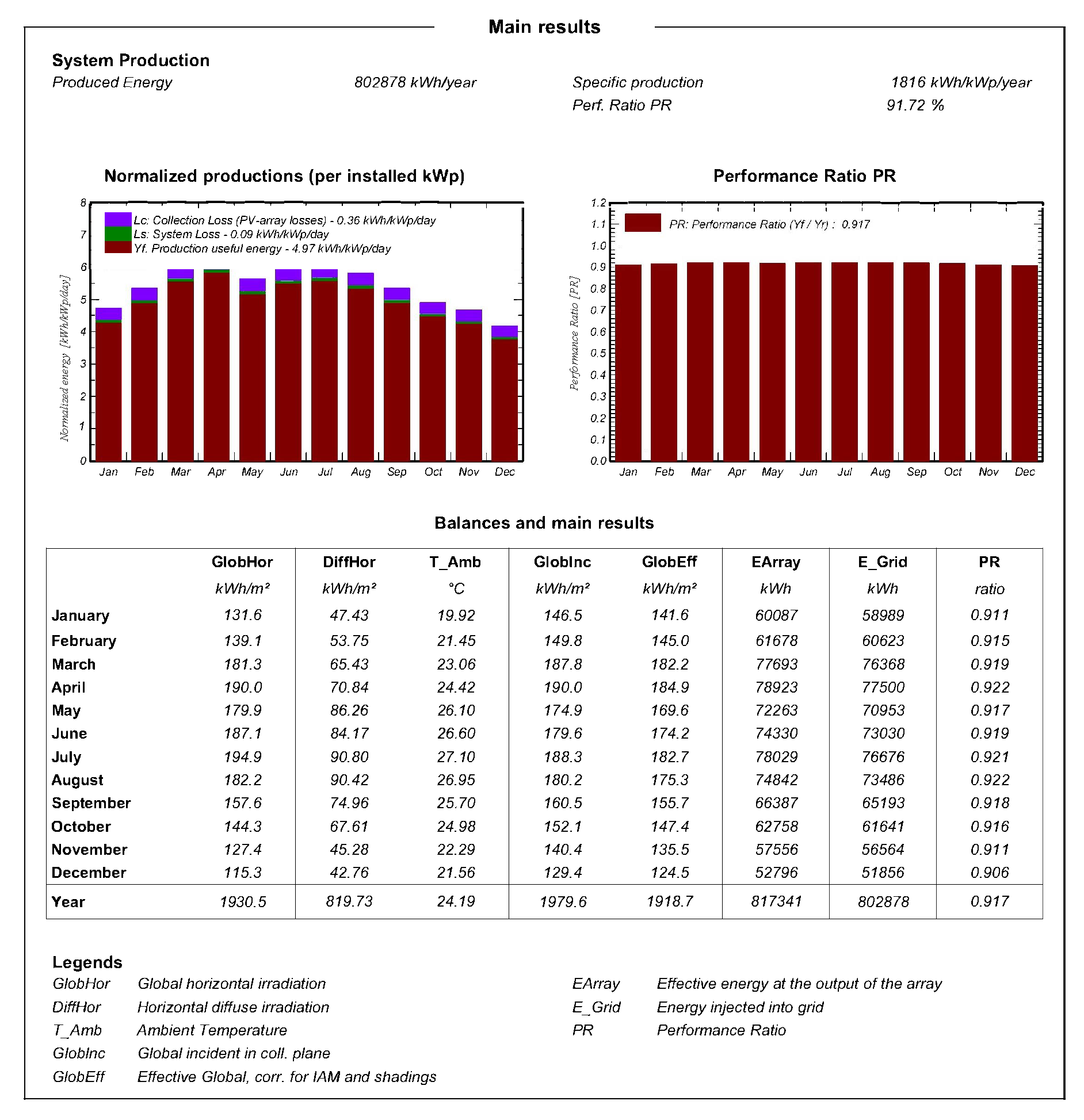
Figure 17 shows the annual generation of the PVFS of 802,880 k W h a n ~ o for 804 modules and an average PR of 91.72%. In the analysis, the most critical months in the PR are the first and last quarters of the year due to the low irradiation in these months of the year, which has a direct relationship with the production of the system.
Table 1 shows the four arrays used and how they are structured, with their corresponding strings, number of modules, orientation, azimuth, production, and PR. It could be observed that the arrays with optimized orientation have the best PR values, followed by the south-facing ones, and lastly, the north-facing ones and the array with the fewest modules. This demonstrates the effectiveness of the genetic algorithm and the importance of inverter selection based on oversizing of up to 30%, taking into account working ranges and inverter efficiency as a reference. The importance of the arrays and MPPT is highlighted, which allowed achieving a high efficiency of the system in general.
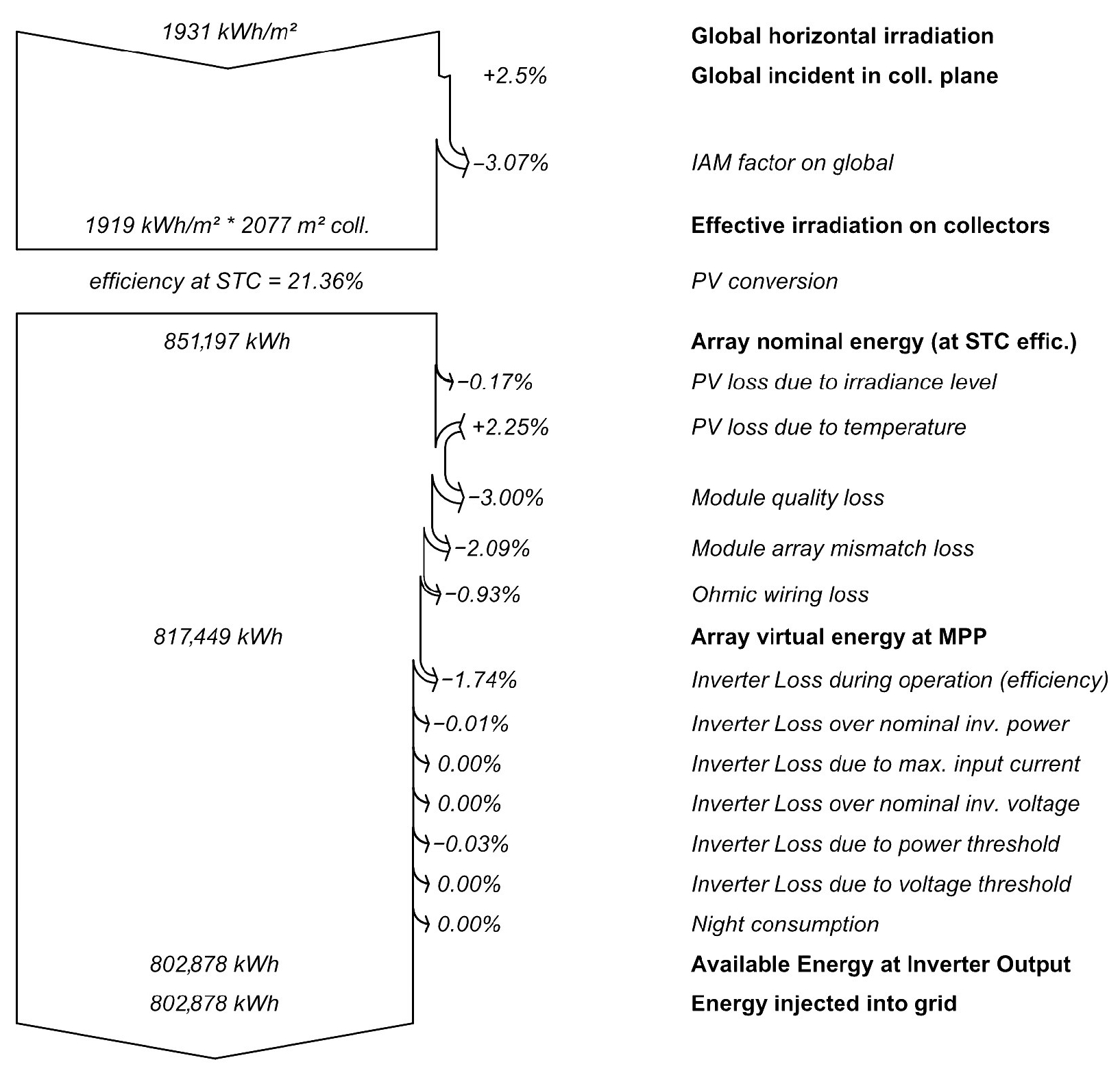
Figure 18 shows the losses of the system and where they are developed; in this case, they are found in the irradiation, quality, and type of module, array, and inverters. They were taken into account in the development and sizing of the PVSS, for which the adjustments mentioned above were made to ensure that they were as minimal as possible.

3.4.10. Economic and Environmental Analysis

For the economic evaluation of the project, the following criteria will be taken into account [46,47].
The economic analysis is based on the SSFV proposal, selected due to its comprehensive design, which includes a higher number of PV modules and inverters compared to other options. This structure results in the highest net cost, making it ideal for an in-depth economic feasibility study. The unit costs of components, assembly services, and financial parameters used in the evaluation were sourced from company data and literature. Given the unique economic and financial conditions in Cuba, a dual analysis was conducted: the enterprise approach evaluates the direct impact on the organization, while the national approach assesses the potential savings from reduced oil imports.
This study uses an exchange rate of USD 1 = CUP 120, as established by the Central Bank of Cuba. Financial parameters include a discount rate of 8%, an inflation rate of 5%, a risk margin of 3%, and a tax rate of 35%, based on reference [48]. Equipment costs, including installation, were sourced from Corey Solar (Mexico) and Alibaba (China) for modules, inverters, and related components, reflecting special pricing for bulk quantities.
  • Each 550 Wp module would cost USD 60 per unit, so the 804 modules would have a total value of USD 48,240.
  • Inverters cost USD 3000 per 100 kW inverter (quantity 2), USD 7500 per 274 kW inverter (quantity 1), and USD 75 per 0.70 kW inverter (quantity 1); and for the installation, four inverters are needed for a value of USD 10,575.
  • Labor USD 0.02 per Wp would be 442 kWp for a total of USD 8840.
  • Structure USD 0.02 per Wp would be 442 kWp for a total of USD 8840.
  • Electrical equipment USD 0.01 per Wp would be 442 kWp for a total of USD 4420.
  • For a total of USD 80,915.
The economic evaluation of the proposal considers the number of modules and system losses to estimate daily production, based on an annual average of 5 peak solar hours (HSP) in Cuba. Additionally, the payment for kWh generated by the proposed PV system and delivered to the National Electroenergetic System (SEN) is calculated using Decree Law 345 of the Ministry of Justice of Cuba. This law states that the purchase price of electricity is based on the avoided cost of fossil fuel-based generation, among other factors.
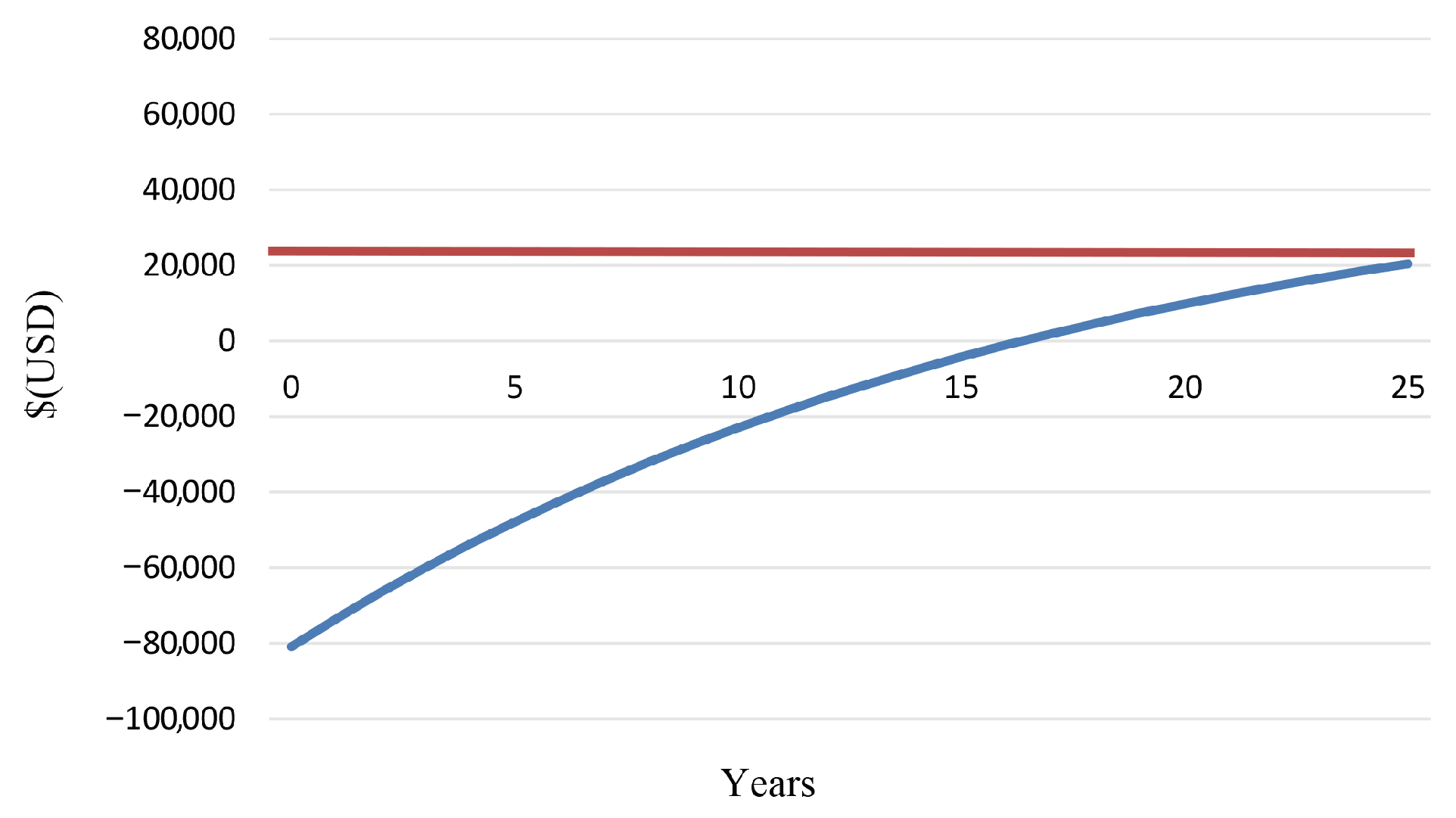
Interviews with officials from the National Office for the Control of the Rational Use of Energy (ONURE), including its director, provided a reference purchase price of 1.5869 CUP kWh for electricity generated outside the SEN [49]. The economic viability of the project, as assessed using data from Corey Solar de México, is summarized in Figure 19.
Given the existing economic situation in Cuba, due to the dual currency, the high inflation margins, and the subsidy on electricity and other social services, Figure 19 shows the TIR of −10% and the VPN of 20,000 USD, which means that the project will be recovered in 17 years; if future maintenance, breakage, depreciation, and the decrease in the efficiency of the SSFV are taken into account, which indicates that the income is not enough to cover the expenses; therefore, the project is not profitable. Therefore, the incorporation of renewable energy in the country is not considered feasible.

3.4.11. Economic Evaluation at Country Level

The income from fuel savings is given in Equation (24):
G c o m b = E g e l e c 365 day year g e s p g e l e c
where
E g e l e c —Electric power generated by the genset;
g e s p g l e c —Specific consumption of the genset. It is considered a value of the most modern equipment (0.236 kg kWh ) as it does not have the real value of the equipment in operation.
Substituting values into Equation (25) as follows:
G comb = 2230 kWh day × 365 day year × 0.236 kg kWh = 192 , 092.2 kg year
Considering the value of the density of diesel ( ρ 3 ) of 850 kg/m3, the volumetric flow of diesel is 225,990.8 L/year. The value of a liter of diesel for Cuba is given in the web page of the site [50].
1 L = USD 1; EUR 0.831.
The income from fuel savings in USD is as follows:
Income from diesel savings = 225 , 990.8 L / year × USD 1 / L = USD 225 , 990.8 / year .

3.4.12. Environmental Analysis

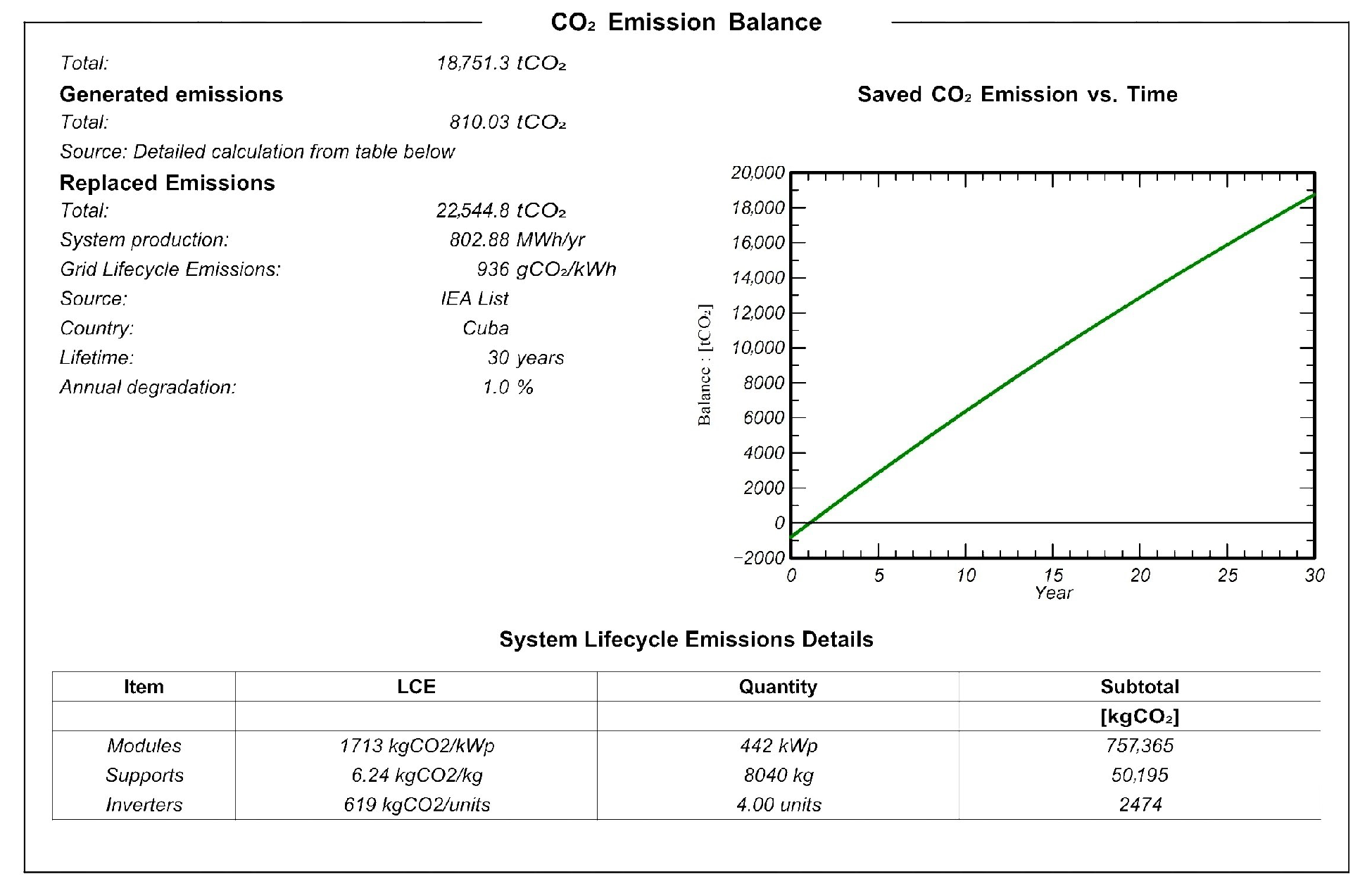
Figure 20 shows the amount of pollutant emissions that this SSFV would contribute to net emitting pollutants.

4. Discussions

Table 2 presented allows a comprehensive comparison between different research studies carried out in different geographical, climatic, and analytical contexts. This comparative analysis shows that the methodology proposed in this paper is innovative and distinctive. This is because it incorporates a comprehensive combination of variables and approaches ranging from energy efficiency and management to the use of advanced artificial intelligence (AI)-based optimization techniques for solar photovoltaic system integration (SSFV). In addition, it includes a detailed analysis of economic feasibility and a study of pollutant emissions, allowing both environmental impact and economic benefits to be assessed. Overall, this proposal not only addresses gaps in previous research but also provides an interdisciplinary approach that could set a new standard in the evaluation of sustainable energy solutions.

4.1. Discussion: Energy Performance Indicators

A correlation analysis was conducted, revealing that the variable ( H D O × D G ) has a significant impact on the hotel’s energy consumption model, as evidenced by a high coefficient of determination ( R 2 = 0.97). One of the innovative aspects of this study lies in the integration of renewable energy sources, which would enable significant reductions in electricity consumption—currently the most utilized energy vector within the facility. This reduction would have a direct impact on operational efficiency. Additionally, the replacement of traditional lighting systems with more efficient alternatives would result in considerable cost savings. Together, these measures not only enhance the environmental sustainability of the installation but also increase the hotel’s competitiveness in the market.
Table 3 shows the results chosen by other authors in similar studies varying the energy performance indicator.

4.2. Discussion: Optimization of the SSFV

This section focuses on the analysis of the proposals created in this research in relation to other similar studies in this field. Key aspects for comparison include the orientation of the system, the location of the study, the type of module technology applied, the number of modules used, the area considered in the analysis, and the expected costs.
Table 4 presents the main elements comparing the results achieved in this research with those of other studies in the same field.
This study emphasizes the significance of system orientation and design in optimizing photovoltaic (PV) system performance. The findings reveal that most studies align system orientation with the latitude of the installation site to enhance efficiency by optimizing the incidence of solar radiation on the module’s surface. Unlike other research, this study also examines the impact of operating temperature on PV module efficiency, highlighting its importance in improving energy production. Additionally, the manipulation of tilt and azimuth angles is identified as a critical factor in achieving higher performance ratios (PR) and meeting significant portions of daily energy demands. Notably, while many studies calculate efficiency indices, they often adopt varying methods and exclude several key variables analyzed in this research. Many of their values were estimated to establish correlations for comparison, whereas this study integrates a comprehensive range of variables for greater accuracy.
A key innovation lies in employing a building-integrated photovoltaic (BIPV) approach to maximize installation areas by modifying building structures, a methodology not widely addressed in prior research. This is complemented by a detailed analysis of maximum power point tracking (MPPT) voltages and inverter efficiency, addressing aspects often overlooked in similar studies. Furthermore, the research underscores the environmental benefits of PV systems, such as reducing greenhouse gas emissions. Its practical application extends globally, provided local regulations, climatic conditions, and building orientation are considered. This study offers valuable insights for project planning, promoting the seamless integration of renewable energy into power grids while optimizing space, resources, and system efficiency through a holistic analysis.

5. Conclusions

This study presents a comprehensive methodology for the integration of standalone solar photovoltaic systems (SSFV) into building energy management frameworks, using Hotel Punta la Cueva as a case study. The main findings of the research can be summarized as follows:
  • A structured methodology was developed that integrates energy performance analysis, SSFV system design, and artificial intelligence-based optimization. The proposed approach demonstrates the feasibility of combining energy efficiency assessment with photovoltaic system optimization within a unified framework.
  • An energy performance indicator based on the combined variable HDO × DG was validated, showing a strong correlation with system behavior ( R 2 = 0.97 ). This indicator enabled the identification of energy-saving potential not associated with production, achieving a reduction of 5.3% relative to the baseline.
  • The application of a genetic algorithm for SSFV optimization led to a non-conventional azimuth configuration, resulting in an increase in energy production of 14.75%, an improvement in the performance ratio, and a more efficient use of the available installation area compared to the conventional south-oriented configuration.
  • The economic and environmental assessment revealed that, although the project presents limited financial profitability at the facility level, it offers significant benefits at the national and environmental levels, including fuel savings and a substantial reduction in greenhouse gas emissions.
Despite these contributions, some limitations should be acknowledged. The proposed methodology was applied to a single case study under specific climatic and operational conditions, which may limit the direct generalization of the results to other contexts. Additionally, the optimization process focused primarily on geometric and performance-related variables, without explicitly considering dynamic operational control or real-time system adaptation.
Future research should extend the proposed framework to multiple building typologies and climatic regions, incorporate dynamic and real-time data for adaptive optimization, and explore hybrid optimization and machine learning techniques to further enhance SSFV performance and decision-making robustness.

Author Contributions

Conceptualization, L.A.I.C., J.M.Á.-A., G.I.P.-S. and C.G.M.-P.; methodology, L.A.I.C., J.M.Á.-A. and G.I.P.-S.; software, L.A.I.C. and O.R.-A.; validation, O.R.-A. and J.R.-R.; formal analysis, L.A.I.C., J.M.Á.-A. and J.R.-R.; investigation, L.A.I.C. and O.R.-A.; data curation, L.A.I.C. and J.R.-R.; writing—original draft preparation, L.A.I.C., O.R.-A. and J.M.Á.-A.; writing—review and editing, O.R.-A., G.I.P.-S. and J.R.-R.; visualization, L.A.I.C. and J.R.-R.; supervision, O.R.-A. and J.R.-R. All authors have read and agreed to the published version of the manuscript.

Funding

This research received no external funding.

Institutional Review Board Statement

Not applicable.

Informed Consent Statement

Not applicable.

Data Availability Statement

The raw data supporting the conclusions of this article will be made available by the authors on request.

Acknowledgments

The authors would like to acknowledge the support of Consejo Nacional de Humanidades, Ciencias y Tecnologías (CONAHCYT) in the production of this work.

Conflicts of Interest

The authors declare no conflicts of interest.

References

  1. Thangavelu, S.; Umapathy, P. Design of new high step-up DC-DC converter Topology for solar PV applications. Int. J. Photoenergy 2021, 2021, 7833628. [Google Scholar] [CrossRef]
  2. González Gaudiano, E.J.; Meira Cartea, P.Á. Educación para el cambio climático: ¿Educar sobre el clima o para el cambio? Perfiles Educ. 2020, 42, 157–174. [Google Scholar] [CrossRef]
  3. Olabi, A.; Abdelkareem, M.A. Renewable energy and climate change. Renew. Sustain. Energy Rev. 2022, 158, 112111. [Google Scholar] [CrossRef]
  4. Sher, F.; Curnick, O.; Azizan, M.T. Sustainable conversion of renewable energy sources. Sustainability 2021, 13, 2940. [Google Scholar] [CrossRef]
  5. Aleksandr, S.B.; Sergey, A.Y.; Aleksandr, S.S.; Aleksandr, F.S.; Galina, M.B. Implementation of ISO 50001 standard in the activities of energy companies. In Proceedings of the 2021 International Conference on Electrotechnical Complexes and Systems (ICOECS), Ufa, Russia, 16–18 November 2021; pp. 417–420. [Google Scholar]
  6. Sousa Lira, J.M.; Salgado, E.G.; Beijo, L.A. Which factors does the diffusion of ISO 50001 in different regions of the world is influenced? J. Clean. Prod. 2019, 226, 759–767. [Google Scholar] [CrossRef]
  7. Marimon, F.; Casadesús, M. Reasons to adopt ISO 50001 energy management system. Sustainability 2017, 9, 1740. [Google Scholar] [CrossRef]
  8. Zhou, X.; Mei, Y.; Liang, L.; Fan, Z.; Yan, J.; Pan, D. A dynamic energy benchmarking methodology on room level for energy performance evaluation. J. Build. Eng. 2021, 42, 102837. [Google Scholar] [CrossRef]
  9. Dibene-Arriola, L.M.; Carrillo-González, F.M.; Quijas, S.; Rodríguez-Uribe, M.C. Energy efficiency indicators for hotel buildings. Sustainability 2021, 13, 1754. [Google Scholar] [CrossRef]
  10. Teng, Z.R.; Wu, C.Y.; Xu, Z.Z. New energy benchmarking model for budget hotels. Int. J. Hosp. Manag. 2017, 67, 62–71. [Google Scholar] [CrossRef]
  11. Salem, R.; Bahadori-Jahromi, A.; Mylona, A.; Godfrey, P.; Cook, D. Energy performance and cost analysis for the nZEB retrofit of a typical UK hotel. J. Build. Eng. 2020, 31, 101403. [Google Scholar] [CrossRef]
  12. Palani, H.; Karatas, A. Identifying Energy-Use Behavior and Energy-Use Profiles of Hotel Guests. Appl. Sci. 2021, 11, 6093. [Google Scholar] [CrossRef]
  13. Álvarez Guerra Plasencia, M.A.; Cabello Eras, J.J.; Sousa Santos, V.; Sagastume Gutiérrez, A.; Haeseldonckx, D.; Vandecasteele, C. Experiencias en la utilización de información meteorológica para el pronóstico y control del consumo de electricidad en hoteles. In Proceedings of the XI Congreso de la Asociación Española de Climatología, Cartagena, Spain, 17–19 October 2018; Asociación Española de Climatología: Barcelona, Spain, 2018. [Google Scholar]
  14. Faiz, F.U.H.; Shakoor, R.; Raheem, A.; Umer, F.; Rasheed, N.; Farhan, M. Modeling and analysis of 3 MW solar photovoltaic plant using PVSyst at Islamia University of Bahawalpur, Pakistan. Int. J. Photoenergy 2021, 2021, 6673448. [Google Scholar] [CrossRef]
  15. Junaidh, P.; Vijay, A.; Mathew, M. Power enhancement of solar photovoltaic module using micro-climatic strategies in warm-humid tropical climate. In Proceedings of the 2017 Innovations in Power and Advanced Computing Technologies (i-PACT), Vellore, India, 21–22 April 2017; pp. 1–6. [Google Scholar]
  16. Kumar, N.M. Simulation tools for technical sizing and analysis of solar PV systems. In Proceedings of the 6th World Conference on Applied Sciences, Engineering and Technology (WCSET-2017), Bangkok, Thailand, 11–12 October 2017; Volume 201, pp. 218–222. [Google Scholar]
  17. Huang, K.H.; Chao, K.H.; Lee, T.W. An Improved Photovoltaic Module Array Global Maximum Power Tracker Combining a Genetic Algorithm and Ant Colony Optimization. Technologies 2023, 11, 61. [Google Scholar] [CrossRef]
  18. Chander, S.; Purohit, A.; Sharma, A.; Arvind; Nehra, S.; Dhaka, M. A study on photovoltaic parameters of mono-crystalline silicon solar cell with cell temperature. Energy Rep. 2015, 1, 104–109. [Google Scholar] [CrossRef]
  19. Ramya, D.; Krishnakumari, A.; Dineshkumar, P.; Srivastava, M.P.; Kannan, L.V.; Puthilibai, G.; Kumar, P.M. Investigating the influence of nanoparticle disbanded phase changing material (NDPCM) on the working of solar PV. Mater. Today Proc. 2022, 56, 1341–1346. [Google Scholar] [CrossRef]
  20. Nadia, M.; Lassad, H.; Abderrahmen, Z.; Abdelkader, C. Influence of temperature and irradiance on the different solar PV panel technologies. Int. J. Energy Sect. Manag. 2021, 15, 421–430. [Google Scholar] [CrossRef]
  21. Venkateswari, R.; Sreejith, S. Factors influencing the efficiency of photovoltaic system. Renew. Sustain. Energy Rev. 2019, 101, 376–394. [Google Scholar] [CrossRef]
  22. Kuznetsov, P.N.; Kuvshinov, V.V.; Issa, H.A.; Mohammed, H.J.; Al Barmani, A.G. Investigation of the losses of photovoltaic solar systems during operation under partial shading. J. Appl. Eng. Sci. 2020, 18, 313–320. [Google Scholar] [CrossRef]
  23. Rana, A.S.; Nasir, M.; Khan, H.A. String level optimisation on grid-tied solar PV systems to reduce partial shading loss. IET Renew. Power Gener. 2018, 12, 143–148. [Google Scholar] [CrossRef]
  24. Zsiboracs, H.; Zentko, L.; Pinter, G.; Vincze, A.; Baranyai, N.H. Assessing shading losses of photovoltaic power plants based on string data. Energy Rep. 2021, 7, 3400–3409. [Google Scholar] [CrossRef]
  25. Patel, A. Mejora de la eficiencia de la transferencia de calor en sistemas solares térmicos mediante intercambiadores de calor avanzados. Multidiscip. Int. J. Res. Dev. (MIJRD) 2023, 02, 31–51. Available online: https://www.mijrd.com/papers/v2/i6/MIJRDV2I60003.pdf (accessed on 15 December 2025).
  26. Tembhare, S.P.; Barai, D.P.; Bhanvase, B.A. Performance evaluation of nanofluids in solar thermal and solar photovoltaic systems: A comprehensive review. Renew. Sustain. Energy Rev. 2022, 153, 111738. [Google Scholar] [CrossRef]
  27. Osorio, J.D.; Wang, Z.; Karniadakis, G.; Cai, S.; Chryssostomidis, C.; Panwar, M.; Hovsapian, R. Forecasting solar-thermal systems performance under transient operation using a data-driven machine learning approach based on the deep operator network architecture. Energy Convers. Manag. 2022, 252, 115063. [Google Scholar] [CrossRef]
  28. Verma, S.K.; Kumar, R.; Barthwal, M.; Rakshit, D. A review on futuristic aspects of hybrid photo-voltaic thermal systems (PV/T) in solar energy utilization: Engineering and Technological approaches. Sustain. Energy Technol. Assess. 2022, 53, 102463. [Google Scholar]
  29. Zhang, C.; Shen, C.; Zhang, Y.; Pu, J. Feasibility investigation of spectral splitting photovoltaic/thermal systems for domestic space heating. Renew. Energy 2022, 192, 231–242. [Google Scholar] [CrossRef]
  30. Derick, M.; Rani, C.; Rajesh, M.; Farrag, M.; Wang, Y.; Busawon, K. An improved optimization technique for estimation of solar photovoltaic parameters. Sol. Energy 2017, 157, 116–124. [Google Scholar] [CrossRef]
  31. Ismail, M.S.; Moghavvemi, M.; Mahlia, T. Characterization of PV panel and global optimization of its model parameters using genetic algorithm. Energy Convers. Manag. 2013, 73, 10–25. [Google Scholar] [CrossRef]
  32. Zamen, M.; Baghban, A.; Pourkiaei, S.M.; Ahmadi, M.H. Optimization methods using artificial intelligence algorithms to estimate thermal efficiency of PV/T system. Energy Sci. Eng. 2019, 7, 821–834. [Google Scholar] [CrossRef]
  33. Pardo de Vera García, J. Optimización del Dimensionamiento de Plantas Solares Fotovoltaicas. Ph.D. Thesis, Universidad Pontificia Comillas, Madrid, Spain, 2020. [Google Scholar]
  34. Odry, Á. An open-source test environment for effective development of marg-based algorithms. Sensors 2021, 21, 1183. [Google Scholar] [CrossRef]
  35. Odry, Á.; Tadic, V.L.; Odry, P. A stochastic logic-based fuzzy logic controller: First experimental results of a novel architecture. IEEE Access 2021, 9, 29895–29920. [Google Scholar] [CrossRef]
  36. Benítez Soler, A.C.; Tello Reyes, I.D. Estudio de Factibilidad de la Implementación de un Sistema Solar Fotovoltaico en la Finca Villa Catalina. Ph.D. Thesis, Universidad Libre, Bogotá, Colombia, 2018. [Google Scholar]
  37. Lamigueiro, O.P. Energía solar fotovoltaica. In Creative Commons Ebook; RC Libros: Madrid, Spain, 2013; p. 192. [Google Scholar]
  38. Delgado, R.M.B.; Yanes, C.J.P.M. Anteproyecto de sistema solar fotovoltaico en la Delegación Provincial de Materiales de la Construcción, Cienfuegos. In Proceedings of the I Convención Científica Internacional de la Universidad de Cienfuegos, XI Taller Internacional de Energía, Medio Ambiente y Desarrollo Sostenible, Cienfuegos, Cuba, 22 November 2022. [Google Scholar]
  39. Callisaya Condori, A.; Romay Ossio, M. Calculo y Diseño de un Sistema Solar Fotovoltaico Auxiliar para el Hospital de La Asunta-Sud Yungas. Ph.D. Thesis, Universidad Mayor de San Andrés, La Paz, Bolivia, 2012. [Google Scholar]
  40. Crespo Sánchez, G.; Monteagudo Yanes, J.P.; Montesino Pérez, M.; Cruz Virosa, I.; Cabrera Sánchez, J.L. La gestión energética en la fabricación de piensos balanceados en Cienfuegos. Rev. Univ. Soc. 2019, 11, 249–256. [Google Scholar]
  41. Vassiliades, C.; Agathokleous, R.; Barone, G.; Forzano, C.; Giuzio, G.; Palombo, A.; Buonomano, A.; Kalogirou, S. Building integration of active solar energy systems: A review of geometrical and architectural characteristics. Renew. Sustain. Energy Rev. 2022, 164, 112482. [Google Scholar] [CrossRef]
  42. Vassiliades, C.; Barone, G.; Buonomano, A.; Forzano, C.; Giuzio, G.; Palombo, A. Assessment of an innovative plug and play PV/T system integrated in a prefabricated house unit: Active and passive behaviour and life cycle cost analysis. Renew. Energy 2022, 186, 845–863. [Google Scholar] [CrossRef]
  43. Deymi-Dashtebayaz, M.; Nikitin, A.; Davoodi, V.; Nikitina, V.; Hekmatshoar, M.; Shein, V. A new multigenerational solar energy system integrated with near-zero energy building including energy storage—A dynamic energy, exergy, and economic-environmental analyses. Energy Convers. Manag. 2022, 261, 115653. [Google Scholar] [CrossRef]
  44. Su, B.; Lin, F.; Ma, J.; Huang, S.; Wang, Y.; Zhang, X.; Han, W.; Wang, H. System integration of multi-grade exploitation of biogas chemical energy driven by solar energy. Energy 2022, 241, 122857. [Google Scholar] [CrossRef]
  45. Tamer, T.; Dino, I.G.; Baker, D.K.; Akgül, C.M. Coupling PCM wallboard utilization with night Ventilation: Energy efficiency and overheating risk in office buildings under climate change impact. Energy Build. 2023, 298, 113482. [Google Scholar] [CrossRef]
  46. Marcelo García, J.S. Análisis Económico y Ambiental de la Implementación de Energía Fotovoltaica en las Instalaciones de Fresenius Medical Care Como Alternativa Frente al Alto Consumo Energético. Ph.D. Thesis, Universidad El Bosque, Bogota, Colombia, 2022. [Google Scholar]
  47. Pupo, G.H.; De la Paz Pérez, G.A.; De la Paz Vento, G.; Mendoza, L.E. Evaluación de opciones de inversión en eficiencia energética y fuentes renovables de energía en hoteles de Santa Lucía, Camagüey. Rev. Arquit. E Ing. 2022, 16, 1–7. [Google Scholar]
  48. Banco Central de Cuba. Tipo de Cambio Oficial con Relación al Peso Cubano. Available online: https://www.bc.gob.cu (accessed on 22 November 2023).
  49. Sevajanes, R. Tarifa Eléctrica Promedio para Instalaciones Hoteleras en Cuba. Available online: https://www.onure.cu/ (accessed on 22 November 2023).
  50. Cuba Gasoline Prices. Available online: https://www.globalpetrolprices.com/Cuba/ (accessed on 15 June 2023).
  51. Guzmán Villavicencio, M.; Soto Castellón, C.R.; Águila Bernal, I.; Torres Águila, J.M. Procedimiento para instalación de un sistema fotovoltaico sobre techos en la corporación cuba ron sa. Cent. Azúcar 2017, 44, 70–81. [Google Scholar]
  52. Albert López, E. Instalación de Placas Solares en una Nave Industrial para Autoconsumo. Ph.D. Thesis, Universidad Pontificia Comillas, Madrid, Spain, 2020. [Google Scholar]
  53. Chiang, W.; Permana, I.; Wang, F.; Chen, H.; Erdenebayar, M. Experimental investigation for an innovative hybrid photovoltaic/Thermal (PV/T) solar system. Energy Rep. 2022, 8, 910–918. [Google Scholar] [CrossRef]
  54. Gautam, K.R.; Andresen, G.B. Performance comparison of building-integrated combined photovoltaic thermal solar collectors (BiPVT) with other building-integrated solar technologies. Sol. Energy 2017, 155, 93–102. [Google Scholar] [CrossRef]
  55. Alshibil, A.M.; Farkas, I.; Víg, P. Multi-aspect approach of electrical and thermal performance evaluation for hybrid photovoltaic/thermal solar collector using TRNSYS tool. Int. J. Thermofluids 2022, 16, 100222. [Google Scholar] [CrossRef]
  56. Tuncer, A.D.; Khanlari, A.; Afshari, F.; Sözen, A.; Çiftçi, E.; Kusun, B.; Şahinkesen, İ. Experimental and numerical analysis of a grooved hybrid photovoltaic-thermal solar drying system. Appl. Therm. Eng. 2023, 218, 119288. [Google Scholar] [CrossRef]
  57. Deymi-Dashtebayaz, M.; Rezapour, M.; Farahnak, M. Modeling of a novel nanofluid-based concentrated photovoltaic thermal system coupled with a heat pump cycle (CPVT-HP). Appl. Therm. Eng. 2022, 201, 117765. [Google Scholar] [CrossRef]
  58. eddine Mechri, H.; Amara, S. Investigation and analysis of energy and water use of hotel buildings in Tunisia. Energy Build. 2021, 241, 110930. [Google Scholar] [CrossRef]
  59. Molina González, A.; Velarde Bedregal, H.R.; Borroto Nordelo, A.E.; Santiesteban Toca, C.E.; Monteagudo Yanes, J.P. Nuevos índices de consumo energético para hoteles tropicales. Ing. Energ. 2017, 38, 198–207. [Google Scholar]
  60. Mendoza, R.P.C.; Yanes, J.P.M.; Nordelo, A.B.; Oqueña, E.C.Q. Línea de Base Energética en la implementación de la norma ISO 50001. Estudios de casos. Hombre Máquina 2015, 137–143. [Google Scholar]
  61. Ochoa, G.V. Application of equivalent occupation method as a tool for energy management in hotel sector. Int. J. Energy Econ. Policy 2018, 8, 187–192. [Google Scholar]
  62. Rodríguez, L.R.; Insuasti, J.A.P.; Peña, W.Y.; Sierra, C.O.; Arroyave, C.P.S.; Soto, C.A.P.; Vispo, N.F.S.; Pinchao, J.M.H.; Torres, R.D.G.; Lara, G.R. Método de cálculo del índice de eficiencia energética de los hoteles. Revista Tecnol. ESPOL 2017, 30, 1–10. Available online: https://www.rte.espol.edu.ec (accessed on 22 November 2023).
  63. Eras, J.J.C.; Santos, V.S.; Gutiérrez, A.S.; Plasencia, M.Á.G.; Haeseldonckx, D.; Vandecasteele, C. Tools to improve forecasting and control of the electricity consumption in hotels. J. Clean. Prod. 2016, 137, 803–812. [Google Scholar] [CrossRef]
  64. Torres Navarro, C.; Malta Callegari, N.; Jara Olave, H. Modelos de regresión y diseño de línea base para indicadores energéticos en una empresa siderúrgica. Ing. Energ. 2021, 42, 1–10. [Google Scholar]
  65. Mesones Abanto, P.F. Dimensionamiento y Selección de un Sistema Solar Fotovoltaico de Conexión a Red para el Restaurante “El Zarco” Ubicado en la Ciudad de Cajamarca. Ph.D. Thesis, Universidad Nacional Pedro Ruiz Gallo, Lambayeque, Peru, 2019. [Google Scholar]
  66. Dey, D.; Subudhi, B. Design, simulation and economic evaluation of 90 kW grid connected Photovoltaic system. Energy Rep. 2020, 6, 1778–1787. [Google Scholar] [CrossRef]
  67. Al-Zoubi, H.; Al-Khasawneh, Y.; Omar, W. Design and feasibility study of an on-grid photovoltaic system for green electrification of hotels: A case study of Cedars hotel in Jordan. Int. J. Energy Environ. Eng. 2021, 12, 611–626. [Google Scholar] [CrossRef]
  68. Sharma, S.; Kurian, C.P.; Paragond, L.S. Solar PV system design using PVsyst: A case study of an academic Institute. In Proceedings of the 2018 International Conference on Control, Power, Communication and Computing Technologies (ICCPCCT), Kannur, India, 23–24 March 2018; pp. 123–128. [Google Scholar]
  69. Belmahdi, B.; El Bouardi, A. Solar potential assessment using PVsyst software in the northern zone of Morocco. Procedia Manuf. 2020, 46, 738–745. [Google Scholar] [CrossRef]
  70. Dindar, T.; Vedat, E.; Sarkin, A.S. Comparison of Simulation Results for 25 kW Power Output Rooftop PV System. Eur. J. Tech. (EJT) 2022, 12, 176–181. [Google Scholar] [CrossRef]
  71. Abu Qadourah, J. Energy and economic potential for photovoltaic systems installed on the rooftop of apartment buildings in Jordan. Results Eng. 2022, 16, 100642. [Google Scholar] [CrossRef]
  72. Hassan, Q. Evaluation and optimization of off-grid and on-grid photovoltaic power system for typical household electrification. Renew. Energy 2021, 164, 375–390. [Google Scholar] [CrossRef]
  73. Fu, X.; Zhou, Y. Collaborative Optimization of PV Greenhouses and Clean Energy Systems in Rural Areas. IEEE Trans. Sustain. Energy 2023, 14, 642–656. [Google Scholar] [CrossRef]
  74. Huang, P.; Sun, Y.; Lovati, M.; Zhang, X. Solar-photovoltaic-power-sharing-based design optimization of distributed energy storage systems for performance improvements. Energy 2021, 222, 119931. [Google Scholar] [CrossRef]
Figure 1. Methodology used for the integration of SSFV.
Algorithms 19 00027 g001
Figure 2. Energy management system model ISO 50001.
Algorithms 19 00027 g002
Figure 3. Stage: Energy planning.
Algorithms 19 00027 g003
Figure 4. Analysis of climatological variables and the displacement of the sun.
Algorithms 19 00027 g004
Figure 5. Statistical analysis in R-Studio. the asterisks (***) indicate that the estimated coefficients are statistically significant with p < 0.001 that allows to reject the null hypothesis H0.
Algorithms 19 00027 g005
Figure 6. Statistical analysis graphs in R-Studio. (a) histogram chart; (b) box and whisker plot; (c) residual plot (normal); and (d) residue graph (zeros).
Algorithms 19 00027 g006
Figure 7. Scatter Please confirm. plot of energy vs. production ( H D O × D G ) (2018–2019).
Algorithms 19 00027 g007
Figure 8. Wind load applied.
Algorithms 19 00027 g008
Figure 9. Support reactions: (a) dead load and (b) wind load.
Algorithms 19 00027 g009
Figure 10. Critical deformation analysis of the support: (a) 3D view and (b) lateral view.
Algorithms 19 00027 g010
Figure 11. Shading study carried out on the three-dimensional model: (a) representative mesh of the solar hours produced on the roof sections of interest and (b) scale corresponding to the shading study.
Algorithms 19 00027 g011
Figure 12. Heat map and correlation line between study variables for the 360° azimuth analysis: (a) correlation matrix; (b) predicted versus actual values.
Algorithms 19 00027 g012
Figure 13. Heat map and correlation line between study variables for the 0°–180° azimuth range: (a) correlation matrix; (b) predicted versus actual values.
Algorithms 19 00027 g013
Figure 14. Heat map and correlation line between study variables for the 180°–360° azimuth range: (a) correlation matrix; (b) predicted versus actual values.
Algorithms 19 00027 g014
Figure 15. Correlation graph, data with efficiencies (PR) greater than 91.56.
Algorithms 19 00027 g015
Figure 16. SSFV dimensioning, SketchUp 2023 software.
Algorithms 19 00027 g016
Figure 17. SSFV analysis (PR and annual generation), PVsyst 7.3 software.
Algorithms 19 00027 g017
Figure 18. SSFV loss diagram, PVsyst 7.3 software.
Algorithms 19 00027 g018
Figure 19. Economic analysis of the SSFV.
Algorithms 19 00027 g019
Figure 20. Diagram and results of the environmental analysis.
Algorithms 19 00027 g020
Table 1. STP inverters selected for the design of the proposals of PV installations.
Arrangement SubsetsOrientationType of ArrangementParameters
1Tilt/Azimuth = 15.0°/0.0°9 chains of 17 modules in series, 153 totalSet PNom = 84 kWp, area = 395 m2; Investors (100.0 kWca)
2Tilt/Azimuth = 15.0°/180.0°10 chains of 16 modules in series, 160 totalSet PNom = 88 kWp, area = 413 m2; Investors (110 kWca)
3Tilt/Azimuth = 15.0°/6.2°35 chains of 14 modules in series, 490 totalSet PNom = 270 kWp, area = 1266 m2; Investors (274 kWca)
4Tilt/Azimuth = 15.0°/6.2°1 chains of 1 modules in series, 1 totalSet PNom = 550 Wp, area = 3 m2; Investors (0.70 kWca)
Table 2. Comparisonof methodologies and studies on the integration of SSFV in buildings.
Ref.Energy AnalysisEfficiency Analysis MethodsOptimization and IntegrationEconomic and Environmental Assessment
[51]Energy consumption behaviorDo not performThey do not use any optimization methodDo not take into account the TIR
[52]Energy consumption behaviorAdjustments to the photovoltaic arrayThey do not use any optimization methodThe corresponding calculations and estimates are made
[53]It does not haveMake a hybrid solar photovoltaic–thermal hybrid systemThey do not use any optimization methodIt does not have
[54]It does not haveMake a hybrid solar photovoltaic–thermal hybrid systemThey do not use any optimization methodIt does not have
[55]It does not havemake a hybrid solar photovoltaic–thermal hybrid systemThey do not use any optimization methodIt does not have
[56]It does not haveMake a hybrid solar photovoltaic–thermal hybrid systemThey do not use any optimization methodDo not take into account the TIR
[57]It does not haveMake a hybrid solar photovoltaic–thermal hybrid systemThey do not use any optimization methodThe corresponding calculations and estimates are made
Our research An energy performance indicator is designed and planning for energy generation is carried outPerforms climatological, shading, support design and structural studiesA genetic algorithm is usedA feasibility study and economic forecasts and an environmental analysis are carried out
Table 3. Analysis of the most commonly used energy performance indicators in the hotel industry.
Energy Performance Indicator UsedCorrelation Obtained ( R 2 )AuthorLinear RegressionStandard Used (ISO 50001)
kWh m 2 0.72[58]s2018
kWh Degree Days 0.73[59]s2011
kWh DG 0.77[60]s2011
kWh Equvalent Occupation 0.80[61]s2011
kWh HDO Equvalent 0.90[62]s2011
kWh Day HDO 0.91[63]s2011
kWh HDO DG 0.92[13]s2011
kWh E C A 0.77[64]m2018
kWh DG HDO 0.90Our researchm2018
kWh DG HDO 0.97Our researchs2018
Table 4. Statistical data obtained from the study on the main variables that affect the efficiency of a plant.
OrientationLocationModulesInstalled Power (kWp)PR (%)/EfficiencyAnalysis TypeReference
North (9°)Cajamarca, Peru309.684PVsyst[65]
South (20°)Odish Institute of Technology, India3609079PVsyst[66]
South (7°)Cedars Hotel, Jordan91230082PVsyst[67]
South (13°)India15854.2579.80PVsyst[68]
South (32°)Morocco3924100077.3PVsyst[69]
South (20°)Turkey5429.472.8PVsyst[70]
East–West (30°)Jordan642678PVsyst[71]
South (30°)Iraq154.380–85Genetic Algorithm[72]
South (32°)ChinaN/AN/A80–90Collaborative Optimization[73]
SouthSwedenN/A322 kWh85–90Genetic Algorithm[74]
Southwest (15°)Hotel Punta la Cueva, Cuba804442.291.72/91.05SketchUp–PVsyst–GAOur research
Disclaimer/Publisher’s Note: The statements, opinions and data contained in all publications are solely those of the individual author(s) and contributor(s) and not of MDPI and/or the editor(s). MDPI and/or the editor(s) disclaim responsibility for any injury to people or property resulting from any ideas, methods, instructions or products referred to in the content.