
Low-Cost Lung Cancer Classification in WSIs Using a Foundation Model and Evolving Prototypes
 , , , , ,
Abstract
1. Introduction
- (a)
- To demonstrate that large-scale histopathology foundation models, specifically H-optimus-0, can be effectively finetuned on consumer-grade hardware using low-rank adaptation (LoRA), thereby eliminating the barrier of expensive enterprise-grade computing infrastructure [23].
- (b)
- To introduce evolving prototype-based multiple instance learning (EP-MIL), a novel, gradient-free approach designed to drastically reduce inference latency and memory footprint. This objective aims to validate EP-MIL as a superior alternative to complex attention-based models like CLAM for deployment in resource-constrained environments.
- (c)
- To rigorously benchmark the proposed efficient pipeline against diverse, multi-centric datasets (Biobank1, HULC, and TCGA) to ensure that the reduction in computational cost does not compromise classification accuracy or generalizability in the face of stain and scanner variability.
2. Methodology
2.1. Datasets
2.2. Preprocessing
2.3. H-Optimus Adoption
2.4. Proposed Classification Method
2.4.1. Representation of WSIs in the MIL Framework
2.4.2. Prototype-Based Classification
2.4.3. Evolutionary Optimization of Prototypes
2.4.4. Fitness Evaluation
2.4.5. Evolutionary Operators and Cycle
- (a)
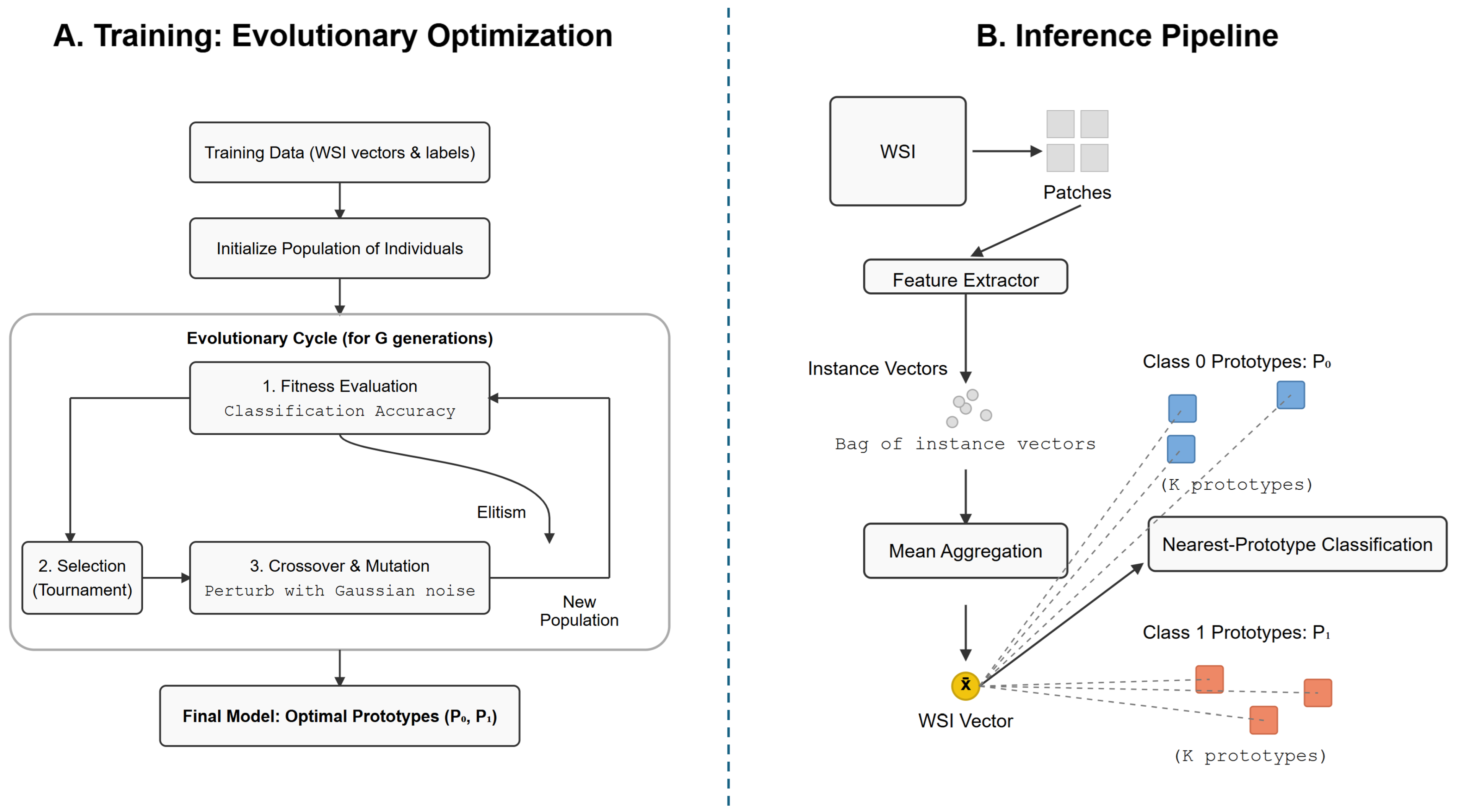
- Selection: A tournament selection rule was employed, in which a small subset of individuals is randomly chosen from the population and the individuals with the highest fitness in the subset are selected to be parents for the next generation.
- (b)
- Crossover: Given two parent individuals, and , a uniform crossover operator is applied. For each prototype position and for each class , the prototype vectors and are swapped between the two parents with a fixed probability. This creates two new offspring individuals that are combinations of their parents’ prototypes.
- (c)
- Mutation: Mutation introduces new values into the population, preventing premature convergence. Each prototype vector within an individual has a fixed probability of mutation, which was 0.3 in our experiments. If selected for mutation, the vector is perturbed by adding a random vector sampled from a zero-mean Gaussian distribution (Equation (3)):where is a identity matrix and is the mutation strength hyperparameter, controlling the magnitude of the perturbation.
- (d)
- Elitism: To ensure that the best solution found during each generation is never lost, the principle of elitism is used. The top-performing individuals from each generation are directly transferred to the next generation without modification.
2.4.6. Hyperparameters
2.4.7. Explainability
2.5. Comparison with the Existing Methods
2.5.1. Classification with 1DCNN
2.5.2. CLAM
2.6. Experiments
2.7. Evaluation
2.8. Computational Environment
3. Results
4. Discussion
5. Conclusions
Author Contributions
Funding
Institutional Review Board Statement
Informed Consent Statement
Data Availability Statement
Acknowledgments
Conflicts of Interest
References
- Shafi, S.; Parwani, A.V. Artificial intelligence in diagnostic pathology. Diagn. Pathol. 2023, 18, 109. [Google Scholar] [CrossRef]
- Davri, A.; Birbas, E.; Kanavos, T.; Ntritsos, G.; Giannakeas, N.; Tzallas, A.T.; Batistatou, A. Deep learning for lung cancer diagnosis, prognosis and prediction using histological and cytological images: A systematic review. Cancers 2023, 15, 3981. [Google Scholar] [CrossRef]
- Rigamonti, A.; Viatore, M.; Polidori, R.; Rahal, D.; Erreni, M.; Fumagalli, M.R.; Zanini, D.; Doni, A.; Putignano, A.R.; Bossi, P.; et al. Integrating AI-Powered Digital Pathology and Imaging Mass Cytometry Identifies Key Classifiers of Tumor Cells, Stroma, and Immune Cells in Non–Small Cell Lung Cancer. Cancer Res. 2024, 84, 1165–1177. [Google Scholar] [CrossRef]
- Kanan, M.; Alharbi, H.; Alotaibi, N.; Almasuood, L.; Aljoaid, S.; Alharbi, T.; Albraik, L.; Alothman, W.; Aljohani, H.; Alzahrani, A.; et al. AI-Driven Models for Diagnosing and Predicting Outcomes in Lung Cancer: A Systematic Review and Meta-Analysis. Cancers 2024, 16, 674. [Google Scholar] [CrossRef] [PubMed]
- Miry, A.; Tbouda, M.; Oqbani, K.; Abbaoui, S. Impact of Artificial Intelligence-Assisted Pathology on Patient Healthcare: Literature Review. In Proceedings of the 1st International e-Health Forum—IeHF, INSTICC, Melbourne, Australia, 28 October–1 November 2024; SciTePress: Setúbal, Portugal, 2024; pp. 5–7. [Google Scholar] [CrossRef]
- Ahmad, Z.; Rahim, S.; Zubair, M.; Abdul-Ghafar, J. Artificial intelligence (AI) in medicine, current applications and future role with special emphasis on its potential and promise in pathology: Present and future impact, obstacles including costs and acceptance among pathologists, practical and philosophical considerations. A comprehensive review. Diagn. Pathol. 2021, 16, 24. [Google Scholar] [CrossRef]
- Zhang, Y.; Liu, H.; Chang, C.; Yin, Y.; Wang, R. Machine learning for differentiating lung squamous cell cancer from adenocarcinoma using Clinical-Metabolic characteristics and 18F-FDG PET/CT radiomics. PLoS ONE 2024, 19, e0300170. [Google Scholar] [CrossRef] [PubMed]
- Ghajari, N.E.; Fathi, A. Detection and Classification of Lung Cancer in Histopathology Images Using Deep Learning. J. Comput. Secur. 2024, 11, 19–28. [Google Scholar] [CrossRef]
- Campanella, G.; Kumar, N.; Nanda, S.; Singi, S.; Fluder, E.; Kwan, R.; Muehlstedt, S.; Pfarr, N.; Schüffler, P.J.; Häggström, I.; et al. Real-world deployment of a fine-tuned pathology foundation model for lung cancer biomarker detection. Nat. Med. 2025, 31, 3002–3010. [Google Scholar] [CrossRef]
- Zheng, Y.; Gindra, R.H.; Green, E.J.; Burks, E.J.; Betke, M.; Beane, J.E.; Kolachalama, V.B. A graph-transformer for whole slide image classification. IEEE Trans. Med. Imaging 2022, 41, 3003–3015. [Google Scholar] [CrossRef] [PubMed]
- Rakaee, M.; Tafavvoghi, M.; Ricciuti, B.; Alessi, J.V.; Cortellini, A.; Citarella, F.; Nibid, L.; Perrone, G.; Adib, E.; Fulgenzi, C.A.; et al. Deep learning model for predicting immunotherapy response in advanced Non- Small cell lung cancer. JAMA Oncol. 2025, 11, 109–118. [Google Scholar] [CrossRef]
- Kludt, C.; Kludt, C.; Wang, Y.; Ahmad, W.; Bychkov, A.; Fukuoka, J.; Gaisa, N.; Kühnel, M.; Jonigk, D.; Pryalukhin, A.; et al. Next-generation lung cancer pathology: Development and validation of diagnostic and prognostic algorithms. Cell Rep. Med. 2024, 5, 101697. [Google Scholar] [CrossRef]
- Carrillo-Perez, F.; Morales, J.C.; Castillo-Secilla, D.; Molina-Castro, Y.; Guillén, A.; Rojas, I.; Herrera, L.J. Non-small-cell lung cancer classification via RNA-Seq and histology imaging probability fusion. BMC Bioinform. 2021, 22, 454. [Google Scholar] [CrossRef]
- Meseguer, P.; del Amor, R.; Colomer, A.; Naranjo, V. Foundation Models for Slide-Level Cancer Subtyping in Digital Pathology. In Proceedings of the Decision Science Alliance International Summer Conference, Valencia, Spain, 6–7 June 2024; Springer: Cham, Switzerland, 2024; pp. 190–198. [Google Scholar]
- Wang, J.; Mao, Y.; Guan, N.; Xue, C.J. Advances in multiple instance learning for whole slide image analysis: Techniques, challenges, and future directions. arXiv 2024, arXiv:2408.09476. [Google Scholar] [CrossRef]
- Campanella, G.; Hanna, M.G.; Geneslaw, L.; Miraflor, A.; Werneck Krauss Silva, V.; Busam, K.J.; Brogi, E.; Reuter, V.E.; Klimstra, D.S.; Fuchs, T.J. Clinical-grade computational pathology using weakly supervised deep learning on whole slide images. Nat. Med. 2019, 25, 1301–1309. [Google Scholar] [CrossRef]
- Lu, M.Y.; Williamson, D.F.; Chen, T.Y.; Chen, R.J.; Barbieri, M.; Mahmood, F. Data-efficient and weakly supervised computational pathology on whole-slide images. Nat. Biomed. Eng. 2021, 5, 555–570. [Google Scholar] [CrossRef]
- Ilse, M.; Tomczak, J.; Welling, M. Attention-based deep multiple instance learning. In Proceedings of the International Conference on Machine Learning, PMLR, Stockholm, Sweden, 10–15 July 2018; pp. 2127–2136. [Google Scholar]
- Ünal, H.T.; Başçiftçi, F. Evolutionary design of neural network architectures: A review of three decades of research. Artif. Intell. Rev. 2022, 55, 1723–1802. [Google Scholar] [CrossRef]
- Stanley, K.O.; Clune, J.; Lehman, J.; Miikkulainen, R. Designing neural networks through neuroevolution. Nat. Mach. Intell. 2019, 1, 24–35. [Google Scholar] [CrossRef]
- Langer, C.J.; Besse, B.; Gualberto, A.; Brambilla, E.; Soria, J.C. The evolving role of histology in the management of advanced non–small-cell lung cancer. J. Clin. Oncol. 2010, 28, 5311–5320. [Google Scholar] [CrossRef] [PubMed]
- Rekhtman, N.; Ang, D.C.; Sima, C.S.; Travis, W.D.; Moreira, A.L. Immunohistochemical algorithm for differentiation of lung adenocarcinoma and squamous cell carcinoma based on large series of whole-tissue sections with validation in small specimens. Mod. Pathol. 2011, 24, 1348–1359. [Google Scholar] [CrossRef]
- Bilal, M.; Raza, M.; Altherwy, Y.; Alsuhaibani, A.; Abduljabbar, A.; Almarshad, F.; Golding, P.; Rajpoot, N. Foundation models in computational pathology: A review of challenges, opportunities, and impact. arXiv 2025, arXiv:2502.08333. [Google Scholar] [CrossRef]
- Lu, M.Y.; Chen, B.; Williamson, D.F.; Chen, R.J.; Liang, I.; Ding, T.; Jaume, G.; Odintsov, I.; Le, L.P.; Gerber, G.; et al. A visual-language foundation model for computational pathology. Nat. Med. 2024, 30, 863–874. [Google Scholar] [CrossRef]
- Ding, T.; Wagner, S.J.; Song, A.H.; Chen, R.J.; Lu, M.Y.; Zhang, A.; Vaidya, A.J.; Jaume, G.; Shaban, M.; Kim, A.; et al. Multimodal whole slide foundation model for pathology. arXiv 2024, arXiv:2411.19666. [Google Scholar] [CrossRef]
- Xu, H.; Usuyama, N.; Bagga, J.; Zhang, S.; Rao, R.; Naumann, T.; Wong, C.; Gero, Z.; González, J.; Gu, Y.; et al. A whole-slide foundation model for digital pathology from real-world data. Nature 2024, 630, 181–188. [Google Scholar] [CrossRef]
- Saillard, C.; Jenatton, R.; Llinares-López, F.; Mariet, Z.; Cahané, D.; Durand, E.; Vert, J.P. H-Optimus-0. 2024. Available online: https://github.com/bioptimus/releases/tree/main/models/h-optimus/v0 (accessed on 15 June 2025).
- Hong, Z.; Xiong, J.; Yang, H.; Mo, Y.K. Lightweight low-rank adaptation vision transformer framework for cervical cancer detection and cervix type classification. Bioengineering 2024, 11, 468. [Google Scholar] [CrossRef]
- Rymarczyk, D.; Pardyl, A.; Kraus, J.; Kaczyńska, A.; Skomorowski, M.; Zieliński, B. Protomil: Multiple instance learning with prototypical parts for whole-slide image classification. In Proceedings of the Joint European Conference on Machine Learning and Knowledge Discovery in Databases, Grenoble, France, 19–23 September 2022; Springer: Cham, Switzerland, 2022; pp. 421–436. [Google Scholar]
- Lee, J.; Lim, J.; Byeon, K.; Kwak, J.T. Benchmarking pathology foundation models: Adaptation strategies and scenarios. Comput. Biol. Med. 2025, 190, 110031. [Google Scholar] [CrossRef]
- Fischer, A.H.; Jacobson, K.A.; Rose, J.; Zeller, R. Hematoxylin and eosin staining of tissue and cell sections. Cold Spring Harb. Protoc. 2008, 2008, pdb-prot4986. [Google Scholar] [CrossRef] [PubMed]
- Hatlen, P.; Grønberg, B.H.; Langhammer, A.; Carlsen, S.M.; Amundsen, T. Prolonged survival in patients with lung cancer with diabetes mellitus. J. Thorac. Oncol. 2011, 6, 1810–1817. [Google Scholar] [CrossRef] [PubMed]
- Ramnefjell, M.; Aamelfot, C.; Helgeland, L.; Akslen, L.A. Vascular invasion is an adverse prognostic factor in resected non–small-cell lung cancer. Apmis 2017, 125, 197–206. [Google Scholar] [CrossRef]
- Oskouei, S.; Valla, M.; Pedersen, A.; Smistad, E.; Dale, V.G.; Høibø, M.; Wahl, S.G.F.; Haugum, M.D.; Langø, T.; Ramnefjell, M.P.; et al. Segmentation of Non-Small Cell Lung Carcinomas: Introducing DRU-Net and Multi-Lens Distortion. J. Imaging 2025, 11, 166. [Google Scholar] [CrossRef] [PubMed]
- The Cancer Genome Atlas Research Network; Weinstein, J.N.; Collisson, E.A.; Mills, G.B.; Shaw, K.R.; Ozenberger, B.A.; Ellrott, K.; Shmulevich, I.; Sander, C.; Stuart, J.M. The cancer genome atlas pan-cancer analysis project. Nat. Genet 2013, 45, 1113–1120. [Google Scholar] [CrossRef]
- Oskouei, S. SoroushOskouei/FastPatchFinder: Superfast_Tissue_Segmentor. 2025. Available online: https://zenodo.org/records/17516344 (accessed on 3 November 2025).
- Lee, G.; Bae, G.; Zaitlen, B.; Kirkham, J.; Choudhury, R. cuCIM—A GPU Image I/O and Processing Library. 2021. Available online: https://zenodo.org/records/5151998 (accessed on 5 June 2025).
- Hu, E.J.; Shen, Y.; Wallis, P.; Allen-Zhu, Z.; Li, Y.; Wang, S.; Wang, L.; Chen, W. Lora: Low-rank adaptation of large language models. ICLR 2022, 1, 3. [Google Scholar]
- Kinga, D.; Adam, J.B. A method for stochastic optimization. arXiv 2014, arXiv:1412.6980. [Google Scholar] [CrossRef]
- Wightman, R. PyTorch Image Models. 2019. Available online: https://github.com/rwightman/pytorch-image-models (accessed on 20 June 2025).
- Oskouei, S.; Pedersen, A.; Valla, M.; Dale, V.G.; Wahl, S.G.F.; Haugum, M.D.; Langø, T.; Ramnefjell, M.P.; Akslen, L.A.; Kiss, G.; et al. OKEN: A Supervised Evolutionary Optimizable Dimensionality Reduction Framework for Whole Slide Image Classification. Bioengineering 2025, 12, 733. [Google Scholar] [CrossRef]
- Seabold, S.; Perktold, J. Statsmodels: Econometric and statistical modeling with python. SciPy 2010, 7, 92–96. [Google Scholar]
- Paszke, A.; Gross, S.; Massa, F.; Lerer, A.; Bradbury, J.; Chanan, G.; Killeen, T.; Lin, Z.; Gimelshein, N.; Antiga, L.; et al. Pytorch: An imperative style, high-performance deep learning library. Adv. Neural Inf. Process. Syst. 2019, 32, 1–12. [Google Scholar]
- Bradski, G. The OpenCV Library. Dr. Dobb’s J. Softw. Tools 2000, 25, 120–123. [Google Scholar]
- Van der Walt, S.; Schönberger, J.L.; Nunez-Iglesias, J.; Boulogne, F.; Warner, J.D.; Yager, N.; Gouillart, E.; Yu, T. scikit-image: Image processing in Python. PeerJ 2014, 2, e453. [Google Scholar] [CrossRef] [PubMed]
- Clark, K.; Vendt, B.; Smith, K.; Freymann, J.; Kirby, J.; Koppel, P.; Moore, S.; Phillips, S.; Maffitt, D.; Pringle, M.; et al. The Cancer Imaging Archive (TCIA): Maintaining and Operating a Public Information Repository. J. Digit. Imaging 2013, 26, 1045–1057. [Google Scholar] [CrossRef]
- Albertina, B.; Watson, M.; Holback, C.; Jarosz, R.; Kirk, S.; Lee, Y.; Rieger-Christ, K.; Lemmerman, J. The Cancer Genome Atlas Lung Adenocarcinoma Collection (TCGA-LUAD); The Cancer Imaging Archive: St. Louis, MO, USA, 2016. [Google Scholar] [CrossRef]
- Kirk, S.; Lee, Y.; Kumar, P.; Filippini, J.; Albertina, B.; Watson, M.; Rieger-Christ, K.; Lemmerman, J. The Cancer Genome Atlas Lung Squamous Cell Carcinoma Collection (TCGA-LUSC); The Cancer Imaging Archive: St. Louis, MO, USA, 2016. [Google Scholar] [CrossRef]
- Shao, Z.; Bian, H.; Chen, Y.; Wang, Y.; Zhang, J.; Ji, X. Transmil: Transformer based correlated multiple instance learning for whole slide image classification. Adv. Neural Inf. Process. Syst. 2021, 34, 2136–2147. [Google Scholar]
- Cheng, H.; Huang, S.; Cai, L.; Xu, Y.; Wang, R.; Zhang, Y. Focus your attention: Multiple instance learning with attention modification for whole slide pathological image classification. IEEE Trans. Circuits Syst. Video Technol. 2025, 35, 5791–5804. [Google Scholar] [CrossRef]
- Qiu, P.; Xiao, P.; Zhu, W.; Wang, Y.; Sotiras, A. Sc-mil: Sparsely coded multiple instance learning for whole slide image classification. arXiv 2023, arXiv:2311.00048. [Google Scholar] [CrossRef]
- Zhang, H.; Meng, Y.; Zhao, Y.; Qiao, Y.; Yang, X.; Coupland, S.E.; Zheng, Y. Dtfd-mil: Double-tier feature distillation multiple instance learning for histopathology whole slide image classification. In Proceedings of the IEEE/CVF Conference on Computer Vision and Pattern Recognition, New Orleans, LA, USA, 21–24 June 2022; pp. 18802–18812. [Google Scholar]
- Wang, X.; Yan, Y.; Tang, P.; Bai, X.; Liu, W. Revisiting multiple instance neural networks. Pattern Recognit. 2018, 74, 15–24. [Google Scholar] [CrossRef]
- Piri, J.; Mohapatra, P.; Dey, R.; Acharya, B.; Gerogiannis, V.; Kanavos, A. Literature review on hybrid evolutionary approaches for feature selection. Algorithms 2023, 16, 167. [Google Scholar] [CrossRef]
- Khan, S.; Mazhar, T.; Naz, N.S.; Ahmed, F.; Shahzad, T.; Ali, A.; Khan, M.A.; Hamam, H. Advanced Feature Selection Techniques in Medical Imaging—A Systematic Literature Review. Comput. Mater. Contin. 2025, 85, 2347–2401. [Google Scholar] [CrossRef]
- Taha, Z.Y.; Abdullah, A.A.; Rashid, T.A. Optimizing feature selection with genetic algorithms: A review of methods and applications. Knowl. Inf. Syst. 2025, 67, 9739–9778. [Google Scholar] [CrossRef]
- Liu, X.; Li, J.; Zhao, J.; Cao, B.; Yan, R.; Lyu, Z. Evolutionary neural architecture search and its applications in healthcare. CMES-Comput. Model. Eng. Sci. 2024, 139, 143–185. [Google Scholar] [CrossRef]
- Agrawal, U.K.; Panda, N.; Das, D.; Dalai, A.K.; Ramana, B.; Mishra, A. Automated Healthcare Medical Imaging through EOA Optimized Hyperparameter in CNN. Procedia Comput. Sci. 2025, 259, 1106–1114. [Google Scholar] [CrossRef]
- Aswathy, S.; Devadhas, G.G.; Kumar, S. MRI brain tumor segmentation using genetic algorithm with SVM classifier. J. Electron. Commun. Eng. 2017, 22–26. [Google Scholar]
- Wu, Q.; Zhao, Z.; Chen, M.; Chi, X.; Zhang, B.; Wang, J.; Zhilenkov, A.A.; Chepinskiy, S.A. An RNA evolutionary algorithm based on gradient descent for function optimization. J. Comput. Des. Eng. 2024, 11, 332–357. [Google Scholar] [CrossRef]



| Model | Biobank1 Test | HULC Test | TCGA Test | |||
|---|---|---|---|---|---|---|
| Accuracy | -Score | Accuracy | -Score | Accuracy | -Score | |
| 1DCNN | ||||||
| H-optimus—zero-shot—whole tissue | 0.766 | 0.688 | 0.825 | 0.822 | 0.583 | 0.515 |
| H-optimus—zero-shot—tumor only | 0.766 | 0.688 | 0.814 | 0.805 | 0.458 | 0.344 |
| H-optimus—Finetuned—whole tissue | 0.766 | 0.688 | 0.823 | 0.823 | 0.625 | 0.624 |
| H-optimus—Finetuned—tumor only | 0.766 | 0.688 | 0.848 | 0.847 | 0.625 | 0.624 |
| CLAM | ||||||
| H-optimus—zero-shot—whole tissue | 0.766 | 0.770 | 0.883 | 0.882 | 0.500 | 0.333 |
| H-optimus—zero-shot—tumor only | 0.766 | 0.770 | 0.802 | 0.798 | 0.520 | 0.378 |
| H-optimus—finetuned—whole tissue | 0.766 | 0.776 | 0.825 | 0.823 | 0.562 | 0.546 |
| H-optimus—finetuned—tumor only | 0.766 | 0.770 | 0.895 | 0.895 | 0.625 | 0.622 |
| EP-MIL | ||||||
| H-optimus—zero-shot—whole tissue | 0.733 | 0.700 | 0.488 | 0.388 | 0.500 | 0.333 |
| H-optimus—zero-shot—tumor only | 0.700 | 0.705 | 0.744 | 0.742 | 0.500 | 0.333 |
| H-optimus—finetuned—whole tissue | 0.800 | 0.806 | 0.732 | 0.727 | 0.708 | 0.695 |
| H-optimus—finetuned—tumor only | 0.666 | 0.664 | 0.802 | 0.795 | 0.666 | 0.685 |
| Metric | 1DCNN | CLAM | EP-MIL |
|---|---|---|---|
| Training time per epoch or generation (s) | 6.414 | 9.198 | 1.104 |
| Training peak RAM (MB) | 1819.307 | 1547.612 | 199.961 |
| Model size on disk (MB) | 0.780 | 3.030 | 0.685 |
| Total inference time (s) | 0.708 | 0.590 | 0.008 |
| Mean latency per slide (ms) | 0.671 | 1.245 | 0.168 |
| Inference peak RAM (MB) | 1399.529 | 1572.265 | 201.833 |
| FLOPs per single-slide forward pass (ops) | 272,016,064 | 858,427,184 | 73,759 |
Disclaimer/Publisher’s Note: The statements, opinions and data contained in all publications are solely those of the individual author(s) and contributor(s) and not of MDPI and/or the editor(s). MDPI and/or the editor(s) disclaim responsibility for any injury to people or property resulting from any ideas, methods, instructions or products referred to in the content. |
© 2025 by the authors. Licensee MDPI, Basel, Switzerland. This article is an open access article distributed under the terms and conditions of the Creative Commons Attribution (CC BY) license (https://creativecommons.org/licenses/by/4.0/).
Share and Cite
Oskouei, S.; Pedersen, A.; Valla, M.; Dale, V.G.; Wahl, S.G.F.; Haugum, M.D.; Ytterhus, B.; Ramnefjell, M.P.; Akslen, L.A.; Kiss, G.; et al. Low-Cost Lung Cancer Classification in WSIs Using a Foundation Model and Evolving Prototypes. Algorithms 2025, 18, 769. https://doi.org/10.3390/a18120769
Oskouei S, Pedersen A, Valla M, Dale VG, Wahl SGF, Haugum MD, Ytterhus B, Ramnefjell MP, Akslen LA, Kiss G, et al. Low-Cost Lung Cancer Classification in WSIs Using a Foundation Model and Evolving Prototypes. Algorithms. 2025; 18(12):769. https://doi.org/10.3390/a18120769
Chicago/Turabian StyleOskouei, Soroush, André Pedersen, Marit Valla, Vibeke Grotnes Dale, Sissel Gyrid Freim Wahl, Mats Dehli Haugum, Borgny Ytterhus, Maria Paula Ramnefjell, Lars Andreas Akslen, Gabriel Kiss, and et al. 2025. "Low-Cost Lung Cancer Classification in WSIs Using a Foundation Model and Evolving Prototypes" Algorithms 18, no. 12: 769. https://doi.org/10.3390/a18120769
APA StyleOskouei, S., Pedersen, A., Valla, M., Dale, V. G., Wahl, S. G. F., Haugum, M. D., Ytterhus, B., Ramnefjell, M. P., Akslen, L. A., Kiss, G., & Sorger, H. (2025). Low-Cost Lung Cancer Classification in WSIs Using a Foundation Model and Evolving Prototypes. Algorithms, 18(12), 769. https://doi.org/10.3390/a18120769