


Abstract
This study presents a new variant of the hybrid block methods (HBMs) for solving initial value problems (IVPs). The overlapping hybrid block technique is developed by changing each integrating block of the HBM to incorporate the penultimate intra-step point of the previous block. In this paper, we present preliminary results obtained by applying the overlapping HBM to IVPs of the first order, utilizing equally spaced grid points and optimal points that maximize the local truncation errors of the main formulas at the intersection of each integration block. It is proven that the novel method reduces the local truncation error by at least one order of the integration step size, O(h). In order to demonstrate the superiority of the suggested method, numerical experimentation results were compared to the corresponding HBM based on the standard non-overlapping grid. It is established that the proposed method is more accurate than HBM versions of the same order that have been published in the literature.
1. Introduction
This study presents a variation of the hybrid block methods (HBMs) for integrating systems of initial value problems of the first order (IVPs). It is now well established that HBMs are effective at solving IVPs that may or may not be stiff. Researchers are now concentrating on enhancing these approaches to increase their efficacy and extend them to other forms of differential equations, such as boundary value problems. Several authors have developed optimised hybrid block methods in recent years by selecting intra-step points that minimise the local truncation error of one or more of the formulas in the set of hybrid block methods (see, for instance, [1,2,3,4,5]). The hybrid block methods were applied with an adaptive strategy in [6,7] in an effort to increase their efficiency and circumvent the difficulties associated with short step sizes. Other researchers (see [8,9]) have implemented the optimised hybrid block methods in nonlinear partial differential equations using cubic spline basis functions. In this study, the hybrid block method is modified by overlapping adjacent integration blocks at the last intra-step point. This adjustment produces a -stable version with a truncation error at least O(h) greater than the comparable HBM without overlap.
The performance of the proposed overlapping HBM is tested utilising an error analysis of numerically challenging solutions to different nonlinear IVPs. In order to determine the approach’s robustness, it is also evaluated on IVPs with extreme stiffness.
The remainder of this paper is organised into four sections. The derivation of the overlapping hybrid block methods is covered in Section 2. Section 3 examines the error and stability properties of the proposed method. Section 4 presents the experimental and numerical results, and Section 5 provides a summary and conclusion.
2. Derivation of the Method
Consider the initial value problem defined on by
where is a general, continuous nonlinear function.
Let h be a prescribed step size on a mesh I defined by
We choose collocation points, defined by
in the first interval . For the intervals, , where , we choose collocation points:
The parameters are called collocation parameters, and they satisfy the condition
An illustrative representation of the grid is shown in Figure 1, for the special case when and . It is worth noting that, for , the grid overlaps with one grid point () from the previous grid . For this reason, the method will be referred to as the overlapping hybrid block method.
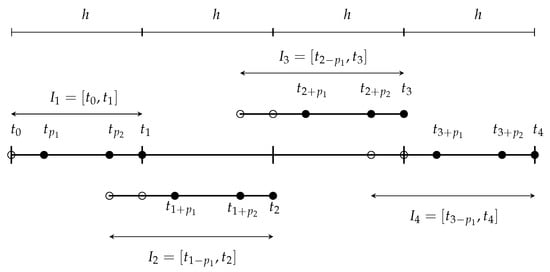
Figure 1.
Illustration of the overlapping grid when and .
In the non-overlapping block , we suppose that the solution can be approximated by the polynomial:
that satisfies the collocation conditions:
By the Lagrange interpolation formula, the function can be approximated as
where
In the block (), we consider the collocation parameters
and assume the following collocation conditions:
for . By the Lagrange interpolation formula, the function can be approximated as
Integrating from 0 to gives
where
3. Analysis of the Method
In this section, we present the truncation error and stability properties of the proposed overlapping hybrid block method.
3.1. Local Truncation Error
Theorem 1.
The local truncation error, in the integration block , for the hybrid block method defined as
is given by
for , when considering the grid points:
Proof.
Given a sufficiently differentiable function , the truncation error of the hybrid block method can be written in terms of a linear operator as
Using Taylor series to expand (14) gives
where is a positive integer.
Using the identity:
we note that
and
As an immediate consequence, we obtain the following result, for the truncation error in the integration blocks ():
Corollary 1.
The local truncation error, in the integration block , for the one-point overlapping hybrid block method:
is
Proof.
The proof is similar to the one for Theorem 1, given above, and uses the identity:
after considering the grid points:
□
By minimizing the local truncation error of the main method at (i.e., ), it was shown in [11] that the optimal intra-step points are the roots of the polynomial:
which is proportional to the first derivative of the shifted Legendre polynomials of degree m given by
The shifted Legendre polynomials are defined in and have the property:
Furthermore, has i distinct roots in . By expanding (19), we obtain the polynomials that give optimal intra-step points with as follows:
As a consequence of Equation (21), the optimal roots (intra-step points) have the form
when m is odd and
when m is even.
The truncation errors for overlapping and non-overlapping HBM algorithms with equally spaced and optimally spaced intra-step points are compared in Table 1 for . The table reveals that the truncation errors of the overlapping HBM are at least h orders of magnitude smaller than those of the non-overlapping HBM. This is consistent with the observations made in the preceding theorems regarding the explicit formulas for local truncation errors.

Table 1.
Truncation errors for the overlapping and non-overlapping HBM with equally spaced and optimal intra-step points.
3.2. Zero Stability
In the limit when , the zero stability of the hybrid methods for all blocks () can be analysed from the zeros of the polynomial that is computed from
Zero stability is confirmed if the roots of satisfy and all the roots with
have a multiplicity of 1. The characteristic polynomial for the hybrid block methods considered in this study is
Thus, the proposed overlapping hybrid block methods are zero stable for any selection of intra-step points. In a related investigation, Reference [1] also validated the zero stability of the HBMs.
3.3. Absolute Stability
If errors introduced in one time step do not accumulate in successive time steps, the general stability of a numerical approach is confirmed. A region of absolute stability is defined as the set of points such that the roots of the characteristic equation associated with the test equation () lie within a unit circle. For hybrid block methods, the absolute stability in the first non-overlapping interval is well established (see, for example, [5]). When this test problem is applied to the overlapping grid methods (11), the following matrix equation is obtained:
where and is a matrix equation given by
By finding the eigenvalues of the matrix one can derive the stability function . Figure 2 depicts, for illustrative purposes, the absolute stability region of the proposed overlapping grid hybrid block method created from optimally spaced and equally spaced intra-step points for . Given that the shaded area encompasses the entirety of the left half-plane, the absolute stability of the overlapping HBM is confirmed for both equally spaced and optimal intra-step points.
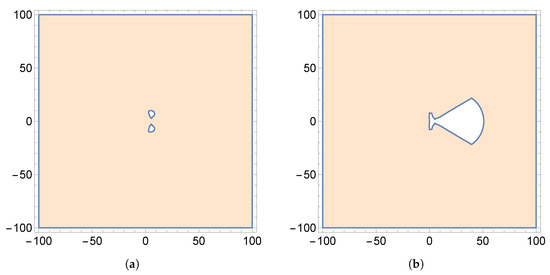
Figure 2.
Stability regions for the overlapping hybrid block method. (a) Equally spaced intra-step points. (b) Optimal intra-step points.
4. Numerical Experimentation and Results
In this section, we implement the proposed overlapping hybrid block method to generate numerical solutions for problems that are typically difficult to solve numerically using standard methods. Before employing the hybrid block approach to integrate the nonlinear IVPs, they are first linearized. For a general nonlinear system of first-order IVPs, the linearisation method is detailed below.
Consider the system of s nonlinear first-order IVPs of the form
where is the coefficient of the state variable , and is the component of the k-th equation that is not linear in , for . The hybrid block method is sequentially applied iteratively to each equation in the system (25), with the solution of the k-th equation used immediately when solving the th equation. Consequently, the iterative scheme is developed as
This linearization method employs the Gauss–Seidel method for decoupling and solving large systems of nonlinear equations. The method has been adapted from the waveform relaxation method that has been reported in the literature (see, for example, [12,13]).
Noting that (26) is linear, it can be applied to the HBM method after setting
where and are known functions of t. As a result, the matrix form of the HBM, (11), becomes
or
where
All numerical examples in this study were solved using (28) applied iteratively over 20 iterations for each integration block . Through numerical experimentation, it was determined that sufficient convergence would have occurred prior to the 20th iteration level. All numerical results presented in this study were generated by iterating the scheme (28) up to for all n values. In light of the linearisation of nonlinear IVPs via partitioning, the hybrid block method defined by (28) is referred to as the linear partitioning overlapping hybrid block method. The method is computationally efficient and easy to implement. Due to the lack of derivatives and Jacobian matrices, it circumvents the challenges of Newton-based iterative techniques that rely on derivatives.
In the examples, given below, the linear partitioning overlapping hybrid block method was applied using equally spaced and the shifted Legendre-based optimal intra-step points. In both cases, and were used for illustrative purposes. The intra-step points corresponding to these values of m are given in Table 2 below.
Table 2.
Intra-step points used in numerical experimentation.
Using as an example, the matrix parameters for the optimal overlapping hybrid block approach are as follows:
which is applied on the scheme:
in the first interval and
which is applied in , for the overlapping hybrid block scheme:
for . The proposed overlapping grid approach is referred to as the overlapping optimal hybrid block method (OOHBM) for the purposes of this paper. The original optimal hybrid block method (OHBM), without overlap, is constructed by applying Equation (29) to all the integration blocks for . It is important to note that the size of the matrices in both the original HBM scheme and the overlapping HBM scheme is the same. This indicates that the computational effort necessary to solve the IVPs will be roughly equivalent for both methods.
4.1. Example 1
Consider the following example that belongs to the class of problems with the so-called Runge phenomenon:
The exact solution of Example (31) is . In this example, the linear partitioning iterative method with
was used with the HBM schemes to solve (31) using and up to 20 iterations, within the integration domain [0,1]. The convergence plot, computed as the maximum error per iteration in the last block , is shown in Figure 3. The convergence of the optimal overlapping (OOHBM) and the original optimal hybrid block technique (OHBM) with no overlapping grid for and are compared. The graph demonstrates that the overlapping HBM plateaus at a higher degree of accuracy than the non-overlapping HBM. This is one indicator of the overlapping HBM’s higher precision. It is also apparent from Figure 3 that the linear partitioning HBM converges swiftly, with full convergence reached within 10 iterations for all HBM variants evaluated in this scenario.
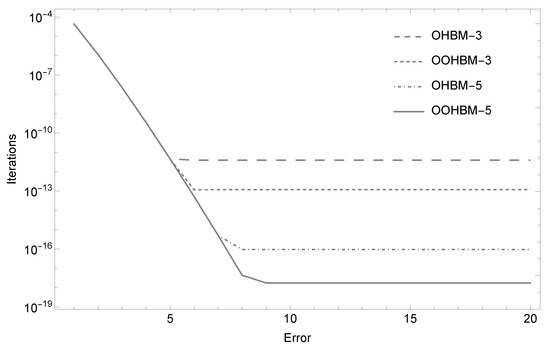
Figure 3.
Comparison of the convergence plots for Example 1 when .
A comparison of the maximum absolute errors, computed from the exact solution, is displayed in Table 3. It can be seen from the table that the maximum error improves when the overlapping grid is applied. In this example, the improvement in the maximum error when comparing equally spaced and optimal hybrid block methods is not as significant as the difference between the original and proposed overlapping HBM. It can also be observed that the maximum error obtained using the overlapping HBM with equally spaced points is greater than the error of the original optimal HBM, for both and . This appears to indicate that introducing grid overlap into HBM systems reduces the maximum error more than adjusting the type of intra-step points.
Table 3.
Maximum errors for Example 1 using different choices of intra-step points.
The maximum error in each block is defined as
Plotting the profile of the maximum error in each block for reveals the distribution of the error as it traverses the complete domain of integration. Figure 4 depicts the maximum error profile for 100 intervals (blocks) used during the deployment of the overlapping optimal HBM and original optimal HBM to Example 31. The graph illustrates the significant reduction in the maximum error when the overlapping grid method is implemented. The maximum error begins in the same location when . This is expected given that the initial interval is identical for both optimal overlapping (OOHBMs) and standard optimal non-overlapping HBMs (OHBMs). After , the maximum errors of the OOHBM are less than those of the OHBM when and when . The reduction in the computed error is consistent with the theorems for local truncation errors derived in the preceding section, which demonstrates that the truncation error of the overlapping HBM is more than that of the corresponding non-overlapping HBM.
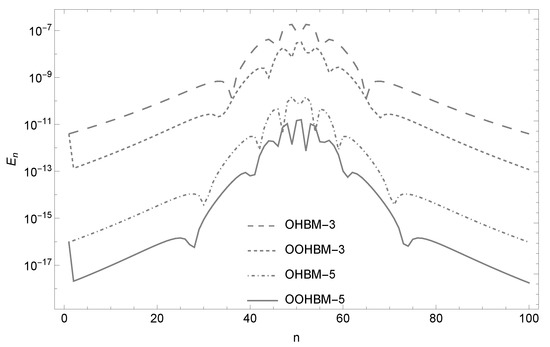
Figure 4.
Maximum error profile for Example 1.
4.2. Example 2
Consider the logistic equation:
with the exact solution . The problem was integrated on using a step size of for the case when .
Table 4 compares the maximum errors produced by the OOHBM versus the OHBM. Included also are the maximum errors of the corresponding hybrid block methods constructed using intra-step points equally spaced apart. The table clearly illustrates the increase in accuracy brought about by the introduction of overlapping in grids that use both equally spaced and optimal intra-step points.
Table 4.
Maximum errors for Example 2 using different choices of intra-step points.
Figure 5 provides a comparison of the convergence plots for the standard OHBM and the proposed OOHBM. The illustration demonstrates the speedy convergence of the linear partitioning iterative approach and the superior accuracy of the proposed OOHBM schemes in comparison to the OHBM schemes.
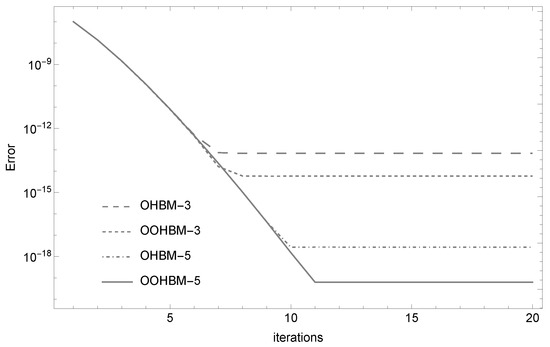
Figure 5.
Comparison of the convergence plots for Example 2 when .
Figure 6 illustrates the maximum error profile across all blocks as a function of the block index n. The decrease in error shown in Figure 6 when switching from the OHBM to the OOHBM is consistent with the pattern observed in Figure 4 of the preceding case. This is additional proof that the concept of overlapping grids improves the accuracy of hybrid methods.
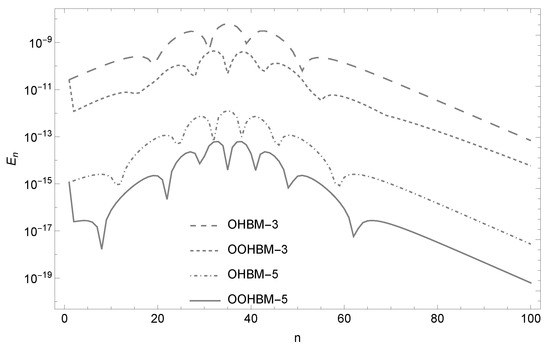
Figure 6.
Maximum error profile for Example 2.
Next, we discuss the implementation of the overlapping HBM on systems of nonlinear equations that are notoriously difficult to numerically solve due to their stiff characteristics or their propensity to change rapidly over short time intervals.
4.3. Example 3
Consider the the van der Pol oscillator with nonlinear damping:
where is a constant parameter. In this example, we set
This problem was solved using the OOHBM-3 with in the domain of integration [0,50]. Since there is no analytic solution to the problem, we compared the results of the solution profiles to those that have been previously reported in the literature. In Figure 7, the solution profiles and phase portrait for the van der Pol oscillator when are depicted. Similar results have been reported in the literature using different numerical solution techniques (see, for example, [14]).
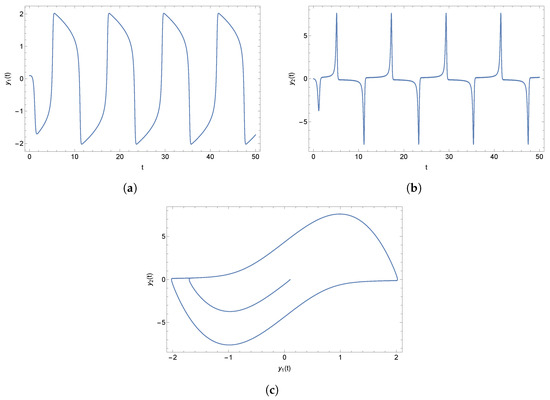
Figure 7.
Solution profile of the van der Pol oscillator example when . (a) vs. t. (b) vs. t. (c) Phase portrait.
4.4. Example 4
Consider the highly stiff system of IVPs below, which has applications in chemical kinetics [15].
For specific values of the reaction constants, this problem becomes highly stiff and unsolvable using ordinary numerical approaches. In this study, we employed the values that were also used to assess the robustness of the extended backward difference methods described in [16] and the implicit Runge–Kutta method as summarized in [17]. Consequently, we set
Figure 8 depicts the solution profiles generated by OOHBM-3 with . The nature of the solution profile for provides insight into the numerical difficulties of solving this problem. Over a brief period of time, the concentration of rises abruptly to a maximum and then falls sharply. Compared to the concentrations of and represented in Figure 8a, the size of the concentration for is less. Due to the widely different concentration amounts, the plot on the x-axis is used to compare all the concentration profiles over a longer period of time, as depicted in Figure 8c. These profiles are comparable to those published in [17].
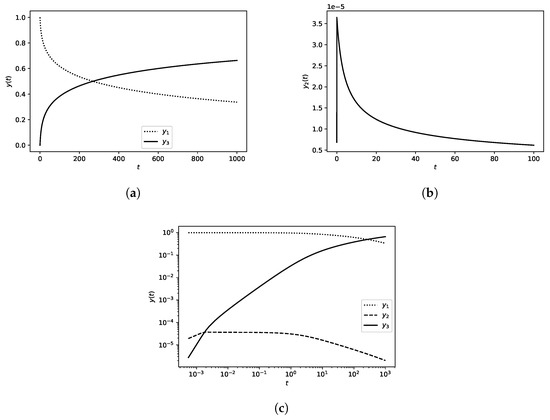
Figure 8.
Solution profiles of Example 4 with and . (a) concentrations of and (b) concentrations of (c) concentration , and .
4.5. Example 5
Consider the Lorenz system [18] given by
The constants are . With these selected constants, the Lorenz system exhibits chaotic behaviour, with the solution profiles fluctuating rapidly over extremely brief time intervals. To precisely and efficiently capture the solution, robust numerical approaches are necessary. The proposed overlapping HBM with the fewest intra-step points was employed to tackle this problem.
The parameters of the iteration scheme are given below.
In Figure 9 and Figure 10, respectively, the time series solutions and phase portraits for the Lorenz equation are displayed. These results were produced using OOHBM-3 with across the integrating domain [0,50]. The results are identical to those reported in numerous publications on the Lorenz system’s solutions (see, for example, [19]).
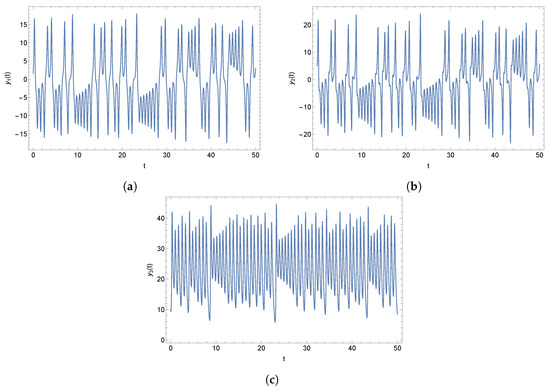
Figure 9.
Time series profiles of the Lorenz system. (a) ; (b) ; (c) .
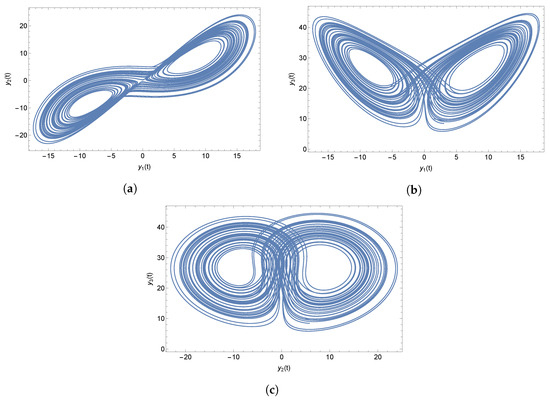
Figure 10.
Phase portraits of the Lorenz system. (a) and ; (b) and ; (c) and .
5. Conclusions
In this study, an enhancement to the conventional hybrid block methods for solving first-order equations was developed. This was accomplished by overlapping successive integration blocks after the first block. When executed on a variety of initial value problems, the resulting method, called the overlapping hybrid block method, demonstrated a significant gain in accuracy. In addition, theorems were established that demonstrate an improvement in local truncation error by an order of the step size, . It was also demonstrated that the proposed method is A-stable. These findings show that the concept of inserting overlapping blocks in hybrid block methods may be a profitable field of study. Further research is required to extend the applicability of the overlapping technique to other types of differential equations, such as boundary value problems, fractional-order differential equations, and differential-algebraic systems of equations (DAEs).
Funding
This research was funded by the University of KwaZulu-Natal.
Institutional Review Board Statement
Not applicable.
Informed Consent Statement
Not applicable.
Data Availability Statement
Data is contained within the article.
Conflicts of Interest
The author declares no conflict of interest.
References
- Ramos, H. An optimized two-step hybrid block method for solving first-order initial-value problems in ODEs. Differ. Geom.-Dyn. Syst. 2017, 19, 107–118. [Google Scholar]
- Kashkari, B.S.; Syam, M.I. Optimization of one step block method with three hybrid points for solving first-order ordinary differential equations. Results Phys. 2019, 12, 592–596. [Google Scholar] [CrossRef]
- Muideen, O.; Yahaya, H.; Raphael, A.; Morufu, O. Optimized Three-step Hybrid Block Method for Stiff Problems in Ordinary Differential Equations. J. Sci. Eng. 2020, 17, 80–95. [Google Scholar]
- Singh, G.; Garg, A.; Singla, R.; Kanwar, V. A novel two-parameter class of optimized hybrid block methods for integrating differential systems numerically. Comput. Math. Methods 2021, 3, e1214. [Google Scholar] [CrossRef]
- Singla, R.; Singh, G.; Ramos, H.; Kanwar, V. A Family of A-Stable Optimized Hybrid Block Methods for Integrating Stiff Differential Systems. Math. Probl. Eng. 2022, 2022, 5576891. [Google Scholar] [CrossRef]
- Singh, G.; Garg, A.; Kanwar, V.; Ramos, H. An efficient optimized adaptive step-size hybrid block method for integrating differential systems. Appl. Math. Comput. 2019, 362, 124–567. [Google Scholar] [CrossRef]
- Ramos, H.; Rufai, M.A. An adaptive pair of one-step hybrid block Nyström methods for singular initial-value problems of Lane–Emden–Fowler type. Math. Comput. Simul. 2022, 193, 497–508. [Google Scholar] [CrossRef]
- Ramos, H.; Kaur, A.; Kanwar, V. Using a cubic B-spline method in conjunction with a one-step optimized hybrid block approach to solve nonlinear partial differential equations. Comput. Appl. Math. 2022, 41, 34. [Google Scholar] [CrossRef]
- Kaur, A.; Kanwar, V. Numerical Solution of Generalized Kuramoto–Sivashinsky Equation Using Cubic Trigonometric B-Spline Based Differential Quadrature Method and One-Step Optimized Hybrid Block Method. Int. J. Appl. Comput. Math. Vol. 2022, 8, 20. [Google Scholar] [CrossRef]
- Butcher, J.C. Implicit runge-kutta processes. Math. Comput. 1964, 18, 50–64. [Google Scholar] [CrossRef]
- Orakwelu, M.G. Generalised Implicit Block Hybrid Algorithms for Initial Value Problems. Ph.D. Thesis, University of KwaZulu-Natal, Durban, South Africa, 2019. [Google Scholar]
- Pasetto, M.; Waisman, H.; Chen, J.S. A waveform relaxation Newmark method for structural dynamics problems. Comput. Mech. 2019, 63, 1223–1242. [Google Scholar] [CrossRef]
- Barbara, Z.K.; Vandewalle, S. Waveform Relaxation for Functional-Differential Equations. SIAM J. Sci. Comput. 1999, 21, 207–226. [Google Scholar]
- Trefethen, L.N.; Birkisson, Á.; Driscoll, T.A. Exploring ODEs; Society for Industrial and Applied Mathematics (SIAM): Philadelphia, PA, USA, 2017. [Google Scholar]
- Robertson, H. The solution of a set of reaction rate equations. In Numerical Analysis: An Introduction; Academic Press: Cambridge, MA, USA, 1966; pp. 178–182. [Google Scholar]
- Cash, J. Second derivative extended backward differentiation formulas for the numerical integration of stiff systems. SIAM J. Numer. Anal. 1981, 18, 21–36. [Google Scholar] [CrossRef]
- Butcher, J.C. Numerical Methods for Ordinary Differential Equations; John Wiley & Sons: Hoboken, NJ, USA, 2016. [Google Scholar]
- Lorenz, E.N. Deterministic nonperiodic flow. J. Atmos. Sci. 1963, 20, 130–141. [Google Scholar] [CrossRef]
- Hirsch, M.W.; Smale, S.; Devaney, R.L. Differential Equations, Dynamical Systems, and an Introduction to Chaos; Academic Press: Cambridge, MA, USA, 2012. [Google Scholar]
Publisher’s Note: MDPI stays neutral with regard to jurisdictional claims in published maps and institutional affiliations. |
© 2022 by the author. Licensee MDPI, Basel, Switzerland. This article is an open access article distributed under the terms and conditions of the Creative Commons Attribution (CC BY) license (https://creativecommons.org/licenses/by/4.0/).