
A Modified Liu and Storey Conjugate Gradient Method for Large Scale Unconstrained Optimization Problems

Abstract
1. Introduction
2. The Proposed CG Formula and Its Motivation
- Satisfies the descent condition.
- Satisfies the convergence properties.
- Equation (16) is constructed based on with restart condition to be non-negative and avoid the convergence problems.
- Dai and Liao [12] suggest using instead of steepest descent as a restart criterion, where Equation (16) is restarted by , more efficient than the steepest descent.
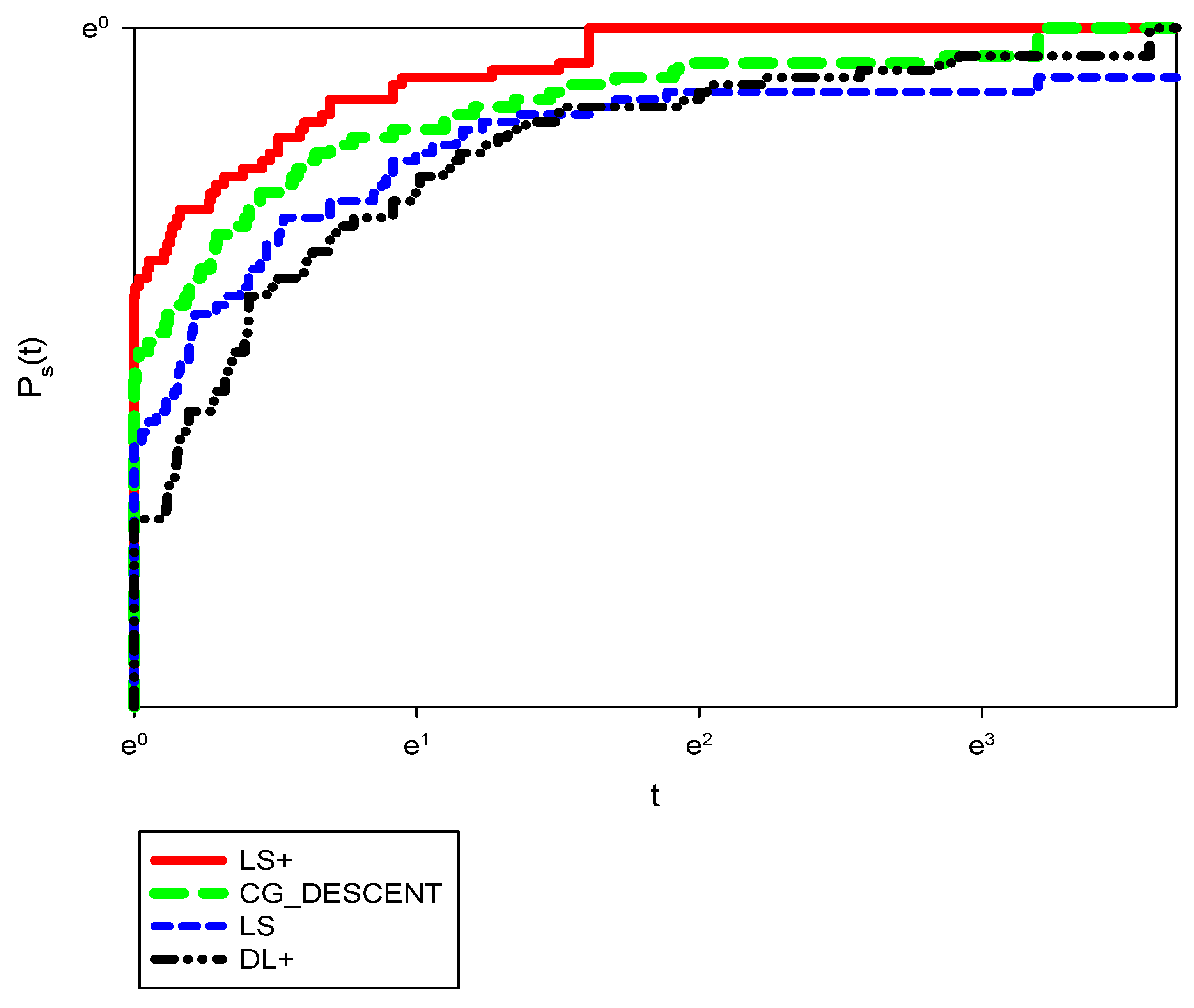
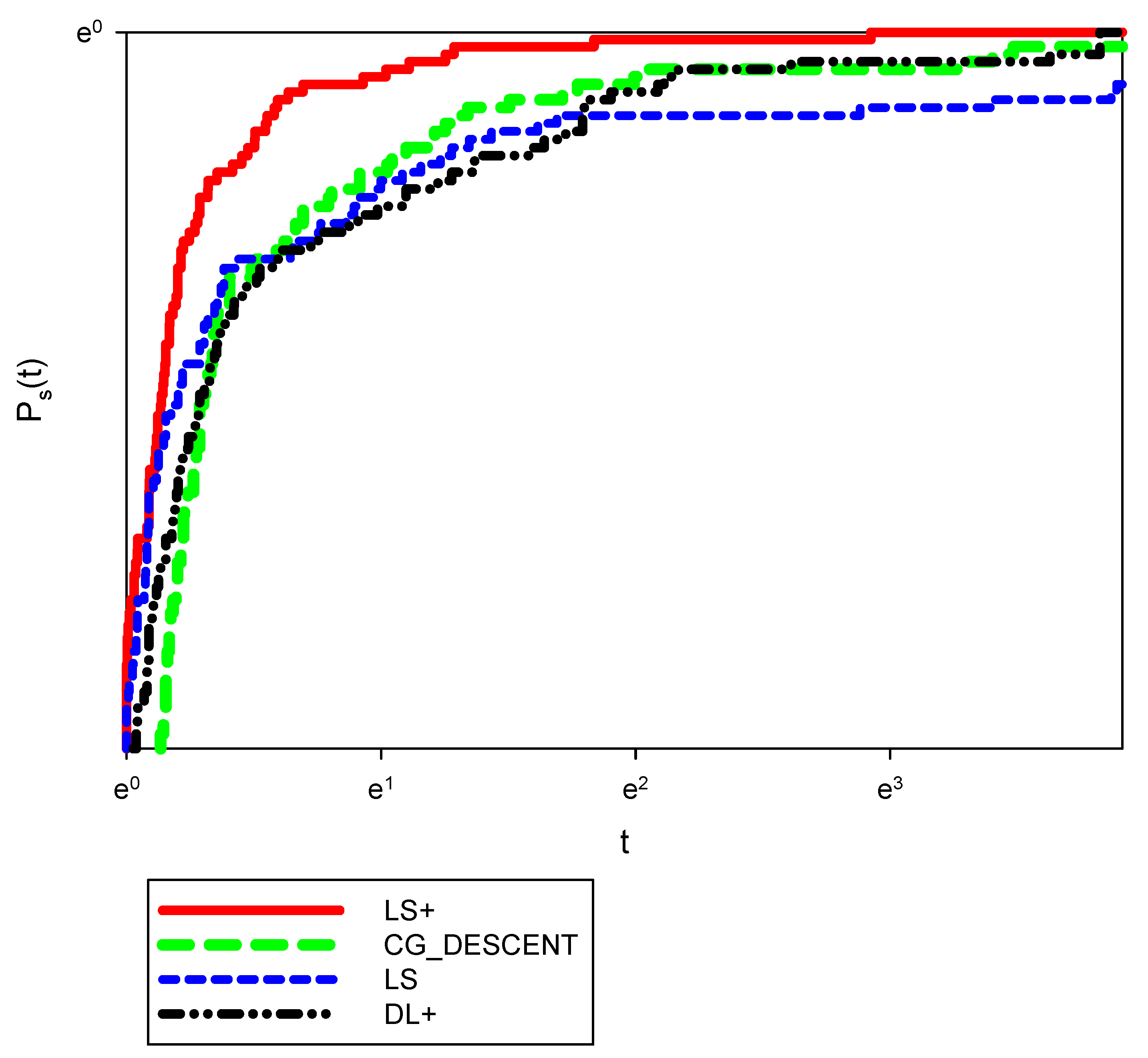
- The numerical results demonstrate the efficiency and robustness of Equation (16) compared to the other CG methods, including CG-Descent, LS, and DL+.
3. Convergence Analysis of
| Algorithm 1. The steps to obtain the optimum point of optimization problem by using the CG method |
| Step 1 Provide a starting point Set the initial search direction . Let . |
| Step 2 If a stopping criteria is satisfied, then stop. |
| Step 3 Compute based on (2) with (16). |
| Step 4 Compute using (4) and (5). |
| Step 5 Update based on (1). |
| Step 6 Set and go to Step 2. |
3.1. The Descent Property of CG Method with
3.2. The Convergence Property of the CG Method with to Obtain the Stationary Point
4. Numerical Results and Discussion
5. Conclusions
- The proposed method is a non-negative two-term CG method.
- The proposed method satisfies the descent condition.
- The convergences properties are satisfied by obtaining the stationary point/s.
- The modified method was restarted based on the suggestion presented by [12] instead of using the steepest descent, improving the efficiency of the proposed method.
- The numerical results show that the new method outperformed CG-Descent, DL+, and LS in terms of the number of iteration and CPU time. Moreover, the modified method is more robust than the original LS.
Author Contributions
Funding
Institutional Review Board Statement
Informed Consent Statement
Data Availability Statement
Acknowledgments
Conflicts of Interest
Appendix A

| LS+ | CG-Descent | ||||||||
|---|---|---|---|---|---|---|---|---|---|
| Function | Dimension | No. Iterations | No. of Function Evaluations | No. Gradient Evaluations | CPU Time | No. Iterations | No. Function Evaluations | No. Gradient Evaluations | CPU Time |
| AKIVA | 2 | 8 | 20 | 15 | 0.02 | 10 | 21 | 11 | 0.02 |
| ALLINITU | 4 | 11 | 28 | 20 | 0.02 | 12 | 29 | 18 | 0.02 |
| ARGLINA | 200 | 1 | 3 | 2 | 0.02 | 1 | 3 | 2 | 0.02 |
| ARWHEAD | 200 | 7 | 16 | 12 | 0.02 | 7 | 15 | 8 | 0.02 |
| BARD | 5000 | 14 | 36 | 25 | 0.02 | 16 | 33 | 17 | 0.02 |
| BDQRTIC | 3 | 140 | 299 | 256 | 0.44 | 136 | 273 | 237 | 0.58 |
| BEALE | 5000 | 12 | 30 | 22 | 0.02 | 15 | 31 | 16 | 0.02 |
| BIGGS6 | 2 | 23 | 55 | 37 | 0.02 | 27 | 57 | 31 | 0.02 |
| BOX3 | 6 | 10 | 23 | 14 | 0.02 | 11 | 24 | 13 | 0.02 |
| BOX | 3 | 7 | 24 | 20 | 0.11 | 8 | 25 | 19 | 0.08 |
| BRKMCC | 1000 | 5 | 11 | 6 | 0.02 | 5 | 11 | 6 | 0.02 |
| BROWNAL | 2 | 6 | 19 | 15 | 0.02 | 9 | 25 | 18 | 0.02 |
| BROWNBS | 200 | 12 | 27 | 19 | 0.02 | 13 | 26 | 15 | 0.02 |
| BROWNDEN | 2 | 16 | 38 | 31 | 0.02 | 16 | 31 | 19 | 0.02 |
| BROYDN7D | 4 | 66 | 120 | 90 | 0.31 | 1411 | 2810 | 1429 | 5.47 |
| BRYBND | 5000 | 38 | 99 | 69 | 0.2 | 85 | 174 | 90 | 0.38 |
| CHAINWOO | 5000 | 257 | 533 | 312 | 0.67 | 318 | 619 | 373 | 0.866 |
| CHNROSNB | 4000 | 298 | 596 | 317 | 0.02 | 287 | 564 | 299 | 0.02 |
| CLIFF | 50 | 9 | 43 | 36 | 0.02 | 18 | 70 | 54 | 0.02 |
| COSINE | 2 | 19 | 62 | 50 | 0.25 | 11 | 39 | 32 | 0.19 |
| CRAGGLVY | 10,000 | 91 | 182 | 142 | 0.37 | 103 | 197 | 147 | 0.45 |
| CUBE | 5000 | 17 | 43 | 30 | 0.02 | 32 | 77 | 47 | 0.02 |
| CURLY10 | 2 | 56,628 | 77,977 | 92,037 | 202 | 47,808 | 67,294 | 76,156 | 173.7 |
| CURLY20 | 10,000 | 78,784 | 101,319 | 135,082 | 426.97 | 66,587 | 89,245 | 110,540 | 383.94 |
| CURLY30 | 10,000 | 84,712 | 111,549 | 142,856 | 637 | 79,030 | 102,516 | 134,682 | 639.63 |
| DECONVU | 10,000 | 181 | 415 | 235 | 0.02 | 400 | 801 | 401 | 0.02 |
| DENSCHNA | 63 | 6 | 16 | 12 | 0.02 | 9 | 19 | 10 | 0.02 |
| DENSCHNB | 2 | 6 | 18 | 15 | 0.02 | 7 | 15 | 8 | 0.02 |
| DENSCHNC | 2 | 11 | 36 | 31 | 0.02 | 12 | 26 | 14 | 0.02 |
| DENSCHND | 2 | 17 | 45 | 34 | 0.02 | 47 | 98 | 51 | 0.02 |
| DENSCHNE | 3 | 14 | 44 | 36 | 0.02 | 18 | 49 | 32 | 0.02 |
| DENSCHNF | 3 | 9 | 28 | 23 | 0.02 | 8 | 17 | 9 | 0.02 |
| DIXMAANA | 2 | 6 | 16 | 13 | 0.02 | 7 | 15 | 8 | 0.02 |
| DIXMAANB | 3000 | 8 | 19 | 13 | 0.02 | 6 | 13 | 7 | 0.02 |
| DIXMAANC | 3000 | 6 | 14 | 9 | 0.02 | 6 | 13 | 7 | 0.02 |
| DIXMAAND | 3000 | 11 | 26 | 17 | 0.02 | 7 | 15 | 8 | 0.02 |
| DIXMAANE | 3000 | 275 | 373 | 627 | 0.42 | 222 | 239 | 429 | 0.33 |
| DIXMAANF | 3000 | 44 | 140 | 106 | 0.06 | 161 | 323 | 162 | 0.13 |
| DIXMAANG | 3000 | 116 | 302 | 274 | 0.2 | 157 | 315 | 158 | 0.12 |
| DIXMAANH | 3000 | 446 | 695 | 1038 | 0.78 | 173 | 347 | 174 | 0.22 |
| DIXMAANI | 3000 | 525 | 670 | 1075 | 0.63 | 3856 | 3926 | 7644 | 4.25 |
| DIXMAANJ | 3000 | 59 | 166 | 117 | 0.08 | 327 | 655 | 328 | 0.36 |
| DIXMAANK | 3000 | 86 | 224 | 151 | 0.16 | 283 | 567 | 284 | 0.28 |
| DIXMAANL | 3000 | 62 | 175 | 127 | 0.08 | 237 | 475 | 238 | 0.2 |
| DIXON3DQ | 3000 | 333 | 401 | 725 | 0.78 | 10,000 | 10,007 | 19,995 | 19.12 |
| DJTL | 10,000 | 82 | 1203 | 1176 | 0.02 | 82 | 917 | 880 | 0.02 |
| DQDRTIC | 2 | 5 | 11 | 6 | 0.02 | 5 | 11 | 6 | 0.02 |
| DQRTIC | 5000 | 15 | 32 | 18 | 0.02 | 17 | 37 | 21 | 0.03 |
| EDENSCH | 5000 | 26 | 56 | 45 | 0.03 | 26 | 52 | 38 | 0.03 |
| EG2 | 2000 | 6 | 13 | 7 | 0.02 | 5 | 11 | 6 | 0.02 |
| EIGENALS | 1000 | 9492 | 17,167 | 11,327 | 166 | 10,083 | 18,020 | 12,244 | 178.36 |
| EIGENBLS | 2550 | 24,630 | 49,386 | 24,810 | 373 | 15,301 | 30,603 | 15,302 | 237 |
| EIGENCLS | 2550 | 14,468 | 28,958 | 14,501 | 228.25 | 10,136 | 19,292 | 11,118 | 174.19 |
| ENGVAL1 | 2652 | 22 | 47 | 35 | 0.05 | 27 | 50 | 36 | 0.06 |
| ENGVAL2 | 5000 | 24 | 64 | 48 | 0.02 | 26 | 61 | 37 | 0.02 |
| ERRINROS | 3 | 3358 | 6774 | 3512 | 0.08 | 380 | 773 | 425 | 0.02 |
| EXPFIT | 50 | 10 | 27 | 21 | 0.02 | 13 | 29 | 16 | 0.02 |
| EXTROSNB | 2 | 2113 | 4570 | 2607 | 0.8 | 3808 | 7759 | 3982 | 1.25 |
| FLETCBV2 | 1000 | 1 | 1 | 1 | 0.02 | 1 | 1 | 1 | 0.02 |
| FLETCHCR | 5000 | 264 | 517 | 287 | 0.09 | 152 | 290 | 176 | 0.05 |
| FMINSRF2 | 1000 | 6 | 116 | 112 | 0.25 | 346 | 693 | 347 | 1.09 |
| FMINSURF | 5625 | 6 | 116 | 112 | 0.22 | 473 | 947 | 474 | 1.51 |
| FREUROTH | 5625 | 21 | 51 | 40 | 0.09 | 25 | 51 | 38 | 0.11 |
| GENHUMPS | 5000 | 2 | 109 | 108 | 0.28 | 6475 | 12,964 | 6493 | 20.11 |
| GENROSE | 5000 | 1149 | 2350 | 1244 | 0.25 | 1078 | 2167 | 1101 | 0.17 |
| GROWTHLS | 500 | 113 | 413 | 347 | 0.02 | 156 | 456 | 319 | 0.02 |
| GULF | 3 | 37 | 94 | 65 | 0.02 | 37 | 84 | 48 | 0.02 |
| HAIRY | 3 | 8 | 19 | 11 | 0.02 | 36 | 99 | 65 | 0.02 |
| HATFLDD | 2 | 15 | 43 | 35 | 0.02 | 20 | 43 | 24 | 0.02 |
| HATFLDE | 3 | 12 | 32 | 25 | 0.02 | 30 | 72 | 45 | 0.02 |
| HATFLDFL | 3 | 76 | 223 | 168 | 0.02 | 39 | 92 | 55 | 0.02 |
| HEART6LS | 3 | 391 | 1096 | 822 | 0.02 | 684 | 1576 | 941 | 0.02 |
| HEART8LS | 6 | 236 | 570 | 378 | 0.02 | 249 | 524 | 278 | 0.02 |
| HELIX | 8 | 26 | 59 | 37 | 0.02 | 23 | 49 | 27 | 0.02 |
| HIELOW | 3 | 13 | 31 | 21 | 0.05 | 14 | 30 | 16 | 0.02 |
| HILBERTA | 3 | 2 | 5 | 3 | 0.02 | 2 | 5 | 3 | 0.02 |
| HILBERTB | 2 | 4 | 9 | 5 | 0.02 | 4 | 9 | 5 | 0.02 |
| HIMMELBB | 10 | 4 | 18 | 18 | 0.02 | 10 | 28 | 21 | 0.02 |
| HIMMELBF | 2 | 22 | 56 | 40 | 0.02 | 26 | 60 | 36 | 0.02 |
| HIMMELBG | 4 | 8 | 23 | 17 | 0.02 | 8 | 20 | 13 | 0.02 |
| HIMMELBH | 2 | 5 | 13 | 9 | 0.02 | 7 | 16 | 9 | 0.02 |
| HUMPS | 2 | 85 | 371 | 319 | 0.02 | 52 | 186 | 144 | 0.02 |
| JENSMP | 2 | 15 | 52 | 46 | 0.02 | 15 | 33 | 22 | 0.02 |
| JIMACK | 2 | 8306 | 16,613 | 8307 | 1168.56 | 8314 | 16,629 | 8315 | 1182.25 |
| KOWOSB | 35,449 | 17 | 44 | 32 | 0.02 | 17 | 39 | 23 | 0.02 |
| LIARWHD | 4 | 16 | 49 | 40 | 0.05 | 21 | 45 | 25 | 0.03 |
| LOGHAIRY | 5000 | 43 | 155 | 127 | 0.02 | 27 | 81 | 58 | 0.02 |
| MANCINO | 2 | 11 | 23 | 12 | 0.08 | 11 | 23 | 12 | 0.08 |
| MARATOSB | 100 | 779 | 3264 | 2857 | 0.02 | 1145 | 3657 | 2779 | 0.02 |
| MEXHAT | 2 | 14 | 54 | 50 | 0 | 20 | 56 | 39 | 0.02 |
| MOREBV | 2 | 161 | 168 | 317 | 0.3 | 161 | 168 | 317 | 0.41 |
| MSQRTALS | 5000 | 1024 | 3224 | 6454 | 3232 | 2905 | 5815 | 2911 | 8.64 |
| MSQRTBLS | 1024 | 2414 | 4705 | 2548 | 7.53 | 2280 | 4525 | 2326 | 6.91 |
| NCB20B | 1024 | 3086 | 4922 | 6405 | 48.9 | 2035 | 4694 | 6006 | 46.36 |
| NCB20 | 500 | 742 | 1712 | 1056 | 9.17 | 879 | 1511 | 1463 | 11.83 |
| NONCVXU2 | 5010 | - | - | - | - | 6610 | 12,833 | 6999 | 15.89 |
| NONDIA | 5000 | 8 | 21 | 14 | 0.02 | 7 | 25 | 20 | 0.03 |
| NONDQUAR | 5000 | - | - | - | - | 1942 | 3888 | 1947 | 2.45 |
| OSBORNEA | 5000 | 67 | 167 | 115 | 0.02 | 94 | 213 | 124 | 0.02 |
| OSBORNEB | 5 | 58 | 132 | 82 | 0.02 | 62 | 127 | 65 | 0.02 |
| OSCIPATH | 11 | 296,950 | 712,333 | 463,338 | 2.09 | 310,990 | 670,953 | 367,325 | 2.08 |
| PALMER1C | 10 | 12 | 27 | 28 | 0.02 | 11 | 26 | 26 | 0.02 |
| PALMER1D | 8 | 10 | 24 | 23 | 0.02 | 11 | 25 | 25 | 0.02 |
| PALMER2C | 7 | 11 | 21 | 22 | 0.02 | 11 | 21 | 21 | 0.02 |
| PALMER3C | 8 | 11 | 21 | 21 | 0.02 | 11 | 20 | 20 | 0.02 |
| PALMER4C | 8 | 11 | 21 | 21 | 0.02 | 11 | 20 | 20 | 0.02 |
| PALMER5C | 8 | 6 | 13 | 7 | 0.02 | 6 | 13 | 7 | 0.02 |
| PALMER6C | 6 | 11 | 24 | 24 | 0.02 | 11 | 24 | 24 | 0.02 |
| PALMER7C | 8 | 11 | 20 | 20 | 0.02 | 11 | 20 | 20 | 0.02 |
| PALMER8C | 8 | 11 | 19 | 19 | 0.02 | 11 | 18 | 17 | 0.02 |
| PARKCH | 8 | 682 | 1406 | 1194 | 31.17 | 672 | 1385 | 1128 | 29.45 |
| PENALTY1 | 15 | 25 | 80 | 64 | 0 | 28 | 69 | 44 | 0.02 |
| PENALTY2 | 1000 | 192 | 228 | 366 | 0.03 | 191 | 221 | 354 | 0.05 |
| PENALTY3 | 200 | 99 | 301 | 240 | 1.94 | 99 | 285 | 219 | 1.78 |
| POWELLSG | 200 | 34 | 80 | 54 | 0.05 | 26 | 53 | 27 | 0.02 |
| POWER | 5000 | 347 | 757 | 433 | 0.59 | 372 | 754 | 384 | 0.76 |
| QUARTC | 10,000 | 15 | 32 | 18 | 0.05 | 17 | 37 | 21 | 0.03 |
| ROSENBR | 5000 | 28 | 77 | 58 | 0.02 | 34 | 77 | 44 | 0.02 |
| S308 | 2 | 7 | 21 | 17 | 0 | 8 | 19 | 12 | 0.02 |
| SCHMVETT | 2 | 201 | 549 | 773 | 2.44 | 43 | 73 | 60 | 0.23 |
| SENSORS | 5000 | 38 | 90 | 59 | 0.5 | 21 | 50 | 34 | 0.25 |
| SINEVAL | 100 | 52 | 145 | 105 | 0.02 | 64 | 144 | 88 | 0.02 |
| SINQUAD | 2 | 15 | 45 | 39 | 0.09 | 14 | 40 | 33 | 0.09 |
| SISSER | 5000 | 5 | 19 | 19 | 0.02 | 6 | 18 | 14 | 0.02 |
| SNAIL | 2 | 17 | 47 | 33 | 0.02 | 100 | 230 | 132 | 0.02 |
| SPARSINE | 2 | 18,177 | 18,446 | 36,089 | 71.8 | 18,358 | 18,647 | 36,431 | 73 |
| SPARSQUR | 5000 | 85 | 267 | 265 | 0.31 | 28 | 61 | 35 | 0.31 |
| SPMSRTLS | 10,000 | 209 | 428 | 223 | 0.5 | 203 | 412 | 210 | 0.59 |
| SROSENBR | 4999 | 9 | 22 | 15 | 0.02 | 11 | 23 | 12 | 0.02 |
| STRATEC | 5000 | 166 | 374 | 239 | 5.19 | 462 | 1043 | 796 | 19.98 |
| TESTQUAD | 10 | 1494 | 1501 | 2983 | 1.25 | 1577 | 1584 | 3149 | 1.52 |
| TOINTGOR | 5000 | 138 | 237 | 179 | 0.02 | 135 | 233 | 174 | 0.02 |
| TOINTGSS | 50 | 3 | 7 | 4 | 0.02 | 4 | 9 | 5 | 0.02 |
| TOINTPSP | 5000 | 114 | 243 | 176 | 0.02 | 143 | 279 | 182 | 0.02 |
| TOINTQOR | 50 | 29 | 36 | 53 | 0.02 | 29 | 36 | 53 | 0.02 |
| TQUARTIC | 50 | 13 | 43 | 36 | 0.03 | 14 | 40 | 27 | 0.03 |
| TRIDIA | 5000 | 781 | 788 | 1557 | 0.88 | 782 | 789 | 1559 | 0.84 |
| VARDIM | 5000 | 11 | 26 | 20 | 0.02 | 11 | 25 | 16 | 0.02 |
| VAREIGVL | - | 24 | 51 | 29 | 0.02 | 23 | 47 | 24 | 0.02 |
| VIBRBEAM | 50 | 135 | 337 | 267 | 0.02 | 138 | 323 | 199 | 0.02 |
| WATSON | 8 | 57 | 129 | 83 | 0.02 | 49 | 102 | 54 | 0.02 |
| WOODS | 12 | 23 | 55 | 36 | 0.02 | 22 | 51 | 30 | 0.06 |
| YFITU | 4000 | 69 | 200 | 157 | 0.02 | 84 | 197 | 118 | 0.02 |
| ZANGWIL2 | 3 | 1 | 3 | 2 | 0.02 | 1 | 3 | 2 | 0.02 |
References
- Wolfe, P. Convergence Conditions for Ascent Methods. SIAM Rev. 1969, 11, 226–235. [Google Scholar] [CrossRef] [Scilit]
- Wolfe, P. Convergence Conditions for Ascent Methods. II: Some Corrections. SIAM Rev. 1971, 13, 185–188. [Google Scholar] [CrossRef] [Scilit]
- Hestenes, M.; Stiefel, E. Methods of conjugate gradients for solving linear systems. J. Res. Natl. Inst. Stand. Technol. 1952, 49, 409. [Google Scholar] [CrossRef] [Scilit]
- Elijah, P.; Ribiere, G. Note sur la convergence de méthodes de directions conjuguées. ESAIM: Math. Model. Numer. Anal. Modélisation Mathématique Et Anal. Numérique 1969, 3. R1, 35–43. [Google Scholar]
- Liu, Y.; Storey, C. Efficient generalized conjugate gradient algorithms, part 1: Theory. J. Optim. Theory Appl. 1991, 69, 129–137. [Google Scholar] [CrossRef] [Scilit]
- Fletcher, R.; Reeves, C.M. Function minimization by conjugate gradients. Comput. J. 1964, 7, 149–154. [Google Scholar] [CrossRef] [Scilit]
- Fletcher, R. Practical Methods of Optimization, Unconstrained Optimization; Wiley: New York, NY, USA, 1987. [Google Scholar]
- Dai, Y.H.; Yuan, Y. A non-linear conjugate gradient method with a strong global convergence property. SIAM J. Optim. 1999, 10, 177–182. [Google Scholar] [CrossRef] [Scilit]
- Powell, M.J.D. Non-convex minimization calculations and the conjugate gradient method, Numerical Analysis (Dundee, 1983). In Lecture Notes in Mathematics; Springer: Berlin, Germany, 1984; Volume 1066, pp. 122–141. [Google Scholar]
- Gilbert, J.C.; Nocedal, J. Global convergence properties of conjugate gradient methods for optimization. Siam. J. Optim. 1992, 2, 21–42. [Google Scholar] [CrossRef] [Scilit]
- Al-Baali, M. Descent property and global convergence of the Fletcher-Reeves method with inexact line search. IMA J. Numer. Anal. 1985, 5, 121–124. [Google Scholar] [CrossRef] [Scilit]
- Dai, Y.H.; Liao, L.Z. New conjugacy conditions and related non-linear conjugate gradient methods. Appl. Math. Optim. 2001, 43, 87–101. [Google Scholar] [CrossRef] [Scilit]
- Hager, W.W.; Zhang, H. A new conjugate gradient method with guaranteed descent and an efficient line search. Siam. J. Optim. 2005, 16, 170–192. [Google Scholar] [CrossRef] [Scilit]
- Hager, W.W.; Zhang, H. The limited memory conjugate gradient method. Siam. J. Optim. 2013, 23, 2150–2168. [Google Scholar] [CrossRef] [Scilit]
- Zhang, J.Z.; Deng, N.Y.; Chen, L.H. New quasi-Newton equation and related methods for unconstrained optimization. J. Optim. Theory Appl. 1999, 102, 147–167. [Google Scholar] [CrossRef] [Scilit]
- Zhang, J.Z.; Xu, C.X. Properties and numerical performance of quasi-Newton methods with modified quasi-Newton equation. J. Comput. Appl. Math. 2001, 137, 269–278. [Google Scholar] [CrossRef] [Scilit]
- Yabe, H.; Takano, M. Global convergence properties of non-linear conjugate gradient methods with modified secant relation. Comput. Optim. Appl. 2004, 28, 203–225. [Google Scholar] [CrossRef] [Scilit]
- Dehghani, R.; Bidabadi, N.; Fahs, H.; Hosseini, M.M. A Conjugate Gradient Method Based on a Modified Secant Relation for Unconstrained Optimization. Numer. Funct. Anal. Optim. 2020, 41, 621–634. [Google Scholar] [CrossRef] [Scilit]
- Jiang, X.; Jian, J.; Song, D.; Liu, P. An improved Polak–Ribière–Polyak conjugate gradient method with an efficient restart direction. Comput. Appl. Math. 2021, 40, 1–24. [Google Scholar] [CrossRef] [Scilit]
- Wei, Z.; Yao, S.; Liu, L. The convergence properties of some new conjugate gradient methods. Appl. Math. Comput. 2006, 183, 1341–1350. [Google Scholar] [CrossRef] [Scilit]
- Qu, A.; Li, M.; Xiao, Y.; Liu, J. A modified Polak–Ribi’e re–Polyak descent method for unconstrained optimization. Optim. Methods Softw. 2014, 29, 177v188. [Google Scholar] [CrossRef] [Scilit]
- Shengwei, Y.; Wei, Z.; Huang, H. A note about WYL’s conjugate gradient method and its applications. Appl. Math. Comput. 2007, 191, 381–388. [Google Scholar] [CrossRef] [Scilit]
- Zhang, L. An improved Wei–Yao–Liu non-linear conjugate gradient method for optimization computation. Appl. Math. Comput. 2009, 215, 2269–2274. [Google Scholar]
- Al-Baali, M.; Narushima, Y.; Yabe, H. A family of three-term conjugate gradient methods with sufficient descent property for unconstrained optimization. Comput. Optim. Appl. 2015, 60, 89–110. [Google Scholar] [CrossRef] [Scilit]
- Powell, M.J.D. Restart procedures for the conjugate gradient method. Math. Program. 1977, 12, 241–254. [Google Scholar] [CrossRef] [Scilit]
- Beale, E.M.L. A derivative of conjugate gradients. In Numerical Methods for Nonlinear Optimization; Lootsma, F.A., Ed.; Academic Press: London, UK, 1972; pp. 39–43. [Google Scholar]
- Dai, Y.; Yuan, Y. Convergence properties of Beale-Powell restart algorithm. Sci. China Ser. A Math. 1998, 41, 1142–1150. [Google Scholar] [CrossRef] [Scilit]
- Alhawarat, A.; Salleh, Z.; Mamat, M.; Rivaie, M. An efficient modified Polak–Ribière–Polyak conjugate gradient method with global convergence properties. Optim. Methods Softw. 2017, 32, 1299–1312. [Google Scholar] [CrossRef] [Scilit]
- Kaelo, P.; Mtagulwa, P.; Thuto, M.V. A globally convergent hybrid conjugate gradient method with strong Wolfe conditions for unconstrained optimization. Math. Sci. 2019, 14, 1–9. [Google Scholar] [CrossRef] [Scilit]
- Liu, J.K.; Xu, J.Ł.; Zhang, L.Q. Partially symmetrical derivative-free Liu–Storey projection method for convex constrained equations. Int. J. Comput. Math. 2019, 96, 1787–1798. [Google Scholar] [CrossRef] [Scilit]
- Gao, P.; He, C.; Liu, Y. An adaptive family of projection methods for constrained monotone non-linear equations with applications. Appl. Math. Comput. 2019, 359, 1–16. [Google Scholar]
- Zheng, L.; Yang, L.; Liang, Y. A Modified Spectral Gradient Projection Method for Solving Non-linear Monotone Equations with Convex Constraints and Its Application. IEEE Access 2020, 92677–92686. [Google Scholar] [CrossRef] [Scilit]
- Zheng, L.; Yang, L.; Liang, Y. A conjugate gradient projection method for solving equations with convex constraints. J. Comput. Appl. Math. 2020, 375, 112781. [Google Scholar] [CrossRef] [Scilit]
- Benrabia, N.; Laskri, Y.; Guebbai, H.; Al-Baali, M. Applying the Powell’s Symmetrical Technique to Conjugate Gradient Methods with the Generalized Conjugacy Condition. Numer. Funct. Anal. Optim. 2016, 37, 839–849. [Google Scholar] [CrossRef] [Scilit]
- Klibanov, M.V.; Li, J.; Zhang, W. Convexification for an inverse parabolic problem. Inverse Probl. 2020, 36, 085008. [Google Scholar] [CrossRef] [Scilit]
- Beilina, L.; Klibanov, M.V. A Globally Convergent Numerical Method for a Coefficient Inverse Problem. SIAM J. Sci. Comput. 2008, 31, 478–509. [Google Scholar] [CrossRef] [Scilit]
- Zoutendijk, G. Non-linear programming, computational methods. Integer Nonlinear Program 1970, 143, 37–86. [Google Scholar]
- Bongartz, I.; Conn, A.R.; Gould, N.; Toint, P.L. CUTE: Constrained and unconstrained testing environment, ACM Trans. Math. Softw. 1995, 21, 123–160. [Google Scholar] [CrossRef] [Scilit]
- Available online: http://users.clas.ufl.edu/hager/papers/Software/ (accessed on 20 May 2021).
- Dolan, E.D.; Moré, J.J. Benchmarking optimization software with performance profiles. Math. Program. 2002, 91, 201–213. [Google Scholar] [CrossRef] [Scilit]
- Alhawarat, A.; Salleh, Z.; Masmali, I.A. A Convex Combination between Two Different Search Directions of Conjugate Gradient Method and Application in Image Restoration. Math. Probl. Eng. 2021, 2021. [Google Scholar] [CrossRef] [Scilit]
- Kaltenbacher, B.; Rundell, W. The inverse problem of reconstructing reaction–diffusion systems. Inverse Probl. 2020, 36, 065011. [Google Scholar] [CrossRef] [Scilit]
- Kaltenbacher, B.; Rundell, W. On the identification of a nonlinear term in a reaction–diffusion equation. Inverse Probl. 2019, 35, 115007. [Google Scholar] [CrossRef] [Scilit]
- Averós, J.C.; Llorens, J.P.; Uribe-Kaffure, R. Numerical Simulation of Non-Linear Models of Reaction—Diffusion for a DGT Sensor. Algorithms 2020, 13, 98. [Google Scholar] [CrossRef] [Scilit]
- Lukyanenko, D.; Yeleskina, T.; Prigorniy, I.; Isaev, T.; Borzunov, A.; Shishlenin, M. Inverse Problem of Recovering the Initial Condition for a Nonlinear Equation of the Reaction–Diffusion–Advection Type by Data Given on the Position of a Reaction Front with a Time Delay. Mathematics 2021, 9, 342. [Google Scholar] [CrossRef] [Scilit]
- Lukyanenko, D.V.; Borzunov, A.A.; Shishlenin, M.A. Solving coefficient inverse problems for nonlinear singularly perturbed equations of the reaction-diffusion-advection type with data on the position of a reaction front. Commun. Nonlinear Sci. Numer. Simul. 2021, 99, 105824. [Google Scholar] [CrossRef] [Scilit]
- Egger, H.; Engl, H.W.; Klibanov, M.V. Global uniqueness and Hölder stability for recovering a nonlinear source term in a parabolic equation. Inverse Probl. 2004, 21, 271–290. [Google Scholar] [CrossRef] [Scilit]

Publisher’s Note: MDPI stays neutral with regard to jurisdictional claims in published maps and institutional affiliations. |
© 2021 by the authors. Licensee MDPI, Basel, Switzerland. This article is an open access article distributed under the terms and conditions of the Creative Commons Attribution (CC BY) license (https://creativecommons.org/licenses/by/4.0/).
Share and Cite
Salleh, Z.; Alhamzi, G.; Masmali, I.; Alhawarat, A. A Modified Liu and Storey Conjugate Gradient Method for Large Scale Unconstrained Optimization Problems. Algorithms 2021, 14, 227. https://doi.org/10.3390/a14080227
Salleh Z, Alhamzi G, Masmali I, Alhawarat A. A Modified Liu and Storey Conjugate Gradient Method for Large Scale Unconstrained Optimization Problems. Algorithms. 2021; 14(8):227. https://doi.org/10.3390/a14080227
Chicago/Turabian StyleSalleh, Zabidin, Ghaliah Alhamzi, Ibitsam Masmali, and Ahmad Alhawarat. 2021. "A Modified Liu and Storey Conjugate Gradient Method for Large Scale Unconstrained Optimization Problems" Algorithms 14, no. 8: 227. https://doi.org/10.3390/a14080227
APA StyleSalleh, Z., Alhamzi, G., Masmali, I., & Alhawarat, A. (2021). A Modified Liu and Storey Conjugate Gradient Method for Large Scale Unconstrained Optimization Problems. Algorithms, 14(8), 227. https://doi.org/10.3390/a14080227