


Abstract
A total coloring of a graph G is an assignment of colors to the elements of the graph G such that no two adjacent or incident elements receive the same color. The total chromatic number of a graph G, denoted by , is the minimum number of colors that suffice in a total coloring. Behzad and Vizing conjectured that for any graph G, , where is the maximum degree of G. In this paper, we prove the total coloring conjecture for certain classes of graphs of deleted lexicographic product, line graph and double graph.
Keywords:
total coloring; lexicographic product; deleted lexicographic product; line graph; double graph MSC:
05C15
1. Introduction
All the graphs in this paper are finite, simple and connected. The edge chromatic number of a graph G, denoted by , is the smallest number of colors needed to color the edges of G so that no two adjacent edges share the same color. For any graph G, it clear that from the Vizing’s theorem that the edge chromatic number , where is the maximum degree of G. If then G is called class-I graph and if then G is called class-II graph. For example, is class-I where as is class-II. Also, any bipartite graph is class-I. In a proper total coloring, any two elements that are either adjacent or incident are assigned different colors. The minimum number of colors needed for a proper total coloring is the total chromatic number of G, denoted by . Behzad [1,2] and Vizing [3] conjectured [also called as the Total Coloring Conjecture (TCC)] that for any graph G the following inequality holds: . The lower bound is clearly the best possible. A graph G is said to total colorable if it satisfies TCC. If a graph G is total colorable with colors then the graph is called type-I, and if it is total colorable with colors, then it is type - II. McDiarmind and Snchez-Arroyo [4] proved that determining the total chromatic number is NP-hard even for -regular bipartite graphs, for each fixed .
Graph products were first defined by Sabidussi [5] and Vizing [6]. A lot of work was done on various topics related to graph products, but on the other hand there are still many open questions. The TCC was verified for graph products, such as Cartesian and Direct products, of certain classes of graphs. The TCC holds for Cartesian product graphs G and H, if the TCC holds for each of the graphs G and H. Seoud [7,8] proved that the Cartesian product graphs , , except are of type I. Campos and de Mello [9] determined the total chromatic number of some bipartite graphs. The equitable total chromatic number of a graph G is the smallest integer for which G has a total -coloring such that the number of elements of any two colors differs by at most one. Tong et al. [10] showed that equitable total chromatic number of is + 1. Pranaver and Zmazek [11] proved that and are 5. Geetha and Somasundaram [12] proved the TCC for generalized Sierpiski graphs. A survey on graph coloring for its types, methods and applications are given in [13]. Recently [14] it is proved that the graphs , and are type-I graphs, where G is any bipartite graph. Mohan et al. [15] proved that certain classes of Corona product graphs are type-I. In [16], they also proved the TCC for certain classes of product graphs.
In this paper, we prove the TCC for certain classes of deleted lexicographic product. We obtain results on the total chromatic number for line graphs, which is a subclass of claw-free graphs. Also we obtain the total chromatic number for double graphs. The following theorems are due to Yap [17].
Theorem 1.
For any complete graph ,
Theorem 2.
For any cycle ,
Theorem 3.
For any complete bipartite ,
2. Deleted Lexicographic Product
Let G and H be two graphs. The lexicographic product [18,19] of graphs G and H is the graph whose vertex set is , and for which is an edge of precisely if , or and . The lexicographic product is also known as graph , a name that bears witness to the fact that can be obtained from G by substituting a copy of H for every vertex g of G and then joining all vertices of with all vertices of if . The lexicographic product is associative but not commutative. The total coloring of some classes of lexicographic product graph were discussed in [14]. For example it is proved that is type-I if m and n are odd other wise type-II.
The deleted lexicographic product [19] of two graphs G and H, denoted by , is a graph with the vertex set and the edge set and , or and . Similar to lexicographic product, and are not necessarily isomorphic. Figure 1 shows the graph . Please note that , where denotes the graph consisting of k vertex disjoint copies of G and denotes the deletion of from .
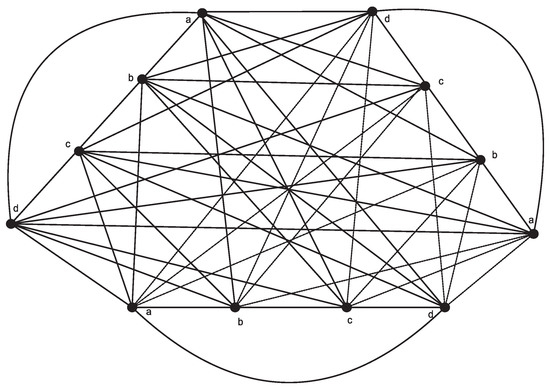
Figure 1.
.
The join of two graphs G and H, denoted as , is obtained by taking G and H, and adding edges between every vertex of G to every vertex of H. Let G and H be two graphs with m and n vertices respectively. can be obtained from G by substituting a copy of H for every vertex u of G and then joining all vertices h of with all vertices of if and . The maximum degree (of this graph) is . It is easy to see that .
Theorem 4.
For any total colorable graph G, is total colorable.
Proof.
The graph [14]. Denote the two copies of G by and . The maximum degree of is , where n is the order of G. Color the elements (vertices and edges) of using colors . Assign n new colors to the vertices of and color the edges of as the edge coloring of . Here, the corresponding vertices in and have common missing colors from . Now, assign a common missing color to the edges (all edges together give one 1-factor of ) between the corresponding vertices. At each vertex in , there are available colors among the n vertex colors and using these available colors we color the remaining join edges between and . □
The above theorem can be extended to any bipartite graph.
Corollary 1.
Let G be a bipartite graph and H be a total colorable graph then is total colorable.
Proof.
Let us consider the graph , where G is bipartite. Let X and Y be the two vertex partitions of G. Color all the elements of the layer for all as and all the elements of for all as . Please note that all the vertices of are properly colored.
Since G is bipartite, the edges of G can be colored with colors. Moreover, in any edge coloring of G with colors each major vertex (vertex with maximum degree) is incident with an edge of each color. Consider the set F of all edges of G of an arbitrary fixed color. For each edge color the edges between and in as in .
So far, copies of and the remaining layers are colored in using at most colors. The uncolored edges induce a bipartite graph of maximum degree which implies that they can be colored with this number of additional colors. Hence . Therefore TCC holds for . □
The above theorem and corollary can be extended to deleted lexicographic product. In the following theorem, we prove the total coloring conjecture for deleted lexicographic product of two large classes of graphs.
Theorem 5.
For any class-I graph G and a graph H with at least 3 vertices, is total colorable. In particular, if H is class-I then is also type-I.
Proof.
Let H be a graph with n vertices, . The maximum degree of is . Assign colors to the edges and n colors to all the vertices of all the copies of H. Now, each edge in G gives a set of join edges between the copies and . Since G is class-I graph, the edges are partitioned into independent sets. Correspondingly, the join edges between the copies of H are partitioned into sets .
Since , there are available colors at each vertex in each copy of H. Using these available colors we color the join edges in and using the remaining unused colors, we color the join edges in the remaining partitions. This is same as problem of finding a perfect rainbow matching in [20]. Therefore we used colors for the total coloring of . Hence satisfy the TCC.
If H is class-I then assign colors to the edges in all the copies of H and remaining elements are colored as in above. Therefore is type-I. □
We know that any bipartite graph is class-I and any regular graph with even order is also class-I. Based on these facts, we have the following two corollaries.
Corollary 2.
For any bipartite graph G and a graph H with at least 3 vertices, is total colorable. In particular, if H is class-I then is type-I.
Corollary 3.
If G is a regular graph with even order and H is any graph with at least 3 vertices then is total colorable. In particular, if H is class-I then is type-I.
In Theorem 5, we can obtain the tight bound for certain classes of G. For example, it is easy to see that is type-I graph. Also, in Theorem 5 either G or H must have at least three vertices. For example, we know that is class-I graph and and is type-II (see Theorem 2).
There are classes of graphs G and H such that may be type-II. For example, consider the graph , , , where F is the one factor . Here the maximum degree is . Vertices in each cycles are colored with colors and the join edges are colored with the same colors with a proper permuation of colors. Also, the edge colorings of any odd cycle requires 3 colors. Therefore colors are not sufficient to color the elements of . Hence is type-II.
It is easy to prove that is type-I since the edge colorings of any even cycle requires only 2 colors. In the following theorem, we prove that is type-I for any graph H.
Theorem 6.
For any graph H, , is type-I.
Proof.
The assertion is obvious if H has at most 2 vertices. If then the graph is empty, if the graph is , and if then the graph is a ladder graph. Hence let H be a graph with n vertices, . Here, . We know that is class-I graph. Suppose H is class-I then from the Theorem 5 is type-I.
Suppose H is class-II then assign colors to all the edges of odd copies of H and assign n colors to all the vertices in all copies of H. Permute the edge colorings of the odd copies and assign to even copies of H. Now, we can find a one to one mapping between the vertices of odd and even copies such that the mapping vertices have a same missing color. We assign these missing colors to the mapping edges. Still there are unused colors. Using these unused colors and missing colors we color the edges between odd and even copies of H. Since the vertices are colored with n colors, , at each vertex there are colors available and using these available colors we color the join edges between even and odd copies of H. Hence we used . □
Note: The above theorem is also holds good if we replace the path with any even cycles. Consider the two graphs G and H with m and n vertices respectively. If has a total coloring with colors such that the vertices of each copy are colored pairwise distinctly and is total colorable. This can be proved very easily. , where denotes the edges in the m copies of H. Color all the edges in m copies of H with colors and color all the elements of with colors. This will give a total coloring of .
3. Line Graphs and Double Graphs
A graph G is said to be claw-free if it does not contain an induced subgraph that is isomorphic to . There are several well-known and important families of graphs that are also claw-free [21]. We consider classes of claw-free graphs, Line graphs is classes of claw-free graphs. Many characterizations of claw-free graphs where given in [21]. There are several well-known and important families of graphs that are also claw-free. Complement of triangle-free graphs, Inflation of a graph, Comparability graphs, Generalized line graphs. In this section, we considered one classes of claw-free graphs.
Line Graphs
The line graph of G, denoted by , has the set as its vertex set and two distinct vertices are adjacent if and only if they share a common vertex in G. Characterization of line graphs are given in [22] including a forbidden subgraph characterization. Figure 2 shows the line graph of and a total coloring with 5 colors. The following are easy observations: (i). We know that the line graph of a path of length m is again a path of length and the line graph of a cycle is again a cycle of the same length. Therefore, it is easy to find the total chromatic number for and (see Theorem 2). (ii). A complete bipartite graph is not always type-I (see Theorem 3). We know that and is type-I if n and m are even and (mod 4) or (mod 4) and is type-II if m is even and n is odd and [23,24]. The TCC is open for other cases.
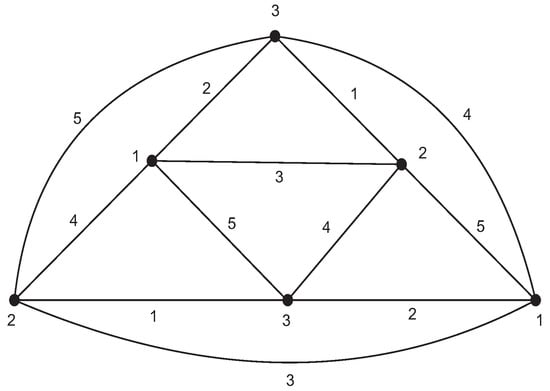
Figure 2.
.
Theorem 7.
For , .
Proof.
For , and . And , , .
Also, . The total coloring of is given in Figure 2. □
From the Theorem 1, we know that is type-I if n is odd and it is type-II if n is even. We believe that is always type-I. In this regard, we proposed the following conjecture.
Conjecture: For any complete graph , .
The double graph of a given graph G is constructed by making two copies of G (including the initial edge set of each) and adding edges and for every edge of G. Munarini et al. [25] studied various properties of double graphs.
Theorem 8.
For any total colorable graph G,
Proof.
Here, .
Suppose G is type I.
Color the elements of two copies of G using colors. The two vertices in are adjacent only if the corresponding vertices are adjacent in G. The remaining uncolored edges in will form matchings, these edges can be colored with additional colors since they induce a bipartite graph with partition sets corresponding to the vertex sets of the two copies of G.
Suppose G is type II.
Color the elements of two copies of G using colors. Again the remaining uncolored edges will form matchings. In this coloring assignment, two adjacent vertices in will receive different vertex colors. We color the remaining edges using addtional colors.
Hence the proof. □
Author Contributions
Conceptualization, R.V., J.G. and K.S.; Methodology, R.V., J.G. and K.S.; Software, R.V.; Validation, R.V., J.G. and K.S.; Formal Analysis, R.V., J.G. and K.S; Investigation, R.V., J.G. and K.S; Resources, J.G. and K.S.; Writing—Original Draft Preparation, R.V., J.G. and K.S.; Writing—Review & Editing, R.V., J.G. and K.S.; Visualization, R.V., J.G. and K.S.; Supervision, J.G. and K.S.; Project Administration, K.S.; Funding Acquisition, K.S.
Funding
This research work is supported by SERB-DST (Grant SR/S4/MS: 867/14).
Acknowledgments
We are grateful to the reviewers for their valuable and helpful comments which lead to the improvement of this paper.
Conflicts of Interest
The authors declare no conflict of interest.
References
- Behzad, M. Graphs and Their Chromatic Numbers. Ph.D. Thesis, Michigan State University, East Lansing, MI, USA, 1965. [Google Scholar]
- Behzad, M. The Total Chromatic Number, Combinatorial Mathematics and Its Applications. In Combinatorial Mathematics and Its Applications: Proceedings of a Conference Held at the Mathematical Institute, Oxford, 7–10 July 1969; Academic Press: London, UK, 1971; pp. 1–8. [Google Scholar]
- Vizing, V.G. Some unsolved problems in graph theory. Uspekhi Mat. Nauk. 1968, 23, 117–134. (In Russian) [Google Scholar] [CrossRef]
- McDiarmid, C.J.; Sánchez-Arroyo, A. Total Coloring regular bipartite graphs is NP-hard. Discret. Math. 1994, 124, 155–162. [Google Scholar] [CrossRef]
- Sabidussi, G. Graph Multiplication. Math. Z. 1960, 72, 446–457. [Google Scholar] [CrossRef]
- Vizing, V.G. The Cartesian product of graphs. Vyc. Sis. 1963, 9, 30–43. [Google Scholar]
- Seoud, M.A. Total chromatic number. Appl. Math. Lett. 1992, 5, 37–39. [Google Scholar] [CrossRef]
- Seoud, M.A. Total colorings of Cartesian products. Int. J. Math. Educ. Sci. Technol. 1997, 28, 481–487. [Google Scholar] [CrossRef]
- Campos, C.N.; de Mollo, C.P. The total chromatic number of some bipartite graphs. Electron. Notes Discret. Math. 2005, 22, 551–561. [Google Scholar] [CrossRef]
- Tong, C.; Lin, X.; Yang, Y.; Li, Z. Equitable total coloring of Cn☐Cm. Discret. Appl. Math. 2009, 157, 596–601. [Google Scholar] [CrossRef]
- Pranavar, K.; Zmazek, B. On total chromatic number of direct product graphs. J. Appl. Math. Comput. 2010, 33, 449–457. [Google Scholar] [CrossRef]
- Geetha, J.; Somasundaram, K. Total coloring of generalized sierpiński graphs. Aust. J. Comb. 2015, 63, 58–69. [Google Scholar]
- Formanowicz, P.; Tanas, K. A survey of graph coloring—Its types, methods and applications. Found. Comput. Decis. Sci. 2012, 37, 223–238. [Google Scholar] [CrossRef]
- Geetha, J.; Somasundaram, K. Total Colorings of Product Graphs. Graphs Comb. 2018, 34, 339–347. [Google Scholar] [CrossRef]
- Mohan, S.; Geetha, J.; Somasundaram, K. Total coloring of the corona product of two graphs. Aust. J. Comb. 2017, 68, 15–22. [Google Scholar]
- Mohan, S.; Geetha, J.; Somasundaram, K. Total Coloring of Certain Classes of Product Graphs. Electron. Notes Discret. Math. 2016, 53, 173–180. [Google Scholar] [CrossRef]
- Yap, H.P. Total Colourings of Graphs. In Lecture Notes in Mathematics; Springer: Berlin, Germany, 1996; Volume 1623. [Google Scholar]
- Imrich, W.; Klavžar, S. Product Graphs: Structure and Recognition; Wiley: New York, NY, USA, 2000. [Google Scholar]
- Miklavič, Š.; Milanič, M. Equistable graphs, general partition graphs, triangle graphs, and graph products. Discr. Appl. Math. 2011, 159, 1148–1159. [Google Scholar] [CrossRef]
- LeSaulnier, T.D.; Stocker, C.; Wenger, P.S.; West, D.B. Rainbow Matching in Edge-Colored Graphs. Electron. J. Comb. 2010, 17, 26. [Google Scholar]
- Faudree, R.; Flandrin, E.; Ryjáčck, Z. Claw-free graphs—A survey. Discret. Math. 1997, 164, 87–147. [Google Scholar] [CrossRef]
- Beineke, L. Derived graphs and digraphs. In Beitra¨ge zur Graphentheorie; Sachs, H., Voss, H., Walther, H., Eds.; Teubner: Leipzig, Germany, 1968; pp. 17–33. [Google Scholar]
- Baril, J.L.; Kheddouci, H.; Togni, O. Vertex Distinguishing Edge- and Total-Colorings of Cartesian and other Product Graphs. Ars Comb. 2012, 107, 109–127. [Google Scholar]
- Kemnitz, A.; Marangio, M. Total Colorings of Cartesian Products of Graphs. Congr. Numer. 2003, 165, 99–109. [Google Scholar]
- Munarini, E.; Perelli Cippo, C.; Scagliola, A.; Zagaglia Salvi, N. Double graphs. Discret. Math. 2008, 308, 242–254. [Google Scholar] [CrossRef]
© 2018 by the authors. Licensee MDPI, Basel, Switzerland. This article is an open access article distributed under the terms and conditions of the Creative Commons Attribution (CC BY) license (http://creativecommons.org/licenses/by/4.0/).